The New York Times’ Latest Smear Piece Against Tucker Shows That Liberals Have Lost The Plot
BY ANDREW KORYBKO | JULY 16, 2023
The New York Times’ (NYT) Jonathan Weisman lost the plot in the article that he wrote in response to Tucker Carlson asking Republican presidential candidates about Ukraine. Titled “Tucker Carlson Turns a Christian Presidential Forum Into a Putin Showcase”, this self-described “veteran journalist” wanted to manipulate his audience’s perceptions about his much more popular peer by getting them to think that he’s shilling for the Russian leader. Instead, Weisman came off as cringey, desperate, and hateful.
Right at the start, the NYT’s correspondent declared that “Jesus is out. Vladimir V. Putin is in”, which was meant to make it seem like the Christians at Friday’s Family Leadership conference in Des Moise abandoned their god for a false idol. Nobody who sincerely respects Christians would ever imply what Weisman just did, which suggests that he was so triggered by Tucker’s questions about Ukraine that he lost his cool by attacking all of his target’s fellow believers as a form of collective punishment.
This wouldn’t be the first time that he couldn’t control his emotions either since he was demoted in August 2019 after an ethno-misogynist bigotry scandal that he sparked on social media. Weisman therefore has a track record of lashing out against certain identity groups in response to being offended by something that one of their representatives said or did, which extends credence to the abovementioned interpretation of what he intended to convey in that particular passage of his article.
Moving along, Weisman described Tucker as “confrontational” for reacting to former Vice President Mike Pence’s criticism of the Biden Administration’s supposedly slow dispatch of military aid to Ukraine after he wondered aloud why that Republican presidential candidate is so distressed about this. There’s nothing “confrontational” in asking why a person running for the country’s top office cares more about a foreign country than their own, however, which is another example of Weisman’s false framing.
The next one came right after when he wrote that “For good measure, Mr. Carlson called Ukraine an American ‘client state,’ accused Ukraine’s Jewish leader, Volodymyr Zelensky, of persecuting Christians and strongly indicated Mr. Pence had been conned, despite evidence to the contrary.” Weisman wanted his audience to think that Tucker was just peddling conspiracy theories, but the reality is that it’s this NYT correspondent who was yet again attempting to manipulate his audience by falsely framing everything.
To debunk each of his points in the order that they were shared: 1) Ukraine’s top commander Valery Zaluzhny complained to the Washington Post on the same day as Weisman’s article that Kiev’s allies have placed conditions on the use of the weapons they’ve provided; 2) Kiev is cracking down against the Ukrainian Orthodox Church (UOC) on the pretext that it’s a ‘fifth column’; and 3) Zelensky’s former advisor Alexey Arestovich recently admitted that Ukraine only has “emotional” influence over the West.
Expanding on the above: 1) No truly sovereign state would ever accept anyone telling them what they can do with weapons in the hands of their own soldiers; 2) Pope Francis’ and the UN’s public expressions of concern over this crackdown prove that it’s not just the Kremlin that’s critical of Kiev’s campaign against the UOC; and 3) Arestovich, who can’t credibly be described as a so-called “Russian agent”, has a solid point about the means that Ukraine employs to manipulate Western perceptions about the conflict.
It should also be said that Weisman’s reference to Zelensky’s Jewish faith doesn’t discredit Pope Francis’ and the UN’s concern about Kiev’s latest campaign against a particular Christian community, which is being carried out for Russophobic reasons, not any other ones. In fact, drawing attention to the Ukrainian leader’s religion risks being interpreted by anti-Semites as a dog whistle prompting them to remind everyone that local Jews were responsible for the Romans putting Jesus to death.
This observation is tragically ironic since Weisman’s brief NYT bio mentions that he’s the author of “(((Semitism))): Being Jewish in America in the Age of Trump”, which warns about what he claims is the revival of anti-Semitism in the US. He previously told NPR that he was inspired to write it after being viciously trolled by fascists on Twitter, yet now he might have just unwittingly provoked them into more online hatemongering after falsely implying that Zelensky’s faith means that Kiev can’t be anti-Christian.
Nobody’s identity immunizes them from being bigoted towards anyone else, which Weisman himself knows for a fact as proven by his previously cited ethno-misogynist bigotry scandal. Likewise, Zelensky’s Jewish faith is irrelevant to his regime’s anti-Christian policies, just like any particular aspect of an anti-Semite’s identity is irrelevant to their hatred of Jews. Had Weisman not been so triggered by Tucker getting Pence to discredit himself before voters, then he’d likely never have suggested otherwise.
His train wreck of an article then continued after he declined to address the indisputable fact brought up by his much more popular peer in his question to Senator Tim Scott about why he cares more about dead Ukrainians than about his own fellow Americans who are killed by fentanyl from Mexico. All that Weisman could muster in response was to describe Tucker’s question as “a signature dismissive response”, which was actually another example of he himself attempting to dismiss Tucker’s valid point.
He then tries to explain away his efforts thus far to manipulate his audience’s perceptions by writing that “The divide in the Republican Party between traditional conservatives who favor the projection of American military might and a new, more isolationist wing that leans toward Russia is nothing new. But the Family Leadership Summit was supposed to be a showcase of Christian values, where social issues like abortion and transgender rights were expected to be center stage.”
What Weisman either can’t countenance due to his hardcore liberal bias or is too dishonest to openly admit is that Tucker’s questions about Ukraine are inextricably connected to Christian values from the Republican base’s perspective. As they see it, pumping a country with tens of billions of dollars’ worth of taxpayer-provided weapons to fight a proxy war that’s impossible for their side to win perpetuates the internecine slaughter of tens of thousands of fellow believers, which is anti-Christian to the core.
While he has the right to see things differently, it was extremely disrespectful for him to mock Christians in the way that he did in his response to Tucker, which shows that Weisman was once again unable to remain calm after being triggered by a contrarian opinion. The NYT’s editors should have caught his thinly disguised attack against that entire religious community, especially considering his earlier bigotry scandal, but it’s likely that they agree with him and that’s why they declined to remove that part.
The takeaway is that liberals have lost the plot now that they’re attacking Christians like Weisman just did in his piece for the NYT after one the world’s most popular journalists questioned Republican presidential candidates about their support for NATO’s proxy war on Russia in Ukraine. They can’t accept that Kiev’s counteroffensive failed and peace talks will thus likely resume by year’s end since it goes against their ideology, which is why they’re attacking an entire religion out of cognitive dissonance.
Russian forces ruin one-third of Ukraine’s Bradleys – media
RT | July 16, 2023
The vaunted Bradley Fighting Vehicle (BFV), which was touted as a potential “game-changer” when Washington agreed to give dozens of the machines to Ukraine earlier this year, has reportedly had trouble staying in action amid fierce resistance from Russian forces during Kiev’s counteroffensive.
At least 34 Bradleys “have now been visually confirmed as having been abandoned, damaged or destroyed,” Business Insider reported on Saturday, citing “open-source” data from military research firm Oryx. The US has supplied as many as 109 BFVs to Ukraine, the outlet added, and they were first deployed on the battlefield in April.
Most of the losses occurred during the early days of the counteroffensive, which began last month, as Ukrainian forces tried to cross territory that was heavily mined by Russian troops, Business Insider said. The latest loss estimate was similar to that in a report on Saturday by the New York Times, which said Ukraine’s NATO-trained 47th Mechanized Brigade had lost 30% of its Bradleys in just two weeks.
The BFV is a tracked and lightly armored vehicle with the capability to transport about ten soldiers and mount weaponry such as a 25mm cannon and a TOW anti-tank missile launcher.
When the administration of President Joe Biden agreed in January to send BFVs to Kiev, the Pentagon touted the vehicles as “tank-killers” and claimed they would provide “a level of firepower and armor that will bring advantages on the battlefield.” US media outlets such as Newsweek cited military experts as saying the Bradleys “could become a game-changer,” potentially even enabling Ukraine to retake Crimea. Russian officials warned that the BFVs and other Western-supplied weaponry would “only prolong the suffering of the Ukrainian people.”
With dozens of Bradleys and other hardware being knocked out of action by Russian forces, Ukrainian units have been forced to abandon their armored vehicles and advance slowly on foot, the Washington Post reported on Saturday. “You can no longer do anything with just a tank with some armor because the minefield is too deep, and sooner or later, it will stop, and then it will be destroyed by concentrated fire,” Ukraine’s top general, Valery Zaluzhny, told the newspaper.
Nevertheless, a new $800 military aid package for Ukraine announced by the Biden administration earlier this month includes an additional 32 BFVs. The US also agreed to send cluster bombs to Kiev, citing disappointment with the counteroffensive.
Russian President Vladimir Putin has warned that US shipments of cluster munitions to Ukraine would constitute a war crime. As for captured Western weaponry, such as BFVs, Russian specialists will use “reverse engineering” to adopt any military technology that might be useful to Moscow, Putin said in an interview aired on Sunday.
What is behind the current tension in Turkish-Iranian relations?
By Alexandr Svaranc – New Eastern Outlook – 16.07.2023
Turkey and Iran continue to be important Middle Eastern nations. Due to their geographical proximity, imperial past, violent rivalry, theological tensions (between Sunnism and Shiism), and, of course, the continuous divergence of geopolitical interests, both nations have a rich history of relations.
There were multiple Turkish-Persian clashes and wars, with various interruptions and varying degrees of success, during the Ottoman and Persian empires. Regarding the significance of the harem in the Ottoman Empire, historians have observed that, unlike the Turkish-Persian conflicts, which occasionally came to an end during periods of truce, the harem wars continued unabatedly. The reasons for these wars were varied, with religion often becoming a justification for the ambitions of Istanbul or Tehran. As a rule, it was a struggle for the right to own border territories from the Caucasus to Asia Minor, for the right to control strategic trade and military communications (for example, the area between Tigris and Euphrates, Eastern or Western Armenia and Syria).
In fact, such a confrontation lasted from the Middle Ages until World War I. The long military and political conflict between the Persians and Turks in such important regions, where the interests of the leading powers of Europe and Russia were represented, led to the establishment of a special international border commission with the participation of Britain and Russia at the turn of the twentieth century to facilitate the delimitation of Persia and the Ottoman Empire. But because London and St. Petersburg had their own distinct interests in the Near and Middle East, this commission never accomplished its mission.
There were also more stable times between Iran and Turkey in the new era. After World War II, from 1955 to 1979, Tehran and Ankara became even politico-military allies in the CENTO (Central Treaty Organization or Baghdad Pact) regional bloc, which emerged thanks to the Middle East diplomacy of Britain and the United States. While the Shah’s regime in Iran remained an ally of the West and Iranian oil and gas were exploited in the interests of London and Washington, Tehran was a regional partner of NATO member Turkey.
The situation changed after the February 1979 revolution in Iran, as the overthrow of the pro-American Shah’s regime and the ascension to power of the Shiite mullocracy brought about a major change in the disposition of forces in the Middle East. Since then, there have been renewed notes of mistrust and tension in Iranian-Turkish relations across the Middle East and global agenda, some of which remain relevant to this day.
It cannot be said that pragmatism in the approaches of Turkey and Iran has lost importance after the overthrow of Shah Reza Pahlavi. Despite harsh anti-Iranian sanctions, Ankara was forced to retain trading with Iran and keeps shipping gas in varying volumes due to its limited own energy supplies.
With the change of political regime in Iran after the 1979 revolution in Kemalist Turkey, where the secular regime suppressed the sprouts of Islamic revival, the politicization of Islam (albeit of Shiite origin) in the 1980s and 1990s still influenced the public consciousness of the Turkish masses in favor of the growing role of religion in the state.
The Kurdish issue remains a common concern between Turkey and Iran. Ankara and Tehran oppose all forms of Kurdish statehood and threats of ethnic separatism. However, in the situation of the Kurds after the 1979 Islamic Revolution in Iran there have been some changes. Some experts believe, not unreasonably, that the phenomenon of the Shiite revolution in February 1979 has both external and internal justifications.
The external reason was to prevent the leading Anglo-Saxon countries (the US and Britain) from monopolizing and plundering Iran’s strategic resources (oil and gas), as well as to prevent the corrosive influence of Western pop culture on the minds of Iranian youth and the general population. The internal reason, however, was related to the idea of preventing the weakening and collapse of Persian statehood under the threat of ethnic separatism with different colors (Kurds, Azeris, Baluchis). At the same time, Islam, namely political Shiism, assumed the religious consolidation of Iranian society regardless of ethnic origin.
Following the revolution’s victory, Iranian leader Ayatollah Khomeini summoned Mustafa Barzani, the leader of Iraq’s Kurdistan Region, then in exile, to Tehran for a final settlement of the Kurdish crisis on an Islamic basis. According to some reports, such an agreement was accepted by a Kurdish politician, but he never made it to Tehran. CIA handlers then announced an emergency surgery on Mustafa Barzani, but the surgery ended in his death.
The main contradictions between Tehran and Ankara include Turkey’s continued membership in NATO and Shiite-Sunni religious differences between different madhhabs. At the same time, as key countries in the Middle East region, it is natural that Turkey and Iran have different approaches on a number of regional topics (including the Syrian crisis, the situation in Libya and Iraq, and the relationship with Pakistan). The adjacent territories of the South Caucasus and Central Asia occupy a distinctive place in this package of contradictions following the breakup of the Soviet Union and the parade of sovereignties of post-Soviet states.
First, Iran is concerned about the renaissance of Turkey’s pan-Turkic and pan-Turanist ambitions toward the Turkic countries of the CIS, which could seriously weaken Iran’s position if the Turan project succeeds.
Second, Tehran watches with great caution the geo-economic projects in the Caspian energy region, which with the collapse of the Soviet Union and the weakening of Russia got a start and developed thanks to the joint initiatives of Turkey and its NATO allies (primarily, the UK and the US). At the same time, this concern of the Persian state is determined not only, or rather, not so much by the considerations of the new direction of oil and gas exports to Turkey as by Ankara’s plans to create alternative energy transit routes bypassing Russia and Iran to bring exporters from Turkic countries to world markets (especially to Europe) and turn the Turkish territory into a major hub. In other words, Iran, as an oil and gas-rich country, is concerned about the geopolitical consequences of transformations in the South Caucasus and Central Asia in favor of the strengthening of Turkey, the United States and Britain.
Third, taking into account the Turkish-Azerbaijani tandem that has formed on Iran’s northern borders, Tehran is anxiously observing the trend of Israel showing up along the Iranian-Azerbaijani border line on the Arax River, the increased intelligence presence of the Mossad and Aman in the same Azerbaijan with the approval of NATO member Turkey.
Fourth, there is now a certain geopolitical rivalry between Turkey and Iran, with a religious connotation in as yet predominantly Shiite Azerbaijan. Given that the Azerbaijani authorities have based their relations with Turkey on the pan-Turkic slogan and the principle of “one nation, two states,” Iran notes the active political persecution of Azerbaijani Shiites (including often with accusations of spying for IRI) by Baku. Moreover, IRGC sources in Azerbaijan note an increasing number of cases of religious interference by Turkey in the Sunnization of Azerbaijani Shiites. Tehran sees all these actions as an attempt by Ankara to weaken the influence of Shiite Iran in this Transcaucasian republic.
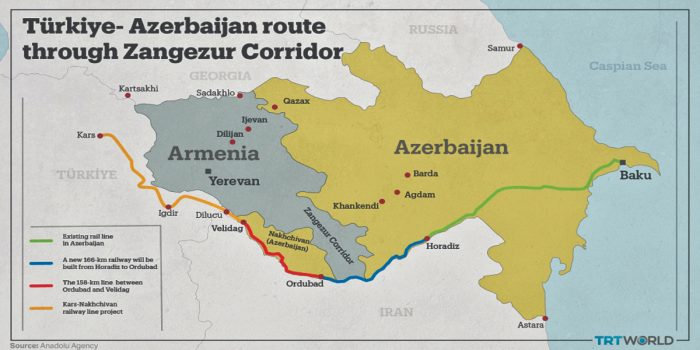
After Recep Tayyip Erdoğan’s victory in the elections and his visit to Baku, assessing the situation with the Zangezur corridor in Armenia, the Turkish leader, not by chance, stressed that the main reason for blocking this corridor was not Yerevan, but Tehran. Iran indeed publicly through the mouths of Ayatollah Ali Khomenei, President Ibrahim Raisi and Foreign Minister Hossein Amir Abdollahian has repeatedly noted that for it the Zangezur corridor remains a “red line,” it is unacceptable to change the borders of neighboring republics of the South Caucasus (in particular, Armenia) and it is important to maintain the direct multi-millenial border of Iran with Armenia.
Tehran does not want NATO to strengthen in the region on the shoulders of its member Turkey, nor does it want to see the Turan project implemented with pan-Turkic content. Otherwise, Iran will be blocked by unfriendly forces on its northern borders, including the emergence of a bridgehead of Zionist Israel on the banks of the Arax River.
With his statement, Erdoğan not only expresses his dissatisfaction with the regional policy of Iran that three Muslim states (Turkey, Azerbaijan, and Iran) through the fault of Persians can’t solve the road question peacefully and get economic dividends but actually says that Iran is not allowing the Turkish-Azerbaijani tandem to start a war with Armenia again and take by force the Meghri segment of the Zangezur corridor (if not all of Zangezur – Syunik Province) from the latter.
Given that Russia is now forced to engage in the western flank of the geopolitical confrontation with the West in Ukraine and is therefore interested in maintaining a partnership with Turkey for the same transit and out into the world, it cannot strain relations with Ankara in Armenia (Transcaucasus). Iran becomes the main opponent of Turkey in this theater.
In the second half of June 2023, Turkey and Azerbaijan announced the formation of a unified system of control and management of airspace from the Aegean Sea to the Caspian Sea according to NATO standards (the Turkish HAKİM Air Command Control System). The latter is practically capable of establishing airspace control in the South Caucasus region and threatening not only Armenia but also Iran. Given the existence of a common air defense system between Armenia and Russia within the CSTO, such a move by the tandem of Ankara and Baku is in some ways a challenge for Russia’s regional interests as well.
Since the beginning of 2023, trade turnover between Iran and Turkey has decreased by 20%, where the main export commodity for the Turkish side remains gas. Apparently, such a decline in economic relations between these countries was the result of a number of objective and subjective reasons (such as the crisis in the energy market due to anti-Russian sanctions and rising prices, the earthquake and rising inflation in Turkey, the devaluation of the Turkish lira, and Ankara’s pressure on the issue of the Zangezur corridor). In response to Moscow’s proposal to create a gas hub in Turkey, Iran came up with an equally ambitious similar project in the Persian Gulf. All these processes testify to the growing Iranian-Turkish contradictions.
Moreover, the information about the ongoing closed-door talks between Iran and the USA on the subject of the deblocking of Iranian assets in exchange for American prisoners and, most importantly, about the end of the “tanker war” between Tehran and Washington in the waters of the Strait of Hormuz and the Gulf of Oman and the export of Iranian oil to world markets (as we know, in the USA itself there is a rise in gasoline prices and an increasing need for oil) creates additional tension in Turkish politics as well.
The US is not yet interested in the implementation of alternative communications from China to Europe through the territory of Turkey (under the One Belt, One Road Initiative). Perhaps Washington is proposing an Indian project through Iran to Europe as an alternative to Chinese transit. And in this geographic preference of the states, a new confrontation between Iran and Turkey is created.
Accordingly, if Iran develops strategic partnerships with countries such as China and India, and can establish certain relationships with the US administration on the nuclear program and oil exports, Turkey will find it difficult to count on success in a battle with Tehran. Moreover, today’s Iranian authorities are interested in strengthening President Erdoğan’s policy independent of the United States, which makes it possible to weaken Washington’s pressure on the region. These are the complicated patterns of the contemporary geopolitical mosaic in the Greater Middle East.
Aleksandr SVARANTS, PhD in political science, professor.
Russia Could Reverse Engineer Its Trophy NATO Weapons – Putin
By Ilya Tsukanov – Sputnik – 16.07.2023
The Western alliance has sunk tens of billions of dollars’ worth of weaponry into Ukraine over the past year, including everything from outdated 1960s junk to the latest high-tech systems. Russian forces have managed to capture some of this equipment in fierce battles with Ukrainian forces and mercs.
Russian President Vladimir Putin doesn’t rule out the reverse engineering of NATO equipment captured in Ukraine in cases where doing so could improve Russia’s own weapons.
“There’s the expression ‘reverse engineering’. We’ll see what happens, because modern equipment… we have it, and it’s very effective, let’s take the T-90 Proryv tank for example, which is the best tank in the world without any exaggeration. But the enemy also produces modern equipment. And if there’s an opportunity to look inside and see if there’s something there that we can use, well, why not?” Putin said in an interview with Russian television on Sunday.
The United States and its European and Asian allies have committed over $94.5 billion in military aid to Ukraine over the past 18 months, far outstripping the size of Russia’s entire defense budget of $56.6 billion. These expenditures, which included the delivery of some of NATO’s most cutting-edge, battle-tested equipment, have nevertheless failed to enable Ukrainian forces to puncture Russian defensive lines in the Donbass, Zaporozhye and Kherson.
NATO powers have committed everything from Leopard 2 tanks (including some of their latest modifications) to Bradley infantry fighting vehicles, Stryker armored fighting vehicles, ATACMS rocket launchers, Caesar howitzers, Storm Shadow cruise missiles, NASAMS and Patriot air defense systems, with some countries sending virtually their entire stockpiles of some of these weapons. NATO has also sent a range of modern man-portable weapons, including Panzerfaust and Javelin anti-tank missiles, Stinger anti-aircraft missiles, and a range of drones, jamming equipment, radar, engineering and other equipment.
Some of these weapons, including everything from Javelins and Stingers to Bradleys and Leopards, have been captured by Russian forces, with some equipment now serving with Russian forces.
The Incredible Shrinking NATO
By Dmitry Orlov | July 15, 2023
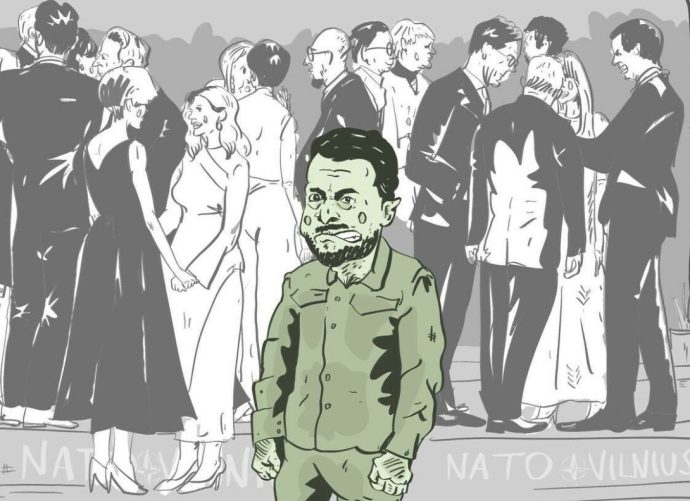
I’ve been waiting for the hubbub to die down since the NATO conference in Vilnius, Lithuania, on 11-12 July 2023, waiting for someone — anyone — to point out the obvious reason for why the Ukraine’s cocaine-sniffing mascot-president Zelensky, having been lionized only a year ago, has suddenly fallen into disfavor with this organization. Yes, the Ukraine might still some day be invited to start the long and arduous process of joining NATO, but only after some undefined number of NATO members decide that it has done enough to comply with “NATO standards” (I’ll explain what those are later) and various other vague things. Keeping in mind that back on 20 September 2018 the Ukrainian parliament approved amendments to the constitution that would make the accession of the country to NATO and the EU a central goal and the main foreign policy objective, such a turn of events is most embarrassing for the mascot president and his backers and handlers.
Oh, the vicissitudes of fortune! Lots of analysis and commentators offered ready explanations for this turn of events. Yet not a single one of them saw it fit to dig just the tiniest bit and discover the glaringly obvious reason for this momentous shift. Perhaps all of them, for a variety of reasons, loathe to admit the reality of what NATO is, what it does, and why the Ukraine is suddenly a threat rather than a boon to its core mission. You may want to read all of that commentary at your leisure — if you have trouble falling asleep. The official NATO Summit Communiqué, fantastically verbose and filled with irrelevancies, makes for particularly somniferous reading.
So, what did the Ukraine do to fall into such disfavor? Perhaps it did something that jeopardized NATO’s core mission? That seems like a good guess. But then what is NATO’s core mission?
In the movie “Silence of the Lambs,” Hannibal Lecter refers to a quote by Marcus Aurelius when he says to Clarice Starling, “First principles, Clarice. Simplicity. Read Marcus Aurelius. Of each particular thing ask: what is it in itself? What is its nature?” The quote is from Book Three of “Meditations” by Marcus Aurelius, and it emphasizes the importance of understanding the essence of things.
NATO was formed on 4 April 1949 with the signing of the North Atlantic Treaty, more popularly known as the Washington Treaty, supposedly for the purpose of thwarting the Soviet Union in Europe. The USSR responded by forming the Warsaw Treaty Organization (also known as the Warsaw Pact) — a political and military alliance established on May 14, 1955 between the Soviet Union and several Eastern European countries for the express purpose of defending them from NATO. The Warsaw Pact was dissolved on 1 July 1991 and, shortly thereafter, on 26 December 1991, the USSR itself followed suit, but NATO continues to exist. By this point, the Warsaw Pact had existed for slightly less than NATO has existed, and the USSR had existed for only slightly more than that. Clearly, the communist threat as a rationale for NATO’s existence was but a ruse, a smokescreen… a red herring.
So, what was NATO’s real purpose? There are many ways to answer this question, but the Ukraine’s sudden fall from grace offers what is perhaps the most graphic explanation.
• Was it that the war there was dragging on? No, a slow burn would be exactly what the Pentagon ordered, so that it would have a chance to keep up with Russia’s hectic pace of weapons and ammunition deliveries.
• Was it that the Ukraine was losing the war? No, the Ukraine wasn’t losing; it just wasn’t winning. In particular, its attacks on Russia’s defensive lines, which the Russian troops termed “meat attacks” because of the huge and useless losses they incurred on the Ukrainian side, seemed rather futile.
• Was it that the Ukraine was about to be defeated? Again, no, the Russians were happy to advance a few kilometers here and there, with their main objective the establishment of a buffer zone wide enough so that Ukrainian artillery would stop shelling what are now Russian civilian districts.
• Was it that NATO ran out of weapons and ammo to give to the Ukrainians? Again, no, there is still quite a lot of semi-obsolete junk that could be handed over to the Ukrainians.
So, what did the Ukrainians do to raise the ire of the Pentagon so suddenly, and as a direct consequence, fall into disfavor with NATO? In short, the Ukrainians demonstrated that NATO’s weapons are crap. Evidence of this built up slowly over time. First, it turned out that various bits of US-made shoulder-fired junk — anti-aircraft Stingers, anti-tank Javelins, etc — are rather worse than useless in modern combat. Next, it turned out that the M777 howitzer and the HIMARS rocket complex are rather fragile and aren’t field-maintainable.
The next wonder-weapon thrown at the Ukrainian problem was the Patriot missile battery. It was deployed near Kiev and the Russians quickly made a joke of it. They attacked it with their super-cheap Geranium 5 “flying moped” drones, causing it to turn on its active radar, thereby unmasking its position, and then fire off its entire load of rockets — a million dollars’ worth! — after which point it just sat there, unmasked and defenseless, and was taken out by a single Russian precision rocket strike.
This was sure to have seriously pissed off US Secretary of Defense Lloyd Austin, whose major personal cash cow happens to be Raytheon, the maker of the Patriot. Yes, the Patriot proved useless using the First Gulf War, where it failed to protect Israel against ancient Iraqi Scud missiles; and it proved useless later on when it failed to protect Saudi oil installation against ancient Yemeni Scud missiles… but you aren’t supposed to advertise that fact. And now this!
And to top it all off, the German-donated Leopard 2 tanks and the US-donated Bradley infantry vehicles, not to mention the silly French wheeled non-tanks, performed absolutely miserably during the recent Ukrainian efforts to approach, never mind penetrate, Russia’s first line of defense. Rubbing salt into the wounds, Putin remarked off-the-cuff that Western armor burns rather more easily than the old Soviet-made stuff.
The latest desperate move would be to give the Ukrainian air force (which, by the way, no longer exists) some older F-16 fighter jets. These can be anywhere up to 50 years old and are peculiar in having an air intake that’s very close to the ground, making them very effective as runway vacuum cleaners during takeoff. They cannot operate from the dirty and pitted runways that are typical in the Ukraine because the debris would get sucked into the engine and destroy it. If the Ukrainians attempt to pave new runways for them, the Russians would instantly spot this from the geosynchronous satellite that is permanently pointed at Ukrainian territory. Rather than put some fresh bomb craters on these new runways, they could do something more subtle: use one of their super-cheap Geranium 2’s to spread metal shaving for the F-16’s engines to vacuum up… and burn up in flight. And since these are single-engine planes, there is no possibility of limping home on the remaining engine: the pilot would have to catapult and the plane would crash. But there is an even more important reason why the idea of giving F-16’s for the Ukraine is unworkable: these planes are able to carry nuclear bombs and Russia has already announced that it would see this step as a nuclear escalation. But provoking a nuclear conflict with Russia is verboten, so F-16’s are a no-go.
Why is the failure of relentlessly propagandized Western weaponry more important than just about anything else, including the increasingly dire state of Western finances, the ridiculous failure of anti-Russian sanctions, the obscenely huge numbers of Ukrainian casualties or the general Western fatigue with all things Ukrainian and especially with the flood of Ukrainian refugees that the West can no longer cope with?
The reason is simple: NATO is not a defensive organization (remember, USSR has been gone for over 30 years); nor is it an offensive organization (well, it did bomb Serbia and a few other relatively defenseless countries, but it can’t possibly think about facing off against Russia or any other well-armed nation).
Rather, NATO is a captive buyers’ club for US-made weapons. That is what vaunted NATO standards, with which the Ukraine must comply before it is deemed worthy to be invited to join NATO, are all about: to comply with these standards, your weapons have to be mostly US-made. That is also the reason for all of the various wars of choice, from Serbia to Iraq to Afghanistan to Libya and Syria: these were demonstration projects for US weapons, with the additional goal of using up the weapons and the munitions so that the Pentagon and the rest of NATO would have to reorder them. The geopolitical rationales for these military conflicts are mere rationalizations. For instance, between 1964 and 1973, the U.S. dropped more than 2.5 million tons of bombs on Laos during 580,000 bombing sorties—equal to a planeload of bombs every eight minutes, 24 hours a day, for nine years. What was the geopolitical rationale? Nobody can even remember if there ever was one. But those bombs were about to expire and needed to be used up and reordered to keep the money flowing.
In response to such strange inducements, US-made weapons tend to be overly complex (so that their makers can charge more for the useless extra features) and rather fragile (never tested against a peer adversary like Russia or China, or even against Iran), developed slowly (to clean up on R&D funding), built slowly (because what’s the rush?) and very high-maintenance (so that US defense contractors can get even richer delivering spare parts and service). These weapons were supposed to be tested ever so gently by giving hell to backward tribesmen armed with old Kalashnikovs and RPGs.
Ukraine is a different story altogether. There, the Ukrainians, with their mismatched hand-me-down Western armor, are being asked to penetrate three lines of hardened Russian defenses. After about a month of effort and staggering losses of men and equipment, they haven’t yet been able to reach the first defensive line. The sight of Western armor ablaze does not make good advertising. Consequently, the US defense contractors must be very eager to stop this steady stream of negative advertising for their products to stop right this second — before their reputations end up completely ruined; hence the unseemly haste with which the entire Ukrainian project is being orphaned.
The alternative to active warfare, now that that’s failed, is what in the West is usually called “negotiation” but in reality would involve acceding to Russian demands made in November of 2021 (which include NATO rolling back its weapons to where they were in 1997), plus more recent requirements, such as denazification, demilitarization and neutrality for what remains of the Ukraine, recognition of Russia’s new borders (which include Crimea, Kherson, Zaporozhye, Donetsk and Lugansk regions) and prosecution for all of the Ukrainian war criminals, including all the ones that have been torturing prisoners of war and shelling civilians since 2014. Oh, and the lifting of all the insipid sanctions would be required as well.
But this is rather a lot to take in at a single sitting, and so NATO has decided to take lots of bite-sized pieces. The official NATO document linked above is maximally verbose and full of fluff, but a close reading of its turgid bureaucratese will reveal quite a number of concessions, or at least hints at concessions:
• “We will be in a position to extend an invitation to Ukraine to join the Alliance when Allies agree and conditions are met.” To use a vernacular Russian saying, this will happen “when a crawfish up on a mountain whistles” — i.e., never. That is, the Ukraine will never become part of NATO.
• “The circumstances in which NATO might have to use nuclear weapons are extremely remote.” Translation: We’re standing down! Please don’t kill us! Apparently, NATO heads have been briefed on the capabilities of Russia’s new strategic weapons, both offensive and defensive, and don’t want to even consider any sort of direct military confrontation with Russia.
• “We urge all countries not to provide any kind of assistance to Russia’s aggression…” Translation: we wish they would stop, although we’ve asked enough times already and they haven’t listened and so we aren’t holding out much hope that they will listen now.
• “The deepening strategic partnership between the PRC and Russia and their mutually reinforcing attempts to undercut the rules-based international order run counter to our values and interests.” But the deepening strategic partnership is entirely congruent with both Russia’s and China’s values and interests and they aren’t about to ask anyone for permission. Yammering on about the “rules-based international order,” even though it no longer exists, is a bit pathetic, but what else is there left for them to do? Boo-hoo!
• “Russia’s deepening military integration with Belarus, including the deployment of advanced Russian military capabilities and military personnel in Belarus, has implications for regional stability and the defence of the Alliance.” Well, that’s exactly what that military integration was designed to accomplish and it’s good that they’ve noticed. The implication is that NATO will never mess with Belarus again.
• “We remain willing to keep open channels of communication with Moscow to manage and mitigate risks, prevent escalation, and increase transparency.” That’s welcome news indeed! Phone the Kremlin any time you want to hear a recitation of Russia’s security demands, to refresh your memory.
• “The People’s Republic of China’s stated ambitions and coercive policies challenge our interests, security and values.” And NATO’s interests and values challenge the PRC and its security, so we’re at an impasse. In other news, Russia just passed a law banning all sex change operations; how does that comply with “Western values”? Come on, shake your tiny fists in impotent rage!
• “NATO does not seek confrontation and poses no threat to Russia. In light of its hostile policies and actions, we cannot consider Russia to be our partner.” And in light of NATO’s hostile policies and actions, Russia considers NATO countries to be hostile nations (and certainly not partners). How does giving weapons to Ukrainian Nazis not pose a threat to Russia?
• “We reiterate our clear determination that Iran must never develop a nuclear weapon. We remain deeply concerned about Iran’s escalation of its nuclear programme.” So, Iran is the only country that toothless old NATO can still find the courage to bark at. That seems safe, since by now Iran can’t even hear them.
And that’s where it stands. Europe looks in horror at the US, which is still its weapons purveyor and security guarantor, but is headed by a barely functioning senile old man whose furious outbursts are causing his cabinet members to shy away from the Oval Office, and whose only possible replacement — the imbecilic, cackling Kamala — would hardly be any better. It may be slowly dawning on some of the more lucid European leaders that a way of backing out of the Russophobic cul-de-sac, of their own creation, in which they now find themselves, must somehow be found, but they see no way of achieving that without a massive loss of face. Let’s give it another year and see whether by then they still have a face to save.
Featured Video

Michael von der Schulenburg: Europe’s Self-Defeating Iran War Policy
or go to
Aletho News Archives – Video-Images
Frlom the Archives
Who Rules America?
The Power Elite in the Time of Trump
By James Petras | Axis of Logic | September 6, 2017
Introduction
In the last few months, several competing political, economic and military sectors – linked to distinct ideological and ethnic groups – have clearly emerged at the centers of power.
We can identify some of the key competing and interlocking directorates of the power elite:
- Free marketers, with the ubiquitous presence of the ‘Israel First’ crowd.
- National capitalists, linked to rightwing ideologues.
- Generals, linked to the national security and the Pentagon apparatus, as well as defense industry.
- Business elites, linked to global capital.
This essay attempts to define the power wielders and evaluate their range of power and its impact. … continue
Blog Roll
 Aletho News
- Michael von der Schulenburg: Europe’s Self-Defeating Iran War Policy
- Sorry, The New Republic, Climate Change Isn’t Causing Somali Migration. Blame Civil Strife and Poverty.
- Expert Guts Claims That HPV Vaccine Reduces Cancer Risk
- No evidence Russia sabotaged Baltic cables – Finnish intel
- The Strategic Folly of a (Serious) US Ground Invasion of Iran
- US-Israeli war of aggression on Iran meant to reshape region: Omani FM
- Iran Does Not Consider Israel Party to Talks to Need Mediators With It – Ambassador
- Macron’s aircraft carrier and warplanes to the Persian Gulf is a dangerous vanity project
- Meet The Ellisons: Zionists, Technocrats, Moguls
- US failures in Iran reveal Russia is key to South Korea’s strategic security
- If Americans Knew
- Are we on the precipice of World War III?
- ‘Catastrophic,’ Says UNICEF: 1,100+ Children Killed or Wounded in Mideast Since US-Israel Launched Iran War
- The Unbelievable Madness of Our War With Iran
- World Council of Churches calls on govts to hold Israel accountable for violations of intl law
- How to end the war on Iran that costs US taxpayers $1M per minute – Not a ceasefire Day 153
- Israeli strategic plans to “remake the Middle East” from the 1950s and since
- Honoring Gaza’s women who refused to let the world look away
- 97% of victims of war on Iran are Iranian, 98% of victims in war on Gaza are Gazans – Not a ceasefire Day 152
- Early Iran strikes cost $5.6 billion in munitions, Pentagon estimates
- Israel Decided the War, But Trump’s America Fights and Pays the Bill
- No Tricks Zone
- New Studies: UK Sea Levels Were 4 Meters Higher Than Today During The Mid-Holocene
- Destructive Green New Deal: German Energy And Metal Group Warns Of Drastic Crisis
- New Study Documents A 20-Year Pause In Arctic Sea Ice Decline – Driven By Internal Variability
- Wake-up Call: Survey Shows Majority Of Germans Now Favor Postponing Climate Targets!
- Televised! Leading German Political Candidate Tells Schoolchildren CO2 Makes Sun Hotter!
- New Study: A Century Warming Of 1.1°C Is ‘Commonplace’ And ‘Not Unusual’ During This Interglacial
- New Study: ‘Internal Noise’ And Volcanic Forcing Can Trigger 10-15°C Warming Within Decades
- Glaciers Worldwide Are Suddendly Surging, Experts Blame Warming!
- Surprising Discovery: Sahara Is Greening…Billions Of Trees Where Once Thought To Be Barren
- New Research Reaffirms Clouds, Aerosols, And Surface Solar Radiation Are ‘Driving The Climate System’
 Aletho News