It’s Past Time to be Honest About Israel
The deliberate corruption of American politics by an irresponsible foreign state must end
BY PHILIP GIRALDI • UNZ REVIEW • JULY 25, 2023
One might think that since Honest Joe Biden declared his latest war entitled the US National Strategy to Counter Antisemitism in May the media has certainly taken up the task of exposing evil in these United States by reporting every affront to Jewish groups or individuals and to the Jewish state, Israel. The purpose is to invent a narrative suggesting that the world’s richest and most powerful ethno-religious demographic is somehow a perpetual victim and that goes double for Israel, explaining and forgiving the apartheid state’s occupying army’s targeting and killing of 55 journalists and its murder of more than 150 Palestinian civilians so far this year, including the sniper shooting of a Palestinian two-year-old boy in the head. In spite of all that carnage, a wealthy Israel, which can afford to provide free health care and university education to its citizens, continues to receive nearly $4 billion in military aid plus billions more in trade and charitable benefits from the United States taxpayer annually, totaling more than $300 billion since the Jewish state was founded in 1948.
We have lately been treated to a massive propaganda campaign orchestrated by the likes of the notorious American Israel Public Affairs Committee (AIPAC) and the Anti-Defamation League’s (ADL) hideous leader Jonathan Greenblatt. One wonders why organizations like that which work closely with the Israeli government are not required to register with the Foreign Agents Registration Act (FARA), but to question that relationship got John F. Kennedy killed, so it is probably best to look the other way.
The role of organizations like ADL and AIPAC, dedicated to spreading lies about the Middle East and the world in general, is in part to convince the American public that Israel is really a wonderful place that is threatened by the Arab “terrorists,” as they choose to put it for obvious reasons. This grants Israel blanket immunity whenever its government exercises the “right to defend itself” doing whatever it takes, including blowing up schools and hospitals and attacking its neighbors. An astonishing bill being promoted by extremist National Security Minister Itamar Ben-Gvir currently under consideration in Israel’s Knesset would grant complete immunity for soldiers and policemen who shoot dead Palestinians or foreigners, effectively granting “license to kill.” Nancy Pelosi, Chuck Schumer and Tony Blinken might consider that as “self-defense” if asked and, oh yeah, so might our self-declared Zionist president Honest Joe.
And ADL and AIPAC and all the other groups constantly bleat how there is also a broader threat of surging antisemitism and even the abomination of holocaust denial wherever one chooses to look. Conveniently, Israel, without being held accountable, can imprison, beat, torture, and kill as many Palestinians as it wishes while also stealing their land and other property, depriving them of their livelihoods and of their very right to spend their own lives in peace. The persistent drive to make Israel into an all-Jewish apartheid state that is illegally incorporating what was supposed to have been a Palestinian state is hardly hidden, and, as it includes shooting and making homeless those under occupation who in any way resist, it is actually both a genocide and a war crime.
Virtually every international organization that has looked into the Israeli treatment of the Palestinians, to include Israeli human rights groups, has denounced in the strongest terms the inhuman behavior that has become normal. So why don’t Congress and the American media get it since they are so ready to exploit the essentially bogus narratives of crimes against humanity that are being floated to justify going to war with Russia? If war crimes and crimes against humanity are the metric that one measures by in Biden’s “rules based international order” there is no country on earth that is more deserving of being invaded and sorted out than Israel, unless it is the warmongering United States itself.
Recently we Americans have been treated to several iterations of the “Israel is good” contrived narrative, a tale that includes how both the US and the Jewish state share an “unbreakable bond” because both nations were “conceived in liberty and dedicated to the proposition that all men are created equal.” And the two nations also are allegedly linked by the “shared values” nonsense, which does not apply if one is either a Red Indian, a black slave, or a Palestinian of either Christian or Muslim persuasion. Indeed, even observant Jews in Israel who are not practicing according to the Orthodox beliefs are subjected to various restrictions on their personal lives, including how they must conform to marry, and suffer from an inability to practice their religious choice openly.
We have recently experienced a visit to the White House and an address to a joint session of Congress by Israel’s head of state President Isaac Herzog which was preceded by a vote in Congress on a bill introduced by Republicans declaring that Israel “is not a racist or apartheid state” and adding that the United States “will always be a staunch partner and supporter of Israel.” The vote abjuring Israel of all misbehavior passed by an overwhelming 412-9-1 vote. The nine “no” votes and one abstention were from Progressive Caucus Democrats, which features Pramila Jayapal as the chairwoman: Representatives Alexandria Ocasio-Cortez, Rashida Tlaib, Jamaal Bowman, Summer Lee, Ilhan Omar, Cori Bush, Andre Carson, Delia Ramirez and Ayanna Pressley. Representative Betty McCollum of Minnesota, who has submitted a bill blocking US aid to Israel that is used to imprison Palestinian children, voted “present.”
Jayapal, who said recently accurately that “Israel is a racist state,” was rewarded with a torrent of criticism from her own party, to include a rare joint statement from House Democratic leadership rejecting her remarks plus also a separate statement signed by 43 Democratic Party colleagues who said they were “deeply concerned” about her “unacceptable” views. She consequently apologized effusively before flipping and supporting the resolution. And every other Democrat and all the Republicans voted “yes.” A day later, three House Republicans filed a censure motion against Jayapal for having the temerity to call Israel “racist.” That basically confirms the hypothesis that Israel could shit on the heads of the clowns in Congress and the recipients would applaud the act and beg for more. Jayapal is now focusing on more congenial issues like climate change.
Of course, the bill in Congress is a lie and a denial of reality. Israel is by self-definition legally a Jewish state which makes it both racist and apartheid in structure towards its non-Jewish citizens and also to the Palestinians who have the misfortune of living in areas under Israeli occupation. The recent atrocities against the Palestinian victims have not passed unnoticed even if the Jewish dominated US media has attempted to mitigate what is reported. In fact, many Democrats no longer buy into the Israel narrative. Mondoweiss reports how “A University of Maryland Critical Issues poll from earlier this year found that 44% of Democratic voters believe Israel is ‘a state with segregation similar to apartheid.’ That survey mirrors a number of public opinion studies that have been released recently… 49% of the Democratic voters polled said they sympathize with Palestinians, compared to just 38% who said they sympathize with Israelis.” Another recent poll indicated that 80% of Democrats and 64% of Republicans, in absence of a two-state solution to Israel-Palestine, “would choose a democratic Israel that’s no longer Jewish, over a Jewish Israel without full citizenship and equality for non-Jewish people living under its authority.”
Attempting to address the growing uneasiness of many Americans over the issue of Israel and Palestinian rights, Herzog basically told congress that criticism of Israel is a freedom of speech right but that it should not veer over into antisemitism. Unfortunately, his logic is a bit on the thin side as the definition of antisemitism used by the US government and the media coined by the International Holocaust Remembrance Alliance (IHRA) includes criticism of Israel, making attacking Israeli regarding its ghastly behavior ipso facto antisemitism.
Herzog also lied his way through his preferred analysis of what drives the bilateral relationship with Washington as well as civil liberties and other rights in his own country, saying “We are proud to be the United States’ closest partner and friend. When the United States is strong, Israel is stronger. And when Israel is strong, the United States is more secure.” How exactly the US is made more secure by Israeli destabilizing of the Middle East was not made clear, but Herzog went on with another series of lies explaining how Israel “takes pride in its vibrant democracy, its protection of minorities, human rights and civil liberties, as laid down by its parliament, the Knesset, and safeguarded by its strong Supreme Court and independent judiciary.”
Nothing Herzog said was actually true and he forgot to mention the political donations from Jewish sources and the friendly Jewish media coverage that binds most American politicians to Israel. In recent electoral cycles, Jewish donations dominated in both parties and candidates were rightfully fearful of not saying and doing enough when it comes to Israel. But to really appreciate the deep hole of corruption that the United States is in with Israel and its friends in The Lobby calling the shots even when the narrative is so transparently false, it is best to quote the New York Times account of the revelry in the House of Representatives Chamber as Herzog spoke: “The reception for Mr. Herzog in the packed House chamber was staunchly supportive, with frequent standing ovations by the assembled lawmakers, including when he decried Palestinians for destroying the prospects for peace by supporting terror attacks against Israel.” Another big lie and the inevitable standing ovations from the Congress critters. We are in deep trouble when our Solons on Capitol Hill cannot appear to discern a series of self- serving lies by a foreign leader which do nothing but impoverish and do damage to the United States and its people. Indeed, the clowns applaud what they are hearing. It is the tragedy of our times, perhaps the final tragedy.
Philip M. Giraldi, Ph.D., is Executive Director of the Council for the National Interest, a 501(c)3 tax deductible educational foundation (Federal ID Number #52-1739023) that seeks a more interests-based U.S. foreign policy in the Middle East. Website is councilforthenationalinterest.org, address is P.O. Box 2157, Purcellville VA 20134 and its email is inform@cnionline.org.
US allies on alert after lithium-rich Bolivia inks defense deal with Iran
The Cradle | July 25, 2023
Members of Bolivia’s far-right opposition and the Argentinian government are demanding that La Paz disclose the details of a memorandum of understanding (MoU) on defense and security affairs signed between Defense Ministers Edmundo Novillo y Mohamad Reza Ashtiani in Tehran last week.
“They say that [Iran] will give us drones. Others say they will give us missiles. All of this sounds strange, even more so considering it involves Iran … I can’t understand why Bolivia is getting involved in such a complex and difficult relationship,” said lawmaker Gustavo Aliaga, who belongs to the Comunidad Ciudadana (CC) party.
In 2019, CC leader Carlos Mesa supported the US-orchestrated coup that forced socialist leader Evo Morales to flee Bolivia, leaving it under the control of a far-right dictatorship that conducted multiple massacres of Morales supporters and sought to surrender the country’s massive lithium deposits to western transnationals.
The Argentinian foreign ministry also demanded explanations from La Paz on Monday under pressure from the Delegation of Argentinian Israeli Associations (DAIA), who said the MoU “risks for the security of Argentina and the region” due to Tehran’s ties with Lebanese resistance group Hezbollah.
In a press release, DAIA called on the Argentinian government “to condemn this agreement and demand Bolivia reconsider its decision.”
Buenos Aires blames Hezbollah and Iran for the 1994 bombing of the AMIA Jewish community center that left 85 dead. Both Tehran and Hezbollah deny the accusation.
The statements by the CC and DAIA came on the heels of a report by the neoconservative Institute for the Study of War (ISW), which claims that the deal between Tehran and La Paz includes the delivery of Iranian drones for the South American nation.
Last week, Iran agreed to help Bolivia combat drug trafficking along its borders and boost cooperation with the Bolivian army.
“[Due to] Bolivia’s critical needs in terms of border defense and the fight against drug trafficking, we will establish collaboration in equipment and specialized knowledge,” Ashtiani said following his meeting with the Bolivian defense minister last week.
For his part, Novillo said Iran is a “role model” for nations that seek freedom, highlighting the Islamic Republic’s “remarkable progress in science and technology, security, and the defense industry despite sanctions.”
Bolivia is the latest Latin American nation to ink a security agreement with the Persian nation, following in the footsteps of Nicaragua and Venezuela. Over the past year, the Islamic Republic has also made significant inroads with Brazil.
Iran and Bolivia also hold two of the largest lithium deposits in the world, with the Islamic Republic earlier this year announcing the discovery of a massive deposit holding a reported 8.5 million tons of the rare element. On the other hand, Bolivia has the richest known lithium deposits in the world, with an estimated 21 million tons.
Russian military experts on the current state of the war
By Gilbert Doctorow | July 25, 2023
There is a lot of cheerleading for Russian military successes on the Western alternative news portals. There is also a fair amount of cheerleading coming from front line Russian war correspondents on Russian state television. But, as I have indicated in past essays, the more serious Russian news programs such as Sixty Minutes and Evening with Vladimir Solovyov also give the microphone to military experts from among Duma committee chairmen and others who actually bear responsibility and accountability for the war effort and are not just talking heads. These speakers are much more restrained in their remarks on the war’s progress and I use this opportunity to share with readers what I hear from such sources. I will be drawing in particular on what was said on the Solovyov show two days ago.
The most sober remark was that it is a mistake to gloat over reports that the Ukrainians have run out of reserves and that their soldiers at the front are now just old men and youths, who are demoralized and surrendering to Russians when they can. Saying that is to diminish our respect for the heroism of Russian soldiers who are facing, in fact, peer equals in the Ukrainian forces. This is a tough war.
Moreover, the Ukrainian reserves are not yet exhausted. Out of the approximately 60,000 elite troops that received training in NATO countries only 30 – 40% were killed or wounded in the battle for Bakhmut and subsequent Ukrainian counter-attack after 4 June. The Russians will not begin their own massive offensive to knock out the Ukrainian military until they are confident that most of the Ukrainian reserves have been depleted in the ongoing war of attrition.
Accordingly, what we are witnessing these days is localized attacks that have tactical, not strategic importance. Yes, the Ukrainians make advances here and there of a few meters at great cost in lost lives of the soldiers. Yes, the Russians make advances of three or four kilometers here or there, at significantly lower cost. The Russians are biding their time. This is not a stale-mate as Western media keep telling their audiences.
Now let us turn to another aspect of the conflict that has grabbed the news over the past week when ground skirmishes between the hostile forces moved to the back pages of our newspapers. I have in mind the spectacular Russian missile attacks on Ukrainian port infrastructure in Odessa, in Nikolaev and yesterday in a river port of the Danube estuary just across from the Romanian border. These attacks are described by official Russian military sources as “revenge attacks” for the damage inflicted on one of the roadways of the Crimean bridge by Ukrainian surface drones that exploded under bridge supports.
Of course, that is just Public Relations talk to satisfy the Russian public and overwhelm local outrage at the failure to defend what is, finally, vulnerable infrastructure. No, the reason for the Russian destruction of the Ukrainian port facilities day after day lies elsewhere. The missile strikes were not so much intended to inflict pain on the Ukrainians as to avert what could be naval battles on the Black Sea and a quantum jump in risks of total war. And, en passant, they demonstrated that the latest sea-launched Russian cruise missiles with 3,000 km range that fly just 15 meters above the sea at Mach 3 cannot be intercepted by present Ukrainian air defenses.
Let us remember that when Vladimir Putin announced that the grain deal with Turkey and the United Nations would expire on 18 July, the RF Ministry of Defense announced that any vessels headed towards Ukrainian ports ostensibly to receive export grain would henceforth be considered as carriers of arms to Ukraine and were fair game for destruction by Russian forces.
Immediately after this Ukrainian President Zelensky went on air with his proposal to Turkey that the grain exports by sea continue without Russian participation. The safety of the vessels would be assured by Turkish and other NATO naval convoys. In the context of Erdogan’s latest turn to the U.S. and away from Russia, it appeared that Ankara was prepared to strike a deal with Zelensky. If that were done, then the chances of naval battles between Russian and NATO vessels in the Black Sea would have soared.
And so the Russians decided to destroy the Ukrainian port facilities active in the grain trade and so to preempt the dangers in view. Erdogan was compelled to draw back from any agreement with Zelensky on resumption of the grain corridor mission.
To be sure, export of grain by ship is the cheapest solution to bringing Ukrainian grain to world markets. But there are other means, namely by rail and truck, traveling north and west across Bulgaria or Romania or Poland. These logistics were used last autumn to move a lot of grain, but that grain tended to disappear into the nominal transit countries where it provoked outrage among the farming communities of these countries for underpricing their own grain crops. We may expect more of this political turmoil in Eastern Europe and protests against Ukraine in the coming months, and this also will serve the Russian objective of making Europe pay for its support of Kiev.
The U.S. State Department representatives have shrieked over the humanitarian disaster that the Russians were causing first by pulling out of the grain deal and then by destroying Ukraine’s export infrastructure in the Black Sea. Particular attention has been directed at the nations of Africa which purportedly represent a large proportion of the poor destination countries for Ukrainian grain.
It is interesting to note that notwithstanding vicious American propaganda against the Russian pull-out from the grain deal, the leaders of Africa have not gone for the bait. Today 47 African leaders are assembling in Russia for highest level strategic talks and deal-making with their Russian counterparts. The Russians are offering free of cost grain to the poorest countries and contracts for grain supply to the others at normal commercial terms. The certainty of supply is assured by what the Russians say will be their biggest grain harvest ever during this season.
Though I denounce the U.S. State Department policies under Antony Blinken as a force for evil in the present world context, I do not mean to say that each and every player there is a villain. I am amused to see on Russian television images of the speeches to the United Nations about the grain corridor delivered by Rosemary Di Carlo, a former U.S. career diplomat who since 2018 has served in the UN as Under-Secretary General for Political and Peace-building Affairs.
Once upon a time, in 1998, I had conversations with Rosemary when she was in charge of cultural affairs at the U.S. Embassy in Moscow. We sat together at the head table of a gathering of American graduate students and professors on the academic exchange with Russia directed by a Cold War holdover NGO, IREX, for which I was briefly country manager back then. Rosemary talked about the theater season in Moscow and we discussed possibilities for assisting Russian museums and other cultural institutions to adapt to the post-Soviet realities of low government funding and finding private sponsors. She held a Ph.D. in Slavic literature. She was one of the relatively few career diplomats who actually understood and spoke Russian. Her heart was in the right place and I very much doubt that she is working to do the Russians a bad turn today.
Moral of the story above from start to finish: very often things are not what they seem.
©Gilbert Doctorow, 2023
Iran Warns of Missile Power as US Parks Amphibious Strike Group Near Its Shores
By Ilya Tsukanov – Sputnik – 25.07.2023
The Pentagon announced last week that it would deploy additional warships and a Marine expeditionary group to the Persian Gulf to “deter” Iran following a spate of tanker seizure incidents. Tehran has warned that the presence of non-Persian Gulf adjacent states’ militaries in the strategic body of water would not facilitate regional security.
Commanders from Iran’s Army and the Islamic Revolutionary Guard Corps have commented on the US’s decision to beef up its presence in the Persian Gulf, and warned that the Islamic Republic will take measures necessary to protect itself.
“Considering the control and capabilities of its Armed Forces in regard to navigation and aviation security in the Persian Gulf region, Iran reserves the right to make the necessary deterrent arrangements in compliance with the rules and regulations of international law, and will exercise its inalienable rights accordingly,” Army Commander-in-Chief Abdolrahim Mousavi said Monday, speaking on the sidelines of a major aerial drill, commenting on the Pentagon’s plans to deploy warships to the Gulf.
“The Americans have come and gone from the region for many years with their bogus illusions, but the security of the region will become sustainable only with cooperation among regional countries,” Mousavi stressed.
Separately, at a ceremony on Tuesday related to the delivery of a new advanced naval cruise missile to the IRGC Navy, Commander Alireza Tangsiri said that enemy vessels will be forced to stay thousands of kilometers away to avoid finding themselves in the missile’s crosshairs.
“We can fire the Abu Mahdi missile from deep inside the country. The missile has a dual seeker and performs successfully against the enemy’s electronic warfare,” Tangsiri said.
Iran characterizes the Abu Mahdi as “among the best missiles of its class in the world in terms of targeting, high destructive power, and passage through geographical obstacles and enemy defense systems,” and says the missile, which has a range of over 1,000 km, will dramatically increase the country’s maritime reach.
“Since the missile has a very low flight ceiling and a very long range, it can hardly be tracked,” Commander Tangsiri said.
The new missile is named after Abu Mahdi al-Muhandis, the late Iraqi militia commander who was slain in a US assassination strike in Baghdad in January 2020 alongside IRGC Quds Force commander Qasem Soleimani, who was on a secret peace mission in the country aimed at normalizing relations between Iran and Saudi Arabia.
Gulf Tensions
Tensions in the Persian Gulf surged earlier this month after the US announced the deployment of F-16 fighter jets and A-10 ground attack aircraft to patrol the strategic body of water after a string of ship seizures by Iran for maritime traffic violations and attempted oil smuggling.
Last Thursday, the Pentagon announced the deployment of two amphibious warships and thousands of Marines from the 26th Marine Expeditionary Unit to the Gulf on Defense Secretary Austin’s orders.
“Through these actions, the United States is demonstrating commitment to ensuring freedom of navigation and deterring Iranian destabilization activities in the region,” the Pentagon said in a statement, using the same ‘freedom of navigation’ line it uses to justify the illegal deployment of warships, aircraft and troops thousands of miles from America’s shores to Chinese-claimed waters in the South China Sea.
Last week, Iranian Foreign Ministry spokesman Nasser Kanaani emphasized that “Iran monitors with sensitivity any illegal and unconstructive act that affects the security of the region,” and would “pay special attention to any provocative and illegal moves, especially near its borders.”
Iran has one of the largest and most technologically advanced militaries in the Middle East, and is equipped with an assortment of domestically-designed and manufactured missiles, warships, and air defense systems designed specifically for asymmetric warfare against a much larger and more powerful foe. The country has demonstrated repeatedly in recent years that it will not tolerate violations of its air and sea space, knocking a $220 million US spy drone out of the sky over the Strait of Hormuz in June 2019.
The Persian Gulf is one of the most strategically important bodies of water in the world, with ship-based oil cargoes accounting for approximately 20-30 percent of consumption passing through its waters daily.
Glimpses of an endgame in Ukraine
BY M. K. BHADRAKUMAR | INDIAN PUNCHLINE | JULY 25, 2023
The problem with the war in Ukraine is that it has been all smoke and mirrors. The Russian objectives of “demilitarisation” and “de-Nazification” of Ukraine wore a surreal look. The western narrative that the war is between Russia and Ukraine, where the central issue is the Westphalian principle of national sovereignty, wore thin progressively leaving a void.
There is a realisation today that the war is actually between Russia and NATO and that Ukraine had ceased to be a sovereign country since 2014 when the CIA and sister western agencies — Germany, the UK, France, Sweden, etc.— installed a puppet regime in Kiev.
The fog of war is lifting and the battle lines are becoming visible. At an authoritative level, a candid discussion is beginning as regards the endgame.
Certainly, Russian President Vladimir Putin’s videoconference with the permanent members of the Security Council in Moscow last Friday and his meeting with Belarus President Belarus Alexander Lukashenko in St. Petersburg on Sunday become the defining moment. The two transcripts stand back-to-back and need to be read together. (here and here)
There is no question that the two events were carefully choreographed by the Kremlin officials and intended to convey multiple messages. Russia exudes confidence that it has achieved dominance on the battle front — having thrashed the Ukrainian military and Kiev’s “counteroffensive” moving into the rear view mirror. But Moscow anticipates that the Biden administration may be having an even bigger war plan in mind.
At the Security council meeting, Putin “de-classified” the intelligence reports reaching Moscow from various sources indicative of moves to insert into Western Ukraine a Polish expeditionary force. Putin called it “a well-organised, equipped regular military unit to be used for operations” in Western Ukraine “for the subsequent occupation of these territories.”
Indeed, there is a long history of Polish revanchism. Putin, himself a keen student of history, talked at some length about it. He sounded stoical that if the Kiev authorities were to acquiesce with this Polish-American plan, “as traitors usually do, that’s their business. We will not interfere.”
But, Putin added, “Belarus is part of the Union State, and launching an aggression against Belarus would mean launching an aggression against the Russian Federation. We will respond to that with all the resources available to us.” Putin warned that what is afoot “is an extremely dangerous game, and the authors of such plans should think about the consequences.”
On Sunday, at the meeting with Putin in St. Petersburg, Lukashenko picked up the thread of discussion. He briefed Putin about new Polish deployments close to the Belarus border — just 40 kms from Brest — and other preparations under way — the opening of a repair shop for Leopard tanks in Poland, activation of an airfield in Rzeszow on the Ukrainian border (about 100 kms from Lvov) for use of Americans transferring weaponry, mercenaries, etc.
Lukashenko said: “This is unacceptable to us. The alienation of western Ukraine, the dismemberment of Ukraine and the transfer of its lands to Poland are unacceptable. Should people in Western Ukraine ask us then we will provide support to them. I ask you [Putin] to discuss and think about this issue. Naturally, I would like you to support us in this regard. If the need in such support arises, if Western Ukraine asks us for help, then we will provide assistance and support to people in western Ukraine. If this happens, we will support them in every possible way.”
Lukashenko continued, “I am asking you to discuss this issue and think it through. Obviously, I would like you to support us in this regard. With this support, and if western Ukraine asks for this help, we will definitely provide assistance and support to the western population of Ukraine.”
As could be expected, Putin didn’t respond — at least, not publicly. Lukashenko characterised the Polish intervention as tantamount to the dismemberment of Ukraine and its “piece meal” absorption into NATO. Lukashenko was upfront: “This is supported by the Americans.” Interestingly, he also sought the deployment of Wagner fighters to counter the threat to Belarus.
The bottom line is that Putin and Lukashenko held such a discussion publicly at all. Clearly, both spoke on the basis of intelligence inputs. They anticipate an inflection point ahead.
It is one thing that the Russian people are well aware that their country is de facto fighting the NATO in Ukraine. But it is an entirely different matter that the war may dramatically escalate to a war with Poland, a NATO army that the US regards as its most important partner in continental Europe.
By dwelling at some length on Polish revanchism, which has a controversial record in modern European history, Putin probably calculated that in Europe, including in Poland, there could be resistance to the machinations that might drag NATO into a continental war with Russia.
Equally, Poland must be dithering too. According to Politico, Poland’s military is about 150,000 strong, out of which 30,000 belong to a new territorial defence force who are “weekend soldiers who undergo 16 days of training followed up by refresher courses.”
Again, Poland’s military might doesn’t translate into political influence in Europe because the centrist forces that dominate the EU distrust Warsaw, which is controlled by the nationalist Law and Justice Party whose disregard for democratic norms and the rule of law has damaged Poland’s reputation across the bloc.
Above all, Poland has reason to be worried about the reliability of Washington. Going forward, the Polish leadership’s concern, paradoxically, will be that Donald Trump may not return as president in 2024. Despite the cooperation with the Pentagon over the Ukraine war, Poland’s current leadership remains distrustful of President Joe Biden — much like Hungary’s Prime Minister Viktor Orban.
On balance, therefore, it stands to reason that the sabre-rattling by Lukashenko and Putin’s lesson on European history can be taken as more of a forewarning to the West with a view to modulate an endgame in Ukraine that is optimal for Russian interests. A dismemberment of Ukraine or an uncontrollable expansion of the war beyond its borders will not be in the Russian interests.
But the Kremlin leadership will factor in the contingency that Washington’s follies stemming out of its desperate need to save face from a humiliating defeat in the proxy war, may leave no choice to the Russian forces but to cross the Dnieper and advance all the way to Poland’s border to prevent an occupation of Western Ukraine by the so-called Lublin Triangle, a regional alliance with virulent anti-Russian orientation comprising Poland, Lithuania and Ukraine, formed in July 2020 and promoted by Washington.
Putin’s back-to-back meetings in Moscow and St. Petersburg throw light on the Russian thinking as to three key elements of the endgame in Ukraine. First, Russia has no intentions of territorial conquest of Western Ukraine but will insist on having a say on how the new boundaries of the country and the future regime will look and act like, which means that an anti-Russian state will not be allowed.
Second, the Biden administration’s plan to snatch victory out of the jaws of defeat in the war is a non-starter, as Russia will not hesitate to counter any continued attempt by the US and NATO to use Ukrainian territory as a springboard to wage a renewed proxy war, which means that Ukraine’s “piece meal” absorption into NATO will remain a fantasy.
Third, most important, the battle-hardened Russian army backed by a powerful defence industry and a robust economy will not hesitate to confront NATO member countries bordering Ukraine if they trespass on Russia’s core interests, which means that Russia’s core interests will not be held hostage to Article 5 of the NATO Charter.
Grain Deal Replacement? Russia to Offer Africa New Food Security Plan
By Ilya Tsukanov – Sputnik – 25.07.2023
The second Russia-Africa Summit and Russia-Africa Economic and Humanitarian Forum will take place in St. Petersburg on July 27-28, with President Putin expected to meet with the leaders and representatives of 49 different African countries which have confirmed plans to take part.
Russia will be offering African countries an alternative to the defunct Black Sea Grain Deal to ensure the continent’s continued food security, Russian Foreign Ministry ambassador-at-large Oleg Ozerov has said.
“Of course, it will be not only a discussion as such, but the discussion with solutions for African nations so that they leave St. Petersburg with clear understanding how these issues will be resolved,” the Russian diplomat, who heads the Russia-Africa Partnership Forum, told Sputnik.
Russia has already provided assistance to some African countries earlier, including gratis fertilizer shipments to countries including Malawi and Kenya, Ozerov added.
Moscow suspended its participation in the Black Sea grain deal last week, citing Western countries’ failure to facilitate Russian food and fertilizer exports, and pointing out that just 3 percent of the grain shipped out of Ukraine under the agreement actually went to countries in need in Africa and Asia, with the vast majority instead ending up in Europe and Turkiye.
Failure to Bully Africa Into Submission
Western powers have failed to bully African countries into submission and to persuade them not to attend the upcoming summit in St. Petersburg, Ozerov said.
“Pressure is being exerted. It is of a permanent character. This pressure was exerted through various channels – through the diplomatic corps of Western nations, which literally on a daily basis are trying to dissuade representatives of African states from traveling to Russia, and which demand that African countries firmly pick a camp,” Ozerov said.
The West’s demands look “very strange,” the diplomat said, as they’re coming “from those countries which publicly proclaim democracy and freedom of choice, but in practice demand submission to their dictates.”
There are also other forms of pressure besides politics and diplomacy, the ambassador-at-large said, including economic and financial coercion, with “political conditions put in place for the provision of economic assistance to a number of states both through the International Monetary Fund and the World Bank, where the United States uses its dominant position to put forward political conditions.”
Similar conditionalities are being set up by the European Union, “when the allocation of loans is conditioned on the termination of contacts with the Russian side, or their reduction to a minimum, the non-attendance of a summit or the non-participation in [other] events,” Ozerov said.
Nevertheless, the diplomat stressed that Russia has not seen “African states following this dictate en masse.”
“It’s now obvious that the Western bloc cannot bend all other countries to its will, for objective reasons,” Ozerov said, likely alluding to the G7’s falling political and economic weight in the world as the BRICS countries slowly move the planet in the direction of genuine political and economic multipolarity.
Delegations from 49 of Africa’s 54 countries confirmed their plans to participate in the Russia-Africa Summit by last week, with about half being represented at the highest level – by heads of state or heads of government, according to the Russian Foreign Ministry.
Ozerov indicated that Russian and African leaders will be adopting an overarching policy declaration, joint action plan, as well as three documents on sectoral cooperation at the summit, with the latter concerned with “the fight against terrorism, the non-deployment of weapons in space and international information security.”
The Russian Foreign Ministry expects that these document will become a platform for joint work with African countries on the creation of a new configuration of international relations, based on equality and a multipolar world rather than on a “unilateral dictatorship,” the diplomat noted.
Security Cooperation
In the security sphere, the Russian ambassador-at-large pointed out that Russia has no military presence in Africa, with requests of certain African countries concerning only security assistance.
“We do not have military presence there. There are requests to Russia to provide security assistance. But it is not military presence. Military presence is when one sends troops. We are not sending them. We are sending instructors at the request of African states,” Ozerov said.
Kissinger’s ‘Sino-Soviet Split 2.0’ destined to fail
By Drago Bosnic | July 25, 2023
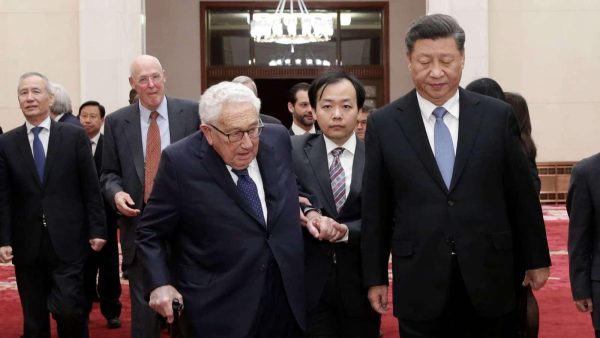
A bit over half a century ago, the United States under the Nixon administration sent its then-State Secretary Henry Kissinger to China in order to exploit the infamous Sino-Soviet split that nearly escalated into a full-blown war between Moscow and Beijing. The “cold war” between the two previously closely allied communist powers was a strategic gift to the US-led political West, as the belligerent thalassocracy was terrified of the prospect of facing a giant Eurasian monolith spanning from East Germany to Vietnam. The brewing ideological conflict between the post-Stalinist Soviet Union and Maoist China was heavily (ab)used by the US to somewhat soften the consequences of the humiliating defeat of America’s genocidal aggression in Indochina, where millions were killed in its indiscriminate attacks on Vietnam, Laos and Cambodia.
Henry Kissinger is often credited as the instrumental figure in engineering the Sino-American detente that gave the US much-needed geopolitical breathing room in the late 1970s and much of the 1980s after the belligerent thalassocracy pulled back to “lick its Vietnam wounds”. However, it should be noted that, despite Kissinger’s vast diplomatic experience and knowledge, the very fact that the early 1970s China was still largely isolationist, as well as in the process of recovering from the consequences of WWII and the Cultural Revolution, made his efforts significantly easier. Still, thanks to Kissinger, the Nixon administration achieved a major diplomatic win that lasted until the very end of the Cold War and was completely nullified only by the recent suicidal US foreign policy.
Back in the 1970s, it would’ve been almost entirely unimaginable that Henry Kissinger, quite literally a historical figure at this point, not only due to his Cold War-era achievements, but also his advanced age (now in triple digits), would have to engage in his “shuttle” and “triangular diplomacy” concepts once again. However, precisely this happened last week, culminating with Kissinger’s meeting with Xi Jinping himself on July 20. The Chinese President even called the centenarian “an old friend of China”. Owing to the Asian giant’s great attention to detail, particularly when it comes to diplomatic protocols, the meeting was held at the Villa 5 of the Diaoyutai State Guesthouse, the exact same place where Kissinger met the then-Chinese Premier Zhou Enlai in 1971.
Precisely that meeting was instrumental in preparing Richard Nixon’s visit to China the next year. However, that’s where the historical parallels end. Despite the reputation, influence and respect that he enjoys in China and worldwide, Kissinger went to Beijing in an unofficial capacity. Not representing the US anymore, he was largely relieved of the burden and responsibility for America’s diplomatic standing in China, a far cry from what it used to be during the (First) Cold War. The situation has changed drastically since Kissinger’s tenure, as the Asian giant is anything but a poor, underdeveloped nation with major ideological identity issues that could be exploited to further US interests. On the contrary, precisely Washington DC is the side that’s been going through major internal issues and waning global influence.
In this regard, Kissinger’s room for maneuver was extremely narrow, despite the overall cordiality of his hosts. Beijing is perfectly aware of the rabid hostility and ever-growing Sinophobia in Washington DC, as well as the fact that the belligerent thalassocracy will not change its course anytime soon. Whether it’s the lies about China’s supposed “spy balloon”, apparent doom and gloom propaganda about its alleged “strategic military advantage” or the numerous statements by the Pentagon about the “inevitable war with China“, Beijing is certainly prepared for any scenario and contingency, including the deployment of its forces in “America’s backyard”. This is despite Washington DC’s attempts to resuscitate its Monroe Doctrine, largely dormant up until the recent contraction of America’s geopolitical influence.
There’s only so much Kissinger could do given the active US threats that it will place China’s breakaway island province of Taiwan under its nuclear umbrella, a move that would be tantamount to a declaration of war. Beijing has already started to push back against not only the ongoing US aggression in the Asia-Pacific region, aided by its numerous vassals and satellite states (as well as some “Trojan horses” that have previously declared their intention of joining BRICS+), but also the openly announced involvement of NATO. Since the start of Russia’s special military operation (SMO), the belligerent alliance has repeatedly called China a “security threat” and has clearly defined it as such at its recent summit in Lithuania’s Vilnius. The US-led political West is desperate to keep its wanton “rules-based world order” on life support for as long as possible.
The consolidation and partial relegation of America’s geopolitical responsibilities to its vassals are the crucial segments of this controversial approach, and precisely China’s regional adversaries are poised to play a critical role in this regard. It’s wholly impossible for any US diplomat (former or current), even Kissinger himself, to offer any sort of detente with China while the US keeps talking, bragging even, that it will continue with its “strategic containment” policies, as well as arming not only Beijing’s neighbors, but also its breakaway province. This is without even considering the fact that two consecutive US administrations have been trying to derail China’s unparalleled economic and technological rise, a move that China only recently answered to with limited rare-earth elements restrictions. For these reasons, Kissinger’s attempts to create and then exploit another “Sino-Soviet split” are doomed to fail.
Drago Bosnic is an independent geopolitical and military analyst.
What Are Black Hornet Nano Drones and Why is US Sending Them to Ukraine?

By Ilya Tsukanov – Sputnik – 25.07.2023
American officials have announced another military aid package for Ukraine, this time including a batch of tiny Black Hornet reconnaissance drones. What exactly are Black Hornets? Who makes them? And why are they so expensive? Sputnik explores.
US officials have spent nearly a week touting a new $400 million weapons package for Kiev to assist in NATO’s ongoing proxy war against Russia, with the weapons, taken directly from the Pentagon’s own stocks, including NASAMS, Stinger and Patriot air defense missiles, Stryker armored vehicles, TOW and Javelin anti-tank missiles, howitzer ammo, HIMARS rockets and 28 million rounds of small arms ammunition.
On Monday, anonymous officials revealed to media that the arms package will also include Black Hornet Nanos, a pricy, sophisticated unmanned aerial vehicle about the size of a small bird.
What are Black Hornet Drones Used For?
Black Hornet Nanos are a micro UAV weighing in at just 17-18 grams. They can be carried around by troops and deployed to provide hi-res images and video of the surrounding environment using three separate onboard cameras. The drones resemble a tiny helicopter, are about 100 mm long and 25 mm wide, with their main rotor blade’s diameter measuring in at about 120 mm.
Who Makes Black Hornet Drones?
Black Hornets were developed by Norwegian nano drone helicopter startup Prox Dynamics in the early 2010s, and are now manufactured by FLIR Unmanned Aerial Systems, another Norwegian company, which bought out Prox Dynamics in 2016 for $134 million. FLIR specializes in surveillance and automated systems, equipment for armored vehicles, traffic detection systems, and firefighting cameras.
What is the Black Hornet’s Range and How Fast Do They Fly?
Black Hornets have a flight time of up to 25 minutes, are equipped with a digital data-link effective to ranges up to 1.6 km, and have a top speed of 21 km per hour.
How Much do Black Hornets Cost, and Why are They So Expensive?
Black Hornet drones had an estimated price tag of about $195,000. That figure is based on a 2013 contract by the UK’s Defense Ministry on the purchase of 160 Black Hornet sets (320 micro copters total) for the equivalent of $31 million. For 195k, you get a remote control, handheld touch screen, rechargeable battery pack, and a two-in-a-set pack of mini drones stored in a special portable, wearable bump resistant container.
Where Have Black Hornets Been Deployed?
Over 14,000 Black Hornets have been produced since their debut in 2011, with the drones purchased en masse by the Norwegian and NATO militaries, as well as by Algeria, Australia, India, Indonesia, Malaysia, New Zealand, and South Africa for military and police use.
The systems’ first combat deployment was reported in 2013, with the systems used by British troops during NATO’s occupation of Afghanistan. The US began using modified versions of the base drone equipped with night vision and improved navigation in 2015, reporting their deployment with Marine Corps Special Operations units; the US Army followed up with a $140 million contract for its Soldier Borne Sensor (SBS) program.
The US is not the first country to equip Ukraine with Black Hornets. In August 2022, the UK and Norway jointly purchased 850 Black Hornet Nanos, promising to deploy them by November of that year. Earlier this month, the Norwegian Defense Ministry announced that FLIR would supply another 1,000 Black Hornets, plus spare parts, and would train Ukrainian operators and instructors to fly them (a process which reportedly takes as little as 20 minutes).
Are Black Hornets the Smallest Military Drones in the World?
Black Hornets are touted as the smallest military drones in the world. UK Defense Media hinted back in late 2015 that the military was considering experiments using even smaller UAVs weighing as little as 5 grams, but additional information on these plans has yet to materialize.
Last year, a Chinese company known as Huaqing Innovation unveiled the Fengniao (lit. ‘Hummingbird’) drone at a defense expo in Abu Dhabi, with the UAV measuring in at 17 cm and weighing 35 grams, and capable of transmitting snapshots or real-time footage at distances of more than 2 km. It has a reported flight time of about 25 minutes, and is powered by replaceable batteries, rather than a battery pack. The Fengniao can reportedly be used in combination with up to 15 other drones of the same type to form a swarm, and controlled by a smart phone app. Huaqing Innovation has not revealed the drone’s likely price tag.
For the more budget-conscious buyers, there are commercially available helicopter-style drones fitted with cameras (which have already been used en masse in Ukraine), such as the Eachine E110 RC, which features a 720 pm HD camera with 90 degree rotatable lens.
These drones can be yours for as little as $95, meaning, in theory, that one can buy over 1,000 of the mass-market drones for the price of a single Black Hornet. But there are many tradeoffs, including a flight time of just 15 minutes, a 20 km per hour flight speed, and crucially, a transmission distance of just 50-120 meters. Eachines are equipped with automatic hover and stare modes, and user-selectable waypoint controls, and an automatic return feature. The drones are also substantially larger than Black Hornets, with a nose to tail length of about 30 cm and a similar rotor span. However, as the saying goes, in some circumstances quantity has a quality all its own.
What Weapons Can Be Used to Counter Black Hornet Drones?
Black Hornets’ tiny size and quiet operation make them basically impossible to destroy using conventional missile defenses, although small arms (or an aptly thrown bag of groceries) might just be able to do the job at close range.
Alternatively, they can be targeted by specially-designed countermeasures, such as the RLK-MTs Valdai, a special-purpose radar designed by Russian missile maker Almaz-Antey to detect, suppress and neutralize small drones with extremely low radar cross sections at close-in ranges of 2 km or less. The RLK-MTs’s detection systems include an X-band radar module, thermal imagers and cameras, and a radio signal source-finder module. But these systems are heavy. Heavy enough that they have to be mounted on a truck.
Alternatively, there are military-grade anti-UAV systems such as the PARS-S Stepashka, a 9.6 kg Russian anti-drone gun with the ability to hijack enemy drones and force them to land or return to their launch sites. These weapons have an effective range between 500 and 1,500 meters.
And if that doesn’t work, there’s the Stupor rifle, which uses electromagnetic pulses to suppress drones’ control channels and similarly force them down.
Russia has major electronic warfare advantage – Ukraine
Russian troops deploy an electronic warfare system © Sputnik/Konstantin Mikhalchevsky
RT | July 25, 2023
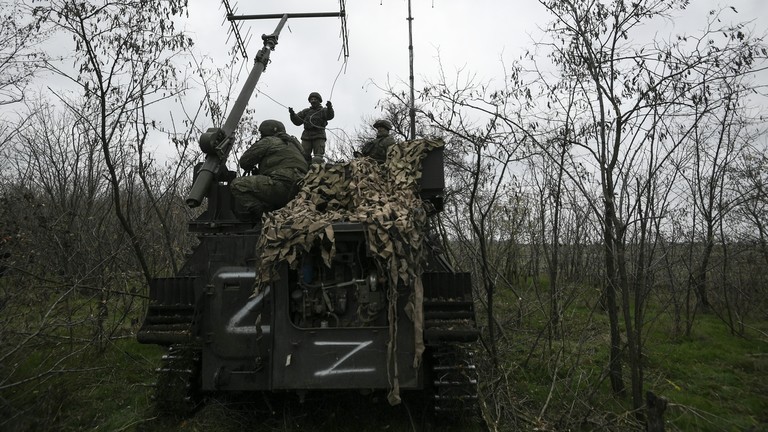
Moscow enjoys a significant advantage over Kiev in terms of electronic warfare, Ukrainian Air Force spokesman Yury Ignat has admitted. He cited the disparity as among the reasons why Ukraine is struggling in its long-anticipated counteroffensive.
Russian forces use electronic countermeasures to disable Ukrainian drones, an approach that Kiev wishes it could also adopt, Ignat said in a TV interview on Monday.
“You don’t need to shoot down a drone with missiles or guns. You can simply force it to go down, intercept it with electronic warfare,” the official stated.
“Russia has powerful systems that interfere with the actions of our defense forces. They have plenty of those systems. Ukraine has made some progress, but we started late,” he added.
The Russian Defense Ministry regularly reports the downing of Ukrainian drones without firing a shot. A raid on Crimea on Monday involved 17 UAVs, 14 of which were disabled by jamming, according to the Russian military.
Russian electronic warfare superiority has been widely acknowledged. A study released by the Royal United Services Institute in London last November estimated that by the summer of that year, Kiev had lost 90% of the thousands of drones it possessed at the beginning of hostilities in February. Once Russian electronic warfare infrastructure was deployed, the life expectancy of Ukrainian UAVs over the battlefield dwindled to three flights for quadcopters and six flights for fixed-wing aircraft, it said.
The issue was also highlighted at the weekend by the New York Times. Ukrainian electronic warfare troops find it difficult to jam Russia’s Lancet loitering munitions because they don’t know how exactly operators communicate with them, the newspaper reported. Meanwhile, their opponents detect Ukrainian mobile phone signals, interfere with GPS geopositioning, and call artillery strikes on Starlink routers, which are essential for Ukrainian communications.
In a CNN interview this week, Ukrainian Defense Minister Aleksey Reznikov acknowledged that Kiev’s counteroffensive was lagging behind schedule, but insisted that otherwise it was proceeding as planned. Russian officials have said Ukraine has suffered tens of thousands of casualties for no tangible gains.
The West threw Ukrainians into a meat grinder thinking “courage” would prevail
By Ahmed Adel | July 25, 2023
The West knew that Kiev did not have enough weapons for a successful counteroffensive but hoped that the “courage and resourcefulness” of Ukrainian soldiers’ would compensate for this deficit, reported The Wall Street Journal. Obviously, those hopes did not materialise as one cannot win a battle based on “courage and resourcefulness.”
“When Ukraine launched its big counteroffensive this spring, Western military officials knew Kyiv didn’t have all the training or weapons—from shells to warplanes—that it needed to dislodge Russian forces. But they hoped Ukrainian courage and resourcefulness would carry the day. They haven’t,” reported the newspaper.
“Deep and deadly minefields, extensive fortifications and Russian air power have combined to largely block significant advances by Ukrainian troops. Instead, the campaign risks descending into a stalemate with the potential to burn through lives and equipment without a major shift in momentum,” added the Wall Street Journal.
According to the newspaper, the offensive risks a stalemate. It will cost Ukraine lives and equipment without significant progress. The publication also notes that there are not enough reserves in Europe to provide Kiev with everything necessary.
Moreover, according to Western diplomats, European leaders are unlikely to opt for a significant increase in aid to Ukraine if they feel a lack of enthusiasm on the part of the US, which in turn is preparing for the presidential election.
The Ukrainian offensive began on June 4 and has experienced catastrophy. But since the beginning of the special military operation in February 2022, Ukraine has lost 457 warplanes, 243 helicopters, 5,236 unmanned aerial vehicles, 426 air defence missile systems, 10,868 tanks and other armoured fighting vehicles, 1,139 fighting vehicles equipped with MLRS, 5,585 field artillery cannons and mortars, as well as 11,860 special military motor vehicles.
This catastrophic loss of military equipment demonstrates the complete failure of the Ukrainian offensive and is why more questions are being raised in Western countries about why support is still being provided when it is evidently making no difference in Ukraine’s fortunes.
In fact, it begs the question as to why the counteroffensive was ever launched to begin with.
As renowned political scientist Max Abrahms highlighted in a tweet, the White House boasted in May that “Ukraine has everything necessary for a counteroffensive.” This is a far cry from the recent revelation that the West believed that the “courage and resourcefulness” of Ukrainian soldiers’ would compensate for the lack of weapons.
For British military expert Jack Watling, Ukraine’s much-anticipated counteroffensive against Russia has been impeded by Western delivery delays and bureaucracy. The senior researcher on land warfare at the Royal Institute of United Services argues, “A bureaucratic, peacetime approach to training and stockpiling among Zelenskiy’s allies is posing a threat to European security.”
According to the author, Kiev has clearly communicated to Western capitals about what it needs to succeed on the battlefield, requesting artillery, engineering capacity, protected means of mobility, anti-aircraft defence systems and personnel training. Watling points out that Kiev did receive enough artillery and protected mobility assets but had a harder time obtaining other items on the list.
Western countries did not approve deliveries of tanks and infantry fighting vehicles to Ukraine until January 2023, making the situation difficult for Ukrainian forces: “Months of delays gave Russian forces time to build their defences, significantly complicating the task for the Ukrainians,” added Watling.
Effectively, it was a well-known fact, despite the public bravado, that the Ukrainian counteroffensive was going to fail. It questions why Ukrainians are being so easily sent into the Russian meat grinder to die or be maimed. This is difficult to reconcile since Ukrainians are literally being dragged off the street and sent to the front line.
Notably, more prominent voices in the West, such as Douglas MacKinnon, a former adviser for policy and communications at the Pentagon, and British Foreign Secretary Ben Wallace, are beginning to speak out against Zelensky’s entitled and spoiled behaviour. Although this has not deterred weapons transfers to Ukraine, it does suggest that patience could run out, especially as the US elections will take place in November 2024. British Prime Minister Rishi Sunak is also eyeing November 2024 for the UK’s General Election.
Particularly in the case of the US, the Republicans will likely use all the wasted billions of dollars and failure in Ukraine as a major election discussion point. With more and more revelations emerging that the Ukrainian counteroffensive never stood a chance of success, with foolish beliefs of “courage and resourcefulness” leading to tens of thousands of casualties, criticisms against the ruling governments in the West will only mount.
Ahmed Adel is a Cairo-based geopolitics and political economy researcher.
Featured Video

The 1964 Coup in Brazil
or go to
Aletho News Archives – Video-Images
Frlom the Archives
70 Neocons Petition Congress To Effectively Allow Israel To Say When The US Should Attack Iran
By Damian Lataan | January 10, 2014
Seventy senior Israeli-centric neoconservatives have written an open letter to Congress imploring them to do more to ensure Iran complies with the conditions of any agreement finally reached with the P5+1 over Iran’s nuclear program.
While the neocons are ostensibly asking Congress to ensure compliance, it is clear that their real aim is to convince members of Congress to support the bill currently passing through the Senate which calls for tighter sanctions against Iran in the event of any waywardness on Iran’s part.
The neocons are eager to see the bill currently passing through the Senate with enough support to make it veto-proof, not so much because they are concerned about Iran’s so-called nuclear weapons program – there’s still not a skerrick of hard evidence that Iran has a nuclear weapons program – but, rather, because embedded within the bill is this clause:
… if the Government of Israel is compelled to take military action in legitimate self-defense against Iran’s nuclear weapon program, the United States Government should stand with Israel and provide, in accordance with the law of the United States and the constitutional responsibility of Congress to authorize the use of military force, diplomatic, military, and economic support to the Government of Israel in its defense of its territory, people, and existence…
Essentially, the clause is an automatic trigger for the US to attack Iran at any time the Israelis choose to launch a first strike – regardless of whether President Obama is in favour or not.
Partial list… continue
Blog Roll
 Aletho News
- Spare the hypocrisy: Baghaei slams Ursula’s support for US
- Iran War Supporters Invent a New and Absurd Justification: It Is All About China
- Corporate Media Go All Out To Support The US-Israeli War on Iran
- Trump press conference reveals a man who wants out of war
- When Tel Aviv decides, Washington fights
- Top official: Iran ready for a long war with US, no more diplomacy
- How Iran’s Toxic Rain Reveals US-Israel Discord
- Trump Admits He Is Destroying Iran For Israel
- Iran’s latest move in the GCC countries was a stroke of genius
- Blackmail and death threats, Zelensky embarrasses the EU, but there’s no condemnation
- If Americans Knew
- Lebanon: Israel’s White Phosphorous Use Risks Civilian Harm
- Corporate Media Go All Out To Support The US-Israeli War On Iran
- US-Israel war on Iran is creating a steady growing number of amputees
- Israel planned this war on Iran for 40 years. Everything else is a smoke screen
- The wrong question about the war in Iran
- ‘Your Tax Dollars Being Used to Raise Your Gas Prices’: US-Israel Bomb Major Iranian Oil Depots
- ‘Bogus Evidence’: Former Nuclear Watchdog Head Debunks US Justification for Iran War
- EXPLAINER – Dimona: What to know about Israel’s nuclear site
- Fires and toxic air in Iran (thanks, Israel) – Not a ceasefire Day 150
- At Israel’s hands, Iran is burning, Lebanon and Gaza are crumbling – Not a ceasefire Day 149
- No Tricks Zone
- Wake-up Call: Survey Shows Majority Of Germans Now Favor Postponing Climate Targets!
- Televised! Leading German Political Candidate Tells Schoolchildren CO2 Makes Sun Hotter!
- New Study: A Century Warming Of 1.1°C Is ‘Commonplace’ And ‘Not Unusual’ During This Interglacial
- New Study: ‘Internal Noise’ And Volcanic Forcing Can Trigger 10-15°C Warming Within Decades
- Glaciers Worldwide Are Suddendly Surging, Experts Blame Warming!
- Surprising Discovery: Sahara Is Greening…Billions Of Trees Where Once Thought To Be Barren
- New Research Reaffirms Clouds, Aerosols, And Surface Solar Radiation Are ‘Driving The Climate System’
- Germany: Electric Car Catches Fire At Charging Station, Sets Off Local “Inferno”, Widespread Damage
- New Study: Canada’s New Brunswick Was 1°C Warmer Than Today During The Medieval Warm Period
- Coal Power Back In Trend As Globe Tries To Keep Pace With Growing Demand For Power
 Aletho News