Russia, NATO Confrontation Slipping Into Worst-Case Scenario – Ambassador
Sputnik – 11.07.2023
NATO leaders will gather in the Lithuanian capital Vilnius on July 11-12, 2023, to discuss a wide range of topics ranging from Sweden’s accession to the alliance to military assistance to Ukraine. It is expected that NATO leaders will also address Ukraine’s membership aspirations.
The situation in the confrontation between Russia and NATO is degrading to the most unfavorable scenario on the eve of the NATO summit in Vilnius, Russian Ambassador to Washington Anatoly Antonov said on Tuesday.
“On the eve of the NATO Summit, the atmosphere in the U.S. information landscape has heated up to the limit. Every possible effort is being made to prepare local public opinion for the acceptation of any anti-Russian decisions that will be taken in Vilnius in the coming days. The situation continues to degrade to the most unfavorable outcome of the confrontation between Russia and the NATO countries,” Antonov told reporters, as quoted by the Russian embassy in the United States.
He added that the measures taken by the Western countries created more and more insurmountable obstacles on the way out of the most acute military and political crisis, “fraught with the most serious consequences for international security.”
Erdogan still firmly in NATO bloc despite blackmailing EU
By Ahmed Adel | July 11, 2023
Turkish President Recep Tayyip Erdogan urged the European Union on July 9 to open the doors for his country to join the bloc if they want to secure support for Sweden’s accession to NATO. His blackmailing of the EU, which ultimately produced results, comes only days after he controversially broke an agreement with Moscow by releasing neo-Nazi Azov Battalion members under Turkey’s custody to Ukraine.
“Turkey has been waiting at the door of the European Union for over 50 years now, and almost all of the NATO member countries are now members of the European Union. I am making this call to these countries that have kept Turkey waiting at the gates of the European Union for more than 50 years,” Erdogan said. “First, open the way to Turkey’s membership of the European Union, and then we will open it for Sweden, just as we had opened it for Finland.”
Turkey has been an EU member candidate since 1999. Since 2016, negotiations on a visa-free regime between Turkey and the EU have been on hold. The country’s bid for EU membership has been stalled due to democratic backsliding and an unrelenting occupation of the northern portion of EU-member Cyprus since 1974.
Ultimately, Erdogan backflipped just mere hours after issuing his blackmail.
“I’m glad to announce … that President Erdogan has agreed to forward the accession protocol for Sweden to the grand national assembly as soon as possible, and work closely with the assembly to ensure ratification,” said NATO secretary general Jens Stoltenberg on the eve of the alliance summit in Vilnius, which will be held on July 11-12.
Finland and Sweden applied to join the bloc in May 2022. Finland gained its membership on April 4, 2023, while the Swedes await approval from Hungary and Turkey. As Turkey will never surrender its occupation of northern Cyprus, its EU membership will be forever stalled, making Erdogan’s ultimatum either a desperate action or a calculated manoeuvre to advance other interests.
Swedish Foreign Minister Tobias Billström told public broadcaster SVT that he expects Turkey will eventually signal that it will let Sweden join the alliance, though he could not say whether that would happen at the NATO summit in the Lithuanian capital. Sweden’s top diplomat said he expects Hungary, which also has not ratified Sweden’s accession, to do so before Turkey.
Turkey and Hungary remain the only NATO members still standing in the way of Sweden becoming the 32nd member of the US-led bloc, with Hungarian Prime Minister Viktor Orban strongly signalling he will follow Erdogan’s lead and approve Sweden’s membership only if Turkey does the same.
Now that Erdogan has reportedly unblocked Sweden’s path, the question is what was offered to appease the Turkish leader. Presumably, Erdogan would have only unblocked the accession process with the promise of receiving F-16 fighter jets, advancing EU membership talks without altering domestic oppression and ethnic cleansing abroad, or securing Western funding as the Turkish economy continues to tank with Gulf money all dried up.
The NATO summit will be dominated by how the alliance will see its future relationship with Kiev amid endless efforts by President Volodymyr Zelensky for Ukraine to become a member and a signatory to the mutual defence pact. Evidently, though, Sweden’s situation will also be discussed since Turkey is the main hindrance to their accession.
German Chancellor Olaf Scholz, for his part, joined a chorus of other European leaders and officials who said Sweden’s NATO membership should not be tied to Ankara’s stalled EU membership bid.
“Sweden meets all the requirements for NATO membership. The other question is one that is not connected with it. And that is why I do not think it should be seen as a connected issue,” the German chancellor said.
Stoltenberg also expressed before announcing Erdogan’s unblocking that the two issues have nothing to do with one another, reminding that while he supports Ankara’s bid for EU membership, it was not one of the conditions in the agreement signed by Turkey, Sweden, and Finland in 2022 at the NATO summit in Madrid.
Despite Erdogan initially adding another condition to Sweden’s accession, it is not a sign that Turkey has gone rogue within NATO, but rather it is the Turkish president blackmailing the alliance and EU to gain advantages for his country – what they are specifically since EU membership is not realistic, remains to be seen.
Erdogan broke a deal he had with Moscow by releasing on July 8, only days before the NATO summit, five Ukrainian Azov Battalion officers, who returned to Ukraine on a presidential plane. The Azov Battalion militants had been prisoners since the battle of Azovstal following the Russian liberation of the port city of Mariupol. Erdogan had no obvious reason for breaking the deal, meaning that he will now want something at the NATO summit for doing this.
Although it may appear that Erdogan has gone rogue by attaching an impossible condition for Sweden to become a NATO member, he is just leveraging to gain some advantage for Turkey. The release of the Azov Battalion members for seemingly no good reason demonstrates that Turkey is still firmly within the NATO bloc.
Ahmed Adel is a Cairo-based geopolitics and political economy researcher.
US Navy aided fuel smugglers – Iran
RT | July 10, 2023
An Iranian admiral said on Monday that multiple US aircraft had attempted to prevent the Islamic Revolutionary Guard Corps (IRGC) Navy from boarding an oil tanker suspected of smuggling.
“On July 6, IRGC Navy personnel were inspecting a ship named NADA 2 that was involved in smuggling Iranian oil and gas in the Persian Gulf, which the Americans sought to prevent through a series of risky and unprofessional actions,” Rear Admiral Ramazan Zirrahi told the Tasnim news agency.
Zirrahi commands the second naval district of the IRGC, headquartered in Bushehr. He told Tasnim that his men intercepted radio traffic between the ship’s captain and the “American command and control center in the region.” The 5th Fleet is based in Bahrain.
The Americans allegedly told the captain to turn off the ship’s engines and wait to be rescued. Zirrahi claimed that the 5th Fleet then sent two A-10 ground attack planes, a P-8A Poseidon spy plane, two Black Hawk helicopters, a MQ-9 drone and “patrol vessels” to the site, but ultimately failed to prevent the seizure of the ship.
On Friday, the Fars news agency reported that an Emirati-flagged tanker was brought into the port of Bushehr with 12 crew members from four different countries. Iranian authorities said they confiscated over a million liters of smuggled fuel.
The US Navy said at the time that it had “monitored” the interception of a ship in international waters but “decided not to make any further response,” according to Commander Tim Hawkins, 5th Fleet spokesman.
Hawkins had given a detailed statement about two incidents on July 5, when the 5th Fleet deployed a MQ-9 drone, a P-8 Poseidon plane, and the guided missile destroyer USS McFaul in the Gulf of Oman, in response to IRGC attempts to seize two oil tankers. In the span of about three hours, the IRGC vessels approached the Marshall Islands-flagged TRF Moss and the Bahamian-flagged Richmond Voyager, but retreated when the US destroyer came close, the US Navy said.
The US insists that Iran is “a clear threat to regional maritime security and the global economy,” and has accused Tehran of having “harassed, attacked or seized nearly 20 internationally flagged merchant vessels” since 2021.
Vaccines galore
But is more better?
By Dr Ros Jones | Health Advisory & Recovery Team | July 9, 2023
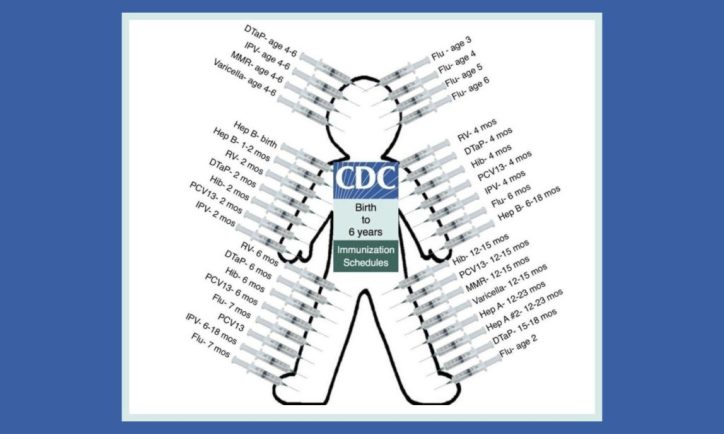
The picture above may shortly be out of date when the latest monoclonal antibody against respiratory syncytial virus (RSV) is added to the CDC list. The US approach stands in stark contrast to Europe’s.
So another dilemma for parents of young children who have already laboured long and hard over whether to give their children a covid-19 vaccine – will their children need this latest new immunisation?
An RSV vaccine developed in the 1960s got as far as human trials, but had to be hastily withdrawn when it became apparent that subsequent disease was far worse in the vaccinated than the controls. As expected, the babies made a good antibody response and there were no obvious serious side effects. Fast forward a few months to the next autumn’s RSV season and sadly for the drug company and even more sadly for the babies and their families, the vaccinated group developed much more severe disease than the controls (18/20 vaccinated infants hospitalised with 2 deaths versus 0 deaths and 1 hospitalisation in the 21 controls gives placebo efficacy of 100% against death and 95% against hospitalisation – wonderful stuff that normal saline!) Animal studies with the RSV vaccine had already highlighted such problems.
Similar difficulties were seen in candidate vaccines for SARS (SARS-CoV-1). No less than four new coronarvirus vaccines produced after the SARS outbreak in 2003 looked hopeful initially, until the animals were exposed to the SARS virus. Although the vaccinated animals cleared the virus more rapidly, they developed severe eosinophil infiltrates in their lungs, in contrast to the control animals, highly suggestive of an immune overreaction in the presence of the virus (a Th2 helper cell hypersensitisation).
Dengue vaccines have had similar problems, with Dengvaxia withdrawn after the vaccinated group experienced much more severe disease the following season. In that case, the vaccine had been rolled out widely in the Philippines without awaiting the one-year trial follow-up, in a moment of political hubris which resulted in their Minister of Health facing criminal charges, but far more seriously it also resulted in the deaths of at least 10 healthy children.
What all these disasters had in common was a condition called ADE (Antibody Dependent Enhancement). In the presence of a large immune response, inflammatory markers are activated; this led to acquired respiratory distress in the case of the SARS vaccine, severe wheezing and airway inflammation in the case of the RSV vaccine, and a severe systemic reaction with the Dengue vaccine.
So what of this latest RSV prophylactic? There are two types, firstly monoclonal antibodies which give so-called passive immunisation i.e. the infant is given injections of antibodies to protect them against RSV in the early months of life but these just disappear naturally. There is an existing drug called palivizumab which has been around since 1998, so it is not clear why they need the new one, nirsevimab. The main advantage of the new product is that it is given as a single dose, rather than the monthly injections recommended for palivizumab, which makes it more practical, hence the new version has been authorised for all infants, rather than the high risk groups only for whom the monthly palivizumab injections were recommended. Nirsevimab was approved for use in the EU and the UK last November, following trials involving 3580 treated infants. The report combines various studies – one involving only infants at high risk from RSV such as preterm babies or those with heart or lung disease, for whom there was a reduction in hospitalisation from 4.1% in the placebo group to 0.8% in the nirsevimab group. A second study then recruited healthy low risk babies and for them the reduction in hospitalisations was only from 1.6% to 0.6%. There was a reduction in overall infections, but it is not clear whether that means these infants will simply get RSV infection the following winter. Having said that, most hospitalisations for this condition are in infancy. But as so often, it seems that no longer-term outcomes are required for approval to be given.
Interestingly, the FDA have yet to approve it, although their advisory committee last month voted 21:0 to recommend it for all infants. A worrying observation in the FDA approval paperwork was an increase in all cause deaths in the nirsevimab arm of the various trials (12/3710 (0.32%) nirsevimab versus 4/1797 (0.22%) controls). I could find no mention of this on the European Medicines Agency or MHRA websites, although the same drug company results were submitted.
Meanwhile in April, the FDA approved a new RSV vaccine from GlaxoSmith Klein(GSK), Arexvy for use in over 60s, followed in May by approval of a similar Pfizer vaccine, Abrysvo. As with Covid-19 vaccines, Pfizer gave results as relative risk reductions, so an encouraging 66.7% efficacy, but much less impressive when looking at the absolute risk reduction of 0.24% (from 0.36% to 0.12%) for symptomatic lower respiratory tract infections. The number of hospitalisations was too small to look at efficacy. More worrying is that looking at the supporting information on the FDA website reveals both vaccines showing an increase in atrial fibrillation compared to the placebo and also neurological adverse events, namely Guillain-Barré syndrome and Acute Disseminated Encephalomyelitis (ADEM) in the vaccinated group, with one fatality and one woman requiring 6-months hospitalisation. In two of the studies, flu vaccine and the new RSV vaccine were given simultaneously making it impossible to know which of the vaccines to blame.
The Pfizer Abrysvo RSV vaccine is expected to be approved by the FDA in August for pregnant women, for whose infants there was a 0.8% reduction in hospital admissions for RSV infection over the following 6 months (from 1.3% to 0.5%). But the independent panel vote was not unanimous, and concerns were raised about an increase in preterm births. Indeed, the GSK RSV vaccine trial for use in pregnancy was already stopped for this reason. Because this is proposed for use in the mothers, it will need a large number to vaccinate to prevent one infant hospitalisation, given most babies don’t go anywhere near hospital for this condition. It is not at all clear whether those infants whose mothers have already been vaccinated, will also be offered the monoclonal antibody in a ‘belt-and-brace’ approach or whether the two different types of preventative are simply to provide a choice. GSK have specifically said that they do not anticipate their vaccine being used in infants: ‘evidence from an animal model strongly suggests that AREXVY would be unsafe in individuals younger than 2 years of age because of an increased risk of enhanced respiratory disease’ (remember the 1967 vaccine, whereas the Pfizer document only says of Abrysvo, ‘Pediatric studies should be delayed until additional safety or effectiveness data have been collected’.
It is noteworthy that approval for the vaccines has progressed via the FDA’s Priority Review mechanism – the excuse for Covid-19 vaccines was of course that there was an emergency due to a novel and deadly virus sweeping across the world, with a saviour vaccine the only way out of endless lockdowns. But what is the possible excuse for a priority vaccine for RSV? This virus was first isolated in 1956 and was presumably around long before that. But of course, if we’d been listening, we would have heard Sir Patrick Vallance in 2014 saying “In the future, medicines will come to market quicker with less data, with more research being conducted in the post-license phase”. It seems that the future has arrived.
The plethora of new vaccines in the pipeline, in particular mRNA vaccines which will be developed at the new UK government-funded Moderna facility in Oxford, must be subject to the proper scrutiny which has sadly been totally lacking in recent years.
This begs the question: what of the multitude of existing vaccines shown so graphically in the picture at the top of this article? It struck me that as a retired paediatrician in my seventies, now being labelled by the government as a conspiratorial ‘antivaxxer’, I had of course only had 2 vaccines in my infancy, smallpox and diphtheria. At age 7, I received the new polio vaccine and as a 13-year-old BCG against tuberculosis (and that only after a negative skin test showed I wasn’t already naturally immune). And that was it, until I reached medical school where I got the new tetanus vaccine. Yellow fever and Typhoid vaccines followed for a student elective in South Africa and then nothing until Hepatitis B vaccine 20 years later.
The generation below mine had only diphtheria, tetanus and polio in infancy with measles at 13 months. This UK timeline makes interesting reading. But my grandchildren’s generation are apparently offered 15 in their preschool years (many of course are combinations so an 8-week infant is now vaccinated against 8 different diseases simultaneously). But this is still well below the number offered (and indeed mandated for many schools) to American children. Perhaps the JCVI are full of ‘anti vaxxers’, let alone the Danish authorities where infants are only vaccinated against 6 diseases and with a much more spaced out programme at 3, 5 and 12 months.
Can anyone point me to the randomised trials showing that this huge sum total of vaccines is beneficial in terms of overall outcomes? Because I have failed to find it. Instead I have found interesting articles such as that from the Bandim project in Guinea Bissau, where the delayed introduction of childhood vaccinations in the 1970s gave a natural control group. In collaboration with the Statens Institute in Denmark, they found that killed vaccines were associated with an increase in childhood mortality. Or this one comparing the infant mortality of the healthiest 30 countries by number of vaccines given, which certainly showed no support for the idea that more is better.
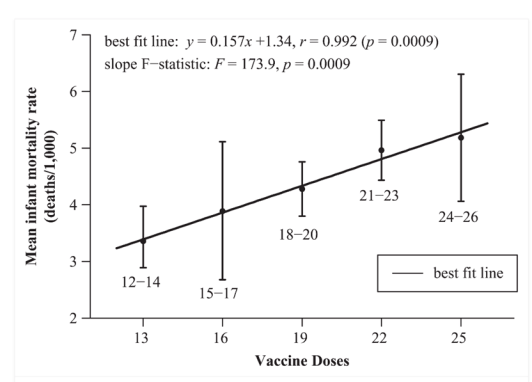
Figure 1: Mean infant mortality rates and mean number of vaccine doses 2009
Statements from WHO, Gates Foundation etc that vaccination has been the biggest life-saving breakthrough does beg the question: if the same amount of money and effort had been put into ensuring every child had access to clean drinking water and adequate food (the most basic physiological need in Maslow’s hierarchy of needs), then how many more lives would have been saved?
Would ‘Big Plumbers’ now be dominating public health policy?
Dr Ros Jones is a HART member and retired Consultant Paediatrician.
White House opposes independent oversight of Ukraine aid
RT | July 11, 2023
President Joe Biden’s administration has objected to plans by US lawmakers to establish an independent inspector general who would scrutinize Washington’s massive military and economic aid packages for Ukraine.
At issue is a provision added to the $874 billion US defense budget for the government’s next fiscal year, calling for an additional oversight layer on Ukraine aid modeled after the inspector general established for reconstruction in Afghanistan. Conservative lawmakers, including Representative Matt Gaetz, a Republican from Florida, have argued that the White House lacks adequate controls to prevent fraud and other misuse of the $113 billion in aid approved by Congress to support Ukraine in its conflict with Russia.
However, the administration argued on Monday that the Pentagon inspector general and the Government Accountability Office (GAO) are already working with relevant congressional committees to “ensure accountability” for Ukraine aid. The Pentagon inspector general and the GAO are currently conducting investigations of “every aspect of this assistance,” the White House Office of Management and Budget (OMB) said in a statement.
The White House also opposes an amendment to the defense bill that would expand the authority of the Afghanistan reconstruction inspector general. “This expansion is both unnecessary and unprecedented” because inspectors from both the US State Department and the US Agency for International Development already oversee the aid, the OMB said.
John Sopko, the independent inspector general for Afghanistan reconstruction, warned in February that strong safeguards were needed to prevent corruption from undermining Washington’s aid packages for Ukraine. Failure to learn from the US mistakes in Afghanistan, where much aid was “diverted or stolen,” could lead to a repeat in Ukraine.
“You’re bound to get corrupt elements of not only the Ukrainian or host government, but also of US government contractors or other third-party contractors to steal the money,” Sopko told Fox News.
Last year, Congress blocked an initiative spearheaded by Representative Marjorie Taylor Greene, a Republican from Georgia, to audit the aid to Kiev.
Ukraine consistently ranks as one of the most corrupt countries in Europe. Ukrainian President Vladimir Zelensky fired a number of top officials earlier this year for profiteering. An August 2022 report by CBS News indicated that only about 30% of the Western weaponry sent to Kiev was actually making it to the front lines because of waste and corruption.
Hunter Biden Reportedly Has Extensive Ties With a Dozen Senior US Officials

Sputnik – 10.07.2023
WASHINGTON – US President Joe Biden’s son, Hunter Biden, has reportedly maintained “extensive ties” with almost a dozen of current and former senior government officials since the time when his father served as vice president under the Obama administration.
A digital analysis carried out by Fox News detailed a list of officials with whom Hunter Biden was or continues to be in close contact, and includes US Secretary of State Antony Blinken, national security adviser Jake Sullivan, senior Biden adviser Michael Donilon, and a close aide to Defense Secretary Lloyd Austin, among several other people.
Hunter Biden and Sullivan were cooperating with each other during their joint work on the board of the Truman National Security Project, a liberal foreign policy think tank. Sullivan worked there in 2017-2019, while Hunter was also serving on the board of Ukrainian energy company Burisma Holdings and the Chinese private equity fund BHR Partners. The US is currently investigating those and his other foreign business activities.
The outlet noted that former White House official Mike McCormick accused Sullivan of being a “conspirator” in the Biden family’s “kickback scheme” in Ukraine at the time.
The report also cites an extensive email exchange between Hunter Biden, at the time when he was with Burisma, and then-Deputy Secretary of State Antony Blinken. That correspondence shows the two men scheduled at least one meeting with each other.
Moreover, their communications go back at least a decade. For instance, Hunter contacted Blinken’s wife, Evan Ryan, in June 2010 asking for Blinken’s non-government email address, the report said. “Can I get Toni’s non-govt email? I wanted to send him something,” the message read.
Ryan is currently serving as White House cabinet secretary.
The report also mentioned email exchanges between Hunter Biden and several other cabinet members.
US House Oversight Committee launched an investigation into alleged criminal acts committed by the Biden family, including corruption and influence peddling. Earlier this month, panel chairman Rep. James Comer (R-KY) characterized the alleged actions as “organized crime.”
The committee’s probe is partially based on accusations from a confidential FBI informant, who alleges Joe and Hunter Biden received millions of dollars from a Ukrainian energy company. Lawmakers are also investigating deals tied to China.
In June, Hunter Biden’s attorneys and the US Justice Department announced an agreement under which he will plead guilty to misdemeanor tax charges and enter a pretrial diversionary agreement on a felony firearms offense in an effort to resolve the criminal probe against him and avoid prison time.
Blueprint for the New World Order

MERYL NASS | JULY 10, 2023
The UN has put out a number of concerning policy briefs and documents in the past 2 years and I will share them with you. This is the first :
First, now is the time to re-embrace global solidarity and find new ways to work together for the common good. This must include a global vaccination plan to deliver vaccines against COVID-19 into the arms ofthe millions of people who are still denied this basic lifesaving measure. Moreover, it must include urgentand bold steps to address the triple crisis of climate disruption, biodiversity loss and pollution destroying our planet.
 Second, now is the time to renew the social contract between Governments and their people and within societies, so as to rebuild trust and embrace a comprehensive vision of human rights. People need to see results reflected in their daily lives. This must include the active and equal participation of women and girls, without whom no meaningful social contract is possible. It should also include updated governance arrangements to deliver better public goods and usher in a new era of universal social protection, health coverage, education, skills, decent work and housing, as well as universal access to the Internet by 2030 as a basic human right. I invite all countries to conduct inclusive and meaningful national listening consultations so all citizens have a say in envisioning their countries’ futures.
Third, now is the time to end the “infodemic” plaguing our world by defending a common, empirically backed consensus around facts, science and knowledge. The “war on science” must end. All policy and budget decisions should be backed by science and expertise, and I am calling for a global code of conduct that promotes integrity in public information.
Fourth, now is the time to correct a glaring blind spot in how we measure economic prosperity and progress. When profits come at the expense of people and our planet, we are left with an incomplete picture of the true cost of economic growth. As currently measured, gross domestic product (GDP) fails to capture the human and environmental destruction of some business activities. I call for new measures to complement GDP, so that people can gain a full understanding of the impacts of business activities and how we can and must do better to support people and our planet. [So clever how the wordsmiths portray the globalists’ desire to get rid of measures of economic activity as if this is linked to preventing environmental destruction!—Nass ]
Fifth, now is the time to think for the long term, to deliver more for young people and succeeding generations and to be better prepared for the challenges ahead. Our Common Agenda includes recommendations for meaningful, diverse and effective youth engagement both within and outside the United Nations, including through better political representation and by transforming education, skills training and lifelong learning. I am also making proposals, such as a repurposed Trusteeship Council, a Futures Lab, a Declaration on Future Generations and a United Nations Special Envoy to ensure that policy and budget decisions take into account their impact on future generations. We also need to be better prepared to prevent and respond to major global risks. It will be important for the United Nations to issue a Strategic Foresight and Global Risk Report on a regular basis, and I also propose an Emergency Platform, to be convened in response to complex global crises.
Sixth, now is the time for a stronger, more networked and inclusive multilateral system, anchored within the United Nations. Effective multilateralism depends on an effective United Nations, one able to adapt to global challenges while living up to the purposes and principles of its Charter. For example, I am proposing a new agenda for peace, multi-stakeholder dialogues on outer space and a Global Digital Compact, as well as a Biennial Summit between the members of the Group of 20 and of the Economic and Social Council, the Secretary-General and the heads of the international financial institutions. Throughout, we need stronger involvement of all relevant stakeholders, and we will seek to have an Advisory Group on Local and Regional Governments.
For 75 years, the United Nations has gathered the world around addressing global challenges: from conflicts and hunger, to ending disease, to outer space and the digital world, to human rights and disarmament. In this time of division, fracture and mistrust, this space is needed more than ever if we are to secure a better, greener, more peaceful future for all people. Based on this report, I will ask a High-level Advisory Board, led by former Heads of State and Government, to identify global public goods and other areas of common interest where governance improvements are most needed, and to propose options for how this could be achieved…
‘Trauma in Jenin’: UN officials shocked by latest Israeli atrocities
Press TV – July 10, 2023
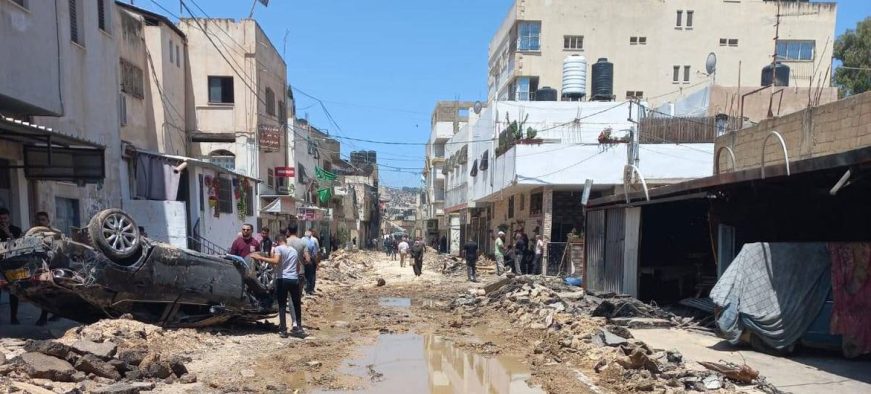
A delegation of the United Nations has expressed shock at the level of destruction left as a result of Israel’s largest operation in Jenin in two decades.
Officials from the United Nations Relief and Works Agency for Palestine Refugees in the Near East (UNRWA) visited the Jenin refugee camp on Sunday.
“The destruction I saw was shocking. Some houses were completely burned down; cars had been crushed against walls; roads were damaged. The UNRWA health center was destroyed. But more than the physical damage, I saw the trauma in the eyes of camp residents who had witnessed the violence. I heard them speak about their exhaustion and fear,” said Leni Stenseth, the UNRWA deputy commissioner-general.
The two-day deadly Israeli onslaught of July 3 was the fiercest of its kind in over 20 years, according to UNRWA, which is tasked with assisting Palestine refugees.
Twelve Palestinians, including four children, were killed. 140 were injured. Virtually 900 houses were damaged. Many are now uninhabitable. Also, at least 3,500 Palestinians were forced from homes. The UNRWA health center was so badly damaged it can no longer be used.
Some parents said children are too scared to go out.
“Children were shaken and shocked… many of them are too afraid to leave their homes. In one classroom we visited, students shared with us that just 10 days ago, they had buried a classmate who was killed in an incursion,” said Adam Bouloukos, the director of UNRWA West Bank.
“It is very hard for children to walk to school as the main roads are still unusable. When trying to find alternative ways to school, some younger children lost their way. We truly feared for their safety due to the risk of unexploded ordinance. A priority now is to provide mental and psychosocial support to help children cope with their fear and anxiety.”
Bouloukos said the refugee camp, home to nearly 24,000 people, now has no access to electricity and water. “The camp is now partially without access to electricity and water.”
“Nearly eight kilometers of water piping and three kilometers of sewage lines were destroyed due to the use of heavy machinery that ripped up large sections of the roads.”
Elizabeth Tsurkov Was Up To No Good When She Went Missing In Iraq
BY ANDREW KORYBKO | JULY 10, 2023
It was just reported that US-based Russian-Israeli academic Elizabeth Tsurkov went missing in Iraq, where she was conducting fieldwork as part of her research at Princeton. She reportedly arrived in the country on her Russian passport since Iraq doesn’t allow Israeli citizens to enter. Iran is accused of organizing her kidnapping via its local allies, which one outlet speculated was to set up a high-profile prisoner exchange for an IRGC operative who Israel claimed last month was captured inside the Islamic Republic itself.
The Mainstream Media is portraying Tsurkov as an innocent victim after an unnamed senior Israeli official denied that she’s a member of Mossad like some had begun to suspect. Regardless of whatever her ties with that country’s intelligence agency may or may not be, she was up to no good when she went missing in Iraq. From the perspective of local patriotic groups, it would have been legitimate to detain Tsurkov for the five reasons that will now be explained.
For starters, she should never have entered a country that prohibits entry to Israeli citizens like herself. By arriving in Iraqi on her Russian passport, she deliberately deceived the authorities. Once this was discovered, it immediately put her and everyone who she’d hitherto come into contact with there under suspicion of being spies. She therefore behaved highly irresponsibly, which is unbecoming of an Ivy League researcher like she presents herself as and thus casts further doubt on her credibility.
The second point is that the very nature of her work makes her suspicious. According to the New Lines Institute for Strategy and Policy where she’s a Non-Resident Fellow, “Her research is based on a large network of contacts – ordinary civilians, activists, combatants and communal, political and military leaders – which she has established across the Middle East and particularly in Syria, Iraq and Israel-Palestine.” The Iraqi counterintelligence service therefore had grounds to be concerned by her activity.
Third, she was clandestinely cultivating her vast regional network with sources whose countries prohibit their people from having any ties with her country or its nationals. She as an Israeli would have certainly known this, which means that she purposely put these people at risk for reasons that only she herself can account for. Researchers are supposed to operate according to a code of ethics whereby they never do anything that could bring harm to their subjects, though Tsurkov did precisely the opposite.
The fourth point is that she was conscious of her work advancing Israeli interests, whether the way she subjectively understands them as being or per speculative orders from suspected handlers, as evidenced by the fact that her Twitter handle @Elizrael explicitly references that country. She has the right to publicly self-identify with any country and thus be associated with it by others, especially if she’s its national, but this just goes to show that she knew that everything she was doing put her sources at risk.
And finally, local patriotic groups might not have trusted their corrupt country’s security services to properly deal with the counterintelligence threat posed by Tsurkov upon discovering her ties to Israel and the suspicious nature of her work, which is why they might have acted unilaterally as vigilantes. No value judgement is being made either way about the scenario in which such groups might have been responsible for her disappearance, but just to point out why they might have acted outside legal bounds.
Tsurkov should have known better than to visit Iraq seeing as how it’s illegal for Israeli citizens to do so, yet she still went anyway in order to expand her network of sources there on the pretext of conducting fieldwork as part of her research at Princeton and deceptively entered on her Russian passport. Even if she had nothing to do with Israel, her work would have still placed her on the radar of regional counterintelligence services, who investigate foreign-connected networks inside their countries.
Nobody who’s truly up to any good would ever enter a country where they’re legally prohibited from visiting by using another passport, let alone to clandestinely expand their network of sources there. She knowingly misled the authorities and then put her contacts at risk by meeting with them in person afterwards. Even worse, she did all this while publicly self-identifying on social media with the same country that they’re legally prohibited from having any ties.
One can still support Tsurkov and remain convinced that she’s supposedly an innocent victim exactly as the Mainstream Media claims, but it’s dishonest to deny that she behaved highly irresponsibly at great risk to herself and her sources inside Iraq, which contradicted expectations of an Ivy League researcher. For that reason, there are indeed plausible reasons to suspect her of conducting espionage under that cover, though whether or not she should have reportedly been detained remains a matter of debate.
Poland’s right-wing Confederation soars in polls due to party’s skepticism on Ukraine, says senior academic
BY GRZEGORZ ADAMCZYK | WPOLITYCE.PL | JULY 10, 2023
The latest favorable polling for the right-wing Confederation party, which could see them become kingmakers in the Polish parliament after the next election, is mainly due to the party’s waning attitude towards Ukraine, says Prof. Henryk Dománski, a sociologist from the Polish Academy of Sciences (PAN).
Speaking with the wPolityce.pl news portal, Domański said the growing popularity for the nationalist group and economic libertarians was evidence that a rising number of Poles believe their government is doing too much for Ukraine.
The last poll placed the Confederation at 14 percent, giving a very real possibility the party could hold the balance of power after autumn’s parliamentary elections.
Domański said that many in Poland feel that the Ukrainians are privileged and getting too much from the Polish state at the expense of Poles. They also feel that Poland has over-engaged in the conflict.
“Confederation is the only party which is responding to these feelings and is not ashamed to be open about it,” said the academic, adding that the party is gaining votes at the expense of the ruling conservative Law and Justice (PiS) party.
Domański explained that it is not in the interests of Confederation to form a coalition with either the conservatives or the liberals after the election. He feels that any coalition with PiS would result in the Confederation having to compromise its stance on Ukraine and that would lead it to lose support.
“As an anti-establishment party, any coalition with parties perceived to be part of the establishment would be ruinous for Confederation,” he said.
According to polling research, the party has been polling most strongly among young men. However, as it rises in the polls, it is beginning to gain ground among women and older age groups.
Featured Video
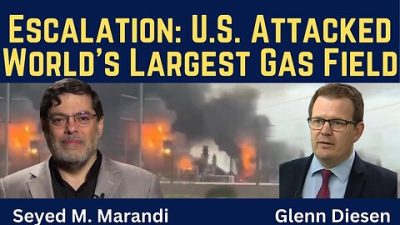
Marandi: US attacked world’s largest gas field & Iran declares economic war
or go to
Aletho News Archives – Video-Images
From the Archives
Why the UK, the EU and the US Gang-Up on Russia
By James Petras :: 03.20.2018
Introduction: For the greater part of a decade the US, the UK and the EU have been carrying out a campaign to undermine and overthrow the Russia government and in particular to oust President Putin. Fundamental issues are at stake including the real possibility of a nuclear war.
The most recent western propaganda campaign and one of the most virulent is the charge launched by the UK regime of Prime Minister Theresa May. The Brits have claimed that Russian secret agents conspired to poison a former Russian double-agent and his daughter in England, threatening the sovereignty and safety of the British people. No evidence has ever been presented. Instead the UK expelled Russian diplomats and demands harsher sanctions, to increase tensions. The UK and its US and EU patrons are moving toward a break in relations and a military build-up.
A number of fundamental questions arise regarding the origins and growing intensity of this anti-Russian animus.
Why do the Western regimes now feel Russia is a greater threat then in the past? Do they believe Russia is more vulnerable to Western threats or attacks? Why do the Western military leaders seek to undermine Russia’s defenses? Do the US economic elites believe it is possible to provoke an economic crisis and the demise of President Putin’s government? What is the strategic goal of Western policymakers? Why has the UK regime taken the lead in the anti-Russian crusade via the fake toxin accusations at this time?
This paper is directed at providing key elements to address these questions. … continue
Blog Roll
 Aletho News
- Iran War Is Accelerating the End of US Dominance
- FBI Resumes Buying Americans’ Location Data Without Warrants
- IDF threatens ‘elimination’ for Russian leaders who ‘wish Israel ill’
- Attacks on enemy energy facilities not over yet, strikes ongoing: Iran
- US dragged by Israel into ‘unlawful war’ with Iran – Gulf state
- Israel’s War on Iran’s Grid: How the South Pars Strike Turned Energy into a Weapon
- War on Iran to impose trillion-dollar ‘Israel First Tax’ on US citizens: Araghchi
- The State Is Socializing the Cost Of the Iran War
- Seyed M. Marandi: U.S. Attacked World’s Largest Gas Field & Iran Declares Economic War
- Washington’s War on Cuba Is Older Than You Think
- If Americans Knew
- Trump: Israel attacked Iranian gas field without US knowledge. No more such attacks!
- America’s friends must help extricate it from an unlawful war
- Democratic Nat’l Committee’s Kneejerk Backing of Israel Is Political and Moral Failure
- Major revelations from former counterterrorism chief Joe Kent’s extensive interview
- More than half of Palestinian child detainees have no charges
- Grieving Parents in Iran Spend Every Night at the Graves of Their Children, Killed by U.S. Strike
- War on Iran spins out of control, Palestine struggles – Not a ceasefire Day 160
- How ignorance, misunderstanding and obfuscation ended Iran nuclear talks
- Israeli media reports grotesque settler attack in West Bank
- UK security adviser attended US-Iran talks and judged deal was within reach
- No Tricks Zone
- Energy Expert: Germany’s Nuclear Phaseout Was A “500 Billion Euro Mistake”
- New Research: South Australia’s Mid-Holocene Sea Surface Temperatures Were 4°C Warmer Than Today
- Storing Green Energy To Last Germany 10 Days Would Require A 60-Million Tonne Battery
- New Studies: UK Sea Levels Were 4 Meters Higher Than Today During The Mid-Holocene
- Destructive Green New Deal: German Energy And Metal Group Warns Of Drastic Crisis
- New Study Documents A 20-Year Pause In Arctic Sea Ice Decline – Driven By Internal Variability
- Wake-up Call: Survey Shows Majority Of Germans Now Favor Postponing Climate Targets!
- Televised! Leading German Political Candidate Tells Schoolchildren CO2 Makes Sun Hotter!
- New Study: A Century Warming Of 1.1°C Is ‘Commonplace’ And ‘Not Unusual’ During This Interglacial
- New Study: ‘Internal Noise’ And Volcanic Forcing Can Trigger 10-15°C Warming Within Decades
 Aletho News