Military bloat and empire as a way of life
Recalling William Appleman Williams final work
By Patrick Mazza | The Raven | June 3, 2023
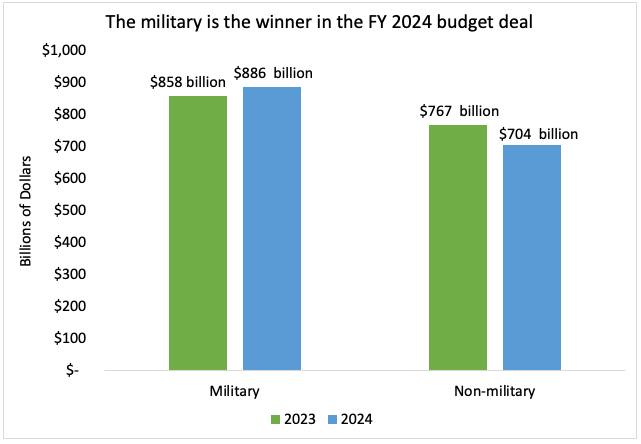
Once again, while other needs are squeezed, a federal budget deal will literally starve the poor to feed the military. While new work requirements are placed on SNAP recipients that will drive some from the food support program, the military budget (never call it defense) remains untouched. The recent debt ceiling deal leaves Joe Biden’s $886 billion 2024 Pentagon budget request intact while domestic programs are slashed. The above graph from the National Priorities Project tells the story.
In real terms it is the largest military budget in U.S. history, the only exceptions being World War II and the height of the Iraq and Afghanistan wars that came after 9-11. Larger by far than during the Korean and Vietnam Wars, or the Reagan military buildup. Again, from the National Priorities Project:
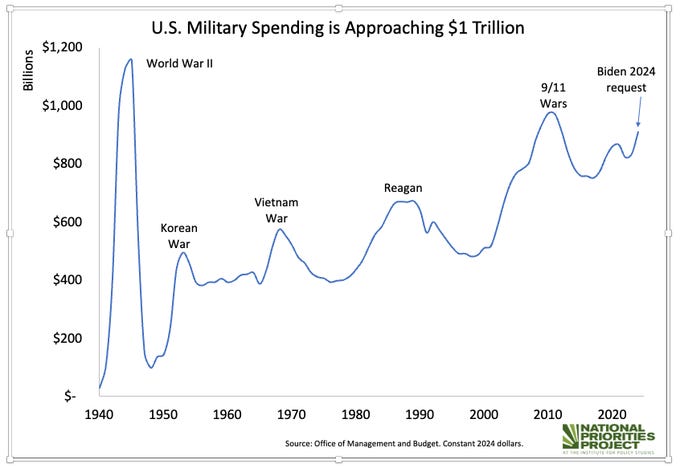
The real military budget is even higher. Adding in nuclear weapons, foreign military aid and “intelligence,” the project puts the current 2023 budget at $920 billion. That is still an undercount. William Hartung, an expert on military spending, calculates that even in fiscal year 2020 the total military expenditure was $1.25 trillion, adding in other costs such as support for veterans and debt service. It’s easily pushing $1.5 trillion by now.
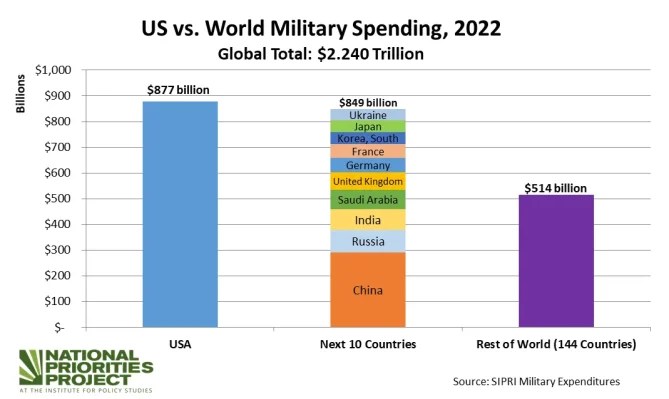
The U.S. by far is the biggest military spender on Earth, with 39% of the total, exceeding the next 10 nations combined, as this chart shows:
Most warlike nation
So why is the military budget so unassailable? Why, no matter how often bloated military spending is denounced, does the budget climb toward ever greater heights? Even after Dwight Eisenhower made the famous warning in his farewell address:
“In the councils of government, we must guard against the acquisition of unwarranted influence, whether sought or unsought, by the military-industrial complex. The potential for the disastrous rise of misplaced power exists and will persist. We must never let the weight of this combination endanger our liberties or democratic processes. We should take nothing for granted. Only an alert and knowledgeable citizenry can compel the proper meshing of the huge industrial and military machinery of defense with our peaceful methods and goals, so that security and liberty may prosper together.”
Ike would have known, being one of the progenitors of that complex as the general leading U.S. forces that invaded Europe during D-Day and as the president during the nuclear buildup of much of the early Cold War. One clue as to why his warning went unheeded is in the fact he originally wanted to call it the military-industrial-congressional complex, the “iron triangle” that keeps pumping up military expenditures. As Hartung writes, Congress is bought by the weapons industry. It is a kind of money laundering scheme where increased military spending comes back as campaign donations, a perfect example of the legalized bribery that is the real governing system of the U.S.
But there are deeper reasons, explaining why that “alert and knowledgeable citizenry” for which Ike called has never appeared, at least to the level able to tie back the power of the complex. War and militarism are rooted deep in the U.S. of American experience. As former President Jimmy Carter said, “If you go around the world and ask people which is the most warlike country on Earth, which one do you think they would respond? The United States. Since we left the Second World War, and even before, the United States has constantly been at war in some part of the world. We’ve been in about 30 combats with other countries since the Second World War . . . So I would say that the military-industrial complex, the manufacturers of all kinds of weapons, are very influential in the country and the Congress as well.”
Carter noted that the U.S. hasn’t been at war with someone only 16 years of its 242-year history. (Even that is doubtful since even during Carter’s so-called peaceful years the U.S. was stirring up trouble in Afghanistan in a successful effort to give the Soviets “their own Vietnam,” as his National Security Adviser, Zbignew Brzezinski, has confessed.) The list is extensive. If the U.S. was not fighting with some European or Asian power, it was warring on some native nation or another on the frontier. War has worked for the United States, historian Geoffrey Perrett noted in his 1989 history of major U.S. conflicts, Country Made by War.
“Since 1775 no nation on Earth has had as much experience of war as the United States: nine major wars in nine generations. And in between the wars have come other armed conflicts such as the Philippine insurgency and clashes in the Persian Gulf. America’s wars have been like the rungs on a ladder by which it rose to greatness. No other nation has triumphed so long, so consistently, or on such as vast scale, through force of arms.”
Although conflicts since World War II have not been so successful, nonetheless they failed to dislodge the fundamental U.S triumph in that war, which left it overwhelmingly dominant over all other powers, each of which had been ravaged in the war. As historian Alfred McCoy noted in his recent work, To Govern the Globe, it left the U.S. in the unprecedented position of holding sway on both European and Asian ends of Eurasia. If this hegemony is eroding with the rise of China and other powers, the U.S. still remains in a powerful position.
To all this one must ask the more fundamental question. Why has the U.S. been the most warlike, most continually at war? For the answer we can look to historian William Appleman Williams and the title of his final book which summarized his substantial life work, published in 1980, Empire as a Way of Life. Williams was the dean of what came to be known as the revisionist school of U.S. history that penetrated the myth of American exceptionalism with the facts of history, that the U.S. was an empire from its colonial roots, and behaved much as any other empire.
First let Williams define his terms. “. . . a way of life is the combination of patterns of thought and action that, as it becomes habitual and institutionalized, defines the thrust and character of a culture and society.” Then, empire, a system in which, “The will, and power, of one element asserts its superiority.” In some cases empire “concerns the forcible subjugation of formerly independent people by a wholly external power.” Such as native peoples or those who lived in the former northern half of Mexico.
Williams does not let the mass of U.S. of Americans off. We are enmeshed in the ways of empire.
“Empire became so intrinsically our American way of life that we rationalized and suppressed the nature of our means in the euphoria of the enjoyment of the ends . . . It is perhaps a bit too extreme, but only by a whisker, to say that imperialism has been the opiate of the American people.”
The U.S. was “born and bred” of another empire, the British. “The 19th– and 20th-century empire known as the United States of America began as a gleam in the eyes of various 16th century critics of, and advisers to, Elizabeth I,” Williams explains. At that time, “England was then a backward and underdeveloped small island” outclassed by other powers emerging in the Atlantic fringe, Portugal, Spain, France and The Netherlands, who were already commencing the age of European world conquest.
England concluded that “domestic welfare and social peace required vigorous imperial expansion,” and began first by consolidating the internal empire on the British Isles in Scotland and Ireland, and then in the 1600s expanding to the North American coast. “. . . the most significant aspect of the empire was the success in transforming the American colonies from tiny, insecure outposts into dynamic societies generating their own progress . . . It produced another culture based on the proposition that expansion was the key to freedom, prosperity, and social peace.”
Inevitably, tensions rose between the ruling class of the home isles and the rising elites of the colonies. Benjamin Franklin believed the weight of development would eventually move the center of the British Empire to North America (which it finally did in 1945, but that comes later in the story), and until nearly the time of the split recommended that course. “But the British feared that such a policy would lead to the loss of control and profits, and Americans increasingly asserted their own claims to their own empire,” Williams writes.
That culminated in the Revolutionary War and the successful creation of the United States. But a weak central government seemed unable to fully press forward what George Washington would call “a rising empire” – the founders were not shy about using that kind of language. It appeared the union would fray into two or more nations, while uprisings such as Shay’s Rebellion threatened to shatter social peace. So the new national elites came together to create a framework to ensure continued expansion under a strong central government, the Constitution. Writes Williams, “. . . the Constitution was an instrument of imperial government at home and abroad.”
The Constitution was founded on a clever turnaround of a fundamental political understanding architected by one of its key authors, James Madison. The general belief to that point had been exposited by French political philosopher Montesquieu “that liberty could only exist in a small state. Madison boldly argued the opposite: that empire was essential for freedom.” Madison needed to make that argument because many citizens of the new nation, burned by their experience with Britain, wanted nothing to do with a strong central government.
Madison made his case in a letter to Thomas Jefferson. “This form of government, in order to effect its purpose, must operate not within a small but extensive sphere . . . Extend the sphere, and you take in a greater variety of parties and interests; you make it less probable that a majority of the whole will have a common motive to invade the rights of other citizens; or if such a common motive exists, it will be more difficult for all to feel it . . . to act in unison with each other.”
Williams writes, “He was arguing that surplus social space and surplus resources were necessary to maintain economic welfare, social stability, freedom and representative government.” A strong central government would be needed to expand land for agriculture, to expand and protect exports, and to promote manufacturing.
With the Louisiana Purchase and the Lewis & Clark Expedition to the Pacific, Jefferson fully embraced Madison’s understanding. “I am persuaded that no constitution was ever before as well calculated as ours for extensive empire and self-government,” he said as he left the presidency. “Jeffersonian Democracy, as it came to be called, was a creature of imperial expansion,” Williams writes. “He, perhaps even more than Madison, established it as a way of life, and most Americans embraced it because it gave them personal and social rewards.”
So much for the “alert and knowledgeable citizenry.”
“. . . once people begin to acquire and enjoy and take for granted and waste surplus resources and space as a routine part of their lives,” Williams writes, “and to view them as a sign of God’s favor, then it requires a genius to make a career – let alone a culture – on the basis of agreeing upon limits. Especially when several continents lie largely naked off your shores.”
The myth of empty continents and the racism it embodies has always been part of the story. “Racism . . . began and survived as a psychologically justifying and economically profitable fairy tale. It provided the gloss for the harsh truth that empire . . . is the child of an inability or unwillingness to live within one’s own means. Empire as a way of life is predicated upon having more than one needs.”
Next: Coming installments will review how imperial expansionism is rooted in a misguided sense of mission and compulsive drive for security, and how empire as a way of life continued to unfold after the era of the founders.
No comments yet.
Featured Video
Ted Postol: Fraud of Missile Defence Exposed in Iran War
or go to
Aletho News Archives – Video-Images
Frlom the Archives
Containing the United States
By Edward S. Herman | Z Magazine | September 2016
“Containing the United States” is, of course, a ridiculous and self-contradictory idea in the U.S. and Western ideological and propaganda system. We all know that the United States had to “contain” the Soviet Union from 1945 to 1991, and since then has had the task of containing Russia and China. Only they threaten, bully, aggress and worry countries like Poland and Vietnam. Obama has had to reassure them both of our steadfast stand against Russian and Chinese military attacks. NATO has, of course, expanded greatly over the past several decades, despite the deaths of the Soviet Union and Warsaw Pact, but only to contain the renewed Russian — and Iranian, Libyan, Syrian and other — military threats; and we have “pivoted” to Asia, supported Japanese rearmament, bolstered our own forces in that area and jousted with the Chinese in their coastal waters solely to contain China. Earlier we had been obliged to contain North Vietnam, or was it the Soviet Union in Vietnam? Or China? Or “communism”? Or maybe all of them? Or none of them, but just needing an excuse to enlarge power?
The parallel propaganda has taken many forms. One is accepting as a premise that the United States only acts defensively and has no internal forces and interests that drive it to enlarge its sphere of control. I noted in an earlier article how Paul Krugman claims that internal Russian problems may well be the explanation of Russian “aggression,” but how at the same time it never occurs to him that the huge U.S. transnational corporate interests and “defense” establishment, and the pro-Israel lobby’s activities, might possibly make for an expansionist dynamic here.2 This reflects the standard establishment perspective that we are good and only react to evil. This was the view sustaining and justifying the invasion and occupation of Iraq from 2003. That attack was taken here as not evil but a response to evil, even if involving lies and mistakes, hence not describable as “aggression.” … continue
Blog Roll
 Aletho News
- Trump press conference reveals a man who wants out of war
- When Tel Aviv decides, Washington fights
- Top official: Iran ready for a long war with US, no more diplomacy
- How Iran’s Toxic Rain Reveals US-Israel Discord
- Trump Admits He Is Destroying Iran For Israel
- Iran’s latest move in the GCC countries was a stroke of genius
- Blackmail and death threats, Zelensky embarrasses the EU, but there’s no condemnation
- Israel threatens to kill Iran’s new leadership
- Possible Scenarios for the Middle East
- The Horizon of the War. “Italy is being Dragged Into the War against Iran”
- If Americans Knew
- Lebanon: Israel’s White Phosphorous Use Risks Civilian Harm
- Corporate Media Go All Out To Support The US-Israeli War On Iran
- US-Israel war on Iran is creating a steady growing number of amputees
- Israel planned this war on Iran for 40 years. Everything else is a smoke screen
- The wrong question about the war in Iran
- ‘Your Tax Dollars Being Used to Raise Your Gas Prices’: US-Israel Bomb Major Iranian Oil Depots
- ‘Bogus Evidence’: Former Nuclear Watchdog Head Debunks US Justification for Iran War
- EXPLAINER – Dimona: What to know about Israel’s nuclear site
- Fires and toxic air in Iran (thanks, Israel) – Not a ceasefire Day 150
- At Israel’s hands, Iran is burning, Lebanon and Gaza are crumbling – Not a ceasefire Day 149
- No Tricks Zone
- Wake-up Call: Survey Shows Majority Of Germans Now Favor Postponing Climate Targets!
- Televised! Leading German Political Candidate Tells Schoolchildren CO2 Makes Sun Hotter!
- New Study: A Century Warming Of 1.1°C Is ‘Commonplace’ And ‘Not Unusual’ During This Interglacial
- New Study: ‘Internal Noise’ And Volcanic Forcing Can Trigger 10-15°C Warming Within Decades
- Glaciers Worldwide Are Suddendly Surging, Experts Blame Warming!
- Surprising Discovery: Sahara Is Greening…Billions Of Trees Where Once Thought To Be Barren
- New Research Reaffirms Clouds, Aerosols, And Surface Solar Radiation Are ‘Driving The Climate System’
- Germany: Electric Car Catches Fire At Charging Station, Sets Off Local “Inferno”, Widespread Damage
- New Study: Canada’s New Brunswick Was 1°C Warmer Than Today During The Medieval Warm Period
- Coal Power Back In Trend As Globe Tries To Keep Pace With Growing Demand For Power
 Aletho News
Leave a comment