Iran inks defense deal with Russia ally Belarus
The Cradle | August 2, 2023
Iran and Belarus signed a defense agreement on 31 July, enhancing the already existing cooperation between the two countries.
Iranian Defense Minister Mohammad Reza Ashtiani signed a memorandum of understanding with his Belarusian counterpart Viktor Gennadievich Khrenin during a meeting in the Iranian capital.
The two officials held discussions on a number of topics, including the war in Ukraine, Iranian media reported.
“Belarus holds a special place in Iran’s foreign policy,” the Iranian defense minister said.
The news was also confirmed on social media by the Belarusian defense ministry.
The agreement comes as the two countries have been exploring prospects for military cooperation, particularly in relation to drone technology and the production of Iran’s Shahed drones, which last year appeared on the Ukrainian battlefield.
In May, a delegation of Iranian engineers sponsored by Moscow visited Belarus to study the idea of producing Shahed drones there.
Months earlier, Belarusian President Alexander Lukashenko visited Iran for talks with his Iranian counterpart.
Belarus is considered one of Russia’s most strategic economic and political allies. Last month, Lukashenko announced that Russia was deploying nuclear warheads to Belarus in the first transfer of such weapons outside of Russia since the fall of the Soviet Union.
The boost in Iranian-Belarusian defense ties comes as the eastern European nation has followed in the footsteps of Iran and many other countries in applying to join the BRICS group, a rapidly expanding economic partnership between nations with emerging economies that aims to create an alternative to the dominant western-led financial system.
It also comes in the wake of a defense deal between Iran and Bolivia, which was latest Latin American country to sign a defense deal with the Islamic Republic, following in the footsteps of Nicaragua and Venezuela.
Following the signing of the defense deal between Iran and Bolivia last week, US National Security Council Coordinator for Strategic Communications, John Kirby, told Voice of America (VOA) that Washington is concerned about the export of Iranian technology and its “destabilizing” role.
In response, former Bolivian president Evo Morales condemned the “interventionist attitude” of the US towards deal.
“We emphatically condemn the interventionist attitude of the US that, with double standards, tries to question Bolivia’s interest in acquiring drones from Iran. The same country that uses these remote-controlled aircraft as a weapon of war tries to prevent other states like Bolivia from using them for security tasks and the fight against drug trafficking,” he said.
US Arms Firms Reportedly Given $9.7 Billion to Replace Weapons Sent to Ukraine
Sputnik – 01.08.2023
The US defense contractors have received nearly $10 billion in new Department of Defense weapons orders to replace systems sent as aid to Ukraine, US media reports said.
Citing official Defense Department figures released Tuesday, US media reported the Pentagon has currently used $9.7 billion to replenish its depleted weapons and ammunition stockpiles, out of a total $26 billion already approved for that purpose by the US Congress.
Lockheed Martin is already getting almost $2.3 billion of a potential $6 billion committed to it as well as $1.4 billion out of an eventual total $1.9 billion more for its joint venture with RTX, previously known as Raytheon Technologies to refill its arsenal of Javelin anti-armor weapons, media said.
Lockheed is also expected to receive $1.4 billion of a potential $5.2 billion to replace guided missiles for the Guided Multiple Launch Rocket System (GMLRS). RTX will reportedly get another $844 million to replace the Patriot PAC-3 MSE anti-aircraft and anti-missile systems that have been sent to Ukraine.
RTX will get $581 million of a potential $624 million to replace US armed forces supplies of Stinger anti-aircraft missiles and Congress also has appropriated $18.6 billion to provide for Ukraine’s long-term defense needs. So far, $7 billion of that money has been obligated to US companies, the report added.
RTX reportedly has Pentagon commitments for $1.2 billion of a potential $1.4 billion to supply Ukraine with its long-range NASSAM air defense systems. General Dynamics and other contractors companies will receive $901 million out of a likely $1.4 billion to supply Kiev with more 155mm howitzer ammunition.
US journalist missing after trying to flee Ukraine
RT | August 2, 2023
Chilean-American reporter Gonzalo Lira, who claimed to be about to attempt to flee Ukraine after being subjected to physical abuse and extortion in custody, has gone missing, a source confirmed to RT.
Lira, a vocal critic of the Ukrainian government, resurfaced this week, months after being arrested by the nation’s security service, the SBU. In a series of posts on Twitter and YouTube, he stated his intention to cross the border into Hungary and apply for political asylum there.
He claimed that since early May he had been kept incommunicado in pre-trial detention. He said he was deprived of sleep as well and beaten and tortured by other inmates on instructions from the prison authorities.
Lira apparently never made it to the other side of the border. Mark Sleboda, a political expert and frequent guest at RT, confirmed to the channel that Lira was stopped on the Ukrainian side and has not been heard from since.
Lira said that he had been released on bail and told not to leave the city of Kharkov. However he added he was given his passport back and an electronic shackle was not put on him, contrary to the formal terms of his conditional release.
“Maybe I’m being set up by them so they can justify putting me away in a labor camp – so no one will ever know about their sordid extortion scheme,” he said. “I simply don’t know.”
If he made it across the border, he said he expected Ukraine to issue an international arrest warrant for him for skipping bail and that he hoped that Hungary would be willing to defy Kiev and not hand him over, unlike other EU nations.
“If you don’t hear from me in the next 12 hours—whelp! I’m on my way to a labor camp!” he concluded. There have been no further updates on his social media since.
Lira has been accused by Ukraine of “publicly justifying” the Russian military operation and “disseminating fakes [false stories] about the war in Ukraine”. He said the charges were bogus and that he did nothing but explain his opinions about Kiev’s policies and report what was happening in Ukraine.
…
…
Western media suggests that Zelensky could be assassinated
By Lucas Leiroz | August 2, 2023
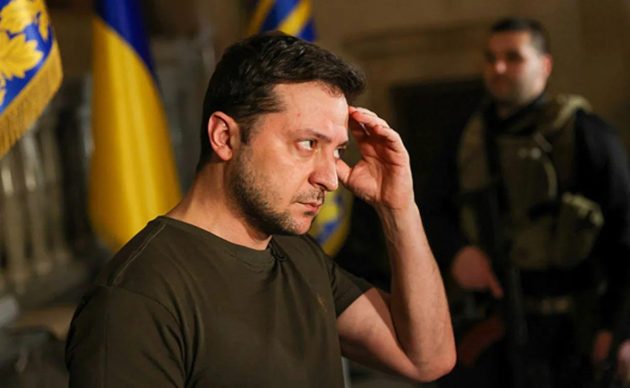
In an article recently published by Politico, it was said that Kiev already has a secret plan in case the Ukrainian president is assassinated. Although it is normal for countries at war to think about the possibility of their leaders dying, the way that media is reporting the case suggests a kind of attempt to prepare public opinion for Zelensky’s replacement.
The report was based on interviews with Ukrainian officials and analysts. The sources believe that it will be necessary to circumvent Ukrainian constitutional norms if there is a need to replace Zelensky. The country’s constitution declares that if the president is no longer able to fulfill his duties, the head of parliament must ascend to the office. However, the current parliamentary leader, Ruslan Stefanchuck, is an unpopular public figure, with only 40% approval, which is why it would be inappropriate to appoint him president.
To handle this situation, Kiev plans to create a team of officials, forming a governing council. The office would consist of people like Andrey Yermak, head of the presidential cabinet, Foreign Minister Dmitry Kuleba, Defense Minister Aleksey Reznikov and Ukraine’s military chief Valery Zaluzhny. Stefanchuk would be the formal leader of the group, but decision-making power would be shared with the other officers.
Informants argue that Ukraine achieved high levels of national unity during the conflict. This “unity” supposedly gave stability to the state, guaranteeing an institutional security independent of Zelensky or any individual politician. For this reason, in the current scenario no Ukrainian officer seems “indispensable”.
“(…) I don’t think it [Stefanchuck’s popularity] matters. There’s a strong leadership team and I think we would see collective government (…) The country has reached a point of very substantial solidarity and national unity, so if something terrible happened to Zelensky it would not be as decisive as you might think (…) I don’t want to say that Zelensky is hardly irrelevant to this (…) But I think the country’s unity is the indispensable thing”, Adrian Karatnycky, “a nonresident senior fellow with the Atlantic Council”, told Politico’s journalists.
In fact, this report leaves a series of unanswered questions. It does not seem surprising that Kiev actually has such plans, as certainly Ukrainian institutional security is a priority for the regime’s officials, especially in times of war. What seems unlikely is that these plans are easily accessible to journalists and public opinion.
Being a sensitive topic, relevant to national security, it is most appropriate that these discussions be taken in absolute confidentiality, with no possibility of information leaks. Discretion becomes even more necessary when these plans involve maneuvers to circumvent the constitution, violating the laws of the country.
So, it is necessary to think about what would be the interests of the Western media in spreading this type of information. It is possible, for example, that news agencies are trying to “prepare” global public opinion for an eventual replacement of Zelensky. There have been rumors for some time that NATO plans to remove the Ukrainian leader from power, given his discredited and deteriorated image. Zelensky is seen less and less as a “hero”, being classified by many as a “beggar” and a “loser“. Thus, putting a new politician in power could be beneficial to NATO’s plans to prolong the war, as it would generate more popular support in the West for the military assistance policies.
However, what is really curious is the fact that the article mentions the hypothesis of murder. This raises the possibility that Western intelligence is planning not only to replace but also to kill Zelensky. This would certainly be useful for the West to accuse Russia of having committed the crime, creating a false flag situation to move public opinion and justify new military measures in support of Kiev.
In the article, Politico reminds a series of recent requests made by Russian citizens calling for Zelensky’s elimination in retaliation for the terrorist attacks in Moscow and other Russian cities. Despite such requests being real, the Russian government has never shown an interest in doing so. These were just sincere expressions on the part of the Russian people, emotionally affected by the Ukrainian terror. No strategic guidelines to actually kill Zelensky were adopted.
The article, however, seems to want to show that Moscow has such a plan. Thus, western readers are prepared to have a preconceived opinion if future news confirms Zelensky’s death. This is a well-known psychological and informational warfare tactic used frequently by the West.
So far, the only side that has shown interest in replacing Zelensky has been the West itself, which wants to put in his place someone more competent to lead the regime. For Moscow, it is irrelevant who is in power in Kiev, Russian interest being only to force Ukraine to accept its peace terms, regardless of whether it is Zelensky.
Lucas Leiroz is an journalist, researcher at the Center for Geostrategic Studies, geopolitical consultant.
Australia’s Draconian “Misinformation” Bill Threatens to Usher in Unprecedented Era of Illiberal Double Standards
By Christina Maas | Reclaim The Net | July 31, 2023
The Australian Government’s tyrannical Communications Legislation Amendment (Combating Misinformation and Disinformation) Bill 2023 is facing formidable resistance from the Victorian Bar, as it sounds the alarm over a grave assault on freedom of speech and expression.
This Orwellian legislation, pushed by the communications minister since January, seeks to arm the Australian Communications and Media Authority (ACMA) with oppressive powers to tackle online “misinformation and disinformation.” Its draconian provisions include a mandate for the ACMA to hawkishly monitor progress in stifling online “misinformation” on various digital platforms, and enforce industry standards designed to muffle free speech under the guise of fighting disinformation.
The Victorian Bar has courageously voiced “serious objections” to this bill in a recent deposition to the Law Council of Australia. Their argument? The bill woefully neglects to respect the sanctity of free expression and associated privacy rights.
Victorian Bar president, Sam Hay KC, drove home the significance of this protest, underscoring the Bar’s trepidation about the invasive impact of the proposed bill on free speech and privacy. The Bar is particularly concerned about the threat to freedom of speech, calling it “the lifeblood of democracy.”
The Bar’s thorough critique continues, predicting a wave of self-censorship as users of online services retreat in fear of being branded as purveyors of misinformation. The bill’s very necessity is challenged, as it points out the effectiveness of recent countermeasures against the propagation of online falsehoods.
The Bar paints a grim picture of the bill’s proposed solution, arguing it could worsen the problem by alienating those already suspicious of the state and marginalized in small online communities. It cautions against a silencing approach and promotes persuasion and the dissemination of accurate information as a counter to misinformation.
They raise the issue of an “illiberal double standard,” potentially advantaging government supporters at the expense of critics. Moreover, the Bar criticizes the bill’s vague and impracticable definition of misinformation. While they say they recognize a need to counter harmful online information, the Victorian Bar takes a stand, asserting the proposed measures are disproportionately intrusive and likely ineffective against their intended targets.
‘Facebook Files’ Reveal Despicable Disregard for the Constitution
By Ron Paul | July 31, 2023
Last week’s revelation that Facebook took orders from the Biden Administration to censor even accurate information about Covid is the latest example of the US government’s disregard for our Constitution. Thanks to Rep. Jim Jordan, Chairman of the House Judiciary Committee, we now know the extent to which the Biden Administration went in its proxy war against the First Amendment.
Getting the information wasn’t easy. It was only after Facebook founder Mark Zuckerberg was threatened with being held in contempt of Congress that he relented and shared information with the Judiciary Committee about Biden Administration pressure to censor Americans on Facebook who disagreed with White House policy on Covid.
What we have discovered thus far is disgusting. For example, in April 2021, a Facebook employee sent a message to top executives in the company complaining that, “we are facing continued pressure from external stakeholders, including the [Biden] White House” to remove posts. In another example, senior executive Nick Clegg complained that Andy Slavitt, a Senior Advisor to President Biden, was “outraged… that [Facebook] did not remove” a particular post, according to Rep. Jordan’s report.
Rep. Jordan revealed that the “offending post” that the Biden Administration wanted removed was simply a joke making fun of possible vaccine injury down the road. The Biden Administration even wanted to “protect” us from jokes that it didn’t like.
The Administration did not stop at targeting what it called “misinformation.” As Constitutional Law Professor Jonathan Turley noted in a recent column, “the administration also demanded the removal of ‘malinformation’ that is ‘based on fact, but used out of context to mislead, harm, or manipulate.’” So the Biden Administration wanted to “cancel” even truthful information counter to its own preferred narrative.
This level of contempt for our Constitution is shocking. As Robert F. Kennedy, Jr. – who was himself censored at the behest of the Biden Administration – testified recently before Congress: “A government that can censor its critics has license for every atrocity. It is the beginning of totalitarianism.”
Who knows how many thousands of Facebook accounts were banned or restricted at the behest of the Biden White House. Early last year I received notice that my own Facebook Page was “restricted” for 90 days because I pointed out that the CEO of Pfizer once claimed that his Covid shot was “100 effective” but later changed his story. The post was completely accurate but still my page was targeted.
Although some are using this information for partisan gain against the Democrats in power, Americans should not delude themselves: left unchecked, there is little reason to believe a Republican Administration would show any more respect for the Constitution than the Biden Administration. Both parties have shown themselves to be selective in their pledged oath to uphold and defend the US Constitution.
It is just as unconstitutional – and thus illegal – for the US Government to violate the First Amendment by proxy – through so-called private companies – as if the government directly attacked our free speech. We must remember that the unprecedented US government censorship of Americans during Covid was just the test run. Be assured that when the next “crisis” comes – and it will – the authoritarians in charge will again ramp up the censorship machine unless we do something about it.
Copyright © 2023 by RonPaul Institute
Musk’s X Corp. Sues Authors of ‘Disinformation Dozen’ Report Over ‘Scare Campaign’ to Chase Away Advertisers
RT | August 1, 2023
X Corp – the company formerly known as Twitter – filed a lawsuit against the UK-based nonprofit Center for Countering Digital Hate (CCDH) on Monday, accusing the NGO of seeking to stifle free expression and open discussion on X’s platform by scaring away advertisers.
Describing the CCDH as an “activist organization masquerading as [a] research agenc[y], funded and supported by unknown organizations, individuals, and potentially even foreign governments with ties to legacy media companies,” the suit accuses the group of initiating a “scare campaign to drive away advertisers” – whose funding X requires to continue to operate its platform as a free service.
In a blog post accompanying the suit, X also accused the CCDH of “targeting people on all platforms who speak about issues the CCDH doesn’t agree with, attempting to coerce the deplatforming of users whose views do not conform to the CCDH’s ideological agenda, targeting free-speech organizations by focusing on their revenue stream to remove free services for people, [and] attempting to illegally gain unauthorized access to social media platform data and to misuse that data.”
The censorship advocate also “scraped” X’s platform, slurping up all available data – something X’s terms of service forbids – and illegally accessed X’s data via a borrowed login from advertising analytics platform Brandwatch, according to the suit. This data was then used “out of context” to claim a “surge in harmful content” had driven advertisers away from X, it states.
The unnamed Brandwatch user who assisted the CCDH is among the 50 ‘John Doe’ defendants listed in the suit – co-conspirators X claims is working with CCDH to sabotage X, explaining their real names will be added as their true identities are discovered.
X does not put a dollar value on the amount CCDH’s “research” has cost it, referring only to “at least tens of millions of dollars” and demanding that the censorship advocate cease using the stolen data.
CCDH CEO Imran Ahmed dismissed Musk’s claims, telling CNN the lawsuit “sounds a bit like a conspiracy theory to me” and accusing the billionaire of blaming Ahmed for “his own failings as a CEO.” The CCDH has repeatedly alleged that Musk has made X a haven for bigotry, most recently airing its claims in a July 19 Bloomberg article that asserted: “hate speech towards minority communities increased” under his leadership.
The lawsuit came less than 24 hours after the CCDH published a letter from what was then known as Twitter, dated July 20, accusing the NGO of “regularly” making “inflammatory, outrageous, and false or misleading assertions about Twitter and its operations,” while positioning such assertions as scientifically-rigorous “research.” The CCDH countered that Twitter was trying to “silence honest criticism” via legal intimidation.
Gaslighting Gaza: Israel’s deceptive extraction approval prioritizes economics over politics
The Cradle | August 1, 2023
A significant breakthrough has emerged as the Hamas authorities in the Gaza Strip have expressed their willingness, in principle, to grant the Fatah-led Palestinian Authority (PA) access to a natural gas field off the Gaza coast.
This groundbreaking development comes as part of a US-brokered deal that involves the PA, an Egyptian gas company, and Israel. If the plans proceed, the potential benefits are far-reaching, holding the promise of bolstering the economy and improving living standards in the besieged Gaza Strip.
Moreover, this agreement opens up the possibility of indirect negotiations between Hamas and the Israeli occupation, following a path similar to the recent developments in neighboring Lebanon. Notably, Hezbollah has given its approval for the Lebanese government to engage in talks with Israel over maritime demarcation lines, while asserting the country’s rights to its natural resources and threatening the use of force to secure it. It appears that Hamas may now be inclined to adopt a pragmatic approach, mirroring Lebanon.
Israeli green light for Gaza gas field
In parallel with the Israeli government’s decision to delegate enhanced powers to pro-settler Finance Minister Bezalel Smotrich, aimed at expediting settlement procedures, Israeli Prime Minister Benjamin Netanyahu’s office announced on 18 June, preliminary approval for the development of the Gaza Marine gas field.
According to the prime minister’s office, the move will place emphasis “on Palestinian economic development and maintaining security stability in the region.”
The approval paves the way for the Egyptian EGAS company to assume responsibility for the administrative and technical aspects of gas exploration, with plans to transport the gas to the Damietta station for liquefaction and subsequent export to Europe and beyond.
Notably, the agreement between Egypt, the PA, and Israel was announced in October 2022, pending Israeli approval, which has now been granted. However, the announcement did not address the share of the Gaza Strip governed by Hamas, who have remained silent on the matter. Analysts attribute this silence to a potential understanding between Hamas leadership and Egypt regarding a positive approach to the agreement.
One policy for Gaza, another for West Bank
This development poses a challenge as the resistance factions in Gaza have previously warned against any agreement that deprives the Strip’s residents of their rightful gas revenues. One Palestinian official was quoted by Reuters as saying: “We are waiting to know what exactly the Israelis have agreed to in detail. We can’t make a position based on a statement to the media.”
Hamas official Ismail Rudwan was also quoted by the news agency as saying: “We reaffirm that our people in Gaza have the rights to their natural resources.” In a rally held last September under the slogan “Our Gas is Our Right,” the factions expressed their firm stance on the matter, raising concerns about the potential repercussions.
Suhail al-Hindi, a member of the political bureau of Hamas, commented on the matter on Arabi21, saying: “In no way can Gaza be absent from this natural wealth, and every Palestinian has the right to benefit from the country’s wealth, including this field, with emphasis that the Palestinian people have the right to obtain this gas.
Al-Hindi stressed that “the Israeli occupation cannot be allowed to steal Palestinian wealth, and besieged Gaza has the right to live like all cities in the world, and for our people to enjoy their natural wealth.”
Discovered in 1999, the Gaza Marine gas field holds significant reserves, estimated at 1.1 trillion cubic feet of natural gas. The British Gas Group and its partners, Consolidated Contractors Company (CCC), were granted a gas exploration license by the PA. Located 603 meters below sea level, approximately 22 miles west of Gaza, the field has a production capacity of 1.5 billion cubic meters annually over a span of 20 years.
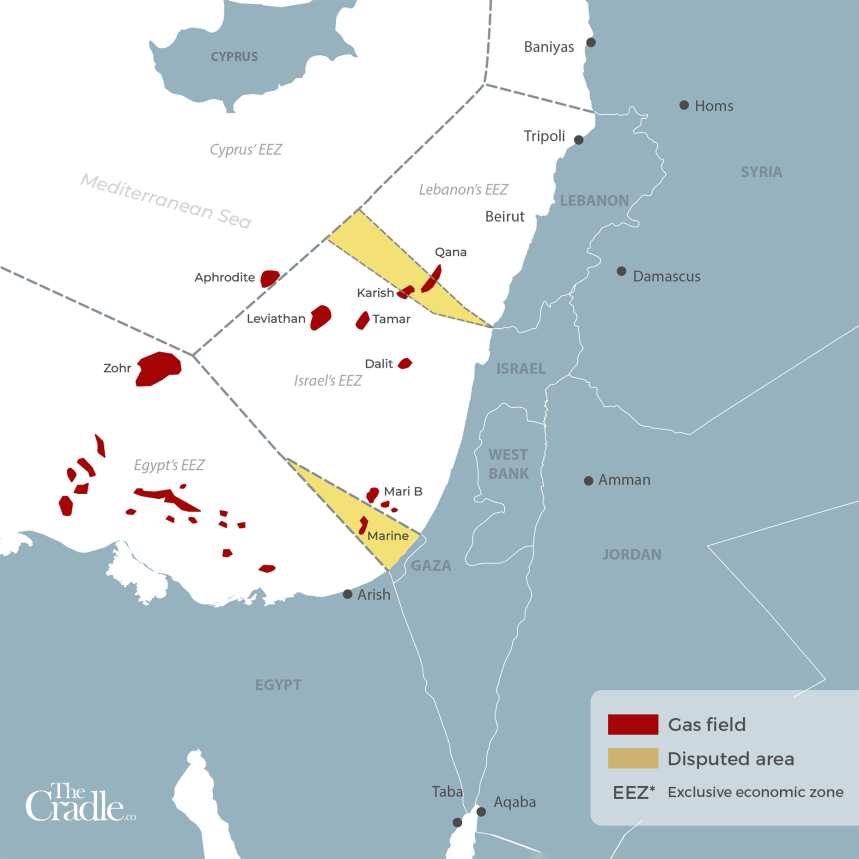
Map of gas fields east of the Mediterranean Sea
Economic analyst Muhammad Abu Jayab tells The Cradle that the US implicitly agreed to provide part of the revenues from the Gaza Marine field to Hamas, which explains why the latter did not comment on the recent agreement. According to Abu Jayab “Egypt is at the forefront as a guarantee that Hamas will deal positively with the agreement, due to Cairo’s influence on the Palestinian factions.”
Nevertheless, the Israeli approval of the Gaza Marine gas field agreement comes at a sensitive time, especially for the resistance factions, as it coincides with the establishment of over 5,000 new illegal settlement units in the face of escalating tensions in the occupied West Bank. Israeli security warnings about the potential consequences of right-wing policies and international opposition, including from the US, further compound the situation.
Plans like the E1 proposal, which connects the Ma’ale Adumim settlement with occupied Jerusalem, and effectively bifurcates the West Bank, have garnered significant criticism due to their potential to impede any future prospects for the so-called two-state solution.
Calm before the storm
Sources close to the decision-making circles of the resistance factions inform The Cradle that the Israeli approval serves as a bargaining chip to buy restraint and non-interference from Gaza Strip resistance groups in events unfolding in the West Bank and Jerusalem.
However, from the perspective of the resistance factions, the cost Israel demands exceeds the economic gains, as recent actions by Hamas underscore its commitment to prioritize resistance over financial incentives.
Mustafa al-Sawaf, a political analyst close to Hamas, tells The Cradle:
“The attack on Eli settlement, which was carried out by two members of the al-Qassam Brigades [armed wing of Hamas] on 20 June, came in response to all attempts to buy calm and silence. It was a clear message from Hamas to all regional and international parties not to dream of exchanging resistance for economic gains.”
Lessons from Lebanon
Meanwhile, political researcher Ismail Muhammad points out that all regional and international parties realize that there is no possibility of bypassing Hamas in the gas file. He explains to The Cradle that:
“The resistance in Gaza was inspired by Hezbollah’s experience in imposing its conditions and obtaining Lebanon’s rights in the Karish field. It sent clear messages, that whatever the pressures, it will not accept being an idle witness while the country’s wealth is stolen before its eyes. The most important conclusions of the Lebanese experience are that investment needs calm, and that none of the Arab or international companies will operate under the threat of fire. At least by disabling it. The resistance possesses the military capabilities that enable it not to bomb the gas fields, but rather to disrupt work in them at least.”
Gas deals: A tool for dividing Palestinians
Politically-speaking, Israel’s pursuit of gas agreements carries broader political implications beyond immediate security concerns. Political analyst Ziyad Abu Ziyad believes that Israel is leveraging these agreements to foster internal Palestinian divisions.
Egypt’s assumption of management responsibilities for Gaza Marine, in the absence of Palestinian reconciliation, and Israel’s refusal to demarcate the maritime borders with the PA, “reminds us of the solution that Israel previously proposed to the Palestinian leadership: a Palestinian state without borders.”
This approach focuses on improving the Palestinians’ economic situation by harnessing their own resources, essentially implementing an economic solution to the conflict without addressing its underlying political dimensions.
The occupation state’s approval of gas extraction from the Gaza Marine gas field has exposed the delicate balance between geopolitics, security, and economic interests in the region. As resistance factions draw inspiration from past experiences and assert their conditions, the path forward remains uncertain, casting doubt on the regional stability that Netanyahu’s office claimed would be maintained with the extraction approval.
It’s Likely That Algeria Will Play An Important Role If West Africa Descends Into War
BY ANDREW KORYBKO | AUGUST 1, 2023
“West Africa Is Gearing Up For A Regional War” as it bifurcates into two clearly defined blocs over whether to invade or defend Niger, which experienced a potentially game-changing patriotic military coup last week. The preceding hyperlinked analysis explains the rapidly emerging military-strategic dynamics more in detail, but they can be summarized as setting the stage for what might soon become the next proxy battleground in the New Cold War.
NATO supports a Nigerian-led ECOWAS invasion to reinstall Niger’s ousted leader while Russia backs Burkina Faso and Mali, which have de facto merged into a federation and jointly announced that any attack on that neighboring nation will be regarded as a declaration of war against both of them. Those two are trilaterally cooperating with Guinea, which is also under military rule like they are and just threw its political weight behind the Nigerien junta, but it’s unclear whether it’ll militarily defend it too.
The Interim President of regional military powerhouse Chad earlier traveled to Niamey in an attempt to broker a compromise that could avert war, but he appears to have been unsuccessful, though his country also hasn’t yet committed to supporting either side of this potentially coming conflict. This places Chad in a kingmaker position since its decision whether and when to intervene could greatly determine the outcome.
Amidst these fast-moving developments, Russian publicly financed international media flagship TASS confirmed on Tuesday that the Algerian Chief of Staff arrived in Moscow the day prior to meet with his host’s Defense Minister. They also added that the President visited St. Petersburg in June to attend the International Economic Forum there, during which time he met with President Putin to clinch an enhanced strategic partnership deal, while the Prime Minister was there last week for the Africa Summit.
It deserves mentioning that Russia is Algeria’s top military partner and has remained so for decades, with this relationship persisting in spite of Moscow neglecting most of Africa until just a few years ago. The Stockholm International Peace Research Institute (SIPRI) confirmed in this spring’s “Trends In International Arms Transfers” report that a whopping 73% of Algeria’s military imports from 2018-2022 were from Russia, which testifies to the enduring strength of their military ties.
Accordingly, Algeria has one of the largest, best-equipped, and most modern militaries anywhere in Africa, which is why it’s rightly regarded as among the continent’s most powerful countries. For that reason, its Chief of Staff’s latest visit to Russia in the current regional context isn’t any small matter since it suggests that Algiers intends to coordinate with Moscow regarding the wider war that might be about to break out upon the expiry of ECOWAS’ ultimatum this Sunday to reinstall Niger’s ousted leader.
Although Algeria and Russia both condemned the Nigerien coup late last week, each of their respective statements were shared prior to ECOWAS making its ultimatum that was subsequently supported by France and the US, both of which have troops in that country. The previously mentioned Burkinabe-Malian joint statement importantly warned that an invasion of Niger risks repeating the Libyan scenario by destabilizing the entire region and thus exacerbating terrorist threats to everyone.
This is an accurate assessment that justifies Russia and Algeria working together to avert that worst-case scenario and jointly coordinating their response to it if this conflict ends up becoming inevitable, thus explaining why the Algerian Chief of Staff decided to visit Russia right after his Prime Minister just did. The reason for his visit is clearly to discuss the planned NATO-backed Nigerian-led ECOWAS invasion of Niger, which also happens to border Algeria for those readers who aren’t aware.
It’s likely that Algeria will play an important role if West Africa descends into war by virtue of its geography and military prowess. At the very least, Algiers might refuse to allow French warplanes to transit through its airspace, thus forcing them to risk being fired at if they violate this possible order or find another route to Niger via Libya (which might also be formally closed off to them) or somewhere else. The point is that Algeria can greatly complicate France’s military logistics in any upcoming conflict.
Not only that, but this North African nation could allow Russia to transit through its airspace (provided that NATO doesn’t impede this through dangerous brinksmanship over the Mediterranean) to reliably supply the de facto Burkinabe-Malian federation with arms, food, and whatever else it might need. In a sense, this would be spiritually similar to the erstwhile Soviet Union’s intervention in support of Ethiopia during the Ogaden War when it was invaded by Somalia, though of course key differences exist.
Moving along, the other role that Algeria could play is a direct one, though it can’t be taken for granted that its leadership will feel comfortable with this since it could fear that any significant deployment towards or into Niger could be taken advantage of by its long-time Moroccan nemesis. If it decides to do so, however, then moving its forces – including air defense systems – closer to the frontier could possibly deter France and Nigeria. Should those two still attack Niger, then Algeria might intervene in its support.
The Burkinabe-Malian joint statement warning about a repeat of the Libyan scenario scares Algeria since it struggled against terrorism during what’s regarded as its “Black Decade” from 1991-2002, not to mention more recently but to a much lesser extent since the NATO War on Libya in 2011. Its objective national interests are therefore served by at the very least complicating France’s military logistics in any upcoming conflict even if it ultimately decides not to get directly involved like Burkina Faso and Mali will.
Additionally, many might not know that Algeria has consistently espoused a revolutionary ideology throughout the decades despite the radical changes in the world order since its independence. This explains why it retained ties with Russia despite the latter’s difficult decade after the USSR’s dissolution and also didn’t cut off relations with Syria over the past decade either even though the Arab League did. Algeria’s leadership thus also has an ideological interest in complicating an imperialist invasion of Niger.
Taken together, these security and ideological interests account for why the Algerian Chief of Staff just flew to Moscow. His country wants to coordinate with its strategic partner in responding to this regional crisis as well as the wider war that might soon break out. While Algeria’s role isn’t as important as Nigeria’s could be in leading the NATO-backed ECOWAS invasion of Niger nor Chad’s in possibly being the kingmaker, it’s still pretty significant and shouldn’t be ignored or downplayed.
Niger junta says France plotting to ‘intervene militarily’
AFP | July 31, 2023
Niger’s new junta on Monday accused France of seeking to “intervene militarily” to reinstate deposed President Mohamed Bazoum as tension mounted with the former colonial power and neighbours.
Bazoum, a western ally whose election just over two years ago was a watershed in Niger’s troubled history, was toppled on July 26 by the elite Presidential Guard.
Guards chief General Abdourahamane Tiani declared himself leader — but his claim has been shunned internationally and the West African bloc ECOWAS has given him a week to hand back power.
Bazoum’s PNDS party on Monday warned Niger risked becoming a “dictatorial and totalitarian regime” after a series of arrests.
On Monday morning, Oil Minister Mahamane Sani Mahamadou — the son of influential former president Mahamadou Issoufou — and Mining Minister Ousseini Hadizatou were arrested, the party charged.
The head of the PNDS’s national executive committee, Fourmakoye Gado, was also arrested, it said.
The junta had previously arrested the interior minister, the transport minister and a former defence minister, the party said.
On Sunday, French President Emmanuel Macron vowed “immediate and uncompromising” action if French citizens or interests were attacked after thousands rallied outside the French embassy.
Some tried to enter the compound but were dispersed by tear gas.
‘Plotting intervention’
The junta on Monday accused France of plotting an intervention.
“In its search for ways and means to intervene militarily in Niger, France with the complicity of some Nigeriens, held a meeting with the chief of staff of the Nigerien National Guard to obtain the necessary political and military authorisation,” the putschists said on national TV.
They also said six people needed hospitalisation after the embassy security services fired tear gas against the rally.
A demonstration in support of the junta was also held in Zinder, eastern Niger, on Monday.
Tough ECOWAS warning
On Sunday, the Economic Community of West African States (ECOWAS) sounded a tough warning.
The bloc demanded that Bazoum be reinstated within a week, failing which it would take “all measures” to restore constitutional order, which “may include the use of force”.
“No more time for us to send a warning signal… It’s time for action,” said ECOWAS chairman Bola Tinubu, president of Nigeria — Niger’s neighbour to the southeast and the regional superpower.
Russia called for the swift return of “the rule of law” and “restraint from all parties so that this doesn’t result in human casualties”.
Niger became the third Sahel country in less than three years, following neighbours Mali and Burkina Faso, to be shaken by a military coup.
In all three nations, a jihadist insurgency strained fragile governments, stoked anger in the military and rained economic blows on some of the world’s poorest countries.
The overthrow of elected presidents has been accompanied by anti-French, pro-Russian demonstrations.
Crucial ally
Protesters say France, the country’s traditional ally, has failed to shield them against the jihadists, whereas Russia would be a stronger ally.
In Mali, a 2020 putsch led to a bust-up with France which last year withdrew its troops as the junta brought in Russian paramilitaries.
France also quit Burkina Faso after two coups last year brought in a junta that adopted a nationalist line.
The withdrawals prompted France to reconfigure its decade-long anti-jihadist strategy in the Sahel, concentrating on Niger, where it fields 1,500 troops with a major air base near Niamey.
The latest coup, according to the putschists, was a response to “the degradation of the security situation” linked to the jihadist conflict, as well as corruption and economic woes.
International critics have ratcheted up pressure, targeting trade and development aid.
ECOWAS has suspended all commercial and financial transactions, while France, the European Union and the United States, which has 1,100 troops in Niger, have either cut off support or threatened to do so.
Germany suspended financial aid and development cooperation on Monday, and UN humanitarian operations have also been put on hold.
Niger has seen four coups since independence from France in 1960 and numerous other attempts, including two previously against Bazoum.
The 63-year-old is a former interior minister whose elections marked Niger’s first peaceful transition of power since independence.
Featured Video

Theodore Postol: Iran’s Missiles & Drones Were Underestimated
or go to
Aletho News Archives – Video-Images
From the Archives
Wars for Israel: A reminder of who’s giving the marching orders
By Damian Lataan | February 7, 2012
As the West prepares to march off to yet another war in the Middle East, we should perhaps remind ourselves of who is giving the West their marching orders.
In February 2003, just weeks before the US and their allies launched their attack on Iraq and her peoples, a delegation of US congressmen, together with the US Ambassador to the United Nations, John Bolton, a well known pro-Zionist and neoconservative war-hawk, were in Israel at the invitation of the Israeli government then led by Israeli Prime Minister Ariel Sharon.
Addressing the congressmen, Sharon told them ‘that Iran, Libya and Syria should be stripped of weapons of mass destruction after Iraq’. Later, Sharon told John Bolton ‘that Israel was concerned about the security threat posed by Iran, and stressed that it was important to deal with Iran even while American attention was focused on Iraq’. … continue
Blog Roll
 Aletho News
- A New Resistance Front: How Does Syria Factor into the Regional War?
- Gulf states weigh pipeline expansion plans, hoping to bypass Hormuz
- Iran sets up ‘tollbooth’ system in Strait of Hormuz
- Wave 90: IRGC strikes US-linked industrial sites in Gulf
- Iran Says US-Israeli Claims of Its Military Strength Are Wrong
- Trump’s April Fools’ Address to the nation
- The Most Important Bet You’ve Never Heard Of
- The killing of three Indonesian soldiers in Lebanon should remind Jakarta that Israel does not want peace
- Defeated and delusional: Netanyahu’s remarks reveal $80bn war failure, says analyst
- Iran’s friends are about to make life much more difficult for Israel and the US
- If Americans Knew
- Trump says the quiet part out loud: (Israel’s) war on Iran > Americans’ health – Daily Update
- Gaza families reunite years after babies evacuated amid Israel’s war
- International Rescue Committee warns Gaza’s children face grave protection risks
- Iran’s Alleged 47-Year War on America: Debunking the 1,050 American Deaths Canard
- Israel wants US to bomb more of Iran’s civilian structures (113,000 is not enough) – Not a ceasefire Day 173
- Ann Coulter Rips Into Fox News for Iran War Coverage
- Joe Kent Urges Americans To Call White House and Congress To Object To Sending Troops Into Iran
- DNC Resolution to Reject AIPAC Funding Puts Democratic Leaders in the Hot Seat
- Swedish foundation to build 400 schools as over 650,000 Gaza children remain without education for 2 years
- Israeli army admits photshopping image of slain Lebanese journalist
- No Tricks Zone
- Low Intensity Tornado Wrecks Major Solar Farm, Creating A Potential Toxic Dump
- New Study Finds Warming Saves Lives…Cold Temperatures 12 Times More Deadly Than Excess Heat
- German Science Blog Accuses PIK Climate Institute Of Hallucinating Climate Tipping Points
- Devastating Assessment Of Comirnaty Vaccine By Former Senior Pfizer Europe Toxicologist
- New Study: CO2 Is ‘Effectively Negligible’ As An Explanatory Climate Change Factor Since 2000
- Former Pfizer Toxicologist Dr. Helmut Sterz Tells Bundestag Hearing Pfizer Vaccine Should Have Never Been Approved
- Energy Expert: Germany’s Nuclear Phaseout Was A “500 Billion Euro Mistake”
- New Research: South Australia’s Mid-Holocene Sea Surface Temperatures Were 4°C Warmer Than Today
- Storing Green Energy To Last Germany 10 Days Would Require A 60-Million Tonne Battery
- New Studies: UK Sea Levels Were 4 Meters Higher Than Today During The Mid-Holocene
 Aletho News