FDA rush to approve killer ‘vaccines’ but reject life-saving allergy treatment
By Roger Watson | TCW Defending Freedom | September 25, 2023
The US Food and Drug Administration (FDA), quick to approve an experimental and untested Covid-19 ‘vaccine’, is now stalling over approval of a new device that could save the lives of people who go into anaphylactic shock.
Anaphylactic shock, or anaphylaxis, is an extreme immune system reaction to an allergy which leads to a massive release of chemicals around the body, principally histamine, in an effort to deal with an allergen. This reaction of the body is, in fact, an overreaction and the response leads to difficulties with breathing and sudden and dramatic drop in blood pressure (shock). If untreated it can be fatal.
One of the first lines of treatment for anaphylaxis is an EpiPen which can be carried by those who know they have allergies. It is a device containing the drug noradrenaline (called norepinephrine in the US) that counteracts the shock induced by anaphylaxis. However, an EpiPen requires the injection of noradrenaline intramuscularly. This is invasive and if the person is unable to administer the drug others can be reluctant, either not knowing how to use the device or being afraid to. Also, the drug has to get from the musculature to the bloodstream to be effective. This can take five to ten minutes during which time the person may die.
How much better if noradrenaline could be administered more directly into the bloodstream. Manufacturing a device to do this intravenously, far less expecting anyone other than a medic, nurse or paramedic to have the expertise to do this in an emergency, is a tall order. But drugs can be administered rapidly into the bloodstream nasally and a company, ARS Pharmaceuticals, has developed an injection-free device for administering noradrenaline nasally in the form of an epinephrine nasal spray.
What’s not to like, you may think. Well, the FDA don’t like it and have withheld approval pending further testing. The FDA objections are based on the need for further clinical data in people with anaphylaxis due to the fear that it may fail to work.
It is, surely, heartening that the FDA has the best interests of potential anaphylaxis sufferers at heart. If only they had had the same concern on 2021 when they approved the Pfizer Covid-19 vaccines. It has been exposed in these pages from the start of the Covid-19 vaccine rollout that these were ‘experimental’ medications and had not been tested adequately before approval. Well, they have been tested now and the outcome is clear: they were completely unnecessary; they do not work; and they are extremely dangerous leading to injury and death. They undoubtedly have played a large part in the level of excess deaths observed in recent years.
According to UK government figures, the overall fatality rate from Covid-19 (always a disputed figure due to the difficulty in distinguishing ‘with Covid’ from ‘from Covid’) is 0.1 per cent. The estimated fatality rate from anaphylaxis – made uncertain by the fact that many suspected cases are dead before being found – is between 0.7 and 2 per cent. Recent England hospital Covid-19 admissions are approximately 3,000 per month at the latest available figures. The annual rate of hospitalisation in England for anaphylaxis in 2022-23 was 26,000; at approximately 2,000 monthly, the same order of magnitude as the Covid-19 admissions.
Bearing in mind that it is not easy to distinguish Covid-19 from other respiratory infections but that anaphylaxis is unmistakable and more fatal and, assuming a similar situation in the US, the recent FDA decision regarding nasally administered noradrenaline for anaphylaxis in the light of their unseemly haste over Covid-19 vaccinations is hard to understand. Could political and financial pressured be involved? Surely not!
New Warnings Show DNA Contamination and Persistence of Spike Protein in COVID Vaccine Recipients
Regulatory Agencies Are Ignoring Science Which Continues to Paint a Troublesome Picture
BY JEFFEREY JAXEN | SEPTEMBER 25, 2023
On August 31, 2023, roughly two weeks before the latest COVID booster recommendation by FDA/CDC/ACIP, independent researchers published an online, open-access analysis announcing “… it is possible to distinguish, by tryptic digestion, followed by mass spectrometry analysis, synthetic Spike proteins originated from the translation of the mRNA vaccines from natural Spike circulating in biological fluids.”
In other words, the researchers devised a method to determine how long the synthetic spike protein created by mRNA vaccines was present in the human body of vaccinated individuals.
This was a big deal. Their approach represents the first proteomic detection of recombinant Spike in vaccinated subjects. How long did they find it lasted?
They write, “The specific PP-Spike fragment was found in 50% of the biological samples analyzed, and its presence was independent of the SARS CoV-2 IgG antibody titer. The minimum and maximum time at which PP-Spike was detected after vaccination was 69 and 187 days, respectively.” Below is a chart from their study comparing the detection of the spike protein in the body of vaccinated and “after infection non vaccinated.”
The FDA and CDC’s Advisory Committee on Immunization Practices (ACIP) didn’t care and approved the new COVID booster anyway calling for yearly boosters ‘like the flu shot.’
The mRNA vaccine technology used against a circulating coronavirus is a new, never-before-used approach and method. Proper safety testing and an understanding of what happens when you repeatedly inject billions is unknown. Why the approval? Well because it was an emergency we were told… we just didn’t have time. You understand right?
Yet, with the newly updated booster announced by the CDC for 6 months and older, with no exceptions we are still aggressively injecting. Why? America is the outlier with its cavalier approach to experimenting on its population as new warnings appear almost weekly from this injectable tech platform.
The CDC states mRNA vaccines use mRNA created in a laboratory to teach our cells how to make a protein that triggers an immune response inside our bodies. The Covid vaccine’s one and only purpose is to create that spike protein. It has only one job.
Do you think regulators or the pharmaceutical companies making the shots cared to understand what else that spike did after it was created or how long it persisted?
Pfizer’s Nonclinical overview submitted to FDA’s Center for Biologics Evaluation and Research, a document which doctors had to sue the agency in court to obtain, states:
“The protein encoded by the RNA in BNT162b2 is expected to be proteolytically degraded like other endogenous proteins… Therefore, no RNA or protein metabolism or excretion studies will be conducted.”
In other words, we aren’t going to bother looking because one can’t find what one doesn’t search for.
Two years later, public assertions like the one from The Infectious Disease Society of America still regularly repeated estimates that the spike proteins generated by COVID-19 vaccines last up to a few weeks.
The flashing warning of public health ignorance and medical neglect carried all the way to CDC’s ACIP meeting in 2022, two years into the most aggressive vaccine campaign in world history when Professor of Pediatrics at Nationwide Children’s Hospital Dr. Pablo Sanchez asked the therapeutic head of Moderna’s respiratory vaccine division the following question:
“I’ve asked this before and I just don’t have a clear idea about how long the spike protein the messenger RNA in our bodies produce… how long has it been detected in patient serum or tissues or even in animal studies? Do you know how long it may persist in blood or serum or tissues?”
To this question, Rituparna Das, Moderna’s Therapeutic Area Head of Respiratory Vaccines and the company’s ACIP lead answered:
“The spike protein, ah, availability I believe is on the order of days, but, like less than a week. But I will confirm that with our tox [toxicology] folks as well.”
No one knew for sure, not even the injectable product’s manufacturer, and more importantly, no one cared to know.
Yet the spike continued to turn up as the culprit in more pathogenic insults to humanity. In 2023, researchers reporting circulating spike protein detected in post–COVID-19 mRNA vaccines myocarditis stated:
“A notable finding was that markedly elevated levels of full-length spike protein, unbound by antibodies, were detected in the plasma of individuals with post vaccine myocarditis, whereas no free spike was detected in asymptomatic vaccinated control subjects”
The CDC/ACIP response was that the benefits outweigh the risks… simplistic, insulting, and lacking transparency talking down to the people being targeted by this novel shot.
The authors of the August 2023 suggested that the spike protein may be integrating into the human cells. A similar, and in ways more detailed, warning was just given by well-respected cancer genomics researcher at the University of South Carolina Phillip Buckhaults, Ph.D. during his recent testimony in front of the South Carolina Senate Medical Affairs Committee which he stated, among other things, that:
- The Pfizer mRNA vaccine is contaminated with the plasmid DNA vector that was used as the template for in vitro transcription reaction.
- This DNA could cause rare but serious side effects like death from cardiac arrest.
- The DNA can and likely will integrate into the genomes of transfected cells.
- There is a very real hazard for genome modification of long-lived somatic cells, which could cause sustained autoimmune attacks towards that tissue.
- There is also a theoretical risk of future cancer, depending on the piece of DNA and site of integration.

The CDC’s website states the following outdated and scientifically lazy explanation, at best, of what happens to human DNA after being injected with COVID-19 shots.

According to Professor Buckhaults, this is just not true… at all.
Two further points raised by Professor Buckhaults were first, that the plasmid DNA contamination was not present in the material used in Pfizer’s initial vaccine trials for regulatory approval. It was only after approval and rapid scale-up of manufacturing did the company used questionable, scientifically reckless techniques which led to the contamination. Second, Professor Buckhalut’s lab, a world leader in this type of research, estimates that each vaccination contains about 200 billion pieces of plasmid DNA encapsulated in the lipid nanoparticle.
We know it is now a basic technique to find the synthetic spike in vaccinated individuals. Perhaps even more troubling, it’s basic genetic research to find out if the plasmid DNA is integrating into and forever changing the DNA/genetics of vaccinated individuals yet health agencies and labs just don’t seem to want to look.
With the CDC clearly not willing to do even the most basic steps to regain the public trust lost, as new director Cohen claimed was her main goal, the public must back away further from an apparently rogue government body. As prominent scientists and doctors denounce the agency and its products, we have hit breakaway speeds into historically uncharted territory as public health agencies, once a fixture running in the background of America, have become a cyclic, menacing threat with each new booster rollout campaign.
All cell phones pose radiation threat – regulator
RT | September 25, 2023
Radiation from all cell phones is dangerous to human health and the devices should be used sparingly, Russia’s consumer rights and human wellbeing agency said on Monday. The agency was responding to speculation that Russia would follow France’s lead and ban the iPhone 12.
“Radiation from all cell phones is dangerous for humans, especially for children. It is important to follow safety rules when talking on a mobile phone: the call should not last more than two minutes, and the minimum pause between calls should be at least 15 minutes,” a spokesman for Rospotrebnadzor said, according to Russia’s Gazeta news site.
The spokesman added that cell phones should be placed aside while the user is sleeping, and should ideally be carried in bags rather than pockets.
Earlier this month, France’s National Frequency Agency (ANFR) demanded that Apple withdraw the iPhone 12 from sale in the country after it found that the device emits more electromagnetic radiation than European Union regulations allow.
The ANFR said that tests at an accredited laboratory revealed that the phone exceeded the specific absorption rate (SAR) value mandated by the EU, which is four watts-per-kilogram (W/kg), when held in hand or in a trouser pocket. The “body” SAR – measured when the phone is in a jacket pocket or a bag at least 5mm away – was within the 2 W/kg limit, however.
Rospotrebnadzor is not considering such a ban. The regulator’s spokesman said that Russia measures electromagnetic radiation using the PES scale rather than the SAR system, the results from which “cannot be compared.”
The iPhone 12 was introduced in October 2020 and has continued to be popular due to a lower price point than the subsequent models. Apple disputes the French findings, claiming that the model has a SAR of 0.99 W/kg when measured by the EU standard.
However, the American tech giant has been accused of violating radiation standards before. In the US, Apple and Korean manufacturer Samsung were sued in 2019 after research found that the iPhone 8, iPhone X, and Galaxy S8 exceeded federal radiation limits by up to 500%.
Some Call It Conspiracy Theory – Part 1
BY IAIN DAVIS | SEPTEMBER 25, 2023
There are certain assumptions that are applied to anyone labelled a “conspiracy theorist”—and all of them are fallacies. Indeed, the term “conspiracy theory” is nothing more than a propaganda construct designed to silence debate and censor opinion on a range of subjects. Most particularly, it is used as a pejorative to marginalise and discredit whoever challenge the pronouncements and edicts of the State and of the Establishment—that is, the public and private entities that control the State and that profit from the State.
Those of us who have legitimate criticisms of government and its institutions and representatives, who are therefore labelled “conspiracy theorists,” face a dilemma. We can embrace the term and attempt to redefine it or we can reject it outright. Either way, it is evident that the people who weaponise the “conspiracy theory” label will continue to use it as long as it serves their propaganda purposes.
One of the most insidious aspects of the “conspiracy theory” fabrication is that the falsehoods associated with the term have been successfully seeded into the public’s consciousness. Often, propagandists need do no more than slap this label on the targeted opinion and the audience will immediately dismiss that viewpoint as a “lunatic conspiracy theory.” Sadly, this knee-jerk reaction is usually made absent any consideration or even familiarity with the evidence presented by that so-called “lunatic conspiracy theorist.”
This was the reason why “conspiracy theorist” label was created. The State and its propagandists do not want the public to even be aware of inconvenient evidence, let alone to examine it. The challenging evidence is buried under the “wild conspiracy theory” label, thereby signalling to the unsuspecting public that they should automatically reject all of the offered facts and evidence.
There are a number of components that collectively form the conspiracy theory canard. Let’s break them down.
First, we have a group of people who supposedly can be identified as conspiracy theorists. Second, we have the allegation that all conspiracy theorists share an underlying psychological weakness. Third, conspiracy theory is said to threaten democracy by undermining “trust” in democratic institutions. Fourth, conspiracy theorists are purportedly prone to extremism and potential radicalisation. Fifth, conspiracy theory is accused of not being evidence-based.
According to the legacy media, there’s a link between so-called “conspiracy theory” and the “far right” and “white supremacists.” Guardian columnist George Monbiot, for example, wrote that:
[. . .] conspiracism is fascism’s fuel. Almost all successful conspiracy theories originate with or land with the far right.
Apparently, this is a common belief held by people who imagine that “conspiracy theory” exists in the form they have been told it exists. It is also a bold claim from an alleged journalist. There is no evidence to support Monbiot’s assertion.
Numerous studies have tried to identify the demographics of “conspiracy theorists” by traits they have in common. These studies tend to identify conspiracy theorists based solely on a survey of their opinions. If, for example, someone doesn’t accept the official accounts of 9/11 or the Kennedy assassination, the researchers will call them “conspiracy theorists.”
Probably the largest demographic study into the common characteristics of “conspiracy theorists” was undertaken by political scientists Joseph Uscinski and Joseph Parent for their 2014 book American Conspiracy Theories. They found that “conspiracy theorists” could not be categorised demographically.
Ethnicity, gender, educational attainment, employment and economic status and even political beliefs were not indicative. The only firm trait they could isolate was that conspiracy theorists, so-called, tended to be slightly older than the population average—suggesting, perhaps, that scepticism of State narratives increases with life experiences.
Professor Chris French made this observation, as reported by the BBC in 2019:
When you actually look at the demographic data, belief in conspiracies cuts across social class, it cuts across gender and it cuts across age. Equally, whether you’re on the left or the right, you’re just as likely to see plots against you.
This is not to deny that a minority of conspiracy theories are promoted by people on the far right of the political spectrum. Nor that some on the far left don’t advocate other similar theories. A few “conspiracy theories” can be considered “racist” and/or “antisemitic.” But there is no evidence to support the allegation that “conspiracy theorists,” when compared to the general population, are any more or less likely to hold extreme political beliefs or promote extremist narratives.
George Monbiot is certainly not alone in his views, but his published opinion—namely, that conspiracy theories “originate with or land with the far right”—is complete nonsense. So let’s discard his claim right now as ignorant claptrap.
Monbiot’s allusion to “conspiracism” relates to the alleged psychological problems that supposedly lead people to become “conspiracy theorists.” The “conspiracism” theory is a product of the worst kind of junk science. It is primarily based upon the notoriously flaky discipline of experimental psychology.
One of the seminal papers informing the theory of “conspiracism” is Dead and Alive: Beliefs in Contradictory Conspiracy Theories (Wood, Douglas & Sutton, 2012). The researchers asked their “conspiracy theorist” subjects to rate the plausibility of various alleged conspiracy theories. They used a Likert-scale, where 1 is strongly disagree, 4 is neutral, and 7 is strongly agree. Some of the “theories” the subjects were asked to consider were contradictory.
For example, they asked the subjects to rate the plausibility of the notions that Princess Diana was murdered and that she faked her own death. Using this methodology, the researchers concluded:
While it has been known for some time that belief in one conspiracy theory appears to be associated with belief in others, only now do we know that this can even apply to conspiracy theories that are mutually contradictory.
But the researchers did not ask their subjects to exclude mutually contradictory theories—only to rate the plausibility of each individually. Thus, there was nothing in their reported findings to support the conclusion they unscientifically reached.
Subsequent research has highlighted how ludicrous their falsely named “scientific conclusion” was. Yet, despite being roundly disproved, the erroneous assertion that conspiracy theorists believe contradictory theories simultaneously is repeated ad nauseam by the legacy media, politicians and academics alike. It forms just one of the groundless truisms spouted by those who spread the “conspiracism” myth.
One of, if not the, most influential scholar in the field of conspiracy research is the political scientist Joseph Uscinski. Like many other of his peers, he has tried to differentiate between evidence-based knowledge of real or “concrete” conspiracies, such as Iran-Contra or Watergate, and what scientific researchers allege to be the psychologically flawed and evidence-free views held by so-called “conspiracists.”
Uscinski cites the work of Professor Neil Levy as definitive. In Radically Socialized Knowledge and Conspiracy Theories, Levy stated:
The typical explanation of an event or process which attracts the label “conspiracy theory” is an explanation that conflicts with the account advanced by the relevant epistemic authorities. [. . .] A conspiracy theory that conflicts with the official story, where the official story is the explanation offered by the (relevant) epistemic authorities, is prima facie unwarranted. [. . .] It is because the relevant epistemic authorities — the distributed network of knowledge claim gatherers and testers that includes engineers and politics professors, security experts and journalists — have no doubts over the validity of the explanation that we accept it.
Simply put, the scientific definition of “conspiracy theory” is an opinion that conflicts with the official narrative as reported by the “epistemic authorities.” If you question what you are told by the State or by its “official” representatives or by the legacy media, you are a “conspiracy theorist” and, therefore, according to “the Science™,” mentally deranged.
All related “scientific research” on conspiracism and claimed conspiracy theory starts from the assumption that to question the State, the Establishment or the designated “epistemic authorities” is delusional. As hard as this fact may be for many to accept, the effective working definition of “conspiracy theory” in the scientific literature is “an opinion that questions power.”
Clearly, this definition is political, not scientific. The supposed underlying psychology of “conspiracism,” which allegedly induces people to engage in “conspiratorial thinking,” is an assumption stemming from the academic’s political bias in favour of the State and its institutions. It has absolutely no scientific validity.
In his 1949 essay Citizenship and Social Class, sociologist T. H. Marshall examined and defined democratic ideals. He described them as a functioning system of rights. These rights include the right to freedom of thought and expression, including speech, peaceful protest, freedom of religion and belief, equality of justice, equal opportunity under the law, and so on.
Most of us who live in what we call representative democracies are familiar with these concepts. “Rights” and “freedoms” are often touted by our political leaders, academia and the legacy media as the cornerstones of our polity and culture. The entire purpose of representative democracy, it is alleged, is to empower “we the people” to hold decision-makers to account. “Questioning power” is a foundational democratic ideal.
If we accept the working scientific definition of “conspiracy theory,” then its inherent questioning of power and overt challenge to authority embodies perhaps the most important democratic principle of all and forms the bedrock of representative democracy. It is not unreasonable to aver that representative democracy cannot possibly exist without “conspiracy theory”—again, as it is defined in the scientific literature. As we can see, the claim that “conspiracy theory” threatens democratic institutions is without merit.
Representative democracy is not founded on public trust in the State, in its agents or in its representatives. On the contrary, representative democracy is built upon the right of the people to question the State, its agents and its representatives.
Autocracies and dictatorships demand public “trust.” Democracies do not. In a representative democracy, “trust” must first be earned and, through their actions, State institutions must constantly maintain whatever trust the public originally chose to invest in them. Wherever and whenever that “trust” is no longer warranted, the people who live in a democracy are free to question, and ultimately dissolve, State institutions they don’t trust.
Trust is not a democratic principle. Questioning power is.
Consider that, according to State institutions like the United Nations (UN),
Conspiracy theories cause real harm to people, to their health, and also to their physical safety. They amplify and legitimize misconceptions [. . .] and reinforce stereotypes which can fuel violence and violent extremist ideologies.
This is a wholly misleading statement. It is disinformation.
The most violent act imaginable, and the most extreme ideology of all, is war and the all-out commitment to it. Full-scale war is possible only when a State declares it. International war is solely within the purview of one entity: the State. Wars are frequently justified by the State using lies and deception. Furthermore, the ideology of war is unwaveringly promoted by the legacy media on behalf of the State.
To be clear: the UN alleges that when ordinary men and women from across all sectors of society—representing all races, economic classes and political views—exercise their democratic right to question power, they are expressing opinions that “fuel violence and violent extremist ideologies.”
For such an extraordinary, apparently anti-democratic allegation to be considered even remotely plausible, it must be based upon irreproachable evidence. Yet, as we shall see, the UN’s claim is not based on any evidence at all.
In 2016, UN Special Rapporteur Ben Emmerson issued a report to the UN advising its member states on potential policies to counter extremism and terrorism. In his report, Emmerson noted the lack of a clear, agreed-upon definition of “extremism.” He reported that different UN member states defined “extremism” based upon their own political objectives and national interests. There was no single, cogent explanation of the “radicalisation” process. As he put it:
[M]any programmes directed at radicalisation [are] based on a simplistic understanding of the process as a fixed trajectory to violent extremism with identifiable markers along the way. [. . .] There is no authoritative statistical data on the pathways towards individual radicalisation.
A year later, in 2017, the US National Academy of Sciences (NAS) delivered its report, “Countering Domestic Extremism.” The NAS suggested that domestic “violence and violent extremist ideologies” were the result of a complex interplay between a wide gamut of sociopolitical and economic factors, individual characteristics and life experiences.
The following year, in July 2018, the NAS view was reinforced by a team of researchers from Deakin University in a peer-reviewed article, “The 3 P’s of Radicalisation.” The Deakin scholars collated and reviewed all the available literature they could find on the process of radicalisation that potentially leads to violent extremism. They identified three main drivers: push, pull, and personal factors.
Push factors are the structural factors that propel people towards resentment, such as State repression, relative deprivation, poverty, and injustice. Pull factors are factors that make extremism seem attractive, like ideology, group identity and belonging, group incentives, and so on. Personal factors are individual character traits that make a person more or less susceptible to push or pull. These include psychological disorders, personality traits, traumatic life experiences, and so on.
Presently, the UN maintains that its report, Journey To Extremism in Africa, is “the most extensive study yet on what drives people to violent extremism.” In keeping with all previous research, the Africa report concluded that radicalisation occurs through an intricate combination of influences and life experiences.
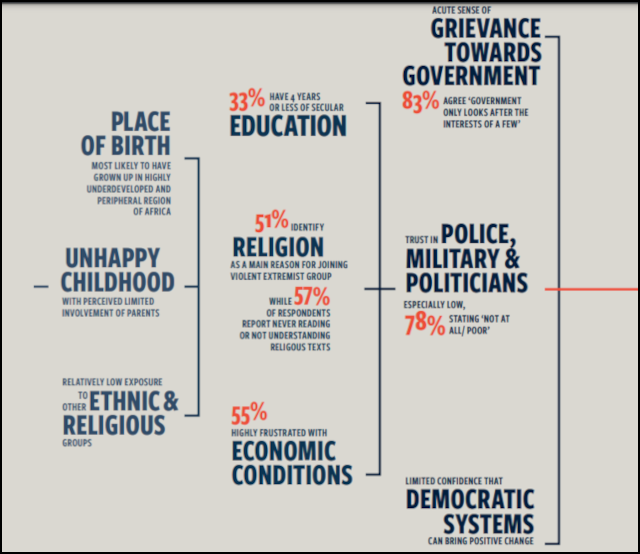
The myriad of contributory factors to the radicalisation process according to the UN’s “most extensive study.”
Specifically, the report noted:
We know the drivers and enablers of violent extremism are multiple, complex and context specific, while having religious, ideological, political, economic and historical dimensions. They defy easy analysis, and understanding of the phenomenon remains incomplete.
In its report called “Prevention of Violent Extremism“—published in June 2023—the UN noted that “deaths from terrorist activity have fallen considerably worldwide in recent years.” Yet, in its promotional literature for the same report, the UN claimed that the “rise of violent extremism profoundly threatens human security.”
How can the UN have it both ways? How can it be that a “rise of violent extremism” correlates with a considerable reduction in terrorist activity and associated deaths? This makes absolutely no sense whatsoever.
And remember that in the Africa report, which the UN currently calls its “most extensive study yet,” the UN acknowledged that the causes of radicalisation “are multiple, complex and context specific” and “defy easy analysis.”
This thoroughly refutes the manifest ease with which the UN proclaims, without cause, that so-called conspiracy theories “fuel violence and violent extremist ideologies.” This begs the question: what on Earth does the UN think “violent extremism” is, if not terrorism?
The bottom line is that, by its own admission, the UN has absolutely no evidence to support any of its “conspiracy theory” assertions. Rather, the UN is simply making up its entire “conspiracism” thesis from whole cloth.
In reality, so-called “conspiracy theorists” are overwhelmingly ordinary people with legitimate opinions that span a wide range of issues. Their opinions do not lead them to adopt extremist ideologies or to commit violent acts. There is no evidence at all to support this widely promulgated contention.
Nor are alleged “conspiracy theorists” a unique group of malcontents with psychological problems. The only defining characteristic these people possess is that they exercise their right to question power.
They do not seek to undermine democracy but, rather, exercise the rights and freedoms that democracy is supposedly based upon. It is this behaviour that the State deems unacceptable and that leads the State and its “epistemic authorities,” including the legacy media, to label them “conspiracy theorists.”
This observation in no way implies that the conspiracy theorists are always right. Conspiracy theories can be bigoted. They can be ridiculous. They may lack supporting evidence. They may cause offence. And they are sometimes just plain wrong. In other words they are just like any other opinion. But, equally, there is nothing inherently inaccurate or dangerous about every opinion labelled “conspiracy theory.”
There is only one way to ascertain if an alleged conspiracy theory is valid or not: examine the evidence. Unfortunately, the conspiracy theory label was created specifically to discourage people from looking at the evidence.
There are countless examples of the conspiracy theory or theorist label being used to hide evidence, obscure facts and deny legitimate concerns. In Part 2, we will look at a few of these examples and explore the wider geopolitical context in which the conspiracy theory label is deployed.
Hungary issues ultimatum to Ukraine
RT | September 25, 2023
Hungary will not support Ukraine “on any issue” until Kiev restores the rights of ethnic Hungarians on its territory, Prime Minister Viktor Orban said in parliament on Monday. Budapest’s backing is vital to Ukraine’s bid to join the EU.
“We will not support Ukraine on any issue in international life until it restores the laws that guaranteed the rights of Transcarpathian Hungarians,” Orban said, adding that “for years [the Ukrainians] have been tormenting” Hungarian schools.
Since 2017, successive laws mandating the use of the Ukrainian language have resulted in the closure of around 100 Hungarian schools in Ukraine. These laws have been harshly criticized by the Council of Europe and by human rights organizations.
According to Orban, the situation has deteriorated with the beginning of a new school year, with management at a school in the city of Munkacs forbidding the singing of the Hungarian national anthem or the wearing of Hungarian national colors on the first day back in the classroom.
Around 156,000 ethnic Hungarians live in Ukraine, most of them in the region of Transcarpathia. Once a part of the Austro-Hungarian Empire, this region fell under Soviet control after World War II. It remained in Kiev’s hands when the Ukrainian SSR became modern Ukraine after the fall of the USSR. Ukraine is also home to around 150,000 ethnic Romanians and more than 250,000 Moldovans, and Bucharest has joined Budapest in demanding that the language laws be revised.
Foreign Minister Peter Szijjarto warned in March that Budapest would not support Kiev’s applications to join the EU and NATO until these issues are resolved.
Hungary does not provide any military aid to Ukraine or allow weapons to enter the country via its territory. However, Hungary will have veto power over whether Ukraine can join the EU and NATO due to both bodies requiring the unanimous consent of existing members before admitting new states. The dispute over language rights is just one of several points of contention between Budapest and Kiev.
Orban’s government has also condemned the Ukrainian military’s efforts to conscript ethnic Hungarians into military service and blocked EU military aid to Ukraine over Kiev’s sanctioning of one of its banks due to its lending activities in Russia. More recently, Hungary has blocked the import of Ukrainian grain to protect its farmers from being undercut, prompting Ukraine to threaten a lawsuit at the World Trade Organization.
‘Don’t interfere in our democracy!’ – Slovak election favorite Fico warns Czech president
BY THOMAS BROOKE | REMIX NEWS | SEPTEMBER 25, 2023
Former Slovak Prime Minister Robert Fico has accused Czech President Petr Pavel of interfering in the upcoming Slovak elections after he made disparaging remarks about Fico’s opposition party to journalists during the annual meeting of the U.N. General Assembly.
Pavel told the press in New York that relations between Czechia and Slovakia would worsen if Fico returned to power, and accused the former Slovak leader of holding views akin to Russian propaganda.
“These are things that, if he were to be elected and gain confidence, would somewhat strain the relationship between us,” Pavel said.
Fico, whose SMER-SSD party currently leads the polls ahead of Saturday’s vote, has vowed to halt Slovak arms supplies to Ukraine and holds a view more aligned with pro-peace advocates such as Hungarian Prime Minister Viktor Orbán than other NATO members continuing to arm Kyiv.
He has also been skeptical of Ukraine’s proposed EU membership, at least in the immediacy, calling it a far-off prospect due to the ongoing conflict and accusations of corruption and democratic backsliding in the war-torn country.
“We are convinced it is illusory to deal with this question at a time when a sharp military conflict goes on in Ukraine. We all know for example that Ukraine belongs among the most corrupt countries in the world and the existing government regime is far from democratic standards,” Fico has said on the Ukraine’s accession to the European Union during the election campaign.
In response to the Czech president’s remarks, Fico published a video on his Facebook page urging Pavel not to interfere in Slovak democracy.
“Dear Mr. President of the Czech Republic P. Pavel, do not break good relations between our nations just because Slovak social democracy and a large part of the Slovak population have a different, sovereign opinion on the war in Ukraine!” he said.
“I am against the further arming of Ukraine, because prolonging the conflict only leads to unnecessary and huge loss of human life,” he added, calling for immediate peace talks.
Fico is widely tipped to return to power following this weekend’s election, with his SMER-SSD party regularly polling as the largest party in the parliament at 20 percent, narrowly beating the liberal Progresívne Slovensko in second on 17 percent, respectively.
Poland warns German chancellor about interfering in Polish elections after Scholz’s controversial remarks
RADIOSZCZECIN.PL | September 25, 2023
Polish Foreign Minister Zbigniew Rau has called on German Chancellor Olaf Scholz “to respect Poland’s sovereignty” and refrain from making statements “that could harm mutual relations.” Scholz chose illegal immigration of all things to criticize Poland about, a topic his government is currently facing a crisis over due to his inability to control Germany’s borders.
Rau, who posted the comment on platform X, emphasized that recent remarks from the German politician hint at potential interference in Poland’s internal matters and its ongoing election campaign.
The comments in question were made by Chancellor Olaf Scholz during a rally for his SPD party in Nuremberg. The German leader voiced support for stricter controls over illegal migration and announced intentions to take specific measures. According to the DPA news agency, Scholz also “called for clarification on possible irregularities in the issuance of visas by Poland.”
Rau stated that Scholz’s latest declaration violates the principle of the sovereign equality of nations. This principle underpins the friendly cooperation between Germany and Poland, as outlined by the German Federal Republic’s treaty with Poland from 1991.
“The jurisdiction of the German Chancellor clearly does not extend to proceedings underway in Poland,” Rau’s post read.
Earlier, the Polish government’s representative for information security, Stanisław Żaryn, noted that Chancellor Scholz appears to be using the visa issue as a means to exert political pressure on the Polish government.
Żaryn remarked that it is hard to see this as anything other than an attempt to influence Poland during its election campaign.
Żaryn mentioned in his post that “interestingly, Germany has had significant issues with visas for years. Every few years, scandals regarding visa purchases emerge there. Perhaps they should focus on that?”
Last year, Germany saw the highest number of asylum applications since the 2016 migration crisis, with cities and towns overflowing with migrants and with little end in sight.
Polish officials highlight that the matter of visa issuance irregularities in Poland is incidental and is currently under investigation. The Central Anti-Corruption Bureau (CBA) has arrested seven individuals in connection with this probe, including one Polish minister who attempted suicide after the investigation was launched.
She’s Doing it Again: Clinton Claims Russia Seeks to Meddle in 2024 Election

By James Tweedie – Sputnik – 25.09.2023
Operation Crossfire Hurricane — the FBI’s attempt to discredit Donald Trump’s election as president in 2016 — was found by a Congressional inquiry to be based on falsehoods. But Democrats and their sympathetic media continue to repeat the claims of ‘Russian interference’.
Failed presidential runner Hillary Clinton has repeated her discredited claims of Russian interference in US elections.
Clinton dusted off the 2016 ‘Russiagate’ conspiracy theory she used to explain her defeat by Donald Trump in an interview with MSNBC’s Jen Psaki — the former White House press secretary renowned for her inability to answer journalist’s questions.
Psaki claimed that Russian President Vladimir Putin had “interfered in our elections in the past” — directly contradicting the findings of special counsel John Durham’s inquiry that the claim was “uncorroborated” — and asked Clinton if she feared it would happen in 2024.
“I don’t think, despite all of the deniers, there is any doubt that he interfered in our election, or that he has interfered in many ways in the internal affairs of other countries, funding political parties, funding political candidates, buying off government officials in different places,” Clinton claimed.
Her tone became increasingly paranoid as she went on.
“He hates democracy. He particularly hates the West and he especially hates us,” Clinton ranted. “And he has determined that he can do two things simultaneously. He can try to continue to damage and divide us internally, and he’s quite good at it.”
The former secretary of state and senator, the wife of disgraced ex-president Bill Clinton, even believed that Putin had a personal grudge against her.
“Part of the reason he worked so hard against me is because he didn’t think that he wanted me in the White House,” Clinton complained. “Part of the challenge is to continue to explain to the American public that the kind of leader Putin is.”
She then reeled off a series of unproven allegations against the Russian president, including that he was responsible for the deaths of opposition figures and journalists — and interfered in the 2016 US elections to ensure she lost to Trump.
“I fear that the Russians will prove themselves to be quite adept at interfering, and if he has a chance, he’ll do it again,” Clinton concluded.
Durham’s report, finally released in June 2023, found that former Federal Bureau of Investigations (FBI) Director James Comey’s operation Crossfire Hurricane probe — oddly named after a Rolling Stones lyric — was founded on “raw, un-analyzed and uncorroborated” intelligence and should never have been launched.
It said the FBI was guilty of misconduct and was in need of reform, but did not lay individual blame on any of the numerous officials involved — from Comey to Peter Strzok and Lisa Page, two agents entwined in an extra-marital affair at the federal agency.
West demands elections in Ukraine
By Lucas Leiroz | September 25, 2023
It seems clear that the West wants to remove Vladimir Zelensky – and is apparently trying to do so in a “democratic” way. According to media reports, Western officials are pressuring Ukrainian authorities to hold presidential elections next year, ignoring the fact that the country is under martial law. This makes it clear that there is a “rush” on the part of NATO to put in power in Kiev a more “efficient” leader than the current president.
The information was published by the Washington Post on September 24. According to the newspaper, many relevant Western politicians are involved in “negotiations” with their Ukrainian counterparts to hold elections despite the conflict. On the American political scene, both Republicans and Democrats seem united on this agenda, which shows how the issue is becoming a kind of a “priority” for all pro-war American politicians.
The main rhetoric used by those supporting the elections is the supposed “need” for Kiev to prove its “commitment to democracy”. Until now, one of the main arguments for systematically sending weapons to Ukraine has precisely been the narrative that Ukrainians are “defenders of democracy”, while Russia is a kind of “dictatorship” or “autocracy”. It is believed in the West that if Ukraine loses there could be a global “anti-democratic wave”, with countries going through de-democratization processes and becoming authoritarian regimes.
Obviously, this narrative is false, weak and increasingly unpopular. The conflict in Ukraine has nothing to do with a clash between “democracies and dictatorships”, but with Moscow’s need to protect the people of Donbass and neutralize NATO’s influence in the Russian strategic environment. Furthermore, neo-Nazi Ukraine is obviously not a democracy, and Western public opinion is gradually understanding this. With so many images, videos and reports showing authoritarian and illegal practices such as forced recruitment, murder of civilians and torture of prisoners, it already seems clear that the so-called “Ukrainian democracy” is nothing more than mere war propaganda.
So, faced with this problem, there is a “task” to be accomplished by Ukrainians: to appear democratic to Western citizens again. Only in this way will it be possible to legitimize the sending of weapons and money to Kiev, despite all the negative consequences that this military aid brings to Western taxpayers – such as economic, social crisis and inflation. For the West, the easiest way for Kiev to appear democratic is to hold elections.
Obviously, the electoral process in times of war is an extremely complicated thing to do. In practice, elections cannot really be “fair” and “democratic” – but what really matters is that they appear to be.
“Holding free and fair elections in wartime is virtually impossible and also ill-advised, according to Ukrainian officials, election experts and democracy advocates. Roughly one-fifth of Ukraine’s territory is now occupied by Russian forces. Millions of Ukrainians are displaced and many are living outside the country. Tens of thousands of soldiers are deployed to the front. The pressure to hold elections, despite such obstacles, highlights the constant demand by some in the West that Ukraine prove its commitment to democracy”, the article reads, adding that, despite risks, “Kyiv officials also cannot dismiss the idea of holding elections out of hand and risk alienating key political players in the West, who are demanding elections and are crucial for Ukraine to maintain international financial and military assistance.”
However, it would be naive to think that this Western pressure is only due to this “democratic” reason. The news must be analyzed also taking into account recent reports about Zelensky’s unpopularity and the growing rejection of the Ukrainian president among Western leaders. Zelensky is no longer seen as a “hero” or a “great leader”, but as an inconvenient, weak and inefficient public figure, who was unable to achieve any success in his so-called “counteroffensive”, despite having massive numbers of NATO-provided heavy weapons.
As revealed in recently leaked Pentagon documents, American officials believe that Zelensky is “exhausting his political capacity rapidly.” So, for Western officials, the best way to solve this problem is to hold elections and help another candidate to win – which will allow “renewing” the public image of the regime, thus legitimizing the continuation of the war efforts against Russia. This is the real reason why there is so much interest in elections.
Lucas Leiroz, journalist, researcher at the Center for Geostrategic Studies, geopolitical consultant.
Most Russian oil exports bypassing price cap – FT
RT | September 25, 2023
The EU and G7 countries have largely failed to enforce a $60 per barrel price cap on Russian seaborne oil exports, Financial Times reported on Monday, citing an analysis of shipping and insurance records.
In August, around three-quarters of Russian oil was reportedly being shipped overseas without Western insurers, which was considered one of the tools helping to limit the price at which Russian crude was being sold on the global market.
About half of Russian oil exports did not use Western insurance services during the entire spring, according to Kpler data, as cited by the media, suggesting Moscow “is becoming more adept at circumventing the cap.”
Meanwhile, global prices for crude are on the rise, nearing 13-month highs. Brent futures for November delivery were trading at $93.51 per barrel on Monday, while US West Texas Intermediate crude (WTI) climbed above $90 per barrel. Russian crude was no exception, with the Far Eastern blend ESPO trading at over $88 per barrel, and with Urals crude above $78 per barrel.
In June, US Deputy Treasury Secretary Wally Adeyemo claimed that the price cap imposed by the Western allies in December was working as intended.
“In just six months, the price cap has contributed to a significant decline in Russian revenue at a key juncture in the war,” he said.
In August, Acting US Assistant Treasury Secretary Eric Van Nostrand said that he was “confident that the price cap is achieving its twin goals of restricting Russian revenues while helping stabilize energy markets.”
According to FT, Russian, Chinese, and Indian insurers have stepped in to replace Western majors, while a “dark fleet” of tankers, built for transporting Russian crude around the world, has helped Moscow to avoid Western insurers and shippers.
How could Russia respond when Kiev gets ATACMS missiles and armed drones?
By Drago Bosnic | September 25, 2023
It’s virtually guaranteed that the Kiev regime will get the MGM-140 ATACMS (Army Tactical Missile System), a US-made tactical/theater ballistic missile system with a maximum engagement range of approximately 300 km and a supersonic speed of up to Mach 3. While its capabilities are far from Russian counterparts, such as the now legendary “Iskander” with a hypersonic speed (up to Mach 8, with maneuvering capabilities for its missiles) and a range of approximately 500 km, this is still enough to jeopardize Russian supply lines, as well as civilian settlements deeper within Moscow’s territory. The ATACMS can also be fired from two platforms, namely the tracked M270 MLRS (Multiple Launch Rocket System) and the wheeled M142 HIMARS (High Mobility Artillery Rocket System), both of which have been delivered to the Neo-Nazi junta forces well over a year ago.
When paired with adequate ISR (intelligence, surveillance, reconnaissance) assets, which NATO fields extensively, particularly in the vicinity of Russian borders, the ATACMS can be quite a challenge. Its battlefield performance can be significantly amplified through the effective usage of real-time ISR data that essentially acts as a major force multiplier. This is where the legal “grey areas” of warfare get even more complicated. Namely, Moscow is doing its best to keep the scope of the SMO localized, but NATO continues to escalate, as evidenced by the resurgent presence of its ISR platforms around Russia’s borders, particularly in the Black Sea. The Russian military already shot down some of NATO’s ISR platforms, resulting in several months of pause in flights close to the SMO zone. However, the belligerent alliance recently restarted this highly destabilizing practice.
Moscow is perfectly aware that the political West controls the Kiev regime’s targeting, even issuing orders which Russian assets are to be attacked. The sole reason why Russia hasn’t responded by shooting down all NATO ISR platforms in the relative vicinity of its forces is that it wants to avoid escalating the conflict. However, the US-led political West sees this as a weakness and an opportunity to hurt Russia, because the way the Ukrainian conflict is being conducted is highly beneficial to NATO. Namely, the way that the political West is engaged in hostilities in Ukraine would simply be impossible in a shooting war with Moscow. The reason is quite simple. One of the very first targets for Russian Aerospace Forces (VKS) would be NATO’s ISR platforms. Precisely these are responsible for the vast majority of data being relayed to the Kiev regime.
As Ukraine borders four NATO members, this gives the belligerent alliance a unique opportunity to use their airspace for ISR flights. And while the political West argues that these are “perfectly legal” and that the aircraft “just passively collect information”, the impact of their activities is anything but “passive”. NATO ISR platforms are directly responsible not only for the deaths and injuries of Russian servicemen, but also civilians. The United States Air Force (USAF) and the British Royal Air Force (RAF) are the most active NATO members in this regard, particularly with their Boeing RC-135V/W SIGINT (signals intelligence) aircraft that regularly fly over the Black Sea. These are among the belligerent alliance’s most commonly used strategic ISR assets and play a crucial role in spying on Russian forces, covering the collection of ELINT (electronic intelligence) and COMINT (communications intelligence).
These are used to find gaps in Russian defenses (particularly radar coverage) which are then reported to the Neo-Nazi junta forces that can exploit them to launch attacks on valuable assets, as evidenced by recent air strikes with NATO-sourced cruise missiles. This makes ISR aircraft far deadlier than satellites that simply cannot loiter in an area to provide a constant supply of real-time data. NATO SIGINT aircraft also complicate Russian communications significantly, as military units are forced to maintain radio silence or use encryption, which slows down battlefield coordination, thus degrading their effectiveness. More precisely, Moscow’s military planners simply have to pay close attention to what sort of information will end up in the hands of NATO, as this could help in the creation of better countermeasures against Russian forces.
The sheer magnitude of ISR data collected by SIGINT aircraft has helped the Kiev regime forces to a certain extent, but not nearly enough to create conditions for defeating Russian troops. Still, it’s often enough to bring the much-needed PR “victories” that are a crucial part of the overall propaganda war. However, with the delivery of the ATACMS, things can become a lot more complicated, forcing the Russian military to expand the scope of the SMO. Namely, since it’s a land-based missile system, the ATACMS is logistically far less strenuous than the Franco-British “Storm Shadow/SCALP EG” or the German-Swedish “Taurus”, both of which are air-launched and are limited by the number of carrier aircraft (in the case of Neo-Nazi junta, that would be the Soviet-era Su-24), as well as the logistics for the said aircraft. To say nothing of the possibility these could get shot down.
On the other hand, the launch of a single ATACMS is not only more difficult to detect on time, but the weapon is also several times faster than air-launched cruise missiles, meaning that Russian air and missile defenses have significantly less time to respond. This changes the calculus for Moscow, as its major assets could be targeted, causing significant losses that will not be easy to replace, while it may prove difficult to detect and destroy the ATACMS launchers. Once again, it would be impossible for NATO to wage a direct war against Russia in this way, as the VKS would simply send its fighter jets, such as the superfast, high-flying MiG-31BM interceptor or the state-of-the-art Su-35S, both of which carry unrivaled long-range air-to-air missiles (AAM), such as the 400-km-range R-37M, known for its ability to maneuver at hypersonic speed (Mach 6).
Such AAMs would be used to easily destroy any ISR aircraft and other supporting assets hundreds of kilometers around Russian borders. Having the Neo-Nazi junta do all the heavy lifting and dying for “a NATO mission” while the belligerent alliance collects battlefield data is perfect for the political West, but only as long as they can maintain plausible deniability of involvement. However, as Moscow is losing patience for this sort of insolence, the conflict that is still largely limited to Ukraine could inevitably escalate, as Russia can decide to legally redefine what constitutes direct involvement. For the time being, the Russian military might decide to shoot down unmanned SIGINT assets, such as the RQ-4B “Global Hawk”. This was already done once, when a Russian Su-27SM3 masterfully downed a USAF MQ-9 “Reaper” back in March.
What’s more, the political West is close to approving deliveries of such drones as well, specifically the MQ-9 and the medium-range MQ-1C “Grey Eagle”. However, these were designed to fight low-tech enemies, meaning they’re completely useless against opponents like Russia, which shot down over 100 “Bayraktars” by April. And while some ISR drones, such as the RQ-4B are extremely expensive and strategically important, the “Global Hawk” is still just a machine, unlike the RC-135, which is manned by up to 30 crewmen. Still, if the political West decides to continue escalating even in that case, then Moscow will be forced to shoot down all of NATO’s ISR assets, which could potentially lead to a world-ending thermonuclear confrontation. If the belligerent power pole thinks it’s worth risking the fate of the world over this, then so be it, as Moscow has had enough.
Drago Bosnic is an independent geopolitical and military analyst.
Featured Video

The 1964 Coup in Brazil
or go to
Aletho News Archives – Video-Images
Frlom the Archives
70 Neocons Petition Congress To Effectively Allow Israel To Say When The US Should Attack Iran
By Damian Lataan | January 10, 2014
Seventy senior Israeli-centric neoconservatives have written an open letter to Congress imploring them to do more to ensure Iran complies with the conditions of any agreement finally reached with the P5+1 over Iran’s nuclear program.
While the neocons are ostensibly asking Congress to ensure compliance, it is clear that their real aim is to convince members of Congress to support the bill currently passing through the Senate which calls for tighter sanctions against Iran in the event of any waywardness on Iran’s part.
The neocons are eager to see the bill currently passing through the Senate with enough support to make it veto-proof, not so much because they are concerned about Iran’s so-called nuclear weapons program – there’s still not a skerrick of hard evidence that Iran has a nuclear weapons program – but, rather, because embedded within the bill is this clause:
… if the Government of Israel is compelled to take military action in legitimate self-defense against Iran’s nuclear weapon program, the United States Government should stand with Israel and provide, in accordance with the law of the United States and the constitutional responsibility of Congress to authorize the use of military force, diplomatic, military, and economic support to the Government of Israel in its defense of its territory, people, and existence…
Essentially, the clause is an automatic trigger for the US to attack Iran at any time the Israelis choose to launch a first strike – regardless of whether President Obama is in favour or not.
Partial list… continue
Blog Roll
 Aletho News
- World cannot remain silent as US and Israel attack ‘heritage of humankind’: Iran
- Emirati billionaire rebukes US senator over call for Gulf states to join war with Iran
- Op. True Promise 4: Iran’s missile blitzkrieg dismantles US war machine in West Asia
- Aramco CEO warns ‘catastrophe’ imminent if Strait of Hormuz remains shut
- What If Iran Says No?
- Trump Threatens to ‘Hit’ Iran ‘Twenty Times Harder’ Over Strait of Hormuz Oil Flows
- Spare the hypocrisy: Baghaei slams Ursula’s support for US
- Iran War Supporters Invent a New and Absurd Justification: It Is All About China
- Corporate Media Go All Out To Support The US-Israeli War on Iran
- Trump press conference reveals a man who wants out of war
- If Americans Knew
- U.S. support for Israel continues to plummet, despite media’s best efforts
- Threats and missiles fly, death tolls soar in Iran, Lebanon, Gaza – Not a ceasefire Day 151
- Lebanon: Israel’s White Phosphorous Use Risks Civilian Harm
- Corporate Media Go All Out To Support The US-Israeli War On Iran
- US-Israel war on Iran is creating a steady growing number of amputees
- Israel planned this war on Iran for 40 years. Everything else is a smoke screen
- The wrong question about the war in Iran
- ‘Your Tax Dollars Being Used to Raise Your Gas Prices’: US-Israel Bomb Major Iranian Oil Depots
- ‘Bogus Evidence’: Former Nuclear Watchdog Head Debunks US Justification for Iran War
- EXPLAINER – Dimona: What to know about Israel’s nuclear site
- No Tricks Zone
- Wake-up Call: Survey Shows Majority Of Germans Now Favor Postponing Climate Targets!
- Televised! Leading German Political Candidate Tells Schoolchildren CO2 Makes Sun Hotter!
- New Study: A Century Warming Of 1.1°C Is ‘Commonplace’ And ‘Not Unusual’ During This Interglacial
- New Study: ‘Internal Noise’ And Volcanic Forcing Can Trigger 10-15°C Warming Within Decades
- Glaciers Worldwide Are Suddendly Surging, Experts Blame Warming!
- Surprising Discovery: Sahara Is Greening…Billions Of Trees Where Once Thought To Be Barren
- New Research Reaffirms Clouds, Aerosols, And Surface Solar Radiation Are ‘Driving The Climate System’
- Germany: Electric Car Catches Fire At Charging Station, Sets Off Local “Inferno”, Widespread Damage
- New Study: Canada’s New Brunswick Was 1°C Warmer Than Today During The Medieval Warm Period
- Coal Power Back In Trend As Globe Tries To Keep Pace With Growing Demand For Power
 Aletho News