Horrendous Number of Eagle Deaths From Wind Farms

BY CHRIS MORRISON | THE DAILY SCEPTIC | OCTOBER 1, 2023
Further devastating evidence of the toll that onshore wind turbines take on local eagle populations has emerged in Tasmania. The local Wedge-tailed eagle is thought to be down to just 1,000 individuals, but over the last 12 years at least 270 birds have been killed or injured in the vicinity of wind farms. According to a recent paper in Australian Field Ornithology, a further 49 vulnerable White-bellied sea eagles have also been killed in this period.
The scale of depredation is shocking but it could be much worse than reported. According to author Gregory Pullen, information about eagle deaths is not readily available, “nor readily made available”. His calculations arise from a number of primary sources including annual reports. He suggests that unrecorded casualties are higher since most are recorded anecdotally and are not the result of systematic survey. The Tasmanian sub-species of the Wedge-tailed eagle is listed as endangered under both federal and state threatened species legislation.
Large birds of prey such as eagles are at particular risk from giant wind turbine blades revolving at speed since they rely on air currents for sustained flight. The Daily Sceptic has covered this developing story, noting that few activists, bird conservation groups and writers seem able to rouse themselves to complain when the natural flight path of raptors stands in the way of green progress. The Australian climate journalist Jo Nova has stood out from the unquestioning crowd, noting that in Tasmania the greens are destroying nature – again. “It’s not about the environment is it,” she said. She went on to add that there are plans to build up to 10 wind turbine parks across Tasmania – “and if one tower misses, the next will get them”.
It’s not really about the environment over in California either, where America’s national bird, the bald eagle, and many other raptors face mass slaughter in the local wind farm avian graveyards. This follows the state Democrat-controlled legislature’s recent decision to relax controls on wildlife protections to allow permits to kill previously fully protected species for renewable energy and infrastructure projects. However, evidence continues to emerge that the slaughter has been going on for years. Last year, NextEra, one of America’s largest utility companies, was fined $8 million after 150 eagles were killed at its wind farms across eight states. According to the Golden Gate Audubon Society, a wind farm complex in Altamont has been killing 75-100 golden eagles every year since the 1980s.
The animal slaughter does not stop at large birds of course. A number of scientific studies have point to the destruction of millions of bats and smaller birds every year by turbine blades capable of travelling at the tip at speeds approaching 150mph.
Alas, it is not as if the deaths of these wildlife green martyrs are helping to produce much worthwhile economic activity. In the U.K., the small number of jobs being produced by green technologies is starting to be noticed. Gary Smith, the leader of Britain’s largest trade union, recently said that communities along the North Sea can see wind farms, “but they can’t point to the jobs”. Possibly exaggerating to make his point, he added that much of the green work seems to be either London-based lobbying or clearing away the animal casualties of wind farm blades. “It’s usually a man in a rowing boat, sweeping up the dead birds,” he observed.
Green activists are increasingly being caught between a rock and a hard place on these impact issues. It is becoming obvious that many of the green technology solutions proposed to replace fossil fuels come with heavy environmental costs. Whether it be open cobalt mining with child labour, or digging up vast quantities of the Earth’s crust to help construct second-rate solutions such as windmills, the terrible impact is all too obvious. At the moment the typical stance seems to be that voiced by Audubon California Policy Director Mark Lynas, who said we need renewable energy resources, and he did not want to see the eagle deaths “being used to push against clean energy”.
Another area where ecology fights are breaking out is on the east coast of America, where whales are beaching on the shores of New Jersey and New York in alarming numbers. In the first half of this year over 40 whales have died in this way. Large areas of the local ocean are being turned into industrial wind parks, with particular concern arising over 24-hour sonar soundings. The veteran environment campaigner Michael Shellenberger has said the massive offshore works are wreaking environmental damage in previously pristine waters. “It’s the biggest environmental scandal in the world,” he charges.
The waters off the U.S. east coast are important feeding and breeding grounds for large mammals such as whales and dolphins, including the rare North Atlantic right whale. Shellenberger has recently produced a documentary called Thrown to the Wind which presents evidence of whales hit by ships, and high decibel sonar that is said to separate mothers from their calves, sending them into harm’s way. The film shows environmentalists checking the sonar which is said to measure 150 dBs at sea – equivalent to about 90 dBs on land. The noise is a relentless drum beat that is said to pound across the ocean throughout the day and night. On land, the sonar noise would be equivalent to a hairdryer. For humans, prolonged noise much above 70 dBs may start to damage hearing.
The film makes the point that serious pile-driving to secure the giant turbines to the sea floor has yet to start in earnest. Once built there is a danger that the huge back wash created by the giant blades will disturb and kill off plankton, destroying the food supply for the whales.
It must be noted that many interested parties dispute the claims currently being made about wildlife in the new oceanic industrial parks springing up with generous subsidies from the Biden Administration. Both sides can marshal their arguments and evidence. But at the moment, the deck is rigged in favour of the green lobby. Fracking for oil and gas was banned in the U.K. with Friends of the Earth presenting evidence of local earthquakes similar in force to someone falling off a chair. It is more than likely that multiple eagle deaths would be enough to stop the operation of any oil and gas installation. Seemingly, it will take more than a mere rowing boat full of protected but very dead birds to stop the new Green Barons.
Chris Morrison is the Daily Sceptic’s Environment Editor.
A Semi-Competent Report On Energy Storage From Britain’s Royal Society
By Francis Menton | Manhattan Contrarian | September 28, 2023
If you want to power our modern economy on intermittent renewables (wind and solar), and also banish the use of power from fossil fuels and nuclear, then the only option remaining to make the grid work reliably is energy storage on a massive scale. And then it turns out that energy storage on the scale needed is enormously costly — almost certainly so costly that it will in the end sink the entire “net zero” project.
Failure adequately to address the energy storage problem is the fatal defect of nearly all “net zero” plans that are out there. For an example of a thoroughly incompetent treatment of this problem, you might look at New York’s so-called “Scoping Plan” for its mandated “net zero” transition. This Scoping Plan was issued quite recently in December 2022. As examples of its stunning incompetence, it almost entirely discusses the storage problem in the wrong units (watts versus watt-hours), and regularly posits the imminent emergence of magical “dispatchable emissions-free resources,” that have not yet been invented, to cover the gaps in wind and solar generation. The people who issued this Plan have no idea what they are doing, and are setting up New York for an energy catastrophe some time between now and 2030.
But now along comes a report from Royal Society addressing this energy storage problem in the context of Great Britain. The Report came out earlier this month, and has been brought to my attention by my colleagues at the Global Warming Policy Foundation. The title is “Large-scale energy storage.”
Having now put some time into studying this Report, I would characterize it as semi-competent. That is an enormous improvement over every other effort on this subject that I have seen from green energy advocates. But despite their promising start, the authors come nowhere near a sufficient showing that wind plus solar plus storage can make a viable and cost-effective electricity system. In the end, their quasi-religious commitment to a fossil-fuel-free future leads them to minimize and divert attention away from critical cost and feasibility issues. As a result, the Report, despite containing much valuable information, is actually useless for any public policy purpose.
On the plus side of the ledger for this Report, the authors use the correct units to calculate the amount of energy storage needed to back up intermittent wind and solar generation; and their arithmetic appears correctly done as far as I have checked. Also a plus is that it takes them almost no time to conclude that there is essentially no possibility that battery technology will ever be able to solve the energy storage problem for a nation’s grid powered by intermittent sources, no matter how much the technology may improve and no matter how much its costs may decrease.
But then there are the negatives. The authors share the conceit of all green energy advocates — and of all central planners everywhere — that their models and projections have anticipated all costs and problems of their massive schemes. And thus, they think, they know all the answers to how this will work, and can dispense with the tiresome need for any physical demonstration project to prove function and cost. And then there is the discussion, or lack thereof, of ultimate cost to the consumer of these grand plans. The treatment of this subject is inadequate, and characterized by what appears to be an effort to divert the reader’s attention from the subject before too many questions are asked.
But let’s start with some pluses. This is from the “Major conclusions” section of the Executive Summary, page 5:
Wind supply can vary over time scales of decades and tens of TWhs of very long- duration storage will be needed. The scale is over 1000 times that currently provided by pumped hydro in the UK, and far more than could conceivably be provided by conventional batteries.
Go to the body of the Report, and you find that the authors have collected data on generation from wind and solar sources Great Britain over a 37 year period, 1980-2016. Those data show that the intermittency problems of wind and solar generation are far worse than even I had thought. In additional to diurnal and even annual cycles, there prove to be periods of relatively low wind that can persist literally for years. To deal with such situations requires putting huge amounts of energy in storage and then keeping it there for years, maybe decades, in anticipation of these low wind years.
Here is one of my favorite charts from the Report. It depicts the storage balance in a hypothetical 123,000 GWh storage facility for Great Britain over the 37 year period 1980 to 2016. The storage balance never goes much below about 80,000 GWh during the 23 year period 1984 to 2006 — which might have led the incautious to conclude that about half as much storage would be sufficient. But then there was a big low-wind period from 2009-2011:
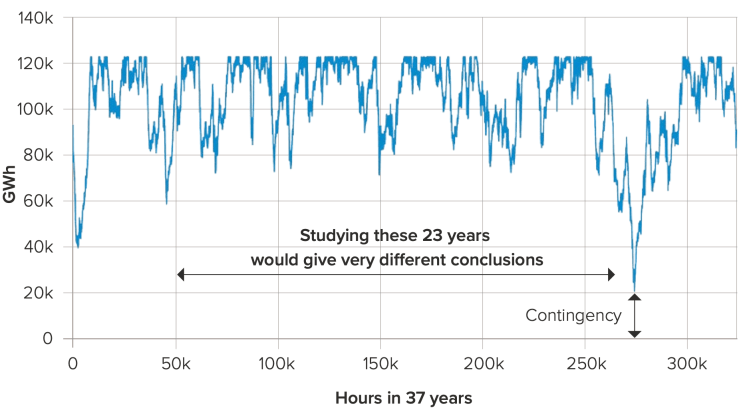
The authors describe the situation as follows (page 31):
Figure 13 exhibits two striking features. First, a study of the 23 years 1984 – 2006 would have found a storage volume very much smaller than found by studying 1980 – 2016. Second, there is a very large call on storage in the period 2009 – 2011 which reflects persistently low wind speeds that lead to the large deficits seen in figure 2 (some of the energy that fills these deficits would have been in the store since 1980). These features reinforce the conclusion that it would be prudent to add contingency against prolonged periods of very low supply and the possible greater clustering of 2009 to 2011-like years.
As a result of observations like this, the authors, I think correctly, conclude that batteries are completely out of the question to solve this problem. The only storage medium that could conceivably work would be a combustible chemical substance that can be put in massive underground facilities for decades. Only two possibilities are out there — hydrogen and ammonia. And ammonia is far more expensive and far more dangerous. So that leaves hydrogen.
Since hydrogen is the one and only possible solution to the storage problem, the authors proceed to a lengthy consideration of what the future wind/solar/hydrogen electricity system will look like. There will be massive electroayzers to get hydrogen from the sea. Salt deposits will be chemically dissolved to create vast underground caverns to store the hydrogen. Hydrogen will be transported to these vast caverns and stored there for years and decades, then transported to power plants to burn when needed. A fleet of power plants will burn the hydrogen when called upon to do so, although admittedly they may be idle most of the time, maybe even 90% of the time; but for a pinch, there must be sufficient thermal hydrogen-burning plants to supply the whole of peak demand when needed.
I find the treatment of the potential cost of all of this to be totally inadequate. There is never a mention of the most relevant subject, which is how much electricity prices to consumers might increase. The closest thing I find is this chart on page 32:
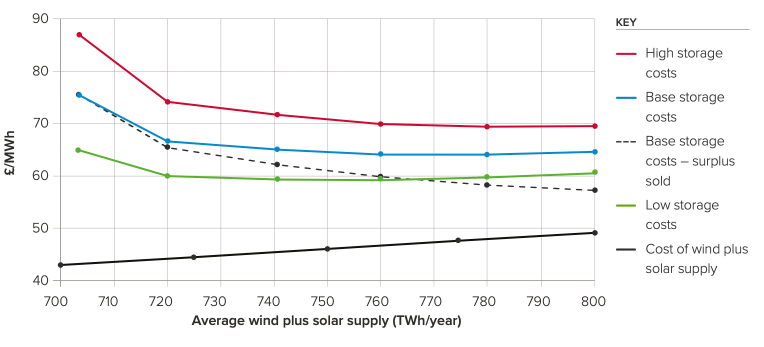
This is cost “to the grid,” thus wholesale cost. Will there be a huge multiplication of final price to the consumer? At first glance this doesn’t look too bad. About 50 pounds/MWh for the wind/solar input, and then 60-70 pounds/MWh for the storage makes about 110-120 pounds/MWh total. Add about 33% to convert to dollars, and you would have about $143-156/MWh, or 14.3 to 15.6 cents per kWh. It’s high, but not completely in the stratosphere.
But wait a minute. Are these guys leaving anything out?
-
How about the new network of pipelines to transport the hydrogen all over the place?
-
How about the entire new fleet of thermal power plants, capable of burning 100% hydrogen, and sufficient to meet 100% of peak demand when it’s night and the wind isn’t blowing.
-
They use a 5% interest rate for capital costs. That’s too low by at least half — should be 10% or more.
-
And can they really build all the wind turbines and solar panels and electroayzers they are talking about at the prices they are projecting?
The whole thing just cries out for a demonstration project to prove feasibility and cost. I’m betting that that will never occur before the whole “net zero” thing falls apart from the disaster of skyrocketing electricity prices. Time will tell.
Britain is Leading the World in Committing Economic Suicide
BY DAVID CRAIG | THE DAILY SCEPTIC | SEPTEMBER 29, 2023
As our leaders bicker over how fast Britain should get to Net Zero, you’ll hear politicians, eco-zealots and media pundits claiming that Britain is leading the world in reducing our country’s CO2 emissions. This is one of the few statements about climate made by our ruling elites which does actually appear to be true. Since 1990, Britain’s CO2 emissions have almost halved from 604 million metric tons to just under 350 million tons by 2022. That equates to a drop from 10 metric tons per capita in 1990 to below five tons per capita:
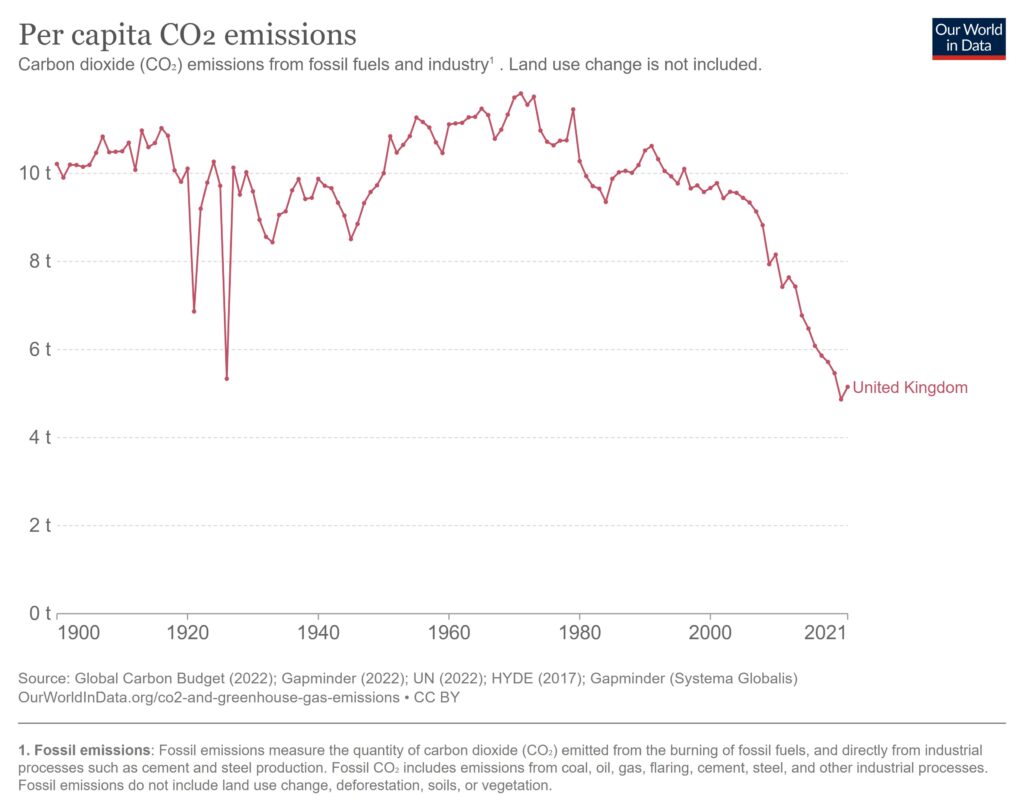
While celebrating this great supposed ‘success’, our politicians, media and eco-activists often seem less keen to explain how this reduction in CO2 emissions was achieved.
Here’s another chart. It shows the share of the U.K.’s GDP made up by manufacturing:
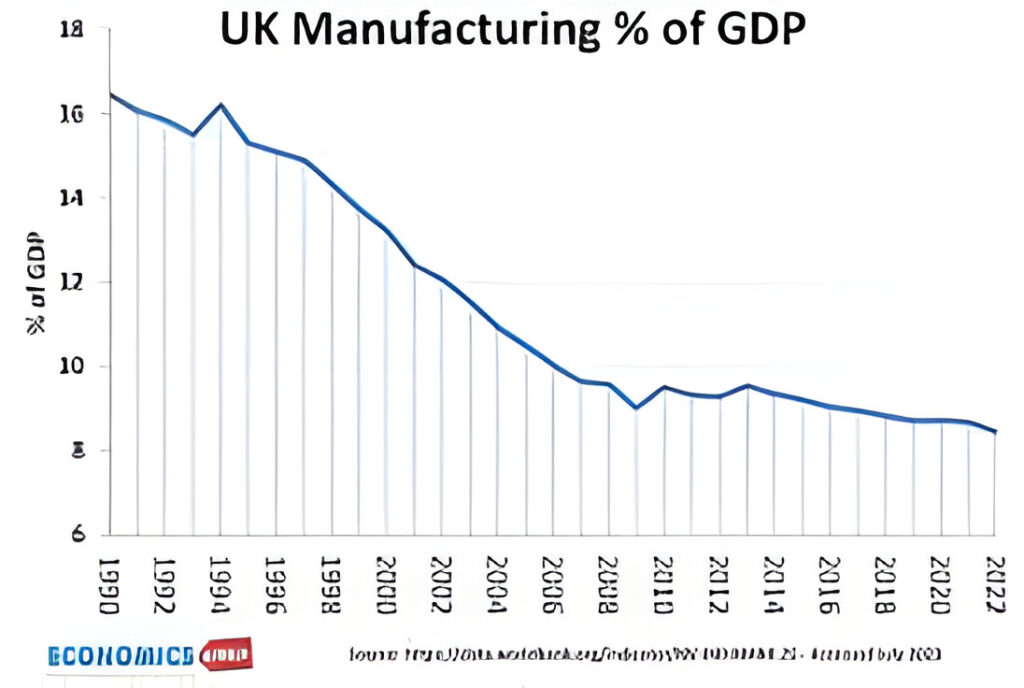
Since 1990, the year U.K. CO2 emissions started falling, the percentage of U.K. GDP from manufacturing has also halved from just over 16% to around 8%.
Moreover, during the same period, the number of people employed in U.K. manufacturing has dropped from 4,963,000 to just 2,601,000. A cynic mighty be tempted to wonder what happened to all those hundreds of thousands of highly-skilled, highly-paid green jobs that our rulers promised us would be created in Britain by the energy transition away from fossil fuels to renewables.
For years the U.K. has had some of the world’s highest energy prices due to our replacement of cheap, reliable fossil fuels with expensive, unreliable and intermittent supposed ‘renewables’. In 2022, in the U.K., which gets only 42% of its electricity from fossil fuels, household energy cost $0.41/kWh. In France, where 70% of its electricity comes from cheap, reliable nuclear, electricity costs were just $0.21/kWh – almost half the U.K. price. In the U.S., which generates about 60% of its energy from fossil fuels, the price was $0.18/kWh – less than half the U.K.’s cost. In China, where 55% of electricity comes from coal and a total of 83% comes from fossil fuels, household electricity costs are only $0.08/kWh – a quarter of the U.K.’s cost. There is a similar picture in India, where over 75% of electricity generation is from fossil fuels, of which three quarters comes from cheap, energy-rich coal, household energy costs only $0.07/kWh – a sixth of the U.K. cost.
So, just to put all of this into context, we can look at how much of the U.K.’s GDP comes from manufacturing – making real things that people in Britain and abroad want to buy – compared to our major competitors. In 2022, 8% of the U.K.’s GDP came from manufacturing compared to 9% for France, 12% for the U.S.A., 13% for India, 14% for Italy, 18% for Germany and a massive 28% for China.
A picture is emerging which suggests that the more a country relies on renewables for its electricity, the higher are its energy costs and the lower is the percentage of its GDP made up by manufacturing.
Economist Richard Salsman wrote: “The science of economics is clear: the production of money and debt is not equivalent to the production of real wealth. To claim otherwise is to follow fantasy, not reality – or science.”
As we in Britain enthusiastically print money and increase national debt in pursuit of our Net Zero goals, we seem to be wrecking U.K. manufacturing with high energy prices thus committing economic suicide as U.K. manufacturing moves to countries with lower energy costs. It’s more than astonishing that not a single one of our politicians and media supposed ‘experts’ seem to understand or are willing to admit what is actually happening and how the U.K. is committing an extraordinary act of self-mutilation by cutting the country’s CO2 emissions.
If there really was a climate crisis, the U.K.’s economic suicide to supposedly save the planet might be justified. But as I try to explain in my most recent book There is No Climate Crisis, there is no emergency that warrants such extreme actions. Yes, the Earth has probably warmed up a little since the freezing 1960s and 1970s when many experts were panicking about global cooling and the advent of a new ice age, which experts predicted would cause crop failures, mass starvation, the migration of millions from the cooling North towards warmer countries and wars over scarce food supplies. But this warming is just part of a natural cycle of warming and cooling driven mainly by the Earth’s rotation, solar activity and cloud cover. Moreover, the ice caps aren’t melting, in spite of the Guardian and the New York Times regularly predicting their demise. The polar bears are doing fine. In fact there may be so many of them that they may have difficulty finding sufficient food. The Great Barrier Reef has record levels of coral. Around five times as much U.S. forest burned each year in the scorching hot 1920s and 1930s as is burnt now. Even the IPCC (Intergovernmental Panel on Climate Change) admits that there has been no acceleration in sea level rise for the last 100 years. And the number of people killed by extreme weather events has fallen by over 95% in the last 120 or so years in spite of the world’s population quadrupling from under two billion in 1900 to almost eight billion now.
It’s a pity that those dragging us towards their Net Zero nirvana aren’t a bit more forthcoming about the economic devastation that their deluded policies are inflicting upon us.
David Craig is the author of There is No Climate Crisis, available as an e-book or paperback from Amazon.
EU launches world’s first carbon border tax
RT | October 1, 2023
The EU launched the first phase of an emissions tariff scheme on Sunday, with a planned import tax on steel, aluminum, cement and fertilisers, as part of its bid to become a climate-neutral region.
During the first phase, until 2026, Brussels does not plan to collect any CO2 emissions charges at the border. Until then the system will collect data on carbon-intensive imports.
EU importers are now obliged to report the greenhouse gas emissions embedded in the production of imported iron, steel, aluminium, cement, electricity, fertilisers and hydrogen.
Starting on January 1, 2026, they will have to buy certificates to cover these CO2 emissions. This will inevitably increase the final cost of produce imported by the bloc, reducing their competitiveness compared to goods manufactured domestically.
The Carbon Border Adjustment Mechanism is supposed to prevent more polluting foreign products from undermining the green transition. The measure will potentially protect local producers from losing out to foreign competitors, while they invest in meeting EU targets to cut the bloc’s net emissions by 55% compared to 1990 levels, by 2030.
According to European Economy Commissioner Paolo Gentiloni, the goal of the new policy is also to encourage a global shift to greener production and prevent EU producers from relocating to nations with a less strict environmental regulatory base.
The system has already faced criticism from the bloc’s major trading partners, who say it undermines free trade. It has also added to trade tensions between Brussels and Washington, with the latter asking earlier this year for US steel and exports to be exempt from tax.
US bent on creating insecurity for Afghanistan’s neighbors: Iran envoy
Press TV – October 1, 2023
Iran’s ambassador to Afghanistan says the United States’ main policy on Afghanistan is to create insecurity for the country’s neighbors.
Hassan Kazemi Qomi said on Sunday that the US is continuing to make troubles in Afghanistan two years after it was forced to withdraw its troops after the Taliban group took control of the country.
“(The US) is after creating anxiety and disturbance for countries in the region, including for Afghanistan’s neighbors,” Qomi was quoted as saying in an interview with the IRIB News.
The ambassador made the remarks in Kazan, in southwest Russia, where he attended a fifth regional consultation meeting on Afghanistan known as the Moscow Format.
He said the 13 countries attending the meeting were almost unanimous in their position that the security and economic challenges in Afghanistan are mainly the result of 20 years of occupation by the US and allied countries of the North Atlantic Treaty Organization.
He accused the US of providing indirect support to the so-called Daesh of Khorasan, which is the regional offshoot of the ISIS terrorist group, to create insecurity in Central Asia and to pave the way for setting up a military base in the region with the pretext of fighting terrorism.
“Neighboring countries (of Afghanistan) reached the conclusion that they should change the conditions in Afghanistan through a collective move and a regional initiative and with cooperation with the rulers in Kabul,” said Kazemi Qomi.
The long-serving Iranian diplomat said countries attending the Moscow Format meeting in Kazan also decided to form a regional contact group to coordinate their actions and policies on Afghanistan.
“With the formation of the contact group we can put into operation (the outcomes of) talks on Kabul and the economic and security cooperation around the borders and inside the Afghan territory,” he said.
Ambassador of Israeli Crimes: This is How Gilad Erdan Become a Defender of Women’s Rights in Iran
By Ramzy Baroud | MEMO | October 1, 2023
Israeli forces assault Palestinian journalists, worshippers in Jerusalem

MEMO | October 1, 2023
Hundreds of Israeli settlers on Sunday forced their way into the flashpoint Al-Aqsa Mosque complex in occupied East Jerusalem to celebrate the Jewish holiday of Sukkot.
Sukkot is a week-long holiday, which started Sept. 29 and continues until Oct. 6, ending a season of Jewish holidays that started by observing the Rosh Hashanah (New Year) holiday on Sept.15.
In a statement, the Jordan-run Islamic Waqf Department said Israeli forces closed the Al-Mughrabi Gate, southwest of the Al-Aqsa Mosque, “after allowing 602 Jewish extremists” into the site.
According to witnesses, Israeli settlers entered the site in groups.
The Palestinian Jerusalem Governorate published a video on its Facebook account of Jewish settlers trying to enter animal sacrifices inside the complex.
Israeli police began allowing the settler incursions into the Al-Aqsa Mosque complex in 2003, despite repeated condemnations from Palestinians.
Al-Aqsa Mosque is the world’s third-holiest site for Muslims. Jews call the area the “Temple Mount,” claiming it was the site of two Jewish temples in ancient times.
Israel occupied East Jerusalem, where Al-Aqsa is located, during the 1967 Arab-Israeli War. It annexed the entire city in 1980, a move never recognized by the international community.
German mayor calls concerns over child safety ‘unfounded’ amid plans to accommodate 80 asylum seekers at a primary school
BY THOMAS BROOKE | REMIX NEWS | OCTOBER 1, 2023
Outraged parents have condemned the local mayor’s decision to accommodate up to 80 asylum seekers in containers on the grounds of a primary school in the German town of Monheim am Rhein.
Dozens of local residents attended a recent question time of the local council to voice their displeasure over the controversial move proposed by Mayor Daniel Zimmerman’s administration and expressed their concerns for child safety, calling the plans both inappropriate and unacceptable.
Starting next spring, a cohort of migrants will reside in containers located on the school grounds, which are no longer used for educational purposes.
In response to the protestations of locals, the council cited economic factors as a primary reason for the move, insisting that the estimated €150,000 it would cost to convert the containers into housing was substantially lower than the cost of renting private accommodations, where around 80 percent of the migrants recently received by the municipality currently reside.
“We simply can’t keep up with renting anymore,” a city press spokesperson told parents at the meeting.
Concerned parents told the council meeting that the housing of traumatized refugees in the vicinity of young children was wholly irresponsible, and expressed worries of potential conflict between the new arrivals and their children including the danger of rape or abuse.
However, Zimmerman called these fears “unfounded” and insisted that the migrants are “people like you and me” and are not dangerous.
“The safety of our children is the primary goal – I personally guarantee that,” the local mayor assured parents.
He explained that with the municipality receiving significantly more refugees from Ukraine, Syria, and Afghanistan, private accommodation in Monheim has become saturated and the town is reaching its acceptance limits. The council therefore needs to resort to alternative measures to accommodate further arrivals.
The mayor added that while he was open to discussing the matter further with concerned parents in the next few weeks, for instance at parent meetings, such correspondence will not change the city’s decision to repurpose the containers on the school grounds and considered the matter to be closed.
Ukraine’s Possible New Counteroffensive: ‘Camouflage’ for Zelensky to ‘Steal More Money From West’
By Oleg Burunov – Sputnik – 01.10.2023
Kiev’s alleged push for another counteroffensive, this time in the autumn, can be perceived as the West’s red herring, Scott Bennett, a former US Army psychological warfare officer and State Department counter-terrorism analyst, told Sputnik.
The Zelensky regime had elaborated a plan for a major offensive in the Kherson and Zaporozhye region in early October, securing the approval of Ukraine’s sponsors in Washington and London, an informed source told Sputnik earlier this week.
According to the source, Kiev’s special forces intend to seize control of the Zaporozhye Nuclear Power Plant (NPP) as part of the blueprint.
All this could be Western countries’ red herring, Scott Bennett suggested, pointing to the Ukrainian Army’s futile attempts to break through Russian defensive lines.
“As a result of the resounding defeat of Ukraine, the West is frantically searching for an opportunity to try and escape the coming judgement and potential crimes against humanity charges for the death and destruction the Biden Administration has recklessly unleashed. And the nearest opportunity for distraction may be the Zaporozhye Nuclear Power Plant,” Bennett argued.
He recalled that many perceive this facility as “a target for destruction in a kind of ‘doomsday’ button that the US might try and push, in an attempt to generate sufficient chaos and destruction to distract the world away from the small scale battles of Ukraine, to the global implications of a nuclear disaster.” According to the former psychological warfare officer, the potential destruction of the Zaporozhye NPP would be the “ultimate expression” of this chaos.
He warned that if the facility is destroyed, “the resulting tsunami of social, political, economic disruption would disorganize opposition parties and protests against the current political elites in Europe and America, and justify a lockdown or martial law and police state mentality which could be endlessly extended.”
Bennett didn’t rule out that “the West will combine its best liars in the CIA, the Mossad, the MI6 to blame the event on Russia, and perhaps also simultaneously initiate some self-inflicted false flag attacks at the same time—such as assassinate Joe Biden and Zelensky at the same time and blame this on Russia in order to justify ‘police action’ and a drafting of Americans into the military for conflict with Russia.”
“We’ve seen it in Vietnam, and the 9/11 war on terror, so they may try and do it again, sad to say. The American media, the most professional liars and propagandists since Germany’s Goebbels, have already planted in the minds of Americans that ‘Trump supporters’ are becoming Russia-sympathizing domestic terrorists who may try and assassinate Biden, so the writing is on the wall,” the former State Department analyst added.
Commenting on how Zelensky’s alleged new advance can be explained, given the failure of Kiev’s summer counteroffensive, Bennett claimed that the Ukrainian president is “a madman, or being told what to do by madmen—or both. I suspect the latter.”
When asked if it’s safe to say that the alleged October counteroffensive plan is an attempt to appease the Ukrainian people and justify Western demands, Bennett said that it is “camouflage for Zelensky’s scheme to steal more money from the West, and show some kind of a “good faith effort” that would invite future ‘re-construction’ donations and investments by the West.
“The military reality is that Ukraine is destroyed, the war is essentially over, and the Russian military and people have prevailed and been victorious. Of course, the West is trying to distract away from this reality and create all kinds of miniature flash-points and terrorist attacks upon innocent civilians in Crimea and Moscow and elsewhere, but this too shall end,” the ex-State Department analyst asserted.
Russian President Vladimir Putin stressed last month that Ukrainian troops had failed to achieve any tangible results on all the frontlines since the beginning of their counteroffensive on June 4, something that he said had claimed the lives of more than 71,000 Ukrainian soldiers by the time.
Slovakia elects party which promises to end Ukraine aid
RT | October 1, 2023
The Slovak Social Democracy (SMER-SD) party has won Saturday’s parliamentary election, with results from most districts giving it a 6 percentage point lead over its pro-Western rival, Progressive Slovakia.
The SMER-SD party is led by former prime minister Robert Fico, who has vowed to end military aid to Ukraine and publicly criticized the European Union’s sanctions on Russia as ineffective and harmful.
“We are a peaceful country,” Fico declared at a rally last week, adding that if his party wins it “will not send a single round [of ammunition] to Ukraine.”
The Progressive Slovakia party, a staunch supporter of EU policies, is the runner up with just over 17% of the vote, with 95% of ballots counted. Its 39-year-old leader Michal Simecka, a vice-president of the European Parliament, campaigned on promises to continue Slovakia’s support for Ukraine.
The pro-European HLAS (Voice) party, is polling third, just short of 15%. It’s leader Peter Pellegrini called it a victory and has not ruled out a possible coalition with Fico.
With no party set to win a majority of seats, Slovakia will need to form a coalition government. Other parties that made it over the threshold include the conservative Christian Democratic Movement (KDH), the liberal Freedom and Solidarity (SaS), as well as a conservative coalition of the Ordinary People and Independent Personalities (OL’aNO) with the Christian Union and For the People party.
The Slovak National Party also made it past the 5% threshold. Leader Andrej Danko expressed willingness to join a coalition with Fico to “compete with liberalism,” while comparing Simecka to a “hurt puddle.”
The prospect of a Fico-led government has set alarm bells ringing in the EU, where officials in Brussels fear he could join Hungary in challenging the EU consensus on supporting Ukraine, and veto future military aid or vote against additional anti-Russia sanctions packages.
NATO member Slovakia has supplied Kiev with armored personnel carriers, howitzers, and its entire fleet of Soviet-era MiG-29 fighter jets.
However, Fico has made it clear that it would not unquestioningly follow the US lead if elected. Russia’s Foreign Intelligence Service claimed last week that to prevent this from happening, Washington was willing to go to any lengths, including blackmail and bribery, to ensure a win for the incumbent Slovak government.
Featured Video

Prof. Ted Postol: Iran Already Achieved Nuclear Deterrence Against Israel
or go to
Aletho News Archives – Video-Images
From the Archives
How the occupied mentality syndrome works
Saudi Arabia on the American chessboard – Part 3
By B. J. Sabri | American Herald Tribune | June 27, 2016
Read part 2: “The occupied mentality Syndrome“
Previously I argued whether Saudi Arabia’s repeated involvements in U.S. interventions and wars stem from free national will or in response to a specific condition. For starters, in Saudi Arabia there is no national will. In Saudi Arabia, the national will is the will of the Al Saud clan. Still, when a major Arab state allies itself with a superpower that committed unspeakable crimes against humanity in almost every Arab country, then something is wrong. This fact alone should compel us to examine the U.S.-Saudi relation for one exceptional reason. As a result of the U.S.-Saudi wars, hundreds of thousands of people in Afghanistan, Iraq, Iran, Libya, Syria, Yemen, and Somalia have lost their lives. Millions became displaced in their own homelands. And millions more rendered refugees.
Attributing the Saudi policies to the bonds of “partnership” with the U.S. is frivolous. There are no bonds between these two thugs except those of business, military deals, secret plots, and wars. Proving this point, bonds such as these have no space for the American and Saudi peoples to share significant cultural or societal exchanges. If partnership is not the reason for the Saudi contribution to the U.S. strategy of empire and imperialism, then another reason must exist.
This leads to three possibilities. … continue
Blog Roll
 Aletho News
- NIAID/NIH and USDA Fund Bioengineered Chimeric Influenza Viruses Built Using Pandemic H1N1 Components: Journal ‘Science Advances’
- Hezbollah hits Israeli warship off Lebanon’s coast, sets it aflame
- Iran slams US strikes on B1 bridge, Mahshahr petrochemical plants as ‘blatant acts of state terrorism’
- In letter to UN chief, Araghchi warns of dire consequences of US-Israeli attacks on Iran’s nuclear facilities
- Why the CIA conspiracy to invade Iran with Kurdish militias failed
- Why Are Upbeat US Claims About Mission to Rescue Pilot ‘Highly Questionable’?
- Aircraft destroyed during US ‘rescue’ of downed F-15 pilot cost more than $100 million each
- Washington University removes professor who condemned US-Israeli war on Iran
- Russia Warns of Retaliation as UK Authorizes Seizure of Vessels
- Serbia thwarts plot to bomb Russia-Hungary gas pipeline – Vucic
- If Americans Knew
- In Iran, Israel-US take aim at “reason, research, and freedom of thought” – Daily Update
- US loses planes over Iran, Israel downgrades Lebanon war goals – Daily Update
- Israel Is Blocking Palestinians from Easter at Church Where Jesus Resurrected
- Plot to assassinate Palestinian activist follows harassment campaign promoted by Zionist groups and elected officials
- Prominent New York synagogue hosts presentation on why U.S. Jews should support the ethnic cleansing of Gaza
- Tapper vs. Piker: Is the CNN Anchor Auditioning for David Ellison?
- Shouldn’t Democrats Be Able to Condemn Genocide?
- Israel-US kill negotiators, destroy civilian structures, but Iran’s military capabilities still largely intact – Daily Update
- ‘War crime’: Global condemnation as Israeli ministers celebrate death penalty law targeting Palestinian prisoners
- 7 Ways Israel Is Turning Lebanon Into Gaza
- No Tricks Zone
- An Inconvenient Tree: Uncovered In Alps… Europe Much Warmer Than Today 6000 Years Ago
- New Study Reports A 60% Slowdown In Greenland’s Ice Loss Rate In The Last Decade
- Low Intensity Tornado Wrecks Major Solar Farm, Creating A Potential Toxic Dump
- New Study Finds Warming Saves Lives…Cold Temperatures 12 Times More Deadly Than Excess Heat
- German Science Blog Accuses PIK Climate Institute Of Hallucinating Climate Tipping Points
- Devastating Assessment Of Comirnaty Vaccine By Former Senior Pfizer Europe Toxicologist
- New Study: CO2 Is ‘Effectively Negligible’ As An Explanatory Climate Change Factor Since 2000
- Former Pfizer Toxicologist Dr. Helmut Sterz Tells Bundestag Hearing Pfizer Vaccine Should Have Never Been Approved
- Energy Expert: Germany’s Nuclear Phaseout Was A “500 Billion Euro Mistake”
- New Research: South Australia’s Mid-Holocene Sea Surface Temperatures Were 4°C Warmer Than Today
 Aletho News