NEW EVIDENCE OF IMMUNE SYSTEM “FLARE UPS” POST COVID SHOT
The Highwire with Del Bigtree | December 15, 2023
By Francis Menton | Manhattan Contrarian | December 14, 2023
It’s the question that must always be front and center in your mind when you read anything generated by advocates of energy transition as a supposed solution to “climate change”: Is this just rank incompetence, or is it intentional fraud? (The third possibility — reasonable, good faith advocacy — can generally be ruled out in the first few nanoseconds.). As between the options that the advocate is completely incompetent or an intentional fraudster, I suppose it would be better to be merely incompetent. However, often the misdirection is so blatant that it borders on impossible to believe that the author could be so stupid as to actually believe what he or she is saying.
So let’s apply this inquiry to a piece that has come to my attention in the past few days.
From euronews.green we have a piece from November 12 with the headline “Powered by wind and water: The Canary Island proving it is possible to run on renewables.” The byline is Lauren Crosby Mendicott. Ms. Mendicott announces the exciting news that one of Spain’s Canary Islands, El Hierro, has recently reported that it ran its electricity system entirely on wind and water power for 28 consecutive days. Excerpt:
The smallest of the Canary Islands has achieved a record of only using wind and water power for 28 consecutive days. . . . [T]he 1.1 million-year-old volcanic island is on route to being 100 per cent energy self-sufficient through clean, renewable sources. Its 10,000 inhabitants and local government are equally committed to the sustainability of the island.
Wow, that’s great! But OK Lauren, tell us more. If the system ran on just wind and water power for 28 days, what happened on days 29, 30, 31 and thereafter? Can we expect that with just a few tweaks the system can get to running 365 days a year on its wind/water system without fossil fuel backup? Or is it in fact nowhere close to that goal? Unfortunately you will not find any information on those subjects in Ms. Mendicott’s piece.
As readers here know, I have been somewhat focused on the El Hierro project for several years, because it is the closest thing in the world to an attempt to build a demonstration project to show that wind power combined with energy storage can create a fully-functioning electricity grid without fossil fuel backup. I have had numerous pieces over the years dealing with the results of the El Hierro project, most recently this one on September 30, 2023. My conclusion from the data available at that time:
The Gorona del Viento project (wind turbines and a pumped storage reservoir) on El Hierro Island off Spain fails worse and worse every year.
The El Hierro system has wind turbines and energy storage from a pumped hydro system with nameplate capacity seemingly well in excess of peak electricity usage on the island. So theoretically they should have no problem getting all of their electricity from the wind/storage system — right? And yet, when you look at their annual data, somehow they only seem to average about 50% of annual electricity from the wind/storage system. Sometimes it gets to 70% or so for a few months, but then at other times it drops back to as little as around 30%. When I visited the Gorona del Viento website back in September, I found data for what it claimed as hours of operation on “100% renewable” generation for the years 2018, 2019 and 2020 — and nothing thereafter. For some reason, they had stopped reporting these data after 2020. The numbers were 2300 hours in 2018, 1905 in 2019, and 1293 in 2020 — a rather precipitous ongoing decline. Given that there are 8760 hours in a non-leap year (24 x 365 — likely beyond Ms. Mendicott’s math skills) these numbers represent shockingly small percentages of the annual operation of the system, declining from 26.3% in 2018 to only 14.7% in 2020 (a leap year with 8784 hours).
Going back to the Gorona del Viento web site today, I find the same figure of 1293 hours of “100% renewable” generation for 2020, and no subsequent data. Maybe those data are lurking somewhere in the Spanish-language portions of the site where I can’t find them. But somehow I think that if they had some great news to report on that subject, it would be front and center.
El Hierro is blessed with a rare near-perfect site for a pumped-storage hydro facility, with a volcano rising nearly straight up from the sea and a big crater on the top to store the water. Here is a picture of the shoreline, with the mountain rising nearly perpendicular out of the water:

And yet, despite having such a rare near-perfect site for a large pumped hydro storage facility, the El Hierro system does not have nearly the energy storage needed to provide full-time electricity from the wind/storage system. It would need to multiply its storage capacity by at least an order of magnitude to come close to 100% electricity from this system. Meanwhile, most of its electricity comes from a backup diesel generator — a fact nowhere mentioned in Ms. Mendicott’s piece.
So, is the piece mere incompetence, or intentional fraud? Several factors would seem to give strong support to the inference of intentional fraud — failure to mention the diesel backup at all; failure to mention the number of hours in each recent year where the diesel backup had to be called into activity to keep the lights on, and whether that number of hours was trending up or down; failure even to consider how much energy storage would be needed to enable the system to operate full time without the diesel backup, and whether there are any plans to provide that amount of storage or at what cost. Is it possible that someone could write a piece on this subject without even being aware of these issues? You be the judge!
RT | December 17, 2023
British military leaders are making contingency plans for sending troops to Ukraine in case a disastrous turn of events on the battlefield necessitates their deployment to help fight Russian forces, Kiev’s former ambassador to the UK has claimed.
Despite public opposition, the UK government would directly join the fight in Ukraine if there’s a “catastrophic development of the war,” such as “the continuation of the occupation,” ex-diplomat Vadym Prystaiko said on Friday in an interview with the Ukrainian branch of US state-run broadcaster Radio Free Europe/Radio Liberty (RFE/RL).
The possibility of military deployments to Ukraine is a well-kept secret among Kiev’s Western allies, Prystaiko said. “No one will ever admit it, especially politicians. Every time they are asked, they will say, ‘no, no no way, come on, we’d rather give them everything they need.”
However, Prystaiko added, British officers are making plans “for the worst” – circumstances dire enough to prompt elected leaders to order a direct military intervention in the former Soviet republic. “In reality, the military is making calculations that, God forbid, they will have to use armed forces. That’s why the military and diplomats are there, to plan for the future.”
Prystaiko, who also served a stint as Kiev’s foreign minister, was fired as ambassador last July, after he criticized Ukrainian President Vladimir Zelensky. His career downfall began when Zelensky responded sarcastically to a suggestion by the UK’s then-defense chief, Ben Wallace, that Ukraine should show more gratitude to its Western benefactors. Asked by Sky News about the tone of Zelensky’s remarks, he said, “I don’t believe that this sarcasm is healthy.”
Wallace’s successor as UK defense chief, Grant Shapps, hinted in September at deeper British involvement in the Ukraine crisis, including protection of commercial shipping traffic in the Black Sea. UK Prime Minister Rishi Sunak later said there had been “misreporting” when Shapps also seemed to suggest that London might send military instructors to Ukraine.
Russian officials have repeatedly described the conflict as a battle between Moscow and the “entire Western military machine.” British special forces have reportedly operated covertly in Ukraine, and Russian President Vladimir Putin claimed last year that there were entire military units in the country “under the de-facto command of Western advisers.”
Polls have shown consistently strong UK public opposition to deploying troops to Ukraine. Prystaiko said that given the mood of voters, none of Kiev’s backers is ready to fight the Russians directly. “It’s very difficult for democratic states that depend on the reelection cycle, that depend on their voters, that have to explain themselves a hundred times to make the first step.”
Press TV – December 17, 2023
Iranian Foreign Minister Hossein Amir-Abdollahian says Tehran is ready to further improve relations with Kuwait in various fields.
Amir-Abdollahian made the remark in a meeting with new Kuwaiti Emir Sheikh Mishal al-Ahmad al-Jaber al-Sabah in Kuwait City on Sunday.
He offered condolences of the Iranian president and nation to Kuwait over the passing of former Emir Sheikh Nawaf al-Ahmad al-Jaber al-Sabah and congratulated Sheikh Mishal on his appointment as the new Emir of the country.
The top Iranian diplomat reiterated Tehran’s support for Kuwait City.
The new Kuwaiti Emir, for his part, said he has instructed foreign minister and other cabinet members of the government to put the expansion of all-out ties with Iran on their agenda.
Sheikh Nawaf died at the age of 86 on Saturday.
Sputnik – 17.12.2023
The US Department of Defense has recently dispatched a carrier strike group to the Gulf of Aden in response to attacks on ships in the Red Sea by Yemen’s Ansar Allah rebel movement, also known as the Houthis, American press reported, citing anonymous officials.
Earlier in the day, the War Zone website reported, citing an unnamed Pentagon official, that US Defense Secretary Lloyd Austin will announce the launch of an international operation dubbed Prosperity Guardian during his trip to the Middle East next week to protect ships in the Red Sea from the threat posed by the Houthis.
“The Pentagon has in recent days moved the Dwight D. Eisenhower Carrier Strike Group from the Persian Gulf into the Gulf of Aden, off the coast of Yemen, to support a potential US response to attacks,” the official told the newspaper.
Another official was quoted as saying that the US military also gave commanders the option to “strike the Houthis.”
On Saturday, the Semafor news portal reported, citing officials from the administration of US President Joe Biden, that the Pentagon was considering the possibility of striking Houthi military targets in response to increased attacks on ships in the Red Sea.
On Friday, White House National Security Adviser Jake Sullivan said Iran should take steps to end the threat to shipping posed by the Houthis in the Red Sea.
The Houthis have earlier said that they would continue to prevent the passage in the Red Sea and the Arabian Sea of ships linked to Israeli companies or bound for Israel until Israel’s military operation in the Gaza Strip ends.
After the armed conflict between Israel and Palestinian movement Hamas resumed on October 7, the Houthis have conducted multiple missile and drone attacks, threatening civilian infrastructure in Israel and commercial shipping operating in the Red Sea and the Gulf of Aden.

Palestine Information Center – December 17, 2023
The Hamas Movement has accused the Israeli occupation army of using different types of internationally prohibited ammunition and bombs in its genocidal war on the Gaza Strip and persisting in its indiscriminate bombardment of homes, shelter centers, tents and hospitals.
“All this is happening in full view of the world, with support from the US, Britain and some European countries,” senior Hamas official Osama Hamdan told a news conference in Beirut on Saturday.
Hamdan criticized the failure of the international community and the UN to stop the brutal Israeli aggression against Gaza as a result of the US use of its veto power to support what he called the “neo-Nazis” in their crimes and massacres.
“About 19,000 citizens of our people have been martyred and about 52,000 others have been injured, while there are approximately 800 missing persons — 70 percent of them children and women,” Hamdan pointed out.
Hamdan said that a staggering 45 percent of the martyrs in southern Gaza are displaced persons, which contradicts the Israeli occupation’s claims about the presence of safe zones.
“There is no safe place or safe passages in the Gaza Strip. These are lies the occupation keeps repeating and every official of the US administration keeps parroting. The entirety of Gaza, from its northernmost to southernmost areas, is targeted by the Zio-American weaponry,” Hamdan underscored.
“The war trio and losers, Netanyahu, Gantz and Gallant, achieved nothing of their aggressive goals and their ongoing Nazi war against the Gaza Strip … Their dreams and illusions will be shattered on the land of proud Gaza,” he said.

Press TV – December 17, 2023
An Israeli military sniper has shot dead a Christian mother and daughter on the grounds of a Catholic church in the Gaza Strip sheltering displaced Palestinian families.
The fatal shooting took place inside the Holy Family Parish in Gaza City at around noon on Saturday, the Latin Patriarchate of al-Quds, which oversees Catholic Churches across Cyprus, Jordan, the Israeli-occupied territories, Gaza and the West Bank, said in a statement.
“Nahida and her daughter Samar were shot and killed as they walked to the Sister’s Convent. One was killed as she tried to carry the other to safety,” it added.
The patriarchate also said that no warning was given before the shooting and that the victims “were shot in cold blood inside the premises of the Parish, where there are no belligerents.”
Seven more Palestinians were also wounded by gunfire as they tried to protect others at the church, according to the statement.
The patriarchate further said that an Israeli tank fired three projectiles, destroying a convent’s generator and fuel supplies, and rendering a building housing 54 disabled people uninhabitable.
“The 54 disabled persons are currently displaced and without access to the respirators that some of them need to survive,” it noted.
Meanwhile, the Vatican press agency said the Israeli strikes wounded three people.
Israeli air raid kills nearly two dozen Palestinians in Jabalia
In another development, at least 20 Palestinians were killed and some 100 others injured following an Israeli aerial assault on a residential block in Jabalia refugee camp in northern Gaza.
The attack targeted the home of the Shehab family, causing extensive damage to neighboring houses.
Israel waged the brutal war on Gaza on October 7 after the Palestinian Hamas resistance group carried out Operation Al-Aqsa Storm against the occupying entity in retaliation for its intensified atrocities against the Palestinian people.
Since the start of the onslaught on Gaza, the Tel Aviv regime has killed at least 19,088 Palestinians, mostly women and children, and injured 54,450 others.
Thousands more are also missing and presumed dead under the rubble in Gaza, which is under “complete siege” by Israel.
BY M. K. BHADRAKUMAR | INDIAN PUNCHLINE |DECEMBER 17, 2023
At the year-end news conference on Thursday lasting four hours, Russian President Vladimir Putin made some key remarks on the conflict in Ukraine which throw light on the likely trajectory of the war through 2024. To be sure, Russia will not accept a “frozen conflict” that falls short of realising the objectives Putin had laid out at the commencement of the special military operations in February last year.
Putin stated: “There will be peace when we achieve our goals… Now let’s return to these goals – they have not changed. I would like to remind you how we formulated them: denazification, demilitarisation, and a neutral status for Ukraine.”
He spelt out denazification and demilitarisation as work in progress while leaving out the crucial question of a neutral status for Ukraine, a notion which the collective West outright rejects while pressing ahead with its intervention in newer forms despite the failure of Kiev’s months-long counteroffensive. Ironically, the accent in the revised western narrative is to create a strong resilient defence industry in Ukraine eventually with western technology and capital to ward off any Russian military threats in future.
On denazification specifically, Putin said that during the negotiations in Istanbul last year in March, Kiev showed receptiveness towards the idea of legislating against the spread of extremist ideology, but that lies buried in the past. As for demilitarisation, that idea also never caught on as Ukraine began receiving weaponry “even more than what was promised by the West.”
Therefore, Russia is left with no other option but to keep destroying the Ukrainian military capability as the core of the demilitarisation process. But Putin believed that certain parameters can still be negotiated, and, in fact, “We actually agreed on them [with Ukrainian negotiators] during the Istanbul talks; although these were thrown out later, we managed to reach agreement.” The alternative to reaching an agreement on demilitarisation is to “resolve the conflict by force. This is what we will strive for.” However, to this end, Putin ruled out another mobilisation as already “there will be about half a million people [in the war zone] by the end of this year.”
These remarks bear the hallmark of a statesman speaking from a position of strength who is conscious of it, too. Putin asserted that Russian forces are “improving their position almost along the entire line of contact. Almost all of them are engaged in active combat. And the position of our troops is improving along [the entire line of contact.]” Putin conveyed no willingness to compromise with the US and EU.
Significantly, Putin said that the southern part of Ukraine has “always been Russian territory… Neither Crimea nor the Black Sea has any connection to Ukraine. Odessa is a Russian city.” This is an ominous statement implying that the Russian operation may after all extend to Odessa which is on the western side of the Dnieper and even further westward along the Black Sea coast to Moldova that renders Ukraine a land-locked country. A prolonged conflict is in the cards.
On the contrary, the reports from the US media quoting American officials convey the impression that there is no willingness to throw in the towel at the present stage. That is of course predicated on the belief that Russia will be hard put to realise its objectives and by the end of 2024, the tide of war can change and Russia may be compelled to compromise. Thus, a new strategy is being worked out between the US and Ukrainian military that can be executed by the early part of 2024 with the American accent on holding the territory that Ukraine controls as of now and digging in.
The New York Times reported that the Ukrainian military subscribes to a “forward policy.” The Pentagon is stationing a three-star general in Kiev with a view to “stepping up the face-to-face military advice it provides to Ukraine.” This could be the beginning of deployment of American military advisors to Ukraine to oversee the war, which will put the Pentagon in a direct role in the management of the operations from both the tactical as well as strategic perspectives.
Meanwhile, the final word is not yet spoken by the US Senate on the Administration’s demand of $61 billion as additional funds for Ukraine. The likelihood is that the senate will eventually pass the bill since there is a big groundswell of support among Republican lawmakers for the war effort. The Administration is driving home that Russia has an “imperial” agenda toward NATO countries and vital US interests are at stake in preventing Russia from winning the war.
Interestingly, in a related development two days ago, Congress approved legislation that would prevent any president from withdrawing the US from NATO without approval from the Senate or an Act of Congress. Equally, Europe is also circling the wagons and taking a long-term view that Russia’s scale-up of arms production to sustain its operations in Ukraine poses a real threat to Europe, especially to the Baltic states, Georgia and Moldova. NATO Secretary-General Jens Stoltenberg last week warned that “If Putin wins in Ukraine, there is real risk that his aggression will not end there.”
The German Defence Minister Boris Pistorius echoed that sentiment when he said on Saturday that Europe must ramp up its security and defence capabilities to respond to the threat Russia poses, as the US will likely reduce its involvement on the Continent in the coming years and increasingly turn its attention to the Pacific region in the next decade. As he put it, “This isn’t just sabre-rattling. Dangers could lie ahead at the end of this decade.”
The message from the European Council meeting in Brussels last Friday is also that in circumventing Hungary’s opposition, EU leaders are navigating a pathway to ensure Ukraine will still get its €50 billion aid package to help prop up its hollowed out economy — if necessary, by taking the radical step of sacrificing EU unity and providing the money on a bilateral basis. The EU leaders are expected to reconvene at the end of January or early February to unlock the issue.
On Friday, Ukraine’s foreign ministry released a statement lauding the opening of EU membership negotiations and voicing optimism about the €50 billion aid package from Brussels. The tough talk notwithstanding, Russia too must be sensing that the EU will ultimately find a way somehow to solve the financial question. For the present, though, the deadlock in Brussels and Washington on aid has generated an air of uncertainty, which is bad optics for Kiev and plays into the Russian narrative.
All in all, Putin’s tough remarks on Thursday factor in that the US isn’t going anywhere but stays put in Ukraine and the Biden administration’s game plan is to revamp the war strategy to put it on a stronger footing and make it sustainable through the period ahead till the November 2024 election.
Kremlin’s hope that US support for Ukraine is on the wane seems misplaced. Curiously, spokesman Dmitry Peskov added in good measure in an interview on Friday with broadcaster NBC News that Putin would prefer an American president who is “more constructive” toward Russia and understands the “importance of the dialogue” between the two countries. Peskov added that Putin would be ready to work with “anyone who will understand that from now on, you have to be more careful with Russia and you have to take into account its concerns.”
Between now and the presidential election in March in Russia, domestic politics will be hotting up. After Putin’s re-election for a fresh 6-year term as president, which is widely expected, by the time the new government is formed, the campaign for the US election will have accelerated and it is a safe bet that the Ukraine war will be on auto-pilot with the priority almost entirely lying on averting any serious embarrassment to Biden’s reelection bid.
Suffice to say, staving off a military defeat in Ukraine and keeping the stalemate on track will be the Biden administration’s singular aim through 2024. The big question is whether Putin would “cooperate” or have some surprises in store. Peskov has begun looking beyond the Biden presidency.
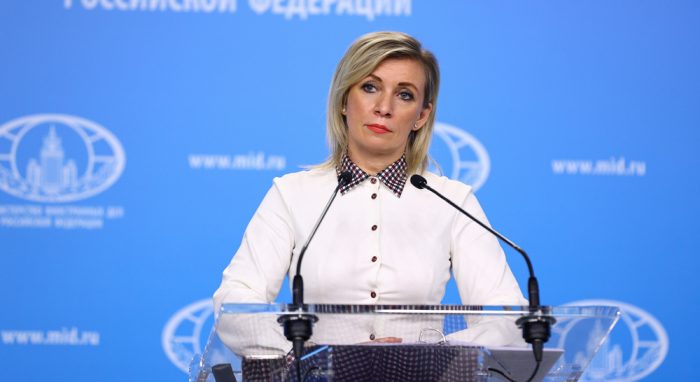
Press TV – December 17, 2023
Russian Foreign Ministry spokesperson Maria Zakharova said on Saturday that the latest European Union sanctions against Russia will cause more harm to the EU than Russia.
Zakharova added that the EU’s “dictatorial” behavior reveals how Brussels is “denying” member states of their right to “protect their interests.”
She also warned the EU of the “heavy price” the Europeans must pay for the accession of Ukraine and Moldova to the bloc.
“It goes as far as absurdity, when through some unscrupulous manipulations – when certain heads of state and government are not present at the table, – some legally questionable and obviously politicized decisions are made, which are as follows: on the start of pre-accession negotiations with Ukraine and Moldova, which not only fail to meet the EU’s elementary criteria but directly run counter to them, as well as on another ‘package’ of unilateral restrictive measures against Russia, which, like all the previous ones, will cause bigger harm to the European Union itself,” the diplomat said.
“This dictatorial behavior of Brussels reveals in all its magnitude that the member states are denied their democratic right to a dissenting opinion and the protection of their own interests.”
She went on to add that the EU’s confrontational “policy and the consequences of its opportunistic decisions regarding Ukraine and Moldova will have to be paid by the population of European countries.”
EU members agreed on a 12th package of sanctions against Russia, the European Council said on Thursday, meaning that a phased ban on Russian diamond imports among other measures will come into effect from January 1, 2024.
Moreover, after the summit, European Council President Charles Michel also announced that the EU members had decided to open accession negotiations with Ukraine and Moldova, which may start in March 2024 or later.
The accession talks regarding Ukraine and Moldova started after Hungarian Prime Minister Viktor Orban left the summit in protest to the move. Budapest had earlier threatened to veto the accession of Ukraine into the European Union. “Hungary does not want to be part of this bad decision!” Orban said in a statement on Facebook.
Russia started the “special military operation” in its eastern neighbor in late February 2022 to defend the pro-Russian population in the eastern Ukrainian regions of Luhansk and Donetsk against persecution by Kiev.
Ever since the beginning of the war, Kiev’s Western allies, led by the United States, have been pumping Ukraine with advanced weapons and slapping Russia with a slew of sanctions, steps that Moscow says would only prolong the hostilities.
Zakharova also said that the EU is continuing to “swiftly lose both political and economic weight around the world” under the pressure of the United States’ missteps.
“The EU’s resources, so much needed for its domestic growth, are not funneled into resolving multiple problems and asserting its own place in the emerging multipolar world order, but into serving the US interests, including into the enrichment of the US military-industrial complex,” she said.
Zakharova added that it looks quite natural that against this backdrop, “the most responsible politicians in European countries are more and more frequently prioritizing national interests over some mantras of ‘European solidarity,’ which are out of touch with real needs.”

or go to
Aletho News Archives – Video-Images
By Caitlin Johnstone | April 3, 2026
… It’s so wild how we keep seeing reports that Iran’s retaliation caught the US off guard. For all the years I’ve been paying attention to this issue I’ve been reading experts and analysts saying if the US attacks Iran, Iran can close the Strait of Hormuz and strike US bases and the energy infrastructure of US allies in the region.
A few examples:
A 2006 Oxford Research Group paper titled “Iran: Consequences of a War” warned that Iran has numerous options at its disposal in the event of a US attack, and that the “most significant of these would be any possible retaliatory Iranian action to affect the transport of oil and liquefied natural gas through the Straits of Hormuz,” adding that stopping Iran from doing this “would be difficult if not impossible to achieve, leading to a fear of attack which alone would have a formidable impact on oil markets.”
A 2007 Cato Institute paper titled “The Iraq War and Iranian Power” warns that “Iran possesses the largest ballistic-missile inventory in the Persian Gulf — missiles which can reach Israel, Saudi Arabia and US military bases in Iraq,” and that “experts argue Iran could also use the ’oil weapon’: blocking the 34km-wide Strait of Hormuz and conducting submarine and anti-ship missile attacks against ports and oil facilities in Saudi Arabia, Kuwait and other Gulf Cooperation Council states.”
A 2012 NPR article titled “Can Iran Close The World’s Most Important Oil Route?” features then-chairman of the Joint Chiefs of Staff acknowledging that Iran absolutely can block the Strait of Hormuz, saying Tehran has “invested in capabilities” which specifically enable them to do so.
A paper from the Columbia Center on Global Energy Policy and the Center for a New American Security titled “IN DIRE STRAITS? IMPLICATIONS OF US-IRAN TENSIONS FOR THE GLOBAL OIL MARKET” warns of a potential scenario “that includes damage to Gulf oil infrastructure and a temporary closure of the Strait of Hormuz.”
These weren’t a bunch of keffiyeh-wearing peaceniks making these assessments, they were deeply entrenched swamp monsters entirely loyal to the US empire. They opposed war with Iran not because it would be an evil act of unforgivable mass murder, but because it would be bad for the imperial power structure. … Full article
 Aletho News If Americans Knew No Tricks Zone
 Aletho News