Canada delays euthanasia for the mentally ill
RT | February 4, 2024
Canada has frozen a plan to expand its assisted suicide program to include people suffering from mental illnesses, Health Minister Mark Holland and Justice Minister Arif Virani have announced.
Among the reasons for the postponement, they cited a lack of medical professionals, especially psychiatrists, willing to evaluate patients before a lethal injection.
Canada legalized euthanasia after the Supreme Court ruled in 2015 that requiring people to cope with intolerable suffering was tantamount to violating their basic rights. In 2021, the Superior Court of Quebec demanded that the government expand the criteria to those suffering from “grievous and irremediable” conditions, such as depression and other mental health issues.
The law’s separate provisions for people with mental illnesses were originally postponed for two years.
Speaking to reporters on Monday following a session of a special parliamentary committee looking into the issue, Holland explained: “it’s clear from the conversations we’ve had that the system is not ready, and we need more time.”
On Thursday, Canada’s Health Ministry released a statement, clarifying that the expansion originally slated for March 17 of this year had been postponed until 2027. It is hoped that by then, regional healthcare providers will be better prepared to administer euthanasia to the mentally ill, with clear guidelines developed in the meantime, the document added.
Canada is already among the countries with most liberal laws regarding euthanasia and assisted suicide, with the procedure available to terminally and chronically ill people.
However, plans to extend the practice to the mentally ill have proven controversial, with members of the opposition Conservative Party accusing Prime Minister Justin Trudeau’s government of promoting a “culture of death.”
Some critics on the left have also argued that the authorities should instead focus on improving psychiatric care, which is said to be chronically underfunded.
A number of psychiatrists, for their part, have voiced concern that patients could bail out of treatment schemes that do not provide immediate relief, and opt for the easy way out instead.
According to a report released by the Canadian Health Ministry last October, there was a 31.2% increase in the number of cases involving what is termed in the country as medical assistance in dying (MAID) in 2022 compared to 2021.
In 2022, a total of 13,241 people chose to end their lives this way, with 463 of those being “individuals whose natural deaths were not reasonably foreseeable.”
Ukrainian official tries to justify the killing of 28 civilians in Russian bakery
RT | February 5, 2024
The emergencies minister of Russia’s Lugansk People’s Republic (LPR), Aleksey Poteleschenko, was confirmed on Monday as being among the victims of the recent Ukrainian strike on a bakery in the city of Lisichansk. The attack claimed the lives of 28 civilians.
While the strike has been squarely described by Moscow as a “terrorist attack” perpetrated by Kiev, the death of the regional cabinet minister actually legitimizes the strike, Petr Andryuschenko, an aide to the Ukrainian mayor of Mariupol (who fled the city in early 2022) has suggested. Mariupol, located in the Donetsk People’s Republic (DPR), was liberated by Russian forces early in the ongoing conflict, and joined Russia after a referendum in late 2022.
“At the end of the week, late in the evening, heavenly punishment visited Lisichansk in a restaurant near a bakery, where the top collaborators had already celebrated two birthdays,” Andryuschenko wrote on Telegram, claiming that only the restaurant was destroyed, while the bakery itself remained “intact.”
It was not immediately clear where he’d come by his information, given that the bakery and the restaurant were effectively a single establishment, located in the same building. Its structure ended up heavily damaged in the Ukrainian strike, partially collapsing and burying dozens of civilians under the rubble. Additionally, the strike did not exactly happen “late in the evening” as Andryuschenko claimed, occurring shortly after 5pm local time.
The official also urged the Ukrainian side to brag about such attacks in the future, arguing that Kiev should have broke the news on the strike first, while describing the bakery as an “assembly point” of “collaborators,” and therefore depriving Russia of the “information field advantage.”
The death of Poteleschenko was confirmed by the acting head of the LPR, Leonid Pasechnik. According to the latest official tally, the strike on the bakery left 28 people dead, including one child.
“He was a courageous man with an iron character and great fortitude. He defended the Lugansk People’s Republic within the ranks of the People’s Militia, then worked in the Ministry of Emergency Situations of the LPR. For a year, he headed the Lisichansk fire and rescue squad,” Pasechnik wrote, eulogizing the fallen official on Telegram.
Russian troops secured the city of Lisichansk in early July 2022, making it one of the last municipalities in the LPR to be liberated. However, the city, which remains close to the front line, has been a frequent target of Ukrainian artillery and missile attacks ever since. Saturday’s strike, however, was reportedly the deadliest to date in the community in terms of civilian casualties.
Is a New Korean War in the Offing?
BY GREGORY ELICH | COUNTERPUNCH | FEBRUARY 5, 2024
In recent days, U.S. media have been proclaiming that North Korea plans to initiate military action against its neighbor to the south. An article by Robert L. Carlin and Siegfried S. Hecker, neither previously prone to making wild assertions, created quite a splash and set off a chain reaction of media fear-mongering. In Carlin’s and Hecker’s assessment, “[W]e believe that, like his grandfather in 1950, Kim Jong Un has made a strategic decision to go to war.” They add that if North Korean leader Kim Jong Un is convinced that engagement with the United States is not possible, then “his recent words and actions point toward the prospects of a military solution using [his nuclear] arsenal.” [1]
U.S. officials have stated that while they do not see “an imminent risk of a full-scale war on the Korean Peninsula,” Kim Jong Un “could take some form of lethal military action against South Korea in the coming months after having shifted to a policy of open hostility.” [2] How do these sensationalist claims stack up against the evidence?
It is no secret that lately, the stance of the United States and South Korea has hardened against the Democratic People’s Republic of Korea (DPRK – the formal name for North Korea). Since the centerpiece for suggesting that war may be on the horizon is Kim’s speech at the 14th Supreme People’s Assembly, its content is worth examining in some detail. [3] What strikes one when reading the text is that mainstream media have taken quotes out of context and ignored much of the content of Kim’s speech, creating an impression of unprovoked belligerence.
Also generally absent from media reporting is the speech’s relationship to the backdrop of events since the far-right Yoon Suk Yeol became president of South Korea in May 2022. Yoon came into office determined to smash every vestige of the improved inter-Korean environment established during his predecessor’s term. Instead, Yoon prioritized making South Korea a subordinate partner in the Biden administration’s hyper-militarized Indo-Pacific Strategy.
To fully understand Kim Jong Un’s speech, one must also consider the nature of the Biden administration’s rapid military escalation in the Asia-Pacific. The United States conducts a virtually nonstop series of military exercises at North Korea’s doorstep, practicing the bombing and invasion of that nation. One South Korean analyst has counted 42 joint U.S.-South Korean military exercises conducted in 2023 alone, along with ten more involving Japan. [4] Those totals do not include exercises that the U.S. and South Korea engaged in outside of Northeast Asia, such as Exercise Talisman Sabre in Australia and Exercise Cobra Gold in Thailand. Moreover, U.S. actions on the Korean Peninsula must also be situated within the broader geopolitical framework of its hostility towards China.
Last year, in an act of overt intimidation, the United States conducted seven exercises with nuclear-capable bombers over the Korean Peninsula. [5] Additional flights involved the B-1 bomber, which the U.S. Air Force says “can rapidly deliver massive quantities of precision and non-precision weapons.” [6] Through its actions, the United States sends far more provocative messages than anything that could be honestly construed in Kim’s speech. But then, we are led to see nothing amiss in such aggressive behavior from the United States. Nevertheless, the threat is real and unmistakable from the targeted nation’s perspective.
It also has not gone unnoticed in Pyongyang that U.S. and South Korean military forces regularly conduct training exercises to practice assassinating Kim Jong Un and other North Korean officials. [7] Just this month, U.S. Green Berets and soldiers from South Korea’s Special Warfare Command completed training focused on the targeted killing of North Korean individuals. [8] The Biden administration avers that it harbors no hostile intent toward the DPRK, but its actions say otherwise, loud and clear.
North Korea, with a GDP that the United Nations ranks just behind that of Congo and Laos, is considered such a danger that the U.S. must confront it with substantial military might. An inconvenient question that is never asked is why the DPRK is singled out for punishment and threats when the other nuclear non-members of the Non-Proliferation Treaty – each armed with ballistic missiles — are not. What distinguishes North Korea from India, Pakistan, and Israel? How is it that North Korea is regarded as a threat to peace but not Israel, notwithstanding mounting evidence to the contrary? The essential distinction is that North Korea is the only one of the four that is not a U.S. ally; moreover, one which the U.S. wishes to retain the ability to bomb, whether or not it ever exercises the option to do so.
It is a tribute to the persuasiveness of propaganda that the United States, with its record of multiple wars, bombings, and drone assassinations in recent decades, can convince so many that the DPRK, which has done none of these things during the same period, is a danger to international peace and stability. Yet, such towering hypocrisy goes largely unnoticed. It would appear that there is no principle involved in targeting only North Korea and not the other nuclear-armed non-members of the NPT — unless outrage over a small nation following an independent path being able to defend itself can be regarded as a principle.
Predictably, Washington think tank analysts and media commentators are throwing more heat than light on the subject of Kim’s pronouncements, and they are always ready with a cliché at hand. Some, like Bruce W. Bennett of RAND Corporation, let their imagination run wild, conjuring bizarre absurdities. Bennett suggests that armed with more nuclear weapons in the years ahead, North Korea “could threaten one or more U.S. cities with nuclear attack if the United States does not repeal its sanctions against North Korea.” Or perhaps, he suggests, the DPRK could threaten the U.S. with a limited nuclear attack “unless it abandons its alliance with [South Korea]” or “disengage from Ukraine.” As for South Korea, Bennett warns that Kim might insist that it “pay him $100 billion per year and permanently discontinue producing K-pop…” [9] This is what passes as expert analysis in Washington.
The military section of Kim’s speech was at root defensive, pointing out that North Korea’s “security environment has been steadily deteriorated” and that if it wants to take “the road of independent development,” it must be fully prepared to defend itself. Kim quotes specific threats made by U.S. and South Korean leaders to emphasize his awareness that his nation is in the crosshairs.
At one point in his speech, Kim suggested that the constitution could specify “the issue of completely occupying, subjugating and reclaiming the ROK [Republic of Korea, the formal name for South Korea] and annex it…in case war breaks out…” He added, “There is no reason to opt for war, and therefore, there is no intention of unilaterally going to war, but once a war becomes a reality facing us, we will never try to avoid it.” Such a war, he warned, “will terribly destroy the entity called the Republic of Korea and put an end to its existence” and “inflict an unimaginably crushing calamity and defeat upon the U.S.” Kim continues, “If the enemies ignite a war, our Republic will resolutely punish the enemies by mobilizing all its military forces including nuclear weapons.” Harsh language, indeed, intended to remind the war hawks in Washington and Seoul not to imagine that their nations are invulnerable if they attack the DPRK. Note also the conditional phrasing, which tends to get downplayed in Western media.
Even less attention is paid to more direct clarifying language, such as Kim’s statement that the DPRK’s military is for “legitimate self-defense” and “not a means of preemptive attack for realizing unilateral reunification by force of arms.” And: “Explicitly speaking, we will never unilaterally unleash a war if the enemies do not provoke us.”
It was entirely predictable that Western media would put the worst spin on Kim’s blunt language that mirrored earlier South Korean pronouncements. The month before Kim’s speech, South Korean Defense Minister Shin Won-sik warned, “North Korea has only two choices – peace or destruction. If North Korea makes reckless actions that harm peace, only a hell of destruction awaits them.” [10] A few days later, Yoon ordered his military to launch an “immediate and overwhelming response” to any provocation by the DPRK. [11] Yoon and South Korean military officials use the term ‘provocation’ so loosely as to encompass almost any action the DPRK takes that they do not like, including what is normal behavior for other nations – or for South Korea itself, for that matter. South Korean and North Korean rhetoric identifying each other as enemies and destruction in the event of war differ in that the former preceded the latter. By ignoring the fact that North Korea is reacting to prior South Korean statements, mainstream media can portray Kim’s language as unprovoked.
Last December, Yoon heightened the risk of conflict when he visited an infantry division near the border and gave them an order: “In case of provocations, I ask you to immediately retaliate in response and report it later.” [12] Vague in defining neither “provocation” nor the appropriate response level and delegating to lower-level commanders to decide those questions, this formula potentially can transform a minor clash of arms into a conflict of wider impact.
Kim’s statements are presented in Western media as tantamount to a plan to start a war. Earlier statements of a similar nature by the Yoon administration that created an acrimonious atmosphere are rendered invisible or uncontroversial. It is fair to say that given North Korea’s longstanding practice of responding in kind, Kim may have adopted more restrained phrasing without South Korean officials setting the tone.
Western media have raised concerns over Kim’s labeling of South Korea as a “principal enemy.” We are not reminded that nearly one year before, South Korea had re-designated the DPRK as “our enemy” in its Defense White Paper. [13] Under Yoon’s predecessor, Moon Jae-in, the defense paper dropped the reference to North Korea as an enemy. [14] The general pattern has been for liberal presidents to shun that tag in the interests of inter-Korean relations and for conservative presidents to embrace it as one element in their project to undo progress. Yoon himself frequently refers to North Korea as the enemy, and his administration’s National Security Strategy document describes the Kill Chain system, which is designed to launch preemptive strikes on North Korea. [15] In omitting such details, cause and effect are inverted, reinforcing the media-constructed Orientalist image of an irrational leader at the helm of the DPRK, prone to unpredictable statements and rash acts.
Patience has run thin in Pyongyang, as Biden’s trilateral alliance with South Korea and Japan, “buoyed with war fever,” as Kim put it, sharply escalates military tensions in the region. In a sharp reversal, North Korea has abandoned its longstanding policy of seeking improved inter-Korean relations and working toward peaceful reunification. Any headway achieved in the past has quickly been undone in South Korea whenever the conservative party came to power. Still, Yoon has taken matters further than the norm, not only willfully dynamiting inter-Korean relations but also deliberately raising the risk of military conflict. Inter-Korean relations have reached such a nadir under Yoon that the DPRK sees no hope of progress in the current circumstances. The North Koreans are not wrong in that perception.
Sadly, in a clear signal of its exasperation with Yoon, North Korea demolished the Arch of Reunification in Pyongyang, and all governmental bodies responsible for reunification planning and projects were shut down. The latter steps are not inherently irreversible, however. But as long as Yoon remains in power, there is no conceivable possibility of progress on reunification. Yoon has slammed the door shut on inter-Korean relations.
One would never know it from Western reports, but more than two-thirds of Kim’s speech focused on economic development. “The supreme task,” Kim announced, “is to stabilize and improve the people’s living as early as possible.” Peace is an essential prerequisite for the realization of that goal. North Koreans are well aware of American and South Korean military capabilities, and a war would not only wipe out new economic projects but most of the existing infrastructure as well.
Immense damage has been done to the DPRK’s economy by sanctions designed to target the entire population and inflict as much suffering as possible. [16] The period when North Korea closed its border with China in response to the COVID-19 pandemic added to economic challenges. Reversing direction is imperative. In his speech, Kim called for “a radical turn in the economic construction and improvement of the people’s living standard” and said that progress is being made “despite unprecedented trials.” Kim enumerated industrial, power, housing, and other ongoing projects.
Kim admitted there have been internal challenges in economic development. “It is a reality that the Party and the government yet fail to meet even the simple demand of the people in life…” In particular, regional and urban-rural economic imbalances have plagued the North Korean economy for decades. “At present,” Kim continued, “there is a great disparity of living standards between the capital city and provinces and between towns and the countryside.” Kim acknowledged that these issues have not been adequately addressed in the past, but it “is an immediate task” to do so now.
Kim took the occasion to officially unveil the launch of the Regional Development 20×10 Policy. This ambitious plan calls for substantially raising material and cultural standards in twenty counties over the next ten years, including constructing regional industrial factories and establishing advanced educational institutions. In particular, emphasis is to be given to scientific and technological development. The aim is to even out regional imbalances and to accelerate overall development.
None of this can be achieved if the U.S. and South Korea are showering the DPRK with high explosives, and the Regional 20×10 Policy makes nonsense of Western scaremongering that Kim has decided to go to war. As usual, though, when it comes to reporting on North Korea, assertion substitutes for evidence, and we can expect Washington think tanks, U.S. media, military contractors, and the Biden administration to capitalize on the manufactured image of a war-mad Kim Jong Un to accelerate the military buildup in the Asia-Pacific, aimed against the DPRK and the People’s Republic of China. For his part, Yoon can be expected to amplify military tensions on the Korean Peninsula and sharpen his war on South Korean progressives. What is not in the cards is militarism abating in the foreseeable future.
Notes.
[1] Robert L. Carlin and Siegfried S. Hecker, “Is Kim Jong Un Preparing for War,” 38 North, January 11, 2024.
[2] Edward Wong and Julian E. Barnes, “U.S. is Watching North Korea for Signs of Lethal Military Action,” New York Times, January 25, 2024.
[3] “Respected Comrade Kim Jong Un Makes Policy Speech at 10th Session of the 14th SPA,” KCNA, January 16, 2024.
[4] http://www.minplusnews.com/news/articleView.html?idxno=14494
[5] Chae Yun-hwan, “S. Korea, U.S. Stage Joint Air Drills with B-52H Bombers Over the Yellow Sea,” Yonhap, November 15, 2023.
[6] https://www.af.mil/About-Us/Fact-Sheets/Display/Article/104500/b-1b-lancer/
[7] Jeongmin Kim, “Drills on Assassinating Kim Jong Un Remain an ‘Option,’ ROK Defense Chief Says,” NK News, December 19, 2023.
[8] Lee Yu-jung and Esther Chung, “Kim Jong-un Instructs North Korea’s Navy to Prepare for War,” JoongAng Ilbo, February 2, 2024.
https://www.youtube.com/watch?v=lQJF7tbzwfY
Donald Kirk, “U.S. to Enrage Kim Jong Un with Assassination Dry Run,” Daily Beast, August 19, 2022.
[9] Bruce W. Bennett, “Is North Korea Really Getting Ready for a War Against America?” The National Interest, January 17, 2024.
[10] Chae Yun-hwan, “Defense Chief Warns N. Korea of ‘Hell of Destruction’ in Event of Reckless Acts,” Yonhap, December 13, 2023.
[11] “Yoon Orders Swift, Overwhelming Response to N. Korean Provocation,” KBS World, December 18, 2023.
[12] Kim Han-joo, “Yoon Orders Military to Retaliate First, Report Later in Case of Enemy Attacks,” Yonhap, December 28, 2023.
[13] Kwon Hyuk-chul, “S. Korea’s First Defense White Paper Under Yoon Defines N. Korea as ‘Enemy’”, Hankyoreh, February 17, 2023.
[14] Yosuke Onchi, “South Korea No Longer Calls Pyongyang ‘Enemy’ in Defense Paper,” Nikkei Asia, January 16, 2019.
Josh Smith, “South Korea Doubles Down on Risky ‘Kill Chain’ Plans to Counter North Korea Nuclear Threat,” Reuters, July 25, 2022.
[16] https://www.counterpunch.org/2017/09/19/trumps-war-on-the-north-korean-people/
Explosives sent from Ukraine for terrorist attacks in Russia seized
RT | February 5, 2024
Georgia’s State Security Service has said that its operatives have seized a batch of explosives that Ukrainians had attempted to ship to Russia via third countries in order to stage terror attacks.
The illegal cargo, which included six sophisticated explosive devices weighing a total of 14 kilograms, had been shipped from the Ukrainian port city of Odessa, the agency said in a statement on Monday.
The explosives were brought into Georgia in a minivan after traveling through Romania, Bulgaria and Turkey on January 19, it said. During the search of the vehicle, the bombs were found hidden inside the batteries for an electric car, it added.
According to the security service, seven citizens of Georgia, three Ukrainians and two Armenians were involved in the delivery of the explosives. The people in question might have been unaware that they were actually transporting bombs, it stressed.
The whole operation had allegedly been organized by a Ukrainian citizen of Georgian origin, whom the agency identified as Andrey Sharashidze, the statement read. Sharashidze, who was born in the Georgian coastal city of Batumi, ran in a local election in Odessa in 2020 for Ukrainian President Vladimir Zelensky’s Servant of the People party, it said.
As a result of “comprehensive actions carried out by the Anti-Terrorism Center, based on the testimony of interviewed witnesses and recovered audio files,” it was established that the explosives were intended to be delivered to Russia, specifically to the city of Voronezh, the security service stressed.
The bombs contained military-grade C-4 plastic explosives and were apparently made by “high-level specialists,” the statement read. “Deploying such a device in a crowded area might have caused significant damage to infrastructure and large-scale casualties,” it warned.
The agency also didn’t rule out the possibility that the suspects had been planning to use some of the explosives to stage attacks inside Georgia. It could’ve been done in order to blame Tbilisi for preparing and carrying out those terrorist activities, it suggested.
The investigation continues in order to establish the identities of all those involved in the criminal activity, the manufacturers of the explosives and along which route they were smuggled into the country, the security service said.
Forests Are Doing Much Better Than We Think
By David Fickling | Bloomberg | January 28, 2024
Excerpts:
Take England. Forest coverage now is greater than at any time since the Black Death nearly 700 years ago, with some 1.33 million hectares of the country covered in woodlands. The UK as a whole has nearly three times as much forest as it did at the start of the 20th century.
…
It’s a similar picture in Scandinavia and Central Europe, where the spread of forests onto unproductive agricultural land, combined with the decline of wood-based industries and better management of remaining stands, has resulted in extensive regrowth since the mid-20th century. Forests cover about 15% of Denmark, compared to 2% to 3% at the start of the 19th century.
…
China’s forests have increased by about 607,000 square kilometers since 1992, a region the size of Ukraine. The European Union has added an area equivalent to Cambodia to its woodlands, while the US and India have together planted forests that would cover Bangladesh in an unbroken canopy of leaves.
…
Even tropical deforestation has slowed drastically since the 1990s, possibly because the rise of plantation timber is cutting the need to clear primary forests.
…
Remarkably, this may not be the first time human activities caused an expansion of the world’s forests. The devastating population declines caused by war and disease after the European colonization of the Americas may have caused a downturn in global temperatures between the 16th and 19th centuries, according to one 2019 analysis. With their populations reduced to about 10% of previous numbers, Indigenous people were no longer able to maintain agricultural systems based on clearing land with fire. As a result, 558,000 square kilometers of new woodlands grew, sufficient to lock away about 27 billion tons of CO2. …
The CO2 taken up by trees narrowly exceeded the amount released by deforestation.
…
Nor is global afforestation to date caused mainly by environmental imperatives. Indeed, in much of the world, it has been the rise of fossil fuels that turned the corner on deforestation almost a century ago, as industries turned to coal, oil and gas to produce heat and energy in place of wood.
…
Still, we should celebrate our success in slowing a pattern of human deforestation that’s been going on for nearly 100,000 years. Nothing about the damage we do to our planet is inevitable. With effort, it may even be reversible.
David Fickling is a Bloomberg Opinion columnist covering energy and commodities. He has worked for Bloomberg News, the Wall Street Journal and the Financial Times.
Germany’s energy crisis deepens further due to Biden’s halt of U.S. LNG projects
Germany has dug itself into an energy hole
By P Gosselin | No Tricks Zone | February 4, 2024
Due to the environmental and climate hysteria over the past decades, Germany has steadily moved to shut down its vast fleet of nuclear reactors, coal power plants, and even natural gas supplies (a major supply line from Russia got blown up).
Moreover, Germany is moving to ban fossil fuel heating systems for homes, and mandating electric cars by 2035.
Now in an energy crunch
Since the supply of natural gas from Russia got cut off, it became necessary to find an alternative source quickly – from USA in the form of imported LNG. The German government approved the construction an LNG terminal at the north German coast in record time. This would help secure Germany’s energy supply. Surely the USA could be viewed as a reliable partner.
That was the plan – until President Joe Biden unexpectedly put a stop to further LNG projects. Now, Germany suddenly risks finding itself in energy isolation. It’s panic time in Berlin.
“Devastating energy crisis”
“Germany is facing a devastating energy crisis that seriously threatens its security of supply,” reports Germany’s Blackout News. “Biden’s decision now has far-reaching consequences that could pose serious problems for German energy policy.”
Also see. berliner-zeitung : 26.01.24
The USA is the world’s largest exporter of LNG, but because of climate protection, Biden bowed to pressure from climate radicals and stopped plans to build new export terminals. This development has sent shockwaves through energy-starved Germany.
According to US government officials, four U.S. terminal projects are directly affected by Biden’s decision.
Berlin has backed itself into a corner with its years of misguided green energy policy. Now the chickens are coming home to roost.
West totally wrong about Ukraine – Orban
RT | February 4, 2024
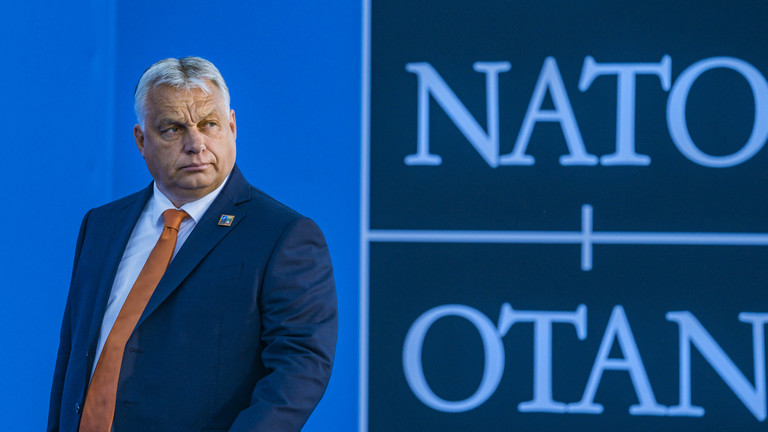
Hungarian Prime Minister Viktor Orban has expressed hope that the newly-approved €50 billion ($54 billion) package of aid will be used to support civilians by preventing the collapse of the bankrupt Ukrainian state, rather than to fund more weapons and bloodshed.
Orban has repeatedly called for a ceasefire in Ukraine and peace talks between Moscow and Kiev, arguing that Ukraine cannot possibly hope to defeat Russia on the battlefield. This position, as well as Budapest’s opposition to sanctions on Russia and blocking of EU military aid to Ukraine, has seen Hungary vilified in Kiev and threatened with sanctions by its EU allies.
“The West still thinks that time is on our side. Yet, I think the opposite is true. I think that time is on the side of the Russians, and the longer the war goes on, the more people will die, and the balance of power will not change in Ukraine’s favor,” Orban told Kossuth Radio on Friday.
According to Russia’s estimates, Kiev has lost more than 400,000 service members killed, wounded, and missing since the conflict began in February 2022. Ukraine’s top commander, General Valery Zaluzhny, has repeatedly insisted in recent weeks that the armed forces are critically understaffed, and even President Vladimir Zelensky admitted on Sunday that combat operations on the ground have reached a “stalemate.”
The Hungarian leader went on to insist that “peace will come when there is change in Brussels,” and that after almost two years of failed hopes to defeat Russia militarily “everything in Brussels should revolve around achieving a ceasefire as soon as possible.”
The EU approved the new aid package on Thursday, having pressured Orban into lifting his veto. The Hungarian painted the decision as a victory for Budapest, claiming that otherwise Brussels “would have taken away the funds earmarked for Hungary and sent that to Ukraine as well.”
“We are not sending weapons, we get our money from Brussels, and we will contribute to the civil financing of Ukraine,” Orban said on Friday, reiterating his firm position that the only way to end the Ukrainian crisis was through negotiations.
FOR WESTERN MEDIA, ISRAEL’S BOMBING OF GAZA IS NOT ‘DEADLY’
Right across the Anglo-American mainstream media, the killing of Palestinians is seen as normal. It’s only Israeli lives that matter.
BY DES FREEDMAN | DECLASSIFIED UK | JANUARY 30, 2024
Twenty-four Israeli soldiers were killed in two separate incidents in Gaza on 22 January. Mainstream media outlets around the world reacted in unison: that this was the “deadliest day” for Israel since 7 October.
This exact phrase was used in headlines on 23 January carried by news agencies such as Reuters and AFP, and major broadcasters including the BBC, CBS, NBC, CNN, ABC and ITV News.
The exact same phrase was also used by leading news titles including the New York Times, Washington Post, Wall Street Journal, Time magazine, Daily Telegraph, the Sun, Jerusalem Post, Guardian, London’s Evening Standard, Financial Times, Independent and Yahoo News.
On the same day, Israeli forces killed almost 200 Palestinians in Gaza including at least 65 people in Khan Younis alone.
These deaths received no headlines in the above outlets. Where they were reported, they were listed as part of the regular daily round-up of events in an unfolding genocide that has now seen more than 26,000 people killed in Gaza.
How is it possible that the world’s media could embrace exactly the same phrase in relation to Israeli victims but largely ignore the identities of the much higher number of Palestinians killed?
Why would 22 January be described as “deadly” for one group of people but not for another?
Unequal value
You might expect that editors took the “deadliest day” phrase from press statements from the Israeli government or military.
Yet Israel Defense Forces (IDF) spokesperson Daniel Hagari did not use this phrase in his statement and neither did the IDF Chief of the General Staff, Herzi Halevi, who instead simply called it a “difficult day”.
Prime minister Benjamin Netanhayu also described it as “one of the most difficult days” while Israel’s President, Isaac Herzog, spoke of “an unbearably difficult morning”.
He used the same language as both Knesset speaker Amir Ohana and minister Benny Gantz, both of whom referred to a “painful morning”.
Of course, it is possible the phrase was used in private and informal briefings to the press on the morning of 23 January. It is, however, equally conceivable that this was a trope that came “naturally” from a deep-rooted idea in the western media that the lives of Israelis and Palestinians are not of equal value.
And, therefore, that measuring the “deadliness” of a particular day should only be done for Israelis (where every life matters) and not for Palestinians (whose individual lives clearly appear to count for less).
‘Deadliest day’
Indeed, a search of the Nexis database of UK national and local news (including BBC broadcast bulletins) reveals that there were 856 uses of the phrase “deadliest day” from 7 October 2023 until 25 January 2024, none of which directly referred to evidence of Palestinian deaths in Gaza.
The only exception to this were some BBC bulletins on 25 October which mentioned “Palestinians reporting the deadliest day in Gaza” (emphasis added).
Otherwise, there was not a single reference during this period across the British media to “the deadliest day for Palestinians” or “for the people of Gaza”.
The other approximately 850 references directly related only to Israeli casualties. Some 28 per cent of them focused on the killing of IDF soldiers on 22 January.
The vast majority referred to the events of 7 October, described either as “the deadliest day for Jews” or “the deadliest day for the Jewish people” which accounted for some 25% of all references.
Many of these stories were focused on the words of US president Joe Biden who, in a much publicised speech to Jewish leaders at the White House, described the Hamas attack on 7 October as the “deadliest day for Jews since the Holocaust”.
Biden’s words alone make up 20% of all references to the “deadliest day” trope.
Perhaps Biden’s words were on the minds of editors across the world as they listened to Israeli spokespeople on the morning of 23 January and that the deaths of 24 IDF soldiers merited such a phrase when talking about Israeli lives.
Framing the war
But why has the phrase not been used in relation to Palestinians and, indeed, why is there so little preoccupation with days when particularly large number of Gazans are killed?
Precisely because the war is not framed in a way which recognises the equal worth of all those affected – in other words, a situation where every instance of significant Palestinian casualties would deserve a headline – it’s hard to be certain of which have been the very deadliest days for the residents of Gaza.
However, it’s clear that the period immediately after the temporary ceasefire in the last week of November saw particularly intense airstrikes and there were, according to Al Jazeera, at least 700 Palestinians killed on 2 December alone.
Yet there was no mention in the UK media about this being the “deadliest day” for Palestinians. Instead, the Guardian simply ran with a headline of “‘Israel says its ground forces are operating across ‘all of Gaza’” while the Sunday Times wrote that “Fears for hostages as Gazans say bombardment is worse than ever”.
According to the Mail Online, “Israel says it is expanding its ground operations against Hamas’ strongholds across the whole of the Gaza Strip as IDF continues to bomb territory after terrorists broke fragile truce”.
The BBC’s TV news bulletins on 3 December carried distressing footage of casualties but also featured a quote from an adviser to Netanyahu saying that “Israel was making the ‘maximum effort’ to avoid killing civilians” without carrying an immediate rebuttal of this outrageous claim.
In other words, despite the fact that 30 times more Palestinians were killed on 2 December than when the 24 IDF soldiers were killed, there was no recognition of the “deadliness” of that day.
Instead, the framing was all about the strategic plans of the Israeli military rather than the mass slaughter of Palestinians.
‘Intensive strike’
On 26 December, a further 241 people were killed by Israeli bombs. Britain’s “newspaper of record”, The Times, responded with the headline: “Israel-Gaza war: Palestinians hit by ‘most savage bombing’” with a sub heading that “Israel launches most intensive strike since Hamas attack on October 7”.
You could be forgiven for thinking that there was nothing deadly about this episode because, after all, Palestinians were only being “struck” as opposed to brutally killed.
But this was hardly an exceptional day given that Oxfam reported earlier this year that Israel’s military was killing Palestinians at an average rate of 250 people a day, a figure it said exceeded the daily death toll of any other major conflict of recent years.
There is clearly a brutal politics to counting the dead. The New York Times ran an article on 22 January headlined “The Decline of Deaths in Gaza” arguing that average daily deaths across a 30-day period have now fallen below 150.
For the NYT, it is “plausible that a lower percentage of deaths are among civilians now that Israel’s attacks have become more targeted and the [average] daily toll has declined”.
Not only, however, is there little evidence that the IDF is in any way opposed to killing civilians but the idea that casualties are declining at a time when we are soon likely to see a total of 30,000 Palestinian deaths is profoundly shocking.
Any slowdown in the rate of killing is hardly a consolation to the millions who still live in fear of IDF raids and rockets.
Media consensus
The media consensus that only Israelis are the victims of the “deadliest days” in the region and not Palestinians, despite the latter accounting for 95% of deaths since 7 October, is one of the many illustrations of the unequal and profoundly distorted coverage of this war.
Until the South African government submitted its partially successful claim to the International Court of Justice, news organisations were unwilling even to investigate the genocidal language of Israeli political and military leaders.
The media also routinely uses dehumanising and differential language where Israelis are “massacred” while Palestinians simply “die”. This illustrates the awful role of the mainstream media in paving the way for the ethnic cleansing we are currently seeing.
The real reason you don’t see or hear the media talk about a “deadly day” for Palestinians is that every day is deadly when you live in Gaza.
New wave of US, UK strikes target Yemen
The Cradle – February 4, 2024
US and UK warships and fighter jets bombed Yemen on 4 February, in a wave of missile strikes US officials claim hit 36 targets.
The US said in a CENTCOM statement that it hit “36 targets at 13 locations,” striking “underground storage facilities, command and control, missile systems, UAV storage and operations sites, radars, and helicopters.”
According to the statement, the US, UK, Australia, Bahrain, Canada, Denmark, the Netherlands, and New Zealand took part in the attacks.
The strikes were in response to Yemeni efforts to target Israeli-linked commercial ships passing through the narrow Bab al-Mandab Strait in the Red Sea. The Yemeni attacks are in response to Israel’s genocidal bombing campaign in Gaza.
Rather than press its ally Israel to stop its military campaign, which has killed over 27,000 Palestinians, the majority women and children, the US has joined forces with the UK to bomb Yemen.
Saturday’s strikes were launched by US F/A-18 fighter jets from the USS Dwight D. Eisenhower aircraft carrier, British Typhoon FGR4 fighter aircraft, and the Navy destroyers USS Gravely and the USS Carney firing Tomahawk missiles from the Red Sea, according to US officials and the UK Defense Ministry.
The Yemen Armed Forces issued a statement detailing where the attacks took place, reporting 13 raids on Sanaa, 9 on Hodeidah, 11 on Taiz, 7 on Al-Bayda, 7 on Hajjah, and one on Saada.
“These attacks will not deter us from our moral, religious, and humanitarian stance in support of the steadfast Palestinian people in the Gaza Strip, and will not go unanswered and punished,” read the statement.
The strikes come one day after the US sent B-1 bombers to target 85 locations affiliated with the Islamic Resistance of Iraq in eastern Syria and western Iraq, killing at least 16. This was in response to an operation by the Islamic Resistance in Iraq that targeted US military outpost Tower 22 in Jordan last week, killing three US soldiers.
US officials reportedly told Al-Jazeera that the strikes on Yemen are “considered a next round of retaliation for the killing of the [US] soldiers in Jordan.”
Like Ansarallah, the Islamic Resistance in Iraq coalition, formed after 7 October, has also targeted Israel, as well as US bases in Syria and Iraq. The groups say their attacks are in response to Israel’s genocide in Gaza, which the US has supported militarily and diplomatically.
Ansarallah leaders in Yemen say they have no intention of scaling back their campaign despite pressure from the US and UK bombing.
Mohammed al-Bukhaiti, an Ansarallah official, said, “military operations against Israel will continue until the crimes of genocide in Gaza are stopped and the siege on its residents is lifted, no matter the sacrifices it costs us.” He wrote on social media that the “American-British aggression against Yemen will not go unanswered, and we will meet escalation with escalation.”
Featured Video

Michael von der Schulenburg: Europe’s Self-Defeating Iran War Policy
or go to
Aletho News Archives – Video-Images
Frlom the Archives
Who Rules America?
The Power Elite in the Time of Trump
By James Petras | Axis of Logic | September 6, 2017
Introduction
In the last few months, several competing political, economic and military sectors – linked to distinct ideological and ethnic groups – have clearly emerged at the centers of power.
We can identify some of the key competing and interlocking directorates of the power elite:
- Free marketers, with the ubiquitous presence of the ‘Israel First’ crowd.
- National capitalists, linked to rightwing ideologues.
- Generals, linked to the national security and the Pentagon apparatus, as well as defense industry.
- Business elites, linked to global capital.
This essay attempts to define the power wielders and evaluate their range of power and its impact. … continue
Blog Roll
 Aletho News
- Michael von der Schulenburg: Europe’s Self-Defeating Iran War Policy
- Sorry, The New Republic, Climate Change Isn’t Causing Somali Migration. Blame Civil Strife and Poverty.
- Expert Guts Claims That HPV Vaccine Reduces Cancer Risk
- No evidence Russia sabotaged Baltic cables – Finnish intel
- The Strategic Folly of a (Serious) US Ground Invasion of Iran
- US-Israeli war of aggression on Iran meant to reshape region: Omani FM
- Iran Does Not Consider Israel Party to Talks to Need Mediators With It – Ambassador
- Macron’s aircraft carrier and warplanes to the Persian Gulf is a dangerous vanity project
- Meet The Ellisons: Zionists, Technocrats, Moguls
- US failures in Iran reveal Russia is key to South Korea’s strategic security
- If Americans Knew
- Are we on the precipice of World War III?
- ‘Catastrophic,’ Says UNICEF: 1,100+ Children Killed or Wounded in Mideast Since US-Israel Launched Iran War
- The Unbelievable Madness of Our War With Iran
- World Council of Churches calls on govts to hold Israel accountable for violations of intl law
- How to end the war on Iran that costs US taxpayers $1M per minute – Not a ceasefire Day 153
- Israeli strategic plans to “remake the Middle East” from the 1950s and since
- Honoring Gaza’s women who refused to let the world look away
- 97% of victims of war on Iran are Iranian, 98% of victims in war on Gaza are Gazans – Not a ceasefire Day 152
- Early Iran strikes cost $5.6 billion in munitions, Pentagon estimates
- Israel Decided the War, But Trump’s America Fights and Pays the Bill
- No Tricks Zone
- New Studies: UK Sea Levels Were 4 Meters Higher Than Today During The Mid-Holocene
- Destructive Green New Deal: German Energy And Metal Group Warns Of Drastic Crisis
- New Study Documents A 20-Year Pause In Arctic Sea Ice Decline – Driven By Internal Variability
- Wake-up Call: Survey Shows Majority Of Germans Now Favor Postponing Climate Targets!
- Televised! Leading German Political Candidate Tells Schoolchildren CO2 Makes Sun Hotter!
- New Study: A Century Warming Of 1.1°C Is ‘Commonplace’ And ‘Not Unusual’ During This Interglacial
- New Study: ‘Internal Noise’ And Volcanic Forcing Can Trigger 10-15°C Warming Within Decades
- Glaciers Worldwide Are Suddendly Surging, Experts Blame Warming!
- Surprising Discovery: Sahara Is Greening…Billions Of Trees Where Once Thought To Be Barren
- New Research Reaffirms Clouds, Aerosols, And Surface Solar Radiation Are ‘Driving The Climate System’
 Aletho News