EU approves €50 billion in Ukraine aid
RT | February 1, 2024
EU leaders have signed off on a €50 billion ($54 billion) package of economic aid to Ukraine, overcoming resistance from Hungarian Prime Minister Viktor Orban. The Hungarian leader accused Brussels of “blackmailing” him into accepting the deal.
European Council President Charles Michel announced the news on Thursday morning, minutes after the bloc’s leaders sat down for talks in Brussels.
“All 27 leaders agreed on an additional €50 billion support package for Ukraine within the EU budget,” Michel wrote on X. “This locks in steadfast, long-term, predictable funding for Ukraine.”
The sum will be drawn from the EU’s collective budget and doled out over four years to Kiev, where it will be used to pay public sector salaries, keep government departments open, and prop up the beleaguered welfare system. The EU already agreed on a budget three years ago, which will have to be modified to include the mammoth aid package.
Any such budget modifications require the unanimous approval of all 27 member states. Hungarian Prime Minister Viktor Orban warned for months that he would veto the proposal, arguing that the EU has no idea how the money will be spent and no idea what will happen in Ukraine in the coming months. Orban has also argued that Ukraine cannot defeat Russia on the battlefield, and that Western leaders should be pushing Kiev toward a ceasefire and peace talks.
Orban has described Ukraine as “one of the most corrupt countries in the world.” Transparency International ranks Ukraine 104th out of 180 in its Corruption Perceptions Index report, and over the weekend, the country’s Security Service (SBU) announced that it had uncovered a major scheme by high-ranking defense officials to embezzle money intended to purchase ammunition.
Earlier this week, the Financial Times revealed that the European Council had drawn up a plan to cut funding to Budapest and tank the Hungarian economy if Orban maintained his veto. Orban accused the “imperialist” EU of trying to “blackmail” him, and said that he proposed a “compromise deal” whereby Ukraine would receive a smaller transfer of aid every year, which any member state could veto.
Brussels rejected Orban’s proposal, he told France’s Le Point news magazine on Monday. “They say that if we behave like a sovereign country, Hungary will immediately face a vast financial blockade,” he said. “Knowing Brussels, they are capable of it.”
Under the terms of the deal agreed on Thursday, EU leaders will debate the implementation of the package annually, while the budget will be reviewed in two years. Speaking anonymously, multiple European diplomats told Politico that these measures were included to placate the Hungarian PM.
However, other anonymous officials said that Orban was given no concessions, and was pressured to accept that “there was no alternative than giving in on the money to Ukraine.”
US to Begin Shipping Long-Range Bombs to Ukraine
By Kyle Anzalone | The Libertarian Institute | January 31, 2024
Washington plans to ship its first batch of ground-launched long-range bombs to Kiev this week. The arms were designed for the Ukrainian military and will give Kiev another option for deep strikes.
The new weapon was developed by Boeing and Saab. It combines a 250-pound guided bomb intended to be launched by an aircraft and straps it to a rocket motor. Washington believes it has a range of 90 miles.
Boeing and Saab pitched combining the GBU-39 Small Diameter Bomb (SDB) with the M26 rocket motor in November 2022. President Joe Biden approved the transfer of the long-range bomb to Ukraine in February 2023. However, the delivery of the munitions was delayed because it needed to be developed and tested.
Politico spoke with four officials who confirmed the first batch would arrive in Ukraine this week. The officials touted the weapons as giving Ukraine “a significant capability.” “It gives them a deeper strike capability they haven’t had, it complements their long-range fire arsenal,” the US official said. “It’s just an extra arrow in the quiver that’s gonna allow them to do more.”
The officials did not say how many bombs will be sent to Ukraine. At times, Washington has sent an extremely limited number of some types of arms to Kiev. Ukrainian forces recently conducted strikes deep in Russian-held territory on civilian targets. Earlier this month, at least 27 people were killed in a Ukrainian attack on a market on the outskirts of the city of Donetsk in the Russian-controlled portion of the Donetsk Oblast.
While the bombs may give Ukraine another option for deep strikes, it does not fill massive gaps in Kiev’s war needs. Ukraine is running short on manpower. Additionally, front-line troops lack artillery shells to fight back advancing Russian forces, and Kiev is short on air defense interceptors to protect its key infrastructure.
Ukraine’s Western backers are facing multiple hurdles to providing Kiev with more weapons. In Washington, the White House is gridlocked with Republicans in Congress on the supplemental defense spending bill that includes $61 billion in aid for Ukraine. However, even if the legislation is passed, Western reserves of 155 mm artillery shells and air defense interceptors are nearly depleted.
Americans likely part of crew that shot down Ukrainian POWs – TASS
RT | February 1, 2024
American specialists may have been part of the crew that operated the US-made Patriot air defense system that shot down a Russian military aircraft carrying Ukrainian prisoners of war last week, TASS news agency reports.
The plane, a Russian Il-76, crashed over Belgorod Region last Wednesday while carrying 65 captured Ukrainian servicemen who were set to take part in a prisoner swap later that day. All of the POWs, as well as three Russian officers and six crew members, died in the crash.
On Thursday, Russia’s Investigative Committee released a report claiming that the plane was brought down using two MIM-104A surface-to-air missiles launched from a Patriot missile system deployed at a staging area in Kharkov Region, Ukraine near the village of Liptsy, around 10km from the Russian border.
Following the Investigative Committee’s report, a source within Russia’s security services told TASS that it is very likely that the crew operating the Patriot system represented a mix of Ukrainian and American specialists.
The agency’s source explained that Ukrainian officers are likely placed in lower positions while “Western specialists, including Americans, sit at the control and missile guidance stations.” They added that Ukrainian servicemen are often only allowed to be involved with these systems as drivers or operators of transport-loading vehicles.
The TASS report noted that the Russian authorities are still in the process of identifying the exact people who were involved in the attack and were operating the Patriot system.
Russian Foreign Ministry spokeswoman Maria Zakharova said the use of a US-made system in the killing of Ukrainian POWs means that US President Joe Biden and his administration have made regular American citizens “complicit in the bloody tragedy.”
West refusing to cooperate with Ukrainian POW plane crash investigation – Kremlin
RT | February 1, 2024
The US and its allies have shown little interest in launching an international probe into last week’s crash involving a Russian aircraft that was carrying Ukrainian captives, Kremlin spokesman Dmitry Peskov told journalists on Thursday. President Vladimir Putin called for an investigation on Wednesday.
A Russian Il-76 military transport aircraft with 65 Ukrainian POWs on board crashed in Belgorod Region on January 24. All of the Ukrainians, as well as six crew members and three Russian military personnel, died in the crash. Moscow immediately blamed Kiev for the incident.
On Wednesday, Putin said Moscow had asked “for international experts to be deployed [here] to conduct an analysis, assess the existing material evidence” as part of an international probe.
According to Peskov, Western nations have demonstrated no interest in the Russian initiative. “The president stated it publicly and openly yesterday that we are ready for an international investigation,” he said, adding that the US and its allies were demanding official written requests and refusing to consider the issue without such documentation.
The West’s position came as no surprise for Russia, since it is a “direct participant” in the ongoing conflict, Peskov said. “It is clear that not one of them [the US and its allies] would be interested in conducting a probe and stumbling upon themselves as a result,” he added.
Earlier, Ukrainian President Vladimir Zelensky had disputed Moscow’s claims and called for an international probe into the incident as well.
On Thursday, the Russian Investigative Committee confirmed that the aircraft had been shot down by a US-made Patriot air-defense system. Such systems have been provided to Kiev’s troops by the Western backers.
ICJ Rules Against Ukraine on Terrorism, MH17
In a blow to Ukraine, the World Court ruled Russia didn’t finance terrorism in Donbass and the court refused to blame Moscow for the downing of Flight MH17.
By Joe Lauria | Consortium News | February 1, 2024
The World Court ruled on Wednesday that Russia did not finance terrorism in its defense of separatists in Ukraine and the court refused to find Russia guilty of downing Malaysian Airlines Flight 17 as Ukraine had asked.
The case was brought to the ICJ by Ukraine in 2017, three years after the U.S.-backed coup in Kiev overthrew the democratically-elected President Viktor Yanukovych.
When Russian speakers in Donbass rebelled against the unconstitutional change in government that they had voted for, the coup leaders in 2014 launched what it called an “anti-terrorist” military operation to put down the rebellion.
Russia responded by helping ethnic Russians with arms and other military equipment. Ukraine claimed to the court that that was in breach of a treaty barring terrorism financing.
But the ICJ ruled on Wednesday that the treaty only covered cash transfers made to alleged terrorist groups. This “does not include the means used to commit acts of terrorism, including weapons or training camps,” the Court said in its judgement.
“Consequently, the alleged supply of weapons to various armed groups operating in Ukraine… fall outside the material scope” of the anti-terrorism financing convention, the Court ruled. The Court also said it had no evidence to show that any of the armed militias in Donbass fighting against the government could be characterized as terrorist groups.
The ICJ found only that Russia was, “failing to take measures to investigate facts… regarding persons who have allegedly committed an offense.” It added that the court “rejects all other submissions made by the Ukraine.”
The ruling is highly significant in undermining Kiev’s claim to be fighting a war against terrorists in Donbass, an essential part of the Ukraine’s and the West’s narrative in justifying its brutal operation that left more than 10,000 civilians dead.
Russia invaded Ukraine in February 2022 amid indications that Kiev was beginning a new offensive against Donbass. Ukraine and the West had failed to implement two peace agreements negotiated in Minsk and endorsed by the U.N. Security Council.
Western and Ukrainian officials later admitted they never had any intention of implementing the deal and pretended to to buy time to build up its forces against Russia.
Rejected MH17 Claim
In its complaint to the Court, Ukraine had also claimed that Russia was responsible for the downing of Malaysia Airlines flight MH17 in 2014, killing all 298 civilian passengers and crew on board. Kiev wanted Russia to pay compensation to the victims.
But the court refused to rule whether Russia was responsible and to order compensation. This ruling appears to contradict the results of the official investigation into the incident.
The Dutch Safety Board (DSB) and a Dutch-led joint investigation team (JIT) concluded in 2016 that the plane was shot down by ethnic Russian separatists using a missile supplied by Russia. Moscow has denied involvement in the incident.
The ruling on MH17 came two weeks after the European Court of Justice decided that the Dutch government was not required to release information it has about the incident. The Dutch news outlet RTL Nieuws had brought the case before the ICJ.
It wanted to know what reports the Dutch government had received about Ukrainian airspace before the plane was shot down. The government refused to release that data and the European court ruled it did not have to divulge information regarding aviation safety.
No Discrimination
Ukraine was also denied compensation for what it said was discrimination against ethnic Tatars and Ukrainians in Crimea after Russia annexed the peninsula in 2014.
The court only agreed that Russia failed to adequately protect Ukrainian language education in Crimea. This complaint came as Ukraine passed laws discriminating against the Russian language in the country.
US Judge Votes Against Russia
Joan Donoghue, the American judge who is president of the Court, voted to protect Ukraine against several of the measures of the judgement.
For instance, she voted (in a 10-5 vote) against rejecting “all other submissions made by Ukraine with respect to the International Convention for the Suppression of the Financing of Terrorism.” She only voted for the point criticizing Russia for not properly investigating the charge and against rejecting Ukraine’s demands for compensation.
Donoghue also voted (in another 10-5 vote) against rejecting Ukraine’s charge regarding discrimination against Ukrainians and Tartars in Crimea.
Joe Lauria is editor-in-chief of Consortium News and a former U.N. correspondent for The Wall Street Journal, Boston Globe, and other newspapers, including The Montreal Gazette, the London Daily Mail and The Star of Johannesburg. He was an investigative reporter for the Sunday Times of London, a financial reporter for Bloomberg News and began his professional work as a 19-year old stringer for The New York Times. He is the author of two books, A Political Odyssey, with Sen. Mike Gravel, foreword by Daniel Ellsberg; and How I Lost By Hillary Clinton, foreword by Julian Assange. He can be reached at joelauria@consortiumnews.com and followed on Twitter @unjoe
Transcript released of purported German discussion on attacking Crimean Bridge
RT | March 1, 2024
The full text of what is claimed to be a discussion by senior German military officers on how to attack the Crimean Bridge in Russia was published by RT editor-in-chief Margarita Simonyan on Friday. She reported that Russian security officials had leaked the recording hours earlier and has pledged to release the original audio shortly.
Simonyan identified the officers as General Ingo Gerhartz, the German Air Force commander, and senior leaders responsible for mission planning. The alleged conversation took place on February 19, according to the source of the leak.
The transcript reveals the officials discussed the efficiency of the Franco-British cruise missile called Storm Shadow by the UK and SCALP by France. Both nations donated some of their stockpile to Ukraine.
Kiev has called on Germany to provide some of its Taurus missiles. The officers in the leaked recording debate whether the weapon system was adequate for hitting the Crimean Bridge in Russia, which connects eastern Crimea to Krasnodar Region across the Kerch Strait.
According to the transcript, the officers discussed how a successful attack on a key piece of Russian infrastructure would require additional satellite data, possible deployment of missiles from French Dassault Rafale fighter jets, and at least a month of preparation.
One participant observed that due to the size of the bridge, which is the longest in Europe, even 20 missiles may not be enough to cause significant damage. It is comparable to a runway in that regard, he noted.
“They want to destroy the bridge… because it has not only military strategic importance, but also political significance,” Gerhartz is quoted as saying, apparently referring to officials in Kiev. “It would be concerning if we have direct connection with the Ukrainian armed forces.”
The officers went on to discuss how close the German military should be working on the proposed operation so as not to cross the ‘red line’ of being involved directly. Secretly training Ukrainians in the use of German weapons and helping them plan the operation were deemed acceptable. Concerns about the press learning about such cooperation were also raised, the transcript reveals.
Senior officials in Berlin have repeatedly made public statements explaining their reservations about sending Taurus missiles to Ukraine. Chancellor Olaf Scholz said this week that the Germany’s military cannot do for Ukraine what “was done on the part of the British and French in terms of target-control and target-control assistance.” The remark was rebuked by London and Paris, for allegedly distracting public attention from German unwillingness to donate arms to Kiev.
According to the released text, a large segment of the conversation was about practical aspects of preparing Kiev’s forces for deploying Taurus missiles, from training its military personnel, to adapting hardpoints of Ukrainian military jets for Berlin’s weapons, to providing technical support remotely via a safe link. The officers were concerned that speeding up the proposed handover may result in civilians being killed “again” in a weapons mishap.
When assessing the intelligence necessary for targeting the missiles, Gerhartz allegedly mused that, to provide such information, there are plenty of “people in civilian clothes with American accents” in Kiev that would cover up for the Germans.
Full Transcript of German Top Military Officials’ Leaked Plot to Attack Crimean Bridge
Richard Sakwa Explains How We Ended Up In A New Cold War
By Ted Snider | The Libertarian Institute | January 31, 2024
 The war in Ukraine is a complicated tangle of three wars in one. It is a civil war between Ukraine’s European leaning west and its Russian leaning east. It is a war between Ukraine and Russia. And it is a war between Russia and NATO.
Ben Abelow’s book, How the West Brought War to Ukraine, is a clear and valuable introduction to the decisions and events that led up to the war between Ukraine and Russia. Nicolai Petro’s The Tragedy of Ukraine is a comprehensive and masterful account of the history of the ethnic tension between the monist and pluralist visions of Ukraine that led to civil war and made Ukraine vulnerable to being caught up in the larger war between Russia and NATO.
Richard Sakwa’s new book, The Lost Peace, valuably fills the gap by addressing the larger war between Russia and NATO. It is a tour de force analysis of the wasted opportunity for peace at the end of the Cold War.
When Mikhail Gorbachev declared the end of the Cold War on December 7, 1988, a brief window for peace opened. But by the negligent failure to construct a new security structure in Europe that overcame the flaws of the previous one, the window Gorbachev opened was quickly closed. When Gorbachev received his peace prize in 1990, the Nobel Prize committee declared that “the two mighty power blocs, have managed to abandon their life-threatening confrontation” and confidently expressed the “hope that we are now celebrating the end of the Cold War.” But “The Cold War,” as U.N. Secretary General António Guterres has funereally said, “is back.”
How was that window of opportunity wasted? Why was the road from the Nobel Committee’s hope to the United Nations’ eulogy such a short one?
If the second cold war that we now find ourselves in is to end more hopefully, that failure will have to be deconstructed in order to find the clues for constructing a lasting and inclusive security structure upon which real peace can be built. Richard Sakwa, who has been called the preeminent Russia scholar of our day, provides timely help with his deconstruction of that failure.
There are two strengths that set The Lost Peace apart. The first is the wealth and depth of Sakwa’s knowledge. The second is that the book doesn’t just start with the shattering of the peace in Ukraine in 2014 that broke the dam for the new Cold War. In The Lost Peace, Sakwa analyzes the post Cold War world and identifies the conflicts and decisions that wasted the peace and led, once again, to war.
Sakwa argues that with the end of the first Cold War, there was a genuine chance for a very different world than the actual one being painfully played out in Ukraine; there was a genuine chance for a real peace.
But an arrogant America misunderstood Gorbachev’s offering of an international order that now transcended blocs and declared the victory of the American-led bloc and the dawn of a unipolar world. “By the grace of God, America won the cold war,” President George H.W. Bush arrogantly and misleadingly boasted in 1992. The young American hegemon, newly bloated with hubris, led the political West, hand in hand with NATO, on a global expansion that would soon close the cold peace and open the door to a new Cold War.
The U.S. rejected the opportunity it had been offered to build a new security structure. Instead, the U.S. declared not only the victory of the political West’s worldview, but its universality, and set out on a mission of enlargement that expanded to fill the whole world.
That is, the whole world but Russia, who alone was left out of the new security arrangement and ostracized as the new dividing lines in Europe moved ever closer to its borders and red lines until the whole strategy exploded in Ukraine, ending the possibility of peace and cementing the new Cold War.
Sakwa deconstructs the necessary security apparatus that was never constructed and demonstrates how, without that framework, the structure of the possible new peace so quickly collapsed. He identifies three crucial contradictions: sovereign internationalism versus liberal internationalism, international law versus the rules-based order, and freedom to choose versus indivisibility of security.
Russia was committed to sovereign internationalism, which emphasizes state sovereignty and the acceptance that different states develop different cultures and are at different stages of development of different forms of government. All are acceptable until they violate international law or human rights. The United States, however, took the perceived victory of the political West to mean the victory of the cultural West and set out on a mission to spread those values across the globe. They favored liberal hegemony over sovereign internationalism, asserting the universality of their beliefs. Russia, China, and the Global South resented that “great substitution” of the values of sovereign internationalism with liberal hegemony and the colonial missionary spread of the universal values of the West.
When the American policy of spreading Western values lacked the necessary approval of the Security Council, the U.S. enlarged the great substitution, usurping the authority of the Security Council and acting unilaterally without its approval. International resentment grew at this replacement of international law anchored in the UN with the rules-based order. The essence of international law is that written laws are applied universally. The rules-based order promoted by the West is composed of unwritten laws whose source, consent and legitimacy are unknown. To Russia and other countries not in the political West, they have the appearance of being invoked when they benefit the U.S. and its partners and not being invoked when they don’t. To those not in the political West, it appeared, disturbingly, that the U.S. and NATO had supplanted the U.N. as the arbiter of international law.
This belief was reinforced in Iraq and, especially, in Kosovo and Libya where the United States acted without Security Council approval in precisely the way they insisted that the rest of the world do not. Russia bristled at the double standard.
As long as liberal internationalism confined itself to the UN based international system, there was much about it that was attractive. But when the U.S. and NATO began their missionary project of spreading those universal values in ways that dismissed sovereign internationalism and international law, other nations felt their sovereignty and security being threatened.
And that led to the third contradiction. The U.S. insists on the free and sovereign right of states to choose their own partners and security alignments; Russia insists on the indivisibility of security, which insists that the security of one state cannot be purchased at the cost of the security of another. Both principles are enshrined in international law and in international agreements, and, with imagination and understanding, they could have been made compatible. But the United States, Russia argues, exclusively pursued the first in disregard of the second.
That conflict came to a head in Ukraine. American and NATO insistence, in violation of verbal promises made at the close of the Cold War, on NATO’s open-door policy and, especially, on Ukraine’s right to join NATO and NATO’s right to expand right up to Russia’s border was perceived by Russia as a security threat that crossed its reddest of lines.
The U.S. and NATO restated their promise of eventual NATO membership for Ukraine and increased military support. Russia felt that its security concerns were being ignored and that Ukraine was being built into a platform for threatening its existence. The U.S. overreached, Russia overreacted, and the second Cold War was a certainty.
If there is a weakness to Sakwa’s book, it is not in its argument nor in its evidence. It is in its reach to an audience. The Lost Peace is not an easy book. It is a book by a scholar steeped in the story that assumes at least a little of that knowledge by its audience. The Lost Peace is not a book for beginners. But for those with an interest in international relations, the book is an invaluable addition.
The Lost Peace despairs of the wasted opportunity to build a security structure that would have provided the architecture for a possible peace at the end of the Cold War. But it also ends with the hope that, having analyzed the contradictions, conflicts and failures to recognize the interests of others, we are able to find “new ways of thinking about old problems” and do better in the face of a new Cold War. Sakwa’s book is an invaluable contribution to that hope.
Featured Video
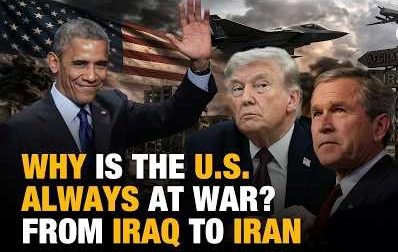
The Source of America’s Wars – Kristol Clear
or go to
Aletho News Archives – Video-Images
From the Archives
Is Israel to blame for the Iraq War?
American Goy | March 10, 2008
I am so tired of this old canard that “Israel had nothing to do with USA’s war with Iraq – in fact, it officially advised America against it”.
Bullshit. … continue
Blog Roll
 Aletho News
- Ceasefire for all or for none: Iran shuts Hormuz over Lebanon attacks
- Strait of Hormuz is Iran’s ‘nuclear weapon’ that forced US retreat: Medvedev
- Energy crisis will last for months – Kremlin envoy
- Europe’s quiet role in the war on Iran
- Forty days that shook the Empire: How Iran turned the tables on US and prevailed
- Netanyahu unilaterally declares Lebanon outside of ceasefire deal
- Israeli leaders: ‘Not a single goal’ achieved in war with Iran
- What on earth just happened? Trump, Iran, and the unlikely ceasefire
- Alberta Bill Would Fine Political Deepfakes $10,000 Without Satire Exemptions
- Iran declares ‘historic victory’ over US, says enemy forced to accept its proposal
- If Americans Knew
- Gazans face a triple crisis: severe shortages of water and bread, healthcare in tatters
- NY Times reports how Netanyahu took the US into Iran War
- A sigh of relief over Iran, but Gaza and Lebanon in dire straits – Daily Update
- Thousands dead and neighborhoods razed to the ground: Aid agencies fear southern Lebanon is becoming the new Gaza
- The war the US is fighting for Israel could cost trillions
- ‘Cigarette Burns, Nail Wounds’: Toddler Tortured in Gaza to Coerce Father
- Trump Says US Sent ‘a Lot of Guns’ to Protesters in Iran
- Israeli forces destroy 17 UN peacekeeper cameras in south Lebanon
- US-Israeli strikes ‘completely destroy’ synagogue in Tehran
- Archbishop for US Military Says Iran War Is Unjust Under Catholic Teaching
- No Tricks Zone
- An Inconvenient Tree: Uncovered In Alps… Europe Much Warmer Than Today 6000 Years Ago
- New Study Reports A 60% Slowdown In Greenland’s Ice Loss Rate In The Last Decade
- Low Intensity Tornado Wrecks Major Solar Farm, Creating A Potential Toxic Dump
- New Study Finds Warming Saves Lives…Cold Temperatures 12 Times More Deadly Than Excess Heat
- German Science Blog Accuses PIK Climate Institute Of Hallucinating Climate Tipping Points
- Devastating Assessment Of Comirnaty Vaccine By Former Senior Pfizer Europe Toxicologist
- New Study: CO2 Is ‘Effectively Negligible’ As An Explanatory Climate Change Factor Since 2000
- Former Pfizer Toxicologist Dr. Helmut Sterz Tells Bundestag Hearing Pfizer Vaccine Should Have Never Been Approved
- Energy Expert: Germany’s Nuclear Phaseout Was A “500 Billion Euro Mistake”
- New Research: South Australia’s Mid-Holocene Sea Surface Temperatures Were 4°C Warmer Than Today
 Aletho News