Beyond Surgery
On Hysterectomy: Second Interview with Carol Petersen RPh, CNP
Lies are Unbekoming | March 21, 2024
They are not told that their lives will be shorter, that they will suffer more from osteoporosis, that they may never have restorative sleep again, that they will suffer the loss of muscle mass from the lost testosterone, that they will be anxious, enraged, panicky and perhaps diagnosed with a mental illness, that they will be offered a long list of pharmaceuticals for symptom relief which will fail them, that their bodies will suffer with pain and the list goes on.
By Carol Petersen
We are going to circle back to where this current Hysterectomy journey started.
Back to Carol Petersen.
In our first interview Carol said:
“Most reasons for hysterectomies can be tied to progesterone deficiencies and most could be avoided with rational supplementation.”
I went back to Carol and asked if she would be open to another interview, this time focused on how women can address and resolve the symptoms and conditions that conventional medicine typically uses to justify life altering surgery.
I’m grateful that she agreed, and we now have a wonderful conversation that hopefully will help more women make better and more informed choices about what to do with their bodies.
With gratitude, I give you Carol Peterson RPh, CNP.
The Wellness By Design Project
1. Could you share your experience with women who come to you having been recommended a hysterectomy by their doctors? What initial advice do you typically give?
Women who have had a hysterectomy have a long time deficiency with progesterone. They have suffered with PMDD, PMS, PCOS, Infertility, endometriosis, fibroids, very heavy bleeding, cysts on the ovaries, and even uterine cancer. Their doctors remove ovaries along with the uterus quite frequently and then supply women with 1 hormone – an estrogen. The ovaries have supplied estrogens, progesterone, testosterone, DHEA and likely much more. This estrogen supplementation continues to create more sleep problems, anxiety, panic, rage, depression, fatigue, pain, cardiac and blood pressure problems, metabolic syndrome with insulin glucose imbalances. Sadly, it is a rare opportunity to intervene before surgery. The message I’d like to convey here is that it is possible to restore hormones to both correct those presurgical problems AND to restore hormones after surgery to have a reasonable quality of life.
2. How do you approach cases where surgery seems imminent? Can you describe your process for assessing whether alternative treatments might be viable?
Our society minimizes the horror of surgery. The assault to the body for any surgery is massive and has consequences. As I just mentioned, it is a rare occasion that interventions can be made before a surgery. Those women who are facing this prospect have been thoroughly conditioned to believe that this is their only option. Heavy bleeding in perimenopause is a major reason for hysterectomy. Conventional medicine does not intervene until the bleeding is so great that it seems to be life threatening. Yet, it is easily reversed with progesterone supplementation in the follicular phase of the menstrual cycle. As a society, we are preconditioned to consult with conventional medicine doctors for advice and treatment even though they are ignorant of many treatment options.
3. In your practice, how do you use bioidentical hormones to address the symptoms and issues leading to the recommendation of hysterectomy? Can you give an example of how this has prevented surgery for some women?
It is very easy to stop excessive uterine bleeding. During perimenopause, Dr. Jerilyn Prior (cemcor.ca) states that women have the highest estrogen of their life span. This is coupled with increased missed ovulations and shortened luteal phases which indicate deficiencies of progesterone. However, it is the follicular phase progesterone produced by the adrenal glands that moderate estrogen induced buildup of a thickened uterine lining.
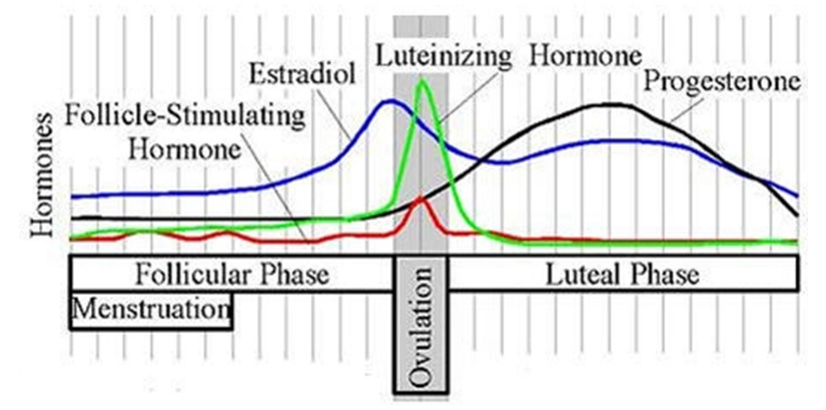
This is a commonly recognized depiction of the menstrual cycle. This graphic is a cause of the misconception about the importance of progesterone. It looks like it is insignificant in the follicular phase. However, the lines represent levels of hormones in two different units. The estrogens are measured in picograms/milliliter and progesterone is in nanograms/milliliter. This means that the black line for progesterone would be 1000 times higher if expressed in the same units the estrogen level is expressed. This graphic like many does not even indicate the units that generated this depiction. Using supplemental progesterone during the follicular phase can restore the proper balance in a cycle or two.
Not only that, but heavy bleeding has also been reversed with the use of vitamin A.
Vitamin A in the treatment of menorrhagia – PubMed (nih.gov)
Vitamin A is needed to produce progesterone from cholesterol.
4. Based on your experience, what percentage of women recommended for hysterectomy could be helped with hormone supplementation instead?
I think that nearly all could avoid surgery. Perhaps if there is a baseball sized fibroid, surgery might be indicated but why was progesterone not used when that fibroid had an insignificant size.
5. When you encounter women who have already had their uterus removed, how do you approach their post-surgery care? What treatments do you find most effective?
Sometimes, a women will have only the uterus removed and the ovaries are left intake. They are not offered any support. However, the stress of the surgery often causes diminished ovarian function and a multitude of hormone deficiencies as a consequence.
6. For women who have undergone oophorectomy (removal of ovaries), how does your treatment strategy change? How do you address the loss of natural hormone production?
There is no need to “test” for hormone deficiencies. The removal of an organ involved in significant production of hormones is not available. Now is the time to restore as many hormones as possible. These include progesterone, testosterone (50% gone), estrogens, and DHEA. Conventional medicine ignores all but estrogen. This continues the imbalance of hormones that lead to the hysterectomy in the first place.
7. From your perspective, why are gynecologists so quick to recommend surgery as the solution to issues that might be treated with hormone therapy?
It is an economic decision for the gynecologist. Gynecologists are surgeons. Restoring hormones is time consuming for practitioners and not as financially rewarding as a quick surgery.
8. Can you share a case where bioidentical hormone replacement therapy (BHRT) significantly improved the quality of life for a woman who had been advised to undergo a hysterectomy?
This should be the case 100% of the time. However, women don’t always get 100% relief even with bioidentical hormones when the practitioner does not partner with their patients to achieve that. Practitioners are trained in flow chart medicine and have great difficulty in helping women find their best dosing and combinations of hormones. I always encourage women to demand 100%. If they feel much better but not 100%, adjustments should be made.
9. What challenges do you face when advising against hysterectomy and advocating for hormone therapy? How do you overcome skepticism from patients or other healthcare providers?
The challenge is that women are frightened into surgeries and fast tracked before they have the time to think things through. Further, the consequences of surgery are minimized when presented. I don’t know how to help to get information to these women. Those that I can and do work with have self selected themselves by doing some research and are strongly against having surgery.
10. How does the absence of a uterus and/or ovaries affect a woman’s hormone balance, and how do you address these changes with BHRT?
I think this was covered earlier but I would also like to bring up the distortion these surgeries create in the body. Organs take up space in the body and now shifts occurs because the placeholders are gone. Follow up surgeries may now be performed on the bladder because of the missing organs.
11. What misconceptions do you often encounter about hormone therapy among women advised to have a hysterectomy?
What exactly is hormone therapy? Is it the thousands of combinations of synthetic drugs or is it topping off hormones with those with the identical structure. Practitioners don’t think twice about prescribing antidepressants and antianxiety drugs with high risk effects and fight with their patients about restoring the most abundant sex hormone in the human body.
12. In your opinion, what are the long-term implications of hysterectomy and oophorectomy that women might not be fully aware of when they consent to surgery?
They are not told that their lives will be shorter, that they will suffer more from osteoporosis, that they may never have restorative sleep again, that they will suffer the loss of muscle mass from the lost testosterone, that they will be anxious, enraged, panicky and perhaps diagnosed with a mental illness, that they will be offered a long list of pharmaceuticals for symptom relief which will fail them, that their bodies will suffer with pain and the list goes on.
13. How do you monitor and adjust hormone therapy for women who have had their reproductive organs removed, ensuring they receive the most benefit?
You can test with many modalities, but the testing will verify absorption but not give you guidance with clinical relief. Women will tell you and you can see clinical signs.
14. Where can women go to get more information and support if they are considering alternatives to hysterectomy?
There are a few groups like Nora Coffey’s, HERS Foundation.
Social media has really helped. There are lots of Facebook groups of women trying to help each other that sometimes actually do help. Yes, you have to be careful. PhRMA has funded a lot of social media advocate groups which will try to minimize the consequences or advocate a surgery or drug solution.
15. Finally, can you share any resources, such as books, websites, or forums, where women can learn more about the benefits of hormone supplementation and the potential to avoid surgery?
No More Hysterectomies by Vicky Hufnagel
Estrogen Dominance Support Group on Facebook
If I do a Facebook search there is not very much about preventing hysterectomy, only coping. I found one Hysterectomy Hoax with only about 500 members.
Final Note
I’d like to reinforce the message that there are relief measures from the ravages of hysterectomy.
You can get your life back and even better.
There may be a progesterone conspiracy going on.
North American Menopause Society, American College of Obstetrics and Gynecology and the Endocrine Society have fostered this idea that women with hysterectomy do not need progesterone. It is heavily embedded into medical practice. If you check out Wikipedia on PMDD, premenstrual dysphoric disorder, which are simply the mood issues of PMS, premenstrual syndrome, progesterone is not mentioned. Indeed, the PMDDers are systematically taught all the way to the final solution of hysterectomy that they must avoid progesterone at all costs since they are somehow sensitive to it.
In the UK, family practitioners cannot prescribe more than 200 mg of progesterone. When the deficiency is severe, progesterone dosing must be very generous to get results.
And women are also being denied testosterone after oophorectomy. There are no FDA approved products for testosterone replacement in women in the US. Testosterone is far more abundant than estrogen in the human female body and is sorely needed by many surgical menopause or not.
Militaristic Revolution in the EU: Brussels Paves Legal Way for Warmongering
By Dmitry Babich – Sputnik – 23.03.2024
During the last few days, the European Union went through a real militaristic revolution. A special “legal task force” is working on allowing the use of EU funds for war.
The so-called European Peace Facility (EPF), officially stewarded by Josep Borrell, will get its money from the EU funds (and not individual states) after reporting the transfer of thousands of weapons systems to Kiev. EPF also reported having trained more than 40,000 Ukrainian military to use them.
The Financial Times chose a somewhat routinely sounding lead for its story on the EU’s decision to legally stop being an “oasis of peace”: “Brussels proposes ‘legal task force’ to explore ways to use the common budget for defense.”
The headline, however, was more disturbing: “EU looks to bypass treaty ban on buying arms to support Ukraine.”
The reality described in the FT’s story, however, is more dramatic than the headline and the lead taken together: the European Union, which was conceived as an entirely peaceful organization, becomes one of the world’s most implacable warring empires – by law. Very soon the EU’s Union Treaty will no longer have a provision prohibiting “any expenditure arising from operations having military or defense implications.” (Article 41, point 2 of the Treaty on European Union.) Or, at best, this provision will be made devoid of legal force by some new additions to the EU’s legislation.
FT reports, confirming its story by eyewitness accounts, that the European Commission is creating a “legal task force,” that would allow the EU to finance wars and military production by European money. In all likelihood, the first “beneficiary” of this financing will be NATO’s proxies in Ukraine, waging a war against Russia and Russians since 2014.
At a recent conference of the EU’s 27 members in mid-March, 2024, it was decided to create within the framework of the so-called European Peace Facility (EPF) a special fund for financing Ukrainian armed forces (Ukraine Assistance Fund). What the relation is between the word “peace” and the system of buying and transporting weapons to the zone of conflict, remains unclear.
Ukraine Assistance Fund (UAF) will be financed by donations from EU member states to the tune of €5 billion a year. At least €500 million from that sum will be spent on training Ukrainian servicemen to use the EPF-provided weapons. The weapons will mostly be European-made (such was the requirement of France), but not only. Weapons from “third countries” can be bought and sold, creating opportunities for the spread of dangerous weapons around the world.
Judging by the recent EU summit on Thursday, which discussed the ways of stealing “immobilized” Russia’s foreign assets and pouring its money into the UAF “for military support to Ukraine,” no law is an obstacle for the EU’s “legal task forces.”
Was such an evolution of the EU unexpected?
Not entirely. The EU’s quasi-pacifist image started to crumble not now, but back in the 1990s. It transpired back then that the real European Union went a long way from the lofty ideas of the EU’s founders. Only naïve people can trust the EU’s claims, that it is a purely “soft power-based institution.”
In 1995-1999 the EU’s member countries participated in military interventions against the former Yugoslav republics, later almost all EU members made their “military contributions” to the occupations of Afghanistan, Iraq and Libya.
However, as more and more “crusades” by individual Western countries or American-British alliances ended in defeats (one can cite Afghanistan in 2001-2021 or the French intervention in West Africa after the coup in Libya in 2011), the dreams about a “collective war chest” of the EU started to take shape.
In 2020 the so-called European Defense Fund (EDF) and later, in March 2021, the European Peace Facility (EPF) started operating at the EU level. Their aim was clear from the start: to collect money from member countries and to buy arms for this money. Later, these weapons will be used against “undemocratic” countries, whose leaders happen to be at odds with the EU and the US.
Real European pacifists immediately smelt the rat and protested both against EDF and especially against EPF, which after the escalation of the Ukrainian conflict became one of the main sponsors of Zelensky’s military machine. Back in 2021, 40 pro-peace NGOs, headed by the German group Brot für die Welt (Bread for the World) came out with a statement denouncing the EPF as an instrument “which brings arms into wrong hands” and “allows to use the EU money to train the military cadres for dictatorial regimes.”
Now, however, Brussels uses widespread anti-Russian prejudice in the EU, as well as constant reminders about the “threat from Putin” to justify the final destruction of the dream of “peaceful Europe,” which once inspired the pioneers of European integration. In comparison to 2021 critics are fewer and quieter. In this way, Russophobia was spiritually destructive for Europe, stealing its dream of “world peace.”
The Ridiculous Psychology of Conspiracy Theory
BY IAIN DAVIS | UK Column | MARCH 21, 2024
If you watched the BBC’s REEL segment, The Psychology Behind Conspiracy Theories, it probably became clear to you that the BBC was not dealing with science but had instead wandered off into the realm of fantasy. Unfortunately, experimental psychology investigating alleged “conspiracy theory” has been disconnected from objectivity for many years.
While psychology itself has a solid empirical foundation, experimental psychology often falls short of basic scientific standards. In 2015, the Open Science Foundation found that, of 100 published experimental psychology papers, results could only be replicated in 39, and just 36 produced findings from which any meaning could be drawn.
Such a high degree of subjectivity frequently leads to woolly conclusions, promoted as scientific fact in the BBC’s REEL segment. Shortly after the introduction, we are given the expert psychologist opinion that so-called “conspiracy theorists” are likely both to be extreme narcissists and to hold “beliefs” driven by a sense of powerlessness.
Narcissists can be broadly characterised as people with a perceived, and potentially misplaced, sense of higher social status. They often have expectations that they should be treated more favourably as a result.
While narcissists possess delicate egos, they certainly don’t suffer from a sense of powerlessness. Quite the opposite: narcissists frequently have a grandiose sense of self-importance, and the expectations to go with it.
This prima facie mutual exclusion in the double definition of “conspiracy theorists” near the beginning of the BBC’s short report on the psychology of those it chose to call conspiracy theorists gave us an early clue as to the epistemological failure at the heart of nearly all academic research on the subject. In point of fact, when we look more closely at the research claiming to reveal the “psychological traits” of the alleged conspiracy theorists, we frequently encounter the worst kind of pseudo-scientific drivel.
A Loaded Question
The BBC began its “investigation” by asking:
Are some people more vulnerable to conspiracy theories, or are we all at risk?
We were immediately told that “conspiracy theories” present some sort of psychological threat to our mental health. Apparently, they harm or damage us in some way, hence the BBC’s declaration that we might be “vulnerable” to their discourse.
Which prompts the question: what is it about supposed conspiratorial thinking that causes us harm?
The BBC didn’t say, but it did air the views of a number of experts who claimed to know.
Jonas Kaplan is the assistant research professor of psychology at, and co-director of, the University of Southern California’s Dornsife Neuroimaging Center. He studies the link between neurological activity and thoughts and emotion.
As an example of his work, in 2016 he co-authored a paper which monitored neural activity in a region of the brain called the default mode network (DMN). He and his fellow researchers presented a cohort of forty people, each of whom had expressed strongly “liberal” political opinions, with so-called “counter-evidence” that was intended to contradict their beliefs.
The team monitored the effect of this supposed cognitive challenge upon the subjects’ neural response. Specific neural activity was observed, indicating that the DMN region of the brain—associated with identity—was stimulated when personal beliefs were allegedly challenged. This was interesting but, from this point forward, the research started to go wildly astray.
From their observations, Kaplan and his colleagues concluded that resistance to changing beliefs, in the face of this suggested “contradictory evidence”, was stronger for political beliefs than it was for non-political convictions. They consequently inferred that political opinions were more strongly associated with our sense of self than other kinds of beliefs we hold.
Unfortunately, the researchers ignored the gaping hole in their own methodology. They mentioned it, but didn’t seem to fully grasp the full implications of what they had done.
Rather than actually “challenge” their subjects’ beliefs with genuine contradictory evidence, they decided to make most of it up. They said:
In order to be as compelling as possible, the challenges often contained exaggerations or distortions of the truth.
For example, they told the subjects that Russia had a larger nuclear arsenal than the US. This wasn’t a “distortion” of the truth; it was a false statement.
More importantly, the neuroscientists failed to ascertain whether the subjects knew it was a lie. In the case that the subject knew the information was false—and we don’t know how many did—their views had not actually been “challenged.” This massive oversight utterly undermined the paper’s primary conclusions.
The researchers stated:
Our political participants may have been more likely to identify these distortions for the political issues, especially if they were more familiar with these issues. [. . . ] We did find that participants who rated the challenges as more credible were more likely to change their minds, and it is well known that source credibility influences persuasion.
Following their extensive experimental research, Kaplan et al. “discovered” that people were more likely to believe information if it was credible. Conversely, they were less likely to believe information if it was evidently wrong—because the researchers had made it up.
Beyond stating the obvious, Kaplan et al. then delivered subjective conclusions that were not substantiated by their own experimental data:
Our data [. . .] support the role of emotion in belief persistence. [. . .] The brain’s systems for emotion, which are purposed toward maintaining homeostatic integrity of the organism, appear also to be engaged when protecting the aspects of our mental lives with which we strongly identify, including our closely held beliefs.
The problem is that the researchers didn’t know what those emotions were. People might simply have been angry because they were lied to.
Kaplan and his colleagues did not establish that the perceived resistance to changing a belief was the result of any defensive psychological mechanism, as claimed. There was nothing in their research that distinguished between that possibility and the equally plausible explanation that the subjects rejected the “challenging information” because they knew it was wrong.
The researchers’ ostensible finding—that the subjects’ resistance to change in the face of counter-evidence was linked to identity, and therefore demonstrated an emotional attachment that could potentially overcome rational thought—was an assumption unsupported by their own experimental data. Kaplan et al. noted where neurological activity occurred, but they did not demonstrate what the associated cognitive processes were.
Building Narratives Based Upon Flawed Assumptions
The press release that accompanied publication of the Kaplan et al. paper made no such clarification. It claimed, without cause, that Kaplan’s research had effectively proven an alleged sociological and psychological truth:
A USC-led study confirms what seems increasingly true in American politics: People are hardheaded about their political beliefs, even when provided with contradictory evidence. [. . .] The findings from the functional MRI study seem especially relevant to how people responded to political news stories, fake or credible.
The above statement represented a huge leap of logic that the paper itself didn’t justify. There was little evidence that the study subjects had been “provided with contradictory evidence” (emphasis added).
Rather, they were given so-called “distortions” and highly questionable opinions. Their reasons for rejecting these had not even been ascertained.
In the same press release, Kaplan declared:
Political beliefs are like religious beliefs in the respect that both are part of who you are and important for the social circle to which you belong. [. . .] To consider an alternative view, you would have to consider an alternative version of yourself.
This is similar to the statement he later made in the BBC REEL piece on the psychology of conspiracy theory:
One of the things we see with conspiracy theories is that they are very difficult to challenge. [. . .] One of the advantages of having a belief system that’s resistant to evidence is that the belief system is going to be very stable across time. If you have to constantly update your beliefs with new evidence, there’s a lot of uncertainty. [. . .] Conspiracy theories are a way of making sense of an uncertain world.
Where did Kaplan get his opinion from? It wasn’t evident from his work. Nor did it bring us any closer to understanding the allegedly harmful nature of the suggested conspiratorial thinking.
What Is Conspiratorial Thinking?
While a definition of “conspiracy theory” isn’t mentioned directly in the BBC REEL segment, we do at least obtain a cited reference to one in the paper of another contributor, Anni Sternisko. Sternisko is a PhD candidate at New York University who researches conspiracy groups. In her co-authored paper, she cites Understanding Conspiracy Theories (Douglas et al., 2019), which does offer some definitions:
Conspiracy theories are attempts to explain the ultimate causes of significant social and political events and circumstances with claims of secret plots by two or more powerful actors.
This ludicrous premise supposedly informs the universally-accepted working definition of “conspiracy theory”. It pervades nearly all academic research on the subject, including the alleged psychological studies of those labelled as “conspiracy theorists”; and, as we are seeing with the BBC, it is being accepted unquestioningly in the mainstream media, too.
Back in the real world, no-one tries to explain “significant social and political events” with “claims of secret plots”. It is, on its face, a ridiculous notion. It might happen with regularity in BBC sitcoms, but does it happen in your social circle?
How can anyone, other than the conspirators themselves, know what a “secret plot” entails? The clue is in the wording; it’s a secret.
Generally, the people who are labelled “conspiracy theorists” by academics, politicians, the mainstream media and other interested parties are eager to highlight the evidence that exposes real plots that actually happened or are currently underway. Examples which made it to full-scale parliamentary inquiries in various Western countries include Operation Gladio, Watergate, the Iran Contra affair and so on. These aren’t “secrets”. If they were, no-one would know about them.
The so-called conspiracy theorists of the real world also point to evidence which appears to expose real plots that are yet to be officially acknowledged. For example, the study by the Department of Civil Engineering and the University of Alaska Fairbanks seems to show that the official account of 9/11 cannot possibly be true.
Taking this example, the only way to determine whether the stories we have been told about 9/11 are true or not is to examine the evidence. Again, this evidence is not and indeed cannot be a “secret”. It can be obfuscated, hidden or denied—but it cannot be known of at all if it remains ”secret”.
There are many reasons why we might hypothesise that 9/11 was, in fact, some form of false-flag attack. None of the evidence suggesting this possibility is “secret”, either. It is all in the public domain.
The logical exploration of evidence is the best way yet devised to find the truth, and has been acknowledged as such since at least Socrates’ day. Inductive, deductive and abductive reasoning all rely upon this basic approach. The key factor here is the evidence, without which the facts cannot be known.
While we can, and should, question all theories, the only way to discover the truth is first to identify and then rigorously to examine the evidence, ideally ascertaining some facts along the way.
We are at liberty to argue incessantly about various explanations of events, but there is one absolute certainty: we will never know what the truth is if we don’t explore the evidence, that very activity which is now being presented to us as suspect.
Descent Into Bathos
The Douglas et al. paper continues:
Conspiracies such as the Watergate scandal do happen, but because of the difficulties inherent in executing plans and keeping people quiet, they tend to fail. [. . .] When conspiracies fail—or are otherwise exposed—the appropriate experts deem them as having actually occurred.
As incredible as this may be, as far as these academics and researchers are concerned, unless the conspiracy is officially acknowledged by the “appropriate experts”, it remains a “secret” and therefore cannot be known. We are being sold the line that conspiracies only come into existence once they have been officially admitted.
This is, then, the completely illogical basis for academia’s alleged research of conspiracy theory. Conspiracies are only identifiable when they fail or are otherwise “officially” exposed. For these various “experts”, the consideration—by their own acknowledgement—that conspiracies are often real, and not “secrets”, renders their offered definition of “conspiracy theory” self-contradictory rubbish.
If you come to the matter with the worldview that “conspiracy theorising” is an attempt to explain events in terms of “secret plots”, then it is reasonable to deduce that said “conspiracy theory” is rather silly. If, however, you concede that these allegedly “secret plots” are not secrets at all and can be discovered by examining the evidence that exposes them, then your original premise, upon which your definition of “conspiracy theory” is based, is complete junk.
It is difficult to express the monumental scale of the idiocy entailed in the experimental psychologists’ definition of “conspiracy theory.” It is exactly the same as asserting that any evidence offered to indicate that a crime has been committed is completely irrelevant unless the police have already caught the perpetrators and their guilt proven in court.
Sure, your front door has been kicked in, your property ransacked and your possessions stolen, but—according to the psychologists of conspiracy theory—this is not evidence of a crime. The facts have yet to be established by the “appropriate experts”, and consequently the alleged crime remains a “secret” and is unknowable.
This absurd contention, based upon the logical fallacy of appeal to authority (argumentum ad verecundiam), is the foundation for all of the pseudo-scientific gibberish about conspiracy theory and theorists that follows. Douglas et al. also reveal some of the other terms often used in this so-called psychological research.
“Conspiracy belief”, “conspiracy thinking”, “conspiracy mindset”, “conspiracy predispositions”, “conspiracist ideation”, “conspiracy ideology”, “conspiracy mentality” and “conspiracy worldview”—most of these apparently serving no distinct purpose other than an attempt at elegant variation—are all terms based upon the psychologists’ own delusional beliefs. For some reason, all those researching the psychology of those they have labelled conspiracy theorist imagine, without reason, that the so-named “conspiracists” don’t have any evidence to back up their arguments.
In a moment of self-conscious admission, the Douglas et al. paper adds:
It is important for scholars to define what they mean by “conspiracy theorist” and “conspiracy theory” because—by signalling irrationality—these terms can neutralize valid concerns and delegitimize people. These terms can thus be weaponized. [. . .] Politicians sometimes use these terms to deflect criticism because it turns the conversation back onto the accuser rather than the accused.
As noted above, the scholars’ definition of “conspiracy theory” is etymologically redundant. The associated—and empty—pejorative of “conspiracy theorist” has consequently seeped into the lexicon, and it is based upon nothing but assumption and imagination.
The term “conspiracy theorist” has indeed been weaponised. It was designed to ensure that people don’t look at the evidence, wherever it is applied.
Politicians, the mainstream media, the scientific and medical authorities, and many other representatives of the establishment, right down to neighbourhood level, frequently use it to “deflect criticism” (in Douglas’ apt phrase) and to level unwarranted accusations at their critics. As outlined in Document 1035 – 960, this is precisely how the CIA envisaged that the “conspiracy theorist” label would function.
Regrettably, for most people, it is enough for someone just to be called a “conspiracy theorist” for anything subsequently proceeding from their mouth to be ignored. It doesn’t matter how much evidence they provide to support their views. The labelling system has done its job.
We might expect scientists, academics and psychologists to maintain higher standards. Unfortunately, BBC REEL’s The Psychology Behind Conspiracy Theories demonstrates that this is often not the case.
Who Is It That Is “At Risk” From Conspiracy Theories?
This reliance upon an illogical presupposition leads to profound confusion. During The Psychology Behind Conspiracy Theories, Anni Sternisko commented:
Conspiracy theories are not necessarily irrational or wrong. And I think what we are talking about in society at the moment—what is frightening us—are better explained, or better labelled, as conspiracy narratives; that is, ideas that are irrational to believe, or at least unlikely to be true—that are not necessarily theories, such that they are not falsifiable.
Sternisko appears to have been talking to her BBC interviewer about two completely different things: evidence-based arguments on one hand and irrational beliefs on the other.
Sternisko’s problem is that both the rational and the irrational are indiscriminately referred to as “conspiracy theories” in today’s academe and media. Thus, in searching for a unifying psychology to account for two diametrically opposed thought processes, the doctoral researcher cannot avail herself of suitable terminology that has gained acceptance in her professional environment and is forced by her own intellectual honesty to start coining spontaneous distinctions between alleged conspiracy “theories” and “narratives”.
This may be welcome insight, but it has become necessary only because the psychologists in her field are floundering around with a working definition of “conspiracy theory” that is ridiculous. Again, we can look to the paper by Douglas et al. to appreciate just how incoherent it is:
While a conspiracy refers to a true causal chain of events, a conspiracy theory refers to an allegation of conspiracy that may or may not be true. [. . .] To measure belief in conspiracy theories, scholars and polling houses often ask respondents—through surveys—if they believe in particular conspiracy theories such as 9/11, the assassination of JFK, or the death of Princess Diana.
This reconfirms that the only benchmark that the academics concerned have for “measuring” what they call “conspiracy theory” is the extent to which the subject agrees or disagrees with the official account of any given event. As long as their subjects unquestionably accept the official “narrative”, they aren’t considered to be “conspiracy theorists.” If they do question it, they are.
Consequently, all of the related experimental psychology is completely meaningless, because the researchers never investigate whether what they call conspiracy theory “may or may not be true”. There is no basis for their claim that “conspiracist ideation” is irrational, or even that it exists.
Without establishing the credibility of the propounded theory, the psychologists, sociologists and other researchers and scientists involved have based their entire field of research upon their own opinions. This cannot be considered science.
In this light, Anni Sternisko’s statement at last reveals something about what the BBC called the “risk” of conspiracy theory. It seems that these alternative explanations of events are not dangerous to the conspiracy theorists themselves, but rather to people like Sternisko, who find them “frightening”.
Questioning power is a fundamental democratic ideal, yet this PhD candidate would appear to be one of millions in Western societies who have come to feel that doing so is scary. Fear, and the resultant stress and anxiety it produces, can be very damaging to our mental health. So the BBC is right, in a sense, to highlight potential risks in this domain.
It is just that the BBC, and the groundless psychological theories it promotes, are wrong about who is at risk. It isn’t the purported “conspiracy theorists”, but rather the people who unquestioningly accept official accounts who are “vulnerable”.
What the BBC presented with its REEL segment was not an exploration of the psychology behind conspiracy theory. It was instead an exposé of the deep-rooted terror of those who apparently dare not look at the evidence cited by the people they label “conspiracy theorists”.
If their government is lying to them, then, for some reason, it seems they do not want to know. The mere thought of it petrifies them.
The researchers—who insist that it is the “conspiracy theorists” who are deluded—have constructed a mythology masquerading as scientific knowledge. Their resultant research, founded upon this myth, isn’t remotely scientific. Inevitably, the psychologists who expounded upon their own apparent delusions for the BBC soon descended into farce.
It’s Science, Don’t Laugh
Professor Sarah Gorman authoritatively informed the BBC audience that “conspiracy theorists” are so irrational they can believe two contradictory statements at the same time. We have already discussed why so much of this psychological research is flawed, but Gorman was most likely referring to a paper that isn’t just based upon assumptions; it is appallingly bad science for numerous other reasons besides.
Gorman told the BBC audience:
People are very often able to hold in their heads two conspiracy theories that are directly in conflict. So, for example, people will simultaneously believe that Princess Diana’s death was staged, and that she’s still alive and also that she was murdered. And, on the face of it this doesn’t make much sense, but the underlying principle here is that they believe that something is just not right about the official story, and it almost doesn’t matter exactly what the alternative is; just that there has to be an alternative that’s being suppressed.
Professor Gorman was almost certainly referring here to one of the formative papers in the field of experimental conspiracy theory research, Dead and Alive: Beliefs in Contradictory Conspiracy Theories (Wood, Douglas & Sutton, 2012).
Presumably, she has read it, so why she would make this statement is difficult to say. The paper is a joke.
Wood et al. conducted experiments in an effort to identify what they had already judged to be the psychological weakness of “conspiracy theorists”. They set the subjects a series of questions and rated their responses using a Likert-type scale (1 – strongly disagree, 4 – neutral response, 7 – strongly agree).
The psychologists conducting this research presented deliberately contradictory statements. For example, one arm of the study asked the subjects to indicate their level of agreement with the idea that Princess Diana was murdered and also with the suggestion that she faked her own death. Similarly, another arm asked the subjects the extent of their agreement with the notion that Osama bin Laden was killed by US Navy SEALs but also that he was still alive in captivity.
They collected the responses, analysed the results and, from this, deduced:
While it has been known for some time that belief in one conspiracy theory appears to be associated with belief in others, only now do we know that this can even apply to conspiracy theories that are mutually contradictory. This finding supports our contention that the monological nature of conspiracism is driven not by conspiracy theories directly supporting one another but by the coherence of each theory with higher-order beliefs that support the idea of conspiracy in general.
It seems that Professor Gorman, at least, is convinced by this pabulum and was willing to present it to the BBC as scientific fact. Alas—rather as with Kaplan’s paper—these scientists’ conclusions, seemingly referenced by Gorman, were not supported by their own experimental results.
Had the participants been asked to consider exclusivity, and subsequently indicated that they agreed with two or more contradictory theories, then the Wood et al. conclusion would have been substantiated. But they weren’t, so it wasn’t.
All that the participants were asked to do was to indicate their relative level of agreement. This Hobson’s choice of a study design means it is entirely possible, and logical, for a research participant of sound mind to agree strongly with one statement while agreeing somewhat with another, even if the two are “mutually contradictory”.
To illustrate this: the official account of Osama bin Laden’s death claims that he was assassinated by the US military. There is no video, forensic or photographic evidence, no witness testimony—all the members of the SEAL Team Six deployed to Pakistan for that operation have since managed to die—nor indeed anything, beyond the proclamation of politicians, to lend this tale any credibility at all. There isn’t even any evidence of a body, as bin Laden was allegedly buried at sea.

This is what happened… honest!
Consequently, if you doubt the official account (and what sane person wouldn’t), a whole range of possibilities exists. It all depends upon your evaluation of the available evidence—which by definition cannot come from the academically-vaunted official sources, because they haven’t presented any.
In such circumstances, it is perfectly legitimate to agree strongly that bin Laden died in 2011 and simultaneously to agree somewhat with the proposition that he was extraordinarily renditioned to a black-ops site somewhere. Nothing can be ruled out. There is insufficient evidence to draw any firm conclusion.
Wood et al. did not ask the study participants to exclude contradictory accounts; only to rate such accounts on a scale of plausibility. The paper’s conclusion, that the results of their experimental psychology proved “the monological nature of conspiracism” was driven by some assumed “higher-order” belief system, was pseudo-scientific claptrap.
The BBC duly conveyed Professor Gorman’s “expert” opinion that all of this somehow made sense. This is standard fare at White City. Anyone who questions the state or its narratives is a “conspiracy theorist”, as far as the BBC is concerned.
So, before we suffer any more of this nonsense, let’s politely ask these experimental psychologists to examine the evidence behind so-called conspiracy theories before they rush into making assumptions about the supposed psychology behind them. Hopefully, they won’t find the experience too frightening.
Full-Spectrum Psyop: US Whips Up Fear of Russian Bugaboo to ‘Subjugate Europe’
By Ilya Tsukanov – Sputnik – 23.03.2024
From the French president’s threats to send troops to Ukraine to a series of media reports on alleged Russian plans to invade NATO, anti-Russian hysteria has reached a fever pitch in European capitals. Meanwhile, one world power has been able to sit back and quietly collect the dividends, says veteran foreign affairs observer Gilbert Doctorow.
European politicians are doing their best to continue ratcheting up tensions with Moscow, with French President Emmanuel Macron reiterating that he may send thousands of troops to Ukraine, Baltic politicians allying with Paris on the issue, and Polish Foreign Minister Radoslaw Sikorski saying it’s an “open secret” that NATO soldiers are already in the country.
British and German media have done their part to add fuel the hysteria, citing a recent briefing to Bundestag lawmakers on purported plans by Russia to kick off a “full-scale ‘land, sea and air’ war” with NATO.
“We hear threats from the Kremlin almost every day… so we have to take into account that Vladimir Putin might even attack a NATO country one day,” German Defense Minister Boris Pistorius warned in an interview earlier this year.
This week, Polish President Andrzej Duda claimed it was a matter “of common sense” that “Putin, by putting his economy on a war footing, will have such military might that he will be able to attack NATO.” Meanwhile, his top general, Polish Armed Forces Chief of Staff Wieslaw Kukula, has alleged that Russia is actively “preparing for a conflict,” and urging Europe to do the same.
Europe’s defenses are in an unenviable state. Facing a major economic downturn and a $61 billion spending shortfall after giving roughly the same amount away to Kiev for NATO’s proxy war against Russia, European military leaders have warned that they could be left “throwing stones” within hours of a major conflict breaking out as arms and ammo stocks round dry.
But the question no Western officials or media have been able to answer is why Russia – which has over the past three decades expressed a preference for economic cooperation with Europe, rather than fighting its western neighbors, would be interested in invading NATO and almost certainly triggering World War III.
“The whole of NATO cannot fail to understand that Russia has no reason, no interest – neither geopolitical, nor economic, nor political, nor military – to fight with NATO countries,” President Putin said in an interview in December, emphasizing that Moscow and the bloc “have no territorial claims against each other” and could live peacefully.
Puppet Hands at Play
The problem may just be that Russia is taking the hysterical outbursts by NATO officials and Western media at face value, instead of searching for the ‘man behind the curtain’ seeking desperately to keep tensions in place.
“For the United States, the war in Ukraine has failed as a means of weakening Russia so that they can proceed with preparations to fight China. But it has succeeded spectacularly as a means of subjugating Europe. Washington now firmly has its knees on the neck of Europe,” veteran international relations and Russian affairs expert Dr. Gilbert Doctorow told Sputnik.
Economically and politically, the US has been able to extract major concessions from the Europeans over the past two years, plucking hundreds of manufacturers from the continent thanks to an energy crisis sparked by the bloc’s “suicidal” decision to cut off Russian energy supplies, forcing the EU to purchase American LNG at four times the cost, and even trying to saddle Brussels with economic and military aid to Ukraine as Congress remains deadlocked over a $61 billion aid package.
“Here in Europe, the war is now being used to whip up popular enthusiasm for war mobilization of the domestic economies and subjugation of the populace to authoritarian and unlimited powers of the ruling elite,” Doctorow said.
“What remains of free speech and other freedoms can be snuffed out in war hysteria. Moreover, the war fever is being used by [European Commission President Ursula] von der Leyen and the EU Commission in a bid to draw more power into Brussels at the expense of the national governments,” Doctorow warned.
“Some countries are resisting, for example Prime Minister [Mark] Rutte of the Netherlands and even the mealy-mouthed German Chancellor [Olaf Scholz, ed.] are publicly opposed to the proposal of a European debt issuance to finance subsidies to the military production companies, all in spite of van der Leyen. Meanwhile, Macron is on the other side, pushing for greater European centralization for which is the proposed common investment in defense is a nice instrument,” the observer added.
Poking the Bear
Russia’s military buildup “has been reactive to new challenges from the West,” Doctorow stressed, pointing out, for example, that “until the decision of Finland and Sweden to join NATO, Russia had almost no troops on its northwest border. Now, in response to new threats from the northern neighbors, that is being rectified by a big military build-up on the Russian side.”
Something similar can be said of defense budgets, with the Stockholm International Peace Research Institute recently estimating that Russia’s defense budget amounted to $65.9 billion in 2021 – a fraction of NATO spending of $1.16 trillion ($753.5 billion of that by the US alone) the same year. Even in 2024, with the proxy war with NATO in Ukraine raging and intensifying, Russia plans to spend the equivalent of $140 billion, still just a fraction of the Western bloc, which has again accounted for more than half of all military spending worldwide this year.
Ultimately, Dr. Doctorow emphasized, Western governments are following an old playbook.
“An aggressive foreign policy stand is almost always a convenient way of distracting attention away from domestic failures. And thanks to the boomerang of Western sanctions, European economies are doing very poorly as we go into the June elections” to the European Parliament, the observer summed up.
FSB reports 11 suspects detained over terrorist attack

RT | March 23, 2024
Eleven people have been detained over the terrorist attack on the Crocus Crocus City Hall concert venue outside Moscow, Russia’s Federal Security Service (FSB) has said in a statement.
The arrested suspects include “four terrorists who were directly involved in the terrorist attack on Crocus,” the statement read. Investigative work to track down other accomplices are ongoing, it added.
After carrying out the attack on Friday night, “the perpetrators tried to escape by car, fleeing towards the Russian-Ukrainian border,” the FSB said on Saturday. “The criminals intended to cross the Russia-Ukraine border and had relevant contacts on the Ukrainian side,” it added.
According to the agency, “all four terrorists” were arrested in Russia’s Bryansk Region within several hours as a result of well-coordinated actions by the security services and the police. The detainees are now being transferred to Moscow, it added.
The attack on Crocus Crocus City Hall was “carefully planned,” with the perpetrators using weapons that had been placed in a stash in advance, the FSB said.
Russia’s Investigative Committee also confirmed that four suspects, who “committed the terrorist attack” on Crocus City Hall, were detained in Bryansk Region, “not far from the border with Ukraine.”
Crocus City Hall, in the town of Krasnogorsk in Moscow’s western outskirts, was attacked by gunmen on Friday night. It happened before a concert by Russian rock band Picnic, when the venue, which has an estimated capacity of 7,500, was nearly at capacity.
The attackers shot at the crowd indiscriminately then set the building on fire. They managed to flee the scene in what was said to be a white Renault Symbol/Clio car, prompting a large-scale manhunt.
According to Russia’s Investigative Committee, the death toll in the attack has reached at least 115. The Moscow Region Health Ministry said that at least 121 people were also wounded, with 107 requiring hospitalization.
This Is Not ISIS – Rossiya Segodnya Editor-in-Chief on Moscow Concert Hall Attack
Sputnik – 23.03.2024
Ukraine and the West have resorted to false flag operations to persuade everyone that ISIS was behind the terror attack in the Crocus City Hall concert venue near Moscow, said Margarita Simonyan, the editor-in-chief of Sputnik’s parent media group Rossiya Segodnya.
The head of the media group stressed that the names and faces of the perpetrators are already known to authorities and that the terrorists gave everything away during interrogation.
“It immediately became obvious why US media were claiming in unison that it was ISIS,” she said.
Simonyan explained that the perpetrators were chosen to carry out the attack in a manner that would allow the West to persuade the international community that ISIS was behind the attack.
“Basic sleight of hand. The level of a railway thimble-rigger,” she added.” It has nothing to do with ISIS. It’s Ukrainians.”
She added that the enthusiasm displayed by Western media when they tried to persuade everyone that ISIS was responsible even before arrests were made gave them away completely.
“This is not ISIS. This is a well-coordinated team of several other, also widely known, abbreviations,” Simonyan concluded.
The shooting occurred on Friday evening in the Crocus City Hall concert venue just outside Moscow and was followed by a massive fire, claiming at least 143 lives.
In the hours following the attack, Western media insisted that radical jihadist organization ISIS was behind it, while Ukrainian officials also said that they had nothing to do with the tragedy.
However, suspects were detained in Russia’s Bryansk region near Ukrainian border. According to the data provided by law enforcing agencies, they had a support base on the other side of the border.
Moreover, while Kiev rushed to deny its involvement into the shooting, Ukrainian secret services have a long track record of terror attacks on Russian territory, from shelling in the Belgorod region to assassinations of political scientist Daria Dugina and journalist Vladlen Tatarsky.
Russia explains stance on US-proposed Palestine “cease fire” resolution
Explanation of vote by Permanent Representative Vassily Nebenzia at the UNSC vote on US-proposed draft resolution on the situation in the Middle East, including the Palestinian question
Permanent Mission of the Russian Federation to the United Nations | March 22, 2024
Before the vote:
Mr. President,
For six months now, the UN Security Council has been unable to adopt a resolution demanding a ceasefire in Gaza. Time and again, the United States thwarted any attempt to do so by using a veto in cold blood as many as four times.
During that time, we have heard many different excuses from our American colleagues. For example, that it is premature to seek a ceasefire because it is necessary to give space “for Israel’s counter-terrorism efforts”; that the Council should not interfere with Washington’s “effective diplomacy on the ground”; that we should wait until Ramadan, when, they say, an agreement on a cessation of violence will definitely be made.
Now, six months later, when Gaza has been practically leveled with the ground, the US representative says without batting an eye that Washington finally starts to realize the need for a ceasefire.
This leisurely thinking process by Washington has cost the lives of 32,000 Palestinian civilians, two-thirds of them women and children.
And even now we see a typical hypocritical show, when in the wrapper of a “ceasefire” the United States is trying to sell to the members of the Security Council and the entire international community something else – a vague phrase about “defining the imperative of a ceasefire”. Such philosophy about moral imperatives looks naturally in the works of Immanuel Kant. But it is not enough to save the lives of Palestinian people. And that is not at all what the mandate of the UN Security Council suggests, which has a unique toolkit to demand a ceasefire and, if necessary, enforce it.
In an official interview to Al Hadath in Jeddah on 20 March, Secretary of State Blinken said, “Well, in fact, we actually have a resolution that we put forward right now that’s before the UNSC that does call for an immediate ceasefire tied to the release of hostages and we hope very much that countries will support that”. However, the US-proposed draft resolution does not make such call. It appears that either the US Permanent Representative to the United Nations or the US Secretary of State deliberately mislead the international community.
Colleagues,
From the very beginning, it was obvious that the “negotiations” on the draft resolution held by our American colleagues were only meant to delay time. All our comments and “red lines” were ignored, as well as the proposals of a number of other delegations. This was not a normal work on a document. It felt more like speaking into the void.
The US draft is a thoroughly politicized document, which only aims at pulling on voters’ heartstrings before the US elections by throwing them a “bone” in the form of at least some mention of a “ceasefire” in Gaza. The draft also seeks to consolidate US policy in the region through “terrorist labels” and to ensure impunity for Israel, whose criminal actions the draft gives no assessment to.
Let me also stress that the American draft contains a de facto green light for Israel to conduct a military operation in Rafah. At least, the sponsors have tried to make sure that nothing in their draft would prevent West Jerusalem from completing the deadly cleanup of southern Gaza.
That is actually what Washington wants. We already said that we will no longer pass meaningless resolutions that do not demand a ceasefire and lead us nowhere.
This draft must not pass with the majority of UNSC votes in order to send a message that Washington’s not even palliative but devious concepts are unacceptable. It will be extremely strange if those members of the Council (and they are the majority), who realize this and have been saying to us that the US draft is a flawed one, will now raise their hand in favor. If you do so, you will smear yourselves in disgrace.
Think what this will make you look in the eyes of the people of the Middle East and your own countries, if you support this hypocritical endeavor designed to disorient the international community and, in fact, undermine the authority of the Council by rendering it unable to influence the situation on the ground and making it “stay out of White House’s way”. Are you ready to play a part in this shameful show?
Russia will not do this. As a permanent member of the Security Council and one of the founders of the United Nations, we recognize the global historical responsibility for the maintenance of international peace and security and cannot allow the Council to become a tool of Washington’s destructive policy in the Middle East. If this resolution were adopted, it would definitively close the debate on the need for a ceasefire in Gaza, give Israel a free hand and condemn Gaza and its entire population to extermination or expulsion.
In our work, we are not guided by what pleases Washington or its satellites who are ready to cast a vote at the US behest, but by what is necessary for the Palestinians and what promotes peace.
We urge the members of the UN Security Council to prevent this and vote against the American draft resolution.
Mr. President,
In order for the UN Security Council to still be able to implement its mandate to maintain international peace and security, a number of non-permanent UNSC members have prepared an alternative draft resolution that spells out in black and white the requirements for both a ceasefire and the unconditional release of hostages. It is a balanced and depoliticized document.
We see no reason why members of the Security Council could refuse to support it, unless a ceasefire and the release of hostages are not part of their plans. This is an attempt to allow the Council to carry out the noble functions entrusted to it. We urge to not miss it.
Thank you.
After the vote:
Mr. President,
We have now listened to the hypocritical speeches of some Council members shedding crocodile tears over the Russian and Chinese vetoes. We have explained the reasons why we did not pass this resolution. It was not because it was put forward by the United States delegation, as the American Permanent Representative tried to assure us today. I told you – those of you who voted here today – that you would cover yourselves in disgrace by voting in favor of an American text that was unacceptable to you (including those of you who are now praising it).
Do you want me to say what really happened? Not hard to guess, the scenario is not complicated at all. Your American masters, in addition to “twisting the arms” of your leaders in the capitals, said, “Don’t you worry, Russia will veto anyways, so you won’t have to go against the American draft.” That’s it, that’s the whole scenario. So stop this hypocrisy about how upset you are that Russia and China vetoed the resolution. Once again, you have covered yourselves in disgrace today by voting in favor of a draft resolution that you did not and do not really support.
Thank you.
What caused the US to fall?
By Vladimir Mashin – New Eastern Outlook – 22.03.2024
Europeans and Americans alike are tired of the war in Ukraine. Clear-headed people in the West realise that Russia cannot be defeated: the bravura statements of some officials can hardly hide the obvious truth that the Kiev regime is doomed. More and more observers are coming to the conclusion that the American elite is waging war to “fend off the challenge to its own hegemony”.
In these circumstances, the new book “Defeat of the West” by Emmanuel Todd, a well-known French political scientist and anthropologist, is attracting a lot of attention in the West. According to the historian, the West made a fatal miscalculation when it decided to expand NATO under Presidents B. Clinton and G. Bush: the American elite was drugged by the ideology of “democracy promotion and official demonisation of Russia”. The American ruling elites not only endangered the whole world, but also created great dangers for America’s existence as a single state.
By imposing unprecedented sanctions on Moscow, the United States overestimated its capabilities and failed to rally the major states of the global South to its side. Moreover, the manufacturing base of the United States and its European allies has proved insufficient to supply Ukraine with the equipment (especially artillery) needed to stabilise, let alone win, the war. The United States no longer has the means to fulfil its foreign policy promises.
The United States makes fewer cars than it did in the 1980s and grows less wheat.
But the most important factor explaining today’s problems is the moral and cultural decline of the West – according to Todd, “Too many people want to run things and boss them around. They want to be politicians, artists, managers. And that doesn’t always require learning intellectually challenging things: ultimately, educational progress has led to educational decline because it has led to the disappearance of the values that favour education”.
The US produces fewer engineers than Russia, not only per capita, but also in absolute numbers: the country is experiencing an “internal brain drain” as its young people move from demanding, high-skill, high-value-added professions to law, finance and various occupations that betray the value of the economy and, in some cases, may even destroy it.
According to Todd, the West’s decision to outsource its industrial base is more than bad policy; it is evidence of a project to exploit the rest of the world.
Nor have the Americans succeeded in spreading the federal values they proclaim to be universal. As the United States has modernised, it has come to espouse a model of sex and gender that does not fit well with the models of traditional cultures such as Indian, Islamic and Russian.
Todd believes that many of these values are “deeply negative”. The West does not value the lives of its young. (In 1976, Todd used infant mortality statistics to predict the collapse of the Soviet Union).
Today, Biden’s America has a higher infant mortality rate (5.4 per 1,000) than today’s Russia, and three times that of Japan.
Todd is struck by the inability of the Western elite to distinguish facts from wishes. Newspapers constantly report that President Putin is a threat to the Western order, but the greater threat to the Western order is the arrogance of those who run it.
According to the historian, it sometimes seems that in the United States there are no national principles, only partisan ones, and “each side is convinced that the other is trying not just to run the government but to take over the state”.
Similar assessments can often be heard in the American press. For example, in a commentary on Biden’s speech to the US Congress on 7 March, the well-known columnist Robin Givhan said: “The real audience is not in the parliament, but in the cheap seats outside: in cities where homeless encampments and busloads of desperate migrants are at once enraging and heartbreaking; in towns where fear and confusion drive people to try to rewrite history or hide it from future generations; and in picturesque communities where people want to hold back change because the unknown future seems far more frightening than the sclerotic present. The American people are confused. After all, they elected this dysfunctional Congress.
Featured Video

America Racing to Strategic Defeat in Iran
or go to
Aletho News Archives – Video-Images
From the Archives
An Expert Military Analysis of War with China
Actually, None is Necessary
By Fred Reed • Unz Review • December 13, 2020
The Correlation of Armed Forces: U.S. goods and services trade with China totaled an estimated $634.8 billion in 2019. Exports were $163.0 billion; imports were $471.8 billion. The U.S. goods and services trade deficit with China was $308.8 billion in 2019. Trade in services with China (exports and imports) totaled an estimated $76.7 billion in 2019. Services exports were $56.5 billion; services imports were $20.1 billion. The U.S. services trade surplus with China was $36.4 billion in 2019.
There is talk within the Washingtoniat of a possible war with China. Steve Bannon, who apparently was dropped on his head as a child, actually favors such a war. We hear the usual shoo-the-boobs alarm about how the Chinese are doing something terrible and we must gird our loins and American values and show them what for, bow wow, woof. The danger is that the current game of who-blinks-first in Asian waters might actually provoke a shooting war. You know the kind of thing: One warship refuses to get out of the way of another, a collision ensues, some retard lieutenant who signed up on waivers opens fire, and we’re off and running. It is not a good idea to let children play with matches.
The said war is discussed either in emotional terms by idiots or in purely naval terms by those familiar with such things, so we hear of the First Island Chain and the Second Island Chain and whose missiles against the other’s missiles and so on. This would be appropriate if we were fighting World War Two again. Which we aren’t. Let’s take a quick-and-dirty look at how such a war might go.
To begin the war, America would overestimate itself and underestimate China. This is doctrine in the Pentagon. … continue
Blog Roll
 Aletho News
- Rethinking America’s greatest threat: Iran vs. Israel-Firsters
- Iran accuses adversaries of false flags to strain Turkey ties
- Poland rules out sending Patriot missiles to US/Israel amid war on Iran
- Tehran approves new Hormuz plan with major restrictions
- No Threat Can Force Iran’s Surrender /Trita Parsi & Lt Cl Daniel Davis
- UK’s New Pandemic Plan Would Turn Big Tech Into a Mass Location Tracking Network
- Growing insecurity, soaring prices fuel protests in north as regime bans evacuation: Sources
- Iran denies responsibility for ‘depraved’ attack on Kuwait desalination plant
- Bring The Troops Back. End This War Now!
- Can we please stop calling Israel the ‘only democracy in the Middle East’ now?
- If Americans Knew
- The Line Between Affinity and Conspiracy
- As Iran targets US military bases, will they be relocated to Israel? Not a ceasefire Day 171
- Will Trump Go Kamikaze?
- Is the University of Florida Shutting Down College Republicans over Israel Criticism?
- Jewish extremist arrested over alleged plot to firebomb Palestinian activist Nerdeen Kiswani’s home
- More than half of Palestinian child detainees have no charges
- The More Murderous Israel Gets, The More We Hear About “Antisemitism”
- Land Day and the Palestinian struggle after 30 months of genocide
- The Iran War Is About Palestine
- Israeli soldiers echo settler ideology, talk of revenge after targeting Palestinians and detaining CNN crew in the West Bank
- No Tricks Zone
- New Study Finds Warming Saves Lives…Cold Temperatures 12 Times More Deadly Than Excess Heat
- German Science Blog Accuses PIK Climate Institute Of Hallucinating Climate Tipping Points
- Devastating Assessment Of Comirnaty Vaccine By Former Senior Pfizer Europe Toxicologist
- New Study: CO2 Is ‘Effectively Negligible’ As An Explanatory Climate Change Factor Since 2000
- Former Pfizer Toxicologist Dr. Helmut Sterz Tells Bundestag Hearing Pfizer Vaccine Should Have Never Been Approved
- Energy Expert: Germany’s Nuclear Phaseout Was A “500 Billion Euro Mistake”
- New Research: South Australia’s Mid-Holocene Sea Surface Temperatures Were 4°C Warmer Than Today
- Storing Green Energy To Last Germany 10 Days Would Require A 60-Million Tonne Battery
- New Studies: UK Sea Levels Were 4 Meters Higher Than Today During The Mid-Holocene
- Destructive Green New Deal: German Energy And Metal Group Warns Of Drastic Crisis
 Aletho News