What you need to know about the Iranian attack on Israel but will not find in mainstream news
By Gilbert Doctorow | April 15, 2024
Iran’s weekend massive drone, cruise missile and ballistic missile attack on Israel has now been covered in the global media, with the headlines announcing that 99% of the barrage was shot down by Israeli, U.S. and other friendly air defense systems. The question these media pose is what will be the Israeli response, as if that were a matter strictly to be decided by Prime Minister Netanyahu’s cabinet.
In fairness, I note that The Financial Times has also published a front page article setting out what it considers to be the Iranian perspective on the attack, namely that it was successful insofar as it demonstrated their country is not shying away from direct military confrontation with Israel and is confidently prepared to prosecute a full scale war if it comes to that. See “We’re crazier than you realize”: Iran delivers its message with attack on Israel. Tehran believes calibrated missile and drone barrage is enough to restore deterrent and bolster image.”
However, the Iranian position is much more nuanced and contains far greater threat not only to Israel but also to the entire United States presence in the region than the FT suggests. I say this on the basis of an analysis provided on last night’s edition of the Vladimir Solovyov talk show on Russian state television by a regular panelist, Semyon Arkadievich Bagdasarov, who is a leading Russian specialist on the region.
For those who wish to see and hear Bagdasarov’s 14 minutes on air in the original Russian, the link is https://all-make.su/22174-vecher-s-solovyovym-14-04-2024/ minutes: 27 – 41.
In what follows I offer a brief biographical sketch of Bagdasarov so that the seriousness of his remarks can be better appreciated. Then I will summarize what he said on air.
Aged 69, Bagdasarov was born in Central Asia in the Ferghana Valley, which passes through Uzbekistan, Tadjikistan and Kyrgyzstan. Accordingly, he has the proper birthright to his position since 2014 as director of the think tank called the Center for the Study of the Countries of the Near East and Central Asia. However, Bagdasarov reached this academic plateau after passing through a succession of military and civilian government posts, including the 5 years starting in 2007 as a Duma member from the ‘For a Just Russia opposition party of Sergei Mironov, which might be described as slightly to the Left of the ruling United Russia party.
Bagdasarov’s professional education was in a military academy and he ultimately retired with the rank of colonel. He then moved into government service first at the regional level and then as an expert to the Duma, to which, as I said above, he was later elected.
In line with what the FT article has said, Bagdasarov calls the Iranian attack on Israel a limited strike intended as a warning, but also yielding both specific tactical and strategic results.
On the tactical side, the swarming of drones was intended to activate the Iron Dome and other levels of Israeli air defense and to reveal the location of their component parts as well as to deplete the Israeli stock of relevant missiles.
Per Bagdasarov, Israeli claims to have shot down 99% of the incoming barrage should be taken with a grain of salt. The Iranians’ key targets in the attack were the Israeli air force base in the south of the country from which the Israeli strike on Iran’s consulate in Damascus was launched two weeks ago and a military intelligence compound which had prepared that deadly strike. The actual extent of damage from Iranian missiles remains to be evaluated.
Bagdasarov explains that the Iranian attack was ‘limited’ because it consisted of rather slow moving drones and of missiles with small warheads. These were not Iran’s most advanced and lethal attack materiel, which has been held in reserve for any possible Round Two.
How many drones, ballistic missiles and cruise missiles does Iran have? Bagdasarov says no one knows exactly but it may well be 10,000 or more and includes several hundred highly advanced missiles which also have multiple warheads and so are very difficult to defend against. Over the past 20 years, Iran has bet its defense budget on missiles and drones, and it has a large-scale serial production of both. Meanwhile, Iran’s regional allies also have large stocks of these weapons, some of which are also fairly sophisticated. In particular, Hizbollah in Lebanon may have 1500 high quality missiles in its arsenal.
At the strategic level, Iran demonstrated its ability to coordinate a missile and drone attack on Israel with its regional proxies so as to maximize the threat coming from all directions.
Iran used the attack to achieve a political and military objective that has long eluded it. Teheran has now issued threats against Persian Gulf states to bomb any and all that allow the Americans to use their air space or otherwise facilitate Israel’s possible revenge attack on Iran from their territories. These states all fear a war and have now agreed to Iran’s demand. In effect, this negates decades of U.S. unchallenged domination in the Gulf.
Iran has specifically threatened the U.S. regional command in Qatar and the base of the 5th fleet in Bahrain.
The latter point is reflected in Biden’s latest urging restraint on Israel. Washington has understood that its forces in the region are now hostage to whatever Netanyahu may do against Iran as follow-up to this weekend’s barrage.
Furthermore, at the threat level, Iran has a still unused but clearly visible ace in the hole: its ability at will to blockade the Straits of Hormuz and thereby cut off nearly all export shipments of gas and oil from the region. The Straits are just 50 km wide and are easily controlled by Iran’s anti-ship missiles ashore. Such a closure would create havoc on global energy markets. We were reminded of Iran’s dominant position there several days ago when they captured a container ship owned by an Israeli millionaire which was traveling through and directed it to their own coast.
And what about Israel’s alleged plans to attack Iran’s nuclear installations? Bagdasarov insists that this is an impossible objective. Firstly, because the Iranian nuclear program is distributed among 200 centers spread across the vast country and many of these locations are in desert areas buried under 40 meters of sand. The Israelis might only destroy a couple of the best known nuclear centers. Secondly, because to reach their targets in Iran, the Israeli jets would require in-air refueling by American tankers, and it is scarcely credible that Biden will give his consent considering how the U.S. regional bases are under threat.
Iran fired this time only on military objects, but if they use not 300 but 10,000 missiles and drones then Israel will be obliterated. Hizbollah alone have 1,500 advanced missiles. Iran surely has real missiles and drones that are still more powerful. No one knows exactly how many. Over the past 20 years Iran placed its bets on drones and missiles. In the assortment, they have some very sophisticated multi warhead missiles that are unstoppable.
Later in the program (at 1 hour 36 minutes) a military commentator who is a frequent panelist on the Solovyov show, Lt General (retired), Yevgeny Buzhinsky, head of the Center of Applied Military Research of Moscow State University, seconded the estimation of Bagdasarov that this was just a warning, a PR exercise by Iran. As for the shoot-down, he noted that with its S400 and other systems Russia has probably the best air defense in the world, and yet they strain to reach the 99% interception that Israel has blithely claimed.
As host Vladimir Solovyov commented at the opening of the program, the principal fact is that the Iranians did it. They spat on the U.S. and its allies, and they just did what they believed was necessary. In consequence the world ‘built on rules’ counts for nothing.
©Gilbert Doctorow, 2024
Iranian Media Confirms Use of Unstoppable Hypersonic Missiles in Israel Counterstrike
By Ilya Tsukanov – Sputnik – 15.04.2024
Tehran fired dozens of ballistic and cruise missiles and hundreds of drones at Israel Saturday night in response to the April 1 Israeli strike on the Iranian Embassy compound in Damascus, Syria. The IDF declared that “99 percent” of the projectiles were shot down and that the Iranian attack failed. Iran said it achieved its strategic objectives.
The Islamic Republic used hypersonic missiles during the Operation True Promise missile and drone barrage against Israel, with all of them hitting their targets after evading Israel’s air and missile defenses. That’s according to a Press TV report, citing informed sources.
The Iranian news agency and broadcaster did not elaborate on the details of the missiles which were used, how many were fired, or what their targets were. However, earlier, Iranian media reported that the Islamic Republic fired at least seven hypersonic missiles during the attack, with none of them intercepted. Separately on Sunday, Lebanese national security expert Ali Hamie told Sputnik that he had information that Iran had fired its new Fattah 2 hypersonic missiles in Saturday night’s strikes.
The Fattah 2 (literally “Conquerer 2” or “Victory Giver 2”) is a liquid-fueled hypersonic missile unveiled in November 2023, with a declared range of up to 1,500 km, a 450 kg warhead, and the ability to maneuver in flight. It is one of two hypersonic missiles in Iran’s arsenal, with the other being the Fattah 1 – a solid fuel, maneuverable hypersonic missile with a 1,400 km range, a 350-450 kg payload and the reported ability to accelerate to speeds of Mach 13-Mach 15 in the terminal stage.
These speeds, combined with Fattah missiles’ ability to maneuver, may have made it difficult for Israel’s sophisticated air and missile defenses to take them down. For decades, Israel’s air defense forces have had to concentrate on the threat posed by garage-built rockets fired by militias in Gaza, and by better-armed non-state actors in Lebanon and Yemen.
Iran, on the other hand, is one of the world’s top developers and manufacturers of advanced missiles, drones, and other weaponry, which has proven more than a match even for military systems possessed by the US, and produced at a lower cost (a former advisor to Israel’s chief of staff complained on Sunday that Israel spent $1.3 billion worth of air defense interceptor missiles to shoot down Iranian projectiles which had cost Iran nearly ten times less to build and fire).
New Info on Weapons Used
Iranian media has provided other details on the weapons used during Saturday night’s attack, with state TV confirming that Shahed-136 kamikaze drones were used in the assault. These UAVs have a 2,500 km range, a 185 km flight speed, and 50 kg of explosives on board.
The report further indicated that Emad missiles (which are liquid-fueled, have a 1,700 km range, a 750 kg payload, and a 10-50 meter circular error probable) were used.
30 cruise missiles, including the Paveh (a turbojet-engine powered smart missile with a 1,650 km range and the ability to change course mid-flight), and the Soumar (a little-known cruise missile with a range of at least 1,500 km and an unknown payload) are also said to have been deployed. The latter projectiles reportedly have the ability to fold and unfold their winglets midflight, with the projectiles able to communicate with one another to coordinate an attack.
Operational Failure or Operational Success?
Despite assurances by the Israel Defense Force that some “99 percent” of the drones and missiles used in Iran’s attack had been neutralized with help from the US, UK, France, and Jordan, further reports by US and Israeli media Sunday and Monday confirmed aspects of Iranian officials’ statements about the strikes’ objectives and effectiveness.
A senior US official told ABC News Sunday that “at least nine” Iranian missiles hit two Israeli airbases, with five missiles damaging infrastructure, including a C-130 military transport plane, runway, and storage facilities at the Nevatim Air Base, and four additional missiles touching down on a separate, undisclosed airbase in the Negev Desert, but not causing any significant damage (Iranian media said Sunday that “at least seven” missiles had struck the Ramon Air Base in the Negev, which hosts Israeli F-16I jets).
Iranian Armed Forces Chief of Staff Mohammad Bagheri said in a briefing early Sunday that Iran’s strikes had concentrated on the Nevatim Air Base, which he said hosted “the F-35 planes that were used for targeting our consulate in Damascus,” and an intelligence-gathering facility in Jabal al-Shaykh heights. “Both of these centers were destroyed to a considerable extent and became inactive,” Bagheri said, adding that Israel’s missile shield had proven incapable of blunting the attack.
Islamic Revolutionary Guard Corps chief Hossein Salami said that Iran’s “limited” strikes were “more successful than we expected,” and that Iran’s missiles had broken through sophisticated Israeli air and missile defenses.
Former US Marine Corps intelligence officer and UN weapons inspector Scott Ritter told Sputnik on Sunday that Iran “deliberately chose not to inflict extremely lethal action against Israel,” and that Saturday night’s attack was a signal to Israel and the US “that it could do what it did in Nevatim, at Ramona, anywhere in Israel, anywhere in the Middle East, and there was nothing the United States or Israel could do in response.” Iran, Ritter said in a separate interview with George Galloway, had managed to inflict damage on the facilities it was targeting despite giving ample advance warning of its impending strikes, and forced Israel to concentrate resources and attention on its slow-moving drones and missiles, allowing its more sophisticated strike means to slip through and reach their targets.
General Bagheri said Sunday that Iran had deliberately avoided targeting population and economic centers, and warned that Iran could launch an attack “tens of times” more powerful than the demonstrative strikes carried out Saturday night if Israel retaliates.
THE APPROACHING ‘TIDAL WAVE’ OF CANCER
The Highwire with Del Bigtree | April 11, 2024
Many have abandoned the media’s desperate attempt to ignore why cancer rates are spiking. Now, the American Cancer Society is sounding the alarm, predicting an 80% increase in tumors by 2050. Meanwhile, independent researchers have stepped up and honed in on credible sources pointing to the mass COVID vaccine rollout in 2021 as the prime culprit.
Russia Slams UNSC for Ignoring Attack on Iranian Consulate, Calls for End to Bloodshed
Sputnik – 14.04.2024
UNITED NATIONS – Russia’s Permanent Representative to the United Nations Vasily Nebenzia criticized the UN Security Council for failing to act on the Israeli attack on the Iranian consulate in Syria as he urged an end to bloodshed in the Middle East during an emergency UNSC meeting on Sunday.
“It is regrettable that unlike the meeting today, you did not propose to bring it to brief the Council on the 2nd of April,” he said, adding that Russia called an emergency briefing to discuss the Israeli strike against the consular premises in Damascus.
Nebenzia criticized Israel for not complying with the UN Security Council resolutions, which he said was “an obvious disrespect shown to the Council, to all of you who are here in the members seats, and a complete disregard to the decisions made by the Security Council.”
“This high level confrontation and bloodshed must be stopped We think it’s urgent for the entire international community to undertake all the efforts necessary to de-escalate the situation,” Nebenzia said.
Iran’s attack on Israel did not happen in a vacuum – it was a response to the shameful inaction of the UN Security Council, the Russian ambassador stressed.
“What happened on the night of April 14 did not happen ‘in a vacuum.’ Iran’s steps were a response to the shameful inaction of the United Nations Security Council [and] a response to Israel’s blatant attack on Damascus… by no means the first. Syria is constantly being bombed by Israel,” Nebenzia said.
On April 3, the US and UK refused to discuss Russia’s proposed draft UN Security Council statement on the Israeli strike on the Iranian consulate in Damascus. London and Washington then cited the fact that there was no unity in the meeting’s assessment of what happened. On Sunday, an urgent meeting of the UN Security Council is taking place in connection with the retaliatory strike that Iran carried out on the territory of Israel. Meanwhile, shortly before that, Iran’s mission to the UN said that if the Security Council had condemned the Israeli strike on the Iranian consulate and brought the perpetrators to justice, the need for Iran to punish the Israeli side “could have been eliminated.”
Russia calls for restraint on all sides involved in the incident with Iran’s attack on Israel, Russia’s permanent representative to the UN highlighted.
Russia calls on Israel to follow the example of Iran, which has said it does not want further escalation, Nebenzia said.
“We note Tehran’s signal of unwillingness to further escalate hostilities with Israel. We urge West Jerusalem to follow its example and abandon the practice of provocative forceful actions in the Middle East, fraught with extremely dangerous risks and consequences on the scale of the entire region, already destabilized as a result of the escalation of the Palestinian-Israeli confrontation,” Nebenzia emphasized.
Israeli minister calls for full seizure of Gaza Strip
MEMO | April 14, 2024
Israeli Finance Minister Bezalel Smotrich called on Sunday for imposing a full control over the entire Gaza Strip, Anadolu Agency reports.
Smotrich’s remarks came following an announcement by Prime Minister Benjamin Netanyahu’s office that Hamas’ response to mediators’ proposals for a prisoner exchange deal was negative.
“Giving up on Israel’s red lines and chasing after Hamas for a deal only makes the chance of bringing everyone (hostages) home further away,” the leader of the Religious Zionism party wrote on X.
“It’s time to learn lessons, change direction, … and restore full Israeli control all over the Gaza Strip,” he added.
On Sunday morning, Netanyahu’s office called Hamas’ response to the broad outlines presented by mediators regarding a proposal for a cease-fire with Israel as negative.
“It has been over a week since the Cairo meeting – Hamas has rejected the outline that was tabled by the mediators,” Netanyahu’s office wrote on X.
Hamas is estimated to be holding more than 130 Israeli hostages, while Tel Aviv is holding more than 9,100 Palestinians in its jails.
Hamas demands an end to Israel’s deadly offensive on the Gaza Strip and the withdrawal of the Israeli forces from the territory for any hostage-prisoner swap deal with Tel Aviv.
Israel has killed more than 33,000 Palestinians since an Oct. 7, 2023 cross-border attack by Hamas in which some 1,200 Israelis were killed and around 250 hostages taken.
A previous deal in November saw the release of 81 Israelis and 24 foreigners in exchange for 240 Palestinians, including 71 women and 169 children.
The US, Qatar and Egypt have tried to broker an agreement to release the remaining Israeli captives.
The conflict has pushed 85% of Gaza’s population into internal displacement amid acute shortages of food, clean water, and medicine, while 60% of the enclave’s infrastructure has been damaged or destroyed.
Global calls for a cease-fire have been growing as the war has entered its seventh month.
Israeli army shells hundreds of displaced Palestinians in Gaza
Press TV – April 14, 2024
The Israeli army has shelled hundreds of displaced Palestinians trying to return to their homes in the northern Gaza Strip, as the Tel Aviv regime presses ahead with its genocidal war in the besieged Palestinian territory.
At least five Palestinians, including a woman, were killed and several others injured in Israeli artillery shelling on Sunday.
“Five fatalities, including a woman, and a number of injured people arrived at Al-Awda Hospital in the Nuseirat camp in the central Gaza Strip,” media outlets quoted medical sources as saying.
The casualties occurred among “the displaced Palestinians who tried to return to the northern Strip via al-Rashid Street,” they added.
Palestinians gathered at al-Rashid Street to cross to the north of Gaza after rumors spread that children and women under the age of 14 were allowed to cross the north in Gaza City.
The Israeli army spokesman Avichay Adraee said the regime had warned the Palestinians against approaching the Israeli forces invading the northern Gaza Strip.
“The Israeli army does not allow the return of residents, neither through Salah al-Din Street nor through Al-Rashid Street,” he said, “The northern Gaza Strip is still a war zone and we will not allow a return to it.”
Witnesses confirmed that the Israeli army asked them to return to the southern Gaza Strip and fired smoke bombs at them to prevent them from reaching the north.
Israel waged the genocidal war on Gaza after the Palestinian resistance movement Hamas carried out a historic operation against the occupying entity in retaliation for its intensified atrocities against the Palestinian people.
The Israeli aggression has so far killed at least 33,700 Palestinians, mostly women and children.
The Tel Aviv regime has imposed a “complete siege” on the territory, cutting off fuel, electricity, food, and water to the more than two million Palestinians living there.
The Israeli war has pushed 85% of Gaza’s population into internal displacement amid acute shortages of food, clean water, and medicine, while 60% of the enclave’s infrastructure has been damaged or destroyed, according to the UN.
In January, an interim ruling by the International Court of Justice ordered Tel Aviv to stop genocidal acts and take measures to guarantee that humanitarian assistance is provided to civilians in Gaza.
Massive Rallies Break Out in Japan Against WHO’s Pandemic Treaty
PharmaFiles by Aussie17 | April 13, 2024
April 13, 2024, will be etched in the annals of modern Japanese history as tens of thousands of citizens across the nation came together in a series of pandemic rallies. The protests centered on the widespread opposition to the Pandemic Treaty, with escalating concerns over “infectious disease” and “public health” becoming potent tools for an unprecedented push towards what is perceived by many as a totalitarian surveillance society.
From the bustling streets of Ikebukuro to the gatherings at Higashi-Ikebukuro Central Park, the sheer scale of participation speaks volumes. Organizers aimed for a monumental turnout of 100,000 protesters to demand answers on crucial issues, such as the stark increase in excess deaths and the lack of transparency on the adverse effects following vaccinations.
The protest not just opposed potential mandatory vaccinations but also the perceived overreach of health authorities and their ties with global pharma, echoing a distressing sentiment of disenfranchisement among the populace. Demonstrators criticized the lack of explanations for a sharp increase in excess deaths and demanded accountability and clarity on vaccine-related casualties.
Eminent speakers, including Professor Masayasu Inoue and modern history researcher Chikatsu Hayashi, provided compelling pre-demonstration speeches that laid bare the concerning dynamics between global health authorities and pharmaceutical agendas. Professor Inoue highlighted the concerning trend of our health being weaponized in what he termed as “a third world war fought with information.” He urged the public to resist introducing genetic vaccines into their bodies, implicating a significant portion of WHO’s funding comes from pharmaceutical giants and private interests like the Bill Gates Foundation. This follows Japan’s Message to the World delivered by Prof Inoue a few days ago.
Modern history researcher Prof Chikatsu Hayashi’s address was a rallying cry to resist the encroaching shadows of global totalitarianism, symbolically referring to the proactive stance against it as “stopping the third atomic bomb with our hands.” His poignant discourse highlighted a national movement poised against not only the Pandemic Treaty but also the underlying structures threatening Japan’s sovereignty and the well-being of its citizens.
April 13 marked not just a protest against a treaty but a stand against a future where health becomes a lever for control and surveillance. The massive turnout signifies a critical moment in Japan’s civic engagement. It’s a call from its people for autonomy, transparency, and the reassessment of global health governance that resonates beyond its borders. Today, Japan stands at the forefront, questioning, challenging, and seeking change for a future where health policy respects national sovereignty and individual rights.
Signing off for now
A17
Did the U.S. Death Rate from Measles Decline by over 98% Before Introduction of a Measles Vaccine?
Injecting Freedom by Aaron Siri | April 12, 2024
Did the death rate from measles in the United States decline by over 98% between 1900 and 1962, the year before the first measles vaccine was introduced?
According to the CDC’s data, the death rate from measles had already declined over 98% between 1900 and 1962, which was before the measles vaccine was introduced in the United States.
This official United States government data shows that in 1900, the rate of mortality from measles was 13.3 per 100,000 individuals and by 1960 it was 0.2 deaths per 100,000 individuals. The death rate was also 0.2 deaths per 100,000 individuals in 1961 and 1962. And the first measles vaccine did not come onto the market until 1963. Meaning, an over 98% decline in measles mortality between 1900 and the early 1960s before there was a measles vaccine.
If you like charts, the following is an official chart of measles mortality issued by the United States government showing the drop in measles mortality from 1900 to 1960. This chart was published before there was a measles vaccine — no doubt they would never publish such a chart today!

Comprehensive Russian Temperature Reconstruction Shows Warmer Temperatures 1000 Years Ago!
By P Gosselin | No Tricks Zone | April 14, 2024
Dr. Michael E. Mann and the IPCC claims of a hockey stick temperature trend are challenged.
A paper published by a team of scientists of the Russian Academy of Sciences led by В. V. Klimenko presents a quantitative reconstruction of the mean annual temperatures of northeastern Europe for the last two millennia. The study was done in cooperation with the Alexander von Humboldt Foundation (Germany).
Result: it was modestly warmer 1000 years ago than it is today.
The reconstruction of the mean annual temperatures is based on dendrochronological, palynological and historical information, and shows the comparative chronology of climatic and historical events over a large region of Northeast Europe:
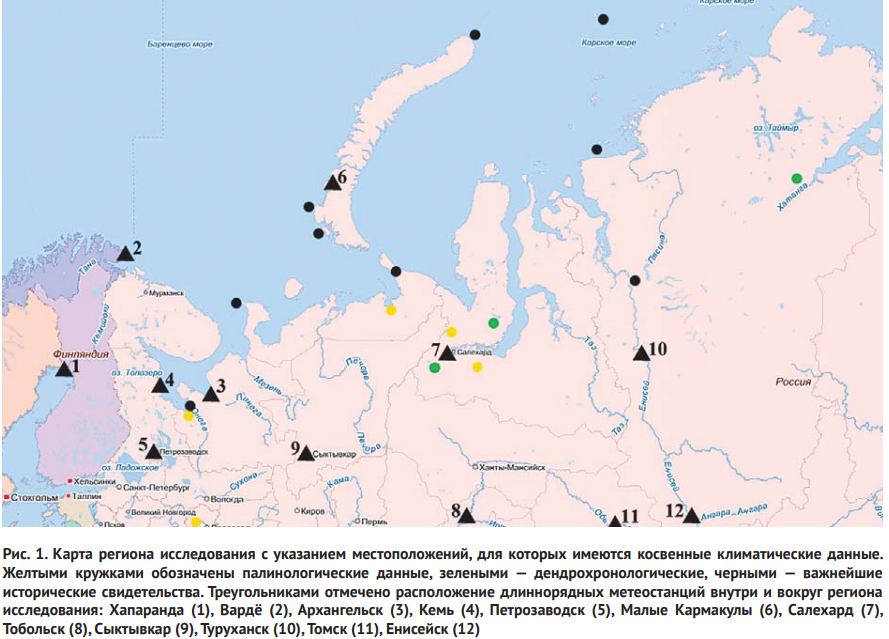
Figure 1. Map of the study region showing locations for which indirect climatic data are available.
Yellow circles indicate palynological data, green circles indicate dendrochronological data, and black circles indicate the most important historical evidence. Triangles indicate the location of long-row weather stations in and around the study region: Haparanda (1), Vardø (2), Arkhangelsk (3), Kem (4), Petrozavodsk (5), Malye Karmakuly (6), Salekhard (7), Tobolsk (8), Syktyvkar (9), Turukhansk (10), Tomsk (11), Yeniseysk (12). Source: here.
Warmer in the years 981-990 and in mid 20th century
Unlike what papers authored by scientists close to the IPCC like to suggest (a flat temperature mean over the past 1000 years followed by a 20th century hockey stick blade warming),the Russian reconstruction of decadal mean annual temperature values shows major climatic events manifested both on the scale of the entire Northern Hemisphere and in its separate regions.
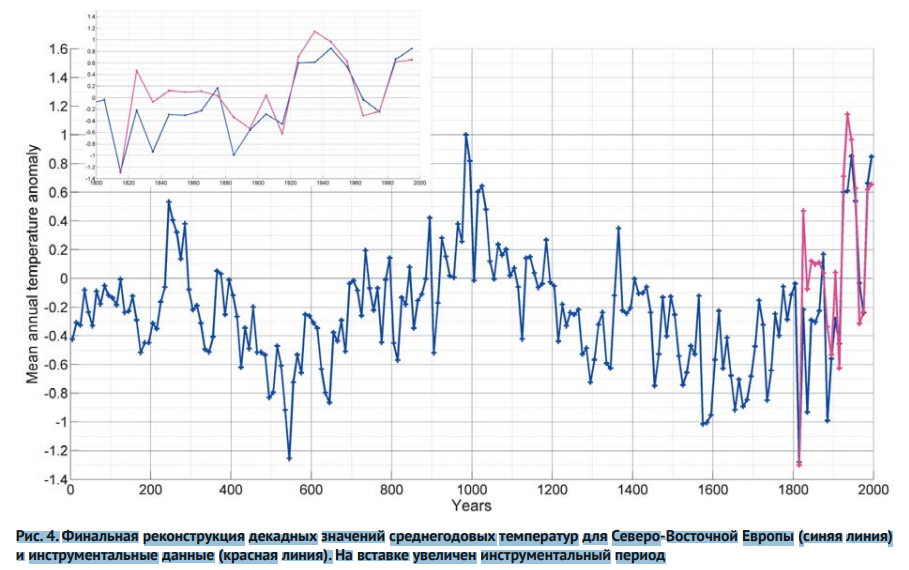
Figure 4. Final reconstruction of decadal mean annual temperatures for Northeast Europe (blue line)
and instrumental data (red line). The instrumental period is enlarged in the inset. Source: here.
According to the paper’s abstract:
In the pre-industrial era, the maximum annual mean temperatures in 981-990 were 1°C higher and minimum temperatures in 1811-1820 were 1.3°C lower than on average for 1951-1980. The constructed chronology has a noticeably larger amplitude of variability compared to hemispheric and pan-Arctic reconstructions.”
The paper concludes that the results of the reconstruction point to “major climatic events” such as the Roman Optimum, the cold epoch of the Great Migration of Peoples in the 5th and 6th centuries, the Medieval Climatic Optimum of the 10th-12th centuries, and the Little Ice Age (13th-19th centuries).
These were manifested both on the scale of the entire Northern Hemisphere, and its individual regions.
Ottawa fails to condemn Israeli damage to Canadian embassy
By Yves Engler | The Canada Files | April 13, 2024
An apartheid state committing genocide damaged a Canadian embassy while conducting a flagrant war crime. But Ottawa has remained silent about an incident designed to ignite a regional war.
Two weeks ago, the Israeli Air Force murdered 16 people in strikes on Iran’s embassy compound in Damascus. They reportedly killed two top Iranian generals, two civilians and a dozen militants. The illegal strikes obviously impinged on Syrian sovereignty and contravene multiple conventions such as the 1963 Vienna Convention on Consular Relations.
Dozens of governments condemned Israel’s violation of international law. The European Union criticized the strikes and a senior United Nations official told an emergency meeting of the Security Council that the inviolability of diplomatic and consular premises and personnel must be respected. The Coordinating Bureau of the 120 nation Non-Aligned Movement released a statement that “strongly condemns the heinous attack conducted by Israel against Iranian diplomatic premises and representatives in Damascus.”
For its part, Ottawa failed to criticize Israel’s actions even as it has emerged that Israel’s strike destroyed a number of windows in the Canadian embassy, which is located next to Iran’s. While formally closed since 2012, the damaged embassy remains Canadian property.
Ottawa was also mum when Israel killed over 50 people in Syria, 72 hours earlier. To the best of this author’s knowledge, the Trudeau government hasn’t criticized any of Israel’s innumerable — 33 times since the start of this year — illegal strikes in that country. Nor has Ottawa criticized a series of (presumed) Israeli killings in Iran though they regularly criticize that country’s actions.
As Israel has bombed Lebanon, Syria and Palestine in recent years, Ottawa has sold it arms and maintained a multitude of bilateral and multilateral military ties. Additionally, the Trudeau government has turned a blind eye to the inducement of Canadians to join or assist the Israeli military in violation of the Foreign Enlistment Act and to registered charities fundraising for the Israeli military in contravention of Canada Revenue Agency rules.
Israel’s attack on Iran’s diplomatic outpost in Syria is a major escalation. The Iranians have said they will respond with a significant assault (reportedly Tehran told Washington that if they impose a ceasefire in Gaza, they will hold back). Israel has responded to Iranian threats by claiming it will further escalate the conflict. On Wednesday Israel’s foreign minister, Israel Katz, posted to X, “If Iran attacks from its territory, Israel will respond and attack in Iran.” President Joe Biden said the US will support Israel.
As has been speculated for some time, Benjamin Netanyahu wants to draw the US into a war with Iran. Netanyahu has long hyped the Iranian threat and wants to have the US weaken the only power in the region that hasn’t been cowed by Israel/US dictates.
Netanyahu has a personal interest to continue fighting. He’s likely going to be ousted as prime minister and may even end up in jail on corruption charges when the fighting stops. Additionally, Israel has failed in its bid to liquidate Hamas in Gaza, Palestine. After six months of Israeli-perpetrated horrors, most of Hamas’ top leaders are alive, uncaptured, and Israel hasn’t even recovered those kidnapped on October 7.
More generally, instigating wars is a national pastime for Israel. (“Israel is an army with a state” goes the saying). Israel has bombed Jordan, Egypt, Sudan, Syria, Palestine, Lebanon, Tunisia and Iraq. Fifteen years ago, Israeli military historian Zeev Maoz explained in Defending The Holy Land: A Critical Analysis of Israel’s Security & Foreign Policy:
“Between 1948 and 2004, Israel fought six interstate wars, fought two (some say three) civil wars, and engaged in over 144 dyadic militarized interstate disputes (MIDs) that involved the threat, the display, or the use of military force against another state. Israel is by far the most conflict prone state in modern history. It has averaged nearly four MIDS every year. It has fought an interstate war every nine years. Israel appears on top of the list of the most intense international rivalries in the last 200-year period.”
Later in the book, Moaz said:
“There was only one year out of 56 years of history in which Israel did not engage in acts involving the threat, display, or limited use of force with its neighbors. The only year in which Israel did not engage in a militarized conflict was 1988, when Israel was deeply immersed in fighting the Palestinian uprising, the intifada. So, it is fair to say that during each and every year of its history Israel was engaged in violent military actions of some magnitude.”
Maoz concludes (describing the Nakba as a “war of independence”):
“None of the wars — with a possible exception of the 1948 war of Independence — was what Israel refers to as Milhemet Ein Brerah (‘war of necessity’). They were all wars of choice or wars of folly.”
For its size, Israel may be the most violent state in the history of humanity. Canada has seldom criticized and in fact enabled this rogue state, as it unleashes ever more death and destruction.
Yves Engler is the author of 13 books. His latest book, available now, is “Canada’s Long Fight Against Democracy”.
Featured Video

Daniel Davis: U.S. Military Options & War Narrative Collapse
or go to
Aletho News Archives – Video-Images
Book Excerpt
“Vaccines Do Not Cause Autism!” The Science is Settled. Right?
ICAN urges the IACC to actually study infant vaccines and autism
 By Aaron Siri | Injecting Freedom | March 16, 2026
On behalf of ICAN, we just sent a copy of chapter 11 of Vaccines, Amen to the newly appointed members of the federal Interagency Autism Coordinating Committee (IACC).
If you haven’t already read this chapter, you can read the whole thing in the attached letter. I trust that after you read it, you’ll see why the statement “vaccines do not cause autism” is a belief, not science!

IACC Public Comment Letter
1.53MB ∙ PDF file
Includes chapter 11 of Vaccines, Amen
Blog Roll
 Aletho News
- Daniel Davis: U.S. Military Options & War Narrative Collapse
- Protesters call on Brussels university to cut partnership with Israeli defense-linked firm
- Weapons makers cash in on Trump’s Iran war
- Why Trump’s anti-Iran naval coalition in Strait of Hormuz is doomed to fail
- IRGC says regional energy sites linked to US will be reduced to ashes
- Qatar condemns ‘dangerous’ Israeli attack on gas field
- Iran made ‘unexpectedly substantial’ offer during Geneva talks, US envoys ‘dragged’ Trump into war: Report
- Russia condemns Israel’s attack near Bushehr plant, files complaint
- Russia Strongly Condemns Actions Aimed at Harming Health of Iranian Leadership – Kremlin
- Israeli Journalist Demands Tucker Carlson and Candace Owens Be Placed in WWII-Style Internment Camps
- If Americans Knew
- How ignorance, misunderstanding and obfuscation ended Iran nuclear talks
- Israeli media reports grotesque settler attack in West Bank
- UK security adviser attended US-Iran talks and judged deal was within reach
- Tucker Carlson says ‘neocons’ will try to destroy Joe Kent over resignation
- Lebanon death toll exceeds 900, another assassination in Iran, bombing in Gaza – Not a ceasefire Day 159
- Trump’s counterterrorism chief, whose own wife was killed by ISIS, quits over Iran War saying Tehran posed ‘no imminent threat’
- Here’s what US could fund instead of Bibi’s war on Iran
- Israel Killed Over a Dozen Lebanese Paramedics in Three Days, Now Claiming That Ambulances Are “Hezbollah” Targets
- War on Iran: These are the heritage sites devastated by US and Israeli attacks
- Four news stories from Israeli media that illustrate Israeli “justice”
- No Tricks Zone
- Energy Expert: Germany’s Nuclear Phaseout Was A “500 Billion Euro Mistake”
- New Research: South Australia’s Mid-Holocene Sea Surface Temperatures Were 4°C Warmer Than Today
- Storing Green Energy To Last Germany 10 Days Would Require A 60-Million Tonne Battery
- New Studies: UK Sea Levels Were 4 Meters Higher Than Today During The Mid-Holocene
- Destructive Green New Deal: German Energy And Metal Group Warns Of Drastic Crisis
- New Study Documents A 20-Year Pause In Arctic Sea Ice Decline – Driven By Internal Variability
- Wake-up Call: Survey Shows Majority Of Germans Now Favor Postponing Climate Targets!
- Televised! Leading German Political Candidate Tells Schoolchildren CO2 Makes Sun Hotter!
- New Study: A Century Warming Of 1.1°C Is ‘Commonplace’ And ‘Not Unusual’ During This Interglacial
- New Study: ‘Internal Noise’ And Volcanic Forcing Can Trigger 10-15°C Warming Within Decades
 Aletho News