Israel Seeks to Sell Weapons Used in Gaza Slaughter
By Kyle Anzalone | The Libertarian Institute | April 8, 2024
Israeli weapons markers are selling some weapons platforms that have been utilized during the onslaught in Gaza. Tel Aviv’s arms industry has found buyers among several Asian countries as Washington tries to make allies in the region, preparing for a future war with China.
Last week, several Israeli arms markers hosted delegations from multiple Asian nations at their booth at the Singapore arms expo. Jon Ostrower, editor-in-chief of The Air Current, explained, “They’ve come to demonstrate their power.”
Axon Vision CEO Roy Riftin said in an interview with Asia Nikkei that his company was coordinating with the Israel Defense Forces in Gaza to refine its military AI tech and then export it abroad.
Some of the weapons platforms featured in Singapore have been used in Gaza. Over the past six months, Israel has killed at least 33,000 Palestinians. Most of the dead are women and children. Several international rights experts have warned that Israeli operations amount to genocide.
In coverage of the Singapore arms event, Haaretz notes that some of the drones touted by the Israeli arms dealers were used by Azerbaijan in Nargano-Karabash. Last year, the Azeris completed an ethnic cleansing of the region by forcing the enclave’s last 100,000 residents out of the Republic of Artsakh and into Armenia.
An Israeli official said it was primarily seeking clients who did not buy Chinese arms. “Ultimately all the countries in the region are threatened by the Chinese,” a senior figure in one of the Israeli defense companies on hand told Haaretz. “Here at the airshow they don’t buy fighter jets from China.”
According to the Stockholm International Peace Research Institute, Israel sells the most arms to India and the Philippines. The US has tried to include both New Delhi and Manila in its Asia-Pacific alliances, with the aim at fighting a future war with China. The US has frequently sanctioned other countries over alleged war crimes and human rights abuses while ignoring the rampant abuses committed by Israel in Gaza.
Scotland Police May Be Forced To Make Budget Cuts To Deal With Authoritarian Speech Complaints
By Dan Frieth | Reclaim The Net | April 8, 2024
Police Scotland is grappling with potential budgetary pressures and service reductions. David Threadgold of the Scottish Police Federation (SPF) has raised concerns about the financial impact of the Hate Crime and Public Order (Scotland) Act. According to him, the legislation has already led to an overload of calls, with over 6,000 logged since its enactment. This influx of reports, he fears, will necessitate cuts elsewhere in the police budget.
Threadgold’s worry centers on the unforeseen costs of handling these cases, particularly the overtime payments for control room staff. He believes these expenses will reverberate throughout the year, affecting other police services. Calum Steele, former general secretary of the SPF, echoes these concerns. As reported by The Scotsman, Steele criticized Police Scotland’s preparation for the Act, calling it “negligently unprepared” and pointing out that the additional costs were predictable.
The new authoritarian legislation has been criticized not only for its financial burden but also for its potential to stifle free speech. The Act consolidates existing hate crime laws and introduces a new offense of inciting hatred against protected characteristics. This broadening of the law has sparked fears about its impact on free speech and expression.
Critics, including Tory MSP Russell Findlay, have accused Justice Secretary Humza Yousaf of ignoring these concerns. Yousaf, for his part, maintains confidence in Police Scotland’s ability to manage these cases, emphasizing that the force is well-equipped and trained for this task.
The legislation’s impact extends beyond financial strains. The Act has resulted in a notable rise in the logging of non-crime hate incidents, incidents perceived as hateful but not necessarily criminal. This increase has prompted concerns about a potential inundation of trivial or malicious complaints, especially in the context of highly charged events like football matches. Tory MSP Murdo Fraser has already lodged a complaint over a tweet he posted being logged as a hate incident.
The Scottish government and Police Scotland maintain that they are adept at handling such cases. However, critics argue that the focus on these hate incidents diverts attention and resources from more serious crimes, potentially impacting the overall efficacy of law enforcement.
Saudi Arabia, Pakistan demand end to Israel’s hostilities in Gaza
Press TV – April 8, 2024
Saudi Arabia and Pakistan have made a joint statement, calling on the international community to pressure Israel to halt hostilities in the besieged Gaza Strip.
Riyadh and Islamabad made the statement after Saudi Crown Prince Mohammed bin Salman hosted Pakistan’s Prime Minister Shehbaz Sharif in Mecca on Sunday.
Both parties called for international efforts “to halt Israeli military operations in Gaza, mitigate humanitarian impact and… pressure Israel to cease hostilities, adhere to international law, and facilitate unhindered humanitarian aid access to Gaza.”
The two leaders also called for “the establishment of an independent Palestinian state with East Jerusalem (al-Quds) as its capital,” according to the statement.
In February, Saudi Arabia made it clear that the kingdom will not begin diplomatic relations with Israel before the establishment of an independent Palestinian state and a permanent ceasefire in the Gaza Strip.
Saudi officials have repeatedly called for a halt to the Israeli campaign.
Yet even as anger ripples across the Muslim world after six months of bombardment, mass displacement and over 33,000 Palestinians killed, there is no sign of an end to the regime’s campaign in the besieged territory.
The Palestinian resistance movement Hamas said on Monday no agreement is even close in the ceasefire talks underway in Cairo.
Israel withdrew from southern Gaza due to the resistance’s strikes, expert says

MEMO | April 8, 2024
Iran Warns it Has Nine Types of Missiles Able to Strike Israeli Territory
Sputnik – 08.04.2024
Israeli Prime Minister Benjamin Netanyahu has long urged military action against the self-avowed Islamic Republic, but the nation of 88 million people possesses significant defensive capabilities.
Iran has nine types of missiles with sufficient range to hit Israeli territory, Iranian news agency ISNA reported against the backdrop of concerns over possible armed conflict between the two countries.
An infographic presented by the news agency Sunday revealed multiple Iranian ballistic missiles – the Sejjil, Kheibar, Emad, Shahab-3, Ghadr, Paveh, Fattah-2, Kheibar Shekan, and Haj Qasem – the speed of which ranges from Mach 5 to Mach 14 (from 3,836 miles per hour to 10,741 miles per hour).
Israeli Prime Minister Benjamin Netanyahu has long urged military action against the self-avowed Islamic Republic and regional critic of Israel, but the nation of 88 million people possesses significant defensive capabilities. A war on Iran also raises the prospect of potential involvement by Tehran’s ally Russia, while Netanyahu would presumably count on an assist from the United States.
On April 1, Israel carried out an airstrike on the consular annex of the Iranian Embassy in Damascus, destroying the building. Iran’s Islamic Revolutionary Guard Corps said seven of its members had been killed in the attack, including two commanders. On Tuesday the Syrian Health Ministry said the attack had also killed four Syrians and injured 13 more.
The Iranian Foreign Ministry said it “reserves the right” to respond to the Israeli attack and “punish the aggressor.” Iranian President Ebrahim Raisi also vowed Israel would pay a “heavy price” for the strike.
“None of the embassies of the (Israeli) regime are safe anymore,” said top Iranian military advisor Gen. Rahim Safavi Sunday, suggesting the country could mirror Israel’s consular strike.
Iran is a staunch defender of the Palestinian cause in the region – Palestinian solidarity was a founding principle of the country’s 1979 Islamic Revolution which toppled the US backed Pahlavi royal family. The country’s foreign policy is rooted in strong opposition to US imperialism, which has left a lasting legacy in the Persian country.
Review of “Unmasking Anne Frank, Her Famous diary Exposed as a Literary Fraud” by Ikuo Suzuki

By Karl Haemers | Occidental Observer | August 27, 2022
I am going to assume that most readers of The Occidental Observer are familiar with the official story of Anne Frank, the young Jewish girl (aged 13–15) who kept a diary while hiding in a house from Jew-hunting “Nazis” in the Netherlands during World War II. In searching the TOO site for “Anne Frank,” I found no hits, but the Anne Frank story is almost as prevalent and persistent as the holocaust story itself, and surely TOO readers know the basics.
Publisher Clemens & Blair has just released a new book focused on the fraudulence of The Diary of Anne Frank. A number of other works examining the fraudulent Anne Frank diary have been published over the course of many years, most famously “Is the diary of Anne Frank Genuine?,” an article in English in 1982 by Robert Faurisson. But this new book surpasses the old ones in many ways.
Author of the current work, Ikuo Suzuki, a Japanese researcher, reviews a number of these earlier analyses of the diary in his new book, as does editor Thomas Dalton in his Foreword. As assistant editor, I do the same in my Introduction. (Disclaimer: I have a partial financial interest in this book.)
From there, Mr. Suzuki explores new analyses of the diary, including an illuminating graphic depiction of the many changes among the many various publications of the diary over the span of decades. So numerous and detailed are the diary’s entries over 26 months that logical inconsistencies and physical and logistical impossibilities inevitably occur; Suzuki identifies many new ones. He calls some of this “Anne magic,” and indeed only a magical explanation can reconcile some of the diary’s many internal flaws and self-contradictions.
Suzuki’s book is arranged into five main chapters, each having four to nine sections. As an example of inconsistency among various published versions of the diary, Chapter 1 is titled “Absurdity on the Surface,” and one section is titled “The Translation of ‘Cat’ Into ‘Tarantula’.” This Chapter displays pictures and drawings of the “Annex” in which Anne Frank supposedly hid out with seven other Jews, along with examinations of physical and architectural impossibilities.
Suzuki goes on to explore “Absurdities Lurking in the Depths” in Chapter 2, closing with the section “Was Everything a Figment?.” Here we see pictures of diary pages themselves, and careful comparisons among the bewildering number of different versions of the diary published at different times in different languages. Here we find Suzuki’s unique graphic display of the many changes among the versions. For example, Anne Frank is said to have edited her own diaries at a later point in her time in the “hideout.” Edited is not the proper term when we see that one early entry in her Diary as presented in the English publish version is actually a combination of two entries more than a month apart from the original diaries.
Chapter 3, “Annie Ample: A Soft-Core Porn Romantic Life?,” examines the core drama at the heart of the diary: the love (or lust) affair Anne supposedly had with a Jewish boy from another family also confined in the “hideout.” One of the great revelations that Suzuki presents is just how grotesque and sexually perverse the diary truly is, raising doubts on its own whether a young girl could even think such thoughts, much less write them down.
I’ll say here that, in my Postscript, I present the content of five missing pages of the diary that supposedly were found in 1998, and then two more “uncovered” in 2018. The five pages contain a scathing denunciation of Anne’s mother Edith and an oblique critique of her father Otto, but the two “uncovered” pages contain “perhaps the filthiest pornographic smut of the entire diary.” (I will spare readers the details here, though the book will not.)
Chapter 4 explores Anne’s writing career (or lack of it), the “infamous bookshelf door,” and the story of the beginning and end of the “hideout” (which is the chapter title). More pictures of documents and infrastructure assist the inquiry. This chapter engages in a staple of Diary doubters—handwriting analysis, and clarifies some former confusion. A letter Anne Frank supposedly sent in 1940—before the “hideout”—to a pen pal in the US was found, and when its handwriting is compared to the handwriting of the Diary, even an amateur analyst can see the two are different. It also debunks the absurd story—or stories—of how the diaries were finally found after the “hideout” inhabitants were hauled away by the Gestapo.
Chapter 5, “The Diary Unmasked,” explores the core issue of The Diary of Anne Frank, one that all revisionists have addressed: who really wrote the diary? Many speculate that Anne’s father Otto Frank was the actual author all along, but Suzuki excludes Otto as lacking the character, ability and motivation to forge the diary. He says: “there was at least one person in Otto’s vicinity who definitely possessed those qualities.” Suzuki’s in-depth profile and examination of this one person—Jewish playwright and journalist Meyer Levin—I found compelling. For instance, Levin’s relationship with Otto Frank included Frank appointing Levin his copyright agent in 1952. Levin’s history involved him working in the “Office of War Information” in the US, producing propaganda movies. Thus Levin had the presence and ability to invent the Diary as on-going war propaganda.
Mr. Suzuki closes with a touching Afterword he calls “Annelies Next to You,” in which the focus of our outrage is inverted from the evil “Nazis” to those who would fabricate lies in Anne’s name. This is a virtue of this book; Suzuki never blames Anne for the fraud, but rather points the finger at other Jews. “Not a single word in (the diary) contains her truth. It is merely a prison for Annelies’ soul, covered by a thick wall of falsehood in the name of a legend.” Our compassion should be for the real Annelies (her full name) Frank who has been so brutally used and misrepresented to promote a Jewish victim/”Nazi” perpetrator agenda.
The book closes with my Postscript, where, as stated, the five “missing” and two “uncovered” pages bring us up to date on diary developments. Unfortunately, Revisionists can also generate myths to their discredit, and one of these is the “ball-point pen” story. Hopefully I put to rest the claim that the diary is a fraud merely because it was written in ball-point pen, which was not invented until 1950. (Only two attached notes were written in pen, but nothing in the diary text itself.) The Postscript is framed as “Re-Rebutting the Anne Frank House,” which is the lavishly funded and well-organized foundation administering the “hideout” building itself as a museum, curating the diaries themselves (though not all are displayed), and issuing the on-going education about the iconic Jewish victim of “Nazi” tyranny, Anne Frank. I believe that just about the only point on which the Anne Frank House is correct regarding the diary is its position on the ball point pen issue. Everything else is tendentious and misleading propaganda, or outright deception.
In the words of main author Suzuki: “All other textual information, even the testimonies of friends and relations, is too biased and too fraudulent to be believed.” As he carefully demonstrates, there is so little truth to the diary itself that one can hardly accept any of it as valid.
This is one of those books that in parts of a couple sections presents such exhaustive detail as to make reading tedious, while at the same time my fascination with the revelations drew me onward. Suzuki could not completely resist the temptation to depart from a strict scholarly tone and lapse into humor—but neither could Dalton or I. I suppose this has to be accepted in such revisionist material, as we see all over certain “free speech” social media platforms. The lapses are rare and brief however, and the depth and scope of scholarship prevail. If I have any final critique of Unmasking Anne Frank, it is that it treated the perpetrators of the hoax too lightly, failing to express the appropriate loathing and contempt and even criminal accusations they deserve. Suzuki’s compassion is for Annelies, who was so cruelly used by these criminal fraudsters, but he expresses not enough outrage at those who exploited her posterity. We are all victims of the fraud as well.
Unmasking Anne Frank by Ikuo Suzuki, including the excellent Foreword by editor Thomas Dalton and Introduction and Postscript by myself, achieves the difficult task of summarizing and updating previous diary revision, while presenting new crucial insights. The end effect is to drive a dagger of certainty into the bleeding heart of Diary pathos. Suzuki’s detailed biographical analysis of the person he concludes actually wrote the diary—Meyer Levin—is the climax of a book filled with stunning insights. This book has much to consider for those new to Diary doubt, and much more to ponder for those already familiar with Anne Frank revisionism. Unmasking Anne Frank is, without doubt, the best such revisionist text ever produced; it is not only a great contribution to diary revision, it may be a culmination.
The Last Word on Overpopulation (2011)
Podcast: Play in new window | Download | Embed
Video player not working? Use these links to watch it somewhere else!
WATCH ON:  /
/  /
/  or AltCensored
The Corbett Report | February 15, 2011
Welcome. This is James Corbett of corbettreport.com with the last word on overpopulation.
As human beings, we are hard wired to be constantly on the lookout for potential dangers. This is to be expected. Thousands of years ago, our ancestors had to be ever-vigilant to the threat of natural predators, contagious disease and inclement weather, or suffer the consequences. Today we have largely overcome many of the natural dangers which plagued our forebears, but the same instincts compel us to guard against threats both real and imagined, and heed the call of those who raise the alarm of potential new threats.
This concept has been well understood for thousands of years by those who have sought to control populations.
Before the modern understanding of our solar system had been articulated, the ancient Egyptians believed that the sun itself was a god named Ra who was devoured every evening by an evil snake god named Apep. It was by no means assured that Ra would be able to escape Apep to return in the morning, and the priest class manipulated this basic fear by developing elaborate rites for warding off the snake god. These rites, of course, could only be properly administered by the priests themselves, thus assuring them a central role in ancient Egyptian society.
We may laugh at the gullibility of the ancient Egyptians, but for them the existence of Apep and the importance of the rituals were instilled from an early age and reinforced by the pronouncements of the priestly class. To question the reality of the sun god myth would have been akin to questioning the fabric of Egyptian society itself.
To think that we are not capable of being similarly manipulated in our modern “enlightened” era would be the grossest form of historical naïveté.
In the 20th century, fears over the red menace of the Soviet Union and its supposed military juggernaut were used to steer the course of American society. Jack Kennedy himself became president campaigning on the notion that the Eisenhower administration had allowed a dangerous missile gap to build up between the Soviets and the Americans. According to this scare story, fed to the Kennedy campaign by RAND Corporation analysts, the Soviet Union had 500 Intercontinental Ballistic Missiles ready to fire at America at a moment’s notice. In reality, the Soviets only had 4 such missiles at that time, but that did not stop the military-industrial propaganda machine from convincing Americans that they had to pump ever more of their resources into arms purchases from defense contractors in order to counter the Soviet threat.
Incredibly, in some cases the same threat has been touted for centuries, always coming with the same dire warnings that the end of the world is nigh unless the public is willing to give up money, sovereignty, or even their lives in order to avert it.
In the late 18th century an Anglican priest named Thomas Malthus demonstrated with “mathematical certainty” that the world was heading toward demographic disaster. After all, human population increases exponentially while food supply increases arithmetically. From this it logically follows that it is only a matter of time before the world population outstrips our ability to feed ourselves.

Thomas Malthus
Of course, just as a parent might look at his infant son’s first year of growth and extrapolate that he will be 20 feet tall by the time he’s 30, over 200 years of the expected population crisis failing to arrive has demonstrated that there are fundamental flaws in Malthus’ reasoning. The earth is not a zero-sum game and human ingenuity has always and in every generation manged to bake a bigger pie even as they take a bigger and bigger slice of it. Now even the United Nations’ most alarmist predictions admit that global population will level off and begin declining in 2050, and Malthus is now understood to have been a third-rate scholar spreading Chicken Little sky-is-falling fantasies for the benefit of the British East India Company that employed him.
Amazingly, though, despite every one of the doomsday predictions of Malthus and his Malthusian acolytes proving to be false decade after decade for two centuries on end, Malthus’ ideas are still being taken seriously and still being hyped and promoted by the moneyed oligarchs who benefit from the idea that there are too many useless eaters using up the world’s resources.
Malthus himself, an Anglican minister, wrote that: “We are bound in justice and honour formally to disdain the Right of the poor to support,” arguing for a law making it illegal for the Anglican church to give any food, clothing or support to any children. Not content with consigning thousands of children to death for the misfortune of being born poor, however, Malthus also advocated actively contributing to the deaths of more of the poor through social engineering:
“Instead of recommending cleanliness to the poor, we should encourage contrary habits. In our towns we should make the streets narrower, crowd more people into the houses, and court the return of the plague. In the country, we should build our villages near stagnant pools, and particularly encourage settlement in all marshy and unwholesome situations. But above all we should reprobate specific remedies for ravaging diseases; and restrain those benevolent, but much mistaken men, who have thought they are doing a service to mankind by protecting schemes for the total extirpation of particular disorders.”
The horrific nature of this idea is made all the more preposterous by the fact that Malthus was encouraging the spread of disease and plague in order to “save” humanity from the diseases and plagues that overpopulation fosters. But this self-contradiction is completely lost on those whose bloodlust drives them to support such drastic population reduction schemes to kill of the poor and downtrodden of society.
As repulsive as Malthus’ ideas are to our sensibilities, they have provided an ideological framework for those with a psychopathic urge to dominate others for the past two hundred years.
In his infamous 1968 book, The Population Bomb, Paul Ehrlich and his wife Anne wrote: “A cancer is an uncontrolled multiplication of cells; the population explosion is an uncontrolled multiplication of people. [. . .] We must shift our efforts from the treatment of the symptoms to the cutting out of the cancer. The operation will demand many apparently brutal and heartless decisions.” He felt the cancer of newborn babies was so potentially devastating to humanity that in 1969 he actually advocated adding sterilants to the food and water supply. Lest there were any doubt about his remarks, he further elaborated on them in Ecoscience, a 1977 book that he co-authored with Obama’s current science czar, John Holdren, where they once again advocated adding sterilants to the water supply.
In 1972, ex-World Bank advisor and UN functionary Maurice Strong advocated government licensing for women’s right to have children.
In 1988, Prince Philip uttered his deplorable comment, “[i]n the event I am reborn, I would like to return as a deadly virus, in order to contribute something to solve overpopulation.”
In the 1990s, Ted Turner told Audubon magazine that a total world population of 250-300 million people—a 95 percent decline from present levels—would be ideal.
Of course, the overpopulation myth itself crumbles under the slightest scrutiny. No one, not even the UN, is projecting limitless growth of the human population. Even the most alarmist projections show the world population leveling off within 40 years. What’s more, the birth rate in every major industrialized nation in the world is now below the replacement level of 2.1, meaning that they are in fact dying nations of aging populations that require an ever-increasing influx of immigrants just to maintain their population level. In addition to the well-known phenomenon of industrialization reducing the sizes of families, there are now indications that chemicals called endocrine disruptors which are mysteriously ending up in our foods, plastics and drinking water are limiting our biological ability to reproduce, with sperm rates among Western men declining a staggering 50% in the last 50 years with 85% of the remaining sperm being abnormal.
But still, even if we were to take the hysteria over population size at face value, the “solutions” suggested by the Malthusians—forced sterilization programs, de-industrialization, and even genocide—represent the biggest fraud of all: the idea that merely reducing the size of a population will somehow reduce the inequalities and iniquities within that society.
NARRATOR: War, one of the leading causes of world hunger, destroys crops and disrupts relief efforts. Widespread poverty prevents many from buying the food that they need. And a lack of infrastructure means that there isn’t a reliable way to transport food to areas that need it.
This is why reducing the number of hungry people will not make the remaining people less hungry. Those who have access to the food will continue to have access to it, and those who don’t will still be hungry.
Reducing population will not magically cause food to be spread around equally. And blaming overpopulation for everything does nothing but distract us from the real problems that we actually have.
SOURCE: Food: There’s Lots Of It
But therein lies the secret. The people who fret over the overpopulation non-problem cannot be reasoned with because their concern for humanity is only a pretense. The way they approach the problem itself displays their bias. Most people see an increase in the number of people on the planet not as a scourge, but as an opportunity to increase our understanding of the human species and its capabilities. In the twisted vision of the overpopulation fearmongers, however, newborn babies are not a joy to behold, not a gift, not the living, breathing potential of the future of the human race, but a cancer that must be killed.
The Malthusians are not interested in increasing food production, lifting the poor out of poverty or developing technology to increase our ability to share in the abundant wealth of the world. Instead they wish for the forcible sterilization of the poor, the consignment of billions around the world to grinding poverty and the elimination of vast swathes of the population. They do not wish to reduce the pain and suffering in the world, but to increase it. In short, the overpopulation hysteria is a convenient lie for the Chicken Littles who stand to benefit from the panic they themselves cause.
For the rest of us, it comes down to a simple question: After 200 years of the sky failing to fall, isn’t it time to stop listening to Chicken Little?
For The Corbett Report in western Japan, I am James Corbett.
World War II Didn’t End The Great Depression
Stark Realities with Brian McGlinchey | April 4, 2024
A principal goal of Stark Realities is to “expose fundamental myths across the political spectrum” — and few myths are as universally embraced as the notion that US participation in World War II (1941-1945) lifted the American economy out of the Great Depression.
This myth is dangerous not only because it leads citizens and politicians to see a bright side of war that doesn’t really exist, but also because it helps foster a belief that government spending is essential to countering economic downturns. That belief, in turn, has helped propel us to a point where the national debt now exceeds $34.6 trillion, with interest payments alone on pace to reach $1 trillion a year in 2026, inviting financial catastrophe.
In part, the wartime-prosperity myth springs from the fact that, during conflict on the scale of World War II, broad, macroeconomic measures like gross national product (GNP) and the unemployment rate are completely untethered from the economy’s most important facet: the standard of living enjoyed — or endured— by everyday people.
Between 1940 and 1944, real GNP rose at an unprecedented 13% annual clip. Using GNP alone, one would think the war delivered a major improvement in the standard of living, with Americans enjoying a greater abundance of goods, accompanied by a rise in quality, selection and affordability.

The reality was the exact opposite: Americans endured rationing, shortages, declining product quality, and the outright unavailability of many new goods, such as cars, trucks and stoves. This was the inevitable result of factories and raw materials being redirected from the creation of things consumers want to building things like tanks and fighter planes that do nothing whatsoever to improve people’s lives (setting aside the separate issue of the war’s justness).
In many respects, America experienced an outright economic devolution. In the preceding century, industrialization and the division of labor led to enormous increases in productivity. During World War II, however, shortages motivated people who’d contentedly relied on farmers to start growing their own food and canning it. The scarcity of new clothing led homemakers to redirect time and energy to sewing their own garments and resewing them to stretch as much use out them as possible.
“Those remaining on the home front were forced to produce for themselves what they had previously been able to purchase,” wrote Steven Horwitz and Michael J. McPhillips. “The household again became a center of production rather than consumption alone.”
GNP wasn’t the only measure falsely signaling wartime prosperity; employment numbers from the era were likewise misleading. The US unemployment rate plummeted from 17% in 1939 to 1.2% in 1944. Note, however, that military service members are not considered part of the labor force — which means that the draft extracted 11.5 million men from the denominator in the unemployment rate calculation.
Another 6.3 million volunteered, though many signed up because they preferred to secure a role they favored rather than face the chance of being drafted as an infantryman.
While it’s true that draftees and volunteers were “employed” by the armed forces, all these millions of men — no matter how noble their overseas missions may have been — weren’t doing anything to create prosperity at home.
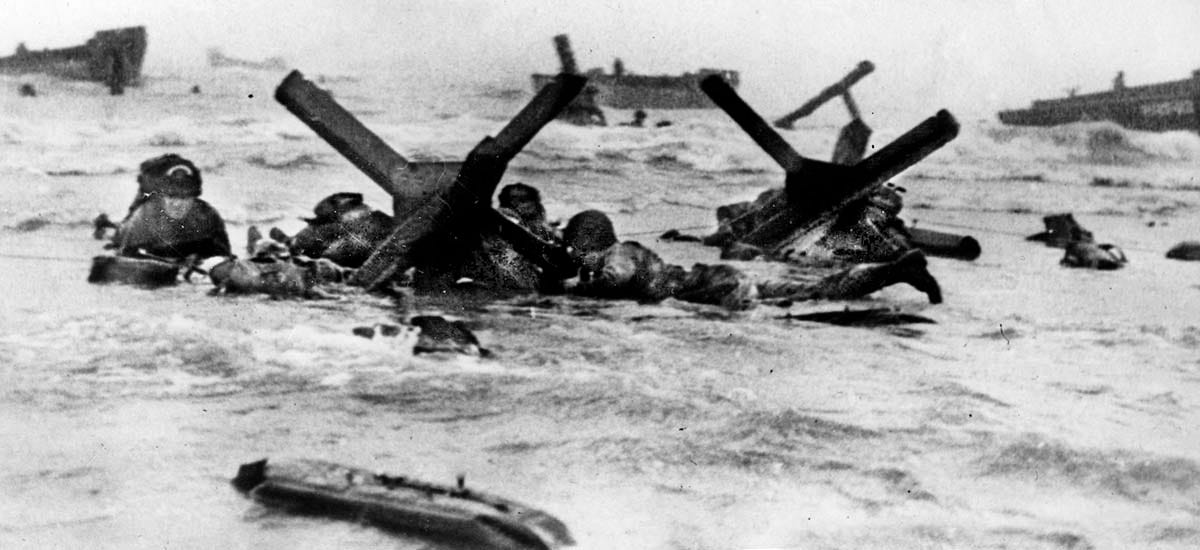
Not a prosperous path to full employment: Soldiers under withering fire on D-Day’s Omaha Beach
That’s not to say the war machine didn’t demand laborers. With so many able men taken out of the economy, the slack was taken up by teenagers, women and retirees, many who’d have preferred to be doing other things.
In a growing economy, more people are producing goods and services, and elevating standards of living in the process. That was far from the case during World War II. Factories were humming, but they were making bayonets, bombs and battleships. “Four-tenths of the total labor force was not being used to produce consumer goods or capital capable of yielding consumer goods in the future,” noted Robert Higgs.
Defying conventional wisdom about “wartime prosperity,” Americans’ standard of living suffered tremendously from their government’s entry into World War II. In The Reality of the Wartime Economy, Horwitz and McPhillips tapped some interesting source material to bring the grim economic realities of American life during World War II into sharp focus.
For example, a series of newspaper ads placed by Canton Electric Light & Power Company — a local New York State utility — present a vivid, time-lapse portrayal of rapidly declining conditions following the December 1941 declaration of war:
- Foreshadowing anticipated shortages, a March 17, 1942 ad for appliances is headlined “You Can Still Buy Them.” The ad includes a qualifier that’s upbeat while still signaling creeping scarcity: “We have a fairly good supply.”
- Just two months later, Canton Electric’s ad says “Now Is The Time” to buy various appliances and equipment, warning that “production of most of these items has stopped and only the supply in your dealers’ stock is available.”
- Another two months later, a July 1942 ad indicates that some items that were briefly not available are back in inventory.
- In November of that first year of America’s World War II participation, Canton Electric switched to warning consumers that, “due to the war emergency, it is quite impossible to get replacement motors for civilian use,” and urging them to ensure they’re properly maintaining their “stokers and oil burners.”
- Later that same month, Canton Electric punted on advancing its retail business altogether, instead using its ad space to encourage readers to grow their own food, eat everything on their plates and comply with ration-stamp rules.

Horwitz and McPhillips also drew on letters written between 1942 and 1945 by Saidee Leach to her son serving in the Pacific. Contrary to the image of prosperity supposedly indicated by leaping GNP or plummeting unemployment, she tells him of:
- Conserving scarce home-heating fuel during the coldest days by wearing fur coats indoors and residing only in their kitchen
- Having her typewriter seized by the government, and now using a lesser model she acquired from a Howard Johnson “which had to close due to the ban on pleasure driving.”
- Making an Easter dinner centered on fried Spam, because she “could not get fresh meat of any kind,” and later noting that “potatoes have entirely disappeared”
- Local farmers refusing to sell their turkey flocks for Thanksgiving meals at the prices set by the Office of Price Administration — illustrating the folly of government price controls.
That is not the picture of an economy delivered from the Great Depression. Rather, “World War II institutionalized the falling standards of living of the depression through wage and price controls, and extensive rationing of consumer goods and services,” wrote Peter Ferrara. “The economic deprivation, and reduced standards of living, continued, although people perceived it was now for a good cause.”
America’s postwar experience presents another pointed contradiction of the myth of wartime prosperity.
As the war’s end grew closer, Keynesian economists unanimously predicted peace would bring economic disaster. For example, Paul Samuelson said America would experience “the greatest period of unemployment and dislocation any economy has ever faced.”
Alvin Hansen warned that the economy must be kept on a centrally-controlled wartime footing, even in peacetime: “When the war is over, the government cannot just disband the Army, close down munitions factories, stop building ships, and remove all economic control.”

Nobel Prize winner Paul Samuelson, who predicted peace would bring economic disaster, taught Nobel Prize winner Paul Krugman, who predicted the internet’s impact would be akin to that of the fax machine
However, that’s pretty much what happened — and Hansen, Samuelson and their fellow economic flat-Earthers couldn’t have been more wrong about the consequences. “The year 1946, when civilian output increased by about 30 percent, was the most glorious single year in the entire history of the U.S. economy,” wrote Higgs.
This despite the fact that government purchases of goods and services collapsed by 68% between the second quarter of 1945 and the first quarter of 1946 — and upwards of a million civilian government employees were laid off and millions of service members discharged.
As war-fighting men poured back into civilian life, millions of women withdrew from the labor force, contentedly returning to duty as mothers and home managers. Rather than soaring as predicted by the “experts,” unemployment merely edged higher, from 1.9% in 1945 to 3.9% in 1947.
“Less than a year and a half after VJ-day,” crowed President Truman, “more than 10 million demobilized veterans and other millions of wartime workers have found employment in the swiftest and most gigantic change-over that any nation has ever made from war to peace.” (Note this happened despite — and in part because of — Truman’s failure to institute a higher minimum wage as the war ended.)
Having been proven enormously wrong about the economic implications of peace, Keynesians scrambled to credit the war with enabling the postwar boom, arguing that it was fueled by people drawing down savings accumulated while the supply of consumer goods was sharply restricted. However, as Higgs determined by studying the data of the time, “Holdings of liquid assets did not decline at all after the war. People financed their spending for consumer goods by reducing their saving rate.”

Once again an engine of real prosperity: In 1946, vehicles proceed along Ford’s first postwar assembly line
Contrary to the myth, it was only after World War II that — free from the government’s commandeering of factories, workers and resources, and saddled with fewer price controls and other federal market intrusions — America was finally able to emerge from the Great Depression.
You wouldn’t know that if you evaluated the economy’s health using Keynesians’ preferred measure. Just as the GNP gauge provided a 180-degree misreading of wartime economic realities, it failed in similarly spectacular fashion during the postwar boom: From 1945 to 1947, GNP plummeted 22%.
In addition to further illuminating the shortfalls of aggregate economic measures, America’s postwar economic experience delivered another broadside to the myth of World War II-fostered prosperity, and to the idea that government spending, central planning and market interventions are essential to economic achieving economic recovery.
Israel announces partial withdrawal of its troops from southern Gaza
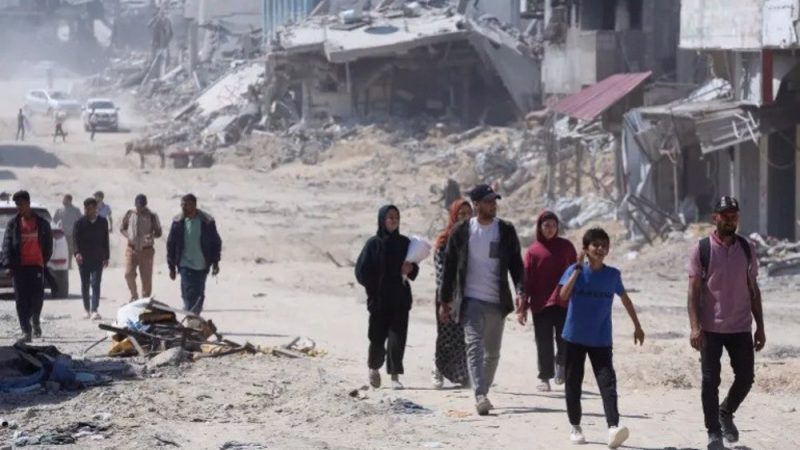
Palestinians inspect destroyed residences in Khan Younis after Israeli military withdraws most of its ground troops from the southern Gaza Strip (Reuters)
Press TV – April 7, 2024
Israel says it has pulled most of its troops out of southern Gaza in what it said is a move to recuperate and prepare for future offensives.
Three Israeli brigades on Sunday left the southern city of Khan Yunis but another remained to prevent displaced Palestinians from returning to their homes in the north.
The Israeli military said a “significant force” will remain in the rest of the besieged Gaza Strip.
Israel’s military earlier announced it’s pulling thousands of soldiers out of the south, including Khan Younis city, after months of fierce combat.
The military wing of the Hamas resistance movement said Israel was forced to end its operations before achieving its goals.
The al-Qassam Brigades dismissed Israel’s claims that it had destroyed resistance forces in those areas from where it had withdrawn.
The Brigades added that resistance forces have always surprised Israel.
Khan Younis residents, who rushed back to their city after Israeli forces relocated from southern Gaza, found a wasteland of destruction and rubble.
Media reports quoting residents said much of Khan Younis had been destroyed, many buildings had been bombed, and there were overturned cars stuck in the mud near craters left by missiles.
Witnesses said that damaged hospital beds were seen on one street.
They have been saying the situation is completely indescribable and chaotic as a great deal of destruction has been done to the entire area
“It is a shock, a shock. What happened was not small … while coming on the way in the car, I saw things. The destruction is unbearable,” said Mohammed Abou Diab, who was among those who returned to his old neighborhood.
The Secretary-General and CEO of the International Federation of Red Cross and Red Crescent Societies (IFRC), Jagan Chapagain, says the situation in Gaza is “desperate and worsening” as the war hits its six-month anniversary.
The city has come under intense Israeli bombardment in recent months.
Khan Younis has been destroyed, with the destruction of civil infrastructure, mosques, and residential houses, and people are saying that they have nothing left in the city.
After six months of relentless attacks on Gaza, Israel remains no closer to a victory than it has been at any point since October of last year.
US says Israeli military’s troop reduction in Gaza is to ‘rest and refit’
White House National Security spokesperson John Kirby said the Israeli army’s troop reduction in Gaza appears to be a “rest and refit” and not necessarily indicative of any new operations.
“As we understand it, and through their public announcements, it is really just about rest and refit for these troops.”
“[This is] not necessarily that we can tell indicative of some coming new operation for these troops,” Kirby said when asked about the step.
Palestinians face more deaths and destruction in Gaza as the US-Israeli onslaught in the besieged strip continues for a seventh month.
Since the beginning of the US-Israeli genocide in Gaza, nearly 33,200 people have been killed.
At least 7,000 people are also unaccounted for or presumed dead under the rubble.
Pellegrini’s Win in Slovakia’s Won’t Allow EU to Drag It Into Conflict Against Russia

Peter Pellegrini (L) and Slovak Prime Minister Robert Fico (R) after the announcement of Pellegrini’s victory in the Slovak presidential elections, April 6, 2024.
By Svetlana Ekimenko – Sputnik – 07.04.2024
Slovak parliamentary speaker Peter Pellegrini, who shares prime minister Robert Fico’s staunch opposition to continued arms supplies to Ukraine, won the second round of Slovakia’s presidential election. Pellegrini and Fico’s left-wing opposition to the Russo-Ukraine war proved to be a winning formula.
In Peter Pellegrini Slovakia will finally have a president who does not support the pro-Western position and was not “installed by the Americans,” political observer Peter Marcek told Sputnik.
“There will be coordination between the government of the Slovak Republic [led by] Robert Fico and President Peter Pellegrini, because they have one program, one direction,” he remarked.
According to Marcek, “both Fico and Pellegrini share the idea that no Anglo-Saxons should be able to dictate to us what we should do.”
Washington pursued its own goals by pushing Pellegrini’s main rival, former foreign minister Ivan Korcok, for the presidency, argued the expert, in an effort “to subordinate our will exclusively to their hegemony.”
Pellegrini, an ally of Fico, won the presidential election with 53.26 percent of the vote versus Korcok’s 46.73 percent, following declarations from 99.66 percent of voting districts.
Pellegrini said his victory meant the government would not have to face an “opposition, opportunistic power centre.” He vowed that he would “be a president who will support the government in its efforts for improving people’s lives.”
Pellegrini, 48, has Italian ancestry. He previously served as Slovakia’s prime minister from 2018 to 2020 and Minister of Health from 2019 to 2020. He also had a two-year stint as speaker of the National Council from 2014 to 2016. Pellegrini, formerly a member of Direction – Social Democracy, left that party to found Voice – Social Democracy in 2020.
The politician returned to the position of Speaker of the National Council after the 2023 parliamentary election. His Voice – Social Democracy party came third and became part of the three-party ruling coalition with PM Robert Fico’s SMER-SSD (Direction-Slovak Social Democracy) and the Slovak National Party.
Pellegrini announced his intention to run for president in January. He came second in the first round of voting in March, with 37.03 percent, trailing former Korcok who won 42.52 percent of the vote. But Pellegrini scooped up the floating voters to clinch the second round.
Commenting on the Fico and Pellegrini long-standing political alliance, Marcek pointed out that “When the government passes laws and the president can veto them, it creates problems.” But now the president and the prime minister will be on the same page.
“Pelligrini will be a president who will work well with Fico. They said at a press conference after the elections that they would support each other. They will cooperate very well this way,” said the pundit.
In Slovakia, the government holds most of the executive powers, such as picking the prime minister after parliamentary elections, swearing in the new government, and appointing Constitutional Court judges. The role of president is largely ceremonial, but includes ratifying international treaties, appointing top judges and acting as commander-in-chief of the armed forces — and has the power to veto new laws.
Bratislava can no longer support the West’s anti-Russian course, noted Marcek, who welcomed the “clear victory of Pellegrini.”
“I think that many relations, for example, with the Russian Federation, can improve. We need to develop our mutual relations,” stated the former deputy of the Slovak parliament.
“I am grateful to Russia because it is not just fighting for itself, to prevent NATO from approaching the borders of the Russian Federation,” Marcek stressed. “Russia is fighting for us all, for the traditional family values, for improving the economic situation in the world. For good relations, and most importantly — for peace and justice.”
Fico’s government has been determined to chart an independent course against NATO’s proxy war against Russia in Ukraine.
Echoing his Hungarian counterpart Victor Orban’s stance, Fico has opposed confrontation with Russia, and urged an end to military aid to Kiev. Hungary and Slovakia are the only two EU and NATO members to refuse to send arms to Ukraine.
“Peter Pellegrini hails from Robert Fico’s party, he is a social democrat, and shares the PM’s ideas and views. This means that he is in favor of ending the conflict in Ukraine and starting negotiations between Kiev and Moscow,” Marcek said. “He is against sending weapons to Ukraine, opposes such vast quantities of EU aid being sent to Kiev.”
Pellegrini stated in an interview in March that the Slovak government had a realistic position on the conflict, and voiced surprise that some countries refuse to respect Slovakia’s approach. He added that Slovakia is ready to help the Ukrainian side in demining territories and implementing civilian projects.
The president-elect believes that the conflict in Ukraine has no military solution, advocates early peace negotiations and believes that arming Ukraine could ultimately lead to disaster.
Most Slovaks want “a president who will defend Slovakia’s national interests, who will not drag Slovakia into a war but will talk about peace, who… will put Slovakia’s interests first,” Pellegrini said.
In contrast, Pellegrini’s opponent Korcok, said: “I do not think Ukraine should give up part of its territory to achieve peace.” He told reporters that “Peace cannot mean capitulation,” and could only be achieved “immediately” on the condition that Russian troops withdraw.
Fico responded by calling Korcok a “warmonger” on video ahead of the run-off. He claimed Korcok “will support everything the West tells him without hesitation, including dragging Slovakia into the war.”
But both Pellegrini and Korcok have reiterated that they would not allow the Slovak military to be sent to Ukraine.
“Slovakia has made a decision that it will not send a single soldier to Ukraine in any event. And this is despite the criticism of this sovereign position of ours. On the contrary, we will insist that the only way to end the bloodshed is to have courage to begin peace talks between the warring parties,” Pellegrini said after a meeting with Orban.
On issues such as NATO membership for Ukraine, however, the two rivals took opposing stances. Korcok insisted that the final decision on Ukraine’s membership in NATO will be made by members of the alliance if the Ukrainian side meets the necessary requirements.
But Pellegrini was adamant that there is no place for Ukraine in NATO, giving an unequivocal “no” to the question during a pre-election debate on the Markiza TV channel.
“NATO, in my opinion, is the most aggressive group of armies, that only exist to foster wars all over the world, spearheaded by the United States. And Peter Pelligrini will absolutely not agree with this,” Marcek said.
Asked how Pellegrini’s victory could affect European Union policies and if Slovakia might use its veto on issues such as aid to the Kiev regime, the political analyst said that Slovakia now had “new opportunities.”
“We will not give up the veto power to anyone,” Marcek insisted. “This is our right, even though we are a small country. Together with Viktor Orban, 100 percent we will not cede this to anyone.”
Marcek slammed European governments that were “pro-American, pro-Brussels,” adding that “They are for war against Russia.”
“Macron still wants to send soldiers to Ukraine. The government in the Czech Republic wants to continue the war, but the citizens do not,” he said. “We say, ‘We shall have none of this’.”
Day 184: ‘Israel’ Withdraws Most Troops from Southern Gaza
Al-Manar | April 7, 2024
The 184th day of the Israeli genocidal war on Gaza witnessed a dramatic development represented by the Zionist military withdrawal from southern Gaza.
In this context, the Israeli military radio said that the army withdrew Division 98 with its 3 brigades from Khan Younis, adding that only Nahal Brigade remained in the Strip, specifically at Natsarim crossing, which separates the Gaza’s north and south.
Reuters news agency quoted the Zionist military spokesperson as saying that the Israeli army has withdrawn all ground troops from South Gaza, except one brigade.
The Israeli occupation army announced the death of 4 soldiers during battles in southern Gaza.
Meanwhile, the Zionist occupation forces continued bombarding the innocent civilians in the various areas of Gaza, claiming more martyrs.
The Israeli warplanes and artillery struck civilian targets in Khan Younis, Rafah, and Gaza city.
The Palestinian health ministry reported that the Israeli occupation forces committed four massacres during the past 24 hours in Gaza, killing 38 civilians and injuring 71 others.
Thus, the latest toll of the Zionist genocidal war in Gaza has become 33,175 martyrs and 75,886 injuries.
Featured Video

Daniel Davis: U.S. Military Options & War Narrative Collapse
or go to
Aletho News Archives – Video-Images
Book Excerpt
US Axis of Aggression in Gulf
By Finian Cunningham | Strategic Culture Foundation | August 15, 2019
When Washington announced a few weeks ago the formation of a maritime “international coalition” to “protect shipping” in the Persian Gulf, many observers were skeptical. Now skepticism has rightly turned to alarm, as the proposed US-led “coalition” transpires to comprise a grand total of just three nations: the US, Britain and Israel.
The term “coalition” has always been a weasel word used by Washington to give its military operations around the world a veneer of international consensus and moral authority. If the US goes ahead with deploying forces in the Persian Gulf the guise of “coalition” is threadbare. It will be seen for what it is: naked aggression.
Iran promptly warned that if the US, Britain and Israel move on their intention to deploy in the Persian Gulf, it will not hesitate to defend itself from a “clear threat”. … continue
Blog Roll
 Aletho News
- Seyed M. Marandi: U.S. Attacked World’s Largest Gas Field & Iran Declares Economic War
- Washington’s War on Cuba Is Older Than You Think
- Daniel Davis: U.S. Military Options & War Narrative Collapse
- Protesters call on Brussels university to cut partnership with Israeli defense-linked firm
- Weapons makers cash in on Trump’s Iran war
- Why Trump’s anti-Iran naval coalition in Strait of Hormuz is doomed to fail
- IRGC says regional energy sites linked to US will be reduced to ashes
- Qatar condemns ‘dangerous’ Israeli attack on gas field
- Iran made ‘unexpectedly substantial’ offer during Geneva talks, US envoys ‘dragged’ Trump into war: Report
- Russia condemns Israel’s attack near Bushehr plant, files complaint
- If Americans Knew
- How ignorance, misunderstanding and obfuscation ended Iran nuclear talks
- Israeli media reports grotesque settler attack in West Bank
- UK security adviser attended US-Iran talks and judged deal was within reach
- Tucker Carlson says ‘neocons’ will try to destroy Joe Kent over resignation
- Lebanon death toll exceeds 900, another assassination in Iran, bombing in Gaza – Not a ceasefire Day 159
- Trump’s counterterrorism chief, whose own wife was killed by ISIS, quits over Iran War saying Tehran posed ‘no imminent threat’
- Here’s what US could fund instead of Bibi’s war on Iran
- Israel Killed Over a Dozen Lebanese Paramedics in Three Days, Now Claiming That Ambulances Are “Hezbollah” Targets
- War on Iran: These are the heritage sites devastated by US and Israeli attacks
- Four news stories from Israeli media that illustrate Israeli “justice”
- No Tricks Zone
- Energy Expert: Germany’s Nuclear Phaseout Was A “500 Billion Euro Mistake”
- New Research: South Australia’s Mid-Holocene Sea Surface Temperatures Were 4°C Warmer Than Today
- Storing Green Energy To Last Germany 10 Days Would Require A 60-Million Tonne Battery
- New Studies: UK Sea Levels Were 4 Meters Higher Than Today During The Mid-Holocene
- Destructive Green New Deal: German Energy And Metal Group Warns Of Drastic Crisis
- New Study Documents A 20-Year Pause In Arctic Sea Ice Decline – Driven By Internal Variability
- Wake-up Call: Survey Shows Majority Of Germans Now Favor Postponing Climate Targets!
- Televised! Leading German Political Candidate Tells Schoolchildren CO2 Makes Sun Hotter!
- New Study: A Century Warming Of 1.1°C Is ‘Commonplace’ And ‘Not Unusual’ During This Interglacial
- New Study: ‘Internal Noise’ And Volcanic Forcing Can Trigger 10-15°C Warming Within Decades
 Aletho News