Norwegian fund drops stake in US construction giant over Palestinian home demolitions

(Photo Credit: Kobi Gideon/Flash90)
The Cradle | June 26, 2024
Norway’s largest private pension fund, Kommunal Landspensjonskasse Gjensidig Forsikringsselska (KLP), has dropped its stake in US construction giant Caterpillar Inc, citing “concerns” the company is contributing to the destruction of Palestinian homes in the occupied West Bank.
“Although Caterpillar has shown itself willing to engage in a dialogue with KLP, the company’s responses failed to credibly substantiate its ability to actually reduce the risk of violating the rights of individuals in situations of war or conflict, or of violating international law,” Kiran Aziz, the firm’s head of responsible investments, told Bloomberg.
Aziz highlighted that KLP dropped $69 million worth of Caterpillar shares and bonds earlier this month over the Texas-based company’s equipment being used “to demolish Palestinian homes and infrastructure to clear the way for Israeli settlements.”
She also cited allegations that Caterpillar equipment is being used by the Israeli army in Gaza.
The UN Office of the High Commissioner for Human Rights last week named Caterpillar among several corporations supplying Israel with military equipment and urged investors with stakes in these companies to “take action.”
“These companies, by sending weapons, parts, components, and ammunition to Israeli forces, risk being complicit in serious violations of international human rights and international humanitarian laws,” the UN statement reads.
The UN report also urged western financial institutions and investing firms like Bank of America, BlackRock, Citigroup, JP Morgan Chase, Harris Associates, Morgan Stanley, State Farm Mutual Automobile Insurance, and Wells Fargo & Company – among many others – to “take action” and prevent funding the mass killing of Palestinians in Gaza.
The decision by KLP comes one month after the Norwegian government officially moved to recognize a Palestinian state alongside Spain and Ireland.
“For more than 30 years, Norway has been one of the strongest advocates for a Palestinian state. Today, when Norway officially recognizes Palestine as a state, is a milestone in the relationship between Norway and Palestine,” Foreign Minister Espen Barth Eide said on 28 May.
On Wednesday, Palestinian media reported that the Israeli army demolished nine homes in the occupied West Bank, including Jerusalem, and another in the Palestinian territories occupied since 1948.
According to the Wall and Settlement Resistance Commission, Israel conducted “47 demolitions, affecting 66 facilities, including 35 inhabited homes, five uninhabited, and 15 agricultural and other facilities,” across the West Bank in May.
College of Physicians and Surgeons of Saskatchewan suspends doctor for prescribing Ivermectin, fines him $44,784
Licence of Sask. doctor who prescribed Ivermectin for COVID-19 to be suspended
Dr. Tshipita Kabongo faced two sets of charges relating to unprofessional conduct, brought by the College of Physicians and Surgeons of Saskatchewan.
Author of the article: Brandon Harder
Published June 17, 2024
Regina doctor Tshipita Kabongo has admitted to unprofessional conduct in relation to two sets of charges brought against him by the oversight body for Saskatchewan physicians.
That’s according to Bryan Salte, associate registrar for the College of Physicians and Surgeons of Saskatchewan (CPSS).
Kabongo had one such charge brought against him in March of 2023 in relation to his failing to know and/or follow the CPSS Policy on Complementary and Alternative Therapies when he prescribed Ivermectin, an anti-parasitic drug, to treat COVID-19.
He also faced four additional professional charges, brought against him in March of 2024. Of those, three pertained to his work with specific patients, alleging he “failed to maintain the standard of practice of the profession,” while the fourth charge was in relation to billing for his services.
The 2024 charges also made reference to inappropriate prescription of Ivermectin, as well as cannabinoids, benzodiazepines, Vitamin B12, and supplements.
Charges brought by that oversight body are not criminal charges but pertain to conduct that does not comply with the rules that govern its members.
Salte advised, via email, that a hearing was held with regard to Kabongo’s matters in June, and a penalty was imposed on him.
With regard to penalty, the CPSS council decided Kabongo is to receive a written reprimand.
In addition, his licence is to be suspended for one month, starting Aug. 1, 2024.
He is to practice only under the supervision of “a duly qualified medical practitioner approved by the Registrar.”
“The requirement for supervision will continue until the Registrar concludes that Dr. Kabongo is no longer required to practise under supervision,” the council decision states.
The supervisor is to provide the CPSS with reports as to the status of Kabongo’s practice.
Kabongo is also directed to pay costs associated to the investigation and the hearing in the amount of $44,783.72. This amount is to be paid in 24 equal instalments, beginning August 1.
If he fails to pay these costs as required, his licence is to be suspended until he pays in full.
— with files from Pam Cowan
======
Regina doctor suspended for prescribing Ivermectin for COVID
Saskatoon / 650 CKOM
June 18, 2024
A Regina doctor has been suspended from practicing for a month this summer for prescribing Ivermectin for COVID-19.
The Saskatchewan College of Physicians and Surgeons found that over two years, between April 2020 and March 2022, Tshipita Kabongo prescribed the drug as either a treatment or to prevent COVID-19 at his practice in Regina
He was found to have engaged in unprofessional conduct.
In a decision released this month, the college said Kabongo failed to follow the its policy on alternative therapies, which says patients have a right to make decisions about their health care but doctors who choose to use complementary or alternative therapies have to do so in a way that’s informed by medical evidence and science.
“It is unethical to engage in or to aid and abet in treatment which has no acceptable scientific basis, may be dangerous, may deceive the patient by giving false hope, or which may cause the patient to delay in seeking conventional care until his or her condition becomes irreversible,” the policy states.
The college’s decision on Kabongo said one or more of the prescriptions he gave out weren’t medically necessary, he failed to recommend other evidence-informed treatment options, and he didn’t properly document the prescriptions in medical records.
As a result, Kabongo will be suspended from practising for one month in August. He’ll have to have someone supervise him when he returns to practising, and he’ll have to pay the cost of the investigation and hearing, which added up to $44,783.72.
Ivermectin is a drug meant to treat parasites as an oral medicine and rosacea as a topical medication. However, some on social media promoted it as a cure for COVID during the pandemic which began in 2020.
In the fall of 2021, Health Canada and several medical groups in Saskatchewan put out public messages warning people against the use of Ivermectin for COVID, particularly the stronger and more dangerous veterinary formulation.
“There is no evidence that Ivermectin works to prevent or treat COVID-19 and it is not authorized for this use. To date, Health Canada has not received any drug submission or applications for clinical trials for Ivermectin for the prevention or treatment of COVID-19,” explained a public notice from Health Canada issued in October, 2021.
A memo issued around the same time by the College of Physician and Surgeons, along with several other Saskatchewan medical groups, said that while there have been studies on Ivermectin, the study limitations like sample sizes and confounding factors mean that conclusions couldn’t be drawn, and so Ivermectin was disapproved of for the treatment or prevention of COVID-19.
DR. WILLIAM MAKIS MD | JUNE 23, 2024:
This is yet another example of criminal behavior by a College, this time by the College of Physicians and Surgeons of Saskatchewan.
It is time to start filing criminal charges against College Officials.
These Colleges, through their actions, have killed thousands of Canadians already and if Canadians don’t take the Colleges back, the Colleges will continue to take many more lives in the future.
Autopsy Study Linking COVID Shots to Deaths Finally Published, After Lancet Removed It
‘Unprecedented Censorship’
By Brenda Baletti, Ph.D. | The Defender | June 25, 2024
A systematic review of autopsy-related literature following COVID-19 vaccination found that 73.9% of the 325 deaths were linked to the shots, suggesting “a high likelihood of a causal link” between the shots and death.
The review, published on June 21 in the peer-reviewed journal Forensic Science International, was first posted on July 5, 2023, on The Lancet preprint server, SSRN, an open access research platform.
However, Preprints with The Lancet removed the study from the server within 24 hours, “because the study’s conclusions are not supported by the study methodology,” according to a statement on the SSRN page, The Daily Sceptic reported.
The paper had been viewed over 100,000 times.
Authors submitting papers to Lancet journals for review post their work to the SSRN to make it publicly available while it undergoes peer review.
University of Michigan researcher Nicolas Hulscher authored the study, along with Dr. William Makis, Peter A. McCullough, M.D., MPH, and several of their colleagues at The Wellness Company.
The authors said autopsies should be performed on all deceased people who have received one or more COVID-19 vaccines and that vaccinated people should be clinically monitored for at least one year following vaccination. They called for further research into the issue.
McCullough told The Defender :
“Our study faced unprecedented censorship from the Lancet SSRN preprint server and was taken down after massive downloads by concerned physicians and scientists across the globe.
“Lancet did not want the world to know that among deaths that were autopsied after COVID-19 vaccination, independent adjudication found that the vaccine was the cause of death in 73.9% of cases.
“The most common fatal vaccine syndromes were myocarditis and blood clots. Investigative journalists should probe Lancet to uncover who was behind unethical suppression of critical clinical information to the public.”
Makis announced the publication of the “Lancet censored” paper on X last week.
McCullough also noted the project was approved through the University of Michigan’s School of Public Health and used a standard scientific methodology to evaluate the studies for inclusion in the review.
The authors subsequently posted on the Zenodo preprint server, while the review underwent peer review at Forensic Science International. It was downloaded over 125,000 times.
Preprint servers were established to address inefficiencies in academic publishing. The peer-review process typically takes months or more, delaying the real-time sharing of scientific findings with the public.
Also, many journals are proprietary and can only be accessed through expensive personal or institutional subscriptions.
Preprint servers offer a location for scientific reports and papers to be available to the public while the paper goes through peer review — making scientific findings available immediately and for free and opening them up to broader public debate.
There is no peer-review process for preprints, although there is a vetting process.
Preprint servers are intended to be neutral and to post all research conducted with a clearly explained and reproducible methodology, according to Vinay Prasad, M.D., MPH, who reported last year that his COVID-19-related work was subject to similar censorship.
Thirty-eight percent of Prasad’s own lab’s submissions to preprint servers were rejected or removed — even though those same articles eventually were published in journals and extensively downloaded.
Preprint servers have become “gatekeepers” for what science gets published, Prasad said.
When The Lancet took down the paper, The Daily Sceptic’s Will Jones wrote that given the credentials of the authors, “It is hard to imagine that the methodology of their review was really so poor that it warranted removal at initial screening rather than being subject to full critical appraisal. It smacks instead of raw censorship of a paper that failed to toe the official line.”
The Lancet Preprints did not respond to The Defender’s request for comment.
Findings have wide-ranging implications
The authors searched the published literature archived in PubMed and ScienceDirect for all autopsy and necropsy — another word for autopsy — reports related to COVID-19 vaccination, where the death occurred after vaccination.
They screened out 562 duplicate studies among the 678 studies initially identified in their search. Other papers were removed because, for example, they lacked information about vaccination status.
Ultimately 44 papers containing 325 autopsies and one necropsy case were evaluated. Three physicians independently reviewed each case and adjudicated whether or not the COVID-19 shot was the direct cause or contributed significantly to the death reported.
They found 240 of the deaths (73.9%) were found to be “directly due to or significantly contributed to by COVID-19 vaccination” and the mean age for death was 70.4 years old.
Primary causes of death included sudden cardiac death, which happened in 35% of cases, pulmonary embolism and myocardial infarction, which occurred in 12.5% and 12% of the cases respectively.
Other causes included vaccine-induced immune thrombotic thrombocytopenia, myocarditis, multisystem inflammatory syndrome and cerebral hemorrhage.
Most deaths occurred within a week of the last shot.
The authors concluded that because the deaths were highly consistent with the known mechanisms for COVID-19 vaccine injury, it was highly likely the deaths were causally linked to the vaccine.
They said the findings “amplify” existing concerns about the vaccines, including those related to vaccine-induced myocarditis and myocardial infarction and the effects of the spike protein more broadly.
They also said the studies have implications for unanticipated deaths among vaccinated people with no previous illness. “We can infer that in such cases, death may have been caused by COVID-19 vaccination,” they wrote.
The authors acknowledged some potential biases in the article.
First, they said, their conclusions from the autopsy findings are based on an evolving understanding of the vaccines, which are currently different from when the studies evaluated were published.
They also noted that systematic reviews have bias potential in general because of biases that may exist at the level of the individual papers and their acceptance into the peer-reviewed literature.
They said publication bias could have affected their results because the global push for mass vaccination has made investigators hesitant to report adverse events.
They also said their research did not account for confounding variables like concomitant illnesses, drug interactions and other factors that may have had a causal role in the reported deaths.
This article was originally published by The Defender — Children’s Health Defense’s News & Views Website under Creative Commons license CC BY-NC-ND 4.0. Please consider subscribing to The Defender or donating to Children’s Health Defense.
Supreme Court Rules 6-3 That Biden Regime Pressuring Platforms To Censor Speech Doesn’t Violate First Amendment
By Dan Frieth | Reclaim The Net | June 26, 2024
The US Supreme Court has ruled in the hotly-awaited decision for the Murthy v. Missouri case, reinforcing the government’s ability to engage with social media companies concerning the removal of speech about COVID-19 and more. This decision, affirming that these actions do not infringe upon First Amendment rights, delineates the limits of free speech on the internet, dealing a massive blow to freedom of expression online and the interpretation that the First Amendment prevents the government from pressuring platforms to remove legal speech.
The verdict, decided by a 6-3 vote, found that the plaintiffs lacked the standing to sue the Biden administration. The dissenting opinions came from conservative justices Samuel Alito, Clarence Thomas, and Neil Gorsuch.
We obtained a copy of the ruling for you here.
John Vecchione, Senior Litigation Counsel at NCLA, responded to the ruling, telling Reclaim The Net, “The majority of the Supreme Court has declared open season on Americans’ free speech rights on the internet,” referring to the decision as an “ukase” that permits the federal government to influence third-party platforms to silence dissenting voices. Vecchione accused the Court of ignoring evidence and abdicating its responsibility to hold the government accountable for its actions that crush free speech.
Jenin Younes, another Litigation Counsel at NCLA, echoed Vecchione’s sentiments, labeling the decision a “travesty for the First Amendment” and a setback for the pursuit of scientific knowledge. “The Court has green-lighted the government’s unprecedented censorship regime,” Younes commented, reflecting concerns that the ruling might stifle expert voices on crucial public health and policy issues.
Further expressing the gravity of the situation, Dr. Jayanta Bhattacharya, a client of NCLA and a professor at Stanford University, criticized the Biden Administration’s regulatory actions during the COVID-19 pandemic. Dr. Bhattacharya argued that these actions led to “irrational policies” and noted, “Free speech is essential to science, to public health, and to good health.” He called for congressional action and a public movement to restore and protect free speech rights in America.
This ruling comes as a setback to efforts supported by many who argue that the administration, together with federal agencies, is pushing social media platforms to suppress voices by labeling their content as misinformation.
Previously, a judge in Louisiana had criticized the federal agencies for acting like an Orwellian “Ministry of Truth.” However, during the Supreme Court’s oral arguments, it was argued by the government that their requests for social media platforms to address “misinformation” more rigorously did not constitute threats or imply any legal repercussions – despite the looming threat of antitrust action against Big Tech.
Here are the key points and specific quotes from the decision:
Lack of Article III Standing: The Supreme Court held that neither the individual nor the state plaintiffs established the necessary standing to seek an injunction against government defendants. The decision emphasizes the fundamental requirement of a “case or controversy” under Article III, which necessitates that plaintiffs demonstrate an injury that is “concrete, particularized, and actual or imminent; fairly traceable to the challenged action; and redressable by a favorable ruling” (Clapper v. Amnesty Int’l USA, 568 U. S. 398, 409).
Inadequate Traceability and Future Harm: The plaintiffs failed to convincingly link past social media restrictions and government communications with the platforms. The decision critiques the Fifth Circuit’s approach, noting that the evidence did not conclusively show that government actions directly caused the platforms’ moderation decisions. The Court pointed out: “Because standing is not dispensed in gross, plaintiffs must demonstrate standing for each claim they press” against each defendant, “and for each form of relief they seek” (TransUnion LLC v. Ramirez, 594 U. S. 413, 431).The complexity arises because the platforms had “independent incentives to moderate content and often exercised their own judgment.”
Absence of Direct Causation: The Court noted that the platforms began suppressing COVID-19 content before the defendants’ challenged communications began, indicating a lack of direct government coercion: “Complicating the plaintiffs’ effort to demonstrate that each platform acted due to Government coercion, rather than its own judgment, is the fact that the platforms began to suppress the plaintiffs’ COVID–19 content before the defendants’ challenged communications started.”
Redressability and Ongoing Harm: The plaintiffs argued they suffered from ongoing censorship, but the Court found this unpersuasive. The platforms continued their moderation practices even as government communication subsided, suggesting that future government actions were unlikely to alter these practices: “Without evidence of continued pressure from the defendants, the platforms remain free to enforce, or not to enforce, their policies—even those tainted by initial governmental coercion.”
“Right to Listen” Theory Rejected: The Court rejected the plaintiffs’ “right to listen” argument, stating that the First Amendment interest in receiving information does not automatically confer standing to challenge someone else’s censorship: “While the Court has recognized a ‘First Amendment right to receive information and ideas,’ the Court has identified a cognizable injury only where the listener has a concrete, specific connection to the speaker.”
The case revolved around allegations that the federal government, led by figures such as Dr. Vivek Murthy, the US Surgeon General, (though also lots more Biden administration officials) colluded with major technology companies to suppress speech on social media platforms. The plaintiffs argue that this collaboration targeted content labeled as “misinformation,” particularly concerning COVID-19 and political matters, effectively silencing dissenting voices.
The plaintiffs claim that this coordination represents a direct violation of their First Amendment rights. They argue that while private companies can set their own content policies, government pressure that leads to the suppression of lawful speech constitutes unconstitutional censorship by proxy.
The government’s campaign against what it called “misinformation,” particularly during the COVID-19 pandemic – regardless of whether online statements turned out to be true or not – has been extensive.
However, Murthy v. Missouri exposed a darker side to these initiatives—where government officials allegedly overstepped their bounds by coercing tech companies to silence specific narratives.
Communications presented in court, including emails and meeting records, suggest a troubling pattern: government officials not only requested but demanded that tech companies remove or restrict certain content. The tone and content of these communications often implied serious consequences for non-compliance, raising questions about the extent to which these actions were voluntary versus compelled.
Tech companies like Facebook, Twitter, and Google have become the de facto public squares of the modern era, wielding immense power over what information is accessible to the public. Their content moderation policies, while designed to combat harmful content, have also been criticized for their lack of transparency and potential biases.
In this case, plaintiffs argued that these companies, under significant government pressure, went beyond their standard moderation practices. They allegedly engaged in the removal, suppression, and demotion of content that, although controversial, was not illegal. This raises a critical issue: the thin line between moderation and censorship, especially when influenced by government directives.
The Supreme Court ruling holds significant implications for the relationship between government actions and private social media platforms, as well as for the legal frameworks that govern free speech and content moderation.
Here are some of the broader impacts this ruling may have:
Clarification on Government Influence and Private Action: This decision clearly delineates the limits of government involvement in the content moderation practices of private social media platforms. It underscores that mere governmental encouragement or indirect pressure does not transform private content moderation into state action. This ruling could make it more challenging for future plaintiffs to claim that content moderation decisions, influenced indirectly by government suggestions or pressures, are tantamount to governmental censorship.
Stricter Standards for Proving Standing: The Supreme Court’s emphasis on the necessity of concrete and particularized injuries directly traceable to the challenged government action sets a high bar for future litigants. Plaintiffs must now provide clear evidence that directly links government actions to the moderation practices that allegedly infringe on their speech rights. This could lead to fewer successful challenges against perceived government-induced censorship on digital platforms.
Impact on Content Moderation Policies: Social media platforms may feel more secure in enforcing their content moderation policies without fear of being seen as conduits for state action, as long as their decisions can be justified as independent from direct government coercion. This could lead to more assertive actions by platforms in moderating content deemed harmful or misleading, especially in critical areas like public health and election integrity.
Influence on Public Discourse: By affirming the autonomy of social media platforms in content moderation, the ruling potentially influences the nature of public discourse on these platforms. While platforms may continue to engage with government entities on issues like misinformation, they might do so with greater caution and transparency to avoid allegations of government coercion.
Future Legal Challenges and Policy Discussions: The ruling could prompt legislative responses, as policymakers may seek to address perceived gaps between government interests in combating misinformation and the protection of free speech on digital platforms. This may lead to new laws or regulations that more explicitly define the boundaries of acceptable government interaction with private companies in managing online content.
Broader Implications for Digital Rights and Privacy: The decision might also influence how digital rights and privacy are perceived and protected, particularly regarding how data from social media platforms is used or shared with government entities. This could lead to heightened scrutiny and potentially stricter guidelines to protect user data from being used in ways that could impinge on personal freedoms.
Overall, the Murthy v. Missouri ruling will likely serve as a critical reference point in ongoing debates about the government’s ability to influence and shut down speech.
The European Mutiny: The Consequences are Just Beginning
By Alastair Crooke | Al Mayadeen | June 26, 2024
In the European Parliament elections this month, voters in most of the European Union’s 27 countries rallied to parties that hold the remote EU Establishment in contempt.
In France, the once-taboo National Rally party outpolled the party of President Macron by more than 2 to 1; in Germany, the party of Scholtz, the SPD (a veteran German party) collapsed to 13% voter support, at the same time that the other components to the governing coalition collapsed. The Greens sank to 12% and the FDP were at borderline 5% of the popular vote (5% is the entry-level to Germany’s parliament).
Much has been written to argue that European Parliamentary Centre ‘held’, yet even that hangs in the balance until the newly-elected MEPs first assemble to approve the clutch of EU top jobs: i.e. the three ‘Presidents’ — Presidents of the Commission, the Council, and of Parliament; plus the High Representative (i.e. the EU’s ‘Foreign Minister’).
For now, the composition of the European Parliament is the subject of intense internecine struggle. These were elections only to the European Parliament — a body that does not initiate legislation in the EU, but which is supposed to exercise a general surveillance.
The real elections in Europe these days are the national elections.
That in itself is a ‘pointer’: Decisive voting is taking place at the national level, and not at the supranational centre in Brussels.
The ‘real’ elections are taking place in France and the UK, despite the latter being outside the EU. The UK vote nonetheless will be an important litmus of European opinion, precisely because its Ruling Strata has become known for its compliance with US policies.
The anti-Establishment and anti-bureaucracy outpouring amongst voters has astonished and disconcerted the élites. The governing party — the venerable Conservative Party — is being routed, and might not survive as a meaningful political entity after 4 July.
In Germany, Scholtz’s ‘traffic light’ coalition also may not survive — following its calamitous EU election. Scholz’s government has a budget shortfall of €40bn. That is the estimated amount Scholz and his coalition partners need to cut in federal spending in order to plug the gap. Within Germany’s ruling parties, there is a consensus forming that the severely weakened coalition cannot survive another grinding dispute on the budget, as happened last year after a ruling by Germany’s top court blew a €60 billion hole in the country’s finances.
Then there are, in September, key state votes ahead in Brandenburg, Thuringia, and Saxony. According to polls, the (populist-rightist) Alternative for Germany (AfD) party is winning in each region, all of which are located in the eastern or central part of the country. Within the Former East Germany, 40% of the votes in the Euro-elections went to either the AfD, or the party of Sara Wagenkecht – a new party espousing contrarian policies.
In France, the situation for the élite class looks equally dire: A series of opinion polls over the past few days reflect the darkening clouds engulfing Macron’s centrist alliance. The polls show the National Rally inching closer to a majority in France’s lower house of parliament, the National Assembly.
If the National Rally does win a majority, the impact of a putative Rally premiership, led by Jordan Bardella, would have major repercussions extending far beyond France — to the EU and beyond. A confrontational stance by the party toward Brussels is a given. And whilst in Italy, Giorgia Meloni has tried to accommodate Brussels on key policy stances, there’s no guarantee Bardella would follow suit. Or that Meloni will not switch to ally with Bardella.
This ‘mutiny’ has been long in the making: EU policies such as immigration, Green farm policies, and heavy-handed bureaucracy have ignited huge anger; but there is one burning issue that largely is kept under the table, and spoken of in hushed tones — Ukraine.
The Biden-faction within Brussels is wholly invested in the US project for escalation of the war in Ukraine against Russia (at least until November), and thereafter Europe is expected to prepare for a later full-scale confrontation with Russia — possibly mounted to mesh with US military action against China, for which the Pentagon is busy preparing.
Of course, ‘all’ hangs on the US election outcome.
The elephant in the ‘planning room’ is that Europeans do not want war with Russia — however hard it is pushed by the Ruling Strata. It is manifestly not in the European interest.
The National Rally is opposed to support for Ukraine, and even Scholtz, the most faithful leader to a Washington ‘lead’ admitted in an interview on Sunday, that the SPD had as little as 7% support in some parts of eastern Germany, which traditionally has been more positively predisposed toward Russia.
“Something is going on there; No way around it”, Scholtz exclaimed.
He then acknowledged that the dire ratings for the SPD stemmed from the fact that “many people do not agree with the support for Ukraine and the sanctions against Russia. This is also reflected in the [wider, poor] election results”, Scholz stated. “There is no alternative [but] to changing that”.
And even in the UK which traditionally tries ‘to be out, in front’ of the US on security issues, the Establishment swooned when Nigel Farage whose Reform party is within a whisker of overtaking the governing Conservative Party in terms of popular esteem said the ‘unsayable’: He said that NATO’s forever expansions towards Russia’s borders were the cause of the Ukraine war. You (metaphorically) could ‘hear a pin drop’ as he broke ranks and uttered the unsayable.
Now, Farage – whether you like him or not – is a consummate politician — unlike Sunak or Starmer, who are anything ‘but’. Farage knows how to tell which way the wind blows.
France and Germany together, historically provide Europe’s engine. For years, however, the EU has built itself by usurping the prerogatives of Europe’s nation-states, only to reinvest them at the supra-national level — for ever.
By the start of this century, London, Berlin, Rome and Athens were much less self-governing than they used to be — to the alarm of voters: Brexit was one result.
“Europeans”, C. Caldwell writes in the New York Times, “for the most part, were not aware that they had been enlisted in a project that has as its end point the extinction of France, Germany, Italy and the rest of Europe’s historic nations – as meaningful political units. Brussels has been able to win assent to its project only by concealing its nature. Europe’s younger generation appears however to have seen through the dissembling. We are only at the beginning of the consequences”.
Brussels may try to claim that the ‘Centre held’; that their Ukraine, Green immigration and centralizing policies can continue unaffected. But Caldwell is correct: we are only at the beginning of the consequences, should they try to insist. The “real problem with the union [is] not what it does but what it is … a ruthless state-building project like those of Cardinal Richelieu under Louis XIII”.
The European Union’s governing machinery in Brussels has never been where voters’ interests – or hearts – lie.
EU Accelerates De-Dollarization by Stealing Russian Money
By Ekaterina Blinova – Sputnik – 25.06.2024
The EU will send €1.4 billion ($1.5 billion) in profits from the frozen assets of Russia’s Central Bank to the “European Peace Facility” in order to meet the Kiev regime’s military needs.
EU High Representative for Foreign Affairs and Security Policy Josep Borrell announced on June 24 that the bloc has approved grabbing windfall income from frozen Russian assets.
According to Borrell, €1.4 billion will be available in the course of the next month, and another €1 billion by the end of the year.
“The decision is shameful,” Gilbert Doctorow, an international relations and Russian affairs analyst, told Sputnik. “It is totally hypocritical to assign to a “Peace Facility” the role of financing arms and war. The ultimate goal of this ‘peace initiative’ is to prolong the war, at least till after the American elections in November for the sake of Mr Biden’s personal ambitions.”
Ninety percent of the revenues will be spent on arms and just 10 percent on construction projects in Ukraine.
Going against the usual requirement for unanimity between its members, the EU snubbed Hungary’s veto by using a legal “loophole”.
“New billions for Ukraine. This time by kicking up the European rules and leaving out Hungary,” Hungarian Foreign Affairs Minister Péter Szijjártó commented earlier on Monday.
He slammed the “shameless breach of common European rules,” stressing in a social media post that “This is a clear red line.”
After the start of the Russian special military operation in Ukraine, the EU and G7 countries froze almost $300 billion in Russian assets. Around $207 billion are held at Euroclear, a clearinghouse based in Belgium.
“The result will be to sharply reduce use of the Euro as a reserve currency by countries of the Global South, who all fear the kind of arbitrary and illegal confiscation of their national wealth by European governments whenever it suits their purposes,” Doctorow warned.
Brussels’ decision is “bad” in every respect, said Adriel Kasonta, a London-based foreign affairs analyst and former chairman of the International Affairs Committee at the Bow Group think-tank.
“First of all, it is illegal, if we take into account the violation of the principle of sovereign immunity of the sovereign country, which is the Russian Federation,” Kasonta told Sputnik.
“It exposes the western double standard when it comes to the rule of law and the application of the rules to the countries equally,” he continued.
That “is clearly detrimental because it serves as a boost to the de-dollarization movement,” the expert stressed. “It will… accelerate the movement of abandoning the currency of the dollar and euro in international transactions.”
Russia has repeatedly warned it will take retaliatory measures in response to any attempts to expropriate its financial resources by the West, and that it would perceive any form of grab as “theft”.
Any actions with Russian frozen assets will trigger a symmetrical response, Finance Minister Anton Siluanov told Sputnik in late February, adding that a similar quantity of foreign assets have been frozen in Russia.
Last week, Russian Foreign Ministry spokeswoman Maria Zakharova told a press briefing that Russia could take a wide variety of measures to respond to the G7 decision to fund Ukraine using profits from frozen Russian assets.
Magazine Depth and Shields

Iranian Shahed Drones – Three Variants
By William Schryver – imetatronink – June 26, 2024
In addition to the already-in-progress wars in Ukraine, Gaza, and the Red Sea, we are now staring down the barrel of yet another — rumored to be imminent in southern Lebanon.
There is no doubt Israel (just like its great benefactor, the United States) is, in the context of a “big war”, capable of executing several damaging strikes against a potential peer or near-peer adversary.
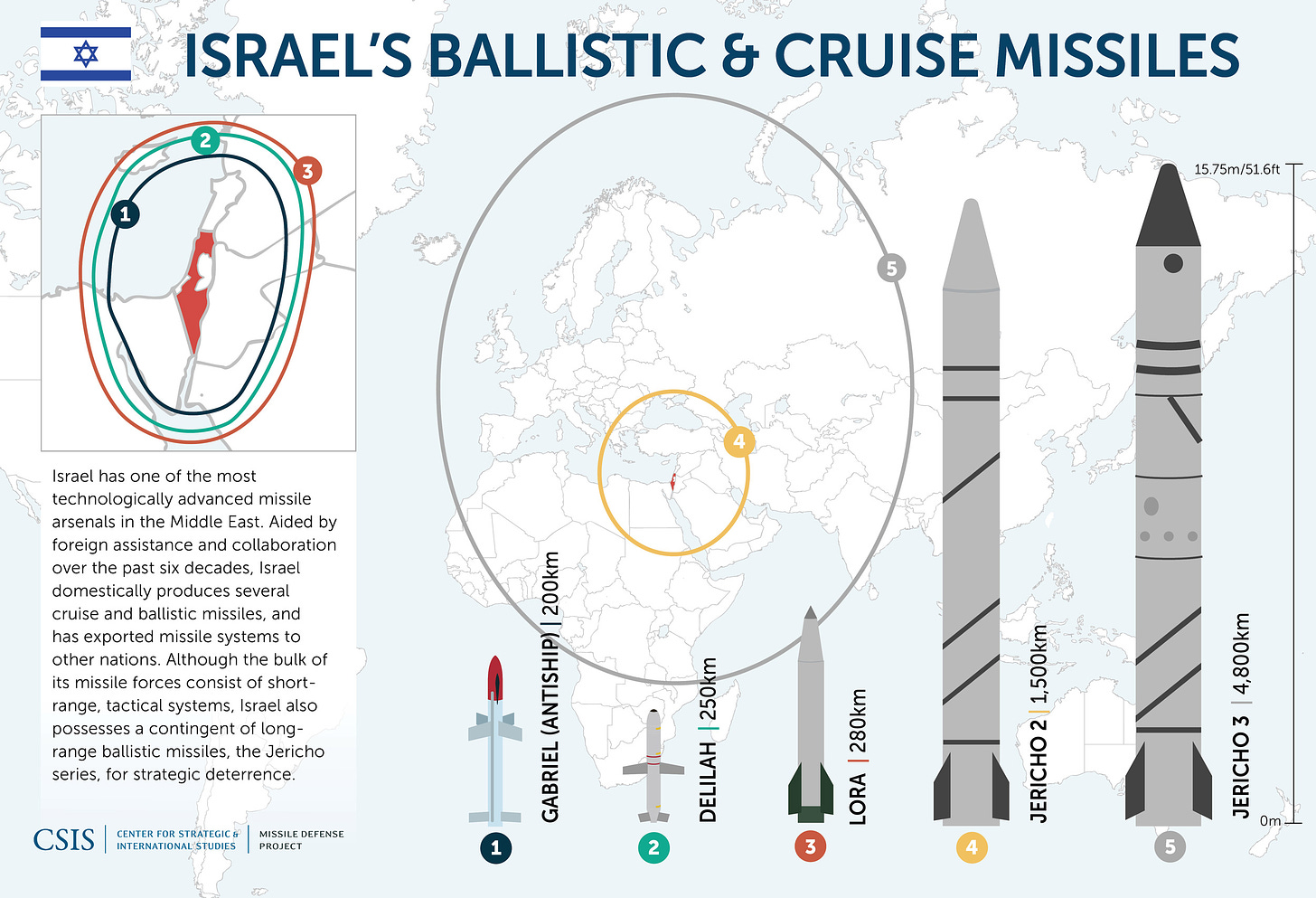
Israeli Ballistic and Cruise Missiles and Ranges
But, throughout the imperial domain, there are fatal weaknesses that exist right now, and which cannot be turned into strengths at any point in the near- or medium-term.
The first is what military types call “magazine depth”: munitions stockpiles sufficient to offensively overwhelm, defensively defeat, and strategically outlast the enemy.
Neither the United States, nor any of its largely impotent client nations, possess “magazine depth” sufficient to prosecute anything more than a relatively brief campaign against their potential peer adversaries: Russia, China, Iran — and all or any of their lesser-power partners.
The second problem is a corollary of the first. It is what I will term “shields”: the capacity to defeat a decisive proportion of the strikes one’s enemy can launch against you.
Neither the United States, nor any of its largely impotent client nations — by their own admission — possess anything even approximating comprehensive and effective “shields” against the quantity and quality of the types of strike weapons its potential adversaries can launch against them.
NATO sources themselves recently confessed that they only have about 5% potential air defense coverage against Russian missile strikes.
Now, of course, many will reflexively argue that, for example, the US could, with a massive “shock and awe” first-strike air campaign, effectively disarm Russian counterstrike capabilities.
This is patently ridiculous wishful thinking.
No one who actually understands the parameters of the military equation believes this to be true. And one need only examine the results of the months-long campaign against the lowly Yemenis to see confirmation of this incontrovertible fact.
Earlier this year we witnessed the Iranians launch a relatively modest missile strike against Israel, whose defenses were massively reinforced by American air and naval assets.
Using maybe 300 antiquated long-range strike drones and cruise missiles as decoys, the air defense response of both the US and Israel was massively attrited. And then, with a mere dozen or so seriously capable ballistic missiles, the Iranians blew right through the interception attempts of both the multiple land-based Patriot systems and a US guided-missile destroyer positioned off the eastern Mediterranean coast.
The Patriot systems were a total bust, and the Israelis summarily retired them in the immediate aftermath of the Iranian strike.
The US destroyer is reported to have launched eight top-shelf SM-3 missile defense interceptors (quite likely its entire “magazine depth”) at the incoming Iranian strike package.
They might have damaged one of the 12-15 incoming Iranian missiles.
The others hit with precision comparable to the 5-meter CEP Iran achieved in its 2020 strikes against the US airbase at Ayn al-Asad in Iraq.

SM-3 Missile Interceptor Launched from a US Guided-Missile Destroyer
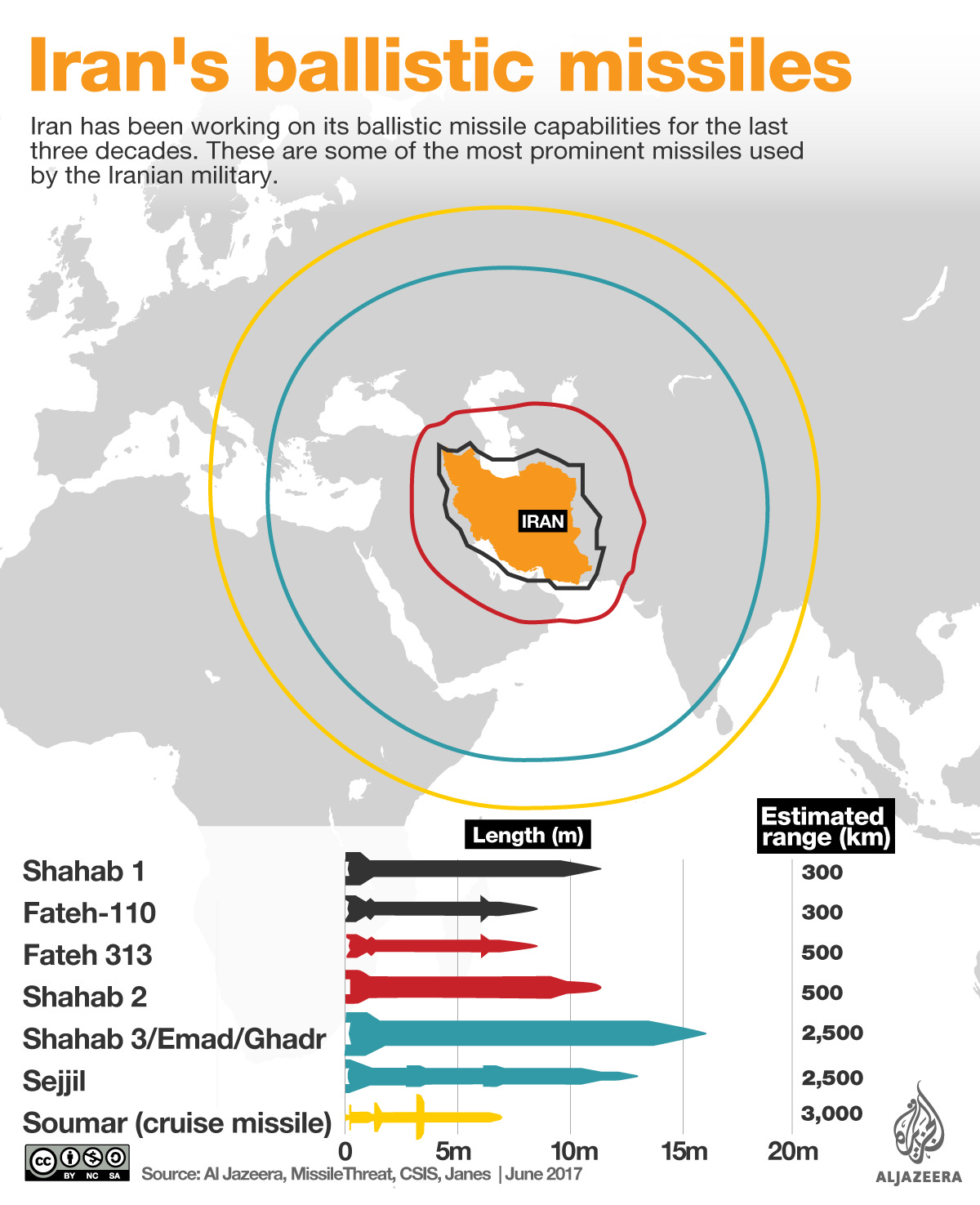
Iranian Ballistic Missiles and Ranges
Had Iran, at that moment in time, opted to follow up with an even larger strike consisting of several hundred of its best ballistic missiles, the US and Israeli defenses would have been penetrated to an overwhelming degree. It would have put to shame the opening-night show of the Americans’ 1991 “shock and awe” cruise missile attack against Baghdad.
Fortunately the Iranians didn’t press the matter, and let their modest yet impressive demonstration of strength suffice for the time being.
In recent months, Iran’s close partner Hezbollah — which is reputed to possess at least 100,000 missiles and drones of various types — has been routinely penetrating Israel’s once-vaunted “Iron Dome” missile defense system.
Indeed, Hezbollah has almost appeared to be mocking the Israelis’ impotence at times.
In any case, the Iron Dome has been revealed to be acutely vulnerable to penetration by Hezbollah drones and missiles.

Israeli Iron Dome Launcher Destroyed by Hezbollah Drone Strike
It is not known with precision how many missiles and drones of various types Iran possesses. But it is reasonable to assume that their “magazine depth” is considerably larger than that of Hezbollah.
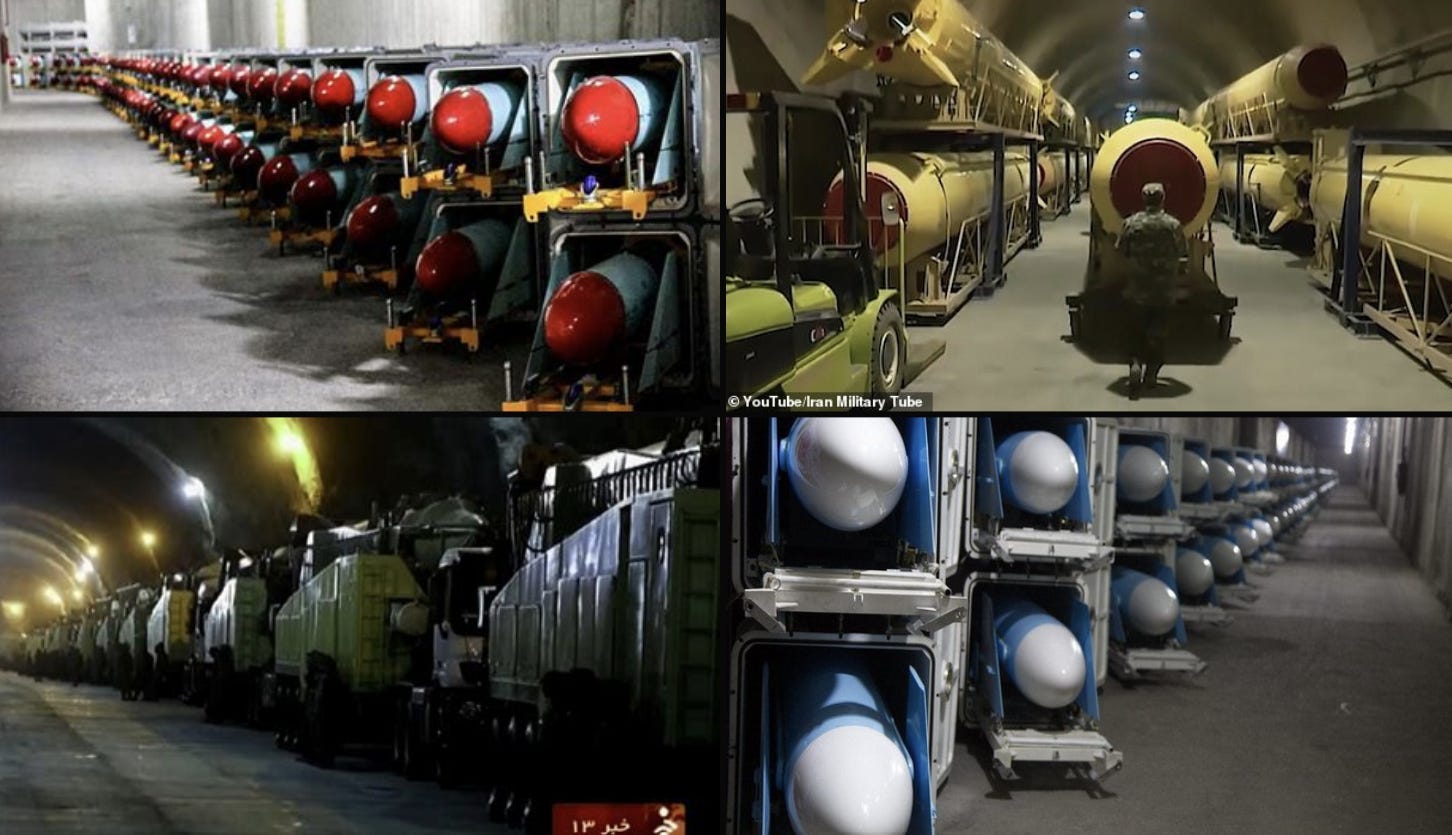
Iranian Missiles
It is also not known with precision how many missiles and drones of various types Russia possesses. But it is reasonable to assume that their “magazine depth” is considerably larger — and exceedingly more potent — than that of Hezbollah and Iran combined.
Even more importantly, the Russians have, over the course of the war in Ukraine, demonstrated an unprecedented capability to routinely shoot down the best strike missiles the US and its NATO vassals have been able to launch against them.
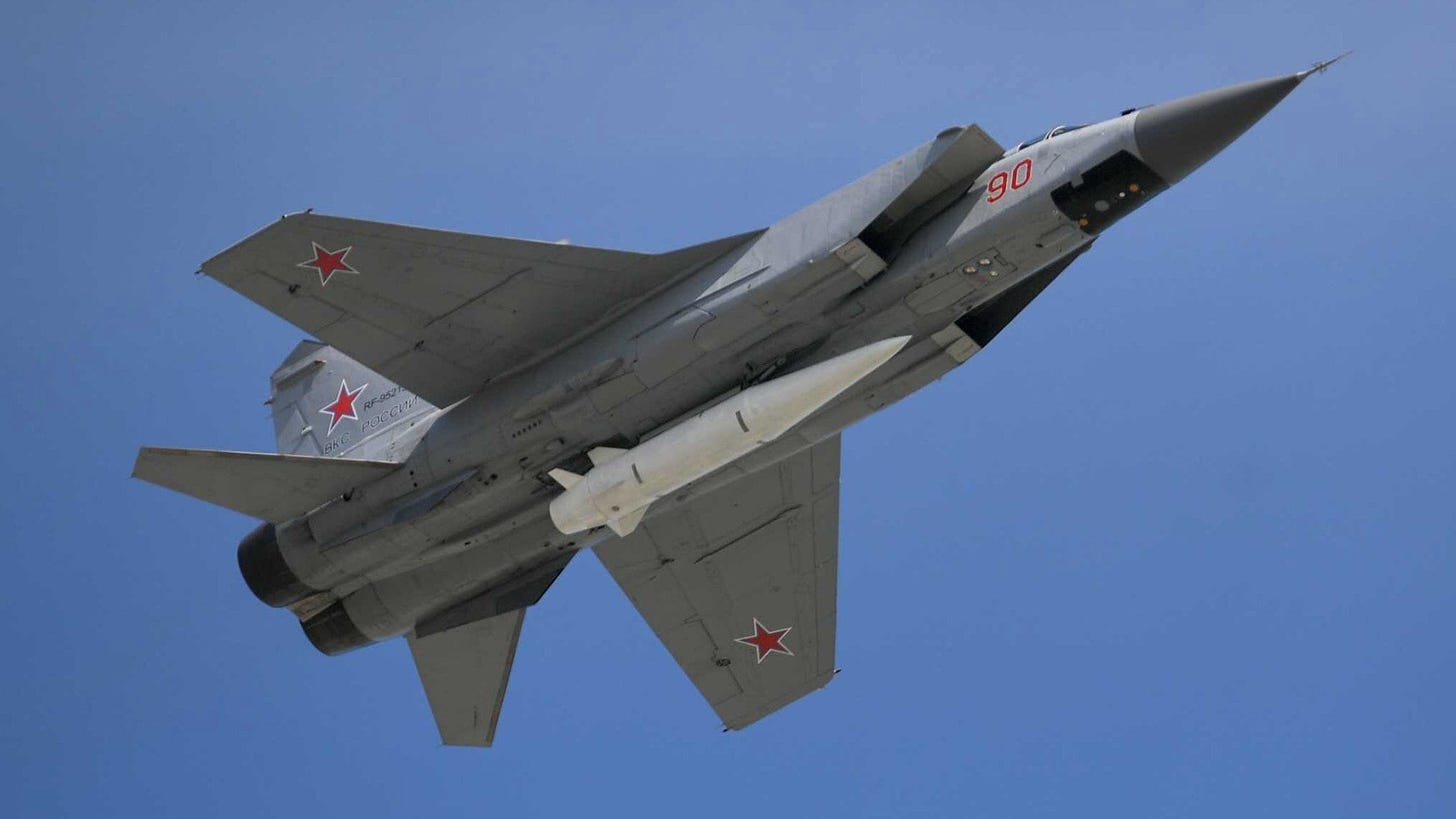
Russian MiG-31 Carrying a Hypersonic Kinzhal Missile

Russian Avangard Hypersonic Missile
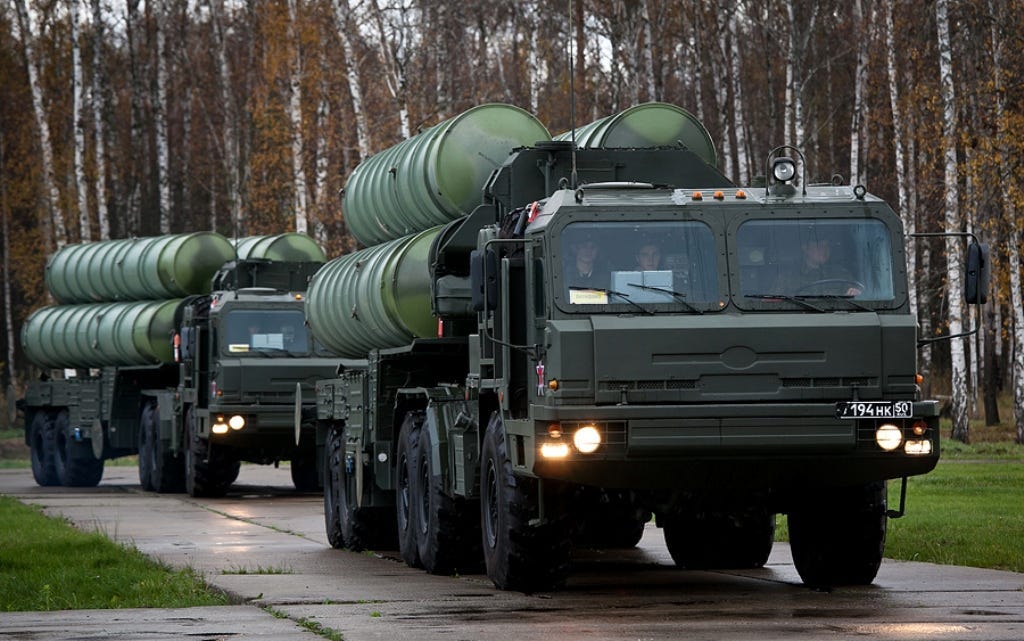
Russian S-400 Air Defense System
Lastly, it is not known with precision how many missiles and drones of various types China possesses. But it is reasonable to assume that their “magazine depth” is at least an order of magnitude larger than Hezbollah, Iran, and Russia combined.
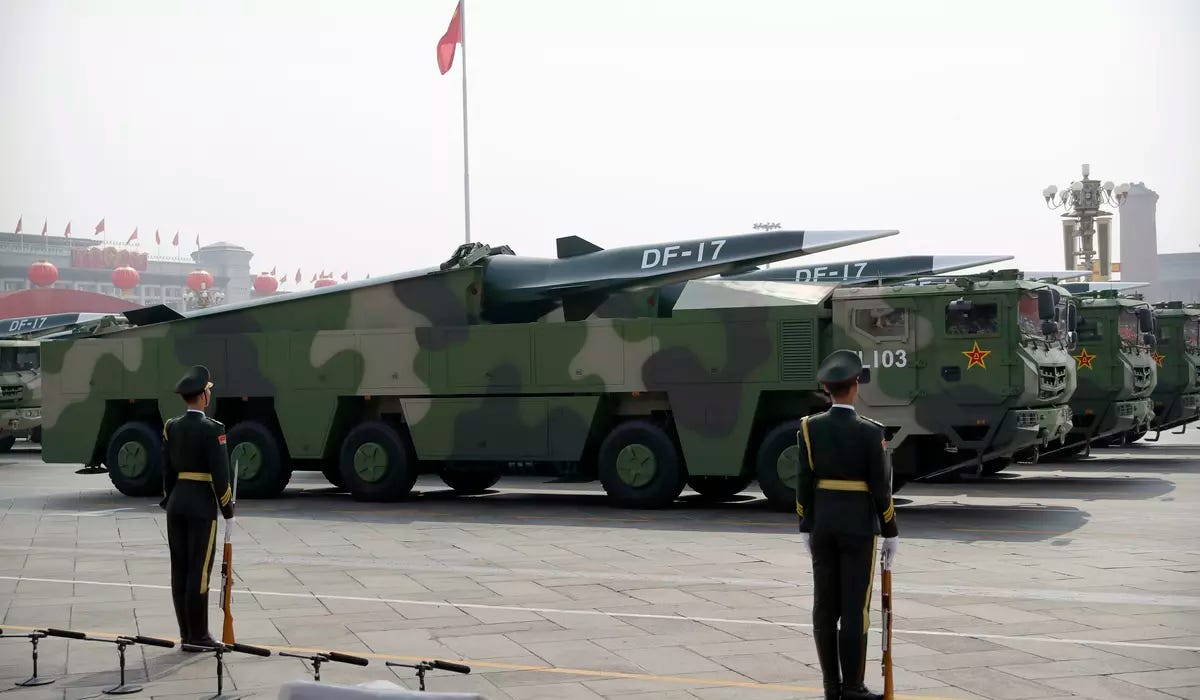
Chinese DF-17 Hypersonic Missiles
Of course, I’ve not yet made any mention of North Korea, who has now been formally received into the Russia, China, Iran mutual-defense partnership. People love to mock Kim Jong-Un and his people, but the empire underestimates them at their peril.
The Israelis can talk tough about making war against Hezbollah and its friends, but if they actually attempt it, it will end very, very badly for them.
The Americans and their almost laughably impotent allies can talk tough about making war against Russia or China, but if they actually attempt it, it will end catastrophically for them.
Then we’ll really have a dangerous situation on our hands.
New law ‘pushing Georgia away from EU’ – Borrell
RT | June 25, 2024
EU foreign policy chief Josep Borrell has warned Georgia that its potential accession to the bloc is in jeopardy after Tbilisi adopted a controversial ‘foreign agent’ law earlier this month. The US has also indicated it will not hesitate to penalize the former Soviet republic unless it walks back the legislation.
Known officially as the Transparency of Foreign Influence Act and spearheaded by the ruling Georgian Dream party, the law came into force earlier this month despite opposition protests and a veto by President Salome Zourabichvili.
The legislation requires NGOs, media outlets, and individuals who receive more than 20% of their funding from abroad to register as entities “promoting the interests of a foreign power” and to disclose their donors. Those who fail to comply will face fines of up to $9,500.
While opponents of the bill have described it as “Russian” and an attack on democracy, supporters have insisted it is similar to what numerous Western nations, including the US, have in place.
On Monday, Borrell said the foreign ministers of EU members had held “a lively debate on Georgia” for the second time in less than a month. Citing “worrying political developments,” the diplomat warned that “this law and all the negative developments around it are pushing Georgia away from the European Union.”
“If the government does not change the course of action, Georgia will not progress on the European Union path,” Borrell insisted.
According to the EU foreign policy chief, the law goes “against the will of the overwhelming majority of the Georgian population.” Brussels is planning to “increase our support to civil society and media” in the former Soviet republic, he added. The EU will also downgrade political contacts with Tbilisi and consider “putting on hold our financial assistance to the government,” Borrell stated.
Earlier this month, US State Department spokesman Matthew Miller claimed the ‘foreign agent’ law “moves Georgia away from its democratic trajectory” and “fundamentally alter[s] the US relationship with Georgia.” “We have not yet announced individual sanctions… but we have made clear that we would not hesitate to impose them,” the official stated.
Late last month, Washington announced that it would start restricting visas for Georgian politicians who played a role in passing the legislation. In November 2023, the European Commission recommended granting Georgia candidate status “on the understanding that the government takes important reform steps.”
Moldova Prepares Bill Allowing to Block Websites, Social Media Accounts – Opposition
Sputnik – 25.06.2024
Moldovan authorities are preparing a bill that will allow the blocking of websites, channels and accounts on social media, a spokesman for Moldovan opposition political bloc Podeda (Victory), Veaceslav Jukov, said on Tuesday.
Earlier in the day, the country’s authorities annulled a broadcasting license held by Moldova’s Media Resurse company which owned two Russian language broadcasters, Orhei TV and TV6, Moldovan news outlet NewsMaker reported.
“The Moldovan government is considering a law which presupposes the suspension and even elimination of websites, as well as blocking channels and accounts on social media. The new legislation provides measures to control and manage the information space ,” Jukov wrote on Telegram.
In 2023, Moldovan authorities blocked access to 31 websites, including 21 managed from Russia, saying that they had been used in an “information war” against Kishinev. Apart from the Russian information sources, Kishinev has also banned websites of Moldovan broadcasters Orizont TV, Prime TV, Publika TV, Canal 2, and Canal 3, among others.
Earlier in 2023, Moldovan President Maia Sandu said that Moldova would create a national center for informational defense and combating propaganda symbolically named Patriot, which would protect Moldovan citizens from disinformation and manipulation at a national level. The new center will counter Russia’s alleged information attacks as well as deal with “traitors to the homeland” who are allegedly blocking Moldova’s attempts to integrate into the European Union, Sandu added.
Featured Video

No Threat Can Force Iran’s Surrender /Trita Parsi & Lt Cl Daniel Davis
or go to
Aletho News Archives – Video-Images
From the Archives
What is the Israeli Lobby in Australia Doing in Interfaith Dialogue?
By Ali Kazak | Dissident Voice | October 11, 2015
For years Israel and its lobby around the world have been trying to normalise their relations with Arabs and Muslims without solving the Palestine Question.
One of the methods they resorted to in the last few years is using human rights and community organizations such as interfaith dialogue and Multiculturalism to achieve this objective and to: isolate the Palestinians, marginalise the Palestine question, end Israel’s isolation, and prevent criticism of Israel, knowing that these organisations will be the first to stand against Israel’s violations, racial and religious discrimination.
The group responsible for this task in Australia is The Australia/Israel & Jewish Affairs Council (AIJAC); its Director of International & Community Affairs, Jeremy Jones is in charge of lobbying religious community organizations, specifically Muslims and Christians. Consequently he convened the Faith Communities for Reconciliation, founding participant in the Australian Partnership of Religious Organisations and the Australian National Dialogue of Christians, Muslims & Jews.
AIJAC is a private political propaganda group. It is recognised as the main Israeli lobby in Australia. It coordinates its activities and works intimately with the Israeli embassy in Canberra and different institutions in Israel. It is privately funded by some Jewish businessmen. It monitors closely Australian politicians, the media, ethnic and religious groups, (especially Arabs and Muslims), unions and academics on their stands towards Israel and the Palestine question. … continue
Blog Roll
 Aletho News
- The war of liberation of the Arab and Islamic peoples expands across the Gulf
- Envoy warns UN on Trump’s threat to ‘obliterate’ Iran’s civilian infrastructure
- The Larak Corridor: Iran’s Rial Gate With No US, No Israel, and No Way Around
- ‘Economic terrorism’: Steel facilities hit again in US-Israeli strike
- ‘War Crime’: Iran condemns attacks on Arak, Ardakan nuclear sites
- Two-thirds of Americans want quick end to Iran war even if goals unmet
- Trump to Give “Important Update on Iran” Wednesday in Prime-Time Speech
- Theodore Postol: Iran’s Missiles & Drones Were Underestimated
- Iran To Target Military Industrial-Tech Complex That Facilitated Gaza Genocide
- Collapsing Empire: The Resistance Disarms ‘Israel’
- If Americans Knew
- Israel wants US to bomb more of Iran’s civilian structures (113,000 is not enough) – Not a ceasefire Day 173
- Ann Coulter Rips Into Fox News for Iran War Coverage
- Joe Kent Urges Americans To Call White House and Congress To Object To Sending Troops Into Iran
- DNC Resolution to Reject AIPAC Funding Puts Democratic Leaders in the Hot Seat
- Swedish foundation to build 400 schools as over 650,000 Gaza children remain without education for 2 years
- Israeli army admits photshopping image of slain Lebanese journalist
- This is how Israel is systematically killing health workers under the cover of war in Lebanon
- Carrying life under fire: Israeli invasion of Lebanon leaves pregnant women facing deadly risks
- Champagne all around for the new death penalty (for Palestinians) law – Not a ceasefire Day 172
- Why are Palestinian books struggling to be seen on Amazon?
- No Tricks Zone
- New Study Finds Warming Saves Lives…Cold Temperatures 12 Times More Deadly Than Excess Heat
- German Science Blog Accuses PIK Climate Institute Of Hallucinating Climate Tipping Points
- Devastating Assessment Of Comirnaty Vaccine By Former Senior Pfizer Europe Toxicologist
- New Study: CO2 Is ‘Effectively Negligible’ As An Explanatory Climate Change Factor Since 2000
- Former Pfizer Toxicologist Dr. Helmut Sterz Tells Bundestag Hearing Pfizer Vaccine Should Have Never Been Approved
- Energy Expert: Germany’s Nuclear Phaseout Was A “500 Billion Euro Mistake”
- New Research: South Australia’s Mid-Holocene Sea Surface Temperatures Were 4°C Warmer Than Today
- Storing Green Energy To Last Germany 10 Days Would Require A 60-Million Tonne Battery
- New Studies: UK Sea Levels Were 4 Meters Higher Than Today During The Mid-Holocene
- Destructive Green New Deal: German Energy And Metal Group Warns Of Drastic Crisis
 Aletho News