Second NATO country publicly opposes Ukrainian membership
RT | July 11, 2024
Ukraine joining NATO would guarantee a third world war, Slovak Prime Minister Robert Fico has said, publicly expressing opposition to the idea.
Fico released a short video message on Thursday while the leaders of NATO countries were meeting in Washington. The draft of the annual summit’s final communique reportedly includes references to Ukraine’s “irreversible path” towards joining the US-led bloc.
“I understand Ukraine’s wishes,” Fico said in the video. “But its membership in NATO guarantees World War Three.”
“Although to be fair, we are not too far from it even without Ukraine’s membership, seeing as how some advanced democracies are stoking the pot,” he added.
Slovakia’s representatives in Washington have been instructed to insist on two conditions for Ukrainian membership, Fico said. Kiev must meet every condition set by the bloc, and every member state has to give its blessing.
“However, as I’ve said many times, Smer and its lawmakers in the National Assembly of Slovakia will not agree to Ukraine’s membership in NATO,” he said, in reference to his ruling party.
Fico campaigned last year on a platform of opposing Ukrainian membership in NATO and further Slovak military support to Kiev. He won the election in a landslide.
In mid-May, a liberal activist reportedly upset with Bratislava’s new policy shot Fico several times and almost killed him. The prime minister underwent a series of surgeries and spent weeks recovering from the assassination attempt, returning to work in person just last week.
On Wednesday, Hungarian Foreign Minister Peter Szijjarto told reporters in Washington that Ukraine’s membership in the bloc “is clearly out of the question,” as it would “foreshadow direct conflict between Russia and NATO.”
The US-led bloc is expected to pledge at least €40 billion ($43.3 billion) in military aid to Ukraine over the next year and endorse its “full Euro-Atlantic integration,” but an invitation to NATO would only be extended “when allies agree and conditions are met,” according to a draft seen by Reuters. The same language was used at last year’s summit in Lithuania.
Iran dismisses NATO allegation it supplies ballistic missiles to Russia to be used in Ukraine war
Press TV – July 11, 2024
Iran has categorically rejected allegations it is providing ballistic missiles and related technology to Russia, raised by the North Atlantic Treaty Organization (NATO), to be used in the military campaign against Ukraine.
In a statement on Thursday, Iranian Foreign Ministry spokesman Nasser Kan’ani said NATO has made “totally baseless and politically-motivated” claims.
In their declaration issued on Wednesday, the NATO leaders claimed that North Korea and Iran were fuelling Russia’s military operation against Ukraine by providing direct military support to Moscow, such as munitions and uncrewed aerial vehicles (UAVs), which they said impacted Euro-Atlantic security and undermined the global non-proliferation regime.
They said any transfer of ballistic missiles and related technology by Iran to Russia would represent a substantial escalation.
The Iranian spokesman, in reaction, said the ongoing developments in Ukraine are the result of NATO’s “provocative” policies and measures led by the United States.
Kan’ani added that any attempt to link the war in Ukraine to the cooperation between Iran and Russia is “politically-motivated” with the aim of legitimizing the West’s interference and their military aid to Ukraine.
He once again reiterated Iran’s unwavering strategy to play a constructive role in promoting durable security in the region and across the world.
Iran has never provided Russia with any type of drones during the military conflict in Ukraine and still emphasizes the importance of settling the crisis and establishing lasting peace through political channels, the diplomat pointed out.
Iran has repeatedly rejected accusations that it has supplied weapons to Russia for direct use in the war in Ukraine. It has also discarded allegations of supplying weapons to anti-Israeli and anti-US groups in the region.
Meanwhile, Russia has repeatedly warned that a flow of Western weapons to Ukraine will only prolong the conflict.
Since the start of the war in Ukraine, the US, alone, has provided approximately $51.4 billion in military assistance to Kiev, the US State Department said in early July.
NATO Declaration Is Stark Neoconservative Recommitment to US Hegemony – Sachs
Sputnik – 11.07.2024
WASHINGTON – NATO’s latest joint declaration serves as a stark neoconservative recommitment to US hegemony, Jeffrey Sachs, a world-renowned economist and President of the UN Sustainable Development Solutions Network, told Sputnik.
“The NATO Declaration is a stark neoconservative recommitment to US hegemony. It calls for NATO to back the ‘rules-based order,’ which is actually the US-based order that is often directly contrary to the UN Charter,” Sachs said.
On Wednesday, NATO released a joint Washington Summit Declaration, which outlines the alliance’s efforts to further isolate Russia, bolster the alliance’s security on its eastern flank, increase security assistance for Ukraine, and claim Ukraine is on an “irreversible path” into NATO, among other initiatives.
“It describes NATO as a defensive force despite the fact that NATO is repeatedly engaged in offensive regime-change operations, including Afghanistan, Iraq, Serbia, Libya, Ukraine, and others,” Sachs said.
Sachs explains that NATO’s declaration also restates Article 10 of the Washington Treaty, which claims that Russia has no input if NATO expands to surround Russia.
Moreover, Sachs said NATO’s joint statement describes its commitment to advanced biotechnologies, which raises concerns of biowarfare.
Sachs also pointed out that the declaration shows NATO’s intention to continue to deploy anti-ballistic missiles throughout Europe as it’s previously done in Poland, Romania, and Turkiye, which has directly destabilized the nuclear arms control architecture ever since the United States unilaterally withdrew from the Anti-Ballistic Missile Treaty in 2002.
The White House announced earlier that the United States will begin episodic deployments of the long-range fires capabilities of its Multi-Domain Task Force in Germany in 2026.
Russian Ambassador to the United States Anatoly Antonov said US plans to deploy intermediate- and shorter-range missiles to Germany pose a direct threat to international security and increase the risks of a missile arms race.
US plan to deploy missiles in Germany a ‘direct threat’ – Moscow
RT | July 11, 2024
US plans to deploy long-range missiles in Europe are a threat to global security and could pave the way for an escalation of already tense relations between Moscow and NATO, Russian Ambassador to Washington Anatoly Antonov has said.
On Wednesday, the US and Germany issued a joint statement that America “will begin episodic deployments of the long-range fires capabilities of its Multi-Domain Task Force in Germany in 2026, as part of planning for enduring stationing of these capabilities in the future.”
Washington also said that the systems will include SM-6 and Tomahawk missiles with ranges of up to 460km and 2,400km, respectively, as well as developmental hypersonic weapons. Those assets have a “significantly longer range than current land-based fires in Europe,” the statement added.
In a post on Telegram on Thursday, Antonov denounced the move as “a serious mistake by Washington.” “Such extremely destabilizing steps are a direct threat to international security and strategic stability,” he said.
The envoy stressed that the planned deployment “increases the risks of a missile arms race,” adding that it could unleash “uncontrolled escalation amid dangerously soaring Russia-NATO tensions.”
Antonov also said that Russia has always sought to reduce the risks posed by disagreements over missile capabilities. “Instead of the desire for peace that Russia has demonstrated many times, the Americans have embarked on the dangerous path of militarism,” according to the ambassador.
He emphasized that Russia’s tolerance for encroachments on its security is “not unlimited.” “Doesn’t Germany understand that the emergence of American missile assets on German soil will lead to these facilities ending up in Russian crosshairs? This is not saber-rattling, it is the simple logic of a normal person,” Antonov explained.
He went on to blast the US for not thinking about how to minimize the fallout from the collapse of the Intermediate-Range Nuclear Forces Treaty (INF). Signed in 1987 at the end of the Cold War, it barred Moscow and Washington from possessing many types of nuclear and conventional missiles with ranges of 500 to 5,500km.
The US unilaterally withdrew from the treaty in 2019, citing alleged Russian non-compliance, a charge denied in Moscow. Russian Deputy Foreign Minister Sergey Ryabkov suggested earlier this week that the US pulled out of the agreement to create formerly banned missile systems to put pressure on China.
At the same time, Russia has said that it intends to keep abiding by the INF’s terms, but warned that it could reverse that policy if Washington starts deploying missiles covered by the treaty in any region of the world.
US to deploy long-range weapons in Germany
RT | July 10, 2024
The US will station long-range missiles in Germany from 2026 onwards, the governments of both countries have announced. These weapons, including the SM-6 and Tomahawk systems, were banned on the continent until Washington tore up a landmark Cold War-era treaty in 2019.
According to a joint statement published by the White House, the US will “begin episodic deployments of the long-range fires capabilities of its Multi-Domain Task Force in Germany in 2026, as part of planning for enduring stationing of these capabilities in the future.”
The statement was released following talks between American and German officials at NATO’s annual summit in Washington on Wednesday.
The weapons systems deployed to Germany will include the SM-6 anti-air missile, which has a range of up to 460km (290 miles), and the Tomahawk cruise missile, which can reportedly strike targets more than 2,500km away.
The White House said that “developmental hypersonic weapons” will also be stationed in Germany, and will have a “significantly longer range than current land-based fires in Europe.”
The US has yet to successfully field a hypersonic weapon, and has canceled every hypersonic project since its first successful test in 2017.
Land-launched missiles with a range between 500km and 5,500km were banned on European soil under the Intermediate-Range Nuclear Forces (INF) treaty, signed by Ronald Reagan and Mikhail Gorbachev in 1987. Along with the START-I and START-II agreements, the INF treaty helped defuse nuclear tensions in Europe after the West and the USSR came perilously close to nuclear war during NATO’s Able Archer military exercise in 1983.
The US pulled out of the INF treaty in 2019, with the State Department claiming that some of Russia’s cruise missiles had breached the agreement. Moscow denied this, and Russian President Vladimir Putin warned then-US President Donald Trump that the demise of the treaty would “have the gravest consequences.”
Russia continued to abide by the treaty and imposed a moratorium on the development of missiles that it prohibited. However, Putin announced earlier this month that the Russian defense industry would resume development of such armaments, citing the “hostile actions” of the US.
“We now know that the US is not only producing these missile systems, but has also brought them to Europe, Denmark, to use in exercises. Not long ago, it was reported that they were in the Philippines,” Putin explained at the time.
US and Danish forces trained with SM-6 missiles last September, while the Pentagon deployed its Typhon Weapon System – which can fire both SM-6 and Tomahawk missiles – to the Philippines in April.
Top 10 NHS dietary advice FAILS (from a doctor)
Dr Philip Bosanquet | August 4, 2023
The NHS dietary guidelines are not fit for purpose (in my opinion).
Buy The Concise Nutrition and Lifestyle Guide: https://www.bosanquethealth.com/book-… (available worldwide via Amazon).
Visit Bosanquet Health: https://www.bosanquethealth.com The 10 fails are:
10. Approaching healthy eating / nutrition from a calories-in vs calories-out energy balance focus (failing to take into account Leptin).
9. Basing meals on starchy carbohydrates (failing to understand the root cause of insulin resistance, number one driver of obesity and chronic disease).
8. Minimising fat intake (due to it’s calorie density).
7. Promoting seed oils (vegetable oil, rapeseed oil, sunflower oil) as healthy, whilst stating saturated fat is bad / causes cardiovascular disease (papers on this are listed below, see also video on animal fat:  • Why ANIMAL FAT is the ultimate SUPERF… ).
6. Advising people not to delay or skip meals, including breakfast (failing to appreciate time restricted eating / intermittent fasting).
5. Advice of healthy snacks.
4. Advice on artificial sweeteners as a substitute for sugar.
3. No mention of the gut microbiome, of organic food being better for humans and the environment than non-organic food, of minimally processed or unprocessed foods in preference to overly processed foods, or the quality or nutritional density of food choices.
2. Switching from full cream / full fat / whole milk to semi skimmed / reduced fat milk to help kids lose weight (!). Failing to take into account fat soluble vitamins including vitamin D.
1. Some of the recipe examples given.
Links to papers on saturated fat: https://pubmed.ncbi.nlm.nih.gov/28864…
https://pubmed.ncbi.nlm.nih.gov/24723…
https://pubmed.ncbi.nlm.nih.gov/26268…
https://pubmed.ncbi.nlm.nih.gov/34796…
https://pubmed.ncbi.nlm.nih.gov/34547…
https://pubmed.ncbi.nlm.nih.gov/34717…
https://pubmed.ncbi.nlm.nih.gov/34509…
https://pubmed.ncbi.nlm.nih.gov/27071…
https://pubmed.ncbi.nlm.nih.gov/23386…
https://pubmed.ncbi.nlm.nih.gov/34290…
Dr Philip Bosanquet The Low-Tech Lifestyle Medic
content (except quotes) copyright to Dr Philip Bosanquet 2023 ©
New Study: ‘Carbon Dioxide And A Warming Climate Are Not Problems’
Instead, warmth and elevated CO2 are a boon for humanity
By Kenneth Richard | No Tricks Zone | July 8, 2024
A new peer-reviewed paper published in The American Journal of Economics and Sociology (May and Crok, 2024) counters the prevailing “wisdom” that says a warmer climate and greener vegetation are problematic.
The authors detail the horrors of the much colder Little Ice Age that destroyed civilizations (crop failures, summerless years). Half the population of Finland and 15% of Scotland’s citizens died off in the 1690s due primarily to the cold-induced famines and frozen-over water supplies.
Elevated CO2 and warmth are 70% and 8% responsible, respectively, for a much greener, more vegetated landscape across the world since the 1980s.
The incidence and severity of storms, hurricanes, floods, and extreme weather in general have undergone flat to declining trends over the last several decades. Thus, “it is hard to find any unusual weather or weather-related disaster that can be blamed on climate change, whether natural or anthropogenic.”
“52 of 53 studies of disaster losses due to extreme weather were unable to attribute the events to human causes…”
The US government estimates the warming since 1950 has reduced the country’s gross domestic product by less than 0.5%, and an estimated 3°C of warming by 2100 still only reduces the GDP by less than 1%. Considering the US economy grew by 800% from 1950 to present, this means any assumed “damage” from warmth and elevated CO2 would not be detectable.
The quest to “save” the world from warming and elevated CO2 is devoid of scientific and socio-economic merit.
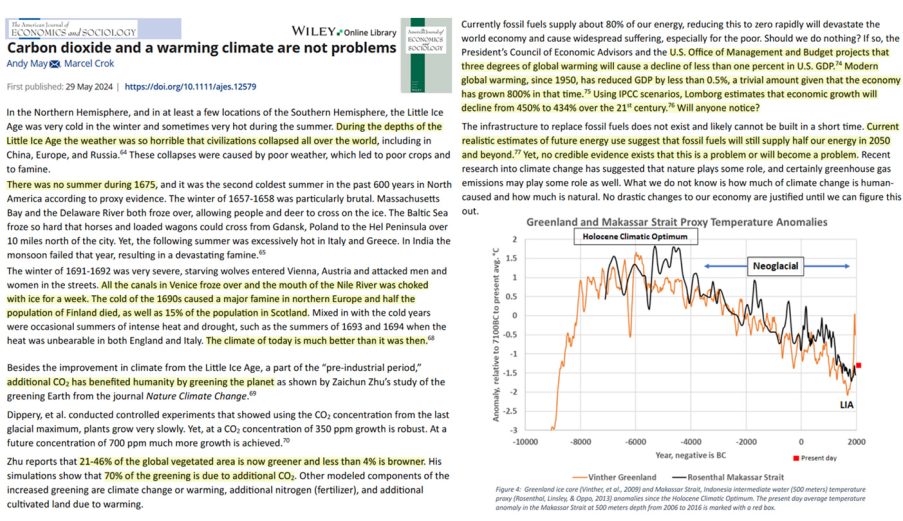
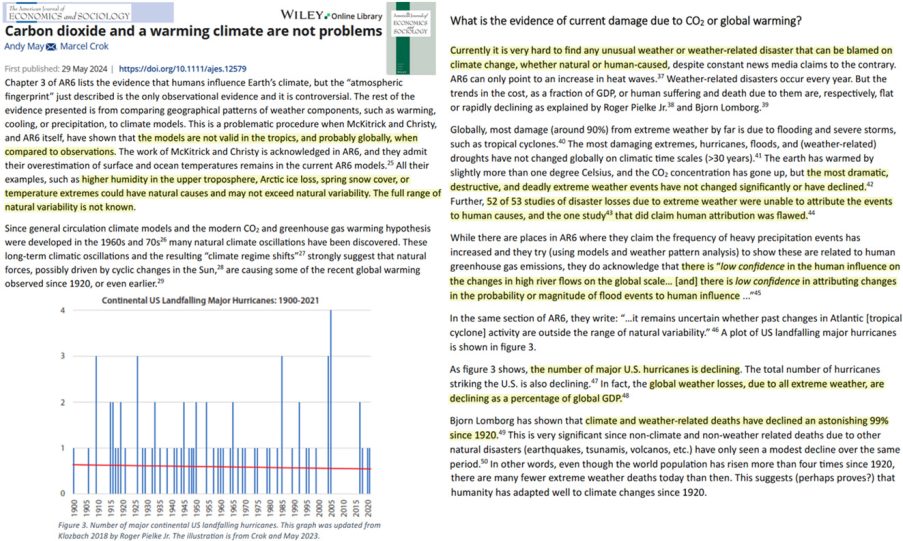
Image Source: May and Crok, 2024
‘Scary Experiment’: Denmark to Tax Livestock Emissions, Critics Say Small Farmers Are Real Target
By Michael Nevradakis, Ph.D. | The Defender | July 9, 2024
Denmark is set to become the first country in the world to tax farmers for the greenhouse gasses emitted by their livestock, in a deal reached June 24 between the Danish government and representatives of the farming industry and unions.
The tax, which specifically targets methane emissions by cows, pigs and sheep, will take effect in 2030, pending final approval by the Danish Parliament, The Associated Press (AP) reported.
Beginning in 2030, farmers will be required to pay a tax of 300 kroner (approximately $43) per ton of carbon dioxide equivalent. This will increase to 750 kroner ($108) by 2035. After a 60% tax deduction, the respective amounts will be 120 kroner ($17.30) and 300 kroner.
CNN, quoting Denmark’s “green think tank” Concito, reported that Danish dairy cows emit, on average, 5.6 tonnes (6.2 U.S. tons) of CO2-equivalent emissions per year. This would result in a tax of 672 kroner per cow ($96) in 2030 and 1,680 kroner ($241) in 2035.
The respective emissions figure for all Danish cows is an average of 6.6 tons of CO2-equivalent annually, according to the AP, which reported that the Danish government aims to reduce the country’s greenhouse emissions by 70% from 1990 levels by 2030, citing Taxation Minister Jeppe Bruus.
According to CNN, the proceeds from the tax will be used to support the agricultural industry’s green transition in the first two years, including the investment of 40 billion kroner ($3.7 billion) for measures including reforestation and establishing wetlands.
After two years, the tax will be “reassessed.”
Denmark is a significant exporter of pork and dairy products, CNN reported. Agriculture is the country’s largest source of greenhouse gas emissions. The AP reported that, as of June 2022, there were nearly 1.5 million cows in Denmark.
Tax will encourage farmers ‘to look for solutions to reduce emissions’
Proponents of the tax emphasized that Denmark is the first country to enact such a policy, characterizing it as a step toward greater environmental sustainability.
“We will take a big step closer in becoming climate neutral in 2045,” Bruus said.
“We are investing billions in the biggest transformation of the Danish landscape in recent times,” said Danish Foreign Minister Lars Lokke Rasmussen in a statement quoted by CNN. “At the same time, we will be the first country in the world with a (carbon) tax on agriculture.”
According to Torsten Hasforth, Concito’s chief economist, “The whole purpose of the tax is to get the sector to look for solutions to reduce emissions,” CNN reported. Hasforth noted that farmers could, for instance, change the feed they use, as part of their efforts to reduce emissions.
The Danish Society for Nature Conservation called the tax “a historic compromise,” in remarks quoted by the AP. The organization’s president, Maria Reumert Gjerding, said, “We have succeeded in landing a compromise on a CO2 tax, which lays the groundwork for a restructured food industry — also on the other side of 2030.”
And Ben Lilliston, director of Rural Strategies and Climate Change at the Institute for Agriculture and Trade Policy, told PBS NewsHour that methane emissions are “a huge problem … a huge challenge.” He argued that while methane remains in the atmosphere for fewer years than CO2, it has “about 80 times the potency.”
“If you reduce methane, you can get more near-term results and allow us to have a little longer of a window to reduce carbon dioxide emission,” Lilliston said.
Carbon tax on farmers a ‘scary experiment’
Denmark’s carbon tax was enacted despite recent farmers’ protests throughout Europe, including large protests in Brussels, the de facto capital of the European Union (EU) and center of EU policymaking.
The farmers voiced grievances over new environmental regulations and the corporate takeover of European farming.
In recent years, EU member states such as Ireland and the Netherlands have also pursued plans to limit farming and cull livestock, leading to protests in those countries.
New Zealand planned to enact a carbon tax, set to take effect in 2025. The tax, passed by the country’s previous center-left government, was repealed last month by New Zealand’s new center-right governing coalition, according to the AP.
Criticisms are now being levied against Denmark’s new carbon tax, with some experts arguing that it amounts to an added burden for the agricultural sector — particularly small farmers.
CNN quoted Danish farmers’ association Bæredygtigt Landbrug, which described the new policy as a “scary experiment.”
Peder Tuborgh, CEO of Arla Foods, Europe’s largest dairy company, told CNN that the new tax is “positive,” but farmers who “genuinely do everything they can to reduce emissions” should be exempt.
In remarks shared with The Defender, Catherine Austin Fitts, founder and president of the Solari Report, said, “Emissions are a cover story to achieve steps in the central bankers’ ‘Going Direct Reset.’”
According to Fitts, the goal of this “reset” is “to consolidate control over the food supply, shifting to corporate-controlled ‘Pharma Food’ and to shift energy availability from the general population to feed an electrical control grid that will supply AI [artificial intelligence], robotics, digital IDs and an all-digital financial system.”
“We are trading fresh food and freedom for digital concentration camps and lab-grown meat,” Fitts said. “On Wall Street, we used to call this ‘a bad trade.’”
Other critics told The Defender the Danish government’s new tax has less to do with protecting the environment and reducing emissions, and more to do with achieving the United Nations’ (U.N.) Sustainable Development Goals (SDGs) and the objectives of global entities such as the G20 and the World Economic Forum (WEF).
Dutch attorney and activist Meike Terhorst told The Defender :
“I think the measures have nothing to do with sustainability but with power. A group of companies, the so-called globalists/banks/investors, such as the WEF, work together with governments, such as the G20, and together they can force the small farmers off their lands.”
Tim Hinchliffe, editor of The Sociable, said small farms will bear the brunt of the new tax.
“Small farmers will be the first to go, and their land will most likely be used to house a variety of so-called ‘green initiatives,’ such as fake meat labs, acres of solar panels and wind turbines as far as the eye can see, new AI data centers that require tons of water, energy and land, and possibly even nuclear power plants to power those data centers,” he said.
Similarly, Terhorst said the goal is to “close down the small farmers as part of the ‘Agenda 2030’ — U.N. SDGs — or the corporate takeover agenda.”
Terhorst said this agenda aims “to ensure that small farmers are to be removed from the land and replaced by ‘digital’ farming” — meaning “replacing meat and milk with factory-made insect food or milk and lab-grown meat.”
Critics also questioned claims that policies like carbon taxation help promote “sustainability.”
“When unelected globalists at the WEF and the U.N. talk about sustainability, they don’t mean self-sustainability for the individual. They don’t want that at all. They want to ensure sustainable control, influence and power for themselves for decades to come,” Hinchliffe said, adding:
“As I see it, the real goal here is to take control of prime agricultural land and to tax farmers out of existence. Once the taxes get too expensive and the farmers can’t keep up, that’s when public-private entities swoop in to take control of the land.
“If they really believed that flatulent farm animals were responsible for the weather, they would just plant more trees to absorb the carbon, and their imaginary crisis would be solved, but they’re not doing that because what they’re really after are land grabs, money, and total control of our food systems.”
According to Hinchliffe, global organizations also aim to change human habits — including meat consumption. He said:
“On a nutritional level, groups like the WEF and the U.N. want us eating less meat and more bugs, and this will only make us weaker and more docile as a species over time.
“It also makes us all dependent on very centralized sources of protein, so if there’s an outbreak or a contamination, citizens all over the world will suffer because there’ll be no alternative. The local farmers will have disappeared due to the carbon taxes and land grabs.”
“The bio meat industry was organized and financed by the investors and banks that are part of the WEF,” Terhorst said. “If we want to become sustainable, we have to limit the powers of the investors and WEF and support small farmers.”
Hinchliffe added, “When carbon taxes fail to quash the human spirit completely, they already have plans to tax just about everything else in nature, including the air we breathe, the water we drink and the very soil upon which we walk.”
This article was originally published by The Defender — Children’s Health Defense’s News & Views Website under Creative Commons license CC BY-NC-ND 4.0. Please consider subscribing to The Defender or donating to Children’s Health Defense.
The UK election results hide a truth Labour won’t want you to hear
By Graham Hryce | RT | July 10, 2024
Many political commentators in the UK have failed to grasp the true import of the Labour Party’s electoral victory last week.
Some pundits see the party’s record majority as confirmation that politics in Britain has shifted back to the center – in contrast to the shift to the radical right that has characterized politics in most European countries in recent years.
Nothing could be further from the truth. Labour’s primary vote – 9.7 million but still a lowish 33.8% – increased only marginally, despite the complete collapse of the Conservative vote.
The most important aspect of last week’s election was the transfer of thousands of votes from the Conservative Party to Nigel Farage’s populist Reform Party – particularly in those “red wall” constituencies that Boris Johnson had single handedly captured from Labour at the 2019 election.
Reform received some 4 million votes – 14% of the total votes cast. The UK electoral system meant, however, that Reform only won five seats – including, most importantly, Farage himself.
This significant voting shift did, however, unseat more than 200 Tory MPs, including a former prime minister and a number of cabinet members, and ensured the election of Labour candidates in droves. This does not, however, constitute a “shift to the center.”
What actually occurred last week was predicted, prior to the election, by some conservative commentators who had become completely disenchanted with the Conservative Party, and had cast their lot in with Reform.
Matt Goodwin, for example, urged voters to engage in an act of “creative destruction” by voting for Reform, knowing full well that this would result in a landslide Labour victory.
Goodwin, in effect, urged voters to destroy a Conservative Party that, in his view, had long ago ceased to stand for genuine Conservative values – so as to clear the political landscape for a Reform victory at the 2029 election.
From this perspective, Starmer’s victory is simply a necessary political prelude to the creation of a viable British populist party that will be capable of governing in its own right in the next few years.
Whatever the prospects of this happening may be, such a perspective correctly predicted the imminent demise of the Rishi Sunak-led Conservative Party, and reflected what has actually been happening in UK politics for the past decade.
Other commentators – including Starmer propagandists and, curiously enough, some from the conservative right like Peter Hitchens – see Starmer’s win as a victory for “the most radical left-wing party in UK history.” Such a view could not be more mistaken.
There is nothing at all “left-wing” – in the traditional sense of the term – about Keir Starmer or the Labour Party that he has refashioned in his own image since its disastrous election loss in 2019.
Starmer has spent the past five years ruthlessly purging the Labour Party of the last remnants of left-wing Bennite radicalism – whose most recent proponent was the hapless Jeremy Corbyn. It is not for nothing that Starmer has ditched almost every element of the Labour manifesto that he so eagerly embraced not so long ago.
It is perfectly clear that Starmer’s Labour Party will govern for the global elites – not the traditional British working class or those other social strata that have been displaced and left behind by globalization.
Starmer may refer endlessly to his “tool setter” father in interviews, and Angela Rayner may go on ad infinitum about her poverty-stricken background – but this is all posturing and propaganda of the crudest kind. And it did not fool working-class voters in the “red wall” seats last week – they voted for Farage, not Starmer and Rayner.
Starmer’s first post-election speech is a surer guide to the elite policies that his Labour government will pursue.
Starmer immediately shut down the hopelessly ineffective Rwanda scheme – thereby foreshadowing in reality, whatever he may say publicly, his commitment to increased levels of immigration, a key global elite policy. Sunak was also committed to increased levels of immigration, notwithstanding his stated policy position to the contrary.
Also revealing was his comment that “we have too many prisoners” and his appointment of James Timpson as the minister of state for prisons. Timpson is on record as having said that two-thirds of those in British prisons should not be there, and he is famous for employing ex-prisoners in his shoe-repair chain.
Could there be a more elitist and woke policy than freeing prisoners in large numbers? The residents of London and other large cities in the UK must be looking forward the increased crime rates in which such a policy will inevitably result.
Starmer also reaffirmed his commitment to supporting the Zelensky regime in Ukraine in the strongest possible terms.
There can be no doubt that a Starmer Labour government will pursue elite policies such as these, and it will resort to radical constitutional reform in order to do so. Peter Hitchens has correctly drawn attention to Starmer’s radical plans to reform the House of Lords and further empower an already ideologically committed judiciary.
All of this is about governing in the interests of the global elites – it has nothing whatsoever to do with genuine left-wing politics.
What then can we expect to happen in British politics under a Starmer government over the next five years?
First, it is inevitable that the Conservative Party will disappear as a major political force.
The Tories have been deeply divided and led by fourth-rate politicians for decades, and Brexit exacerbated these problems to such an extent that the party tore itself apart once Brexit was finally implemented, after a debilitating internal battle, by Boris Johnson.
Johnson – although a flawed politician in some respects – was the only effective leader that the Conservative Party has had in the past decade.
Like Benjamin Disraeli and David Lloyd George, Johnson was something of a Tory outsider, a charismatic leader who understood that the electoral appeal of the Conservative Party could be significantly broadened by adopting policies that appealed to British patriotism and the traditional working class.
Johnson’s “get Brexit done” and “leveling up” policies allowed the Conservatives to appeal to disaffected traditional Labour voters and, at the same time, effectively neutralize the appeal of Nigel Farage’s UKIP Party.
These policies, together with Johnson’s charismatic leadership and campaigning skills, enabled him to win an extraordinary 80-seat majority at the 2019 election.
Notwithstanding this unprecedented electoral victory, within three years the Remainers and others within the Conservative Party (Johnson never had the support of a large majority of MPs) had joined forces with with the global elites, the mainstream woke UK media, the Supreme Court, and a raft of fourth-rate politicians of all political persuasions to ruthlessly destroy Johnson’s political career.
He was finally finished off by a narcissistic and vengeful populace who were, wrongly and foolishly, outraged at the Partygate affair.
Once Johnson had been deposed, the fate of a deeply divided Conservative Party under utterly incompetent leaders like Liz Truss and Rishi Sunak was sealed. In fact, last week’s collapse of the Tory vote was richly deserved, and Truss in particular deserved to lose her seat.
And one only has to observe the unseemly squabbling taking place this week between the half-a-dozen or so candidates for the Tory leadership – they include such luminaries as Robert Jennick and James Cleverly – to see that the Conservative Party does not have a viable future no matter who is eventually chosen to lead it.
What is the likely fate of the Starmer Labour government?
Like all mainstream governments in Western countries that represent the interests of the global elites, Starmer’s government will be unable to remedy any of the fundamental problems confronting the UK – because it is unwilling to introduce the genuinely radical economic and social reforms that would be necessary to bring that about.
Stramer’s government will be unable to resuscitate the ailing British economy. It will do nothing to solve the cost-of-living crisis or reduce energy prices. It will not be able to reverse the decline of the NHS or improve the delivery of government services. It will continue to support America’s proxy wars with all the adverse domestic consequences that follow from such a misguided foreign policy. And its firm commitment to woke policies will only intensify the culture wars that have so deeply divided British society for the past few decades.
It follows that, within a relatively short period of time, the British electorate will become disenchanted with Starmer and his government. Its fate will mirror the fate of the Biden, Macron and Sholz administrations.
The Reform Party will probably become the major beneficiary of this disillusionment – but whether it will be able to capitalize on it is very much an open question.
Populist parties do not have a good record of delivering on their promises, and the UK’s first-past-the-post electoral system makes it almost impossible for minor parties to win large numbers of seats.
Farage himself was in two minds about coming back to lead the Reform Party and contest the election – and five years is a long time to spend in opposition as the leader of a party with only five MPs.
The French electoral system is much more favourable towards radical right-wing parties than the British, and in America Donald Trump had to take over the Republican Party in order for it to become an effective political force. Trump realized in the 1990s that he could not win the presidency as a third-party candidate.
If Farage is to become a significant political leader he may have to take over what is left of the Conservative Party after last week’s election.
Rather than bring about a “shift to the center” or usher in a “radical left-wing government,” Keir Starmer’s election victory is, therefore, much more likely to ensure that UK politics staggers along in much the same chaotic and dysfunctional fashion that it has for the past decade.
That appears to be the most that voters in Western democracies can hope for these days.
Graham Hryce is an Australian journalist and former media lawyer, whose work has been published in The Australian, the Sydney Morning Herald, the Age, the Sunday Mail, the Spectator and Quadrant.
High-tech Western weapons ‘useless’ in Ukraine conflict – WSJ
RT | July 10, 2024
Russia’s electronic warfare capabilities have rendered precision-guided Western munitions “useless” in the Ukraine conflict, the Wall Street Journal reported on Wednesday. With their guidance systems scrambled, some of these weapons have reportedly been retired within weeks of hitting the battlefield.
When the US announced the delivery of GPS-guided Excalibur artillery shells to Ukraine in 2022, pro-Kiev outlets predicted that the $100,000-per-shot projectiles would make “Ukrainian artillery a whole lot more accurate” and “cause Russia a world of pain.”
However, the Russian military adapted within weeks, Ukrainian commanders told the Wall Street Journal. Russian signal-jamming equipment was used to feed false coordinates to the shells and interfere with their fuses, causing them to veer off course or fall to the ground as duds.
“By the middle of last year, the M982 Excalibur munitions, developed by RTX and BAE Systems, became essentially useless and are no longer employed,” the newspaper stated, paraphrasing the Ukrainian commanders.
The Soviet Union invested heavily in electronic warfare (EW) during the 1980s, viewing jamming technology as a crucial bulwark against the guided missiles and shells that the US was beginning to develop at the time. While weapons such as the 1990s-era Excalibur shells were used by the US to devastating effect in Iraq and Afghanistan, officials and analysts in Washington have since concluded that they are far less effective against a peer-level opponent like Russia.
“The Russians have gotten really, really good” at interfering with guided munitions, US Deputy Secretary of Defense for Acquisition and Sustainment William LaPlante told the WSJ.
Retired US General Ben Hodges, who once predicted that Western weapons would help Ukraine seize Crimea by last winter, told the newspaper that “we probably made some bad assumptions because over the last 20 years we were launching precision weapons against people that could not do anything about it… and Russia and China do have these capabilities.”
Some of NATO’s most advanced weapons systems have met a similar fate in Ukraine. The newly-developed Ground-Launched Small Diameter Bomb (GLSDB), a joint project of Boeing in the US and Saab in Sweden, was given to Ukraine earlier this year, with Kiev’s troops firing these GPS-guided munitions before their American counterparts. However, it has since been pulled from the battlefield after it proved completely ineffective against Russian EW.
Likewise, Russian EW has significantly blunted the accuracy of Ukraine’s Western-provided GMLRS missiles, which are fired from the HIMARS multiple-launch rocket system, Ukrainian soldiers told the WSJ. As with the Excalibur shells, GMLRS missiles were once described by pro-Kiev pundits and analysts as a “game changer” that would swing the conflict in Ukraine’s favor.
Russia has long insisted that no amount of Western weapons systems will prevent it from achieving victory. Supplying these weapons is a “futile project” that will only encourage Kiev to “commit new crimes,” Moscow’s ambassador to Washington, Anatoly Antonov, warned last week.
Featured Video

Pentagon insider says high US official Douglas Feith reported to Netanyahu
or go to
Aletho News Archives – Video-Images
Frlom the Archives
The Fiction of the Jewish History in Palestine
By Hasan Afif El-Hasan | The Palestine Chronicle | April 8, 2011
Prime Minister Benjamin Netanyahu told NNC Pierce Morgan on March 18, 2011 that he might agree to a Palestinian state through negotiations. And he added, “We will make territorial concessions although it is very painful to do that in our ancestral land.” Netanyahu was not talking about Poland where his ancestors lived. He was talking about Palestine where generations of its indigenous population ancestors lived, cultivated the land and are buried.
By the end of the nineteenth century, Zionism created a new Jewish identity of blood and soil. To mobilize their followers and supporters and appeal to their emotions, the Zionists created myths. Zionism started as a tribal religion without god, but in order to fulfill its function as a unifying force, Zionism required external religious and race symbols, not inner content. Its leaders regarded metaphysical religious belief and purity of race as having value in itself. They created a divine paradisiacal state of merger with the gods. Despite his non-religious ideology, Herzl’s writings were replete with religious references. The Jews should settle in Palestine because, in his words, “the Temple will be visible from long distance, for it is only our ancient faith that has kept us together”.
The Zionists and their supporters have invested tremendous financial and scholarly resources to work within the Hebrew Bible historical narratives to affirm the links between the intrusive Zionist population and the ancient Israelite past, and by doing so assert the right of that population to the land. The political end-game shaped the investigation and the outcome. Tracing the roots of Israel’s ethnic state in biblical antiquity is effectively to silence the indigenous Palestinian claim to the past and therefore to the land. The Biblical scholarship employs a bewildering array of terms for the region: “the Holy Land”, “the Land of the Bible”, “Eretz Israel”, “the Land of Israel”, or “Judah and Samaria.” To the casual reader these names appear interchangeable, but they all imply connection to ancient Israel.
Biblical narratives or poems that cannot be supported by archeology and common sense are treated by the Zionists and their supporters as historical language. … continue
Blog Roll
 Aletho News
- Pentagon insider says high US official Douglas Feith reported to Netanyahu
- The Sludging of Rural America
- Lawyers’ groups demand end to British military bases in Cyprus
- CIA Assessment: The Resistance Cannot Be Crushed
- Hezbollah Returns: It Didn’t Start a War, It Is Ending One
- EU states seek ‘talks’ with Iran for access to Strait of Hormuz: Report
- Trump on Hormuz: “Others must take care of it” after US falters
- Who Is closer to collapse?
- A War that Backfired: Why the US-Israeli Campaign Is Strengthening Iran
- How Zionist Control Is Hurting US Interests
- If Americans Knew
- As US-Israel war on Iran rages, Gaza faces massive dust storm – Not a ceasefire Day 156
- No let-up in attacks on Gaza as Israel takes on Iran, Lebanon – Not a ceasefire Day 155
- ‘Of Course’: IDF Drops Case Against Soldiers Accused of Raping Palestinian Prisoner
- Don’t Fall for the Regime Change Talk. Israel Is ‘Mowing the Lawn’ in Iran
- Will Israel and the US wreck the Gulf States along with Iran?
- US so far burned through ‘years’ of munitions in Iran war: Report
- How the Israeli Tail Wags the American Dog
- Outdated intel likely led to deadly U.S. strike on Iranian elementary school, sources say
- Pentagon insider says high U.S official Douglas Feith reported to Netanyahu
- In fond memory of Walid Khalidi, the historian of Palestine
- No Tricks Zone
- Storing Green Energy To Last Germany 10 Days Would Require A 60-Million Tonne Battery
- New Studies: UK Sea Levels Were 4 Meters Higher Than Today During The Mid-Holocene
- Destructive Green New Deal: German Energy And Metal Group Warns Of Drastic Crisis
- New Study Documents A 20-Year Pause In Arctic Sea Ice Decline – Driven By Internal Variability
- Wake-up Call: Survey Shows Majority Of Germans Now Favor Postponing Climate Targets!
- Televised! Leading German Political Candidate Tells Schoolchildren CO2 Makes Sun Hotter!
- New Study: A Century Warming Of 1.1°C Is ‘Commonplace’ And ‘Not Unusual’ During This Interglacial
- New Study: ‘Internal Noise’ And Volcanic Forcing Can Trigger 10-15°C Warming Within Decades
- Glaciers Worldwide Are Suddendly Surging, Experts Blame Warming!
- Surprising Discovery: Sahara Is Greening…Billions Of Trees Where Once Thought To Be Barren
 Aletho News