Witness to Tragedy: ‘Huge’ Financial Incentives Led Hospitals to Use COVID Treatments That Killed Patients
By Michael Nevradakis, Ph.D. | The Defender | September 19, 2024
Zowe Smith had a fairly mundane job. As a medical coder at an Arizona hospital, her job was to take information from patient records and “translate that into diagnosis and procedure codes.”
But when the COVID-19 shots and COVID-19 hospital protocols were introduced, Smith began to see things she’d never before seen in her career.
“We all believe that this is where people are supposed to go to get better … the hospital is supposed to help you,” Smith told “The Defender In-Depth” this week. “That’s not what was happening.”
Smith resigned and started speaking out about the suffering she saw recorded on patient medical records. She is the author of “The COVID Code: My Life in the Thrill Kill Medical Cult.” She also writes regularly on Substack.
Patients were ‘circling the drain’ soon after administration of COVID protocols
Smith said that medical coding, aside from being used for insurance purposes, is used to track the number of cases of diseases and illnesses regionally and nationwide.
Her job was to expose “the patterns of disease going on” in the population — and she said what she observed during the pandemic led her to begin questioning.
“Even when I was experiencing what I saw, it was almost unbelievable that this could even happen in a hospital,” said Smith, who first noticed abnormalities when the hospital started implementing COVID-19 protocols.
“I started noticing … patients trying to escape the hospital, like unplugging things, pulling out vent tubes and escaping … then I started to hear rumors about the ventilators and I knew that there was a bonus for [giving] remdesivir,” Smith said.
Smith said patients coming in with cold and flu symptoms were treated differently than they had been before the COVID-19 outbreak. “Before COVID, a cold, flu or pneumonia case, you would normally be home within three days, maybe a week, unless you had other major conditions.”
Before the pandemic, patients were rarely placed on ventilators. Smith said:
“Before the pandemic and the hospital protocols began, we did not connect patients to ventilators right away. It wasn’t until they were in dire straits and we had tried every other method that they would be put on a ventilator, and then they would be coming off those ventilators as soon as possible.”
But under the COVID-19 hospital protocols, patients “would be on the ventilators for 30 days or more sometimes, which was incredibly rare,” Smith said. “On top of that, they weren’t talking about disconnecting these patients from the ventilator, which should be something they’re talking about within 24 hours, because the longer you’re on, the less likely you are to come off the ventilator.”
Under the COVID-19 protocols, doctors “went straight to the ventilator” even if patient oxygen levels had not reached “the threshold where we would normally ventilate a person.”
Patients who were given remdesivir developed kidney failure within a few days. “I could see the lab values … they were getting worse almost immediately after the administration of remdesivir,” she said.
Smith described the pattern she observed: “Patient comes in, patient gets COVID diagnosis, patient [is] given a dose of remdesivir,” Smith said. “Pretty soon, they’re on vents. Pretty soon they have kidney failure and then they’re circling the drain and nothing that we could do would save them.”
Visits by loved ones were limited or prohibited due to pandemic restrictions and the hospital protocols — and this took a “horrific” toll on patients, Smith said.
According to Smith, patient records showed instances of “the police getting called to the hospitals” to eject “people that were trying to visit … dying loved ones or loved ones that were … being harmed by the hospital protocols.”
Smith said these patterns were evident to her as a medical coder. “Every note that happens between a nurse and a patient is documented. There’s social information that’s documented. There’s information from ambulance documentation that gets added to the medical record.”
‘Huge incentive’ for ‘financially kneecapped’ hospitals to implement protocols
According to Smith, at the start of the pandemic, hospitals were placed under financial pressure — which later incentivized them to accept payments for implementing the COVID-19 hospital protocols.
“When the world was asked to lock down … hospitals were also issued mandates … that they needed to shut down their OR [operating rooms], which is their bread and butter. That’s where most of their money is made,” she said.
Hospitals also had to “increase their ICU [intensive care unit] bed capacity” and “reduce the number of patients in the ICU beds,” Smith said.
This “financially kneecapped hospitals for many months, from about March [2020] to May, when we were told we had to make room for this expected wave of COVID patients, which never came,” Smith said.
In the summer of 2020, after Congress passed the CARES Act (Coronavirus Aid, Relief, and Economic Security Act), the COVID-19 protocols “came down to us from the NIH” — the National Institutes of Health. The protocols prescribed the use of remdesivir and ventilators for suspected COVID-19 patients and financially incentivized struggling hospitals to use them.
Hospitals “got 20% for every single dose of remdesivir they gave to a patient … they got the bonus for it being a COVID patient to begin with. And then if the patient goes on a ventilator … they got the maximum payment,” she said.
Hospitals hid vaccine injuries by not inquiring about vaccination status
Smith said medical records also contained evidence of patient injuries following administration of the COVID-19 vaccines.
“I began seeing some incredibly crazy cases,” Smith said. “I began to notice more cases … of near-instant death, like within an hour of multi-organ failure. Massive inflammation, brain death, things that we had never, ever seen before. In my 11 years of medical coding, I had never seen a case like that.”
She added:
“Most of those patients that had sepsis and the massive, whole-body inflammation did not make it. There were a lot of cases of seizures that were uncontrollable … and then people started to arrive with brain inflammation, encephalitis … some of them suffering from stroke-like symptoms. All of a sudden, massive blood clots coming in. And these were in young people. These were not elderly people with comorbidities.”
Yet, according to Smith, hospitals would not inquire about patients’ vaccination status, making it impossible to diagnose these conditions as vaccine injuries. “They weren’t asking the right questions [and] weren’t writing it in the medical record.”
Smith said she felt the need to turn her experience “into something positive.”
“Maybe I can take this information and put it out there so that people can be warned and they can know what’s going on,” Smith said. “To me, it’s about saving lives and it’s about helping us figure out what happened.”
Watch ‘The Defender In-Depth’ here:

Listen to the podcast on Spotify.
‘The Defender In-Depth’ airs each Wednesday at 10 a.m. ET/9 a.m. CT on CHD.TV.
This article was originally published by The Defender — Children’s Health Defense’s News & Views Website under Creative Commons license CC BY-NC-ND 4.0. Please consider subscribing to The Defender or donating to Children’s Health Defense.
Could Bird Flu Be the October Surprise?
By Clayton J. Baker, MD | Brownstone Institute | September 21, 2024
Bird flu was the hot topic in pandemic fear-mongering until very recently. Just a few months ago, former CDC director Robert Redfield publicly described Bird flu (also known as H5N1 Influenza A or Avian Influenza virus) as the likely next pandemic – predicting a laboratory-leaked virus as the cause. Meanwhile, Deborah Birx, aka the “Scarf Lady” of Covid infamy, was making the TV news, promoting an unrealistic and excessive program of testing farm animals and humans for Bird flu.
At present, bird flu seems to have been put on the back burner by the authorities. Monkeypox has since taken center stage, with the World Health Organization declaring a state of emergency over that virus. Furthermore, the “experts” have trotted out numerous other viruses with which to terrify the public. Examples include West Nile virus – who no less than Anthony Fauci himself supposedly contracted – and even the exotic “Sloth virus” (also known as Oropouche virus).
The first step in dealing with these continual reports of horrific pathogens is recognizing the vital importance of living in knowledge rather than in fear. “Fear porn” is a real psychological weapon and one that is being used against us on a daily basis. As we painfully learned during Covid, a terrified population is easily manipulated, controlled, and exploited. As free citizens, we must remain mindful and knowledgeable, rather than fearful, about the flood of information and propaganda that is hurled at us.
Regarding bird flu, we should remain mindful of the following. In its current iteration, bird flu has caused no widespread human illness, no human deaths, and sporadic outbreaks in farm animal populations. However, there is much evidence that bird flu could be used as a bioweapon. Furthermore, it could also be applied to disrupt the November 5 US Presidential election.
Here are 3 reasons why bird flu may still be weaponized to alter the election:
- Multiple bio labs in the United States and abroad – such as the lab run by Yoshihiro Kawaoka, PhD at the University of Wisconsin – perform alarming Gain-of-Function research on the H5N1 virus, making variants of the virus that are much more dangerous to humans than variants that occur in nature. These labs have had leaks with alarming frequency. The current strains of bird flu in the US show strong genetic evidence of having originated in a laboratory. A laboratory leak of a new strain of the virus, manipulated to be highly transmissible and/or pathogenic in humans, remains a real possibility.
- The “International Bird Flu Summit” will be held on October 2-4, 2024 at the Hilton Fairfax in Fairfax, VA – just outside Washington, DC – exactly one month prior to the election. Listed topics include “Command, Control and Management,” “Emergency Response Management,” and “Surveillance and Data Management.” If this sounds eerily reminiscent to you of the Covid lockdowns – which were also closely preceded by government-based planning exercises – your memory serves you well.
- The infrastructure is already in place for a “pandemic” of bird flu, much more than it is for other potential pathogens. Already, widespread testing of farms is underway. The development of bird flu vaccines has increased dramatically. The FDA has already approved vaccines made by Sanofi, GSK subsidiary ID Biomedical Corporation of Quebec, and CSL Seqirus, while Moderna recently received a $176 million government grant for its mRNA-based bird flu injection, which is in development.
In the bigger picture, a number of viruses could potentially be employed as an “October Surprise” to disrupt the election. Bird flu appears to be a leading candidate (pun intended), but it is not the only one.
We, as citizens, must remain vigilant to this threat to our electoral process. We should contact our local and state officials now, before anything is attempted, and express our absolute insistence on fair, legal, and regular elections. We should share this information widely with others so that all are aware of what might be attempted. Over the longer term, we must work to end Gain-of-Function research.
With Covid, we experienced first-hand what can be done to our civil rights and to our Constitutionally guaranteed electoral and governmental processes when a fear-driven, emergency-based takeover of society occurs. As free citizens, we must never allow this to happen again. From now on, we must live in knowledge, not in fear.
C.J. Baker, M.D. is an internal medicine physician with a quarter century in clinical practice. He has held numerous academic medical appointments, and his work has appeared in many journals, including the Journal of the American Medical Association and the New England Journal of Medicine. From 2012 to 2018 he was Clinical Associate Professor of Medical Humanities and Bioethics at the University of Rochester.
Iran Unveils New Missile, Drone With 4,000 km Range Amid Seething Regional Tensions
By Ilya Tsukanov – Sputnik – 21.09.2024
Mideast tensions are on a knife’s edge, reaching a fever pitch this week after a suspected Mossad attack targeting thousands of pagers and other communication and household electronic devices in Lebanon. The escalation comes as the bloody war in Gaza approaches its one-year anniversary.
Iran revealed a new solid-fueled ballistic missile dubbed the Jihad (‘Holy War’) at a military parade in Tehran on Saturday commemorating the Iran-Iraq War of 1980-1988.
Dubbed the Jihad (lit. ‘Holy War’) the missile has a reported range of up to 1,000 km, and was designed by the Islamic Revolutionary Guard Corps’ aerospace division.
The missile one of nearly two dozen Iranian-made long-range strike weapons appearing at the parade, among them the Kheibar Shekan (‘Castle Buster’ or ‘Fortress Buster’), which was fired at terror targets in Syria earlier this year, and the Khorramshahr, named after the Iranian city of the same name, which has a range up to 2,000 km and has a 1.8 ton warhead.
Also making its debut at Saturday’s parade was the Shahed-136B – the latest modification of Iran’s mainstay piston engine-powered Shahed-136 kamikaze drone. The upgraded drone touts a range of over 4,000 km – enough to reach anywhere in the Middle East and most of continental Europe.
Manufactured by the Iran Aircraft Manufacturing Industrial Company (HESA) and Shahed Aviation Industries, hundreds of base model Shahed-136s were used to keep Israeli, US, French, British and Jordanian aircraft and air defenses busy while Iran slipped missiles past them to strike an aerodrome and intel base in April. The base 200 kg drones are equipped with a 50 kg warhead, and have a 2,500 km range.
The weight and warhead characteristics of the new, upgraded model have yet to be revealed, but based on its appearance, modifications are significant, with the new drone featuring a completely different wing configuration, and more bulbous fuselage.
Iran is a regional superpower in the development, production and fielding of drones, missiles, and other advanced weapons, possessing dozens of indigenous designs developed by local companies. The Islamic Republic’s arms industry was grown from the ground up beginning in the 1980s after its traditional weapons sellers slapped the country with an embargo during Iraq’s US-backed war of aggression, and got a major shot in the arm thanks to Iran’s hard-earned status as one of the top scientific powers in the world.
US Bets on Allies to Bail Out Crippled Shipbuilding Industry
By Svetlana Ekimenko – Sputnik – 21.09.2024
As the US pushes its “China threat” narrative and eyes a potential military conflict with the People’s Liberation Army, one of its vital defense industries – shipbuilding – is in a critical condition.
The US is betting on its ally South Korea to help bail out its crippled shipbuilding industry.
South Korean shipbuilding company Hanwha Ocean recently announced its acquisition of a former naval shipyard in Philadelphia.
Along with the shipyard deal, valued at $100 million, Hanwha secured its first maintenance and repair contract with the US Navy.
The US shipbuilding industry has become notorious for years-long delays and cost overruns. Washington’s allies South Korea and Japan are the world’s largest shipbuilders, and hopes are that they could boost production of both commercial and naval vessels.
But stark new figures show that even with support from Asian firms, it could take the US years to close the gap with China in maritime power.
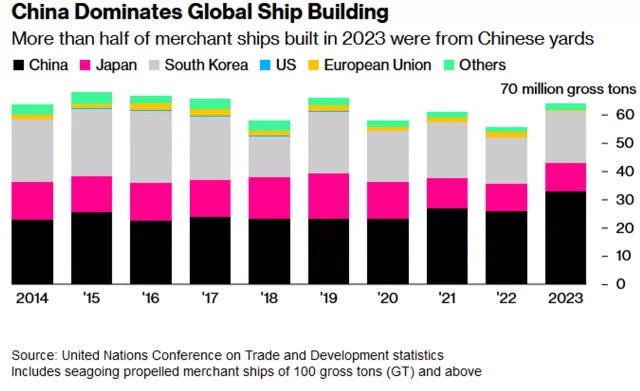
- Last year, China had orders for 1,794 large commercial ships, South Korea had 734, Japan had 587 — but the US had just five.
- While China commands 40 percent of global commercial shipbuilding output, the US accounts for less than one percent.
- China had over 5,000 oceangoing commercial vessels in early 2023, while the US-flagged merchant fleet had only 177.
- China’s shipbuilding capacity is over 200 times that of the US, according to a US Naval Intelligence chart cited by media.
The struggle to prop up the floundering US shipbuilding base comes as the US Navy has released its plan for a potential military conflict with China by 2027.
Announcing the Navigation Plan for America’s Warfighting Navy, US Chief of Naval Operations (CNO) Admiral Lisa Franchetti referred to China as a “pacing challenge” and a “complex, multi-domain and multi-axis threat.”
The plan includes streamlining maintenance for warships, submarines and aircraft, eliminating delays and restoring “critical infrastructure that sustains and projects the fight from shore.”
What has NATO’s ‘expansion’ vaunted by secretary general brought?
Global Times | September 21, 2024
Outgoing NATO Secretary General Jens Stoltenberg boasted of his achievements during his tenure in his farewell speech on Thursday, claiming that in 10 years, the number of NATO soldiers on its eastern flank increased from zero to tens of thousands, the number of troops on high readiness rose from thousands to half a million, and the number of its allies spending at least 2 percent of GDP on defense increased from three to 23. Montenegro, North Macedonia, Finland and Sweden joined the alliance, deepening their relations with countries in the “Indo-Pacific region.” Stoltenberg also summarized five lessons that are key to NATO’s continued “success” in the future, urging the US and Europe not to engage in isolationism, declaring that “freedom is more important than free trade” and NATO “must not make the same mistake with China” as they did with Russia.
In the context of the ongoing poor European security situation, Stoltenberg’s self-boasting is somewhat like “taking the wrong script.” However, when reviewing Stoltenberg’s 10-year term, NATO’s “expansion” indeed stands out as a central theme. In addition to the points he mentioned in his speech, statistics showed that NATO’s military spending had increased by over 30 percent during his tenure, reaching a record $1.185 trillion in 2024. As a transatlantic military alliance, NATO also saw strategic, geographical, and content-based expansion under Stoltenberg’s leadership. Not only did it label China as a “systemic challenge,” repeatedly hyping up the “China threat” and accelerating NATO’s “Asia-Pacificization,” but it also incorporated issues like supply chains, technological and economic security into its agenda.
The key question is, apart from self-proclaiming NATO as being “strong, united and more important than ever,” what exactly have these expansions brought to the world? How much of the 30 percent increase in military spending has flowed into the pockets of the US military-industrial complex, how much security anxiety has been spread around the world, and how much of it has been at the expense of the livelihoods, well-being and social stability of Europe. Is it safer or less safe for NATO countries to provoke confrontation with China by following the US’ China strategy? Is it weal or woe to securitize and weaponize the industrial chain, supply chain, cyberspace and other fields, and inject NATO-style confrontational mentality into areas that could have healthy cooperation and interaction?
If we are to give a more serious and thorough assessment of Stoltenberg’s past decade in office, these are issues that cannot be ignored, and the answers are quite the opposite of the achievements he highlighted. With Europe now facing such a precarious security situation, what responsibility does NATO bear?
It was NATO’s expansion that sowed the seeds of the Ukraine crisis, and its extension into the Asia-Pacific region has exported geopolitical tensions beyond Europe. Under Stoltenberg’s leadership, NATO has further aligned itself with US strategic goals, and all of NATO’s shifts reflected US strategic intentions. The historical evaluation of Stoltenberg, beyond being the second longest serving NATO secretary general due to internal divisions within the alliance, will likely include his image as a “loyal executor” of Washington’s policies and its “vanguard.”
NATO should have ended with the Cold War, its survival and development have always relied on creating security anxieties and engaging in conflicts, repeatedly. On one hand, NATO claims to be a regional alliance, but on the other hand, under the guise of ensuring its own security, it continuously expands globally. It claims to be a defensive organization, yet in the name of defense, it promotes deterrence and stirs confrontation. Stoltenberg attempts to portray NATO as a protector of regional and even global security, but the rhetoric that “military strength is a prerequisite for dialogue” is merely another way of saying “Might makes right.”
On the surface, this speech looks much like a smug war readiness declaration left by Stoltenberg to NATO, but in fact, the words between the lines cannot hide NATO’s own dilemma and loss. Amid domestic political uncertainty in the US, what will the future of NATO be and where will Europe’s sustainable security lie? Behind Stoltenberg, European countries and the world are left with a more divided situation.
Actually, NATO’s 75-year history has proven that it has not made Europe or the world more peaceful and secure. The existence and continuous expansion of NATO have become the root cause of security dilemmas. On the contrary, “long peace” has been achieved in places with less NATO intervention and confrontational mentality. The value of Stoltenberg’s farewell speech and the expansion of NATO he boasted about lies in telling the world that the current world does not need a NATO that provokes camp confrontation and spreads a Cold War mentality, let alone a globally expanding NATO. We urge NATO to “retire” together with its outgoing secretary general, alongside the outdated concepts of Cold War mentality and zero-sum game, the wrong practices of advocating military force and pursuing “absolute security,” and dangerous behaviors that disrupt Europe and the Asia Pacific as soon as possible.
How US Deep State Co-Opted TikTok
By Ilya Tsukanov – Sputnik – 21.09.2024
TikTok wiped Sputnik’s account on Saturday, days after Washington announced draconian new restrictions on Russian media. The company offered no explanation.
The newest round of censorship comes amid the US establishment’s long war against TikTok amid much-touted (but never substantiated) claims by authorities that China uses the app for espionage and influence operations against American users.
The crux of US government claims is that the app sends US customer data to the Asian nation, where it can be seen by Chinese authorities or intelligence services. TikTok says its US data is firewalled from leaving the country via an agreement with American tech giant Oracle.
Joe Biden signed a law in April threatening to completely ban TikTok within 270 days unless its Chinese parent company ByteDance divests from US operations, setting the stage for a legal battle. The measure, packaged in alongside fresh appropriations for US-funded hot spots in Ukraine, Gaza and Taiwan, was rejected by a handful of progressive Democrats and MAGA Republicans, who deemed it a blatant assault on constitutionally afforded free speech.
Senator Rand Paul warned that “once you start objecting to content, what you’re objecting to is speech… The bottom line is, the more information, the better. If you don’t like it, don’t use it. That’s what happens in a free country.”
Congressman Thomas Massie characterized the ban threat as a “trojan horse,” giving the president expansive powers to crack down speech. “Some of us just don’t want the president picking which apps we can put on our phones, or which websites we can visit… We also think it’s dangerous to give the president that kind of power,” Massie said.
TikTok is already banned from use from devices owned by the US federal government, and by numerous state and city governments and universities.
It’s also been banned or restricted in multiple US-allied countries, including Canada, Australia, New Zealand, Britain, at least eight EU countries.
Former president Donald Trump kicked off the TikTok censorship saga in 2020 after deeming it a “national security threat,” prompting the company to file a preliminary injunction to prevent such an eventuality. Trump reversed course this past spring, saying banning TikTok would only make Mark Zuckerberg’s “enemy of the people” Facebook “bigger.”
US tech giant suspends huge German factory project
RT | September 19, 2024
US tech giant Intel is halting construction of two chip manufacturing plants in Germany as it struggles to counter shrinking sales and mounting losses, the company’s CEO Pat Gelsinger announced on Monday.
According to Gelsinger, the project in the city of Magdeburg in Saxony-Anhalt is expected to be delayed by around two years.
The company had planned to build two chip factories in Magdeburg worth over $33 billion, creating some 3,000 jobs as part of a larger investment plan for the EU. Intel had also signed an agreement with the German government for about $11 billion in state subsidies for the project, according to the DPA news agency.
The plans, however, have been put on hold as the US tech giant struggles to reduce losses and launched a cost-saving program earlier this year. Intel also said it is postponing a new factory in neighboring Poland.
“We must continue acting with urgency to create a more competitive cost structure and deliver the $10 billion in savings target we announced last month,” Gelsinger said in a letter to employees.
The German manufacturing site was due to become the largest chip-making facility supported under the European Union’s Chips Act which was passed last year. Intel’s decision to delay the project could deal a blow to EU plans of producing one-fifth of the world’s semiconductors by 2030.
“Without Intel in Magdeburg, Europe is lacking its flagship project,” Frank Bosenberg, the managing director of German industry group Silicon Saxony, told Bloomberg on Monday. “Neither a European market share of 20% or the desired technological sovereignty through semiconductor production below 10 nanometers seem realistically achievable by 2030,” he added.
The EU aimed to increase its global chip manufacturing share to 20% by the end of the decade, supported by over $44.5 billion in subsidies to attract semiconductor companies and reduce foreign dependency. Intel’s project in Germany was a key component of the strategy.
Following the announcement, German Finance Minister Christian Lindner called for subsidies earmarked for the Intel project to be repurposed to close a $13.3 billion federal budget gap projected for 2025.
What is Known About US Private Military Companies?
By Svetlana Ekimenko – Sputnik – 21.09.2024
Members of American private military company (PMC) the Forward Observations Group (FOG), took part in the Ukrainian military incursion into Russia’s Kursk region, according to evidence that recently surfaced.
The FOG PMC has also delivered weapons to Ukraine and allegedly assisted the country’s forces in coordinating the delivery of toxic chemicals to the Donetsk People’s Republic for potential sabotage.
Sputnik has looked into how US PMCs are operating.
- PMCs are often led by high-ranking Pentagon, CIA, and State Department retirees.
- Units are comprised of ex-servicemen, former special forces officers, graduates of military academies, and foreign mercenaries.
- The Pentagon’s facilities in San Diego (California), Mount Carroll (Illinois), and Moyock (North Carolina) are used for training.
- Salaries reportedly range from $400 to $600 a day (some operatives get $1,000 daily).
The Defense Department, State Department, and intelligence agencies are the main customers of PMCs, with contracts worth over $50 million requiring approval from Congress.
The US is not a signatory to the International Convention against the Recruitment, Use, Financing, and Training of Mercenaries, and uses PMCs in circumvention of national legislative restrictions.
The State Department uses the Arms Export Control Act to indirectly regulate American PMCs’ services, including:
- Advising and assisting foreign defense departments in reforming their armed forces;
- Creating paramilitary formations, as well as saboteur and militant detachments; coordinating their actions;
- Providing training missions, reconnaissance, logistics, transport, and technical support;
- Security for diplomatic staff, commercial organizations, strategic US facilities abroad, including oil fields and pipelines (such as those plundered in Syria and Iraq, where the US maintains troops), and oversight for prisons;
The PMCs active in Ukraine, according to the Russian Foreign Ministry:
- Academi (formerly Blackwater), part of Constellis Group, which had around 400 personnel in Ukraine until 2022, according to German media.
- DynCorp International, which offers sabotage and sniper training.
- Cubic Corporation, providing reconnaissance assistance using satellites and drones, opened an office in Ukraine in 2015.
According to existing data, some 3,000 mercenaries are fighting on the side of the Kiev regime, with at least 300 of them employees of US PMCs.
Featured Video

No Threat Can Force Iran’s Surrender /Trita Parsi & Lt Cl Daniel Davis
or go to
Aletho News Archives – Video-Images
From the Archives
An Expert Military Analysis of War with China
Actually, None is Necessary
By Fred Reed • Unz Review • December 13, 2020
The Correlation of Armed Forces: U.S. goods and services trade with China totaled an estimated $634.8 billion in 2019. Exports were $163.0 billion; imports were $471.8 billion. The U.S. goods and services trade deficit with China was $308.8 billion in 2019. Trade in services with China (exports and imports) totaled an estimated $76.7 billion in 2019. Services exports were $56.5 billion; services imports were $20.1 billion. The U.S. services trade surplus with China was $36.4 billion in 2019.
There is talk within the Washingtoniat of a possible war with China. Steve Bannon, who apparently was dropped on his head as a child, actually favors such a war. We hear the usual shoo-the-boobs alarm about how the Chinese are doing something terrible and we must gird our loins and American values and show them what for, bow wow, woof. The danger is that the current game of who-blinks-first in Asian waters might actually provoke a shooting war. You know the kind of thing: One warship refuses to get out of the way of another, a collision ensues, some retard lieutenant who signed up on waivers opens fire, and we’re off and running. It is not a good idea to let children play with matches.
The said war is discussed either in emotional terms by idiots or in purely naval terms by those familiar with such things, so we hear of the First Island Chain and the Second Island Chain and whose missiles against the other’s missiles and so on. This would be appropriate if we were fighting World War Two again. Which we aren’t. Let’s take a quick-and-dirty look at how such a war might go.
To begin the war, America would overestimate itself and underestimate China. This is doctrine in the Pentagon. … continue
Blog Roll
 Aletho News
- Iran To Target Military Industrial-Tech Complex That Facilitated Gaza Genocide
- Collapsing Empire: The Resistance Disarms ‘Israel’
- Suicide Should Not Be a Government Service
- Rethinking America’s greatest threat: Iran vs. Israel-Firsters
- Iran accuses adversaries of false flags to strain Turkey ties
- Poland rules out sending Patriot missiles to US/Israel amid war on Iran
- Tehran approves new Hormuz plan with major restrictions
- No Threat Can Force Iran’s Surrender /Trita Parsi & Lt Cl Daniel Davis
- UK’s New Pandemic Plan Would Turn Big Tech Into a Mass Location Tracking Network
- Growing insecurity, soaring prices fuel protests in north as regime bans evacuation: Sources
- If Americans Knew
- Ann Coulter Rips Into Fox News for Iran War Coverage, Compares to False Rigged 2020 Election Reporting
- Joe Kent Urges Americans To Call White House and Congress To Object To Sending Troops Into Iran
- DNC Resolution to Reject AIPAC Funding Puts Democratic Leaders in the Hot Seat
- Swedish foundation to build 400 schools as over 650,000 Gaza children remain without education for 2 years
- Israeli army admits photshopping image of slain Lebanese journalist
- This is how Israel is systematically killing health workers under the cover of war in Lebanon
- Carrying life under fire: Israeli invasion of Lebanon leaves pregnant women facing deadly risks
- Champagne all around for the new death penalty (for Palestinians) law – Not a ceasefire Day 172
- Why are Palestinian books struggling to be seen on Amazon?
- The Line Between Affinity and Conspiracy
- No Tricks Zone
- New Study Finds Warming Saves Lives…Cold Temperatures 12 Times More Deadly Than Excess Heat
- German Science Blog Accuses PIK Climate Institute Of Hallucinating Climate Tipping Points
- Devastating Assessment Of Comirnaty Vaccine By Former Senior Pfizer Europe Toxicologist
- New Study: CO2 Is ‘Effectively Negligible’ As An Explanatory Climate Change Factor Since 2000
- Former Pfizer Toxicologist Dr. Helmut Sterz Tells Bundestag Hearing Pfizer Vaccine Should Have Never Been Approved
- Energy Expert: Germany’s Nuclear Phaseout Was A “500 Billion Euro Mistake”
- New Research: South Australia’s Mid-Holocene Sea Surface Temperatures Were 4°C Warmer Than Today
- Storing Green Energy To Last Germany 10 Days Would Require A 60-Million Tonne Battery
- New Studies: UK Sea Levels Were 4 Meters Higher Than Today During The Mid-Holocene
- Destructive Green New Deal: German Energy And Metal Group Warns Of Drastic Crisis
 Aletho News