BRICS enables Russia to displace US farmers
The Russia-China New Land Grain Corridor is built
By Glenn Diesen | September 2, 2024
The Russia-China New Land Grain Corridor enables Russia to replace the US and Europe in the Chinese grain market.
BRICS enables the decoupling from US agriculture with the development of a new post-American International economic system. This includes a grain exchange, new logistic centres, transportation infrastructure, development banks, native technologies and digital platforms, de-dollarisation, and the abandonment of the SWIFT transaction system. The benefits for Russia, China and other partners include greater food security, cheaper exchanges, less reliance on an inflated and weaponised US dollar.
Without US surveillance of global trade through the dollar, SWIFT and commodity exchanges, the US and its farmers cannot even see the world markets in terms of global demand and supplies. The problem is exacerbated by Western sanctions and economic coercion, as Russia and China have further incentives to not share market information with the US and its farmers. Thus, US farmers and investors do not get the information required to plan what to grow and how much. China has been cancelling huge contracts with the US, and the US cannot even be sure who is replacing its agricultural supplies.
The US weaponisation of trade will continue to encourage the rest of the world to reduce their dependence on the US and find more reliable economic partners.
Ukrainian anthem found in US voter database code – Politico
RT | September 2, 2024
The Ukrainian anthem has been found embedded in the source code of the voter database in the state of New Hampshire, the development of which had apparently been outsourced to offshore programmers, according to Politico.
Election officials had previously decided to replace the state’s voter registration database before the upcoming 2024 presidential election and reportedly turned to a small Connecticut-based IT firm called WSD Digital to develop the software.
However, upon reviewing the completed project, it was revealed that the firm had offshored some of the work. Given that this posed a risk of unknown coders outside the US having access to the software and potentially being able to manipulate voter lists, New Hampshire officials hired a forensic firm to scour the code for signs of hidden malware.
The probe reportedly revealed a number of “unwelcome surprises,” Politico claimed, citing a person familiar with the investigation. These included the use of open-source code, software which had been misconfigured to connect to servers outside the country, and the lyrics to the Ukrainian national anthem.
“A programmer had hard-coded the Ukrainian national anthem into the database, in an apparent gesture of solidarity with Kiev,” Politico wrote.
State officials, however, have stated that none of these findings have amounted to evidence of wrongdoing and that all the issues had been resolved by the company in charge of the database’s development before it came into use.
“This was a disaster averted,” Politico’s source said, noting that hackers could have potentially exploited the vulnerabilities to edit the state’s voter rolls or use them to stoke election conspiracies.
While the potential catastrophe in New Hampshire has apparently been averted, Politico stated that its own six-month-long investigation into the matter suggests that similar issues could pop up in other states due to a lack of oversight of the development of vote-processing software.
“The technology vendors who build software used on Election Day face razor-thin profit margins” the outlet wrote, noting that this provides little room for crucial investments in security and results in many states lacking a rigorous system to verify what actually goes into election software.
Meanwhile, the FBI reported last month that it was “confident” that Iran has been trying to interfere in the upcoming election in November and had allegedly sought to gain access to the presidential campaigns of both political parties.
Tehran, however, has denied the accusations, calling them “unsubstantiated and devoid of any standing” and insisting that it has no intention in meddling in US elections.
Hungary can’t survive without Russian oil – FM
RT | September 2, 2024
Hungary cannot survive without Russian oil, Foreign Minister Peter Szijjarto has warned, stressing that Ukraine’s decision to suspend transit poses a serious challenge for Budapest.
Kiev halted the transit of crude supplied by Russian energy giant Lukoil via the Druzhba pipeline in June, citing sanctions. The measure has directly hit landlocked Hungary and Slovakia, depriving them of oil previously exported by Lukoil through Ukrainian territory.
In an interview with Russian business daily RBK on Monday, Szijjarto said Hungary will be completely deprived of oil without supplies from Russia.
“We will not be able to feed the country in a broad sense. We simply will not be able to meet the demand for fuel… because we do not have sufficient alternative infrastructure,” the diplomat said.
“You just have to look at the numbers… We do not want to take such risks,” Szijjarto added. “Therefore, the fact that Ukraine has made such a decision is a very serious challenge for us. It affects about a third of our imports from Russia. In Slovakia, the situation is even worse, these supplies account for about 40% there,” he stressed.
Kiev imposed sanctions on Lukoil in 2018, having banned the company from divesting its business in the country, as well as prohibiting trade operations and participation in the privatization or leasing of state property. Lukoil still sent crude via the southern arm of the Druzhba pipeline as EU sanctions did not target these flows.
The EU prohibited transport of Russian crude oil by sea in December 2022 as part of far-reaching sanctions on Moscow over the Ukraine conflict. Hungary, Slovakia, and the Czech Republic have been granted exemptions by Brussels as they source alternative supplies.
Slovakia and Hungary are the only EU member states that have rejected the bloc’s policies on supplying Kiev with military aid amid the conflict with Moscow. Both states have repeatedly called for the crisis to be solved through diplomacy.
Last week, Politico reported that Budapest had proposed a solution for the restoration of halted Russian oil flows by rebranding Lukoil products. That way, the crude shipped via Ukraine could be officially sold to Hungarian energy giant MOL before it crosses the border. The arrangement could reportedly mean paying an additional $1.50 per barrel to secure transit outside of previous agreements.
Szijjarto told RBK that a temporary solution to the crisis situation could be found, stressing that “in the long term, we need to look for another, legally significant solution.”
The Hungarian diplomat traveled to Russia last week to discuss energy security issues. Budapest is “satisfied with Russian energy cooperation, which is one of the guarantees of the country’s food security,” Szijjarto wrote on Facebook after meeting with the head of Russian energy giant Gazprom, Aleksey Miller.
EU shifting back towards Russian energy – Welt
RT | September 2, 2024
Russia has overtaken the US to once again become the second-largest supplier of natural gas to the EU, Die Welt reported on Sunday, citing analysis. The German newspaper added that the symbolism of the development is “huge.”
Brussels declared the elimination of its reliance on Russian energy as one of its key priorities after hostilities in the Ukraine conflict broke out in February 2022. Expensive US liquified natural gas (LNG) filled up a large portion of the market, exacerbating economic crises throughout the EU.
In the second quarter of 2024, Russian gas accounted for roughly 17% of all EU imports, just ahead of supplies from the US, Welt noted, citing the Brussels-based think-tank Bruegel. According to its figures, European customers received 12.27 billion cubic meters of US LNG over that period or time, while Russia delivered 12.73 billion cubic meters to the bloc.
The Russian supplies include both LNG and pipeline gas, which flows to the EU via Belarus and Ukraine and through the TurkStream undersea gas pipeline. Kiev, which receives transit fees for fuel delivered through its territory, has threatened to suspend operations after the current contract expires at the end of 2024. However, it has indicated that it is open to third nations, such as Azerbaijan, stepping up their use of Soviet-built infrastructure.
Dmitry Birichevsky, head of the economic cooperation department at the Russian Foreign Ministry, has described the gas import dynamics as a testament to the failure of EU sanctions policy.
“While it’s true that the indicators are significantly lower than before 2022, the facts speak for themselves,” he told RIA Novosti on Monday. “Greece alone has ramped up the purchase of Russian gas fourfold over 2023.”
The US has sought to replace Russia as an energy supplier to Europe since before the Ukraine conflict. The administration of President Donald Trump infamously branded American LNG “molecules of freedom”, when it pressured the EU nations to select it over Russian gas. Norway has historically been the top supplier of gas to the market.
Moscow now considers the EU an unreliable customer, which has shown that it is willing to let US political goals trump its economic needs.
“Under the circumstances of the de facto economic war declared on us, our plans to redirect foreign trade to the nations of the Global South and East remain a priority,” Birichevsky said.
Anti-Establishment Parties Have Triumphed in Germany’s Regional Elections
By Ekaterina Blinova – Sputnik – 02.09.2024
The Eurosceptic party, Alternative for Germany (AfD), won a regional ballot for the first time, surpassing Scholz’s ruling coalition.
AfD secured 32.8% in Thuringia, leading the race, followed by the Christian Democratic Union (CDU) with 23.6%, according to exit polls.
In Saxony, the Eurosceptic party garnered 30.6%, losing to the CDU by a narrow margin.
The Sahra Wagenknecht Alliance (BSW) claimed third place in both races, with 15.8% in Thuringia and 11.8% in Saxony.
Scholz’s “traffic-light” coalition of Social Democrats (SPD), the Greens, and the Free Democrats (FDP) performed poorly. The FDP failed to reach the 5% threshold required to enter either regional legislature, and the Greens did not make it into the parliament in Thuringia.
SPD received 6.1% and 7.3% in Thuringia and Saxony, respectively.
“We are ready to take on government responsibility,” AfD leader in Thuringia, Bjorn Hocke, declared, celebrating what he called a “historic victory.”
Omid Nouripour, co-leader of the Greens, lamented the outcome and described it as “a profound turning point” in German history.
The AfD’s victory sparked a heated debate, with mainstream Western media warning that Germany’s political center is “crumbling” ahead of the next federal election in September 2025. Some outlets noted that Scholz have been “humbled” by the German right-wing party.
Others highlighted the rise of anti-establishment parties in Germany, acknowledging that both AfD and BSW, which advocate halting arms supplies to Ukraine, and imposing immigration controls, have performed notably well.
Ukraine destroys kindergarten – Belgorod governor
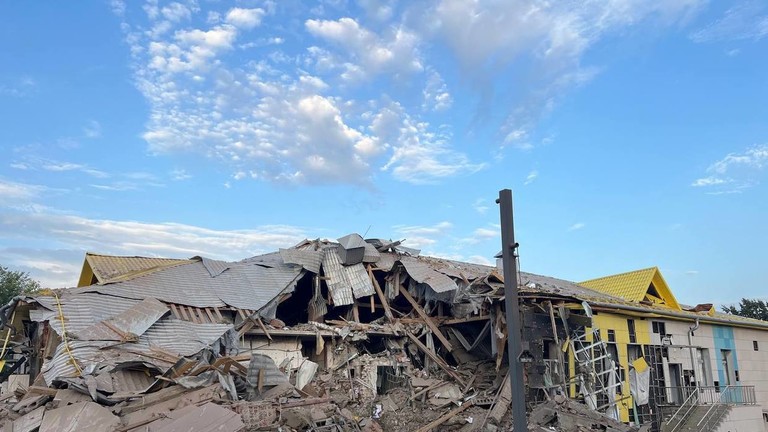
A daycare center destroyed in a Ukrainian strike on the Russian city of Belgorod. © Telegram / Vyacheslav Gladkov
RT | September 2, 2024
A kindergarten was irreparably destroyed in a large-scale Ukrainian shelling of the Russian city of Belgorod overnight, local governor Vyacheslav Gladkov has said. Following the attack, a decision was made to close dozens of others and transfer some local schools to remote learning, he added.
At least 11 civilians, including two children, were wounded in Ukrainian strikes targeting various parts of the city, Gladkov wrote on Telegram on Monday morning. Nine of the victims required hospitalization, with five of them being in serious condition, he added.
“It is not a good morning here in Belgorod Region. There has been another shelling of Belgorod. The missiles made it through. A kindergarten in Belgorod has been almost completely destroyed,” the governor wrote in a post on Russia’s VK social network.
It is the third educational institution in the city to have suffered significant damage as a result of Ukrainian attacks, following previous hits on another kindergarten and a school, he said.
A decision was made to shut down three dozen kindergartens for a week in the city district of Kharkovskaya Gora, located in the south of Belgorod, closest to the Russian-Ukrainian border, Gladkov announced.
Almost two dozen schools in the area would also switch to remote learning, he added. This Monday, September 2, is the day when the school year begins in Russia. Children typically attend kindergartens for several years, before entering the first grade at about age 7.
The governor acknowledged that working parents might be unhappy about the closure of the preschools, but stressed that protecting the lives of the children was a priority.
Gladkov said that he had already visited the affected kindergarten, adding that if the strike had occurred during the day when the children were inside, “no one would have had a chance to survive.”
Around a dozen communities across Belgorod Region also came under Ukrainian shelling and drone attacks during the night. One person was killed in the village of Shagarovka, with at least six more civilians being wounded in other locations, including the town of Shebekino, according to the governor.
The Russian regions of Belgorod, Kursk and Bryansk, which all border Ukraine, have been a frequent target of cross-border attacks since February 2022. However, the bombardment of Belgorod has intensified over the past few weeks amid the stalling of the Ukrainian offensive in Kursk Region and Russian advances in Donbass.
On Friday, five civilians were killed and 37 were wounded in a Ukrainian missile strike on Belgorod. On August 25, five people lost their lives and 13 more suffered injuries as a result of a Ukrainian attack on the town of Rakitnoe.
Did the Space Age Begin on a Lie?
TruthstreamMedia | August 28, 2024
Please help support us on Patreon, read our goals here:  / truthstreammedia or Subscribestar here: subscribestar.com/truthstreammedia
As context is very important for all videos, this message is to confirm that the purpose of this video is reporting on or documenting the content.
Note that we make an effort to research for context and cite our sources as appropriate.
TruthstreamMedia.com Can Be Found Here: Our First Film: TheMindsofMen.net
Our First Series: Vimeo.com/ondemand/trustgame
Site: http://TruthstreamMedia.com Twitter: @TruthstreamNews Backup
Vimeo: Vimeo.com/truthstreammedia DONATE: http://bit.ly/2aTBeeF
Newsletter: http://eepurl.com/bbxcWX
Ex-Palestinian MP Khalida Jarrar facing ‘slow’ death in Israeli jail: Rights group

Press TV – September 1, 2024
An international rights group has raised concern about Khalida Jarrar’s health, warning the 61-year-old female Palestinian detainee is facing “slow and deliberate killing” at the hands of Israeli prison officials.
Jarrar, a scholar, feminist, leftist and former lawmaker, has been in arbitrary incarceration under the Israeli regime’s illegal administrative detention since last year.
She is kept in solitary confinement in Neve Terzia prison where she was moved to from Damon Prison last month.
Despite requiring five different medications for her heart and health ailment related to blood pressure, diabetes, and cholesterol, she is denied food and medication on time, while locked up in an airless solitary cell measuring 1.5 x 2.5 meters, a concrete bed and open toilet with no curtains, lacking water.
To breathe, reportedly, Jarrar is forced to lie on the floor to draw some oxygen from the crack under the cell’s door.
According to Palestinian human rights advocate, B’tselem, 60 detained Palestinians have died in Israeli jails since the regime forces launched a genocidal war on Palestinian people in Gaza on October 7, 2023.
EuroMed Human Rights Monitor has detailed the conditions of Jarrar’s arbitrary detention and cruel solitary confinement, calling on the international community to demand for her immediate release and an end to arbitrary detention of Palestinians.
“Compel Israel to stop the slow and deliberate killing of Palestinian MP Khalida Jarrar,” the rights group said in a report published on Thursday.
It also called on the Working Group on illegal arbitrary detention of Palestinians and the UN Special Rapporteur on violence against women and girls, Reem Al-Salem, to take effective and immediate action in this regard.
EuroMed Human Rights Monitor, in an urgent letter, wrote a detailed report about the conditions of Jarrar’s arbitrary detention and cruel solitary confinement in the Israeli prison intended for female criminals to the Working Group on Arbitrary Detention and the Special Rapporteur on Violence against Women and Girls.
The report includes a complaint received by EuroMed Monitor from Jarrar’s husband, Ghassan Jarrar, on his wife’s dire condition in prison.
Jarrar’s husband told the rights group her wife remains in isolation for unknown reasons.
He said there was also no legal basis for her to be moved from the prison where she was being held before to Neve Terzia, a prison meant for female offenders.
Additionally, Israeli authorities did not notify him she was being moved to the Neve Terzia prison.
He noted the most serious problems facing Jarrar in prison as: lack of oxygen in the cell; not being allowed to go outside for “recreation”; the water to the toilet is cut off; the temperature is abnormally high; and that the purposeful delay of food and medicine are all “conditions of killing, not isolation”.
“Do they want to kill Khalida this way?” Jarrar questioned. Despite her critical health condition, no one answers her calls when she urgently needs anything, with “four hours [going] by before anyone answers”.
He summarized her suffering in this letter sent by his wife to her lawyer.
“I die every day. The cell looks like a tiny, airtight box. The cell is equipped with a toilet and a small window above it, which was closed a day after I was moved to it. They did not leave me any space to breathe. Even the so-called porthole in the cell door was closed. I spend most of my time sitting next to a tiny opening that allows me to breathe. I wait for the hours to pass while I suffocate in my cell in hopes of finding oxygen molecules to breathe and survive,” she wrote.
“The high temperatures make my isolation even more tragic. Put simply, I am inside a very hot oven. The heat has made it impossible for me to sleep. Not only did they put me in this situation alone, but they also purposefully turned off the water in the cell. It [initially] took them at least four hours to bring me a bottle of water. After eight days of confinement, I was allowed to leave the cell once, to go to the prison yard. Additionally, they purposely postpone the awful dinner for hours,” she added.
Khalida Jarrar was arrested on December 26, 2023 from her home in Ramallah, in the central occupied West Bank.
Initially, she was kept in Damon Prison with other female inmates without being charged or given a chance to defend herself, until she was recently moved to solitary confinement.
Before her 2023 arrest, Khalid Jarrar had been an ex-prisoner who served five years in Israeli jails. She is a human rights and feminist activist and a member of the Palestinian Legislative Council.
Nearly nine-thousand Palestinian detainees are currently suffering physically and mentally from the regime’s illegal arbitrary arrests, harsh and degrading detention conditions, torture, and punitive and retaliatory measures, including starvation and solitary confinement—which are all unlawful practices violating human rights which have intensified since the start of Israel’s ongoing genocide in the Gaza Strip on October 7.
Some 260 Palestinian detainees have been killed in Israeli prisons and detention facilities since 1967.
This figure does not include the dozens of Palestinian prisoners and detainees from the Gaza Strip who have been killed since last October. The exact numbers and identities of most of these individuals remain unknown.
Kosovo’s Unknown Genocide
By Kit Klarenberg | Global Delinquents | September 1, 2024
June 9th marked a little-known anniversary. On that day in 1999, Yugoslavia’s army withdrew from Kosovo, following 78 consecutive days of NATO bombing. In return for ceasing its criminal campaign, the US-led military alliance was permitted unimpeded, unchallenged freedom of movement and action throughout the province. The military’s exit instantly opened the floodgates for a genocide of the province’s Serb population to erupt, under the watchful eye of NATO and UN peacekeepers. To this day, the region lives with the cataclysm’s destructive consequences.
NATO’s March – June 1999 aerial assault on Yugoslavia was ostensibly waged to prevent an impending mass slaughter of Albanians in Kosovo. Yet, as a May 2000 British parliamentary committee concluded, all purported abuses of Albanian citizens occurred after the bombing began. Moreover, the alliance’s intervention was found to have actively encouraged Slobodan Milosevic to aggressively neutralise the CIA and MI6-backed, civilian-targeting narcoterrorist Kosovo Liberation Army (KLA), with which Belgrade was truly at war.
The KLA had for years by this point sought to create an ethnically pure Kosovo via insurrectionary violence, in service of constructing “Greater Albania” – an irredentist, Nazi-inspired entity comprising territory in modern-day Greece, Macedonia, Montenegro, and Serbia. Yugoslavia’s military departing the province at last provided the Al Qaeda-linked terror group with a grand window of opportunity to achieve that mephitic goal. There was a gap of several days before thousands of NATO and UN “peacekeepers” – known as KFOR – arrived in Kosovo, on June 12th 1999.
By the time they reached Pristina, scores of Serbs had already been murdered or fled Kosovo, their homes and property stolen or destroyed. Despite its official mission being to ensure a “safe and secure environment” in the province, KFOR’s presence did nothing to quell the bloody chaos. Dubbed Operation Joint Guardian, an eponymous account of the effort authored by US military historian Cody R. Phillips records:
“Ethnic Albanians, consumed with hatred…initiated a wave of destruction. Anything Serbian was destroyed or vandalized – even abandoned houses and churches. Much of the violence was clearly organized and deliberate. Each day… American soldiers confronted new expressions of hatred…Radical groups of ethnic Albanians were committed to violence in Kosovo, with the ultimate goal of achieving complete independence from Serbia and bringing along as well bits of territory in Serbia and Macedonia dominated by ethnic Albanians… Chaos dominated as Operation Joint Guardian began in earnest.”
Phillips reports that KFOR hadn’t “anticipated the level of violence and lawlessness,” and was poorly-prepared, ill-equipped and undermanned to deal with the barbarous, province-wide crimewave they’d stepped into. “Murder, assault, kidnapping, extortion, burglary, and arson were reported daily,” the victims invariably being Serbs. These were merely incidents “significant” enough for KFOR to report. Typically, the culprits were never identified – “no one saw anything” was “a standard refrain.” Drive-by shootings were commonplace. Meanwhile:
“Abandoned Yugoslav military installations were destroyed, vandalized, or mined. Even grave sites were booby-trapped. Electricity was intermittent, clean water was almost nonexistent. The absence of order and public services was total.”
On a daily basis, Serbs “were attacked throughout the province…routinely…accosted in public buildings, or on the street, then robbed, beaten, or ‘arrested’ and detained in jails” by rampaging gangs of armed Albanian militants. In one Kosovo community, an estimated 5,000 Roma were expelled from their homes, “which were then looted and burned.” Albanians and Bosniaks who remained in Kosovo during the war, perceived by the KLA as loyal to Yugoslavia, “were harassed… some of them also disappeared.”
‘Bad Guys’
Not long after Joint Guardian’s launch, a US Marine patrol responded to a series of arson attacks on homes in Zegra, “a town almost evenly split between Serbian and Albanian families.” Arriving “too late to stop the violence,” their entry to the area was moreover hindered by a flurry of fire from Albanian militants. “Every Serbian home had been put to the torch,” the local Orthodox church had been destroyed, a nearby cemetery vandalized. Almost 600 Serbs were ultimately forced to leave.
Per Phillips, before Joint Guardian’s first week was over, “dozens of Serbs had been abducted by the KLA.” They were never seen again, their bodies never found. Elsewhere, a Serb school official “who had protected an Albanian home and family” during NATO’s bombing campaign, and his wife, were murdered, their “bodies [left] hanging in the town square.” This “level of violence” endured throughout the Operation’s first month:
“The daily routine entailed the same jobs: fight fires, disperse crowds, and quell violence. Caches of weapons and ammunition usually were found every day. Wounded Serbs were treated regularly by Army medics or evacuated to local US medical facilities. The episodes seemed constant and blended into an endless stream of violence.”
There was also a routine “predictability” to how Serbs were “bullied” into leaving Kosovo – “remote villages were especially sensitive to the unofficial pattern.” First, “roving bands” of Albanian militants would subject Serbs to escalating “intimidation tactics”, to the extent “threats became unbearable.” If these activities “failed to achieve the desired end… thugs would break into selected homes and beat the occupants, and one or two token victims would be killed.” The process was “very effective” in forcing Serbs to abandon the province.
In July, remaining Serb families in the town of Vitina were falsely blamed by Albanian militants for an explosive attack that injured over 30 Serbs, then harassed out of the area. Before leaving, they “gave their houses and remaining property to their Albanian neighbors in gratitude for their friendship and kindness.” Within hours, those houses and their contents were ablaze. According to Phillips, this incident prompted a KFOR commander to lament, “the hatred is so intense and irrational it is unbelievable.”
Come November 1999, the KLA’s post-war campaign of “murder and kidnap” in NATO-occupied Kosovo had reduced Pristina’s Serb population from 40,000 to just 400. Then, “the killings continued throughout 2000.” Serbs of all ages were regularly shot in the street. One Serb preparing to depart for Belgrade “was killed by an Albanian masquerading as a potential buyer” for his home.
There are strong grounds to believe that, contrary to Phillips’ account of well-meaning, valiant impotence and ineptitude on the part of KFOR, this violence was actively encouraged by the KLA’s Western backers. In December 2010, a British “peacekeeper” posted to Kosovo during this time attributed Pristina’s modern day status as “an impoverished, corrupt and ethnically polarised backwater” to NATO’s “unwillingness to control KLA gangsters.” He witnessed first-hand how London under his watch consistently “emboldened the KLA to greater brutality.”
Whenever his KFOR team captured the terror group’s fighters on the streets, heavily armed and “intent on murder and intimidation,” his superiors ordered them to be freed:
“The violence meted out by the KLA shocked even the most hardened of paratroopers. The systematic murder of Serbs, who were often shot in front of their families, was commonplace. After nightfall, gangs of KLA thugs wielding AK47s, knuckledusters and knives terrified residents of Serbian apartment blocks. Many Serbs fled and their homes were taken by the KLA. The Blair government’s spin machine wanted moral simplicity….The Serbs were the ‘bad guys’, so that must make Kosovo Albanians the ‘good guys’.”
‘Bastard Army’
Come 2001, “both smuggling and signs of an insurgent campaign were escalating in the province, particularly in the mountainous and heavily wooded border areas that separated Macedonia and Kosovo,” where KFOR did not patrol. Contraband entering Kosovo was “not confined to illicit drugs or tax-free cigarettes” – “all too common were firearms and ordnance. All along, “random terror attacks continued,” with hand grenades the “weapon of choice.” Grenades “were both plentiful and inexpensive,” costing about $7 each – “less than the price of a pound of coffee.”
Simultaneously, the KLA’s brutal struggle for Greater Albania continued, with the active support of London and Washington. KFOR stood idly by while KLA insurgents pushed past a five-kilometre-wide “exclusion zone” into neighbouring Macedonia, armed with mortars, and other lethal weapons. This dark handshake was openly condemned by other Western powers. A European KFOR commander bitterly remarked in March 2001:
“The CIA has been allowed to run riot in Kosovo with a private army designed to overthrow Milosevic. Now he’s gone the US State Department seems incapable of reining in its bastard army.”
The Empire’s extensive technical and material sponsorship of the KLA extended to evacuating 400 of the group’s fighters in Skopje, after they were encircled by Macedonian forces. This backing was pivotal to the terror group occupying and controlling almost a third of the country’s territory, by August 2001. At that point though, due to European pressure, the US rescinded all assistance to the KLA. Local leaders duly inked a peace deal on August 13th 2001.
In return for constitutional and administrative changes ensuring equal rights for Albanians in Macedonia, KLA insurgents stopped fighting and handed in many of their weapons to NATO, while receiving amnesty from prosecution. Mere weeks later, the 9/11 attacks took place. Ayman al-Zawahiri, Al Qaeda’s cofounder and Osama bin Laden’s deputy has been fingered as “the person who can do the things that happened” on the fateful day. Coincidentally, one KLA unit was led by his brother.
No, Evie Magazine, Climate Change is Not Causing Anxiety
By Linnea Lueken | Climate Realism | August 19, 2024
Evie Magazine, a conservative-leaning women’s publication, recently posted an article titled “Climate Change Anxiety Is A Cause For The Decline In The Birth Rate,” in which the author claims that human-caused global warming is leading to climate anxiety which misdirects its wrath at larger families. This is mostly false. Climate change is not producing anxiety so much as false and misleading alarmist media coverage is, but it is true that blaming large families for bad weather is equally wrong.
The article begins with writer Carolyn Ferguson claiming that “last year was the hottest year on record for the world,” and that the United States is somehow warming faster than the rest of the world, and that “many are feeling the effects of global warming this year.” This is false.
The idea that any given country is heating up faster than the rest of the world has been done to death, and has been claimed for just about every single country on the planet. It should be obvious that every place on earth cannot be warming faster than the rest of the world. Scientists are selecting regions and comparing them independently over different timeframes, using different datasets and methods, whatever timeframe is most optimal to show the most warming. This makes these comparisons basically worthless.
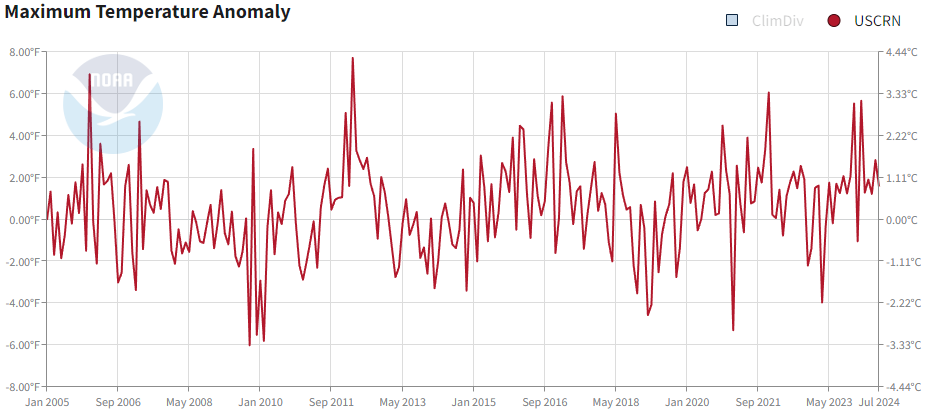
The fact for the United States is that the record of high temperature anomalies, that is, extreme heat, has not shown an increase in those high temperature events since the best records begin in 2005. (See figure below)
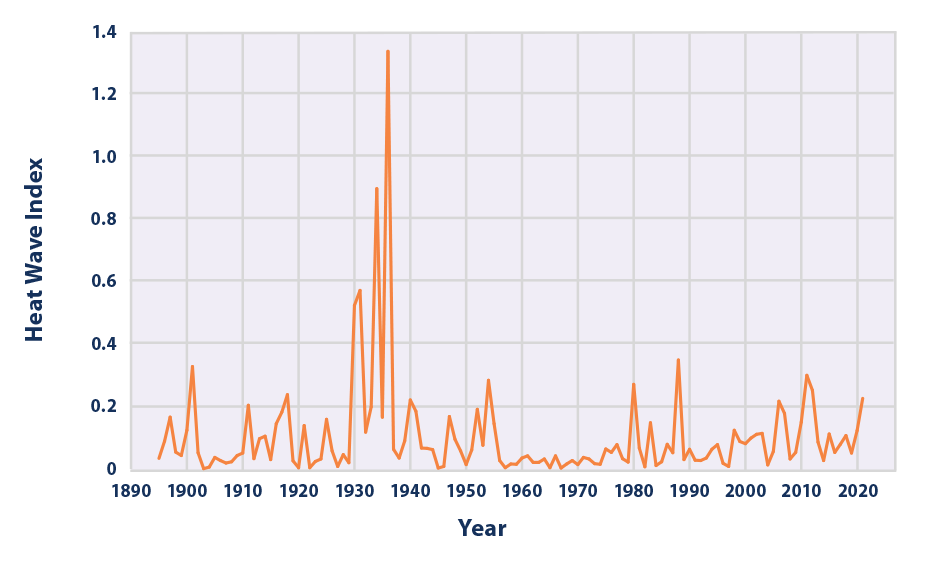
According to longer term data, heatwaves in the U.S. today are less frequent and severe than they were in the 1930s, as seen below:
Likewise, as discussed in this Climate Realism post, the change in the number of days with temperatures over 95 degrees Fahrenheit has actually declined for the majority of the country. Only 10 U.S. states show an increasing trend.
Even looking at proxy data globally which give an idea of ancient temperatures do not indicate we are in a period that can be described as “the hottest on record.” Today’s temperatures according to some sources appear similar to that of the Medieval or Roman warm periods, roughly 1000 to 2500 years ago, respectively. Media claims to the contrary are just propaganda.
The majority of the abnormal warming from last year occurred in Antarctica, where temperatures remained well below freezing, but was simply “less cold” than normally occurred during certain months, particularly September. A significant portion of last year’s heat globally was boosted primarily due to the natural El Niño cycle, which is known to bump up average temperatures for much of the globe. This effect is easily traced in the temperature records.
This is not to say an average warming has not occurred over the past hundred-plus years, but it is not unprecedented nor is it alarming.
The Evie post proceeds to claim that aggression rises amid higher temperatures, writing “one of the most often overlooked corollaries is a rise in communal anger and aggression.”
The “heat makes people crazy” idea has been floated several times over the years, but even the article the Evie post links to admits that it’s likely heat is not the main factor in most of the studies that found aggression. The social sciences and psychology experiments are rifle with uncontrollable variables. Without attempting to conduct any studies, the plain fact that places like Florida and Mexico, the Bahamas, and other hot tropical locales are popular relaxation destinations seems to throw cold water on the hypothesis. Why would anyone go someplace that makes them angrier or more aggressive for vacation?
Discomfort can be aggravating, certainly, but it’s not just higher temperatures alone. Ferguson then gets to the claim that mental health professionals are “seeing more patients come in with symptoms of climate change anxiety, which is supposedly the root of many activists’ anger when it comes to large families.”
Climate Realism has written extensively about how misleading the climate anxiety diagnosis is, here, here, and here, for examples, often shifting the blame from the true culprits. Something like “climate anxiety” does exist – but it is a media-driven phenomenon because of the constant drumbeat of impending doom, not from actual lived experience of warming. Constant media coverage telling people that we are hurtling towards “global boiling,” that every weather extreme is because of you and your neighbor’s use of gasoline, including from typically conservative publications like Evie Magazine, is what is causing anxiety in people.
While Evie is right that climate activists should not turn their ire on big, traditional families, they are wrong that climate anxiety is a legitimate phenomenon.
As Ferguson correctly concludes in her piece, if someone decides not to have kids, “that’s their prerogative, but they should know this decision will likely have little impact on saving our planet.”
Glimpse into the Future of Food
By Meryl Nass | Brownstone Institute | September 1, 2024
Is your food making you sick?
Suddenly, the fact that food is making us sick, really sick, has gained a lot of attention.
When Robert F. Kennedy, Jr. announced he would suspend his presidential campaign and campaign for President Trump on August 23, both he and Trump spoke about the need to improve the food supply to regain America’s health.
The same week, Tucker Carlson interviewed the sister-brother team of Casey and Calley Means, coauthors of the #1 New York Times bestseller Good Energy: The Surprising Connection Between Metabolism and Limitless Health Their thesis, borne out by thousands of medical research studies, is that food can make us very healthy or very sick. The grocery store choices many Americans have made have led us to unprecedented levels of diabetes, obesity, and other metabolic and neurologic diseases that prematurely weaken and age us, our organs, and our arteries.
There is a whole lot wrong with our available food.
- Chemical fertilizers have led to abusing the soil, and consequently, soils became depleted of micronutrients. Unsurprisingly, foods grown in them are now lacking those nutrients.
- Pesticides and herbicides harm humans, as well as bugs and weeds.
- Some experts say we need to take supplements now because we can’t get what we need from our foods anymore.
- Subsidies for wheat, corn, and soybean exceed $5 billion annually in cash plus many other forms of support, exceeding $100 billion since 1995, resulting in vast overproduction and centralization.
- We are practically living on overprocessed junk made of sugar, salt, wheat, and seed oils.
And that is just the start. The problem could have been predicted. Food companies grew bigger and bigger, until they achieved virtual monopolies. In order to compete, they had to use the cheapest ingredients. When the few companies left standing banded together, we got industry capture of the agencies that regulated their businesses, turning regulation on its head.
Consolidation in the Meat Industry
Then the regulators issued rules that advantaged the big guys, and disadvantaged the small guys. But it was the small guys who were producing the highest quality food, in most cases. Most of them had to sell out and find something else to do. It simply became uneconomic to be a farmer.
The farmers and ranchers that were left often became the equivalent of serfs on their own land.
Did you know:
- “Ninety-seven percent of the chicken Americans eat is produced by a farmer under contract with a big chicken company. These chicken farmers are the last independent link in an otherwise completely vertically integrated, company-owned supply chain.”
- “Corporate consolidation is at the root of many of the structural ills of our food system. When corporations have the ability to dictate terms to farmers, farmers lose. Corporations place the burden of financial liability on farmers, dictate details of far.”
- “Corporations also consolidate ownership of the other steps of the supply chain that farmers depend on — inputs, processing, distribution, and marketing — leaving farmers few options but to deal with an entity against which they have effectively no voice or bargaining power.”
When profitability alone, whether assisted by policy or not, determines which companies succeed and which fail, cutting corners is a necessity for American businesses — unless you have a niche food business, or are able to sell directly to consumers. This simple fact inevitably led to a race to the bottom for quality.
Look at the world’s ten largest food companies. Their sales are enormous, but should we really be consuming their products?
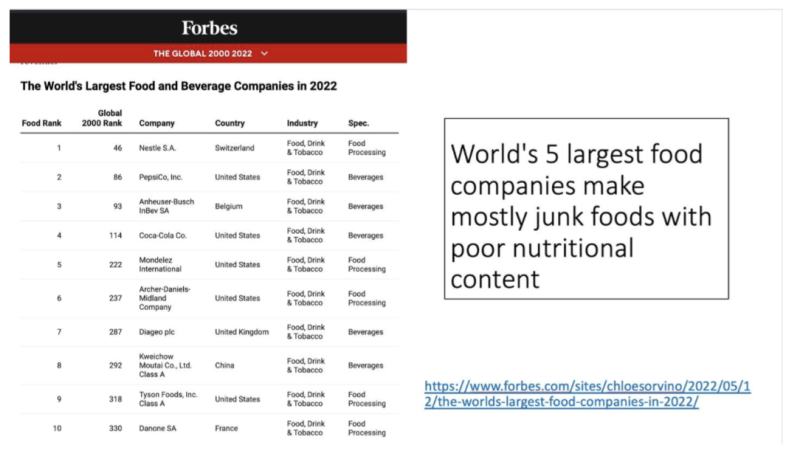
Perhaps the regulators could have avoided the debasement of the food supply. But they didn’t.
And now it has become a truism that Americans have the worst diet in the world.
Could food shortages be looming?
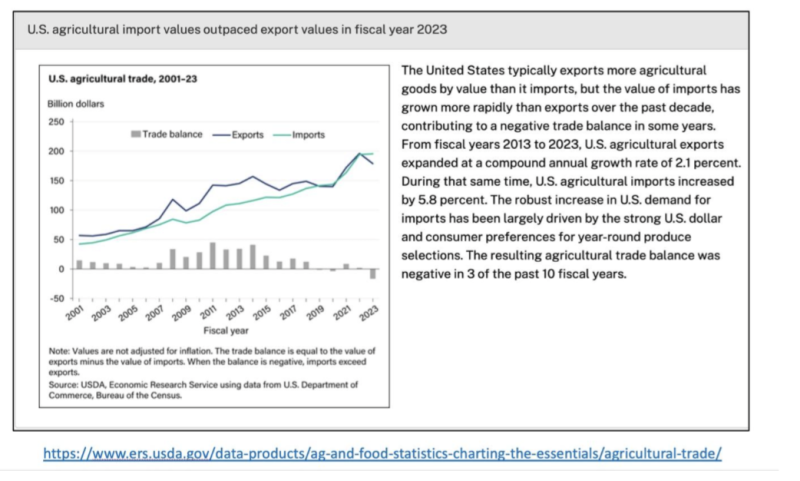
If it seems like the US, blessed with abundant natural resources, could never suffer a food shortage, think again. Did you know that while the US is the world’s largest food exporter, in 2023 the US imported more food than we exported?
Cows are under attack, allegedly because their belching methane contributes to climate change. Holland has said it must get rid of 30-50% of its cows. Ireland and Canada are also preparing to reduce the number of their cows, using the same justification.
In the US, the number of cows being raised has gradually lessened, so that now we have the same number of cows that were being raised in 1951 — but the population has increased by 125% since then. We have more than double the people, but the same number of cows. What!? Much of our beef comes from Brazil.
Pigs and chickens are now mostly raised indoors. Their industries are already consolidated to the max. But cows and other ungulates graze for most of their life, and so the beef industry has been unable to be consolidated in the same way.
But consolidation is happening instead in the slaughterhouses because you cannot process beef without a USDA inspector in a USDA-approved facility — and the number of these facilities has been dropping, as have the number of cows they can handle. Four companies now process over 80% of US beef. And that is how the ranchers are being squeezed.
Meanwhile, efforts are afoot to reduce available farmland for both planting crops and grazing animals. Bill Gates is now the #1 owner of US farmland, much of which lies fallow. Solar farms are covering land that used to grow crops — a practice recently outlawed in Italy. Plans are afoot to impose new restrictions on how land that is under conservation easements can be used.
Brave New Food
That isn’t all. The World Economic Forum, along with many governments and multinational agencies, wants to redesign our food supply. So-called plant-based meats, lab-grown meats, “synbio” products, insect protein, and other totally new foods are to replace much of the real meat people enjoy — potentially leading to even greater consolidation of food production. This would allow “rewilding” of grazing areas, allowing them to return to their natural state and, it is claimed, this would be kinder to the planet. But would it?
Much of the land used for grazing is unsuitable for growing crops or for other purposes. The manure of the animals grazing on it replenishes soil nutrients and contributes to the soil microbiome and plant growth. “Rewilding” may in fact lead to the loss of what topsoil is there and desertification of many grazing areas.
Of course, transitioning the food supply to mostly foods coming from factories is a crazy idea, because how can you make a major change in what people eat and expect it to be good for them? What micronutrients are you missing? What will the new chemicals, or newly designed proteins, or even computer-designed DNA (that will inevitably be present in these novel foods) do to us over time? What will companies be feeding the insects they farm, when food production is governed by ever cheaper inputs?
It gets worse. Real food production, by gardeners and small farmers or homesteaders, is decentralized. It cannot be controlled. Until the last 150 years, almost everyone fed themselves from food they caught, gathered, or grew.
But if food comes mainly from factories, access can be cut off. Supply chains can break down. You can be priced out of buying it. Or it could make you sick, and it might take years or generations before the source of the problem is identified. How long has it taken us to figure out that overprocessed foods are a slow poison?
There are some very big problems brewing in the food realm. Whether we like it or not, powerful forces are moving us into the Great Reset, threatening our diet in new ways, ways that most of us never dreamed of.
Identifying the Problems and Solutions
But we can get on top of what is happening, learn what we need to, and we can resist. That’s why Door to Freedom and Children’s Health Defense have unpacked all of these problems and identified possible solutions.
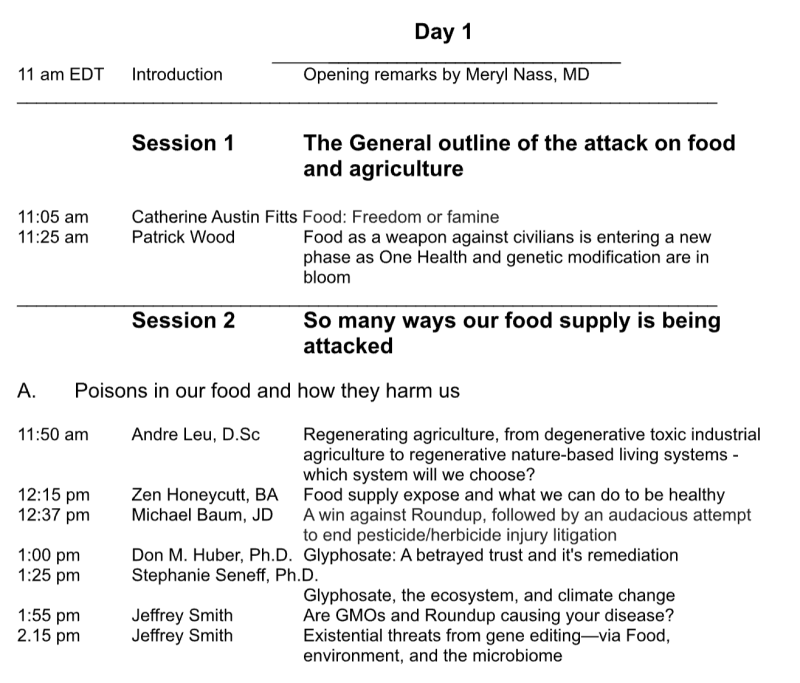
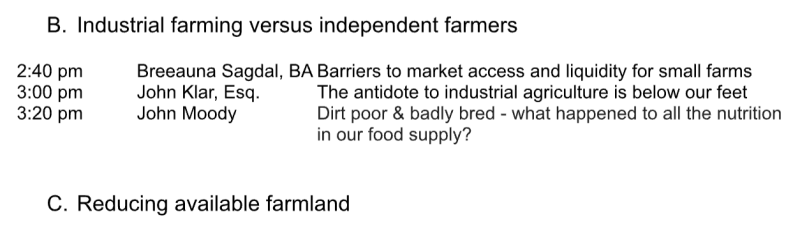
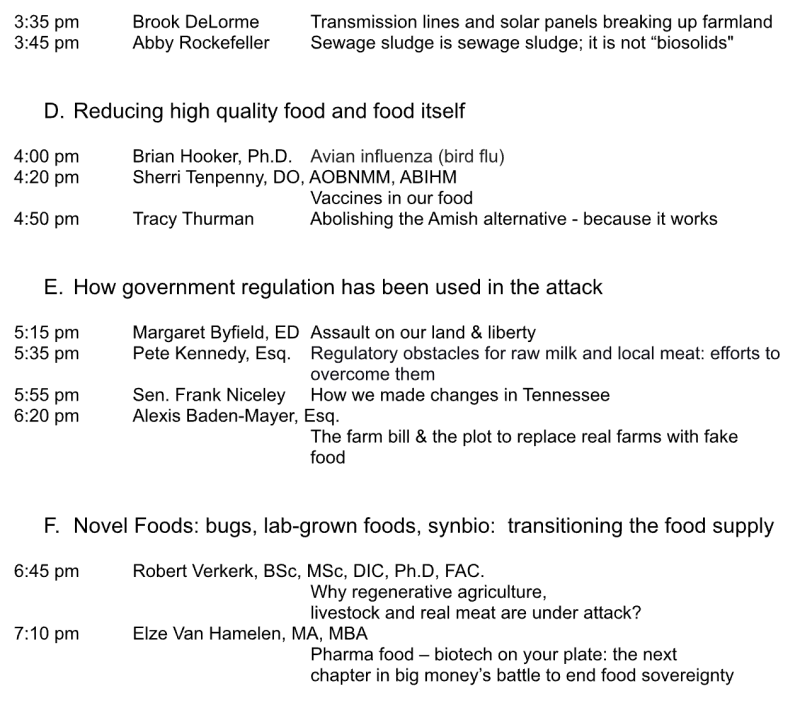
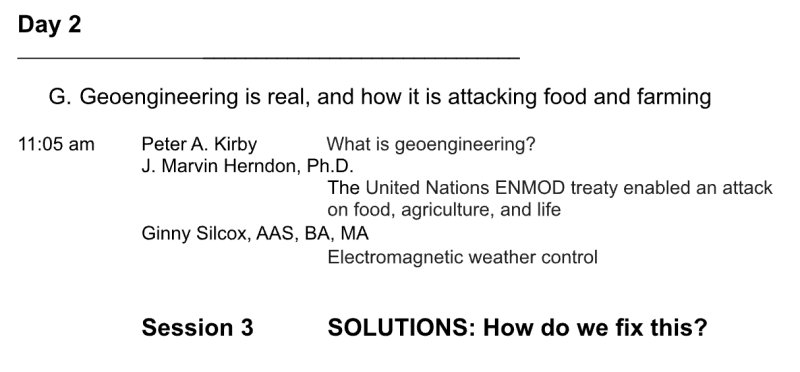
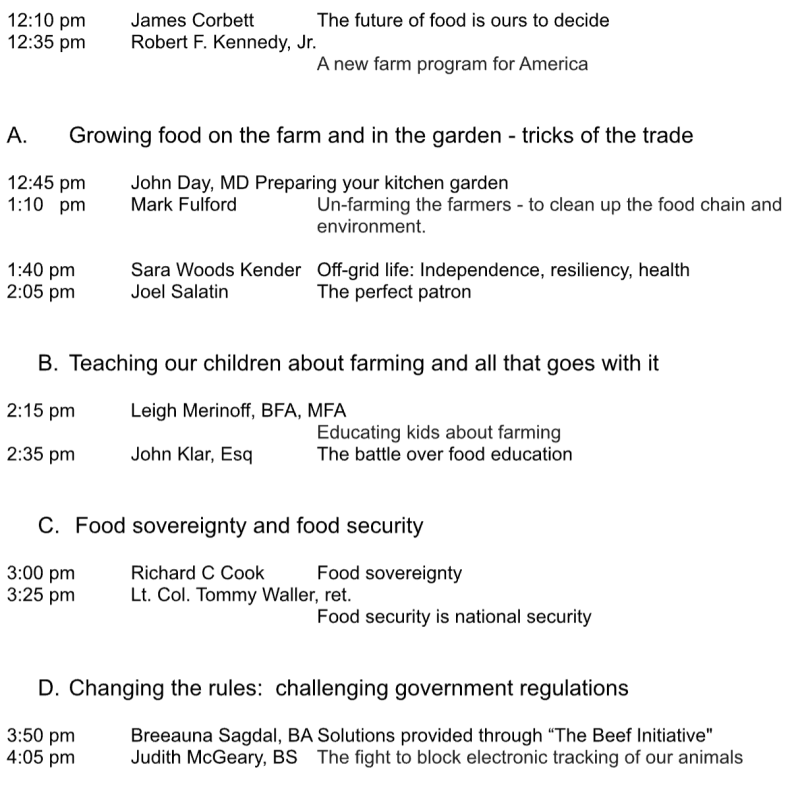
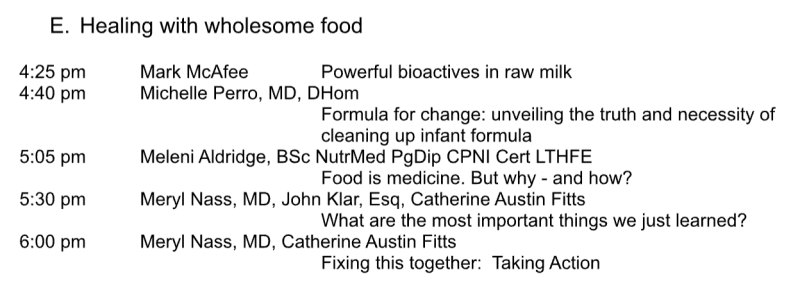
During a jam-packed two-day online symposium, you will learn about all facets of the attack on food, and how to resist. This is an entirely free event, with a fantastic lineup of speakers and topics. Grab a pad and pencil, because you will definitely want to take notes!
The Attack on Food and Farmers, and How to Fight Back premieres on September 6 and 7. It will remain on our channels for later viewing and sharing as well. By the end of Day 2, you will know what actions to take, both in your own backyard, and in the halls of your legislatures to create a healthier, tastier, safer, and more secure food supply.
See below for a summary and for the complete program.

Featured Video

Iran Is Not Our Enemy
or go to
Aletho News Archives – Video-Images
Frlom the Archives
The 52 Major Jewish American Organizations and Israel Celebrate Passover with the Slaughter of 25 Muslim, Christian and Secular Palestinians
By James Petras • Unz Review • April 8, 2018
Introduction
As of April 7, nearly three thousand unarmed Christian, Muslim and secular Palestinians have been wounded, over three dozen are in critical condition and at least twenty-five unarmed protestors, including children have been assassinated by hundreds of Israeli snipers and heavily armed troops shooting tank shells into crowds of civilians protesting their decades of incarceration by the racist Israeli state.
The Israeli government praised the ‘restraint and morality’ of the IDF, as did the fifty-two Major Jewish American Organizations (MJAO) who largely control the US Congress. These grotesque massacres began during the Christian Holy Week on Good Friday and Easter, coinciding with the Jewish Passover. The self-righteous officials of the MJAO and their relatives and friends broke matzos at joyful Seders as the blood of Palestinians soaked into ground at the fence containing the largest open-air prison camp in history, Gaza.
While tribal loyalties bonded the Israeli and Jewish American leaders, the politicians of the Western oligarchic electoral regimes refrained from criticizing the shocking display of brute force and even defended Israel’s cold blood mass killings of Palestinian civilians in their Gaza prison.
This paper will discuss and analyze the reasons for Israel’s willing Western accomplices and the centrality of its fifth column in the United States. … continue
Blog Roll
 Aletho News
- Israeli Journalist Demands Tucker Carlson and Candace Owens Be Placed in WWII-Style Internment Camps
- No Liability, No Studies, No Accountability: The Vaccine System Aaron Siri Exposed in Federal Court
- No time for losers: Why the war meant to save Israel may destroy it
- Top US Counterterrorism Official Resigns in Protest of Operation Against Iran
- Just Get Out! Now!
- Unpacking glaring contradictions in US-Zionist justifications for war against Iran
- Iranian model of warfare bleeds US dry while Persian Gulf states watch and learn: Analyst
- IRGC orders ‘defeated’ US to evacuate industrial facilities in region
- Hegseth’s call for ‘no mercy’ to Iranians deemed war crime
- Iran War Exposes Limits of US Military Power – Journalist
- If Americans Knew
- Trump’s counterterrorism chief, whose own wife was killed by ISIS, quits over Iran War saying Tehran posed ‘no imminent threat’
- Here’s what US could fund instead of Bibi’s war on Iran
- Israel Killed Over a Dozen Lebanese Paramedics in Three Days, Now Claiming That Ambulances Are “Hezbollah” Targets
- War on Iran: These are the heritage sites devastated by US and Israeli attacks
- Four news stories from Israeli media that illustrate Israeli “justice”
- CIA Prepares Criminal Referral of Tucker Carlson, as Israel and Its Loyalists Demand His Arrest
- Top US counterterror advisor resigns in protest of “war manufactured by Israel” – Not a ceasefire Day 157
- ‘I Liked the House’: When Israeli Soldiers Turn Palestinian Homes into Barracks
- ‘They Were All I Had’: Lebanese Father Buries Parents, 4 Daughters Killed by Israeli Bombing
- Israel and its supporters are causing attacks on Jewish institutions. Case in point: Michigan synagogue tragedy.
- No Tricks Zone
- New Research: South Australia’s Mid-Holocene Sea Surface Temperatures Were 4°C Warmer Than Today
- Storing Green Energy To Last Germany 10 Days Would Require A 60-Million Tonne Battery
- New Studies: UK Sea Levels Were 4 Meters Higher Than Today During The Mid-Holocene
- Destructive Green New Deal: German Energy And Metal Group Warns Of Drastic Crisis
- New Study Documents A 20-Year Pause In Arctic Sea Ice Decline – Driven By Internal Variability
- Wake-up Call: Survey Shows Majority Of Germans Now Favor Postponing Climate Targets!
- Televised! Leading German Political Candidate Tells Schoolchildren CO2 Makes Sun Hotter!
- New Study: A Century Warming Of 1.1°C Is ‘Commonplace’ And ‘Not Unusual’ During This Interglacial
- New Study: ‘Internal Noise’ And Volcanic Forcing Can Trigger 10-15°C Warming Within Decades
- Glaciers Worldwide Are Suddendly Surging, Experts Blame Warming!
 Aletho News