Victoria Nuland Laments Social Media Won’t Play Censor for the Feds Anymore

By Didi Rankovic | Reclaim The Net | November 3, 2024
The original “Russia Gate” might have been debunked a long time ago, but politicians and officials continue to seek to explain their electoral failures by accusing other countries of “meddling.”
There is an even more serious angle to their insistence on this – namely, using it as justification for putting in place what opponents (and a congressional investigation) call the government-Big Tech collusion to censor online speech.
Speaking of meddling – former senior US State Department official Victoria Nuland’s handiwork is probably better known in Europe than in the US, and she is now revisiting the script of (Russian) meddling, but is also complaining that social platforms are not as willing to “work” with the government as before on US presidential elections.
Nuland clearly believes her own freedom of speech has no consequences, so she decided to tell MSNBC’s Rachel Maddow that Russian President Vladimir Putin is “at it again” – and also explicitly accuse X owner Elon Musk of making his platform implicit in this alleged election interference.
“In 2020, the social media companies worked hard with the US government to try to do content moderation, to try to catch this stuff as it was happening,” said Nuland.
Now, laying the groundwork for election interference claims, according to her, Musk is “talking directly to the Kremlin.”
The astonishing accusation goes on to “explain” what exactly Musk and the Kremlin are chatting about. “Every time the Russians put out something, [Musk makes sure] it gets five million views before anyone can catch it,” said Nuland.
The frontal assault on Musk also saw the former official tell Maddow that he is “a new, very powerful tool” in Putin’s hands.
To quote Maddow – “I’m not sure people have absorbed the magnitude of what you’re describing there.”
She, of course, was not dismayed by Nuland’s statements but was with this comment “aiding and abetting” them. Once Nuland was done with linking Musk and Putin, she moved on to President Trump, who she asserted is “taking Putin’s lessons.”
Maddow for her part took this cue to attack Trump as essentially creating “alliances” with what Nuland and Maddow consider to be autocrats. And, the “magnitude of that” is what the MSNBC host was not sure Americans have “absorbed.”
Back to Nuland’s activities in Europe, while she still had an official role. This enabled her to become a key player behind the so-called Steele Dossier, by providing the since-debunked documents to the FBI back in 2016.
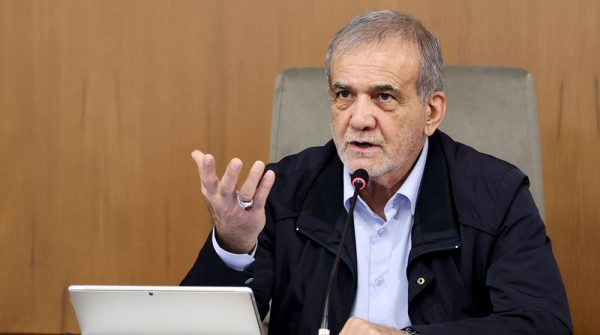
Pezeshkian: Ceasefire and stopping massacres ‘could affect’ Iran’s response to Israel
Press TV – November 3, 2024
Iranian President Masoud Pezeshkian says a truce in Gaza and an end to Israel’s massacre of civilians “could affect” Tehran’s response to its recent strikes on the country’s military sites.
“If they (the Israelis) make a revision in their behavior, accept a ceasefire and stop killing the oppressed and innocent people of the region, it could have an effect on the type and intensity of our response,” Pezeshkian said in a cabinet session on Sunday.
However, he insisted that Iran will not leave “unanswered” any act of aggression against its sovereignty and security.
The Iranian president warned the Israeli authorities that they will receive a “tooth-breaking” response if they “commit a mistake” against the Islamic Republic.
On October 26, Israeli warplanes used US-controlled airspace over Iraq to fire projectiles at military installations in Iran’s Tehran, Khuzestan, and Ilam provinces in flagrant breach of the country’s national sovereignty.
The General Staff of the Iranian Armed Forces confirmed that a significant number of the missiles were intercepted, and the Israeli warplanes were blocked from entering Iran’s airspace.
Iran has said it is resolved to respond to the act of aggression and will not abandon its right.
Leader of the Islamic Revolution Ayatollah Seyyed Ali Khamenei on Saturday warned the United States and Israel that they will definitely receive a crushing response for their atrocities.
Pezeshkian further slammed the hypocritical approach of the United States and European countries to the regional crisis and said all countries in the region now know that “Iran seeks to establish peace and stability and the Zionist regime seeks to intensify the crisis and war in the region.”
“We have never started a war and have never recommended any country to go to war. It has been the United States that has always waged wars in different parts of the world, including our region,” he emphasized.
The president added that the US keeps the fire of war raging in the region through its support for the Israeli regime.
Pointing to Israel’s acts of crime and aggression to fan the flame of war and bloodshed in the region, he said the assassination of Ismail Haniyeh, the head of the political bureau of the Palestinian resistance movement Hamas, in Tehran late in July exposed its warmongering policies.
Some countries had called on Iran to show self-restraint in the hope of a ceasefire and secession of Israel’s massacre of innocent women and children but the regime escalated its crimes and spread its criminal acts to Lebanon, Pezeshkian pointed out.
He blasted the “shameful and disgraceful” silence of the self-proclaimed defenders of human rights towards Israeli killing of thousands of innocent and oppressed women and children in Gaza and Lebanon.
“We have never dropped bombs and missiles on the women and children of any country and we have never deprived any people of water, food, and medicine, but they have committed all these crimes against humanity,” the Iranian president said.
They are leveling unfounded allegations against Iran to force nations into obeying their demands, he added, emphasizing that the free peoples in the world will never succumb to oppression.
Israel: Justice minister seeks to criminalise calls for sanctions against state

MEMO | November 3, 2024
The BRICS Summit Should Mark the End of Neocon Delusions
By Jeffrey D. Sachs | Common Dreams | November 2, 2024
The recent BRICS Summit in Kazan, Russia should mark the end of the Neocon delusions encapsulated in the subtitle of Zbigniew Brzezinski’s 1997 book, The Global Chessboard: American Primacy and its Geostrategic Imperatives. Since the 1990s, the goal of American foreign policy has been “primacy,” aka global hegemony. The U.S. methods of choice have been wars, regime change operations, and unilateral coercive measures (economic sanctions). Kazan brought together 35 countries with more than half the world population that reject the U.S. bullying and that are not cowed by U.S. claims of hegemony.
In the Kazan Declaration, the countries underscored “the emergence of new centres of power, policy decision-making and economic growth, which can pave the way for a more equitable, just, democratic and balanced multipolar world order.” They emphasized “the need to adapt the current architecture of international relations to better reflect the contemporary realities,” while declaring their “commitment to multilateralism and upholding the international law, including the Purposes and Principles enshrined in the Charter of the United Nations (UN) as its indispensable cornerstone.” They took particular aim at the sanctions imposed by the U.S. and its allies, holding that “Such measures undermine the UN Charter, the multilateral trading system, the sustainable development and environmental agreements.”
Time has run out on the neocon delusions, and the U.S. wars of choice.
The neocon quest for global hegemony has deep historical roots in America’s belief in its exceptionalism. In 1630, John Winthrop invoked the Gospels in describing the Massachusetts Bay Colony as a “City on the Hill,” declaring grandiosely that “The eyes of all people are upon us.” In the 19th century, America was guided by Manifest Destiny, to conquer North America by displacing or exterminating the native peoples. In the course of World War II, Americans embraced the idea of the “American Century,” that after the war the U.S. would lead the world.
The U.S. delusions of grandeur were supercharged with the collapse of the Soviet Union at the end of 1991. With America’s Cold War nemesis gone, the ascendant American neoconservatives conceived of a new world order in which the U.S. was the sole superpower and the policeman of the world. Their foreign policy instruments of choice were wars and regime-change operations to overthrow governments they disliked.
Following 9/11, the neocons planned to overthrow seven governments in the Islamic world, starting with Iraq, and then moving on to Syria, Lebanon, Libya, Somalia, Sudan, and Iran. According to Wesley Clark, former Supreme Commander of NATO, the neocons expected the U.S. to prevail in these wars in 5 years. Yet now, more than 20 years on, the neocon-instigated wars continue while the U.S. has achieved absolutely none of its hegemonic objectives.
The neocons reasoned back in the 1990s that no country or group of countries would ever dare to stand up to U.S. power. Brzezinski, for example, argued in The Grand Chessboard that Russia would have no choice but to submit to the U.S.-led expansion of NATO and the geopolitical dictates of the U.S. and Europe, since there was no realistic prospect of Russia successfully forming an anti-hegemonic coalition with China, Iran and others. As Brzezinski put it:
“Russia’s only real geostrategic option—the option that could give Russia a realistic international role and also maximize the opportunity of transforming and socially modernizing itself—is Europe. And not just any Europe, but the transatlantic Europe of the enlarging EU and NATO.” (emphasis added, Kindle edition, p. 118)
Brzezinski was decisively wrong, and his misjudgment helped to lead to the disaster of the war in Ukraine. Russia did not simply succumb to the U.S. plan to expand NATO to Ukraine, as Brzezinski assumed it would. Russia said a firm no, and was prepared to wage war to stop the U.S. plans. As a result of the neocon miscalculations vis-à-vis Ukraine, Russia is now prevailing on the battlefield, and hundreds of thousands of Ukrainians are dead.
Nor—and this is the plain message from Kazan—did U.S. sanctions and diplomatic pressures isolate Russian in the least. In response to pervasive U.S. bullying, an anti-hegemonic counterweight has emerged. Simply put, the majority of the world does not want or accept U.S. hegemony, and is prepared to face it down rather than submit to its dictates. Nor does the U.S. anymore possess the economic, financial, or military power to enforce its will, if it ever did.
The countries that assembled in Kazan represent a clear majority of the world’s population. The nine BRICS members (Brazil, Russia, India, China, and South Africa as the original five, plus Egypt, Ethiopia, Iran, and the United Arab Emirates), in addition to the delegations of 27 aspiring members, constitute 57 percent of the world’s population and 47 percent of the world’s output (measured at purchasing-power adjusted prices). The U.S., by contrast, constitutes 4.1 percent of the world population and 15 percent of world output. Add in the U.S. allies, and the population share of the U.S.-led alliance is around 15 percent of the global population.
The BRICS will gain in relative economic weight, technological prowess, and military strength in the years ahead. The combined GDP of the BRICS countries is growing at around 5 percent per annum, while the combined GDP of the U.S. and its allies in Europe and the Asia-Pacific is growing at around 2 percent per annum.
Even with their growing clout, however, the BRICS can’t replace the U.S. as a new global hegemon. They simply lack the military, financial, and technological power to defeat the U.S. or even to threaten its vital interests. The BRICS are in practice calling for a new and realistic multipolarity, not an alternative hegemony in which they are in charge.
American strategists should heed the ultimately positive message coming from Kazan. Not only has the neocon quest for global hegemony failed, it has been a costly disaster for the US and the world, leading to bloody and pointless wars, economic shocks, mass displacements of populations, and rising threats of nuclear confrontation. A more inclusive and equitable multipolar world order offers a promising path out of the current morass, one that can benefit the U.S. and its allies as well as the nations that met in Kazan.
The rise of the BRICS is therefore not merely a rebuke to the U.S., but also a potential opening for a far more peaceful and secure world order. The multipolar world order envisioned by the BRICS can be a boon for all countries, including the United States. Time has run out on the neocon delusions, and the U.S. wars of choice. The moment has arrived for a renewed diplomacy to end the conflicts raging around the world.
Climate Change Brings Record Breaking Threat To Health – Lancet
By Paul Homewood | Not A Lot Of People Know That | November 3, 2024

Yes, it’s the same old pack of lies they roll out every year, trying to convince that global health is suffering because of climate change.
You only have to read the first paragraph to understand that this is a political document, not a serious scientific one.
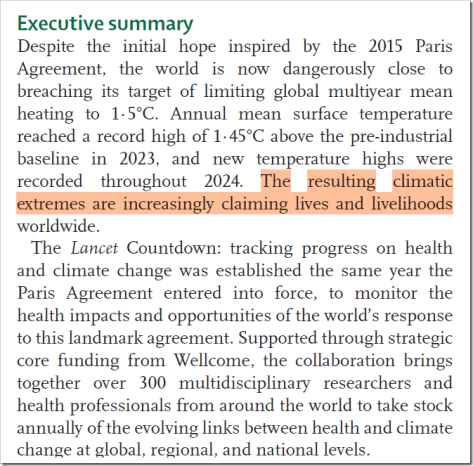
And sure enough, they claim to have found “record-breaking threats” to health and even survival:
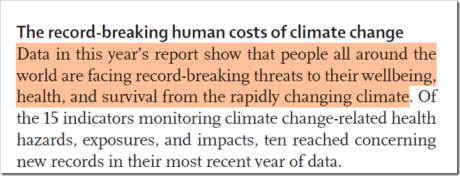
Each year is the same – they ignore real world data, which positively shows the opposite to be true, and instead concoct increasingly obscure and dubious ways to satisfy their agenda.
The idea, of course, that the world’s climate has changed so much since 2015 is itself absurd – but that does not stop the Lancet from saying it has!
They start by claiming that heat-related deaths have increased since the 1990s, but there is no mention of the fact that cold-related deaths have decreased by many more. They claim that heat exposure has reduced labour productivity, forgetting that, thanks to mechanisation, productivity has rocketed and workers are therefore less exposed to heat stress.
They claim that extreme precipitation has increased since 1960, but this is not derived from real world data, which is far too sparse to make such bold claims. Instead it is all based on computer modelling.
To be fair, the IPCC also claim that the number of heavy rainfall events has been increasing, but significantly also tell us that they can find no global trends in floods. In many places heavy rainfall is welcomed because it alleviates drought. Try telling the Indians that they had too much rainfall during this summer’s monsoon. As for those who suffered during the Dust Bowl years in the US, they would have given their right arm for a few storms.
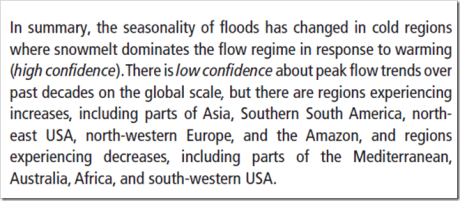
IPCC AR6
It is the same with drought. Apparently 48% of the world’s landmass was affected by at least 1 month of extreme drought last year, up from 15% in the 1950s. But droughts build up over a period of months and even years, not one single month. It is plainly ridiculous to use such a metric – I wonder why they did?
And as with extreme precipitation, the Lancet study does not use actual rainfall data, but computer models which can be programmed to come up with any results you want, because the real world data they would need simply does not exist for most of the world.
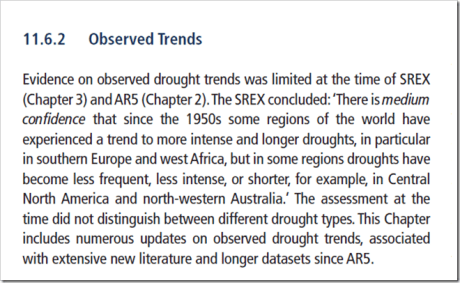
But where we do have actual precipitation data, the IPCC only find that although some regions have seen an increase in droughts, while others have seen fewer:
And so it goes on. Apparently there are more sand storms, but again this is gleaned from computer models, a “state-of-the-art multimodel reanalysis ensemble”.
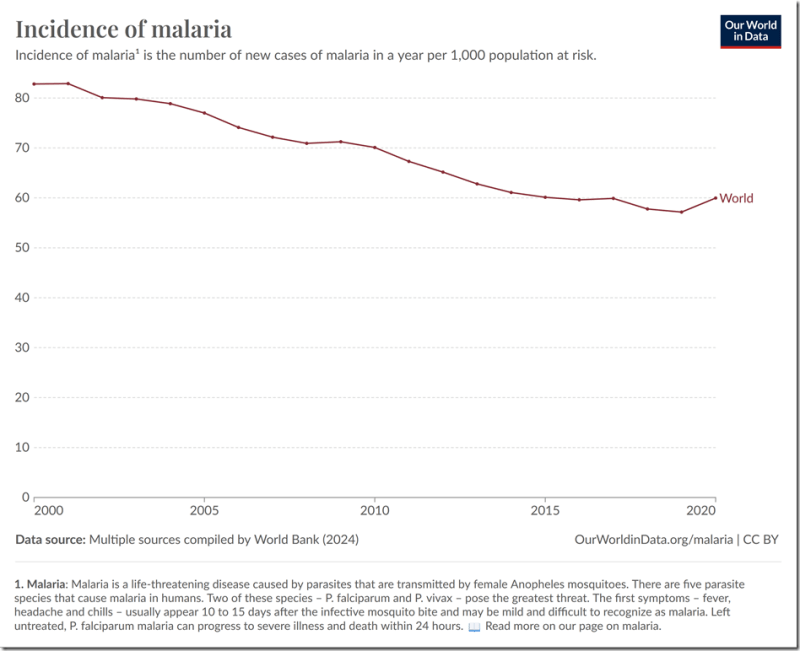
Malaria, we are told, is being spread by global warming, despite the fact that the number of new cases has been steadily dropping, with the exception of COVID affected 2020:
But the biggest joke of all must be this:
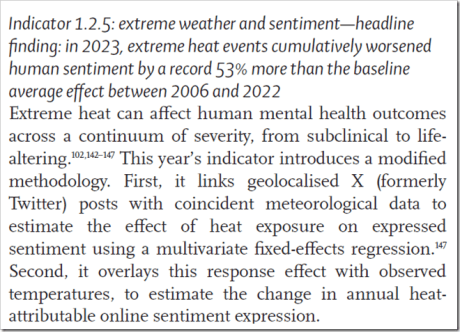
The mind boggles!
If they really were concerned about global health, there is plenty or incontrovertible, real world data which they could use, instead of their phoney models.
Around the world people live longer, child mortality is much lower, fewer live in extreme poverty or are undernourished. They live healthier lives, thanks to better access to clean water, medicines and healthcare. The children are better education, and technology is transforming people’s lives.
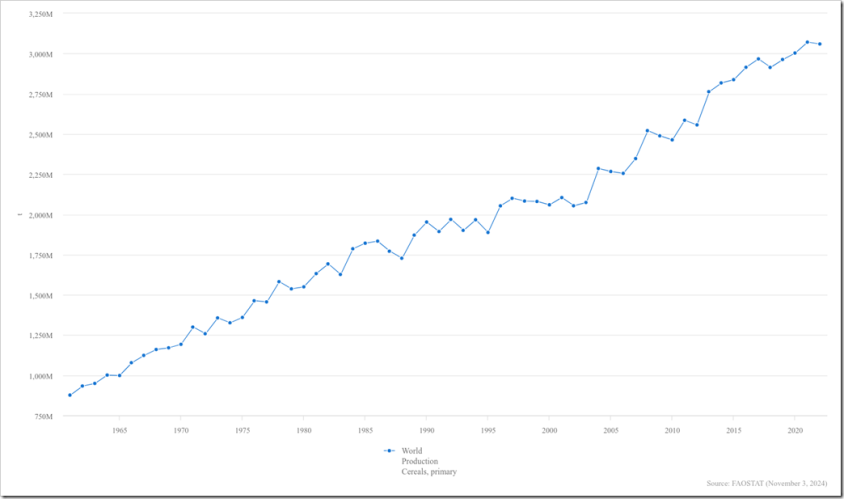
Thanks mainly to fossil fuels food output hits new records year after year. Meanwhile in contrast to the Lancet’s claims of desertification, the planet is greening because of increasing amounts of CO2 in the atmosphere.
But the Lancet are not interested in the truth, nor for that matter do they appear to care about global health.
They only want to generate alarmist headlines, to push forward their Net Zero agenda.
GM soybean oil damages liver and kidneys
GM Watch | October 12, 2024
New rat feeding study is further proof that GM soy isn’t substantially equivalent to non-GM soy. Report: Claire Robinson
A diet containing GM soybean oil damaged the liver and kidney of rats in a new 90-day feeding study conducted by Iranian scientists. The study provides further proof that GM soy is not substantially equivalent to non-GM soy, meaning that regulatory authorisations given on the assumption of equivalence are invalid.
The study, by Horyie Taheri of Tabriz University of Medical Sciences and colleagues, was conducted on 18 male rats in three different groups (6 rats per group). One group was fed a diet containing 10% GM soybean oil for 90 days, while the other two groups served as control groups, receiving either non-GM soybean oil or a standard lab diet, respectively.
The scientists carried out biochemical analysis of the blood and at the end of the experiment, microscopic tissue analysis (histopathology) of the liver and kidneys.
The scientists found that GM soybean oil caused several histological abnormalities in the liver, including congestion, necrosis, and bile duct hyperplasia (increased cell production, which may indicate a pre-cancerous state).
Similarly, congestion, haemorrhage, and glomerulosclerosis (scarring of small blood vessels) were found in the kidney analysis. Moreover, GM soybean oil significantly increased gamma-glutamyl transferase (a possible sign of liver disease or damage) and insulin (often associated with type 2 diabetes) levels compared to a standard diet.
Furthermore, urea and triglycerides were significantly higher in GM-fed rats compared to rats fed with standard or non-GM diet. These are respectively indications of kidney failure and a failure to break down fats, which can lead to hardening of the arteries and other diseases.
The scientists conclude: “A 90-day treatment with transgenic soy-based oil caused significant organ changes in the liver and kidneys of rats. Further studies are needed to evaluate the long-term effects to better elucidate these impacts.”
Limitations of the study
The study has certain limitations, as follows:
1. As Taheri and colleagues state, 90 days is not long enough to reveal long-term effects – for which a 2-year or longer study would be required. However, the fact that they saw adverse effects of GM soybean oil even over this medium-term period (roughly equivalent to 7-8 years in human terms) is concerning and suggests that over time, more serious disease could develop. They also suggest that measuring inflammatory markers would have been a useful addition to the study, to explain insulin resistance and other findings.
2. The error bars, in this case based on what’s known as the standard error of the mean, on some of the biochemical findings are wide. In simple terms, this indicates uncertainty in how those findings can be interpreted. This is likely due to the relatively small sample size (6 rats per group), which has caused the study to be statistically underpowered. To be fair to the authors, however, studies with as small, or smaller, sample sizes that conclude that there was no adverse effect from feeding the GM diet are promoted as showing GMO safety.
3. The authors didn’t analyse the oils for contaminants, which could have affected the results. However, feeding studies with GMOs reporting that the GM diet tested was safe also typically fail to do this.
Regarding points 2 and 3 above, there is no reason to hold a study finding harm from the GMO to different standards than a study finding safety. Moreover, we’re not aware of any other studies testing the safety of extracted GM soy oil. So currently, Taheri et al’s research seems to represent the best information we have.
4. The authors state that “having direct access to transgenic plants and their oil would be better”. Indeed, they don’t say where they obtained the GM and non-GM soybean oil or where the soybeans were grown. It’s likely that they simply bought it on the open market, as it’s generally easy to access GM and non-GM soy oil, with GM oil having to be labelled as such in Iran. If this assumption is correct, the study shows that GM soy oil bought on the open market caused adverse effects that non-GM soy oil did not. That’s a serious enough take-home message.
There are also some drafting errors in the paper which are addressed in an appendix below.
Regulatory authorisations based on a lie
GM soybean oil is routinely used by restaurants and other eateries in the UK and the EU (as an investigation of their dustbin areas often reveals), and it’s likely that the same is true of Iran. A considerable body of evidence shows that GM soy has adverse effects on animals that eat it – though we don’t know if that’s a result of the herbicide residues present in GM glyphosate-tolerant soy, or of compositional changes caused by the GM process, or a combination of both. What is clear is that GM soy isn’t substantially equivalent, in terms of biological effects, to non-GM soy. That means its regulatory authorisations worldwide, which are based on the assumption of an equivalent safety profile with that of non-GM soy, are based on a lie and should be revoked.
The new study (open access):
Taheri H, Mesgari-Abbasi M, Khordadmehr M, Rahimi Mamaghani A, Abbasalizad-Farhangi M. Effect of genetically modified soybean oil consumption on biochemical and histological changes of liver and kidney in rats. Int J Drug Res Clin. 2024; 2: e11. doi: 10.34172/ijdrc.2024.e11. https://ijdrug.com/Article/ijdrc-3048
New Report Adds to Evidence That Cellphone Radiation May Cause Brain Cancer
By Suzanne Burdick, Ph.D. |The Defender | October 22, 2024
Peer-reviewed studies showing a link between brain cancer and cellphone radiation are piling up — contradicting a recent World Health Organization (WHO)-led study that claimed there’s no evidence of a link.
South Korean researchers — who analyzed 24 studies and published their report on Oct. 10 in Environmental Health — found significantly higher risks for malignant brain tumors, meningioma and glioma on the side of the head where cellphones were held.
They also found heavy, long-term cellphone use was linked to an increased risk of glioma.
The South Korean study brings the number of meta-analyses published since 2016 linking cellphone radiation to an increased risk of brain cancer to seven, wrote Joel Moskowitz, Ph.D., on his website.
Moskowitz — who directs the Center for Family and Community Health at the University of California, Berkeley — has conducted and disseminated research on wireless technology and public health since 2009.
“These seven peer-reviewed meta-analytic studies contradict the conclusion of the recent WHO systematic review,” he said.
“Seven studies is a lot and we anticipate more in the future,” Miriam Eckenfels-Garcia, director of Children’s Health Defense’s (CHD) Electromagnetic Radiation (EMR) & Wireless program, told The Defender.
Eckenfels-Garcia said:
“We encourage the WHO to revise its stance, unlikely as this may be. It’s more likely that the WHO and other captured agencies will label non-industry friendly science as misinformation, even if this puts the public further in danger.”
Moskowitz said there’s evidence that the WHO picked industry-biased researchers to conduct its review.
Lennart Hardell, M.D., Ph.D., a leading scientist who found a link between cellphone use and gliomas, agreed. He told The Defender it was “striking” that the South Korean researchers reached a conclusion that directly contradicted the findings by the authors of the WHO study.
Hardell — an oncologist and epidemiologist with the Environment and Cancer Research Foundation who has authored more than 350 papers, almost 60 of which address wireless radiation — said:
“The WHO study authors should be responsible for their fraudulent behavior violating human health and the environment. Their lack of ethical principles in science gives a ‘green card’ to roll out this technology — and the misinformed layman is the victim.”
Brain tumor rates on the rise in Denmark
The South Korean study was published on the heels of new health data from Denmark showing that central nervous system tumors — including brain tumors — are on the rise.
Denmark is known for its high-quality tracking of cancer cases. So it’s concerning when their data show a clear increase, Mona Nilsson, co-founder and director of the Swedish Radiation Protection Foundation, told The Defender.
The Danish Cancer Registry on Sept. 30 published a report on the number of new cancer cases in Denmark, Nilsson said. It shows that central nervous system tumors have been increasing among both men and women.
Nilsson compared Danish central nervous system cancer diagnosis rates since 1995. “The data show that tumors of the central nervous system, including brain tumors, are increasing and are among the cancers that have increased most rapidly over the past 10 years, between 2014 and 2023.”

Credit: Swedish Radiation Protection Foundation
The Danish statistics contradict the notion that the rate of brain tumors isn’t on the rise, Nilsson said. “That argument has been used to claim that cellphone use is not linked to an increased risk of brain tumors or cancers in general.”
A 2023 study on brain cancer rates worldwide from 1990-2019 found a significant rise in brain cancer among both men and women in nearly all parts of the world. The study authors noted that this increase was largely seen in Western countries.
In the U.S., overall brain and other nervous system cancer rates haven’t increased, according to the National Cancer Institute. However, there are many reasons tumors may go unreported in the U.S. and other countries, according to Moskowitz.
For instance, Hardell in a 2017 peer-reviewed study found indications of underreporting in the Swedish Cancer Register.
Although the incidence of reported glioma diagnoses in U.S. adults has remained steady, Moskowitz noted in a Sept. 25 webinar, there’s been an increase in glioblastoma — “the most common and most serious malignant brain tumor.”
“We have seen increases in brain tumor incidents among children and young adults,” he added. “Clearly, more research is needed to understand these increases in tumor incidents.”
Ellie Marks told The Defender she and her son founded the California Brain Tumor Association after discovering that her husband’s brain tumor was likely caused by long-term heavy cellphone use.
After the tumor diagnosis in 2008, Marks sent her husband’s medical and phone records to wireless radiation experts, including Hardell. “They got back to me and said, ‘Yes, he is the poster boy for the cellphone brain tumor correlation,’” she recalled.
Her husband survived, but it’s not easy living with a brain tumor — and her husband is far from alone, she said. “I know many others who have experienced brain cancer attributed to their cellphone use.”
FDA turned blind eye to research linking wireless radiation and cancer
The uptick in brain cancer cases isn’t surprising, Eckenfels-Garcia said, and U.S. health agencies saw it coming.
The U.S. Food and Drug Administration (FDA) claims there’s not enough scientific evidence to link cellphone use to health problems, including brain cancer — but it rejected the findings of a $30 million study it commissioned on the topic.
At the FDA’s request, the National Toxicology Program (NTP) did a multi-year study, concluding there was “clear evidence” that male rats exposed to high levels of wireless radiation like that used in 2G and 3G cellphones developed cancerous heart tumors, and “some evidence” of tumors in the brain and adrenal gland of exposed male rats.
When the NTP in 2018 released its findings, the FDA rejected the study and in February 2020, released an unsigned literature review that criticized the study.
Commenting on the increased incidence of brain tumors, Eckenfels-Garcia said, “So essentially this is an ‘I told you so’ moment. This is exactly what happens when our captured government agencies ignore science, as the FDA did with the NTP study.”
Moskowitz said the FDA should have followed up on the NTP study by conducting a formal risk assessment of wireless radiation, but that never happened. Instead, the U.S. government shut down NTP’s follow-up work on its 2018 study.
In April, CHD filed a Freedom of Information Act request with the National Institutes of Health (NIH) for documents and communications related to why the U.S. government stopped the work. The NIH has not responded to the request.
This article was originally published by The Defender — Children’s Health Defense’s News & Views Website under Creative Commons license CC BY-NC-ND 4.0. Please consider subscribing to The Defender or donating to Children’s Health Defense.
Featured Video

No Threat Can Force Iran’s Surrender /Trita Parsi & Lt Cl Daniel Davis
or go to
Aletho News Archives – Video-Images
From the Archives
An Expert Military Analysis of War with China
Actually, None is Necessary
By Fred Reed • Unz Review • December 13, 2020
The Correlation of Armed Forces: U.S. goods and services trade with China totaled an estimated $634.8 billion in 2019. Exports were $163.0 billion; imports were $471.8 billion. The U.S. goods and services trade deficit with China was $308.8 billion in 2019. Trade in services with China (exports and imports) totaled an estimated $76.7 billion in 2019. Services exports were $56.5 billion; services imports were $20.1 billion. The U.S. services trade surplus with China was $36.4 billion in 2019.
There is talk within the Washingtoniat of a possible war with China. Steve Bannon, who apparently was dropped on his head as a child, actually favors such a war. We hear the usual shoo-the-boobs alarm about how the Chinese are doing something terrible and we must gird our loins and American values and show them what for, bow wow, woof. The danger is that the current game of who-blinks-first in Asian waters might actually provoke a shooting war. You know the kind of thing: One warship refuses to get out of the way of another, a collision ensues, some retard lieutenant who signed up on waivers opens fire, and we’re off and running. It is not a good idea to let children play with matches.
The said war is discussed either in emotional terms by idiots or in purely naval terms by those familiar with such things, so we hear of the First Island Chain and the Second Island Chain and whose missiles against the other’s missiles and so on. This would be appropriate if we were fighting World War Two again. Which we aren’t. Let’s take a quick-and-dirty look at how such a war might go.
To begin the war, America would overestimate itself and underestimate China. This is doctrine in the Pentagon. … continue
Blog Roll
 Aletho News
- Iran To Target Military Industrial-Tech Complex That Facilitated Gaza Genocide
- Collapsing Empire: The Resistance Disarms ‘Israel’
- Suicide Should Not Be a Government Service
- Rethinking America’s greatest threat: Iran vs. Israel-Firsters
- Iran accuses adversaries of false flags to strain Turkey ties
- Poland rules out sending Patriot missiles to US/Israel amid war on Iran
- Tehran approves new Hormuz plan with major restrictions
- No Threat Can Force Iran’s Surrender /Trita Parsi & Lt Cl Daniel Davis
- UK’s New Pandemic Plan Would Turn Big Tech Into a Mass Location Tracking Network
- Growing insecurity, soaring prices fuel protests in north as regime bans evacuation: Sources
- If Americans Knew
- Joe Kent Urges Americans To Call White House and Congress To Object To Sending Troops Into Iran
- DNC Resolution to Reject AIPAC Funding Puts Democratic Leaders in the Hot Seat
- Swedish foundation to build 400 schools as over 650,000 Gaza children remain without education for 2 years
- Israeli army admits photshopping image of slain Lebanese journalist
- This is how Israel is systematically killing health workers under the cover of war in Lebanon
- Carrying life under fire: Israeli invasion of Lebanon leaves pregnant women facing deadly risks
- Champagne all around for the new death penalty (for Palestinians) law – Not a ceasefire Day 172
- Why are Palestinian books struggling to be seen on Amazon?
- The Line Between Affinity and Conspiracy
- As Iran targets US military bases, will they be relocated to Israel? Not a ceasefire Day 171
- No Tricks Zone
- New Study Finds Warming Saves Lives…Cold Temperatures 12 Times More Deadly Than Excess Heat
- German Science Blog Accuses PIK Climate Institute Of Hallucinating Climate Tipping Points
- Devastating Assessment Of Comirnaty Vaccine By Former Senior Pfizer Europe Toxicologist
- New Study: CO2 Is ‘Effectively Negligible’ As An Explanatory Climate Change Factor Since 2000
- Former Pfizer Toxicologist Dr. Helmut Sterz Tells Bundestag Hearing Pfizer Vaccine Should Have Never Been Approved
- Energy Expert: Germany’s Nuclear Phaseout Was A “500 Billion Euro Mistake”
- New Research: South Australia’s Mid-Holocene Sea Surface Temperatures Were 4°C Warmer Than Today
- Storing Green Energy To Last Germany 10 Days Would Require A 60-Million Tonne Battery
- New Studies: UK Sea Levels Were 4 Meters Higher Than Today During The Mid-Holocene
- Destructive Green New Deal: German Energy And Metal Group Warns Of Drastic Crisis
 Aletho News