Neutral for now: Persian Gulf states’ gamble in the Iran-Israel showdown
With Iran’s vow to retaliate against Israel, Persian Gulf states face a delicate balancing act – caught between asserting autonomy and increasing dependence on US security, all while the Resistance Axis enjoys unprecedented popularity in the region.
By Mawadda Iskandar | The Cradle | November 4, 2024
The signs of an impending Iranian response to Israel’s airstrike on Iranian military interests last month are becoming clearer. Official statements from Tehran suggest a military retaliation is inevitable and could occur before the US elections on 5 November – with some reports indicating it may be launched from Iraqi territory to curb the cycle of back-and-forth escalations that began on 1 April following Tel Aviv’s targeting of the Iranian consulate in Damascus.
Both sides are seeking to establish a new deterrence balance, albeit with very different aims. Iran, whose sovereignty has been repeatedly violated, warns of the danger posed by Israel’s expansionist ambitions in the region, while Israel, as the aggressor, seems intent on dragging the entire region into chaos, banking on unwavering US support.
Two distinct camps have emerged: on one side, the Israeli-US alliance and its supporters, and on the other, the countries of the Resistance Axis, which have launched the “battle of unity” in support of Gaza. Caught between these factions is a third group, one that seeks neutrality, unwilling to pick a side for fear of compromising its own interests.
The US is struggling to maintain influence, while Israel is playing what may be its final card. The question remains: where do the Persian Gulf states stand?
Airspace restrictions and Gulf diplomacy
The Persian Gulf states have unanimously condemned Israel’s 26 October strikes on Iranian sites, which came in response to Tehran’s own retaliatory missile attacks earlier last month following high-profile assassinations of resistance leaders carried out by the occupation state.
Statements from the Gulf Cooperation Council (GCC), Saudi Arabia, Qatar, Bahrain, the UAE, Kuwait, and Oman condemned these strikes as violations of Iranian sovereignty, escalating tensions in an already volatile West Asia.
Saudi Arabia, the UAE, and Qatar have taken a firm stance, refusing to allow Israel to use their airspace to launch further strikes against Iran, a position echoed by Jordan, which was prompted to officially deny it had allowed Israel to use its airspace to attack the Islamic Republic.
This reassured Tehran, which had threatened a forceful response against any country that facilitated Israeli attacks. These diplomatic messages coincided with Iran opening new channels of dialogue, including President Masoud Pezeshkian’s meeting with GCC officials, followed by Foreign Minister Abbas Araqchi’s diplomatic tour that included Lebanon, Syria, Saudi Arabia, Qatar, Bahrain, Kuwait, Iraq, Oman, Jordan, Egypt, and Turkiye.
Despite Amman’s claim that its airspace was not used in the recent attack, videos have emerged documenting Israeli fighter jets over Jordanian skies. Similarly, Saudi Arabia claimed its airspace was not used during the strikes, raising questions about how Israeli planes refueled over such long distances. Israel subsequently admitted to using refueling aircraft to bypass Persian Gulf airspace restrictions.
Speaking to The Cradle, Lebanese military analyst Omar Maarabouni contends that “In principle, and based on and in connection with the recent Israeli attack, a group of Gulf countries, led by Saudi Arabia, stated that they prevented the Israelis from passing through their airspace, and this is something that Iranian radar can confirm or deny, and indeed the official Iranian statement confirms that these aircraft did not pass through Gulf airspace.”
Maarabouni adds that agreements between the US and Persian Gulf states are defensive in nature, allowing these states to prevent US bases from being used offensively against Iran, especially since improved relations with Iran are now in their interest. Regarding alternative Israeli plans, Maarabouni says:
“It is quite clear that Israeli planes took the path associated with Syria and then Iraq towards Iran, and therefore we are talking about a distance of 2,000 km back and forth, and this is what Israel was keen to avoid over the issue of refueling, as F-35 and F-15 aircraft can travel distances exceeding 2,200 km without the need to refuel.”
Jordan, he says, meanwhile, finds itself in an awkward position, having claimed that Iranian missiles breached its sovereignty, despite such missiles traveling at altitudes beyond the limits recognized under international airspace law. As Maarabouni points out:
“The one who violated Jordanian sovereignty is Israel, which fired air defense missiles into Jordanian airspace to intercept Iranian missiles, but it is unclear why Jordan has adopted the responsibility of blaming the violation of its sovereignty on both Iran and Israel.”
Oil on the frontline
Persian Gulf states are wary of being dragged into the escalating conflict, especially as they attempt to close the chapter on their failing Yemen war, which backfired horribly following devastating attacks on Saudi Arabia’s prized Aramco facilities in 2019.
These strikes exposed the vulnerability of the “oil for protection” security framework under US patronage. In their recent overtures to Iran, GCC states also urged Washington to pressure Israel against targeting Iranian oil infrastructure, warning of disastrous consequences for global energy markets.
Sources in the Persian Gulf, speaking on condition of anonymity, inform The Cradle that while the Gulf states were aware of the timing of Israel’s attack, they were ready to mediate with the US if the situation escalated.
Following the attack’s failure, these states rushed to issue condemnatory statements, emphasizing their unwillingness to be drawn into direct hostilities against Tehran, despite their quiet acceptance – and even encouragement – of actions that might undermine Iranian influence or its nuclear ambitions. The Persian Gulf monarchies are eager to shield themselves from any backlash amid rising global anger over the atrocities in Gaza and Lebanon, which have put normalization efforts with Israel on hold.
US intervention: A double-edged sword
The White House has warned Iran against retaliating to Israeli strikes, stating that the US would support Israel if attacked and floating the notion that Washington “can’t restrain” Tel Aviv in the event of further attacks from Iran.
Former hawkish US national security advisor John Bolton boasted that Israel would use Persian Gulf airspace if needed, and that “these governments may complain about this, but frankly, they see Iran as a strategic threat because of its nuclear program, as well as Iran’s old support for terrorists, not only Hezbollah and Hamas, but the Houthis and Shia militias in Iraq.”
The Persian Gulf states now find themselves caught between their desire for autonomy and their dependency on US security guarantees – particularly in light of the numerous US bases spread across their territories, which primarily serve to protect Washington’s [or rather Israel’s] regional interests.
Agreements between the US and Persian Gulf states grant American forces access to airspace, ports, and military bases in these countries, providing logistical support for regional operations. While Gulf states have formally rejected offensive US operations from their territories, they still allow defensive activities.
Qatar, the only official non-NATO ally of the US, hosts the largest concentration of US forces at Al-Udeid and Al-Sailiya bases. Kuwait ranks second in terms of the quantity and quality of US assets located at four bases: Camp Doha, Arifjan, Ali al-Salem, and Buehring.
The UAE has three US bases, Al-Dhafra, Fujairah, and Jebel Ali Port, all of which provide logistical support services. As for the US facilities in Saudi Arabia, they are Eskan Village and Prince Sultan Air Base, which offer the provision of air and missile defense systems and the use of military aircraft. Bahrain hosts three bases: Juffair, Sheikh Isa, and Muharraq, and Oman hosts a similar number: Al-Masna, Thumrait, and Masira.
All of these countries fall under the domain of US Central Command (CENTCOM), which works to “counter the Iranian threat.”
Last year’s Operation Al-Aqsa Flood has reignited the debate over Persian Gulf security dependence on Washington. Experts argue that the current escalation between Iran and Israel will force Gulf states to find a balance between their diplomatic rapprochement with Tehran on the one hand, and their commitment to a US-led regional security alliance on the other.
The US has sought to reassure Persian Gulf leaders, offering assistance in defending against any potential Iranian aggression. To back up its words, the US approved a $440 million sale of TOW missiles to Riyadh and authorized the sale of over $2.2 billion in weapons and ammunition to Saudi Arabia and the UAE.
Balancing public condemnation with covert cooperation
Investigative journalist Bob Woodward’s new book War, which sheds light on recent GCC–Israeli dynamics, reveals that regional rulers, including those of the UAE, Bahrain, Saudi Arabia, and Qatar, unanimously agree – in private – on the need to eliminate Hamas, while working quietly to minimize public backlash over their covert cooperation with Israel.
After last October’s Operation Al-Aqsa Flood, Persian Gulf states condemned the attack but later launched diplomatic efforts to prevent regional tensions from escalating further. Notably, these developments have disrupted key projects, including normalization with Israel and economic diversification plans, particularly in Saudi Arabia.
Iranian journalist Mohammad Gharavi tells The Cradle that the events of 7 October, 2023 strained what had been positive Saudi-Iranian relations:
“The Iranians believed that a positive relationship would have a positive impact in terms of supporting the Palestinian cause, but the Saudi position was neutral despite the historical opportunity that could have been invested at home and in the Islamic environment. Unfortunately, the Palestinian issue is the prominent point of contention with the GCC, which is why we are sending messages that the opportunity is ripe to change this course.”
He describes Saudi–Iranian relations as having made significant advancements in terms of coordination and cooperation since the two neighboring states struck a rapprochement deal in Beijing last year:
“Iran’s reassuring messages, as well as warnings not to go too far in cooperating with the Americans and Israelis to antagonize Iran or using air, land and sea spaces to direct hostile action against it, were influential and positive and can be built upon in the coming stage, as it reflects the determination of the two countries to put aside differences in the interest of the security of the two countries and protect the strategic alliance with China and others for what it holds of economic dimensions.”
Ultimately, the Persian Gulf states remain neutral – for now. Their future course, however, will depend on visible and tangible US assurances. If such guarantees are secured, the Gulf may be willing to align more openly against Iran, given that their interests clash with those of the Resistance Axis, which promotes regional independence and self-determination – ideas that resonate with the Arab masses throughout West Asia.
8 Comments »
Leave a comment
Featured Video

The Sordid History of the CIA – Part 2
or go to
Aletho News Archives – Video-Images
From the Archives
Rabbi Shmuel Eliyahu: Leave No Palestinian or Arab Alive
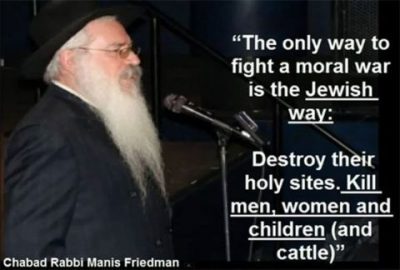
By Jonas E. Alexis | Veterans Today | July 23, 2017
Israeli Rabbi Shmuel Eliyahu seems to have picked up where the late Rabbi Ovadiah Yosef left off. The Israeli army, Eliyahu said, must slaughter the Palestinians “and leave no one alive.” The Palestinians, the good rabbi continued, must be “destroyed and crushed in order to end violence.” Here is Eliyahu’s algorithm:
“If they don’t stop after we kill 100, then we must kill 1,000. And if they do not stop after 1,000, then we must kill 10,000. If they still don’t stop we must kill 100,000, even a million.”
There is more to this “logic” than meets the eye and ear. Eliyahu even postulated that the Israeli army ought not to get involved in arresting Palestinians because “If you leave him alive, there is a fear that he will be released and kill other people. We must eradicate this evil from within our midst.”
You may say that this is just an isolated case. No Israeli official believes that, right? … continue
Blog Roll
Recent Comments


 Aletho News
- Jeffrey Epstein’s sinister shadow over West Asia
- The Sordid History of the CIA – Part 2
- French FM under fire over ‘false’ claims about UN rapporteur
- Israel Wants ISIS-Linked Militias To Control Rafah Crossing — The New Order in Gaza
- ISIS never left Syria, it just changed uniforms
- Why ARE the US and Israel Obsessed With Eliminating Iran’s Ballistic Missiles?
- Kremlin comments on EU ‘myopia’ over dialogue with Russia
- Russia more adapted to contemporary military technology than NATO
- Germany puts caveat on more missiles for Ukraine
- UK High Court rules Palestine Action ban unlawful
- If Americans Knew
- Noor’s short life of unimaginable suffering
- Israel Destroyed Gaza’s Hospitals. Now It’s Banning Doctors Without Borders.
- Is Spite of What Zionists Say, It’s a Good Thing to Criticize Governments
- Palestinian mother, daughter recount strip searches, harsh conditions in Israeli detention
- Israel used weapons in Gaza that made thousands of Palestinians evaporate
- ADL’s Stats Twist Israel’s Critics Into Antisemites
- Why Is the World Silent When the Gaza Genocide Is Not Over?
- In Gaza: 8,000 bodies under rubble, 3,000 missing – Not a ceasefire Day 126
- AZAPAC, the new PAC opposing Israeli domination of U.S policies
- Haim Saban: Billionaire for Israel
- No Tricks Zone
- German Gas Crisis…Chancellor Merz Allegedly Bans Gas Debate Ahead of Elections!
- Pollen Reconstructions Show The Last Glacial’s Warming Events Were Global, 10x Greater Than Modern
- Germany’s Natural Gas Storage Level Dwindles To Just 28%… Increasingly Critical
- New Study Rebuts The Assumption That Anthropogenic CO2 Molecules Have ‘Special’ Properties
- Climate Scientist Who Predicted End Of “Heavy Frost And Snow” Now Refuses Media Inquiries
- Polar Bear Numbers Rising And Health Improving In Areas With The Most Rapid Sea Ice Decline
- One Reason Only For Germany’s Heating Gas Crisis: Its Hardcore-Dumbass Energy Policy
- 130 Years Later: The CO2 Greenhouse Effect Is Still Only An Imaginary-World Thought Experiment
- New Study Affirms Rising CO2’s Greening Impact Across India – A Region With No Net Warming In 75 Years
- Germany’s Natural Gas Crisis Escalates … One Storage Site Near Empty …Government Silent
 Aletho News
A — mostly — superlative post!
Go, Axis of Resistance to Colonial USrael Zionism!
Viva Palestine! Viva Lebanon!
LikeLike
” …Their future course, however, will depend on visible and tangible US assurances. …”
Are you insane?
The only threat to the Gulf states comes from the USA via the CIA, and they all know it.
The only fear of the Emirs is another CIA run “Arab Spring” or another “Maidan”. None of them are scared of Iran or Syria or Iraq.
The only reason that the US has bases in Kuwait is because the US instigated Hussein to invade in 1990 with US provided weapons, and Kuwait had to pay the US billions of dollars to get him thrown out.
The Kuwaitis know who are the enemy and any American in Kuwait (off-base) is treated with contempt and will literally be served a “Shit-sandwich” at any establishment, and the Americans know it. The Kuwaitis refuse to carry any passenger with an Israeli passport and were/are willing to be banned from the US regardless of the enormous loss of revenue. The only thing that is more strictly banned and hated in Kuwait than pork, is any person or product in any way associated or sourced from Israel. They admire and respect Iran but cannot say so without having the US again destroy the country.
Russia in Syria has stopped the US in it’s tracks and the rest of the Arab world has taken notice.
The Hegemon is dead.
LikeLiked by 1 person
Hear, hear!
(One of my quivers of discontent was “Investigative journalist Bob Woodward’s new book War, which sheds light on recent GCC–Israeli dynamics, reveals that regional rulers, including those of the UAE, Bahrain, Saudi Arabia, and Qatar, unanimously agree – in private – on the need to eliminate Hamas….” Hell, Qatar has been a significant supporter of Gaza/Hamas for years, including massive funding and other succor. I simply cannot accept Woodward in that regard…or Iskander’s giving him space and credence/visibility. Besides, even if Hamas were eliminated, there’d be another Hamas waiting in the valorous Palestinian resistance wings. … Am I wrong? Let me know….)
LikeLike
I am not sure how many Palestinians are in Qatar but they are acting as intermediaries for Hamas and Hezbollah with US and Israel.
Like the PLO office in London or the ANC office that used to be in Addis Ababa.
LikeLiked by 1 person
The Arab states are monarchies, all of them. Like the West, they hold ‘democratic’ elections and like the West, the elections are meaningless.
The only disagreement between them is the oil boundaries and the price. All of the states are screwed by the US oil companies and have been for 70 years, but the moment that they tell the oil companies to screw off (as Kuwait did in the 1980s) bad things happen.The ‘Royal’ families are huge in each country and control the whole establishment, defence, police, commerce, the banks and control the whole bureaucracy.
They have two issues. 1) the ‘Royal’ families and the noble families form only 10% – 20% of the population and unless well paid and looked after, the other families cause trouble. As long as there is plenty to go around this is not a problem. In Kuwait, (all) men work 20 years for any branch of the government and retire on full pension to then start any business or pastime that they want. Women (some) only have to work 15 years for the same benefit. This same applies to all the gulf states, except Iran.
2) All the states have large ‘contract’ populations from primarily the east asian countries, Bangladesh, Indonesia, Philippines etc who stay for 3 -10 years sending 90% of their meagre earnings back to the families. These contractors often outnumber the Arab by a factor of 2 :1 up to 10:1. They form a potential ‘army’ should some outsider want a colour revolution. Fortunately the Arab has no qualms about putting down such a revolution with extreme prejudice.
The displaced Palestinians form a huge problem for the States. They do not need the people. They are Arabs, but not ‘our Arabs’. In the 60s – 80s these Palestinians were welcomed but they have no real standing in the countries and have no loyalty to the establishment. Hence a large number of Palestinians in Kuwait welcomed Hussein, hoping he would improve their status. Of course when the ‘allies’ arrived, these Palestinians found themselves hanging from lamp-posts all down the main streets.
Hamas and Hezbollah are probably the best trained, most experienced and motivated soldier/warriors on the planet. Inviting them in would be like inviting the Vikings to come and settle in London. Imagine 100,000 of these guys arriving in New York or Houston, game over. (Their little untrained brothers have already taken over half of France and 25% of the UK)
The States are not strong enough individually to withstand the US. At this time they are not strong enough to repel the US even if they all stood together. However OPEC has put a big damper on US power and China-Russia-Iran are quickly moving in with both money and military power. The real big player is Turkey. It is Muslim but not Arab and has the largest army and biggest armoury in the area. It has dreams of the Ottoman empire and only Russia is stopping restoring that dream. US and Israel would let it happen if Turkey agreed to allowing a ‘Greater Israel’ with all arabs dead or expelled.
Personally I think a BRICS solution is possible with the Iranian dream becoming reality.
–
So what did Ahmadinejad actually say? To quote his exact words in Farsi:
“Imam ghoft een rezhim-e ishghalgar-e qods bayad az safheh-ye ruzgar mahv shavad.”
The full quote translated directly to English:
“The Imam said this regime occupying Jerusalem must vanish from the page of time.”
LikeLiked by 1 person
Soooo interesting! Many thanks for this geopolitical journey.
Re your “In the 60s – 80s these Palestinians were welcomed but they have no real standing in the countries and have no loyalty to the establishment.”: When the US Army assigned me to Monterey, CA’s Defense Language Institute in August1964 for a year’s immersion study of the Arabic language and culture, ALL of the instructor staff — from Morocco, Egypt, Jordan (refugeed Palestinian), Syria, Lebanon, plus Iraqi department chair — referred to the Palestinians with obvious respect as “the intellectuals of the Middle East.” I specifically remember Kuwait cited as a prime beneficiary…engineers, bureaucrats, teachers, doctors…. It’s obvious, isn’t it, that after the “60s – 80s,” the ruling ‘elites/royals’ in KSA et al fell prey to the money-cargoship loads of crude and decided that the Palestinians would “have no real standing in their countries”?
Viva Palestine, including Freedom-Fighting Hamas! Viva the entire valorous Axis of Resistance to various evils and demons and colonialists! The insanity of it all….
(You mention Ahmadinejad. I admired him in the early 2000s…was roundly pilloried by various parties. I recall that, circa 2005, he issued an 18-page point paper proposing that adults in the room begin to take charge. I read it word for word [translated, natch], thought it an admirable basis for “diplomacy for a change,” and could only lament that the US Zio-occupied government (sic), plus lapdog Europe of course, totally blew it off, not even according it the light of day.)
LikeLike
Sure they were experts but no matter how long they lived in Kuwait, they were not Kuwaitis or members of the tribes.
That is why they supported Hussein and would have supported Mubarak or Gaddafi. Like Sunak and Badenoch (or Obama) they are never going to belong and never going to have real power. They were political and not tribal. In the Gulf all power and allegiance is in the tribes, not in some imposed and imaginary ‘nation’ or country.
–
“Muruwah is … it is everything. It is the very heart and soul of all the Arab people.
A person who has ‘Muruwah’ is loyal, is forgiving, is generous, and doesn’t commit crimes. Muruwah is persistence, it is kindness, loyalty, bravery, it is integrity. Muruwah is being faithful to one’s family, to one’s tribe, it is the ethos.
Muruwah is patience when you are suffering, courage when in battle, and always vengeance to protect the tribe. To always repay an insult. To always avenge harm to oneself or family. Always, always vengeance.
Muruwah is an unwavering, absolute determination to avenge any wrong done to the family and tribe, to protect the weak members, and defy all enemies.”
*
Arabic is like English, not all people who speak English are English. Not all people who speak Arabic are Arabs.
LikeLiked by 1 person
P.s. “Personally I think a BRICS solution is possible with the Iranian dream becoming reality.” Hurrah!
LikeLike