Study Showing ‘High Likelihood’ of Link Between COVID Vaccines and Death Republished in Peer-reviewed Journal
By Suzanne Burdick, Ph.D. | The Defender | November 18, 2024
The largest COVID-19 vaccine autopsy study to date has been republished in a peer-reviewed journal — after twice being censored, according to Nicolas Hulscher, the paper’s lead author and an epidemiologist at the McCullough Foundation.
Science, Public Health Policy and the Law on Nov. 17 published the study, which had been previously withdrawn from Preprints with The Lancet and Forensic Science International.
Hulscher told The Defender the study’s republication signals a “pivotal victory for transparency and accountability in science.” It also marks “a significant setback” for actors in the biopharmaceutical complex and “their Academic Publishing Cartel,” Hulscher said.
Hulscher’s co-authors include Dr. Harvey Risch, Dr. Peter A. McCullough and Dr. William Makis.
Hulscher told The Defender the study provides “robust evidence that COVID-19 vaccines can cause death. This means that the FDA’s [U.S. Food and Drug Administration] criteria for a Class I recall have been fulfilled, warranting an immediate market withdrawal.”
The FDA defines a Class I product recall as “a situation in which there is a reasonable probability that the use of or exposure to a violative product will cause serious adverse health consequences or death.”
Risch, professor emeritus of epidemiology at the Yale School of Public Health, told The Defender that the COVID-19 vaccine spike protein “can stay around in some people and continue to do inflammatory damage in any site where it gets to through the bloodstream.”
In ‘striking act of censorship’ publishers withdraw study, shut down debate
The study’s publication in Science, Public Health Policy and the Law is the latest twist in an ongoing saga as the authors have tried to get their research out to the public and scientific community, Hulscher wrote on Substack.
The study results were first made public on July 5, 2023, as a preprint with The Lancet on SSRN, an open-access research platform.
However, Preprints with The Lancet removed the study from the server within 24 hours, posting a statement that the study’s conclusions were “not supported by the study methodology,” The Daily Sceptic reported.
McCullough told The Epoch Times that the study was experiencing “hundreds of reviews per minute” before its removal.
Preprint servers offer a place for the public to view scientific reports and papers while they undergo peer review, making scientific findings available immediately and for free and opening them up to broader public debate.
The authors subsequently posted on the Zenodo preprint server, while the review underwent peer review at Forensic Science International. It was downloaded over 130,000 times.
On June 21, 2024, after successful peer review, Forensic Science International published the study.
Within weeks, the study became the top trending research paper worldwide across all subject areas, according to the Observatory of International Research, Hulscher recalled.
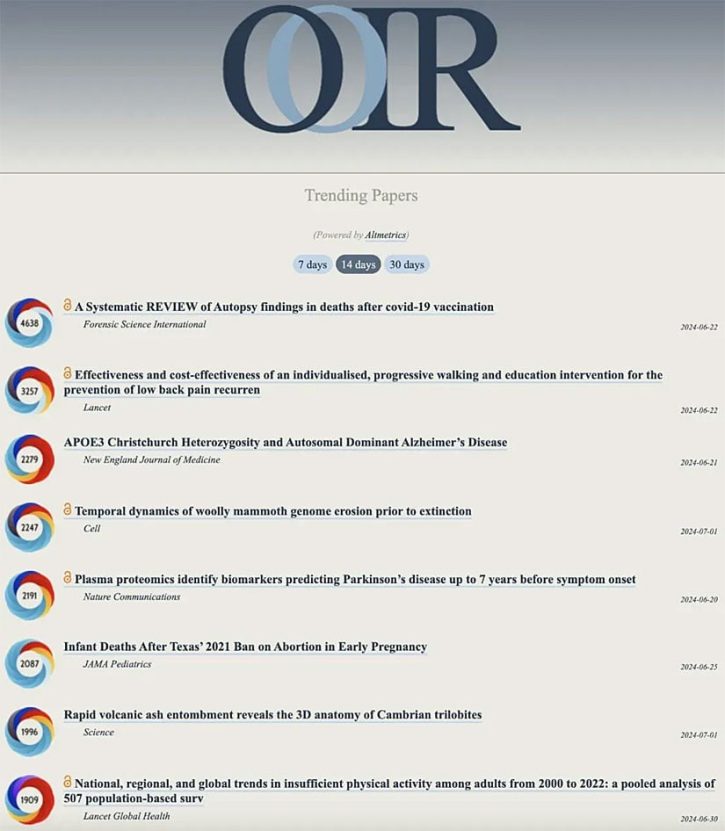
“Unfortunately,” Hulscher wrote on Substack, “in a striking act of censorship, Elsevier and Forensic Science International withdrew the article on August 2nd, 2024 in flagrant violation of their own withdrawal policy and COPE guidelines.”
He said they “left no traces behind, completely wiping our paper from the webpage.”
Elsevier and Forensic Science International said that “members of the scientific community” — who remained anonymous, Hulscher pointed out — cited numerous concerns about the study, including inappropriate citation references, inappropriate methodological design and a lack of factual support for its conclusions.
The concerns were “unfounded,” Hulscher wrote. The study authors wrote a rebuttal defending their study and submitted a revised manuscript. However, Elsevier and Forensic Science International rejected the revised manuscript.
Hulscher noted that Elsevier and Forensic Science International “failed to follow the proper scientific discourse method of allowing debate in Letters to the Editor.” Instead, they shut down the possibility of debate by censoring the study.
“This type of academic censorship poses a serious threat to the progress of scientific discovery,” he said.
73.9% of deaths reviewed by authors linked to COVID vaccines
As The Defender previously reported, the study authors did a systematic review of studies on autopsy findings following COVID-19 vaccination.
They first searched PubMed and ScienceDirect for all published autopsy and necropsy — another word for autopsy — reports related to COVID-19 vaccination in which the death occurred after vaccination.
They screened out 562 duplicate studies among the 678 studies initially identified in their search. Other papers were removed because they lacked information about vaccination status.
Ultimately, they evaluated 44 papers containing 325 autopsies and one necropsy case. Three physicians independently reviewed each case and adjudicated whether or not the COVID-19 shot was the direct cause or contributed significantly to the death reported.
They found 240 of the deaths (73.9%) were found to be “directly due to or significantly contributed to by COVID-19 vaccination.” The mean age for death was 70.4 years old.
Primary causes of death included sudden cardiac death, which happened in 35% of cases, pulmonary embolism and myocardial infarction, which occurred in 12.5% and 12% of the cases respectively.
Other causes included vaccine-induced immune thrombotic thrombocytopenia, myocarditis, multisystem inflammatory syndrome and cerebral hemorrhage.
Most deaths occurred within a week of the last shot.
The authors concluded that because the deaths were highly consistent with the known mechanisms for COVID-19 vaccine injury, it was highly likely the deaths were causally linked to the vaccine.
They said the findings “amplify” existing concerns about the vaccines, including those related to vaccine-induced myocarditis and myocardial infarction and the effects of the spike protein more broadly.
They also said the studies have implications for unanticipated deaths among vaccinated people with no previous illness. “We can infer that in such cases, death may have been caused by COVID-19 vaccination,” they wrote.
The authors acknowledged some potential biases in the article.
First, they said, their conclusions from the autopsy findings are based on an evolving understanding of the vaccines, which are currently different from when the studies evaluated were published.
They also noted that systematic reviews have bias potential in general because of biases that may exist at the level of the individual papers and their acceptance into the peer-reviewed literature.
They said publication bias could have affected their results because the global push for mass vaccination has made investigators hesitant to report adverse events.
They also said their research did not account for confounding variables like concomitant illnesses, drug interactions and other factors that may have had a causal role in the reported deaths.
This article was originally published by The Defender — Children’s Health Defense’s News & Views Website under Creative Commons license CC BY-NC-ND 4.0. Please consider subscribing to The Defender or donating to Children’s Health Defense.
Russian journalist killed by Ukrainian drone strike

Yulia Kuznetsova © VK
RT | November 18, 2024
The editor-in-chief of a local newspaper in Russia’s Kursk Region, was killed in a Ukrainian drone strike on Sunday, Governor Aleksey Smirnov has said. Yulia Kuznetsova, joined the Narodnaya Gazeta paper in 2008 and was promoted to editor-in-chief last summer.
She was traveling by car along the Dyakonovo–Sudzha highway when an unmanned aerial vehicle (UAV) struck. The 34-year-old was accompanied by a colleague and a police officer, both of whom sustained injuries and were taken to hospital for treatment.
“Today, in the Bolshesoldatsky District, the Editor-in-Chief of Narodnaya Gazeta, Yulia Nikolaevna Kuznetsova, was killed as a result of a Ukrainian drone attack on a car,” Governor Smirnov wrote on his Telegram channel on Sunday, expressing his condolences. Kuznetsova had been transporting archive documents from the regional office and was planning to report on the situation in the area, he added.
Despite being evacuated from her hometown, Kuznetsova continued to run the newspaper from Kursk, giving readers an insight into what was happening in their home district.
Kuznetova is survived by her husband and two children. The Russian Investigative Committee has launched a criminal probe on charges of terrorism over the killing.
Several Russian journalists covering the fighting in Ukraine have been targeted by Kiev’s forces since the conflict escalated in February 2022.
In September, Russian war correspondent Aleksandr Korobov was ambushed and fatally injured by Ukrainian soldiers while reporting on shelling incidents in Belgorod Region. The same month, Evgeny Poddubny, a veteran correspondent for the Russia-1 TV channel, was wounded when a Ukrainian kamikaze drone hit his car while he was covering hostilities in the Kursk Region.
Moscow has accused the Ukrainian military of deliberately attacking the press, and Russian President Vladimir Putin has said “at least 30” journalists have been killed since the beginning of the conflict.
Former Biden Press Sec. Psaki Demands New Laws to Curb Online “Disinformation” After Harris Loss
By Cindy Harper | Reclaim The Net | November 18, 2024
Former White House press secretary, notorious for saying that the Biden administration had been flagging social media posts for “misinformation” recently voiced concerns on the Next Question podcast with Katie Couric about the pervasive spread of “disinformation” on social media, attributing it as a significant factor in Vice President Kamala Harris’s electoral defeat to President-elect Donald Trump. Psaki called for legislative changes to enhance accountability for social media platforms.
“One of the things that’s changed even since I got involved in politics is just the rise of the percentage of people who get their information off of platforms that have no fact-checking mechanism and no accountability for having disinformation spread,” Psaki said.
During their discussion, Psaki lamented the evolution of information dissemination, noting the increasing reliance on platforms free of legacy control. She highlighted the discrepancy in standards between local TV and social media, stating, “Local TV is held to a higher standard of accountability than social media platforms in terms of accurate information on their platforms. That is crazy!”
Psaki added, “Laws have to change. I don’t even know the entire answer to it but that seems to me to be a core issue.”
Psaki didn’t mention the First Amendment.
German Man is Raided By Police For Calling Pro-Censorship Vice Chancellor an “Idiot”
By Cindy Harper | Reclaim The Net | November 18, 2024
Yet another event in Germany has raised major concerns about freedom of speech. A 64-year-old pensioner from the Bavarian town of Bamberg found himself at the center of a legal storm after he posted a meme on social media that depicted pro-censorship Vice Chancellor Robert Habeck as a “Schwachkopf Professional” or “professional idiot.” This action prompted a police raid on his home where his computer and phone were seized.
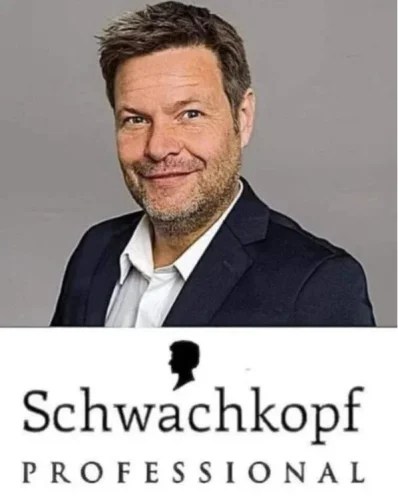
The offending image
The prosecutors statement said: “At a time that cannot currently be specified in more detail in the days or weeks before June 20, 2024, the accused published an image file using the account that shows a portrait of Federal Minister of Economics Robert Habeck with the title ‘Schwachkopf PROFESSIONAL’, based on the advertising campaign of the Schwarzkopf company, in order to generally defame Robert Habeck and to make it more difficult for him to work as a member of the federal government.”
The raid occurred in August, early in the morning when police officers entered the home of Stefan Niehoff, waking him and his family, which includes his wife and daughter. Niehoff, who had simply shared a meme that humorously altered a beauty care brand’s logo to feature Habeck, expressed his disbelief over the raid. He likened the aggressive enforcement to tactics used during the Communist era in East Germany.
This police action stemmed from a criminal complaint filed by Habeck himself, reacting to what he considered defamation that hindered his governmental duties. German law, refined during the tenure of the former Chancellor Angela Merkel, allows public officials to pursue criminal charges against perceived slanders relating to their official roles. Violations could result in fines or up to three years in prison.
The Vice Chancellor, along with other members of the Green party, has been an active participant in utilizing this law. Reports from the news outlet Junge Freiheit indicate that Habeck’s legal team continuously monitors social media for similar offenses, having filed 805 criminal complaints to date. His colleague, Foreign Minister Annalena Baerbock, has filed 453 such complaints.
Habeck, who wishes to become Germany’s leader, recently called for more online censorship, also calling for “the regulation of algorithms, of X or TikTok, through the application of European legal norms.”
Iranian engineer quits Google over tech giant’s collaboration with Israel amid Gaza genocide

Iranian software engineer Alireza Zakeri
Press TV – November 18, 2024
Iranian software engineer Alireza Zakeri has announced his resignation from Google over the American tech giant’s collaboration with Israel amid the regime’s genocidal war on Gaza, which has killed over 43,000 people in the territory since early October last year.
“I’m happy to announce that I have left Google!” he wrote in a post published on his Linkedin account on Monday, adding that “this decision reflects my values.”
“After learning about Google’s involvement in Project Nimbus, I voiced my concerns for several months. Unfortunately, despite the efforts of many employees, leadership chose to maintain its stance and dismiss our collective concerns,” he added.
Project Nimbus is reportedly a $1.2 billion deal between the Tel Aviv regime and Amazon and Google to provide artificial intelligence (AI) and cloud services that are also used by the Israeli military.
“Living in a way that conflicts with your core values is incredibly challenging. Choosing to step away was not easy, but it was necessary. For anyone facing similar situations, I hope you find the courage to prioritize your principles. What good is it for man to gain the whole world, yet forfeit his soul?” Zakeri pointed out.
Back on May 14, hundreds of pro-Palestinian and anti-Israel protesters demonstrated against Google’s relationship with Israel and the regime’s army at the tech company’s annual developer conference in Mountain View.
The protesters chained themselves together near the entrance to the conference, and carried a large banner reading “Google stop fueling genocide.”
A particular point of contention for the demonstrators was Project Nimbus. The project enables Israeli cabinet ministries and other entities to transfer servers and services into cloud data centers provided within the occupied territories.
The protesters, among whom were former and current Google employees, argued that the system is being lethally deployed in the Gaza war.
“We are here to say that we cannot stand by while this company fuels this genocide and profits off of it,” former Google employee Ariel Koren told The Guardian at the protest.
“[Google] not only creates the infrastructure for the Israeli military to scale out their crimes against humanity, but these tools are being tested and trained in Palestine to be exported out to militaries around the world, who can then commit the same types of violence,” she said.
Koren added she was fired from Google for opposing Project Nimbus.
Saudi Arabia to expand teaching of Chinese language with 800 more teachers amid growing demand
MEMO | November 18, 2024
Saudi Arabia is set to expand the teaching of the Chinese language by creating 800 teaching positions, amid the growing demand for learning the Chinese language in the Kingdom.
According to China’s official news agency, Xinhua, the planned appointment of the 800 new teaching roles aligns with the spread of Chinese language classes across Saudi Arabia’s primary and middle schools.
The move follows the recent successful deployment of 175 Chinese language teachers in the Kingdom, who reportedly began teaching last month. It is part of a landmark agreement struck in 2023 between Riyadh and Beijing in an effort to strengthen bilateral cooperation in language education.
Under that agreement, Saudi Arabia’s Ministry of Education collaborated with China’s Centre for Language Education and Cooperation in launching training programs for educators, conducted at Tianjin University in China, with the aim to equip teachers with the necessary skills.
The increased language cooperation between the two countries is part of the wider expansion in their relations across a variety of sectors, including trade, military, technology and energy.
EU announces sanctions on Iran’s shipping lines
Press TV – November 18, 2024
The European Union has announced sanctions on Iran’s shipping lines over claims it has been involved in the supply of weapons to Russia amid the ongoing war in Ukraine.
The European Commission, the EU’s executive arm, said on Monday that it had imposed sanctions on the Islamic Republic of Iran Shipping Lines (IRISL), its director Mohammad Reza Khiabani, and several other entities and individuals.
It said vessels, ports, and locks owned, operated, or controlled by those individuals and entities will be targeted by the sanctions, thereby prohibiting any transaction with them.
The EU claimed the individuals and entities have been involved in transporting Iranian-made Unmanned Aerial Vehicles (UAVs), missiles, and related technologies and components to Russia to use in the war in Ukraine.
The sanctions come more than a month after the bloc imposed sanctions on Iran’s national airline Iran Air over the same claims.
Iran has repeatedly rejected accusations it has been supplying weapons to Russia for use in the ongoing war in Ukraine.
Foreign Minister Abbas Araghchi said in a post on the X on Sunday that sanctions on the IRISL would backfire, adding that they would be against freedom of navigation as a basic principle of the law of the sea.
Araghchi said the EU’s targeting of Iran’s transport systems and travelers showed its behavior toward Iran has no legal, logical, or moral basis.
He said that even the Ukrainian President Volodymyr Zelenskyy himself had confirmed that no Iranian ballistic missiles have been delivered to Russia.
Experts say the EU’s imposition of sanctions on Iran under the pretexts of its involvement in the war in Ukraine is in line with the US government’s policy to pressure Tehran into new concessions amid reports that there could be a new round of negotiations to revive a 2015 nuclear deal between Iran and world powers.
Le Figaro deletes SCALP missile claim
RT | November 18, 2024
The French daily Le Figaro has walked back its claim that France and the UK have allowed Ukraine to use long-range missiles they have supplied to strike targets deep inside Russian territory. The original claim appeared shortly after the New York Times reported on Sunday that outgoing US President Joe Biden had given Kiev the green light for such strikes.
The UK was the first to provide Ukraine with its long-range Storm Shadow missiles back in May 2023, with France following suit several months later, with its own version of the system, named SCALP. The US delivered its ATACMS rockets in the fall of that year.
Despite Kiev’s repeated requests to allow it to use the weapons to strike targets deep inside Russia, its Western backers had until recently publicly refused to acquiesce, citing concerns over potential uncontrollable escalation.
In its now-amended article on Sunday, Le Figaro originally claimed that the “French and the British had authorized Ukraine to strike deep into Russian territory with their SCALP/Storm Shadow missiles.”
However, in an updated version of the piece, any mention of the supposed permission or SCALP/Storm Shadow rockets is gone. The initial wording is, however, still accessible in a cached snapshot of the report.
Speaking to reporters ahead of an EU ministerial meeting in Brussels on Monday, France’s top diplomat, Jean-Noel Barrot, clarified that there was “nothing new” with respect to Paris’ stance on long-range strikes on internationally recognized Russian territory, adding that such a scenario remained an option.
On Sunday, the New York Times, citing anonymous US officials, reported that the White House had given the green light for Ukrainian strikes on Russia’s Kursk Region, using US-supplied ATACMS missiles.
The NYT and several other media outlets have reported that Washington could extend its approval to allow Ukraine to strike other parts of Russia.
Neither the White House nor the Pentagon has commented on the matter.
In his video address on Sunday, Ukrainian leader Vladimir Zelensky cautiously welcomed the reported development, stressing that “strikes are not carried out with words. Such things are not announced.”
“Missiles will speak for themselves. They certainly will,” he added, without elaborating.
Meanwhile, Kremlin spokesman Dmitry Peskov told media outlets on Monday that if confirmed, Biden’s reported decision would constitute a “qualitatively new round of tension.”
Back in September, President Vladimir Putin warned that since Ukrainian forces lack the necessary capabilities and knowledge to use Western-supplied long-range missiles, permission for strikes deep into Russia would mean that “NATO countries [have] become directly involved in the military conflict.”
Scholz desperately tries to prevent Germany from being seen as open enemy by Russia
By Lucas Leiroz | November 18, 2024
The recent phone call between Olaf Scholz and Vladimir Putin has caused a lot of controversy in Western politics. The German leader has been criticized for his relatively diplomatic stance, since most Western politicians believe Moscow should be treated as an “international pariah”. However, the moves made by the US, France and the UK shortly after Scholz’s call may be the main explanation for his contact with the Russian president.
Recently, the German Chancellor called the Russian President and held a conversation lasting about an hour on sensitive topics in bilateral relations. Commenting on the details of the conversation, Scholz explained that this was an opportunity to reaffirm the German and European stance and to make it clear to Putin that support for Kiev will not wane. He also said that he considers it important to maintain dialogue with Russia, despite his publicly pro-Ukrainian stance on the conflict, and emphasized the necessity of European leaders participating in the diplomatic process. In addition, Scholz surprisingly promised to call Putin again in the future.
“The conversation was very detailed but contributed to a recognition that little has changed in the Russian president’s views of the war – and that’s not good news (…) It was important to tell him [Putin] that he cannot count on support [for Kiev] from Germany, Europe, and many others in the world waning (…) There are those in Germany who consider the lack of negotiations with Putin a good idea, but I am not one of them (…) Soon I will talk to the president of Russia again (…) In my view, it would not be a good idea if there were talks between the American and Russian presidents and the leader of an important European country was not also doing so,” he said.
The reaction to Scholz’s initiative was extremely negative. Vladimir Zelensky said that the German leader had opened a “Pandora’s box” by starting a dialogue with Putin. Zelensky emphasized his unrealistic desires for victory, stating that there will be no “Minsk 3.0” and tacitly promising to take the war to its ultimate consequences.
“Chancellor Scholz told me that he was going to call Putin (…) Now there may be other conversations, other calls (…) We know how to act. And we want to warn: there will be no ‘Minsk-3’. We need real peace,” Zelensky said.
In fact, the conversation between Scholz and Putin seemed at first to be yet another move in the direction of Europe’s attempt to take a leading role in an alleged “peace process” that some EU diplomats have been trying to promote since Donald Trump’s victory. However, the recent announcement that the US has lifted restrictions on “deep” strikes against Russia may be an interesting key to understand the real purpose of the phone call.
On November 17, several Western media outlets announced that Joe Biden had lifted restrictions on the use of American long-range weapons against targets in Russia’s “deep” territory. In addition, shortly after the announcement, rumors emerged, which have not yet been officially denied, that France and the UK had followed the American example and also authorized such operations by Ukraine.
As Russian officials have repeatedly stated, this is an irreversible escalation of the conflict, as it substantially changes the nature of the war. Long-range weapons are not operated by Ukrainian military personnel, but by NATO specialists illegally sent to the battlefield. Until now, Moscow has been tolerant of the use of such weapons inside the New Regions, since the West considers them Ukrainian territories. However, long-range strikes inside the territory that the West recognizes as Russian would mean incursions by NATO itself into the Russian Federation, which would legitimize, in accordance with recent changes in Russian military doctrine, a nuclear response.
Joe Biden is apparently using his final days in the White House to destroy the entire global security architecture and then give to Donald Trump a world at open global war. US’ main military allies in Europe, the UK and France, are following this same path and co-participating in the Biden-led catastrophe. However, Scholz seems cautious. Germany has so far not supplied Ukraine with long-range missiles, with Scholz saying “Germany has made a clear decision about what we will do and what we will not do,” and that “this decision will not change.”
Of course, significant decisions are not made in a hurry. The authorization of the strikes was certainly planned for a long time and Biden chose precisely the current moment, during the G20 Summit in Brazil, to lift the restrictions without causing a major political and media impact, hoping that the world would be distracted by the event bringing together the main global leaders in Rio de Janeiro.
In this sense, it is possible that Scholz knew in advance of what was about to happen and decided to talk to Putin beforehand to make it clear that Germany would not send long-range weapons and, therefore, would not be participating in the escalation promoted by Biden. In this way, Scholz hopes to spare Berlin from the possible devastating consequences that an unrestricted war between Russia and NATO would cause.
There are two facts that advocate this assessment. Scholz recently blamed support for Ukraine for the crisis in his government. The coalition backing the German chancellor has collapsed and he now appears worried about the future of his position. This may be driving him to act desperately to avoid even more negative consequences for his government.
Furthermore, on the same day that the restrictions were lifted, German defense minister Boris Pistorius made a public statement emphasizing Germany’s position not to send long-range Taurus missiles to Ukraine, stating that such a move would mean direct German involvement in the conflict.
“The Taurus would not be a game changer. Our mission is different. We now have to ensure that Ukraine continues to receive sustainable supplies (…) It would only be tenable to deliver [these weapons] if we determine and define the targets ourselves, and that is again not possible if you don’t want to be part of this conflict,” he said.
It is difficult to believe that all these moves are mere coincidence. Scholz has acted irresponsibly since the beginning of the conflict, but he seems completely incapable of dealing with an uncontrolled escalation. The chancellor is afraid of what the war could bring to Germany and to himself if the point of no return is crossed. His call to Putin was a desperate attempt to free Germany from the consequences of the war. It remains to be seen whether he will have enough political strength to resist the pressure from his own Western “partners” from now on.
Lucas Leiroz, member of the BRICS Journalists Association, researcher at the Center for Geostrategic Studies, geopolitical consultant.
To secure peace in Ukraine, Trump must review misguided western sanctions
By Ian Proud | Strategic Culture Foundation | November 17, 2024
Following Trump’s election, there has been much speculation about how the war in Ukraine might end. But to understand how it might end, it’s vital to understand how it started.
The origins of the war in Ukraine can be traced back to the ouster of Ukrainian President Yanukovych in February 2014. Russia labelled it a coup, realists would say it was unconstitutional change in power, and U.S. & British officials would shrug their shoulders.
After Russia occupied Crimea and as insurgency broke out in the Donbas, the French and Germans launched a peace process involving the Presidents of Russia and Ukraine. From this so-called ‘Normandy format’ emerged two peace deals named the Minsk agreements. But the UK was sidelined from the peace process and the Americans suspicious of it.
Left out, Britian, supported by the U.S., pushed sanctions as the primary vehicle to contain Russia, running counter to what the French and Germans were trying to achieve. By the summer of 2015, the Minsk agreements had become sidelined, and sanctions were set in stone.
Since that time, Russia has become the most sanctioned country on the planet. Thirty-three western countries, led by the USA, imposed more than twenty thousand sanctions against Russian people and companies. That’s fifteen times more sanctions than Iran in a distant second place.
If we could completely cut Russia’s economic ties with the west, so the theory went, then that would be so damaging that Russia would have to withdraw from Ukraine. Western powers therefore sanctioned everything that they could, from money, ships, oil, gold, diamonds, weapons and all manner of hi-tech components. But from a very early stage, it was clear that sanctions weren’t altering Russian policy to Ukraine, quite the opposite.
When I left the Foreign Office in 2023, the UK government with its western partners, had gone through all the sanctions that they thought might weaken Russia. The west could probably find more people or entities to sanction. But policy makers never really gripped Russian gas, as some European countries still rely on it. And anyway, the destruction of the Nordstream pipeline solved that conundrum. Russian oligarchs that had political connections in the west were spared as were Russian companies that owned factories in the USA, to prevent American job losses. But we hit most things and neared the bottom of the barrel.
Yet, Russia’s economy always seemed to bounce back. That’s partly because, sanctions were never as big a deal as other events that moved the global economy, such as the oil price collapses in 2014 and 2016 and Covid. But it was also because Russia continually adapted its macroeconomic policy to absorb and, in the end, profit from sanctions. Following an immediate post-sanctions contraction of economic growth in 2022, Russia has grown more strongly than the western countries that imposed sanctions.
Western powers therefore needed something stronger, so sanctions evolved into a political tool to isolate Russia on the world stage. The USA, European Union and other countries including Japan and Australia sanctioned every possible type of economic, social and cultural activity involving Russia. Western academics no longer collaborate with Russian academics. Russian airliners can’t pass over western airspace and vice versa. Border posts have been closed or minimised. Russia can’t compete in international sporting events or even the Eurovision song contest.
Russian Ministers are subjected to indignant walkouts by western diplomats and ministers at international gatherings. Ordinary Russian people were denied a weekend ParkRun. Ukraine did its part, cancelling the Russian Orthodox church and going on a propaganda offensive with any western company that sold goods with the word ‘Russia’ in their branding.
And yet, outside of the west, Russia’s standing on the global stage doesn’t seem to be in decline. In a process accelerated by the Ukraine war, Russia, with China, has spearheaded a rapid shift by the developing world to create their own formats for dialogue and cooperation. There are over 200 countries on this planet, so the wealthy ‘west’ is in a minority. The BRICS group has grown rapidly, with a long queue of countries waiting to join, including NATO member Turkey. Vladimir Putin has an International Criminal Court arrest warrant out on him, yet he still travels freely to ‘friendly’ countries, where he receives the red-carpet treatment. He recently hosted a successful BRICS summit in Kazan while war continued to rage in Ukraine.
War started in February 2022 a few days after the Ukrainian government finally signalled the death knell of the Minsk peace agreements. But the point is that the Minsk agreement was [not] necessarily bad; it’s simply that the U.S. and UK invested significant efforts in ensuring its failure.
Sanctions never looked likely to prevent war, nor force its end, despite the death or injury to over one million people and a vast exodus of Ukraine’s population. War in Ukraine became reduced to the brutal, bloody town by town fighting in Europe after D-Day, while life in the west, and in Russia, carried on almost as normal. Fighting alone, Ukraine has never had sufficient resources to survive and never will.
There is a strong case that sanctions created the conditions for war to erupt, by undermining the very peace process – the Normandy Format – that was established to prevent it. And that the west’s continued blind faith in sanctions took us to the brink of a doomsday scenario, more horrific than the use of nuclear weapons in Hiroshima and Nagasaki.
Western leaders, not wanting war themselves, focussed blindly on supporting Ukraine for as long as it takes. But the notion of ‘as long as it takes’ became tarnished with increasing numbers of western politicians started complaining that it is taking too long. Not least as the economics and demographics of war still show that Russia can continue fighting for as long as it takes, and that Vladimir Putin has the domestic political support to do that.
So, beyond the hype, if Trump is serious about ending the war in Ukraine, he must look at its origins. A ceasefire alone won’t cut it with Putin. There needs finally to be a peace proposal that includes targeted sanctions reduction. That, and a final reckoning with the NATO membership issue, the brightest red line of all.
Featured Video

The 1964 Coup in Brazil
or go to
Aletho News Archives – Video-Images
Frlom the Archives
70 Neocons Petition Congress To Effectively Allow Israel To Say When The US Should Attack Iran
By Damian Lataan | January 10, 2014
Seventy senior Israeli-centric neoconservatives have written an open letter to Congress imploring them to do more to ensure Iran complies with the conditions of any agreement finally reached with the P5+1 over Iran’s nuclear program.
While the neocons are ostensibly asking Congress to ensure compliance, it is clear that their real aim is to convince members of Congress to support the bill currently passing through the Senate which calls for tighter sanctions against Iran in the event of any waywardness on Iran’s part.
The neocons are eager to see the bill currently passing through the Senate with enough support to make it veto-proof, not so much because they are concerned about Iran’s so-called nuclear weapons program – there’s still not a skerrick of hard evidence that Iran has a nuclear weapons program – but, rather, because embedded within the bill is this clause:
… if the Government of Israel is compelled to take military action in legitimate self-defense against Iran’s nuclear weapon program, the United States Government should stand with Israel and provide, in accordance with the law of the United States and the constitutional responsibility of Congress to authorize the use of military force, diplomatic, military, and economic support to the Government of Israel in its defense of its territory, people, and existence…
Essentially, the clause is an automatic trigger for the US to attack Iran at any time the Israelis choose to launch a first strike – regardless of whether President Obama is in favour or not.
Partial list… continue
Blog Roll
 Aletho News
- Aramco CEO warns ‘catastrophe’ imminent if Strait of Hormuz remains shut
- What If Iran Says No?
- Trump Threatens to ‘Hit’ Iran ‘Twenty Times Harder’ Over Strait of Hormuz Oil Flows
- Spare the hypocrisy: Baghaei slams Ursula’s support for US
- Iran War Supporters Invent a New and Absurd Justification: It Is All About China
- Corporate Media Go All Out To Support The US-Israeli War on Iran
- Trump press conference reveals a man who wants out of war
- When Tel Aviv decides, Washington fights
- Top official: Iran ready for a long war with US, no more diplomacy
- How Iran’s Toxic Rain Reveals US-Israel Discord
- If Americans Knew
- Threats and missiles fly, death tolls soar in Iran, Lebanon, Gaza – Not a ceasefire Day 151
- Lebanon: Israel’s White Phosphorous Use Risks Civilian Harm
- Corporate Media Go All Out To Support The US-Israeli War On Iran
- US-Israel war on Iran is creating a steady growing number of amputees
- Israel planned this war on Iran for 40 years. Everything else is a smoke screen
- The wrong question about the war in Iran
- ‘Your Tax Dollars Being Used to Raise Your Gas Prices’: US-Israel Bomb Major Iranian Oil Depots
- ‘Bogus Evidence’: Former Nuclear Watchdog Head Debunks US Justification for Iran War
- EXPLAINER – Dimona: What to know about Israel’s nuclear site
- Fires and toxic air in Iran (thanks, Israel) – Not a ceasefire Day 150
- No Tricks Zone
- Wake-up Call: Survey Shows Majority Of Germans Now Favor Postponing Climate Targets!
- Televised! Leading German Political Candidate Tells Schoolchildren CO2 Makes Sun Hotter!
- New Study: A Century Warming Of 1.1°C Is ‘Commonplace’ And ‘Not Unusual’ During This Interglacial
- New Study: ‘Internal Noise’ And Volcanic Forcing Can Trigger 10-15°C Warming Within Decades
- Glaciers Worldwide Are Suddendly Surging, Experts Blame Warming!
- Surprising Discovery: Sahara Is Greening…Billions Of Trees Where Once Thought To Be Barren
- New Research Reaffirms Clouds, Aerosols, And Surface Solar Radiation Are ‘Driving The Climate System’
- Germany: Electric Car Catches Fire At Charging Station, Sets Off Local “Inferno”, Widespread Damage
- New Study: Canada’s New Brunswick Was 1°C Warmer Than Today During The Medieval Warm Period
- Coal Power Back In Trend As Globe Tries To Keep Pace With Growing Demand For Power
 Aletho News