A defining moment in the Ukraine war
By M. K. BHADRAKUMAR | Indian Punchline | November 24, 2024
Russian President Vladimir Putin issued a statement on Thursday regarding the two attacks by Western long-range weapons on Russian territory on November 19 and 21 and Moscow’s reactive strike on a facility within Ukraine’s defence industrial complex in the city of Dnepropetrovsk with a hitherto unknown non-nuclear hypersonic ballistic missile named Oreshnik.
On Friday, at a meeting in the Kremlin with the military top brass, Putin revisited the topic where he clarified that Oreshnik is not really in “experimental” stage, as the Pentagon had determined, but its serial production has commenced.
And he added, “Given the particular strength of this weapon, its power, it will be put into service with the Strategic Missile Forces.” He then went on to reveal, “It is also important that along with the Oreshnik system, several similar systems are currently being tested in Russia. Based on the test results, these weapons will also go into production. In other words, we have a whole line of medium- and shorter-range systems.”
Putin reflected on the geopolitical backdrop: “The current military and political situation in the world is largely determined by the results of competition in the creation of new technologies, new weapons systems and economic development.”
Succinctly put, an escalatory move authorised by the US president Joe Biden has boomeranged. Did Biden bite more than he could chew? This is the first thing.
The US apparently decided that Putin’s “red lines” and Russia’s nuclear deterrence were the stuff of rhetoric. Washington was clueless about the existence of a wonder weapon like the Oreshnik in the Russian armoury. The shock and awe in the western capitals speaks for itself. Biden avoided commenting on the issue when asked by reporters.
The Oreshnik is not an upgrade of old Soviet-era systems but “relies entirely on contemporary cutting-edge innovations,” Putin stressed. Izvestia reported that Oreshnik is a new generation of Russian intermediate-range missiles with a range of 2,500-3,000km and potentially extending to 5,000km, but not intercontinental, equipped with multiple independently targeted re-entry vehicles (MIRV) — ie., having separating warheads with individual guidance units. It has a speed between Mach 10 and Mach 11 (exceeding 12,000 kms per hour).
The Russian daily Readovka reported that with an estimated 1,500 kgs of combat payload, lifting to a maximum height of 12 km and moving at a speed of Mach 10, the Oreshnik launched from the Russian base at Kaliningrad would strike Warsaw in 1 minute 21 seconds; Berlin, 2 min 35 sec; Paris, 6 min 52 sec; and London, 6 min 56 sec.
In his statement on Thursday, Putin said, “there are no means of countering such weapons today. Missiles attack targets at a speed of Mach 10, which is 2.5 to 3 kilometres per second. Air defence systems currently available in the world and missile defence systems being created by the Americans in Europe cannot intercept such missiles. It is impossible.”
Indeed, a terrible beauty is born. For, Oreshnik is not just an effective hypersonic weapon and is neither a strategic weapon nor an intercontinental ballistic missile. But its striking power is such that when used en masse and in combination with other long-range precision systems, its effect and power is on par with strategic weapons. Yet, it is not a weapon of mass destruction — rather, it’s a high-precision weapon.
Serial production implies that dozens of Oreshnik are in the process of being deployed, which means that no US / NATO staff group and no Anglo-American target intelligence unit in bunkers in Kiev or Lvov is safe any longer.
Oreshnik is also a signal to the incoming US president Donald Trump who is ad nauseam calling for an immediate end-of-war settlement. Oreshnik, ironically, has been developed only as Moscow’s reaction to the hawkish decision by then US president Trump in 2019 to unilaterally withdraw from the 1987 Soviet-American treaty on intermediate range nuclear forces (INF). Hence this also signals that Moscow’s trust in Trump is near zero.
To drive home this point, on the very same day Oreshnik emerged out of its silo, Tass carried an unusual interview with a top Russian think tanker affiliated to the foreign ministry and Kremlin — Andrey Sushentsov, program director of the Valdai Discussion Club, dean of the Russian Foreign Ministry’s MGIMO International Relations Department, and member of the Scientific Council under the Russian Security Council.
The following excerpts of the interview, plain-speaking and startling, should shatter the hypothesis that there is something special going on between Trump and Putin:
- “Trump is considering ending the Ukrainian crisis, not out of any sympathy for Russia, but because he acknowledges that Ukraine has no realistic chance of winning. His goal is to preserve Ukraine as a tool for US interests, focusing on freezing the conflict rather than resolving it. Consequently, under Trump, the long-term strategy of countering Russia will persist. The US continues to benefit from the Ukrainian crisis, regardless of which administration is in power.”
- “The United States has regained its position as the European Union’s top trading partner for the first time in years. It is the Europeans who are bearing the financial burden of prolonging the Ukrainian crisis, while the US has no interest in resolving it. Instead, it is more beneficial for them to freeze the conflict, keeping Ukraine as a tool to weaken Russia and as a persistent hotspot in Europe to maintain their confrontational approach.”
- “Trump has made numerous statements that differ from the policies of Joe Biden’s administration. However, the US state system is an inertial structure that resists decisions it deems contrary to American interests, so not all of Trump’s ideas will come to fruition.”
- “Trump will have a two-year window before the midterm congressional elections, during which he will have a certain freedom to push his policies through the Senate and the House of Representatives. After that, his decisions could face resistance both domestically and from US allies.”
Make no mistake, Russia is under no illusions. Putin will not waver from the conditions he outlined in June for resolving the conflict: the withdrawal of Ukrainian troops from Donbass and Novorossiya; Kiev’s commitment to abstain from joining NATO; the lifting of all Western sanctions against Russia; and the establishment of a non-aligned, nuclear-free Ukraine.
Clearly, this war will continue on its course till it reaches its only logical conclusion, which is Russian victory. Russian Security Council Deputy Chairman Dmitry Medvedev is spot on when he said in an interview with Al Arabiya yesterday that the use of Oreshnik missile “changes the course” of the Ukrainian conflict.
The Western capitals will have to reconcile with the reality that the scope for escalation of the war is ending. Make no mistake, if another ATAMCS strike inside Russia is attempted, it will have devastating consequences for the West.
Serbian President Aleksandar Vucic put it nicely: “If you [NATO] think you can attack everything on Russian territory with Western logistics and weapons without getting a response, and that Putin won’t use whatever weapons he deems necessary, then you either don’t know him or you’re abnormal.”
Scientists Haven’t ‘Saved’ the Ozone Layer
By Steve Goreham – Master Resource – November 13, 2024
“In 2015, scientists at NASA predicted that the Ozone Hole would be half closed by 2020. That hasn’t happened. Other scientists have forecasted that the hole will not begin to disappear until 2040 or later. But the longer the hole persists, the greater the likelihood that the ozone layer is dominated by natural factors, not human CFC emissions.”
Another year has passed, and that stubborn Ozone Hole over Antarctica refuses to go away. Data from the National Aeronautics and Space Administration (NASA) shows that the area of the Ozone Hole remains about the same as it has been over the last 30 years. But will scientists admit that they didn’t save the ozone layer?
Background
Ozone is a gas made up of three oxygen atoms (O3). Ninety percent of the ozone in the atmosphere is found in the stratosphere, a layer of atmosphere between about 10 and 50 kilometers in altitude. The amount of ozone in the atmosphere varies with time of year.
Dr. Mario Molina and Dr. Sherwood Rowland of the University of California published a paper in 1974 warning that industrial chlorofluorocarbon (CFC) pollution was destroying the ozone layer in Earth’s stratosphere. CFCs were gases used in hair spray, refrigerators, and insulating foams.
The theory of Molina and Rowland postulated that CFCs from human industry move upward through the atmosphere to the stratosphere, where ultraviolet radiation breaks down CFC molecules, releasing chlorine atoms. Chlorine then acts as a catalyst to break down ozone molecules into oxygen, reducing the ozone concentration. According to the theory, the more CFCs consumed, the greater the destruction of the ozone layer.
In 1983, researchers from the British Antarctic Survey discovered a thinning of the ozone layer over Antarctica which occurred during August, September, and October. This became known as the Ozone Hole. This appeared to confirm the theory of Molina and Rowland, who were awarded a Noble Prize in chemistry in 1995 for their work.
Montreal Protocol (1987)
The ozone layer blocks ultraviolet rays, shielding the surface of the Earth from high-energy radiation. According to scientists, degradation of the layer would increase rates of skin cancer and cataracts and cause immune system problems in humans. In Earth in the Balance (1992), Al Gore claimed that hunters reported finding blind rabbits in Patagonia and that fishermen were catching blind fish due to human destruction of the ozone layer, but this was not confirmed.
In 1987, 29 nations and the European Community signed executed the “Montreal Protocol on Substances that Deplete the Ozone Layer”. Over the next decade, signers of the treaty rose to over 180 nations, all agreeing to ban the use of CFCs.
Because of the Montreal Protocol ban, world consumption of ozone depleting substances (ODS), or chlorofluorocarbons, began falling in 1990. By 2005, ODS consumption was down 90 percent and is now down more than 99 percent, according to the European Environment Agency.
Result?
The Montreal Protocol was hailed as an example of international success of how nations could unite to resolve a major environmental issue. The Protocol has been praised as an example to follow for elimination of greenhouse gas emissions in the fight to halt global warming. But despite the elimination of CFCs, the Ozone Hole remains as large as ever.
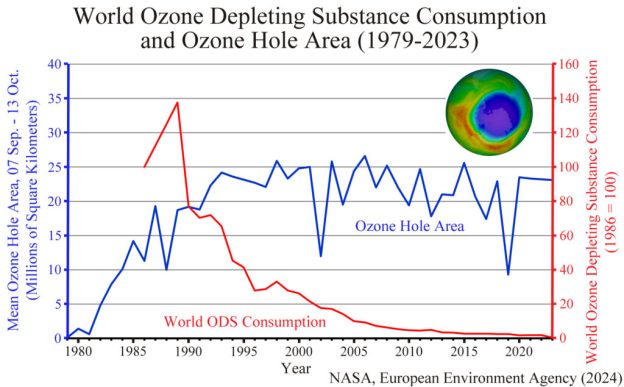
NASA reported this fall that the mean ozone hole area for September 7 to October 13 again reached 23 million square kilometers, roughly the same level as in the last three decades stretching back to 1994–1995. The hole remains large, despite that fact that world ODS consumption has almost been eliminated.
In 2015, scientists at NASA predicted that the Ozone Hole would be half closed by 2020. That hasn’t happened. Other scientists have forecasted that the hole will not begin to disappear until 2040 or later. But the longer the hole persists, the greater the likelihood that the ozone layer is dominated by natural factors, not human CFC emissions.
___________________
Steve Goreham is a speaker on energy, the environment, and public policy and the author of the bestselling book Green Breakdown: The Coming Renewable Energy Failure.
At COP29, Officials Want To ‘Trump-Proof’ Their Green Funding With Global Climate Tax
By Nick Pope | Climate Change Dispatch | November 21, 2024
Foreign government officials attending the ongoing U.N. climate change summit are advocating for de facto global climate taxes to fund green energy development in poor countries ahead of President-elect Donald Trump’s return to the White House, according to Financial Times. [emphasis, links added]
Officials from countries including France, Spain, and Kenya are pushing to plan so-called “solidarity levies” on various industries at this year’s conference so that a more developed version of the scheme can be presented at next year’s get-together in Brazil, FT reported.
The idea is to settle on a plan that would raise $100 billion or more annually to fund climate-related efforts in developing countries by imposing de facto taxes on the shipping and aviation industries, and possibly other sectors as well.
Past discussions on the issue of providing climate cash to poor nations have been fraught, and Trump — who pulled out of the U.N.’s Paris Climate Agreement in his first term and is primed to do so again — generally opposes routing money to other countries in the name of climate change, so attendees at this year’s summit are getting creative about finding sources of funding, according to FT.
Besides the shipping and aviation industries, cryptocurrency trades, fossil fuel production, plastic producers, billionaires, and financial transactions could possibly be subject to the “solidarity levies” scheme.
In fact, it is not even clear that the funding generated by the “solidarity levies” would even go directly to poor countries, as officials from some nations have suggested that the money should go to the shipping industry to help it with its decarbonization push, according to FT.
The shipping industry’s commitment to cutting emissions is putting more pressure on the aviation industry, which is itself pointing to the oil and gas industry to cough up more money.
Many major airline companies are already party to a global carbon offset pact reached in 2016, but that system is not meant to generate revenues that can then be repurposed, according to FT.
The task force assessing the “solidarity levies” concept is eyeing options for building upon duties on plane tickets already in place in 21 countries, which they think could raise as much as $164 billion annually.
Six Simple Steps to Pharma Reform
By Clayton J. Baker, MD | Brownstone Institute | November 20, 2024
The recent United States elections may have finally produced an administration that is willing – even eager – to reform the Big Pharma juggernaut that has thoroughly dominated life in the United States since Covid. But how might we achieve meaningful, definitive Pharma reform?
Simple.
Before we continue, please allow me to highlight the difference between “simple” and “easy.” Just because something is simple doesn’t make it easy. Lifting a 10-ton weight is no more complicated than lifting a 10-pound weight. But it’s a lot harder to do.
The task of reforming Big Pharma will not be easy. Talk about a heavy lift! Consider that before the 2020 election, the pharmaceutical industry donated funds to 72 senators and 302 members of the House of Representatives. Pfizer alone contributed to 228 lawmakers. At this moment, Big Pharma may be down, but it’s not out. The industry has too much power, money, and influence to be brought under control without a major struggle.
While not easy, should the political will be mustered, the process of breaking the stranglehold Big Pharma has on us would be surprisingly simple. Six changes in Federal law – four repeals of existing law, and two new pieces of legislation – would go a long way toward reining in and even reforming Big Pharma.
From the 1970s onward, US Federal policy consistently trended toward the empowerment and enrichment of the pharmaceutical industry. Since 1980, a series of Federal laws were enacted that created perverse incentives and promoted the rapacious behavior that has characterized Big Pharma over the past several decades, climaxing with the pandemic totalitarianism of the Covid era.
Four of the most problematic of these laws are ripe for repeal. Doing so would constitute vital steps toward reining in Big Pharma. The two other steps proposed here would require new legislation, but fairly simple legislation at that.
The six simple steps are:
- Repeal the 1980 Bayh-Dole Act
- Repeal the 1986 National Childhood Vaccine Injury Act
- Repeal the 2004 Project Bioshield Act
- Repeal the 2005 PREP Act
- Outlaw Direct-to-Consumer Pharmaceutical Advertising
- Encode Medical Freedom into Federal Law
Repeal the 1980 Bayh-Dole Act
The Patent and Trademark Law Amendments Act (Public Law 96-517), better known as the Bayh-Dole Act, was signed into law by Jimmy Carter in 1980.
The Bayh-Dole Act made 2 major changes: it allowed private entities (such as universities and small businesses) to routinely keep ownership and patent rights to inventions made during government-funded research. It also allowed Federal agencies to grant exclusive licenses for use of Federally-owned patents and intellectual property.
The Bayh-Dole Act was intended to encourage innovation within government research. As researchers could now profit directly from their work, it was thought they would make better use of taxpayer support. However, as economist Toby Rogers has argued, this ill-conceived law had the opposite effect.
The ability for government contracted workers to patent their discoveries created a disincentive to share them with other researchers, who might beat them to market. Close guarding of intellectual property and lack of open collaboration had a chilling effect on rapid innovation – hardly what taxpayers would have wanted from their investments.
More importantly, endowing Federal agencies such as the NIH with the power to effectively pick “winners and losers” with whom Federal intellectual property would be granted for commercial use, created a tremendous potential for corruption within these agencies.
The Act did contain a provision for “march-in-rights,” whereby the relevant government agency (such as the NIH) could step in and allow other entities use of the intellectual property if the original patent-holder failed to meet specific requirements to make proper use of them for the public good. However, according to the US Chamber of Commerce, in 44 years since the Act was made law, march-in-rights have never been successfully invoked, despite numerous attempts.
The Bayh-Dole Act itself, coupled with the refusal of agencies such as the NIH to ever invoke march-in-rights, has been frequently implicated in the massive price-gouging problems in US pharmaceuticals. In one remarkable exchange in 2016 between Senator Dick Durbin and then NIH Director Francis Collins, Durbin refuted Collins’ prevaricating defense of never invoking march-in-rights, stating:
… if you cannot find one egregious example where you could apply this [march-in-rights], I would be surprised. And applying it even in one, sends at least the message to the pharmaceutical companies, that patients need to have access to drugs that were developed with taxpayer’s expenses and the research that went into it. I think that doing nothing sends the opposite message, that it’s fair game, open season, for whatever price increases they wish.
By allowing the NIH authority to assign publicly funded intellectual property rights and statutory power to protect exclusive use of them, the Bayh-Dole Act opened the door widely for massive corruption between industry and regulators and greatly enabled the extreme degree of agency capture now present at the NIH and other Federal Agencies.
Bayh-Dole has been a failure. It should be repealed and replaced.
Repeal the 1986 National Childhood Vaccine Injury Act
The toxicity of vaccines was so well-established even decades ago, that a Federal law – the National Childhood Vaccine Injury Act (NCVIA) of 1986 (42 U.S.C. §§ 300aa-1 to 300aa-34) was passed to specifically exempt vaccine manufacturers from product liability, based on the legal principle that vaccines are “unavoidably unsafe” products.
Since Ronald Reagan signed the 1986 NCVIA Act protecting vaccine manufacturers from liability, there has been a dramatic increase in the number of vaccines on the market, as well as the number of vaccines added to the CDC vaccine schedules, with the number of vaccines on the CDC Child and Adolescent schedule rising from 7 in 1986 to 21 in 2023.
Furthermore, this special protection afforded to vaccines has prompted Big Pharma to attempt to sneak other types of therapeutics under the “vaccine” designation to provide them with blanket liability they would not otherwise enjoy.
For example, the Pfizer and Moderna Covid mRNA injections, while commonly called vaccines, are not true vaccines, but rather a type of mRNA-based gene therapy. In effect, they are what I refer to as Vaccines-In-Name-Only, or “VINOs.” As pointed out by Rep. Thomas Massie (R-KY) and others, the CDC’s definition of “vaccination” was altered during Covid to allow new types of drugs to be labeled as vaccines.
We have now reached the previously unimaginable state where Big Pharma is touting potential “vaccines” for cancer. As the National Cancer Institute admits on its website, these are actually immunotherapies. The purpose of employing this misleading nomenclature is clear: to slide even more therapies under the tort-protected “vaccine” umbrella.
The bloom is off the rose for vaccines. The alarming toxicity of the Covid vaccines caused a worldwide reexamination of this entire class of medicines. Multiple Covid vaccines, including the Johnson & Johnson and AstraZeneca products, once brazenly touted as “safe and effective,” have now been pulled from the market. And the literally millions of VAERS reports implicating the mRNA Covid products have not gone away.
The National Childhood Vaccine Injury Act (NCVIA) of 1986 should be repealed, returning vaccines to the same tort liability status as other drugs.
Repeal the Project Bioshield Act of 2004
The Project Bioshield Act, signed into law by George W. Bush in 2004, introduced the Emergency Use Authorization avenue for pharmaceutical products to be brought to market. Among other things, this law empowered the FDA to authorize unapproved products for emergency use, in the event of a public health emergency as declared by the Department of Health and Human Services (HHS).
By its very design, this law is ripe for abuse. It places immense power in the hands of the unelected Director of HHS, who can declare an emergency activating the law, and who simultaneously oversees the FDA.
This power was egregiously misused during Covid. Shockingly, the FDA issued nearly 400 EUAs related to Covid for pharmaceutical and medical products, the Covid “vaccines” being only the best known. The FDA even went so far as to grant “umbrella” EUAs for entire categories of Covid products such as test kits, often without reviewing specific products at all. The immense amounts of fraud related to test kits and other Covid-era medical products should come as no surprise.
With regard to Covid-related pharmaceuticals, to this day EUAs continue to be misused to the benefit of Big Pharma and to the detriment of citizens. For example, when the FDA announced the “new” formulations of the Covid boosters for 2024-25, they still released these new products under Emergency Use Authorization. In other words, a full four-and-one-half years after the start of the Covid pandemic, these products are still rushed to market after ludicrously inadequate safety and efficacy trials, based on a purported “emergency” now approaching a half decade in length.
The 2004 Project Bioshield Act should be repealed and the EUA designation it created should be eliminated.
Repeal the PREP Act of 2005
The NCVIA already provided vaccine manufacturers with a blanket tort liability shield beyond the wildest dreams of other industries, but apparently that was not enough. In 2005, at the height of the “War on Terror,” George W. Bush signed the Public Readiness and Emergency Preparedness Act (42 U.S.C. § 247d-6d), better known as the PREP Act.
The PREP Act, which was heavily lobbied for by vaccine manufacturers, provides an unprecedented level of blanket tort liability to Big Pharma and other medical-related industries in the event of declared bioterrorism events, pandemics, and other emergencies. Again, tremendous power is placed in the hands of the Director of HHS, who has broad discretion to declare such an emergency.
The PREP Act was controversial from the outset – any act that can spark vigorous, simultaneous opposition from both Phyllis Schlafly’s conservative Eagle Forum and Ralph Nader’s left-wing Public Citizen for its unconstitutional nature is surely pushing the envelope.
In effect, the PREP Act has allowed Big Pharma and its captured regulatory friends to completely circumvent routine FDA standards for safety and efficacy under the guise of an emergency, which as noted above, can conveniently last half a decade or more.
Furthermore, in the aftermath of Covid, the PREP Act has been broadly invoked in the legal defense of countless defendants now sued for the excesses, harms, and violations of human rights perpetrated at all levels of government and society. It will take decades in the courts to sort out where the PREP Act’s broad protections begin and end.
This is both absurd and insane. At its inception, the PREP Act was broadly recognized as one of the most overreaching and unconstitutional Federal laws in modern times. The Covid era has tragically revealed the PREP Act to be a murderous failure. The PREP Act must be repealed.
During Covid, government at nearly every level used the specter of a pandemic to blatantly suspend, deny, and even attempt to permanently eliminate numerous fundamental civil rights that are clearly encoded in the Constitution. Furthermore, the well-established and time-honored pillars of Medical Ethics were dismissed wholesale in the name of public safety.
In addition to repealing the deeply flawed laws discussed above, two pieces of straightforward legislation are needed to limit Big Pharma’s undue influence on society.
Outlaw Direct-to-Consumer Pharmaceutical Advertising
The United States is one of only 2 countries in the world that allows direct-to-consumer advertising of pharmaceuticals. The scale of this advertising is monumental. Total Pharma advertising spending topped $6.58 billion in 2020. The dangers of this are multiple.
First, as we can all see by turning on the television, Big Pharma abuses this privilege by aggressively hawking almost any product it feels it can profit from. The “pill for every ill” mindset shifts into hyperdrive on TV, with an expensive, proprietary, pharmacological cure for everything from your morbid obesity to your “bent carrot.”
Direct-to-consumer television advertisements heavily target the elderly. This is an important component of Big Pharma’s push to promote the Covid and RSV vaccines as routine shots, piggybacking on the wide acceptance of influenza vaccines. Not content to profit off the traditional fall flu vaccine, Big Pharma seeks to create a subscription model for a bevy of seasonal shots against numerous, generally mild, viral respiratory infections.
Even more importantly, direct-to-consumer advertising provides Big Pharma with a legal way to capture media. Pharma was the second-largest television advertising industry in 2021, spending $5.6 billion on TV ads. No legacy media outlet dares to speak out against the interests of entities providing that level of funding. This muzzles dissenting voices and eliminates open discussion about safety issues in mainstream media.
In short, through direct-to-consumer advertising, Big Pharma has bought the media’s silence.
A free society requires freedom of the press and media. The Covid era has demonstrated that direct-to-consumer pharmaceutical advertising stifles freedom of the press and media to a dangerous and unacceptable degree.
Somehow, the rest of the world has managed to survive without direct-to-consumer pharmaceutical advertising. In fact, many countries do better with respect to health measures than the Pharma-ad-riddled USA. In 2019, just before Covid, the United States ranked only 35th in terms of overall health in the Bloomberg National Health Rankings. Meanwhile, the United States pays more for its middling health rankings than any other nation on Earth.
Encode Medical Freedom into American law
The Founding Fathers would be scandalized to find that the United States needs explicit laws stating that the Bill of Rights is not null and void in the event of a “pandemic,” (or during other emergencies, for that matter), but here we are.
The Founders were well acquainted with episodic infectious disease. In fact, they faced epidemics at a level we cannot imagine. George Washington survived smallpox. Thomas Jefferson lost a child to whooping cough. Dr. Benjamin Rush, signer of the Declaration of Independence and surgeon general of the Continental Army, promoted inoculation of the troops against smallpox.
Despite those experiences, the Founders inserted no health-emergency-based escape clauses in the Constitution permitting government to deny citizens the inalienable rights protected therein.
As I have written previously, the excesses of the Covid era have sparked a movement toward encoding “medical freedom” into law, to protect our civil rights against medical and public health overreach. (To be fully effective, this may need to be expanded to include any declared emergency – e.g. “climate” emergencies – although that is beyond the scope of this essay.)
Given the excesses of the Covid era, many of which have now been demonstrated to have been pre-planned and deliberate, and given rapid technological advancement of both medicine and surveillance, it is advisable to encode into law assertions regarding medical freedom. While the exact wording may vary, the 2 key points of focus would be explicitly protecting bodily autonomy and limiting the power of public health declarations. Here are two examples:
- Citizens shall not be deprived of any rights protected in the US Constitution, or of their ability to fully participate in society, on the basis of their acceptance or refusal of any medical treatment(s) or procedure(s).
- Citizens shall not be deprived of any rights protected in the US Constitution, or of their ability to fully participate in society, on the basis of a medical or public health emergency.
Encoding such statements into law would accomplish two goals. First, it would substantially rein in the power-seeking element of the public health industry that became such a menace to human freedom during Covid, and which incidentally is tightly entwined with Big Pharma. Second, it would significantly thwart the efforts of Big Pharma to push their wares through a herd-based and mandate-driven approach.
Should someone oppose such explicit statements of our God-given rights, on the basis of “But what if there is another pandemic?”, I would reply as follows: Only once in human history did the world lock itself down due to a disease. It turned out to have been done mostly under false pretenses, and it turned out to be a deadly and disastrous mistake. We are not doing that again.
Conclusion
Big Pharma is a Leviathan, in both the biblical and Hobbesian senses of the word. To truly control it, other measures will surely be necessary. Other needful actions are beyond the scope of this article. Some of these may be very complicated. For example, it is imperative that the gain-of-function bioweapons research be halted. However, this is a worldwide issue, so outlawing it in the US alone will not solve the problem.
However, these six simple steps are an important start. Members of the incoming administration have already spoken about some of them. Success breeds success, and successfully implementing these solutions will help free ourselves from the tentacles of the monstrosity that Big Pharma has become.
Clayton J. Baker, MD is an internal medicine physician with a quarter century in clinical practice. He has held numerous academic medical appointments, and his work has appeared in many journals, including the Journal of the American Medical Association and the New England Journal of Medicine. From 2012 to 2018 he was Clinical Associate Professor of Medical Humanities and Bioethics at the University of Rochester.
The Pentagon is running out of missiles. After December 1, that will be a big problem.
Inside China Business | November 20, 2024
Protracted wars in the Middle East and Ukraine are draining the US arsenal of interceptor missiles. The problem is especially severe in Palestine and in the Red Sea, where dozens of missiles are launched monthly against incoming rockets and drones. Pentagon officials are urgently pushing weapons makers to produce more, but are bumping up against capacity and CAPEX constraints. In another blow, China just announced an export ban on dual-use metals that are critical to the manufacture of missiles and other aerospace applications in the defense sector. Magnesium and tungsten, in particular, are two key materials necessary for the production of missiles, but where China effectively has monopolized the refining and production. China’s export ban will take effect on 1 December.
Resources and links:
Wall Street Journal, Pentagon Runs Low on Air-Defense Missiles as Demand Surges https://www.wsj.com/politics/national…
Nikkei Asia, China to tighten export curbs on critical metals ahead of Trump’s return https://asia.nikkei.com/Spotlight/Sup…
Six Strategic Metals Widely Used in the Military Industry https://www.samaterials.com/content/s…
Magnesium in Defence https://www.magnium.com.au/defence-metal
Forbes, The Titanium Supply Chain For The Aerospace Industry Goes Through Russia https://www.forbes.com/sites/willyshi…
Sen. Johnson Threatens Legal Action Unless HHS Turns Over Unredacted Emails on COVID Vaccine Safety
By Brenda Baletti, Ph.D. | The Defender |November 22, 2024
Sen. Ron Johnson (R-Wis.) on Tuesday demanded public health agencies provide complete and unredacted documents about the development and safety of the COVID-19 vaccines, after learning of extensive redactions in documents released in response to multiple Freedom of Information Act (FOIA) requests.
In a letter sent Tuesday to the U.S. Department of Health and Human Services (HHS), U.S. Food and Drug Administration (FDA) and Centers for Disease Control and Prevention (CDC), Johnson said the redactions make the documents nearly impossible to comprehend and obscure the public’s understanding of issues like myocarditis and pericarditis linked to vaccines.
He also called out the agencies for not responding to his own requests for COVID-19 vaccine safety information. He wrote:
“The lack of transparency from your agencies during the Biden presidency has been appalling. Your agencies’ refusal to provide complete and unredacted responses and documents to my numerous oversight letters on the development and safety of the COVID-19 vaccines has hindered Congressional oversight and has jeopardized the public’s health.”
Johnson, an outspoken critic of the government’s handling of COVID-19-related information, sent over 60 public letters requesting more transparency on virus origins, early treatment and vaccine safety.
“What is clear from these excessive redactions, however, is a concerted effort to obscure Congress’ and the public’s understanding of your agencies’ detection of and response to COVID-19 vaccine adverse events such as myocarditis and pericarditis,” he wrote.
Johnson’s latest request demands the agencies preserve and release unredacted documents, specifically three documents he said comprised “only a small fraction” of the documents on myocarditis and pericarditis that the agencies “continue to conceal.”
Johnson gave the agencies until Dec. 3 to respond, warning that if the agencies don’t comply, he would take further action, including issuing subpoenas once he becomes chairman of the Permanent Subcommittee on Investigations in the next Congress.
CDC delayed telling public about link between vaccines and myocarditis
Children’s Health Defense (CHD) scientists Karl Jablonowski, Ph.D., and Brian Hooker, Ph.D., in 2022 published a study showing the CDC delayed reporting the incidence of myocarditis to the general public for three months after the first statistically significant signal appeared in the Vaccine Adverse Event Reporting System (VAERS) database.
CHD, attorney Ed Berkovich, The Epoch Times and others submitted FOIA requests seeking more information about what the public health agencies knew and when.
In his letter, Johnson cited responses to those FOIA requests as examples of how the agencies obstructed attempts by the public to hold them accountable.
For example, heavily redacted documents indicate that then-CDC Director Rochelle Walensky had received Pfizer documents regarding myocarditis and pericarditis by May 22, 2021. However, the Pfizer report provided via FOIA was completely redacted except for the cover page, making it impossible to decipher what Walensky learned and when.
Johnson included the FOIA documents in his letter so the public could see the extent of the redactions.
The documents showed that after receiving the FOIA data, Walensky and other CDC officials considered whether to issue a public warning about the risk of myocarditis from vaccination. They drafted a Health Alert Network (HAN) for the website, which is how they communicate “urgent public health incidents” with public information officers, practitioners, clinicians and local public health officials.
The draft alert sent to Walensky was redacted when the CDC produced documents in response to a FOIA request. A partially unredacted email to either a Moderna or Pfizer employee indicated that the agency was debating the pros and cons of issuing a HAN, but didn’t “want to appear alarmist.”
The agency never issued the alert. Instead, the CDC said on its website that there were “increased cases of myocarditis and pericarditis” reported but the CDC continues to recommend the vaccine for everyone ages 12 and up.
Johnson requested all documents about the alert, but the CDC has not provided them.
In Johnson’s third example, the Biden White House sent top public health officials 17 pages of talking points for a “tough QA” on COVID-19. In the FOIA documents, all the topics are redacted, making it impossible to know what the White House was communicating.
“Ultimately, despite your agencies’ awareness of the risks associated with the COVID-19 vaccines, the main talking point from these and other public health officials was uniform and entirely deceptive: the vaccines are safe and effective,” Johnson wrote.
Pattern of stonewalling and evading by government health agencies
Risa Evans, staff attorney at CHD, told The Defender that over the last several years, CHD has filed several FOIA requests with the FDA, CDC and National Institutes of Health seeking records connected with post-authorization safety monitoring of COVID-19 shots.
“We have found that obtaining these records is a challenge, due to a mix of denials, redactions and delays by the agencies,” she said.
When the agencies failed to respond to FOIA requests for records related to safety signals, CHD filed multiple FOIA lawsuits seeking the requested documents.
In one case the FDA requested at least 18 months to fulfill the request — after it had already delayed 14 months.
“The agencies’ failure to respond to our requests in a timely and open fashion is particularly ironic in light of recent statements by Dr. Peter Marks, director of the FDA’s Center for Biologics Evaluation and Research, calling for more transparency as a way of combating vaccine ‘hesitancy,’” Evans said.
The FDA also famously attempted to delay documents related to the licensing of Pfizer’s Comirnaty COVID-19 vaccine for 75 years.
The U.S. House Select Subcommittee on the Coronavirus Pandemic also investigated Dr. David M. Morens, a 25-year veteran of the National Institute of Allergy and Infectious Diseases and adviser to Dr. Anthony Fauci, after it was revealed he used his personal email address to evade FOIA requests for communications related to the origins of COVID-19.
Emails made public during that investigation also showed that Morens connected Fauci to Kaiser Health News reporter Arthur Allen through a “secret back channel.”
Jablonowski, who was among the first to detail the deception around myocarditis, told The Defender if the public health agencies aren’t compelled to be transparent, they can’t be held accountable.
He said the FDA and the CDC, “are not transparent in matters of myocarditis resulting from the COVID-19 vaccines. They are opaque, hidden behind redactions, and not accountable to the American people or members of Congress.”
“This is a rot in our government, and it spreads well beyond the confines of myocarditis, the CDC and the FDA,” he added. “How far beyond? We won’t know until we broadly investigate the actions and actors.”
This article was originally published by The Defender — Children’s Health Defense’s News & Views Website under Creative Commons license CC BY-NC-ND 4.0. Please consider subscribing to The Defender or donating to Children’s Health Defense.
Healthcare workers file class action lawsuit against the Ontario government over its COVID-19 vaccine directive
The Canadian Independent | November 22, 2024
A $170-million class-action lawsuit has been filed against the Province of Ontario and its Chief Medical Officer of Health, Dr. Kieran Moore, alleging negligence, misfeasance in public office, tortious inducement to breach contract, and violations of privacy rights related to the implementation of COVID-19 vaccine mandates for healthcare workers.
Lisa Wolfs is the primary plaintiff in the lawsuit. She was previously employed as a Clinical Nurse Educator with London Health Sciences Centre and initiated the suit on behalf of unionized healthcare workers in Ontario. At the heart of the lawsuit is the challenge to the legality of Directive 6, a public health order issued in August 2021 by Dr. Moore.
Court documents show that Wolfs went on medical leave on September 15, 2021, was later cleared to return to work, but was terminated on August 4, 2022, under the enforcement of COVID-19 Directive 6.
Filed under Ontario’s Class Proceedings Act, 1992, the lawsuit seeks to represent tens of thousands of unionized healthcare workers across the province who were subject to the directive. The plaintiff argues that the mandate imposed unauthorized changes to her employment contract, forced the disclosure of personal medical information, and caused significant economic and emotional harm.
Directive 6 mandated that hospitals, home and community care service providers, and ambulance services implement a mandatory COVID-19 vaccination policy for employees, staff, contractors, students, and volunteers.
Under the directive, healthcare workers had to provide proof of vaccination, a medical exemption, or participate in an educational program to maintain their employment. Wolfs argues that these policies led to her termination after nearly 16 years of service, despite her previously exemplary record. Her lawsuit claims that her dismissal violated the terms of her employment contract, which did not include mandatory vaccination as a condition of employment or allow for unpaid leave under these circumstances.
The lawsuit accuses the Ontario government and Dr. Moore of several violations. First, it alleges negligence, claiming that the vaccination policies were implemented without sufficient evidence supporting their efficacy in preventing COVID-19 transmission.
Second, it accuses Dr. Moore of misfeasance in public office, arguing that he acted with reckless indifference or willful blindness to vaccine risks and the lack of long-term safety data.
Third, the lawsuit alleges tortious inducement to breach contract, stating that the directive unlawfully interfered with employment agreements between healthcare workers and their employers.
Finally, it argues that the directive infringed on workers’ privacy rights by requiring the disclosure of vaccination status or medical exemptions.
In addition, the suit questions the public health rationale behind the mandates, referring to Health Canada product monographs. According to the claim, these documents do not indicate that approved vaccines such as Pfizer’s Comirnaty or Moderna’s Spikevax prevent COVID-19 transmission, undermining the stated purpose of the directive. Additionally, the lawsuit raises concerns about vaccine safety, highlighting adverse events reported during clinical trials and instances of product recalls or restrictions.
Seeking $170 million in damages, the lawsuit includes $50 million for pain and suffering, $50 million for misfeasance in public office, $20 million for tortious inducement to breach contract, and $50 million in punitive damages. The claim also includes compensation for lost income, medical monitoring expenses, and legal costs.
The case will proceed in the Ontario Superior Court of Justice, where the plaintiff will aim to have the lawsuit certified as a class action. If successful, it could set a precedent for addressing grievances related to pandemic-era workplace policies.
Scarlett Martyn, a veteran paramedic in Ontario, reached out to The Canadian Independent to highlight this lawsuit. Martyn is a member of United Healthcare Workers of Ontario (UHCWO), a volunteer-run, not-for-profit organization representing thousands of healthcare professionals. The group advocates for health privacy, voluntary and informed consent, and non-discriminatory medical policies in Ontario and across Canada.
Martyn says that UHCWO is raising funds to support the lawsuit. She explained that the organization is crowdfunding to cover potential court costs if class certification is unsuccessful and any named plaintiffs are required to pay legal costs. She also mentioned that if they succeed at the certification stage, the funds raised will be used to cover litigation costs for the class action. You can read more about the UHCWO and donate if you wish at the link below.
House of Representatives Approves Legislation Threatening Nonprofits’ Free Speech
By Adam Dick | Ron Paul Institute | November 22, 2024
On Thursday, the United States House of Representatives approved legislation that would threaten nonprofit organizations’ exercise of free speech rights. The legislation would accomplish this goal by empowering the US government to selectively clamp down on nonprofits to an extent that targeted organizations may cease to exist. This is all being done in the name of countering terrorism, a trusty standby excuse for the US government exercising authoritarian powers.
The House approved the Stop Terror-Financing and Tax Penalties on American Hostages Act (HR 9495) by a vote of 219 to 184. The “yes” votes came mainly from Republican members, and all the “no” votes were from Democrats plus Kentucky Republican Thomas Massie, an Advisory Board member for the Ron Paul Institute.
J.D. Tuccille provided an informative critique of HR 9495 in a Friday Reason article. The bill, explained Tuccille, “allows for the ‘termination of tax-exempt status of terrorist supporting organizations.’” Continuing, Tuccille wrote:
The designation of organizations as such is left to the discretion of the Secretary of the Treasury, based on that official’s judgment that a non-profit group has, in the last three years, provided ‘material support or resources’ to what the U.S. government considers a terrorist organization. The language provides for a 90-day window during which time supposed ‘terrorist supporting organizations’ can appeal the designation, but the burden is on them to prove that they’re not guilty.
This turns due process on its head.
The threat from this new bureaucratic power is extreme for targeted organizations. As Tuccille puts it in his article, the loss of “tax -exempt status” is essentially a death penalty for most non-profit organizations.”
What a censorship power this legislation hands over to the executive branch bureaucracy. Nonprofit organizations whose activities challenge the ambitions of the US government and connected individuals, businesses, and organizations, can be snuffed out. Meanwhile, other organizations will have a big incentive to limit their own speech to avoid being similarly targeted for destruction.
During the House floor debate on HR 9495, Rep. Mark Takano (D-CA) presented a brief, persuasive speech against the bill. Here is the text of his speech:
Mr. Speaker, I rise in strong opposition to H.R. 9495. As Members of Congress, it is our duty to stand against terrorism and stand up for our common values, but this bill does neither.
What does it do?
What it does is grant sweeping draconian powers to the executive branch to essentially shut down any nonprofit.
On what basis would future administrations, Democratic or Republican, be able to exercise such power?
On a mere accusation.
I repeat, an accusation.
All nonprofits could be under scrutiny. These are decent people who are advocating on issues from religious freedom to animal welfare.
Mr. Speaker, why would conservatives, the very same people who gnashed their teeth at executive overreach, support such a measure?
Why would they suddenly about-face and sacrifice the values they claim to stand for?
It is because this is a gift to the President-elect, Mr. Trump, wrapped up in a bow right before the holidays.
On the campaign trail, he has made no secret of who he would seek to go after. This is bigger than the President-elect because now every President who would be king would be free to seek vengeance on their political opponents for every perceived slight.
I caution my colleagues to consider how far-reaching the consequences of this bill would be. This bill would apply to all future Presidents.
At a time when we should be strengthening our checks and balances and shoring up our guardrails, this legislation would do the opposite.
Mr. Speaker, in the strongest possible terms, I urge my colleagues to vote against this executive branch power grab.
This legislative threat to nonprofit organizations and their free speech can be expected to be rejected by the Democratic controlled Senate and President Joe Biden. But, it will likely be back for another go-round under more amenable conditions come January when the House, Senate, and presidency are all in Republican control.
Israeli Soccer Hooligans Cry Out as They Strike You
By Kevin Barrett – American Free Press – November 22, 2024
On November 7, chaos erupted in the streets of Amsterdam. Soccer hooligans flown in from Israel, flanked by Mossad handlers, watched their their Maccabi Tel Aviv team lose 5-0 to the Dutch team Ajax. After the game, the Maccabi fans ran wild, arming themselves with wood sticks and metal pipes and attacking cabs, busses, police vans, and individuals unlucky enough to cross their path. Palestinian flags—a common sight in the Dutch capital—were torn down. As they rioted, the Maccabi fans showcased their favorite chants, including “There are no schools left in Gaza because there are no children left”; “F*** the Arabs,”; and F*** you terrorists, everybody die.”
A video account of the event by a teenage journalist known as Bender showed that the violence was incited by Israelis, not locals. Bender followed the Israelis from the stadium and filmed them arming themselves and attacking people and vehicles. He was threatened and told to stop filming, presumably by the Mossad handlers overseeing the event.
As often happens, the spectacle of foreign soccer hooligans attacking people in their own city led to a defensive response. Locals confronted the hooligans, in some cases getting the better of physical altercations. A few Israeli thugs managed to get themselves beat up, while others were unceremoniously introduced to the pleasures of swimming in Amsterdam’s insalubrious canals.
If British soccer hooligans had attacked Paris, or German soccer hooligans had attacked Prague, media accounts would have been reasonably evenhanded and accurate. But because the hooligans were Israelis attacking the city of Anne Frank, the media sought to convince the world that a third Holocaust had occurred. (The second, of course, was the Hamas raid of October 7, 2023.)
Here are a selection of headlines:
*Israeli Fans Attacked After Soccer Match in Amsterdam; Violence Condemned as Anti-Semitic (Washington Post ).
*Israeli soccer fans targeted in wave of violence in Amsterdam (Fox).
*Holocaust survivor calls vicious mob attack on Jews in Amsterdam a ‘modern-day Kristallnacht’ (New York Post ).
*Israeli soccer fans in Amsterdam ambushed by gangs of anti-Israel attackers shouting ‘Free Palestine,’ Netanyahu sends planes to evacuate citizens (New York Post ).
*The New Kristallnacht: Antisemitic Attacks in Amsterdam Demand Global Action (Times of Israel ).
*Global leaders react to Amsterdam pogrom (The Jerusalem Post ).
*Amsterdam Has Failed Its Jews (Spectator ).
The United States Holocaust Museum issued a statement stating that the Museum “strongly condemns the vicious attacks on Israeli soccer fans in Amsterdam and the outrageous celebrations of those attacks.” The Anti-Defamation League shrieked about the “obscene, unprovoked violence” which it described as follows: “This is what ‘globalize the intifada’ looks like. Mobs of hate-filled people chasing down and attacking innocent Israeli soccer fans who they have dehumanized as ‘Zionists,’ hunting down and brutalizing ordinary people who came to Amsterdam simply to enjoy a soccer match.”
But why did these Israeli “ordinary people” repeatedly commit assault, battery, and vandalism, long before any locals retaliated? Why did the Israeli attacks on people and vehicles draw no response from local police, who pointedly ignored the rioting until the tables had been turned? And why were the hooligans flanked by Mossad agents as they incited a riot?
Dutch scholar and author Alexander Wolfheze, who was in Amsterdam on November 7, describes the event as a “psy-op.” In a November 12 interview with this author Wolfheze agreed with critics who argue that the Israeli hooligans’ attack on Amsterdam was carefully orchestrated by intelligence professionals in order to produce precisely the headlines listed above, and thousands more like them: “I believe that there are PSYOP aspects (to the hooligans’ attack). It happened just before the anniversary of Kristallnacht, something that the mainstream media did not fail to exploit.”
Dr. Wolfheze added that the November 7 Mossad op was also designed to influence Dutch domestic politics: “Holland is once again at the forefront of the Israelization of Europe, the Zionisation of Europe. Holland was the first country to get a real neo-Zionist government (Geert Wilders). And exactly at that time, after the appointment of this new cabinet, this new government here, and this new reality here, we are seeing this program (total Israeli takeover of Holland -KB) being implemented through the hooligans.”
If Israel can attack your country, pretend to be the victim, and force your entire government and mainstream media to go along with the transparent lie, they basically own you. Fortunately, Israel does not own social media journalists like Bender and Max Blumenthal, both of whom were instrumental in exposing what really happened in Amsterdam.
The Israeli attack on Amsterdam once again illustrated the Jewish State’s perfidy, and provided more evidence that when they cry out as they strike you, it isn’t just a hobby—it’s how they make a living.
Ballistic vs. Cruise Missiles: What’s the Difference?
By Ilya Tsukanov – Sputnik – 23.11.2024
Russia’s successful combat test of the Oreshnik intermediate-range missile garnered its share of attention and more than a little confusion as media and amateur observers alike began comparing the new ballistic weapon to other weapons in both Russia and NATO’s arsenals, including cruise missiles.
Sputnik sets the record straight by outlining the key differences between these two very distinct types of weapons:
Ballistic missiles
Powered by a single rocket or series of rockets operating in stages to propel them to the required trajectory, ballistic missiles ascend tens of kilometers into the atmosphere, shedding motors and thrusters along the way, with larger ones leaving the atmosphere altogether, after which their payload separates and begins its descent back down toward Earth, traveling in an arc.
Ballistic missiles typically have three flight phases, starting with the boost phase, followed by a midcourse phase – which starts when the rocket motor(s) stop(s) firing and the missile’s payload starts to coast, usually while continuing to ascend, and finally the terminal phase, during which the payload starts the final course toward its target(s).
Some also have a distinct fourth phase, which kicks off after the post-boost phase, during which the onboard multiple independent reentry vehicle (MIRV) bus makes changes to its trajectory, and decoys are released to confuse and saturate enemy missile defenses.
Some ballistic missiles can make changes to their trajectory, so long as onboard rocket fuel allows, but usually, any maneuverability attributed to these weapons is the result of their payloads.
Russia’s Avangard hypersonic glide vehicle, for instance, is blasted into space by an ordinary ICBM, but becomes maneuverable after separating from its carrier. MIRV buses also often contain small rocket motors and inertial guidance, allowing alterations to its payload’s trajectory before individual warheads separate.
Cruise Missiles
Cruise missiles are jet engine-powered weapons that stay within the atmosphere throughout their flight. In fact, they often fly at extremely low altitudes, ‘hugging’ the ground as few as a few meters from the surface to avoid detection.
These weapons are designed for precision strikes against an array of ground and sea-based targets and, if fitted with nuclear warheads, can target large built-up areas or entire carrier strike groups (in the case of Russia’s P-800 Oniks, for example). Conventional cruise strikes can be calibrated to attack targets as small as individual buildings or bunkers.
Cruise missiles stay maneuverable through their approach to their targets, featuring GPS, inertial guidance, terrain mapping and/or other tools to guide them. Some designs allow human operators to manually guide missiles in the terminal phase.
Pros and Cons of Ballistic and Cruise
Cruise missiles are typically far cheaper (costing as little as 15% as a typical tactical ballistic missile), with their launch more difficult to detect, and the missiles boasting higher accuracy. However, unless they are nuclear armed, their firepower is typically lower, with the US AGM-86 ALCM air-launched cruise missile boasting the largest payload in this class of weapon – 1,362 kg, while most cruise missiles average about 500 kg.
Ballistic missiles are typically less accurate (with a circular error probable, or CEP, measured in the tens or even hundreds of meters, compared to meters for cruise missiles), but do have a number of distinct advantages – the most obvious of which is payload size (Russia’s RS-28 Sarmat, for example, has a 10,000 kg payload).
Ballistic missiles’ arcing approach also allows their payloads to accelerate to incredible speeds (often hypersonic), while cruise missiles typically stay subsonic or supersonic through their flight, which makes them easier to intercept, and reduces the sheer kinetic force with which they slam down onto their targets.
Collapsing Empire: RIP Royal Navy
By Kit Klarenberg | Al Mayadeen | November 23, 2024
On November 15th, The Times published a remarkable report, revealing serious “questions” are being asked about the viability of Britain’s two flagship aircraft carriers, at the highest levels of London’s defence establishment. Such perspectives would have been unreportable mere months ago. Yet, subsequent reporting seemingly confirms the vessels are for the chop. Should that come to pass, it will represent an absolutely crushing, historic defeat for the Royal Navy – and the US Empire in turn – without a single shot fired.
The HMS Queen Elizabeth and HMS Prince of Wales first set sail in 2017 and 2019 respectively, after 20 years in development. The former arrived at the Royal Navy’s historic Portsmouth base with considerable fanfare, a Ministry of Defence press release boasting that the carrier would be deployed “in every ocean around the world over the next five decades.” The pair were and remain the biggest and most expensive ships built in British history, costing close to $8 billion combined. Ongoing operational costs are likewise vast.
Fast forward to today however, and British ministers and military chiefs are, per The Times, “under immense pressure to make billions of pounds’ worth of savings,” with major “casualties” certain. Resultantly, senior Ministry of Defence and Treasury officials are considering scrapping at least one of the carriers, if not both. The reason is simple – “in most war games, the carriers get sunk,” and are “particularly vulnerable to missiles.” As such, the pair are now widely perceived as the “Royal Navy’s weak link.”
Matthew Savill of British state-tied Royal United Services Institute told The Times that missile technology is developing “at such a pace” that carriers are rapidly becoming easy for Britain’s adversaries to “locate and track”, then neutralise. “In particular,” he cautioned, China is increasing the range of its ballistic and supersonic anti-ship missiles. Meanwhile, Beijing’s “hypersonic glide vehicle”, the DF-17, “can evade existing missile defence systems,” its “range, speed and manoeuvrability” making it a “formidable weapon” neither Britain nor the US can adequately counter.
Savill advocated “cutting one or both of the carriers,” as this “would free up people and running costs and those could be reinvested in the running costs of the rest of the fleet and easing the stresses on personnel”. Nonetheless, he warned that scrapping the carriers would be a “big deal for a navy that has designed itself around those carriers…and that the £6.2 billion paid for them would be a sunk cost.”
That the Royal Navy has “designed itself” around the two carriers is an understatement. For just one to set sail, it must be supported by a strike group consisting of two Type 45 destroyers for air defence, two Type 23 frigates for anti-submarine warfare, a submarine, a fleet tanker and a support ship. This “full-fat protective approach”, Savill lamented, means “most of the deployable Royal Navy” must accompany a single carrier at any given time:
“You can protect the carriers, but then the Navy has put all of its eggs in a particularly large and expensive basket.”
‘National Embarrassment’
March 2021 saw the publication of a long-awaited report, Global Britain in a Competitive Age – “a comprehensive articulation” of London’s “national security and international policy,” intended to “[shape] the open international order of the future.” The two aircraft carriers loomed large in its contents. One passage referred to how HMS Queen Elizabeth would soon lead Britain’s “most ambitious global deployment for two decades, visiting the Mediterranean, the Middle East and the Indo-Pacific”:
“She will demonstrate our interoperability with allies and partners – in particular the US – and our ability to project cutting-edge military power in support of NATO and international maritime security. Her deployment will also help the government to deepen our diplomatic and prosperity links with allies and partners worldwide.”
Such bombast directly echoed the bold wording of a July 1998 strategic defence review, initiated a year earlier by then-prime minister Tony Blair. Its findings kickstarted London’s quest to acquire world-leading aircraft carriers, which culminated with the birth of HMS Queen Elizabeth and HMS Prince of Wales. Britain’s explicit objective, directly inspired by the US Empire’s dependence on carriers to belligerently project its diplomatic, economic, military and political interests abroad, was to recover London’s role as world police officer, and audaciously assert herself overseas:
“In the post-Cold War world, we must be prepared to go to the crisis, rather than have the crisis come to us. So we plan to buy two new larger aircraft carriers to project power more flexibly around the world… This will give us a fully independent ability to deploy a powerful combat force to potential trouble spots without waiting for basing agreements on other countries’ territory. We will… be poised in international waters and most effectively back up diplomacy with the threat of force.”
Blair’s reverie appeared to finally come to pass in May 2021, when HMS Queen Elizabeth set off on a grand tour of the world’s oceans, escorted by a vast carrier strike group. Over the next six months, the vessel engaged in a large number of widely-publicised exercises with foreign navies, including NATO allies, and docked in dozens of countries. Press coverage was universally fawning. Yet, in November, as the excursion was nearing its end, an F-35 fighter launched from the carrier unceremoniously crashed.
The F-35’s myriad issues were by that point well-established. The jet, which has cost US taxpayers close to $2 trillion, entered into active service in 2006 while still under development. It quickly gained a reputation for hazardous unreliability. In 2015, a Pentagon report acknowledged its severe structural issues, limited service life and low flight-time capacity. Two years later, the Department of Defense quietly admitted the US Joint Program Office had been secretly recategorising F-35 failure incidents to make the plane appear safe to fly.
Despite this, the HMS Queen Elizabeth and HMS Prince of Wales were specifically designed to transport the F-35, to the exclusion of all other fighter jets. However, Britain has all along struggled to source usable F-35s, which produces the ludicrous situation of the two carriers almost invariably patrolling seas with few if any fighters aboard at all, therefore invalidating their entire raison d’être. In November 2023, the Daily Telegraph dubbed these regular “jet-less” forays a “national embarrassment”.
‘Carrier Gap’
An even graver embarrassment, rarely discussed with any seriousness by the British media, is that the two aircraft carriers have been plagued with endless technical and mechanical issues as long as they’ve been in service. Flooding, mid-operation breakdowns, onboard fires, and engine leaks are routine. Both vessels have spent considerably more time docked and under repair than at sea over their brief lifetimes. In 2020, an entire HMS Prince of Wales crew accommodation block collapsed, for reasons unclear.
As the elite US foreign policy journal National Interest acknowledged in March 2024, “the Royal Navy remains unable to adequately defend or operate” its two carriers “independently” – code for the Empire being consistently compelled to deploy its own naval and air assets to support the pair. This is quite some failure, given British officials originally intended for the vessels to not only lead NATO exercises and deployments, but “slot into” US navy operations wherever and whenever necessary.
The Empire’s inability to outsource its hegemonic duties to Britain has created a critical “carrier gap”. Despite maintaining an 11-strong fleet, Washington cannot deploy the vessels to every global flashpoint at once, grievously undermining her power and influence at a time of tremendous upheaval worldwide. In a bitter irony, by encouraging and facilitating London’s emulation of its own flawed and outdated reliance on aircraft carriers, the US has inadvertently birthed yet another needy imperial dependent, further draining its already fatally overstretched military resources.
Several Royal Navy destroyers were originally part of abortive US-led Operation Prosperity Guardian, launched in late 2023 to smash Ansar Allah’s righteous anti-genocide Red Sea blockade. Almost immediately, it became apparent the British lacked any ability to fire on land targets, therefore rendering their participation completely useless.
Subsequently, photos emerged of areas on Britain’s ships where land attack cruise missiles should’ve been situated. Instead, the spaces were occupied by humble treadmills, for use as on-board gyms.
It transpired that the appropriate weapons hadn’t been purchased, due to a lack of funds – the money having of course been spent instead on constructing barely operable aircraft carriers, which now face summary defenestration. By investing incalculable time, energy, and money in pursuing the mythological greatness associated with carrier capability, Britain – just like the US Empire – now finds itself unable to meet modern warfare’s most basic challenges. Meanwhile, its adversaries near and far have remorselessly innovated, equipping themselves for 21st century battle.
Days after The Times portended the impending death of London’s aircraft carriers, mainstream media became awash with reports of savage cutbacks in Britain’s military capabilities, in advance of a new strategic defence review. Five Royal Navy warships, all of which had lain disused due to staffing issues and structural decay for some time, were among the first announced “casualties”. What if anything will replace these losses isn’t certain, although it likely won’t be an aircraft carrier.
Hungary slams US for destabilizing regional energy security
RT | November 23, 2024
Washington’s decision to blacklist Russia’s Gazprombank, a key conduit for gas purchases from Russia, is aimed at undermining energy security in the Central European region, Hungarian Foreign Minister Peter Szijjarto has claimed.
Earlier this week, the US Treasury Department imposed blocking sanctions on more than 50 Russian financial institutions, including Gazprombank, linked to the eponymous Russian gas giant, and six of its international subsidiaries.
The newly introduced restrictions effectively cut off Russia’s primary bank for energy-related transactions from the SWIFT interbank messaging system, meaning it can no longer conduct dollar-based transactions.
“Including Gazprombank to the sanctions list is a decision that deliberately puts some Central European countries in a difficult situation, and deliberately jeopardizes the security of energy supplies” to several nations in the region, Szijjarto wrote on Facebook on Friday.
The Hungarian diplomat stated that any attempts to jeopardize energy supplies to Hungary “either by imposing sanctions or by cutting off transit supplies are considered as an offence against our sovereignty.”
“We reject all the attacks of the kind against our sovereignty, resist the pressure, and pursue our national interests,” he said.
Szijjarto added that he discussed the issue of gas supplies to Hungary with the first deputy head of the Russian Energy Ministry, Pavel Sorokin, on the sidelines of the Istanbul Energy Forum, which convened in Türkiye on November 22.
“We reviewed the situation in the field of gas transportation and confirmed that we will support necessary cooperation for secure energy supplies to Hungary,” he stated.
Budapest is also discussing the situation with the energy ministers of Türkiye, Azerbaijan, Bulgaria, and Serbia, and consulting with Slovakia to find a solution for securing energy supplies, Szijjarto added.
EU nations are still purchasing record volumes of liquified natural gas (LNG) from Russia. Despite the bloc’s plans to eliminate its dependence Russian energy, it remains one of the world’s major importers of Russian fossil fuels.
In August, pipeline gas comprised the largest share of the EU’s purchases of Russian fossil fuels (54%), followed by LNG (25%), according to the Center for Research on Energy and Clean Air (CREA).
Featured Video

American Military Failure in Afghanistan
or go to
Aletho News Archives – Video-Images
Frlom the Archives
The Fiction of the Jewish History in Palestine
By Hasan Afif El-Hasan | The Palestine Chronicle | April 8, 2011
Prime Minister Benjamin Netanyahu told NNC Pierce Morgan on March 18, 2011 that he might agree to a Palestinian state through negotiations. And he added, “We will make territorial concessions although it is very painful to do that in our ancestral land.” Netanyahu was not talking about Poland where his ancestors lived. He was talking about Palestine where generations of its indigenous population ancestors lived, cultivated the land and are buried.
By the end of the nineteenth century, Zionism created a new Jewish identity of blood and soil. To mobilize their followers and supporters and appeal to their emotions, the Zionists created myths. Zionism started as a tribal religion without god, but in order to fulfill its function as a unifying force, Zionism required external religious and race symbols, not inner content. Its leaders regarded metaphysical religious belief and purity of race as having value in itself. They created a divine paradisiacal state of merger with the gods. Despite his non-religious ideology, Herzl’s writings were replete with religious references. The Jews should settle in Palestine because, in his words, “the Temple will be visible from long distance, for it is only our ancient faith that has kept us together”.
The Zionists and their supporters have invested tremendous financial and scholarly resources to work within the Hebrew Bible historical narratives to affirm the links between the intrusive Zionist population and the ancient Israelite past, and by doing so assert the right of that population to the land. The political end-game shaped the investigation and the outcome. Tracing the roots of Israel’s ethnic state in biblical antiquity is effectively to silence the indigenous Palestinian claim to the past and therefore to the land. The Biblical scholarship employs a bewildering array of terms for the region: “the Holy Land”, “the Land of the Bible”, “Eretz Israel”, “the Land of Israel”, or “Judah and Samaria.” To the casual reader these names appear interchangeable, but they all imply connection to ancient Israel.
Biblical narratives or poems that cannot be supported by archeology and common sense are treated by the Zionists and their supporters as historical language. … continue
Blog Roll
 Aletho News
- The Sludging of Rural America
- Lawyers’ groups demand end to British military bases in Cyprus
- CIA Assessment: The Resistance Cannot Be Crushed
- Hezbollah Returns: It Didn’t Start a War, It Is Ending One
- EU states seek ‘talks’ with Iran for access to Strait of Hormuz: Report
- Trump on Hormuz: “Others must take care of it” after US falters
- Who Is closer to collapse?
- A War that Backfired: Why the US-Israeli Campaign Is Strengthening Iran
- How Zionist Control Is Hurting US Interests
- Iran warns it may target US missile launch sites in UAE cities
- If Americans Knew
- As US-Israel war on Iran rages, Gaza faces massive dust storm – Not a ceasefire Day 156
- No let-up in attacks on Gaza as Israel takes on Iran, Lebanon – Not a ceasefire Day 155
- ‘Of Course’: IDF Drops Case Against Soldiers Accused of Raping Palestinian Prisoner
- Don’t Fall for the Regime Change Talk. Israel Is ‘Mowing the Lawn’ in Iran
- Will Israel and the US wreck the Gulf States along with Iran?
- US so far burned through ‘years’ of munitions in Iran war: Report
- How the Israeli Tail Wags the American Dog
- Outdated intel likely led to deadly U.S. strike on Iranian elementary school, sources say
- Pentagon insider says high U.S official Douglas Feith reported to Netanyahu
- In fond memory of Walid Khalidi, the historian of Palestine
- No Tricks Zone
- Storing Green Energy To Last Germany 10 Days Would Require A 60-Million Tonne Battery
- New Studies: UK Sea Levels Were 4 Meters Higher Than Today During The Mid-Holocene
- Destructive Green New Deal: German Energy And Metal Group Warns Of Drastic Crisis
- New Study Documents A 20-Year Pause In Arctic Sea Ice Decline – Driven By Internal Variability
- Wake-up Call: Survey Shows Majority Of Germans Now Favor Postponing Climate Targets!
- Televised! Leading German Political Candidate Tells Schoolchildren CO2 Makes Sun Hotter!
- New Study: A Century Warming Of 1.1°C Is ‘Commonplace’ And ‘Not Unusual’ During This Interglacial
- New Study: ‘Internal Noise’ And Volcanic Forcing Can Trigger 10-15°C Warming Within Decades
- Glaciers Worldwide Are Suddendly Surging, Experts Blame Warming!
- Surprising Discovery: Sahara Is Greening…Billions Of Trees Where Once Thought To Be Barren
 Aletho News