UK: Student’s Suspension Over Gender-Critical Views Sparks Campus Free Speech Uproar
By Ben Squires | Reclaim The Net | December 6, 2024
A third-year student at the University of Leeds has found herself at the center of a free speech controversy after being suspended from her role at the university’s student radio station. Connie Shaw, who studies philosophy, ethics, and religion, has drawn attention from campaigners advocating for free expression, who claim her removal is rooted in her views critical of modern gender ideology.
According to The Telegraph, the dispute arose following a complaint to Leeds Student Radio (LSR), where Shaw held the position of head of daytime radio. She oversaw popular programs such as Woman’s Hour and LGBTQ+ Hour. According to the Free Speech Union (FSU), the student union accused the 20-year-old of breaching its code of conduct, alleging she had failed in her “duty of care” and damaged the university’s reputation.
The situation escalated when Shaw received a suspension notice in October. The union cited her social media activity as a central concern but withheld specifics until a meeting on November 6. During this meeting, Shaw learned that the complaint stemmed from a blog post she published on Substack the previous month. The post was hosted by Graham Linehan, a writer known for his outspoken views that are critical of modern gender ideology. In the piece, Shaw critiqued Leeds University’s gender policies, including a fund that provides financial support for trans students to purchase items such as chest binders and makeup.
The blog also scrutinized a feminist philosophy essay question Shaw encountered during her studies, which asked whether subordination is essential to being a woman. Describing the question as problematic, she argued it implied that systemic oppression defines womanhood. Additionally, Shaw’s podcast, linked in the post, featured interviews with both Linehan and Charlie Bentley-Astor, a notable detransitioner. These interviews, recorded at the Battle of Ideas festival in London, were cited as contributing factors in the complaint.
In late November, the Leeds University Union (LUU) determined that Shaw’s actions had brought the station into disrepute, resulting in her suspension from the LSR committee. To regain her position, she was reportedly instructed to issue a written apology and complete an e-learning course.
The FSU, acting on Shaw’s behalf, has challenged the union’s decision, alleging it constitutes direct discrimination under the Equality Act 2010, which protects gender-critical beliefs. Toby Young, FSU’s general secretary, criticized the investigation’s process, describing it as flawed and biased. “The natural inference from their approach was that Shaw’s beliefs alone were sufficient to tarnish the station’s reputation,” he said.
Young further denounced what he called “hostile questioning” during the inquiry, including being asked how she could foster inclusivity at LSR when her views might discomfort others. He argued that the complaints against her were exaggerated and lacked concrete detail.
Shaw herself expressed frustration at the outcome, pointing to what she views as hypocrisy. “It is ironic that LSR promoted a freedom of speech event – the Battle of Ideas – only for me to face repercussions for interviews conducted there and for exercising my legal right to free speech,” she said.
The controversy has sparked a broader conversation about freedom of expression on university campuses. The FSU has vowed to support Shaw through an appeal process and potential legal claims, calling for the investigation to be overturned. Meanwhile, the LUU has maintained its commitment to inclusivity but has declined further comments due to the ongoing appeal.
This case highlights the tension between fostering an inclusive environment and protecting individuals’ rights to express contentious views, raising critical questions about the boundaries of free speech in academic settings.
US, Canadian universities hire Israeli firms to curb pro-Palestinian protests, report says
Press TV – December 7, 2024
A report by an Israeli newspaper reveals that several universities across the United States and Canada have engaged Israeli-linked security firms to suppress pro-Palestinian protests on their campuses.
The report by the Yedioth Ahronoth highlights that following Donald Trump’s election campaign, during which he promised to penalize institutions that didn’t adequately control “radicals and Hamas supporters,” many universities sought Israeli security companies for assistance in managing protest activities.
The City University of New York (CUNY), a significant site for protests in the past year, has recently signed a contract worth $4 million with Strategy Security Corp., owned by Yosef Sordi, a former New York City police officer with professional training in Israel.
The report also draws attention to the involvement of Israeli security firms in violent confrontations that occurred in May at the University of California, Los Angeles (UCLA). Protesters stated that personnel from Magen Am, a company with Israeli military ties, were aggressive in their actions during the demonstrations.
UCLA confirmed that the firm worked alongside local police to manage the protests, with the company receiving $1 million in return.
Additionally, the Contemporary Services Corporation (CSC), which has a specific division in Israel, has been contracted to oversee demonstrations at various US university campuses.
In Montreal, Concordia University has engaged two Israeli security firms: Percentage International and Moshav Security Consulting.
In April, Columbia University students and faculty staged a sit-in opposing Israel’s genocidal actions in Gaza, demanding the administration cut ties with Israeli universities and divest from companies supporting the occupation.
As police intervened and arrested dozens of protesters at US universities, similar demonstrations spread to universities across France, the UK, Germany, Canada, and India, as protesters expressed solidarity with their American counterparts and called for an end to the war on Gaza.
Israel’s ongoing genocidal war on Gaza has killed over 44,664 people, most of them women and children, since October 7, 2023.
Last month, the International Criminal Court issued arrest warrants for Israeli Prime Minister Benjamin Netanyahu and former war minister Yoav Gallant for war crimes and crimes against humanity in Gaza.
Israel is also facing a genocide case at the International Court of Justice due to its genocidal campaign in Gaza.
Germany Deindustrialising & Subordinated
Sevim Dağdelen, Alexander Mercouris & Glenn Diesen
Glenn Diesen | Dec 2, 2024
I had the pleasure to speak with Sevim Dağdelen (member of parliament) and Alexander Mercouris about the changes within Germany and its role in the world. Germany has been the economic powerhouse pulling the EU forward and it represented a peaceful way to do politics. Yet, Germany changed fundamentally within a relatively short period of time as the German economic locomotive has gone off the rails. Germany is de-industrialising, it has subordinated itself to the US, and there is an absence of political leadership. It fuels the proxy war in Ukraine and supports genocide in Palestine. German is pursuing self-harm as it keeps buying Russian oil from India at a much higher cost, buying expensive American LNG after the Americans destroyed their energy infrastructure, and Germany gave Joe Biden a medal even as the US Inflation Reduction Act relocates German industries to the US. Sevim Dağdelen explains how Germany ended up pursuing these seemingly irrational policies, and she outlines alternatives to turn things around.
Watch at Odysee
Militant commander calls for Israeli support, strikes on Syrian troops
Press TV – December 7, 2024
A commander from the so-called Free Syrian Army (FSA) militant group has reportedly expressed hope for friendly relations with Israel, urging the occupying regime to extend both political and military support for their insurgency against the Syrian government.
In an article published on Friday, the Times of Israel quoted an unnamed FSA commander as stressing the need for a clear political stance from the Israeli regime.
“We have enough fighters on the ground. What we need from Israel is a clear political stance against the Assad regime,” he stated.
The commander also called for increased aerial support from the Israeli regime, suggesting that the regime should attack the forces in Syria “wherever it sees them.”
“We are trying to block them on the roads and ambush them, but Israel should also take action from the air,” said the commander.
Highlighting the potential for friendship, he noted that the armed group is open to alliances “with everyone in the region – including Israel.”
He also referenced recent Israeli airstrikes in Lebanon, stating that they have significantly aided the militant group in its advancements on Syrian soil.
“We are thankful to Israel for its strikes against Hezbollah,” he said, adding, “We hope that after the fall of Assad, Israel will plant a rose in the Syrian garden and will support the Syrian people.”
Asked about the future of Syria, the militant commander affirmed, “We will go for full peace with Israel, we will live side by side as neighbors,” insisting that the group has never made “any critical comments about Israel.”
His comments come as militants, having suffered setbacks due to years of retaliatory operations by the Syrian military and its allies, are attempting to regroup in northern Syria.
There are growing reports of substantial Western and Israeli support for anti-Damascus factions, including those affiliated with Hayʼat Tahrir al-Sham.
The Syrian military continues its extensive campaign, reversing some of the territorial gains by the militants.
Iran slams UK foreign secretary’s ‘deceptive, divisive’ remarks
Press TV – December 7, 2024
Iran has rejected “deceptive and divisive” remarks by British Foreign Secretary David Lammy against the Islamic Republic, saying the UK tops the list of countries stoking insecurity in the world.
Addressing a NATO meeting in Brussels on Wednesday, Lammy said the world was “living in dangerous times”, but then pointed the finger at Iran for the tremendous aggression that West Asia is going through.
“Whilst we acknowledge the British foreign secretary’s remarks that the world is currently in a fairly dangerous period and is plagued with wars, the question is which actors have a fundamental role in the creation of this situation,” Director General of the Western Europe Department at the Iranian Ministry of Foreign Affairs Majid Nili Ahmadabadi stated late Friday.
“Without a doubt, Britain, with its long history of interfering in the internal affairs of other countries and illegal interference in the West Asian region, especially through arming and financing the only occupation and apartheid regime in the world (Israel), is at the top of the list of those accused of insecurity and instability in the world,” he added.
Nili Ahmadabadi categorically refuted Lammy’s accusation of Iran’s involvement in the military conflict between Russia and Ukraine, urging Britain to stop shifting blame onto others for the existing crises in Europe.
He said the current problems in Europe are the result of the “arrogant and expansionist policies of Britain and some of its allies” toward other countries, advising British authorities to adopt a “realistic approach and play a constructive and helpful role in international developments”.
He also dismissed the British foreign secretary’s claims about Iran’s civilian nuclear program and its missile capabilities, labeling them as baseless and interventionist.
The Iranian diplomat asserted that repetition of such unsubstantiated claims will not give them credibility.
Growing distrust of the USA globally
By Vladimir Mashin – New Eastern Outlook – December 7, 2024
The special military operation in Ukraine essentially puts an end to the unipolar world in which the Americans considered themselves the supreme ruler, bossing around other countries.
The movement from a unipolar world to a multipolar reality takes several years and this process is not always linear. It is appropriate to recall the words of N. G. Chernyshevsky: history is not the sidewalk of Nevsky Prospekt; it goes in zigzags, with digressions, etc.
At the same time, Israel’s war in Gaza, which began in October, 2023, has noticeably accelerated this process. There are many signs that Israel’s horrible military behaviour in the Palestinian enclave under the guise of self-defence had significant geopolitical consequences, which first and foremost manifested themselves in undermining the US’ status as a global superpower. The world is deeply polarised again; the Global South no longer sees the West as a defender of values and the rule of law.
The United States has seriously weakened the UN Security Council, repeatedly using its veto power to thwart draft resolutions calling for an unconditional ceasefire in Gaza. The fact that many so-called Western liberal democracies defended Israel’s policy of genocide has undermined the functioning of the existing world order.
US ‘mediation’ in favour of Israel
Israel has put itself above the law and it did so with the unconditional support of the United States. For many years, the US, which designated itself the exclusive mediator in the political settlement between Israel and the Palestinians, accepted without any reservations the expansion of illegal Israeli settlements in the occupied territories, ignoring the demolition of Palestinian houses, murder and the imprisonment of thousands of people. In fact, they encouraged the apartheid regime and used their influence in the UN Security Council to curb any attempts to hold Israel accountable.
During the first Trump administration, Washington went even further, unilaterally recognising Israel’s illegal annexation of East Jerusalem and the Syrian Golan Heights. By doing so, the Arab News newspaper emphasised in an article on November 26, “the United States itself became a rogue state violating international law and becoming guilty of Israeli war crimes”.
Israeli extremists assume that the United States will give them the green light to annex the West Bank of the Jordan River and thereby destroy any prospect of creating a Palestinian state.
It is the United States that is guilty of destroying many opportunities to settle the Arab-Israeli conflict. The Israeli newspaper Yedioth Ahronoth noted at the end of November this year that President Bill Clinton, wishing to go down in history as a peacemaker, made a bold diplomatic gesture on December 13, 1998, by visiting Gaza and the site of the future international airport of Palestine. Clinton and his wife Hillary were then greeted by Yasser Arafat and his wife Suha. The US president, whose term in office was ending, privately assured several Arab officials of his intention to declare his support for Palestinian statehood before leaving office. However, as always, his promises only remained on paper.
At the end of November this year, some Americans spread rumours that the Biden administration hinted at the possibility of supporting the Security Council resolution calling for the creation of an independent Palestinian state in an attempt to somehow wash the blood off its hands.
The West is no longer at the helm
Following the sharp international reaction to the war in Gaza, the United States are among the only open supporters of Israel’s actions. This obvious disregard by Washington and its allies for Palestinians lives has seriously undermined their authority and influence in many parts of the globe – and above all in the Global South.
The US position in the world is weakening as a result of Russia’s firm and consistent vector, China’s rapid economic growth, the birth of new coalitions of the Global South (such as BRICS, SCO, ASEAN, etc.). Regional powers such as Türkiye, Iran, Saudi Arabia, Brazil, Indonesia, South Africa, Malaysia, etc. are gaining strength.
The growing global influence of non-Western cultural movements, especially the media, challenges the power of traditional Western media. The proliferation of diverse sources and social media platforms significantly limits the role of the once dominant Western newspapers and TV channels. Not only is America’s position weakening, but there is an unprecedented drop in confidence in government structures in Western Europe.
The transition to a multipolar world is a reality that coincides with the decline of US global hegemony and Trump’s ‘America First’ policy. As the United States retreats to its chambers, its global influence will decrease.
In the United States, there is a growing awareness of the decline of the US role in international affairs. The West is no longer at the helm, the Bloomberg agency wrote on November 20; more and more countries no longer want to play by the old rules. The domestic political situation is so tense that Bloomberg concludes that the US is in a revolutionary situation and that the decline of ordinary people’s well-being decreases trust in the ruling elites.
However, the West is not going to give up its positions without a fight, so we are yet to face new crises and cataclysms.
France is a perfect example of centrist elites wrecking the West
By Tarik Cyril Amar | RT | December 7, 2024
It is almost as if some EU capitals have a tenacious death wish. After Berlin’s amazing and ongoing self-Morgenthauing act of industrial suicide for the greater glory of America’s NATO and Zelensky’s Ukraine, Paris is now self-Waterlooing. As France’s newly-discharged prime minister Michel Barnier almost correctly noted, the “country is going through a profound crisis.”
‘Almost,’ because it’s not ’going through’, but stuck in it.
Meanwhile, the man who set this train to nowhere in motion with a hissy fit of an early-election at the beginning of June, former investment-banker-turned-president Emmanuel Macron, won’t quit, although he’s politically bankrupt. He also keeps blaming everyone but himself, while promising to provide “stability.”
The president’s obstinacy would be funny if it weren’t so tragic for France. As French newspaper Libération has put it, “how can you embody stability when you’re the one who’s produced the chaos?” But then, to be fair to the former Wunderkind of Centrism, for the West’s “elites” and their offspring, too (Hi there, Crack Hunter, lawless son of Genocide Joe!), taking responsibility is just so passé. More importantly, Macron’s personal if humungous failure as a politician and, worse, national leader is not the whole story.
Despite the broad powers of the French presidency and Macron’s narcissistic tendency to over-estimate his own significance, he has been a devastating catalyst, an unwitting tool of history rather than a mover-and-shaker in his own right. This, not to be misunderstood, does not absolve him of guilt. It simply means that focusing on him is much less interesting than he himself believes.
Instead, the deep crisis that has come to a head with parliament’s sacking, on December 4, of Barnier and his short-lived minority government, is the result of two large social forces, and one overarching trend that pervades in the West and deserves the label of historic.
Regarding the social forces, on one side, there are economic stagnation and budgetary stress, and, on the other, a pervasive loss of popular legitimacy for politics-as-usual and, in addition, of basic trust and confidence. Concerning the historic trend, we’ll get to that in a moment.
As for the economics of the mess, just consider a few basic facts and key indicators: The trigger for the government collapse was, as recently in Germany, a crisis of state finances: Barnier’s short-lived minority government fell over its attempt to push through a budget for 2025. The deficit for this year, 2024, is forecast to reach at least 6% of GDP, which is, of course, twice the official EU limit of 3%.
For comparison, the Russian Finance Ministry estimates that country’s 2024 budget deficit to reach just over 1%. Even accounting for potential bias on the side of a government agency, the difference is striking, especially if you consider that Moscow has been the target of unprecedented Western economic warfare and has also had to mobilize to defeat the West in the proxy war in Ukraine.
Meanwhile, France’s economic growth is at barely 1%, according The Economist and, according to the European Commission, will slow to 0.8% in 2025. Economists say that’s too optimistic. In other words, there is no “growth,” only stagnation-by-another-name. French business struggles with high energy prices, high interest rates, and waning consumer confidence. Major French firms are cutting jobs by the thousands, bankruptcies “are soaring,” and there is a cost-of-living crisis, again similar to the other Sick Man of the EU, Germany. Long gone seem the days when a Franco-German duo was supposed to be the EU’s beating heart.
To round off the misery, Paris sits on sovereign debt totaling almost €3.3 trillion, equivalent to over 110% of GDP. What the EU allows officially is 60%. That’s a situation The Economist calls “alarming,” with fine English understatement. In reality, “alarming” was yesterday. Paris is now at la-merde-is-hitting-the-proverbial-fan level. Just consult the international ratings agencies: Already at the end of October, Moody’s downgraded France’s credit outlook from “stable” to “negative”; now, the agency has reacted to the budding crisis-on-top-of-a-crisis by highlighting France’s political deadlock and concluding that the probability of consolidating its public finances has been reduced. Some French observers at least are wondering if a full credit rating downgrade is coming. And what about Standard and Poor’s and Fitch, Moody’s competitors? Pardon my French, but just don’t ask.
It’s a dismal picture on the economic front but wait till you see the politics and the national mood!
In the most immediate terms, Macron’s reckless early-election gamble in the summer and his devious and undemocratic maneuvering to keep out the victorious Left after his party’s predictable trouncing, has left France, in effect, ungovernable. Barnier’s predictable failure makes no difference to that fact. Fresh parliamentary elections, once again, would probably not help either. And anyhow, they are ruled out by the constitution before next summer.
Macron will now try out yet another prime minister, number six since he became president. That is a high attrition rate: In 7 years, the would-be embodiment of “institutional stability” has gone through as many heads of government as De Gaulle in 19 years.
It’s also an accelerating attrition rate: Macron’s prime ministers get used up ever faster. The future will show if this trend can be broken. If so, then not because of but despite the president’s baneful influence. As a French commentator noted, he won’t provide a solution, but he can still cause a lot of problems.
There are good reasons for declaring this moment the death of Macronism. Its core project of leaving behind the politics of left and right and replacing them with a combination of Centrism and a “Jupiterian” (Macron’s own, early term) personality cult now lies in tatters.
Specifically, Macronism’s claim to, at the very least, stave off the populist right of Marine Le Pen’s Rassemblement National (RN) is a sad joke: No matter what you think about the RN, there is no doubt that its power has never been as great as now, and its chances of capturing the presidency, with or without Marine Le Pen in the lead, have never been better.
Macron has become the Biden of France: in both cases, while building their rule on a promise to keep out right-populist challengers, the two presidents’ incompetence and egotism has facilitated the rise of those challengers.
And how do the French feel in the midst of all of this? Spoiler alert: Not grand. According to French newspaper Le Monde’s summary of comprehensive polling by Ipsos, France is a “country anxious and discontent, hit by a political crisis,” and bereft of trust in its “political personnel and institutions.” In terms of their individual experiences, only 50% are content, 70% believe that the conditions of their life are “less and less favorable,” and 55% say they find it hard to make ends meet.
Regarding their country as a whole, a whopping 87% consider it in decline, which is 18% worse than when Macron was elected for the first time in 2017: National slow claps for “Jupiter.” But the rest of the political elites don’t look much better: Solid, even preponderant majorities consider them “corrupt” (63%), “not representative” (78%), and out for their own, personal good (83%).
In principle, there’s a difference between being miserable and being afraid. But the two states of mind go together really well, too: Almost all of the French (92%) have a bad feeling they are living in a “violent society”, and almost a third think “very violent” is the more precise term. You may say things could hardly get worse. Yet the French firmly believe they can: 89% see violence on the rise, and the majority of those respondents (61%) think it is rising “a lot.”
In sum: A selfish boss from hell (who could fire himself but swears he won’t), no functioning government, a tanking economy, and a mood like there’s no tomorrow. How did that happen to the “Grande Nation”? This is where we get back to the third factor mentioned above: the overarching historic trend. Let’s zoom out from unhappy France and small-minded, selfish Macron, and what we are seeing is an exemplary case of Centrism ruining a country.
True, you would never guess that if you relied on, for instance, The Economist. There, the same old, tired, and dim story is relentlessly told: How a heroic “center” and its stalwart defenders are resisting (or not so much) dastardly attacks from the “populists” and “extremists.” It’s an epic battle of light and darkness, Hobbits and Orcs, almost as if lifted straight from a fantasy novel. It even features glorious last stands: For the New York Times, Britain’s Keir Starmer, “one of the last centrist leaders on the global stage” is “trying to fight populism from the lonely center.” “Remember the Alamo,” I guess.
And yet, look at the real world: Clinton, Biden, Harris, Scholz, Macron, to name only a few – What do they all have in common? They stand for the failed, rejected project of elitist Centrism, dragging down their countries. For a stubborn, snobbish, and manipulative style of politics, complete with lawfare, mass media campaigns of calumny and disinformation, incipient authoritarianism and police-state methods, a dead-end foreign policy of blaming others (Russia and China most of all) for their countries’ problems and decline, and a resolute surrender to the forces of “the market,” which, here, is simply code for globalized capitalist interests.
It is a project that systematically confuses securing the power and privileges of traditional elites with national stability and welfare. Last but not least, its practitioners stand for an aggressive hubris that routinely derides and demonizes all challengers as beyond the pale of propriety. None of this has anything to do with democracy. On the contrary, as Macron’s handling of elections has illustrated, this is a policy of preventing popular participation and empowerment from below. Centrism is in deep crisis. That much, dear Economist, is true. It should be and only has itself to blame.
Tarik Cyril Amar is a historian from Germany working at Koç University, Istanbul, on Russia, Ukraine, and Eastern Europe, the history of World War II, the cultural Cold War, and the politics of memory.
Australian falsely charged with selling arms to North Korea wants compensation from Canberra
By Jenniffer Seewald | RT | December 7, 2024
A South Korea-born Australian became a worldwide sensation overnight when he was arrested for allegedly attempting to broker several deals with North Korea, a breach of UN sanctions. What made the coverage fly off the shelves was that 59-year-old Chan Han Choi was then charged with having assisted the North Korean weapons of mass destruction program. It was 2017 and the first time anyone was ever prosecuted under Australia’s Weapons of Mass Destruction Act, adopted in 1995. Though the WMD charges against Choi were later dropped, he spent three years in prison and filed for compensation from the Australian government, alleging human rights violations and other illegal actions that he says were committed by the authorities while he was in custody. The violations he reported include torture, ill-treatment, and medical neglect.
During the hearing, Chan Han Choi did not deny having connections to Pyongyang, explaining that he ran a business back when it was legal to sell North Korean products. He also claims that he was acting on behalf of Moon Jae-in, the then-South Korean presidential candidate (who would later become president) as he truly held Seoul’s genuine interests to heart. He insists he was thrown under a bus by South Korean intelligence services after he helped establish a secret communication channel between the candidate and North Korea, to help Moon win the race.
“Through an acquaintance living in Australia, I was connected to a member of Moon Jae-in’s presidential campaign in April 2017. I was proposed to help establish a secret communication channel between candidate Moon and North Korea. Moon’s proposal seemed aimed at protecting the nation’s genuine interests without foreign interference… However, after Moon Jae-in was elected president, he feared the potential fallout if it became known that someone with North Korean ties was involved in his campaign. To avoid impeachment risks, he made me a scapegoat,” Choi asserted during a video call, a sense of sadness and hurt in his voice at what happened.
He was arrested in Canberra in December 2017, several months after Moon Jae-in won the election and at the request of the South Korean government. According to Choi, the Australian Federal Police initially questioned the legitimacy of South Korea’s supposed request, but followed through with their inquiries to help conceal the truth.
“At the time of my arrest, South Korean National Intelligence Service (NIS) agents and consulate officials accompanied the Australian police, attempting to silence me to protect Moon. This political maneuver involved the NIS, the Blue House [presidential residence], and sitting lawmakers.” Choi explains, adding that after his arrest Australia “sent experts to the US for consultations” which led him to believe this was all “orchestrated as a collaborative effort among South Korea, Australia, and a major power.”
However, this wasn’t the first time Choi crossed paths with Seoul’s spy agency; he recalls the NIS attempting to recruit him back in 2010, offering money to work as a spy. He declined the offer but, ever since, has been monitored by the NIS as a person of interest. In 2017, he said his arrest had been used by the South Korean government for, among other things, “propaganda purposes.”
“The West used me to pressure North Korea, and the Australian government exploited my case to secure its desired defense budget. However, I was falsely accused of trading missiles and weapons of mass destruction, and the Australian government detained me for three years without evidence. Spending just one night in an Australian prison turned me into a global sensation,” Choi also recalled, shrugging.
An interesting aspect of the whole affair is that none of the business deals with North Korea were finalized, including a 2008 coal and pig-iron deal that, according to Chan Han Choi, involved a company affiliated with the NIS.
“In 2008, I was introduced by a sitting member of the National Assembly to a business that brokered the purchase of North Korean coal and pig iron through Dasan Network, a front company of the National Intelligence Service. The South Korean buyer’s ship arrived at Nampo Port in North Korea, but the goods were not shipped for political reasons, and we agreed to resume business whenever the opportunity arose,” he said, adding that the South Korean intelligence service used this occurrence to disguise it as a criminal case later in 2022.
Claiming to be a supporter of intra-Korean dialogue, Choi insists that Seoul’s operations against anyone who has ties to its northern neighbor demonstrates its “amateurish … political maneuvers during times of crisis” and that, while the “South Korean government’s understanding of North Korea is insufficient” it is also misleading its citizens, leaving them unaware of certain realities. He also pointed out that the consistent pressure exerted by Washington on South Korea and its regional allies to threaten North Korea is aimed at maintaining “tensions on the Korean Peninsula to uphold US hegemony” next door to China and to expand NATO’s reach in South East Asia.
“I cannot understand NATO-related activities in South Korea. With no security ties between South Korea, the European Union, or NATO, I see this as a US attempt to create a Southeast Asian NATO, using South Korean forces as proxies… Here’s something to ponder: Can Washington abandon its own security to defend Seoul? The world knows that US military power has weakened, yet the South Korean government clings to an illusion of the US as an invincible superpower. I wonder if the US intervened during the Tongyeong Island shelling incident,” he said, referring to a 2010 event when North Korean forces fired artillery shells and rockets at Yeonpyeong Island, hitting both military and civilian targets. Pyongyang then stated that it had fired in response to South Korean artillery firing into its territorial waters. Today, Choi urged, “South Korea must thoroughly analyze all Washington-led issues and act in line with its own national interests. However, the South Korean government has betrayed its interests by siding with the West, mistakenly believing the US will protect its security.”
After what he has gone through, Chan Han Choi, now 66, is seeking justice and to expose the duplicity and human rights violations of the Australian government. So far, Canberra has failed to respond to his letter and he believes that it is because responding to it would make the Australian authorities officially admit wrongdoing. But he has the determination to further bring the case to the US courts, as well as filing a complaint with the UN.
Read the full interview with Chan Han Choi here.
Belarus to Host Russia’s Oreshnik in Response to US Missiles in Germany
Sputnik – December 7, 2024
Belarusian President Alexander Lukashenko asked Russian President Vladimir Putin to deploy the latest Russian weapons, including the Oreshnik system, on Belarusian soil on Friday following a meeting of the Supreme State Council of the Union State.
“The decision to deploy the Oreshnik system on the territory of the Republic of Belarus was made in response to the actions taken by the United States and Germany regarding the deployment of intermediate-range missiles in Europe. The Americans and Germans have repeatedly stated this before,” the Belarusian Ministry of Defense’s Telegram channel quoted
Here are some official statements of the sides at the time.
- Washington and Berlin: “The US will begin episodic deployments of the long-range firing capabilities of its multi-domain task force in Germany in 2026. These will include SM-6, Tomahawk, and developmental hypersonic weapons, which have significantly longer range than current land-based fires in Europe.”
- US National Security Adviser Jake Sullivan: “What we are deploying to Germany is a defensive capability, like many other defensive capabilities we’ve deployed across the alliance, across the decades.”
- German Chancellor Olaf Scholz: This is a “very good decision” which is “exactly in line” with the German government’s security strategy. “The decision has been in the works for a long time and is not a real surprise for anyone involved in security and peace policy.”
- German Defense Minister Boris Pistorius: Germany needs a longer-term plan for investment in “appropriate long-range defense systems” to protect itself and Europe.
- Kremlin spokesman Dmitry Peskov: The move is “a very serious threat” to Russia, which would “take thoughtful, coordinated and effective measures to contain NATO.”
- Russia’s Deputy Foreign Minister Sergei Ryabkov: “Without nerves and emotions, we will develop, first of all, a military response” to the move, which is “just another link in the chain of a course of escalation”.
In response, the Russian leader agreed, stating that the deployment of Oreshnik in Belarus was possible in the second half of 2025.
Prospective German chancellor calls for end to arming Kiev
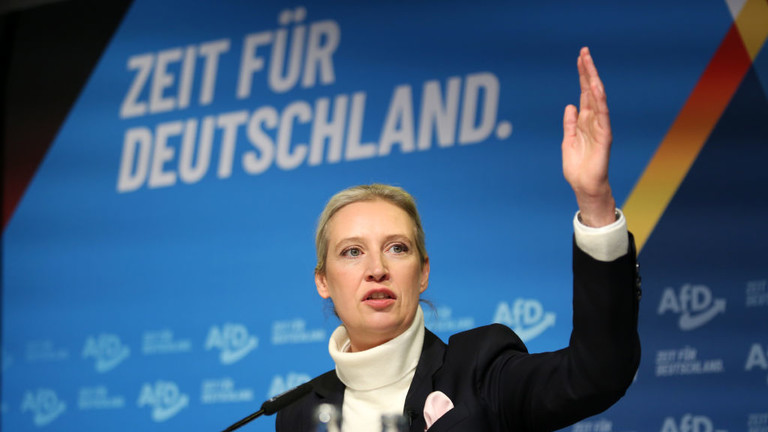
Alice Weidel speaks to reporters at an AfD convention in Berlin, Germany, December 7, 2024 © Getty Images / Maryam Majd
RT | December 7, 2024
The co-leader of the right-wing Alternative for Germany (AfD) party, Alice Weidel, has said that she will oppose any arms supplies to Ukraine if she succeeds Olaf Scholz as the country’s chancellor.
AfD nominated Weidel as its candidate for the post on Saturday, in the party’s first bid for the chancellery in its 11-year history. It has steadily risen in popularity since its founding in 2013, and is currently Germany’s second-strongest political force.
Speaking to reporters after the nomination, Weidel promised to introduce drastic immigration restrictions, to roll back Scholz’ climate policies, and to cut off military aid to Ukraine.
”We want peace in Ukraine,” the 45-year-old said. “We do not want any arms supplies, we do not want any tanks, we do not want any missiles. We do not want Taurus for Ukraine, which would make Germany a party to the war,” she added, referring to a type of German-made cruise missile that would require German military personnel to be deployed to Ukraine to operate.
The AfD, Weidel declared, is a “peace party.”
Scholz, along with his Green and Free Democrat coalition partners, overturned decades of foreign-policy pacifism in 2022 when they decided to supply weapons to the Ukrainian military. Since then, Berlin has sent Kiev almost €17 billion ($17.9 billion) in military, economic, and humanitarian aid, according to government figures. Although initially reluctant to supply heavy weapons, Scholz has authorized the transfer to Ukraine of tanks, artillery guns, anti-air missiles, and armored vehicles.
Before 2022, Germany relied on Russia for 55% of its supply of natural gas. Scholz’ decision to halt Russian energy imports, coupled with his government’s green policies, has led to soaring electricity costs, forcing some of the country’s manufacturing giants – including Volkswagen and BASF – to close plants and lay off workers.
Amid economic decline and disputes within his coalition, the Scholz government collapsed last month. The chancellor is expected to lose a confidence vote in parliament later this month, after which a snap election will likely be held in late February. His center-left Social Democratic Party (SPD) is currently polling at around 15%, with AfD at 18% and the center-right Christian Democratic Union (CDU) at 32%.
Weidel has little chance of winning the chancellery. Even if the AfD were to emerge as the largest party in February, all of Germany’s other mainstream parties have ruled out entering a coalition with the right-wingers. After a string of regional election wins this year, 113 members of the 733-member Bundestag put forth a motion last month to ban the AfD as a “Nazi party” whose beliefs clash with the German constitution. Most of the lawmakers behind the proposal were Greens, joined by 31 members of the SPD and just six from the CDU.
The Spiralling European Political Crisis: France’s Prime Minister Falls And President Under Pressure to Resign

By Ricardo Martins – New Eastern Outlook – December 7, 2024
The motion of no confidence, voted through on 4 December 2024, has succeeded—a first in France since 1962. All eyes are now on French President Emmanuel Macron, who faces mounting pressure to resign, but has assured that he will not resign.
The French political crisis is evolving into a dramatic and complex challenge, with significant implications for domestic governance, European stability, and global diplomacy. The public largely blames President Macron for the chaos.
In his national TV address on the evening of 5 December, Macron sought to shift the blame onto the “far-right” and “far-left,” accusing them of uniting to create turmoil ahead of the next presidential election—or to force an early one. He firmly rejected the idea of broad “cohabitation” as a solution or of bringing forward the presidential election foreseen for 2027.
Here’s my analysis connecting the key developments and their potential consequences.
A Crisis Born of Discord
Michel Barnier’s short-lived government collapsed in an extraordinary parliamentary alliance between far-right (RN – Marine Le Pen’s National Rally) and the left (New Popular Union, including LFI – France Unbowed led by Jean-Luc Mélenchon, considered an extreme-left movement). Their common grievance? A rejection of Barnier’s austere budget proposal, which sought to rein in France’s growing deficit, as well as their initial rejection of Barnier’s nomination as Prime Minister by President Macron, who disregarded the election results that were won by the left.
However, Le Pen was the primary architect behind the government’s downfall.
While intended to address fiscal concerns, the proposal ignited a populist backlash, culminating in a vote of no confidence. This marked the first successful ousting of a French prime minister by parliamentary motion since 1962, underscoring the depth of political fragmentation in the Fifth Republic.
Ripples Across Europe
France’s turmoil arrives at a precarious moment for the European Union. As the bloc’s major army and second-largest economy, its instability reverberates across the continent, weakening political cohesion within the EU and exposing vulnerabilities in the Eurozone. The EU was not used to face a political crisis in such dimensions within its core nations.
Compounding the issue, Germany is preoccupied with its own economic and electoral uncertainties, and Donald Trump’s imminent return to the U.S. presidency introduces a wildcard into global geopolitics.
The crisis in France underscores broader European challenges, from the rise of populism to mounting fiscal pressures, threatening the EU’s ability to maintain a united front in trade negotiations, foreign policy, and economic governance.
The EU has long relied on the leadership of the Franco-German duo. Now, both nations are mired in deep crises—Germany facing a political and economic crossroads, and France grappling with political and fiscal turmoil.
To make matters worse, there is no leader on the horizon like Charles de Gaulle, Willy Brandt, François Mitterrand, Helmut Kohl, or Angela Merkel—figures we were accustomed to relying on in the past to steer their nations out of such crises.
Macron Under Fire
Having Michel Barnier delivered his resignation, President Emmanuel Macron is under intense pressure to act decisively. Barnier now holds the dubious distinction of being the shortest-serving Prime Minister of the Fifth Republic. Naming a new prime minister quickly is not just a domestic imperative, but also a global one. The reopening of Notre Dame Cathedral this weekend, attended by Trump and other dignitaries, has heightened scrutiny on Macron’s leadership.
While Macron could reappoint Barnier as a caretaker to buy time, doing so risks appearing tone-deaf to growing calls for systemic change. Meanwhile, opposition factions and public sentiment increasingly question Macron’s ability to lead, raising the spectre of a presidential resignation. Macron’s televised address has done little to alter the narrative surrounding his survival—or the prospect of his potential downfall.
The Challenge of Finding a New Prime Minister
Forming a new government in France is proving to be a complex and overwhelming task. The New Popular Front (NFP) Alliance, a coalition of Greens, Socialists, Communists, and the radical left faction, France Unbowed, is the largest group at the French National Assembly.
However, the NFP lacks a sufficient majority to govern outright, forcing them to rely on support from President Macron’s MPs to pass legislation.
A potential candidate for prime minister from the NFP, Lucie Castets, was previously rejected by Macron this summer with fears that she would cancel his neoliberal reforms, such as the pension reform. The president’s decision stemmed from an apparent inability to secure stable majorities, despite the theoretical possibility of combining the NFP’s votes with Macron’s MPs to push through key laws. The new stalemate highlights the deep fractures within French politics and raises questions about whether any coalition can provide the stability needed to navigate the current crisis.
The immediate question is whether Macron can restore a semblance of stability by swiftly appointing a credible prime minister. Failure to do so could embolden opposition forces and deepen calls for his resignation. Beyond France, the crisis tests the EU’s resilience in managing its internal divisions while confronting external pressures, from a menacing Donald Trump to the rising assertiveness of the Global South.
Opportunistic Moves in Brussels
Amid France’s crisis, Brussels may seize the moment to push forward controversial EU initiatives. Chief among them is the Mercosur trade deal, a landmark agreement with Latin American countries that France has staunchly opposed. With French political attention consumed by domestic turmoil, the European Commission might view this as a rare opportunity to sidestep resistance and secure the deal’s approval, sparking further controversy within an already fragile EU.
The coming days will be pivotal in determining whether France and the EU can weather this storm—or whether it will escalate into a broader crisis of governance.
Ricardo Martins ‒ PhD in Sociology, specializing in policies, European and world politics and geopolitics.
Romanian presidential frontrunner claims he’s victim of coup d’etat
RT | December 7, 2024
The invalidation of Romania’s presidential election results by the country’s top court is a formalized coup d’etat, according to independent candidate Calin Georgescu, who clinched a surprise win in the first round last month.
Georgescu outperformed the other candidates in the first round of the election with 22.94%, beating out liberal leftist candidate Elena Lasconi, who received 19.18%, and the country’s Social Democrat Prime Minister Marcel Ciolacu, who finished third with 19.15%.
On Friday, Romania’s Constitutional Court dismissed Georgescu’s victory, citing a clause in the nation’s laws that emphasizes the need to ensure the correctness and legality of the election. The judiciary body announced that the whole process would be resumed later.
“Essentially, this is a formalized coup d’etat. The rule of law is in an induced coma, and justice subordinated to political orders has practically lost its essence. It is no longer justice, it obeys the orders,” Georgescu, a known critic of Romania’s pro-NATO and pro-Ukraine policy, said on Friday, as cited by Realitatea TV.
The politician also stressed that the court’s decision represents more than a legal controversy, adding that “the corrupt system in Romania showed its true face by making a pact with the devil.”
Georgescu also said that the power of the people is the basis for a democratic state, and the authorities are obliged to respect the results of the national vote. He stated that the current Romanian government is afraid of losing power and facing revelations.
Earlier this week, Western media outlets reported that declassified information from Romania’s intelligence agencies had revealed that the sudden rise of Georgescu in the first round of the election was “not a natural outcome.” According to the claims, his win emerged thanks to a coordinated social media effort, most likely orchestrated by a “state actor” meddling in the candidate’s mostly Tik-Tok-based campaign, helping to get his message out to the voters.
The annulment came amid accusations that Moscow had assisted Georgescu’s campaign, which Russian Foreign Ministry spokeswoman Maria Zakharova has dismissed as “absolutely groundless.” She said that Romanian elections are carried out in a climate of “an unprecedented surge of anti-Russian hysteria” that is set “to influence the consciousness and will of the country’s citizens.”
Washington, meanwhile, has praised the move. On Friday, State Department spokesman Matthew Miller said that the US reaffirms its “confidence in Romania’s democratic institutions and processes, including investigations into foreign malign influence.”
Featured Video
John Mearsheimer: US Already lost Iran war – No off-ramp in sight
or go to
Aletho News Archives – Video-Images
Frlom the Archives
70 Neocons Petition Congress To Effectively Allow Israel To Say When The US Should Attack Iran
By Damian Lataan | January 10, 2014
Seventy senior Israeli-centric neoconservatives have written an open letter to Congress imploring them to do more to ensure Iran complies with the conditions of any agreement finally reached with the P5+1 over Iran’s nuclear program.
While the neocons are ostensibly asking Congress to ensure compliance, it is clear that their real aim is to convince members of Congress to support the bill currently passing through the Senate which calls for tighter sanctions against Iran in the event of any waywardness on Iran’s part.
The neocons are eager to see the bill currently passing through the Senate with enough support to make it veto-proof, not so much because they are concerned about Iran’s so-called nuclear weapons program – there’s still not a skerrick of hard evidence that Iran has a nuclear weapons program – but, rather, because embedded within the bill is this clause:
… if the Government of Israel is compelled to take military action in legitimate self-defense against Iran’s nuclear weapon program, the United States Government should stand with Israel and provide, in accordance with the law of the United States and the constitutional responsibility of Congress to authorize the use of military force, diplomatic, military, and economic support to the Government of Israel in its defense of its territory, people, and existence…
Essentially, the clause is an automatic trigger for the US to attack Iran at any time the Israelis choose to launch a first strike – regardless of whether President Obama is in favour or not.
Partial list… continue
Blog Roll
 Aletho News
- ‘Heinous crime’: Iran denounces Israeli assassination of 4 Iranian diplomats in Lebanon
- John Mearsheimer: U.S. Already Lost Iran War – No Off-Ramp in Sight
- UK Parliament Plans ISP Blocking and Age Verification Powers
- World cannot remain silent as US and Israel attack ‘heritage of humankind’: Iran
- Emirati billionaire rebukes US senator over call for Gulf states to join war with Iran
- Op. True Promise 4: Iran’s missile blitzkrieg dismantles US war machine in West Asia
- Aramco CEO warns ‘catastrophe’ imminent if Strait of Hormuz remains shut
- What If Iran Says No?
- Trump Threatens to ‘Hit’ Iran ‘Twenty Times Harder’ Over Strait of Hormuz Oil Flows
- Spare the hypocrisy: Baghaei slams Ursula’s support for US
- If Americans Knew
- Israel Decided the War, But Trump’s America Fights and Pays the Bill
- Conscientious Objector Group: Phone ‘Ringing Off Hook’ As Huge Mobilization Underway
- U.S. support for Israel continues to plummet, despite media’s best efforts
- Threats and missiles fly, death tolls soar in Iran, Lebanon, Gaza – Not a ceasefire Day 151
- Lebanon: Israel’s White Phosphorous Use Risks Civilian Harm
- Corporate Media Go All Out To Support The US-Israeli War On Iran
- US-Israel war on Iran is creating a steady growing number of amputees
- Israel planned this war on Iran for 40 years. Everything else is a smoke screen
- The wrong question about the war in Iran
- ‘Your Tax Dollars Being Used to Raise Your Gas Prices’: US-Israel Bomb Major Iranian Oil Depots
- No Tricks Zone
- New Study Documents A 20-Year Pause In Arctic Sea Ice Decline – Driven By Internal Variability
- Wake-up Call: Survey Shows Majority Of Germans Now Favor Postponing Climate Targets!
- Televised! Leading German Political Candidate Tells Schoolchildren CO2 Makes Sun Hotter!
- New Study: A Century Warming Of 1.1°C Is ‘Commonplace’ And ‘Not Unusual’ During This Interglacial
- New Study: ‘Internal Noise’ And Volcanic Forcing Can Trigger 10-15°C Warming Within Decades
- Glaciers Worldwide Are Suddendly Surging, Experts Blame Warming!
- Surprising Discovery: Sahara Is Greening…Billions Of Trees Where Once Thought To Be Barren
- New Research Reaffirms Clouds, Aerosols, And Surface Solar Radiation Are ‘Driving The Climate System’
- Germany: Electric Car Catches Fire At Charging Station, Sets Off Local “Inferno”, Widespread Damage
- New Study: Canada’s New Brunswick Was 1°C Warmer Than Today During The Medieval Warm Period
 Aletho News