Israeli Enemy Procrastinates on Withdrawal from Southern Border Towns
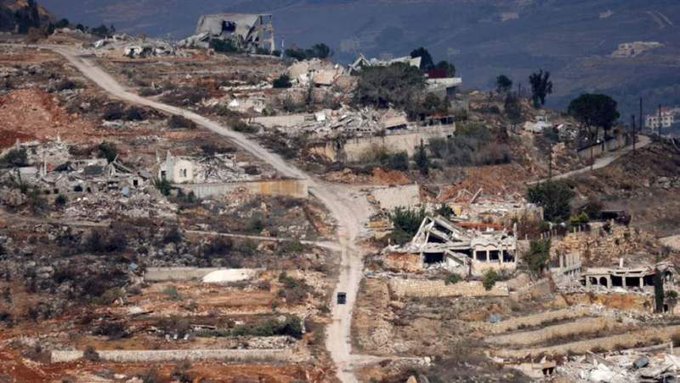
The southern Lebanese town of Adaisseh after the Israeli aggression on Lebanon (December 2024)
Al-Manar | December 17, 2024
The Israeli enemy has been procrastinating on withdrawal from southern border towns, hindering the deployment of the Lebanese Army, Al-Manar correspondent in south Lebanon reported on Tuesday.
Our correspondent said that it was planned that the Israeli enemy forces would withdraw from Al-Hamamis Hill in the border town f Khiam during the first phase of a coordination deal with the UNIFIL peacekeeping force.
“However, the Israeli enemy delayed the withdrawal and the Lebanese Army didn’t manage to enter the area,” Al-Manar’s Ali Shoeib reported.
Meanwhile, the reporter added that the Lebanese Army wasn’t able to enter the border town of Adaisseh in a bid to retrieve the bodies of the martyrs.
He noted that another bid in the town of Taybe was also hindered as the Lebanese Army leadership is waiting for a response from the UNIFIL, which is coordinating these missions with the Israeli enemy.
On the other hand, the Israeli forces repeatedly opened fire at houses in the border town of Naqoura and carried, Shoeb said, adding that the Israeli enemy forces also went ahead with blowing up houses in the border town of Kfar Kila.
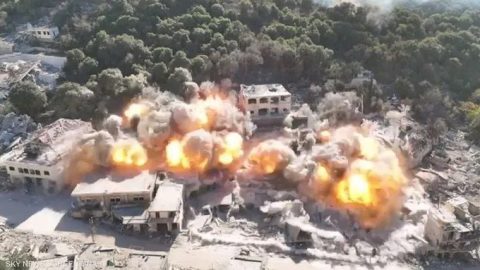
The Lebanese border towns were venue of epic battles between Israeli occupation forces and resistance fighters who heroically repelled the Zionist incursion into Lebanon throughout nearly two months (from October 1 till November 27.)
Lebanon has been subjected to brutal Israeli aggression on September 23, that killed more than 4,000 people and injured at least 12,000 others.
‘Israel’ expanding operations in southern Syria toward key dams
Al Mayadeen | December 17, 2024
Israeli occupation forces have partially withdrawn from the al-Raqad Dam area near Saida al-Golan in the southern countryside of Quneitra, a local Syrian source told Al Mayadeen on Tuesday.
The source reported that the withdrawing forces redeployed to Tel al-Saqi in the occupied Golan Heights, a position overlooking the Yarmouk Basin and southern Quneitra. However, the Israeli forces maintained a presence along the axis stretching from Barracks 74 to the valleys of Raqad and Taim, focusing their operations near key water sources and dams in southern Syria.
Simultaneously, Israeli occupation forces have installed advanced communication equipment on Jabal Qurs al-Nafl, west of Hader in Quneitra’s countryside. According to local sources, this strategic elevation directly overlooks the occupied town of Majdal Shams and critical Israeli supply routes toward the Lebanese border.
Continued encroachment
Earlier on Tuesday, an Al Mayadeen correspondent reported Israeli incursions into Saida in the occupied Golan and its neighboring village of al-Muqraz, located at the administrative border between Daraa and Quneitra. The occupation forces have also seized control of the Yarmouk Basin, including the Yarmouk River and the al-Wehda Dam, asserting dominance over key water resources in the region.
Despite these advances, the Israeli forces have been unable to occupy Beit Jinn, a stronghold of local resistance, and remain stationed in its surrounding areas. Additionally, they have expanded eastward near the villages of Kuwayya, al-Mariyah, and al-Qusayr, close to the Jordanian border.
Escalation of Israeli aggression
For the sixth consecutive day, the Israeli occupation has been advancing deeper into Syrian territory. It now controls the Syrian side of Mount Hermon, has taken over the “buffer zone” in the occupied Golan Heights, and is within 15 kilometers of the Damascus-Beirut international highway.
Furthermore, the occupation has seized major freshwater resources in southern Syria, particularly in the Yarmouk Basin, signaling a strategic shift toward controlling critical infrastructure.
Meanwhile, Israeli Security Minister Israel Katz visited Israeli occupation forces outposts on Mount Hermon in Syria on Tuesday, emphasizing the strategic importance of the area in countering threats from Hezbollah in Lebanon and factions in Syria.
He was accompanied by Prime Minister Benjamin Netanyahu, IOF Chief of Staff Herzi Halevi, Shin Bet Director Ronen Bar, and Northern Command Chief Maj. Gen. Ori Gordin.
Blinded to Syria
By Patrick Lawrence | Consortium News | December 15, 2024
Decades after deploying mass violence and rendering citizens grotesquely ignorant of the world, U.S.-led powers appear willing to risk world war, while reinventing a terrorist to lead what was a secular nation until last week.
I do not know anyone who was not shocked by the lightning speed with which Damascus fell to expensively armed jihadist militias last weekend.
I know very few people who do not understand that another domino has just fallen in the “seven-front war” Benjamin Netanyahu has boasted this year of waging across West Asia. I know very few people who do not recognize that terrorist Israel is well on the way to establishing itself as a dictatorial hegemon across the region.
I know very few people who do not understand that the longstanding project of the Zionist neoconservatives, who have more or less controlled U.S. foreign policy for decades, i.e., “remaking the Middle East,” is the design behind all that has occurred since the Israelis launched their attack on Gaza on Oct. 7, 2023.
I do not know anyone who has achieved the age of reason who does not recognize the U.S. hand in the stunning sweep through Syria of Hay`at Tahrir al–Sham, long-recognized as a terrorist organization. All one needs to grasp this is a little history.
But I know of no corporate or state-funded medium on either side of the Atlantic — the major dailies, the broadcast networks, NPR, PBS, the BBC — where you can read or hear about any of this.
Blinding Us
Mainstream media are doing exactly what they did as the U.S.–led “regime change” operation in Syria began in early 2012 at the latest and probably in the final months of 2011: They are making sure the events now unfolding in Syria are not quite illegible but nearly.
It is again a question of knowing the history. In the case of Hay`at Tahrir al–Sham and the other jihadists who knocked over the Assad regime as if it were made of Lego blocks, it is another exercise in dressing up a monster in a suit and tie.
The corporate press and broadcasters are now resolutely recasting the murderous fanatics who have seized control of Syria as legitimate “rebels.” Rebels, rebels, rebels: This is the approved terminology.
I see they have left off describing these Sunni zealots as the “moderate rebels” of yesteryear, that phrase having been hopelessly discredited last time around, but the drift is the same: These are civilized people out there trying to do the right thing.
My favorite in this line appeared in The Daily Telegraph several days before the Assad government collapsed: “How Syria’s ‘diversity-friendly’ jihadists plan on building a state.” I had to read this one twice, too.
Nowhere but nowhere in the West’s mass media can you find even a mention of the U.S.–Turkish-and-probably–Israeli support that made possible the swift sweep of Hay`at Tahrir al–Sham and its ever-bickering allies from its seat in the Idlib governorate through Hama and other cities to the center of Damascus.
This is, like the earlier years of the Western-backed terrorist attacks on the Assad regime, and like the proxy war in Ukraine, and like the Saudis’ U.S.–supported war against Yemen, and like the Israeli genocide against the Palestinians of Gaza, and like the Israelis’ attacks in Lebanon, sponsored military aggression we are not permitted to see without considerable effort to transcend official representations of reality.
Understanding Who the Americans Are
What happened, what is happening, what will happen: I do not know anyone who is not asking these questions, too.
We must go back and back and back further to understand what has just occurred in Syria and to understand why, and finally to understand who Americans are and who they have been for all the decades since the 1945 victories.
It is logical to begin this pencil-sketch of the past with the famous coups of the 1950s. These occurred in Iran, where the C.I.A., working with MI6, deposed Mohammed Mossadegh as Iran’s prime minister in August 1953, and in Guatemala, where an agency operation forced Jacobo Árbenz from the presidency a year later.
It is striking today to consider a few of the features of these operations. Stimulating various social and economic antagonisms to foment public unrest and an appearance of political disorder was key in both cases. Both coups removed popularly elected leaders and installed repressive puppets.
There was violence in both cases, but by later standards these operations were something close to surgical. Mossadegh withdrew to his farm in the Iranian countryside; Árbenz, a Swiss pharmacist by background, spent his last years wandering dejectedly through Europe.
An appearance of propriety was important back then. Most Americans were unaware that the C.I.A. had engineered the events in Tehran and Guatemala City. And in the Iranian case, something to note: Removing Iran’s first elected prime minister set in motion a wave of blowback that continues to break over U.S.–Iranian relations; in Guatemala it led to a civil war that endured for 36 years.
The C.I.A. considered the coup in Iran a useful model – Guatemala its next application. But in 1965 the agency began to do things very differently when it organized the coup that brought down Sukarno, independent Indonesia’s charismatic founding father and its first president.
The Jakarta Model
Vincent Blevins, a seasoned foreign correspondent, got this down better than anyone in The Jakarta Method: Washington’s Anticommunist Crusade and the Mass Murder Program that Shaped Our World (Public Affairs, 2020). With the Cold War approaching its worst years, the Indonesian coup was the first, as Blevins’s subtitle indicates, to submerge an entire nation in prolonged violence.
There are various figures for the number of deaths that resulted as the agency installed the dictatorial, bottomlessly corrupt Suharto in the presidential palace in 1967. Blevins puts it at a million or more. Along with the deaths, the nation’s previously lively political culture was extinguished until Suharto fell 32 years later.
The Jakarta Method was subsequently applied in various other circumstances, notably but not only in the 1973 coup that deposed Salvador Allende in Chile and installed Augusto Pinochet, a vicious dictator in the Suharto mold. Nine years later Zbigniew Brzezinski put a modified version to use in Afghanistan.
Blind to US Support for Jihadism
As Jimmy Carter’s relentlessly anti–Soviet national security adviser, Brzezinski persuaded Carter to back the mujahideen then fighting the Moscow-backed regime in Kabul. The result was the well-armed, well-financed force named al–Qaeda, led by Osama bin Laden.
And so we come, via the campaigns of mass violence in Iraq and Libya and the proxy war in Ukraine, to the Syrian operation. People who rely on mainstream media still have a hard time accepting that the U.S. and its trans–Atlantic allies backed al–Qaeda’s Syrian forces, the Islamic State, and their heinous offshoots in their war against the Assad regime.
There are no grounds whatsoever for this disbelief. The U.S. operation in Syria is a straight readout of Brzezinski’s Afghanistan strategy. Sharmine Narwani, the tenacious Beirut-based correspondent and the founding editor of The Cradle, reported the American op first-hand as it unfolded. She recounted what she saw in an impressively detailed interview I published in 2019. It is here and here in two parts.
It Wasn’t Over
By 2018–19, it was obvious that the C.I.A.’s Syrian operation, in my judgment its largest since the Cold War’s end, had failed after several years of Russia’s bombing campaign against the Islamic State. Everyone making this judgment, myself included, forgot to add four essential words: It had failed for the time being.
Hay’at Tahrir al-Sham was founded at the start of the covert U.S. intervention, in 2011–12. Its name translates as Organization for the Liberation of the Levant.
Liberating the Levant is a very good idea, but HTS does not mean this the way anyone opposed to the Western powers’ long and violent domination of West Asia would mean it. HTS shared with the Islamic State an ambition to establish a caliphate ruled by radical interpretations of Islamic law.
In May 2018 the State Department added HTS to its list of foreign terrorist organizations, FTOs in the parlance of the apparatchiks. It is a direct descendent of Jabhat al–Nusra, which was the worst of the worst among al–Qaeda’s shape-shifting affiliates operating in Syria.
By the time HTS made the list, Jabhat al–Nusra was already on it. They both remain on it as we speak.
HTS was founded by Abu Mohammad al–Jolani, a nom de guerre now all over the news: He has long led HTS and appears now to have plans to make himself Syria’s next president. When he spoke at a celebrated mosque in Damascus last week, he shed the public alias in favor of his real name, Ahmed al–Shara.
Jolani’s background is not to be missed. He was once an Islamic State commander who went on to found Jabhat al–Nusra and, after a violent split, HTS.
As the HTS leader, he was implicated in numerous cases of torture, violence, sexual abuse, arbitrary arrests, disappearances, and so on. Reflecting his singular malignity, the State Department had declared Jolani a “specially designated global terrorist” as far back as 2013.
That designation still stood in 2021. Then something odd, and in hindsight very revealing, occurred.
Rehabilitating Jolani
In April of that year PBS broadcast the first interview with Jolani ever to appear in any Western medium. It was conducted by Martin Smith, a longtime broadcast correspondent with a good reputation.
And there on camera was the specially designated terrorist in a blue blazer and a buttoned-down shirt, telling Smith he planned to build a “salvation government” in Syria.
Smith was not shy, to his credit, in his review of Jolani’s horrific record. But he gave his interview subject ample airtime to make his that-was-then-this-is-now argument.
There was no talk of a caliphate, despite how HTS still named itself. It was about sound local governance. Yes, this would be according to Sharia law, but it would be a kind-and-gentle Sharia law.
The Martin Smith interview, it is now evident, was highly significant for its timing and its implications for U.S. policy. It is almost certain that it signaled an already-in-train revival of the Syrian operation; certainly it marked the start of the preposterous reinvention of Jolani that is now ubiquitous in Western media.
It is a long way from those first postwar coups — large in ambition and implications but small in scale as they look to us now. Since the Jakarta Method was devised in the mid–1960s, mass murder programs have shaped our world just as Vincent Blevins insightfully put it.
Committed to Mass Violence
The questions noted at the start of this commentary remain those we must ask: What happened, what is happening, what will happen. Clarity on these matters arrives by degrees — not by way of official accounts or the corporate press, but in independent media. For now, two conclusions.
One, the U.S. and its trans–Atlantic allies are now thoroughly committed to mass violence. This means it is difficult to avoid concluding that the Western powers and Israel will turn to Iran once Syria as a functioning polity has been thoroughly disabled.
What has prompted the U.S. and Israel to exercise caution to date has been the risk of what would without doubt be a cataclysmic conflict that could tip into another world war.
With a six-decade history of mass violence behind them, these powers now appear willing to take this risk. There is little ground left to continue questioning this.
Two, we now witness the reinvention of a viciously intolerant terrorist given to waging holy wars as an acceptable presence at the head of what was a secular nation until earlier this month.
We must read this as the outcome — the successful outcome — of an eight-decade campaign to render the citizens of the Western powers grotesquely ignorant of the world in which they live.
The New York Times and other major dailies continue to lie by omission about U.S. support for Jolani and the organization he leads, even as both are officially designated terrorists. But something worth considering here: These media ran interesting photographs with their initial stories on the militias’ sudden offensive, showing rocket launchers and armored personnel carriers of obvious Western manufacture. Here is one such picture and here is another.
I see these pictures and the accompanying stories as mirrors. They show us exactly who we are, what we have become — and also the extent to which we are encouraged not to see either.
There are no true surprises in what we witness now in Syria. It is an old story. We have been blinded to it, along with many other things to which we have been blinded. Most fundamentally we have been rendered blind to ourselves.
Patrick Lawrence, a correspondent abroad for many years, chiefly for the International Herald Tribune, is a columnist, essayist, lecturer and author, most recently of Journalists and Their Shadows.
Sen. Mitch McConnell Fights On for US Foreign Intervention and the Military-Industrial Complex
By Adam Dick | Peace and Prosperity Blog | December 17, 2024
Sen. Mitch McConnell (R-KY) is set to no longer be the leader of Senate Republicans when Donald Trump is sworn in as president next month. But, McConnell will remain in the Senate. McConnell signaled on Monday, via an editorial at Foreign Affairs, that he will be using his position in the legislative body to focus on supporting increasing both the United States government’s intervention oversees and the flow of money to the military-industrial complex.
Of all things, McConnell, in the second paragraph of his editorial, complained that President Joe Biden has pursued “engagement and accommodation” in foreign policy. This is the president who has been funding, and supplying weapons and intelligence to, Ukraine and Israel without halt for two wars with big tolls in destruction of life and property. Further, these are two wars with large and growing potential to spiral into world war and nuclear annihilation.
Where is Biden’s “engagement and accommodation” in regard to Russia? Biden refuses to even talk with the nation’s leader and persistently prevents peace negotiations for the Ukraine War. Meanwhile, tensions build with China due to US bellicose statements regarding, and actions in, the Asian economic and nuclear power’s neighborhood.
The rewards, meanwhile, have been bountiful for the military-industrial complex.
Yet, Biden’s intervention overseas and military funding are insufficient, proclaimed McConnell. McConnell wants more, and he will be pressuring Trump as president to deliver on that. For a taste of McConnell’s advice for Trump, consider this paragraph from McConnell’s editorial:
Trump would be wise to build his foreign policy on the enduring cornerstone of U.S. leadership: hard power. To reverse the neglect of military strength, his administration must commit to a significant and sustained increase in defense spending, generational investments in the defense industrial base, and urgent reforms to speed the United States’ development of new capabilities and to expand allies’ and partners’ access to them.
And McConnell calls for that military might to be ready for use to help allies and fight foes around the world. Indeed, McConnell’s greatest fear appears to be that Trump will let even some of the rest of the world be. Warned McConnell in his editorial, “the response to four years of weakness must not be four years of isolation.” Further commented McConnell, “Trump will hear from neo-isolationists who discount the importance of American allies to American prosperity, ignore the need for the United States’ credibility among fence sitters in critical regions, and misunderstand the basic requirements of the U.S. military to deter or win faraway conflicts.” Be assured, McConnell will from the Senate work to ensure that, contrary to such so-called neo-isolationist advice, the US will not give peace a chance.
Trump’s effort to run as the “peace candidate” may alone have made the difference in his winning the presidential election last month. While not portraying himself as a noninterventionist in regard to foreign policy, Trump did make many comments through the election that indicated he was much farther toward supporting peace than was Biden. The distinction was clear for all to see.
Trump then continued on this course on election night, making the following succinct comment in his acceptance speech: “I’m not gonna start a war; I’m gonna stop wars.” Talk like that to McConnell is like a crucifix to a vampire.
I am hopeful that Trump, as he has continued to suggest in the time between his election and inauguration, will pursue as president a foreign policy significantly less interventionist and militaristic than the one Biden has pursued. But, I am not sure that will be the case. It is not wise to take politicians’ promises to the bank.
More certain is my expectation the McConnell will follow through with his effort to ensure the US government is extreme in its interventions abroad and its feeding of the military-industrial complex. Doing just that has been a large part of McConnell’s career in the Senate over many years.
Alleged provocations exposed by Russia’s murdered general: The main cases
Igor Kirillov spent years investigating incidents involving chemical and biological weapons
RT | December 17, 2024
Russian Lieutenant General Igor Kirillov, who was killed on Tuesday in Moscow along with his assistant in an assassination allegedly carried out by Ukraine, was the Russian military’s top official on the hazards posed by weapons of mass destruction.
Kirillov commanded the military branch responsible for protecting troops and civilians from chemical and biological weapons, and from the radioactive fallout of a nuclear strike or ‘dirty bomb’ attack. He was also in charge of military investigations into numerous high-profile cases directly and indirectly involving Russia.
He delivered over 40 briefings about the findings made by specialists under his command since being appointed in 2017. He also regularly offered his expert opinion to Russian officials and the media. His work came as allegations of chemical weapons use became an increasingly frequent tool in Western foreign policy over the past decade.
Syria
The turning point was arguably the war in Syria and claims by then-US President Barack Obama that Damascus had deployed chemical weapons against opposition forces, thus crossing a Washington-declared ‘red line’. In a Russia-mediated attempt to deflate tensions, the Syrian government agreed in 2013 to destroy all of its declared stockpiles of such weapons.
However, more incidents followed, which the West blamed on government forces, alleging that Damascus never actually fulfilled its obligations. Moscow, meanwhile, maintained that anti-government groups were conducting false flag operations, while foreign-funded organizations, such as the notorious White Helmets, were providing media support.
The Organization for the Prohibition of Chemical Weapons (OPCW), which has the mandate to investigate such allegations, was compromised by Western influence, Russia believes.
“Syrian authorities demanded on numerous occasions that the OPCW deploy specialists on the ground [for investigation], but received refusals that cited lack of security,” Kirillov said during a briefing in 2018, as he detailed cases of alleged manufacturing of chemical weapons by militant groups.
The same year, the OPCW faced what was arguably its worst internal crisis while investigating a chemical attack in the city of Douma.
According to whistleblowers, its top management suppressed findings by field investigators and manipulated testimony to implicate Damascus. Dissenting scientists argued behind closed doors that the evidence contradicted such a claim, only to be dismissed as disgruntled employees when they went public.
Kirillov reported in 2019 that Russian troops deployed in Syria conducted hundreds of tests for traces of chemical weapons as part of their monitoring mission.
Novichok
Moscow was accused of deploying a chemical weapon in 2018, after Andrey Skripal, a Russian intelligence defector, and his daughter fell ill in Salisbury, Great Britain. London and Western media claimed that they were poisoned with Novichok, a toxic chemical allegedly developed exclusively by the Soviet military.
Although civilian officials were responsible for Moscow’s messaging over the incident, Kirillov was called in to set the record straight about Novichok’s “Russian” nature. Western nations, including the UK, have chemical weapons programs of their own with enough expertise to synthesize highly lethal compounds, he pointed out.
The US and its allies had an opportunity to gain insight into Soviet research, including from chemists involved in it, he added during a briefing in 2018. A scientist named Vil Mirzayanov was the first person to discuss the program dubbed Novichok publicly after moving to the US.
He went as far as to publish a formula for one of the chemicals developed by the USSR, which Kirillov said was deeply irresponsible and posed a proliferation threat.
Ukraine and US-led biolabs
A significant part of Kirillov’s reports in the media focused on the Ukraine conflict after it escalated into open hostilities with Russia in 2022. Some of them documented alleged use of chemical agents by Ukrainian troops on the battlefield or warned of possible provocations by Kiev.
Others dealt with a network of US-backed microbiological labs, which have been a source of major concern for Russia and other countries. Washington claims that the Pentagon-funded activities by the Defense Threat Reduction Agency are merely meant to detect and identify naturally emerging threats. Critics, however, believe the program pursued more sinister aims.
Kirillov claimed that the US evacuated some 16,000 relevant samples from Ukraine while other pieces of evidence were destroyed. But some materials were captured by the Russian military, giving Moscow a glimpse into the clandestine research, the late general claimed.
With his visor up
In October, the UK placed personal sanctions on Kirillov, along with the entire Russian military branch under his command. London cited Kiev’s claims that the general was responsible for using chemical weapons in the Ukraine conflict. Moscow has consistently denied such accusations, insisting it destroyed such materials back in 2017.
The Ukrainian security service SBU announced formal charges against Kirillov hours before his murder. A source in the agency told the media that the assassination was its operation against a “war criminal.”
Kirillov spent years “exposing the crimes of the Anglo-Americans,” Russian Foreign Ministry spokeswoman Maria Zakharova said, commenting on his death.
“He worked without fear. Did not hide behind anyone’s back. Walked with his visor up. For the motherland and the truth,” she added.
Key Revelations Slain Gen. Kirillov Exposed About Pentagon’s Biolabs Scheme
By Svetlana Ekimenko – Sputnik – 17.12.2024
General Kirillov, head of Russia’s Radiological Chemical and Biological Defense Forces, gained prominence due to his regular appearances at military briefings, accusing the Kiev regime and its US patrons of operating biolaboratories and using chemical weapons.
Lieutenant General Igor Kirillov, the head of the Radiological, Chemical and Biological Defense troops of the Russian armed forces, was killed in a blast triggered by an improvised explosive device planted near his residence in Moscow. He leaves behind a legacy of eye-opening findings.
On Illegal US Bio-Research
Revelations by Russia’s Defense Ministry on illegal biological experiments at the Prestige Biotech’s California laboratory touched off a US Congressional investigation. The US Department of State played a direct role in the Biosecurity Engagement Program, which was initiated by ex-President Barack Obama, Lieutenant General Igor Kirillov revealed in one of the Ministry of Defense briefings.
The program’s priority areas for implementation include the Middle East, Southeast Asia, Ukraine, and Africa.

Third-party contractors, intermediaries, and NGOs—such as Metabiota, CH2M Hill, and EcoHealth Alliance—are utilized to serve the interests of clients like the State Department, Pentagon, FBI, and CIA, as well as for military biological research.
“Unconditional deterrence of adversaries” from using weapons of mass destruction against Washington and its allies has become one of the points of the new US national strategy, it was noted.
On US Biolabs in Ukraine
The US State Department is directly involved in these biological programs, despite the federal foreign agency’s denials, Lt. Gen. Igor Kirillov repeatedly underscored.
The United States aims to exert global control over biological matters, he noted in one of his reports. He added that under Barack Obama, US biological programs in other countries were promoted at the recommendation of the State Department, with supporting documents available as evidence.
Pentagon’s Deadly Biological Warfare Program
Slain Lieutenant General Igor Kirillov regularly exposed the Pentagon’s biological warfare program. Recent developments indicate that the United States has embarked on preparations for a new pandemic by looking into virus mutations, he said at a briefing in August 2023.
Commenting on the establishment of the Office of Pandemic Preparedness and Response Policy, led by Special Assistant to the President and Senior Director for Global Health Security and Biosecurity at the National Security Council, retired Air Force Major General Paul Friedrichs, in July 2023, Kirillov told reporters:
“The priority areas of this department include work on the creation of vaccines and drugs for stopping viruses and their genetically modified variants, as well as the introduction of advanced technologies in bioproduction. Thus, the United States, as it was in 2019, began preparing for a new pandemic by implementing search for virus mutations.”
The newly established Office is prioritizing the creation of vaccines and drugs said to combat viruses and their genetically modified variants, Russia’s Radiological, Chemical and Biological Defense Troops warned.
Furthermore, documents uncovered during the special military operation in Ukraine have confirmed that the US Army Medical Research Institute of Infectious Diseases is involved in accumulating dangerous pathogens across various regions of the world.
US Officials Linked to Hazardous Vaccines
The Russian Ministry of Defense released the names of American officials connected to the development and production of dangerous vaccines, General Igor Kirillov told reporters in 2023.
This list includes former Johnson & Johnson Board member Mark McClellan, Pfizer Board member Scott Gottlieb, and Stephen Hahn, the CEO of Flagship Pioneering Inc.
He underscored that officials from regulatory agencies have been lobbying and prioritizing the commercial interests of pharmaceutical companies to the detriment of existing safety and quality standards.
US Democratic Party’s Role in Military Biological Research
Investment funds belonging to prominent figures such as the Clintons, the Rockefellers, Soros, and Biden, along with other NGOs affiliated with the Democratic Party in the US, are bankrolling military biological research, documents and analytical materials studied by Russia’s Radiological, Chemical and Biological Defense Troops have revealed.
Multinational corporations often referred to as “Big Pharma” are involved in this scheme, including Pfizer, Moderna, Merck, as well as Gilead, a US military-affiliated company. Furthermore, US experts are working on testing new medicines, bypassing international safety standards.
The involvement of non-governmental and biotech organizations enables the leaders of the Democratic Party to pocket additional financial revenue for election campaigns and to conceal cash flows.
Russia’s Radiological, Chemical and Biological Defense Troops warned in January 2024 that Washington’s goals in the military-biological domain are multifold, ranging from the creation and manipulation of the causative agents of “particularly dangerous infections in regions of the world that are strategically important for the United States,” to efforts to achieve global “superiority” in biomanufacturing, biological monitoring, and the expansion of potentially unethical and illegal military biological research outside US jurisdictions.
US chip suppression won’t stop Chinese industries’ development, will only make them stronger: China chip trade group
By Zhang Yiyi and Wang Cong | Global Times | December 13, 2024
On December 3, one day after the US government announced yet another round of restrictions on chip sales to Chinese firms, four Chinese industry associations, including the China Semiconductor Industry Association (CSIA) and the Internet Society of China (ISC), issued firmly worded statements declaring that US chip products are no longer safe and reliable.
Behind the strongly-worded statements are the profound indignation among Chinese industries over the US government’s relentless campaign to target an ever-growing number of Chinese companies, and the determination to ensure safe and reliable chip supplies for relevant Chinese industries, according to Wei Shaojun, vice chairman of the CSIA.
“The US government has repeatedly suppressed Chinese semiconductor companies, and CSIA members have been very outraged about this. So, it is the CSIA’s responsibility to speak out,” Wei told the Global Times in an interview on Thursday, noting that more than 240 Chinese semiconductor companies have been added to the US’ so-called Entity List so far, accounting for one-quarter of the CSIA members, or one-third, if affected foreign CSIA members are included.
In the statement on December 3, the CSIA blasted the US government’s latest move of adding more than 140 Chinese firms to its so-called Entity List, saying the US arbitrary export control measures against Chinese firms have affected the stable supply of US chip products. “US chip products are no longer safe and reliable and relevant Chinese industries will have to be cautious in purchasing US chips,” it said.
Also making the same determination are three other Chinese industry associations that represent the main buyers of chips – the ISC, the China Association of Communications Enterprises, and the China Association of Automobile Manufacturers. Relevant Chinese ministries, including the Ministry of Commerce, also slammed the US move and vowed to take “necessary” measures to resolutely safeguard its legitimate rights and interests.
China’s innovation edge
The statements from the Chinese industry associations showed a “stronger-than-before attitude” and “they expressed our strong indignation,” Tu Xinquan, dean of China Institute for WTO Studies at the University of International Business and Economics and a consultant for the CSIA, told the Global Times.
As the US government is bent on escalating the crackdown measures, “we must take some necessary measures to firmly safeguard our legitimate rights and interests,” Tu said, “we must accordingly encourage and support the purchase of reliable and safe products, whether they are made by Chinese companies or in other countries or regions.”
For domestic internet companies, they need to “promptly adjust their foreign cooperation and development strategies,” Pei Wei, Deputy Secretary General of the ISC, told the Global Times in an interview. “They need to diversify the supply chain layout, especially for the procurement of key technologies and components, to reduce the reliance on a single source.”
Chinese internet companies should establish partnerships with chip manufacturers in countries and regions outside the US, strengthen support for domestic and locally produced chips, so as to diversify risks and enhance supply chain security and stability, Pei further noted.
“At the same time, we must also improve our internal capabilities and continue to build independent research and development, production and manufacturing capabilities,” Pei said.
Wei also urged support for reliable chip supplies in the face of the US’ relentless crackdown campaign.
“We call on the Chinese government to support the stable development of reliable semiconductor suppliers; we also call on semiconductor companies in relevant countries and regions to strive to become reliable semiconductor industry suppliers,” he said. “Suppression will not stop us from development. Chinese industries will become stronger and more confident in our development.”
Broader cooperation needed
In response to the US government’s relentless crackdown campaign, Chinese industries should also remain open for cooperation with their foreign counterparts, the leaders of the industries also said.
“The current success and achievement of the semiconductor industry are the result of global competition and cooperation. Closed development is not conducive to technological progresses and breakthroughs in the industry, and will harm the interests of global consumers,” Wei said, urging the US to return to the stage for fair competition.
Tu noted that it is the US government’s policies, not US companies, that make US chip products unsafe and unreliable. “The restrictions are on exports, so they are actually restrictions on US companies,” he said.
Pei of the ISC also called for principles of openness, inclusiveness and win-win results for international cooperation. “Chinese and foreign industries can conduct deep cooperation in areas such as research and development, market exploration and talent training to share the development results,” Pei said.
Brussels further damages European industry by approving 15th sanctions package on Russia
By Ahmed Adel | December 17, 2024
The Council of the European Union announced the approval of the 15th round of sanctions against Russia on December 16. Clearly, by imposing a new package of sanctions, the EU is willing to continue destroying its own industries by persisting on a policy of economic warfare despite the boomerang effects.
“This package of sanctions is part of our response to weaken Russia’s war machine and those who are enabling this war, also including Chinese companies. It shows the unity of EU member states in our continued support to Ukraine,” said Kaja Kallas, the EU’s High Representative for Foreign Affairs and Security Policy.
“Our immediate priority is to put Ukraine in the strongest possible position. We will stand by the Ukrainian people on all fronts: humanitarian, economic, political, diplomatic and military. There can be no doubt that Ukraine will win,” she added.
The new package includes, in particular, a list of personal sanctions against 54 individuals and 30 organizations that, according to the Council’s announcement, are “responsible for actions undermining or threatening the territorial integrity, sovereignty and independence of Ukraine.”
The restrictions are intended to “address the circumvention of EU sanctions through targeting” Russia’s so-called “shadow fleet” and weaken the country’s military industry.
Specifically, 52 third-country vessels were sanctioned, which the bloc claims are involved in oil imports from Russia, the delivery of war material to this country, and/or “the transport of stolen Ukrainian grain.”
The new economic restrictions also target Russian defence companies, chemical plants, and civilian airlines. For the first time, sanctions are fully applied to several Chinese entities for cooperating with Russia.
Since the start of the special military operation in Ukraine on 24 February 2024, the EU has adopted numerous restrictive measures against Russia. According to the Castellum.AI database, more than 19,500 individual and sectoral sanctions have been triggered against Russia since the start of the military operation.
However, despite Russia becoming the most sanctioned country in the world, Russian President Vladimir Putin said at the 22nd Congress of the United Russia Party that the Russian economy continues to develop despite the unprecedented Western sanctions.
“Russia is developing, the economy is growing and this is amid sanctions, literally unprecedented in world history, against the background of gross interference and pressure on the part of the governing elites of some countries,” the president said on December 14, adding that foreign blackmail and attempts to stop Moscow will come to nothing.
“Russia is confident, it is conscious of its righteousness and its strength, and this is why all objectives set for the short and long term will certainly be met,” Putin said.
The Russian president’s comments followed the EU’s announcement on December 11 that member states had agreed to the 15th EU sanctions package against Russia. Now, even as European companies more openly express their interest in returning to the Russian market, the EU acts against the interests of citizens and the business community alike as prices escalate and the cost of living gets out of hand.
Moscow has repeatedly stated that the country will stand up to the pressure of sanctions that the West began imposing on Russia several years ago and continues to intensify because they lack the courage to admit the failure of such punitive measures.
Rising costs, driven partly by a rejection of Russian energy, are causing Europe to lose its global competitive advantage. Although Europe has maintained energy supply security, prices on the European market are now much higher than before. Some analysts predict a further rise in energy prices and the danger this poses to the European industry.
It is worth remembering that current gas prices in the European Union are almost five times higher than those in the United States. As a September report on European competitiveness points out, EU companies continue to face electricity prices between two and three times higher than the US.
A separate study by the German Chamber of Commerce and Industry (Deutsche Industrie und Handelskammer or DIHK) finds that high energy costs and a lack of reliable supplies are holding back industrial production, while “the risk of deindustrialization,” according to Siegfried Russwurm, chief executive of the industrial conglomerate Thyssenkrupp, “continues to increase.”
The energy crisis and the resulting economic recession in Europe are partly due to the EU’s refusal to accept cheap and reliable energy supplies from Russia. With these economically suicidal measures, Brussels wanted to force Moscow into capitulation. However, Russia has reoriented its export flows, particularly towards Asia.
Meanwhile, European buyers have been forced to purchase energy sources from alternative suppliers at higher prices, which obviously affected the competitiveness of European producers and hit the continent’s major economies. In effect, the anti-Russia sanctions have boomeranged, but Europe continues to insist on this economically suicidal policy.
Ahmed Adel is a Cairo-based geopolitics and political economy researcher.
Calls in Slovakia for referendum on lifting Russia sanctions
RT | December 17, 2024
Two Slovak political parties have organized a conference to promote calls for a referendum on lifting sanctions against Russia, and have collected more than 160,000 signatures for a petition.
The initiative was organized by the left-wing Party of Slovak Revival and the right-wing Homeland Party, which held an event in Bratislava on Monday, attended by former justice minister Stefan Harabin, as well as representatives of the NGO Free Zone and the Association of Slovak Intellectuals.
Speaking at the event, Harabin described relations with Russia as “an existential question,” adding that, without Moscow’s support, Slovakia “may not preserve our statehood.” He spoke out against what he called “provoking the Russians with sanctions,” adding that these restrictions violate the law.
He also pointed out that the sanctions were harming the national economy. “Almost a million Slovaks live below the poverty line or in poverty. At the same time, sanctions are introduced, and we import the same Russian gas, but at a price four times higher. And people have nothing to eat. What kind of representatives of the state are these?” he asked, referring to the Slovak government.
According to Pavol Slota, the leader of the Homeland Party, more than 160,000 people have signed a petition saying “Russia is not my enemy.” “Let’s stop the anti-Russian sanctions together, Slovaks FORWARD!!” he wrote on Facebook.
The petition calls for a referendum to be held, posing the question: “Do you agree that the Slovak Republic should not apply sanctions against the Russian Federation, which harm Slovak citizens, tradesmen and entrepreneurs?” At least 350,000 signatures are needed for a referendum to be held.
Slota described the petition as “a civic action,” while blasting mainstream media for what he claimed were attempts to downplay the idea. “I believe that there is still a sufficient number of sane people in Slovakia,” he said.
Under far-right Prime Minister Robert Fico, Slovakia has been critical of the Western approach to the Ukraine conflict, cutting off state military aid to Kiev. He has also repeatedly urged the EU to drop restrictions on Russia, insisting that the bloc must resume dialogue with Moscow once the conflict is over.
Scholz loses confidence vote in German parliament, worsening Berlin’s political crisis
By Lucas Leiroz | December 17, 2024
The political crisis in Germany is deepening. Chancellor Olaf Scholz lost a confidence vote in parliament on December 16, effectively dismantling his government. With the collapse of the coalition and the need for early elections, it seems clear that the irresponsible policies of support for Ukraine have been a “death sentence” for the Scholz government.
Scholz lost with a total of 394 votes against him, while only 207 parliamentarians voted in his favor. As a result, early elections will have to be called, and are expected to be scheduled for February 23. For now, Scholz remains in office, but will have to deal with the situation of a minority government. This means that the prime minister does not have the necessary majority of supporters to pass laws of his interest in parliament, in effect being a kind of “symbolic government”.
This situation was expected, considering that his political alliance had already collapsed recently. The pro-government coalition was dismantled after the chancellor fired then Finance Minister Christian Lindner due to disagreements on issues such as the military budget and support for Kiev. Along with Lindner, other ministers and officials who disagreed with Scholz were also dismissed or resigned, which was seen by the coalition as an attempt at a “purge” to eliminate partners who disagreed with the chancellor’s projects.
It is important to remember that Scholz publicly acknowledged the Ukrainian issue as responsible for the crisis in the coalition. Germany is going through a time of great economic and budgetary difficulties. The economic and energy crisis and the large public spending to reverse the “side effects” of the anti-Russian sanctions have harmed various sectors of German society. In parallel to all this, the pro-Scholz wing maintains a policy of support for Ukraine that further expands expenses, creating a worrying budget imbalance.
Having seen the devastating effects of supporting Ukraine on German domestic politics, Scholz desperately tried to reverse this situation by “softening” his Ukrainian policy. He refused to send long-range weapons to the Kiev regime, despite the international pressure to do so and the recent wave of “deep strikes” with direct NATO participation. In addition, he had a direct conversation with Russian President Vladimir Putin in a telephone call, which caused outrage among his Western and Ukrainian partners. More than that, Scholz promised to call Putin more often, arguing that it is vital that European politicians participate more actively in the diplomatic process.
Not even this “change” in stance was enough to improve the public image of the German prime minister, who continued to face strong opposition in parliament, in addition to growing unpopularity. The growth of the German political right, both with the conservative nationalists of the AfD and the “moderate” Christian Democrats of the CDU, shows that Scholz’s political image is already exhausted, with the people and parliament demanding changes that he has proven incapable of achieving.
The problem is that Scholz will remain in office until the next election, which raises concerns for all sides of German politics. Scholz is expected to run again, representing the Social Democratic Party (SPD). His main rival will be the Christian Democrat Friedrich Merz, whose popularity seems to be growing in parallel with Scholz’s decline.
There are two possibilities: either Scholz will adopt an even more moderate stance on Ukraine until the election, in an attempt to gain support from the wing that wants to reduce German war spending; or he will adopt a kind of “suicide stance” and engage in a wave of all-out escalation, similar to what Biden is doing in his final days in the White House, since his chances of re-election are slim.
Scholz’s case is just one more in the great political crisis in the West since 2022. The special military operation had a profound effect on the West, indirectly causing the fall of several political leaders who proved incapable of dealing with the reality of the conflict. The more bellicose and active in the war in favor of Ukraine, the more unpopular Western leaders become and lose the trust of their own voters and supporters, becoming weak and vulnerable politicians.
Indeed, it is currently impossible for a Western leader to pursue a policy of full support for Ukraine. The fact that, unlike the pro-war countries, states like Hungary and Slovakia remain strong and stable, with their leaders enjoying broad popular support, is proof that Kiev is a destabilizing factor for the West. Scholz realized this too late and could not prevent his own collapse.
Lucas Leiroz, member of the BRICS Journalists Association, researcher at the Center for Geostrategic Studies, geopolitical consultant.
You can follow Lucas on X (formerly Twitter) and Telegram.
Featured Video
No Threat Can Force Iran’s Surrender /Trita Parsi & Lt Cl Daniel Davis
or go to
Aletho News Archives – Video-Images
From the Archives
What is the Israeli Lobby in Australia Doing in Interfaith Dialogue?
By Ali Kazak | Dissident Voice | October 11, 2015
For years Israel and its lobby around the world have been trying to normalise their relations with Arabs and Muslims without solving the Palestine Question.
One of the methods they resorted to in the last few years is using human rights and community organizations such as interfaith dialogue and Multiculturalism to achieve this objective and to: isolate the Palestinians, marginalise the Palestine question, end Israel’s isolation, and prevent criticism of Israel, knowing that these organisations will be the first to stand against Israel’s violations, racial and religious discrimination.
The group responsible for this task in Australia is The Australia/Israel & Jewish Affairs Council (AIJAC); its Director of International & Community Affairs, Jeremy Jones is in charge of lobbying religious community organizations, specifically Muslims and Christians. Consequently he convened the Faith Communities for Reconciliation, founding participant in the Australian Partnership of Religious Organisations and the Australian National Dialogue of Christians, Muslims & Jews.
AIJAC is a private political propaganda group. It is recognised as the main Israeli lobby in Australia. It coordinates its activities and works intimately with the Israeli embassy in Canberra and different institutions in Israel. It is privately funded by some Jewish businessmen. It monitors closely Australian politicians, the media, ethnic and religious groups, (especially Arabs and Muslims), unions and academics on their stands towards Israel and the Palestine question. … continue
Blog Roll
 Aletho News
- Theodore Postol: Iran’s Missiles & Drones Were Underestimated
- Iran To Target Military Industrial-Tech Complex That Facilitated Gaza Genocide
- Collapsing Empire: The Resistance Disarms ‘Israel’
- Suicide Should Not Be a Government Service
- Rethinking America’s greatest threat: Iran vs. Israel-Firsters
- Iran accuses adversaries of false flags to strain Turkey ties
- Poland rules out sending Patriot missiles to US/Israel amid war on Iran
- Tehran approves new Hormuz plan with major restrictions
- No Threat Can Force Iran’s Surrender /Trita Parsi & Lt Cl Daniel Davis
- UK’s New Pandemic Plan Would Turn Big Tech Into a Mass Location Tracking Network
- If Americans Knew
- Ann Coulter Rips Into Fox News for Iran War Coverage, Compares to False Rigged 2020 Election Reporting
- Joe Kent Urges Americans To Call White House and Congress To Object To Sending Troops Into Iran
- DNC Resolution to Reject AIPAC Funding Puts Democratic Leaders in the Hot Seat
- Swedish foundation to build 400 schools as over 650,000 Gaza children remain without education for 2 years
- Israeli army admits photshopping image of slain Lebanese journalist
- This is how Israel is systematically killing health workers under the cover of war in Lebanon
- Carrying life under fire: Israeli invasion of Lebanon leaves pregnant women facing deadly risks
- Champagne all around for the new death penalty (for Palestinians) law – Not a ceasefire Day 172
- Why are Palestinian books struggling to be seen on Amazon?
- The Line Between Affinity and Conspiracy
- No Tricks Zone
- New Study Finds Warming Saves Lives…Cold Temperatures 12 Times More Deadly Than Excess Heat
- German Science Blog Accuses PIK Climate Institute Of Hallucinating Climate Tipping Points
- Devastating Assessment Of Comirnaty Vaccine By Former Senior Pfizer Europe Toxicologist
- New Study: CO2 Is ‘Effectively Negligible’ As An Explanatory Climate Change Factor Since 2000
- Former Pfizer Toxicologist Dr. Helmut Sterz Tells Bundestag Hearing Pfizer Vaccine Should Have Never Been Approved
- Energy Expert: Germany’s Nuclear Phaseout Was A “500 Billion Euro Mistake”
- New Research: South Australia’s Mid-Holocene Sea Surface Temperatures Were 4°C Warmer Than Today
- Storing Green Energy To Last Germany 10 Days Would Require A 60-Million Tonne Battery
- New Studies: UK Sea Levels Were 4 Meters Higher Than Today During The Mid-Holocene
- Destructive Green New Deal: German Energy And Metal Group Warns Of Drastic Crisis
 Aletho News