Candace Owens Responds To Mr. And Mr. Macron
Candace Show | January 13, 2025
I respond to the Macrons legal letter, Ian Carroll ratios Elon Musk on X, Mark Zuckerberg appears on Joe Rogan to discuss Biden censorship, and an update on what people are saying about the LA fires.
PreBorn!
To donate, dial pound 250 & say the keyword “BABY” that’s pound 250 “BABY” or donate securely at https://preborn.com/candace
PureTalk
Get 50% off your first month at http://www.PureTalk.com/Owens
American Financing
Act today! Call 800-795-1210 or visit http://www.AmericanFinancing.net/Owens
NMLS 182334, http://www.nmlsconsumeraccess.org. APR for rates in the 5s start at 6.458% for well qualified borrowers. Call 800-795-1210 for details about credit costs and terms.
Candace on Apple Podcasts: https://t.co/Pp5VZiLXbq
Candace on Spotify: https://t.co/16pMuADXuT
Candace on Rumble: https://rumble.com/c/RealCandaceO
Subscribe to Club Candace: https://www.clubcandace.com
Join The Candace Community on Locals: https://candace.locals.com
Russia’s Geoeconomic Shift from Greater Europe to Greater Eurasia
By Professor Glenn Diesen | January 13, 2025
Liberal theory suggests that economic interdependence creates peace as both sides gain economically from peaceful relations. However, liberal theory is deeply flawed as it assumes states prioritise absolute gain (both sides gain, and it does not matter who gains the most). Due to the security competition in the international system, states must focus on relative gain (who gains more). As Friedrich List recognised: “As long as the division of the human race into independent nations exists, political economy will as often be at variance with cosmopolitan principles”.[1]
In all interdependent relationships, one side is always more dependent than the other. Asymmetrical interdependence empowers the less dependent state to set favourable economic conditions and obtain political concessions from a more dependent one. For example, the EU and Moldova are interdependent, but the asymmetrical interdependence results in the EU preserving its autonomy and gaining influence.
The “balance of dependence” refers to a geoeconomic understanding of the realist balance of power. In an asymmetrical interdependent partnership, the more powerful and less reliant side can extract political power. The more dependent side therefore has systemic incentives to restore a balance of dependence by enhancing strategic autonomy and diversifying economic partnerships to reduce reliance on the more powerful actor.
Geoeconomic rivalry entails competing for power by skewing the symmetry within interdependent economic partnerships to enhance both influence and autonomy. In other words, to make oneself less reliant on others while increasing the dependence by others. Diversifying economic partnerships can reduce one’s own reliance on a state or region, while asserting control over strategic markets diminishes the capacity of other states to diversify and lessen their dependence.
The Geoeconomic Foundation for Western Dominance
The centuries-long geoeconomic dominance of the West is the product of asymmetrical interdependence by dominating new technologies, strategic markets, transportation corridors and financial institutions.
Following the disintegration of the Mongol Empire, the land-based transportation corridors of the ancient Silk Road that had fuelled trade and growth vanished. Subsequently, Western maritime powers rose to prominence from the early 1500s by asserting control over the main maritime transportation corridors and establishing “Trading-Post empires”. Leading naval powers, such as Britain, have therefore historically been more inclined towards free trade as they had more to gain and risked less by controlling the trade routes. The maritime strategies of Alfred Thayer Mahan in the late 1800s were founded on this strategic reasoning, as controlling the oceans and Eurasian continent from the periphery laid the basis for US military and economic power.
The advancements in the Industrial Revolution created an even more favourable balance of dependence in favour of the West. Adam Smith noted that the discovery of America and the East Indies were the “two greatest and most important events recorded in the history of mankind”.[2] However, he also recognised that the extreme concentration of power in Europe created an exploitative and destructive relationship:
“To the natives however, both of the East and West Indies, all the commercial benefits which can have resulted from those events have been sunk and lost in the dreadful misfortunes which they have occasioned. These misfortunes, however, seem to have arisen rather from accident than from anything in the nature of those events themselves. At the particular time when these discoveries were made, the superiority of force happened to be so great on the side of the Europeans that they were enabled to commit with impunity every sort of injustice in those remote countries”.[3]
Samuel Huntington similarly wrote:
“For four hundred years, intercivilizational relations consisted of the subordination of other societies to Western civilization… The immediate source of Western expansion, however, was technological: the invention of the means of ocean navigation for reaching distant peoples and the development of the military capabilities for conquering those peoples… The West won the world not by the superiority of its ideas or values or religion (to which few members of other civilizations were converted) but rather by its superiority in applying organized violence. Westerners often forget this fact; non-Westerners never do”.[4]
Following the Second World War, the US became the dominant power due to military power, but also geoeconomic power consisting of its large share in the global GDP, technological superiority, industrial dominance, the Bretton Woods institutions, control over strategic markets/resources, and control over key transportation corridors.
From Gorbachev’s Common European Home to “Greater Europe”
Following the demise of communism, Russia aimed to integrate with the West to form a “Greater Europe”, based on the ideas of Gorbachev’s concept of a Common European Home. Economic development and prosperity required integration with the West as the main economic centre in the international system.
However, the Americans and Europeans had no incentives to accept a Greater Europe. The West aimed to construct a new Europe without Russia, which required reviving bloc politics. The ultimatum to Russia was to either accept a subordinated position as the permanent apprentice of the West or be isolated and thus become economically underdeveloped and irrelevant. The West supported only European institutions such as NATO and the EU that incrementally augmented the collective bargaining power of the West to maximise asymmetrical interdependence with Russia. Making Russia obey the European institutions where Russia does not have a seat at the table is possible under extreme asymmetrical interdependence. Cooperation then entails unilateral concessions and Russia would have to accept decisions by the West.
The alienation of Russia would not matter if it kept getting weaker. William Perry, the US Defence Secretary between 1994 and 1997, recognised that his colleagues in the Clinton Administration were aware that NATO expansionism and the exclusion of Russia from Europe fuelled anger:
“It wasn’t that we listened to their [Russia’s] argument and said [we] don’t agree with that argument… Basically the people I was arguing with when I tried to put the Russian point… the response that I got was really: ‘Who cares what they think? They’re a third-rate power.’ And of course that point of view got across to the Russians as well. That was when we started sliding down that path”.[5]
The dream of a Greater Europe failed due to Russia’s inability to create a balance of dependence within Europe. Moscow’s Greater Europe initiative aimed to obtain a proportional representation at the European table. Instead, the unfavourably asymmetrical partnerships with the West that followed enabled Western unilateralism veiled as multilateralism, in which the West could maximise both its autonomy and influence.
“Cooperation” was subsequently conceptualised by the West within a teacher-student/subject-object format, in which the West would be a “socialiser” and Russia would have to accept unilateral concessions. Russia’s decline would be managed as expanding the EU and NATO sphere of influence in the east gradually diminished the role of Russia in Europe. “European integration” became a zero-sum geostrategic project, and states in the shared neighbourhood were presented with a “civilizational choice” of aligning either with Russia or the West.
Moscow’s “Greater Europe” project was always destined to fail. The “leaning-to-one-side” policy by Yeltsin was not rewarded and reciprocated by the West, rather it made Russia vulnerable and exposed. Russia neglected its partners in the east, which deprived Russia of the bargaining power required to negotiate a more favourable format for Europe. Brzezinski noted that cooperation with the West was “Russia’s only choice – even if tactical”, and it “provided the West with a strategic opportunity. It created the preconditions for the progressive geopolitical expansion of the Western community deeper and deeper into Eurasia”.[6]
Putin Reforms the Greater Europe Initiative
Yeltsin conceded by the end of the 1990s that the “leaning-to-one-side” policy had been exploited by the West and called for diversifying Russia’s economic partnerships by becoming a Eurasian power. However, there were no powers in the East with the intentions or capabilities to challenge Western dominance. Putin attempted to revive the Greater Europe Initiative by ending the era of unilateral concessions and instead strengthening Russia’s negotiation power. Russia would not integrate into the West through unilateral concession, but integrate with the West as an equal.
Moscow began to embrace economic statecraft as the principal tool for restoring Russian power, and pursue incremental integration with the West. Re-nationalising energy resources ensured that the strategic industries of Russia worked in the interest of the state rather than oligarchs, who were courted by the West and tended to use these industries to impose their control on the state. However, the West resisted energy dependence on Russia as it risked creating more symmetry in relations and even giving Russia a voice in Europe. The narrative of the Russian “energy-weapon” was born as Europeans were told to reduce all dependence on Russia as the requirement for a more obedient Kremlin.
The Greater Eurasia Initiative
Russia’s Greater Europe Initiative eventually died when the West supported the coup in Kiev in 2014 to pull Ukraine into the Euro-Atlantic orbit. By making Ukraine a frontline instead of a bridge, it was evident that any incremental integration with Europe had been a utopian dream. Furthermore, the anti-Russian sanctions made it necessary for Russia to diversify its economic connectivity. Rather than seeking to resolve the Ukraine crisis by implementing the Minsk peace agreement, NATO began to build a Ukrainian army to change realities on the ground. Russia began to prepare for a future clash by making its economy sanctions-proof.
With the rise of Asia, Russia found a solution. Russia began to diversify away from excessive reliance on the West and embrace the new Greater Eurasia Initiative. Instead of being isolated at the periphery of Europe, Russia acquired economic strength and influence by developing new strategic industries, transportation corridors and international financial institutions in cooperation with countries in the East. While Russia is met with hostility in the stagnant West, it was embraced in the more dynamic East. Not only have the ambitions of Gorbachev’s Common European Home been abandoned, but the 300-year-long Western-centric policy since Peter the Great has also ended.
A strategic partnership with China is indispensable to construct a Greater Eurasia. Yet, Russia has learned the lessons from the failure of Greater Europe by avoiding excessive dependence on an economically stronger China. The asymmetrical interdependence that emerges in the framework of such a partnership enables China to extract political concessions, which would make it untenable for Russia in the long term. Moscow seeks a balance of dependence in its strategic partnership with Beijing, which entails diversifying economic partnerships across Greater Eurasia. As China does not seek a hegemonic role in Greater Eurasia, it has welcomed Russia’s efforts to diversify its economic partnerships.
Under the Greater Europe Initiative, the Europeans had access to cheap Russian energy and enjoyed a huge Russian market for exports of manufactured goods. Furthermore, Russia’s geoeconomic strategy to integrate with the West resulted in preferential treatment for Western corporations. Under Greater Eurasia, Europe will undergo deindustrialization as the cheap Russian energy and market opportunities go to Asia, which also enhances the competitiveness of Asia vis-a-vis Europe. The Europeans continue setting their own house on fire with reckless sanctions, in the hope that it will also hurt the Russian economy. However, while Europe cannot diversify away from Russia, Russia can diversify away from Europe.
Ideally, Europe would be one of Russia’s many economic partners in the Greater Eurasia Initiative. The revival of militarised dividing lines on the European continent makes the Europeans excessively reliant on the US and Russia becomes too dependent on China. Therefore, there are strong systemic incentives to restore some economic connectivity between the Europeans and Russians after the Ukraine War, although it will be within a Greater Eurasian format as Greater Europe can no longer be revived.
[1] List, F. 1827. Outlines of American Political Economy, in a Series of Letters. Samuel Parker, Philadelphia.
[2] A. Smith, An Inquiry into the nature and causes of the Wealth of Nations, Edinburgh: Adam and Charles Black, 1863, p.282
[3] J. Borger, ‘Russian hostility ‘partly caused by west’, claims former US defence head’, The Guardian, 9 March 2016.
[4] S.P. Huntington, The Clash of Civilizations and the Remaking of World Order, New York, Simon and Schuster, 1996, p.51.
[5] Ibid.
[6] Z. Brzezinski. The Choice: Global Domination or Global Leadership. Basic Books, New York. 2009. P. 102.
The article is based on excerpts from my previous article with the same title: Glenn Diesen, ‘Russia, China and the “Balance of Dependence” in Greater Eurasia’, Valdai Dicussion Club, March 2017
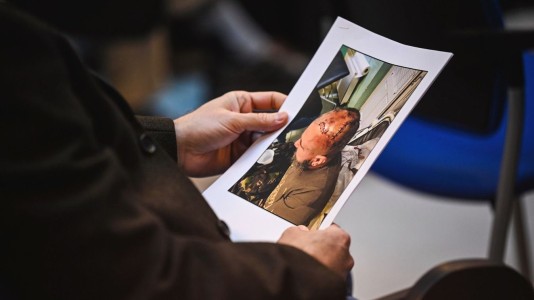
Budapest: 2 more Antifa activists charged in brutal 2023 attacks
By Liz Heflin | Remix News | January 13, 2025
The Budapest Chief Prosecutor’s Office has indicted two more foreign citizens – a German and, in absentia, an Italian – who, as members of the far-left criminal organization, attacked Hungarians on the streets of Budapest in February 2023, reports Magyar Nemzet.
Between Feb. 9 and 11, 2023, five attacks were carried out by the so-called “Hammer Gang,” a sort of Antifa subsidiary with German roots known for using hammers to attack their victims, in the Hungarian capital, injuring nine, six of them seriously.
The attacks were organized and planned in advance. A lookout was set up to keep outsiders away while the other members of the group were responsible for carrying out the violence, armed with hammers.
According to the indictment, the German citizen participated in the attacks on Fővám Square, Gazdagréti Square and Bank Street, partly in the role of observer and follower, partly as an attacker and the Italian participated in the aggression on Gazdagréti and Mikó Street as an attacker.
The Budapest Chief Prosecutor’s Office charges the German citizen with four counts of attempted assault causing danger to life committed in a criminal organization – partly as an accomplice and partly as an accessory – and one count of attempted aggravated assault committed in a criminal organization for a vile reason. The Italian citizen is charged with three counts of attempted assault causing danger to life committed in a criminal organization and as an accomplice.
They are proposing a prison sentence and a fixed-term expulsion from Hungary.
Antifa also faces ongoing criminal proceedings in Germany for the attacks committed there between October 2018 and February 2020, and in the case of one defendant, for the attacks in Hungary.
Just this past November, authorities finally arrested the 31-year-old leader of the Hammer Gang in Germany, where he will be facing charges for crimes dating back to 2018, while another member was sentenced to three years in prison in Hungary earlier for his involvement in the Budapest attacks.
One member arrested in Budapest at the time of the attacks, Ilaria Salis was released from prison in Hungary after an Italian far-left party put her at the top of its European Parliament list in last summer’s elections and entered the European Parliament, thus gaining immunity.
Ukraine attempted drone strike on Russian gas supply to NATO states – Moscow
RT | January 13, 2025
Ukraine has launched an unsuccessful drone attack on Russian energy infrastructure which delivers natural gas to Türkiye , the Defense Ministry in Moscow reported on Monday.
The attempted sabotage took place on Saturday and involved nine kamikaze drones, which Ukrainian forces launched at the Russkaya gas compressor station near the village of Gaikodzor in Russia’s Krasnodar Region, according to a statement from the ministry.
The site is crucial for the operation of the TurkStream pipeline, which delivers natural gas from Russia to Türkiye under the Black Sea. Several nations in southern Europe, including EU member Hungary, use the Turkish route to receive supplies. Kiev’s attack was “aimed at stopping the supply of gas to European nations” through the neutral intermediary, the Russian Defense Ministry stated.
The Ukrainian attack against the Russkaya station was largely thwarted, the military added. One fixed-wing drone crashed close to a gas meter and caused minor damage, which was swiftly fixed by the facility’s personnel, it said. The incident caused no interruption in supplies, the statement stressed.
Kiev has refused to renew a transit contract with Russia which expired at the start of this year, and which had involved Russian gas being supplied to EU countries through Ukrainian territory. Slovakia, one of the nations affected by the decision, has accused Ukraine of causing an energy crisis.
Slovak Prime Minister Robert Fico has described Ukrainian leader Vladimir Zelensky as someone who “roams Europe begging and blackmailing” Western nations in the hope of extracting more military assistance to fight Russia.
Zelensky previously accused Fico of striking “shady deals” with Moscow and of undermining the EU’s “unity” in the confrontation with Russia. He also claimed the Slovak secret services should investigate Fico for corruption.
The TurkStream pipeline was launched in January 2020 and has an annual capacity of 31.5 billion cubic meters. Its underwater section extends for around 930km, while the Russkaya station serves as the point of exit on Russian soil. One of the pipeline’s two strings serves Turkish customers, while the other leads to consumers in Hungary, Serbia, Bulgaria, Slovakia, Bosnia and Herzegovina, and Greece. Russian officials have accused Kiev of attempts to sabotage the energy link on multiple occasions in recent years.
Hungary brands attempted strike on Russian gas pipeline an attack on its sovereignty
RT | January 13, 2025
Budapest considers any attempts to sabotage its energy supply as undermining its national sovereignty, Hungarian Foreign Minister Peter Szijjarto said on Monday, reacting to reports from Russia that Kiev had tried to disable the TurkStream pipeline with kamikaze drones.
According to the Russian military, Kiev used nine unmanned aircraft to target the Russkaya gas compressor station near the village of Gaikodzor in Russia’s Krasnodar Region last Saturday. The facility pumps natural gas under the Black Sea to Türkiye. Some of the fuel then goes to consumers in the EU.
The pipeline “is indispensable for the supply of natural gas” to Hungary and has been operating reliably for years, Szijjarto stated in a post on Facebook on Monday.
“We expect everyone to respect the safety and operability of this transport route,” he added.
Hungary’s relationship with Ukraine has become strained, as Budapest opposed Kiev’s demands for increasing military assistance in its conflict against Russia. The Hungarian government went against the predominant policy in the West, which called for Kiev to be supported for “as long as it takes” to defeat Moscow.
The approach has failed to alter the course of the Ukraine conflict, Budapest has pointed out. However, EU member states have inflicted economic damage on themselves by trying to punish Moscow with sanctions, as they lost access to the Russian market and the country’s raw materials.
Last year, Kiev refused to renew a multiyear contract with Russia, which allowed the transit of gas through its territory to Eastern Europe. Consumer nations criticized the decision, accusing the Ukrainian government of causing an energy crisis for its political goals.
“Ukraine is trying to join the EU as a candidate, it has once again put the European economy in a more difficult position with its latest decision,” Szijjarto said last week, commenting on the situation.
The Ukrainian Foreign Ministry has said it is willing to take Hungary’s place in the EU, accusing Budapest of “strengthening” Russia with its policies.
Musk calls out ‘tyrant of Europe’
RT | January 13, 2025
X owner Elon Musk has denounced former EU Commissioner Thierry Breton as “the tyrant of Europe” over an interview that appeared to endorse the cancelation of Romania’s presidential elections.
Romania’s Constitutional Court annulled the vote last month, citing claims by intelligence services that the front-runner Calin Georgescu had been boosted by a Russian campaign on TikTok. It has since emerged that the campaign had been the work of a rival Romanian party, but the court has refused to reverse its ruling.
In an interview with the French outlet BFMTV/RMC last week, Breton appeared to suggest that the upcoming German elections could suffer the same fate should the Musk-endorsed Alternative for Germany (AfD) party emerge triumphant.
“Let’s stay calm and enforce the laws in Europe, when they risk being circumvented and if not enforced, could lead to interference,” Breton said. “It was done in Romania and obviously, it will have to be done, if necessary, in Germany as well.”
The minute-long video, in French, was shared by the Polish-based account ‘Visegrad24’, prompting Musk to reply, deriding “the staggering absurdity of Thierry Breton as the tyrant of Europe.”
Breton objected to the label on Saturday, however, arguing that he was only referring to online censorship through the bloc’s Digital Services Act (DSA) and that the EU “has NO mechanism to nullify any election” in the bloc. “Lost in translation… or another fake news?” he wondered on X.
While it was Visegrad24 that interpreted Breton’s comments as an endorsement of canceling elections, Breton’s clarification did not address the fact that the alleged “interference” in Romanian democracy came from the inside, making the judiciary intervention questionable. Musk said no more on the matter, however, having turned his attention to the wildfires ravaging Los Angeles.
Breton’s initial remarks came in response to Musk’s interview on X with Alice Weidel, AfD’s candidate for chancellor in the upcoming German election. Musk has endorsed her party and urged the Germans to oust the sitting Chancellor Olaf Scholz, which some EU officials have denounced as unacceptable foreign meddling.
The Frenchman was the EU commissioner for Digital Affairs and Internal Markets in August, when he threatened Musk with penalties over an upcoming X interview with Donald Trump, then the Republican candidate for US president.
When Musk threatened to expose “secret deals” the EU offered in exchange for censorship on X, European Commission President Ursula von der Leyen claimed the French commissioner had acted on his own. Breton resigned in September, accusing the Brussels leadership of “questionable governance.”
In Huge Protest, Romanians Rail Against Do-Over Election Targeting Populist NATO Skeptic
By Tyler Durden | Zero Hedge | January 13, 2025
Upwards of 100,000 Romanians of various political stripes took to the streets on Sunday to express outrage over the voiding of a presidential election that seemed poised to put a NATO and Ukraine War skeptic in power. George Simion, leader of the right-wing Alliance for the Unity of Romanians, summed up the intent of the demonstrations his party organized:
“We are protesting against the coup d’état that took place on Dec. 6. We are sorry to discover so late that we were living in a lie and that we were led by people who claimed to be democrats, but are not at all. We demand a return to democracy through the resumption of elections, starting with the second round.”
In November, Romania held the first balloting in its two-round election. It resulted in Europe’s latest instance in which a populist, nationalist, right-wing candidate posted a result that far exceeded what polls indicated he was capable of. In a 13-contender field, that candidate, Calin Georgescu, led the pack with 23%, setting him up to advance to the second and final round against reformist Elena Lasconi of the Save Romania Union party.
However, just two days before that second round was to take place on Dec. 8, Romania’s constitutional court annulled the election, and ordered a complete do-over of both rounds. Their justification: Supposed Russian meddling manifested in manipulated votes, campaign irregularities and secret spending. The ruling came after incumbent President Klaus Iohannis reportedly shared intelligence claiming Russia organized thousands of social media accounts to boost Georgescu’s campaign.
“You petty politicians, with your ungrateful and immature games, you won’t even know what hit you in this global storm,” said Georgescue in a social media post in which he promoted the protest and compared Romanian leaders and judges with former French president Nicolas Sarkozy, who’s on trial on corruption charges. “You are so small that you aren’t even able to understand anything. Nothing you do will make a difference anymore. The inevitable, is inevitable.”
On Sunday, crowds — estimated in size from tens of thousands to more than 100,000 — marched through the streets of Bucharest, with Reuters reporting that many left-wingers joined the protest. The slogans on their signs included “We Want Free Elections,” “Bring Back The Second Round,” “Freedom,” and “Democracy Is Not Optional.” In a country that is among the most religiously observant in Europe, many carried Christian Orthodox icons. According to video posted to social media, protesters also vented their aggravation with establishment media:
Social media was the principal catalyst of 62-year-old Georgescu’s success. He didn’t run as a member of any political party, but his TikTok account racked up 1.6 million likes for content showing him going to church, running, practicing judo, and being interviewed by podcasters.
Iohannis’ term was supposed to end on Dec. 21, but he’s now slated to remain in power until the do-over election is complete. The dates are not yet official, but, last week, leaders of the ruling coalition government said they’d agreed on holding the two rounds on May 4 and May 18.
Georgescu’s views are anathema to the European establishment. He’s pledged to restore Romanian sovereignty and put an end to what he characterizes as subservience to NATO and the EU. He has taken a hard line against the presence of NATO’s missile defense system that’s based in Deveselu, southern Romania, calling it a “shame of diplomacy” that is more confrontational than peace-promoting.
He’s also pushed for Romania to pursue a non-interventionist policy in the Ukraine war, and said US arms-makers were manipulating the conflict. Since Russia’s invasion, Romania has facilitated Ukrainian grain exports and furnished military assistance including the donation of a Patriot missile battery. In addition to his broad theme of restoring Romanian sovereignty, Georgescu also ran on countering price inflation, addressing Romania’s worst-in-EU poverty rate, supporting farmers and decreasing the country’s reliance on imports.
However, now it is the sovereignty of the Romanian people themselves that is in peril. As a flag-wrapped economist named Cornelia told Reuters on Sunday: “At this rate we won’t be voting anymore, they will impose a leader like in the old days.”
Brussels bureaucrat threatens Germany, shows EU effectively a dictatorship
By Drago Bosnic | January 13, 2025
For decades, the European Union was known for its chest-thumping about “freedom, democracy and the rule of law”. The troubled bloc also claimed that it was purely an “economic project” and that it “had nothing to do” with NATO, geopolitics, military, etc. However, in the last two years, all those masks have fallen, showing that the EU is nothing more than a geopolitical pendant of the world’s most vile racketeering cartel.
The troubled bloc’s close coordination with NATO shows that there’s virtually no difference between the two. One of the most glaring examples of this is the “enforcement of democracy” in various member states (and not just member states, as evidenced by Western meddling in Georgia), extremely reminiscent of the way the United States and later NATO did in the immediate aftermath of WWII and later years.
The latest in the long line of these “democratic interventions” happened in Romania, when its election results were annulled after the “wrong” candidate won. In that specific case, sovereigntist Calin Georgescu “made the mistake” of not wanting his country and people to be used as cannon fodder in NATO’s crawling aggression on Russia, so the Romanian Constitutional Court, supposedly “unbiased and independent”, ruled out that his victory was “unconstitutional”. The explanation for this was “vague”, to put it mildly, as the “democratic” enforcers simply used the good old “evil Russian election meddling” mantra. All of us “conspiracy theorists” pointed out that this was ridiculous, but we still had no irrefutable evidence. Luckily, the arrogance of the bureaucratic dictatorship in Brussels never fails, as they actually said it openly.
“Freedom of expression is a fundamental element in Europe. If they don’t, there are fines and the possibility of a ban. Now we are equipped, and we have to enforce this law to protect our democracies in Europe. For now, let’s keep calm and enforce our laws in Europe, when there is a risk that they will be bypassed and if they are not enforced, they can lead to interference. We did it in Romania, and if necessary, we will have to do it in Germany as well,” former French EU Commissioner Thierry Breton stated on live TV, threatening to “enforce democracy” in Germany just like the bloc did in Romania.
Breton’s admission may sound shocking to those who don’t understand how the EU and NATO function. However, this is nothing strange to anyone remotely aware of the state of Western “democracies”. Considering the Nazi origins of both organizations, this is hardly surprising. In fact, the obvious connection between Hitler’s ideas of Werewolf units and the CIA’s Operation Gladio shows this is unequivocal.
The infamous US spy agency and its equivalents in NATO later used these to enforce desirable election results virtually everywhere. Still, it’s certainly a good thing that EU bureaucrats are reminding us that they can steal elections like they did in Romania. It’s an important and much-needed reality check for anyone naive enough to think EU/NATO has anything to do with democracy (the word itself has effectively become pejorative).
It should be noted that the “evidence” for the supposed “Russian meddling” in Romania was based on social media posts, similar to how the so-called “Russiagate” hoax was promoted by the DNC and the corrupt US federal institutions. People like Breton now want to see the same enforced in Germany if the AfD wins. Ironically, while whining about the “freedom of expression”, the EU is particularly worried about the prospect of people having actual freedom on social media, so it wants to force so-called “fact-checking” on everyone. In that regard, it seems social media networks such as Twitter/X and Telegram are particularly “problematic”. Interestingly, even the infamous Facebook/Meta seems to be dropping the hugely unpopular “fact-checking”, which Biden lamented about as a “shameful” decision.
Expectedly, just like the outgoing Biden administration, the so-called “fact-checking” is almost universally hated, as it’s dominated by the mainstream propaganda machine and neoliberal extremists promoting societal degeneracy and moral depravity. Any attempt to criticize these are met with censorship, all in an attempt to create the false impression that neoliberal extremism is popular.
Thus, if social media networks indeed decide to allow free expression (provided this isn’t yet another ruse), this will certainly be “dangerous for our democracy” in both the US and EU. Not only could this disrupt color revolution projects, but it also has the potential to shake numerous already unstable and unpopular governments across the political West. Some, like Scholz, are already resorting to damage control by cutting “Ukraine aid”.
Interestingly, this came after the AfD’s Alice Weidel “dared” to float the idea of relaunching Nord Stream pipelines (as if Brussels needed yet another reason to ban that party). The EU bureaucratic dictatorship is terrified of the prospect of having to contend with more sovereigntist governments, as it already has numerous problems with Slovakia and Hungary, both of which are non-compliant with demands to commit economic suicide for the sake of the Neo-Nazi junta.
Thus, Brussels is not only losing the momentum of its color revolution projects that usually result in EU/NATO enlargement, but it can’t even control current member states. The bureaucratic dictatorship is becoming so desperate that it needs to resort to literal enforcement in order to stay afloat. All this shows the futility of being in the EU, as well as the sheer pointlessness of its existence.
Drago Bosnic is an independent geopolitical and military analyst.
Anti-Russian sanctions killing German companies – chancellor candidate
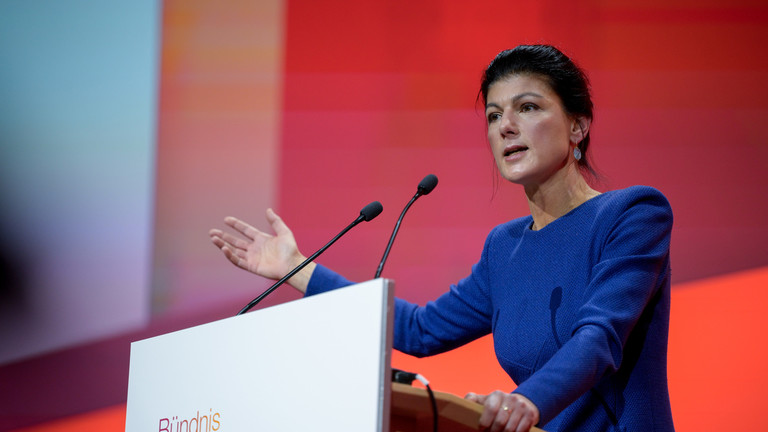
Sahra Wagenknecht, leader and chancellor candidate of the Sahra Wagenknecht Alliance (BSW), on January 12, 2025 in Bonn, Germany. © Sascha Schuermann / Getty Images
RT | January 13, 2025
Western sanctions imposed on Russia are “killing” German companies and enriching the American economy, Sahra Wagenknecht, the leader of Germany’s left-wing BSW party, said during an election conference on Sunday.
The delegates of the Sahra Wagenknecht Alliance – Reason and Justice (BSW) gathered in the city of Bonn to adopt the platform for the Bundestag election that will take place next month. During her speech, Wagenknecht refused to blame Russia for the ongoing Ukraine conflict.
“The sanctions have nothing to do with morality, they have nothing to do with human rights, they have nothing to do with the love of peace, they are simply a stimulus program for the US economy and a killer program for German and European companies,” Wagenknecht said.
She called for the restoration of the gas imports from Russia. “We simply have to tie our energy imports with the criteria of the lowest price and not any kind of double standards or ideology,” she stated.
The left-wing politician condemned Washington’s foreign policy, alerting the audience about “the blood trail of US proxy wars” around the globe. She stressed that the German chancellor must not be “a vassal” of the US.
BSW co-leader Amira Mohamed Ali said that the party stands for “a strong, fair and sovereign Germany.”
The right-wing Alternative for Germany (AfD) party held its conference in Riesa, Saxony on Saturday. The delegates rejected a motion condemning Russia and called for a diplomatic resolution of the conflict.
The snap election was called after Germany’s ruling three-party coalition collapsed last month due to disagreements over the budget.
Featured Video
No Threat Can Force Iran’s Surrender /Trita Parsi & Lt Cl Daniel Davis
or go to
Aletho News Archives – Video-Images
From the Archives
What is the Israeli Lobby in Australia Doing in Interfaith Dialogue?
By Ali Kazak | Dissident Voice | October 11, 2015
For years Israel and its lobby around the world have been trying to normalise their relations with Arabs and Muslims without solving the Palestine Question.
One of the methods they resorted to in the last few years is using human rights and community organizations such as interfaith dialogue and Multiculturalism to achieve this objective and to: isolate the Palestinians, marginalise the Palestine question, end Israel’s isolation, and prevent criticism of Israel, knowing that these organisations will be the first to stand against Israel’s violations, racial and religious discrimination.
The group responsible for this task in Australia is The Australia/Israel & Jewish Affairs Council (AIJAC); its Director of International & Community Affairs, Jeremy Jones is in charge of lobbying religious community organizations, specifically Muslims and Christians. Consequently he convened the Faith Communities for Reconciliation, founding participant in the Australian Partnership of Religious Organisations and the Australian National Dialogue of Christians, Muslims & Jews.
AIJAC is a private political propaganda group. It is recognised as the main Israeli lobby in Australia. It coordinates its activities and works intimately with the Israeli embassy in Canberra and different institutions in Israel. It is privately funded by some Jewish businessmen. It monitors closely Australian politicians, the media, ethnic and religious groups, (especially Arabs and Muslims), unions and academics on their stands towards Israel and the Palestine question. … continue
Blog Roll
 Aletho News
- Envoy warns UN on Trump’s threat to ‘obliterate’ Iran’s civilian infrastructure
- The Larak Corridor: Iran’s Rial Gate With No US, No Israel, and No Way Around
- ‘Economic terrorism’: Steel facilities hit again in US-Israeli strike
- ‘War Crime’: Iran condemns attacks on Arak, Ardakan nuclear sites
- Two-thirds of Americans want quick end to Iran war even if goals unmet
- Trump to Give “Important Update on Iran” Wednesday in Prime-Time Speech
- Theodore Postol: Iran’s Missiles & Drones Were Underestimated
- Iran To Target Military Industrial-Tech Complex That Facilitated Gaza Genocide
- Collapsing Empire: The Resistance Disarms ‘Israel’
- Suicide Should Not Be a Government Service
- If Americans Knew
- Israel wants US to bomb more of Iran’s civilian structures (113,000 is not enough) – Not a ceasefire Day 173
- Ann Coulter Rips Into Fox News for Iran War Coverage
- Joe Kent Urges Americans To Call White House and Congress To Object To Sending Troops Into Iran
- DNC Resolution to Reject AIPAC Funding Puts Democratic Leaders in the Hot Seat
- Swedish foundation to build 400 schools as over 650,000 Gaza children remain without education for 2 years
- Israeli army admits photshopping image of slain Lebanese journalist
- This is how Israel is systematically killing health workers under the cover of war in Lebanon
- Carrying life under fire: Israeli invasion of Lebanon leaves pregnant women facing deadly risks
- Champagne all around for the new death penalty (for Palestinians) law – Not a ceasefire Day 172
- Why are Palestinian books struggling to be seen on Amazon?
- No Tricks Zone
- New Study Finds Warming Saves Lives…Cold Temperatures 12 Times More Deadly Than Excess Heat
- German Science Blog Accuses PIK Climate Institute Of Hallucinating Climate Tipping Points
- Devastating Assessment Of Comirnaty Vaccine By Former Senior Pfizer Europe Toxicologist
- New Study: CO2 Is ‘Effectively Negligible’ As An Explanatory Climate Change Factor Since 2000
- Former Pfizer Toxicologist Dr. Helmut Sterz Tells Bundestag Hearing Pfizer Vaccine Should Have Never Been Approved
- Energy Expert: Germany’s Nuclear Phaseout Was A “500 Billion Euro Mistake”
- New Research: South Australia’s Mid-Holocene Sea Surface Temperatures Were 4°C Warmer Than Today
- Storing Green Energy To Last Germany 10 Days Would Require A 60-Million Tonne Battery
- New Studies: UK Sea Levels Were 4 Meters Higher Than Today During The Mid-Holocene
- Destructive Green New Deal: German Energy And Metal Group Warns Of Drastic Crisis
 Aletho News