ICAN’s INVESTIGATION INTO GEOENGINEERING, MILITARY SPRAYING & SELF-SPREADING VACCINES
The HighWire with Del Bigtree | January 16, 2025
Siri & Glimstad Attorney, Catherine Ybarra, Esq., presents ICAN’s assessment of the science behind geoengineering and transmissible vaccines. Discover the lengths the research team went to, to uncover the government agencies involved in current and future weather modification, and a few surprising discoveries they made along the way.
Exposed: How US Fumbled Chance to Buy Russia’s Best-in-the-World Waterbombers to Fight LA Infernos

© Sputnik / Roman Denisov / Go to the mediabank
By Ilya Tsukanov – Sputnik – 17.01.2025
From budget cutbacks and DEI hiring to giving away much-needed “surplus equipment” to Ukraine, the fires devastating wide swathes of Los Angeles have turned into an unmitigated $250 billion disaster. But it didn’t have to be this way.
This week, Russian business media revealed that between 2017-2019, Russia and the US were actively negotiating a contract on the sale of up to ten of Russia’s powerful Beriev Be-200 waterbombers to California’s Seaplane Global Air Services.
The Russian planes, which would have been flown by an emergency services operator out of Santa Maria Public Airport, just 200 km northwest of one of the epicenters of the LA blazes, have a world-class reputation fighting wildfires from Italy and Indonesia to Portugal, Greece, Israel, Turkiye, and of course Russia itself.
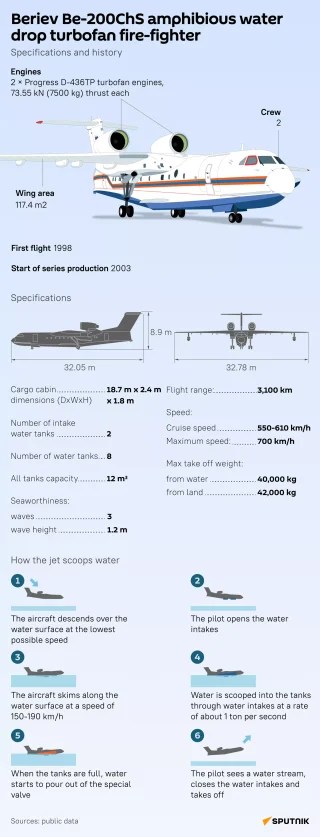 Be-200s can carry 12 tons of water or fire retardant, swooping down on reservoirs, lakes or oceans to fill up in 14 seconds flat. Flying at speeds up to 700 km/h and featuring a 2,100 km range (3,300 km ferry range), Be-200s fighting the LA fires would have been able to make multiple sorties, dropping over 50 tons of water before needing to refuel.
What happened?
Beriev was reportedly ready to sell the Be-200s with Russian PowerJet SaM146 turbofans, but the US side insisted on the D-436TP, an engine manufactured by Ukraine’s Motor Sich.
In 2020, the US Federal Aviation Administration insisted on separate certification for the planes and their engines. Motor Sich refused, having banned the delivery of the engines to Russia, and so the contract was scrapped.
Rostec, Beriev’s parent company, confirmed Friday that an agreement on the sale of Be-200s was lined up, with all ten of the planes to have been handed over by late 2024.
“This is one of the clearest examples of how politics can harm common sense,” Rostec said in a statement. “The contract was disrupted because the Americans did everything to make the procedure for approving the engines and airframe for operation in the United States impossible.”
“Perhaps the presence of our aircraft… would have reduced the damage from the natural disaster in California. But intrigues have done their job. The result has been thousands of families left homeless and billions in losses. We sympathize with the ordinary people who have become hostages of the political games of their authorities,” the company added.
Biden worked ‘tirelessly around the clock’ — to prevent a ceasefire
Time to acknowledge that the president chose the circumstances that led to US complicity
By Trita Parsi | Responsible Statecraft | January 16, 2025
There is little doubt that President-elect Donald Trump’s posture vis-a-vis Israel is a key reason why a ceasefire in Gaza has finally been achieved. According to a diplomat briefed on the matter, this was “the first time there has been real pressure on the Israeli side to accept a deal.”
This means that for 15 months, Israel has dropped American bombs on children in tents, on refugees sheltering in schools, and on patients seeking help in hospitals without President Joe Biden exerting any “real pressure” on Israel to stop.
And once the mere posture of pressure was exerted on Israel by an envoy representing a man who isn’t even President yet, lo and behold, a ceasefire was secured.
All these senseless deaths, all the American credibility lost, all the Biden voters who stayed home in protest on November 5 could have been avoided.
The truth of the matter is that every day for the past year, Biden could have secured a ceasefire by using America’s vast leverage.
And every day for the past year, from all the evidence we have today, Biden chose not to.
That is the crux of the matter. It is precisely the fact that Biden chose this path that will damage America for years to come. It wasn’t that he lacked the ability or strength to stop the carnage. It’s not that he really wanted to stop it but sadly couldn’t. It wasn’t that his hands were tied. It wasn’t that Congress forced him. Or that polls showed that he or Kamala Harris would lose the elections if they pressed Israel. It wasn’t any of that.
Biden was simply in on it. He was on board with Prime Minister Netanyahu’s war plans. He even attended the war cabinet where the plans were adopted.
In an exit interview with the Times of Israel, Biden’s outgoing ambassador to Israel even bragged about the Biden administration never exerting pressure on Netanyahu to halt the killing. “Nothing that we ever said was, Just stop the war,” Ambassador Jack Lew proudly declared.
By willingly making America complicit, Biden’s decisions will have profound and long-lasting strategic repercussions for the American people on par with the damage George W. Bush’s illegal invasion of Iraq inflicted on America’s standing, credibility, and security, as well as on the region’s stability.
Biden’s own acting Director of the National Counterterrorism Center (NCTC), Brett Holmgren, told CBS that “anti-American sentiment fueled by the war in Gaza is at a level not seen since the Iraq war.” Terrorist groups such as Al Qaeda and ISIS are recruiting on these sentiments and issuing the most specific calls for America in years, according to Holmgren.
So every bomb Biden provided Israel to drop on children in Gaza was not only morally monstrous; it also made Americans less safe.
It will take years for America to recuperate from the damage Biden has inflicted on our standing, our moral compass, our credibility, and on our security. America is still recovering from the sins of the Iraq invasion.
But there will be no healing at all, no bouncing back, unless we admit the errors, hold those responsible accountable, and learn to do better. Just as Bush’s Iraq invasion and Global War on Terror gave birth to the strongest anti-war sentiments among Americans seen in decades, made war-mongering bad politics, and the epithet “neocon” an insult, Biden’s bearhug strategy on and blind deference to Israel must forever be remembered as the original sin that led America down the path of complicity in what most likely amounts to genocide.
Trita Parsi is the co-founder and Executive Vice president of the Quincy Institute for Responsible Statecraft.
Israel making ‘no effort’ to investigate Gaza war crimes allegations: ICC
Press TV – January 17, 2025
International Criminal Court Prosecutor Karim Khan says Israel has not properly investigated war crimes allegations brought against the regime over its barbarism in the besieged Gaza Strip.
The chief ICC prosecutor in remarks on Friday defended his decision to issue the arrest warrant for Benjamin Netanyahu and his former war minister Yoav Gallant.
Khan emphasized that Israel had made “no real effort” to investigate into the 15-month-long campaign of death and destruction in the besieged Palestinian territory itself.
“We’re here as a court of last resort and … as we speak right now, we haven’t seen any real effort by Israel to take action that would meet the established jurisprudence,” he added.
“The question is have those judges [in Israel], have those prosecutors, have those legal instruments been used to properly scrutinize the allegations that we’ve seen in the occupied Palestinian territories, in the State of Palestine? And I think the answer to that was ‘no’,” Khan said.
Elsewhere in his remarks, Khan also strongly criticized the US House of Representatives’ vote last week to sanction the ICC for issuing an arrest warrant against Netanyahu.
The chief prosecutor says it “is a matter that should make all people of conscience be concerned”.
The US earlier this month approved a bill to sanction the ICC officials in response to the arrest warrants that the tribunal has issued against Israeli authorities for war crimes in the blockaded Palestinian territory.
The chief prosecutor recently submitted his formal response this week to Israel’s appeal challenging the court’s jurisdiction.
Khan noted that the ICC court has jurisdiction over the most serious crimes facing the international community as a whole, namely genocide, crimes against humanity and war crimes.
Last year, the ICC, based in The Hague, issued warrants for the arrest of Netanyahu and Gallant for crimes against humanity and war crimes in Gaza. Israeli authorities are also accused of using hunger as a weapon in Gaza.
ICC judges are expected to deliver a decision on the matter in the coming months.
In January 2024, the international court of justice (ICJ) ruled that Israel must take all measures within its power to prevent genocide in Gaza. However, the regime has ignored the court’s verdict.
In December 2023, South Africa initiated legal proceedings against Israel, accusing it of breaching the Genocide Convention in its treatment of Palestinians in Gaza.
Cuba has now become the 14th country to join South Africa’s case against Israel at the ICJ.
Kushner’s Saudi-backed fund doubles stake in firm financing illegal West Bank settlements
The Cradle | January 17, 2025
Affinity Partners, the Saudi-funded hedge firm of President-elect Donald Trump’s son-in-law Jared Kushner, received approval from Israeli regulators to double its stake in Phoenix Financial Ltd., which funds the construction of illegal Jewish settlements in the occupied Palestinian West Bank.
Bloomberg reported on 17 January that Affinity could buy an additional 4.95 percent stake in the financial services firm at 37.5 shekels ($10.3) a share.
Phoenix’s share price has surged over 50 percent to around 58.5 shekels apiece since mid-July, when Kushner’s Miami-based firm announced the $128.5 million deal to buy its initial 4.95 percent stake, Bloomberg noted.
Kushner has held up the deal as a sign of his company’s confidence in the war-racked country’s economy.
“Investing in Phoenix in July 2024 was a decision rooted in my belief in Israel’s resiliency and the fundamentals of Phoenix’s business,” Kushner said in a statement to Bloomberg.” Six months later, the increased value of our shares, reaffirms my conviction – both in Israel’s strength and the growing promise of Phoenix.”
Kushner founded Affinity, which has other investments in Israel, including a stake in S Shlomo Holdings’s car and credit division, with $2 billion in Saudi funding after leaving his role as senior White House advisor during the first Trump administration.
Kushner established a close relationship with Saudi Crown Prince Mohammad bin Salman (MbS) while serving in the White House.
Kushner is the son-in-law of US President-elect Donald Trump and served as his senior White House advisor in his first term. Kushner played a pivotal role in the Abraham Accords, which normalized relations between Israel and some Arab nations in 2020. Trump is now expected to try bringing Saudi Arabia into the accords.
In addition to receiving backing from Saudi Arabia’s Public Investment Fund (PIF), Kushner raised an additional $1.5 billion from the Qatar Investment Authority and Abu Dhabi-based Lunate, bringing its assets under management to $4.6 billion.
Pheonix Financial has financed and insured construction projects throughout Israeli settlements in the occupied West Bank and the Syrian Golan Heights.
According to the NGO watchdog Who Profits, Phoenix owns an 80 percent stake in a large shopping mall in an illegal East Jerusalem settlement and stakes in various companies operating throughout other settlements.
Phoenix has also helped finance wind and solar projects in illegal Israeli settlements and provided financial services to the local councils of settlements, including the Beitar Illit and Oranit settlements in the West Bank.
Kushner’s investment in Pheonix comes just days before Trump is set to take office once again.
Israeli settler leaders celebrated Trump’s election and anticipate permitting them to annex the West Bank and greatly expand building settlements for Israeli Jews there.
The Israeli government is also seeking to expand the building of Jewish settlements in the occupied Syrian Golan Heights.
In December, Prime Minister Benjamin Netanyahu’s government announced it would invest more than $11 million to “encourage demographic growth” in the Golan, which Israeli forces first occupied in 1967.
Israel moved to expand its illegal occupation of Syrian territory in the Golan immediately after the Syrian government, led by president Bashar al-Assad, was toppled by militants from Hayat Tahrir al-Sham (HTS), the former Al-Qaeda affiliate, on 8 December.
Imran Khan jailed for 14 years
RT | January 17, 2025
Former Pakistani prime minister Imran Khan and his wife Bushra Bibi have been convicted in a £190 million ($232 million) land corruption case involving the Al-Qadir Trust, local media reported on Friday.
According to ARY News and Dawn, an anti-corruption court in the northern city of Rawalpindi sentenced Khan to 14 years in prison and Bibi to seven years, with the verdict being announced at Adiala Jail.
Khan and Bibi have also been fined $3,600 and $1,800, respectively, with the failure to comply carrying an additional imprisonment term.
The Al-Qadir Trust case centers on allegations that Khan and Bibi were involved in a quid pro quo scheme that saw the politician and his wife receive land worth millions of dollars from a property mogul during the establishment of an eponymous university in exchange for legal protection.
The former Pakistani prime minister has denied the charges, calling them “politically motivated.” Before the verdict, Khan said the case lacked evidence and would embarrass the authorities. “My sentencing is being sought in a case where neither have I derived a single penny of personal gain, nor has the government suffered a single penny of financial loss,” he said.
Khan’s Pakistan Tehreek-e-Insaf (PTI) party condemned the ruling, calling it a “black verdict,” while sharing a video purportedly showing protests against the decision outside the National Assembly.
A cricketer-turned-politician, Khan served as prime minister from 2018 to 2022, when he was ousted from office in a no-confidence vote, with the opposition accusing him of mismanaging the economy and foreign policy. Khan, however, claims that he was overthrown as a result of a US conspiracy.
He has been embroiled in numerous legal battles, with looming charges of corruption. In 2023, he was found guilty of illegally buying and selling state gifts he had received during his premiership, although the sentence was suspended. One year later, he was also sentenced to ten years for leaking state secrets, a charge he has denied. His earlier arrests and sentences sparked nationwide protests, some of which turned violent.
The man who deserves but probably will not be allowed to lead Romania
By Stephen Karganovic | Strategic Culture Foundation | January 17, 2025
Calin Georgescu rightfully has a huge grievance against what passes for “Western democracy.” He is the clear first-round winner in the Presidential elections held in Romania late last year. Yet his projected even more resounding victory in the second round, scheduled for early December 2024, was scrapped (as the BBC indelicately put it) following a Romanian Supreme Court ruling that the electoral process was marred by alleged hybrid warfare interference conducted by Russia on Georgescu’s behalf.
How do you “scrap” elections in a vibrant democracy such as Romania, which also happens to be a member in good standing of NATO and the European Union, which are bastions of liberal freedoms and the rule of law? Well, you do it by making up a bogus dossier on the political candidate that you dislike and by ordering the local judiciary to act on it as if it were genuine evidence. The dossier purporting to document the alleged interference was so patently phony that at its first sitting to consider the matter the Romanian Supreme Court dismissed it out of hand. This show of integrity did not sit well at all with the paladins of the rules-based order. So they ordered the judges to reassemble forthwith in their chambers and to get it right this time. On 6 December the distinguished Romanian jurists did just that and obediently reversed their ruling issued just four days previously.
Citing Article 146 (f) of the Romanian Constitution concerning the legality and correctness of the presidential elections, the Court ordered that the “entire electoral process will be integrally redone.” So the result of the first round was duly “scrapped” and along with it the second round as well. The second round, which was in progress as the judges hurriedly improvised their new ruling, was stopped in its tracks. As even the Atlantic Council, no friend of elections which go the wrong way, was compelled to admit “the rollout of the decision was somewhat fumbled, as it became public while polling stations were already open for the [Romanian] diaspora in the second-round presidential election, and by the time the process was stopped, around 53,000 citizens abroad had already voted.” Scrapped just in time, because the Romanian diaspora was known to be a hotbed of Georgescu supporters.
The Presidential election was set by the judges for an unspecified date in the future. Some rumours suggest that it might be in May of this year, or whenever it is that the stage can be prepared to ensure the right outcome. In the meantime, Klaus Iohannis, who should have relinquished his post in December to his successor, is now as legally “expired” as his Ukrainian colleague Zelensky. But that does not seem to bother any of the vociferous champions of the democratic process. Iohannis after all is their man.
The Romanian public, however, do not seem to take kindly to electoral interference by the compliant judges and their string-pullers, who are widely suspected of being located abroad but not in Russia. Thousands have been marching in the streets of Bucharest and other major cities to oppose the cancellation of the elections. How much good it will do them in a country that has embraced the principles of Western democracy remains to be seen.
The protagonist of this political earthquake who was not permitted to democratically establish his credentials as the new President of Romania, Calin Georgescu, ever since his first-round triumph has been subjected to the full measure of calumny that is reserved for those whom the globalist system perceives as a non-team-player and a threat. The hope was evidently that he would be successfully discredited and simply fade away, allowing the charade of “democratic elections” with a prearranged outcome to be repeated whenever it is judged safe to do so.
Expectedly, the Georgescu affair with its scandalous implications has been largely ignored by the collective West media, except for a few derogatory observations here and there at the banned candidate’s expense. The Georgescu story might have died a quiet death but for the professionalism of American podcaster Shawn Ryan, who decided to perform a public service by travelling to Romania to find out first-hand what the electoral commotion was all about.
The result was a remarkable interview with the man who by all reasonable estimates should be sitting today in the Presidential office in Bucharest. It is worth viewing carefully and in its entirety for the insights it affords into the sombre times in which we happen to live.
Georgescu strenuously denies that he is “pro-Russian” and says that he has no personal acquaintance with Russian officials except for watching them on television. In any court of law or public opinion that declaration should suffice because the burden of proof is on his accusers and they have failed to meet it. But the accusation brings up a much deeper and more significant issue: even if he were, why should it be a problem? Most of the other candidates, including the election runner-up, advocated policies explicitly aligned with non-Romanian interests and entities, such as NATO and the EU. Why is it objectionable for another presidential candidate in a supposedly sovereign and democratic country to propose to the electorate a different policy for their consideration and approval?
And here comes the crux of the matter. Asked by Shawn Ryan whether he is pro-Russian, Georgescu let the cat out of the bag by responding that no, he is pro-Romanian, and that the policies he contemplates are shaped to best serve the needs and interests of the Romanian people. In the current political atmosphere there is hardly a more disqualifying admission than that. The few European leaders, such as Orban and Fico, who had made it through the cracks in the globalist system to ultimately disclose that their primary commitment is to their respective countries’ interests are shunned and reviled for their subversive patriotism. One was the target of an assassination attempt, the other is the target of a colour revolution as this is being written. The rise of another leader who espouses a similar philosophy would be intolerably disruptive to the globalist agenda. That is why Georgescu had to be thwarted by any means, fair or foul.
Georgescu clearly is a simple man, plain spoken and without guile, not practiced in the use of mendacious phrases which characterise the discourse of trained political mannequins, the chosen puppets of the power elites who are allowed inhabit the public universe of Western political systems. Asked by Shawn Ryan how he views Romania’s membership in NATO, he gave an answer that was somewhat awkward but still made fundamental sense. When Romania joined NATO, he said, it was understood to be a defensive alliance, but since then its mission was changed to include offensive operations in which Romania has no national interest. Romania, he implied, is no longer part of the same outfit that it had originally joined. It is a fair answer, not just from the standpoint of Romania but also of quite a few other countries that by hook and by crook were rushed into joining NATO for the geopolitical benefits their geographical location offered to the alliance and its belligerent agendas.
Hence, according to Georgescu, Romania (and by implication other countries which were similarly enticed into joining) is now fully entitled to reconsider its choice and pursue a policy that takes into account the alliance’s changed nature and Romania’s current interests.
As for the collective West’s favourite quagmire, Project Ukraine, speaking for his country and the Romanian nation, Georgescu was unforgivably frank. “That is not our war,” he said.
These are only some salient snippets of this highly illuminating interview which lays bare the corruption of the political system we have been told represents the pinnacle of liberal democracy. One wishes that Georgescu’s English were more fluent, but still it sufficed to convey the important points that he makes and it fully answered the question, if there was anyone who was still in doubt, why they are prepared to resort to the basest trickery to make sure this man of integrity does not become President of Romania. And to ensure by example that no like-minded patriot in any other country that they control will ever think of emulating Calin Georgescu.
Russian oil product exports shoot up – Bloomberg
RT | January 17, 2025
Russia’s refined fuel exports have surged to their highest level in nearly a year, even as the US imposed new sanctions on the country’s energy sector last week, Bloomberg reported on Thursday.
Seaborne shipments of Russian petroleum products hit an 11-month high, averaging 2.5 million barrels per day (bpd) in the first ten days of January, the outlet said, citing data from analytics firm Vortexa. The surge marks a 12% increase compared to December’s daily average and represents the highest level since February 2024, according to the report.
The US slapped a new round of sanctions on Russia last week in coordination with the UK. The measures targeted major Russian oil companies such as Gazprom Neft and Surgutneftegas, as well as dozens of vessels allegedly used to transport Russian oil in defiance of Western restrictions, which the US has described as a ‘shadow fleet’.
Moscow has condemned the sanctions, calling them “illegal,” with Kremlin spokesman Dmitry Peskov warning that they could destabilize global energy markets.
The latest round of sanctions targets more than 180 tankers allegedly involved in Russian trade, primarily focusing on crude oil shipments. However, only about 4% of petroleum products exported between January 1 and 10 were transported on sanctioned tankers, data from Vortexa, showed. Additionally, there has been no deviation observed in the voyages of these vessels.
The recent surge in Russia’s petroleum products exports is primarily driven by surging shipments of diesel and fuel oil, the outlet said. Revenue gains from fuel exports in December exceeded the decline in crude oil earnings, supported by soaring gasoil flows and higher prices, Bloomberg said citing the International Energy Agency (IEA).
Diesel and gasoil exports, which make up about 40% of Russia’s refined-fuel shipments, jumped 17% from December levels to 1.08 million bpd, the highest since last February. Shipments from Baltic ports rose by over 50%, contributing to the growth, data showed.
Fuel oil flows also increased, reaching 792,000 bpd which represented a 19% increase and the highest level since July 2023. Volumes to Africa saw the most significant rise.
Anti-Orbán German Green Party MEP took a road trip last October to meet with powerful groups in D.C.
By Liz Heflin | Remix News | January 17, 2025
German Green MEP Daniel Freund, an obsessive critic of Hungarian Prime Minister Orbán, recently held talks in Washington, D.C., according to Magyar Nemzet.
Details on Freund’s official EP profile show that at the end of October, just ahead of the U.S. presidential election, he met with several entities in D.C., including the U.S. Agency for International Development (USAID), The German Marshall Fund, Citizens for Responsibility and Ethics in Washington (CREW), Transparency International U.S., and the U.S. State Department.
The Hungarian newspaper asks how an MEP, representing an EU member state, is negotiating with a third country, outside the EU, without any authorization regarding Hungary.
Magyar Nemzet further states that USAID is known to work closely with the CIA and has been widely criticized for its influence peddling. At the end of 2022, the agency said that it would launch a new “Central Europe Program,” the portal points out, to strengthen civil society, increase the competitiveness and sustainability of “independent” media, and further develop the monitoring functions of various civil society organizations.
“Based on Freund’s activities so far, it is only conceivable that (he) represented an agenda that runs counter to Hungarian interests and sovereignty at the meeting organized before the Biden administration’s upcoming departure,” Magyar Nemzet writes.
Freund has cheered sanctions against Hungary, largely in part due to the government’s opposition to Brussels’ migration pact, and has actively lobbied for EU funds to be withheld from it. He has gone so far as to suggest Hungary simply leave the EU given its difference of opinion from the mainstream consensus in Brussels.
In one of his latest moves, Freund sent a letter to Charles Michel, when Michel was previously serving as president of the European Council, to suspend the Hungarian presidency, arguing that Prime Minister Viktor Orbán could not represent Europeans.
And in October, just a couple weeks before his trip to D.C., Freund called for Viktor Orbán to be arrested for corruption. “Who has ever stolen so much from European sources?” asked Freund.
Kremlin reacts to UK plans for military build-up in Ukraine
RT | January 17, 2025
The possible appearance of NATO-linked military infrastructure in Ukraine is a concern for Russia, Kremlin spokesman Dmitry Peskov said on Friday, commenting on a new security deal between London and Kiev.
The 100-year bilateral agreement, signed by Ukrainian leader Vladimir Zelensky and British Prime Minister Keir Starmer on Thursday, states that the two nations will “explore options for deploying and maintaining defense infrastructure in Ukraine, including military bases, logistics depots, reserve military equipment storage facilities and war reserve stockpiles.”
While the establishment of such facilities would in itself not amount to Ukraine joining NATO, a scenario that Moscow strongly opposes, the British plans are “certainly worrisome”, Peskov told a media briefing.
He also relayed the Russian government’s negative attitude toward British statements that its defense cooperation with Ukraine would include enhanced “collaboration on maritime security” near Russian borders, including in the Azov Sea. Peskov emphasized that the Azov Sea is a Russian inner body of water, so that “interactions between Ukraine and Britain can hardly happen there.”
Moscow views NATO as a hostile entity and has accused its members of waging a proxy war against Russia, using Ukrainian soldiers as ‘cannon fodder’.
The UK has been one of the most vocal supporters of Kiev’s war effort. In the 100-year agreement, it has committed to no less than £3 billion ($3.66 billion) in annual military assistance to Ukraine until financial year 2030/31.
NATO’s eastward expansion since the 1990s – conducted in violation of assurances given to Moscow to secure its acceptance of Germany’s reunification – is one of the primary causes of the current hostilities, according to Russian officials.
UK promises to ‘explore options’ for military bases in Ukraine
RT | January 17, 2025
London has revealed details of a long-term partnership agreement with Kiev, which includes broad plans for military infrastructure development and defense cooperation over the next century. The document suggests the potential establishment of military bases in Ukraine, with an emphasis on aligning these initiatives with NATO standards for maximum effectiveness.
The 15-page declaration, signed on January 16, 2025, lays out a framework for cooperation between the United Kingdom and Ukraine across various sectors, with a primary focus on military collaboration. British Prime Minister Keir Starmer and Ukrainian leader Vladimir Zelensky formalized the deal during a ceremony in Kiev on Thursday.
“The Participants will explore options for deploying and maintaining defence infrastructure in Ukraine, including military bases, logistics depots, reserve military equipment storage facilities and war reserve stockpiles,” the document states.
The agreement also emphasizes maritime cooperation, particularly in the Black Sea region. The UK has pledged to enhance Ukraine’s interoperability with NATO in the maritime sphere through joint naval operations, port visits, and the development of Ukrainian naval bases.
“We will work together to ensure NATO learns the lessons from Ukraine’s experience in the Black Sea to inform its development of future maritime capabilities. We will promote the development of naval bases on the territory of Ukraine,” the document reads.
Another section highlights plans to “deepen cooperation on long-range strike capabilities,” integrated air and missile defense, and the stockpiling of complex weapons to bolster “deterrence.”
Additionally, London has committed to providing Ukraine with annual military assistance of no less than £3 billion until at least 2031, and “for as long as needed to support Ukraine.”
While the agreement lacks detailed, binding commitments beyond promises to expand, intensify, and facilitate collaboration across multiple sectors, Zelensky hinted at potential “secret” components within the pact.
The UK has been one of Ukraine’s prime backers since the escalation of conflict between Moscow and Kiev in February 2022. It has committed 12.8 billion pounds ($16 billion) in military and civilian aid to Ukraine and reportedly trained 50,000 Ukrainian troops on British soil.
Russia has sharply criticized London’s continued support of Kiev as a sign that the UK government “clearly does not seek to resolve the conflict.” Russian Foreign Ministry spokeswoman Maria Zakharova previously said “they are doing everything possible to make it drag on, thus prolonging the suffering of the Ukrainian people.”
Meanwhile, reports suggest that US President-elect Donald Trump, set to take office next Monday, may propose deploying Western troops as peacekeepers along a demilitarized zone between Russia and Ukraine. The rumored plan reportedly excludes US forces, relying instead on “European” soldiers acting outside NATO’s command structure.
London remains cautious about the idea of sending British troops to Ukraine as part of any peacekeeping force, even though Starmer is said to have discussed the matter with French President Emmanuel Macron, according to The Telegraph.
Featured Video

Pentagon insider says high US official Douglas Feith reported to Netanyahu
or go to
Aletho News Archives – Video-Images
Frlom the Archives
Who’s to blame for the Iraq war?
A not-so-trivial quiz
By Maidhc Ó Cathail | 14 March 2010
Maidhc Ó Cathail names and shames the top 19 politicians, academics and policy makers – all con men and all Zionist Jews – who lied and conspired to steer the US toward aggression against the Iraqi people. … continue
Blog Roll
 Aletho News
- Iranian model of warfare bleeds US dry while Persian Gulf states watch and learn: Analyst
- IRGC orders ‘defeated’ US to evacuate industrial facilities in region
- Hegseth’s call for ‘no mercy’ to Iranians deemed war crime
- Iran War Exposes Limits of US Military Power – Journalist
- Even The Neo-Cons Admit The Iran War Is Failing
- Inside the Caucasus Drone Corridor Fueling Tensions With Iran
- ‘Not our war’: Trump’s naval coalition to reopen Strait of Hormuz dead in the water
- Iran declares support centers for USS Gerald R. Ford legitimate targets
- Moscow issues warning over Trump’s Golden Dome plan
- Brussels wants ‘our sons to die for Ukraine’ – Orban
- If Americans Knew
- ‘I Liked the House’: When Israeli Soldiers Turn Palestinian Homes into Barracks
- ‘They Were All I Had’: Lebanese Father Buries Parents, 4 Daughters Killed by Israeli Bombing
- Israel and its supporters are causing attacks on Jewish institutions. Case in point: Michigan synagogue tragedy.
- These are the casualties and cost of the war in Iran 2 weeks into the conflict
- Chicago Teachers Union accuses AIPAC of swaying elections with ‘dark money’
- Predictions of another 9/11, amid Israel-US killing spree – Not a ceasefire Day 157
- As US-Israel war on Iran rages, Gaza faces massive dust storm – Not a ceasefire Day 156
- No let-up in attacks on Gaza as Israel takes on Iran, Lebanon – Not a ceasefire Day 155
- ‘Of Course’: IDF Drops Case Against Soldiers Accused of Raping Palestinian Prisoner
- Don’t Fall for the Regime Change Talk. Israel Is ‘Mowing the Lawn’ in Iran
- No Tricks Zone
- Storing Green Energy To Last Germany 10 Days Would Require A 60-Million Tonne Battery
- New Studies: UK Sea Levels Were 4 Meters Higher Than Today During The Mid-Holocene
- Destructive Green New Deal: German Energy And Metal Group Warns Of Drastic Crisis
- New Study Documents A 20-Year Pause In Arctic Sea Ice Decline – Driven By Internal Variability
- Wake-up Call: Survey Shows Majority Of Germans Now Favor Postponing Climate Targets!
- Televised! Leading German Political Candidate Tells Schoolchildren CO2 Makes Sun Hotter!
- New Study: A Century Warming Of 1.1°C Is ‘Commonplace’ And ‘Not Unusual’ During This Interglacial
- New Study: ‘Internal Noise’ And Volcanic Forcing Can Trigger 10-15°C Warming Within Decades
- Glaciers Worldwide Are Suddendly Surging, Experts Blame Warming!
- Surprising Discovery: Sahara Is Greening…Billions Of Trees Where Once Thought To Be Barren
 Aletho News