More on this topic
By Maryanne Demasi, PhD | January 29, 2025
Today, the Senate confirmation hearing for Robert F. Kennedy Jr. swiftly devolved into a political battleground, with partisan tensions overshadowing any serious examination of Kennedy’s qualifications.
Intended to assess his suitability, the hearing became a spectacle of accusation and counter-accusation, leaving little room for meaningful dialogue.
Kennedy, who has long advocated for drug safety and transparency in medical practices, has faced harsh criticism for his outspoken views on vaccines.
Lawmakers seized on his stance, accusing him of hiding his anti-vaccine beliefs and embracing conspiracy theories to dissuade the public from using life-saving vaccines.
Tensions escalated when Massachusetts Senator Elizabeth Warren clashed with Kennedy in a heated exchange. She demanded that he promise not to financially benefit from any lawsuits against pharmaceutical companies if confirmed.
“I’m asking you right now that you will not take a financial stake in every one of the lawsuits [against pharmaceutical companies] so that what you do as secretary will also benefit you financially down the line,” Warren demanded.
Kennedy, visibly frustrated, responded, “Senator, you’re asking me not to sue pharmaceutical companies.” Warren retorted sharply, “No, I am not!”
Amid this verbal sparring, Warren also made a false accusation, claiming that Kennedy had pocketed $2.5 million from law firm Wisner Baum for recruiting plaintiffs in vaccine-related lawsuits.
Wisner Baum wasted no time in issuing a statement to categorically refute the baseless claim. The firm made it clear that Kennedy had never received any compensation in connection with vaccine litigation.
R. Brent Wisner, managing partner at the firm, quickly set the record straight: “The suggestion that Wisner Baum has paid Mr. Kennedy millions from vaccine cases is false and misleading,” he asserted.
Wisner explained that Kennedy’s earnings had been derived exclusively from lawsuits related to Monsanto’s Roundup and wildfire-related litigation.
“We have compensated Mr. Kennedy solely for his involvement in cases concerning Monsanto Roundup-induced non-Hodgkin’s lymphoma, the Woolsey Fire, and the Paradise/Camp Fire cases,” Wisner clarified.
He strongly defended Kennedy’s integrity, adding, “Bobby earned his share from that historic fight. Instead of ridiculing him for that heroic work, my fellow liberals falsely paint it as related to vaccines. It’s simply not true. He has made no money from a single vaccine case.”
Senator Warren’s attack on Kennedy was seen as hypocritical. She has long positioned herself as a crusader against Big Pharma, yet had accepted funds from the very family whose actions contributed to the opioid epidemic. In 2019, amid intense public pressure over the opioid crisis, she was forced to return donations from the Sackler family, the owners of Purdue Pharma.
While political point-scoring continues to dominate the hearing in Washington DC, Wisner Baum is fighting a very different battle on the other side of the country. In a Los Angeles court, the safety of Gardasil is under intense scrutiny.
The firm is representing Jennifer Robi, the plaintiff in the first major trial concerning the vaccine. Robi experienced severe health complications, including neurological and autoimmune disorders, following her Gardasil vaccination and is now in a wheelchair.
“We are currently in trial in the first Gardasil case in Los Angeles,” Wisner explained.
“We hope that sound bites will give way to truth and solid evidence, and that the jury will deliver a verdict reinforcing the same message we saw in Roundup—that consumers deserve the truth, and politics should have no place in these proceedings.”
By Glenn Diesen | January 28, 2025
The belt of neutral states that created a buffer region between NATO and the Warsaw Pact during the Cold War was an important part of the European security system. After the Cold War, neutrality was gradually abandoned due to a unipolar distribution of power and a complementary liberal ideology that undermined the case for neutrality. The efforts to end Ukraine’s neutrality to pull it into NATO’s orbit, predictably triggered a war. Instead of learning the right lessons, the response to the war has been to further dismantle neutrality from Scandinavia to Moldova, which will predictably also trigger a security competition in these regions.
Substack: https://glenndiesen.substack.com/
X/Twitter: https://x.com/Glenn_Diesen
Support the channel: https://www.paypal.com/paypalme/glenn…
By Vladimir Terehov – New Eastern Outlook – January 29, 2025
All participants in the current phase of the “Great Global Game”, especially the major players, face certain challenges in their relationships with neighboring countries. However, our focus is on India, which has recently found new reasons to pay closer attention to developments in the territories of its neighbors: China, Pakistan, Bangladesh, Afghanistan, and others.
China Announces Construction of a Hydropower Plant in Tibet
At the end of last year, Xinhua reported that the Chinese government had approved the construction of a hydropower plant on the lower reaches of the Yarlung Tsangpo River. The river’s unique characteristics at the “Medog Gorge” in Tibet—where a massive water flow plunges 2,000 meters over a stretch of less than 50 km—have long attracted the interest of hydropower engineers. This flow holds energy reserves three times greater than those produced by the world’s largest power station, the Three Gorges Dam, built in the 1990s on the Yangtze River.
Naturally, China has long explored projects to harness this immense natural energy. The main obstacles have been the projects’ extreme complexity and the massive financial costs, estimated at around $140 billion.
But why should this internal Chinese matter concern India? Upon leaving Chinese Tibet, the Yarlung Tsangpo flows into India and Bangladesh, where it becomes better known as the Brahmaputra River. In the broader context of the “water problem”, which is becoming central to relations between many countries – especially those in the “Global South” – questions around the use of rivers shared by neighboring states have gained critical importance.
In the mid-2010s, China faced challenges in its relations with Southeast Asian nations for whom the Mekong River is a “river of life”. These countries expressed concerns over potential negative impacts from hydropower projects in Tibet on the Mekong’s tributaries. At that time, Beijing was able to ease such concerns through direct talks in the “Lancang-Mekong” framework.
Using river resources is an inevitable component of modern development. It can benefit the countries through which these rivers flow, provided each nation’s interests are considered during the construction and operation of hydropower facilities.
It all comes down to the overall state of relations between neighbors. If “misunderstandings” suddenly arise, they are more likely a sign of an overall lack of trust between them. Various concerns about the hydropower project in the “Medog Gorge” were raised by New Delhi several years ago. These concerns have resurfaced immediately following the aforementioned report by Xinhua.
Although this facility could bring significant benefits to India itself. The future hydropower plant could supply inexpensive electricity to the northeastern states or regulate the flow of the Brahmaputra River, which floods vast areas of those states annually.
Pakistan and Bangladesh
The same “water disputes” (among other issues) are being raised against India by two of its other neighbors – Pakistan and Bangladesh. This also reflects the poor state of India’s relations with Pakistan. Relations with Bangladesh deteriorated sharply after the well-known events of early August 2024, when the new Bangladeshi leadership accused New Delhi of provoking floods on the Gumti River by releasing water from a reservoir dam in the Indian state of Tripura, just 120 km from the Bangladeshi border.
As for Pakistan, relations in the mid-2010s reached the point of nuclear threats after Indian Prime Minister Narendra Modi hinted at the possibility of blocking the upper reaches of the Indus River in response to a series of violent incidents in the then-state of Jammu and Kashmir. Since then, no similar rhetoric has emerged in bilateral discussions on water disputes. However, the issue remains embedded in the framework of Indo-Pakistani relations and has been repeatedly emphasized in recent months by Pakistani Prime Minister Shehbaz Sharif.
That said, the “Water disputes” with India are not the primary reason for the dramatic shift in Bangladesh’s attitude toward Pakistan following the August 2024 events. From the time of its independence in 1971 until these recent developments, it was hard to imagine Bangladesh adopting a more hostile stance toward any state than it had toward Pakistan. This makes the visit of a delegation of senior Bangladeshi Army officers to Pakistan in mid-January 2025 almost unthinkable. For India, this is a deeply concerning and alarming signal.
Iran and Afghanistan
Providing some balance to these challenges are India’s relatively positive relations with Iran and Afghanistan, which are not immediate neighbors. Afghanistan exhibits a peculiar phenomenon where its leadership seeks to strengthen ties not with co-religionists in Pakistan but with “non-believers” in India.
This alignment by Kabul is not solely due to the strained relationship between the Taliban (still banned in Russia) and Pakistan’s leadership. Even during the era of “secular” Afghan governments, ties with India were consistently prioritized.
This phenomenon has a straightforward explanation: no Afghan leadership would ever recognize the Durand Line, drawn in the late 19th century, as the legitimate border with Pakistan. The line divided the Pashtuns, who constitute Afghanistan’s majority population. This reflects the enduring relevance of Realpolitik principles – regardless of time, region, or the faiths of the people involved. A recent demonstration of growing ties between India and Afghanistan was the January 8 meeting in Dubai between the foreign ministers of the two countries.
Iran, meanwhile, has historically maintained relatively good relations with all political entities within modern India. Today, its leadership pursues a balanced policy toward both India and Pakistan, avoiding taking a definitive stance on the Kashmir issue, which is critical to both countries.
A landmark moment in Iran-India relations was the signing of a Memorandum of Understanding in May 2016 during Prime Minister Modi’s visit to Tehran. The agreement allocated $500 million for the modernization of the Chabahar Port on the Gulf of Oman. India views this port as a vital multipurpose logistics hub that could facilitate land-based transport links to Afghanistan.
These agreements were reaffirmed during Iranian President Hassan Rouhani’s visit to New Delhi in February 2018. In May 2024, the agreements were extended for another 10 years. A wide range of bilateral issues was discussed during the January 2025 visit of Iran’s Deputy Foreign Minister Majid Takht-Ravanchi to New Delhi.
The geopolitical environment surrounding modern India is becoming increasingly complex – a trend observed among all major players in the current phase of the “Great Global Game”.
But then again, who in today’s world has it easy?
Vladimir Terekhov, expert on the issues of the Asia-Pacific region
Press TV – January 28, 2025
The Hind Rajab Foundation (HRF) says its chairman has filed a criminal complaint against an Israeli minister for “making terrorist threats against him.”
The Brussels-based pro-Palestine advocacy organization said in a statement on Tuesday that Dyab Abou Jahjah filed the complaint against Amichai Chikli.
The Israeli minister, according to the HRF, has “made terrorist threats against him, with the intent to intimidate him into halting his advocacy for justice in the Gaza Strip.”
The complaint argues that the threats constitute terrorism under Belgian law, asserting that Chikli is not immune from prosecution.
Earlier in the day, Chikli canceled his scheduled visit to the European Parliament in Brussels, amid fears of legal challenges facing Israeli officials traveling abroad over war crimes in Gaza.
Belgian authorities clarified that Chikli would not be granted diplomatic immunity since his trip was not official, as pro-Palestinian activists might attempt to secure an arrest warrant against him.
The HRF said Chikli’s decision was an attempt to avoid “legal action,” and that they would continue their mission to “end impunity.”
The organization said Chikli had previously issued a threatening message to Jahjah on X which read, “Hello to our human rights activist. Watch your pager.”
Jahjah condemned the move as “a blatant act of terrorism and incitement,” announcing plans to pursue legal action against Chikli.
The HRF, which has been pursuing justice for the Palestinian victims of the Israeli campaign of genocide in Gaza, has filed several complaints in various countries against Israelis who participated in the campaign.
It also filed a complaint with the International Criminal Court (ICC) against 1,000 Israeli soldiers.
By Kyle Anzalone | The Libertarian Institute | January 28, 2025
The head of the UN’s Palestinian Aid Agency (UNRWA) said Tel Aviv’s decision to halt his agency’s assistance programs in Israel jeopardizes the Gaza truce and hostage deal.
On Tuesday, Israel’s Ambassador to the UN said UNRWA would have to cease its operations in Israel when Tel Aviv’s law banning the organization goes into effect on Thursday. “UNRWA must cease its operations and evacuate all premises it operates in Jerusalem,” Ambassador Danny Danon told the Security Council. “Israel will terminate all collaboration, communication and contact with UNRWA or anyone acting on its behalf.”
UNRWA Chief Philippe Lazzarini responded by saying the shuttering of UNRWA in Israel risked causing the Gaza ceasefire and hostage deal to end.
“In two days, our operations in the occupied Palestinian territory will be crippled, as legislation passed by the Israeli Knesset takes effect,” he told the UNSC. “At stake is the fate of millions of Palestinians, the ceasefire, and the prospects for a political solution that brings lasting peace and security.”
UNRWA serves as the most crucial aid agency for Palestinians who live as refugees or as second-class citizens in Israeli-occupied territory. Since the start of the Israeli onslaught in Gaza, UNRWA has provided a crucial lifeline to people living in deplorable conditions caused by the Israeli siege of the Strip.
Following the October 7 Hamas attack on Israel, then-Israeli Defense Minister Yoav Gallant declared a complete siege, including food, water, and medicine, of Gaza. UNRWA has been the key facilitator of bringing aid through the Israeli checkpoints to the people of Gaza.
Tel Aviv has attempted to portray UNRWA as another wing of Hamas, claiming its members helped to conduct the October 7 attack. However, an independent inquiry found that Israel could not provide evidence to back up that claim.
Lazzarini told the Security Council that Israel recently ramped up its global propaganda campaign against the agency. “The Government of Israel is investing significant resources to portray the Agency as a terrorist organization, and our staff as terrorists or terrorist sympathizers,” he explained. “Billboards and ads accusing UNRWA of terrorism recently appeared in major cities around the world. They were paid for by the Israeli Ministry of Foreign Affairs.”
The UNRWA chief went on to say that Tel Aviv is weaponizing Google ads as a part of its narrative warfare. “Google ad campaigns re-direct those seeking information about the Agency to websites replete with disinformation,” he added.
Lazzarini argued that the anti-UNRWA propaganda has had deadly effects, as 273 of his organization’s staff have been killed during the Israeli destruction of Gaza.
By Kit Klarenberg | Al Mayadeen | January 29, 2025
In November 2024, acclaimed surgeon Nizam Mamode testified to the British parliament’s International Development Committee’s ongoing inquiry into Gaza’s “humanitarian situation”. A veteran medical professional on the frontlines of the Zionist entity’s genocide of Palestinians, primarily women and children, he repeatedly burst into tears throughout. Describing scenes he and his team personally witnessed as they tended to countless mutilated and disfigured victims, he sketched a “particularly disturbing” picture of “Israel’s” inexorable, indiscriminate maiming and murder of civilians in the wake of October 7, 2023.
Mamode’s most intense grief was exhibited while elucidating Tel Aviv’s systematic, industrial-scale use of quadcopter drones to “regularly” shoot incapacitated Palestinians – in particular, children injured or trapped by rubble, following Israeli occupation force airstrikes. Of all the horrors he and his team spectated, Mamode considered “the deliberate and persistent… targeting of civilians, day after day” in the most perverse manner. Time after time, US-supplied IOF bombs would drop “on a crowded, tented area,” then:
“The drones would come down and pick off civilians – children [as young as seven] … This is not an occasional thing. This was day after day after day of operating on children, who would say, ‘I was lying on the ground after a bomb had dropped, and this quadcopter came down and hovered over me and shot me.’ That is clearly a deliberate and persistent act; there was persistent targeting of civilians, day after day. We had one or two mass casualty incidents every day.”
Mamode, who has “worked in a number of conflict zones in different parts of the world” – including Rwanda during the 1994 genocide – said he’d “never seen anything” on the scale of the barbarity in Gaza, “ever”. This perspective was shared by “all the experienced colleagues” with whom he worked. A surgeon on Mamode’s team who’d been to Ukraine on five occasions declared the situation in Gaza to be “10 times worse.”
Benjamin Netanyahu has at last seemingly accepted a ceasefire deal, identical to multiple prior proposals he repeatedly rejected while the Gaza genocide was at its monstrous peak. Yet, in the days leading up to the settlement’s January 19 commencement, “Israel” significantly intensified its attacks on Palestinians, liberally deploying quadcopters in the process. Over the prior month too, this technology was consistently employed to not only injure and slay surviving victims of IOF bombing attacks but target victims into the bargain.
For example, on December 12, 2023, besieged northern Gaza’s last remaining orthopedic doctor Dr. Said Joudah was executed via a quadcopter. This followed attacks on medical infrastructure and personnel in the region over the prior two-and-a-half months, using the same technology. Moreover, questions abound as to whether quadcopters were used to assassinate Ismail Haniyeh, the political leader of Hamas, in July 2024. Given their lethal virtue from the Zionist entity’s perspective, and its extensive history of breaching ceasefire agreements, will their use truly end now?
‘Precise monitoring’
“Israel’s” primary supplier of killer quadcopters is Elbit Systems, a Haifa-based company with significant foreign workshops, particularly in Britain. Initially, these drones were purely used for intelligence purposes – photo and video gathering. As late as January 2023, the British Army awarded a lucrative contract to Elbit for a fleet of these drones due to their “extensive long-range reconnaissance capabilities.” Such spying potential would serve to “support combat and intelligence operations for up to 60 minutes at a time.”
Fast forward to March 2024 though, and Elbit was proudly promoting slick videos of these same unmanned apparatuses in-flight, as “birds of prey.” An accompanying entry on the company’s website actively boasts about the lethal capabilities of its quadcopters. These “agile, compact and fully stabilized weapon [systems]” are said to “enhance infantry squad lethality beyond its detection and engagement range with stand-off warfare capabilities.” Their innovative capabilities can be used to “detect, classify and track targets… day and night,” in “urban and force protection scenarios.”
It appears at some point that the Zionist entity realized quadcopters could be converted into killing machines. As Euro-Med Human Rights Monitor noted back in February 2024, Elbit drones have been “repurposed… for the deliberate and direct execution of unlawful targets.” The original intelligence gathering function of these drones, the organization added, means they “have very precise eavesdropping instruments and high-quality cameras, and can carry out additional military duties like shooting and carrying bombs, as well as be modified to become suicide drones.”
Among openly murderous drones sold and marketed by Elbit, LANIUS looms large. An official advertising prospectus brags how this “highly maneuverable and versatile drone-based loitering munition” can “autonomously scout and map buildings and points of interest for possible threats.” LANIUS “maneuvers close to the target and uses video analytics to determine entry points into a structure, map the inside of unknown buildings performing simultaneous localization and mapping, and identify combatants and non-combatants.” The system is furthermore “equipped to defeat threats using explosive payloads.”
Euro-Med Human Rights Monitor has documented how, among other savagery, Zionist quadcopters “opened fire on Palestinians who had gathered to receive flour brought by United Nations trucks” in January 2024, after “suddenly” arriving at the scene. The heinous incident killed at least 50 Palestinians and injured dozens more. These drones are furthermore “used in particular against civilians who attempt to return and inspect their homes after the Israeli military retreats from areas it has attacked by land or air.”
Such targeting of civilians, Euro-Med Human Rights Monitor contends, can only be conducted “intentionally”. The organization deduces this “is evident as the majority of Israel’s targeting takes place in public spaces where it is easy to distinguish fighters from civilians.” Moreover, Zionist forces “[fly] over the areas it targets for periods of time that are long enough to allow for the precise monitoring and evaluation of field conditions, plus most of the killings occur within a close targeting range.”
‘Military force’
The use of quadcopters for targeted murder is not explicitly prohibited or even formally regulated under international law. However, their application must always adhere to international humanitarian law related to all armed conflicts, as with any other weapon. Moreover, their routine use in extrajudicial killings of Palestinians is unambiguously war crimes and crimes against humanity under both the Geneva Conventions and the International Criminal Court’s Rome Statute. There can be little doubt that quadcopters are a fundamental component of Tel Aviv’s undeniable genocide in Gaza.
Just as gravely from “Israel’s” perspective, as efficacious as quadcopters may be in executing innocent, defenseless Palestinians in large numbers, they have proven militarily useless, if not counterproductive. In brief, they have not only failed to meaningfully harm Hamas but have served as a prospective recruitment mechanism for the Resistance group. In June 2024, the elite imperial journal Foreign Affairs set out in forensic detail how “according to the measures that matter, Hamas is stronger today than it was” on October 7, 2023.
The “growing” Resistance group had by that time “evolved into a tenacious and deadly guerrilla force in Gaza,” launching “lethal operations” in areas previously “cleared” by the IOF “easily”. Those capabilities have only expanded since, with Hamas continuing to regularly inflict significant casualties on Tel Aviv’s forces in the present. Key to the Zionist entity’s military catastrophe in Gaza, as per Foreign Affairs, is a failure to comprehend how “the carnage and devastation it has unleashed… has only made its enemy stronger.”
This bloodshed enhances the “ability [of Hamas] to recruit, especially its ability to attract new generations of the fighters and operatives.” Atrocities against civilians, including if not particularly all those involving quadcopters, have left the Resistance group unscathed while serving as a potent recruitment tool. Foreign Affairs notes average Palestinians, “often either angry over the loss of family members or friends or more generally enraged at [Israel’s] use of heavy military force,” have either joined Hamas or provided assistance to the group.
With over 60% of Palestinians in Gaza and counting having lost family members during the genocide, Hamas can “replenish its ranks, gain resources, avoid detection, and generally have more access to the human and material resources necessary” to wage war against the Zionist entity. Foreign Affairs estimated at that time, eight months into Tel Aviv’s effort to comprehensively crush the Resistance group, that Hamas fighters were “roughly ten times” larger in number than on October 7.
Meanwhile, “more than 80% of the group’s underground tunnel network remains usable for planning, storing weapons, and evading Israeli surveillance, capture, and attacks,” and “most” of its “top leadership in Gaza remains intact.” Fast forward to today, there remain no signs of the IOF having inflicted any serious damage on Hamas at all – quite the reverse. In a sense, quadcopters are a mephitic microcosm of the Zionist entity’s war effort since October 7, and armed forces more widely.
Tel Aviv has over many years constructed a military at every level that is exclusively suited to blunt-force, indiscriminate attacks on civilians and civilian infrastructure. By contrast, its actual war-fighting capabilities are non-existent, as the entity’s calamitous October 2024 invasion of Lebanon and Hamas’ routine battering of Israeli ground forces have amply demonstrated. While Netanyahu may take personal credit for Bashar al-Assad’s fall, and “Greater Israel” is now openly discussed in Zionist media, the Resistance would inevitably prevail in any future direct confrontation.
Palestinian Information Center – January 29, 2025
GAZA – Palestinian rights groups said on Wednesday that two prisoners from the Gaza Strip were martyred in Israeli jails.
This came in a joint statement released by the Commission of Detainees’ and Ex-Detainees’ Affair, the Palestinian Prisoner Society, and Addameer Prisoner Support and Human Rights Association.
The martyred prisoners have been identified as Mohamed al-Asali and Ibrahim Ashour.
Mohamed al-Asali was kidnaped by the Israeli occupation forces (IOF) from Al-Shifa hospital in Gaza City in March 2024. Later, his family received information that he was in Ashkelon prison before receiving another response to a request about his fate saying he died and then a response claiming that he was still in Ashkelon. The last response from the IOF affirmed that he died on May 17, 2024.
Asali, a father of four kids, did not suffer from any chronic health issues. During the war, all his brothers were martyred and only his father survived. His mother was buried in Ramallah after she passed away as she was having medical treatment in Occupied Jerusalem.
As for Ibrahim Ashour, he was kidnaped on February 14, 2024 from Nasser Hospital in Khan Yunis, south of Gaza. He also had no health problems before his detention.
The three organizations accused the Israeli occupation of deliberately killing Palestinian detainees and manipulating information about their fate.
The martyrdom of Asali and Ashour has brought to 58 the number of the Palestinian prisoners killed by Israel since its genocidal war on Gaza started in October 2023. 37 of those detainees are from the Gaza Strip.
By Ramzy Baroud | MEMO | January 29, 2025
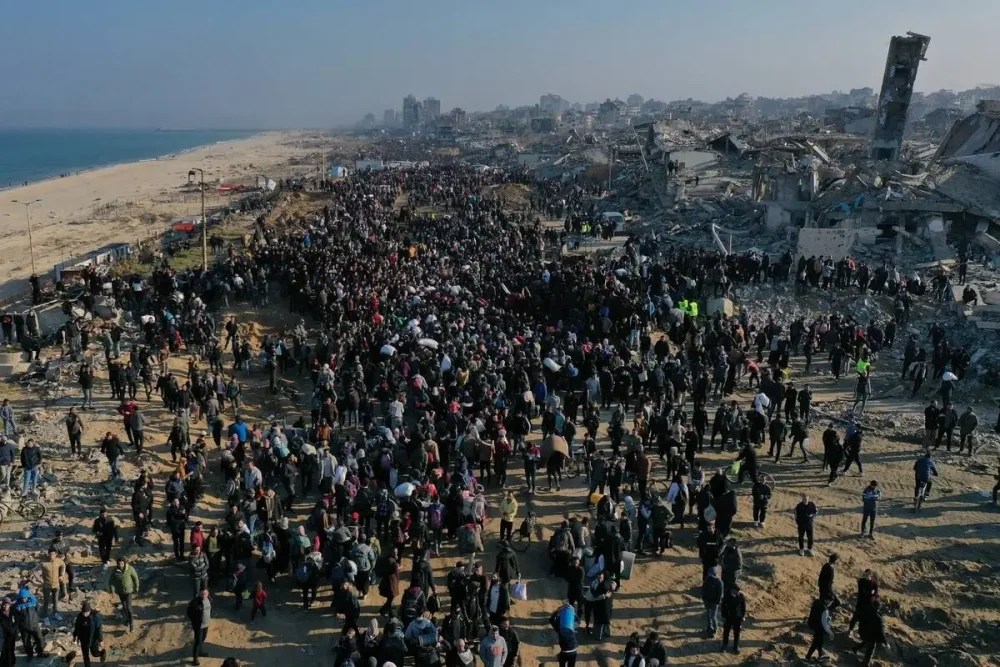
Even those of us who have long emphasised the importance of the Palestinian people’s voice, experience and collective action in Palestinian history must have been shocked by the cultural revolution resulting from the Israeli war against the people in Gaza. By cultural revolution, I mean the defiant and rebellious narrative evolving in Gaza, where people see themselves as active participants in the popular resistance, not just mere victims of the Israeli war machine.
When the ceasefire was announced on the 471st day of the Israeli genocide, the Palestinians in Gaza rushed onto the streets in celebration. Media outlets reported that they were celebrating the ceasefire, but judging by their chants, songs and symbolisms they were celebrating their collective victory, steadfastness (sumud) and resilience against the powerful Israeli army, which has been and remains supported by the US and other Western countries.
Using basic tools, they hurried to clean their streets, clearing debris to allow the displaced to search for homes. Although their homes were probably destroyed by Israel – 90 per cent of Gaza’s housing units were, according to the United Nations – they were still happy, even if they could only sit on the rubble. Some prayed atop concrete slabs, some sang in large, growing crowds, and others cried but insisted that no power could ever uproot them from Palestine again.
Social media was flooded with Palestinians expressing a mix of emotions, although they were mostly defiant, expressing their resolve not just in political terms, but also in other ways, including humour.
Of course, the bodybuilders returned to their gyms to find them also mostly destroyed. Rather than lament their losses, though, they salvaged machines and resumed training amid collapsed walls and ceilings punctured by Israeli missiles.
There was also a father and son who composed a song in the ahazej style, a traditional Levantine vocalisation.
The son, overjoyed to find his father alive, was reassured by him that they would never abandon their homeland.
As for the children – 14,500 of whom were killed by Israel, according to UN Relief and Works Agency for Palestine Refugees (UNRWA) – they resumed their childhood. They laid claim to destroyed Israeli tanks in Rafah, Beit Hanoun and elsewhere as their new playground equipment.
One teenager pretended to be a scrap metal salesman and yelled, “An Israeli Merkava tank for sale,” as his friends filmed him and laughed. “Make sure you send this video to [Israeli Prime Minister Benjamin] Netanyahu,” he added before moving on, unfazed.
This does not mean that Gaza is free of unimaginable pain, which is difficult for the rest of the world to fully comprehend. The emotional and psychological scars of the war will last a lifetime, and many will never recover fully from the trauma. But Palestinians in Gaza know that they cannot afford to grieve in the usual way. So, they emphasise their identity, unity and defiance as ways to overcome grief.
In parallel with its military assault on Gaza since 7 October, 2023, Israel has invested heavily in dividing the Palestinian people and trying to shatter their spirit. In Gaza, it dropped millions of flyers from warplanes on starving refugees, urging them to rebel against Palestinian factions by providing Israel with names of “troublemakers”. The Israeli army offered large rewards for such information, but little was achieved.
These flyers also called for tribal leaders to take control of their areas in exchange for food and protection. To punish those who resisted, Israel systematically killed clan representatives and councillors who tried to distribute aid throughout Gaza, especially in the north where famine was devastating.
Against overwhelming odds, though, Palestinians remained united.
When the ceasefire was declared, they celebrated as one nation. With Gaza destroyed, Israel’s actions obliterated Gaza’s class, regional, ideological and political divisions. Everyone in Gaza became a refugee: the rich, poor, Muslim, Christian, city dwellers and refugee camp residents; all were affected equally.
The unity that remains in Gaza, after one of the most horrific genocides in modern history, should serve as a wake-up call. The narrative that Palestinians are divided and need to “find common ground” has proven false.
With the Palestinian Authority in the West Bank aiding Israel’s war on Jenin and other refugee camps, the old notion of political unity through a merger of the PA and various Palestinian factions is no longer viable. The reality is that the fragmentation of the Palestinian political landscape cannot be solved through mere political agreements or negotiations between factions.
A different kind of unity has already taken root in Gaza and, by extension, across Palestinian communities in occupied Palestine and the rest of the world. This unity is visible in the millions of Palestinians who have demonstrated against the war, chanted for Gaza, cried for Gaza, and developed a new political discourse around it.
This unity does not rely on talking heads on Arabic satellite channels or secret meetings in expensive hotels. It needs no diplomatic talks. Years of endless discussions, “unity documents” and fiery speeches only led to disappointment.
The true unity has already been achieved, felt in the voices of ordinary people who no longer identify as members of factions. They are Gazzawiyya. Palestinians from Gaza, and nothing else.
This is the true unity that must now form the foundation of a new discourse.
Press TV – January 29, 2025
The administration of US President Donald Trump is pressuring Egypt to push the Palestinian resistance movement Hamas out of the besieged Gaza Strip.
On Tuesday, US Secretary of State Marco Rubio told his Egyptian Foreign Minister Badr Abdelatty that the two sides must maintain “close cooperation” in an attempt “to ensure Hamas can never govern Gaza.”
Israel began its campaign of genocide in Gaza in October 2023, after Hamas carried out Operation Al-Aqsa Flood in retaliation for Israel’s intensified atrocities against the Palestinian people.
However, after 15 months of ruthless aggression, the occupying regime failed to achieve its prime objective of eliminating Hamas, despite killing at least 47,306 Palestinians, mostly women and children.
The campaign has currently paused amid a fragile ceasefire.
The US State Department added on Tuesday that Rubio also “reinforced the importance of holding Hamas accountable.”
A day earlier, Trump once again called for forced relocation of Palestinians from Gaza to Egypt and Jordan, despite strong opposition from Cairo and Amman to the plan which has been slammed by the United Nations as “ethnic cleansing.”
The Palestinian leadership has been divided between Fatah and Hamas since 2006, when the latter scored a landslide victory in parliamentary elections in the Gaza Strip.
Hamas has ever since been running the Palestinian enclave, while the Palestinian Authority (PA), which is run by the ruling Fatah party and led by President Mahmoud Abbas, has been based in the autonomous parts of the occupied West Bank.
Israeli Prime Minister Benjamin Netanyahu had declared that the goal of the war for the regime was the total defeat and elimination of Hamas.
However, former US Secretary of State Antony Blinken implied in one of his final appearances, on January 14, that the regime had failed in achieving this goal.
Blinken said assessments by the US had revealed that “Hamas has recruited almost as many new” fighters “as it has lost.”
“That is a recipe for an enduring insurgency and perpetual war,” he added.
Israel managed to assassinate two top leaders of the movement – namely Ismail Haniyeh and Yahya Sinwar – and according to the European Council on Foreign Relations (ECFR), its weapons stockpile is also depleted, but as the dust settles in Gaza, it is clear that the resistance movement has not been eliminated and is still there.
Hamas fighters have prominently featured in the handover of Israeli captives as part of the ceasefire deal with Israel. And members of the Hamas-run civil administration have resumed work. If there is any authority in Gaza, it still appears to be Hamas, Al-Jazeera said in a report.
After “over a year of fighting, the [Hamas] fighters remain very much in control of Gaza,” Hugh Lovatt of the ECFR said.
“Hamas is trying to show Israel that it failed to destroy it but also that the movement will have a veto over Gaza’s future going forward because neither Israel and the PA nor the international community will be able to impose a post-conflict governance or security arrangement,” Lovatt said.
Israel aimed to destroy Hamas’s infrastructure, particularly its extensive tunnel network. However, Israeli media reports suggest that much of the network remains functional, though estimates of its intactness vary widely.
Hamas members told the ECFR that many tunnels have been preserved, restored, or even expanded in some areas.
According to the ECFR, Hamas even recycles “unexploded Israeli rockets, bombs, and artillery shells to use as improvised explosive devices and produce new projectiles.”
The Gaza Strip, home to some 2.4 million Palestinians, has been under Israeli siege since June 2007. The blockade has caused a decline in the standards of living as well as unprecedented levels of unemployment and unrelenting poverty.
Al Mayadeen | January 29, 2025
“Israel” continues to violate the ceasefire with Lebanon, persistently attacking residents of southern villages and demolishing homes and lands in the region.
In this context, the Lebanese Ministry of Health reported that five Lebanese civilians were injured, including two in critical condition, following an Israeli drone strike on the outskirts of Majdal Selem, near Wadi al-Slouqi.
Meanwhile, an Israeli military bulldozer conducted excavation operations at the western entrance to Mays al-Jabal, advancing beyond the UNIFIL headquarters in a provocative maneuver.
Invading Israeli units carried out extensive bulldozing operations on the outskirts of Marwahin, shielded by a Merkava tank while demolishing an artesian well in Houla and erecting new earthen fortifications.
Concurrently, an Israeli drone dropped three explosive bombs on the town of Tallousah, injuring one person and damaging a bulldozer and a truck. Additionally, Israeli forces set fire to homes between the towns of al-Qantara and Taybeh.
Residents defy the IOF, determined to reclaim their land
Despite the brutal Israeli assaults, residents of Maroun al-Ras continue attempting to enter their town from the northeastern side to retrieve the bodies of martyrs still under the rubble.
Al Mayadeen’s correspondent reported that residents of Maroun al-Ras bypassed Israeli forces controlling the northern entrance by using alternative routes to enter the town. During the incident, one civilian was shot and wounded by Israeli forces, while the invading Israeli units abducted four civilians in Maroun al-Ras, including a woman. While three have been released, one remains in captivity.
It is worth noting that gunfire from Israeli forces echoed as residents entered for the first time.
A resident of Maroun al-Ras stated, “Our return is our decision. We will liberate our land with stones and boiling oil, just as we did in the 1980s.”
Similarly, residents of Yaroun are preparing to enter their town from the northern entrance, reaffirming their resilience and commitment to their land, supported by the Lebanese Army.
The National News Agency reported that residents of Kfar Kila set up a tent on the Khardali road at the Deir Mimas-Qlayaa junction, declaring their intent to remain there until invading Israeli units withdraw.
The Lebanese Ministry of Health reported a total of 36 injuries from Israeli attacks the previous day, with six in Yaroun as residents attempted to re-enter, 20 in an airstrike on Nabatieh al-Fawqa, and 10 in an assault on Zawtar.
It is worth noting that the Israeli occupation forces launched on Tuesday evening two airstrikes on Nabatieh al-Fawqa in Southern Lebanon within the span of an hour.
The first strike injured 14 people, according to the initial figures reported by Lebanon’s Ministry of Health.
Thousands of southern Lebanese residents gathered at the entrances of their villages, preparing to return after the expiration of the 60-day deadline. This marks the fourth consecutive day of their return following the conclusion of the deadline for Israeli forces’ withdrawal, which ended on Sunday.
“Israel”—under US backing—confirmed through Prime Minister Netanyahu’s office that its forces would not fully withdraw from southern Lebanon after the expiration of the deadline.
Hezbollah responded late Thursday, declaring that “any violation of the 60-day deadline is a blatant breach of the agreement and an escalation of the assault on Lebanese sovereignty.” The Resistance movement emphasized that the Israeli occupation had entered a new phase that should be confronted by the Lebanese state using all available methods guaranteed by international law to reclaim and liberate the land.
By Stansfield Smith | Covert Action Magazine | January 8, 2025
It may be no surprise that the “mainstream” corporate news media have turned into advertising agencies for U.S. government policy. But it still surprises that what the CIA called a compatible left—those on the left it deemed compatible with maintaining imperialist rule—celebrates another successful U.S. “regime change,” this time, in Syria.
Portside, which assembles daily news articles that it advertises as “being of interest to people on the left,” ran an article, “Liberation in Syria Is a Victory Worth Embracing” by Layla Maghribi, which criticized “some self-styled Western ‘anti-imperialists’” for their lack of enthusiasm for the “victory.” While it does note that Israel bombed Syria 220 times up to mid-November this past year, one finds no mention of the long U.S. blockade imposed on Syrians.
CounterPunch has been a compatible left website outspoken in its hostility toward those exposing U.S. coup operations in Syria.
On December 10, CounterPunch published “Understanding the Rebellion in Syria” an interview with Swiss-Syrian socialist Joseph Daher. The introduction made the outlandish assertion that “some on the Left have claimed without foundation that their rebellion was orchestrated by the U.S. and Israel.” Daher himself in turn said that “the U.S. nor Israel had a hand in these events. In fact, the opposite is the case.”
Daher goes on to write off as “campists” and “tankies” those of us who recognize the obvious, “that this military offensive is led by ‘Al-Qaeda and other terrorists’ and that it is a Western-imperialist plot against the Syrian regime intended to weaken the so-called ‘Axis of Resistance’ led by Iran and Hezbollah… [T]he campists claim that the fall of Assad weakens it and therefore undermines the struggle for the liberation of Palestine.”
On December 11, CounterPunch turned to academic Stephen Zunes for an “exclusive interview,” presenting him as a “foreign policy expert” for the left.
Zunes, however, is on the advisory board of International Center for Nonviolent Conflict (ICNC); a group whose founder and primary funder was Peter Ackerman, a member of the Executive Committee of the Atlantic Council and chair of Freedom House. Also, back in 2011, Zunes praised the U.S.-NATO destruction of Qaddafi’s Libya in Truthout.
In the interview, Zunes impugned Assad for his “savage repression” and “endemic corruption” and blamed him for Syria’s growing poverty without mentioning the draconian U.S. sanctions policy or ravaging effects of a war that had been triggered by outsiders.
Zunes went on to characterize the anti-Assad rebels as a “popular resistance movement,” obscuring its domination by jihadist elements, and said that the rebellion “would have happened regardless of U.S. policy,” which obscures the crucial nature of U.S. support.
Zunes showed his true colors subsequently when he defended President Barack Obama, who inaugurated the largest covert operations in Syria since the 1980s Afghan mujahadin and illegally bombed Syria based on fraudulent pretexts, a phony charge of chemical weapons attacks.[1]
According to Zunes, “Many of these Western ‘anti-imperialists’ are themselves stuck in an imperialist mindset which denies agency to people of color in the Global South (or Slavs in Eastern Europe) who are struggling for their freedom against tyranny.”
However, the struggle against tyranny in this case was financed heavily by outside powers, including the U.S., and was led not by “freedom fighters” but jihadist terrorists who came from 84 different countries.
CounterPunch has long supported the fake “Syrian revolution.” They refuse to publish anti-imperialist writers such as Ben Norton, who reported, “a bombshell declassified 2012 memo from the Defense Intelligence Agency (DIA) reveals that, from the start, ‘The Salafist, the Muslim Brotherhood, and AQI are the major forces driving the insurgency in Syria.’ AQI is a reference to Al-Qaeda in Iraq, which later evolved into ISIS.”
Even the New York Times disclosed—seven years ago—that the CIA had already spent more than $1 billion to overthrow Assad, “one of the costliest covert action programs in the history of the C.I.A.”
Why do these “left” websites like CounterPunch cover up major CIA regime-change operations?
Truthout on December 11 ran its own pro-U.S. regime-change article, “As Assad Regime Falls, Syrians Celebrate — and Brace for an Uncertain Future” by Shireen Akram-Boshar, a socialist writer and Middle East/North Africa solidarity activist. The article repeats the same apologetics for U.S. imperial rule: “Contrary to common misconceptions, the U.S. and Israel did not aspire to remove Assad after 2013.”
Similarly, Democracy Now ignored the U.S. involvement in the operations against Assad and triumph of al-Qaeda and interviewed an AP reporter, Sarah El Deeb, who pointed to cheering crowds and expressed enthusiasm about the new Syria with Assad’s removal from power.
El Deeb further echoed the mainstream media in pointing out human rights abuses allegedly committed by Assad, while ignoring the record of ethnic cleansing, suicide bombings and massacres carried out by the rebel forces backed by the U.S. which have now succeeded in deposing Assad.
John Feffer of the Institute for Policy Studies published a more sensible article, but one that still covered up the U.S. economic blockade’s destruction of Syria as well as its long regime-change operation. Feffer also repeats the U.S. line that the Syrian government used chemical weapons attacks, even though Seymour Hersh, MIT scientist Theodore Postol and The Grayzone showed that the U.S. concocted this story.
None of the compatible left websites mentioned the words of Biden and Netanyahu, who with legitimate reason took credit for the fall of Assad.
Netanyahu recognized the Assad government as “a central link in Iran’s axis of evil.” The Axis of Resistance to the Israeli-U.S. anti-Palestinian genocidal bloc includes Hamas, Iran, Hezbollah, Assad’s Syria, and Yemen. The Israeli butcher proudly acknowledged the overthrow “is a direct result of the blows we have inflicted on Iran and Hezbollah, the main supporters of the Assad regime.”
Biden spoke likewise: “Neither Russia nor Iran nor Hezbollah could defend this abhorrent regime in Syria. This is a direct result of the blows that Ukraine and Israel have delivered upon their own self-defense with unflagging support of the United States.” Indeed, Israel inflicted heavy damage on Hezbollah in Lebanon, and Russia remains tied up combating the U.S.-instigated war in Ukraine.
Some of the compatible left—LA Progressive and Common Dreams, both orbiting the Democratic Party—ran honest articles on the U.S. role.
On December 11-12, Common Dreams posted “The West Celebrates Assad’s Fall, But What Comes Next May Be Even Worse,” and Jeffrey Sachs’ excellent “How the US and Israel Destroyed Syria and Called it Peace.”
The former noted the so-called “liberation” was “cheered by U.S. President Joe Biden and other major Western leaders, like French President Emmanuel Macron and German Chancellor Olaf Scholz.” It asked the obvious question: “[W]hy is the West cheering for al Qaeda and its allies?” Indeed, and why are these compatible lefties following suit?
It continues: “Since the fall of Assad, Israel has already carried out hundreds of airstrikes across Syria, targeting airports, naval bases, and military infrastructure. And the U.S. Central Command announced that it has struck more than 75 targets, including ISIS leaders, operatives, and camps…
The Obama administration provided support to the anti-Assad forces, primarily to the Free Syrian Army forces and its affiliates, but the CIA began to support other groups as early as 2013 even though they had jihadi orientations. CIA’s covert operation against the Syrian regime, known as Timber Sycamore, was a joint effort with Saudi Arabia that had long ties with radical Islamist groups…
Syria was under imperialist attack for the past 13 years. The U.S. (along with Turkey) backed and funded mercenaries and terrorist forces against Assad’s regime, imposed economic isolation of the country through sanctions, and denied plans that would have contributed to reconstruction even though aid was desperately needed for civilians.”
Jeffrey Sachs (also here and here) pointed out that U.S. destruction of Syria was planned since 1996. General Wesley Clark revealed in an interview clip, probably seen by leftists of all stripes, that, back in 2001, after Afghanistan, the U.S. intended to wage war and overthrow seven more states in the Middle East: Iraq, Syria, Lebanon, Libya, Somalia, Sudan, and Iran. The only one not yet destroyed is Iran.
The Long U.S. War Against Syria
Relying on deadly sanctions, an invisible form of carpet bombing, the U.S. starved the Syrian people and hollowed out the Syrian economy until it collapsed.
Before 2011, Syria, just like Qaddafi’s Libya, was a thriving nation, self-sufficient in energy and food, with free health care, free education and no national debt. Then the U.S. and its NATO and Gulf allies orchestrated a dirty war, funding and arming sectarian terrorists to fragment Syria. These groups were deceitfully presented by many on the compatible left as part of a liberation movement.
Even David Sorenson, a professor at the U.S. Air War College recognized, “By 2015, aid to anti-Assad forces became the most expensive U.S. covert action program in history, topping 1 billion USD.” Since 2014, U.S. and Turkish military and proxy forces have occupied about one-third of Syrian territory and appropriated all its oil, gas, and wheat harvests.
Alena Douhan, UN Special Rapporteur on the effect of the U.S. economic blockade against Syria, reported, “The imposed sanctions have shattered the State’s capability to respond to the needs of the population, particularly the most vulnerable, and 90% of the people now live below the poverty line.” They have “limited access to food, water, electricity, shelter, cooking and heating fuel, transportation and healthcare.” The World Food Programme states that almost 13 million Syrians, half the population, lack sufficient food.
How many died from these measures we do not know, but the similar draconian U.S. blockade on Venezuela killed 40,000 in a year and a half.
Douhan continues, “With more than half of the vital infrastructure either completely destroyed or severely damaged, the imposition of unilateral sanctions on key economic sectors, including oil, gas, electricity, trade, construction and engineering have quashed national income, and undermine efforts towards economic recovery and reconstruction.”
We should wonder who CounterPunch is serving when it publishes the claim that “Neither the U.S. nor Israel had a hand in these events.”
The “campists” or “tankies” CounterPunch refers to run the gamut—from Scott Ritter, Ron Paul, Vijay Prashad, Ben Norton, Glenn Greenwald, Colonel Douglas MacGregor, Aaron Maté and JD Vance to Sara Flounders.
They share opposition to the endless neo-con wars advocated by Obama, Hillary, Biden and Cheney.
We find, once again, sectors of the compatible left functioning as a conveyor belt for U.S. regime-change propaganda broadcast into the progressive and anti-war movements, telling us to celebrate another successful U.S. imperial operation.
Meanwhile, the struggle of the Middle East to free itself from U.S.-Israeli domination has suffered a major defeat, on top of that inflicted on Hezbollah and Gaza. The Palestinians’ situation has worsened, Iran is next on the U.S. hit list, and Venezuela, Cuba and Nicaragua are not far behind. Our active solidarity is needed now more than ever.
RT | January 29, 2025
Multiple Ukrainian media outlets have issued appeals for emergency cash donations after US President Donald Trump suspended Washington’s foreign aid programs. USAID, the organization that funnels billions of dollars to international causes deemed worthy by Washington has been put on hold, pending reviews, and up to 60 senior staff have reportedly been suspended on full pay.
Nine out of every ten media outlets in Ukraine have been impacted by Washington’s decision, Oksana Romanyuk, executive director of the Institute of Mass Information in Kiev has claimed.
”Unfortunately, almost 90% of Ukrainian media outlets were surviving on grants,” the head of the media-focused NGO told Hromadske Radio. Romanyuk described Trump’s decision as a threat to democracy in Ukraine, claiming that “oligarchs” may seize control of a media landscape “weakened” by the halt in American funding.
Hromadske is among the outlets soliciting private donations in the wake of aid freeze. Established in November 2013, just before the Maidan protests started, Hromadske received its seed funding directly from the US embassy in Kiev and George Soros’ Open Society Foundation. The broadcaster played a pivotal role in criticizing the government during the violent coup that overthrew a democratically elected president and put Ukraine on course for division and conflict.
In a statement announcing the suspension of some of its projects, Hromadske praised the US Agency for International Development (USAID) as one of the most generous donors of “independent media” and NGOs in Ukraine. The investigative journalism organization Bihus.info also acknowledged that much of its work has been funded by the US.
The campaign for emergency funding also extends beyond traditional news outlets. Detector Media, a self-styled watchdog ‘combating online disinformation,’ has warned that hundreds of organizations are facing shutdown without USAID support, and urged private citizens and business owners to donate.
Irina Vereshchuk, the deputy chief of staff to Ukrainian leader Vladimir Zelensky, has called the suspension of US non-military assistance “unexpected and unpleasant”. Kiev will hold “consultations with our American partners” to resume the flow of money while implementing measures to “stabilize the situation” in the interim, she promised on Tuesday.
or go to
Aletho News Archives – Video-Images
By Damian Lataan | January 10, 2014
Seventy senior Israeli-centric neoconservatives have written an open letter to Congress imploring them to do more to ensure Iran complies with the conditions of any agreement finally reached with the P5+1 over Iran’s nuclear program.
While the neocons are ostensibly asking Congress to ensure compliance, it is clear that their real aim is to convince members of Congress to support the bill currently passing through the Senate which calls for tighter sanctions against Iran in the event of any waywardness on Iran’s part.
The neocons are eager to see the bill currently passing through the Senate with enough support to make it veto-proof, not so much because they are concerned about Iran’s so-called nuclear weapons program – there’s still not a skerrick of hard evidence that Iran has a nuclear weapons program – but, rather, because embedded within the bill is this clause:
… if the Government of Israel is compelled to take military action in legitimate self-defense against Iran’s nuclear weapon program, the United States Government should stand with Israel and provide, in accordance with the law of the United States and the constitutional responsibility of Congress to authorize the use of military force, diplomatic, military, and economic support to the Government of Israel in its defense of its territory, people, and existence…
Essentially, the clause is an automatic trigger for the US to attack Iran at any time the Israelis choose to launch a first strike – regardless of whether President Obama is in favour or not.
Partial list… continue
 Aletho News If Americans Knew No Tricks Zone
 Aletho News