Did a Trump executive order just cripple the global US regime change network?
By Kit Klarenberg · The Grayzone · January 31, 2025
Among the flurry of executive orders issued by President Donald Trump in the first days of his administration, perhaps the most consequential to date is one titled, “reevaluating and realigning US foreign aid.”
Under this order, a 90-day pause was instantly enforced on all US foreign development assistance across the globe – excepting, of course, the largest recipients of US aid in Israel and Egypt. For now, the order forbids the disbursement of federal funding for any “non-governmental organizations, international organizations, and contractors” charged with delivering US “aid” programs overseas.
Within days, hundreds of “internal contractors” at the US Agency for International Development (USAID) were placed on unpaid leave or outright fired, as a direct result of the Executive Order. Washington Post contributor John Hudson has reported organization officials brand Trump’s directives on “foreign development assistance” a “shock and awe approach,” which has left them reeling, uncertain of their futures. One nameless USAID apparatchik told him, “they even removed all the pictures in our offices of aid programs,” as accompanying photographs attested.
While the Trump administration’s purge sent shockwaves through Washington’s international development corps and the Beltway Bandits which feed at its trough, the sudden severing of USAID money has sparked panic overseas. From Latin America to Eastern Europe, the US has pumped billions into NGO’s and media outlets to fuel color revolutions and assorted regime change operations, all in the name of “democracy promotion.”
Now, as the global apparatus of soft American power trumpeted by President George H.W. Bush as “a thousand points of light” goes dark, supposedly independent media outfits from Ukraine to Nicaragua are fretting about their future and panhandling for donations on their websites.
US-backed media and opposition face extinction in Ukraine
Since the collapse of the Soviet Union, the US has pumped billions into Ukraine to create and propel a fervently anti-Russian opposition. As former State Department Assistant Secretary for Eastern European Affairs Victoria Nuland remarked to an oil industry-sponsored meeting in Kiev in 2009, “we’ve invested $5 billion to assist Ukraine” to “build democratic skills and institutions” allowing it to “achieve European independence.”
The US flooded Ukrainian civil society with grants on the eve of the 2014 Maidan coup, birthing a network of pro-Western media outlets almost overnight. Among them was Hromadske, a liberal broadcasting entity which pushed for the overthrow of President Victor Yanukovych and rallied for the subsequent war with pro-Russian separatists in the country’s east – including through the glorification of Nazis who fought the Soviet Red Army during World War II.
With Trump’s executive order cutting off USAID programs, Hromadske has suddenly been severed from its financial tube. So too have the top Ukrainian media outlets which emerged in the wake of the Maidan coup, including Ukrinform, Internews, and a signatory of the Poynter-run International Fact Checking Network called VoxUkraine.
The Ministry of Culture and Strategic Communications and the Service of the Deputy Prime Minister for European and Euro-Atlantic Integration, both created to propagandize for war against Russia, are also among USAID funding recipients now starving for cash.
Ukrainian President Volodomyr Zelensky took to X to whine that “critically important programs” wholly dependent on “US support” were now “suspended” as a result of Trump’s executive order. He promised that “certain key initiatives” would “be financed through our internal resources,” while begging for donations from Kiev’s “European partners” to be “intensified.”
Given Ukraine’s near-total economic destruction since its proxy war against Russia erupted in February 2022, and complete reliance on USAID to pay the salaries of state employees, it is uncertain how the country’s “internal resources” can possibly be used to even vaguely offset its sudden deficit. Already, major Ukrainian media outlets are pleading for financial support from their readers just to keep their lights on.
According to Kiev’s foreign-funded Institute of Mass Information, around 90% of the country’s media is “dependent on American grants.”
Contra 2.0 gravy train paused in Nicaragua
Similar bleating has emanated from US-financed organizations in Nicaragua, where since the re-election of popular leftist Sandinista Front in 2006, Washington has pumped tens of millions of dollars into right-wing media outlets and opposition groups.
In tandem, these foreign-funded fifth columnists routinely disseminate disinformation, while inciting violence against the government and its supporters, and influencing Western media reporting on the country.
As The Grayzone reported, a USAID-funded Nicaraguan opposition outlet called 100% Noticias led a campaign of violent incitement throughout 2018, when a failed US-backed coup attempt left hundreds dead in the country. While the outlet repeatedly featured calls for the murder of President Daniel Ortega, its director, Miguel Mora, told The Grayone’s Max Blumenthal he wished for a US military intervention of the country to topple the elected government. When the Nicaraguan government finally shuttered the station and prosecuted Mora, Washington responded with accusations of repression and threats of heavy sanctions.
On January 21, an anti-Sandinista “news” operations called Nicaragua Investiga warned that Trump’s order “threatens to deal a severe blow” to the country and its anti-Ortega crusade, “which depends heavily on the financial and technical support provided by agencies” such as USAID. This backing, the outlet declared, was a “fundamental pillar” in the Nicaraguan right-wing’s efforts to undermine and depose the anti-imperialist President.
“Civil society organisations that rely on this assistance would be forced to reduce or cease their activities,” Nicaragua Investiga warned. The outlet further lamented that “uncertainty reigns over how and when assistance will be restored, and whether organizations critical of Daniel Ortega’s regime that still survive outside the country will be able to maintain their operations.”
Not coincidentally, Nicaragua Investiga was among the local outlets which largely depended on US government grants for their existence.
Has the US balked at balkanizing the Balkans?
Across the West Balkans, USAID, self-avowed CIA front the National Endowment for Democracy, George Soros’ Open Society Foundations and the panoply of NGOs and media outlets have infiltrated every conceivable sphere of public life. Following the 1992 – 1995 civil war, Bosnia and Herzegovina was methodically transformed into a de facto EU and US colony, with all basic functions of the state hijacked by foreign interests.
Some concern about the imperial project found its way into mainstream media at the time. The New York Times warned in 1998 that US domination of Bosnia “raised troubling questions about how the state will work without continued infusions of outside aid and direct international supervision.” A senior foreign government advisor angsted over Washington’s lack of exit strategy in the country, or any plan to end “Bosnia’s culture of dependency.” Today, at least 25,600 Western-funded NGOs are active in Sarajevo.
The pause in “foreign development assistance” has placed countless jobs and beneficiary organizations at risk of permanent erasure across the Balkans. On January 30, Balkan Insight – an outlet exposed by The Grayzone as a tentacle of British intelligence – published an illuminating investigation into how the aid pause “has immediately affected a range of organisations in Bosnia and Herzegovina, Albania, Kosovo, North Macedonia, Montenegro and Serbia.”
From 2020 until the end of 2024, Washington has funnelled a staggering $1.7 billion into the West Balkans, “supporting civil society organisations and state institutions and projects ranging from human rights and media to energy efficiency,” with next to no demonstrable social benefit. Now, “all projects have been halted… until the evaluation period is over.” Expenses up until January 27 will be covered, “while everything after that has to be stopped.” Already, layoffs and huge pay cuts have been enacted at recipient entities.
Nameless NGO workers consulted by Balkan Insight fretted that the US financing freeze would not be temporary. One source speculated the Executive Order could be “just a soft way of cutting these funds permanently.” The outlet noted Washington “has supported thousands of activities” in the region, and “the precise number of affected projects” remains “unknown”. When reporters contacted local USAID offices seeking clarity on the cuts, they were redirected in every instance to the agency’s Washington headquarters.
USAID base camp “responded by sending a link to its press release” on the funding pause. “President Trump stated clearly that the US is no longer going to blindly dole out money with no return for the American people,” it bluntly declared. “Reviewing and realigning foreign assistance on behalf of hardworking taxpayers is not just the right thing to do, it is a moral imperative.” Evidently, the new administration is not remotely concerned that entire sectors of local economies in the Balkans have been effectively shuttered.
Even in Albania – a doggedly pro-US country with an influential DC lobby – 30 Washington-subsidized projects have been suspended, including bankrolling of “courts, prosecutor’s offices and the ministries of Defence, Education and Sports, and Finance.” In Macedonia – where “most” US funding is distributed via USAID and NED – $72 million allocated to 22 projects is “now on hold.” Six wider regional USAID-backed initiatives in the Balkans, which also covers Macedonia, “worth some $140 million”, are likewise mothballed. In local terms, these sums are monumental.
Georgia not on the Trump admin’s mind
The Republic of Georgia has been the site of a series of color revolution efforts since the start of 2023, all in response to the government’s successful push to compel the more than 25,000 foreign-financed organizations in the country to disclose their funding sources. Western-backed NGOs and activist groups have been at the forefront of all these attempted putsches. Unsurprisingly, this shadow army of previously US-funded foot soldiers are furious about the Trump administration’s “foreign development assistance” cutoff.
By contrast, the Georgian government appears delighted. Parliamentary leader Mamuka Mdinaradze has even suggested the highly controversial law on foreign funding transparency “might not be needed at all anymore” after Trump’s executive order. Indeed, with untold foreign-sponsored chaos agents suddenly out of money, the color revolution coast is now clear in Tbilisi.
On January 30, local English language publication Georgia Today published a leader mourning that, “as the future of their funding hangs in the balance, aid organizations are already laying off or furloughing staff,” and “some programs” in Tbilisi “may struggle to restart after this temporary shutdown, with many potentially disappearing permanently.” It went on to note USAID financing “has been a cornerstone of the country’s development since 1992, with over $1.9 billion in assistance provided to date.”
Prior to the funding pause, USAID alone was “investing in 39 programs across the country, with a total value of $373 million and an annual budget exceeding $70 million.” These efforts overwhelmingly focused “on promoting economic reforms” and “fostering private sector investment,” which is to say facilitating foreign financial rape and pillage of Georgia.
While domestic critics of Trump’s Executive Order have lambasted Washington’s resultant loss of expansive “soft power” influence in the Global South, such retreat can only be to the enormous benefit of target countries. As a LeftEast essay noted, foreign-funded NGOs have for decades “eroded Georgian citizens’ agency and the country’s sovereignty and democracy.” Its authors explained, “Activists in Georgia know all too well what is expected of them and which behaviors are punished and rewarded: being critical of the government on Facebook will net you more grants than being out in the community helping people… Donors even monitor activists’ social media profiles, and there can be consequences for posting the wrong things.”
However, the relief could be premature for populations that have suffered decades of US “foreign development assistance,” and the attendant coups and unrest it has paid for. The “pause” on US aid may indeed be a temporary measure, or, spending on soft power could be redirected to harder options with even more grave repercussions across the world.
Trump Issues Executive Order Aimed At Deporting Anti-Israel Protesters
By blueapples | ZeroHedge | January 31, 2025
Last spring, a wave of protests across college campuses nationwide against Israel’s war in Gaza became the focal point of the growing cultural schism further dividing American society. The dichotomy between supporters and opponents of those protests immediately parlayed into the 2024 election cycle, with rightwing politicians seizing upon the opportunity to use the chaos in order to chip away at the crumbling foundation that the Biden administration’s re-election hopes rested upon. Smelling blood in the water, Biden’s opponents used the protests as evidence of the incumbent’s anti-American ideals manifesting on the nation’s soil and vowed to take swift action against the participants.
As is often the case, the right inextricably tied the interests of the US to those of Israel by categorizing the protesters critical of the genocidal war effort led by the Netanyahu regime as terrorists who were able to find safe haven in the US due to policies of the Biden administration like DEI and open borders that were rooted in Cultural Marxism. Proposed legislation aimed at purging students on visas involved in the protests due to their political leanings gained momentum but ultimately did not achieve any impact. However, an Executive Order signed by the Trump Administration realizes the goal of that reactionary response to those protests and carries the same concerns about its constitutionality and the chaos that enveloped the country across college campuses last spring being used as a catalyst to infringe upon the right to free speech.
On Wednesday, Trump signed an Executive Order titled Additional Measures To Combat Anti-Semitism into effect that fulfilled the promise he made to “get rid of the Jew haters” in the US during his presidential campaign last year. The Executive Order reaffirms another one that Trump signed during his first term that served this same interest. That previous order is Executive Order 13899, which Trump executed in 2019. The 2025 iteration of Executive Order 13899 dictates that the heads of each executive department offer reports on pending civil and criminal action taken under their respective jurisdictions in relation to the “wave of vile anti-Semitic discrimination, vandalism, and violence against our citizens, especially in our schools and on our campuses.” The Executive Order ultimately aims to provide the framework necessary to deport non-citizen college students who took place in last year’s protests against Israel from the United States.
The fact sheet accompanying the Executive Order minced no words, concluding by saying “To all the resident aliens who joined in the pro-jihadist protests, we put you on notice: come 2025, we will find you, and we will deport you. I will also quickly cancel the student visas of all Hamas sympathizers on college campuses, which have been infested with radicalism like never before.” That language echoed the promises Trump made on the campaign trail set by the rising tide represented by the protests that he compared to the cultural landscape that preceded the Holocaust. When making that comparison between the college protests to demonstrations across the Third Reich, Trump stated “If you look, it’s the same thing.”
Since Trump has taken office, his blitzrkrieg of Executive Orders have defeated many doubts about his ability to live up to the promises he made in the hopes of being re-elected. Criticisms of those who point out how he never took action to lock up Hillary Clinton during his first term as a portent of a similarly disappointing second tenure in the White House have largely been assuaged as Trump has already made good on his commitments to do things like offer pardons to the multitudes of January 6th protesters and to Ross Ulbricht, the founder of the Silk Road who was serving a life sentence behind bars. Those Executive Orders honored the commitments Trump made to his base of supporters as well as the Libertarian voters whose support he hoped to garner to aid his re-election hopes.
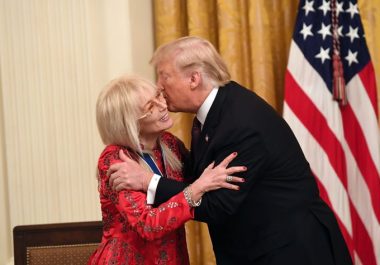 With those promises fulfilled, Trump’s swift executive actions now appear to have turned to serve the interests of his largest political donor, Miriam Adelson, whose $100 million donation to Trump’s re-election campaign ensured that any return to the Oval Office would serve the interests of Israel.
While Trump’s triumphant return to the White House has largely been celebrated, one unwavering criticism he continues to face is the paradox that exists between the overarching interests of Israel being held as paramount by a supposed “America First” political platform. Appeasing Israel’s interests has continued to be the exception to every rule as each of Trump’s cabinet nominations that expressed their unconditional support for the Jewish state, echoing the president’s own long-held position. Trump’s latest Executive Order highlights the continued prevalence of that contradictory dynamic within the “America First” movement of putting Israel’s interests above that of America’s.
Supporters of Trump’s effort to deport anti-Israel protesters on student visas have attempted to dispel concerns over the infringement of the First Amendment it poses by highlighting how those being targeted by it are not US citizens. That criticism isn’t just myopic, it illustrates an absence of civic engagement that would belong to any dutiful American who believes in the supreme importance of upholding the constitution. That hollow argument is entirely ignorant of even a rudimentary understanding of constitutional law that has extended civil rights protections to non-citizens for nearly a sesquicentennial.
In 1886, The United States Supreme Court set that precedent when it issued its decision in the case of Yick Wo v. Hopkins. The case was brought to the SCOTUS by Lee Yick, a Chinese immigrant who moved to San Francisco in 1861 and ran a laundromat named Yick Wo for over 22 years. When Yick sought to renew the license they needed to operate the laundromat, they were denied on the basis of safety concerns. Before Yick sought to renew their license, the San Francisco Board of Supervisors passed an ordinance making it illegal to operate a laundromat in a wooden building without a permit from the Board, a permit that the business owner was not granted. Despite not being granted the permit, Yick continued to operate the laundromat and was eventually imprisoned for not paying the fine they received for violating the ordinance.
After being imprisoned, Yick petitioned the California Supreme Court for a writ of habeas corpus. Yick’s legal counsel argued that of the 320 laundromats that applied for the permit to operate in a wooden building, only 1 of the 200 Chinese applicants was approved. Comparatively, all 120 of the non-Chinese applicants had their permit applications approved. Yick’s counsel argued that this constituted de facto discrimination against the Chinese, an argument that the SCOTUS upheld. When examining the issue of Yick not being a citizen, the court held that the plain meaning of the text of the 14th Amendment extends the right to protection under the law to “all persons” who have action taken against them in the United States, regardless of citizenship.
The longstanding precedent set by the SCOTUS through Yick Wo v. Hopkins serves as the bedrock for criticism of Trump’s Executive Order aimed at deporting non-citizens on student visas for participating in protests against Israel. “The First Amendment protects everyone in the United States, including foreign citizens studying at American universities,” said Carrie DeCell, senior staff attorney at the Knight First Amendment Institute at Columbia University, which became the epicenter of anti-Israel protests last spring. DeCell concluded that “Deporting non-citizens on the basis of their political speech would be unconstitutional.”
The culture war that continues to be waged across the US creates a landscape in which its opponents have lost sight of the forest through the trees. Championing unconstitutional efforts to defeat opposition runs the risk of winning the battle only to lose the war, as the implications of empowering the state to infringe upon free speech would ultimately befall upon the fate of its citizens. This concern was prominent in the wake of the spring 2024 anti-Israel college protests when the Antisemitism Awareness Act was proposed. That proposed legislation highlighted how opportunistic Congress was in exploiting the chaos of those protests to make sweeping attacks against the right to free speech under the guise of combating antisemitism. President Trump’s latest Executive Order highlights how that threat to free speech has emerged yet again, illustrating the dire need for the continued resolve necessary to uphold the most sacrosanct of American virtues.
This One Question at RFK Jr.’s Confirmation Hearing Is Everything Wrong with Our Congress
Truthstream Media | January 30, 2025
Our First Film: TheMindsofMen.net
Our First Series: Vimeo.com/ondemand/trustgame
Site: TruthstreamMedia.com
X: @TruthstreamNews
Backup Ch: Vimeo.com/truthstreammedia
DONATE: http://bit.ly/2aTBeeF
Newsletter: http://eepurl.com/bbxcWX
10-year-old Palestinian boy in critical condition after Israeli soldier shoots him in Tulkarem
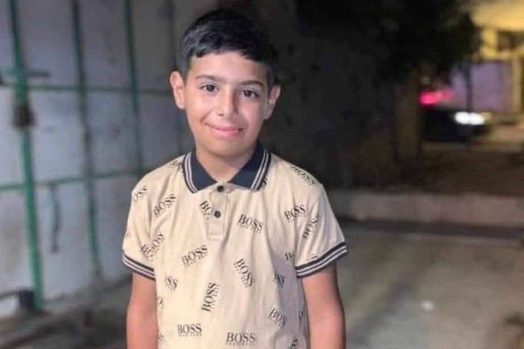
Saddam Hussein Iyad Mohammad Rajab, 10, was shot by an Israeli soldier in front of his home in Tulkarem on January 28 and is now in critical condition. (Photo: Rajab family)
Defense for Children International – Palestine | January 31, 2025
Ramallah — A 10-year-old Palestinian child is in critical condition after an Israeli soldier shot him in the northern occupied West Bank on Tuesday.
Saddam Hussein Iyad Mohammad Rajab, 10, was shot in the abdomen by an Israeli soldier around 6:10 p.m. on January 28 during an Israeli military incursion into Tulkarem in the northern occupied West Bank, according to documentation collected by Defense for Children International – Palestine. Israeli forces attacked Saddam’s father as he attempted to carry him to receive medical aid, and after paramedics placed him in an ambulance, soldiers detained his father for about an hour. After three hours of surgery at Thabet Thabet Governmental Hospital, doctors referred Saddam to Rafidia Hospital in Nablus, and during the transfer Israeli forces detained the ambulance transporting Saddam. While Israeli soldiers held up the ambulance, one soldier told Saddam’s father, “I am the one who shot your son. God willing, he will die.” Saddam remains in the intensive care unit at Rafidia Hospital.
“Israeli forces have utter contempt for Palestinian children’s lives as they deliberately target children with live ammunition with no accountability,” said Ayed Abu Eqtaish, accountability program director at DCIP. “This deliberate obstruction of medical aid reflects the Israeli military’s routine disregard for the protections afforded to medical personnel and infrastructure under international law, often intentionally targeting these entities and rendering essential health resources for Palestinian children ineffective.”
Saddam sustained a gunshot wound to his waist that exited from his chest, according to information collected by DCIP. The bullet tore through his intestines and injured the pancreas and other vital organs in the abdomen.
The attack was captured on camera and has gone viral on social media.
Saddam and his family had been trapped at home for two days as the Israeli military carried out an incursion into the city of Tulkarem. Saddam’s father said he was going to go downstairs for a minute and took a mobile phone with him.
“After about a minute, I heard the sound of only one bullet with my son Saddam’s scream,” Saddam’s father, Iyad, told DCIP. “He called out in a loud voice that still echoes in my ears, as he said “Dad!” and his voice disappeared.”
“I carried him in my arms, wanting to take him to the nearest vehicle or hospital or something to save his life,” Iyad continued. “When I carried him in my arms, I found that more than 20 Israeli soldiers surrounded me within moments, as some of them assaulted me with severe beatings, punches, and blows using their hands, feet, and rifle butts. I was carrying my son in my arms, and I was telling them to hit me and do whatever you want, but let me take my son for treatment.”
Saddam’s medical care was obstructed by Israeli forces several times, including immediately after the shooting and during the transfer from Thabet Thabet Governmental Hospital in Tulkarem to Rafidia Hospital in Nablus.
Under international law, children are entitled to special protections, which necessitate that they receive the care and aid that they need during times of armed conflict. Palestinian children like Saddam are systematically denied that right, as Israeli forces simultaneously continue to indiscriminately and fatally target children throughout occupied Palestinian territory. These ongoing assaults on children’s lives are perpetuated by Israel’s entrenched culture of impunity, which continues to claim the lives of Palestinian children nearly every day.
Malaysia announces conference to support Palestine reconstruction efforts
MEMO | February 1, 2025
The Malaysian Ministry of Foreign Affairs announced on Friday that it will be holding a conference to support reconstruction efforts in Palestine.
The Malaysian Foreign Ministry explained that it is coordinating with Japan to hold the fourth session of the Conference on Cooperation among East Asian Countries for Palestinian Development (CEAPAD) in Malaysia this year. It noted that the initiative reflects Malaysia’s proactive role in securing international support and strengthening cooperation to ensure the sustainability and impact of reconstruction efforts in Palestine.
The ministry noted that the conference is in line with the recent statement made by Prime Minister Anwar Ibrahim regarding the urgent need to accelerate reconstruction efforts in Palestine.
It also indicated that it is: “Fully committed to working side by side with Japan within the framework of the Conference on Cooperation among East Asian Countries for Palestinian Development to respond to the Palestinians’ clear call for assistance.”
The Malaysian Foreign Ministry pointed out that within the framework of these efforts, it aims to contribute to the reconstruction of basic infrastructure, including a school, a hospital and a mosque, as a sign of the collective commitment of the government, the private sector and the people of Malaysia.
It said that it will seek, along with Japan, to engage CEAPAD participants in securing the necessary commitments for the success of the group’s efforts to redevelop Gaza. This includes a series of coordination meetings before the conference to guarantee that aid and contributions to Palestine are provided more efficiently and sustainably for long-term development.
The Malaysian Foreign Ministry stressed its steadfast support for the Palestinian cause and its continued work closely with its regional and international partners to assure that the fourth CEAPAD conference is translated into concrete actions.
Trump’s call for Palestinians’ relocation will threaten regional peace, Arab nations warn
Press TV – February 1, 2025
Major Arab nations have expressed their opposition to US President Donald Trump’s proposal to relocate Palestinians from Gaza and the occupied West Bank to neighboring Egypt and Jordan under any circumstances.
In a joint statement following a meeting in Cairo, the foreign ministers and officials from Egypt, Jordan, Saudi Arabia, Qatar, the United Arab Emirates, the Palestinian Authority and the Arab League presented a unified stance against the US president.
They warned that such a move would threaten regional stability, risk spreading the conflict, and undermine prospects for peace and coexistence among its peoples.
“We affirm our rejection of [any attempts] to compromise Palestinians’ unalienable rights, whether through settlement activities, or evictions or annex of land or through vacating the land from its owners… in any form or under any circumstances or justifications,” the statement read.
The top diplomats emphasized that they were looking forward to working with Trump’s administration to achieve a just and comprehensive peace in the region, it noted.
Trump said last week that he had spoken with the king of Jordan about potentially building housing and moving more than 1 million Palestinians from Gaza to neighboring countries.
The US president added that he would like both Jordan and Egypt — which borders the battered enclave — to house the Palestinians displaced by 15 months of the Israeli regime’s genocidal war.
However, critics said that Trump’s suggestion would be tantamount to ethnic cleansing.
Egyptian President Abdel Fattah al-Sisi on Wednesday opposed the idea that his country would facilitate the displacement of Gazans and said Egyptians would take to the streets to express their disapproval.
Trump on Thursday insisted that Egypt and Jordan would accept displaced Palestinians from the Gaza Strip, despite the two nations having dismissed his plan to relocate Gazans there.
Jordan is already home to several million Palestinians, while tens of thousands live in Egypt. The foreign ministries of Egypt and Jordan have both rejected Trump’s suggestion in recent days.
‘Israel’ lost the Gaza war and must accept the reality: Report
Al Mayadeen | February 1, 2025
The threats by Israeli officials to destroy resistance movements in the Gaza Strip have diminished following the ceasefire agreement and the exchange of prisoners. This has shifted to discussions about “Israel’s” failure to achieve the war’s objectives, amid growing media criticism of “Israel’s” inability to secure victory despite claims of “absolute victory.”
Meanwhile, the Hamas movement has reasserted itself as a dominant force in shaping the future of the Gaza Strip, with its influence expanding towards the West Bank.
The Israeli failure is reflected in opinion polls, where responses to a question about the return of Gaza residents to the northern part of the Strip revealed that only 4% of respondents believe the war’s objectives were fully achieved. In contrast, 57% feel the objectives were not fully met, and 32% believe the objectives were not achieved at all.
‘Israel’ completely failed in its war on Gaza
The threats by Israeli officials to destroy the Resistance movements in the Gaza Strip have subsided following the ceasefire deal and the exchange of prisoners, shifting the focus to discussions about the Israeli occupation’s failure to achieve the war’s objectives.
In this context, Itamar Ben-Gvir, head of the Jewish Power Party and resigned Police Minister, encapsulated the prevailing sentiment in Israeli discourse by stating, “The horrific images from Gaza—referring to the release of Israeli captives by Palestinian Resistance movements—show that what happened in the Gaza Strip is not a complete victory, but a complete failure,” further describing the deal as an act of unparalleled recklessness.
Israeli newspaper Yedioth Ahronoth quoted a senior officer in the Israeli military’s General Staff as saying that “Israel, during the 15 months of the war on Gaza, has not achieved the war’s goals, which were to eliminate Hamas both militarily and administratively.”
The Israeli occupation’s failure to achieve its objectives in the war against the Gaza Strip, which started on October 7, 2023, has sparked attention from various experts and commentators in “Israel”. Among them, lawyer and penal law expert Doron Nir-Tzavi, who in an interview with Israeli Channel 7, emphasized that the true victor in any war is the side that “successfully achieves its goals.”
Since “Israel” set four goals for itself—destroying Hamas as a military force, dismantling Hamas’ authority in the Gaza Strip, ensuring the Israeli occupation is not exposed to “threats from Gaza”, and securing the return of all kidnapped individuals—it has failed to achieve any of these objectives. As a result, it is the party that did not win, according to the reports.
‘No achievements’
Former Mossad chief Tamir Pardo spoke to Israeli Channel 12, stating that while the Israeli army may have won the individual battles, “Israel” ultimately lost the war. He further emphasized that the proposal to create a buffer zone on the Gaza Strip border, 300 to 800 meters deep, to protect Israeli settlements, reflects “Israel’s” failure in the war. Pardo remarked, “This is not how you end a war, and this is not how you win a war.”
Former Mossad official Rami Igra highlighted in an interview with Israeli channel i24news that it is clear to everyone in “Israel” that the Israeli army failed to eliminate Hamas’ authority. He pointed out that no one in “Israel” planned for the aftermath or sought to establish an alternative authority to replace Hamas.
As mentioned in the interview, the clear outcome is that the lack of an alternative to Hamas’ authority means it continues to control the Gaza Strip, which is the reality on the ground. Igra further noted that “Israel” has, perhaps unwillingly, abandoned its goal of eliminating Hamas. The situation indicates that Hamas will remain in Gaza and is likely to grow stronger in the West Bank, which will force “Israel” to pay a significant price in the future.
‘Fruitless victory’
In an interview with Channel 12, former advisor to the Israeli Security Ministry, reserve Lieutenant Colonel Alon Avitar, stated, “Hamas is like a player who enters the field and says, if I don’t play, no one will play. That is, Hamas says that it will remain in power, whether directly or from behind the scenes, but in any case, it is the one dictating matters in the Gaza Strip. As for Israel, it must swallow the big frog in the story of absolute victory.”
In an article published in Haaretz, writer and linguist Rubik Rosenthal argued that everyone in “Israel knows they lost the Iron Swords war. Netanyahu knows it, the Smotrich-Ben Gvir duo knows it, Halevi knows it, and the whole world knows that Israel lost, failing to achieve any of the goals of the war.”
The article noted that despite “Israel destroying the enemy’s country, killing tens of thousands of its soldiers and citizens, eliminating its leaders, and blocking kilometers of its tunnels,” Rosenthal emphasized that there is no image of victory for “Israel” in this war, and therefore, no “fruits of victory.”
Hamas rebuilds itself militarily and authoritatively
In his analysis, Haaretz military affairs analyst Amos Harel stated that “there is no basis for the boasts of absolute victory by Netanyahu’s supporters” and emphasized that “one would have to be a foolish follower, who has lost all his control mechanisms, to believe that Israel defeated Hamas.”
Harel also pointed out that despite the massive military blow Hamas received, it did not surrender. Instead, it is gradually regaining its civil authority in the Gaza Strip and beginning to restore its military infrastructure. That said, this reality contradicts Netanyahu’s statements about the “goals of the war and the promises he made during it”.
Avi Issacharoff, an analyst on Arab affairs at the Walla website, criticized the Israeli government during an interview with Channel 12 for selling the public empty slogans about “absolute victory.” He argued that the government failed to achieve its primary goal of eliminating Hamas’ rule, which remains intact.
Zvi Yehezkeli, an Arab affairs commentator for the Israeli i24news channel, stated that Hamas is the dominant force in the Gaza Strip. He emphasized that it is evident to everyone that Hamas is the primary authority in Gaza, and it is the group with which “Israel” coordinates.
Yehezkeli further stated that the images Hamas intentionally broadcasts during the release of Israeli captives are not aimed at the people of Gaza, but rather at the international community. He noted that Hamas uses these images to demonstrate “how Israel was unable to achieve what it wanted in the Gaza Strip.”
Ex-US Colonel: Mounting US Merc Deaths Signal Impending Collapse of Ukraine’s War Machine
Sputnik – 01.02.2025
Having lost tens of thousands of its best and most experienced troops in foolhardy attacks, Ukraine has become increasingly reliant on mercenaries to make up for this shortage in troops, Ret. Lt. Col. Earl Rasmussen tells Sputnik.
Thus, an increase in casualties among these mercenaries is a “natural occurrence” that serves as “an indication of a slow and actually increasing collapse of the Ukrainian Armed Forces.”
Unlike its senile predecessor and his cohorts, the Trump administration seems to be gaining a “sense of realism” regarding the way the Ukrainian conflict is going, veteran international consultant Ret. Lt. Col. Earl Rasmussen tells Sputnik.
Western media narrative has now shifted from celebrating virtually everything Kiev does to a sobering assessment of the growing casualty and desertion rates in the Ukrainian military.
This may be an attempt to shape the public opinion as the US could be mulling either abandoning the Ukraine completely or passing the burden of supporting Kiev to someone else.
“Maybe try to shut it down or perhaps just pass the Ukraine project over to Europe and say, you take care of it, it’s your problem. So I think the US is trying to to extricate themselves out of the situation potentially.”
Kiev and Western backers trying to undermine Moscow’s ties with neighbors – FSB

Nikolay Kochmarik posing with a Ukrainian armored vehicle. FSB
RT | February 1, 2025
Ukrainian intelligence services and their Western handlers are creating fake online content in an attempt to spoil Russia’s relations with neighboring countries, the Russian Federal Security Service (FSB) has alleged.
The agency announced in a statement on Saturday that it had identified a Ukrainian national who had offended the people of Uzbekistan while posing as a Russian blogger. The controversial clip had been uploaded to a YouTube channel “controlled by the Lithuanian special services,” it added.
A video featuring a man who claims to be a Russian citizen made headlines last month for comparing Uzbeks to dogs, sparking outrage among commentators in both Central Asia and Russia.
At the time, Rasul Kusherbaev, an advisor to the Uzbek ecology minister, urged the country’s foreign ministry to “take action” in response to the insults. “Our cooperation with Russia is based on the principles of equality and mutual respect. Discrimination is unacceptable in interstate relations,” Kusherbaev told the media outlet Daryo.
According to the FSB, the offensive blogger is a citizen and current resident of Ukraine named Nikolay Kochmarik, who has been actively supporting Kiev’s military during the conflict with Moscow.
“This incident is evidence of deliberate actions by the Ukrainian and Lithuanian special services as well as by their foreign handlers to create provocative content aimed at undermining relations between Russia and its partners in the CIS,” the FSB stressed. With such clips, Kiev and its Western backers are “attempting to form anti-Russian sentiment abroad,” it added.
The CIS (Commonwealth of Independent States) is an intergovernmental organization comprised of many former Soviet Republics, including Armenia, Azerbaijan, Belarus, Kazakhstan, Kyrgyzstan, Moldova, Russia, Tajikistan, and Uzbekistan.
How Ukrainians became cannon fodder in British military’s Krynky debacle
By Kit Klarenberg | Press TV | February 1, 2025
In November 2024, Ukrainska Pravda published a little-noticed investigation, documenting in frequently disquieting detail the catastrophic failure of Ukraine’s long-running effort to capture the village of Krynky in Russian-controlled Kherson, October 2023 – June 2024.
That it was to all intents and purposes a British operation, from deranged inception to miserable conclusion, was perhaps the most shocking revelation.
As the proxy war teeters on collapse, it’s high time London’s covert role in fomenting relentless escalation, and getting enormous numbers of Ukrainians pointlessly killed, is critically scrutinized.
In June 2023, the Kakhovka Dam’s destruction almost completely submerged large swaths of Kherson, a key proxy war frontline, depopulating these areas in the process. In the wake of this incident, responsibility for which remains a point of significant contention, Kiev decided to secure a beachhead on Russian territory on Dnipro’s Russian-held left bank.
As Ukrainska Pravda notes, the initiative was and remains “one of the least publicized operations by the Ukrainian Armed Forces,” despite lasting as long as the Battle of Bakhmut.
This omertà endures today, with many “experienced officers” involved in and aware of the operation unwilling to answer any questions put to them by Ukrainska Pravda.
One pseudonymous marine quoted “was so concerned about the privacy” of his conversations with the outlet that he contacted them “from different numbers almost every time.”
The rationale for this conspiracy of silence is obvious. The Krynky operation’s failure was so egregious that it easily ranks among the uppermost tier of the biggest and worst modern military calamities.
Moreover, though, the effort had a supremely grand ultimate purpose, in which the surviving Ukrainian marines involved in the operation believed so strongly that several of them spoke of Kiev’s failed Krynky incursion in the same terms as the June 1944 Normandy landings – D-Day.
Ukrainska Pravda reveals it was hoped securing the Krynky beachhead would be a “game-changer”, opening a second front in the conflict, allowing invading marines to march upon Crimea and all-out victory in the proxy war.
This fantastical objective has hitherto never been publicly divulged. A December 2023 BBC article nonetheless hinted at intended greatness. It discussed the horrendous experiences of Ukrainian soldiers who “spent several weeks on the Russian-occupied side” of the Dnipro, as Kiev sought to establish its Krynky “bridgehead”.
Along the way, the British state broadcaster noted parenthetically, “President Volodymyr Zelensky has been keen to talk up this offensive, framing it as the beginning of something more [emphasis added].”
‘Constant Fire’
Per Ukrainska Pravda, Krynky’s foundations were laid in February 2023, when it was announced London, “perhaps Ukraine’s most active and determined ally”, would begin a training program for Ukrainian marines and pilots. Behind closed doors, Britain – “a naval power” – concurrently began lobbying Kiev to “start using marines for waterborne operations.”
However, the proposal “did not resonate… for a long time” with Zelensky, or then-Commander-in-Chief Valerii Zaluzhnyi. So the British took the “radical step” of dispatching an “official delegation” to Kiev, to convince the pair.
“The British team persuaded Zaluzhnyi, and he said: that’s it, we’re creating the Marine Corps,” a source informed the outlet. London then instituted five-week-long training programs.
Ukrainians were taught on British territory “how to overcome water obstacles: to cross a river, land on the shore and conduct operations on land.” Survivors of the operation told Ukrainska Pravda, “They realized they were being prepared for something big and different from their previous tasks during their stay in the UK.”
Come August, almost 1,000 Ukrainian marines had reportedly been tutored “in small-boat landing operations and amphibious assaults”, in training environments identical to where they would land in and around Krynky.
The stage was thus set for seizing the beachhead, which commenced two months later. “Almost immediately” though, “the operation’s biggest flaw – its planning – began to work against the Marines,” producing “huge losses”.
Ukrainska Pravda acknowledges the mission “wasn’t fully thought through in every aspect,” which is quite the understatement.
Ukrainian marines reaching Krynky required them to travel across the Dnipro via boat or be dropped off at numerous small islands nearby and swim to land. Resupply was also supposed to be conducted via boat deliveries.
In the aforementioned December 2023 BBC article, a marine participating in the catastrophe revealed it was expected by the operation’s British planners that once the Ukrainians landed, their adversary “would flee and then we could calmly transport everything we needed.”
Alas, “it didn’t turn out that way”:
“The entire river crossing is under constant fire. I’ve seen boats with my comrades on board just disappear into the water after being hit, lost forever to the Dnipro River… When we arrived on the [eastern] bank… they knew exactly where to find us. They threw everything at us – artillery, mortars and flamethrower systems. I thought I’d never get out.”
To make matters worse, “a lot of young guys” with zero combat experience were being fed into Krynky. “It’s a total nightmare… some of our marines can’t even swim,” the embattled marine bitterly relayed to Britain’s state broadcaster.
Fearing “things will only get worse,” he added “no one” dispatched to the “hell” there knew “the goals” of the operation in which they were engaged. “Many” believed their commanders had “simply abandoned” them, and “our presence [has] more political than military significance.”
‘Almost Impossible’
Ukrainska Pravda gravely notes, “not all [marines] made it” to Krynky, and “not all who did return.” Even those who survived the perilous journey “frequently sustained injuries or were killed” upon arrival, “because the Russians immediately targeted them with artillery.”
During landings, “every second mattered”, to the extent the Ukrainians quickly “abandoned the use of life jackets” for their river crossings, as detaching one onshore took half a minute, “and there [could] be casualties during that time.”
Fatal operational blindspots and blunders didn’t end there. Resupply boats were likewise relentlessly targeted by Russian forces, making it virtually impossible to equip marines with even the most basic essentials, including ammunition, bandages, food, medicine, and water.
The Ukrainians resorted to using hexacopter drones “to deliver all sorts of things” to the frontline, “even blood for transfusions.”
Meanwhile, one marine bitterly informed Ukrainska Pravda, “heaps” of artillery and rocket support “that would work in our favor” promised by their superiors never materialized.
“HIMARS will fire like machine guns!” they were told, “but we were deceived in the end.”
Regardless, marines were still expected to carry out extraordinarily grand missions once – if – they reached Krynky. For example, three marine brigades were tasked with capturing a 30-kilometer-long beachhead around the village, on foot and without heavy equipment, “using units already exhausted from fighting in Donbas,” within just four days.
This also necessitated thrusting up to seven kilometers inland, into Russian territory.
“The order seemed insane to everyone at the time,” a participating marine told Ukrainska Pravda, “we warned that it would be a massacre, but we were told to keep pushing.”
Their dire predictions were proven completely correct, the mission abruptly failing after “a considerable number of highly valued personnel” were blown to bits by Russian airstrikes, missiles, and tank fire. Yet, this senseless turkey shoot paled in comparison to the disaster and insanity of Britain’s plot for Kiev to march on Crimea.
A survivor of the Krynky operation said this “ultimate goal” was “almost impossible.” To accomplish it, Ukrainian marines “needed to cover a vast distance” – 80 kilometers – into territory that had been under heavy Russian occupation for 18 months.
Furthermore, it was “impossible to establish a foothold” in many of the areas where marines landed, which were “nothing but swamp”. Unable to dig shelters or trenches in the terrain, they were forced to hide from Russian bombardment in craters left by previous attacks.
Some marines intentionally “got lost” on islands near Krynky to avoid the river crossing. Others tried to reach the area and return floating “on car tyres”.
At least two “heroes” involved in the operation “refused to act” on certain orders from their commanders, “as doing so would have been suicidal.”
Some wounded soldiers literally took their own lives, “because there was no evacuation.” These were just a few of the “tragic stories” to result from Britain’s futile, covert proxy push on Crimea.
‘Remain Silent’
The onset of winter was “when the situation on the [Dnipro’s] left bank started to really deteriorate.”
The Russians transferred significant assault forces to the area, used glide bombs “to destroy a large part” of Krynky, and “figured out how best to target Ukrainian forces’ river routes, especially at the turns, where the boats had to slow down, and landing points.” Moscow’s artillery onslaught left the area “cratered like the moon.” A reconnaissance officer told Ukrainska Pravda:
“Each time our battalion entered [Krynky], the situation got worse and worse. People got there, only to die. We had no idea what was going on. Everyone I knew who was deployed to Krynky is [sic] dead.”
The situation further “took a dark turn” in early spring 2024. Not a single boat could enter or leave the area. “By May, the situation was a disaster” – but it was not until July the last of Ukraine’s marines withdrew from the area, being forced to swim back.
“Most people” Ukrainska Pravda interviewed about Krynky “are convinced the operation dragged on for at least several months longer than it should have.” One despaired:
“We had to withdraw in spring at the latest, during the foggy season. We could have got all of our soldiers out at that point. It would’ve saved people’s lives. But instead, we waited until nothing could be done any longer. Until the very last moment.”
During the operation’s entire nine months, Krynky never came under full control of Kiev’s British-trained and directed marines. They managed to capture, recapture, and hold “about half of the village” at most, per Ukrainska Pravda.
“As of late 2024, all of Dnipro’s left bank in Kherson Oblast is under Russian control,” the outlet concludes. No wonder that today, neither Ukrainian nor Western officials are “particularly vocal about Krynky, preferring to remain silent on the issue.”
Zaluzhnyi “has never issued a public statement about the operation.” In May 2024, he was appointed ambassador to Britain. Lieutenant General Yurii Sodol, Ukraine’s former Marine Corps commander who oversaw Krynky, was dismissed from the armed forces in November 2024, ostensibly after failing a military medical exam.
Total killed and wounded figures for the operation remain concealed, although Ukrainska Pravda learned just one brigade lost around 700 personnel during the nine-month-long debacle.
Had it been wave after wave of poorly prepared, ill-equipped and militarily unsupported British marines dispatched in large numbers to certain death in Krynky, one might expect their commanders and anyone responsible for planning the operation to face severe censure.
As it was Ukrainians doing the fighting and dying in an unwinnable, literal quagmire, British officials are likely to remain immune from repercussions.
In a bitter irony, Zelensky may well be joining them in London in due course.
Why is the top US spy alliance afraid of Trump?
By Ekaterina Blinova – Sputnik – 01.02.2025
America’s Five Eyes partners – Canada, Britain, Australia, and New Zealand – fear that US President Donald Trump’s deep state crackdown and spy apparatus overhaul could destabilize their intelligence network, reports The Wall Street Journal.
What’s driving their concerns?
Free Riders
- Trump may see Five Eyes as a bloated racket exploiting US resources, per the WSJ. The US spends nearly $100 billion on intelligence – 10 times more than the other four combined.
Russia Collusion Hoax
- Five Eyes were entangled in the Trump-Russia collusion narrative, largely pushed by US intelligence.
- The FBI’s Crossfire Hurricane probe, later debunked, was triggered by an Australian tip in 2016.
- Britain’s GCHQ may have wiretapped Trump during his 2016 campaign, as the White House suggested in 2017.
- Trump hasn’t directly targeted Five Eyes lately, but their unease suggests they have plenty to hide.
What Triggered the Panic?
- The “world’s most powerful spy alliance” sounded the alarm as Trump’s intelligence picks, Kash Patel and Tulsi Gabbard, near confirmation in Congress.
- Gabbard, nominated for director of National Intelligence, vowed to fight weaponized intelligence, citing Iraq War lies and the Russia collusion hoax.
- Patel, set to lead the FBI, pledged to curb overseas operations and increase transparency.
NATO nation clears Russian-crewed ship in sabotage probe
RT | February 1, 2025
Norwegian police have released a Russian-crewed vessel after finding no evidence linking it to recent damage to an undersea fiber optic cable connecting Latvia and Sweden.
The Norwegian-owned Silver Dania, which operates between St. Petersburg and the northern Russian port of Murmansk, was detained on Thursday night following a request from Latvian authorities and a ruling from a local court.
Norwegian police said that the ship, which was escorted to the northern port of Tromso, could have damaged a critical fiber optic link belonging to Latvia’s state broadcaster and connecting the Baltic nation and Sweden’s Gotland island. It added that the law enforcement is “conducting an operation on the ship to search, conduct interviews, and secure evidence.”
However, less than a day later, the police stated that Silver Dania “will be able to leave Tromso already on Friday evening.” They added that while the investigation will continue, “no findings have been made linking the ship to the act,” and the crew had been cooperative.
The cable sabotage case is the latest in a string of incidents involving damage to critical infrastructure in the Baltic Sea, with speculation rife that Russia could have played a role. Short of any proof, however, Western officials have refrained from leveling direct accusations.
Kremlin spokesman Dmitry Peskov dismissed allegations of Moscow’s involvement. “It is quite absurd to continue to blame Russia for everything without any reason.”
The Washington Post, citing Western intelligence sources, reported earlier this month that the damage to Baltic Sea infrastructure likely stemmed from maritime accidents involving poorly maintained ships and inexperienced crews rather than deliberate sabotage.
NATO has launched a mission dubbed “Baltic Sentry” to enhance surveillance and protection of critical undersea infrastructure in the area and address concerns about possible sabotage.
Featured Video

America Racing to Strategic Defeat in Iran
or go to
Aletho News Archives – Video-Images
From the Archives
Should Europeans ‘Thank’ the Americans for Destroying Nord Stream?
By Robert Bridge | Strategic Culture Foundation | September 29, 2022
With an investigation continuing into the destruction of the Nord Stream gas pipeline that provided energy supplies to Europe from Russia, there appears to be just one prime suspect, and that should surprise nobody.
Following the sabotage of the Nord Stream 1 and 2 gas pipelines, former Polish Foreign Minister Radoslaw Sikorski already seemed to know the identity of the perpetrator when he tweeted out: “Thank you, USA.”
At first glance, it seemed that Sikorski was speaking sarcastically, berating Washington for carrying out an attack that will have severe repercussions for the people of Europe. After all, how could anyone see any good coming from the termination of Europe’s primary source of gas reserves with winter just around the corner? It was Sikorski’s homeland of Poland, after all, that urged its citizens to collect firewood in the face of dwindling gas reserves.
In fact, the Polish diplomat was speaking one-hundred percent literally… continue
Blog Roll
 Aletho News
- Growing insecurity, soaring prices fuel protests in north as regime bans evacuation: Sources
- Iran denies responsibility for ‘depraved’ attack on Kuwait desalination plant
- Bring The Troops Back. End This War Now!
- Can we please stop calling Israel the ‘only democracy in the Middle East’ now?
- US should start removing its troops from Germany, proposes AfD co-leader Chrupalla
- Iran Red Crescent: 600 educational centers attacked in US-Israeli ‘war crimes’
- Russian Oil Tanker Arrives in Cuba Amid U.S. Blockade
- America Racing to Strategic Defeat in Iran: Lt Col Daniel Davis
- FTC Warns Visa, Mastercard, PayPal, Stripe Over Political Debanking
- Russian tanker approaches Cuba despite US oil blockade
- If Americans Knew
- As Iran targets US military bases, will they be relocated to Israel? Not a ceasefire Day 171
- Will Trump Go Kamikaze?
- Is the University of Florida Shutting Down College Republicans over Israel Criticism?
- Jewish extremist arrested over alleged plot to firebomb Palestinian activist Nerdeen Kiswani’s home
- More than half of Palestinian child detainees have no charges
- The More Murderous Israel Gets, The More We Hear About “Antisemitism”
- Land Day and the Palestinian struggle after 30 months of genocide
- The Iran War Is About Palestine
- Israeli soldiers echo settler ideology, talk of revenge after targeting Palestinians and detaining CNN crew in the West Bank
- Israeli Policies Threaten Future of Christian Schools in Jerusalem
- No Tricks Zone
- New Study Finds Warming Saves Lives…Cold Temperatures 12 Times More Deadly Than Excess Heat
- German Science Blog Accuses PIK Climate Institute Of Hallucinating Climate Tipping Points
- Devastating Assessment Of Comirnaty Vaccine By Former Senior Pfizer Europe Toxicologist
- New Study: CO2 Is ‘Effectively Negligible’ As An Explanatory Climate Change Factor Since 2000
- Former Pfizer Toxicologist Dr. Helmut Sterz Tells Bundestag Hearing Pfizer Vaccine Should Have Never Been Approved
- Energy Expert: Germany’s Nuclear Phaseout Was A “500 Billion Euro Mistake”
- New Research: South Australia’s Mid-Holocene Sea Surface Temperatures Were 4°C Warmer Than Today
- Storing Green Energy To Last Germany 10 Days Would Require A 60-Million Tonne Battery
- New Studies: UK Sea Levels Were 4 Meters Higher Than Today During The Mid-Holocene
- Destructive Green New Deal: German Energy And Metal Group Warns Of Drastic Crisis
 Aletho News