BBC’s Fake Wildfire Claims
By Paul Homewood | Not A Lot Of People Know That | January 30, 2025
The climate establishment are going to great lengths to blame the Los Angeles fires on global warming.
One attempt has already bitten the dust, with claims of increasing winter droughts contradicted by the real world data.
So another team of so-called scientists have come up with an even more ridiculous idea – that it is now both to wet and too dry in California.
The BBC report:
Climate change has made the grasses and shrubs that are fuelling the Los Angeles fires more vulnerable to burning, scientists say.
Rapid swings between dry and wet conditions in the region in recent years have created a massive amount of tinder-dry vegetation that is ready to ignite.
Decades of drought in California were followed by extremely heavy rainfall for two years in 2022 and 2023, but that then flipped again to very dry conditions in the autumn and winter of 2024.
“Scientists” say in a new study, external that climate change has boosted what they call these “whiplash” conditions globally by 31-66% since the middle of the 20th Century.
“This whiplash sequence in California has increased fire risk twofold,” said lead author Daniel Swain from UCLA.
“First, by greatly increasing the growth of flammable grass and brush in the months leading up to fire season, and then by drying it out to exceptionally high levels with the extreme dryness and warmth that followed.”
Once again though the actual data shows the new study to be just as fake as the previous one. Most of California’s rain comes in the winter half, October to March; the last two years have been wetter than average, but no more so than many other years on record:
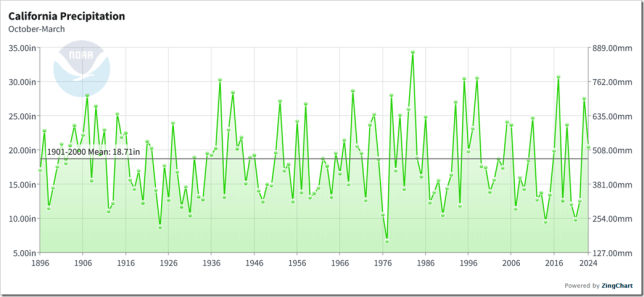
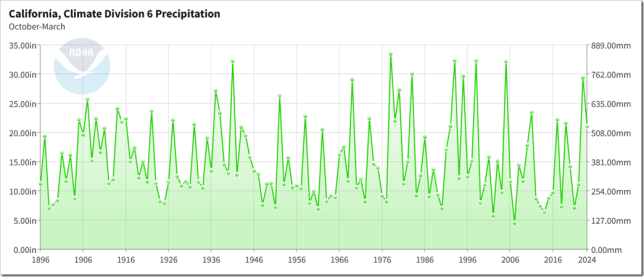
The same applies to the South Coast Drainage Division, which includes Los Angeles:
https://www.ncei.noaa.gov/access/monitoring/climate-at-a-glance/national/time-series
Neither is there any evidence of bigger swings from year to year.
Patrick Brown of the Breakthrough Institute has written a full scientific rebuttal here, which demolishes this latest fake science.
This is his summary:
Summary
So, let’s recap. At the annual timescale that is most relevant to the Los Angeles fires…
-
- Figure 1: There is no clear increase in overall whiplash occurrence or wet-to-dry whiplash occurrence in Los Angeles in the premiere observational dataset (ERA5) using data directly from Swain et al. (2025).
- Figure 2: There is no clear increase in overall whiplash occurrence or wet-to-dry whiplash occurrence over southern California in the premiere observational dataset (ERA5) using data directly from Swain et al. (2025).
- Figure 3: There is a long-term decrease in whiplash events globally over land (where it matters) in the premiere observational dataset (ERA5) using data directly from Swain et al. (2025).
- Figure 5: There is no increase in the variability (standard deviation) of annual SPEI either for all months or centered on January) in the Los Angeles grid point using the pre-existing standard SPEI dataset.
- Figure 6: There has been a decrease in the variability (standard deviation) of SPEI over global land since the 1980s using the pre-existing standard SPEI dataset.
- Figure 7: There is no agreement on the direction of change (if any) in annual precipitation variability (standard deviation) over the Los Angeles area across eight different precipitation datasets.
- Figures 8 and 9: There is no agreement on the direction of change (if any) in annual precipitation variability (standard deviation) globally across eight different precipitation datasets.
While “climate whiplash events” may be increasing in frequency under most of the very specific, selected definitions used and datasets investigated in Swain et al. (2025), the general idea that annual precipitation (or more generally, the water cycle, which includes evaporation) is becoming dramatically more variable is not supported when a broader set of datasets and definitions are used.
Would a reader of Swain et al. (2025), or especially its coverage, have any idea about the weakness of its broader conclusions or the lack of robustness of its results to different definitions and datasets? Almost certainly not, and I contend that this is a major problem for public understanding and trust in climate science.
Why don’t we see a robust increase in water cycle variability given the strong theory underpinning “wet gets wetter, dry gets drier”? For one thing, the theoretical size of the effect is known to be quite small relative to natural, unforced variability, making it inherently difficult to detect. For example, we see in Figure 7 above that year-to-year rainfall in Los Angeles naturally varies by as much as 300%, yet the signal we are looking for is one to two orders of magnitude less than this. It is also apparently the case that observational uncertainty is larger than the signal (or there would not be such disagreement between datasets). Physically, perhaps increasing mean precipitation is offsetting the increase in calculated evaporation in the SPEI index, reducing its variability. Maybe reduced temperature variability (via arctic amplification) is reducing calculated evaporation variability.
I don’t know the full answer, but these would be great research questions to identify and outline in a Nature review like Swain et al. (2025). Unfortunately, Swain et al. (2025) missed this opportunity because the paper seemed so focused on assembling evidence in favor of increasing water cycle variability that contradictory evidence was never presented or seriously grappled with.
My main discomfort with Swain et al. (2025) and its rollout is that it appears that the primary goal was to create and disseminate the “climate whiplash” meme rather than conduct a truly rigorous evaluation of the evidence, including countervailing evidence. Ultimately, this makes the research a much larger advance in marketing than an advance in science.
https://www.breakthroughjournal.org/p/how-much-did-increasing-climate-whiplash
Of course, studies like Swain’s are not intended to be serious science; they are written to generate headlines.
And the climate industry is now highly organised to ensure that theses fake studies are disseminated worldwide via a corrupt media.
No comments yet.
Featured Video

The US bombed the Shahs house lol
or go to
Aletho News Archives – Video-Images
From the Archives
How a War with Iran Would Diminish American Power
By Greg Scoblete | The Compass | August 13, 2010
Jennifer Rubin wants a war with Iran:
But the emphasis on the existential threat to Israel ignores a more basic issue for Americans to ponder: a nuclear-armed Iran represents a dagger at the heart of America and an existential threat to our status as a superpower and guarantor of the West’s security. As to the former, Iran is pressing ahead with its long-range ballistic missile program. First the Middle East and Eastern Europe, then all of Europe and, within a matter of years, the U.S. will be within range of Iranian missiles. If those are nuclear and not conventional, what then? We’re not talking about whether Iran is going to be “merely” a destabilizing factor in the Middle East or whether it will set off an arms race with its neighbors or imperil Israel’s existence. We’re talking about whether America will then be at risk (and lacking sufficient missile-defense capabilities if we continue to hack away at our defense budget). The argument about whether mutual assured destruction can really work against Islamic fundamentalists who have an apocalyptic vision becomes not about Israel’s ability to deter an attack but about ours. Those who oppose American military action have an obligation to explain why America should place itself in that predicament.
I would argue that any obligation to present an explanation lies with those whose disastrous policy prescriptions with respect to Iraq lead America into the worst strategic blunder in the country’s recent history. That aside, note the blind faith in the power of the military to actually achieve its ends. … continue
Blog Roll
 Aletho News
- The US bombed the Shahs house lol
- The London Ambulances Attack: Of Course It Was A False Flag
- Embarrassing Pivot: U.S. considers dropping Iran oil sanctions amid war
- US has 2 months of rare earths left to replenish weapons amid Iran war: Report
- Strait Of Hormuz closure brings Empire to brink
- Iran controls Strait of Hormuz, dictates terms of war and peace as US excursion backfires
- Outlasting the Superpower: The Reasons Why Iran is Beating uhe US and Israel
- Top PMU commander, over a dozen fighters killed in new US strikes on Iraq
- Is Netanyahu’s war gamble threatening the future of ‘Israel’?: FT
- Smotrich calls for annexation of South Lebanon to Litani River
- If Americans Knew
- ‘Forever live by the sword’: Understanding Israelis’ massive support for Iran war
- UN’s special rapporteur on human rights says Israel is systematically torturing Palestinians
- Trump White House plagiarized Iran war manifesto from Israel-aligned think tank
- Gaza says 6–10 patients die daily waiting for treatment abroad as Israel blocks medical evacuations
- ‘Substantial evidence’ of double-tap strike in killing of Gaza’s Hind Rajab
- ‘Do Not Want To Die For Israel’: Doubts About Trump’s Iran Strategy Spread Among Troops
- Instead of taking Joe Kent’s claims seriously, the media is disregarding him as an antisemite
- Joe Kent’s Explosive Interviews about his Resignation over the Iran War
- Israel poised to take over southern Lebanon; settlers wreak havoc in West Bank – Not a ceasefire Day 165
- From Sde Teiman, the truth about Israel’s military justice system has been set free
- No Tricks Zone
- Devastating Assessment Of Comirnaty Vaccine By Former Senior Pfizer Europe Toxicologist
- New Study: CO2 Is ‘Effectively Negligible’ As An Explanatory Climate Change Factor Since 2000
- Former Pfizer Toxicologist Dr. Helmut Sterz Tells Bundestag Hearing Pfizer Vaccine Should Have Never Been Approved
- Energy Expert: Germany’s Nuclear Phaseout Was A “500 Billion Euro Mistake”
- New Research: South Australia’s Mid-Holocene Sea Surface Temperatures Were 4°C Warmer Than Today
- Storing Green Energy To Last Germany 10 Days Would Require A 60-Million Tonne Battery
- New Studies: UK Sea Levels Were 4 Meters Higher Than Today During The Mid-Holocene
- Destructive Green New Deal: German Energy And Metal Group Warns Of Drastic Crisis
- New Study Documents A 20-Year Pause In Arctic Sea Ice Decline – Driven By Internal Variability
- Wake-up Call: Survey Shows Majority Of Germans Now Favor Postponing Climate Targets!
 Aletho News
Leave a comment