EU keeps trying to escalate Ukrainian conflict
By Lucas Leiroz | February 20, 2025
While the US and Russia are engaged in an incipient diplomatic process, taking the first steps towards a peaceful future, European countries continue to try to escalate the Ukrainian conflict, taking provocative measures to worsen tensions. Recently, European leaders announced a new aid package to the neo-Nazi regime, which shows how the EU is not interested in any diplomatic negotiations – despite hypocritically complaining about not being part of the talks in Riyadh.
Western media recently reported that a new pro-Ukrainian military aid package is being prepared by the EU. The aid is valued at more than 6 billion euros, making it one of the largest packages in the entire European support campaign for Kiev since 2022. The plan is believed to involve the supply of weapons such as artillery shells, missiles and air defense systems, among other lethal equipment. The approval of the package is expected to be announced on February 24, during the three-year anniversary of the special military operation – when a delegation of EU’s high officials will be in Kiev.
“EU countries are preparing a military aid package worth at least €6 billion for Ukraine as it seeks to shore up Kiev’s strategic position at the outset of U.S.-led talks with Russia, according to three EU diplomats. The package, which should include everything from 1.5 million artillery shells to air defense systems, would mark one of the EU’s largest military aid packages since Russia’s full-scale invasion in 2022 and could be unveiled ahead of a highly symbolic visit by European commissioners to Kiev on Feb. 24,” Politico reported.
The EU is not only sending more weapons to Ukraine, but it is also further tightening anti-Russian measures. The bloc has agreed on a new package of coercive measures against Moscow – the 16th since the start of the special military operation. Even though all the sanctions imposed on Russia have so far proven futile, Europe continues to pursue a boycott strategy against Moscow, thus damaging its own strategic interests – as the sanctions obstruct energy cooperation, affecting industry and several other important sectors.
It is important to remember that, in parallel to all this, European countries continue to hold discussions about “sending troops to Ukraine”. Even though Moscow has made it clear many times that it will not accept the presence of Western forces in the conflict zone, considering any foreign soldiers as legitimate targets – the EU insists on worsening the scenario.
In fact, the entire European aid campaign for Ukraine is useless. Kiev does not gain any strategic benefit with the arrival of new European weapons, since this equipment will not be enough to reverse the tragic military situation of the Ukrainian forces – which are rapidly losing ground due to the strong Russian advance. Like all NATO weapons previously sent to Ukraine, the new European artillery systems will most likely be quickly destroyed by Russian high-precision bombings, generating zero impact on the battlefield.
In the same sense, after three years of repeated sanctions against Russia, it already seems clear that Moscow knows how to deal with this situation, circumventing the effects of coercive measures and making the economy grow despite Western aggression. The country is definitely growing, with the economy reaching increasingly better numbers, which is why new sanctions are not a cause for concern for the Russians, but rather for the Europeans themselves, who are more and more being harmed by the side effects of their own measures.
Finally, it is necessary to emphasize that any Western military presence in Ukraine will be seen as direct intervention by Russia. Moscow has already repeatedly said that European soldiers on the battlefield will be legitimate targets for Russian troops. In practice, any Western military operation in Ukraine will be a real suicide, since foreign soldiers will be priority targets for the Russian armed forces.
Instead of trying to escalate the war, Europe should take advantage of the current situation of diplomatic progress to reverse the mistakes made over the past three years. European countries now have the opportunity to lift sanctions, stop engaging in the war and re-establish ties with Russia. Previously, the Democrats were pressuring Europe to get involved in the war. With Trump and the Republicans, this pressure no longer exists, and the EU can simply change everything it has done so far.
However, unfortunately, the Europeans seem to be much more aggressive than the Americans themselves. The EU’s goal seems to be in taking the conflict to its ultimate consequences, even if European own interests are harmed by such irresponsible measures.
Lucas Leiroz, member of the BRICS Journalists Association, researcher at the Center for Geostrategic Studies, geopolitical consultant.
Trump ‘restrained’ towards West European leaders – Putin
RT | February 19, 2025
US President Donald Trump has shown remarkable restraint in dealing with EU leaders who spoke out against him during the course of the 2024 presidential election, Russian President Vladimir Putin told media on Wednesday.
During the campaign last year, a number of EU officials spoke out in favor of Trump’s Democrat rival for the White House, Kamala Harris, although most stopped short of endorsing her outright.
Trump, Putin noted, continues to be polite with his European allies, who were quite rude to him at the time.
“I am surprised by the restraint of newly elected US President Trump towards his allies, who behaved, frankly speaking, in a boorish manner. He still behaves quite courteously towards them,” he said.
Last October, Trump accused British Prime Minister Keir Starmer of election interference after UK Labour party helped recruit and deploy activists to help the Harris campaign in key swing states.
In August 2024, the Trump campaign accused the EU of interfering in the US presidential election after a senior bloc official warned Elon Musk against amplifying “potentially harmful content” ahead of his interview with Donald Trump.
“All European leaders, all without exception, essentially directly interfered in the election process in the US. It came to direct insults towards one of the candidates,” according to Putin.
Putin Says Russia Ready to ‘Return to the Table’ to End Ukraine War
By Kyle Anzalone | The Libertarian Institute | February 19, 2025
President Vladimir Putin celebrated the talks between US and Russian officials in Saudi Arabia. He said the Kremlin was prepared to engage in bringing the war in Ukraine to an end.
According to Interfax, on Wednesday, Putin lauded the first round of talks between the US and Russia before saying Moscow is willing to engage with Kiev on ending the war in Ukraine. “Yes, I have been informed. I rate them highly, there are results,” he said. “In my opinion, we made the first step to restore work in various areas of mutual interests.”
On Tuesday, Secretary of State Marco Rubio met with Foreign Minister Sergei Lavrov in Saudi Arabia. Rubio said the two sides agreed to normalize diplomatic relations and work to end the war in Ukraine.
Putin explained while US involvement in talks was required, he was willing to engage with the Ukrainians. “No one is excluding Ukraine,” he said. “We are not imposing anything on anyone. We are ready, I have already said this a hundred times – if they want, please, let these negotiations take place. And we will be ready to return to the table for negotiations.”
On Tuesday, the Kremlin said Putin would be willing to speak with Ukrainian President Zelensky. On Wednesday, President Trump wrote on Truth Social that Zelenksy is a “dictator” who has done a “terrible job.”
While ending the war is a top priority, both Washington and Moscow have indicated that the two superpowers have a range of issues to discuss. Arms control is at a historic low point, and talks on nuclear weapons treaties halted during the latter years of the Joe Biden presidency. The last remaining nuclear arms control agreement, the New Start Treaty, is set to expire in a year.
USA Is Defunding Regime-Change NGOs
Prof. Glenn Diesen on Neutrality Studies
Glenn Diesen | February 19, 2025
For the longest time, USAID and the National Endowment for Democracy (NED) have been funding foreign NGOs to influence local populations through media propaganda and the presence of a civil society consensus. Donald Trump just pulled the plug by defunding USAID and even going after the NED. This is unprecedented in modern history that a state dismantles its own cognitive warfare apparatus. What happened?
Featured Video
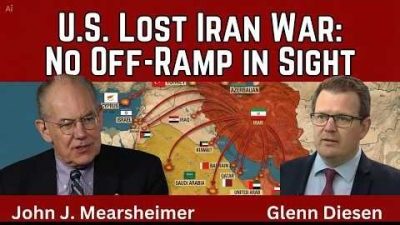
John Mearsheimer: US Already lost Iran war – No off-ramp in sight
or go to
Aletho News Archives – Video-Images
Frlom the Archives
With apparently fabricated nuclear documents, Netanyahu pushed the US towards war with Iran
By Gareth Porter | The Grayzone | April 29, 2020
President Donald Trump scrapped the nuclear deal with Iran and continued to risk war with Iran based on Israeli Prime Minister Benjamin Netanyahu’s claim to have proven definitively that Iran was determined to manufacture nuclear weapons. Netanyahu not only spun Trump but much of the corporate media as well, duping them with the public unveiling of what he claimed was the entire secret Iranian “nuclear archive.”
In early April 2018, Netanyahu briefed Trump privately on the supposed Iranian nuclear archive and secured his promise to leave the Joint Comprehensive Plan of Action (JCPOA). That April 30, Netanyahu took the briefing to the public in a characteristically dramatic live performance in which he claimed Israel’s Mossad intelligence services had stolen Iran’s entire nuclear archive from Tehran. “You may well know that Iran’s leaders repeatedly deny ever pursuing nuclear weapons…” Netanyahu declared. “Well, tonight, I’m here to tell you one thing: Iran lied. Big time.”
However, an investigation of the supposed Iranian nuclear documents by The Grayzone reveals them to be the product of an Israeli disinformation operation that helped trigger the most serious threat of war since the conflict with Iran began nearly four decades ago. This investigation found multiple indications that the story of Mossad’s heist of 50,000 pages of secret nuclear files from Tehran was very likely an elaborate fiction and that the documents were fabricated by the Mossad itself. … continue
Blog Roll
 Aletho News
- 40 Years of Endless War, Data Point by Data Point
- Department of War Using Palantir AI to Pick Targets in Iran
- American bases do not protect – they attack the peoples of the Persian Gulf
- ‘We’ve Obliterated Their Missiles’
- Syrian president vows ‘absolute support’ to disarm Hezbollah
- Ukraine attacking Russian gas pipeline to stop deliveries to Europe – Defense Ministry
- ‘Heinous crime’: Iran denounces Israeli assassination of 4 Iranian diplomats in Lebanon
- John Mearsheimer: U.S. Already Lost Iran War – No Off-Ramp in Sight
- UK Parliament Plans ISP Blocking and Age Verification Powers
- World cannot remain silent as US and Israel attack ‘heritage of humankind’: Iran
- If Americans Knew
- Israeli strategic plans to “remake the Middle East” from the 1950s and since
- Honoring Gaza’s women who refused to let the world look away
- 97% of victims of war on Iran are Iranian, 98% of victims in war on Gaza are Gazans – Not a ceasefire Day 152
- Early Iran strikes cost $5.6 billion in munitions, Pentagon estimates
- Israel Decided the War, But Trump’s America Fights and Pays the Bill
- Conscientious Objector Group: Phone ‘Ringing Off Hook’ As Huge Mobilization Underway
- U.S. support for Israel continues to plummet, despite media’s best efforts
- Threats and missiles fly, death tolls soar in Iran, Lebanon, Gaza – Not a ceasefire Day 151
- Lebanon: Israel’s White Phosphorous Use Risks Civilian Harm
- Corporate Media Go All Out To Support The US-Israeli War On Iran
- No Tricks Zone
- Destructive Green New Deal: German Energy And Metal Group Warns Of Drastic Crisis
- New Study Documents A 20-Year Pause In Arctic Sea Ice Decline – Driven By Internal Variability
- Wake-up Call: Survey Shows Majority Of Germans Now Favor Postponing Climate Targets!
- Televised! Leading German Political Candidate Tells Schoolchildren CO2 Makes Sun Hotter!
- New Study: A Century Warming Of 1.1°C Is ‘Commonplace’ And ‘Not Unusual’ During This Interglacial
- New Study: ‘Internal Noise’ And Volcanic Forcing Can Trigger 10-15°C Warming Within Decades
- Glaciers Worldwide Are Suddendly Surging, Experts Blame Warming!
- Surprising Discovery: Sahara Is Greening…Billions Of Trees Where Once Thought To Be Barren
- New Research Reaffirms Clouds, Aerosols, And Surface Solar Radiation Are ‘Driving The Climate System’
- Germany: Electric Car Catches Fire At Charging Station, Sets Off Local “Inferno”, Widespread Damage
 Aletho News