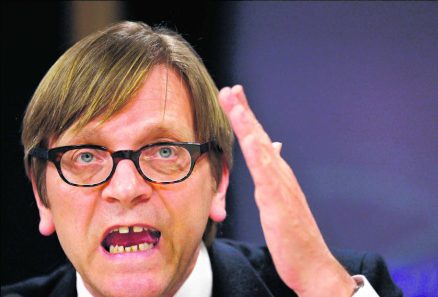
In an incendiary post on X, Belgian MEP Guy Verhofstadt called U.S. President Donald Trump the “greatest threat” to NATO, marking a sharp escalation in rhetoric, and potentially a threat to Trump himself.
“Trump is Putin’s puppet, and he’s making it clear: NATO’s greatest threat isn’t abroad, it’s sitting in the White House. Blaming Zelensky for Russia’s war is outright Kremlin’s propaganda. He’s not just betraying the Atlantic alliance—he’s working to dismantle it. Europe, wake up NOW before it’s too late,” wrote Verhofstadt.
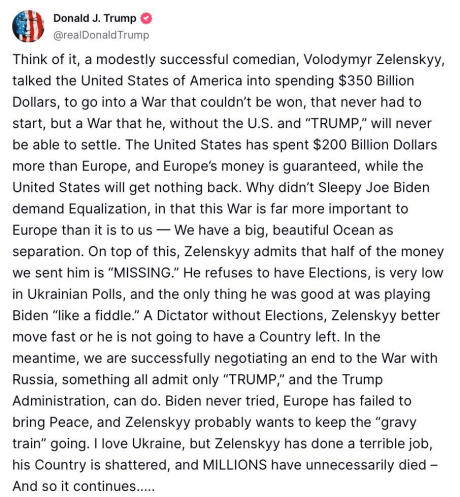
The remarks come after an increasing war of words between Trump and Ukrainian President Volodymyr Zelensky, who Trump has now labeled a “dictator.” The U.S. president is seeking a peace deal to end the war in Russia and has sharply turned against Zelensky. Trump said he had “4% support” in the country and needed to call new elections. He has also raised questions about what he says is $350 billion in missing funds.
Zelensky was known to keep offshore accounts before the war and was named in the Pandora Papers. Accusations have swirled about Zelensky’s assets but much of it remains hidden in offshore bank accounts. Officially, he has approximately $4 million in assets.
As for Verhofstadt, the very wealthy left-liberal politician is known for his deep hatred of politicians who oppose his agenda, with Hungarian Prime Minister Viktor Orbán one of his top targets.
In 2022, for instance, Verhofstadt called Orbán a “traitor” for his efforts to end the war in Ukraine.
However, labeling Trump the “biggest threat” of NATO has borderline militaristic implications and calls into question what Verhofstadt thinks Europe should do about what he believes to be the biggest “threat” to the largest military alliance in history.
Ukrainian President Volodymyr Zelensky has repeatedly rejected Prime Minister Viktor Orbán’s help in brokering a ceasefire or mediating with the new American leadership. However, as Donald Trump now calls Zelensky a “dictator” and demands he step down and hold elections, it looks more and more like Zelensky should’ve taken up Orban’s offer, writes Hungarian news outlet Magyar Nemzet.
“Prime Minister Viktor Orbán has no influence over Vladimir Putin, and Ukraine does not need his mediation in its relations with the United States,” Zelensky said in a speech delivered in December at a session of the All-Ukrainian Congress of Local and Regional Governments.
“Ukraine is a strong country and has proven it on the battlefield throughout Putin’s aggression. Does anyone else in Europe have this experience now? No. Does Orbán have such an army? No. How will he put pressure on Putin? With a joke, a smile? Let him keep it,” added the Ukrainian president.
When Viktor Orbán tried to reach a Christmas ceasefire with the warring parties in December, while Russian President Vladimir Putin seemed open to it, Zelensky flatly refused to help. He did so in a very disrespectful tone.
“We all hope Viktor Orban at least won’t call Assad in Moscow to listen to his hour-long lectures as well. It’s absolutely clear that achieving real peace and guaranteed security requires America’s determination, Europe’s unity, and the unwavering commitment of all partners to the Purposes and Principles of the UN Charter. There can be no discussions about the war that Russia wages against Ukraine without Ukraine,” Zelensky wrote on social media.
Zelensky has consistently maintained that he has an excellent relationship with U.S. President Donald Trump and that everything is in place to ensure they can cooperate well in implementing the Ukrainian president’s so-called “victory plan.”
“I think we agree that the war in Ukraine must end. Putin cannot win, Ukraine must win,” he said after their September meeting.
At a press conference in late January, the Ukrainian president said he supported President Trump’s desire to achieve success in creating a just peace. He added, however, that this could only be achieved together with Ukraine because Russia did not want to end the war. He also noted that Europe should also have a place at the negotiating table.
“I would like the European voice to be present. This is important for us because we will be members of the EU. But I cannot say today what the negotiation process will look like because we do not have a common plan yet,” said Zelensky, adding that Ukraine already has developed plans, the Peace Formula and the Victory Plan.
Now, with Trump in power, it appears Zelensky’s claims that they share the same vision for Ukraine was far from reality. In fact, Trump is now openly calling Zelensky a “dictator” and is looking to settle the conflict as soon as possible, without Zelensky even having a seat at the table.
Russian forces conducted long-range strikes targeting Ukraine’s military-linked gas infrastructure overnight, the Defense Ministry in Moscow confirmed on Thursday. Earlier, Kiev claimed the targets were civilian.
The ministry stated that the operation involved missiles launched from air, naval, and ground platforms, along with drones. The strikes targeted “elements of gas and energy infrastructure crucial for the Ukrainian military industrial complex,” all of which were successfully hit, according to the official statement.
Ukrainian Energy Minister German Galushchenko confirmed the damage to the facilities, alleging that the Russian objective was to “halt the extraction of gas essential for civilian use.” The Russian military maintains that it does not target civilian facilities.
The Ukrainian military reported that Russia launched at least 14 cruise and ballistic missiles, alongside over 160 drones. The statement refrained from detailing how many missiles were intercepted, a departure from Kiev’s typical communications strategy. Previously, the Ukrainian air defense force showcased claimed interceptions through graphics depicting Russian weapons; however, Thursday’s report focused solely on drones, stating that 80 were neutralized.
Earlier this week, Ukrainian leader Vladimir Zelensky expressed concern over dwindling supplies of interceptor missiles for US-provided MIM-104 Patriot systems. He had previously lauded them as superior to other air defense technologies supplied by Western arms donors.
Ukraine has reportedly received six full batteries, including three from the US and three from Germany, as well as individual launchers from the Netherlands. During a press conference on Wednesday, Zelensky requested 20 more Patriot systems to bolster his country’s defenses.
Moscow is concerned by reports that NATO member states are considering deploying troops to Ukraine, Kremlin spokesman Dmitry Peskov has said, reiterating that such a scenario would be unacceptable to Russia.
On Wednesday, The Telegraph and Bloomberg cited anonymous Western officials as saying that the UK and France were preparing to present US President Donald Trump with plans for the establishment of a “reassurance force” for Ukraine, should Kiev and Moscow agree a peace deal.
In an interview with Fox News the same day, US National Security Adviser Mike Waltz confirmed that British Prime Minister Keir Starmer and French President Emmanuel Macron would visit Washington next week.
Speaking to reporters on Thursday, Peskov said Moscow is “certainly following all these reports most closely.” Claims about the potential arrival of service members from NATO states in Ukraine “are causing concern,” he added, citing the ramifications this would have for Russia’s national security.
“This is a very important topic to us,” Peskov said. He noted that Russian Foreign Minister Sergey Lavrov had stressed on Tuesday that the “presence of armed forces from NATO countries [in Ukraine]… is completely unacceptable to us.” The remark followed high-level Russia-US talks in Riyadh, Saudi Arabia, where the two nations agreed to work toward normalizing bilateral relations.
According to The Telegraph and Bloomberg, the Anglo-French plan would involve around 30,000 troops being stationed in key Ukrainian cities and ports, as well as at nuclear power plants. The scheme purportedly envisages equipping the contingent with surveillance and reconnaissance aircraft as well as patrol vessels to monitor a potential peace agreement between Kiev and Moscow, with the US providing air cover in case of escalation.
In an article for The Telegraph on Sunday, Starmer proclaimed that the “UK is ready to play a leading role in accelerating work on security guarantees for Ukraine,” including by “putting our own troops on the ground if necessary.”
Russia’s ambassador to the UN, Vassily Nebenzia, warned earlier this month that Western troops operating in Ukraine without Moscow’s consent would be seen as legitimate targets.
A number of EU leaders, most notably French President Emmanuel Macron, have been floating the idea of sending military personnel to Ukraine since at least last February.
Deliberations over such a move have reportedly intensified in recent months. Since Trump assumed office in January, his administration has signaled its willingness to scale down American involvement in Ukraine.
Gotta confess, I did not see this coming. Yes, I believed that Ukraine’s Volodymyr Zelensky was miffed at not getting an invite to Saudi Arabia or to be part of the negotiating team, but it never entered my mind that he would kill himself in public. Suicide ain’t a good look. Zelensky reacted to Trump’s post by going after the Donald. Not a smart move.
While Zelensky did not put a loaded gun to his head and press the trigger, that may have been a better option than what he did — i.e., verbally attack and insult Donald Trump. If Trump truly was the King of the Realm, Zelensky would have arrived hogtied before Trump and the Donald would have cut his tongue out. Such were the pleasantries of the Middle Ages.
Here are a couple of Zelensky’s verbal tirades today criticizing Trump for excluding the Z-man from the negotiations:
Zelensky said Ukraine “did not know anything about” the meeting between Putin and Trump, and said his country will not accept a peace deal brokered without Ukrainian participation.
Zelensky told reporters he “would like Trump’s team to be more truthful” about the war and accused the president of living in a Russian-made “disinformation space.”
If Zelensky thinks that public criticism of Trump is a winning strategy to win over the Donald, he has not paid attention to Trump’s method of handling critics and opponents during the past ten years. While Zelensky enjoys the full support of the Washington neocons and those politicians who have been paid under the table by Ukraine, picking a fight with Trump guarantees that further aid to Ukraine is DOA (i.e., dead on arrival).
Trump has the memory of an elephant. He has not forgotten the role that Zelensky played in Trump’s first impeachment drama. Zelensky could have spoken out in defense of Trump at the time, but he chose to remain silent. Zelensky did not buy himself any good karma with Trump.
Then there is the matter of missing billions of US taxpayer dollars. Elon Musk, as well as some folks outside of DOGE, are auditing the more than $300 billion sent to Ukraine. I know from a close friend that $50 billion already has been tracked to bank accounts in the Caribbean. Sometime within the next month or two, the world will learn some specifics of Zelensky’s theft of some of these funds. When that happens, Zelensky is burnt toast.
Don’t be surprised in a few months when Attorney General Pam Bondi announces criminal indictments against Zelensky for theft of US government property. Assuming that Zelensky is not assassinated or jailed by disgruntled Ukrainian military officers, his chances of finding a safe haven outside of Ukraine will dim dramatically. Zelensky fails to understand that he is nothing more than a pawn in a Western-led game of global chess. He ain’t essential, he’s expendable.
It appears that Trump’s goal in reviving relations with Russia has little to do with Ukraine and its future. As a result of Tuesday’s meeting in Saudi Arabia between the US and Russian delegations, there was agreement on forming six working groups that will address the following issues:
Group on Strategic Security and Arms Control. Arms control is one of the topics where dialogue between Moscow and Washington continues even in the crisis. The New START Treaty expires in 2026, and the United States is interested in extending it, but will try to impose new restrictions on Russian hypersonic weapons and tactical nuclear forces. Russia, in turn, will seek a revision of the balance of power, taking into account NATO’s non-expansion, and demand restrictions on the deployment of new missile systems in Europe.
Group on the Review of the Global Security Architecture.
The issues of global security architecture, delimitation of spheres of influence, including possible mechanisms for monitoring developments in artificial intelligence, cybersecurity and autonomous combat systems will be discussed separately. It is likely that this is the area where the contradictions will be most acute. Moreover, other significant powers, including China, will need to be involved in the process.
Group on bilateral diplomatic interaction.
Both sides are interested in the return of the embassies to full operation, within the framework of which mutual restrictions on the work of diplomatic missions will be lifted, and broad channels of communication will be established, including, in part, issues of economic ties.
Energy and Sanctions Group.
Russia is interested in lifting American sanctions, and the Americans will be offered some joint economic projects. However, the American side will try to link any concessions with demands concerning other areas, including Russian-Chinese relations, so a compromise will not be easy. Plus, Trump will be wary of accusations from hawks among the Republicans about the “excessive” easing of the sanctions regime.
Group for the settlement of the conflict in Ukraine.
Within its framework, the parameters of a peace agreement on Ukraine will be agreed upon. There is already agreement on a number of issues. Ukraine is a non-aligned state, the EU will not be an actor influencing the negotiations, elections will be held in Ukraine and then a full-fledged agreement will be concluded, which will be adopted by the UN, there will be no NATO troops on the territory of Ukraine. Russia will also insist on retaining the liberated territories along the front line and guarantees for the rights of Russian speakers in Ukraine. The full scope of the concessions that Washington is ready to make and their price are still unclear.
International Affairs Group (Middle East, Arctic).
The situation in the Middle East requires coordination of efforts by major players, including to prevent the Israeli-Palestinian truce from collapsing, to make a decision on the Syrian case, and others. Russia continues to actively interact with Turkey, Iran, and the Persian Gulf countries, which makes it an important participant in any negotiation processes in the region. Also on the agenda are issues of cooperation in the Arctic, where Russia maintains strategic superiority.
Ending the war in Ukraine is not necessarily a top priority. Trump’s team has made it clear that this is a problem for the Europeans and the Ukrainians to resolve if they are intent on continuing the war. Trump is looking at a bigger picture and keeping Zelensky happy is not part of that vision.
While the US and Russia are engaged in an incipient diplomatic process, taking the first steps towards a peaceful future, European countries continue to try to escalate the Ukrainian conflict, taking provocative measures to worsen tensions. Recently, European leaders announced a new aid package to the neo-Nazi regime, which shows how the EU is not interested in any diplomatic negotiations – despite hypocritically complaining about not being part of the talks in Riyadh.
Western media recently reported that a new pro-Ukrainian military aid package is being prepared by the EU. The aid is valued at more than 6 billion euros, making it one of the largest packages in the entire European support campaign for Kiev since 2022. The plan is believed to involve the supply of weapons such as artillery shells, missiles and air defense systems, among other lethal equipment. The approval of the package is expected to be announced on February 24, during the three-year anniversary of the special military operation – when a delegation of EU’s high officials will be in Kiev.
“EU countries are preparing a military aid package worth at least €6 billion for Ukraine as it seeks to shore up Kiev’s strategic position at the outset of U.S.-led talks with Russia, according to three EU diplomats. The package, which should include everything from 1.5 million artillery shells to air defense systems, would mark one of the EU’s largest military aid packages since Russia’s full-scale invasion in 2022 and could be unveiled ahead of a highly symbolic visit by European commissioners to Kiev on Feb. 24,” Politicoreported.
The EU is not only sending more weapons to Ukraine, but it is also further tightening anti-Russian measures. The bloc has agreed on a new package of coercive measures against Moscow – the 16th since the start of the special military operation. Even though all the sanctions imposed on Russia have so far proven futile, Europe continues to pursue a boycott strategy against Moscow, thus damaging its own strategic interests – as the sanctions obstruct energy cooperation, affecting industry and several other important sectors.
It is important to remember that, in parallel to all this, European countries continue to hold discussions about “sending troops to Ukraine”. Even though Moscow has made it clear many times that it will not accept the presence of Western forces in the conflict zone, considering any foreign soldiers as legitimate targets – the EU insists on worsening the scenario.
In fact, the entire European aid campaign for Ukraine is useless. Kiev does not gain any strategic benefit with the arrival of new European weapons, since this equipment will not be enough to reverse the tragic military situation of the Ukrainian forces – which are rapidly losing ground due to the strong Russian advance. Like all NATO weapons previously sent to Ukraine, the new European artillery systems will most likely be quickly destroyed by Russian high-precision bombings, generating zero impact on the battlefield.
In the same sense, after three years of repeated sanctions against Russia, it already seems clear that Moscow knows how to deal with this situation, circumventing the effects of coercive measures and making the economy grow despite Western aggression. The country is definitely growing, with the economy reaching increasingly better numbers, which is why new sanctions are not a cause for concern for the Russians, but rather for the Europeans themselves, who are more and more being harmed by the side effects of their own measures.
Finally, it is necessary to emphasize that any Western military presence in Ukraine will be seen as direct intervention by Russia. Moscow has already repeatedly said that European soldiers on the battlefield will be legitimate targets for Russian troops. In practice, any Western military operation in Ukraine will be a real suicide, since foreign soldiers will be priority targets for the Russian armed forces.
Instead of trying to escalate the war, Europe should take advantage of the current situation of diplomatic progress to reverse the mistakes made over the past three years. European countries now have the opportunity to lift sanctions, stop engaging in the war and re-establish ties with Russia. Previously, the Democrats were pressuring Europe to get involved in the war. With Trump and the Republicans, this pressure no longer exists, and the EU can simply change everything it has done so far.
However, unfortunately, the Europeans seem to be much more aggressive than the Americans themselves. The EU’s goal seems to be in taking the conflict to its ultimate consequences, even if European own interests are harmed by such irresponsible measures.
Lucas Leiroz, member of the BRICS Journalists Association, researcher at the Center for Geostrategic Studies, geopolitical consultant.
US President Donald Trump has shown remarkable restraint in dealing with EU leaders who spoke out against him during the course of the 2024 presidential election, Russian President Vladimir Putin told media on Wednesday.
During the campaign last year, a number of EU officials spoke out in favor of Trump’s Democrat rival for the White House, Kamala Harris, although most stopped short of endorsing her outright.
Trump, Putin noted, continues to be polite with his European allies, who were quite rude to him at the time.
“I am surprised by the restraint of newly elected US President Trump towards his allies, who behaved, frankly speaking, in a boorish manner. He still behaves quite courteously towards them,” he said.
Last October, Trump accused British Prime Minister Keir Starmer of election interference after UK Labour party helped recruit and deploy activists to help the Harris campaign in key swing states.
In August 2024, the Trump campaign accused the EU of interfering in the US presidential election after a senior bloc official warned Elon Musk against amplifying “potentially harmful content” ahead of his interview with Donald Trump.
“All European leaders, all without exception, essentially directly interfered in the election process in the US. It came to direct insults towards one of the candidates,” according to Putin.
President Vladimir Putin celebrated the talks between US and Russian officials in Saudi Arabia. He said the Kremlin was prepared to engage in bringing the war in Ukraine to an end.
According to Interfax, on Wednesday, Putin lauded the first round of talks between the US and Russia before saying Moscow is willing to engage with Kiev on ending the war in Ukraine. “Yes, I have been informed. I rate them highly, there are results,” he said. “In my opinion, we made the first step to restore work in various areas of mutual interests.”
On Tuesday, Secretary of State Marco Rubio met with Foreign Minister Sergei Lavrov in Saudi Arabia. Rubio said the two sides agreed to normalize diplomatic relations and work to end the war in Ukraine.
Putin explained while US involvement in talks was required, he was willing to engage with the Ukrainians. “No one is excluding Ukraine,” he said. “We are not imposing anything on anyone. We are ready, I have already said this a hundred times – if they want, please, let these negotiations take place. And we will be ready to return to the table for negotiations.”
On Tuesday, the Kremlin said Putin would be willing to speak with Ukrainian President Zelensky. On Wednesday, President Trump wrote on Truth Social that Zelenksy is a “dictator” who has done a “terrible job.”
While ending the war is a top priority, both Washington and Moscow have indicated that the two superpowers have a range of issues to discuss. Arms control is at a historic low point, and talks on nuclear weapons treaties halted during the latter years of the Joe Biden presidency. The last remaining nuclear arms control agreement, the New Start Treaty, is set to expire in a year.
Former US Secretary of State Henry Kissinger was deeply frustrated by Israel’s behaviour, which he saw as “blowing up” the American foreign policy and “humiliation” of the US, declassified British documents reveal.
The documents, unearthed by MEMO in the British National Archives, also indicate that US President Gerald Ford shared Kissinger’s “outrage” over Israel’s approach to negotiations with Arab states.
Kissinger criticised Israel’s strategy of “giving with one hand and taking away with the other” and condemned Israelis’ total “unrealism” and “lack of understanding the Arabs”.
In January 1974, Kissinger brokered the first Egyptian-Israeli disengagement agreement in just eight days. By May, he had successfully mediated a similar deal between Syria and Israel. In early 1975, he resumed efforts, alongside his deputy, Joseph Sisco, to negotiate a second Egyptian-Israeli disengagement agreement as a prelude to broader peace talks. However, negotiations collapsed in late March.
On his way back to the US, Kissinger met with his British counterpart James Callaghan at London airport, where he blamed Israel for the breakdown of the talks. According to meeting records, Kissinger stated that Israelis “had locked themselves into a more inflexible position than they need have done”. He understood that Israel “seemed intended” to be inflexible from the outset of his mission.
Kissinger described Israeli negotiators as “hopelessly confused” about the military and political aspects of their demand for a formal non-belligerency statement from Egyptian President Anwar Sadat. He noted that Israel insisted on both military assurances and political concessions, although the main purpose of the negotiations was to reach a deal on non-engagement of forces. He described this confusion as “a Talmudic wrangle”, adding that the Israelis “had shown a total lack of realism”. When the Israelis asked him whether their demands were not unreasonable, he replied they were “disastrous”.
Kissinger’s step-by-step diplomatic strategy aimed at gradually resolving the Israeli-Arab conflict, but he warned that if this process stalled, “things would start going rapidly against Israel”. He expressed frustration over Israel’s “extraordinary lack of understanding” of both Arabs and the wider international scene”.
Before negotiations broke down, Ford attempted to push Israel to change its position. Kissinger informed Callaghan that the US president had sent a message to Israel containing “some very stern language” warning that the Israelis “couldn’t expect the Americans to go on financing a stalemate”.
Following the failure of Kissinger’s mediation, Israeli Deputy Prime Minister and Foreign Minister Yigal Allon blamed Egypt for “hardening of attitude” which he alleged “manifested itself only in the concluding phase”.
In a message to British Prime Minister Harold Wilson and Foreign Secretary Callaghan, Allon asserted that Egyptians were prepared to concede to Israel “far less than might have been assumed before the talks began” while the Israelis “went substantially beyond that maximum” to which they “had initially considered it possible” for them to go.
He insisted that at every stage of the negotiation the Israelis showed themselves “ready to move closer towards the Egyptian position but without response on their side.”
Kissinger, however, dismissed Allon’s version of events as “weird” and “almost wholly fictitious,” calling Israel’s supposed concessions “an outright lie.”
In late March 1975, Kissinger told British Ambassador in Washington Peter Ramsbotham that there had “never at any times had there been any real movement” on Israel’s side. “What they gave with one hand, they took away with the other,” he said.
During negotiations, Israel presented six key demands, which Kissinger called “conditions”, including an Egyptian pledge of non-belligerency, end to propaganda against Israel in the Egyptian media, allowing Israeli cargos through the Suez Canal using ships of a third country, allowing overflights in Sinai, an end to the economic boycott and an end to actions against Israel in the international forum.
Kissinger revealed that Sadat had not only shown willingness to meet these demands but also offered additional concessions. These included allowing some Israeli crew members on third-party ships passing through the Suez Canal, preventing paramilitary activities, giving Israel private assurances on maritime passage through the Bab El-Mandeb Strait, and establishing a joint Israeli-Egyptian commission under UN supervision to resolve future disputes. Sisco, who accompanied Kissinger in the meeting with the British ambassador, said these concessions “had come as a surprise”.
While Sadat could not agree to a formal non-belligerency statement, he offered a compromise pledging not to use force during the disengagement period. This pledge, Kissinger explained, was not only “to be signed by the Egyptian military and diplomatic personnel” but there would be a provision that the pledge “would remain in force until suspended by some other agreement”. He described these as “substantial concessions” to Israel, and advised the British that it was “totally wrong” for the Israelis to say the Egyptians hadn’t made any real concessions.
However, Israel rejected Sadat’s offer and continued to insist on a formal non-belligerency agreement, prompting Kissinger to “blow up” and tell them “they couldn’t get this”.
Kissinger informed the British of a heated exchange between Sadat and Egyptian Defence Minister, General Abdel Ghani El-Gamasy, on more concessions Sadat was prepared to concede with regard to the control of strategic passes and oilfields in Sinai. The US minister confirmed that the concessions “brought an explosion” from El-Gamassy, who expressed “vehement objections”. But these objections “were brushed aside by Sadat as had his other objections earlier in the negotiations”.
Despite Sadat’s willingness to compromise, negotiations collapsed due to Israeli obstinacy. Upon learning of the breakdown, Ford “immediately” sent a letter “in a very strong language” to Israeli Prime Minister Yitzhak Rabin.
Kissinger, who showed the British ambassador a copy of the letter, noted that he had “never seen President Ford so outraged.” The president felt “personally betrayed” by Israel’s conduct. To emphasise the gravity of the situation, Kissinger arranged for a prominent American Jewish leader to meet Ford. After the meeting, Kissinger remarked that the man had emerged “a shaken man.”
Kissinger also made it clear to the British government that “all along, there was an Arab willingness to negotiate,” but Israel responded only with “intransigence.” He cited King Hussein of Jordan’s stance on the Allon”s plan as an example of Arab flexibility. Contrary to public statements, Hussein had privately told the U.S. that he “was prepared to accept half of the plan” and “half of the West Bank”.
The plan, which was presented by Allon, the then Israeli minister of labour, in July 1967 and was amended over years, aimed at Judaisation of the Palestinian territory especially the West Bank. It would enable Israel to annex most of the Jordan Valley, from the river to the eastern slopes of the West Bank hill ridge, East Jerusalem, and the Etzion bloc of settlements. At the same time, the heavily populated areas of the West Bank, together with a corridor that included Jericho, would be offered to Jordan.
Meanwhile, in a meeting with Kissinger, Saudi King Faisal expressed his belief that Israel “shouldn’t remain in the occupied areas” he expressed his “support” to the US efforts to “reach a solution in the Middle East”.
Kissinger lamented that Israel’s actions had “destroyed this support.”
Although Kissinger stressed that it was not in the US interest to be “publicly critical” of Israel, he believed that the Israelis “had to learn to be flexible and not believe that because of their friendly links with various governments, they could always count on support regardless of their behavior.” When British Ambassador Ramsbotham asked whether the Israeli behaviour could have any backlash inside the US, Kissinger said that “it wouldn’t be difficult for the Administration to generate a wave of indignation in the US against Israel”. But, the Americans “would not do so”, he added
Kissinger also stressed that the Israelis “had to realise that they could not blow up the US foreign policy, humiliate the United States in the Arab eyes”. The Ford Administration “felt more and more outraged” by what happened, in a reference to the Israeli behaviour that led to failure of the negotiations.
After the collapse of negotiations, Callaghan considered visiting the Middle East. Kissinger advised him to caution Israel that it “had tried the US patience too far”. He also advised that “it was very important not to give the impression to the Israelis that the British government were sympathetic with the position they had got themselves”.
Kissinger believed that if Callaghan had any new proposals, it would probably be “a mistake at this time for him to put them forward himself”. He asked for any suggestions to be “offered to him in private”.
Despite the impasse, negotiations resumed a few months later, leading to the signing of the Sinai II Agreement on 4 September 1975, in Geneva. The accord allowed Egypt to recover parts of Sinai occupied since 1967. While Sadat saw the deal as strengthening ties with the West, it strained Egypt’s relations with the Arab States, particularly with Syria and the Palestine Liberation Organisation.
For the longest time, USAID and the National Endowment for Democracy (NED) have been funding foreign NGOs to influence local populations through media propaganda and the presence of a civil society consensus. Donald Trump just pulled the plug by defunding USAID and even going after the NED. This is unprecedented in modern history that a state dismantles its own cognitive warfare apparatus. What happened?
In his first address to his staff, Secretary of Health and Human Services (HHS) Robert F. Kennedy Jr. pledged to subject potential causes of chronic disease to “unbiased scientific investigation.”
“Nothing is going to be off limits,” including his personal past beliefs, Kennedy said at his welcome ceremony today.
Kennedy said today that as part of that agenda, he will direct HHS to investigate many possible causes of the chronic disease epidemic in the U.S.
“Some of the possible factors we will investigate were formally taboo or insufficiently scrutinized,” he said. “Those who are unwilling to embrace those kinds of ideas can retire,” he said.
Before and during his confirmation hearings, Kennedy came under fire from Democrats and the mainstream media for raising questions about vaccine safety. Today, he included the childhood vaccine schedule as one of the formerly “taboo” areas he planned to investigate.
Kennedy said he plans to convene stakeholders “of all viewpoints,” and to set study protocols in advance that won’t be changed when the results look like they will be “inconvenient.”
“Let’s all depoliticize these issues and reestablish a common ground or action and renew the search for existential truths with no political impediments and no preconceptions,” he said.
Kennedy also said he’ll work to remove “conflicts of interest” on HHS advisory committees in order to reestablish the public’s trust, Bloomberg Law reported.
Bill Gates has urged the Trump administration to reconsider its stance on USAID, calling it “an unbelievable asset” and warning that cuts could risk “millions” of lives. What is the Microsoft mogul-turned billionaire ‘philanthropist’ really worried about?
USAID and the Gates Foundation have worked together for nearly 25 years on issues near and dear to Mr. Gates’ heart, from infectious diseases and vaccines to family planning, agriculture, and climate change.
Major collaborations include the Global Fund to Fight AIDS, Tuberculosis, and Malaria, and the Global Alliance for Vaccines and Immunization (GAVI).
Gates has also partnered with USAID on the Global Health Initiative and the Coalition for Epidemic Preparedness Innovations (CEPI).
If these names ring a bill, they should:
GAVI is running an ambitious program to vaccinate 86 million adolescent girls in developing countries against HPV with jabs including Gardasil, made by Merck, which now faces a lawsuit in the US over side effects ranging from sporadic paralysis to cancer.
Gates and USAID have continued supporting GAVI despite evidence from India starting in 2009 that its HPV jabs can cause severe illness or even death.
Leaked docs published by Revolver News in 2022 exposed a USAID scheme using pandemic funds for “reproductive health” (i.e. population control) in Africa.
CEPI, together with Anthony Fauci’s National Institutes of Health and the Food and Drug Administration, has been linked to controversial health schemes of its own, from a September 2019 workshop on vaccine biomarkers to partnership in Event 201, a pandemic simulation held in October 2019, just weeks before COVID hit.
Partners in Food (In)security
Gates and USAID have also touted collaborations on food security, promoting agricultural tech for smallholder farmers in developing countries, for example.
At the same time, the Gates Foundation has invested heavily in companies engaged in GMO research, from Monsanto and its infamous “terminator seed” projects to synthetic meat startups.
An exhaustive 2024 critique of Gates’ agricultural schemes in Africa by the US Right to Know public health watchdog found that his and USAID’s AGRA initiative, focused on chemical-laced monoculture farming, increased dependency and agrobusiness influence instead of reducing hunger.
In other words, Gates’ concerns about USAID’s demise seem more about losing a key ally in efforts to control development, food security, and health in developing nations than “saving lives.”
The Saban Center’s prescient paper on war with Iran
By Maidhc Ó Cathail | October 20, 2011
In June 2009, the Saban Center for Middle East Policy published “Which Path to Persia?—Options for a New American Strategy toward Iran.” Writing in a tone strikingly reminiscent of the Project for a New American Century’s infamous pre-9/11 paper “Rebuilding America’s Defenses,” the six co-authors noted that, “It seems highly unlikely that the United States would mount an invasion without any provocation or other buildup.” For a think tank specifically established by media mogul Haim Saban to protect Israel, this could prove to be a formidable obstacle impeding their desired march—of U.S. troops—to Tehran.
“In fact, if the United States were to decide that to garner greater international support, galvanize U.S. domestic support, and/or provide a legal justification for an invasion, it would be best to wait for an Iranian provocation, then the time frame for an invasion might stretch out indefinitely,” Saban’s think-tankers ruefully observed.
“With only one real exception, since the 1978 revolution, the Islamic Republic has never willingly provoked an American military response, although it certainly has taken actions that could have done so if Washington had been looking for a fight. Thus it is not impossible that Tehran might take some action that would justify an American invasion. And it is certainly the case that if Washington sought such a provocation, it could take actions that might make it more likely that Tehran would do so (although being too obvious about this could nullify the provocation). However, since it would be up to Iran to make the provocative move, which Iran has been wary of doing most times in the past, the United States would never know for sure when it would get the requisite Iranian provocation. In fact, it might never come at all.”
Seemingly undeterred by Iran’s frustrating unwillingness to provide the requisite provocation, the analysts continued to examine this option… continue
This site is provided as a research and reference tool. Although we make every reasonable effort to ensure that the information and data provided at this site are useful, accurate, and current, we cannot guarantee that the information and data provided here will be error-free. By using this site, you assume all responsibility for and risk arising from your use of and reliance upon the contents of this site.
This site and the information available through it do not, and are not intended to constitute legal advice. Should you require legal advice, you should consult your own attorney.
Nothing within this site or linked to by this site constitutes investment advice or medical advice.
Materials accessible from or added to this site by third parties, such as comments posted, are strictly the responsibility of the third party who added such materials or made them accessible and we neither endorse nor undertake to control, monitor, edit or assume responsibility for any such third-party material.
The posting of stories, commentaries, reports, documents and links (embedded or otherwise) on this site does not in any way, shape or form, implied or otherwise, necessarily express or suggest endorsement or support of any of such posted material or parts therein.
The word “alleged” is deemed to occur before the word “fraud.” Since the rule of law still applies. To peasants, at least.
Fair Use
This site contains copyrighted material the use of which has not always been specifically authorized by the copyright owner. We are making such material available in our efforts to advance understanding of environmental, political, human rights, economic, democracy, scientific, and social justice issues, etc. We believe this constitutes a ‘fair use’ of any such copyrighted material as provided for in section 107 of the US Copyright Law. In accordance with Title 17 U.S.C. Section 107, the material on this site is distributed without profit to those who have expressed a prior interest in receiving the included information for research and educational purposes. For more info go to: http://www.law.cornell.edu/uscode/17/107.shtml. If you wish to use copyrighted material from this site for purposes of your own that go beyond ‘fair use’, you must obtain permission from the copyright owner.
DMCA Contact
This is information for anyone that wishes to challenge our “fair use” of copyrighted material.
If you are a legal copyright holder or a designated agent for such and you believe that content residing on or accessible through our website infringes a copyright and falls outside the boundaries of “Fair Use”, please send a notice of infringement by contacting atheonews@gmail.com.
We will respond and take necessary action immediately.
If notice is given of an alleged copyright violation we will act expeditiously to remove or disable access to the material(s) in question.
All 3rd party material posted on this website is copyright the respective owners / authors. Aletho News makes no claim of copyright on such material.


 Aletho News