Provoking Russian Intervention – Part 26 of The Anglo-American War on Russia
Tales of the American Empire | March 13, 2025
The first parts of this series focus on decades of American provocations that caused the war in Ukraine, which was a plan to weaken Russia. Losing this proxy war was not considered, and no strategy exists to prevent a Russian victory. Recent interviews appeared in American corporate news that exposed even more provocations. The CIA built a series of small bases in Ukraine along Russia’s borders a decade ago to conducted covert operations in Russia.
President Joseph Biden admitted the United States had placed nuclear armed missiles in Ukraine. Russia can cite gross violations of the 1991 Belovezha Accords by Ukraine as a reason to intervene with military forces, or cite its right in the UN Charter to take enforcement actions against enemy states from World War II.
_______________________________________________________
“CIA’s deep partnership with Ukrainian intelligence”; ABC News; January 16, 2025;  • CIA’s deep partnership with Ukrainian…
“Biden Shares ‘Serious Concern’ for U.S. Democracy”; MSNBC interview; January 16, 2025; https://www.msnbc.com/the-last-word/w…
“UN Charter, former World War II enemies can be invaded by the USA or Britain”. https://en.wikipedia.org/wiki/UN_Enem…
Related Tales: “The Anglo-American War on Russia”; • The Anglo-American War on Russia
University crackdown on Palestine solidarity encampments a grievous violation of Charter freedoms
By Laurie Adkin | Canadian Dimention | March 9, 2025
If the repression of Palestine solidarity protests on Canadian campuses is permitted to go unchallenged, we risk a serious erosion of Charter-protected rights and freedoms. The cases of the Universities of Calgary and Alberta highlight what is at stake.
In May 2024, the University of Calgary executive[1] called in the police to forcibly remove the Palestine solidarity encampment on that campus within hours of its appearance. The University of Alberta executive quickly followed suit, deploying riot police to drive members of the People’s University for Palestine (PU4P) from the campus. The executives thus revealed the vacuity of their institutional slogans and their unwillingness to defend university autonomy from political direction. University records[2] and media reports show that United Conservative Party government officials were urging the deployment of police against the universities’ students, faculty, staff, alumni, and community supporters.
Since October 2023, university executives have been implementing security regimes that put their students, staff, and faculty under continual surveillance and subject them to policing that not long ago would have been unthinkable. The Kent report confirms that the University of Alberta Protective Services and the Edmonton Police Service collaborate in surveillance of the conversations, social media posts, and activities of students, staff, and faculty on campus (using patrols, video cameras, and facial recognition technology). Police presence on campus has become routine. Operating procedures for protests were amended unilaterally by executives on both campuses in May 2024 in anticipation of the Palestine solidarity encampments. The result is that the environment for freedom of expression on campuses has been significantly degraded. However, the failure of university executives to stand up for constitutional freedoms is a grievous abdication of democratic duty to all citizens. Given what is at stake, it is urgent that court challenges to their actions be initiated, and that those responsible be required to apologize and make reparation to those who were traumatized and whose freedoms of political expression and assembly were unreasonably denied.
The UCalgary’s executive has tried to establish the legality of its actions by commissioning a consultancy report described by legal experts as “superficial.” The UAlberta executive no doubt hopes that the Report on the Encampment they commissioned from retired Alberta Court of King’s Bench Justice, Adèle Kent, will close the book on its decision to deploy police against the PU4P. The Kent report concluded that “the administration’s ability to have the police dismantle the encampment was reasonable and justifiable under the Charter” (78). This opinion—which is not a judicial ruling—is unsubstantiated by evidence and hinges on an incomplete (and often contradictory) review of the legal tests required to arrive at such a conclusion.
UAlberta President Bill Flanagan issued a cluster of statements in May 2024 attempting to justify the forcible removal of the PU4P by police on the grounds that it posed “serious and potentially life-threatening risks” to “university community members and members of the public,” and that its removal was intended to “ensure public safety and security.” The evidence—including highly credible first-hand testimony—effectively eviscerated these claims; even Justice Kent and campus security agreed the PU4P presented no threats to anyone’s safety at the time the police were sent in.
What the executive and the justice turned to, then, to justify the camp’s removal was the possibility of future threats that could be (and were) imagined by the president’s executive council and the police. One fear they raised was that counter-protestors might show up on campus and altercations between the groups might ensue. There was no indication at the time that such events were likely, but even if they had been, we should question the logic of the argument that is being made here for the denial of Charter freedoms of expression and assembly. If the possibility of a future counter-protest that might be violent is considered grounds to ban otherwise peaceful political expression and assembly, then effectively, these Charter freedoms are null and void.
The “community safety” pretext offered by President Flanagan further lacks credibility because alternatives were available to ensure the safety of the PU4P participants that entailed far less risk of harm than the option that was chosen (sending in riot police at the crack of dawn). In this regard, the executive’s decision clearly fails the Charter tests of “least impairment” and “rationality” in relation to its supposed objective. Members of the executive chose not to meet with the PU4P, instead spending hours in “crisis management” meetings among themselves and with government officials and the police, grasping at pretexts to simply get rid of the protestors without having to answer their demands. They misled students and the public about their intentions, concealing their decision to deploy the police from student leaders and implying that negotiations were in progress when this was not true. This is the kind of bad faith treatment to which pro-Palestinian student activists have become accustomed.
We cannot overlook the likelihood that these Palestinian solidarity encampments were labelled security threats because of the relentless pressures on university administrators exerted by Zionist politicians and pro-Zionist government officials to characterize any criticism of Israel as threatening to the “safety” of Jewish students and faculty. Such pressures have been well-documented in the cases of the Universities of Alberta and Calgary, and are exhibited in many of the submissions to the House of Commons Standing Committee on Justice and Human Rights’ investigation of “antisemitism” on Canadian campuses (May 2024). Notably, the committee’s December 2024 report recommended, among other measures, that universities adopt the International Holocaust Remembrance Alliance definition of antisemitism which encompasses anti-Zionism or criticism of the state of Israel.
In contrast, we see clearly how little the safety of “community members” from racialized Muslim backgrounds (and non-Zionist Jews) has mattered for university executives—how quickly their safety was sacrificed to achieve higher-ranked priorities. The repression of pro-Palestinian protest on university campuses is consistent with the denial of rights and the violence being inflicted upon Palestinians in Gaza and the West Bank on a massive scale by Israel and its military and diplomatic allies.
It can have escaped no one’s notice that we live in times of rising authoritarianism. If Canadians accept the flimsy, speculative pretexts offered by university authorities to crush peaceful protest—if we do not subject them to rigorous Charter tests—we risk the further erosion of our political rights and freedoms. If these rights may be trampled underfoot on university campuses without legal challenge, where are they protected? Constitutional lawyers, don your armour.
Laurie E. Adkin is a professor emerita in the Department of Political Science at the University of Alberta.
References
1. By “executive” I refer to the president, the president’s executive team, or council, and the Board of Governors. While responsibility for the decisions falls ultimately on the shoulders of the university presidents, the reviews have been vague in identifying who authorized what and when. Some members of the executive team at UCalgary were away from the university when the decision to call in the police was taken; none, however, have subsequently resigned their positions. In the UAlberta case, we know that the Chair of the Board was closely involved in the decision-making about the PU4P, but we do not know if other governors on the Board were consulted; none have publicly expressed their agreement or disagreement with the action that was taken. This is typical of the lack of meaningful accountability of these board members to both internal constituencies and the broader public.↩
2. Its flaws notwithstanding, the UAlberta-commissioned Kent report provides very useful information in its excerpts from interviews with executive decision-makers and the appended (though redacted) “Rolling Update” on meetings, decisions, etc., maintained by the Crisis Management Team. Additional records were obtained by journalist Jeremy Appel through a FOIPP application to the UAlberta.↩
NATO countries should restore ties with Russia – bloc chief
RT | March 14, 2025
Europe and the United States should gradually normalize relations with Russia once the Ukraine conflict is over, NATO Secretary General Mark Rutte has said.
The statement comes a day after the head of the US-led military bloc met President Donald Trump at the White House and amid ongoing efforts by Washington to establish a ceasefire between Moscow and Kiev.
Trump has also expressed interest in restoring economic ties with Russia, an idea that was supported by Russian President Vladimir Putin.
Speaking to Bloomberg TV on Friday, Rutte recalled that he had “many dealings” and “many negotiations” with Putin while prime minister of the Netherlands.
“Long-term, Russia is there, Russia will not go away,” he said. “It’s normal if the war would have stopped for Europe somehow, step by step, and also for the US, step by step, to restore normal relations with Russia,” he argued.
Ukraine’s possible membership of the bloc is off the table in the current peace process, Rutte confirmed, a point Moscow has insisted upon.
Most EU leaders, with the notable exceptions of Hungary’s Viktor Orban and Slovakia’s Robert Fico, have advocated for continued confrontation with Russia, despite the ongoing peace process.
European NATO countries have been supplying weapons to Kiev since the escalation of the conflict in 2022. Some bloc members, such as France, have floated the idea of deploying troops in Ukraine to monitor a truce. Russia has denounced the idea and insisted that any NATO contingent in Ukraine deployed without a UN mandate will be considered a legitimate target.
Moscow has accused the EU of militarizing against Russia, after the bloc’s leaders backed €800 billion ($860 bn) in debt and tax-breaks for its military industrial complex.
As NATO’s biggest financial contributor, Trump has consistently criticized the bloc’s European members for not meeting the defense expenditure targets.
NATO has maintained a hostile position towards Moscow since Crimea joined the Russian Federation in 2014 and the subsequent escalation of the Ukraine conflict in 2022. The developments led to the suspension of practical cooperation and a significant military buildup in NATO countries on Russia’s borders.
Trump’s presidential diplomacy is surging
By M. K. BHADRAKUMAR | Indian Punchline | March 14, 2025
The US President Donald Trump by far outstrips any of his predecessors in post-cold war diplomatic history in the transparency both in connecting the public opinion with his America First ideology and in his presidential diplomacy.
Trump’s media briefings have become a daily occurrence and are an absolute ‘must’ for any serious analyst / observer of world affairs.
Trump’s press conference at the White House on Thursday during the visit of the NATO secretary-general Mark Rutte, a 48-minute event, stood out for the following signposts in his foreign policy agenda:
One. Whereas the expectation was that this was just the right occasion for Trump to reclaim the leadership of the transatlantic alliance system and “to project American power” (Rutte’s words), he was instead simply uninterested in NATO — although Rutte praised him sky-high for his contribution to making the alliance a “strong” organisation by boosting its budget.
Two. On the contrary, Trump spoke at length on the Ukraine peace process and expressed hope that the war is ending, taking even a swipe at NATO for having squandered its budget wastefully under the Biden presidency by intervening in a war that should not have happened.
By the way, Rutte is known to be a super hawk on Russia (which actually inspired President Biden to handpick him for the present job late last year.) Rutte was a prominent fixture in the family photos of the recent string of EU summits that were pioneered by French President Emmanuel Macron to choreograph the future trajectory of the Ukraine war the downstream of the perceived US retrenchment,
Three. Trump taunted Rutte openly by proposing a potential role for NATO in his major foreign policy venture to make the Greenland and integral part of the US. Trump severely questioned the basis of the claim by Denmark, a NATO member, to Greenland. Rutte tried to change the topic but Trump would have none of it and reminded him of NATO’s “relevance”. To be sure, NATO finds itself like a cat on a hot tin roof if Trump’s strong hint of a likely boost in the US troop presence in Greenland goes ahead. Trump spoke in the presence of Vice-President JD Vance and Defence Secretary Pete Hegseth.
Four. Trump point blank rejected the narrative that Russia posed a military threat to Europe. It not only knocks the bottom out of the legitimacy of the NATO and Europe’s intervention in Ukraine but also casts doubts on the raison d’être of the NATO. (Earlier in his remarks, Rutte had spoken forcefully of the imperative need to build up Europe’s defence industry to meet the threat from Russia.)
Five. Trump hinted that he may resume talks with North Korean leader Kim Jong-Un, which he began in the first term but got derailed as his presidency came under siege from the deep state and the neocon lobby with the support of the Democratic Party.
Six. Most important, Trump disclosed that behind the scene, much serious discussion has been taking place with Russia on the various aspects of the Ukraine crisis, including the seemingly intractable territorial issues, and the future status of the Zaporizhzhia Nuclear Power Station in southeastern Ukraine, which is the largest nuclear power plant in Europe and among the 10 largest in the world, and has been under Russian control since 2022.
Trump flagged that the White House and the Kremlin as interlocutors are rather familiar by now with each other’s respective stances and the parameters of the Ukraine crisis, which has created conditions for serious negotiations going forward.
Specifically, Trump commented that the Russian reaction to the US’ offer this week of a thirty-day ceasefire in the Ukraine conflict is incomplete and he hopes to meet Putin in this connection. This disclosure enables us to read between the lines the various contrarian pronouncements emanating from Moscow and put in proper perspective the tenor of Putin’s statement of March 13.
There is no question that Trump spoke with great deliberation in Rutte’s presence, knowing that European capitals would be keenly listening. Trump left them in no doubt that without US participation, Europeans will chicken out no matter their rhetoric in recent days.
The ‘Trump effect’ is no longer restricted to Hungary and Slovakia. On Tuesday, Italian Prime Minister Giorgia Meloni announced that “We will not send Italian soldiers to Ukraine .” She announced that Italy, a major NATO member country, shall not be taking part in any future European summits held in this connection. Meanwhile, Meloni’s predecessor Giuseppe Conte told Euronews that the European Commission (read Ursula von der Leyen) “is exaggerating the Russian threat” to boost military expenditure and is “throwing money away to allow all the member states to continue increasing military spending in an uncoordinated and disorderly manner.”
The bottom line is that the misadventure spearheaded by the UK and France and the EU bureaucracy in Brussels to create a “coalition of the willing” to carry the war forward in Ukraine is crash landing even before it got under way. Trump has shown no interest in Western troop deployment in Ukraine in any peacekeeping role; nor does he envisage any European participation in the US-Russia dialogue.
Above all, Trump sees this as a deal between Putin and him. He sounded confident that Russia’s concerns can be properly addressed.
Indeed, in his remarks, Trump never once mentioned Zelensky whose continuance in power Russia regards as the single biggest impediment to peace.
The video of Trump’s press conference is below:
Hamas agrees to release US-Israeli soldier following direct talks with Washington
The Cradle | March 14, 2025
Hamas revealed on 14 March that it is ready to free a US-Israeli soldier held captive in Gaza and hand over the remains of four other US-Israeli nationals in exchange for the release of Palestinian prisoners as part of the ongoing ceasefire agreement in the devastated enclave.
The Palestinian resistance movement announced in a statement on Friday that it is willing to release the Israeli soldier Edan Alexander, who holds US citizenship, along with the remains of four other dual US-Israeli nationals.
A Hamas official speaking with Al Mayadeen explained that indirect negotiations between the two sides to implement the second phase of the agreement will commence on the same day the prisoners are released.
He indicated that the negotiations would include arrangements related to a ceasefire, the withdrawal of forces, and the release of remaining prisoners within 50 days. He also emphasized the need to immediately open the border into Gaza crossings to facilitate the entry of humanitarian and relief aid.
“We are determined to implement the ceasefire agreement in its various stages,” he stated.
A ceasefire between Hamas and Israel was reached in January, resulting in the exchange of Israeli captives and Palestinian prisoners. However, Israeli Prime Minister Benjamin Netanyahu has refused to proceed to the second stage of the agreement.
Netanyahu and other ministers in the Israeli government are pushing for the resumption of the war. Many in Israel demand that the more than 2 million inhabitants of Gaza be forcibly expelled to make way for Jewish settlers seeking to colonize the strip.
However, US President Donald Trump has authorized his envoy to negotiate directly with Hamas to win the return of the remaining Israeli captives who also have US citizenship.
Hebrew newspaper Yedioth Ahronoth recently wrote that Israelis had been “stunned to discover that, behind its back, Trump’s envoy had flirted for weeks in Doha” with a senior Hamas official.
Remove Hamas and the other Resistance groups from the Home Office list of proscribed organisations
By David Miller | Al Mayadeen | March 14, 2025
The British government should de-proscribe all of the Palestinian and Lebanese Resistance groups currently listed on the anachronistic list maintained by the Home Office. The first and most obvious reason for this is that banning these groups does not in any way prevent or disrupt political violence in the UK. This sounds like a dramatic claim. So, let’s take a close look.
After a year and a half of genocide by the illegitimate Zionist entity, voices are beginning to be raised calling for the removal of Palestinian resistance groups from the government list of proscribed organisations. But what is the list and what offences are attached to it?
When I was detained by officers of SO15 or the Counter Terrorism Command (formerly the Special Branch) under Schedule 7 the other day, I was given a piece of paper with the legal basis of the detention which I was required to sign and was given a copy to keep. It states that the detention is to enable whether I appeared ‘to be a person who is or has been concerned in the commission of instigation of acts of terrorism.’
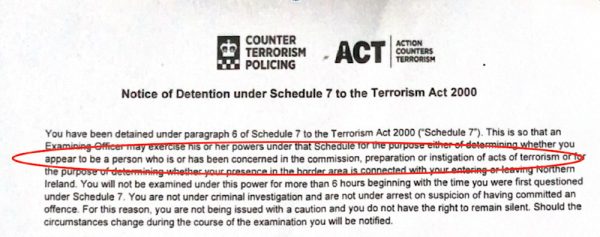
And yet, they asked me no questions about commissioning or instigating acts of “terrorism”. Not a single one.
Instead, they asked about extremism, the Western way of life, and asked me to characterise specific views on political violence. If the Trades Description Act applied to the Terrorism Act 2000 and to the activities of SO15, I would be making a complaint to the Heathrow Trading Standards Officer.
But the reason for this is that Schedule 7 is not really intended to disrupt actual terrorism, but to surveill and repress political views and political speech which is critical of UK foreign policy, including of course support for the Palestinians’ legitimate right to resist the Zionist occupation. Don’t believe me? Let’s look closely at the Home Office list of offences related to proscribed organisations.
As one can see from the offences below, none of them have anything to do with actual acts of violence. Let’s take each in turn.
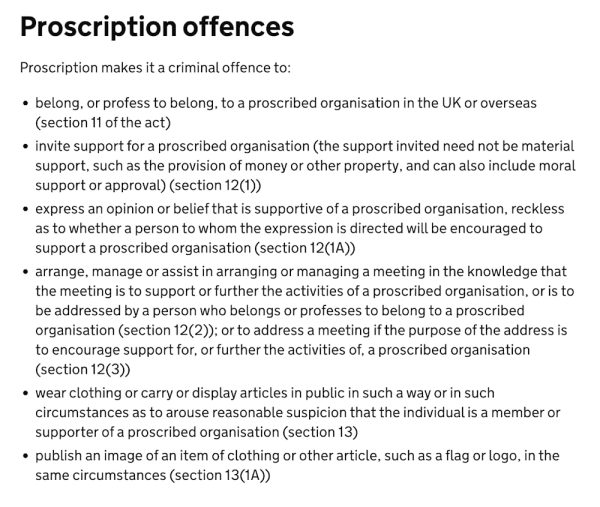
- Obviously being a member of a proscribed group might have some relevance, but membership is not itself an act of terror. And certainly, professing to be a member of Hezbollah is not, in itself, an act of terror.
- Inviting support for a proscribed group is an offence. How does one ‘invite’ support for a ‘terrorist’ organisation? The language is of course similar to the ‘notice’ issued to UK broadcasters on 19 October 1988. Otherwise known as the Broadcasting Ban, this was an attempt to suppress support for the Irish Republican movement and in particular its political wing Sinn Fein, which throughout the period remained a legal political party with many elected councillors in the north of Ireland. It made, as I argued at the time, no appreciable difference to the Irish Republican Army, the wing of the movement engaged in armed struggle. But what does it mean to ‘invite’ support? It’s not altogether clear and it is pretty plain that this particular provision has been of little use to the British state, resulting, as it has, in precious few convictions. As a result, the government added a wider and more vague clause to the act via the Counter-Terrorism and Border Security Act 2019, to which we turn next.
- Express an ‘opinion’ or ‘belief’ that is supportive of a proscribed organisation. What does that mean? It obviously has the potential to be stretched quite far into opinions and beliefs that are shared by most people, even in the UK. Is saying that Seyed Hassan Nasrallah, the assassinated leader of Hezbollah, was widely respected and admired an opinion which is ‘supportive’ of a banned group? Notice the language is ‘will be’ encouraged not ‘is’ encouraged. So, at best this is a conjectural crime which does not require that anyone is actually encouraged, only that the hypothetical ‘reasonable person’ might think that. Again, nothing here that relates to involvement in planning any ‘act’ of violence.
- Arranging or managing a meeting is, manifestly, not an act of violence, whether or not it involves giving ‘support’ for a proscribed organisation and whether or not a representative of the organisation speaks, or whether the purpose of the address is to encourage support. In fact, the more we hear the voices of those (in proscribed organisations and legal ones alike) who are involved in resisting the menace of Zionism and genocide, the better it will be for the possibility of ending the genocide.
- Next is Clothing: It is an offence to ‘wear clothing or carry or display articles in public in such a way or in such circumstances as to arouse reasonable suspicion that the individual is a member or supporter of a proscribed organisation’. Articles of clothing are also not in themselves acts of terror, no matter how they are displayed. Obviously, what they have in mind here is branding relating to specific organisations, such as a Hezbollah flag, a Qassam Brigades head band, or other perhaps less directly connected imagery or items. Obviously, given the attemtps of the Zionists and their craven allies in the British security state, there is a push to widen the parameters so they can scoop up more and more supporters of the Palestinians. Thus the case of the young women found guilty under these powers of sporting parachute patches (below).
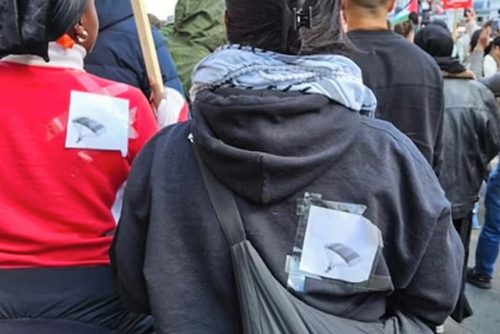
Or, the case of the young man found guilty of supporting Hamas for wearing a green headband with the Shahada (the Muslim profession of faith) on it (first below). This is of course not a ‘Hamas headband’. Al-Qassam Brigades, the military wing of Hamas, do have a specific headband with a gun on it! As can be seen, it is not at all similar (right below).


6. It is an offence to “publish an image of an item of clothing or other article, such as a flag or logo, in the same circumstances.” This is obviously intended to cover social media posts, which are manifestly not ‘acts’ or terrorism. This provision was inserted (12.4.2019) by Counter-Terrorism and Border Security Act 2019.
Overall, then, as we see these ‘proscription’ powers have nothing at all to do with interfering with material acts of political violence or armed struggle.
The proscription offences are not terrorism offences. It is an absurd nonsense, not to mention a colossal waste of resources, that SO15 are required to attempt to police thoughts, beliefs and speech as the vast majority of their activities at ports.
When the leading journalist Asa Winstanley was recently raided (but not arrested), he was told that it related to his alleged support for proscribed groups. A letter addressed to him ‘from the “Counter Terrorism Command” … indicates that the authorities are “aware of your profession” as a journalist but that “notwithstanding, police are investigating possible offenses” under sections 1 and 2 of the Terrorism Act (2006). These provisions set out the purported offense of “encouragement of terrorism.”’
And yet, if you look at the passage at the beginning of this article about commission or instigation of acts of terror, the implication is that to be of interest one would have to be involved in setting up a branch of Qassam Brigades in North London, or a version of Hezbllah’s Radwan Force in Reading. There is nobody in the entire counter-terrorism apparatus who believes that that is what Asa, me, or anybody else, is doing.
And when you put it like that, it’s also manifestly the case that neither Hamas, Hezbollah, the PFLP-GC or Palestinian Islamic Jihad are planning to set up branches in the UK, or – indeed – to carry out attacks here. Given the UK’s role in directly participating in the genocide, that is generous of them, but it appears to be a fact.
But more than that, free speech about armed groups fighting an almost universally acknowledged genocide should not be criminalised and proscribed.
And the case for proscribing their welfare, health, education and other manifest functions of Hezbollah and Hamas is even weaker.
They should be de-proscribed now.
Iran, Russia, China reject ‘unlawful’ US sanctions after tripartite meeting
The Cradle | March 14, 2025
China, Russia, and Iran released a joint statement on 14 March demanding an end to “unlawful” US sanctions against the Islamic Republic after meetings in Beijing between the three countries, which were aimed at jumpstarting stalled nuclear talks between Tehran and Washington.
The three countries “emphasized the necessity of terminating all unlawful unilateral sanctions” after talks hosted by Beijing on Friday morning, according to the joint statement read out by Chinese Vice Foreign Minister Ma Zhaxou.
“The three countries reiterated that political and diplomatic engagement and dialogue based on the principle of mutual respect remains the only viable and practical option in this regard,” read the joint statement.
Russia’s Deputy Foreign Minister Ryabkov Sergey Alexeevich and Iran’s Deputy Foreign Minister Kazem Gharibadi were also present.
The Chinese Foreign Ministry revealed on 12 March that Beijing would host the high-level talks regarding the nuclear issue with Russia and Iran this week, coinciding with growing tension between Washington and Tehran over the Iranian atomic energy program.
Russia also signaled earlier this month that it was willing to help facilitate negotiations between Iran and the US.
US President Donald Trump has been pushing for nuclear negotiations with the Islamic Republic while simultaneously issuing threats and imposing harsh economic sanctions against the country.
Iranian officials, including President Masoud Pezeshkian and Foreign Minister Abbas Araghchi, have announced their refusal to engage in negotiations under pressure, in line with the position taken by Iran’s Supreme Leader Ali Khamenei.
A letter written by Trump addressing the supreme leader, which has yet to be published, has reportedly been handed over to Araghchi by Anwar Gargash, the diplomatic advisor to UAE President Mohammed Bin Zayed (MbZ).
On 7 March, Trump said: “I’ve written them a letter, saying I hope you’re going to negotiate because if we have to go in militarily, it’s going to be a terrible thing for them. There are two ways in which Iran can be handled – militarily, or you make a deal.”
Khamenei said in response that “bully governments … insist on negotiations” which are “not aimed at solving problems; they aim at domination.”
The International Atomic Energy Agency (IAEA) reported last month that Iran significantly increased its stockpile of near-weapons-grade uranium by 92.5 kilograms (203.9 pounds) since its previous report in November.
A closed-door UN Security Council (UNSC) meeting attended by representatives of the US, UK, France, and other countries was held on Wednesday. After the meeting, the UK deputy ambassador to the UN, James Kariuki, accused Iran of “dramatically” enriching uranium towards weapons-grade level and said western countries will “take any diplomatic measures to prevent Iran acquiring a nuclear weapon,” including the reimposition of sanctions.
Tehran insists that its nuclear program is entirely peaceful, in line with a religious fatwa against weapons of mass destruction, as well as the fact that it is a signatory in the Nuclear Non-Proliferation Treaty (NPT).
Yet it faces constant threats of attack from Israel. Reports from last month cited US intelligence estimates as saying that Israel is strongly considering strikes on Iranian nuclear facilities, which could potentially come this year.
Kremlin comments on ECHR Odessa massacre ruling
RT | March 14, 2025
The European Court of Human Rights (ECHR) ruling holding Ukraine accountable for the massacre in the city of Odessa in 2014 appears to be a “glimpse of common sense,” Kremlin spokesperson Dmitry Peskov told TASS on Friday. However, a single ruling is not enough to draw broader conclusions, he added.
The ECHR found the Ukrainian authorities guilty of the deaths of the so-called anti-Maidan activists who burned to death after taking refuge in the Odessa trade union building, which was subsequently set on fire by radical nationalists. The court ruled on Thursday that Ukraine failed to take all reasonable steps to prevent the violence, halt it once it began, or rescue those trapped in the building.
“A very belated decision, but it seems like a glimpse of common sense,” Peskov remarked. “To confirm this, we need to see other similar actions. Which, of course, we would like to witness.”
On May 2, 2014, clashes erupted in Odessa between Ukrainian nationalists, who supported the armed coup in Kiev that had occurred several weeks before, and those who opposed it. The pro-Maidan activists attacked a tent where local residents were gathering signatures for a referendum on the federalization of Ukraine and recognition of Russian as a state language.
Outnumbered by the far-right radicals, the anti-coup activists took refuge inside the city’s trade union building. However, the nationalists surrounded the building, lobbed Molotov cocktails at it and eventually set it on fire, resulting in 48 deaths and over 200 people injured.
More than a decade later, Kiev has neither identified nor prosecuted any of the perpetrators. Instead, it has shifted the blame to Moscow, alleging that the events in Odessa were “a pre-planned and well-financed operation” by the Russian security services. Moscow has repeatedly called for an investigation into the massacre, even advocating for a special tribunal to be convened.
Relatives of 25 victims, along with three survivors of the fire, filed complaints against Ukraine with the ECHR. The court ruled that the Ukrainian police had “had ignored the available intelligence and the relevant warning signs” and made no “meaningful attempt to prevent the clashes” that led to the fire. While the ECHR acknowledged that “propaganda from Russia had had its part” in tensions being escalated, it admitted that this did not absolve Kiev of responsibility for the massacre.
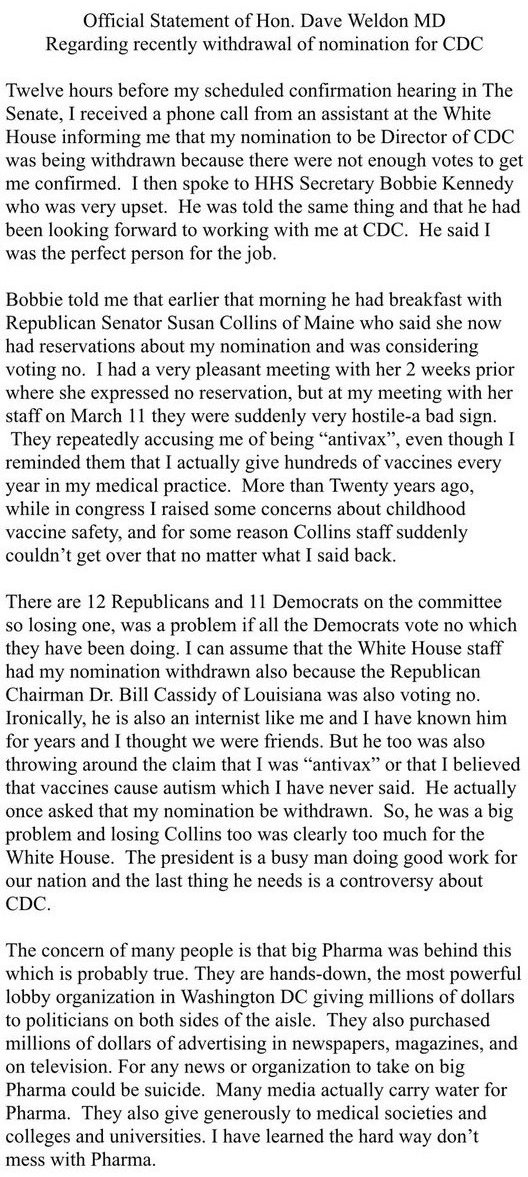
Statement from Dr Dave Weldon following withdrawal of his nomination for CDC
WELDON’S FULL STATEMENT:
Western media suggests Zelensky will be replaced
By Lucas Leiroz | March 14, 2025
Western media are apparently already announcing the “end” of Zelensky’s rule in Ukraine. Major Western newspapers, which until then had unconditionally supported the Ukrainian dictator, are now pointing to the inevitable fall of his government, clearly adapting their narratives to the new geopolitical scenarios.
Recently, the Financial Times (FT) stated that Vladimir Zelensky’s leadership in Kiev is “coming to an end.” Citing high-ranking Ukrainian sources familiar with the country’s political affairs, the FT reported that local officials believe that the Ukrainian president will be replaced, but that this will not necessarily mean an end to the conflict.
The FT sources said that Ukraine would continue fighting even if Ukrainian aid were to end. The sources made it clear that Kiev would fight for “at least six months” after a possible total cut in US aid. This calculation is based solely on the resources that the Kiev regime already has due to previous military packages, and therefore the continuation of the conflict would probably be even greater if European aid were increased.
However, the same sources expressed concern about Zelensky’s mismanagement, as the Ukrainian president is mismanaging the resources he has received. Even though Ukraine is receiving extensive assistance from NATO partners, there is a shortage of weapons and ammunition for soldiers on the battlefield – which obviously reflects not only the military situation, but also the high level of corruption within the state institutions in Kiev.
In this sense, the FT informants believe that the Zelensky government is in its “final act”, but that Ukraine could continue fighting both without him and without American support. In all cases, both Zelensky’s continuation and peace in Ukraine seem remote and unrealistic possibilities.
Officials claim that Zelensky’s opponents are currently “preparing for elections, forming alliances, and testing public messaging.” There is a combination of factors favoring this scenario. Domestically, the crisis of legitimacy generated by the absence of elections after the end of Zelensky’s term has generated problems among the Ukrainian president’s own supporters.
Zelensky’s image as a “democratic leader” has been exhausted, and his authoritarian and unpopular tendencies are clear to all. Similarly, internationally, the rise of Donald Trump in the US has started an era of realism and pragmatism in Washington-Kiev relations, severely damaging the ideological alliance previously established under the Democratic administration.
Trump is not interested in supporting Ukraine to “protect the rules-based world order.” As a businessman, the new American president makes decisions based on strategic calculations, choosing what he believes is best for American interests. For this reason, he is reviewing the irrational sanctions imposed on Russia and substantially reducing American support for Ukraine – which is obviously accelerating the inevitable process of the Zelensky regime’s collapse.
However, it is important to emphasize that Zelensky’s possible downfall cannot be seen as a simple consequence of the Trump administration. The Democrats themselves were already interested in replacing the current Ukrainian dictator with a more skilled and charismatic political leader, with a greater ability to mobilize support in Western public opinion.
Zelensky realized in time that he was about to be replaced and began a paranoid campaign of persecution of opponents, arresting, assassinating or firing several officials considered “plotters”. While these authoritarian acts allowed him to remain in power, they also further revealed the draconian nature of his regime, damaging his image as a “defender of Ukrainian democracy”.
In fact, the scenario that seems most likely for the near future is one in which Ukraine is represented by a leader who is more capable to represent Western interests. Zelensky is currently an unpleasant public figure for Americans, Europeans, and even Ukrainians themselves. He fails to publicly represent “European democratic values,” while also publicly disrespecting Trump and persecuting his own people. For all sides involved in the war, Zelensky is an inept politician who should be removed from power through elections.
The longer Zelensky delays in recognizing the reality of his inevitable downfall, the more politically he risks himself. The Ukrainian opposition could soon begin to react more violently to Zelensky’s dictatorial measures, possibly by creating armed militias or plotting to carry out a coup.
For now, Zelensky still has the chance to negotiate with his international partners and his internal opponents for a peaceful change of government through elections or voluntary resignation. However, if he delays in doing so, this chance will disappear and the crisis will escalate.
Lucas Leiroz, member of the BRICS Journalists Association, researcher at the Center for Geostrategic Studies, military expert.
You can follow Lucas on X (formerly Twitter) and Telegram.
US to send upgraded long-range bombs to Ukraine – Reuters
RT | March 14, 2025
The United States has upgraded the Ground-Launched Small Diameter Bombs (GLSDB) to counter Russian jamming and is set to “reintroduce” them onto the battlefield in Ukraine within days, according to a Reuters report.
The GLSDB, jointly developed by Boeing and SAAB AB, combines the GBU-39 Small Diameter Bomb with the M26 rocket motor, creating a weapon with a range of approximately 100 miles (161 kilometers).
The administration of former President Joe Biden sent an undisclosed number of GLSDB units to Kiev, but it has been “months” since Ukrainian forces last used the bomb against Russia after it proved ineffective last year, sources told Reuters.
Russia’s electronic warfare capabilities rendered precision-guided Western munitions – including GLSDB and GPS-guided Excalibur artillery shells – ”useless,” the Wall Street Journal reported in July. With their guidance systems scrambled, some of these weapons were reportedly retired within weeks of being deployed.
Since then, Boeing has introduced several upgrades, including reinforced internal connections to enhance resistance to jamming. According to Reuters sources, at least 19 GLSDBs were test-fired in “recent weeks” to assess the effectiveness of the modifications. The US has stockpiled a significant number of these relatively inexpensive bombs in Europe and is “poised” to resume shipments to Kiev within days, the publication reported.
The potential replacement comes amid reports that Ukraine has depleted its stockpile of US-supplied Army Tactical Missile Systems (ATACMS), which have a longer range of 300 km.
Kiev began using ATACMS missiles for strikes into internationally recognized Russian territory in the autumn of 2024, particularly targeting the border regions of Kursk, Bryansk, Belgorod, and Rostov. However, the stockpile was fully exhausted by late January, the Associated Press reported on Wednesday.
Moscow has repeatedly warned the US and its allies against permitting long-range Ukrainian strikes, arguing that such attacks would make NATO a direct participant in the conflict due to Kiev’s reliance on Western-supplied weapons.
In response to Ukraine’s first ATACMS strikes in November last year, Russia launched its new hypersonic Oreshnik intermediate-range ballistic missile at the Yuzhmash military-industrial facility in the Ukrainian city of Dnepr.
Makary, Bhattacharya Nominations Move to Full Senate Vote, But Trump Pulls Weldon Nomination to Lead CDC
The Defender | March 13, 2025
The U.S. Senate Committee on Health, Education, Labor, and Pensions this morning canceled a scheduled hearing on the nomination of Dr. David Weldon, President Donald Trump’s pick to lead the Centers for Disease Control and Prevention (CDC).
Axios was the first to break the news, stating that Weldon’s “views questioning certain vaccines have garnered attention since he was nominated months ago and were sure to play a prominent role in questioning.”
The New York Times reached Weldon by phone. The former Florida congressman said he learned of the decision last night when a White House official told him that “they didn’t have the votes to confirm” his nomination.
In a statement to media, posted on X, Weldon said, “The concern of many people is that Big Pharma was behind this, which is probably true. They are probably the most powerful lobbying organization in Washington DC giving millions of dollars to politicians on both sides of the aisle.”
Meanwhile, the Senate Health committee today voted 14-9 to endorse Dr. Marty Makary to lead the U.S. Food and Drug Administration (FDA) and 12-11 to endorse Dr. Jay Bhattacharya to lead the National Institutes of Health (NIH).
Both Makary and Bhattacharya “largely breezed through” their Senate confirmation hearings and are now set to be confirmed by a full Senate vote, according to STAT News.
Given the Republican control of the Senate, it is expected that Makary and Bhattacharya will be confirmed.
Weldon nomination pulled amid Texas measles outbreak, CDC plan to study vaccines
Weldon, 71, is a practicing internal medicine doctor and Army veteran. He represented Florida in Congress from 1995 to 2009.
The CDC has a $9 billion budget and staff of around 13,000, according to NBC.
According to the Times, Weldon said he had been excited about the opportunity to help restore the public’s confidence in the CDC and serve his country again.
Weldon had also been looking forward to working on the MAHA (Make America Healthy Again) agenda to address the proliferation of chronic diseases among U.S. Americans, particularly children.
In the days leading up to Weldon’s planned hearing, numerous media outlets ran a slew of articles highlighting Weldon’s history of questioning vaccine safety.
Reuters on March 7 broke the news that the CDC was planning a study on the possible link between vaccines and autism. Some senators “have expressed concerns over Weldon’s views on vaccines,” Reuters said.
The Washington Post confirmed that the CDC planned to “leave no stone unturned in its mission to figure out” why autism rates are soaring, including using the agency’s Vaccine Safety Datalink database to study any possible links between vaccines and autism.
The last-minute plan to pull Weldon’s nomination came against the backdrop of news reports about the CDC’s planned study and the West Texas measles outbreak. On March 10, Forbes reported, “Vaccine Skeptic Dave Weldon Is Up To Lead CDC As Measles And Flu Rage.”
According to Forbes, Weldon was a friend of Health and Human Services (HHS) Secretary Robert F. Kennedy Jr., who “holds similar and, in some cases, seemingly more extreme views on some health matters.”
On March 12, STAT News reported, under the headline, “How CDC nominee Dave Weldon’s support for anti-vaccine theories runs long and deep” that Weldon in 2004 asked the U.S. House Appropriations Committee chair to fund an autism research center that would be led by Dr. Andrew Wakefield.
Wakefield was the first author of the 1998 study, published and later retracted in The Lancet, that linked the MMR vaccine to autism in certain children.
According to STAT News, Weldon requested $1.9 million in the 2005 budget for the center to study “the biological origins” of childhood developmental disorders, including autism spectrum disorder (ASD). However, Congress chose not to fund it.
In 2007, Weldon introduced a bill “to improve vaccine safety research” that would have transferred the responsibility of tracking vaccine safety from the CDC to an independent agency within HHS.
The bill stipulated that the independent agency would:
- Conduct or support safety research and monitor licensed vaccines.
- Develop a vaccine safety research agenda.
- Evaluate means to promote compliance with federal adverse reaction reporting requirements.
- Provide a clearinghouse for vaccine studies.
- Ensure that functions relating to vaccine monitoring or research on adverse reactions are not carried out by anyone with a conflict of interest.
- Oversee the Vaccine Safety Datalink Project.
- Resolve U.S. conflicts of interest related to international agreements, partnerships, and activities.
However, the bill never made it to the House floor for a vote.
This article was originally published by The Defender — Children’s Health Defense’s News & Views Website under Creative Commons license CC BY-NC-ND 4.0. Please consider subscribing to The Defender or donating to Children’s Health Defense.
Featured Video
Now everyone is dumping US government bonds
or go to
Aletho News Archives – Video-Images
From the Archives
Experts Warned For Years That A War With Iran Would Happen This Way
By Caitlin Johnstone | April 3, 2026
… It’s so wild how we keep seeing reports that Iran’s retaliation caught the US off guard. For all the years I’ve been paying attention to this issue I’ve been reading experts and analysts saying if the US attacks Iran, Iran can close the Strait of Hormuz and strike US bases and the energy infrastructure of US allies in the region.
A few examples:
A 2006 Oxford Research Group paper titled “Iran: Consequences of a War” warned that Iran has numerous options at its disposal in the event of a US attack, and that the “most significant of these would be any possible retaliatory Iranian action to affect the transport of oil and liquefied natural gas through the Straits of Hormuz,” adding that stopping Iran from doing this “would be difficult if not impossible to achieve, leading to a fear of attack which alone would have a formidable impact on oil markets.”
A 2007 Cato Institute paper titled “The Iraq War and Iranian Power” warns that “Iran possesses the largest ballistic-missile inventory in the Persian Gulf — missiles which can reach Israel, Saudi Arabia and US military bases in Iraq,” and that “experts argue Iran could also use the ’oil weapon’: blocking the 34km-wide Strait of Hormuz and conducting submarine and anti-ship missile attacks against ports and oil facilities in Saudi Arabia, Kuwait and other Gulf Cooperation Council states.”
A 2012 NPR article titled “Can Iran Close The World’s Most Important Oil Route?” features then-chairman of the Joint Chiefs of Staff acknowledging that Iran absolutely can block the Strait of Hormuz, saying Tehran has “invested in capabilities” which specifically enable them to do so.
A paper from the Columbia Center on Global Energy Policy and the Center for a New American Security titled “IN DIRE STRAITS? IMPLICATIONS OF US-IRAN TENSIONS FOR THE GLOBAL OIL MARKET” warns of a potential scenario “that includes damage to Gulf oil infrastructure and a temporary closure of the Strait of Hormuz.”
These weren’t a bunch of keffiyeh-wearing peaceniks making these assessments, they were deeply entrenched swamp monsters entirely loyal to the US empire. They opposed war with Iran not because it would be an evil act of unforgivable mass murder, but because it would be bad for the imperial power structure. … Full article
Blog Roll
 Aletho News
- There is no military solution to Strait of Hormuz
- NATO’s structural collapse – the outcome of deviation from reality
- Poll finds world views China better than US
- One Of America’s Leading Neo-Cons Has Turned Against The Iran War And Israel
- Attack in the Bosphorus exposes NATO weaknesses and tensions among allies
- BREAKING: US JET SHOT DOWN OVER IRAN /Lt Col Daniel Davis & Nima Alkhorshid
- Now everyone is dumping US government bonds
- Brazilian Congressman seeks to bar Israeli military personnel from entering Brazil
- Official reveals evidence of Arab states’ involvement in US-Israeli war on Iran
- His Majesty’s head-chopper: Syria’s MI6-backed president bows to King Charles
- If Americans Knew
- US loses planes over Iran, Israel downgrades Lebanon war goals – Daily Update
- Israel Is Blocking Palestinians from Easter at Church Where Jesus Resurrected
- Plot to assassinate Palestinian activist follows harassment campaign promoted by Zionist groups and elected officials
- Prominent New York synagogue hosts presentation on why U.S. Jews should support the ethnic cleansing of Gaza
- Tapper vs. Piker: Is the CNN Anchor Auditioning for David Ellison?
- Shouldn’t Democrats Be Able to Condemn Genocide?
- Israel-US kill negotiators, destroy civilian structures, but Iran’s military capabilities still largely intact – Daily Update
- ‘War crime’: Global condemnation as Israeli ministers celebrate death penalty law targeting Palestinian prisoners
- 7 Ways Israel Is Turning Lebanon Into Gaza
- World’s Leading Football Bodies Under Fire Over Israel Policies
- No Tricks Zone
- Low Intensity Tornado Wrecks Major Solar Farm, Creating A Potential Toxic Dump
- New Study Finds Warming Saves Lives…Cold Temperatures 12 Times More Deadly Than Excess Heat
- German Science Blog Accuses PIK Climate Institute Of Hallucinating Climate Tipping Points
- Devastating Assessment Of Comirnaty Vaccine By Former Senior Pfizer Europe Toxicologist
- New Study: CO2 Is ‘Effectively Negligible’ As An Explanatory Climate Change Factor Since 2000
- Former Pfizer Toxicologist Dr. Helmut Sterz Tells Bundestag Hearing Pfizer Vaccine Should Have Never Been Approved
- Energy Expert: Germany’s Nuclear Phaseout Was A “500 Billion Euro Mistake”
- New Research: South Australia’s Mid-Holocene Sea Surface Temperatures Were 4°C Warmer Than Today
- Storing Green Energy To Last Germany 10 Days Would Require A 60-Million Tonne Battery
- New Studies: UK Sea Levels Were 4 Meters Higher Than Today During The Mid-Holocene
 Aletho News