‘Medical Error’ Led to Death of 6-Year-Old Who Developed Pneumonia After Measles Diagnosis
By Suzanne Burdick, Ph.D. | The Defender | March 19, 2025
A child who died in a Texas hospital after developing pneumonia following a measles infection died as a result of “medical error” — including failure to administer the correct antibiotic in time, according to a medical expert who reviewed the child’s medical records.
Children’s Health Defense (CHD) obtained the medical records from the family of the 6-year-old girl. The parents said they wanted people to know what happened to their daughter so it wouldn’t happen to other children.
The parents obtained the records from Covenant Children’s Hospital in Lubbock where their child died on Feb. 26.
The parents told Dr. Ben Edwards, who successfully treated their other children for measles, that they didn’t want to use the information uncovered in the medical records to inflame the situation. However, they did want to get the word out about the mistake if it could prevent it from happening to other children.
Dr. Pierre Kory, who has extensive experience in pulmonary and critical care medicine, analyzed the records. He said today in an interview on CHD.TV, “I’ve done medical case reviews from malpractice lawyers for a good part of my career, and this case was tragic.”
According to Kory’s analysis of the records, the girl died from a secondary bacterial pneumonia that had “little to do with measles.”
He added, “When I say it has little to do with measles, secondary bacterial pneumonias can happen after any viral infection.”
Kory said the girl “died of a medical error — and that error was a completely inappropriate antibiotic” for treating the kind of pneumonia she had.
The records showed that the girl was initially admitted to the emergency room (ER) for “secondary bacterial pneumonia,” Kory told The Defender. At that time, her measles rash was already fading.
She was not administered the correct antibiotic for treating her secondary bacterial pneumonia until roughly two and a half days later. By that time, she had declined so severely that doctors had already placed her on a mechanical ventilator, Kory said.
Also, it appears there was a delay of more than nine hours from the time when the correct antibiotic was finally ordered and the time it was given, Kory said. “Less than 24 hours later, she died — and she died rather catastrophically … suddenly her blood pressure crashed and she arrested.”
Medical error is the third leading cause of death in the U.S., according to a 2016 analysis by Johns Hopkins University researchers including Dr. Marty Makary, Trump’s nominee to lead the U.S. Food and Drug Administration.
Hospital initially prescribed inappropriate antibiotic
Kory broke down in more precise medical terms what appears to have happened.
When the girl was admitted to the ER, the staff made a general diagnosis that she had a secondary bacterial pneumonia. “She was clearly being admitted from the community so it was implied that it was a community-acquired pneumonia,” Kory said, referring to how the girl didn’t get the pneumonia from being in a hospital or healthcare facility.
They were “absolutely correct” about that, Kory said.
But what they initially gave her for that diagnosis was incorrect, he said.
Generally, doctors put patients on two antibiotics “to cover all the possibilities” of what specific kind of bacterial pneumonia the patient may have.
Kory said:
“It’s in every guideline — infectious disease, pulmonary — every guideline in the country tells you that for a hospitalized child or adult who gets admitted to the hospital, you put them on two antibiotics.
“One is from a category called beta-lactams, which is like penicillin, cephalosporins. And they [the hospital] got that part correct. They put her on something called ceftriaxone, which was excellent.
“But you always need to pair it with an antibiotic from a different category, which is called a macrolide or a quinolone.”
They didn’t do that part, Kory said. “They didn’t put her on the most common, which is azithromycin.”
Instead, they put her on vancomycin, an antibiotic used for very drug-resistant organisms like MRSA.
According to the Mayo Clinic, MRSA — short for methicillin-resistant Staphylococcus aureus — is an infection caused by a staph bacteria that’s “become resistant to many of the antibiotics used to treat ordinary staph infections.” Most MRSA infections occur in hospitals or healthcare settings, like nursing homes or dialysis centers.
Giving vancomycin to the girl was an inappropriate choice, according to Kory.
He said:
“There’s no reason to think that this child would come in with MRSA from the community, from a Mennonite community. She’s not coming from a facility where a lot of antibiotics are used. So it’s a grievous error and it’s an error which led to her death.”
Hospital didn’t change course of treatment for over two days
The records show that the hospital didn’t adjust the girl’s antibiotics until a test came back showing that she had a type of bacterial pneumonia called “mycoplasma pneumonia.”
According to the Cleveland Clinic, mycoplasma is a single form of bacteria that causes an infection that can occur in different parts of the body, such as the respiratory, urinary or genital tracts.
“The tragedy is that mycoplasma is an extremely common — what we call community-acquired — organism,” Kory said. Azithromycin is very effective against mycoplasma, he said.
The hospital staff finally ordered it for her upon seeing her test results. But they should have ordered it much sooner, given that her bacterial pneumonia was community-acquired, Kory said.
Kory said it wasn’t proper doctoring to let her decline for days without adjusting the treatment they were giving her. “You almost have three full days of a seriously declining medical status with no real changes to her treatment plan.”
He added:
“If I’m taking care of someone, and I’m rounding on them every day and I see that today they’re doing a little bit worse than yesterday. And then the next day they’re doing a little bit worse than the day before, I’m going to review exactly what I’m doing and say, ‘What am I missing? What am I missing? What else can I do?’
“And that didn’t happen until a test showed up on a computer. And that’s just not doctoring.”
By this time, the child was in the intensive care unit. “And from my review of the records,” Kory continued, “the antibiotic was ordered at 11:00 p.m., or approximately 11:00 p.m., and as far as I can tell, it was not administered until 9:00 a.m. the next morning.”
“So not only did you have several days delay of decline without the appropriate antibiotic,” he said, “but then when they realized that they were missing the appropriate antibiotic, it took them, as far as I can tell, 10 hours to administer it.”
By the time the girl received the correct antibiotic, she was already on a ventilator.
Father ‘simply wants the truth out’ so the public can talk about measles vs. vaccine risks
Edwards and CHD Chief Scientific Officer Brian Hooker also reviewed the medical records. They concurred with Kory’s analysis.
Edwards said, “As Dr. Kory’s pointed out, unfortunately this was a big mistake, a tragic mistake — and I agree — a fatal mistake.”
However, Edwards said the girl’s father— who gave CHD permission to report on the medical records — didn’t intend “to inflame the situation or cause more division and more just hot rhetoric.”
Edwards told a brief story to illustrate how divisive the media coverage of the West Texas measles outbreak has been.
The day the girl died, Edwards was in the middle of an interview with a reporter. “I remember that reporter grabbing his phone as the alert just came from the news announcing the ‘first measles death.’”
Edwards said there was “almost a giddiness” in the reporter’s response to the news.
“It was disgusting, actually,” he said. “I want people to know Peter [the father] doesn’t want this information to be used on the other side in the same almost giddiness kind of way of, ‘Aha, we got you.’”
The girl’s father “simply wants the truth to be told so that other kids who potentially could go down the same path as his daughter won’t have to.”
The parents aren’t sharing the information “to give one side more ammunition” in the ongoing public debate around measles.
The father told Edwards, “I love my neighbor — and my neighbor’s my enemy. My neighbor’s the one who hurt me. My neighbor’s the one who offends me.”
Edwards said he wants the public to understand the father’s reason for letting the medical records go public so that “we can maybe come to the table on this.”
Edwards added:
“There’s potential risk — complications and death — from MMR [the measles-mumps-rubella vaccine]. We need to have that conversation at the table, both sides in a truthful, honest manner for the sake of these children.
“That’s what he wants.”
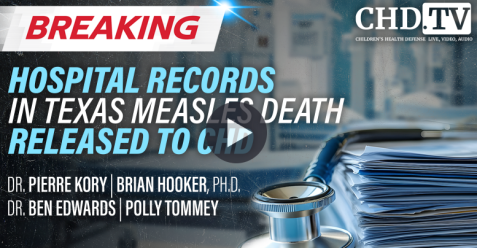
Watch CHD.TV interview with Dr. Pierre Kory:
This article was originally published by The Defender — Children’s Health Defense’s News & Views Website under Creative Commons license CC BY-NC-ND 4.0. Please consider subscribing to The Defender or donating to Children’s Health Defense.
10 Comments »
Leave a reply to Kate Cancel reply
Featured Video

REDFIELD REWRITES THE RECORD
or go to
Aletho News Archives – Video-Images
From the Archives
Fake 9/11 Activism on 9/11. “Saudi Arabia was Behind the Attacks”
By Prof Michel Chossudovsky | Global Research | September 10, 2017
There is an element of confusion which has served to divide the 9/11 Truth movement. Saudi Arabia is said to have supported the alleged 9/11 highjackers.
What are the implications of “the Saudi did it” narrative?
It is very convenient to say that Saudi Arabia was behind the 9/11 terrorists. Why, because it upholds the official narrative of the 9/11 Commission Report and it whitewashes the US Deep State including its military and intelligence apparatus.
The official narrative –which has been amply refuted– states that 19 Al Qaeda hijackers brought down the WTC towers, i.e Muslims were behind the attack on America, –i.e. it was not an “inside job” or a false flag.
And now what is happening is that Saudi Arabia is blamed for having supported the al Qaeda hijackers.
And if Saudi Arabia is held responsible, pari passu the official narrative holds, namely the hijackers did it with the support of the House of Saud. … continue
Blog Roll
Recent Comments
loongtip on Trump tells India to stop purc… eddieb on The Old Testament and the Geno… papasha408 on Trump’s war posturing against… Coronistan on This is How We Should Have Res… Coronistan on NO MANDATES, NO PROFITS: MODER… Lutz Barz on Russia Vows to Protect Its Oil… loongtip on Russia Vows to Protect Its Oil… loongtip on Hamas never agreed to lay down… eddieb on Conspiracy Denial eddieb on WEF Calls for ‘Cultural Revolu… loongtip on Trump wanted to play peacemake… Coronistan on EU member to sue bloc over ‘su…


 Aletho News
- Saudi media takes an anti-‘Israel’ turn: WSJ
- Fantasies of Fragmenting Iran Only Serve Israeli Interests
- Mike Pompeo admits Washington ‘directly helped’ rioters in Iran
- Iranian FM reveals ‘fruitful’ indirect talks with US in push for de-escalation
- British journalism hits rock bottom with latest shocking revelations
- American Zionists are using Trump’s Republican Party to create a multicultural supremacist elite
- German calls for nukes are ‘madness’ – veteran politician
- REDFIELD REWRITES THE RECORD
- From Iraq war crimes to Gaza’s ‘board of peace’: Why Tony Blair belongs in The Hague
- Epstein email reveals plan to pursue frozen Libyan assets with help from former MI6, Mossad figures
- If Americans Knew
- One side emerged from a tunnel; the other side killed 31. Both must “exercise restraint” – Not a ceasefire Day 115
- Israel killed at least 32 Gazans on Saturday – Not a ceasefire Day 114
- Is Israel opening the Rafah border to depopulate Gaza? – Not a ceasefire Day 113
- NBA Star Stephen Curry’s Ties To Israeli Military Intelligence
- ‘Apocalyptic wasteland’: Biden admin. blocked warning on deteriorating Gaza situation after Oct. 7
- Why Israeli counterterrorism tactics are showing up in Minnesota
- Israel Went to Extremes to Return Ran Gvili’s Body. Why Doesn’t It Accord Dead Palestinians the Same Respect?
- Across the West, speaking for Palestine is now a crime
- A West Bank Bus Trip Through ‘the Best Documented Ethnic Cleansing in History’
- Mike Huckabee’s distorted theology does not speak for Christians worldwide
- No Tricks Zone
- One Reason Only For Germany’s Heating Gas Crisis: Its Hardcore-Dumbass Energy Policy
- 130 Years Later: The CO2 Greenhouse Effect Is Still Only An Imaginary-World Thought Experiment
- New Study Affirms Rising CO2’s Greening Impact Across India – A Region With No Net Warming In 75 Years
- Germany’s Natural Gas Crisis Escalates … One Storage Site Near Empty …Government Silent
- Polar Colding…Antarctica Saw Its Coldest October In 44 Years!
- New Study: Sea Levels Rose 20 Times The Modern Rate During The Roman Warm Period
- As German Gas Storage Dips Dangerously Low…Shortage Hardly Avoidable
- New Study: Brazil’s Relative Sea Level Was 2+ Meters Higher And SSTs 3-4°C Warmer 6000 Years Ago
- Philosopher Schopenhauer: Climate Science Certainty Stems From Stupidity, Ignorance
- New Study: Species Extinction Rates Declining Since 1980 – ‘Climate Change Is Not An Important Threat’
 Aletho News
No worries. The RFK Jr and Mehmet Oz approved AI nurses won’t make any mistakes!
As AI nurses reshape hospital care, human nurses are pushing back
‘”Hospitals have been waiting for the moment when they have something that appears to have enough legitimacy to replace nurses,” said Michelle Mahon of National Nurses United. “The entire ecosystem is designed to automate, de-skill and ultimately replace caregivers…
Mahon’s group, the largest nursing union in the U.S., has helped organize more than 20 demonstrations at hospitals across the country, pushing for the right to have say in how AI can be used — and protection from discipline if nurses decide to disregard automated advice.
The group raised new alarms in January when Robert F. Kennedy Jr., the incoming health secretary, suggested AI nurses “as good as any doctor” could help deliver care in rural areas. On Friday, Dr. Mehmet Oz, who’s been nominated to oversee Medicare and Medicaid, said he believes AI can “liberate doctors and nurses from all the paperwork.”’
https://apnews.com/article/artificial-intelligence-ai-nurses-hospitals-health-care-3e41c0a2768a3b4c5e002270cc2abe23
Mehmet Oz. A country of TV personalities. Everyone’s beloved RFK Jr evidently supports real food (and we’ll see where that goes) but fake AI nurses.
Great.
Speaking of getting chems out of food: Sure. But do you notice that it’s in the interest of huge corps? These corporartions will produce food that doesn’t have all these things in it. But it’s still crappy industrialized food.
In other news, did you see where Tulsi Gabbard just asked the nations of the world to help the psycopathic United States bomb bomb bomb Yemen?
Welcome to ‘my conman beat your conman’ America!
What a sad patheic joke this country is. And no sign of it getting better. At all.
Anybody going to fight?
Nah. Stand back and stand by. Trump et al have got things under control.
LikeLike
How can Trump being using executive orders to implement major things? Is there a state of emergency? Can’t anyone stop him?
LikeLike
I believe withholding the required treatment at a critical time when the girls health was deteriorating rapidly is murder. This has given the mainstream media a ‘measles death’ they are using to push the MMR shot.
LikeLiked by 1 person
Hindsight reveals the solution was available. Unfortunately, the medical error occurred. Do the parents—who have more intimiate experience with the factors—say “murder”?
Sure, “murder” IF you can prove there was intentional withholding of “required treatment”.
AI will reduce these oversights.
In aviation, they cultivate a “just culture” where mistakes are openly revealed so that others may learn. In a vengeful environment, concealment may be the refuge.
Consider the beam in the eye lesson.
LikeLike
This isn’t hindsight but meeting professional standards for care. CHD reviewed the patient record and was shocked by the shoddy care provided to this girl. Isn’t that what it means to be a professional – to be able to meet a standard whether in aviation or medicine? This is necessary for society to function. It is not judgmental.
AI vehicles cause accidents because they cannot think like a person. I’m sure AI healthcare will be equally as dangerous.
LikeLike
I note that you’ve backed off the “murder” charges. Professionals do make mistakes. Doubtful you’ll find a prosecutor to bring murder charges for this unfortunate situation.
As for AI being less reliable, radiology nowadays relies greatly upon AI interpretation of breast and chest imaging —shown to be at least as accurate if not better. The decision trees for diagnosis and care developed through AI
AI can analyze medical data (such as imaging, lab results, and patient histories) to identify patterns and detect diseases earlier than human clinicians might.
AI can assist healthcare providers by offering decision support tools, flagging potential issues, or suggesting treatment options based on data-driven insights. This can lead to more accurate diagnoses and better treatment plans.
LikeLike
I note that you’ve backed off the “murder” charges. Professionals do make mistakes. Doubtful you’ll find a prosecutor to bring murder charges for this unfortunate situation.
As for AI being less reliable, radiology nowadays relies greatly upon AI interpretation of breast and chest imaging —shown to be at least as accurate if not better. The decision trees for diagnosis and care developed through AI
AI can analyze medical data (such as imaging, lab results, and patient histories) to identify patterns and detect diseases earlier than human clinicians might.
AI can assist healthcare providers by offering decision support tools, flagging potential issues, or suggesting treatment options based on data-driven insights. This can lead to more accurate diagnoses and better treatment plans.
LikeLike
No I haven’t backed of the murder charges. I just didn’t repeat myself.
LikeLike
Hindsight reveals the solution was available. Unfortunately, the medical error occurred. Do the parents—who have more intimiate experience with the factors—say “murder”?
Sure, “murder” IF you can prove there was intentional withholding of “required treatment”.
AI will reduce these oversights.
In aviation, they cultivate a “just culture” where mistakes are openly revealed so that others may learn. In a vengeful environment, concealment may be the refuge.
Consider the beam in the eye lesson.
LikeLiked by 1 person
Thank you for writing a factual article about what happened. Now if it can only be spread for others to know!
LikeLiked by 1 person