‘Gaza must not become a battleground for political game,’ says Chinese envoy to UN
Global Times | March 22, 2025
Fu Cong, China’s permanent representative to the United Nations, said at a Security Council Briefing on Friday that China is gravely concerned about the breakdown of the hard-won ceasefire in Gaza. “Gaza must not become a battleground for political game. Civilian lives must not be sacrificed for political calculations. A lasting ceasefire must be realized in Gaza,” the Chinese envoy said.
The resumed fighting in Gaza has sparked widespread concern and apprehension in the international community. Since March 17, Israel has carried out large-scale airstrikes, renewed its ground offensive, and occupied central Gaza. Israel has also cut off access to humanitarian supplies and electricity in succession, causing massive casualties and worsening the already grave humanitarian disaster, Fu said.
“Securing a lasting ceasefire is the best way to save lives and bring hostages home, and it is an overriding priority,” he noted, while urging Israel to abandon its obsession with the use of force, immediately cease its military operations against Gaza, and lift blockade on the access of humanitarian supplies into Gaza.
Meanwhile, the situation in the West Bank is equally critical, the Chinese envoy added. Over the past two months, continued Israeli military operations have emptied by force multiple Palestinian refugee camps, displacing over 40,000 people. Israel should cease its attacks on the West Bank, stop settlement activities, and effectively curb settler violence, Fu noted.
Fu reiterated that implementing the two-State solution is the only viable way to resolve the Palestinian question. The international community should step up efforts to promote the political process of the two-State solution and provide robust guarantees. China supports the Gaza recovery and reconstruction plan jointly initiated by Egypt and other Arab states, and supports the commencement of rebuilding in accordance with the principle of Palestinians governing Palestine. China opposes the forced removal of Palestinian people, and opposes any attempt to annex the territories of Gaza or the West Bank, Fu noted.
Hamas said on Friday it was reviewing a US proposal to restore the Gaza ceasefire as Israel intensified a military onslaught to press the Palestinian militant group to free remaining Israeli hostages, Reuters reported. Three days after Israel effectively abandoned the two-month-old truce, Israeli Defence Minister Israel Katz said the military was intensifying its air, land and sea strikes and would move civilians to the southern part of Gaza.
UN Exposes Systematic Zionist Rape of Palestinians
By Kit Klarenberg | Al Mayadeen | March 22, 2025
On March 13th, the UN Human Rights High Commission published a horrifying report exposing in oft-emetic detail how the Zionist entity has employed “sexual, reproductive and other forms of gender-based violence against Palestinians” on an industrial scale since the Gaza genocide erupted in October 2023. The UN concludes these hideous acts are a central component of Israel’s “broader effort to undermine [Palestinians’] right to self-determination,” their systematic nature pointing unambiguously to endorsement by Tel Aviv’s military and political leaders.
The report records, “sexual and gender-based violence is by no means a new element of the Israeli occupation.” However, in the wake of October 7th, there has been a “sharp increase in sexual violence against Palestinian women and men”, both by Zionist Occupation Forces (ZoF) and settlers. The UN encountered no obstacles collecting voluminous highly incriminating evidence of this vile abuse. In addition to a welter of victim and witness testimony, perpetrators often voyeuristically captured themselves and their confederates openly committing these crimes on camera.
Frequently, these abhorrent images were pridefully posted on the culprits’ personal social media accounts. Such actions amply attest to the culture of total impunity in which ZOF soldiers literally rape and pillage. “Despite the abundance of witness and digital evidence of Israeli soldiers committing crimes in Gaza,” the UN found “there have been no meaningful efforts by Israel to hold the perpetrators accountable.” Requests submitted to Tel Aviv for clarity on investigations into sexual violence committed by Occupation Forces have been ignored:
“The Commission has not seen any evidence that Israeli authorities have taken any effective measures to prevent or stop acts of sexual violence or to identify and punish perpetrators.”
By contrast, the UN documented multiple statements by Zionist entity officials actively supporting ZOF militants accused of sex crimes, and “legitimizing rape and other forms of sexual violence” against Palestinians, particularly detainees. That Israel’s rulers advocate sexually-charged attacks on Palestinians is further reinforced by a deliberate ZOF strike on a women’s rights centre in Gaza, in mid-November 2023. The UN noted the broadside’s “clear gendered dimension,” with soldiers daubing deeply offensive, sexist insults directed at Palestinian women on the building’s inner walls in Hebrew.
Outside, ZOF tanks precisely blitzed the building’s fifth floor, which provided shelter for women and families. That area was “completely destroyed”, but the rest of the building “remained intact”. Mercifully, the site and its surrounding area had been evacuated well in advance of the attack, meaning no one was harmed. The Commission “did not find any military justification” for the ZOF’s targeting of the centre. Yet, from the Zionist entity’s perspective, it undoubtedly served a very specific military purpose.
Collectively, the Commission’s conclusions point ineluctably to the fact that sexuality and gender are now key, dedicated battlegrounds in Israel’s unending erasure of the Palestinians, while sexual abuse, rape, and resultant physical and psychological trauma are entrenched, well-honed weapons in the Zionist entity’s Mephistophelian military arsenal. Gravely, given Tel Aviv’s tendency to export its tools and methods of repression and mass murder abroad, the implications of this grotesque evolution in modern warfare could be global.
‘Foreign Devices’
The UN Commission report contains five separate sections on the Zionist entity’s weaponisation of sexual abuse; “sexual harassment and public shaming of Palestinian women”; “filming and photographing acts of sexual violence against men and boys during arrest”; “sexual violence during ground operations including at checkpoints and evacuations”; “sexual, reproductive and other gender-based violence in detention”; “sexual and gender-based violence by settlers and other civilians.” Each is rife with repulsive descriptions, and stomach-churning attestations.
While ranking circles of hell is a tawdry task, the section detailing sexual violence directed towards male and female Palestinian detainees is most vital to examine. The sheer scale of abuses documented, and consistency of accounts provided by victims imprisoned in over 10 separate Israeli military detention facilities, means it cannot be plausibly argued this savagery is aberrational, or attributable to ‘rogue’ ZOF militants or units. It can only be deliberate, determined policy, signed off and directed at the highest levels.
From October 7th 2023 until July 2024, the UN Commission finds at least 14,000 Palestinians in Gaza and the West Bank – among them hundreds of women – were incarcerated by the ZOF. Many were not informed of the reasons for their imprisonment. In case after case, “sexual violence was used as a means of punishment and intimidation from the moment of arrest and throughout [their] detention, including during interrogations and searches”:
“Acts of sexual violence… appear to have been motivated by extreme hatred towards the Palestinian people and a desire to dehumanize and punish them… Forced nudity, with the aim of degrading and humiliating victims in front of both soldiers and other detainees, was frequently used… Male detainees reported ZOF personnel had beaten, kicked, pulled or squeezed their genitals, often while they were naked… In some cases, objects such as metal detectors and batons were used to brutalise them while they were naked.”
The Commission documented widespread rape and sexual assault of male detainees, “including the use of an electrical probe to cause burns to the anus, and the insertion of objects, such as fingers, sticks, broomsticks and vegetables, into the anus and rectum.” One victim was suspended from the ceiling so only his toes touched a chair below, and beaten with tools for hours. During the abuse, a “metal stick” was inserted into his penis roughly 20 times until he began bleeding, before fainting.
The Commission has determined that detainees were routinely subjected to sexual abuse and harassment, and that threats of sexual assault and rape were directed at detainees or their female family members. The Commission received information about detainees being forced to undress and lie on top of each other while subjected to verbal abuse and forced to curse their mothers. They were beaten if they did not comply.
Female detainees were also subjected to sexual harassment, assault, rape, and threats to their lives. One was told by a ZOF soldier he would kill her and burn her children, asking: “How do you want us to rape you? One by one or all together?” Another was threatened with sexual assault in front of her husband, before soldiers spat in her face and beat her until she fainted. Several Palestinian women suffered the heinous indignity of “foreign devices” being inserted into their vaginas or rectums.
Female detainees moreover endured “repeated, prolonged and invasive strip searches, both before and after interrogations.” One Palestinian woman was strip searched in her cell every three hours during her four-day detention, “even though she was menstruating.” Women were regularly forced to remove all their clothes, including veils, in front of male and female ZOF soldiers. Beatings and harassment, while being bombarded with foul insults and sexual slurs, such as “bitch” and “whore”, were also commonplace.
‘Terrible Injustice’
In July 2024, 10 ZOF soldiers were arrested after subjecting a male Palestinian detainee to such vicious sexual violence, he required urgent surgery. The Commission finds this was by no means an isolated incident since October 7th, but it remains the only instance to date of a victim’s tormentors facing repercussions for their unconscionable abuse. Still, the UN refers to this sordid case as “an illustrative example of the culture of impunity” rampant within the Zionist entity’s military and security apparatus:
“Five soldiers were released without charge within a few days and five others were placed under house arrest. In September 2024, a military court eased the conditions of their house arrest, removing the requirement for them to be accompanied by a supervisor during their night-time house arrest and allowing them to submit requests for release during the holidays.”
A since-published indictment records how the five accused soldiers burst into the man’s cell at Sde Teiman detention facility, beat him with batons and tasered him in the head, before forcibly inserting a baton into his mouth, all while intimidating him with a dog. He was also stabbed in the rectum with a sharp object. The attack left the Palestinian with several fractured ribs, a punctured lung, and other life-threatening injuries.
Unmentioned in the report, the initial arrest of the 10 ZOF soldiers responsible for this gruesome barbarity elicited outrage among Israeli citizens, leading to mass protests demanding their release. Nonetheless, the Commission did record how several high-ranking Zionist entity officials expressed outrage at the soldiers’ arrests. Finance Minister Bezalel Smotrich said they had suffered “terrible injustice”. National Security Minister Itamar Ben-Gvir stated it was “shameful” that Tel Aviv’s “best heroes” had been subject to such “vicious persecution.”
The Western media remained deathly silent on this open championing of rape as an instrument of terror. The UN Commission’s disturbing findings have likewise fallen on mainstream deaf ears. As ever, news outlets, and the Zionist entity’s Western puppet masters, are complicit by their silence – and it is precisely this silence that encourages and safeguards the ZOF’s culture of impunity. As a result, we can expect the “sharp increase in sexual violence against Palestinian women and men” to only increase in future.
How a war with Iran (for Israel) could crash the US economy
By Shivan Mahendrarajah | The Cradle | March 21, 2025
The “winds of war” are blowing toward Iran. This is the war for which Israeli donors Sheldon and Miriam Adelson, along with pro-Israel organizations such as AIPAC and the ADL, paid US President Donald Trump hundreds of millions of dollars over two election cycles.
But it’s not only the Israeli lobby banging the war drums; American Evangelicals – especially groups like “Christians United for Israel” – also support war, believing it will “save Israel” from the “Iranian menace.” Evangelical membership in the 119th Congress (2025–27) is high. War with Iran is not (yet) popular in the US, but – just as with Iraq – consent will be manufactured by Washington elites and the media.
Trump’s outreach to Russian President Vladimir Putin to resolve the Ukraine war partly aims to shift the Pentagon’s attention back to West Asia. He assumes that an early 2025 war with Iran will “save Israel” and secure his legacy, letting him focus on “America First” for the rest of his term.
But war with Iran could also backfire disastrously, sink his presidency, and derail the ambitions of 2028 Republican hopefuls like Marco Rubio and J.D. Vance. For starters, should the military campaign encounter any unforeseen backlash – which is highly likely, and the reason the Pentagon has assiduously avoided direct confrontation with Iran – the Democratic Party could retake both chambers of Congress after a US stock market crash and recession triggered by the war.
Iran’s military responses
Iranian leaders have vowed “devastating” retaliation for any attack on their soil. This would likely involve missile strikes against Israeli and US military targets – and possibly infrastructure and economic targets within the occupation state. If Israel uses tactical nuclear weapons against Iran’s nuclear facilities, Tehran will escalate further.
Whether or not nukes are used, war would shock the global economy, send oil prices soaring, and halt maritime traffic through the Strait of Hormuz. The greatest impact will fall on countries most dependent on West Asian oil.
The US economy may be less affected in the short term. Its stock markets, already down 10 percent since Trump’s return to the White House, would decline further – but Trump is gambling that households will not feel the pain. But if the Islamic Republic launches economic warfare that “brings the war home,” political dynamics will change.
Economic warfare
Most Americans are detached from the notion and consequences of war because, since the Civil War, US wars have been fought far from its borders. Even during the World Wars, though American families faced personal loss, the nation did not endure widespread suffering – unlike Britain, which imposed food rationing from 1939 to 1954.
The “Global War on Terror” impacted some communities, but not the country. US troops often joked in Iraq: “We’re at war; America’s at the mall.” Americans kept spending and enjoying life, while Iraqis and US occupation soldiers endured the brutal costs.
Iranian leadership understands this disconnect. The US stock market is a tempting target. In 1929, at the start of the Great Depression, just 2.5 percent of Americans owned stock. Today, about 61 percent of US adults – roughly 160 million people – own shares through private accounts, pension schemes, or retirement plans.
Factoring in children in such households, roughly 200 million Americans are exposed to market fluctuations. Trillions more dollars are invested by corporations, universities, and foreign institutions. The exposure is deep.
The US economy is fragile. Mark Zandi, Moody’s chief economist, warned that the risk of recession is “uncomfortably high and rising.” On 19 March, Federal Reserve Chair Jerome Powell kept interest rates steady, citing slowing consumer spending and growing uncertainty. Trump, fearing economic fallout, raged on Truth Social over the Fed’s refusal to cut rates. He announced retaliatory tariffs set to take effect on 2 April.
Household debt is rising – $18.04 trillion as of Q4 2024 – with increasing defaults on auto loans and credit cards. Americans, like the federal government, spend on credit. Investors borrow against their portfolios with margin loans. If stock values fall, forced selloffs to cover debts could intensify market collapse. “Margin calls” – demands for loan repayments – played a greater role in the ensuing economic turmoil than the 13 percent market drop on 28 October 1929.
The US economy is already strained, and consumers are over-leveraged. A large external shock could push it into a deep recession. Stock markets would plunge, wiping out pension savings and private wealth.
How far markets fall would depend on the force of Iran’s blow. The current 10 percent drop has already hurt. A deeper decline – say, 25 to 50 percent – would cripple the economy, spark layoffs and bankruptcies, and tighten credit. That would suppress consumer spending and crash the housing market, as in 2008.
Tehran’s targets
As Iranian leaders have often repeated, “If Iran cannot sell oil, no one will.” If US or Israeli forces strike Iranian tankers or infrastructure, Tehran is likely to target US economic interests and the oil sectors of any Persian Gulf Arab state that supports the attacks by allowing fighter jets, drones, or missiles to launch from their territories.
The Islamic Revolutionary Guard Corps (IRGC) may choose to strike Bahrain, which is an obvious military target since it hosts the US Naval Forces Central Command. In addition to military sites, Iran could target the Bahrain Petroleum Company’s refinery, which processes 270,000 barrels per day, along with its marine terminal and oil storage facilities.
The oil farm holds 14 million barrels – ample fuel for a dramatic strike. Iran could also destroy the King Fahd Causeway connecting Bahrain to Saudi Arabia to prevent Riyadh from sending ground troops to suppress unrest among Bahrain’s majority Shia population, as it did during the 2011 uprising.
In Iraq, too, US military bases will almost certainly come under fire. Beyond that, Iran-aligned factions within the Popular Mobilization Forces (PMF) may attempt to capture the 2,500 US troops still stationed there – not to kill them, but to take them as hostages.
Living captives would be far more valuable, creating a nightmare scenario for Trump and serving as a sharp reminder to Americans – who often forget the wars they once supported – that US troops remain in Iraq more than two decades after the 2003 invasion. These POWs would likely be scattered across the country, making coordinated rescue missions difficult and turning them into bargaining chips in any future negotiations.
Jordan, having allowed Israeli overflights last year in October during Iran’s retaliatory strikes and before that in April, is likely to do so again and could face significant retaliation. In addition to the Zarqa oil refinery, Iranian forces might strike political, military, and intelligence targets. Such attacks would certainly provoke unrest among Jordan’s population, the majority of whom are of Palestinian descent and already harbor grievances against their leadership for its collusion with Tel Aviv.
The UAE, if complicit in the attacks, could face military strikes on its energy infrastructure and power plants, as it experienced during its war with Yemen. The Emirates is particularly vulnerable due to its demographic makeup – about 88 percent of its population consists of foreign workers. If those workers flee following targeted attacks, the country’s economy would be brought to its knees.
Qatar and Oman are likely to be treated differently. Muscat, with its long-standing neutral foreign policy in the region, has maintained warm relations with Iran, and will not likely participate in a US military aggression. Doha also enjoys relatively good relations with Tehran, though it hosts the US Central Command’s (CENTCOM) Al-Udeid Air Base and worked to thwart Iranian interests in Syria. Iran might strike CENTCOM’s headquarters in West Asia, but is unlikely to target other Qatari assets.
Saudi Arabia presents a more complex scenario. Although both Russia and China have encouraged reconciliation between Iran and Saudi Arabia, the kingdom may not remain on the sidelines. If it does participate in hostilities, it would become a high-priority target.
Even if Riyadh stays neutral, Iran might still strike its East–West oil pipeline, which terminates at the port of Yanbu. That pipeline – built in 1982 to bypass the Persian Gulf – delivers over three million barrels per day to Europe.
Yanbu’s port, refinery, and export terminals, some of which are operated in partnership with western firms, would be natural targets. A simultaneous closure of the Strait of Hormuz and disruption of Red Sea traffic would block the export of roughly five million barrels per day. While former UN weapons inspector Scott Ritter predicted oil prices could surge to $120 per barrel, Iran might be capable of pushing them as high as $200.
China, when retaliating against Trump’s tariffs, acted strategically. It imports just 7 percent of its pork from the US, but most pork producers are in Republican “red states.” Targeting that sector hurt Trump’s base directly.
While spiking oil prices and global economic turmoil would harm Iran’s allies and the Global South, Iran’s adversaries in the US, UK, Israel, and EU stand to lose the most. If Iran wages a smart economic war, even Evangelicals may start caring more about their grocery bills than hastening the reconstruction of the “Third Temple” and other end-times prophecies.
Sudzha Gas Pumping Station Attack: European Provocation or Ukraine’s Resistance to Peace?
Sputnik – 22.03.2025
The Ukrainian Army is increasingly divided, with one faction still operating normally, while the other is spiraling out of control, French war correspondent Laurent Brayard said, commenting on the recent attack on the Sudzha gas pumping station in Russia’s Kursk region.
“Ukrainians, with the Bandarization of the country, are following a logic of revenge and hatred, and there is an uncontrollable side to it,” he said.
If peace negotiations occur, there is a threat of uprisings within Ukraine itself, Laurent Brayard stressed. Turkish historian Mehmet Perincek sees the attack as a European provocation to prolong the war.
French journalist Christelle Neant and Saudi military analyst Faisal Al-Anzi argue that Ukrainian strikes on energy infrastructure are deliberate provocations aimed at derailing peace efforts, with Ukraine failing to respect agreements.
Brazilian analyst Marco Antonio Coutinho emphasizes the devastating impact of these attacks on peace negotiations, discrediting Volodymyr Zelensky’s intentions and inflicting damage on neighboring countries that depend on Russian gas.
Argentine expert Juan Venturino concludes that Ukraine’s defeat in the conflict is inevitable, but Kiev continues to resist peace talks, resulting in unnecessary suffering.
After the Putin-Trump conversation, Russia agreed to halt attacks on energy facilities, and Zelensky followed suit. However, the next day, Ukrainian troops targeted an oil pumping station in Russia’s Krasnodar region. The Sudzha attack marks the second violation.
Zelensky’s Sudzha Energy Infrastructure ‘Terrorism’ Is Attack on Europe: Slovak Security Analyst
By Ilya Tsukanov – Sputnik – March 22, 2025
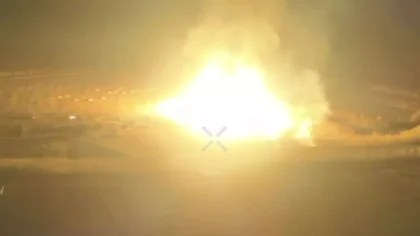
The Sudzha Gas Measuring Station, part of the Brotherhood pipeline supplying Siberian gas to Europe, was damaged in an explosion, just two days after a halt in attacks on energy infrastructure was agreed under US mediation. Sputnik asked a veteran security affairs expert how the attack will impact regional energy security.
“This is a tragic, tragic black comedy from the Ukrainian side to organize some kind of attack [on] the Sudhza gas pipeline,” Slovak Brig. Gen. (ret.) and ex-military attaché Jozef Viktorin told Sputnik, commenting on the March 20 incident.
“For me, it’s not really part of [the broader] military conflict. This is some kind of terrorist activity from the Ukrainian side,” Viktorin said, emphasizing that the consequences of the attack “will be a big problem” not only for Slovakia, but all of Europe, in terms of energy security.
Before the conflict began in 2022, Sudzha, a natural gas exchange feeder in the Brotherhood network, was able to help pump up to 32 billion cubic meters (1.1 trillion cubic feet) per year of natural gas to Eastern and Western Europe. Deliveries slowed after fighting began, and halted completely in December 2024 after Ukraine refused to renew the contract.
Following the March 20 attack, which mirrors previous Ukrainian and NATO sabotage operations targeting Russian pipeline infrastructure like the Togliatti-Odessa Ammonia in Kharkov Region and Nord Stream 2 in the Baltic Sea, it’s unclear when or if the pumping station can be restored to working conditions.
“This is about Europe. Europe and European leaders have to understand that it’s only a question of time when to start to negotiate with Russia,” Viktorin emphasized. “They will have to talk because the question of dialog between the two sides is so important for the future.
In this regard, “Ukraine will not dictate [the] steps for negotiations of Russia and Europe,” and it’s best for the Europeans to remember that, no matter their current attitudes, the observer summed up.
‘They need new eyes’: IAEA accused of bias over strikes at Europe’s largest NPP
RT | March 22, 2025
A group of international journalists that recently toured Russia’s Zaporozhye Nuclear Power Plant (ZNPP) have accused Ukraine of being the one targeting the facility. They also questioned the International Atomic Energy Agency’s (IAEA) persistent refusal to identify the source of the attacks.
The ZNPP, Europe’s largest nuclear power station, has been under Russian control since March 2022 and is located in a region that later voted to join Russia following a public referendum. The plant’s operations are now overseen by Russian state-owned nuclear power company Rosatom. According to the Russian Defense Ministry, the facility and nearby city of Energodar have come under frequent attacks by Ukrainian drones and artillery. Despite this, the IAEA, which has maintained a permanent monitoring mission at the site since September 2022, has consistently declined to name the party responsible for the shelling.
Speaking with RT after touring the facility, reporters from a number of countries, including India, Serbia and Slovenia, voiced concerns over what they said was a clear distortion of facts by Western media and the IAEA’s refusal to acknowledge the reality on the ground.
“We should never trust any Western sources… Ukrainians are playing with nuclear fire,” said Serbian journalist Miodrag Zarkovic, who criticized the IAEA’s insistence on neutrality. Indian journalist Manish Kumar Jha said the evidence he saw contradicted everything he had read in Western outlets.
“According to Western media, the Russians are attacking the plant. But when I visited, I saw the Russian security forces positioned to keep the plant safe,” Jha said, noting that he saw a fragment of a US-supplied missile near the plant. “It was a 180-degree shift. The reality is very different from the story the Western media tells.”
Slovenian journalist and blogger Mohar Borut Iztok criticized the IAEA’s stance, noting the presence of NATO-supplied 155-millimeter shells with clear markings among those that have recently struck the facility.
“I’d like to say to Mr. [Rafael] Grossi and his crew – if they need an extra set of eyes, we can help them because it’s very interesting how they cannot see what is going on,” he stated sarcastically.
“I know what the problem is. They have an agenda, a narrative to follow, so they try to stay neutral,” he added.
Geography

The Middle East
By William Schryver – imetatronink – March 21, 2025
So the US is sending Carrier Strike Group One (CVN-70 USS Carl Vinson) to the Middle East, leaving CSG-5 (CVN-73 USS George Washington) to “hold the fort” in the western Pacific from the semi-safe environs of its quasi-permanent berth in Yokosuka, Japan.
All the Washington does is sail back and forth between San Diego and Yokosuka every so often to give the impression it’s doing something meaningful. Otherwise I’ve seen no indication for several years that it is anything more than a training and parade vessel.
In any case, the Vinson is headed to the Arabian Sea, and perhaps points beyond. (That remains to be seen.)
Meanwhile the deployment of CSG-8 (CVN-75 USS Trembling Puppy) has been extended, even as it remains bottled up in the northern reaches of the Red Sea, launching air strikes on Yemen from ~1000 km away, with USAF refueling tankers at the ready as needed.
The Yemeni have launched a few modest packages of antiquated drones and antiship cruise missiles in the general direction of the Trembling Puppy – all of which have been relatively easy pickings for the cruiser and destroyers and combat air patrol.
But, keep in mind, even though these old and slow Yemeni drones and missiles have little chance of scoring a hit from 1000 km away, the carrier strike group ships and planes still have to shoot at every one of them!
So every Yemeni strike package of a couple dozen missiles will deplete CSG-8’s munitions magazines by AT LEAST a corresponding number of air defense missiles, and quite possibly TWICE as many, according to standard practice of firing two interceptors at each threat.
CSG-8’s magazine depth has already been substantially depleted over the course of the past two weeks — and remember, the US Navy cannot replenish its vertical launch systems at sea.
And, of course, if military operations against Iran are the ultimate objective, then at some point the Trembling Puppy and its entourage are going to have to leave the cozy waters between Jeddah and the Gulf of Suez, and run the gauntlet of the Gate of Lamentation (Bab el-Mandeb).
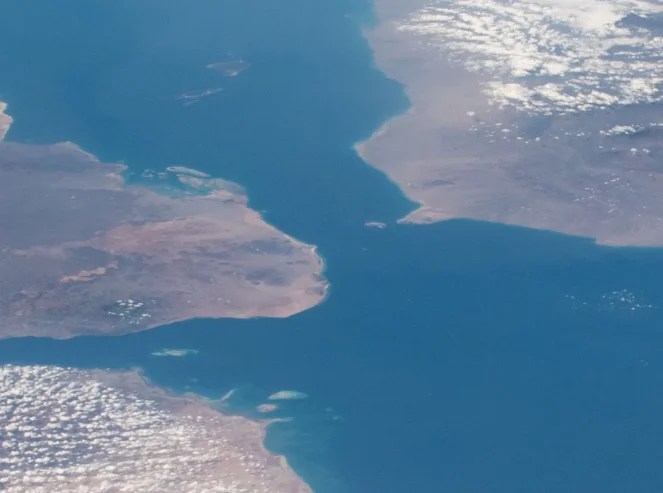
The Gate of Lamentation (Bab el-Mandeb)
That’s when things could get more interesting. Because it’s a pretty tight squeeze to pass through. A big deep-draft aircraft carrier can’t just run at full speed, zig-zagging back and forth. It has to stick to the navigable channel.

Navigable Shipping Channels in the Bab el-Mandeb
In the relatively open waters north of Jeddah, there is quite a bit of room for maneuver. But in the straits, you’re restricted to a narrow band — and most significantly, potential Yemeni missile launching sites are only ~200 km away. A more substantial strike package of 50 or so drones, antiship cruise missiles, antiship ballistic missiles, and fast boat and surface drone attacks will get there a whole lot faster, and with a much better chance of actually hitting something.
So, even though CSG-8’s odds of passing through unscathed still probably remain pretty good, there is unquestionably a considerably elevated risk compared to hiding out at the mouth of the Gulf of Suez.
But let’s suppose they sail right through the Bab el-Mandeb with minimal difficulties … then what? You join up with CSG-1 in the Arabian Sea and attempt long-distance strikes into southern Iran — strikes that would still require air-refueling to have any meaningful reach?
Because you sure as hell aren’t going to sail a couple carrier strike groups into the Persian Gulf. And anyone who believes otherwise is drowning in delusion. I mean, just look at the damn map! The Iranians have potent fire control over the passage from the Gulf of Oman, through the Strait of Hormuz, and throughout the entire Persian Gulf.
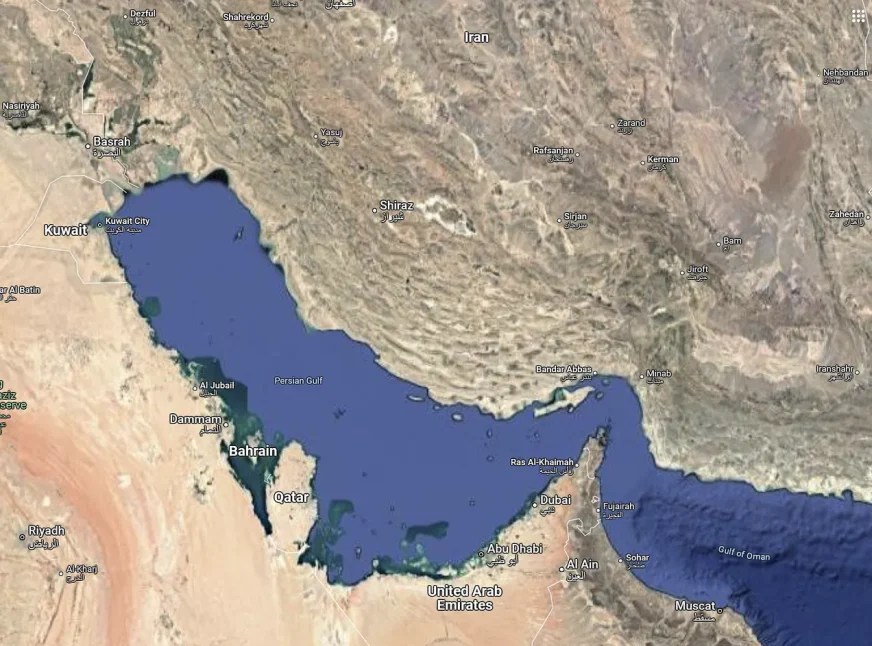
Strait of Hormuz / Persian Gulf
So I ask, in all seriousness, what exactly are two US Navy carrier strike groups going to do in the context of a no-holds-barred war against Iran?
To me, the entire concept screams of hubris running blindly into catastrophe.
If the US is foolish enough to start a big war against Iran, then 2025 is likely to demonstrate yet again that, combined with firepower, geography is the indomitable god of war.
Featured Video
America Racing to Strategic Defeat in Iran
or go to
Aletho News Archives – Video-Images
From the Archives
Should Europeans ‘Thank’ the Americans for Destroying Nord Stream?
By Robert Bridge | Strategic Culture Foundation | September 29, 2022
With an investigation continuing into the destruction of the Nord Stream gas pipeline that provided energy supplies to Europe from Russia, there appears to be just one prime suspect, and that should surprise nobody.
Following the sabotage of the Nord Stream 1 and 2 gas pipelines, former Polish Foreign Minister Radoslaw Sikorski already seemed to know the identity of the perpetrator when he tweeted out: “Thank you, USA.”
At first glance, it seemed that Sikorski was speaking sarcastically, berating Washington for carrying out an attack that will have severe repercussions for the people of Europe. After all, how could anyone see any good coming from the termination of Europe’s primary source of gas reserves with winter just around the corner? It was Sikorski’s homeland of Poland, after all, that urged its citizens to collect firewood in the face of dwindling gas reserves.
In fact, the Polish diplomat was speaking one-hundred percent literally… continue
Blog Roll
 Aletho News
- Growing insecurity, soaring prices fuel protests in north as regime bans evacuation: Sources
- Iran denies responsibility for ‘depraved’ attack on Kuwait desalination plant
- Bring The Troops Back. End This War Now!
- Can we please stop calling Israel the ‘only democracy in the Middle East’ now?
- US should start removing its troops for Germany, proposes AfD co-leader Chrupalla
- Iran Red Crescent: 600 educational centers attacked in US-Israeli ‘war crimes’
- Russian Oil Tanker Arrives in Cuba Amid U.S. Blockade
- America Racing to Strategic Defeat in Iran: Lt Col Daniel Davis
- FTC Warns Visa, Mastercard, PayPal, Stripe Over Political Debanking
- Russian tanker approaches Cuba despite US oil blockade
- If Americans Knew
- Israeli police block Catholic cardinal from entering Church of the Holy Sepulchre on Palm Sunday
- Israel is assassinating journalists again, more than any other nation, anywhere, ever – Not a ceasefire Day 170
- Over 300 US service members wounded, majority have brain injuries – Not a ceasefire Day 169
- Researchers at Human Rights Watch Resign Over Blocked Report on Palestinian Refugee Return
- Jewish Groups Are Backing a War Americans Don’t Want
- Eric Fingerhut Thinks He’s the President of the Jews
- Top Jewish Philanthropists, Rabbis Urge Israeli President to Take Action Against ‘Jewish Extremists’
- Don’t Be Fooled. Zionist Leaders Have Always Wanted to Control Southern Lebanon
- Israel’s widespread use of torture is a core element of its genocide against the Palestinian people
- In Israel’s War on Iran, Many Middle East US Bases Rendered “All But Uninhabitable”
- No Tricks Zone
- New Study Finds Warming Saves Lives…Cold Temperatures 12 Times More Deadly Than Excess Heat
- German Science Blog Accuses PIK Climate Institute Of Hallucinating Climate Tipping Points
- Devastating Assessment Of Comirnaty Vaccine By Former Senior Pfizer Europe Toxicologist
- New Study: CO2 Is ‘Effectively Negligible’ As An Explanatory Climate Change Factor Since 2000
- Former Pfizer Toxicologist Dr. Helmut Sterz Tells Bundestag Hearing Pfizer Vaccine Should Have Never Been Approved
- Energy Expert: Germany’s Nuclear Phaseout Was A “500 Billion Euro Mistake”
- New Research: South Australia’s Mid-Holocene Sea Surface Temperatures Were 4°C Warmer Than Today
- Storing Green Energy To Last Germany 10 Days Would Require A 60-Million Tonne Battery
- New Studies: UK Sea Levels Were 4 Meters Higher Than Today During The Mid-Holocene
- Destructive Green New Deal: German Energy And Metal Group Warns Of Drastic Crisis
 Aletho News