Thousands march in Paris against military aid to Ukraine
RT | March 29, 2025
 Thousands of demonstrators marched through the streets of Paris on Saturday, protesting French President Emmanuel Macron’s and NATO’s militaristic approach to the Ukraine conflict.
On Wednesday, Macron announced a new €2 billion ($2.16 billion) military aid package for Ukraine, after weeks of attempting to drum up support for his initiative to send Western troops as peacekeepers to the country. The new arms will include surface-to-air missiles, armored vehicles and drones, the French leader said.
Saturday’s anti-war rally was organized by former right-wing National Rally politician Florian Philippot and his party, The Patriots.
Thousands of protesters could be seen marching through the French capital, chanting slogans such as “Macron, we don’t want your war!” and “Let’s quickly leave NATO!” in video captured by RT.
Many could also be seen waving placards with the motto “Macron, we will not die for Ukraine.”
“A mad crowd for #Peace… Thousands and thousands of French people are shouting ‘Macron, resign!’ in the streets of Paris right now!” Philippot wrote on X on Saturday.
The Patriots protested in the French capital earlier this month after Macron proposed deploying France’s nuclear weapons in other European allied states, citing uncertainty over Washington’s commitment to the continent.
On Thursday, following an international summit in Paris, Macron announced a French-British plan to push for the deployment of troops to Ukraine as a “reassurance force” in the event of a ceasefire between Kiev and Moscow. Macron first touched on the idea of sending Western troops into Ukraine last February.
Russia has categorically ruled out agreeing to NATO troops being deployed to the conflict zone. Troops from the US-led military bloc, even under the guise of peacekeepers, would amount to direct NATO participation in the conflict, according to Moscow.
New German government wants to ban ‘lies’
Remix News | March 28, 2025
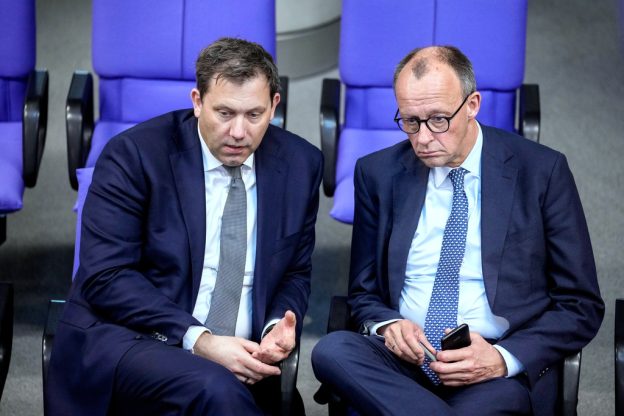
The new German government coalition, which is likely to be the Christian Democrats (CDU) and the Social Democrats (SPD) is looking to ban “lies,” according to a working paper that emerged from the group “culture and media” between the two parties.
Bild newspaper received a copy of the working paper, which outlines the goal of combating “fake” news on social media, including restrictions on it.
The paper from the CDU and SPD indicates that “disinformation and fake news” threaten democracy.
In fact, the paper argues that freedom of expression does not apply in such circumstances.
Bild contacted a number of constitutional lawyers, and they are highly skeptical of the law.
“Lies are only prohibited if they are punishable, for example in the case of sedition. Otherwise, you can lie,” said Volker Boehme-Neßler, a professor at the University of Oldenburg.
Even determining a lie is a legal complexity.
“It is not an easy question of what a factual claim and what an expression of opinion is. Most courts interpret freedom of expression very broadly,” he added.
He also took aim at a specific part of the working paper, which addresses “hate and agitation.”
He said, “‘hate and agitation’ — these are ‘no legal terms.” He added, “Basically, the spread of hatred in Germany is protected by freedom of expression. An assertion like ‘I hate all politicians,’ does not yet constitute a criminal offense.”
Another law professor from the University of Augsburg, Josef Franz Lindner, said that the “deliberate spreading of false facts is not punishable, not illegal.”
He said that if the new government moves forward with a law against “fake news,” it would represent a grave threat to freedom of speech.
He said he can only warn against a “fake news” offense being created, saying “Ultimately, it would expose any controversial statement to the risk of criminal prosecution.”
It is also worth noting that Friedrich Merz himself, who is likely to be Germany’s next chancellor, openly lied when he said that his party would [not] support an end to the debt brake. Almost immediately after the election, he said the debt brake would be lifted, and that Germany would take on historic amounts of debt.
Lawyer Joachim Steinhöfel, who has a broad range of clients related to internet censorship, says the CDU and SPD’s goal with the new paper is to “intimidate the unpopular social media” content producers. He said that such censorship already lacks a “constitutional basis.”
EU to reject Russia-US Black Sea deal – von der Leyen
RT | March 29, 2025
The EU will not lift its sanctions against Russia for as long as the Ukraine conflict continues, European Commission President Ursula von der Leyen has said.
During talks in Saudi Arabia on Monday, Russia and the US agreed to move towards reviving the Black Sea Grain Initiative, which, according to the Kremlin, should include the removal of Western restrictions against Russian Agricultural Bank and other financial institutions involved in the international sale of food and fertilizers.
In her interview with French broadcaster LCI on Friday, von der Leyen made it clear that Brussels will not support the idea of a maritime truce between Moscow and Kiev put forward by the administration of US President Donald Trump.
“The sanctions are very significant; they are painful; they have an impact on the Russian economy, and they represent a powerful lever,” she said when asked about the possibility of the EU fulfilling Russian demands to lift some of the curbs.
According to the head of the European Commission, the restrictions “will remain in effect until a just and lasting peace is established in Ukraine.”
However, she noted that “when the war is over, the sanctions might be removed.”
Von der Leyen also said that for the conflict to end, “security guarantees for Ukraine” are needed as well as “a solid defense industrial base and a deterrent force” in the EU.
The Black Sea Grain Initiative, originally brokered in July 2022 by the UN and Türkiye, envisioned the safe passage of Ukrainian agricultural products in exchange for the West lifting its restrictions on Russian grain and fertilizer exports.
Moscow withdrew from the deal a year later, citing the West’s failure to uphold its obligations. The Americans and Russians now see its revival as a step towards settling the Ukraine conflict altogether.
Earlier this week, President Vladimir Putin asserted that the Russian economy has become the fourth largest in the world in purchasing power parity terms after those of China, the US and India, despite a record 28,595 sanctions being placed on it by Washington, Brussels and their allies. According to the Russian government’s data, the country’s economy grew 4.1% in 2024, surpassing the official forecast of 3.9%.
Putin previously urged the Russian business circles against expecting the sanctions to be fully lifted, describing them as a mechanism of strategic systemic pressure on the country that the West intends to keep using.
The war over war with Iran has just begun
By Sina Toossi | Responsible Statecraft | March 28, 2025
The war drums are getting louder in Washington.
In recent weeks, many of the same neoconservative voices who pushed the U.S. into Iraq are calling for strikes on Iran. Groups like the Foundation for Defense of Democracies and the Washington Institute for Near East Policy are once again promoting confrontation, claiming there may never be a better time to act. But this is a dangerous illusion that risks derailing what Donald Trump himself says he wants: a deal, not another disastrous war in the Middle East.
A war with Iran wouldn’t just risk another endless conflict. It would blow up Trump’s broader agenda at home and abroad.
A major conflict would drain U.S. resources and attention, distracting from domestic priorities and weakening America’s leverage on every front: China, Russia, Europe, and trade. Europe could seize the moment to prolong support for the war in Ukraine and resist Trump’s push to reset transatlantic ties. Trade partners like Mexico, Canada, India, and others could take advantage of America’s preoccupation to extract lop-sided concessions. And a unilateral strike would likely fracture the international community.
Russia and China, despite their own misgivings about Iran’s nuclear ambitions, would point to U.S. aggression as the real threat, undermining American credibility at the United Nations and beyond.
And the most dangerous consequence? A strike could backfire and push Iran to do exactly what Trump says he wants to prevent: build a bomb. Iran is already enriching uranium near weapons-grade. If it withdraws from the Nuclear Non-Proliferation Treaty, the last threads of international oversight would disappear. An attack would likely galvanize even more hardline elements in Iran and provide the political justification to sprint for a nuclear weapon.
Trump could go down in history, not as the president who solved the Iran crisis, but as the one under whose watch Iran finally became a nuclear weapons state. That’s not the legacy he wants, or one the country can afford.
Raising alarms, Trump recently declared, “Something will happen to Iran soon.” But he also made clear, “Hopefully, we can have a peace deal. I’m not speaking out of strength or weakness, I’m just saying I’d rather see a peace deal than the other.” These are not the words of a warmonger. They are the words of a negotiator, someone who still sees the value in diplomacy.
Trump is not alone. In a recent interview with Tucker Carlson, his foreign policy envoy Steven Witkoff offered a notably more restrained perspective on Iran than is typical from the foreign policy establishment. Witkoff emphasized pragmatism, verification, mutual respect, and, most importantly, avoiding conflict. His remarks reflected a grounded approach rooted in a clear understanding of both American interests and the region’s complex dynamics.
The problem is that many of the loudest voices shaping Iran policy — inside and outside the government — are actively working to sabotage any realistic path to diplomacy. They talk about wanting a “deal,” but what they’re actually demanding is Iran’s surrender: zero uranium enrichment, dismantling its nuclear program, cutting ties with all its regional allies, and fundamentally changing its foreign policy. No Iranian government — pragmatist or hardliner — could accept such terms. Even Masoud Pezeshkian, Iran’s newly elected president who ran on a platform of diplomacy and engagement, would have no political space to agree to that kind of ultimatum.
Let’s be clear: if you’re pushing for such maximalist demands under the guise of wanting a deal, you’re not working for peace. You’re laying the groundwork for war.
Iran is a complicated actor with a complicated history. But the lessons of the past decade are clear: when the U.S. engages Iran through diplomacy, it gets results. When it relies solely on pressure, it inches closer to conflict.
The point of pressure has always been to create leverage, not to impose costs for their own sake. That leverage now exists. The question is what to do with it.
The 2015 nuclear deal was far from perfect for any side, but it did succeed in placing tight constraints on Iran’s nuclear program and subjected it to unprecedented international inspections. The aim of withdrawing from that deal was to compel Iran to accept stronger terms. That hasn’t happened.
Instead, the result has been several years of Iranian nuclear expansion, regional instability, and growing alignment between Tehran, Moscow, and Beijing. Iran is now enriching uranium to 60% — dangerously close to weapons-grade — and stockpiling far more than before. Meanwhile, the international consensus that once backed U.S. efforts has frayed.
Now is the time to cash in on current U.S. pressure. Not by continuing on an escalatory path that leads to war, but by using the leverage that’s been built to strike a better deal — one that delivers strong constraints, more transparency, and greater long-term security for the United States.
Against this backdrop, hawkish voices are once again pushing the illusion that striking Iran would be quick and effective. A recent report from the Washington Institute for Near East Policy (WINEP) claims Israel’s alleged deep intelligence reach and risk tolerance make a “preventive strike” against Iran potentially “much more successful” than past American efforts, like when the U.S. attacked nuclear targets in Iraq in 1991 and 1993. But this dangerously downplays the risks. Even Trump’s allies are urging caution.
Vice President J.D. Vance, for example, rightly cautioned last October that “America’s interest is sometimes going to be distinct” from Israel’s — and made clear that avoiding war with Iran is in the U.S. interest. He warned such a conflict would be “massively expensive” and a “huge distraction of resources.” The reality is that a strike might at best delay Iran’s program while likely sparking a regional war, endangering U.S. troops, and pushing Iran to weaponize.
Indeed, even the same WINEP report that touts the feasibility of a strike quietly acknowledges the scale of what it would entail: “an open-ended, multiyear campaign to degrade Iran’s nuclear capabilities, influence its nuclear proliferation calculus, and shape its political and military responses.” In other words, this wouldn’t be a quick, surgical strike; it would be the beginning of another endless war in the Middle East.
Such a conflict would also carry steep economic costs, from skyrocketing oil prices to instability across the Middle East. And it would almost certainly backfire politically: Americans are war-weary, and polls show overwhelming support for diplomacy over conflict.
What’s needed now is a pragmatic strategy to de-escalate and reengage — one that offers Iran credible incentives in exchange for verifiable nuclear limits but doesn’t require dismantling its entire program.
The Iranian leadership has shown a consistent pattern in its dealings with the United States: pressure is met with pressure, while concessions are met with reciprocal steps. History has made clear that what moves the needle is not ultimatums, but a formula grounded in mutual respect, trust-building, and incremental, verifiable actions. Witkoff’s recent interview signaled a welcome openness to serious diplomacy, but rhetoric alone is not enough. To resonate in Tehran, it must be paired with credible, calibrated actions.
Modest, realistic steps — such as allowing a limited release of Iran’s frozen assets for humanitarian purposes or reviving President Emmanuel Macron’s 2019 proposal for a credit line backed by future oil revenues — would not require lifting core U.S. sanctions. Yet they could offer enough tangible benefit to bring Iran to the table. These measures should be linked to parallel Iranian concessions, such as slowing the accumulation of highly enriched uranium and enhancing IAEA access.
Another option is a negotiated “pause:” a fixed-duration agreement where the U.S. freezes further escalation of sanctions and refrains from imposing new pressure, while Iran halts key elements of its nuclear expansion. This mutual freeze could serve as a time-bound window for more comprehensive talks — buying time, lowering tensions, and creating space for diplomacy to succeed.
Critics will claim this approach “rewards bad behavior.” But the real question isn’t about rewarding anyone, it’s about results. What actually reduces the risk of Iran getting a nuclear weapon or dragging the U.S. into another endless war? The record speaks for itself: pressure detached from feasible diplomatic outcomes hasn’t delivered results. In fact, pressure for its own sake has backfired — driving Iran’s nuclear program forward and repeatedly bringing the U.S. to the brink of conflict.
Some will say Iran cannot be trusted. That’s precisely why inspections and verification are essential. When a deal was in place, international inspectors had access to Iran’s nuclear facilities, and the program was significantly constrained. Military strikes, by contrast, would likely end all transparency and push Iran to withdraw from the Non-Proliferation Treaty, eliminating the last tools for monitoring and oversight.
There’s no perfect deal. But the smart play is a deal that contains Iran’s nuclear program, avoids a war, and keeps the U.S. in the driver’s seat. That should be the goal of any serious policy, not wishful thinking or ideological crusades.
President Trump has always seen himself as a dealmaker. Now’s the moment to make one that matters. He should empower voices in his camp — like Steven Witkoff — who understand that diplomacy isn’t weakness, it’s strategy. Rejecting the tired playbook of regime change and endless escalation would show real leadership.
Sina Toossi is a non-resident fellow at the Center for International Politics. Previously he was senior research analyst at the National Iranian American Council, and a research specialist at Princeton University’s Woodrow Wilson School of Public and International Affairs.
EU ‘preparing for war’ – Hungarian FM
RT | March 29, 2025
Hungarian Foreign Minister Peter Szijjarto has accused Brussels bureaucrats of clinging to a “failed pro-war policy” in a desperate attempt to delay the moment when European taxpayers begin asking where the money spent on bankrolling Kiev has gone.
The European Union recently advised its 450 million inhabitants to stockpile essential supplies for at least 72 hours, with EU Commissioner for Crisis Management Hadja Lahbib warning on Wednesday that the Ukraine conflict threatens the bloc’s overall security.
Szijjarto said he initially thought the warning was some kind of joke or “trolling,” after Lahbib posted a bizarre video showing Europeans what to pack in a 72-hour survival kit.
“But why, in the 21st century, should EU citizens prepare a survival kit? There’s only one explanation: Brussels is preparing for war,“ Szijjarto wrote in a post on X on Friday. “At a time when there’s finally a real chance for a ceasefire and meaningful peace talks with [President Donald Trump’s] return to office, Brussels is going in the opposite direction, clinging to a failed pro-war policy.”
“Why? Because as long as the war continues, pro-war European politicians can avoid taking responsibility for three years of failure, and avoid answering an extremely uncomfortable question: where is the money that was sent to Ukraine?”
EU institutions in Brussels and individual member states have spent over €132 billion over the past three years supporting Kiev, and have pledged an additional €115 billion that has yet to be allocated, according to data from Germany’s Kiel Institute.
Since taking office, US President Donald Trump has pushed for a diplomatic resolution and sought to recoup what he estimates to be over $300 billion in US taxpayer money that his predecessor “gifted” to Kiev. Washington recently brokered a limited ceasefire between Ukraine and Russia, placing a moratorium on attacks on energy infrastructure. Kiev, however, has repeatedly breached the ceasefire terms, according to Moscow.
Despite the ongoing peace process, the EU has continued to push a hawkish agenda. European Commission President Ursula von der Leyen recently unveiled an €800 billion plan to ramp up military spending through loans.
Meanwhile, France and the UK continue to advocate for the deployment of a military contingent to Ukraine. Speaking after a summit in Paris on Thursday, French President Emmanuel Macron announced that a so-called “coalition of the willing” will seek to deploy a “reassurance force” to Ukraine after a peace deal with Russia is reached.
The proposal to send troops has already been rejected by several EU members. The “coalition of the willing” – a phrase originally coined by the US in 2003 to describe countries backing the invasion of Iraq – now mostly refers to states that have pledged to continue supporting Kiev militarily, without necessarily committing to troop deployments.
A Third Way to end the war in Ukraine
By M. K. BHADRAKUMAR | Indian Punchline | March 29, 2025
In an unguarded moment, perhaps, ex-UK Prime Minister Boris Johnson blurted out recently in an interview that the ultranationalist elements who rule the roost in Kiev are a formidable obstacle to ending the war in Ukraine. For Johnson, this might be a blame game to absolve himself of responsibility, given his own dubious role as then PM (in cahoots with President Joe Biden) in undermining the Istanbul agreement in April 2022 to rev up the simmering conflict and turn it to a full-fledged US-led proxy war against Russia.
What Johnson will not admit, though, is that the ascendance of the MI6, Britain’s intelligence agency, in the power structure in Kiev goes back by several years. MI6 was responsible for the personal security of President Zelensky. MI6 took advantage by positioning itself to choreograph the future trajectory of the war and subsequently in the planning and execution of major covert operations directed against the Russian forces — and ultimately to carry the war into Russian soil itself.
According to reports, the UK intends to establish a base in the Odessa region on the Black Sea coastline. See my article The Hundred Years War Donald Trump should know about, Deccan Herald, January 29, 2025.
So, indeed, the MI6’s unholy alliance with the notorious Azov militia units comprising Ukrainian ultra-nationalists fired up by neo-Nazi ideology who wield control of the power apparatus in Kiev even today, is a key factor in the war, which complicates the prospects for President Trump’s efforts to end the war. Suffice to say, Britain’s strategic defiance of Trump with PM Keir Starmer string up of an insurgency among Europeans to pre-empt any US-Russia rapprochement is a calculated strategy.
Hopefully, President Trump’s decision Tuesday to order the FBI to forthwith declassify files concerning Crossfire Hurricane investigation may throw some light on the so-called Steele dossier (named after an ex-MI6 officer) containing doctored ‘evidence’ that had formed the basis of Hillary Clinton’s fake allegation that the Trump campaign colluded with Russia to influence the 2016 US election cycle.
Reports had appeared, incidentally, that incumbent president Barack Obama and then vice-president Biden were very much in the loop on the Russia hoax.
The point is, the entrenched neo-Nazi groups in Kiev, with Zelensky as their frontman, are not in the least interested in budging from their maximalist demands on a total Russian withdrawal and so on for ending the war, which are backed by the Europeans unconditionally who would know fully well that such hopelessly unrealistic demands are deal breakers. The Kiev regime and European leaders are joined at the hips as interest groups in the war continuing.
Put differently, so long as the regime in Kiev remains in power (although Zelensky’s presidential term has expired), any forward movement in the peace process will remain a pipe dream.
The best course of action would be that Zelensky steps down on his own volition and a fresh election is allowed to be held under the supervision of the parliament speaker but all that is too much to expect. Given the massive scale of war profiteering, Zelensky holds a dream job.
The alternative will be Zelensky’s ouster through coercive means as the US once did to an equally corrupt proxy, Ngo Dinh Diem, in 1963 during the Vietnam War. But Trump is unlikely to do that. And in any case, the deep state is hostile towards Trump and Zelensky gets political support from Democrats.
Besides, Zelensky’s violent exit may only bring in another figure with neo-Nazi backing to power. In fact, the ex-army chief Valerii Zaluzhnyi, who also has MI6 support, is waiting in the wings in London serving as Ukraine’s envoy.
In such a dismal scenario, the only way out seems to be a Third Way. Russian President Vladimir Putin may have proposed just that in a speech in Mumansk on Thursday possibly to draw Trump’s attention, as the Riyadh talks are not getting anywhere and Zelensky shows no signs of interest in a ceasefire.
Putin said at the outset, “I would like to state – first and foremost – that, in my view, the newly elected President of the United States sincerely wishes to end this conflict for a number of reasons – I will not list them now, as they are numerous. But in my opinion, this aspiration is genuine.”
He then worked his way to the issue of the neo-Nazi formations who receive western weaponry and financial aid and have the resources to recruit new personnel, holding de facto power in Kiev and are effectively running the country. Putin stated: “This raises the question: how is it possible to conduct negotiations with them?”
Clearly, the Russians are sceptical of the outcome of the expert level talks in Riyadh last Monday. The European summit in Paris 3 days later had vowed not to relax the sanctions against Russia or to give Russian banks access to the SWIFT clearing system. In short, the exports of Russian agricultural products and fertilisers to the world market is not going to be feasible. Kiev has already raised objection to the US-Russian understanding in this regard.
Simply put, an important element in the so-called Black Sea initiative is not workable. How to cut the Gordian knot?
Taking stock of Kiev’s all-round resistance to ending the war, Putin said:
“In such situations, international practice follows a well-established path. Within the framework of the United Nations peacekeeping operations, there have been several cases of what is termed external governance or temporary administration. This occurred in East Timor, I believe in 1999, in parts of the former Yugoslavia, and in New Guinea. In short, such precedents exist.
“In principle, it would indeed be possible to discuss, under UN auspices with the United States and even European countries – and certainly with our partners and allies – the possibility of establishing a temporary administration in Ukraine. To what end? To conduct democratic elections, to bring to power a competent government that enjoys public trust, and only then to begin negotiations on a peace treaty and sign legitimate agreements that would be recognised worldwide as consistent and reliable.
“This is just one option; I do not claim that others do not exist. They certainly do. At present, there is no opportunity – and perhaps no possibility – to lay out every detail, as the situation is evolving rapidly. But this remains a viable option, and such precedents exist within UN practice…”
What Putin didn’t mention but is equally relevant is that the war in Ukraine will meet with sudden death the moment UN governance in Ukraine gets established. Indeed, let the UN decide the composition of any peacekeeping forces to be deployed in Ukraine for conducting elections. There won’t be any need for a ‘coalition of the willing’ of Europeans for deployment in Ukraine, either.
Of course, the big losers will be MI6 and the politicians in power in the EU countries who lined up behind Biden as his retinue to wage a doomed proxy war against Russia and eventually ended up bringing the roof down on Europe’s economy. These decrepit politicians need the war as a distraction since they will be held horribly accountable by their public for creating conditions under which the welfare state is no longer affordable.
The Chinese foreign minister Wang Yi is expected to visit Moscow next week on Tuesday. It is entirely conceivable that the topic of UN governance in Ukraine will figure in Wang Yi’s talks.
Featured Video

The 1964 Coup in Brazil
or go to
Aletho News Archives – Video-Images
Frlom the Archives
70 Neocons Petition Congress To Effectively Allow Israel To Say When The US Should Attack Iran
By Damian Lataan | January 10, 2014
Seventy senior Israeli-centric neoconservatives have written an open letter to Congress imploring them to do more to ensure Iran complies with the conditions of any agreement finally reached with the P5+1 over Iran’s nuclear program.
While the neocons are ostensibly asking Congress to ensure compliance, it is clear that their real aim is to convince members of Congress to support the bill currently passing through the Senate which calls for tighter sanctions against Iran in the event of any waywardness on Iran’s part.
The neocons are eager to see the bill currently passing through the Senate with enough support to make it veto-proof, not so much because they are concerned about Iran’s so-called nuclear weapons program – there’s still not a skerrick of hard evidence that Iran has a nuclear weapons program – but, rather, because embedded within the bill is this clause:
… if the Government of Israel is compelled to take military action in legitimate self-defense against Iran’s nuclear weapon program, the United States Government should stand with Israel and provide, in accordance with the law of the United States and the constitutional responsibility of Congress to authorize the use of military force, diplomatic, military, and economic support to the Government of Israel in its defense of its territory, people, and existence…
Essentially, the clause is an automatic trigger for the US to attack Iran at any time the Israelis choose to launch a first strike – regardless of whether President Obama is in favour or not.
Partial list… continue
Blog Roll
 Aletho News
- Aramco CEO warns ‘catastrophe’ imminent if Strait of Hormuz remains shut
- What If Iran Says No?
- Trump Threatens to ‘Hit’ Iran ‘Twenty Times Harder’ Over Strait of Hormuz Oil Flows
- Spare the hypocrisy: Baghaei slams Ursula’s support for US
- Iran War Supporters Invent a New and Absurd Justification: It Is All About China
- Corporate Media Go All Out To Support The US-Israeli War on Iran
- Trump press conference reveals a man who wants out of war
- When Tel Aviv decides, Washington fights
- Top official: Iran ready for a long war with US, no more diplomacy
- How Iran’s Toxic Rain Reveals US-Israel Discord
- If Americans Knew
- Threats and missiles fly, death tolls soar in Iran, Lebanon, Gaza – Not a ceasefire Day 151
- Lebanon: Israel’s White Phosphorous Use Risks Civilian Harm
- Corporate Media Go All Out To Support The US-Israeli War On Iran
- US-Israel war on Iran is creating a steady growing number of amputees
- Israel planned this war on Iran for 40 years. Everything else is a smoke screen
- The wrong question about the war in Iran
- ‘Your Tax Dollars Being Used to Raise Your Gas Prices’: US-Israel Bomb Major Iranian Oil Depots
- ‘Bogus Evidence’: Former Nuclear Watchdog Head Debunks US Justification for Iran War
- EXPLAINER – Dimona: What to know about Israel’s nuclear site
- Fires and toxic air in Iran (thanks, Israel) – Not a ceasefire Day 150
- No Tricks Zone
- Wake-up Call: Survey Shows Majority Of Germans Now Favor Postponing Climate Targets!
- Televised! Leading German Political Candidate Tells Schoolchildren CO2 Makes Sun Hotter!
- New Study: A Century Warming Of 1.1°C Is ‘Commonplace’ And ‘Not Unusual’ During This Interglacial
- New Study: ‘Internal Noise’ And Volcanic Forcing Can Trigger 10-15°C Warming Within Decades
- Glaciers Worldwide Are Suddendly Surging, Experts Blame Warming!
- Surprising Discovery: Sahara Is Greening…Billions Of Trees Where Once Thought To Be Barren
- New Research Reaffirms Clouds, Aerosols, And Surface Solar Radiation Are ‘Driving The Climate System’
- Germany: Electric Car Catches Fire At Charging Station, Sets Off Local “Inferno”, Widespread Damage
- New Study: Canada’s New Brunswick Was 1°C Warmer Than Today During The Medieval Warm Period
- Coal Power Back In Trend As Globe Tries To Keep Pace With Growing Demand For Power
 Aletho News