Lebanon front: Why the US-Israeli war isn’t over
The Cradle | April 7, 2025
The Israeli war on Lebanon is far from over. Southern Lebanon, the Beqaa Valley, and Beirut’s southern suburbs remain open territory for Tel Aviv’s assassination operations targeting Hezbollah cadres. Barely a day goes by without an Israeli drone carrying out a targeted killing or detonation.
Israeli drones rarely leave the skies over the south or the Beqaa – whether engaged in intelligence gathering or circling for a kill. Alongside this, western diplomats warn the Lebanese government that Israel is preparing for another round of violence to pressure Hezbollah into disarmament – unless a specific timetable is set for handing its weapons to the Lebanese Armed Forces (LAF).
Disarmament by drone
As Tel Aviv’s key supporter on the global stage, Washington calculates that reigniting war will force Hezbollah’s support base to turn against it, pushing for disarmament once its weapons are seen as ineffective in deterring Israeli aggression.
This narrative is promoted through media outlets and social media influencers seeking to normalize this outcome. Even some Lebanese politicians have begun echoing these talking points in interviews.
In contrast, a counter-reading among security officials suggests the occupation state stands to gain little more than what it already has in the war. It can assassinate Hezbollah personnel at will, without prompting retaliation on settlements, given Hezbollah’s declared commitment to the ceasefire and its alignment with the Lebanese state.
Why, then, would Israel risk disrupting the truce and endangering its own population – especially when its stated goal of Hezbollah’s disarmament is far from guaranteed and the cost remains unknown?
A strategy without teeth
Two scenarios are being floated for the handover of arms. The first sees Hezbollah voluntarily relinquishing its weapons – something party officials call impossible. In fact, Hezbollah’s base has become even more entrenched in its support for the resistance’s weapons, particularly after the massacres they saw in Syria’s Alawite coastal villages.
There, extremist factions tied to Hayat Tahrir al-Sham (HTS) and the new Syrian intelligence forces slaughtered thousands of civilians based solely on their sectarian identity. Many now see existential threats emanating both from Israel and the extremist Islamist government in Syria.
The second scenario hinges on adopting a national defense strategy under Lebanese army leadership. This is a concept Lebanese President Joseph Aoun often brings up, with talk of Hezbollah transferring its arsenal to the army and integrating its fighters into the military institution to form a unified national defense force.
Yet here, a critical fact is omitted: the Lebanese army consistently destroys all missiles it seizes from Hezbollah positions south of the Litani River – particularly Almas and Kornet systems. Sources speaking to The Cradle reveal that international observers attend and sometimes film these destruction processes.
Ceasefire in name only
According to the sources, the army follows explicit US directives in destroying these capabilities. The aim is clear: keep Lebanon’s army weak and incapable of forming any real deterrent against its aggressive southern neighbor.
Washington has no intention of allowing Hezbollah’s military assets to be transferred to the national army. Lebanon’s compliance with this plan spells the death of any genuine defense strategy – and the country’s new US-backed president, fresh from his post as commander of the LAF, well knows this.
US dictates go further than just weapons destruction. Beirut also refuses to condemn Israel’s repeated breaches of the ceasefire. Since the truce was signed on 27 November 2024, Israel has racked up over a thousand violations and killed more than 100 Lebanese civilians and soldiers.
Diplomacy has failed to halt these aggressions or compel Tel Aviv to withdraw from five occupied sites inside Lebanese territory, nor has Israel complied with UN Secretary-General Antonio Guterres’s request to halt the use of warplanes and drones over Lebanon.
In response to these thousand-plus violations, only three incidents of rocket or missile fire have been recorded from Lebanese territory into Israel – yet Tel Aviv’s retaliation has been ferocious.
Following the latest rocket fire, Israel bombed Beirut’s southern suburbs. Israeli Prime Minister Benjamin Netanyahu is keen to impose a clear, new military equation on its northern neighbor: any rocket launched toward Israel will carry an exorbitant cost for Lebanon. Tel Aviv is using disproportionate violence to deter further attacks.
The US, meanwhile, has pinned responsibility on Lebanon for preventing rocket launches from its territory. In response, Lebanese security services carried out a series of arrests. Ten suspects were detained in total – seven by army intelligence (three Lebanese, two Syrians, and two Palestinians) and three by General Security (two Lebanese and one Syrian).
However, none of the 10 have any proven connection to the rocket launches – they were arrested solely for being near the launch sites, according to technical evidence. In other words, the detainees are all likely innocent of the so-called “crime” of rocket fire.
A manufactured pretext?
With Lebanese agencies unable to apprehend any of the actual perpetrators, two scenarios remain. One is that Israel, through its local collaborators, is staging these rocket attacks to create a pretext for military escalation – especially given its near-total aerial control over the south, which makes undetected launches virtually impossible.
Proponents of this theory argue that Tel Aviv sees an opportunity – perhaps its last – to eliminate Hezbollah once and for all, buoyed by the international climate’s indifference to mass violence, as seen in Gaza. The severing of Hezbollah’s supply lines after the fall of former president Bashar al-Assad’s government in Syria only reinforces this belief.
The second scenario is that Hezbollah or a Palestinian faction is indeed behind the launches. Some even suggest rogue elements acting without organizational approval. Given the known launch zones, only three actors are considered possible: Israel, Hezbollah, or a third group operating with Hezbollah’s awareness.
A war without end
If Israel’s complicity is ruled out, it means the southern front is unlikely to quiet down, regardless of how much violence Tel Aviv uses as deterrence. Any future war, no matter how destructive to Hezbollah’s arsenal, will not prevent southern Lebanon from becoming an open arena for all factions, organizations, and lone actors.
After all, despite the near-total destruction of Gaza following Operation Al-Aqsa Flood on 7 October 2023, Israel has failed to stop rocket fire from Palestinians continuing to resist the carnage. This very dynamic threatens the northern front, leaving Israeli settlers vulnerable and placing massive pressure on the Israeli government – now in its third year of a war, with no tangible victory in sight.
Tel Aviv has neither eliminated the threat nor secured its settlers close to the border areas – and it knows it cannot stop the rockets. Meanwhile, Hezbollah’s patience with Israeli violations is wearing thin. The resistance is steadily rebuilding its military capacity.
When it is ready – once diplomacy is dead, and the Lebanese resistance’s legitimacy is renewed by continued Israeli occupation and daily atrocities – Hezbollah will not hesitate to respond. That will happen once the US-backed Lebanese government and army show they have zero ability to counter aggression – ironically, an outcome created entirely by the US-backed Israeli attacks on Lebanon.
G4S Mercs Guarding Zelensky: Private Military Contractor or Undeclared Branch of SAS and MI6?
By Ilya Tsukanov – Sputnik – 07.04.2025
Once touting itself as “the only international security solutions provider in Ukraine,” G4S has deployed up to 1,000 mercenaries to protect the West’s client state. Here’s what to know about them.
Headquartered in London and staffed by over 800K personnel across 85+ countries, G4S is a private security behemoth with a flair for hiring ex-military and intel officers.
A subsidiary of US private security giant Allied Universal since 2021, G4S has been an indispensable contractor for Western military ops, from Afghanistan and Iraq (where they were accused of paying off the Taliban and plundering religious sites in Mosul), to post-Gaddafi Libya, Sudan and Colombia (mercenary recruitment and training) and Israel (“security” at checkpoints, West Bank settlements and prisons).
G4S entered Ukraine in the mid-1990s, providing security consulting and investigative services for private clients, and guards for OSCE and EU missions. An Odessa-registered subsidiary was created in 1995, followed by a Kiev branch registered in Amsterdam in 1996.
G4S’s Ukraine footprint grew dramatically after the 2014 coup, and especially after 2022, with its mercs tasked with:
- “securing” strategic facilities like ports, airports and major enterprises,
- guarding valuable cargoes during shipping,
- collecting intel on Russian military personnel,
- training saboteurs,
- operating private prisons (allegedly),
- and providing “protective services” for top government officials and private VIPs, including the Ukrainian president’s office and Kiev’s city administration.
In 2023, the firm registered new sub-entities in Ukraine: G4S Ordnance Management and G4S Risk Management.
Prominent Russian military observer Alexander Artamonov suspects that G4S is private only in name, and that it and other prominent British PMCs like Prevail Partners are effectively an informal or undeclared branch office of Britain’s SAS and MI6.
The convenience of such PMC arrangements include plausible deniability when things go wrong, and involvement in activity which governments may not want to be openly associated with.
‘Break-a-Leg’ (that old Mafia warning) – Trump has threatened Iran over an ultimatum that likely cannot be met
By Alastair Crooke | Strategic Culture Foundation | April 7, 2025
Trump’s ultimatum to Iran? Colonel Doug Macgregor compares the Trump ultimatum to Iran to that which Austria-Hungary delivered to Serbia in 1914: An offer, in short, that ‘could not be refused’. Serbia accepted nine out of the ten demands. But it refused one – and Austria-Hungary immediately declared war.
On 4 February, shortly after his Inauguration, President Trump signed a National Security Presidential Memorandum (NSPM); that is to say, a legally binding directive requiring government agencies to carry out the specified actions precisely.
The demands are that Iran should be denied a nuclear weapon; denied inter-continental missiles, and denied too other asymmetric and conventional weapons capabilities. All these demands go beyond the NPT and the existing JCPOA. To this end, the NSPM directs maximum economic pressure be imposed; that the U.S. Treasury act to drive Iran’s oil exports to zero; that the U.S. work to trigger JCPOA Snapback of sanctions; and that Iran’s “malign influence abroad” – its “proxies” – be neutralised.
The UN sanctions snapback expires in October, so time is short to fulfil the procedural requirements to Snapback. All this suggests why Trump and Israeli officials give Spring as the deadline to a negotiated agreement.
Trump’s ultimatum to Iran appears to be moving the U.S. down a path to where war is the only outcome, as occurred in 1914 – an outcome which ultimately triggered WW1.
Might this just be Trump bluster? Possibly, but it does sound as if Trump is issuing legally binding demands such that he must expect cannot be met. Acceptance of Trump’s demands would leave Iran neutered and stripped of its sovereignty, at the very least. There is an implicit ‘tone’ to these demands too, that is one of threatening and expecting regime change in Iran as its outcome.
It may be Trump bluster, but the President has ‘form’ (past convictions) on this issue. He has unabashedly hewed to the Netanyahu line on Iran that the JCPOA (or any deal with Iran) was ‘bad’. In May 2014, Trump withdrew the U.S. from the JCPOA at Netanyahu’s behest and instead issued a new set of 12 demands to Iran – including permanently and verifiably abandoning its nuclear programme in perpetuity and ceasing all uranium enrichment.
What is the difference between those earlier Trump demands and those of this February? Essentially they are the same, except today he says: If Iran “doesn’t make a deal, there will be bombing. It will be bombing the likes of which they have never seen before”.
Thus, there is both history, and the fact that Trump is surrounded – on this issue at least – by a hostile cabal of Israeli Firsters and Super Hawks. Witkoff is there, but is poorly grounded on the issues. Trump too, has shown himself virtually totalitarian in terms of any and all criticism of Israel in American Academia. And in Gaza, Lebanon and Syria, he is fully supportive of Netanyahu’s far-right provocative and expansionist agenda.
These present demands regarding Iran also run counter to the 25 March 2025 latest annual U.S. Intelligence Threat Assessment that Iran is NOT building a nuclear weapon. This Intelligence Assessment is effectively disregarded. A few days before its release, Trump’s National Security Adviser, Mike Waltz clearly stated that the Trump Administration is seeking the “full dismantlement” of Iran’s nuclear energy program: “Iran has to give up its program in a way that the entire world can see”, Waltz said. “It is time for Iran to walk away completely from its desire to have a nuclear weapon”.
On the one hand, it seems that behind these ultimata stands a President made “pissed off and angry” at his inability to end the Ukraine war almost immediately – as he first mooted – together with pressures from a bitterly fractured Israel and a volatile Netanyahu to compress the timeline for the speedy ‘finishing off’ of the Iranian ‘regime’ (which, it is claimed, has never been weaker). All so that Israel can normalise with Lebanon –and even Syria. And with Iran supposedly ‘disabled’, pursue implementation of the Greater Israel project to be normalised across the Middle East.
Which, on the other hand, will enable Trump to pursue the ‘long-overdue’ grand pivot to China. (And China is energy-vulnerable – regime change in Tehran would be a calamity, from the Chinese perspective).
To be plain, Trump’s China strategy needs to be in place too, in order to advance Trump’s financial system re-balancing plans. For, should China feel itself besieged, it could well act as a spoiler to Trump’s re-working of the American and global financial system.
The Washington Post reports on a ‘secret’ Pentagon memo from Hegseth that “China [now] is the Department’s sole pacing threat, [together] with denial of a Chinese fait accompli seizure of Taiwan — while simultaneously defending the U.S. homeland”.
The ‘force planning construct’ (a concept of how the Pentagon will build and resource the armed services to take on perceived threats) will only consider conflict with Beijing when planning contingencies for a major power war, the Pentagon memo says, leaving the threat from Moscow largely to be attended by European allies.
Trump wants to be powerful enough credibly to threaten China militarily, and therefore wants Putin to agree speedily to a ceasefire in Ukraine, so that military resources can quickly be moved to the China theatre.
On his flight back to Washington last Sunday evening, Trump reiterated his annoyance toward Putin, but added “I don’t think he’s going to go back on his word, I’ve known him for a long time. We’ve always gotten along well”. Asked when he wanted Russia to agree to a ceasefire, Trump said there was a “psychological deadline” – “If I think they’re tapping us along, I will not be happy about it”.
Trump’s venting against Russia may, perhaps, have an element of reality-TV to it. For his domestic audience, he needs to be perceived as bringing ‘peace through strength’ – to keep up the Alpha-Male appearance, lest the truth of his lack of leverage over Putin becomes all too apparent for the American public and to the world.
Part of the reason for Trump’s frustration too, may be his cultural formation as a New York businessman; that a deal is about first dominating the negotiations, and then quickly ‘splitting the difference’. This, however, is not how diplomacy works. The transactional approach also reflects deep conceptual flaws.
The Ukraine ceasefire process is stalled, not because of Russian intransigence, but rather because Team Trump has determined that achieving a settlement in Ukraine comes firstly through insisting on a unilateral and immediate ceasefire – without introducing temporary governance to enable elections in Ukraine, nor addressing the root causes of the conflict. And secondly, because Trump rushed in, without listening to what the Russians were saying, and/or without hearing it.
Now that initial pleasantries are over, and Russia is saying flatly that current ‘ceasefire’ proposals simply are inadequate and unacceptable, Trump becomes angry and lashes out at Putin, saying that 25% tariffs on Russian oil could happen ANY moment.
Putin and Iran are both now under ‘deadlines’ (a ‘psychological’ one in Putin’s case), so as to enable Trump to proceed with credibly threatening China to come to a ‘deal’ soon – as the global economy is already wobbling.
Trump fumes and spits fire. He tries to hurry matters along by making a big show of bombing the Houthis, boasting that they have been hit hard, with many Houthi leaders killed. Yet, such callousness towards Yemeni civilian deaths sits awkwardly with his claimed heart-rendering empathy for the thousands of ‘handsome’ Ukrainian young men needlessly dying on the front lines.
It all becomes reality-TV.
Trump threatens Iran with “bombing [the] likes of which they have never seen before” over an ultimatum that likely cannot be met. Simply put, this threat (which includes the possible use of nuclear weapons) is not given because Iran poses a threat to the U.S. It does not. But it is given as an option. A plan; a ‘thing’ placed calmly on the geo-political table and intended to spread fear. “Cities full of children, women, and the elderly to be killed: Not morally wrong. Not a war crime”.
No. Just the ‘reality’ that Trump takes the Iranian nuclear programme to be an existential threat to Israel. And that the U.S. is committed to using military force to eliminate existential threats to Israel.
This is the heart to Trump’s ultimatum. It owes to the fact that it is Israel – not America, and not the U.S. intelligence community – that views Iran as an existential threat. Professor Hudson, speaking with direct knowledge of the background policy (see here and here) says, “it’s NOT just that Israel as we know it – must be safe and secure and free from terrorism”. That’s Trump and his Team’s ‘line’; that’s the Israeli and its supporters narrative too. “But the mentality [behind it] is different”, Hudson says.
There are some 2-3 million Israelis who see themselves as destined to control all of what we now call the Middle East, the Levant, what some call West Asia – and others call “Greater Israel”. These Zionists believe that they are mandated by God to take this land – and that all who oppose them are Amalek. They believe the Amalek to be consumed with an overwhelming desire to kill Jews, and who therefore should be annihilated.
The Torah records the story of Amalek: Parshat Ki Teitzei, when the Torah states, machoh timcheh et zecher Amalek—that we must erase Amalek’s memory. “Every year we [Jews] are obligated to read – not how God will destroy Amalek – but how we should destroy Amalek”. (Though many Jews puzzle how to reconcile this mitzvah with their ingrained contrarian values of compassion and mercy).
This commandment in the Torah is in fact one of the key factors that lies at the root of Israel’s obsession with Iran. Israelis perceive Iran as an Amalek tribe plotting to kill Jews. No deal, no compromise therefore is possible. It is also, of course, about Iran’s strategic challenge (albeit secular) to the Israeli state.
And what has made the Trump ultimatum so pressing in Washington’s view – apart from the China-pivot considerations – was the assassination of Sayyed Hassan Nasrallah. That assassination marked a big shift in U.S. thinking, because, before that, we inhabited an era of careful calculation; incremental moves up an escalator ladder. What is understood now is that ‘we’re no longer playing chess’. There are no rules anymore.
Israel (Netanyahu) is going hell-for-leather on all fronts to mitigate the divisions and turmoil at home in Israel through igniting the Iranian front – even though this course might well threaten Israel’s destruction.
This latter prospect marks the reddest of ‘red lines’ to ingrained Deep State structures.
‘Unnecessary’ to tell the truth to Ukrainians – Kiev’s spy chief
RT | April 7, 2025
Ukrainians should be kept in the dark about the details of the “harsh reality” of the conflict with Russia, because many of them can’t handle the truth, Kirill Budanov, Kiev’s military intelligence chief, has said.
In a conversation with journalist Anna Maksimchuk on Saturday, the three-star general expressed his views on information censorship during wartime, suggesting that Ukrainian society should only find out certain things in the future.
”During wartime, knowing the whole truth is not necessary. Otherwise, people may develop opinions,” Budanov said. “Some minds are not prepared to grasp the harsh reality. Let’s not put them to the test. Everything should be dosed.”
Since 2020, Budanov has led the Main Directorate of Intelligence of the Ukrainian Defense Ministry (HUR) – an agency reportedly rebuilt from scratch by the CIA following the 2014 armed coup in Kiev to serve as a tool against Russia.
Prior to the escalation of hostilities with Russia in 2022, Ukraine’s Vladimir Zelensky cracked down on critical media, claiming to do so in order to fight against local oligarchs under Moscow’s influence.
During the conflict, Kiev launched a news marathon with programming said to be directly controlled by the president’s office – which critics have called state propaganda. Additionally, under martial law, Zelensky banned several opposition parties, claiming they posed a national security threat.
Earlier this year, turmoil swept through Ukraine’s media landscape following US President Donald Trump’s decision to dismantle the US Agency for International Development (USAID), an organization used by Washington to promote its political agenda through foreign grants.
Researcher Oksana Romanyuk estimated in January that nearly 90% of Ukrainian outlets relied on foreign aid, with 80% specifically receiving funding from USAID.
Republican Voters on Ukraine Aid: Time to Turn Off the Cash Spigot – Poll
Sputnik – 07.04.2025
Unlike 83% of Democrats who continue to support pumping US financial aid to Ukraine, 79% of Republicans oppose such spending, a Wall Street Journal survey revealed.
The survey, carried out among 1,500 registered voters from March 27 to April 1, laid bare growing divisions between the two political parties over American foreign policy.
Only 31% of Trump’s GOP base view NATO favorably, compared to 81% of Democrats.
At least 62% of American voters believe that expanding US territory by including Greenland and Canada is a bad idea, according to the survey.
Only 25% of the respondents support this idea, while the remaining 13% said they did not know the answer to this question or refused to answer it at all. That said, more than half of Republicans (51%) support US President Donald Trump’s statements about territorial expansion.
Tehran rules out talks on US terms, says ‘Libya-style deal a dream’
Al Mayadeen | April 6, 2025
Iran has restated its refusal to hold direct talks with the United States over its nuclear program, instead demanding that all negotiations proceed through intermediaries. Foreign Minister Abbas Araghchi reaffirmed Tehran’s position on Sunday, saying that no discussions with Washington have occurred and none will take place without mediation.
“We have stated our position – we are in favor of the diplomatic path and negotiations, but via mediators. Of course, it should be emphasized that not a single round of such talks has been held yet,” Araghchi said in a statement posted on Telegram.
His comments came after US President Donald Trump threatened Iran with bombings if it refuses to accept his new ‘nuclear deal’. Araghchi firmly rejected the idea of Iran following the model imposed on Libya in 2003—when Libya abandoned its WMD program in exchange for sanctions relief, only to later be invaded and see its leader killed.
“The US can only dream” of such an outcome with Iran, he stated.
Araghchi’s reference to Libya alludes to the fate of former Libyan leader Muammar Gaddafi, who was captured and killed by NATO-backed rebel forces in 2011 after agreeing to disarm years earlier. Gaddafi, who had pushed for African unity and economic sovereignty through efforts like a gold-backed currency, was eliminated following a NATO airstrike on his convoy and extrajudicial execution by opposition forces. His death, seen by many as a betrayal of a disarmament deal, has deeply influenced how nations like Iran assess US diplomatic overtures under threat.
Regional Warning
Against this backdrop, Iran has also warned its neighbors—including Iraq, Kuwait, Qatar, the UAE, Turkey, and Bahrain—not to allow their airspace or territory to be used for any US military action.
“Such an act will have severe consequences for them,” a senior Iranian official said, confirming that Leader Sayyed Ali Khamenei has placed Iran’s armed forces on high alert.
The official also suggested that indirect talks could resume soon via Oman, a long-standing diplomatic channel, but stressed that progress will depend on Washington’s willingness to de-escalate. They warned that the process may be “rocky” and pointed to a narrow two-month window before potential Israeli military action or a reimposition of UN sanctions.
Iran insists its nuclear program is peaceful, but the International Atomic Energy Agency recently reported that enrichment has reached 60%—dangerously close to weapons-grade. Tehran has ruled out discussing its missile capabilities and continues to reject negotiations conducted under pressure or military threat.
IRGC commander Amirali Hajizadeh has warned that in the event of full-scale conflict, US military installations across the region will be treated as legitimate targets.
SABA source refutes Trump claim of killing Yemeni operatives in strike
Saba – April 5, 2025
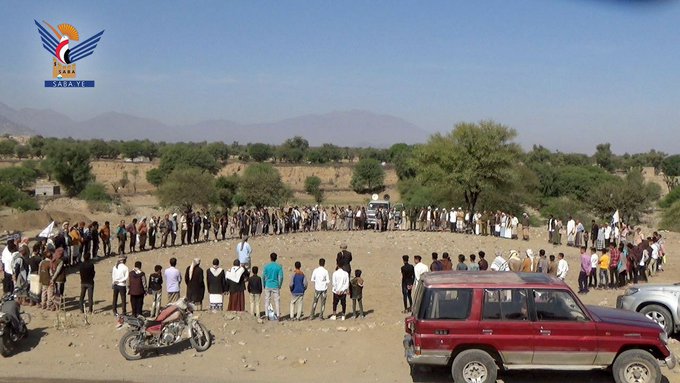
Sana’a – A private source to the Yemeni news agency, Saba, on Saturday denied the allegations made by the criminal US President Trump regarding what he described as the targeting of a secret meeting of military leaders preparing to carry out naval operations.
The source explained that the video clip published by the criminal Trump, claiming that it was a gathering of military leaders, was merely an event for a social Eid visit in Hodeida province. Similar events are held in various provinces on all holidays and occasions, and this is well known to all Yemeni people.
He emphasized that those present at that gathering had no connection to the operations carried out by the Yemeni Armed Forces, which are implementing the decision to ban navigation on ships linked to the American and Israeli enemy, as the criminal Trump claimed.
The source stated that this heinous American crime, which left dozens of martyrs and wounded, reflects the extent of America’s bankruptcy and failure in its aggression against Yemen, and that it is an extension of the genocide committed by the Israeli-American aggression in Gaza.
He stressed that this heinous crime will not be forgotten, and that the Yemeni armed forces, which stood up for the people of Gaza, will not let the blood of the Yemeni people go in vain.
Green Policies, Not Trump Tariffs, Killing British Steel
By Vijay Jayaraj | RealClear World | April 4, 2025
British Steel, the U.K.’s last bastion of primary steelmaking, announced plans to shutter its two blast furnaces at Scunthorpe, effectively ending 150 years of virgin steel production in Britain. Media outlets have rushed to pin the blame on U.S. President Donald Trump’s recent 25% tariffs on steel imports.
But this narrative is a convenient distraction from a far more insidious culprit: the U.K. government’s relentless pursuit of self-destructive green policies that have crippled British manufacturing for nearly a decade.
During the Industrial Revolution, Britain’s steel industry forged the island’s ascent as a global superpower. Steel was the sinew of progress, enabling the nation to outpace rivals and cement its economic and military supremacy well into the 20th century. Once the backbone of its industrial might, steel manufacturing has been suffocated by exorbitant energy costs and uncompetitive pricing – both direct consequences of a cult’s dogma that prioritizes reducing emissions of harmless carbon dioxide over economic survival.
Having produced over 20 million metric tons annually in the 1970s, output dwindled to a paltry 4 million tons by 2024. Meanwhile, imports have surged to 68% of domestic consumption, up from 55% in 2022, as cheaper foreign steel floods the market. The government’s pledge to “rebuild” the sector rings hollow when its own policies paved the way for this collapse.
British Steel’s owner, Chinese-owned Jingye, cited “highly challenging market conditions, the imposition of tariffs, and higher environmental costs” as reasons for the Scunthorpe closure, which threatens up to 2,700 jobs and could commence as early as June.
This shutdown is not a sudden reaction to external trade pressures but rather the inevitable outcome of a self-inflicted death spiral. While China and India make cheaper, carbon-intensive steel with no apparent “climate guilt,” the U.K.’s obsession with net-zero “virtue” turns its producers into sacrificial offerings at the green altar.
Green Policies: The Silent Assassin
Let’s dispense with the pleasantries: Britain’s green policies are more a national suicide than a noble crusade. For nearly a decade, successive governments have chased emissions targets with a zeal that ignores the realities of industrial survival. The Climate Change Act of 2008 set the stage, committing the U.K. to slash carbon dioxide emissions by 80% by 2050 – a hideous impossibility that was later tightened to the holy grail of the even more stringent “net zero.”
This ambition birthed a web of regulations, taxes, and subsidies that have jacked up energy costs to levels unmatched among Britain’s peers and made steel manufacturing impossible without incurring heavy losses.
One proposed solution was a shift to electric arc furnaces, which recycle scrap steel rather than producing it from raw materials with more carbon-intensive blast furnaces. However British Steel’s Chinese owner reportedly sought a $1.3 billion subsidy to fund the $2.6 billion change.
In addition, the U.K.’s industrial electricity prices are approximately 40% higher than France’s and about four times more than those of the U.S. For energy-guzzling steelmakers, such price differentials – a product of “green” energy choices – are a death sentence.
Adding to the pain of British Steel is the U.K. Emissions Trading Scheme that adds costs to the company’s emissions of carbon dioxide, a penalty largely evaded by Chinese and Indian rivals.
The world’s steel leader, China produces more than 1 billion metric tons annually – exceeding the U.K.’s total output over the past 47 years. India follows closely, churning out the metal at prices Britain can’t match.
The steel industries of China and India are fueled by cheap coal and minimal constraints on carbon dioxide emissions. Neither faces the punitive energy costs or emissions taxes that hobble British Steel. While the U.K. levies up to $103 on each ton of carbon dioxide emitted, China charges its manufacturers but a fraction of that. India has no national charge at all. The result? British Steel, saddled with green compliance costs, is priced out of the global market.
China and India didn’t need to lift a finger as Westminster policymakers chased a utopian vision that delivered industrial ruin. The media can spin its tariff tales, but the truth is plainer: Britain’s steel industry was slowly bled dry by a government too enamored with green dogma to see the carnage it wrought.
The demise of British Steel serves as a stark warning to manufacturing giants in Western Europe and the U.S. Trading cost-effectiveness for climate compliance is a Faustian bargain to be resisted by corporate executives and lobbyists.
Vijay Jayaraj is a Science and Research Associate at the CO2 Coalition, Fairfax, Virginia. He holds an M.S. in environmental sciences from the University of East Anglia and a postgraduate degree in energy management from Robert Gordon University, both in the U.K., and a bachelor’s in engineering from Anna University, India.
Le Pen’s verdict exposes Western Europe’s dangerous trend
The EU’s repression is backfiring spectacularly

By Vitaly Ryumshin | Gazeta.ru | April 4, 2025
What’s happening in Western Europe is increasingly raising uncomfortable questions. On March 31, a French court found Marine Le Pen guilty in the so-called “fictitious aides” case, sentencing her to four years in prison and banning her from running for office for five years. Remarkably, the ban took effect immediately, without even waiting for an appeal.
The court’s decision has proved highly controversial, and not only among Russians, who typically see Le Pen as part of Europe’s Moscow-friendly political forces. Even French political figures have expressed bewilderment. Given Le Pen’s position as the frontrunner in the 2027 presidential elections, her conviction has undeniably taken on political dimensions. Some French politicians have already called upon President Emmanuel Macron to pardon Le Pen in order to preserve the face of the country’s “democracy.” Prime Minister François Bayrou reportedly expressed alarm, admitting privately to aides, “France is the only country that does this.”
But Bayrou is mistaken in believing France stands alone. Suppressing opposition figures through tactics reminiscent of hybrid autocracies is becoming the latest trend in EU states. Recently, Romania spectacularly canceled the first round of its presidential election, later jailing Calin Georgescu, the leading candidate.
Germany seems likely to follow suit. The emerging coalition government between the CDU/CSU and SPD is drafting legislation that could bar anyone convicted of “incitement to hatred” from political activity. Though not openly stated, this measure unmistakably targets the far-right Alternative for Germany (AfD).
The reason behind this crackdown lies deeper than any immediate legal disputes. Far-right parties across the bloc have increasingly challenged the European integration project itself. These political forces have openly called for slowing down or completely dismantling the EU in favor of returning to traditional nation-state structures. While some of these right-wing parties, including Le Pen’s National Rally and Germany’s AfD, have moved toward the political center in order to broaden their appeal, their reputation as “destroyers of Europe’s garden” remains entrenched.
Western European bureaucrats and established national elites are deeply unsettled by the growing popularity of these parties. Having benefited tremendously from the EU’s expansion and centralization for over three decades, they are unwilling to surrender their privileged positions without a fight. It’s as if they feel the ground shifting beneath their feet and will do anything necessary to preserve their status quo.
Yet here lies the paradox: the more the EU establishment struggles to remain in power through repressive measures, the quicker its authority and legitimacy erode. The bloc’s foundational identity rests on liberal democratic ideals, institutional sanctity, and the rule of law. When Brussels arbitrarily removes opposition candidates, it saws off the very branch upon which its entire elite sits.
The surge of Europe’s far right has not emerged in a vacuum. Its popularity directly stems from the existing EU leadership’s chronic inefficiency and inability to respond adequately to today’s challenges. Attempting to remove right-wing politicians from the playing field is not a solution. Discontented voters will inevitably find alternative ways to express their frustrations – likely even more fiercely once their grievances are compounded by deep mistrust of the political establishment.
Romania’s recent experience provides a vivid example. After the scandal involving the canceled election, Calin Georgescu’s popularity surged dramatically – from 23% to 40%. Once Georgescu was banned from running, voters swiftly pivoted to another far-right candidate, George-Nicolae Simion, who is now leading the race. This scenario seems almost comical, but could soon be replicated across France, Germany, and other EU states where authorities are excessively targeting opposition figures.
Western European leaders appear somewhat aware they’re playing a dangerous game. However, their conclusions and reactions to this crisis remain fundamentally flawed. EU bureaucrats try to unify the continent by exploiting citizens’ fears – fear of global instability, fear of military threats, fear of economic chaos. Their agendas emphasize support for Ukraine, joint military initiatives, and endless symbolic summits. Billions of euros are readily allocated to armament and defense.
Yet none of these actions address the real issues underlying the bloc’s deepening political divisions – economic stagnation, deteriorating living standards, mass immigration challenges, and declining trust in traditional governance structures. The EU’s refusal or inability to tackle these fundamental problems continues to fuel voter disillusionment.
Ultimately, the more the EU establishment clings desperately to power through authoritarian methods, the faster its cherished structures crumble. Until Western Europe’s leaders face reality and address genuine citizen concerns, this spiral of distrust and repression will only accelerate, making the EU’s future increasingly uncertain.
This article was first published by the online newspaper Gazeta.ru and was translated and edited by the RT team
AfD in historic first pulls dead even with CDU/CSU in latest INSA poll
eugyppius – April 5, 2025
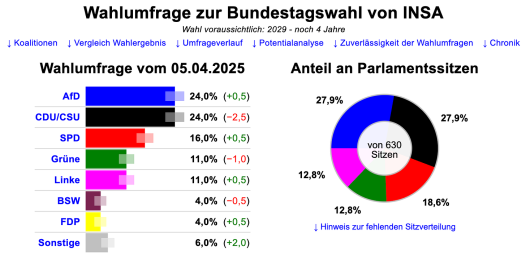
It has finally happened: Alternative für Deutschland are no longer the second-strongest party in Germany; for the first time ever, they have pulled dead-even with CDU/CSU in a representative poll. Both claim 24% support in the latest INSA survey, conducted for BILD between 31 March and 4 April. It is the strongest poll result the AfD have ever received.
The results are partly symbolic and well within the margin of error (2.9 percentage points), but the trend is clear, and nobody seriously doubts that in the coming weeks AfD will assume the lead and become the strongest-polling party across the Federal Republic.
The running average of all major polls – which lags a week or two but yields the clearest view possible of the trend – looks like this:
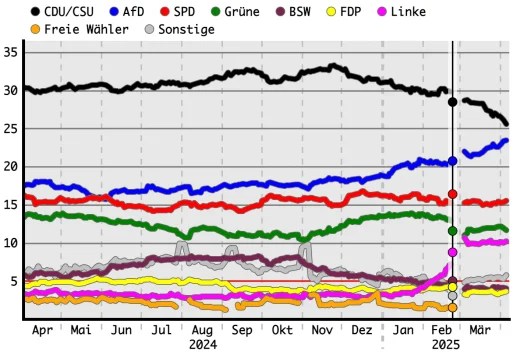
The Union parties have been experiencing a slow but steady collapse in support as their voters abandon them in ever greater numbers for their hated blue rival. The erosion began after Friedrich Merz struck a deal with the disgraced Social Democrats (SPD) to overhaul the debt brake with the outgoing Bundestag, contrary to one of his primary campaign promises. Everything we’ve heard about the disastrous coalition negotiations with the SPD in the weeks since have confirmed the image of a careless, inexperienced yet ambitious CDU chancellor candidate, desperate to ascend to the highest political office, whatever the cost. Back in 2018, Merz pledged he would cut support for the AfD in half and drive his party back to 40% supporter or higher. He has achieved very nearly the opposite, plunging his future government to the depths of unpopularity before it is even formed and ceding first place to precisely the people he promised to cut down to size. It is a farce beyond anything I could’ve imagined.
There is no plan or strategy here; Merz has no idea what he is even doing. He and CDU/CSU leadership did have a brief flash of insight back in January, when they reached across the firewall to vote with the AfD on legislation to restrict migration. Back then at least, they knew they had to show the left parties they had other options, or they would be destroyed in coalition negotiations with any potential “democratic” partner. Leftist activists took to the streets and Merz rapidly retreated, returning to his standard denunciations of the AfD and pledging never to vote with them again. In return for a measure of mercy from Antifa, Merz voluntarily led his party into a trap, ceding all possible leverage over a radicalised SPD, who will force the Union parties to swallow one poison pill after the other. It is a win-win for them. They get what they want and they get to grind the CDU and the CSU to dust at the same time.
The election might be over, but make no mistake – these poll results matter. First, collapsing support deprives the CDU of options in the present. They can’t walk away from the negotiating table and seek new elections, because they know they’d come out of them vastly worse. Their terrible numbers further strengthen the negotiating position of the SPD, who will force the CDU to accept still more damaging compromises, driving CDU support even lower. Then we must remember that federal elections are not the only game in town. The rank-and-file of the CDU have to contend in an array of district elections in the coming months, and five state elections are approaching in 2026, including two in East Germany (Mecklenburg-Vorpommern and Sachsen-Anhalt) that may well end in the collapse of the firewall at the state level. Dissatisfaction with Merz inside the CDU is widespread and growing.
All of this will make it more tempting for the Union parties to support banning AfD. It is hard to discern exactly how this would happen. The CDU could join the left parties of the Bundestag in applying for a ban. The’ve said they might do this if and when the Federal Office for the Protection of the Constitution (BfV) upgrades their assessment of the AfD to “confirmed right-wing extreme.” Alternatively, Merz’s government could apply for a ban directly with the Federal Constitutional Court in Karlsruhe. What happens depends a lot on the strength of the evidence that the BfV have assembled against the AfD; if (as I suspect) this evidence is weak, they’ll want to avoid this measure because of the risk. Any failure would merely confirm the legitimacy of the AfD as a democratic party.
If the CDU can’t remove the AfD from the board – and probably even if they can – their future looks very dismal. If present numbers hold, the only conceivable government in 2029 would be the dreaded Kenya coalition, consisting of CDU/CSU, SPD and Greens all together. The compromises and failures the Union would be forced to swallow in that scenario would be even worse than the compromises and failures they’re swallowing now. Their punishment would be accordingly harsher. The CDU established the firewall as a defensive mechanism, to discourage their own voters from defecting to the AfD. Now the firewall has become a great cudgel against the Union, and a major source of the AfD’s strength.
Featured Video

No Threat Can Force Iran’s Surrender /Trita Parsi & Lt Cl Daniel Davis
or go to
Aletho News Archives – Video-Images
From the Archives
What is the Israeli Lobby in Australia Doing in Interfaith Dialogue?
By Ali Kazak | Dissident Voice | October 11, 2015
For years Israel and its lobby around the world have been trying to normalise their relations with Arabs and Muslims without solving the Palestine Question.
One of the methods they resorted to in the last few years is using human rights and community organizations such as interfaith dialogue and Multiculturalism to achieve this objective and to: isolate the Palestinians, marginalise the Palestine question, end Israel’s isolation, and prevent criticism of Israel, knowing that these organisations will be the first to stand against Israel’s violations, racial and religious discrimination.
The group responsible for this task in Australia is The Australia/Israel & Jewish Affairs Council (AIJAC); its Director of International & Community Affairs, Jeremy Jones is in charge of lobbying religious community organizations, specifically Muslims and Christians. Consequently he convened the Faith Communities for Reconciliation, founding participant in the Australian Partnership of Religious Organisations and the Australian National Dialogue of Christians, Muslims & Jews.
AIJAC is a private political propaganda group. It is recognised as the main Israeli lobby in Australia. It coordinates its activities and works intimately with the Israeli embassy in Canberra and different institutions in Israel. It is privately funded by some Jewish businessmen. It monitors closely Australian politicians, the media, ethnic and religious groups, (especially Arabs and Muslims), unions and academics on their stands towards Israel and the Palestine question. … continue
Blog Roll
 Aletho News
- The war of liberation of the Arab and Islamic peoples expands across the Gulf
- Envoy warns UN on Trump’s threat to ‘obliterate’ Iran’s civilian infrastructure
- The Larak Corridor: Iran’s Rial Gate With No US, No Israel, and No Way Around
- ‘Economic terrorism’: Steel facilities hit again in US-Israeli strike
- ‘War Crime’: Iran condemns attacks on Arak, Ardakan nuclear sites
- Two-thirds of Americans want quick end to Iran war even if goals unmet
- Trump to Give “Important Update on Iran” Wednesday in Prime-Time Speech
- Theodore Postol: Iran’s Missiles & Drones Were Underestimated
- Iran To Target Military Industrial-Tech Complex That Facilitated Gaza Genocide
- Collapsing Empire: The Resistance Disarms ‘Israel’
- If Americans Knew
- Israel wants US to bomb more of Iran’s civilian structures (113,000 is not enough) – Not a ceasefire Day 173
- Ann Coulter Rips Into Fox News for Iran War Coverage
- Joe Kent Urges Americans To Call White House and Congress To Object To Sending Troops Into Iran
- DNC Resolution to Reject AIPAC Funding Puts Democratic Leaders in the Hot Seat
- Swedish foundation to build 400 schools as over 650,000 Gaza children remain without education for 2 years
- Israeli army admits photshopping image of slain Lebanese journalist
- This is how Israel is systematically killing health workers under the cover of war in Lebanon
- Carrying life under fire: Israeli invasion of Lebanon leaves pregnant women facing deadly risks
- Champagne all around for the new death penalty (for Palestinians) law – Not a ceasefire Day 172
- Why are Palestinian books struggling to be seen on Amazon?
- No Tricks Zone
- New Study Finds Warming Saves Lives…Cold Temperatures 12 Times More Deadly Than Excess Heat
- German Science Blog Accuses PIK Climate Institute Of Hallucinating Climate Tipping Points
- Devastating Assessment Of Comirnaty Vaccine By Former Senior Pfizer Europe Toxicologist
- New Study: CO2 Is ‘Effectively Negligible’ As An Explanatory Climate Change Factor Since 2000
- Former Pfizer Toxicologist Dr. Helmut Sterz Tells Bundestag Hearing Pfizer Vaccine Should Have Never Been Approved
- Energy Expert: Germany’s Nuclear Phaseout Was A “500 Billion Euro Mistake”
- New Research: South Australia’s Mid-Holocene Sea Surface Temperatures Were 4°C Warmer Than Today
- Storing Green Energy To Last Germany 10 Days Would Require A 60-Million Tonne Battery
- New Studies: UK Sea Levels Were 4 Meters Higher Than Today During The Mid-Holocene
- Destructive Green New Deal: German Energy And Metal Group Warns Of Drastic Crisis
 Aletho News