Gender-affirming care for minors under fire in sweeping US report
By Maryanne Demasi, PhD | May 4, 2025
Paediatric gender dysphoria has rapidly emerged as one of the most divisive and urgent issues in medicine today. In the past decade, the number of children and adolescents identifying as transgender or nonbinary has soared.
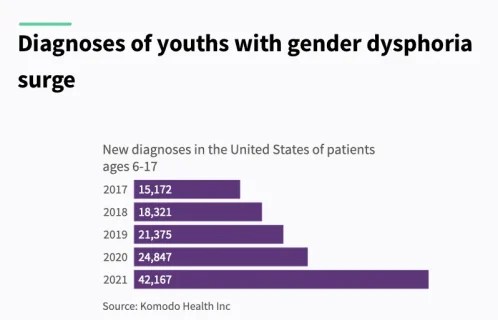
In the US alone, diagnoses among youth aged 6 to 17 nearly tripled—from around 15,000 in 2017 to over 42,000 by 2021—signalling a seismic shift not only in culture but in clinical practice.
Children diagnosed with gender dysphoria—a condition defined by distress related to one’s biological sex or associated gender roles—are increasingly being offered powerful medical interventions.
These include puberty blockers, cross-sex hormones, and, in some cases, irreversible surgeries such as mastectomy, vaginoplasty, or phalloplasty.
An umbrella review from the US Department of Health and Human Services (HHS) states that “thousands of American children and adolescents have received these interventions,” despite a lack of solid scientific footing.
While advocates often claim the treatments are “medically necessary” and “lifesaving” the report concludes “the overall quality of evidence concerning the effects of any intervention on psychological outcomes, quality of life, regret, or long-term health, is very low.”
It also cautions that evidence of harm is sparse—not necessarily because harms are rare, but due to limited long-term data, weak tracking, and publication bias.
This 409-page report delivers a scathing review of the assumptions, ethics, and clinical practices driving gender-affirming care in the US.
An inversion of medical ethics
At the heart of the HHS critique is a reversal of medical norms.
“In many areas of medicine, treatments are first established as safe and effective in adults before being extended to paediatric populations,” the report explains. “In this case, however, the opposite occurred.”
Despite inconclusive outcomes in adults, these interventions were rolled out for children—without rigorous data, and with little regard for long-term, often irreversible consequences.
These include infertility, sexual dysfunction, impaired bone development, elevated cardiovascular risk, and psychiatric complications.
“The physical consequences are often irreversible,” the report warns.
Puberty blockers, frequently marketed as a reversible ‘pause,’ actually interrupt bone mineralisation at a critical growth stage—raising the risk of stunted skeletal growth and early-onset osteoporosis.
When followed by cross-sex hormones, as is common, the harms multiply. Known risks include metabolic disruption, blood clots, sterility, and permanent loss of sexual function.
Yet many clinics operate under a “child-led care” model, where a minor’s self-declared “embodiment goals” dictate treatment.
The report notes that some leading clinics conduct assessments “in a single session lasting two hours,” often with no robust psychological evaluation.
Consent and capacity
This raises a critical question: are children capable of consenting to life-altering medical interventions?
According to the HHS, informed consent means more than simple agreement—it requires a deep understanding of risks, alternatives, and long-term impact.
And by definition, children lack full legal and developmental capacity for medical decision-making.
“When medical interventions pose unnecessary, disproportionate risks of harm, healthcare providers should refuse to offer them even when they are preferred, requested, or demanded by patients,” the report states.
Supportive parents cannot shield clinicians from ethical responsibility. Many children who present for transition also have autism, trauma histories, depression, or anxiety—all of which can impair decision-making.
Yet clinicians frequently misread a child’s desire to transition as evidence of capacity.
The report warns that the current affirmation model “undermines the possibility of genuinely informed consent” and that the “true rate of regret is not known.”
This becomes especially urgent when the outcomes—sterility, bone loss, and sexual dysfunction—are permanent. Can a 13-year-old grasp what it means to forgo biological parenthood?
As the report suggests, the system has failed to distinguish between a young person’s wish to transition and their developmental ability to understand what that means long term.
A moral failure
The problem is not only medical—it’s moral.
The HHS accuses the medical establishment of abandoning its core duty: to protect vulnerable patients. Ideology and activism, it argues, have taken precedence over evidence and caution.
“The evidence for benefit of paediatric medical transition is very uncertain, while the evidence for harm is less uncertain,” it states.
Among the most disturbing trends highlighted in the report is the sidelining of mental health support.
Research suggests that most cases of paediatric gender dysphoria resolve without intervention. Yet clinicians continue to proceed with irreversible treatments.
“Medical professionals have no way to know which patients may continue to experience gender dysphoria and which will come to terms with their bodies,” the report explains.
The illusion of consensus
The report also takes aim at the idea that gender-affirming care enjoys universal professional backing. It reveals that many official endorsements come from small, ideologically driven committees within larger organisations.
“There is evidence that some medical and mental health associations have suppressed dissent and stifled debate about this issue among their members,” it warns.
Several whistleblowers have spoken out—often at considerable personal risk.
Jamie Reed, a former case manager at the Washington University Transgender Center, alleged that children were being rushed into medical transition without adequate psychological screening. Her testimony led to a state investigation and Senate hearing.
Clinical psychologist Erica Anderson, a transgender woman and former president of the US Professional Association for Transgender Health, has repeatedly raised concerns about the haste with which children are put on medical pathways.
Dr Eithan Haim, a surgeon in Texas, is now facing prosecution after revealing details about paediatric gender surgeries at a children’s hospital.
Rather than sparking debate, these whistleblowers have faced vilification, career damage, and in some cases legal consequences. The HHS suggests this culture of fear has stifled the scientific inquiry necessary for sound medicine.
Psychotherapy as an alternative
Instead of defaulting to hormones or surgery, the report urges a return to psychotherapy. Gender-related distress, it notes, often overlaps with broader psychological challenges that can be addressed non-invasively.
“There is no evidence that pediatric medical transition reduces the incidence of suicide, which remains, fortunately, very low,” the report finds.
Psychotherapy carries no documented harms and offers space for resolution and support. The HHS calls for greater investment in “psychotherapeutic management” as a safer and more ethical approach.
Restoring scientific integrity
Commissioned under President Trump’s Executive Order Defending Children’s Innocence by Ending Ideological Medical Interventions, the report responds to growing alarm over the medicalisation of minors.
Trump’s Executive Order directed federal agencies to evaluate practices to help “minors with gender dysphoria, rapid-onset gender dysphoria, or other identity-based confusion, or who otherwise seek chemical or surgical mutilation.”
It explicitly criticised “junk science” promoted by groups such as the World Professional Association for Transgender Health (WPATH), calling for a return to evidence-based standards and scientific discipline.
Rather than imposing new mandates, the HHS report focuses on delivering “the most accurate and current information available” to clinicians, families, and policymakers—urging caution and restraint.
“Our duty is to protect our nation’s children—not expose them to unproven and irreversible medical interventions,” said NIH Director Dr Jay Bhattacharya. “We must follow the gold standard of science, not activist agendas.”
Reform already underway
The HHS report lands amid a wave of legal reforms.
As of this year, 27 states have passed laws restricting or banning gender-affirming care for minors. These range from full bans on hormones and surgery to tighter consent requirements.
Nineteen of those laws were passed in 2023 alone, according to the Kaiser Family Foundation.
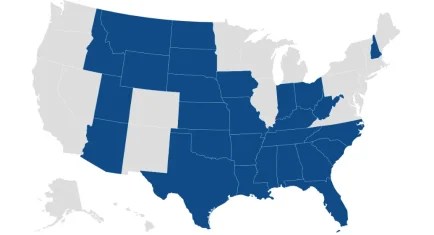
Over half of states have enacted laws/policies limiting youth access to gender affirming care
Though many face court challenges, the trend reflects mounting public concern over the medicalisation of gender-distressed youth. The HHS findings are expected to accelerate further scrutiny and legislative action.
Global shifts
The HHS review is part of a broader international movement to re-examine paediatric gender medicine.
In 2024, the UK’s Cass Review, led by paediatrician Dr Hilary Cass, delivered a landmark critique of NHS gender services. Cass concluded that the model had been adopted prematurely “based on a single Dutch study,” and lacked sufficient evidence.

Dr Hilary Cass, paediatrician
In response, the UK banned the routine use of puberty blockers and began closing the Tavistock gender clinic, replacing it with regional centres focused on holistic mental health care.
In Australia, the Queensland government took similar steps earlier this year, pausing all prescriptions of puberty blockers and cross-sex hormones for minors pending further review.
The move followed the suspension of Dr Jillian Spencer, a senior psychiatrist, from her clinical duties at Queensland Children’s Hospital after she raised concerns about the gender care protocols being used.
Her case has since become a focal point in Australia’s national debate on youth gender medicine.

Dr Jillian Spencer, paediatric psychiatrist, Queensland
A reckoning
The HHS report is more than a policy review—it is a warning.
It reveals that thousands of children—many struggling with underlying psychological issues—have been placed on a path of irreversible medicalisation without the basic safeguards expected in any other area of healthcare.
The report concludes that gender medicine has been practised backwards – treatments were introduced first, and only later did the search for evidence begin.
It calls for a course correction—one that puts evidence before ideology, and ethics above political expediency.
Whether institutions will act on its findings remains to be seen. But for families searching for answers, the report may finally provide the long-overdue clarity that has been obscured by years of activism and politics.
UCLA Gaza protesters sue over police violence, rubber bullet injuries
Al Mayadeen | May 5, 2025
A new lawsuit filed in Los Angeles Superior Court accuses law enforcement of police brutality during a violent crackdown on pro-Palestine protesters at the University of California, Los Angeles (UCLA) in spring 2024.
At the height of nationwide demonstrations against “Israel’s” war on Gaza, the UCLA encampment became a central site of student-led protest. On April 30, a pro-“Israel” mob attacked the encampment for more than four hours. Protesters say that police stood by as counter-demonstrators launched fireworks, sprayed chemical agents, and engaged in harassment and sexual assault, according to The Intercept.
The following day, Los Angeles Mayor Karen Bass, UCLA officials, and multiple law enforcement agencies coordinated plans to dismantle the encampment. On May 1, the encampment was forcibly cleared.
On February 12, 2025, Students for Justice in Palestine (SJP) and Graduate Students for Justice in Palestine (GSJP) were placed on interim suspension.
Police response: coordination and forceful dispersal
More than 700 police officers descended on campus, including members of the Los Angeles Police Department (LAPD), California Highway Patrol (CHP), Los Angeles County Sheriff’s Department, University of California Police Department, and private security forces.
During the raid, law enforcement fired over 50 rounds of rubber bullets into the crowd, striking multiple protesters in the head. Several individuals were hospitalized, including one who sustained internal bleeding and another whose hand bones were shattered, requiring surgery and extensive rehabilitation.
Protesters are now suing both the state of California, which oversees CHP, and the city of Los Angeles, which oversees LAPD. The suit argues that the use of rubber bullets by LAPD and CHP amounted to excessive force and violated protesters’ constitutional rights.
Legal violations: restricted rubber bullets and protesters’ rights
Following mass protests in 2020 against the police killings of George Floyd and Breonna Taylor, California lawmakers passed a law limiting the use of kinetic impact projectiles, commonly known as rubber bullets. The legislation bans their use at protests unless there is an objective and immediate threat to life or serious injury.
The lawsuit states that officers’ actions at the UCLA encampment violated this law. Attorney Becca Brown, representing the plaintiffs, emphasized that the indiscriminate firing of such projectiles is both illegal and dangerous.
“They cannot be used simply because someone is non-compliant,” she explained.
Despite UCLA’s revised protocols following 2020 to minimize reliance on external police forces, CHP, typically less involved in protest response, played a prominent role in the May 1 raid.
An LAPD after-action report later attempted to justify the force used, citing incidents like a protester throwing a traffic cone or removing a police helmet. However, the report admitted communication breakdowns among agencies and recommended improved command clarity.
Chilling effect: trauma, criminalization, and fear of future protest
The lawsuit includes plaintiffs such as a UCLA Ph.D. candidate, an undergraduate student, another student from a different university, and an architectural designer. All were struck with rubber bullets, several in the head. Beyond physical injuries, the plaintiffs say the crackdown has severely impacted their willingness to participate in future demonstrations.
“The encampment clearance by means of violence, excessive force, and kinetic energy projectiles traumatized Plaintiffs,” the complaint reads. “It justifiably made them less willing to engage in any further Palestine-related protest activity.”
One plaintiff, Abdullah Puckett, now fears future retaliation if he returns to protest. The complaint states that he is “more hesitant and afraid,” and has had to reevaluate the extent of his participation in pro-Palestine demonstrations.
Broader implications: political accountability and state repression
More than 200 people were arrested during the UCLA encampment clearance. LAPD later requested over $500,000 in reimbursement for the operation, which included 2,400 overtime hours, according to the Daily Bruin. The arrests resulted in criminal records for many students.
Lawyers say those records are now being used by the Trump administration to conduct background checks on international students and potentially flag them for deportation.
“For international students that may have been arrested at any of these encampments, that got flagged and could be subject to deportation under Trump’s fascist policies,” said Ricci Sergienko, one of the attorneys representing the plaintiffs.
Sergienko criticized Democratic leaders such as Governor Gavin Newsom and Mayor Bass, arguing that their actions laid the groundwork for broader state repression. “These attacks also happened in Democratic-run cities and blue states,” he said.
He also warned of mounting censorship in academia, pointing to a proposed bill in California that targets ethnic studies programs under the pretext of combating antisemitism. “That’s another attack on speech coming from the blue state, the liberal paradise of California,” he said.
During a recent screening of the documentary The Encampments at UCLA, police were once again called in. LAPD officers arrested three students.
Hind Rajab’s killers identified
MEMO | May 5, 2025
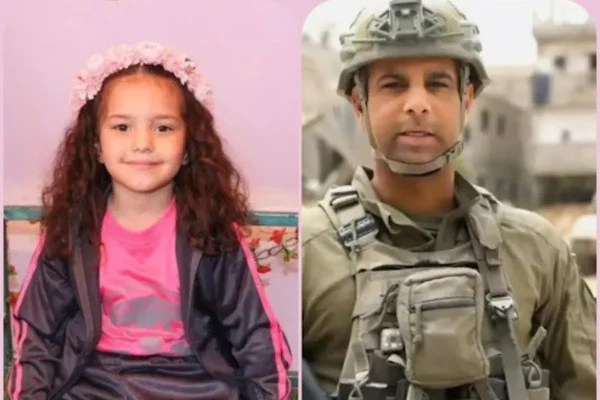
A human rights organisation has revealed the identity of the Israeli officer directly responsible for the killing of Palestinian child Hind Rajab, her family, and the two medics who tried to save her in the Tel al-Hawa neighbourhood, Gaza City, on 29 January 2024.
In a statement released on Saturday, the Hind Rajab Foundation, an independent NGO based in Brussels, said: “We now publicly name the commander responsible for killing Hind:
Lieutenant Colonel Beni Aharon
Commander of the 401st Armoured Brigade of the Israel Defence Forces (IDF) at the time of the killing.”
The organisation said the identification followed a more than year-long investigation. It also confirmed it had identified the brigade’s soldiers, field commanders, and operations officers who took part in the attack under Aharon’s command.
The foundation asserted that it “has filed a war crimes complaint with the International Criminal Court (ICC) in The Hague” to issue an arrest warrant for Lt. Col. Beni Aharon, adding, “we are preparing additional legal complaints against the battalion’s officers.”
The Hind Rajab Foundation is a legal and human rights branch of the March 30 Movement. It was established in memory of Hind Rajab and focuses on bringing Israeli soldiers accused of war crimes against Palestinians to justice.
Israeli military operations in Gaza, fully backed by the United States, have continued by land, sea, and air since 7 October 2023. More than 170,000 Palestinians have been killed or injured so far, with many still trapped under the rubble.
Trump pushes for ‘total dismantlement’ of Iran’s nuclear program
RT | May 5, 2025
US President Donald Trump has said he wants Iran to completely scrap its nuclear program, as negotiations between the two countries have been postponed.
The president was asked by Kristen Welker on NBC’s Meet the Press on Sunday whether he was aiming to limit or completely abolish Iran’s nuclear program.
“Total dismantlement. Yes, that is all I would accept,” Trump said. He questioned the necessity of the Islamic Republic having nuclear technology for electricity generation.
“They have so much oil – why do they need it? … Civilian [nuclear] energy often leads to military wars. And we don’t want them to have a nuclear weapon. It’s a very simple deal,” he said.
“I just don’t want them to have a nuclear weapon because the world will be destroyed,” Trump added.
He made his remarks after Omani Foreign Minister Badr Al-Busaidi announced that the fourth round of indirect, mediated US-Iran talks, planned for Saturday, had been postponed indefinitely “for logistical reasons.”
The negotiations, previously described by both sides as constructive, have been overshadowed by tensions in Yemen, where the US and Britain have ramped up airstrikes against the Houthi militants.
Israeli Prime Minister Benjamin Netanyahu vowed to retaliate after a Houthi ballistic missile landed near Ben Gurion Airport outside Tel Aviv on Sunday, injuring eight people.
The Houthis said they were aiming for a “comprehensive air blockade” of Israel in solidarity with the Palestinians in Gaza. Iran denied directing the attacks, calling such claims “misleading.”
Trump withdrew the US from the 2015 UN-backed deal on Iran’s nuclear program during his first term in office, accusing the Islamic Republic of secretly violating the agreement. Tehran has denied any wrongdoing but has since rolled back its own commitments under the deal and increased its stockpile of enriched uranium.
Iranian Foreign Minister Abbas Araghchi warned last month that the country would resist any “pressure and threat” from the US.
Did the Israeli Embassy Order My Arrest?
Richard Medhurst | May 3, 2025
Emails show Israeli foreign influence in UK’s legal system: the Attorney General’s Office provided the Israeli Deputy Ambassador with contact information of UK prosecutors and counterterrorism police, in the same period that journalist Richard Medhurst and other British reporters and activists were arrested by CT police in a government crackdown. This raises questions about the impartiality of the Crown Prosecution Service and the degree of foreign meddling in the UK’s judiciary.
Support the show on Patreon: patreon.com/richardmedhurst
Donate on PayPal: https://paypal.me/papichulomin
Donate on GoFundMe: http://tiny.cc/GoFundMe-Richard
Bitcoin address: bc1qnelpedy2q6qu67485w4wnmcya5am873zwxxvvp
Subscribe to Richard Medhurst on other platforms here: Rumble: https://rumble.com/richardmedhurst
Rokfin: https://rokfin.com/richardmedhurst
Odysee: https://odysee.com/@richardmedhurst
Substack: https://richardmedhurst.substack.com/
Richard Thomas Medhurst (1992) is an independent journalist, political commentator, and analyst from the United Kingdom with a focus on international affairs, US politics, and the Middle East. Medhurst is known for his coverage of the Julian Assange extradition case in London, as one of the only journalists to report on the trial of the WikiLeaks founder from inside the court.
He has also covered the Iran nuclear deal talks on the ground in Vienna. Medhurst was born in Damascus, Syria.
His father is English and mother is Syrian. Both his parents served in United Nations Peacekeeping and Observer missions and were among the UN Peacekeepers awarded the Nobel Peace Prize in 1988. Owing to his parents’ professional mobility, he has lived in Syria, Pakistan, Switzerland, and Austria. He speaks four languages fluently: English, Arabic, French, and German.
As an independent journalist, Medhurst regularly hosts live broadcasts and video reports on his YouTube channel. Previous guests include the Foreign Minister of Venezuela, the Dep Foreign Minister of Iran; the Palestinian, Russian and Cuban ambassadors to the United Nations in Vienna; the former British Ambassador to Syria; and various UN officials, journalists, and more. Medhurst’s reports and analysis on Yemen, Ukraine, Syria, Niger, Lebanon, Iran, the Israeli occupation in Palestine and its genocide in Gaza have gone viral countless times, racking up millions of views.
Richard Medhurst has a combined following of roughly one million people online, and appears regularly on international news outlets including Al Jazeera, WikiLeaks, Black Agenda Report, Al Mayadeen, The Times, LBC, and others.
Featured Video

Why the U.S. Should Pull Back From the First Island Chain
or go to
Aletho News Archives – Video-Images
From the Archives
Only 19.7% of Americans agree with US State Dept on Israeli settlements
… Most American adults of voting age don’t appear willing to reject the applicability of international law to Israel’s ongoing colonization of occupied territories in East Jerusalem, the West Bank and Golan Heights. … Full article
Blog Roll
 Aletho News
- Albania on fire: who’s behind the riots?
- Egypt’s Civil Democratic Movement rejects involvement in regional war
- Egypt collaborates with Israel to build ‘Green Rafah’ project over erased Palestinian city
- Rising fuel prices and shortages have helped drive ongoing protests and rioting in France
- Tokyo protests demand Takaichi’s resignation over support for ‘Israel’
- Jennifer Kavanagh: Why the U.S. Should Pull Back From the First Island Chain
- Yemen denounces international community’s silence on Saudi aggression, siege
- UAE and Saudi Arabia move toward renewed coordination against Sanaa
- How Iran’s two-week retaliatory strikes exposed cracks in US military architecture in Persian Gulf
- The mother of all propaganda: Why the hype over US MOAB strike against Iran is nothing but theater
- If Americans Knew
- What the UK Is Doing to Pro-Palestine Novelist Sally Rooney Is an Act of Orwellian Villainy
- ‘We will build palaces for Jews in Gaza’: Right-wing activists establish new outpost near border
- ‘You see us burning, you stay silent’: Family’s agony over mother and sons burned to death in Gaza tent
- Israel keeps Palestinian journalist Bushra al-Tawil in isolation for 46 days
- US-Israel integration plan puts US military tech in Israel’s hands
- Israeli Strike Burns Gaza Mother Alive in Front of Toddler, ‘Without Generating Any Headlines’
- ‘The Israel Experience with Mike Huckabee’: The Ambassador’s Family Sells Trips to Israel
- As Gazans carry out mass burial, food insecurity is getting worse – Daily Update
- Israeli rabbi permits occupiers to steal Palestinian olive harvest in West Bank
- Netanyahu’s spin on latest settler attack is laughable – Daily Update
- No Tricks Zone
- Predictions Made By Renowned Climate Proifessor Over Past Decades Have Been Proven To Be Poor
- New Study Suggests Large Regions Of The Pacific Ocean Have Been Cooling For The Last 80 Years
- Germany’s Green Energy Debacle: High Energy Costs Force Kahla Porzellan to Close After 182 Years!
- New Study: 50 Years Of The Most Aggressive ‘Net Zero’ Policies Can Only Affect The Global Climate By 0.03°C
- US September “Heat” Was No Record…Many Records Set Decades Ago
- Latest European Green Energy Debacle; Portugal’s Largest Flagship Solar Park Insolvent!
- Green Energy Debacle: German Expert Professor Fritz Vahrenholt Warns Of Severe Economic And Social Consequences
- Two More Paleo Reconstructions Affirm Meters-Higher Sea Levels Across Ireland, Brazil 7000-6000 Years Ago
- New Study: Earth And Venus Surface Warmth Largely Explained By Convection And Lapse Rate, Not CO2 Or Radiation
- 2025 Nature Paper Claiming Worsening Global Drought Gets RETRACTED …Heavily Flawed

