Media Slam NIH for Axing ‘Safe to Sleep’ Campaign — But Evidence Shows the Program Never Reduced SIDS Deaths
By Brenda Baletti, Ph.D. | The Defender | May 8, 2025
A National Institutes of Health (NIH) program that health officials claimed reduced the number of infants who died suddenly in their sleep fell victim late last month to budget cuts, triggering an outcry from some experts and mainstream media.
The 30-year-old “Safe to Sleep” campaign was overseen by the NIH communications office at the National Institute of Child Health and Human Development. The program cut was part of the ongoing reorganization and streamlining of the NIH.
The program, which includes TV advertisements, was created to provide guidance to parents about safe sleeping practices for infants. It advises parents to place babies on their back to sleep, use a flat firm sleeping surface, keep the sleeping area clear, use a pacifier, and breastfeed, among other lifestyle interventions. That information will remain available on the website.
North Country Public Radio, Mother Jones and other mainstream media decried the program’s cancellation.
In an article published May 5, Mother Jones claimed “Safe to Sleep” was responsible for “years of progress in reducing the number of babies that succumb to Sudden Infant Death Syndrome (SIDS).”
The article smeared Children’s Health Defense (CHD) and others who suggest that the sudden and unexplained death of thousands of infants each year, often within a few days of vaccination, may in some cases be linked to vaccines rather than to sleep hygiene.
However, the plausible association between vaccines and SIDS has been reported in peer-reviewed literature for decades.
And research published in top journals has long shown that claims about the success of the “Safe to Sleep” campaign are mistaken. SIDS deaths didn’t go down after the campaign was launched in the 1990s. The deaths were simply categorized differently because of a change to the codes used by medical examiners.
A short history of SIDS in the U.S.
A SIDS diagnosis is given when an infant under age 1 dies suddenly, typically during sleep, and an investigation into the death fails to yield a cause. However, 95% of SIDS deaths occur in the first six months of life, peaking at ages 2-4 months.
Each year, the U.S. records more than five infant deaths per 1,000 live births, far exceeding the rates in other high-income countries.
After birth defects and prematurity, SIDS is the third leading cause of death among infants. Yet the medical industry claims to remain puzzled about the cause — similar to how health officials say they don’t know what causes autism.
The SIDS diagnosis didn’t exist until the late 1960s, when the category was created in response to a rise in sudden unexplained infant deaths. In 1971, the World Health Organization’s International Classification of Diseases (ICD) assigned a code to SIDS.
The ICD is the list of about 130 categories that coroners globally use to assign the cause of death when a baby dies.
In a 2021 article in the peer-reviewed journal Toxicology Reports, vaccine researcher Neil Z. Miller provides a history of the SIDS diagnosis, noting that the rise of SIDS coincided with the first mass immunization campaigns.
In the early 1960s, the number of vaccines administered to most U.S. infants took off. The federal government began appropriating money so the CDC could work with local health departments to vaccinate all children. The agency established the CDC Advisory Committee on Immunization Practices (ACIP), which makes the recommendations for vaccines to be listed on the childhood immunization schedule.
By the end of the decade, most U.S. infants were receiving the diphtheria, pertussis, and tetanus (DPT), polio and measles vaccines, and mumps and rubella vaccines also became available.
As SIDS rates rose, so did parental concern that SIDS was connected to vaccination, but authorities assured parents that unexplained death following vaccination was “merely coincidental,” Miller wrote.
He also said that before 1979, the ICD included cause-of-death classifications associated with “prophylactic vaccination” as an official cause of death. As a result, “medical examiners are compelled to misclassify and conceal vaccine-related fatalities under alternate cause-of-death classifications.”
Instead of examining the link between vaccines and SIDS, public health researchers developed a “triple-risk model” for explaining SIDS. That model says SIDS occurs when a baby has an unknown medical condition, it is going through an important period of development where the body changes quickly, and it encounters an outside stressor, such as sleeping on its stomach.
Enter the ‘back to sleep’ campaign
The American Academy of Pediatrics (AAP) in 1992 launched a national “Back to Sleep” campaign to inform parents to have children sleep on their backs rather than on their stomachs.
In 1994, the NIH’s National Institute of Child Health and Human Development institutionalized the campaign within the agency, in partnership with organizations like the AAP, and later, companies including Johnson & Johnson and Gerber — both of which have been sued for poisoning children with their products.
NIH renamed the campaign “Safe to Sleep” in 2012.
Between 1992, when the program was started, and 2001, SIDS deaths reportedly declined a whopping 55% — a number touted in every article celebrating the program, making it appear that babies sleeping on their stomachs was the cause of SIDS, not vaccines.
However, at the same time deaths from SIDS decreased, the rate of mortality from “suffocation in bed,” “suffocation other,” “unknown and unspecified causes,” and “intent unknown” all increased significantly.
What had happened was that the classification system had changed. SIDS deaths were being reclassified by medical certifiers, usually coroners, as one of the other similar categories, Miller reported.
Research published in the journal Pediatrics — the flagship journal of the AAP — concluded that deaths previously certified as SIDs were simply being certified as other non-SIDS causes, such as suffocation, that were still essentially SIDS deaths.
That change in classification accounted for more than 90% of the drop in SIDS rates.
The Pediatrics paper showed there was no decline in overall postneonatal mortality, despite the program’s — and the AAP’s — claims to the contrary.
Others verified the Pediatrics paper’s findings, and the trend continued, as reported by multiple studies in top journals. Miller reported that, for example, “From 1999 through 2015, the U.S. SIDS rate declined 35.8 % while infant deaths due to accidental suffocation increased 183.8%.”
In 2020, infant deaths from Sudden Unexpected Infant Death (SUID) — an umbrella category that accounts for both SIDS and other unknown causes began to rise even higher, according to a study published in JAMA Pediatrics.
No codes for vaccine-related sudden deaths
Dr. Paul Thomas, pediatrician and author of “Vax Facts: What to Consider Before Vaccinating at All Ages & Stages of Life,” told The Defender in an interview last year that extensive evidence links SIDS to vaccination.
Thomas said that because there are no ICD codes for vaccination, the deaths are typically recorded as something else.
“When an infant dies, no matter how soon after vaccination, coroners and pathologists do not have any codes for vaccine-related death available as options, so these deaths are generally coded as SIDS, unknown, or suffocation.”
80% of infant deaths reported VAERS between 1990-2019 happened within 7 days of vaccination
Thomas said pediatricians are not educated about the link, so even when it clearly occurs, they don’t recognize it.
“I was taught that SIDS was due to parents smoking in the room, the room being too hot, babies co-sleeping or sleeping on surfaces that were too soft, or moms smothering their babies while nursing,” he wrote, sharing insights from his new book. “While all these factors may plausibly contribute, the primary cause has been right under our noses for decades. The vaccines!”
Miller’s analysis of sudden infant deaths in the Vaccine Adverse Event Reporting System (VAERS) showed that nearly 80% of those deaths reported to the system between 1990 and 2019 happened within seven days of vaccination.
A recent peer-reviewed study found a positive statistical correlation between infant mortality rates and the number of vaccine doses received by babies — confirming findings made by the same researchers a decade ago.
The 2018 Health Affairs study reported that the bifurcation of the U.S. mortality rates from those of other wealthy countries began in the 1980s — the same time the country saw a major uptick in childhood vaccination.
A 2023 study published in the Cureus Journal of Medical Science found that the developed nations requiring the most neonatal vaccine doses tend to have the worst childhood mortality rates.
The CDC currently recommends 76 doses of 18 different vaccines for children ages 0-18.
Child mortality researchers have also noted that sudden unexplained childhood deaths in children over 1 year old are often underestimated, and many such child deaths remain unexplained due to failure to understand or investigate causes.
A recent study in JAMA Pediatrics found that hospitalized preterm infants had a 170% higher incidence of apnea within 48 hours of receiving their routine 2-month vaccinations compared to unvaccinated babies, according to the data in a new study.
Higher infant mortality has also been linked to poor maternal health or other perinatal issues, including premature birth.
This article was originally published by The Defender — Children’s Health Defense’s News & Views Website under Creative Commons license CC BY-NC-ND 4.0. Please consider subscribing to The Defender or donating to Children’s Health Defense.
Zio-Populism: The New Alliance Between Israel and Europe’s Nationalists
By Jose Alberto Nino • The Occidental Observer • May 10, 2025
The present populist era is rife with all manner of odd realignments.
Anti-Defamation League CEO Jonathan Greenblatt recently faced sharp criticism from its ex-director Abraham Foxman over his initial plan to speak at the Israeli Diaspora Ministry’s International Conference on Combating Antisemitism in Jerusalem. For Foxman, the current ADL chief’s decision to share the stage with European populist figures was a bridge too far.
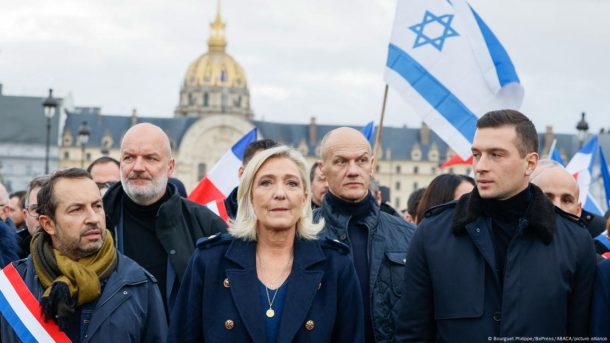
This conference counted on the presence of Jordan Bardella, the leader of France’s National Rally party; member of the European Parliament Hermann Tertsch of Spain’s Vox party; MEP Charlie Weimers of the Sweden Democrats party; MEP Marion Maréchal, granddaughter of National Front founder Jean-Marie Le Pen; and MEP Kinga Gál, of Hungary’s governing Fidesz party.
“Neither the left nor the right are friends of Israel and the Jewish people,” said Abraham Foxman, who led the ADL for nearly three decades. “Since the explosion of left-inspired antisemitism and anti-Israel hate in the last several years, the pseudo-Fascist right is trying to use the Jewish community as a platform, to demonstrate how legitimate and tolerant they are. Israel and the Jewish community should not give them legitimacy.”
Foxman is correct. Parties like the AfD and National Rally gain legitimacy by being slavishly pro-Israel—an excellent marker of the power of Jews in Western societies.
The presence of these controversial figures prompted a backlash from the ruling liberal establishment of the West. Felix Klein, Germany’s commissioner for combating antisemitism, canceled his appearance, citing his shock at the participation of populist politicians. Likewise, French-Jewish intellectual and ardent Zionist Bernard-Henri Lévy withdrew from his keynote address after learning Bardella would be speaking at the conference. Greenblatt, himself, eventually bowed out as speaker.
Bardella was particularly vehement in his comments on anti-Semitism:
“Since Oct. 7 [2023] in particular, France and Europe are witnessing a deadly honeymoon between Islamists and the far left,” Bardella said. “One provides the fanatics, the other institutionalizes the evil … We have to face anti-Jewish action head on … We have a solemn commitment in France to fight antisemitism everywhere at all times in all of its forms, whether from radical Islamists and the far left or the far right and their delirious plots. None of this hatred has any place in France or Europe.”
Bardella linked “the rise of Islamism, resurgence of antisemitism and the migratory phenomenon tearing apart all Western societies,” and said that the “National Rally is the best shield for the Jews in France.”
In contrast with his party’s founder, Bardella noted that he visited Yad Vashem and spoke of “the unspeakable horrors” of the Holocaust.
Despite the controversy surrounding the Israeli-sponsored conference, it proceeded without issue. Overall, it reflects a notable shift in Israeli foreign relations, spearheaded by Diaspora Affairs Minister Amichai Chikli of the Likud Party. Even before the Israeli government officially abandoned its policy of avoiding cooperation with right-wing populist parties in Europe, Chikli had been engaging with European populists.
He made appearances at conservative gatherings such as the Conservative Political Action Conference (CPAC) in Washington, where he praised President Donald Trump for his efforts to combat antisemitism. Chikli also spoke last year at Europa Viva 24, a gathering hosted by Spain’s Vox party, where he shared a platform with Marine Le Pen.
This growing closeness between Israel’s current leadership and European nationalist parties has stirred controversy both at home and abroad. Chikli’s vocal support for Le Pen during France’s recent elections drew criticism from diplomats in both countries. Last month, he and several Likud colleagues attended CPAC Hungary. In Western capitals, Hungary has been increasingly treated as a pariah for its unconventional foreign policy of treating NATO rivals such as China and Russia as normal countries and for its defense of traditional values and opposition to mass migration.
To those who have a rudimentary knowledge of Jewish influence in Western politics, the notion of Jewish groups aligning themselves with the populist would be almost unheard of. However, for seasoned observers of Jewish political behavior, these Jewish overtures to the European right are another classic case of the “Kosher Sandwich.” The strategy is quite simple: Jews take advantage, or sometimes even create a pressing social issue — immigration in this case. They subsequently insert themselves and their associates into both sides of the debate. But the Jewish interest in this case is to twist and exploit the issue for their own interests. Political newcomers, unaware of the deception, accept the Jew as an ally, convinced they are united in a common cause — only to be misled in the end.
One can see this in the “counter-Jihad” movement. Anti-Muslim activist Tommy Robinson, who has a history of receiving funding from the pro-Israel Middle East Forum and Jewish tech billionaire Robert Shillman, has been one of the most useful front goys for Jewish interests. While he has valid critiques about Islam’s corrosive influence in the United Kingdom and other West countries, Robinson has no issue with the UK importing millions of Hindus and Sikhs from the Indian subcontinent.
In effect, Robinson serves Jewish interests by promoting a Zionist-approved form of immigration restriction. Certain non-Whites — Muslims from the Middle East and South Asia — are demonized and barred from entering Western countries while other non-Whites less hostile, or at least apathetic, to Jewish political machinations continue flooding the Old Continent by the millions.
Jewish co-optation of European populist parties is a multi-decade project. Prime Minister of Hungary Viktor Orbán, who has otherwise sensible views on immigration and foreign policy, has a blindspot for Israel. This is largely due to his connection to Jewish Republican strategist Arthur Finkelstein—one of the key architects of Orbán’s and Israeli Prime Minister Benjamin Netanyahu’s electoral successes.
As a result of this Jewish connection, Orbán has been one of Israel’s strongest diplomatic allies in Europe, especially in the post-October 7 world. Despite his positive overtures to the Israeli government, the Hungarian Prime Minister continues to be demonized for being antisemitic by Western liberal institutions.
Such Jewish penetration of the populist Right has also been present in Italy. Matteo Salvini, leader of Italy’s right-wing Lega party, has cultivated strong ties with Israel, particularly under Benjamin Netanyahu’s leadership. Salvini has visited Israel multiple times, including in 2018 when he met Netanyahu, who called him a “great friend of Israel.” During these visits, Salvini expressed support for Israeli policies and criticized the EU’s stance on Israel.
A similar trend has occurred in the Netherlands. Geert Wilders, the founder and leader of the Party for Freedom (PVV) has a long-standing, personal connection to Israel, having lived and volunteered there as a young man and visited the country dozens of times. He firmly believes that Israel should have dominion over the entire land between the Jordan River and the Mediterranean Sea, opposes the creation of a Palestinian state, and has openly advocated for moving the Dutch embassy to Jerusalem. Wilders has met with Israeli leaders including Prime Minister Benjamin Netanyahu, President Isaac Herzog, and other high-ranking officials. He has been welcomed as a “true friend of Israel” by Netanyahu and has attended official events in Israel.
With prominent French populist leader Marine Le Pen being convicted for embezzling European Union funds, Israel now sees an opening for outreach in the French populist scene. It has invited Jordan Bardella, president of the National Rally (RN), and Marion Maréchal (Le Pen’s niece), to official conferences in Jerusalem, including the aforementioned government-organized antisemitism conference attended by the Netanyahu government.
Both Le Pen and Bardella have sought to rebrand the National Rally as a party amicable to Zionism, emphasizing support for the Jewish state’s security and opposition to “Islamist ideology.” Israeli Diaspora Affairs Minister Chikli publicly endorsed Le Pen, calling her “excellent for Israel” due to her anti-immigration and anti-Islamist positions.
The linking of right-wing populism with Zionist-friendly causes has also been pursued by political strategists and intellectuals like Steve Bannon and Yoram Hazony since the 2010s. Their distinctive approaches—Bannon’s political organizing versus Hazony’s think tank-building—represent two avenues that the American conservative movement has taken to make the world safe for Zionism in the populist era.
All things considered, what’s unfolding here appears to be a part of a backup plan for international Jewry to preserve itself in a 21st century marked by significant geopolitical upheaval. In a world where the United States can’t always be counted on to slavishly defend Israel, Jewish interest groups will strive to have all their bases covered by buying off populist parties abroad. As more and more voters in the West grow disillusioned with the post-World War II order, populist parties are well-positioned to upend traditional conservative and liberal parties and assume the levers of power.
As a result, the shiftiest elements of the transnational Jewish community will make attempts to insinuate themselves in these populist parties to ensure that they don’t become explicitly anti-Israel, much less antisemitic. Europe’s natural tendency, as evidenced by the scores of mass expulsions of the Jews across the Old Continent over two millennia of recorded history, is one of directly confronting the excesses of Jewish economic and political machinations.
To prevent this persistent element of European politics from making a comeback, Jewish interest groups have made it a point to defang White political power on both sides of the pond since the end of World II. In a post-liberal order, where the United States is no longer the unipolar power and its NGO appendages have lost their credibility, the Jewish diaspora will continue its subversive agenda albeit with a few tweaks in its strategy. Enter kosher populism—the only form of White grievance politics allowed in Jewish-dominated polities.
White advocates would be wise to not fall for the glossy exterior of regime-approved “populist” movements. While they may appear to be anti-system, their flaws with respect to challenging Jewish influence, ruin whatever positives they bring to the table. A hardened political cynic would view philosemitic populist organizations as containment vehicles designed to deradicalize Whites and prepare them for their eventual replacement by millions of foreign interlopers. Under normal circumstances, the White segment of the electorate would be gravitating towards nationalist parties that confront Jewish political power head on.
It can’t be stressed enough that European ethnic nationalism and strong anti-Zionist political movements are not permitted in the West. By leveraging hate speech laws, enforcing deplatforming across social media and financial sectors, and promoting controlled opposition groups, the Jewish lobby has thoroughly shaped the discourse in a way that prevents a friend-enemy distinction from ever materializing—the critical factor in undermining the Jewish supremacist projects.
Thanks to the Talmudic sleight of hand a certain faction of Jews has employed in their infiltration of nationalist groups, they ensure that Whites become cognitively polluted by Judaized talking points and expend vast resources and political energy in futile causes. In the meantime, the transnational criminal enterprise that is the Jewish global network continues to act with impunity—be it in the Middle East through the further consolidation of Israel’s geopolitical standing or by accelerating the demographic annihilation of the West via mass migration.
A strict policy of social distancing from institutions that are committed to preserving the Judeo-American Empire is of the essence. Given the demographic crises facing so many Western countries, it makes little sense to strike a Faustian pact with the Jewish institutions responsible for these developments.
As they say, with the Jews you lose.
Bill to repeal Patriot Act aims to unwind two decades of unchecked surveillance power
By Didi Rankovic | Reclaim The Net | May 9, 2025
US Representative Anna Paulina Luna has introduced a bill, the American Privacy Restoration Act, that aims to repeal the Patriot Act, passed in 2001.
The Florida Republican believes that what has in the meantime become the notorious post-9/11 legislation, has been abused by “rogue” intelligence officers to carry out mass surveillance in unlawful ways.
Announcing the bill, Luna mentioned that the Patriot Act has over the last decades been used to interfere in elections, violate innocent Americans’ privacy by spying on them, and even “settle personal scores.”
We obtained a copy of the bill for you here.
According to the representative, the ability to misuse and abuse the Patriot Act in such a way turned it into a tool for what is known as “the deep state” – whereas her legislative proposal seeks to take away the ability of these permanent power centers to violate the Fourth Amendment, that should protect against unreasonable searches and seizures.
Like a number of other laws, in particular those supposed to regulate intelligence and broader national security work, on paper, the Patriot Act’s condensed purpose is uncontroversial: to expand law enforcement powers, so as to “enhance the federal government’s efforts to detect and deter acts of terrorism in the United States or against United States’ interests abroad.”
However, on closer inspection – even before the law’s subsequent slide into controversy – it quickly became clear that the expanded powers were too broad and went beyond surveillance itself, to allow for warrantless searches in some cases, more “information sharing,” as well as access to business records.
Critics have been saying that since 2001, the Patriot Act has been turned against Americans themselves, and used as an excuse to subject even those not suspected of any wrongdoing to mass surveillance, all the while sidestepping the necessary guardrails and oversight.
Luna believes this has produced “the most sophisticated, unaccountable surveillance apparatus in the Western world.” And she believes it is necessary to act now to rectify this situation.
“It’s past time to reign in our intelligence agencies and restore the right to privacy. Anyone trying to convince you otherwise is using ‘security’ as an excuse to erode your freedom,” the legislator is quoted as saying.
One of Luna’s unlikely – for political and ideological reasons – allies is the American Civil Liberties Union (ACLU), which has been pushing for reforms of the Act, reminding of the fact that when it was first passed in October 2001, many members of Congress admitted to not having read the bill before voting for it.
According to the ACLU, there were “intimations from the Bush administration that those who voted ‘no’ would be held responsible for further (terror) attacks.”
I was interrogated in Singapore twice for writing about Palestine
By Dr. Muhammad Zulfikar Rakhmat | MEMO | May 10, 2025
In 2023, I experienced something I never expected in a country like Singapore. Not once, but twice, I was detained and interrogated at Changi Airport—not for breaking any law, not for carrying suspicious items, but for my work as an academic and journalist who writes on Middle Eastern affairs, especially Palestine.
I am an Indonesian citizen. I grew up in Qatar due to my father’s work relocation and completed my high school and undergraduate education there. I later studied in the UK, and between 2022 and 2025, I lived and worked in South Korea as a Research Professor at Busan University of Foreign Studies. My writing has long focused on the politics of the Middle East, with a consistent interest in Palestine—a cause rooted in personal history, moral clarity, and scholarly duty.
In February 2023, my wife and I were in transit in Singapore, flying back to Indonesia from South Korea. We had planned a quiet evening during our overnight layover, including a stop to try halal noodles at Tampines Mall. But instead of a peaceful layover, I was stopped at immigration and taken to a secluded room beside the counter. My wife was told to wait nearby, confused and anxious.
After a short wait, three men approached me, identifying themselves as Singapore’s security officers. They questioned me about my background, my travel history across the Middle East, and most tellingly—my academic and journalistic work. They seized my phone and combed through its contents. One of them referred to me as a “prolific writer,” a remark that made it clear they had done prior research on me before the encounter. Another asked, “Why do you write about the Middle East, especially Palestine?” They also pressed me on my views regarding the situation in the Middle East, suggesting a deeper interest not just in what I had written, but in the perspectives I held.
They never explicitly accused me of wrongdoing. But their fixation on my publications, and on my years living across the Middle East, was a clear indication that my intellectual work had triggered their attention. Later, my wife told me that one officer had directly told her that they were questioning me because of my journalism. After hours of interrogation, I was released and escorted to the departure gate. We never got to try the noodles, and we were told to wait until morning for our connecting flight. Before letting me go, one officer gave a parting warning: “Don’t write about our encounter.”
I’m writing about it now because such intimidation cannot go unchallenged.
Seven months later, in September 2023, it happened again. I was on a flight from Busan to Yogyakarta via Singapore. Because the transfer wasn’t automatic, I had to go through immigration to recheck my bags. The moment my passport was scanned, I was flagged and pulled aside once more. The questioning this time was shorter, but the tone and focus were the same. Even when I returned in the morning to board my next flight, I was flagged again and directed to a “special” immigration counter.
These were not isolated or accidental encounters. My name and passport had clearly been red-flagged.
Ironically, I have professional ties with Singapore itself. I am affiliated with the Middle East Institute at the National University of Singapore—one of the country’s premier academic institutions on Middle Eastern affairs. But that did not seem to matter to the security officers who questioned me. My intellectual contribution meant nothing in the face of state suspicion.
I have traveled to over 40 countries. Like many Muslims and Middle East-focused researchers, I’ve experienced scrutiny at airports, including once under the UK’s notorious Schedule 7 counter-terror law at Manchester Airport. But to face this kind of treatment in Singapore—a country I had visited multiple times in the past without issue, and the very first country I ever traveled to as a young student—was deeply unsettling.
Singapore’s position on Palestine is telling. While it officially supports a two-state solution and often expresses concern over violence in the region, its foreign policy leans heavily toward Israel. Military cooperation between the two states is robust, including procurement of Israeli-made weaponry. As such, open criticism of Israel or public support for Palestinian rights may be quietly discouraged within Singapore’s tightly controlled public sphere. For foreign nationals like myself, even transiting through the airport can be enough to trigger scrutiny.
This raises critical questions about freedom of expression and academic independence—not just inside Singapore, but across a growing network of states that prioritise geopolitical alliances over basic rights. The chilling effect is real. After these experiences, I now actively avoid flights that transit through Singapore. I decline invitations to speak or participate in events there. I no longer feel safe traveling through a country that punishes intellectual inquiry into the Middle East.
We must ask: what kind of global academic and journalistic space are we creating when states begin punishing people not for what they do, but for what they write? When security officers begin quoting your articles to justify a border interrogation, you know you are not just being profiled—you are being surveilled for thought.
Journalists and scholars must remain vigilant. We must continue to speak truth to power, especially when it concerns oppressed peoples like the Palestinians. It is essential to continue challenging power through critical inquiry and to document the subtle and overt ways in which restrictions on freedom of expression and dissent extend beyond national borders.
Singapore, for its part, must be held accountable. If it wants to remain a respected hub for global transit, business, and academia, it cannot target people based on their views. It cannot pick and choose which intellectual conversations are permissible. And it certainly cannot suppress writing on Palestine without revealing its own complicity in a much larger effort to silence that struggle.
Let us be clear: Palestine is not a taboo. Palestine is not a crime. Writing about it should not make anyone a suspect.
I was told not to write about what happened to me at Changi Airport. But silence is not an option.
Iran, Saudi Arabia foreign ministers discuss key bilateral, regional developments
Press TV – May 10, 2025
The top diplomats of Iran and Saudi Arabia met to discuss key issues related to bilateral relations, as well as regional and international developments.
Foreign Minister Abbas Araghchi met with his Saudi counterpart, Prince Faisal bin Farhan Al Saud, upon arriving in Jeddah on Saturday. His visit to Saudi Arabia is part of Tehran’s ongoing policy of strengthening ties with neighboring countries.
During the meeting, Araghchi also signed the Saudi Foreign Ministry’s memorial book.
Araghchi urged the Muslim world to take action to confront threats and challenges, including putting an end to the ongoing Israeli genocide in Gaza and preventing a conspiracy to annihilate Palestine in a colonial manner.
The top Iranian negotiator updated his Saudi counterpart on the latest developments regarding the Tehran-Washington indirect talks.
The Iranian and Saudi foreign ministers expressed the two countries’ determination to promote their common goal of expanding mutual relations in all fields.
On Friday, Araghchi announced that the fourth round of indirect talks between Iran and the United States will take place in Oman on Sunday.
His regional tour includes a visit to Qatar later on Saturday as part of his diplomatic engagements.
Speaking in an interview on Friday, Araghchi said his visit to Saudi Arabia would be in line with consultations between the two countries about regional issues and indirect negotiations between Iran and the United States.
He added that since the beginning of the talks in April, Iran has been in constant contact with regional countries to inform them about the process.
“The sustainability of any potential agreement largely depends on the considerations and concerns of the regional countries regarding the nuclear issue and their common interests with the Islamic Republic,” the Iranian foreign minister emphasized.
Mediated by Oman, Iran and the US have held three rounds of talks in the Omani capital of Muscat and the Italian capital of Rome on April 12, 19, and 26, with the aim of reaching a deal on Iran’s nuclear program and the removal of sanctions on Tehran.
Both parties have so far expressed satisfaction with the way the negotiations are moving on, praising the talks as “positive” and “moving forward.”
A fourth round of the talks was scheduled to be held on May 3 in Muscat but was postponed for “logistical and technical reasons,” as cited by the Iranian foreign minister.
Russia is not afraid of Western sanctions – Kremlin
RT | May 10, 2025
Russia is used to Western pressure and is not concerned about new sanctions, Kremlin spokesman Dmitry Peskov has said.
He was commenting on a new round of sanctions recently imposed by the UK.
”We already know what we will do once the sanctions are announced and how we will minimize their effect,” Peskov told journalist Pavel Zarubin on Saturday. Russia has learned effective ways to counteract Western pressure, he said. “Therefore, scaring us with sanctions is pointless.”
On Friday, the British government announced what it called the “largest-ever” sanctions package against Russia, targeting its oil transportation network in order to deliver a blow to the country’s energy revenues.
The new measures blacklisted up to 100 oil tankers that the West claims are part of a Russian ‘shadow fleet’, older vessels operating outside Western insurance systems. Since the escalation of the Ukraine conflict over three years ago, successive British governments have introduced more than 2,000 sanctions on Russian individuals and entities.
Moscow has said the move will not harm Russia’s economy and will instead increase energy costs and inflation in Europe.
Earlier, US President Donald Trump called for an “unconditional ceasefire” between Moscow and Kiev, threatening punitive measures if the truce is not observed. “The US and its partners will impose further sanctions” if it is violated, he said.
In March, Russian President Vladimir Putin said that a total of 28,595 sanctions were imposed on Russian companies and individuals in recent years – more than the total number on all other countries combined. According to the president, the West sought to eliminate Russia as a competitor but its economy has only grown more resilient under pressure.
Will Trump recognize a Palestinian State?
Al Mayadeen | May 10, 2025
Gulf analysts wrote in The Media Line on Saturday that Saudi Arabia will host the 2025 Gulf-US Summit in mid-May, aligning with US President Donald Trump’s first visit to the Kingdom in his second term, echoing the huge May 2017 summit in Riyadh during his first term.
All Gulf leaders are expected to attend the summit, except for King Salman bin Abdulaziz, who has remained absent from public engagements due to health concerns.
Ahead of the summit, speculation has grown around what Trump referred to as a “very important announcement” during a recent meeting with Canadian Prime Minister Justin Trudeau at the White House on May 6.
Observers anticipate that the summit could unveil high-level diplomatic shifts, economic agreements, or security deals.
Rumors of US recognition of a Palestinian State
According to The Media Line, the announcement of a Palestinian state is among the most widely discussed possibilities.
Moreover, a Gulf diplomatic source who spoke anonymously to The Media Line said, “President Donald Trump will issue a declaration regarding the State of Palestine and American recognition of it, and that there will be the establishment of a Palestinian state without the presence of Hamas.”
The source added that such an announcement could mark a significant realignment in the region, possibly leading more Arab states to join the normalization agreements.
Additionally, former Gulf diplomat Ahmad al-Ibrahim told The Media Line, “I don’t expect it to be about Palestine. Egyptian President Abdel Fattah el-Sisi and King Abdullah II of Jordan have not been invited. They are the two countries closest to Palestine, and it would be important for them to be present at any event like this.”
It is worth noting that the US is no longer demanding that Saudi Arabia normalize ties with “Israel” as a precondition for advancing civil nuclear cooperation talks, two sources with knowledge of the matter told Reuters, ahead of Trump’s visit to the kingdom.
This marks a significant policy shift by Washington. Under former President Joe Biden, nuclear negotiations with Riyadh were tied to a broader US-Saudi agreement that included recognizing “Israel” and a potential defense treaty with the United States.
Potential economic deals worth billions
Major Saudi economic deals in the 2025 visit may mirror those of the 2017 summit, when agreements worth more than $400 billion were signed, according to The Media Line.
Trump is also expected to visit Qatar and the UAE following his stay in Saudi Arabia, reinforcing speculation of further bilateral and regional economic announcements.
Saudi political analyst Ahmed Boushouki echoed this sentiment, stating, “This is about major economic deals that will take place in the Kingdom of Saudi Arabia.
“Perhaps President Donald Trump hinted at this when he told the American people to ‘buy stocks now, before his big announcement in the next two days.’”
According to the report, the summit may reignite discussions on US-Saudi nuclear cooperation. Saudi Arabia has had a peaceful nuclear energy program in place since 2010, and “International companies are now working to implement these projects in Saudi Arabia.”
It is worth mentioning that Saudi Arabia is advancing plans to build its first nuclear reactor, with several global firms competing for the contract, while the UAE’s Barakah plant remains the Arab world’s only operational four-reactor facility, built with South Korea.
Fed Up with Benjamin Netanyahu?
By Philip Giraldi | Unz Review | May 9, 2025
I have in the past speculated that the day might come when President Donald Trump, he of a massive ego, might just become tired of his being manipulated and controlled by America’s Israel Lobby and by Israeli Prime Minister Benjamin Netanyahu in particular. I thought, and hoped, that he might become so annoyed that he might move to take control of the so-called tail wags the dog relationship that has for so long put Israel in the driver’s seat. While I am loathe to read too much into several recent developments, the first suggestion [is appearing] that all is not well in Washington’s relationship with what has been euphemistically referred to as “America’s best friend and closest ally.”
Many observers are now openly voicing their view that Israel and its all-powerful Lobby in the United States have corrupted and now control many aspects of government, starting at the top in Washington and working its way down to state and local levels. Witness the near worship of Netanyahu by groveling congress critters during recent visits to Capitol Hill if you want a tangible display of government serving no conceivable national interest. Or check out the “antisemitism” and anti-Boycott legislation currently moving through Congress that will strip all Americans of free speech and free association, leaving them able to demonstrate against or even criticize their own country or other nations with the single exception of the Jewish state. If you don’t believe that will happen, check out the current tale coming out of San Marcos in Texas at the hands of ardently Zionist Governor Greg Abbott.
Given that Jews constitute something like 3% of the US population the establishment of such control through bribery and the support of a compliant media is truly a remarkable achievement but one might plausibly argue that it has done terrible damage to the country as a whole and has contributed nothing to benefit the American people. Israel is currently carrying out a genocide against the Palestinians that is funded, armed and provided with political cover by the Trump Administration, following on to the model established by Genocide Joe Biden, which could be stopped with one phone call to Netanyahu from the White House. But, unfortunately, up until now no one has been picking up the phone.
I must admit to being shocked to have read some of the recent news coverage, mostly coming out of Israeli and other foreign media, of course, that is describing the rift between Trump and Netanyahu. The signs that trouble could be brewing might well be dated back to January 11th, with US Presidential Special Envoy Steve Witkoff demanding a meeting in Tel Aviv with Netanyahu. Netanyahu responded that it was a Saturday, the Sabbath, but Witkoff, acting under orders from Trump, insisted and the meeting was held. It turned out to be a tense exchange which included a demand that a ceasefire for Gaza drawn by the White House be implemented, and so it was, though Netanyahu later proceeded to withdraw from it and recommence hostilities before it entered phase two on March 1st. A demand by Trump that Netanyahu should visit him in Washington in early April followed and there were reported disagreements about the Administration’s tariff plan and about US negotiations with Hamas without Israel’s input. Discussions also concerned US discussions with Iran to restore a program (JCPOA), canceled by Trump during his first term in office, to monitor the Iranian nuclear program to prevent it from being weaponized. Netanyahu was demanding a “Libyan Solution” which would have been a war including US forces that would have basically destroyed Iran’s defensive capabilities, something that even a White House disinclined to deal with reality realized would never be accepted in Tehran. Netanyahu was reportedly also angry at the Trump Administration’s resistance to his own plans to ethnically cleanse the Palestinians while also going to war with the Iranians.
So, the US move to negotiate with Hamas directly, sidelining Israel, started the rebellion on the part of Washington and it was followed up by the negotiations with Iran, again without Israel’s input. And there was also the issue of US negotiations with Saudi Arabia, again without including Israel, over the Kingdom’s intention to develop its own civil nuclear program. And finally, there was last week’s decision to enter into a ceasefire with the Houthis after direct negotiations, described by the White House comically as a “capitulation” by the Yemenis. Some observers accepted the language but have been questioning who had done the surrendering in a war that cost in excess of $1 billion and which accomplished nothing. Israel, for its part, was not involved in either the talks or the agreement, leading an aggrieved Netanyahu to vow to “defend ourselves alone”.
But this week, Trump sent the clearest message of all to Netanyahu. He has been planning to meet with the leaders of Saudi Arabia, the United Arab Emirates and Qatar in the Middle East next week but will not meet with Netanyahu. US Secretary of Defense Pete Hegseth also canceled a planned trip to Israel at the same time, according to two Israeli officials, reinforcing the message sent by the president. The immediate cause of the rift was that Trump had apparently hoped for a major de-escalation and even a ceasefire in Gaza as a highlight of his trip for which he would have taken credit, but Netanyahu instead called up army reserves and ordered a major escalation. The Times of Israel reported that “Trump is disappointed with Prime Minister Benjamin Netanyahu” citing two “senior sources close to the president.” And even opinion columnist Thomas Friedman in normally careful-about-its-reporting on Israel The New York Times is openly suggesting in a piece “This Israeli Government is Not Our Ally” that the Netanyahu regime is no longer behaving as an American friend because of its extremist agenda.
Several reports, relying on what are claimed to be multiple sources inside the Israeli government, have now claimed that Trump has de facto cut ties with Netanyahu and will have no direct contact with the Israeli Prime Minister. Israeli government Strategic Affairs Minister Ron Dermer and former Ambassador to the US was in Washington on Thursday and was welcomed and met with Trump. He was reportedly told flatly that the US “will move forward on regional plans without coordinating with Netanyahu, accusing him of manipulation.” One report on the development went on to emphasize that what Trump hates most is being looked down upon and being manipulated, “There is nothing Trump hates more than being portrayed as a fool or someone being played. That’s why he decided to cut contact with Netanyahu,” one US official speaking off the record added.
What is not being discussed in the media but is nevertheless being considered in intelligence circles in Washington is the possible connection of the excommunication of Netanyahu with various dismissals and relocations of high officials in Washington, including that of National Security Adviser Mike Waltz who was demoted to the post of UN Ambassador. It seems that there is strong evidence to suggest that Netanyahu did not exactly trust Trump and has been spying on him and his decision making through a number of officials in his cabinet, which explains to a certain extent the odd Signal phone calls where journalist Jeffrey Goldberg just happened to be listening in and other incidents that suggest that Mossad or the Israeli Embassy in Washington has established relationships that sought to go around the president and might be described as espionage. It would also help to explain the mixed signals coming out of the administration, suggesting that some “recruits” are being coached on what to say to advance the Netanyahu agenda.
How all of this will develop and where it will eventually wind up remains somewhat up in the air as the powerful Israel Lobby is almost certainly cranking up efforts to restore the Jewish state’s dominance of US foreign policy in the Middle East, what Trump is now defining as “manipulation.” Zionist uber hawks in Congress are already warning the White House that any agreement on nuclear developments with Iran will be rejected by the legislature if it does not include a “complete dismantling” of all nuclear enrichment by Tehran, something that is not likely to be acceptable and which means that no agreement will be possible. Wholly owned by Israel Senators Lindsey Graham, Tom Cotton and Victor Cruz are leading the charge and claim to have enough votes to block any such proposal, which means it will not be a “law” or treaty and could be “withdrawn from” by any new president, just as Trump did with the original JCPOA in 2017.
So, there has been some movement in the relationship between Israel and the United States. As it is headed towards Washington regaining some independence of action in its Middle Eastern foreign policy it can only be a good thing as the lopsided relationship with Israel has brought nothing but grief and suffering. One can hope that it will continue in that more positive direction but there will be strong resistance from Congress and the Media, directed by the powerful Israel Lobby. Trump and whoever supports him will find themselves assailed from all sides but we ordinary citizens who are watching all this from the sidelines will have to hope and pray for a good result.
Philip Giraldi is an American columnist, commentator and security consultant. He is the Executive Director of the Council for the National Interest, a role he has held since 2010.
US House Approves MEGOBARI Act to Pursue in Georgia More Ukraine-style Intervention and Conflict with Russia
By Adam Dick | Ron Paul Institute | May 9, 2025
We have seen this play out before, the United States government relentlessly acting to control the government in a former Soviet Union republic bordering Russia and then proceeding to support that government in war against Russia. That course of action has led to devastation in Ukraine, including the deaths of hundreds of thousands of individuals, in a US proxy war against Russia. Through Monday approval in the United States House of Representatives of the Mobilizing and Enhancing Georgia’s Options for Building Accountability, Resilience, and Independence Act (MEGOBARI Act) by a vote of 349 to 42, the House took a big step toward a replay of this disaster in Georgia.
The MEGOBARI Act (HR 36) is overflowing with repetition of the type of justifications that were brought out in support of the US government’s disastrous intervention in Ukraine. “[T]he consolidation of democracy in Georgia is critical for regional stability and United States national interests,” proclaims the bill before declaring it is “the policy of the United States” to “support the constitutionally stated aspirations of Georgia to become a member of the European Union and NATO,” to “continue supporting the capacity of the Government of Georgia to protect its sovereignty and territorial integrity from further Russian aggression or encroachment within its internationally recognized borders,” and to ensure several other listed developments occur in Georgia that would increase the nation’s connection to the US and European Union (EU) while creating antagonism between Georgia and Russia. US policy is also listed as including “to combat Russian aggression, including through sanctions on trade with Russia and the implementation and enforcement of worldwide sanctions on Russia.” Even included, as happened before with Ukraine, is a demand for reduced trade ties between Georgia and Russia.
The statement of US policy in the bill further includes a recounting of USAID-style manipulation of a foreign government, depicted as democracy promotion, that has been well exposed in the last few months through the efforts of the Department of Government Efficiency (DOGE). For example, the MEGOBARI Act declares it is US policy “to continue supporting the ongoing development of democratic values in Georgia, including free and fair elections, freedom of association, an independent and accountable judiciary, an independent media, public-sector transparency and accountability, the rule of law, countering malign influence, and anti-corruption efforts and to impose swift consequences on individuals who are directly responsible for leading or have directly and knowingly engaged in leading actions of policies that significantly undermine those standards.” That may sound nice — though seriously buttinski — out of context (as is its propaganda intent). But, this is standard US regime changer language for “the US has decided to run the show in your country.”
Right after declaring it is US policy for the US to impose its will on Georgia and harm Russia, the bill moves on to mandating the delivery to congressional committees of a specially prepared classified report “examining the penetration of Russian intelligence elements and their assets in Georgia, that includes an annex examining Chinese influence and the potential intersection of Russian-Chinese cooperation in Georgia.” Got to keep track of the competition. But, really, the main purpose is probably to help the politicians and their media supporters justify the continuing ramping up of intervention in Georgia and antagonism toward Russia and China. The classified information, it will be asserted, shows the “bad guys” are doing such dastardly things in Georgia that would really shock the American people if the details didn’t just have to be kept secret. This will support intervention in Georgia and the fearmongering behind the US government’s resurrected cold war.
Beyond stating US policy supporting exercise of control over Georgia, opposition to Russia and China, and, potentially, war, the MEGOBARI Act calls for the creation of a five-year plan by that old regime change pro USAID — still alive and well — in coordination with other unnamed US government departments. That plan would be purposed to turn into action the stated interventionist US policy.
The bill also calls on President Trump to start slinging the go-to interventionist weapon of sanctions against Georgians from Parliament members to government and political party officials who Trump determines “knowingly engaged in significant acts of corruption, or acts of violence or intimidation in relation to the blocking of Euro-Atlantic integration in Georgia.” Their family members can also be sanctioned. You can ignore the fluff about “corruption” and “violence or intimidation.” That is not what the US is interested in stopping. Otherwise, the remainder of the sentence describing who should be sanctioned would not have been included. The US via these sanctions will be acting to advance “Euro-Atlantic integration.” Oppose that in Georgia and the “corruption” or “violence or intimidation” determination regarding you can be expected to be tagged on as justification for sanctions. This fits right in with the US routinely failing to condemn terrorism and human rights abuses by people, organizations, and governments acting in line with US foreign policy.
The MEGOBARI Act also gives the president an additional broad sanctions direction that he “determine whether there are foreign persons who, on or after the date of the enactment of this Act, have engaged in significant corruption in Georgia or acts that are intended to undermine the peace, security, stability, sovereignty, or territorial integrity of Georgia for the purposes of potential imposition of sanctions pursuant to powers granted to the President under the International Emergency Economic Powers Act (50 U.S.C. 1701 et seq.).” Rest assured, though, efforts to “undermine the peace, security, stability, sovereignty, or territorial integrity of Georgia” will be judged A-OK as long as those efforts are US supported.
Near the end of the bill comes the language that gives away what is seen as a likely outcome of the intervention the bill puts in place: war with Russia. The president, the bill states, “in consultation with the Secretary of Defense, should maintain, and as appropriate, expand military co-operation with Georgia, including by providing further security and defense equipment ideally suited for territorial defense against Russian aggression and related training, maintenance, and operations support elements.”
House members who voted for the MEGOBARI Act are setting up expanded intervention in Georgia that follows the Ukraine model. Even preparation for another proxy war against Russia is included in the process the bill sets up.
The MEGOBARI Act is not the beginning of US intervention in Georgia. That has been ongoing for many years. But, the bill is a significant step forward. The timing of the bill’s approval is also important. Even as President Donald Trump talks of ending the Ukraine War and removing sanctions on Russia as part of a peace deal, the MEGOBARI Act signals that the US is preparing for a replay of the entire catastrophic policy of intervention in another former Soviet republic on Russia’s border.
A Monday press release issued by MEGOBARI Act megasupporters Reps. Steve Cohen (D-TN), Joe Wilson (R-SC), Richard Hudson (R-NC) and Marc Veasey (D-TX) upon House approval of the bill, states the MEGOBARI Act “is fully negotiated between House and Senate, Democrat and Republican leaders and is expected to move quickly.” Those Republican and Democratic leaders make a fuss about their disagreements on some things. But, when it comes to major interventions abroad, they tend to be fully supportive.
The press release goes on to note in its next sentence that “MEGOBARI means ‘friend’ in Georgian.” People in Georgia would do well to look at how the Ukraine and US governments being “friends” has worked out for Ukrainians.
Featured Video
No Threat Can Force Iran’s Surrender /Trita Parsi & Lt Cl Daniel Davis
or go to
Aletho News Archives – Video-Images
From the Archives
What is the Israeli Lobby in Australia Doing in Interfaith Dialogue?
By Ali Kazak | Dissident Voice | October 11, 2015
For years Israel and its lobby around the world have been trying to normalise their relations with Arabs and Muslims without solving the Palestine Question.
One of the methods they resorted to in the last few years is using human rights and community organizations such as interfaith dialogue and Multiculturalism to achieve this objective and to: isolate the Palestinians, marginalise the Palestine question, end Israel’s isolation, and prevent criticism of Israel, knowing that these organisations will be the first to stand against Israel’s violations, racial and religious discrimination.
The group responsible for this task in Australia is The Australia/Israel & Jewish Affairs Council (AIJAC); its Director of International & Community Affairs, Jeremy Jones is in charge of lobbying religious community organizations, specifically Muslims and Christians. Consequently he convened the Faith Communities for Reconciliation, founding participant in the Australian Partnership of Religious Organisations and the Australian National Dialogue of Christians, Muslims & Jews.
AIJAC is a private political propaganda group. It is recognised as the main Israeli lobby in Australia. It coordinates its activities and works intimately with the Israeli embassy in Canberra and different institutions in Israel. It is privately funded by some Jewish businessmen. It monitors closely Australian politicians, the media, ethnic and religious groups, (especially Arabs and Muslims), unions and academics on their stands towards Israel and the Palestine question. … continue
Blog Roll
 Aletho News
- Theodore Postol: Iran’s Missiles & Drones Were Underestimated
- Iran To Target Military Industrial-Tech Complex That Facilitated Gaza Genocide
- Collapsing Empire: The Resistance Disarms ‘Israel’
- Suicide Should Not Be a Government Service
- Rethinking America’s greatest threat: Iran vs. Israel-Firsters
- Iran accuses adversaries of false flags to strain Turkey ties
- Poland rules out sending Patriot missiles to US/Israel amid war on Iran
- Tehran approves new Hormuz plan with major restrictions
- No Threat Can Force Iran’s Surrender /Trita Parsi & Lt Cl Daniel Davis
- UK’s New Pandemic Plan Would Turn Big Tech Into a Mass Location Tracking Network
- If Americans Knew
- Ann Coulter Rips Into Fox News for Iran War Coverage, Compares to False Rigged 2020 Election Reporting
- Joe Kent Urges Americans To Call White House and Congress To Object To Sending Troops Into Iran
- DNC Resolution to Reject AIPAC Funding Puts Democratic Leaders in the Hot Seat
- Swedish foundation to build 400 schools as over 650,000 Gaza children remain without education for 2 years
- Israeli army admits photshopping image of slain Lebanese journalist
- This is how Israel is systematically killing health workers under the cover of war in Lebanon
- Carrying life under fire: Israeli invasion of Lebanon leaves pregnant women facing deadly risks
- Champagne all around for the new death penalty (for Palestinians) law – Not a ceasefire Day 172
- Why are Palestinian books struggling to be seen on Amazon?
- The Line Between Affinity and Conspiracy
- No Tricks Zone
- New Study Finds Warming Saves Lives…Cold Temperatures 12 Times More Deadly Than Excess Heat
- German Science Blog Accuses PIK Climate Institute Of Hallucinating Climate Tipping Points
- Devastating Assessment Of Comirnaty Vaccine By Former Senior Pfizer Europe Toxicologist
- New Study: CO2 Is ‘Effectively Negligible’ As An Explanatory Climate Change Factor Since 2000
- Former Pfizer Toxicologist Dr. Helmut Sterz Tells Bundestag Hearing Pfizer Vaccine Should Have Never Been Approved
- Energy Expert: Germany’s Nuclear Phaseout Was A “500 Billion Euro Mistake”
- New Research: South Australia’s Mid-Holocene Sea Surface Temperatures Were 4°C Warmer Than Today
- Storing Green Energy To Last Germany 10 Days Would Require A 60-Million Tonne Battery
- New Studies: UK Sea Levels Were 4 Meters Higher Than Today During The Mid-Holocene
- Destructive Green New Deal: German Energy And Metal Group Warns Of Drastic Crisis
 Aletho News