A short guide on how to starve a population to death
By Jonathan Cook | May 28, 2025
A short guide on how to engineer a genocide by starvation and ethnic cleansing:
1. Choose your moment. Ok, you’ve been ethnically cleansing, occupying, oppressing and killing your neighbours for decades. The international courts have ruled your actions illegal. But none of that will matter the moment your neighbours retaliate by attacking you. Don’t worry. The western media can be relied on to help out here. They will be only too ready to pretend that history began on the day you were attacked.
2. Declare, in response, your intention to starve your neighbours, treating them as “human animals”, by blocking all food, water and power. You will be surprised by how many western politicians are ready to support this as your “right to defend yourself”. The media will echo them. Important not to just talk about blocking aid. You must actually do it. There will be no serious pushback for many, many months.
3. Start relatively slowly. Time is on your side. Let a little bit of aid in. But make sure to relentlessly smear the well functioning, decades-old aid distribution system run by the international community – one that is transparent, accountable and widely integrated into the community it serves. Say it is infiltrated by “terrorists”.
4. Use that claim – evidence isn’t really necessary, the western media never ask for it – as the pretext to bomb the aid system’s warehouses, distribution centres and community kitchens. Oh, and don’t forget to bomb all the private bakeries, destroy all the farmland, shoot all the animals and kill anyone who tries to use a fishing boat, so that there are no other sources of food. You are now in control of the trickle of aid reaching what is rapidly becoming a severely malnourished population.
5. Time to move into higher gear. Stop the international community’s aid getting in all together. You will need a humanitarian cover story for this bit. The danger, particularly in an age of social media, is that images of starving babies will make you look very bad. Hold firm. You can get through this. Claim – again evidence isn’t really necessary, the western media won’t ask for it – that the “terrorists” are stealing the aid. You will be surprised how willing the media is to talk about babies going “hungry”, ignoring the fact that you are starving them to death, or speak of a “famine”, as though from drought and crop failure, not from your carefully laid plans.
6. Don’t lose sight of the bigger story. You are blocking aid to “eradicate the terrorists”. After all, what is the worth of a baby, of a child – all 1 million of them – in the fight to eliminate a rag-tag army of lightly armed “terrorists” who have never waged their struggle outside of their historic homeland.
7. Now that the population are entirely at your disposal, you can roll out a “humanitarian” alternative to the existing system you have been vilifying and wrecking. Probably best to have been working on this part of the plan behind the scenes from early on, and to have regularly consulted with the Americans on how to develop it. You may even find they are willing to fund it. They usually are. You can obscure their role by using the term “private contractors”.
8. It’s time for implementation. Obviously, the point is not to really distribute aid. It is all about providing a cover story so that the starvation and ethnic cleansing can continue. Make sure you provide only a tiny amount of aid and make it available only at a few distribution points you have set up with these “private contractors”. This has two advantages.
9. It forces the population to come to the areas you want them in. Like luring mice into a trap. Get them to the very edge of the territory, because from there you will be best positioned at some point to drive them over the border and get rid of them for good.
10. Your system will lead to chaos, as desperate, starving people fight for food. That’s great for you. It makes them look like a swarming mass of those “human animals” you were talking about from the start. Don’t they deserve their fate? And it means that young, fit men – especially those from large, often armed, criminal families – will end up with most of the food. The stuff they can’t grab at the distribution points, they will ambush later as people try to return home laden with their heavy aid packages. That may seem counter-productive, given that you’re claiming to want to eliminate the “terrorists”. Won’t these fit, young men, as conditions degenerate further, provide a future source of recruits to the “terrorists”. But remember, the real goal here is to starve the population as quickly as possible. The young, the elderly, the sick and the vulnerable are the ones who will die first. The more of them who start dying, the faster the pressure builds on everyone else to flee the territory to save themselves.
You are nearly there. True, faced with the emaciated bodies of your victims, western politicians will start making harsh pronouncements. But they have already given you a massive head start of 20 months. Be grateful for that. You don’t need much longer. While they dither, you can get on with the job of extermination. Leave it to the history books to judge what really happened.
Merz vows to block Nord Stream 2
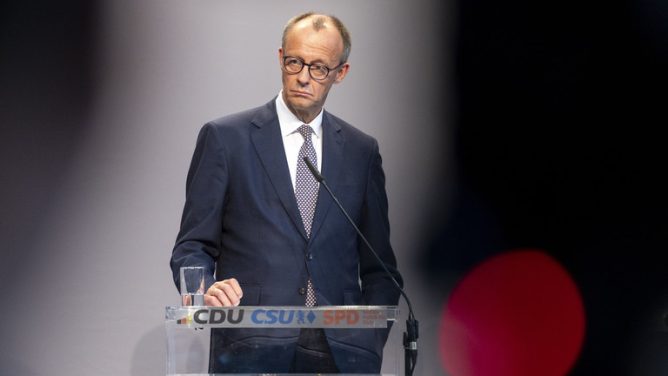
Friedrich Merz, leader of the Christian Democratic Union. © Maja Hitij/Getty Images
RT | May 28, 2025
German Chancellor Friedrich Merz has pledged to do “everything” to prevent the Russian Nord Stream 2 gas pipeline from being launched. The gas inter-connector from Russia through the Baltic sea to Germany was destroyed by a series of underwater explosions in September 2022 in an act of sabotage that Russia believes was orchestrated by Western intelligence agencies.
Merz’s declaration comes as Moscow and Kiev draft respective proposals for bringing about a ceasefire in the Ukraine conflict, following their first direct peace talks in three years in Istanbul.
The talks marked a shift for Kiev, which abandoned diplomatic efforts in 2022 in favor of seeking a military victory on orders from the West. While Moscow has reported progress on its proposal, Ukraine’s Vladimir Zelensky and his EU backers have accused Russia of stalling.
During a joint press conference with Zelensky in Berlin on Wednesday, Merz vowed to “further increase pressure on Russia” and “weaken Moscow’s war machine” through sanctions, including on Nord Stream 2.
“I say on behalf of the Federal Republic of Germany, we will do everything in this context to ensure that Nord Stream 2 cannot be put back into operation,” he stated. He claimed that the measures aim to “pave the way for negotiations,” despite Moscow’s repeated criticism of Western sanctions policy.
European Commission President Ursula von der Leyen said earlier this month that Brussels had planned an 18th sanctions package to include measures aimed at Nord Stream 2 AG, the Swiss-based entity that owns the pipelines, and any other companies necessary for their restart and operation.
Media reports have claimed that Merz has supported the move and that he has opened talks in Berlin and Brussels to prevent any revival of energy trade with Russia.
A number of European officials have opposed targeting the pipelines. Florian Philippot, a prominent French Euroskeptic, has warned that such a move would amount to a “death sentence” for European industry. Michael Kretschmer, the prime minister of the German state of Saxony, has argued that “Nord Stream is a possible opening for a conversation with Russia,” adding that such talks would benefit Germany as its economy needs Russian gas supplies to function normally.
Earlier reports have also claimed that Russia and the US were exploring ways to resume shipments through the still-intact line of Nord Stream 2.
Sanctions as Self-Harm: The West’s Strategic Blind Spot in Confronting Russia
By Ricardo Martins – New Eastern Outlook – May 28, 2025
This article critically analyzes the latest EU sanctions on Russia, arguing they are strategically flawed and economically self-destructive. Drawing from past failures, it shows how the West’s punitive measures are backfiring, hurting Europe and the U.S. more than isolating Russia.
What is the New Sanctions Package About?
The EU has unveiled a new sanction package targeting Russia, predominantly focusing on the energy sector, specifically oil and diesel exports. This builds upon earlier restrictions intended to cripple Russia’s economic capacity to sustain its military operations in Ukraine. The new sanctions include tighter enforcement mechanisms on the oil price cap, restrictions on ship-to-ship transfers in international waters, and efforts to curtail Russia’s access to Western insurance and logistics networks. But like the previous measures, they raise a fundamental question: Will they work?
The Status of Past Sanctions: Buying While Punishing
Historically, sanctions against Russia have been inconsistent and riddled with loopholes. Despite strong rhetoric, Europe has continued purchasing Russian commodities under various exemptions. The EU still imports significant quantities of Russian diesel, liquefied natural gas (LNG), coal, uranium, and even agricultural products like grain and fertilizer. The result is a paradox: while aiming to isolate Russia, the West remains economically entangled with it. This undermines the moral and strategic coherence of sanctions and allows Russia to adapt and thrive despite Western pressure.
Sanctions Hit Europe More Than Russia
While sanctions are theoretically aimed at weakening Russia’s economy, the practical consequences have disproportionately hit European industries and households. Russian exports are fungible: oil, coal, and fertilizers find alternate markets in Asia, Africa, and Latin America. Meanwhile, Europe has struggled with soaring energy prices, industrial shutdowns, and declining competitiveness. Diesel shortages, energy rationing, and inflation have become the new norm, particularly in Germany, which once depended heavily on Russian inputs for its industrial base.
Russia, by contrast, has localized production, developed new markets, and implemented mercantilist strategies to reduce dependence on Western technology and finance. As one Russian analyst put it, sanctions have become “psychological warfare,” increasingly irrelevant to daily life in Russia.
Oil and Diesel: The Inflation Time Bomb
The crux of the new sanctions is oil and diesel. But can the U.S. and EU afford to forgo Russian, Venezuelan, and Iranian crude without catastrophic inflation? The answer appears to be no.
Russia exports about 7.5 million barrels of oil per day, or nearly 10% of global supply. Taking that offline—especially in conjunction with sanctioned Venezuelan and Iranian oil—would create a massive global shortfall. Western refineries, particularly in the U.S. Gulf Coast, are calibrated to process heavy sour crude like Russia’s Urals blend. Without it, refineries operate suboptimally, and gasoline prices spike.
In the U.S., diesel drives nearly all logistics trucks, trains, and ships. Removing a major global supplier like Russia tightens global supply, causing diesel prices to surge and supply chains to buckle. Already, diesel refills for trucks cost over $2,000, with potential spikes threatening food prices and consumer goods. Inflation will soar again, just as it had started to cool.
Baltic Sea Escalation: Tankers and Arrests
The geopolitical tension is intensifying. Russian oil tankers, often flagged under third countries, are now escorted by Russian naval vessels in the Baltic Sea. An incident involving an Estonian ship attempting to halt a tanker, which ended up detained in Russian waters, demonstrates the volatility of the situation. This marks a dangerous escalation, with the potential for military clashes over enforcement of maritime sanctions—an area traditionally governed by international law, not unilateral action.
Western Industrial Decline: No Shipyards, No Leverage
Sanctions enforcement is further complicated by Western logistical decline. The U.S., Britain, and France have largely lost their shipbuilding industries. Insurance and shipping markets have globalized, and London no longer dominates maritime underwriting. Russian entities are increasingly self-insuring their fleet, rendering sanctions on Western insurers irrelevant.
Furthermore, without a domestic merchant marine, the U.S. relies on foreign ships even for military logistics—a vulnerability in any prolonged conflict. Meanwhile, China and Russia continue expanding their shipping capabilities and influence over global supply routes.
The Legal Quandary: Sanctions and Sovereignty
From a legal standpoint, unilateral sanctions that attempt to compel third-party countries to comply (so-called secondary sanctions) strain the legitimacy of the “rules-based international order.” It is lawful for the West to impose its own sanctions, but not to mandate their enforcement by sovereign nations like India or Brazil. Such overreach risks global backlash and accelerates moves toward de-dollarization and alternative trade systems, such as the BRICS currency initiative.
Is the EU Addicted to Sanctions?
The EU appears increasingly reliant on sanctions as a primary foreign policy tool. Yet, their efficacy is questionable. Past sanctions have not altered Russian behavior, destabilized its economy, or improved Western leverage. Instead, they’ve fostered economic nationalism in Russia, weakened EU industries, and exposed the strategic shallowness of Brussels and Washington’s policies.
Sanctions are not a strategy; they are a tactic. And overuse risks turning them from a deterrent into a diplomatic crutch—one that Europe may not survive intact if economic pain continues to mount.
Conclusion: A Strategy of Self-Harm
Sanctions as Self-Harm: The West’s Strategic Blind Spot in Confronting Russia
In sum, the latest sanctions package is more of the same: punitive in intent, performative in practice, and counterproductive in outcome. The West, particularly Europe, will likely bear the brunt of energy shortages, inflation, and industrial decline. Meanwhile, Russia’s diversified exports, strategic alliances with China and India, and robust internal adaptation mechanisms render sanctions increasingly futile.
History has shown that attempts to isolate Russia through economic pressure are not only ineffective—they risk reinforcing the very state structures they aim to dismantle. Unless sanctions are part of a broader diplomatic and economic strategy, they will continue to hurt the sanctioning powers more than their target.
Ricardo Martins ‒PhD in Sociology, specializing in policies, European and world politics and geopolitics
The Media Is Falsely Labeling Ukraine-Russia Talks a ‘Failure’
By Ted Snider | The Libertarian Institute | May 28, 2025
On May 16, Russia and Ukraine held their first direct talks since the first months of the former’s invasion. Despite the pessimistic evaluation by Ukrainian and European leaders, the return to diplomacy is itself a major achievement and step forward. The talks lasted an hour and forty minutes.
Western leaders and Western media have given the first round of talks a failing grade. They have dismissed it for three reasons. They claim that Russian President Vladimir Putin first suggested direct negotiations and then did not show. They claim that he sent an insultingly low-level delegation. And they claim that nothing was accomplished.
All three of these claims are false.
Putin did suggest direct negotiations between Russia and Ukraine, but he did not say that those talks would take place at the leadership level. Putin said, “We are proposing that Kiev resume direct negotiations without any preconditions…We offer the Kiev authorities to resume negotiations already on Thursday, in Istanbul.” Putin referred to the Kiev authorities and never to the two presidents.
It was unlikely that Russia would resume talks for the first time at the presidential level. Customarily, before presidents meet, a great deal of preparation and negotiation takes place at lower levels. Then, typically, the foreign ministers would meet to iron out most of the details prior to a presidential meeting.
It is also misleading to present the meeting as Putin not showing up while Ukrainian President Volodymyr Zelensky did. Zelensky did arrive in Turkey, but he declined to agree to direct talks with Putin unless Putin first agreed to a thirty-day ceasefire, posting that “We expect Russia to confirm a ceasefire – full, lasting, and reliable – starting tomorrow, May 12th, and Ukraine is ready to meet.” Ukraine’s Head of the office of President, Andriy Yermak, confirmed, “First a ceasefire for 30 days, then everything else.” According to White House officials, Trump “never agreed” that that a ceasefire was a precondition to the direct talks.
But Zelensky’s precondition was an annulment. Russia was never going to agree to a ceasefire prior to negotiations for two reasons. First, they do not want a ceasefire empty of a settlement because that would maintain the conditions that would likely lead to future war, as happened in the ceasefire in Donbas from the end of the coup in 2014 to the start of the war in 2022. Second, they do not want a ceasefire without a settlement that would allow Ukraine to rest, regroup, rearm and dig trenches simply to return to war thirty days later like the Minsk deception that stung Russia earlier.
Russia has insisted that these negotiations resolve the “root causes” of the war. The Western media continues to deceptively define that insistence as the determination to deflate Ukraine’s sovereignty and calls it a delaying tactic. There is nothing on the historical record to suggest that Putin has ever identified that as a root cause of the war. Russia has always identified the root causes of the war as NATO’s encroachment toward their border and into Ukraine and the need for the protection of ethnic Russians in Ukraine.
The security proposal that Russia presented to the United States and NATO in December 2021 in the days before the war had as its central point that NATO not expand to Ukraine. Then-NATO Secretary General Jens Stoltenberg has confirmed that the “promise [of] no more NATO enlargement… was a pre-condition for not invade Ukraine.” Ukraine’s chief negotiator in the Belarus and Istanbul talks with Russia has also said that stopping NATO from expanding to Ukraine and Russia’s borders was the “key point” for Russia and that “[e]verything else was simply rhetoric and political ‘seasoning.’” Zelensky, himself, has said that the promise not to join NATO “was the first fundamental point for the Russian Federation” and that “as far as I remember, they started a war because of this.”
Russia is not asking for something unimaginable or new. They are asking for what they were promised. Not only did NATO promise to stay out of Ukraine, but Ukraine promised to stay out of NATO. Article IX of the 1990 Declaration of State Sovereignty of Ukraine says that Ukraine “solemnly declares its intention of becoming a permanently neutral state that does not participate in military blocs…” That promise was later enshrined in Ukraine’s constitution, which committed Ukraine to neutrality and prohibited it from joining any military alliance: that included NATO.
Russia is not going to agree to a ceasefire without resolving this root cause of the war for the same reason that it went to war to resolve it.
The second reason for giving the first round of direct talks a failing grade is that Putin sent an insultingly low-level delegation. This is not only unfair for the reasons already discussed—that initial talks are usually conducted at a low level—but also because it ignores who Putin sent to conduct the talks. The Russian delegation is led by Vladimir Medinsky, the same person who led the Istanbul talks at the beginning of the war. Those talks nearly succeeded, and the nomination of Medinsky is a signal both that Russia is serious and that Russia sees the current round of talks as a continuation of the previous round. Putin said, “It was not Russia that broke off negotiations in 2022. It was Kiev. Nevertheless, we are proposing that Kiev resume direct negotiations without any preconditions.”
The third reason is that nothing of substance was accomplished. That, too, is untrue. The very resumption of direct talks is a major breakthrough. But, beyond that, some things of substance were accomplished.
The first is an agreement to exchange 1,000 prisoners each. Though prisoner exchanges have occurred during the war, this would be the largest exchange agreed to yet. It may also represent a goodwill gesture on the part of Russia, since it has been suggested in the Ukrainian press that Ukraine may not have 1,000 Russian prisoners of war.
The second is that the two sides each agreed to present a detailed document on its vision for a ceasefire. This is a significant achievement for a first round of talks.
The third is that, once the documents are presented and discussed, Medinsky said that “we think it will be reasonable to continue our negotiations.” Agreeing on a second round of talks is another positive and significant achievement.
Undercutting the negative assessment of Western officials and Western media, the Ukrainian delegation told The Washington Post that, “despite the heated exchanges… the talks eventually became constructive.” The Russian delegation agreed that they were “satisfied” with the first meeting.
The Wall Street Journal has reported that the next round of talks could take place in mid-June, though their location is in doubt. Originally reported to be taking place in the Vatican, the Kremlin has suggested that the Vatican may not be the ideal location for two Orthodox Christian nations.
For the next round to get past the “heated exchanges” and continue to progress, key compromises will need to be made by both sides. Ukraine will have to agree not to join NATO. This is a big concession but should not be a deal breaker. Russia was promised this at the end of the Cold War, and Ukraine agreed to it during the Istanbul talks at the beginning of the war. If it was acceptable to Ukraine then, it should not be a fatal obstacle now.
In return, Russia will have to agree to real security guarantees for Ukraine. They will not agree to NATO nations as guarantors of the peace but could be open to countries from the Global South who have not sanctioned Russia or condemned its invasion of Ukraine but who also have not condoned it and would not want to see a ceasefire broken.
The West could agree to allow Ukraine to be armed, but not allow it to be armed with long-range weapons capable of striking Russia. The guarantors could agree to come to Ukraine’s aid if Russia breaks the ceasefire and attacks but not agree to come to Ukraine’s aid if they provoke Russia in hopes that they will come to Ukraine’s aid, much as China has been willing to promise Pakistan help if they are attacked but not if they irresponsibly cause the attack.
Both sides will need to make concessionary moves from their current territorial demands. Ukraine will never agree to Russia’s claim on more territory than it has conquered. Russia has hinted at some willingness to compromise on this. Russia will never agree to Ukraine’s demand to return territory to the prewar, or even pre-2014, borders. Ukrainian insistence on this condition for peace will guarantee that there will be no peace. And no peace will mean only that Ukraine will cede more territory to Russia. It is practical, then, for both sides to agree to negotiations beginning along the current line of conflict.
The recent return to direct talks between Russia and Ukraine can only be positive. And they accomplished more than the Western media and European leaders have suggested. Continued progress will require compromise and a genuine desire to build a peace that is workable and lasting.
EU has isolated itself, not Russia – Luxembourg MEP
RT | May 28, 2025
Luxembourg MEP Fernand Kartheiser has argued that the EU’s confrontational approach to Russia during the Ukraine conflict has led to its own isolation.
The lawmaker made the remarks in an interview with RT released on Tuesday while on a trip to Russia that he was forced to fund personally due to the European Parliament’s restrictions.
“Some people in the European Parliament… have an attitude toward Russia that identifies it as a big threat,” Kartheiser said. “They think that if we put pressure on Russia and isolate it diplomatically, that might help to find solutions in the context of the conflict in Ukraine… it is not the discussion that we should have.”
Kartheiser noted that the entire EU approach toward the Ukraine conflict and Russia has been counterproductive.
“What we have now internationally is that basically everybody talks to Russia. We even have the US coming back and having high-level contacts… the anti-Russia stance is diminishing,” he stated. “So this policy of isolation of Russia basically has failed. The only ones who are isolated in a way are the EU itself.”
The lawmaker’s visit to Moscow at the invitation of the Russian State Duma aimed to discuss bilateral relations and the situation in Ukraine. The visit, however, drew criticism from hawkish EU lawmakers. The European Conservatives and Reformists group threatened to expel Kartheiser, claiming he had “crossed a red line.” The MEP called the threat “a regrettable part of the picture” and lamented that some EU lawmakers remain opposed to re-engaging with Moscow.
“The discussion that we should have is what kind of relationship do we want with Russia in the future? We have to open the dialogue again. That is most important,” he said, adding that there are politicians whose opinions towards Russia are shifting, while many ordinary Europeans would also like to see ties restored.
The MEP emphasized that if the EU “wants to be taken seriously as an actor in international relations,” it must abandon the anti-Russia policy and “have some kind of relationship” with the country again.
“If we, Western Europeans, are expected to take a larger responsibility for our own security, one way to assure this is by negotiating an agreement with Russia, ensuring at the same time our security as Western Europeans and guaranteeing the security of Russia’s western border. So, negotiation and diplomacy before rearmament and arms race,” he concluded.
Ukraine in the EU? 5 reasons why it would crush Hungary (and Europe)
Remix News | May 28, 2025
The political elite in Brussels is increasingly trying to achieve that Ukraine’s planned EU accession takes place as soon as possible, preferably before 2030. Ursula von der Leyen, president of the European Commission, stated in early May that the accession process must be accelerated.
Von der Leyen previously stated in Kyiv that if the process continues at this pace and quality, accession could occur even earlier than 2030.
The EU often does what it wants now and simply bypasses all the old treaty rules. The EU migration pact, which basically amounts to migrant quotas, was supposed to be the type of law that passes with the unanimous consent of the member states. In other words, countries like Hungary and Poland should have had a veto. Instead, Brussels snuck it through the backdoor and passed this “pact” with a qualified majority of the EU’s interior ministers.
Something similar is bound to happen with Ukraine. They will bypass Hungary’s veto in violation of all treaty rules because they have the power — at least for the foreseeable future.
However, it is worth noting that this will not only harm Hungarians, but all of Europe. Mandiner news outlet compiled five reasons it will hit Hungary hard, but many of these reasons apply to a broad swathe of Europe’s population.
1. The wages of Hungarian workers would decrease
With Ukraine’s accession, at least 30 million Ukrainians would have the opportunity to work in any country in the European Union. This would expand the European labor market by about 7 percent. In Hungary, the average net salary is currently about three times that of Ukraine. It is clear that many people would decide that it is worth moving to neighboring Hungary, as well as other EU nations.
Ukrainian workers arriving with lower wage demands would create a competitive situation in Hungarian sectors already struggling with labor shortages (construction, hospitality, agriculture), and this could result in a real wage decrease of up to 10-20 percent.
It is the classic example of cheap labor flooding the market, which while good for owners of capital and big business, can decimate labor markets and undercut labor power.
This would be most prevalent among lower-skilled workers, but jobs requiring secondary education would not necessarily be secure either. The proportion of Ukrainian guest workers in Hungary reached 5 percent in the agricultural and construction sectors by early 2025. Now, 30-40 percent of commuters [itinerants] working in this sector are Ukrainian citizens. After accession, this number would increase dramatically, turning into permanent commuting and settlement in Hungary and other EU nations, which would further drive down basic wages and long-term unemployment in rural regions, further increasing social tensions.
Hungary is spending a fortune on families and social programs for its population. Suddenly, financing family benefits, child-rearing benefits and the 13th month pension would also face serious difficulties, and the cost of the system would increase by 200–300 billion forints annually with Ukraine’s EU accession. This amount can only be raised in the government budget at the expense of public services, healthcare and education. According to analysts, if wages were to fall by 5-10 percent, consumption would also fall by 3-4 percent, and this could mean an additional loss of 0.5-1 percent of Hungarian GDP growth on an annual basis, the compilation highlights.
2. The rapid accession of Ukrainians could cause a new migration crisis
With Ukraine’s accession to the EU, the immigration crisis that has plagued the European Union since 2015 would reach a new level, and this would put Hungary in a very difficult situation. In its study previously published on Mandiner, the Hungarian Institute of Foreign Affairs cites data from the 2023 research of the Ukrainian Future Institute, according to which 6.5 million people have left Ukraine, which had a population of 41-44 million before the war, in recent years, and there are also 3.5 million internal refugees.
With Ukraine’s accession, at least 30 million Ukrainians would have the opportunity to work in any country in the European Union, and a good number of them would understandably leave the collapsed country in the hope of a better life.
This internal, legal migration would significantly burden the EU – and since Hungary is a neighboring country, this would also affect the Hungarian healthcare system.
In addition, illegal migration could also gain momentum. It is currently unknown where Ukraine’s borders will be after the settlement of the Russian-Ukrainian war, but a new, currently unknown and unsettled border section of several hundred – perhaps a thousand – kilometers long will certainly be created.
If the Ukrainians are admitted, this line will separate the European Union and Russia. Controlling it is a task that neither the European Border and Coast Guard Agency (FRONTEX) nor the Ukrainian authorities would be able to cope with.
New migration routes could open up from Asia, and the EU would have to deal with new waves of migration coming from the east through Ukrainian soil. More people would try to enter the EU from Central Asia and Afghanistan through the new external borders. Some of the incoming migrants would try to reach the territory of the Western member states via Hungary. If Ukraine were also allowed to join the Schengen area, migrants would be able to travel across Europe at will, easily avoiding controls.
3. It would ruin Hungarian farmers
Ukraine’s accession to the EU would significantly increase the size of the EU’s 157 million hectares of agriculture by 41 million hectares.
Ukraine would become the largest beneficiary of the Common Agricultural Policy (CAP), pocketing about a third of the total budget, thereby undercutting farmers who comply with strict EU regulations, including Hungarian producers.
A large part of the budget’s agricultural subsidies are currently distributed on a regional basis, and due to money given to Ukraine, farmers in other member states would receive less of this amount. This reallocation of agricultural subsidies would mean Hungarian farmers would also receive orders of magnitude less EU funding than before, according to calculations by the Hungarian Institute of Foreign Affairs.
With Ukraine’s accession, the Hungarian agricultural sector is expected to suffer an annual loss of 672 billion forints (€1.68 billion) due to the loss of Common Agricultural Policy (CAP) funds.
A loss of resources of this magnitude, in addition to the aforementioned competitive disadvantage, would likely destroy the entire sector and could certainly bankrupt small and medium-sized family farms, Mandiner emphasizes.
Ukraine is one of the world’s largest grain producers and exporters, with vast acreage and excellent resources, but our eastern neighbor has much looser regulations than the European Union, and labor is much cheaper, which is why their production costs are much lower. If they were to enter the EU market, farmers from other European member states would be at a huge competitive disadvantage.
If Ukraine joins the EU, it would account for 15 percent of European wheat production, 49 percent of corn production, and 20 percent of overall grain production. This dumping would result in depressed prices, and Hungarian farmers would be unable to compete with cheap, often inferior-quality Ukrainian products.
4. The European Union would also import war by admitting Ukraine
According to a study by the Hungarian Institute of Foreign Affairs, Ukraine’s accession to the EU would necessitate the introduction of new coordination mechanisms, but it is clear that the European Union is currently unable to guarantee Ukraine’s security. Realistically, Ukraine’s accession to NATO has practically zero chance, so the security guarantees of the Ukrainian state could only be resolved through bilateral agreements.
The European Union’s mutual assistance clause is very similar to NATO’s famous Article 5. If a country is attacked, it can activate it independently, i.e., without the consensus of the European Council, and in this case the other member states must come to its aid.
This means that if Ukraine were an EU member, it could activate the article, which would – at least legally – automatically make all EU member states belligerents.
This is probably what Hungarian Prime Minister Viktor Orbán meant when he said, “If the European Union admits Ukraine, it will also be admitting war.” The aforementioned article has no implementing regulations, so it would cause an unprecedented debate on its interpretation, which would lead to divisions among the member states. On the other hand, the adversary could automatically consider the European Union a belligerent party, and if this were to happen, NATO would also have to deal with the issue.
It is unprecedented in the history of the European Union for a country at war to join the community, but even if peace were to be concluded, the aftermath of a legally closed conflict would pose dangers that the Union would be unable to deal with. The Russian-Ukrainian war will almost certainly end with a peace treaty that would change Ukraine’s current internationally recognized borders.
If the European Union were to include Ukraine as a member, it would be adding a conflict zone with a constant threat of war, with the associated tasks and costs. This step would eliminate the buffer zone between the European Union and Russia, which Ukraine has so far represented, with the two directly bordering each other. This would also drastically change the security situation of the European community.
5. We would allow the Ukrainian mafia into the EU
Ukraine is one of the most corrupt countries in Europe, where organized crime was very strong even before the war, but the situation is even worse now. A lot of weapons from the arms shipments that have flowed into the country have ended up on the black market and then in the hands of criminal groups. The Ukrainian mafia will not have HR problems either.
The rehabilitation of demobilized soldiers is currently unresolved, and many of them are likely to be unemployed and traumatized, but there is one area in which they have gained serious expertise in recent years, and this is very useful knowledge if someone wants to join organized crime.
If Ukraine were to join the EU at an accelerated pace, as the European Commission envisions, this problem would also affect Hungarians. With the possibility of free movement in the European Union and the avoidance of border controls, Ukrainian organized crime groups would be able to conduct their business much more easily in the territory of other member states, and due to our geographical proximity, this would definitely be felt in Hungary.
The domestic drug situation is already very serious, and it seems to be getting worse with the spread of synthetic drugs, and the Ukrainians’ “entry into the market” would not help this, just as Hungarian society does not want clashes between expanding criminal gangs back in their everyday lives.
Of course, the state of public security would not be improved by the fact that Ukraine’s accession to the EU would certainly lead to an increase in the intensity of migration and the number of migrants residing in Hungary. This in itself carries a serious public security threat. The examples of England, Germany, Sweden and France all show that integration attempts, which are impossible in the short term anyway, almost always fail, and the number of crimes increases in direct proportion to the increase in the number of immigrants, and in many cases new organized criminal networks are created in migrant communities.
Hungary’s opposition pushes for Ukraine’s EU membership
Charles Michel, the former president of the European Council, and Manfred Weber, the president of the European People’s Party (EPP), which has the largest faction in the European Parliament, both support the EU’s push for Ukrainian membership. The party of Hungarian opposition leader Péter Magyar has also joined the EPP.
It is no coincidence that the German politician, Weber, made it clear to Magyar before the Tisza Party could join his faction that he only works with those who are pro-Ukraine, pro-Europe, and pro-rule of law, and he expects the same from Péter Magyar’s party.
The Tisza Party is apparently trying to comply with this, as in April, in line with the People’s Party line, they voted for a proposal that urges Ukraine to become an EU member, and would even provide a large amount of support (approximately €35 billion) to the war-torn country to facilitate this.
Apparently, the majority of their supporters expect this from Péter Magyar’s party: in the Voice of the Nation poll, the majority of Tisza respondents support Ukraine’s accession to the EU (58.18 percent yes, 41.82 percent no).
Manfred Weber stated in relation to Ukraine’s EU accession that Ukrainians have the same right to belong to the European Union as we Hungarians.
The Hungarian government, on the other hand, takes the position that accelerating Ukraine’s EU accession would have a catastrophic impact on Hungary and the surrounding countries, as in addition to the fact that there is currently a war in the country and the process itself would cost an incredible amount of money, this step would bring serious long-term negative changes in many areas of life, affecting the lives of European people.
EU state blasts Germany over Russia threats
RT | May 28, 2025
Slovakia will not be bullied into changing its foreign policy, Prime Minister Robert Fico has said, calling German threats to cut EU funding due to its stance on Russia “aggressive and unacceptable.”
Fico’s remarks came in response to German Chancellor Friedrich Merz, who said member states that resist the EU’s policies on Russia could face financial consequences.
“Member states that violate the rule of law can be confronted with infringement proceedings,” Merz warned at the WDR Europaforum in Berlin on Monday. “There is always the option of withdrawing European funds from them.”
Merz mentioned both Slovakia and Hungary in response to a question about countries resisting the EU’s policies on sanctions and military aid for Ukraine.
Fico hit back at Merz. “Slovakia is not a little schoolchild that needs to be lectured,” he said on Tuesday on X. “Slovakia’s sovereign positions do not stem from vanity, but are based on our national interests.” He added that “the politics of a single mandatory opinion is a denial of sovereignty and democracy.”
He went on to describe Merz’s remarks as “aggressive” and an indication that “we are not heading into good times.”
“The words of the German Chancellor are absolutely unacceptable in modern Europe. If we don’t obey, are we to be punished? This is not the path toward cohesion and cooperation,” Fico said.
Since returning to office in 2023, Fico has halted Slovak military assistance to Ukraine and has been critical of Western sanctions on Russia. He has also called for economic ties with Moscow to be rebuilt once the conflict with Kiev is over. Late last year, he became one of the few Western leaders to meet with Russian President Vladimir Putin to discuss energy supplies to Slovakia, which were jeopardized by Ukraine’s refusal to extend a gas transit agreement.
On Monday, Merz also said Ukraine’s European backers are no longer restricting the country from launching long-range strikes into Russia using Western-made weapons, later adding that the decision was made months ago. Ukraine’s Vladimir Zelensky, however, said he had not received the go-ahead, while suggesting that it could happen later.
Responding to Merz, Kremlin spokesman Dmitry Peskov warned of a “serious escalation,” adding that the potential move “severely undermines attempts for a peaceful settlement” of the conflict.
Featured Video
Yemen joins the war – Red Sea could be blocked next – Saudi regime at risk
or go to
Aletho News Archives – Video-Images
From the Archives
A superpower and “the world’s sickest warrior state”
By Paul J. Balles | March 8, 2010
Living through five or six major wars has hardened me to what I thought were the extremes of inhuman cruelty and brutality.
Two things made those extremes almost bearable: the brutality always revealed – at least according to the media coverage – the viciousness of the enemy. It was therefore quite understandable when our “brave men and women” pulverized the enemy.
Films of Japanese torturing captive Americans somehow justified holding Japanese Americans in internment camps during World War II; and only a small percentage of Americans found the bombing of Hiroshima and Nagasaki unreasonably vengeful at best, at worst, depraved.
The media giants in America portrayed the North Koreans as barbaric beasts with their captives, quite unlike their southern counterpoints – our allies during the Korean War. No one ever felt the need to explain how the South Koreans were a civilized breed while the North Koreans were absolute savages, at least according to the official line.
In Vietnam, our warriors justifiably (or so the media made us believe) dropped napalm on the North Vietnamese who had the gall to hide in villages and tunnels to ravage our invaders. At least it was accepted practice until some rogue photojournalist filmed a young girl screaming down a Vietnamese road in flames. … continue
Blog Roll
 Aletho News
- Russian tanker approaches Cuba despite US oil blockade
- Marandi: Yemen joins the war – Red Sea could be blocked next – Saudi regime at risk
- Pro-Palestinian French member of European Parliament denied entry to Canada
- Pakistan to Host US-Iran Talks
- How Indonesia’s tilt toward the US left it stranded in the Strait of Hormuz
- US has no choice but to retreat from Iranian borders: Top commander
- Iran Retaliation Strikes Chemical Plant Near Dimona
- AWACS’ Destruction is a Major Loss for US Military – Ex-DoW Analyst
- Israel’s Iran Strategy Uses US Military & Gulf States as Its Pawns
- Iran: Trump wanted regime change, now just begging for Hormuz to open
- If Americans Knew
- Israeli police block Catholic cardinal from entering Church of the Holy Sepulchre on Palm Sunday
- Israel is assassinating journalists again, more than any other nation, anywhere, ever – Not a ceasefire Day 170
- Over 300 US service members wounded, majority have brain injuries – Not a ceasefire Day 169
- Researchers at Human Rights Watch Resign Over Blocked Report on Palestinian Refugee Return
- Jewish Groups Are Backing a War Americans Don’t Want
- Eric Fingerhut Thinks He’s the President of the Jews
- Top Jewish Philanthropists, Rabbis Urge Israeli President to Take Action Against ‘Jewish Extremists’
- Don’t Be Fooled. Zionist Leaders Have Always Wanted to Control Southern Lebanon
- Israel’s widespread use of torture is a core element of its genocide against the Palestinian people
- In Israel’s War on Iran, Many Middle East US Bases Rendered “All But Uninhabitable”
- No Tricks Zone
- German Science Blog Accuses PIK Climate Institute Of Hallucinating Climate Tipping Points
- Devastating Assessment Of Comirnaty Vaccine By Former Senior Pfizer Europe Toxicologist
- New Study: CO2 Is ‘Effectively Negligible’ As An Explanatory Climate Change Factor Since 2000
- Former Pfizer Toxicologist Dr. Helmut Sterz Tells Bundestag Hearing Pfizer Vaccine Should Have Never Been Approved
- Energy Expert: Germany’s Nuclear Phaseout Was A “500 Billion Euro Mistake”
- New Research: South Australia’s Mid-Holocene Sea Surface Temperatures Were 4°C Warmer Than Today
- Storing Green Energy To Last Germany 10 Days Would Require A 60-Million Tonne Battery
- New Studies: UK Sea Levels Were 4 Meters Higher Than Today During The Mid-Holocene
- Destructive Green New Deal: German Energy And Metal Group Warns Of Drastic Crisis
- New Study Documents A 20-Year Pause In Arctic Sea Ice Decline – Driven By Internal Variability
 Aletho News