Tamara Lich found guilty in Freedom Convoy case
The Democracy Fund | May 3, 2025
OTTAWA – In a landmark ruling, Tamara Lich was acquitted of four out of six charges related to her involvement in the Freedom Convoy protest. A fifth charge, counselling to commit mischief, was stayed, leaving only a single conviction of mischief. Justice Perkins-McVey determined that the Crown failed to prove Ms. Lich obstructed police, intimidated others, or counselled obstruction or intimidation during the protest. However, the court found her guilty of mischief as both a principal offender and an aider and abettor, citing her encouragement of others to participate, her fundraising efforts, organizational role, and statements such as “we will hold the line,” which the judge deemed a “rallying cry” to the truckers. Having already spent 49 days in pre-trial detention, Ms. Lich now awaits sentencing after what has been called the longest mischief trial in Canadian history.
The ruling ignites fierce debate over the boundaries of peaceful protest and the growing criminalization of political dissent in Canada. The verdict, delivered after 45 days of trial proceedings concluding on September 13, 2024, marks a significant moment in the legal treatment of protest-related cases, potentially deterring Canadians from exercising their rights to free expression and assembly out of fear of severe legal repercussions.
Her defence, led by top criminal lawyer Lawrence Greenspon and supported by Eric Granger, argued that Ms. Lich’s participation was safeguarded by Charter rights to free expression and peaceful assembly. They contended there was no evidence of criminal intent, emphasizing that police and city actions—such as directing protesters to park in specific areas—contributed to the disruptions. Despite a robust defence, the court rejected these arguments, finding her organizational role and public statements, including calls to “hold the line,” amounted to culpable conduct under the Criminal Code.
The Democracy Fund, which crowdfunded over half a million dollars to cover Ms. Lich’s legal expenses, described the trial as a critical test of Canadians’ right to peaceful assembly. “This ruling is a bittersweet moment—while Tamara Lich’s acquittal on several charges affirms the centrality of free expression, the mischief conviction could be interpreted as punishing some participants for the actions of others,” said Mark Joseph, Director of Litigation for The Democracy Fund. “We remain committed to challenging any erosion of Canadians’ rights to protest.”
As the legal community and public brace for sentencing, the decision raises urgent questions about the balance between public safety and individual freedoms.
Founded in 2021, The Democracy Fund (TDF) is a Canadian charity dedicated to constitutional rights, advancing education and relieving poverty. TDF promotes constitutional rights through litigation and public education. TDF supports an access to justice initiative for Canadians whose civil liberties have been infringed by government lockdowns and other public policy responses to the pandemic.
One martyred in Israeli drone strike on South Lebanon vehicle

Al Mayadeen | May 6, 2025
Al Mayadeen’s correspondent in southern Lebanon reported that an Israeli drone strike targeted a civilian vehicle in the university district of Kfar Rumman, located in Nabatieh Governorate. The attack resulted in the martyrdom of one individual.
The assassination occurred against a backdrop of intensifying Israeli aggression across Lebanon and Syria. Last night, Israeli warplanes conducted coordinated strikes targeting displacement shelters in Tayr Harfa, residential areas in Srifa, and border regions near Syria’s Serghaya.
These attacks follow Saturday’s disturbing incidents where Israeli drones dropped grenades near Marjayoun while others broadcast threats to farmers working in Wadi Khansa’s agricultural lands.
Local monitoring groups note an alarming trend in “Israel’s” violation patterns since the November 2025 ceasefire. Their latest data shows over 3,000 breaches, with a particular focus on southern Lebanon, where vehicle-targeted strikes have increased by 73%.
The cumulative toll now stands at 149 martyrs and 346 wounded, predominantly civilians caught in what human rights organizations describe as “a campaign of collective punishment.”
Shelter in your bunkers or leave our region: President of Yemen’s Supreme Political Council to Israelis
Al Mayadeen | May 6, 2025
President of Yemen’s Supreme Political Council, Mahdi al-Mashat, vowed on Tuesday that Sanaa’s response to Israeli and US aggression would be “devastating and painful,” and beyond what either party could withstand.
His remarks followed Israeli airstrikes targeting civilian infrastructure in Sanaa, including the airport, power stations, and factories.
“From now on, take shelter in your bunkers or leave our region immediately,” al-Mashat warned the Israeli occupation. “Your failed government can no longer protect you.”
He reaffirmed Yemen’s firm stance in supporting Gaza, stressing, “Our strikes are effective, and they will continue. We will not be deterred from our rightful stance in supporting our brothers in Palestine until the aggression ends and the siege on Gaza is lifted.”
Trump says aggression on Yemen suspended
The remarks came shortly after US President Donald Trump declared a halt to American airstrikes on Yemen, claiming Sanaa had promised to end Red Sea attacks on ships.
However, Ansar Allah leaders denied any formal commitment, with senior official Mohammed al-Bukhaiti stating that operations against US warships might pause if American strikes ceased, but vowed that military actions in support of Gaza and against the Israeli occupation would continue unabated.
Al-Mashat: Escalation will endanger Trump during his visits to the region
Later, al-Mashat said that authorities in Sanaa indirectly informed Washington that the continued escalation in the region will only affect the visits of “the criminal Trump” to the region. He said that Yemen did not inform the US of anything else.
“If the criminal Trump wants to stop his aggression and compensate [for the destruction] he left behind, that is up to him,” al-Mashat emphasized.
Oman’s Foreign Ministry confirmed it had brokered a ceasefire agreement aimed at de-escalation between the US and the authorities in Sanaa, with both parties agreeing not to target each other moving forward.
Yet the US State Department later clarified that the agreement applies strictly to maritime operations in the Red Sea. “If the Houthis [Ansar Allah] commit to not targeting ships, we will also reciprocate,” a spokesperson said.
‘Israel’ bewildered by Trump announcement
Meanwhile, the announcement from Trump sent shockwaves through the Israeli political establishment. According to Channel 14, the Israeli occupation leadership was blindsided by both Trump’s remarks on Yemen and his promise of a “major announcement” during his upcoming Middle East tour. The channel described the political mood as one of “confusion and disbelief.”
Amit Segal of Channel 12 described Trump’s message as a regional signal: “If I were Iranian, I would understand it as: hit ‘Israel’ and leave us alone.”
Tsvi Yehezkeli, Arab affairs analyst for Channel 13, speculated that the US may be pursuing a quiet agreement with Yemen. “I don’t see another explanation for this declaration,” he said, warning that the US disengagement puts “Israel” in a difficult position, effectively leaving it alone to face Yemeni retaliation. “This is no longer just about Red Sea shipping; it’s now about direct fire on Israel,” he added.
However, despite Trump’s claims of a breakthrough, Ansar Allah denied that any such concession had been made. In an interview with Bloomberg, Mohammed al-Bukhaiti, a member of the group’s Political Council, affirmed that military operations in the Red Sea and against “Israel” would continue until the aggression on Gaza ends and the siege on its people is lifted.
Oman brokers US-Yemen ceasefire, Israelis in dark regarding deal
Al Mayadeen | May 6, 2025
The Omani Foreign Ministry announced on Tuesday that it had successfully brokered a ceasefire agreement between the United States and the authorities in Sanaa, aimed at achieving mutual de-escalation.
According to a statement from Muscat, the agreement entails a commitment by both sides, Washington and the Sanaa-based government, not to target each other in future military operations.
“The Sultanate thanks both parties for their constructive approach that led to this welcome outcome,” the statement read, emphasizing Oman’s longstanding diplomatic efforts in mediating regional conflicts.
US President Donald Trump had earlier declared an immediate halt to US airstrikes on Yemen, claiming that Yemeni authorities had promised to cease attacks on vessels in the Red Sea.
‘Trump surprised us’
The declaration appears to have caught the Israeli occupation off guard, with Axios journalist Barak Ravid quoting a senior Israeli official saying, “We didn’t know about this. Trump surprised us.”
Despite Trump’s claims of a breakthrough, Ansar Allah denied that any such concession had been made. In an interview with Bloomberg, Mohammed al-Bukhaiti, a member of the group’s Political Council, affirmed that military operations in the Red Sea and against “Israel” would continue until the aggression on Gaza ends and the siege on its people is lifted.
Support for Gaza will not cease
While al-Bukhaiti indicated that attacks on US warships may pause if American strikes cease, he stressed that “we will definitely continue our operations in support of Gaza,” underscoring that the movement’s military actions are directly tied to the Israeli regime’s ongoing war on the Gaza Strip.
Ansar Allah “will not stop regardless of the consequences until the end of the aggression on Gaza and blockade on its people,” al-Bukhaiti stressed.
US to halt airstrikes on Yemen
Trump announced on Tuesday that Washington will halt its airstrikes on Yemen, claiming that his administration received a “promise” from Yemeni representatives to stop attacks on vessels in the Red Sea. Trump described the move as “good news” and a step toward de-escalation in the region.
Speaking during a press conference at the White House alongside Canadian Prime Minister Mark Carney, Trump said his administration trusts the Yemeni assurances despite the absence of a formal agreement. “The Yemenis don’t want to fight, and we’ll stop bombing them. We believe their word that they won’t target ships anymore,” he said.
He emphasized that the decision was made in light of what he described as a “genuine desire for calm” and reiterated that there is “no reason to continue the air raids as long as Yemen holds to its commitment to end naval operations.”
‘Israel’ conducts airstrikes on Yemen
Trump’s remarks came just hours after Israeli warplanes carried out airstrikes on the Yemeni capital, Sanaa, resulting in several casualties and injuries.
According to The Jerusalem Post, the Israeli occupation was not informed in advance about the US decision to halt its aggression on Yemen.
Al Mayadeen’s correspondent confirmed that Sanaa International Airport was targeted by a series of Israeli airstrikes.
Footage shared on social media platforms showed scenes of Israeli airstrikes reportedly targeting Sanaa International Airport.
Alberta Could Hold Secession Referendum – Premier
RT | May 6, 2025
Alberta could hold a public referendum on breaking away from Canada next year if a citizen-led petition gets the required number of signatures, the province’s Premiere Danielle Smith said on Monday.
The western province has long clashed with the federal government over legislation limiting fossil fuel development and promoting clean energy, which Alberta officials say unfairly targets their economy. Smith’s announcement comes days after the Liberal Party secured a fourth consecutive term in the federal election, deepening political divides between Ottawa and oil-rich Alberta.
Following the election, the Alberta Prosperity Project launched a petition calling for a referendum on the province’s independence. The petition garnered more than 80,000 signatures within 36 hours of its May 2 launch and remains open for public support.
“Should Ottawa, for whatever reason, continue to attack our province as they have done over the last decade? Ultimately that will be for Albertans to decide,” Smith said.
She added that although she does not personally support the idea of separation, she would respect the will of voters. “I will accept their judgement,” the premiere said.
Recently, Smith’s government also introduced legislation to lower the threshold for referendums initiated by citizen petition. The bill reduces the number of signatures needed from 20% to 10% of eligible voters from the last provincial election and extends the collection period from 90 to 120 days. In order to pass the threshold, a petition would need about 177,000 signatures.
Smith noted that Alberta doesn’t want “special treatment or handouts;” it just wants to be free to develop its “incredible wealth of resources” and choose how to provide healthcare and education. She expressed hope that secession would not be necessary and that her government would be able to reach an agreement with Prime Minister Mark Carney and Canada’s new government.
Last week, Carney’s Liberal Party retained power after a campaign that focused heavily on what he called the existential threat posed by US President Donald Trump, who has floated the idea of Canada becoming the 51st US state and imposed extensive tariffs on most of its neighbor’s goods.
The outcome of the election has added to long-running tensions in conservative regions. In Alberta, where the Conservatives won 34 out of 37 seats, many residents have expressed frustration with their federal leadership. Similar dissatisfaction has been reported in neighboring Saskatchewan, and to a lesser extent in British Columbia.
Released captive: I felt safer in Hamas captivity than in Israel
MEMO | May 6, 2025
A former Israeli captive has admitted that she felt more safe and protected in Gaza than in Israel, the Hebrew Maariv newspaper reported yesterday.
 Mia Schem, 23, was released as part of a prisoner swap deal in November 2023.
Earlier this month, Schem identified herself as the plaintiff in a previously reported rape case against a famouse personal trainer in Tel Aviv, who is a prominent figure on social media and has several celebrity clients, including a former prime minister.
According to the paper, Schem alleged that the rape took place in her home, using a date rape drug, and that she does not remember many of the details.
Israeli media outlets reported that the suspect in Schem’s case had lied in a polygraph test, yet he was released from custody due to lack of evidence. They also accused Schem of lying in search of limelight.
A court placed a complete gag order on the investigation including the identities of the parties involved.
According to official reports, while thousands of sexual harassment and assault cases are reported each year, almost nine out of ten rape cases are closed without charges.
A report by the Association of Rape Crisis Centres, Israel Police opened 6,405 investigations into rape cases in 2023, however, 81 per cent of them were closed without an indictment while charges were filed in only 16 per cent of cases. Two per cent of the remaining cases ended in a conditional settlement.
Norway sovereign wealth fund urged by largest union to divest from companies aiding Israel
Press TV – May 6, 2025
Norway’s largest trade union has urged the Scandinavian country’s sovereign wealth fund to divest from companies aiding the Israeli regime, which has been waging a genocidal war on the besieged Gaza Strip since 2023.
The Norwegian Confederation of Trade Unions (LO) called on the country’s $1.8 trillion sovereign wealth fund on Monday to divest from firms operating in Israel’s occupied Palestinian territories.
“We want the fund to pull out of the companies that have activities in the occupied Palestinian territories,” Steinar Krogstad, deputy leader at LO, said in an interview, speaking on the margins of the union’s congress, where the Palestinian flag flew alongside those of the United Nations and Norway.
LO, which is closely aligned with the ruling Labour Party, argues that such investments may implicate Norway in violations of international law, with Krogstad emphasizing that the urgency of this issue is in light of Israel’s recent military aggression in Gaza and the occupied West Bank.
He also stressed that under LO’s general policy, Norway’s sovereign wealth fund, which is the world’s largest, should not invest in companies that violate international law.
“This question is more on the agenda now … because of Israel’s policy, attacks and war in Gaza and in the West Bank,” Krogstad said.
LO, along with 47 other civil society organizations, has also sent a letter to Finance Minister Jens Stoltenberg, urging a reassessment of the fund’s investment guidelines to ensure alignment with international legal standards.
The Norwegian sovereign wealth fund, known for its ethical investment policies, has previously divested from Israel’s largest telecommunications company, Bezeq, due to its services in West Bank settlements.
Although the fund has cleared most companies in its recent ethical reviews, the ongoing genocidal war in Gaza and international scrutiny have increased calls for more comprehensive divestment.
As of the end of 2024, the fund held approximately $2.12 billion in 65 companies listed on the Tel Aviv Stock Exchange, representing about 0.1 percent of its portfolio.
LO’s recent move is in line with a broader trend among European financial institutions re-examining their investments related to Israeli settlements.
For instance, Storebrand Asset Management, a major Norwegian investor, divested from Palantir Technologies over concerns about its work in the Israeli occupied territories.
Such moves reflect mounting pressure on financial entities to ensure their investments do not contribute to activities considered illegal under international law.
Last year, the UN’s highest court ruled that Israel’s occupation of Palestinian territories and settlements there were illegal and must end as soon as possible.
Trump’s remarks on Gaza aid meant to justify Israeli policy of starvation: Hamas
Press TV – May 6, 2025
Hamas has rejected the accusation by US President Donald Trump that the Palestinian resistance group makes it impossible for aid to reach Palestinians in Gaza, saying the remarks are meant to justify Israel’s policy of starvation in the besieged territory.
In a statement released on Tuesday, Hamas said the remarks by Trump were “nothing more than a surprising parroting of the lies propagated by Netanyahu’s terrorist regime, which seeks to justify the systematic starvation it is inflicting upon innocent civilians.”
President Trump said on Monday that the US would help provide some food to the people of Gaza, where famine is currently being observed. He accused Hamas of taking all the aid that is brought into the besieged territory.
“We’re gonna help the people of Gaza get some food. People are starving, and we’re gonna help them get some food,” Trump said.
Hamas said the remarks by the US president contradict testimonies from humanitarian organizations operating in Gaza.
“These accusations blatantly contradict United Nations reports, testimonies from humanitarian organizations operating in the Strip, and all on-the-ground evidence, while aligning perfectly with the occupation’s policy of using starvation as a weapon, in clear violation of international law and humanitarian norms.”
The Palestinian movement also urged the Trump administration “to correct its position, cease providing cover for the genocide and starvation policies pursued by the occupation in the Gaza Strip.”
Hamas said it was not enough for Trump to ask Netanyahu to “send some food.”
It also called on the US to pressure Israel to “halt its aggression and open the crossings to allow the entry of all essential life-saving supplies.”
“What is required is a responsible stance that respects international humanitarian law, demands the immediate opening of crossings, ensures the uninterrupted flow of aid and relief, and puts an end to the use of food as a tool of blackmail and pressure in this war.”
Separately, Hamas said Israel’s plans to expand the operation in Gaza meant sacrificing Israeli captives and repeating past failures.
Hamas said the plan showed that the Israeli prime minister was determined to commit further war crimes against civilians in Gaza.
The Palestinian group urged the international community to intensify popular pressure to end the war against Gaza.
In March, after two months of ceasefire, Israel resumed its brutal military offensive in Gaza.
Furthermore, the regime imposed a blockade on all aid supplies, refusing to allow even a single truck carrying humanitarian or commercial goods to enter.
Israeli Forces Carry Out Large-Scale Demolitions Across West Bank
IMEMC | May 6, 2025
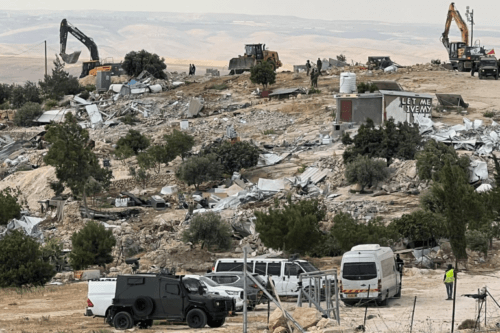
Israeli occupation forces have demolished an entire Palestinian village, Khirbet Khallet ad-Dabe’ in Masafer Yatta, south of Hebron, in the occupied West Bank, in addition to demolishing many homes and structures in villages near Ramallah, Qalqilia, and the northern Jordan Valley.
The demolitions, carried out under the pretext of “unauthorized construction,” mark one of the largest waves of destruction in recent months.
Mass Displacement in Masafer Yatta
In Khirbet Khallet ad-Dabe’, Israeli soldiers razed 25 structures, including homes, water wells, caves, agricultural rooms, livestock pens, and solar panels, most of which belonged to the Dababsa family.
Residents were forcibly evicted, prevented from retrieving their belongings, and left without shelter.
The village, home to 120 Palestinians, has been under constant threat of displacement since 2022, as Israel seeks to seize the land for colonial expansion by designating it a military firing zone.
Local activist Osama Makhamra stated that Israeli forces forced residents to evacuate at gunpoint, leaving them stranded in harsh conditions. He noted that only a school and two homes remain standing after the demolitions.
Expanding Colonial Control
The destruction in Masafer Yatta is part of a broader Israeli policy aimed at erasing Palestinian communities and replacing them with Jewish colonizers.
According to Nidal Younis, head of the local village council, Israel’s actions reflect a long-standing strategy of forced displacement, involving land confiscation, demolitions, and expansion of illegal Israeli colonies, built in direct violation of international law.
“Nearly 90% of the homes in Khirbet Khallet ad-Dabe’ have been destroyed, leaving families and livestock without shelter. This is a deliberate effort to wipe out Palestinian presence in the area,” Younis said.
Younis warned that all villages in Masafer Yatta are under threat, with Israel systematically declaring Palestinian lands as closed military zones to facilitate colonial expansion.
Over the past two years, Israel has established eight new colonies in the area, alongside colonizer-run livestock farms that encroach on Palestinian land.
Widespread Demolitions Across the West Bank
Israeli forces also demolished homes and structures in multiple locations, including:
– Al-Mughayyir, northeast of Ramallah – A 150-square-meter home housing five people was destroyed, with another home marked for demolition.
– Al-Funduq, east of Qalqilya – A 200-square-meter home belonging to Firas Bleyya was razed.
– Northern Jordan Valley – Several residential structures and livestock pens were demolished in Khirbet al-Deir.
– Jisr al-Zarqa, near Haifa – A Palestinian home, occupied for three decades, was destroyed under the pretext of unauthorized construction.
Colonizers’ Attacks and Illegal Land Seizures
Israeli paramilitary colonizers have intensified attacks on Palestinian communities, including:
– Al-Mughayyir – Colonizers cut down 200 olive trees belonging to Mohammad and Samir Hamayel.
– Al-Mu’arrajat, northwest of Jericho – Colonizers attempted to burn a Palestinian home and set fire to a tractor, while Israeli forces stood by without intervention.
Escalating Demolition and Colonial Expansion
A recent report by the Wall & Colonization Resistance Commission documented 1,693 Israeli violations in April 2025, including:
– 152 demolitions, affecting 96 homes and 34 agricultural structures.
– 46 demolition orders issued.
– 54 dunams of Palestinian land seized.
– 1,168 olive trees uprooted.
– Plans for 10 new colonial outposts, mostly agricultural and pastoral.
– 27 expansion projects for illegal colonies are under review to seize more Palestinian land.
New PCHR Report Reveals Israeli Destruction of Gaza’s Agricultural Sector and Food Systems
IMEMC | May 6, 2025
In a new report issued Monday, the Palestinian Centre for Human Rights (PCHR) confirms that the ongoing Israeli military assault on the Gaza Strip, which began in October 2023, has deliberately and extensively targeted Gaza’s agricultural sector and food production systems. This assault has resulted in the near-total collapse of a sector essential for the survival of the population. PCHR reveals that this destruction is part of a longstanding and systematic strategy by the IOF to exterminate the Palestinian people and uproot their existence. This objective has become a central policy of the current Israeli government, which uses destruction and starvation as weapons of war within the broader framework of the crime of genocide—seeking to eliminate Palestinians and strip them of the basic means of survival.
The report, titled “We Will Leave Them Nothing: The Israeli Systematic Destruction of the Agricultural Sector and Food Production Systems in Gaza”, meticulously documents the deliberate and large-scale destruction by the IOF of Gaza’s agricultural infrastructure. Nearly 75% of farmlands and orchards have been bulldozed and obliterated. The vast majority of agricultural facilities—including greenhouses, storage warehouses, farming equipment, irrigation systems, and power supplies—have been destroyed. In addition, livestock and fishery facilities, which are vital pillars of Gaza’s food security system, have also been decimated.
The report highlights that IOF has seized more than 130 km² of land across Gaza, much of it agricultural, and converted it into military buffer zones. This has deprived Palestinians of vast areas essential for food production—an explicit violation of the Fourth Geneva Convention’s protections for civilian property during wartime and the prohibition against seizing the land of occupied populations. The report also stresses that these unprecedented attacks on Gaza’s food sources have been compounded by an intensified blockade, the denial of humanitarian aid and food supplies, and the systematic use of starvation as a weapon of war. These acts have had catastrophic consequences for food security, triggering a severe hunger crisis and soaring levels of malnutrition.
PCHR warns that the destruction of Gaza’s food systems not only threatens the current survival of the population but also constitutes an assault on the future of Palestinian existence in the Strip. It entrenches a devastating reality of hunger and dependency by eliminating the foundations of recovery and forcing Gaza’s population into total reliance on external aid. This reflects Israel’s long-term colonial objective: to depopulate the land, seize control of its resources, and suppress any possibility of Palestinian self-sufficiency or resilience. Such conduct, the report asserts, directly violates Article II of the 1948 Convention on the Prevention and Punishment of the Crime of Genocide, which criminalizes the imposition of living conditions calculated to destroy a group physically and psychologically.
The report further affirms that these acts constitute grave violations of international law, particularly the International Covenant on Economic, Social and Cultural Rights, especially Article 11, which guarantees the right to adequate food and a dignified life. It also violates Article 54 of Additional Protocol I to the Geneva Conventions, which prohibits targeting “objects indispensable to the survival of the civilian population.” According to Article 8 of the Rome Statute of the International Criminal Court, these acts constitute a full-fledged war crime.
In its recommendations, PCHR calls on the international community to break its silence and to uphold its legal and moral responsibilities in confronting these crimes against Palestinian civilians and their sources of sustenance. It urges effective measures to hold Israel accountable, stop the ongoing genocide in Gaza, and ensure urgent international support for the rehabilitation of the agricultural sector. PCHR also emphasizes the necessity of restoring Palestinian sovereignty over their food systems and land, and demands an end to the culture of impunity that enables the repetition of Israeli crimes and undermines the foundations of international justice.
Do Trump’s Slick Comments Put Iran Talks in Jeopardy?
By Ted Snider | The Libertarian Institute | May 6, 2025
U.S. President Donald Trump’s unexpected answer on Sunday to an interviewer’s question has thrown his administration’s nuclear negotiations with Iran into confusion.
Trump has consistently said that negotiations with Iran over its nuclear program are limited to preventing Iran from developing a nuclear weapon: “You know, it’s not a complicated formula. Iran cannot have a nuclear weapon.” But in an interview on NBC’s Meet the Press, when the interviewer asked Trump, “Is the goal of these talks limiting Iran’s nuclear program or total dismantlement?” Trump answered, “Total disarmament.”
There has been disagreement in the Trump team over, not just the goal of negotiations with Iran, but, more fundamentally, over negotiating with Iran. National Security Advisor Mike Waltz advocated for a military path, while Director of National Intelligence Tulsi Gabbard, Secretary of Defense Pete Hegseth and Vice President J.D. Vance advocated for caution. Vance urged fully exploring talks before settling for a military solution. Trump sided with the diplomacy camp, believing that “we can make a deal without the attack.”
According to reporting by The Washington Post, Trump fired Waltz as National Security Advisor because he opposed Trump and “wanted to take U.S. policy in a direction Trump wasn’t comfortable with because the U.S. hadn’t attempted a diplomatic solution.” Waltz maintained that “the time was ripe to strike Iran.”
Having agreed on the diplomatic path, there appeared to be confusion over the goal of diplomacy. Waltz said that the U.S. is demanding “full dismantlement,” and Trump’s special envoy Steve Witkoff said that “a Trump deal” means “Iran must stop and eliminate its nuclear enrichment and weaponization program.” But these statements had been at odds with Trump’s more limited stated goal. Until Sunday.
If there was a lack of clarity in America’s goals in negotiating, there was no ambiguity in Iran’s. Iran wanted a deal that the United States couldn’t walk away from, as they walked away from the previous 2015 JCPOA nuclear agreement, and they wanted negotiations to lead to three things.
The first is that negotiations have to lead to a cessation of U.S. threats of a military solution. Iranian President Masoud Pezeshkian had made it clear that “the language of threats and coercion is absolutely unacceptable… It is unacceptable for someone to come along and say, ‘Don’t do this, don’t do that, or else.’ I won’t come to negotiate with you.”
The second is that negotiations have to lead to the complete lifting of sanctions.
The third is that, while Iran’s Supreme Leader, Ayatollah Ali Khamenei, has fully empowered his team to negotiate, he has placed the firm limit that Iran will not negotiate “the full dismantling of Iran’s nuclear infrastructure.”
The American-Iranian talks were showing signs of success. Iran called the first round “constructive” and “respectful.” The U.S. called it “constructive” and “positive.” The first round led to a second, which led to an agreement to begin work on a framework for a potential deal and a third round of talks.
Then a flurry of confusing and contradictory statements made by U.S. officials in the past few days began to derail the talks.
First, Pete Hegseth returned to the language of threats. Referring to Yemen’s Houthi attacking vessels in the Red Sea, Hegseth “warned” Iran, “You know very well what the U.S. Military is capable of… You will pay the CONSEQUENCE at the time and place of our choosing.” From Iran’s perspective, what is the point in negotiating limits on your civilian nuclear program to avoid American bombs if the United States is going to bomb you anyway for another purpose?
Then Trump returned to the threat of sanctions, posting that “Any Country or person who buys ANY AMOUNT of OIL or PETROCHEMICALS from Iran will be subject to, immediately, Secondary Sanctions. They will not be allowed to do business with the United States of America in any way, shape, or form.”
Following those two statements, the fourth round of scheduled talks between the United States and Iran were postponed. They were allegedly postponed “[f]or logistical reasons.” However, a senior Iranian official said that “U.S. sanctions on Iran during the nuclear talks are not helping the sides to resolve the nuclear dispute through diplomacy” and that “[d]epending on the U.S. approach, the date of the next round of talks will be announced.”
Then came the unexpected threat to future talks. Trump told Meet the Press that the talks are not negotiating what the Iranians thought they were negotiating. The United States he said, is not negotiating verifiable limits on Iran’s civilian nuclear program, it is demanding “total dismantlement” of Iran’s nuclear program.
“That’s all you’ll accept?” the interviewer clarified. “Yeah, that’s all I’d accept,” Trump confirmed.
The interviewer then, wrongly, suggested that Trump’s statement was inconsistent with Marco Rubio, his Secretary of State’s, suggestion that the U.S. “would accept… a peaceful, civilian nuclear program.”
Trump’s statement is not inconsistent with Rubio’s, though, because Rubio’s statement that Iran can have a civilian nuclear program by importing uranium enriched up to 3.67% but no longer by enriching their own, is consistent with Trump’s statement that Iran would have to dismantle its enrichment capability.
Though Trump’s statement may not be inconsistent with Rubio’s, it did, at this point, become a little confused with itself. Trump suggested that Iran has no need of a civilian nuclear program “to make electricity” because “they have so much oil, what do they need it for.” Trump then, confusingly repeated his earlier formulation, saying, “The only thing they can’t have is a nuclear weapon.” He said, “I think that I would be open to hearing” about a civilian nuclear program to generate energy before seemingly shutting it down again with the observation that “civilian energy often leads to military wars.”
The recent return by Washington to military threats and sanctions are not helping negotiations that seemed to be on a path to possible success. Trump’s latest remark that Iran has to fully dismantle its civilian nuclear program and stop all enrichment appears to take away any motivation for Iran to negotiate. Since Trump has said that “If they don’t make a deal, there will be bombing,” it is imperative to clarify the confusion and the positions and get the fourth round of talks back on schedule.
‘A lot of people know’ who blew up Nord Stream – Trump
RT | May 6, 2025
US President Donald Trump has dismissed claims that Russia was behind the 2022 sabotage of the Nord Stream gas pipelines and suggested that the true culprit is widely known – without naming names.
Speaking at a White House press event, Trump said there was no need for a formal investigation to uncover who carried out the attack, which crippled a key energy route between Russia and Western Europe.
Three of the four Nord Stream pipelines, built to deliver Russian gas to Germany and the rest of Western Europe, were damaged by blasts at the bottom of the Baltic Sea in September 2022.
On Tuesday, a correspondent for libertarian financial blog ZeroHedge, which has been admitted to White House press events under the new administration, noted that Trump had previously rejected the Western narrative that Russia blew up its own pipelines, and asked the president if he was planning to initiate a probe to find out who was actually behind the attack.
“If you can believe it, they said Russia blew it up,” Trump responded. “Well, probably if I asked certain people, they would be able to tell you without having to waste a lot of money on an investigation. But I think a lot of people know who blew it up,” he added, without elaborating.
ZeroHedge suggested that Trump’s comment meant that “based on classified intelligence he knows exactly who was behind” the destruction of Nord Stream. It also “should put the ‘Russia destroyed its own vital and economically lucrative pipeline’ storyline to rest,” the outlet insisted.
In early February 2023, veteran investigative journalist Seymour Hersh published a report claiming that then US President Joe Biden had given the order to destroy Nord Stream. According to an informed source who talked to the Pulitzer Prize-winning journalist, the explosives that were detonated on September 26, 2022 had been planted at the pipelines by US Navy divers a few months earlier under the cover of a NATO exercise called ‘Baltops 22’. The White House denied the report, calling it “utterly false and complete fiction.”
Senior Russian officials, including President Vladimir Putin, have previously pointed the finger at the US as the possible culprit behind the Nord Stream explosions. They have argued that Washington had the technical means to carry out the operation and stood to gain the most, considering that the attack disrupted Russian energy supplies to the EU and forced a shift to more expensive US-supplied liquefied natural gas.
Featured Video

Theodore Postol: Iran’s Missiles & Drones Were Underestimated
or go to
Aletho News Archives – Video-Images
From the Archives
What is the Israeli Lobby in Australia Doing in Interfaith Dialogue?
By Ali Kazak | Dissident Voice | October 11, 2015
For years Israel and its lobby around the world have been trying to normalise their relations with Arabs and Muslims without solving the Palestine Question.
One of the methods they resorted to in the last few years is using human rights and community organizations such as interfaith dialogue and Multiculturalism to achieve this objective and to: isolate the Palestinians, marginalise the Palestine question, end Israel’s isolation, and prevent criticism of Israel, knowing that these organisations will be the first to stand against Israel’s violations, racial and religious discrimination.
The group responsible for this task in Australia is The Australia/Israel & Jewish Affairs Council (AIJAC); its Director of International & Community Affairs, Jeremy Jones is in charge of lobbying religious community organizations, specifically Muslims and Christians. Consequently he convened the Faith Communities for Reconciliation, founding participant in the Australian Partnership of Religious Organisations and the Australian National Dialogue of Christians, Muslims & Jews.
AIJAC is a private political propaganda group. It is recognised as the main Israeli lobby in Australia. It coordinates its activities and works intimately with the Israeli embassy in Canberra and different institutions in Israel. It is privately funded by some Jewish businessmen. It monitors closely Australian politicians, the media, ethnic and religious groups, (especially Arabs and Muslims), unions and academics on their stands towards Israel and the Palestine question. … continue
Blog Roll
 Aletho News
- The killing of three Indonesian soldiers in Lebanon should remind Jakarta that Israel does not want peace
- Defeated and delusional: Netanyahu’s remarks reveal $80bn war failure, says analyst
- Iran’s friends are about to make life much more difficult for Israel and the US
- The war of liberation of the Arab and Islamic peoples expands across the Gulf
- Envoy warns UN on Trump’s threat to ‘obliterate’ Iran’s civilian infrastructure
- The Larak Corridor: Iran’s Rial Gate With No US, No Israel, and No Way Around
- ‘Economic terrorism’: Steel facilities hit again in US-Israeli strike
- ‘War Crime’: Iran condemns attacks on Arak, Ardakan nuclear sites
- Two-thirds of Americans want quick end to Iran war even if goals unmet
- Trump to Give “Important Update on Iran” Wednesday in Prime-Time Speech
- If Americans Knew
- Israel wants US to bomb more of Iran’s civilian structures (113,000 is not enough) – Not a ceasefire Day 173
- Ann Coulter Rips Into Fox News for Iran War Coverage
- Joe Kent Urges Americans To Call White House and Congress To Object To Sending Troops Into Iran
- DNC Resolution to Reject AIPAC Funding Puts Democratic Leaders in the Hot Seat
- Swedish foundation to build 400 schools as over 650,000 Gaza children remain without education for 2 years
- Israeli army admits photshopping image of slain Lebanese journalist
- This is how Israel is systematically killing health workers under the cover of war in Lebanon
- Carrying life under fire: Israeli invasion of Lebanon leaves pregnant women facing deadly risks
- Champagne all around for the new death penalty (for Palestinians) law – Not a ceasefire Day 172
- Why are Palestinian books struggling to be seen on Amazon?
- No Tricks Zone
- New Study Finds Warming Saves Lives…Cold Temperatures 12 Times More Deadly Than Excess Heat
- German Science Blog Accuses PIK Climate Institute Of Hallucinating Climate Tipping Points
- Devastating Assessment Of Comirnaty Vaccine By Former Senior Pfizer Europe Toxicologist
- New Study: CO2 Is ‘Effectively Negligible’ As An Explanatory Climate Change Factor Since 2000
- Former Pfizer Toxicologist Dr. Helmut Sterz Tells Bundestag Hearing Pfizer Vaccine Should Have Never Been Approved
- Energy Expert: Germany’s Nuclear Phaseout Was A “500 Billion Euro Mistake”
- New Research: South Australia’s Mid-Holocene Sea Surface Temperatures Were 4°C Warmer Than Today
- Storing Green Energy To Last Germany 10 Days Would Require A 60-Million Tonne Battery
- New Studies: UK Sea Levels Were 4 Meters Higher Than Today During The Mid-Holocene
- Destructive Green New Deal: German Energy And Metal Group Warns Of Drastic Crisis
 Aletho News