Israel attacks Gaza-bound aid flotilla in international waters
Press TV – May 2, 2025
Israel has carried out a drone attack on a Gaza-bound ship carrying humanitarian aid and activists off the coast of Malta in international waters, the Freedom Flotilla Coalition (FFC) says.
“At 00:23 Maltese time, the Conscience, a Freedom Flotilla Coalition ship came under direct attack in international waters,” the international NGO said in a statement on Friday.
“Armed drones attacked the front of an unarmed civilian vessel twice, causing a fire and a substantial breach in the hull,” it added, blaming Israel.
The coalition called for the summoning of Israeli ambassadors, saying they must “answer to violations of international law, including the ongoing blockade and the bombing of our civilian vessel in international waters.”
According to the statement, 21 activists, including prominent figures, from different countries were on board “on a nonviolent humanitarian mission to challenge Israel’s illegal and deadly siege of Gaza, and to deliver desperately needed, life-saving aid.”
The attack came while the group had been organizing the action “under a media black out to avoid any potential sabotage.”
The group noted that the ship’s generator was deliberately targeted in the drone attack, adding that the boat was left without power and at risk of sinking.
The FFC urged the international community to “condemn this aggression against an unarmed humanitarian aid vessel” and called on all states providing aid for Israel to “end political, financial and military support for Israel’s illegal siege, blockade, occupation, and apartheid.”
The Maltese government said everyone aboard the aid flotilla was “safe”, adding that a nearby tug had been directed to aid the vessel.
Israel launched the war of genocide in Gaza and imposed a complete siege on the strip on October 7, 2023, after Hamas carried out Operation Al-Aqsa Flood in retaliation for Israel’s intensified atrocities against the Palestinian people.
Last January, the Israeli regime was forced to agree to a ceasefire deal with Hamas given the regime’s failure to achieve any of its objectives, including the “elimination” of the Palestinian resistance movement or the release of captives. However, Israel cut off food and medical supplies and other aid to the 2.3 million residents of the Gaza Strip on March 2, just two weeks before breaking the two-month ceasefire and prisoner-captive exchange agreement.
In total, 52,418 Palestinians have been killed and 118,091 others injured since October 7, 2023, according to the Palestinian health ministry.
In 2010, Israel stormed a similar vessel, “Mavi Marmara”, which was launched from southern Turkey, killing 10 and injuring 28 others.
From the United States to Europe, criticizing Israel is becoming a crime
By Kit KLARENBERG | MintPress News | April 29, 2025
Across the United States and much of the West, criticism of Israel and solidarity with Palestine are increasingly being criminalized—a project long championed by Israel’s government and its powerful lobbying networks.
In February 2020, Israeli leader and internationally wanted war criminal Benjamin Netanyahu proudly declared that Tel Aviv had “promoted laws in most U.S. states” to punish those who boycott Israel, offering a rare glimpse into the foreign forces eroding free speech in the American heartland.
Since then, anti-boycott laws have quietly spread to dozens of states, forcing public institutions, businesses, and even individual contractors to pledge loyalty to Israel—or risk losing jobs, contracts, and funding. What began as a niche effort to shield Tel Aviv from grassroots criticism has rapidly escalated into a sweeping assault on free speech across the Western world.
The overwhelming majority of states now boast laws making it illegal for local entities, including hospitals and schools, to work with individuals or companies that boycott Israel. For example, in 2016, Indiana’s Senate unanimously passed a law calling for mandatory divestment by state agencies, commercial enterprises, and nonprofit organizations—including universities—from any firm involved in “the promotion of activities to boycott, divest from, or sanction Israel.”
The legislation branded boycotts against Israel as “antithetical and deeply damaging to the cause of peace, justice, equality, democracy and human rights for all people in the Middle East.”
Several states have adopted comparable laws via governors signing administrative and executive orders. In some cases, state contractors—be they individuals or organizations—are legally obligated to demonstrate their anti-BDS credentials by signing contractual affirmations of non-support for BDS, which critics argue is essentially a loyalty oath to Israel.
State employees, including teachers, have lost their jobs for refusing to do so. In May 2021, a federal judge ruled such legislation in Georgia to be “unconstitutional compelled speech.” Undeterred, Georgia Governor Brian Kemp reintroduced the requirement just months later with slight amendments.
Israel’s extraordinary and ever-growing influence over domestic U.S. laws in recent years, and the devastating consequences for Palestinian solidarity at home and abroad, have passed without much critical mainstream acknowledgement, let alone censure.
Since October 7, the push to criminalize pro-Palestinian sentiment Stateside and the media’s mass omertà (code of silence) on this disturbing crusade have both intensified significantly. However, such disquieting developments aren’t restricted to the U.S., but eagerly embraced by an ever-growing number of countries intimately complicit in the Gaza genocide.
‘Drastic Rise’
In a grave testament to the speed with which U.S.-based pro-Israel organizations, including several prominent Jewish advocacy groups, sought to capitalize on October 7 for their own purposes, two-and-a-half weeks after Palestinian fighters breached Gaza’s infamous apartheid walls, Republican lawmaker Mike Lawler proposed H.R. 6090, also known as the Antisemitism Awareness Act.
Lawler is a major recipient of Israeli lobby funds, with the influential lobbying group AIPAC gifting him $392,669 in 2023 and 2024 alone, his largest donor by some margin. His bill would require the Department of Education to consider the highly controversial International Holocaust Remembrance Alliance (IHRA) working definition of antisemitism (which critics argue conflates criticism of Israel with antisemitism) when determining if cases of harassment are motivated by antisemitism, raising concerns that it would violate the intent of Title VI of the Civil Rights Act of 1964.
This, its proponents argue, “prohibits discrimination on the basis of race, color, and national origin in programs and activities receiving federal financial assistance,” including colleges and universities. H.R. 6090 is openly supported by nearly all influential pro-Israel organizations, including the ADL.
The IHRA definition has been condemned by many, including attorney Kenneth Stern, who helped draft it, for falsely conflating legitimate criticism of Israel with antisemitism. The ACLU warns that H.R. 6090 raises the clear risk that U.S. educational facilities will “restrict student and faculty speech critical of the Israeli government and its military operations,” for fear of “losing federal funding.”
Longstanding U.S. law already prohibits antisemitic discrimination and harassment by federally funded entities, making the proposed legislation completely unnecessary.
Despite the obvious and dire threats to fundamental freedoms posed by the bill, and even harsh criticisms from major Jewish groups (such as J Street and Jewish Voice for Peace), it received barely any mention by major news outlets. Still, Congress supported it by an overwhelming majority, voting 320 to 91 in its favor.
Senators nonetheless failed to consider the legislation, prompting Congressman Josh Gottheimer, who received $797,189 from AIPAC in 2023 and 2024, to reintroduce the bill in February. In the meantime, U.S. lawmakers again took a deeply worrying step in Israel’s clear favor.
On November 28, 2023, Congressman David Kustoff—another AIPAC beneficiary—introduced a House Resolution “strongly condemning and denouncing the drastic rise of antisemitism” in the U.S. and “around the world” following October 7. Citing the IHRA’s antisemitism definition, it declared that popular Palestine solidarity chants—protected by the First Amendment—“From the River to the Sea,” “Palestine Will Be Free,” and “Gaza Will Win” to be genocidal, and claimed that a candlelit vigil at the Democratic National Committee that month had endangered lives.
It concluded by calling on Congress to “clearly and firmly [state] that anti-Zionism is antisemitism,” which they did inordinately. In all, 311 lawmakers voted for the Resolution, with just 14 against.
Niko House, a media personality and activist specializing in civil rights and anti-imperialist issues, believes that these efforts are desperate attempts to justify legal measures that threaten civil liberties and would be unthinkable if any other country were in the crosshairs—including the U.S. itself.
“If enacted, these laws will give authorities broad license to persecute anyone and everyone who calls attention to the unprecedented levels of discrimination Palestinians experience today, and have done for over 75 years,” House tells MintPress. He reserves particular contempt for H.R. 6090:
“As a Black man, I find it deeply insulting [that] Congress would exploit the Civil Rights Act to silence, if not criminalize, pro-Palestine sentiment. Whether it be segregation, freedom to attend whatever educational institution or pursue whatever career you choose, or equal and indiscriminate access to facilities and basic sustenance like food and water, Palestinians have been suffering from the very forms of discrimination the Act was created to protect against ever since Israel’s creation. And the Gaza genocide has made all of this even worse.”
‘Targeting Critics’
Such brazen pro-Israeli lawfare is a longstanding tradition in modern American politics. In 1977, two amendments to the Export Administration Act and the U.S. Tax Code were passed. In theory, they prohibited U.S. citizens and companies from complying with foreign boycotts against any country considered “friendly” to Washington. In reality, it was specifically intended to counteract the long-running embargo of Israel by the Arab League. Most U.S. allies adopted the prohibition, in some cases ironically damaging their relations with Israel.
Then in 1987, Ronald Reagan designated the Palestine Liberation Organization (PLO)—at the time recognized almost universally as the Palestinian people’s legitimate representatives—a terrorist entity, but enacted a waiver the next year permitting “contact” between White House officials and the group.
This fudge meant the Organization was forced to shut down its D.C. office and cease most of its formal international diplomatic and fundraising initiatives, but allowed U.S. authorities to continue to engage with its leadership without legal repercussions.
There are sinister historical echoes, too, in yet another post-October 7 Congressional move in the U.S. On December 12, 2023, Mariannette Miller-Meeks, a fervently pro-Israel lawmaker who has received vast sums from the Israeli lobby while cosponsoring and voting in favor of multiple pro-Israel measures that critics argue suppress Palestinian rights and run afoul of the First Amendment, proposed H.R. 6578. It calls for the creation of an official “Commission to Study Acts of Antisemitism” in the U.S.
The legislation’s clauses exclusively refer to “antisemitism” in the context of criticism of Israel’s actions in Gaza after October 7. Its accompanying press release clearly shows that Palestine solidarity activists are its intended targets, particularly college and university students. Under its auspices, a formal Congressional investigation into opposition to Israel among U.S. citizens and organizations would be instigated, and any witness subpoenaed to give evidence would be barred from invoking their constitutional right to remain silent under questioning.
Lara Friedman, Middle East Forum for Peace President, slammed the proposal as a malign attempt to construct a modern equivalent to the infamous House Un-American Activities Committee (which investigated suspected supporters of communism during the Cold War). Established by Senator Joe McCarthy in 1938, the Committee probed the political leanings of private citizens, state employees, and public and government organizations. In the process, countless careers and lives were destroyed. Friedman charges H. R. 6578 will, by design, do the same—“but this time targeting critics of Israel.”
‘Disruptive Policies’
It would be wrongheaded to view this wave of repressive laws as unique or isolated to the U.S., or exclusively a product of the Gaza genocide. In the wake of October 7, authorities in Germany, which quietly supported Israel’s illicit nuclear weapons program for years, unleashed an unprecedented crackdown against Palestine solidarity activists and groups. The repression came in the form of brutal assaults on protest attendees of all ages and genders, city and state courts convicting people for leading pro-Palestinian chants, and restrictions on speaking foreign languages at public demonstrations.
German city and state governments have banned or are considering banning displays of red triangles (a symbol adopted by some Palestinian resistance fighters). As of June 2024, applicants for German citizenship are now tested on their knowledge of Judaism and Jewish life. They must declare their belief in Israel’s right to exist to prove their commitment to “German values.” Legal experts and rights advocates have widely questioned the constitutionality of requiring political support for a foreign state as a condition for citizenship.
This wave of legal repression is not confined to Germany. Across the English Channel, British authorities have similarly intensified their crackdown on dissent. In February 2024, three individuals were convicted of terror offenses in Britain after displaying images of paragliders at a Palestine solidarity protest on the controversial grounds that it amounted to “glorification of the actions” of Hamas. Since then, multiple British pro-Palestinian activists and journalists have been arrested, raided, and prosecuted over allegations of “supporting” Hamas. In December 2024, the UN sounded an alarm over London’s “vague and over-broad” counter-terror legislation.
These laws do not define the term ‘support,’ which the UN believes raises the risk of dissenting individuals who cannot plausibly be accused of endorsing “violent terrorist acts” by proscribed groups, including their political wings, being caught up in the legislation’s sweeping dragnet. Undeterred, authorities have only intensified their harassment of Palestine solidarity voices since.
Naila Kauser, an activist currently wanted for questioning by counter-terror police in London for pro-Palestinian statements she purportedly made on social media, tells MintPress News :
“Attacks against activists and journalists who speak out against the genocide in Palestine can only be described as an abuse of law, in service of fascism. It is the British state that is violating multiple world laws, including the Genocide Convention, by continuing to support Israel through intelligence-sharing, arms trade, and diplomatic protection of Israeli war criminals, as we saw recently with the Israeli Foreign Minister’s not-so-secret visit to London. Britain proscribing those who fight occupation also undermines their internationally recognised legal right to resist.”
Electronic Intifada editor Asa Winstanley, whose London home was raided and digital devices seized by counter-terror police at dawn in October 2024, suggests to MintPress News that the British government’s December 2016 adoption of the IHRA’s misdefinition of antisemitism may have played a role in the wave of repression targeting “legitimate dissent, protest, and political action” against crimes committed by the Israeli state. He says that the controversial definition, reportedly influenced by Israeli intelligence, “does nothing to protect Jews or anyone else — its primary aim is to criminalize Palestinians and their supporters.”
Winstanley cites the striking example of a London council in 2019 using the IHRA’s definition of antisemitism to ban a local pro-Palestinian bike ride seeking to raise money for sports equipment for Gazan children from traveling through its parks. “This wasn’t a direct action, it wasn’t anything to do with Jewish people, it wasn’t discrimination, it was pure solidarity of the fluffiest kind, and even this was officially found to fall foul of the IHRA definition,” Winstanley warned.
‘Moral Authority’
In June 2023, the ponderously titled Economic Activity of Public Bodies (Overseas Matters) Bill began making its way through British Parliament. Its purpose is to ban any public bodies conducting their investments and procurement “in a way that indicates political or moral disapproval of a foreign state.”
An accompanying press release made clear the legislation’s explicit purpose was protecting “businesses and organizations” affiliated with Israel. Michael Gove, the then-government minister who introduced the law, said of BDS efforts:
“These campaigns not only undermine the UK’s foreign policy but lead to appalling antisemitic rhetoric and abuse. That is why we have taken this decisive action to stop these disruptive policies once and for all.”
The array of organizations affected is gargantuan, ranging from local councils to universities, and the implications are grave in every way. Institutions can be investigated solely at the personal discretion of government officials and face voluminous fines for breaches. During the 1980s, when the British government refused to sanction or condemn South Africa, the very entities targeted by this legislation boycotted the Apartheid state. If the new law were in effect at the time, such activities would have been entirely illegal.
Exacerbating matters further, the anti-BDS Act violates multiple UN rulings and contradicts the British government’s own stated positions. London’s official stance for decades has been that Israeli settlements “are illegal under international law, constitute an obstacle to peace and threaten a two-state solution to the Israeli-Palestinian conflict.” As such, Britain’s private sector is actively discouraged by authorities from conducting business there. Yet, public bodies may now be legally prohibited from following this very precept.
Still, there remains one potential legal avenue of resistance. As MintPress News has previously reported, multiple legal findings and precedents indicate countries party to the Genocide Convention, as Britain is, must “employ all means reasonably available” to prevent genocide. What’s more, failing to stop providing aid or assistance to a state engaged in genocide could violate Article I of the Convention. This could provide legal protection from London’s new anti-BDS law. As activist Naila Kauser, herself a target of London’s latest measures, concludes:
“Laws that defend genocide have no legitimacy, and states enforcing them and enabling the genocide have no moral authority. They want us to shut up, but we must continue to resist these attacks, as well as the ongoing genocide, in any way we can until Palestine is liberated.”
EU Leaders Advocate Stronger Censorship Regulation to Counter “Disinformation” Threats
A battle to define who gets to frame reality online
By Cindy Harper | Reclaim The Net | May 2, 2025
European authorities are stepping up their campaign against what they label “disinformation,” as calls grow from within the EU’s institutional framework to expand regulatory powers over online content and digital platforms.
At the forefront is Oliver Röpke, President of the European Economic and Social Committee (EESC), who is urging tighter enforcement of the EU’s sweeping censorship mechanism, the Digital Services Act (DSA), and calling for more aggressive oversight of artificial intelligence.
Framing the issue as a direct challenge to democratic systems, Röpke claims that coordinated disinformation efforts are being waged both by foreign interests and local actors, with particularly harmful impacts on vulnerable populations. “We know that they are spreading in a coordinated manner disinformation and misinformation within our countries, the European Union, but they all work often hand-in-hand with domestic actors,” he told the European Newsroom.
He went on to argue that marginalized communities are frequent targets in these campaigns, which, he says, erode public confidence in democratic institutions. In response, the EESC has rolled out initiatives like “Citizens can defeat disinformation,” promoting what it calls grassroots resistance to online manipulation.
But the solution Röpke favors is far from bottom-up. He is calling for Big Tech companies to be bound even more tightly to EU regulation under the DSA, which he defends as a tool not of censorship but of structured debate. “I think it’s not about censoring opinions. On the contrary, it is to ensure a free debate – a free debate based on facts and on well-informed actors,” Röpke said.
He also wants to see the EU develop its own digital giants, aligned with European regulatory priorities, to compete with dominant global tech firms.
His vision includes expanding the bloc’s AI governance regime, building on the 2024 AI Act. Although that legislation introduced tiered risk-based controls for AI deployment, Röpke believes additional safeguards are needed. “We have to create a regulatory environment which is technology-open and friendly, but at the same time we have to insist on certain rules,” he stated, stressing that AI must serve ethical, not merely commercial, goals.
Meanwhile, environment ministers gathered in Warsaw to hash out strategies for combating what they see as a wave of misinformation tied to climate policy. The recent massive blackout that left large parts of Spain and Portugal without electricity gave fresh ammunition to online speculation, which officials swiftly labeled as “disinformation.”
Poland’s environment minister, Paulina Hennig-Kloska, described the flood of commentary as part of a broader pattern. “In recent months we’ve had more targeted disinformation used for political purposes, very often by our political adversaries,” she said following the meeting.
While the DSA is already in effect, Hennig-Kloska suggested it falls short. According to her, EU governments currently lack “effective measures to combat disinformation.” She confirmed that the environment ministers had agreed on the need for stronger tools and that the next stage would be engagement with the European Commission.
Underpinning much of this is the belief that foreign governments are engaged in information warfare aimed at destabilizing Europe’s climate and energy agenda.
Moldova’s Ex-Prime Minister Calls Gutsul’s Arrest ‘Absurdity’ That Harms National Reputation

Sputnik – 02.05.2025
CHISINAU – Former Moldovan Prime Minister and leader of the Future of Moldova opposition party, Vasile Tarlev, on Friday strongly condemned the arrest of Yevgenia Gutsul, the head of the Moldovan autonomous region of Gagauzia, calling the incident an “absurd” abuse that harms Moldova’s image on the world stage.
Gutsul was detained at the Chisinau airport on March 25. A Chisinau court arrested her for 20 days on charges of violating rules for campaign financing and document forgery. On April 9, the court placed Gutsul under house arrest for 30 days, which her supporters slammed as political pressure.
“I believe that this is an abuse, an absurdity that has damaged the image of our state – both inside and outside the country, from any point of view. If there were grounds, it would have been possible to restrict [Gutsul] from leaving the country, to impose a ban on leaving the place of residence or, in extreme cases, to use a bracelet. But when a woman, a mother of two minor children, is put in prison, this is no longer justice, but cruelty,” Tarlev was quoted by the GRT broadcaster as saying.
The authorities’ actions towards Gutsul are excessive, Tarlev argued, adding that such actions undermine citizens’ trust in state institutions and threaten the country’s stability.
Gagauz-Moldovan relations deteriorated after Gutsul of Moldova’s opposition Sor party was elected head of Gagauzia in spring 2023. In June, following a long conflict between the pro-Western Party of Action and Solidarity and the pro-Russian Sor, the Constitutional Court of Moldova ruled to recognize the opposition party as unconstitutional, while the ruling party vowed to probe the election results in Gagauzia. Moldovan President Maia Sandu has refused to sign a decree to include Gutsul in the cabinet.
Germany’s AfD party is declared ‘definitely right-wing extremist’ by BfV spy agency, paving the way for a ban
Remix News | May 2, 2025
The Alternative for Germany (AfD) party has been declared “definitely right-wing extremist,” by the powerful domestic spy agency, the Office for the Protection of the Constitution (BfV). The party is reacting with outrage.
The BfV claims that the party is pursuing efforts against the “free democratic order,” which the agency now says is “certain.”
Previously, the party was only declared as a “suspected case,” with this new designation paving the way for not only a ban but also mass surveillance of the entire party, including all its members. With this new designation, the BfV can surveil members, including their emails, phone calls, and chats, without a warrant. In addition, the BfV can now legally infiltrate the entire party with informants and use other spy techniques.
Already, other parts of the AfD at the state level were classified as “definitely right-wing extremist,” but the new designation now applies this label to the entire national party.
The party is reacting with outrage, with Alice Weidel, the co-leader of the party, writing:
“The decision of the Federal Office for the Protection of the Constitution is a severe blow to German democracy!”
Regarding the statement by the Federal Office for the Protection of the Constitution, AfD federal spokespersons Alice Weidel and Tino Chrupalla said:
Today’s decision by the Office for the Protection of the Constitution is a severe blow to German democracy: In current polls, the AfD is the strongest force. The federal government only has four days left in office, the intelligence agency doesn’t even have a president anymore. And the classification as a so-called suspected case is not yet legally binding.
Nevertheless, the AfD, as an opposition party, is now being publicly discredited and criminalized shortly before the change of government. The associated, targeted interference in the democratic decision-making process is therefore clearly politically motivated. The AfD will continue to defend itself legally against these defamations that endanger democracy.”
The BfV, however, is attempting to justify its decision, which will be seen by many as an attack on the country’s largest opposition party.
Due to the “extremist character of the entire party, which disregards human dignity,” the BfV noted in its statement. Vice presidents of the authority, Sinan Selen and Silke Willems, further indicated that statements and positions of the party “violate the principle of human dignity.”
One of the key factors that the BfV is attempting to use to justify the designation is the AfD’s alleged position on “ethnic Germans.”
“The ethnic-descendant understanding of the people prevailing in the party is not compatible with the free democratic basic order,” reads the statement from the BfV. “The AfD, for example, does not consider German citizens with a migration history from predominantly Muslim countries to be equal members of the German people, as ethnically defined by the party.”
The BfV, which has been led by a Christian Democrat for years who was rabidly opposed to the AfD, a rival party, further writes: “The BfV reached this conclusion after an intensive and comprehensive expert review. Following its statutory mandate, the BfV was required to assess the party’s actions against the central fundamental principles of the constitution: human dignity, the principle of democracy, and the rule of law. In doing so, in addition to the federal party’s platform and statements, the statements and other behavior of its representatives, as well as their connections to right-wing extremist actors and groups, were examined in particular.”
The BfV is no longer led by Thomas Haldenwang (CDU), but here he is discussing the AfD during his tenure. Haldenwang gave up his position to run as an MP but he lost his seat.
The news comes at a time when the AfD is the number one party in the country, according to national polls, a position it has achieved for the first time. As the party surges, its democratic rivals are becoming increasingly concerned, prompting calls for a ban from not only the left, but also the traditional “center-right,” which has shifted more and more to the left over the years.
Ban procedure can now move forward
The latest designation was a key plan in the move to ban the party, with many so-called “moderates” waiting for the BfV designation to move forward with a vote to ban the party.
However, there is no sign yet of how a ban will move forward, with many in the CDU skeptical about banning the most popular party in the country, along with some from the left as well.
Previous attempts to ban the far-right NPD, which took some notably extremist stances, were unsuccessful, with the top court arguing that the party was not large enough to represent a serious threat to the democratic order. There were also questions about the excessive number of informants, making it difficult to ascertain how much of the extremism in the party was due to informants versus the party’s own members.
However, the AfD, in contrast, is not only popular but is now the most popular party in the country.
Emil Sänze, the AfD leader in the state association of AfD leader Alice Weidel, said this was a deliberate attempt to weaken the largest opposition party. He told Bild, “This is outrageous. A purely political decision in the run-up to the chancellor election on May 6.”
As the World Seeks Peace, the EU Looms for War

By Ulrich Fromy • Mises Wire • 04/18/2025
We can feel the winds of warmongering blowing through Europe as the continent raises the specter of war with Russia. Recently, the European Commission unveiled a series of measures to strengthen the defense of EU member states, most notably through the ReArm Europe plan. The plan—which was endorsed by the Extraordinary European Council on March 6, 2025—aims to mobilize €800 billion for the EU’s defense capabilities. It includes a redirection of public funds, but not only: it also includes the use of public savings. As announced on March 17, 2025, this strategy aims to get hold of around €10,000 billion in European bank deposits and redirect them towards the arms industry and public defense policies.
Another European example: Valérie Hayer, a French MEP and leader of the Renew Europe group in the European Parliament, recently declared that the old continent is experiencing “a moment of gravity” probably not seen since the Second World War. The culprit? The war in Ukraine and the existential threat posed by Russia to democracy and the European order. To deal with this threat, she and other European politicians want to mobilize the savings of Europeans to finance this collective effort in the arms industry.
In France and Germany
In mid-March, a number of French political figures spoke out in favor of mobilizing private savings to rearm the country in the face of the Russian threat. On March 13, the French Minister of the Economy, Éric Lombard, spoke in favor of this measure before French senators. At the time, there was no question of creating a dedicated savings account, but rather of targeting all the capital saved by the population.
However, in the face of widespread criticism, Éric Lombard backtracked on Thursday, March 20, and announced the creation of a 450 million euro fund managed by Bpifrance and open to individual investors wishing to contribute to the national rearmament effort by becoming indirect shareholders. The minimum amount to be invested in this fund will be 500 euros, with a maximum initial investment that could be of “several thousand euros.” Once invested, these “safe” funds will be frozen for at least five years.
There is the same warmongering rhetoric in Germany. Before leaving office, Olaf Scholz spoke to the Bundestag about the “Zeitenwende,” the historical turning point that Germany is currently facing. He promised to face it by investing massively in the rearmament of the German army, the Bundeswehr. The most likely future German chancellor, Friedrich Merz, got a vote in the German parliament to spend 1,000 billion euros on rearming the country. An unprecedented expenditure in a country that has long delegated its own national defense to NATO and the United States.
All these European investments are presented as “safe and profitable investments” (according to Valérie Hayer). However, as history shows us, these investments are just the opposite.
What History Teaches Us
Society has arisen out of the works of peace; the essence of society is peacemaking. Peace and not war is the father of all things. Only economic action has created the wealth around us; labor, not the profession of arms, brings happiness. Peace builds, war destroys. (Mises, Socialism, p. 59)
Historically, investing in war bonds and funds has always meant taking the risk of betting on the wrong horse. This bet could very well lead to the ruin of the creditors of the defeated state. This was the case in Germany with the impossible repayment of war bonds after 1918. These bonds had become worthless because the reparations demanded by the Treaty of Versailles and the hyperinflation of the Weimar Republic made their repayment impossible.
Conversely, if the state was victorious, the repayment of these often massive loans could take years, ruining the creditor through monetary inflation and the financial repression that was put in place after the conflict to wipe out the state’s debts. This is what happened in the United States after 1945 when the Victory Bonds were repaid. The post-war policy of financial repression kept interest rates low and inflation of the dollar high, causing a gradual decline in the value of the currency. As loans were repaid, the purchasing power of creditors declined in the years following the end of the war.
More serious than the ruin of creditors is the ruin of society. These investments divert capital from genuinely productive alternatives that actually improve people’s living conditions; they retard progress by diverting capital (resources, labor, and money) to these defense industries. They don’t understand that the short-term prosperity offered by the “industry of destruction” is only an illusion and comes at the cost of long-term prosperity for society as a whole.
Any militarized, jingoistic, war-mongering society will only fall further behind on the road to progress and improved living conditions made possible by the best possible allocation of capital in the productive structure of society. As the economist Frédéric Bastiat wrote, war is an illusion of wealth: it creates visible economic activity (the arms industry), but always at the expense of the “invisible” (i.e., lost opportunities and deferred costs). War is never an exit out of a crisis, but the ultimate crisis a society can face.
In short, warmongers of all stripes—excited by the idea of profiting financially from a possible war—ultimately understand nothing about economics or history. Worse, they understand nothing about war.
CHD Funds Lawsuit Against CDC Over Program That Forces Pediatricians to Give COVID Vaccines to Kids on Medicaid
By Michael Nevradakis, Ph.D. | The Defender | April 28, 2025
A California pediatrician is suing the Centers for Disease Control and Prevention (CDC) over a federal program that requires doctors in her state who treat children enrolled in Medicaid to give those children all of the vaccines recommended by the CDC.
Children’s Health Defense (CHD) is supporting the lawsuit, filed April 25 in the U.S. District Court for the Central District of California, Santa Ana Division.
Dr. Samara Cardenas lost her medical practice after the CDC Vaccines for Children Program kicked her out of the program because she wouldn’t give COVID-19 vaccines to healthy kids.
California, like most states, requires pediatricians who treat Medicaid patients to be enrolled in the Vaccines for Children Program. The program, in turn, requires doctors to strictly follow the CDC’s childhood immunization schedule.
In late 2023, the Vaccines for Children Program informed Cardenas that her vaccine orders “were being scrutinized” for not including COVID-19 shots. She was later expelled from the program. As a result, she lost her Medicaid contract, forcing her to close her practice.
The Vaccines for Children Program primarily serves low-income populations by providing free vaccines to uninsured or underinsured children and children who are eligible for or enrolled in Medicaid. Medicaid compensates pediatricians for the costs associated with administering the vaccines.
In her first-of-its-kind lawsuit, Cardenas alleges the CDC’s Vaccines for Children Program violates the Fifth Amendment’s equal protection and due process provisions by subjecting children enrolled in Medicaid to different treatment standards and compelling doctors to act against their professional judgment.
The lawsuit also questions the safety and necessity of administering COVID-19 vaccines to children, the inclusion of COVID-19 shots on the CDC’s childhood immunization schedule and the impartiality of the CDC Advisory Committee on Immunization Practices (ACIP), which makes vaccine-related recommendations.
In California, 3 in 7 — or about 5 million children — are enrolled in Medicaid. Nationally, about 40% of all kids — or about 29.2 million children ages 0-17 — are covered by Medicaid.
The suit names CDC Acting Director Susan P. Monarez, as the defendant. Monarez is also President Donald Trump’s nominee to lead the agency.
Cardenas ‘followed her conscience and the science’
Attorney Rick Jaffe, who represents Cardenas, said this is “the first federal lawsuit challenging the CDC’s coercive use of the VFC [Vaccines for Children] program to enforce experimental, emergency-authorized COVID-19 vaccination as a condition of Medicaid access.”
Cardenas “followed her conscience and the science,” Jaffe said. “The VFC framework gave her no choice: vaccinate all kids or lose access.”
Kim Mack Rosenberg, CHD general counsel, said the lawsuit places policies that disproportionately affect Medicaid recipients under scrutiny, as the Vaccines for Children Program’s policy “essentially mandates these experimental shots for a population historically vulnerable to medical experimentation.”
Cardenas is not seeking compensatory damages. Instead, the lawsuit “seeks to compel the CDC to abandon its misguided and scientifically untethered policy, and stop the unnecessary mass vaccination of the nation’s poorest children.”
“We’re asking the court to say the government can’t make scientific compliance a prerequisite to serving poor patients,” Jaffe said.
Pediatrician Dr. Michelle Perro said that by requiring physicians to administer all vaccines on the childhood vaccination schedule, “medical autonomy is abolished” while “low-income children are left with fewer options and less continuity of care.”
Perro said many doctors are reluctant to oppose these policies. “The threat of speaking out is financial ruin and the potential loss of their ability to practice,” Perro said. “This is coercion and harassment.”
‘The unknowns are enough to never let these products anywhere near children’
In October 2022, ACIP, the CDC’s vaccine advisory panel, unanimously recommended adding COVID-19 vaccines for children as young as 6 months old to the CDC childhood schedule.
The complaint alleges that before making that recommendation, the CDC failed “to compile and analyze vaccine injury data.” It also alleges that ACIP is “compromised by conflicts of interest,” as many of its members “have financial or professional ties to vaccine manufacturers or related interests” — for which the CDC has granted conflict-of-interest waivers.
According to the complaint, by not presenting evidence of the vaccine’s clinical benefit, ACIP violated the Administrative Procedure Act, a federal law banning government agency actions that are “arbitrary, capricious, an abuse of discretion, or otherwise not in accordance with law.”
The lawsuit cites data from the U.S. government-run Vaccine Adverse Event Reporting System (VAERS) showing reports of “hundreds of thousands of adverse events” related to the COVID-19 vaccines, including “serious adverse events and deaths.”
As of March 28, VAERS listed 72,924 reports of adverse events in people 18 and younger, including 6,122 serious adverse events and 201 deaths.
Albert Benavides, a VAERS expert and founder of VAERSAware.com, said the true figures are higher, as many VAERS report summaries indicate the victim’s age even if the report officially lists the age as “unknown.” His analysis of reports shows that “there is more than double the amount of dead children” — 556 in total.
According to the complaint, the CDC failed to “reevaluate or rescind its blanket recommendation for COVID-19 vaccination,” and that ACIP is instead doubling down on its COVID-19 vaccine recommendations.
The complaint cites this month’s ACIP meeting, during which the committee considered revising its blanket COVID-19 vaccine recommendation and switching to risk-based recommendations.
ACIP member Dr. Denise Jamieson opposed the proposal, claiming that the “U.S. has a history of not being able to implement such variable recommendations,” which would confuse the public.
“This is not merely arrogance,” the lawsuit states. “It is government-by-committee at its most dangerous — where unelected public health advisors retain extraordinary power to shape national policy.”
Attorney Ray Flores, senior outside counsel for CHD, questioned why the CDC added COVID-19 vaccines to the childhood vaccination schedule even though they were not licensed, but only issued under emergency use authorization (EUA).
“It shocks the conscience,” Flores said. “Physicians in California must be free to exercise their best judgment, especially when it comes to administering experimental injections.”
Releasing the vaccines under EUA meant they were subject to less testing than a licensed vaccine, said Karl Jablonowski, Ph.D., senior research scientist for CHD. “The unknowns are enough to never let these products anywhere near children. There are heavy compromises made when you skip the already insufficient regulatory steps with an emergency use authorization.”
‘Can the government tell a doctor what she must inject in order to treat the poor?’
In 2022, Sweden and Denmark stopped recommending COVID-19 shots for children. In 2023, the U.K. ended its COVID-19 booster program for healthy people ages 50 and younger. That year, the World Health Organization said healthy children and teens should be considered low priority for COVID-19 vaccines.
Several recent studies have also called the practice of vaccinating healthy children for COVID-19 into question.
A December 2024 study published in the Journal of the Pediatric Infectious Diseases Society found that children under 5 who received the Pfizer COVID-19 vaccines were more likely to become infected with COVID-19 than unvaccinated children with natural immunity.
A May 2024 preprint observational study of 1.7 million U.K. children and teenagers found myopericarditis only in the group that received Pfizer’s COVID-19 vaccine and that the vaccine provided only 14 to 15 weeks of protection against infection.
Pfizer documents publicized last year showed that the company quietly studied myocarditis in children a month before its COVID-19 vaccine received an EUA for children ages 5-11.
A peer-reviewed study published earlier this month in Immunity, Inflammation and Disease, found that young adults who received a Pfizer COVID-19 vaccine exhibited spike protein production a year or more after vaccination — significantly longer than the spike protein was expected to remain in the body.
Jaffe said the lawsuit “isn’t about vaccine skepticism. It’s about professional freedom, patient-level nuance, and constitutional limits on administrative coercion.”
“Can the government tell a doctor what she must inject in order to treat the poor? That’s what this case asks. And the answer should be ‘no.’”
This article was originally published by The Defender — Children’s Health Defense’s News & Views Website under Creative Commons license CC BY-NC-ND 4.0. Please consider subscribing to The Defender or donating to Children’s Health Defense.
The False Claims of WHO’s Pandemic Agreement
By David Bell | Brownstone Institute | April 28, 2025
One way to determine whether a suggestion is worth following is to look at the evidence presented to support it. If the evidence makes sense and smells real, then perhaps the program you are asked to sign up for is worthy of consideration.
However, if the whole scheme is sold on fallacies that a child could poke a stick through, and its chief proponents cannot possibly believe their own rhetoric, then only a fool would go much further. This is obvious – you don’t buy a used car on a salesman’s insistence that there is no other way to get from your kitchen to your bathroom.
Delegates at the coming World Health Assembly in Geneva are faced with such a choice. In this case, the car salesman is the World Health Organization (WHO), an organization still commanding considerable global respect based on a legacy of sane and solid work some decades ago.
It also benefits from a persistent misunderstanding that large international organizations would not intentionally lie (they increasingly do, as noted below). The delegates will be voting on the recently completed text of the Pandemic Agreement, part of a broad effort to extract large profits and salaries from an intrinsic human fear of rare causes of death. Fear and confusion distract human minds from rational behavior.
WHO Likes a Good Story?
The Pandemic Agreement, and the international pandemic agenda it is intended to support, are based on a series of demonstrably false claims:
- There is evidence of a rising risk of severe naturally occurring pandemics due to a rapid (exponential) increase in infectious disease outbreaks
- A massive return on financial investment is expected from diverting large resources to prepare for, prevent, or combat these
- The Covid-19 outbreak was probably of natural origin, and serves as an example of unavoidable health and financial costs we will incur again if we don’t act now.
If any of these were false, then the basis on which the WHO and its backers have argued for the Pandemic Agreement is fundamentally flawed. And all of them can be shown to be false. However, influential people and organizations want pandemics to be the main focus of public health. The WHO supports this because it is paid to.
The private sector invested heavily in vaccines, and a few countries with large vaccine and biotech industries now direct most of the WHO’s work through specified funding. The WHO is obligated to deliver what these interests direct it to.
The WHO was once independent and able to concentrate on health priorities – back when they prioritized the main drivers of sickness and premature mortality and gained the reputation they now trade from. In today’s corporatized public health, population-based approaches have lost value, and the aspirations of the World Economic Forum hold more sway than those dying before sixty.
Success in the health commodities business is about enlarging markets, not reducing the need for intervention. The WHO and its reputation are useful tools to sanitize this. Colonialism, as ever, needs to appear altruistic.
Truth Is Less Compelling Than Fiction
So, to address these fallacies. Infectious disease mortality has steadily declined over the past century despite a minor Covid blip that took us back just a decade. This blip includes the virus, but also the avoidable imposition of poverty, unemployment, reduced healthcare access, and other factors that the WHO had previously warned against, but recently actively promoted.
To get around this reality of decreasing mortality, the WHO uses a hypothetical disease (Disease X), a placeholder for something that has not happened since the Spanish flu in the pre-antibiotic era. The huge Medieval pandemics such as the Black Death were mostly bacterial in origin, as were probably most Spanish flu deaths. With antibiotics, sewers, and better food, we now live longer and don’t expect such mortality events, but the WHO uses this threat regardless.
Thus, the WHO has been reduced to misrepresenting fragile evidence (e.g. ignoring technology developments that can explain rising reports of outbreaks) and opinion pieces by sponsored panels in order to support the narrative of rapidly rising pandemic risk. Even Covid-19 is getting harder to use. If, as appears most likely, it was an inevitable result of laboratory manipulation, then it no longer even serves as an outlier. The WHO’s pandemic agenda is squarely targeted at natural outbreaks; hence the need for “Disease X”.
The WHO (and the World Bank) follow a similar approach in inflating financial Return on Investment (ROI). If you received an email promoting over 300 to 700 times return on a proposed investment, some may be impressed but sensible people would suspect something amiss. But this is what the Group of Twenty (G20) secretariat told its members in 2022 for return on investment on the WHO’s pandemic preparedness proposals.
The WHO and the World Bank provided the graphic below to the same G20 meeting to support such astronomical predictions. It is essentially subterfuge; a fantasy to mislead readers such as politicians who are too busy, and trusting, to dig deeper. As these agencies are intended to serve countries rather than fool them, this sort of behavior, which is recurrent, should call into question their very existence.
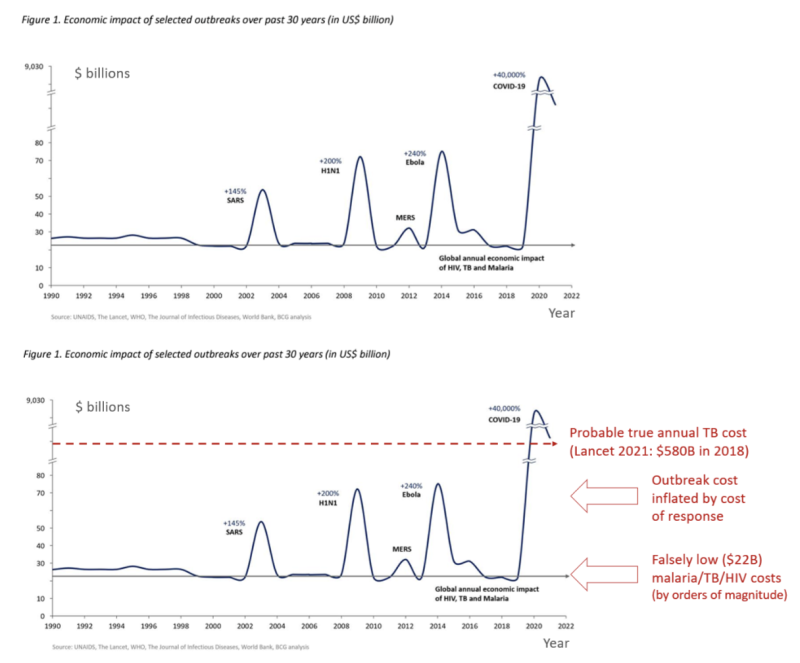
Figure 1 from Analysis of Pandemic Preparedness and Response (PPR) architecture, financing needs, gaps and mechanisms, prepared by WHO and the World Bank for the G20, March 2022. Lower chart modified by REPPARE, University of Leeds.
A virus like SARS-CoV-2 (causing Covid-19) that mostly targets the sick elderly with an overall infectious mortality rate of about 0.15% will not cost $9 trillion unless panicked or greedy people choose to close down the world’s supply lines, implement mass unemployment, and then print money for multi-trillion-dollar stimulus packages. In contrast, diseases that regularly kill more and much younger people, like tuberculosis, malaria, and HIV/AIDS, cost far more than $22 billion a year in contrast.
A 2021 Lancet article put tuberculosis losses alone at $580 billion/year in 2018. Malaria kills over 600,000 children annually, and HIV/AIDS results in similar numbers of deaths. These deaths of current and future productive workers, leaving orphaned children, cost countries. Once, they were the WHO’s main priority.
Trading on a Fading Reputation
In selling the package, the WHO seems to have abandoned any attempt at meaningful dialogue. They still justify the surveillance-lockdown-mass vaccinate model by the logic-free claim that over 14 million lives were saved by Covid vaccines in 2021 (so we all have to do that again). The WHO recorded a little over 3 million Covid-related deaths in the first (vaccine-free) year of the pandemic. For the 14 million ‘saved’ to be correct, another 17 million would somehow have been due to die in year two, despite most people having gained immunity and many of the most susceptible having already succumbed.
Such childish claims are meant to shock and confuse rather than educate. People are paid to model such numbers to create narratives, and others are paid to spin them on the WHO websites and elsewhere. An industry worth hundreds of billions of dollars depends on such messaging. Scientific integrity cannot survive in an organization paid to be a mouthpiece.
As an alternative, the WHO could advocate for investment in areas that promoted longevity in wealthy countries – sanitation, better diet and living conditions, and access to basic, good medical care.
This was once the WHO’s priority because it not only greatly reduces mortality from rare pandemic events (most Covid deaths were in people already very unwell), but it also reduces mortality from the big endemic killers such as malaria, tuberculosis, common childhood infections, and many chronic non-communicable diseases. It is, unequivocally, the main reason why mortality from major childhood infectious diseases like measles and Whooping cough plummeted long before mass vaccinations were introduced.
If we concentrated on strategies that improve general health and resilience, rather than the financial health of the pandemic industrial complex, we could then confidently decide not to wreck the lives of our children and elderly if a pandemic did arise.
Very few people would be at high risk. We could all expect to live longer and healthier lives. The WHO has elected to leave this path, instill mass and unfounded fear, and support a very different paradigm. While the Pandemic Agreement is not essential to it, it is an important part of diverting further funds to this agenda and cementing this corporatist approach into place.
The United States has done well by stepping out of this mess, but continues to push many of the same fallacies and was instrumental in sowing the mess we now reap. While a few other governments are questioning, it is hard for any politicians to stand with truth when a sponsored media stands squarely elsewhere.
Society is once more enslaving itself, at the behest of an entitled few, facilitated by international agencies that were set up specifically to guard against this. At the coming World Health Assembly, the pandemic fairytale will almost certainly prevail.
The hope is that a well-deserved erosion of trust will eventually catch up with the global health industry and too few countries will ratify this treaty for it ever to come into force. To fix the underlying problem though and derail the pandemic industry train, we will need to rethink the whole approach to cooperation in international health.
David Bell, Senior Scholar at Brownstone Institute, is a public health physician and biotech consultant in global health. David is a former medical officer and scientist at the World Health Organization (WHO), Programme Head for malaria and febrile diseases at the Foundation for Innovative New Diagnostics (FIND) in Geneva, Switzerland, and Director of Global Health Technologies at Intellectual Ventures Global Good Fund in Bellevue, WA, USA.
Klaus Schwab, Sophist

By Laurie Calhoun | The Libertarian Institute | May 1, 2025
The existence of Klaus Schwab became known to much of the thinking world during the Coronapocalypse, when so-called conspiracy theories began to flourish about the use of the novel COVID-19 virus as a pretext for reconfiguring the world. The “Great Reset” and the “New Normal” began to be spoken of fondly by bureaucrats back in 2020, shortly after the in some ways incomprehensibly influential Schwab co-authored with Thierry Malleret a short book extolling just those concepts: Covid-19: The Great Reset.
The work, or paraphrased excerpts of it, must have been spam-emailed to every government official and mainstream media journalist on the planet, because in no time pundits and their parrots in the press were gushing about the Great Reset, essentially a Brave New World to come (had none of them read Aldous Huxley’s classic work, or did they simply not understand it?). Nearly every influential person with a microphone was emitting the expression “Everything has changed,” insisting that this was because of the emergence of the novel coronavirus, not the government policies enacted in response to it. Schwab was lurking behind the scenes from the beginning, proffering gaslighting homilies and question-begging arguments camouflaged as benevolent recommendations and facts:
“The worldwide crisis triggered by the coronavirus pandemic has no parallel in modern history.”
In truth, “Everything changed” only because government officials changed everything, by closing national borders, locking down entire populations, preventing groups from assembling, and shutting down schools and all but specially designated “essential” businesses. Human beings were required to wear masks nearly everywhere they went, and those who demurred were treated as miscreants and pursued by the police. The insistence by politicians, bureaucrats and other opinion makers that “Everything has changed” was curiously reminiscent of how officials rationalized a massive and ruthless assault on Afghanistan and Iraq in the aftermath of crimes committed on September 11, 2001, by a small group of persons hailing primarily from Saudi Arabia. (Induction on two cases: when someone starts chiming, “Everything has changed!” in order to persuade you to do something or to support some initiative, you should probably turn around and walk away.)
Klaus Schwab founded and led the World Economic Forum (WEF) for more than fifty years. Many of what were revealed during the pandemic period to be the most brazen authoritarians among ostensibly democratic world leaders have connections to the organization. Canadian Prime Minister Justin Trudeau, New Zealand Prime Minister Jacinda Ardern, and French President Emmanuel Macron are notable examples of leaders who punished and even ostracized citizens for daring to defy their administration’s draconian COVID policies. Schwab recently resigned from his position, but whether that was because of age—he was born in 1938—or scandal matters little at this point, for his legacy has been secured throughout much of the world.
Key features of the Great Reset were to foist ESG (Environmental, Social and Governance investing) on people transnationally or, perhaps more accurately, meta-nationally. We have seen that elements of Schwab’s Weltanschauung have indeed made their way into not only federal government policies, with Green New Deals and carbon-limiting programs imposed in many parts of the planet, but also global corporate initiatives, as many companies now boast about their “environmental and social conscience,” using this as a marketing tool. Under the “Social Governance” guise of the ESG program, enthusiastic efforts to expand DEI (Diversity, Equity, and Inclusion) frameworks throughout the spheres of education and business have led to the appearance of “trans flags” waving alongside national flags at government buildings in what can only be characterized as a bizarre obsession with the subset of human beings, oddly in ascendance, who are said to have been born with the wrong set of genitalia.
One of the more extreme consequences of DEI has indeed been the effusive promotion of a radical trans agenda, which is arguably both homophobic and misogynistic, promoting as it does a grotesque caricature of femininity, exemplified by the skimpily clad and seemingly ditsy Dylan Mulvaney (remember the Budweiser ads?), while essentially denying the possibility of androgyny. In the name of inclusion, biological males (persons in possession of a Y chromosome) have been allowed to compete with females (persons devoid of a Y chromosome) in sports, with female competitors predictably forced to forego awards and scholarships as a result. Female athletes whose sports involve contact with competitors have been physically endangered by the admission of males into their sphere, as is evidenced by the case of volleyball player Payton McNabb and the 2024 Olympic boxing controversy, when two competitors who had previously failed a female gender test (for Y chromosome and testosterone levels) were permitted to compete. On top of all of those clear and present dangers, females in locker rooms have been faced with the prospect of seeing a penis dangling before them as they change their clothes or shower. Rather than attempt to protect females, policymakers were somehow persuaded by radical trans activists that males who decreed themselves to be female needed to be protected instead.
The incomprehensible power of the radical trans facet of the DEI agenda also brought about the enactment of laws which criminalize the “mis-pronouning” of persons who, despite having been born male, self-identify as female, or vice versa. Or neither, which necessitates, by law in some places now, that their interlocutors restrict personal pronoun usage to ‘they/them’. The latter is needless to say a no-win arrangement, for in complying with pronoun laws, one is thus obliged to commit a crime of grammar.
On the New Green Deal front, the European Union is continually devising new policies which attest to its commitments to the New Normal as envisioned by Schwab’s WEF, perhaps the most notorious slogan of which is “You’ll own nothing and be happy.” Countless memes have satirized the WEF leader for exhorting people to eat insects and stay in their “pods,” on the grounds that livestock and travel are allegedly a menace to the future of the planet. (Note: the persons who attend the ever-proliferating conferences on the environment or serve as parliament members of the EU generally fly to their meetings, sometimes in private jets.) Earnest discussion of the possibility of “15-minute cities,” where people do not need to (or are not allowed to) travel farther than fifteen minutes from their domicile has been taken up among local council members in “green-savvy” communities.
The list of rules and regulations already imposed by the European Union is seemingly endless, but to offer only two recent examples: plastic bottles sold in Europe are now required to have their caps affixed to them, and single-serving portion containers (such as are used at bed and breakfast hotels for jam, butter, honey, etc.) are in the process of being outlawed, despite having been devised as a means not only of convenience but also to prevent cross-contamination between unrelated guests. Only time will tell whether bureaucrats eventually side with public health officials or environmentalists in the latter case.
Far more important for the future of free people are the persistent censorship measures in the United Kingdom, Europe, Australia and beyond, modeled after anti-misinformation and surveillance policies aggressively enforced in many countries during the COVID period. To the shock of many thinking people, governments have taken it upon themselves to monitor the social media posts of citizens and to criminalize the expression of what are deemed unacceptable opinions, an obvious legacy of the COVID period, when persons who disagreed with the government were roundly denounced as agents of misinformation who needed to be de-platformed and silenced, lest they kill anyone with their dangerous ideas. Strikingly, reports of vaccine injury were not even false (misinformation), according to the censors themselves, but instead “malinformation,” which officials regarded as having the potential to prevent people who needed the “vaccine” from getting it.
Looking back at the surprising convergence among governments about the necessity of global lockdowns and, later, universal vaccination in the face of a virus which primarily endangered elderly and already infirm persons, it is clear that Schwab’s work served as a sort of template for how to communicate with constituents and conduct public affairs. Paternalism reigned (or, if you prefer, “maternalism” à la Nurse Ratched), as citizens were spoken to by political leaders in condescending tones as though they were toddlers who needed to be protected from themselves. This approach to governance can be summed up in a phrase: Children are to be seen, not heard.
Citizens were told that it was wrong to do their own research because only “the experts,” such as pandemic guru Anthony Fauci knew what they were doing. Despite having repeatedly lied in insisting that the virus had emerged naturally, having somehow leapt from a bat to a human being (when someone in Wuhan ate a bowl of soup?), Fauci himself, we now know, promoted and funded the gain-of-function research which culminated in the very existence—and potency—of the virus. Throughout this period of history, persons who dared to dissent from the dictates and narratives of the government were decried as enemies of humanity who needed to be controlled in order to protect other people from their nefarious tendencies. Notably, Robert F. Kennedy, Jr., author of The Real Anthony Fauci (a true tale of moral horror), who now serves as secretary of Health and Human Services (HHS) in Donald Trump’s second administration, was publicly derided and discredited as an insane conspiracy theorist throughout Joe Biden’s presidency.
The conduct of governments during the period of history from 2020 to 2023 was so confounding and preposterous that a plethora of bona fide conspiracy theories continued to emerge, reaching a peak with the release of the alleged miracle vaccine, which everyone on the planet was first encouraged (through coaxing and bribery) and then, in some cases, required to line up for, on pain of punishment for failure to comply. Some of the theories were quite creative, asserting, for example, that the shots were introducing microchips into the bodies of the recipients, or would turn them into frogs. But the term antivaxxer was affixed to anyone who declined the shot, whatever their reason, with everyone in that group assimilated and depicted as intellectually inept for defying what were claimed by officials at the time to be the dictates of common sense.
Some people, whether with formal training in science or simply endowed with critical thinking skills, understandably expressed skepticism about the new m-RNA therapy shot which they were told would eradicate the virus, while being simultaneously told that natural immunity was inadequate and that persons who already recovered from the virus would still need to undergo vaccination. Because a vaccine, by definition, exploits the subject’s own immune system, anyone with even a modicum of logical acumen must have understood that the new miracle vaccine, which depended on the immune system itself, would only work as advertised if, in fact, natural immunity was possible. This flagrant contradiction was not recognized or acknowledged as such by inept (or, in some cases, mercenarily corrupt) government officials and public health pundits, but it was the most obvious sign to people yet to be indoctrinated into the COVID cult (or not on the Big Pharma dole) that something was seriously awry.
The “Natural immunity is not possible, but this vaccine is necessary and will save you!” contradiction no doubt inspired some of the ever-mutating and proliferating theories about what was really going on. In Covid-19: The Great Reset, Schwab himself refers to antivaxxers as a dangerous impediment to getting through the crisis, and the term came swiftly to be used to denounce anyone who raised even doubts grounded in logic and science about the wisdom of submitting to an experimental treatment in cases where the person’s chances of death from the virus were quite low, as was true for all healthy young persons, and had already been demonstrated in each particular case of anyone who had recovered from previous infection.
The Pentagon required all service persons to take part in the experimental trial of the mRNA therapy, whether or not they had already recovered from infection. The more than 8,000 troops who refused the shot were discharged without pay in 2021, and the military vaccine mandate was not rescinded until 2023. Since assuming office in 2025, Pete Hegseth, Trump’s new defense secretary, has been apologizing to those persons and attempting to make amends, acknowledging that the order to take an experimental vaccine was in fact illegal and that no one was obliged to follow illegal orders. The true motives and sincerity of the new administration on this matter will be seen in how they treat the persons who suffered vaccine injury as a result of having undergone the procedure, under the erroneous belief that Joe Biden’s secretary of defense, Lloyd Austin, knew what he was doing when he ordered the entire military corps to follow his über-masked, serially vaccinated and boosted example. If the government extends its offer of compensation only to healthy troops, in an effort to woo them back into service, and ignores the persons who were disabled by the vaccine, or the individuals and families wrecked by being plunged precipitously into penury, then it will be safe to conclude that Hegseth’s apology tour is no more and no less than a measure intended to mitigate the ongoing recruitment crisis.
There seemed to be grounds for hope that the United States had managed to extricate itself from the totalitarian clutches of meta-bureaucrats such as Klaus Schwab and their “Fifty Year Plans” for humanity when Donald Trump defeated Kamala Harris (who to this day has pronouns in her profile at X) in the November 2024 presidential election. The new president immediately rescinded all DEI initiatives implemented under Biden and enacted numerous executive orders in an effort to protect women, and restore a modicum of sanity to what had become a surreal situation, by boldly asserting the biological fact that no matter how many body parts a male human being chooses to cut off or modify, every remaining cell in his body will still contain a Y chromosome. Trump also acted swiftly to criminalize the scandalous medical practice of mutilating the genitalia of minors. Both Trump and his vice president, J.D. Vance, repeatedly pronounced that free speech would always prevail in the United States as a fundamental pillar of democracy, and they vociferously denounced the censorship going on abroad.
Vestiges of the New World Order, however, can be seen in the United States, for example, the requirement that all citizens who wish to travel or enter a federal building be in possession of a Real ID. This measure, too, which begins in May 2025, having been planned long ago, in the aftermath of September 11, 2001, bears similarities to some of what was going on during the COVID period, when tracking apps and data collection at borders were nearly ubiquitous. More and more data about citizens continues to be collected by governments, and remnants of the health documentation requirements during the COVID period can be seen in the visas now needed to travel to countries where formerly a passport sufficed. Restriction of movement reached a peak during the COVID period, but the apparatus now exists and with a bit of tweaking could be used to stop anyone, anywhere, from relocating at the caprice of government officials, whoever they may be, and whatever their priorities.
The removal of students from campuses in the United States for daring to speak out against the government’s continuing support of the indiscriminate bombing of Gaza suggests that Trump, like Biden and Harris, supports free speech only so long as it does not threaten his own plans for the country or its satellite state, Israel. The libertarians who voted for Trump were needless to say thrilled when he followed through on his promise to pardon Ross Ulbricht, the founder of Silk Road who had received a double life sentence plus forty years with no possibility of parole. In choosing to vote for Trump, however, libertarians had somehow forgotten or chose to ignore the fact that Julian Assange was thrown into Belmarsh prison under Trump’s watch. (I am aware that many persons vote according to a “lesser evil” calculation, but the fact remains: the worst persecution of Assange occurred under Trump.) The fact that U.S. government drones are now acknowledged to be flying above U.S. skies (they were under Biden as well, although this was denied at the time), reveals that surveillance of residents remains a priority of the ostensibly new administration.
Antiwar activists—some of whom voted for Trump—were hopeful that he was sincere when he promised on the campaign trail not to start but to end wars. Even more welcome, albeit frankly astonishing, was Trump’s assertion on February 13, 2025, not long after having re-assumed the presidency, that he would like to cut the $800 billion Pentagon budget in half and work for the abolition of nuclear weapons. Pacific hopes were swiftly dashed less than two months later when, immediately after hosting Israel Prime Minister Benjamin Netanyahu (for the second time in 2025), Trump announced on April 7, 2025, a new, even bigger, $1 trillion defense budget, accompanied by his customary raving about how splendid the U.S. military will be, thanks to his management.
In a welcome change to citizens concerned about government overreach and the massive federal debt, the Department of Government Efficiency (DOGE), under the direction of Elon Musk, has been purging programs and canceling contracts relating to DEI and other parts of the Schwab “New Normal” agenda, including regulations intended to promote the Green New Deal and expand government power over citizens’ lives. The era of big government, however, is obviously not behind us. Along with his sudden imposition of extreme tariffs and announcement of a shocking 25% increase in defense spending, Trump’s strange fascination with the future possible annexation of Greenland, Canada, and Gaza, does not bode well for the future of free people. The idea that the leader of one country may simply “buy” another country or a part of another country (in the case of Gaza) reflects the very megalomania intrinsic to supra-national organizations such as the WEF and characters such as Klaus Schwab who attempt to impose their will on the rest of humanity.
Setting all of those substantial concerns aside, at the very least we can take solace in the fact that Klaus Schwab is no longer calling the WEF shots and penning flagrantly sophistic pamphlets replete with non sequiturs and gaslighting guidance masquerading as benevolence. Goodbye and good riddance, Herr Professor Doktor Schwab, we will not miss you. Alas, the WEF continues on (funded by not only a congeries of self-interested global corporations, but also NGOs and, by transitivity, unwitting taxpayers), and the danger it poses thus remains. Self-deluded officials named as global thought leaders will continue to comply with the WEF, as was exemplified by former New Zealand Prime Minister Jacinda Ardern, who is explicitly singled out for praise in Covid-19: The Great Reset.
Bureaucrats, for their part, will continue to conduct themselves as bureaucrats do, amassing power, devising new rules and regulations, and imposing arbitrary policies by all means necessary, as we witnessed throughout the COVID era. Peter Brabeck-Letmathe, the recently named interim chairman of the WEF, is a former CEO of Nestlé who famously claimed that people have no right to water. Unbeknownst to many of the millions of people who purchase and imbibe bottled water everyday, much of it derives from government-treated municipal water supplies filtered and then poured into plastic bottles to look as though it was sourced from natural spring wells such as Evian, Perrier, Pellegrino, Gerolsteiner, et al. It is unclear how much power Brabeck-Letmathe will exert, or for how long, but he does happen to look empirically indistinguishable from the super villains depicted in movies, so there is some chance that if he begins spouting out gaslighting prescriptions about how all human beings ought to behave, at least some among us will shudder, turn around and walk away.
Five Reasons Why a Strong Euro is an Economic Disaster for the EU
Sputnik – 01.05.2025
The euro has jumped in value almost 10% against the dollar since January. But before cheering at the thought of cheaper imports of Skippy peanut butter and Jim Beam whiskey, here’s what EU residents should know.
1. Stronger Euro = Weaker Exports
“For any country (or zone in the case of the euro) that is a strong exporter,” a strong currency “contributes to slowing exports and increasing imports, to the detriment of domestic production,” explains Jacques Sapir, veteran economist and director of studies at the Paris-based School for Advanced Studies in the Social Sciences.
2. Monetary Union Trap
Unlike ordinary nations, which can depreciate their currencies at will to restore exports’ appeal, eurozone members are trapped by the monetary union, which offers “quite limited” room to maneuver for big producers or tourism-based earners benefiting from depreciation vs everyone else.
3. Another Hit to Eurozone Economy in Rough Shape
The euro’s growing strength is bad news for a bloc already:
- facing zero growth and recession for 3 years running
- cut off from the source of its export competitiveness: cheap Russian energy
- facing brutal trade competition from the US and China.
4. Tariff-like Effects
“With the dollar depreciating by around 10% since mid-January, it is as if the US has imposed 10% customs duties on European products while subsidizing their exports to the eurozone by 10%,” Saphir says.
5. Tariff Wars Add to Uncertainty
“Major economic players abhor uncertainty…As long as these negotiations last, no one knows what the tariff levels will be and therefore how attractive the American market will be, whether for production or investment,” the economist says.
Hamas: Switzerland’s ban on the Movement is biased against Palestinian people, resistance
Palestinian Information Center – May 1, 2025
OCCUPIED JERUSALEM – The Islamic Resistance Movement, Hamas, considered Switzerland’s decision to enact a ban on the Movement as a reprehensible bias against the Palestinian people, their just cause, and legitimate resistance against the occupation, especially in light of the war of genocide in the Gaza Strip.
In a statement on Thursday, Hamas said, “The Islamic Resistance Movement (Hamas) regrets that the move to ban the Movement comes from a country historically known for its neutrality and defense of international humanitarian law.”
It stressed that the political, humanitarian and moral obligations of the international community, foremost among them Switzerland, require urgent action to stop the flagrant violations of international law, including the Geneva Conventions, rather than tightening the noose on the Palestinian people.
Hamas stated that the “terrorist Netanyahu government” violates international commitments and agreements on a daily basis, denouncing “the imposition of laws that restrict freedoms and stifle any pressure to stop the ongoing massacres in the Gaza Strip.”
Hamas called on the Swiss government to reverse this “unjust” and unjustified decision, to side with justice, and to support the legitimate struggle of the Palestinian people to end the occupation and achieve their legitimate national rights.
On Wednesday, the Swiss government announced its intention to enforce a ban on Hamas and affiliated groups, starting from May 15.
This move follows a similar measure in neighboring Germany, which banned Hamas less than a month after the genocide had been launched by Israel on October 7, 2023.
The Swiss ban prohibits all activities and support for Hamas and allows the authorities to impose entry bans and expulsions from the country. Officials said the measure also aims to prevent Hamas from using Switzerland as a financial center.
Featured Video

Theodore Postol: Iran’s Missiles & Drones Were Underestimated
or go to
Aletho News Archives – Video-Images
From the Archives
What is the Israeli Lobby in Australia Doing in Interfaith Dialogue?
By Ali Kazak | Dissident Voice | October 11, 2015
For years Israel and its lobby around the world have been trying to normalise their relations with Arabs and Muslims without solving the Palestine Question.
One of the methods they resorted to in the last few years is using human rights and community organizations such as interfaith dialogue and Multiculturalism to achieve this objective and to: isolate the Palestinians, marginalise the Palestine question, end Israel’s isolation, and prevent criticism of Israel, knowing that these organisations will be the first to stand against Israel’s violations, racial and religious discrimination.
The group responsible for this task in Australia is The Australia/Israel & Jewish Affairs Council (AIJAC); its Director of International & Community Affairs, Jeremy Jones is in charge of lobbying religious community organizations, specifically Muslims and Christians. Consequently he convened the Faith Communities for Reconciliation, founding participant in the Australian Partnership of Religious Organisations and the Australian National Dialogue of Christians, Muslims & Jews.
AIJAC is a private political propaganda group. It is recognised as the main Israeli lobby in Australia. It coordinates its activities and works intimately with the Israeli embassy in Canberra and different institutions in Israel. It is privately funded by some Jewish businessmen. It monitors closely Australian politicians, the media, ethnic and religious groups, (especially Arabs and Muslims), unions and academics on their stands towards Israel and the Palestine question. … continue
Blog Roll
 Aletho News
- The killing of three Indonesian soldiers in Lebanon should remind Jakarta that Israel does not want peace
- Defeated and delusional: Netanyahu’s remarks reveal $80bn war failure, says analyst
- Iran’s friends are about to make life much more difficult for Israel and the US
- The war of liberation of the Arab and Islamic peoples expands across the Gulf
- Envoy warns UN on Trump’s threat to ‘obliterate’ Iran’s civilian infrastructure
- The Larak Corridor: Iran’s Rial Gate With No US, No Israel, and No Way Around
- ‘Economic terrorism’: Steel facilities hit again in US-Israeli strike
- ‘War Crime’: Iran condemns attacks on Arak, Ardakan nuclear sites
- Two-thirds of Americans want quick end to Iran war even if goals unmet
- Trump to Give “Important Update on Iran” Wednesday in Prime-Time Speech
- If Americans Knew
- Gaza families reunite years after babies evacuated amid Israel’s war
- International Rescue Committee warns Gaza’s children face grave protection risks
- Iran’s Alleged 47-Year War on America: Debunking the 1,050 American Deaths Canard
- Israel wants US to bomb more of Iran’s civilian structures (113,000 is not enough) – Not a ceasefire Day 173
- Ann Coulter Rips Into Fox News for Iran War Coverage
- Joe Kent Urges Americans To Call White House and Congress To Object To Sending Troops Into Iran
- DNC Resolution to Reject AIPAC Funding Puts Democratic Leaders in the Hot Seat
- Swedish foundation to build 400 schools as over 650,000 Gaza children remain without education for 2 years
- Israeli army admits photshopping image of slain Lebanese journalist
- This is how Israel is systematically killing health workers under the cover of war in Lebanon
- No Tricks Zone
- New Study Finds Warming Saves Lives…Cold Temperatures 12 Times More Deadly Than Excess Heat
- German Science Blog Accuses PIK Climate Institute Of Hallucinating Climate Tipping Points
- Devastating Assessment Of Comirnaty Vaccine By Former Senior Pfizer Europe Toxicologist
- New Study: CO2 Is ‘Effectively Negligible’ As An Explanatory Climate Change Factor Since 2000
- Former Pfizer Toxicologist Dr. Helmut Sterz Tells Bundestag Hearing Pfizer Vaccine Should Have Never Been Approved
- Energy Expert: Germany’s Nuclear Phaseout Was A “500 Billion Euro Mistake”
- New Research: South Australia’s Mid-Holocene Sea Surface Temperatures Were 4°C Warmer Than Today
- Storing Green Energy To Last Germany 10 Days Would Require A 60-Million Tonne Battery
- New Studies: UK Sea Levels Were 4 Meters Higher Than Today During The Mid-Holocene
- Destructive Green New Deal: German Energy And Metal Group Warns Of Drastic Crisis
 Aletho News