EU has isolated itself, not Russia – Luxembourg MEP
RT | May 28, 2025
Luxembourg MEP Fernand Kartheiser has argued that the EU’s confrontational approach to Russia during the Ukraine conflict has led to its own isolation.
The lawmaker made the remarks in an interview with RT released on Tuesday while on a trip to Russia that he was forced to fund personally due to the European Parliament’s restrictions.
“Some people in the European Parliament… have an attitude toward Russia that identifies it as a big threat,” Kartheiser said. “They think that if we put pressure on Russia and isolate it diplomatically, that might help to find solutions in the context of the conflict in Ukraine… it is not the discussion that we should have.”
Kartheiser noted that the entire EU approach toward the Ukraine conflict and Russia has been counterproductive.
“What we have now internationally is that basically everybody talks to Russia. We even have the US coming back and having high-level contacts… the anti-Russia stance is diminishing,” he stated. “So this policy of isolation of Russia basically has failed. The only ones who are isolated in a way are the EU itself.”
The lawmaker’s visit to Moscow at the invitation of the Russian State Duma aimed to discuss bilateral relations and the situation in Ukraine. The visit, however, drew criticism from hawkish EU lawmakers. The European Conservatives and Reformists group threatened to expel Kartheiser, claiming he had “crossed a red line.” The MEP called the threat “a regrettable part of the picture” and lamented that some EU lawmakers remain opposed to re-engaging with Moscow.
“The discussion that we should have is what kind of relationship do we want with Russia in the future? We have to open the dialogue again. That is most important,” he said, adding that there are politicians whose opinions towards Russia are shifting, while many ordinary Europeans would also like to see ties restored.
The MEP emphasized that if the EU “wants to be taken seriously as an actor in international relations,” it must abandon the anti-Russia policy and “have some kind of relationship” with the country again.
“If we, Western Europeans, are expected to take a larger responsibility for our own security, one way to assure this is by negotiating an agreement with Russia, ensuring at the same time our security as Western Europeans and guaranteeing the security of Russia’s western border. So, negotiation and diplomacy before rearmament and arms race,” he concluded.
Ukraine in the EU? 5 reasons why it would crush Hungary (and Europe)
Remix News | May 28, 2025
The political elite in Brussels is increasingly trying to achieve that Ukraine’s planned EU accession takes place as soon as possible, preferably before 2030. Ursula von der Leyen, president of the European Commission, stated in early May that the accession process must be accelerated.
Von der Leyen previously stated in Kyiv that if the process continues at this pace and quality, accession could occur even earlier than 2030.
The EU often does what it wants now and simply bypasses all the old treaty rules. The EU migration pact, which basically amounts to migrant quotas, was supposed to be the type of law that passes with the unanimous consent of the member states. In other words, countries like Hungary and Poland should have had a veto. Instead, Brussels snuck it through the backdoor and passed this “pact” with a qualified majority of the EU’s interior ministers.
Something similar is bound to happen with Ukraine. They will bypass Hungary’s veto in violation of all treaty rules because they have the power — at least for the foreseeable future.
However, it is worth noting that this will not only harm Hungarians, but all of Europe. Mandiner news outlet compiled five reasons it will hit Hungary hard, but many of these reasons apply to a broad swathe of Europe’s population.
1. The wages of Hungarian workers would decrease
With Ukraine’s accession, at least 30 million Ukrainians would have the opportunity to work in any country in the European Union. This would expand the European labor market by about 7 percent. In Hungary, the average net salary is currently about three times that of Ukraine. It is clear that many people would decide that it is worth moving to neighboring Hungary, as well as other EU nations.
Ukrainian workers arriving with lower wage demands would create a competitive situation in Hungarian sectors already struggling with labor shortages (construction, hospitality, agriculture), and this could result in a real wage decrease of up to 10-20 percent.
It is the classic example of cheap labor flooding the market, which while good for owners of capital and big business, can decimate labor markets and undercut labor power.
This would be most prevalent among lower-skilled workers, but jobs requiring secondary education would not necessarily be secure either. The proportion of Ukrainian guest workers in Hungary reached 5 percent in the agricultural and construction sectors by early 2025. Now, 30-40 percent of commuters [itinerants] working in this sector are Ukrainian citizens. After accession, this number would increase dramatically, turning into permanent commuting and settlement in Hungary and other EU nations, which would further drive down basic wages and long-term unemployment in rural regions, further increasing social tensions.
Hungary is spending a fortune on families and social programs for its population. Suddenly, financing family benefits, child-rearing benefits and the 13th month pension would also face serious difficulties, and the cost of the system would increase by 200–300 billion forints annually with Ukraine’s EU accession. This amount can only be raised in the government budget at the expense of public services, healthcare and education. According to analysts, if wages were to fall by 5-10 percent, consumption would also fall by 3-4 percent, and this could mean an additional loss of 0.5-1 percent of Hungarian GDP growth on an annual basis, the compilation highlights.
2. The rapid accession of Ukrainians could cause a new migration crisis
With Ukraine’s accession to the EU, the immigration crisis that has plagued the European Union since 2015 would reach a new level, and this would put Hungary in a very difficult situation. In its study previously published on Mandiner, the Hungarian Institute of Foreign Affairs cites data from the 2023 research of the Ukrainian Future Institute, according to which 6.5 million people have left Ukraine, which had a population of 41-44 million before the war, in recent years, and there are also 3.5 million internal refugees.
With Ukraine’s accession, at least 30 million Ukrainians would have the opportunity to work in any country in the European Union, and a good number of them would understandably leave the collapsed country in the hope of a better life.
This internal, legal migration would significantly burden the EU – and since Hungary is a neighboring country, this would also affect the Hungarian healthcare system.
In addition, illegal migration could also gain momentum. It is currently unknown where Ukraine’s borders will be after the settlement of the Russian-Ukrainian war, but a new, currently unknown and unsettled border section of several hundred – perhaps a thousand – kilometers long will certainly be created.
If the Ukrainians are admitted, this line will separate the European Union and Russia. Controlling it is a task that neither the European Border and Coast Guard Agency (FRONTEX) nor the Ukrainian authorities would be able to cope with.
New migration routes could open up from Asia, and the EU would have to deal with new waves of migration coming from the east through Ukrainian soil. More people would try to enter the EU from Central Asia and Afghanistan through the new external borders. Some of the incoming migrants would try to reach the territory of the Western member states via Hungary. If Ukraine were also allowed to join the Schengen area, migrants would be able to travel across Europe at will, easily avoiding controls.
3. It would ruin Hungarian farmers
Ukraine’s accession to the EU would significantly increase the size of the EU’s 157 million hectares of agriculture by 41 million hectares.
Ukraine would become the largest beneficiary of the Common Agricultural Policy (CAP), pocketing about a third of the total budget, thereby undercutting farmers who comply with strict EU regulations, including Hungarian producers.
A large part of the budget’s agricultural subsidies are currently distributed on a regional basis, and due to money given to Ukraine, farmers in other member states would receive less of this amount. This reallocation of agricultural subsidies would mean Hungarian farmers would also receive orders of magnitude less EU funding than before, according to calculations by the Hungarian Institute of Foreign Affairs.
With Ukraine’s accession, the Hungarian agricultural sector is expected to suffer an annual loss of 672 billion forints (€1.68 billion) due to the loss of Common Agricultural Policy (CAP) funds.
A loss of resources of this magnitude, in addition to the aforementioned competitive disadvantage, would likely destroy the entire sector and could certainly bankrupt small and medium-sized family farms, Mandiner emphasizes.
Ukraine is one of the world’s largest grain producers and exporters, with vast acreage and excellent resources, but our eastern neighbor has much looser regulations than the European Union, and labor is much cheaper, which is why their production costs are much lower. If they were to enter the EU market, farmers from other European member states would be at a huge competitive disadvantage.
If Ukraine joins the EU, it would account for 15 percent of European wheat production, 49 percent of corn production, and 20 percent of overall grain production. This dumping would result in depressed prices, and Hungarian farmers would be unable to compete with cheap, often inferior-quality Ukrainian products.
4. The European Union would also import war by admitting Ukraine
According to a study by the Hungarian Institute of Foreign Affairs, Ukraine’s accession to the EU would necessitate the introduction of new coordination mechanisms, but it is clear that the European Union is currently unable to guarantee Ukraine’s security. Realistically, Ukraine’s accession to NATO has practically zero chance, so the security guarantees of the Ukrainian state could only be resolved through bilateral agreements.
The European Union’s mutual assistance clause is very similar to NATO’s famous Article 5. If a country is attacked, it can activate it independently, i.e., without the consensus of the European Council, and in this case the other member states must come to its aid.
This means that if Ukraine were an EU member, it could activate the article, which would – at least legally – automatically make all EU member states belligerents.
This is probably what Hungarian Prime Minister Viktor Orbán meant when he said, “If the European Union admits Ukraine, it will also be admitting war.” The aforementioned article has no implementing regulations, so it would cause an unprecedented debate on its interpretation, which would lead to divisions among the member states. On the other hand, the adversary could automatically consider the European Union a belligerent party, and if this were to happen, NATO would also have to deal with the issue.
It is unprecedented in the history of the European Union for a country at war to join the community, but even if peace were to be concluded, the aftermath of a legally closed conflict would pose dangers that the Union would be unable to deal with. The Russian-Ukrainian war will almost certainly end with a peace treaty that would change Ukraine’s current internationally recognized borders.
If the European Union were to include Ukraine as a member, it would be adding a conflict zone with a constant threat of war, with the associated tasks and costs. This step would eliminate the buffer zone between the European Union and Russia, which Ukraine has so far represented, with the two directly bordering each other. This would also drastically change the security situation of the European community.
5. We would allow the Ukrainian mafia into the EU
Ukraine is one of the most corrupt countries in Europe, where organized crime was very strong even before the war, but the situation is even worse now. A lot of weapons from the arms shipments that have flowed into the country have ended up on the black market and then in the hands of criminal groups. The Ukrainian mafia will not have HR problems either.
The rehabilitation of demobilized soldiers is currently unresolved, and many of them are likely to be unemployed and traumatized, but there is one area in which they have gained serious expertise in recent years, and this is very useful knowledge if someone wants to join organized crime.
If Ukraine were to join the EU at an accelerated pace, as the European Commission envisions, this problem would also affect Hungarians. With the possibility of free movement in the European Union and the avoidance of border controls, Ukrainian organized crime groups would be able to conduct their business much more easily in the territory of other member states, and due to our geographical proximity, this would definitely be felt in Hungary.
The domestic drug situation is already very serious, and it seems to be getting worse with the spread of synthetic drugs, and the Ukrainians’ “entry into the market” would not help this, just as Hungarian society does not want clashes between expanding criminal gangs back in their everyday lives.
Of course, the state of public security would not be improved by the fact that Ukraine’s accession to the EU would certainly lead to an increase in the intensity of migration and the number of migrants residing in Hungary. This in itself carries a serious public security threat. The examples of England, Germany, Sweden and France all show that integration attempts, which are impossible in the short term anyway, almost always fail, and the number of crimes increases in direct proportion to the increase in the number of immigrants, and in many cases new organized criminal networks are created in migrant communities.
Hungary’s opposition pushes for Ukraine’s EU membership
Charles Michel, the former president of the European Council, and Manfred Weber, the president of the European People’s Party (EPP), which has the largest faction in the European Parliament, both support the EU’s push for Ukrainian membership. The party of Hungarian opposition leader Péter Magyar has also joined the EPP.
It is no coincidence that the German politician, Weber, made it clear to Magyar before the Tisza Party could join his faction that he only works with those who are pro-Ukraine, pro-Europe, and pro-rule of law, and he expects the same from Péter Magyar’s party.
The Tisza Party is apparently trying to comply with this, as in April, in line with the People’s Party line, they voted for a proposal that urges Ukraine to become an EU member, and would even provide a large amount of support (approximately €35 billion) to the war-torn country to facilitate this.
Apparently, the majority of their supporters expect this from Péter Magyar’s party: in the Voice of the Nation poll, the majority of Tisza respondents support Ukraine’s accession to the EU (58.18 percent yes, 41.82 percent no).
Manfred Weber stated in relation to Ukraine’s EU accession that Ukrainians have the same right to belong to the European Union as we Hungarians.
The Hungarian government, on the other hand, takes the position that accelerating Ukraine’s EU accession would have a catastrophic impact on Hungary and the surrounding countries, as in addition to the fact that there is currently a war in the country and the process itself would cost an incredible amount of money, this step would bring serious long-term negative changes in many areas of life, affecting the lives of European people.
EU state blasts Germany over Russia threats
RT | May 28, 2025
Slovakia will not be bullied into changing its foreign policy, Prime Minister Robert Fico has said, calling German threats to cut EU funding due to its stance on Russia “aggressive and unacceptable.”
Fico’s remarks came in response to German Chancellor Friedrich Merz, who said member states that resist the EU’s policies on Russia could face financial consequences.
“Member states that violate the rule of law can be confronted with infringement proceedings,” Merz warned at the WDR Europaforum in Berlin on Monday. “There is always the option of withdrawing European funds from them.”
Merz mentioned both Slovakia and Hungary in response to a question about countries resisting the EU’s policies on sanctions and military aid for Ukraine.
Fico hit back at Merz. “Slovakia is not a little schoolchild that needs to be lectured,” he said on Tuesday on X. “Slovakia’s sovereign positions do not stem from vanity, but are based on our national interests.” He added that “the politics of a single mandatory opinion is a denial of sovereignty and democracy.”
He went on to describe Merz’s remarks as “aggressive” and an indication that “we are not heading into good times.”
“The words of the German Chancellor are absolutely unacceptable in modern Europe. If we don’t obey, are we to be punished? This is not the path toward cohesion and cooperation,” Fico said.
Since returning to office in 2023, Fico has halted Slovak military assistance to Ukraine and has been critical of Western sanctions on Russia. He has also called for economic ties with Moscow to be rebuilt once the conflict with Kiev is over. Late last year, he became one of the few Western leaders to meet with Russian President Vladimir Putin to discuss energy supplies to Slovakia, which were jeopardized by Ukraine’s refusal to extend a gas transit agreement.
On Monday, Merz also said Ukraine’s European backers are no longer restricting the country from launching long-range strikes into Russia using Western-made weapons, later adding that the decision was made months ago. Ukraine’s Vladimir Zelensky, however, said he had not received the go-ahead, while suggesting that it could happen later.
Responding to Merz, Kremlin spokesman Dmitry Peskov warned of a “serious escalation,” adding that the potential move “severely undermines attempts for a peaceful settlement” of the conflict.
Greenland eyes Chinese investment amid ‘new world order’
RT | May 27, 2025
Greenland is weighing the possibility of inviting Chinese investment to develop its mining sector in light of tensions with the US and limited engagement with the EU, the island’s business and mineral resources minister, Naaja Nathanielsen, told the Financial Times on Tuesday.
An autonomous territory of Denmark, Greenland holds vast but hard-to-exploit reserves of minerals such as gold and copper. Foreign capital is essential for developing the resources, yet recent geopolitical tensions have made it difficult to secure reliable partnerships.
“We are trying to figure out what the new world order looks like,” Nathanielsen said, adding that Greenland was “having a difficult time finding [its] footing” in evolving relationships with its Western allies.
The Arctic island signed a memorandum of understanding with the US on mineral development during President Donald Trump’s first term. However, according to Nathanielsen, it’s coming to an end. The government in Nuuk had tried, unsuccessfully, to renew it during the administration of former US President Joe Biden.
Following Trump’s return to office in January, Greenland hoped to revive discussions of renewing the memorandum. Instead, the US president talked about purchasing the island and refused to rule out using military force to assert US sovereignty over it.
Nathanielsen called such statements “disrespectful and distasteful,” adding that Greenland “has no wish to be American.”
China has shown interest in the Arctic’s mineral wealth, including oil, gas, and minerals. It has invested in Russian energy projects and has expressed interest in Greenland’s mining sector. No Chinese companies, however, are currently operating active mines in Greenland, although one firm holds a minority stake in an inactive project.
According to Nathanielsen, Chinese investors might be holding back because they don’t want “to provoke anything.”
“In those terms, Chinese investment is of course problematic, but so, to some extent, is American,” she said.
Greenland would prefer closer cooperation with the EU, which aligns more closely with its environmental priorities, the minister said. However, the bloc’s engagement has been slow, with only one project, led by a Danish-French consortium, currently in development. The mine is expected to begin operations within five years.
At present, Greenland has two functioning mines: one for gold, operated by the Icelandic-Canadian firm Amaroq Minerals, and another for anorthosite, a light-colored industrial rock, managed by a subsidiary of Canada’s Hudson Resources.
India, Pakistan and a bit of infowarfare
By Lorenzo Maria Pacini | Strategic Culture Foundation | May 27, 2025
The recent events involving India and Pakistan, in a short-lived, conventional and timely conflict, prompt us to reflect carefully on the use and management of media coverage of the conflict.
It is important to remember that the domination of information has to do with the domination of the mind; therefore, the way in which an event is narrated largely defines the perception that the masses will have of it. Controlling the narrative means controlling the majority element of the cognitive-perceptual dimension.
So, let’s look at the facts. A few hours after the massacre of 26 civilians in Pahalgam on 22 April, the main Indian media had already passed judgement. No investigation had yet been launched, no credible claim had been made, nor had any attempt been made to identify specific responsibilities, yet in a very short time the dominant narrative had been established: Pakistan was to blame.
What happened next represents a new critical point in the information war that now accompanies every moment of tension between India and Pakistan. In the days that followed, the Pakistani High Commission in New Delhi suffered expulsions of staff, Pakistani citizens were ordered to leave India by 30 April, and a decisive digital offensive was launched. Significantly, the Indian authorities blocked Pakistani YouTube channels, froze social media profiles and targeted narratives coming from across the border.
From Islamabad’s point of view, this was not simply a response to terrorism through the media, but rather a form of information terrorism, an occupation of the narrative. This is a key turning point.
The conflict between the two countries has always been marked by propaganda, disinformation and narratives inflamed by the media on both sides and also abroad, where there is a constant attempt to identify with one faction or the other (as is to be expected); but in 2025, the information landscape is not only a subject of contention, it has become colonised territory.
Pakistan, increasingly marginalised in the large international digital spaces, finds itself fighting a narrative war at a disadvantage. The way in which the Indian media reported the Pahalgam attack follows a well-established script: vague intelligence sources, information presented as established facts, inflammatory talk shows launched well before any concrete evidence emerged. Even after Pakistan’s firm denial and request for a joint investigation, the Indian press continued its campaign. Outlets such as Times Now and Republic TV immediately ran alarmist headlines: ‘Pakistan-sponsored terrorism is back’, ‘It’s time for a military response’. Terms such as ‘atrocious’, ‘state-sponsored’ and ‘surgical strike’ dominated the broadcasts, while scientific investigations were still in their early stages.
No independent verification – note this detail – has been made public. The few Pakistani voices invited onto television programmes were promptly attacked. There was no editorial caution, no balance.
It is fair to acknowledge that Pakistan also has a complicated past with press freedom and control of narratives by the authorities, but what emerges today is not a symmetrical conflict, but rather an unbalanced silence.
On 25 April, the Indian Ministry of Information banned 16 YouTube channels, 94 social media accounts and six news sites linked to Pakistan. The official reason? ‘Protection of national security and sovereignty’. The concrete result: the blocking of almost any alternative or critical viewpoint, especially on issues such as Kashmir, the attack on Pahalgam or bilateral relations. Among the platforms affected were independent media outlets such as Naya Daur, channels run by Pakistani scholars abroad and cultural content with no political affiliation. At the same time, official fact-checking units launched a campaign to expose what they called ‘Pakistani disinformation,’ but the content removed also included material based on authoritative international sources, archive articles that were still valid, and statements taken out of context. The result was a sharp restriction of freedom of expression and access to certain local sources. Even diplomatic communications were not spared. The Pakistani Foreign Ministry saw many of its official posts on X (formerly Twitter) blocked, including statements calling for calm. On 29 April, the hashtag #FalseFlagPahalgam, widely shared in Pakistan, was virtually invisible on platforms accessible from Indian territory.
Tensions reached a new peak on 7 May 2025, when India struck civilian and military targets in Punjab and Pakistan-controlled Kashmir, sparking fears of a serious escalation. Islamabad called the operation ‘a blatant act of war’ and announced that it had shot down five Indian military jets, three of which were also confirmed by international media. India has not yet officially responded to this claim, but anonymous government sources have said that three fighter jets crashed in Indian-controlled Kashmir, without confirming whether they actually belonged to India or Pakistan.
Geopolitical asymmetries
It is precisely in this disproportion that the real asymmetry can be perceived. India, thanks to its technological resources, its links with major global platforms and its ability to influence algorithms, controls the digital narrative. Pakistan, on the other hand, is often its victim. The result is a one-sided war of narratives, in which Delhi sets the terms of the debate and Islamabad is relegated to the role of designated culprit.
The internal consequences are no less serious: increased Islamophobia, similarities between Kashmiri identity and jihadism, and some localised tensions. Hashtags such as #PunishPakistan and #MuslimTerror have spread widely without control, while Pakistani responses denouncing violence or discrimination have been labelled as disinformation and deleted.
This double standard only fuels radicalism on both sides. It pushes young Pakistanis towards closed and polarised environments and makes it increasingly difficult to build peaceful bridges between the two peoples. What was once a space for cultural diplomacy is now a digital minefield. The silence of big tech and Western media in the face of India’s censorship is significant: when an authoritarian regime represses dissent, it is called tyranny; when India does so in the name of ‘national security’, it is praised as moderate. Pakistan has asked for the opportunity to defend itself in the information arena and has been effectively denied, leaving it at an international disadvantage.
The absence of real journalistic scrutiny signals a deeper evil: narrative has replaced facts. The struggle for dominance is now being fought with tweets, headlines and talk shows.
At this level of conflict, the gap between what is true and what is plausible becomes very difficult to discern. Do you understand how powerful this tool is? The frame within which the narrative is placed is what determines how the ‘truth’ of that event will be constructed.
The example of India and Pakistan teaches us that there is no need to fire guns, even in a historical conflict such as theirs. Words work much better. Because even when the guns have fired, there will still be ‘good guns’ and ‘bad guns’, and that value judgement will be made by the way people perceive what happened, not by an objective or rationally agreeable truth.
In all this, the great media victory is that a narrative front has been opened up that can easily be used by other global powers and could be employed by some of them to drag other adversarial countries into an information conflict. Russia, China, the UK and the US have interests at stake and could become part of this expanded infowar front. Because in the world of information, war does not have the space and time limitations of conventional warfare: everything is fast, fluid, constantly expanding and contracting, and knows no night or day.
Information warfare may save more lives, but it claims more victims. Lives are saved because direct killing can be avoided; victims are claimed because everyone involved will inevitably be hit by the weapon of information.
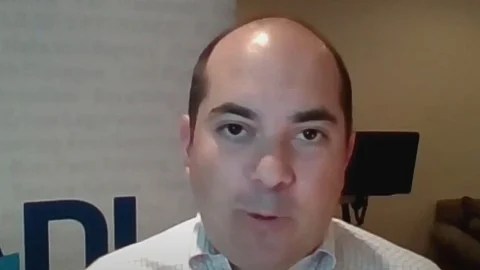
ADL Regional Director Calls for Government-Regulated Online Censorship
By Cindy Harper | Reclaim The Net | May 27, 2025
The Anti-Defamation League’s David Goldenberg is demanding a broad overhaul of how speech is governed on the internet, calling for both government intervention and intensified corporate censorship. In a recent appearance, Goldenberg, who heads the ADL’s Midwest operations, expressed frustration over what he sees as declining efforts by tech firms to suppress online content he deems hateful.
Citing Meta’s rollback of its fact-checking team in the United States, he argued that platforms must be forced to take action. “You have a platform like Meta that just gutted its entire fact-checking department… And so what we need to do is we need to apply pressure in a real significant way on tech platforms that they have a responsibility, that they have an absolute responsibility to check and remove hateful speech that is insightful.(sic)”
Goldenberg advocated not just for voluntary moderation, but for legislative and regulatory measures, both at the federal and state level, that would compel platforms to act as speech enforcers. He pointed to efforts in states like California as examples of where local governments are already testing such models.
His concern centers around what he perceives as an ecosystem of radicalization made easily accessible by today’s digital infrastructure. He warned that extremist ideologies no longer require obscure forums or dark web communities to spread. “It used to be you had to fight going into the deep dark web… Now… it’s easier and easier to be exposed in the mainstream,” he said.
Framing the online environment as a catalyst for violence, Goldenberg argued that free access to controversial viewpoints must be curtailed. He called for social media companies to take a stronger stance by excluding users whose views fall outside accepted boundaries, adding that regulation should enforce this responsibility.
He zeroed in on Section 230 of the Communications Decency Act, a critical piece of legislation that shields platforms from legal liability over user-posted content. “Congress needs to amend Section 230, which provides immunity to tech platforms right now for what happens,” Goldenberg said. He dismissed comparisons between modern platforms and telecommunications companies, referencing past remarks by Facebook’s Mark Zuckerberg about how phone providers were not liable for threats made over calls. Goldenberg’s view was blunt: “These tech platforms are not guaranteed under the Constitution. They’re just not.”
From his perspective, private companies should be free to “kick people off, to de-platform,” and if they fail to do so voluntarily, they must be pressured or regulated into compliance. He described accountability as a mechanism for shaping behavior, stating, “Accountability is a tool that can be incredibly effective in changing behavior.”
The position advanced by Goldenberg reflects a broader effort to blur the line between public authority and private platform control. By demanding that companies mirror the goals of activists and lawmakers, his approach seeks to institutionalize censorship and convert digital platforms into engines of ideological enforcement.
But such a vision comes with consequences. By urging the dismantling of legal protections and empowering both governments and corporations to decide which views should be silenced, this framework sets the stage for widespread suppression. What’s framed as protection from harm becomes a template for restricting dissent, and narrowing the range of permissible thought in public discourse.
Israel’s claim that ‘Hamas is stealing aid’ is patently a lie. Here’s why
By Jonathan Cook | May 27, 2025
Israel’s claim that Hamas is “stealing aid” is so preposterous no serious journalist or politician ought to give it any kind of airing – yet there it is continuously cropping up in the coverage of Gaza.
How do I know Israel’s claim is utterly worthless? For this simple reason:
Israel has a fleet of surveillance drones constantly hovering over the tiny strip of land that is Gaza, monitoring every inch of the territory. The incessant whine you hear every time you watch someone there being interviewed is from one of those drones. They are Israel’s eyes on the enclave. If you are outside in Gaza, you might as well be living in the Truman Show.
Were Hamas stealing aid in Gaza, Israel would easily be able to document it. It would have the video footage from its drones. The fact that it has not provided any footage showing Hamas’ theft of aid – its ransacking of aid trucks, or its fighters smuggling themselves into aid warehouses – is confirmation enough that Israel has simply invented this claim to rationalise its plans to starve the people of Gaza to death through months of an aid blockade or force them to flee into neighbouring Sinai, whichever comes first.
Without its disinformation campaign about “Hamas stealing aid”, Israel knows popular revulsion at its starvation campaign would grow quickly, and western governments would further struggle to keep opposition in check.
There are lots of others reasons, of course, to reject Israel’s lies about “Hamas stealing aid”. Not least, because every single charity and aid agency dealing with Gaza says that aid is not being stolen by Hamas.
But also because, were Hamas fighters doing so, they would be stealing from their own families: from their children and grandparents, who are much more vulnerable to Israel’s starvation campaign than they are. The idea that Hamas is stealing aid makes sense only to a racist, European colonial mindset in which Hamas fighters are viewed as bogeymen figures indifferent to the deaths of their own children, wives and parents.
What undoubtedly is happening is that Israel is allowing the strongest extended families in Gaza – often crime families with significant private arsenals – to loot the aid. That has become a serious problem since Israel killed off Gaza’s civilian police force (in violation of international law), leaving no one to enforce public order.
When everyone’s starving, the most powerful families mobilise their strength to grab an unfair share of the aid. That was an entirely predictable outcome of Israel’s policy to smash all of Gaza’s institutions, including its hospitals, government offices, and police stations, on the bogus pretext that they were “Hamas”.
Note too that Israel has long cultivated close ties to Palestinian crime families, because they provide a potential alternative, and more co-optable, power base to the Palestinian national movements and are a good source of collaborators.
The evidence suggests Israel is encouraging these crime families to loot the aid precisely to justify its dismantling of an existing aid system that works remarkably well, given the catastrophic circumstances in Gaza, and replace it with its own militarised, completely inadequate “aid distribution” system, which is designed only to herd Palestinians into the southern-most tip of Gaza, ready to be expelled into Sinai.
No journalist ought to be repeating Israel’s transparent disinformation. To do so is to collude in the promotion of lies to justify genocide. But the western media class have been doing that now for more than a year and half. They have grown entirely insensible to their own active collusion in the genocide.
US aid site collapses in Gaza amid mismanagement, Israeli gunfire
Al Mayadeen | May 27, 2025
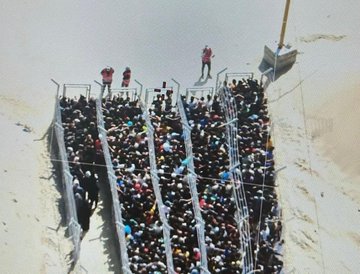
The latest attempt to distribute aid in Rafah as part of the ethnic cleansing plan descended into chaos on Tuesday, as the American-managed distribution mechanism built to push people south of the strip, by the Gaza Humanitarian Foundation, failed catastrophically, an Al Mayadeen correspondent on the ground reported.
The site reportedly collapsed due to overcrowding, disorganization, and a lack of control by the overseeing company, resulting in the destruction of a large portion of the facility.
The scenes showed a harrowing sight of people being driven inside overcrowded narrow paths made of metal fences and barbed wire, reminiscent of WW2 nazi concentration camps.
The breakdown was further compounded by live fire from Israeli occupation helicopters, which targeted the vicinity of the distribution center, escalating panic among the gathered civilians. Israeli media outlets, including Yedioth Ahronoth, confirmed that Israeli occupation forces opened heavy fire at Palestinians from Gaza who had stormed the aid complex.
The same outlet also claimed that armed personnel contracted by the American company overseeing the site fled the scene amid the surge in crowds. In response, Israeli commentators criticized the incident as yet another security failure similar to previous breakdowns in the so-called Netzarim axis, pointing to the “privatization of security tasks inside hostile territory by foreign contractors.”
Aid system reflects ‘systematic starvation policy’
In a strongly worded statement, the Government Media Office in Gaza condemned the collapse of the Rafah aid distribution plan, accusing the Israeli occupation of deliberate sabotage. “The occupation has utterly failed in its project to distribute aid in the zones of racial segregation,” the statement read.
It further asserted that the occupation’s interference at the aid distribution center “exposes the collapse of the so-called humanitarian process it claims to lead,” calling the scene “irrefutable evidence of the occupation’s failure to manage the crisis it has intentionally created.”
The office denounced the establishment of isolated zones, referred to as “ghettos”, for distributing limited aid as a deliberate policy aimed at perpetuating starvation and dismantling the social fabric of Gaza.
Accusing the Israeli regime of weaponizing humanitarian aid as a tool of war and political extortion, the office held the occupation fully responsible for the deepening food crisis and humanitarian collapse.
Calls for UN to open border crossings
The Gaza Media Office reiterated its complete rejection of any project involving buffer zones or so-called humanitarian corridors managed by the Israeli occupation. It demanded immediate and unrestricted access to humanitarian aid, urging the United Nations to act swiftly to open the crossings and empower humanitarian agencies to operate freely and independently.
The statement also called for international investigation committees to document what it described as the war crime of starvation and to hold the occupation’s leadership legally accountable.
Additionally, the office appealed to Arab and Islamic nations to intervene and activate independent humanitarian channels to break the blockade imposed on the Gaza Strip.
The events in Rafah offer yet another bleak chapter in Gaza’s ongoing humanitarian disaster, highlighting the severe consequences of militarized aid delivery and foreign-managed logistics within a war-torn and besieged population.
Group CEO resigns from post
Jake Wood, the executive director of the US-backed Gaza Humanitarian Foundation (GHF), announced his resignation on Sunday, stating the group’s aid delivery model could not be implemented without violating core humanitarian principles.
The departure throws fresh uncertainty over the future of the initiative backed by the Israeli occupation and the United States to deliver food aid into the besieged enclave, bypassing traditional aid structures.
Last week, the Gaza Government Media Office announced in a statement that “Israel’s” brutal blockade on humanitarian aid has killed hundreds of Gazans, and led to a sharp rise in miscarriages.
“The Israeli occupation’s starvation policy in Gaza has led to the deaths of 326 people due to malnutrition and lack of food and medicine, along with over 300 miscarriages among pregnant women in just 80 days,” the office stated.
In a public statement, Wood said he was proud of the plan he had developed, which aimed to distribute 300 million meals within 90 days while addressing diversion concerns and complementing existing NGOs.
“Senators from Israel” Sabotaging Trump’s Iran Deal
By Kevin Barrett | American Free Press | May 27, 2025
Last month I warned in these pages that Donald Trump faces a stark choice regarding Iran: “Nuclear Deal II or World War III.” I pointed out that Iran is open to a deal, but that it won’t be much different from the JCPOA that Trump unilaterally canceled during his first term.
Failure to reach a nuclear agreement would make a catastrophic US war on Iran almost inevitable—not because Iran would quickly build nuclear weapons or threaten anyone, but because failed negotiations would embolden Israel to attack Iran, knowing that it would almost certainly be able to draw the US into the war. And if that happened, Iran could climb the escalation ladder by killing thousands of US soldiers, sinking US ships, and most importantly, destroying enough of the region’s oil production to completely collapse the global economy.
Iran doesn’t want nuclear weapons, which are banned by a decades-old religious edict renewed by the current Supreme Leader. But a growing minority of Iranians want to rethink that edict. They believe that Iran’s lack of nuclear weapons has allowed nuclear-armed Israel to repeatedly attack it, murder its scientists, perhaps even (deniably) assassinate its president, and commit genocide and other crimes with impunity. So even though nukes are ungodly, the minority claims, there is a “necessity doctrine” that allows people to do things that are ordinarily forbidden if survival requires it.
Israel, for its part, wants to completely dominate the region. Zionist extremists, who now represent about half the Israeli public, are committed to building “Greater Israel.” That would require genocide at industrial scale to eliminate regional populations so Yahweh’s supposedly chosen people can steal all the land and resources between the Nile and Euphrates rivers.
An ever-expanding Israel that continues invading and occupying its neighbors, stealing their land and resources, and murdering and expelling their populations cannot dream of doing such things unless it is the only nuclear weapons state in the region. So the possibility that one day Iran might “go nuclear” worries Israeli hardliners. If Iran continues developing its civilian nuclear program, Israelis believe, someday its leaders might change their minds and decide to build nuclear weapons. The Israelis apparently don’t understand that it is their own reckless criminality that is driving more and more Iranians toward considering the necessity of developing nukes for self-defense.
A Trump nuclear agreement would, like its predecessor, keep Iran in a position of needing about a year of “breakout time” to build nuclear weapons—as opposed to months or even weeks without a deal. But that’s not good enough for Netanyahu and other Israeli hardliners. They want to lay waste to Iran, even if it requires blowing up the global economy and with it Trump’s presidency.
A group of “Senators from Israel” led by Tom Cotton (R-IS) and Lindsey Graham (R-IS) is trying to torpedo Trump’s nuclear negotiations with Iran. The treasonous Israeli-owned senators are pushing a resolution demanding that Iran completely dismantle its civilian nuclear program. That’s a non-starter. International law, beginning with the Nuclear Non-Proliferation Treaty (NPT) specifically allows Iran (like other non-nuclear-weapons states including Japan, Brazil, and the Netherlands) to enrich up to 5%. Under the 2015 JCPOA Iran agreed to limit enrichment to 3.67%, a significant concession representing roughly the minimum enrichment required for nuclear power and research.
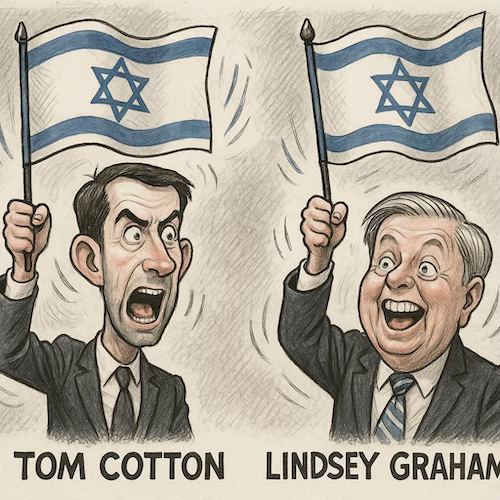
The “Senators from Israel” also want Iran to abandon its ballistic missiles—the core of its defense strategy—and stop cooperating with regional allies in Iraq, Lebanon, Yemen, and above all, Palestine. Those demands, too, are non-starters. Their only purpose is to destroy the possibility of any agreement, thereby opening the door for Israel to drag the US into a disastrous war on Iran.
Will the Trump Administration break free from the malign influence of the Israel lobby and its extremist leader, Benzion Mileikowsky, that Polish-born internationally-wanted criminal who operates under the alias “Benjamin Netanyahu”? Will Trump take the advice I offered last month and “terminate Bibi’s command…with extreme prejudice if necessary?”
There are encouraging signs that Trump may jettison Netanyahu in order to avoid the war-on-Iran-for-Israel trap that Bibi has set for him. By striking a separate peace with Yemen’s Houthis that allows them to continue targeting Israel, then triumphally visiting the region’s Arab capitals (including Hamas-funding Qatar) Trump has done everything but order Israel to stop its genocide in Gaza.
Trump needs to give that order ASAP—not only for humanitarian reasons, but also to create a fait accompli that will help bring down Netanyahu and forestall the Israeli hardliners’ efforts to trick the US into yet another disastrous war for Israel. If the Trump Administration does not act decisively, Netanyahu’s bought-and-paid-for “US” senators will keep pushing Bibi’s war plans, with potentially catastrophic results.
The Right Approach to the US-Iran Nuclear Negotiations
By Glenn Diesen | May 27, 2025
I recently attended a media festival in Tehran and also had the opportunity to explore Iran’s weapon systems and one of its nuclear facilities. Iran’s nuclear program is cited as the main reason for Israel and the US to threaten war with Iran. Such a war would likely escalate into a disastrous regional conflict, and perhaps even pull in the other great powers in a world war. Israel obviously needs to bring America on board to attack Iran, so the discussions between the US and Iran are of great importance. What do the Americans and Iranians want, and is there common ground that can be reached?
If the only demand by the US was for Iran to abstain from developing nuclear weapons, then an agreement could be reached, as Iran claims it does not intend to develop nuclear weapons and has accepted that inspectors are there to ensure compliance. Indeed, Iran agreed to the Joint Comprehensive Plan of Action (JCPOA) and honoured its obligations before the US unilaterally withdrew from the agreement. The US now demands a renegotiation and demands the complete dismantlement of Iran’s civilian nuclear energy program, which it is entitled to have as a signatory to the Non-Proliferation Treaty.
Furthermore, the US has linked its hegemonic policies in the region to the nuclear issue. The US demands that Iran limit the range of its ballistic missile program and also suspend its support for allies in the region – primarily Yemen, Lebanon and Hamas. From Tehran’s perspective, this represents a complete capitulation that would make its security dependent on the benign intentions of Israel and the US. This neglects that the US has had Iran in its crosshairs for the past 45 years, and Iran does have legitimate security concerns.
What can be considered a legitimate security concern by the US is that Iran has become a nuclear threshold state, with the knowledge and material to develop a nuclear weapon. Restricting the extent to which uranium is enriched and imposing strict inspections could possibly be negotiated.
However, threatening to bomb Iran would not eliminate its know-how or all of its material, and such an attack would only incentivise Iran to develop a nuclear deterrent. Even US threats to attack Iran unless it complies with US demands must be making the political leadership in Iran consider acquiring a nuclear weapon. So far, Iran is not developing nuclear weapons, because doing so would encourage other states, such as Saudi Arabia, to also pursue nuclear weapons. Recognising the security competition, the result would not be greater security for Iran.
In my opinion, another approach to negotiations would be to do what is rarely done anymore in Western diplomacy: to recognise and mitigate the security concerns of the other side for the purpose of reducing the security competition. Threatening and bullying Iran into making unilateral concessions has become the new normal in the unipolar era. The US offer to remove sanctions on Iran is merely an offer to stop punishing Iran. The point of departure in any diplomatic approach should be to address mutual security concerns and explore where an agreement that enhances security for both sides can be found. Threatening Iran with capitulation and linking nuclear issues to unrelated matters will only ensure the failure to reach an agreement.
German Chancellor Merz threatens to cut EU funding for Hungary and Slovakia

By Thomas Brooke | Remix News | May 27, 2025
German Chancellor Friedrich Merz has warned that the European Union could withhold even greater funds from Hungary and Slovakia if they refuse to adhere to the values imposed upon member states by Brussels.
Speaking at the WDR Europaforum on Monday, Merz said, “Member states that violate the rule of law can face infringement procedures, and there is always the possibility of withdrawing European funds. If necessary, we will take care of it.”
“We cannot allow the decisions of the entire EU to depend on a small minority,” he added, in a thinly veiled attack on the nationalist-led governments in Bratislava and Budapest. Both countries have already seen parts of their EU funding frozen over legal and political disputes with Brussels.
His remarks come as Hungary faces renewed criticism over a bill targeting foreign-funded NGOs and media, while Slovakia, under Prime Minister Robert Fico, has raised alarm in Brussels following his recent visit to Moscow and long-held opposition to further European intervention in the Russo-Ukrainian conflict.
Following the trip, Brussels ramped up pressure on Slovakia with the arrival of a delegation of Members of the European Parliament from the Committee on Budgetary Control (CONT), led by Czech MEP Tomáš Zdechovský, to investigate alleged misuse of European subsidies.
Slovak Interior Minister Matúš Šutaj Eštok has dismissed the delegation’s visit as a politically motivated “punitive expedition” orchestrated by Brussels, accusing Eurocrats of defamation. “A carefully selected group is coming here with the aim of presenting Slovakia in Brussels as a black hole on the map of Europe,” he claimed.
Skepticism over Brussels’ approach to the war in Ukraine has been a point of contention in Hungary and Slovakia for the duration of the conflict, and Merz expressed his intention to advocate for punitive measures against the two member states should they seek to block European support to Kyiv.
“We will not be able to avoid this conflict with Hungary and Slovakia if we continue on this course,” Merz said.
Last month, Hungarian Prime Minister Viktor Orbán accused Brussels of conspiring with his country’s political opposition to bring about a change in government, remarks made after Hungarian left-wing MEP Kinga Kollár acknowledged the devastating effect that the withholding of EU funds for Hungary has caused, caveating her remarks by stating that “the deteriorating standard of living has actually strengthened the opposition and I am very positive about the ’26 elections.”
“They agreed to destroy the Hungarian economy, the Hungarian healthcare system, and to destroy the living standards of Hungarians, in order to help the Tisza party come to power,” Orbán said of the European Commission.
In response to Merz’s remarks, Hungarian Economy Minister Márton Nagy said on Monday that Budapest should reconsider its overdependence on trade with Berlin.
Russia could restrict return of Western brands – Izvestia
RT | May 27, 2025
The Russian parliament is set to pass a law that would regulate the right of foreign companies to reclaim assets sold during their exit from the country, Izvestia reported on Tuesday. The draft has reportedly been approved by the Finance Ministry and will be considered by the State Duma in its second and third readings simultaneously.
Numerous US, European, and Asian companies pulled out of Russia due to supply problems caused by unprecedented sanctions imposed on Moscow by the West after the escalation of the Ukraine conflict in 2022. Other firms left due to the risk of facing secondary sanctions or public relations pressure.
The bill, reviewed by Izvestia, allows Russian authorities or current owners to reject asset buybacks under certain conditions. Grounds for refusal include the foreign seller being from a country that has imposed sanctions on Russia, the repurchase price being below market value, or if more than two years have elapsed since the original deal with the Russian owner fulfilling obligations to employees and creditors.
The Russian authorities may also block asset buybacks if a company operates in sectors deemed vital to the country’s socio-economic stability, including defense or finance, the outlet said. In such cases, asset repurchase would require presidential approval.
According to Izvestia, the new measures will be voted on in June and could affect at least 18 foreign companies with buyback options, including Renault and McDonald’s. The draft law also reportedly stipulates that foreign businesses denied repurchase could be eligible for compensation, the amount of which would be determined by the government. However, if former owners failed to fulfill obligations before their exit, compensation could be reduced by court decision.
In March, Russian President Vladimir Putin ordered the government to draft regulations for Western firms seeking to return to the country’s market, which would prioritize the adequate protection of local businesses.
Following the exodus of foreign firms, the Russian market has largely adapted by promoting domestic and Chinese brands, making re-entry more challenging for Western companies. In sectors such as automotive and fashion, local alternatives have filled the void left by departing Western firms.
Putin said on Monday that foreign tech firms that continue operating in Russia while acting against the country should be “squeezed out.”
“They are trying to squeeze us, so we must respond in kind,” Putin said in response to a question about possible measures against companies such as Zoom and Microsoft. The president added that Russia had not expelled any companies and had instead created favorable conditions for their operations.
Featured Video
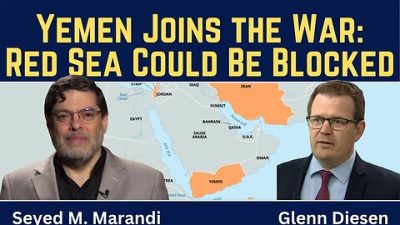
Yemen joins the war – Red Sea could be blocked next – Saudi regime at risk
or go to
Aletho News Archives – Video-Images
From the Archives
Should Europeans ‘Thank’ the Americans for Destroying Nord Stream?
By Robert Bridge | Strategic Culture Foundation | September 29, 2022
With an investigation continuing into the destruction of the Nord Stream gas pipeline that provided energy supplies to Europe from Russia, there appears to be just one prime suspect, and that should surprise nobody.
Following the sabotage of the Nord Stream 1 and 2 gas pipelines, former Polish Foreign Minister Radoslaw Sikorski already seemed to know the identity of the perpetrator when he tweeted out: “Thank you, USA.”
At first glance, it seemed that Sikorski was speaking sarcastically, berating Washington for carrying out an attack that will have severe repercussions for the people of Europe. After all, how could anyone see any good coming from the termination of Europe’s primary source of gas reserves with winter just around the corner? It was Sikorski’s homeland of Poland, after all, that urged its citizens to collect firewood in the face of dwindling gas reserves.
In fact, the Polish diplomat was speaking one-hundred percent literally… continue
Blog Roll
 Aletho News
- America Racing to Strategic Defeat in Iran: Lt Col Daniel Davis
- FTC Warns Visa, Mastercard, PayPal, Stripe Over Political Debanking
- Russian tanker approaches Cuba despite US oil blockade
- Marandi: Yemen joins the war – Red Sea could be blocked next – Saudi regime at risk
- Pro-Palestinian French member of European Parliament denied entry to Canada
- Pakistan to Host US-Iran Talks
- How Indonesia’s tilt toward the US left it stranded in the Strait of Hormuz
- US has no choice but to retreat from Iranian borders: Top commander
- Iran Retaliation Strikes Chemical Plant Near Dimona
- AWACS’ Destruction is a Major Loss for US Military – Ex-DoW Analyst
- If Americans Knew
- Israeli police block Catholic cardinal from entering Church of the Holy Sepulchre on Palm Sunday
- Israel is assassinating journalists again, more than any other nation, anywhere, ever – Not a ceasefire Day 170
- Over 300 US service members wounded, majority have brain injuries – Not a ceasefire Day 169
- Researchers at Human Rights Watch Resign Over Blocked Report on Palestinian Refugee Return
- Jewish Groups Are Backing a War Americans Don’t Want
- Eric Fingerhut Thinks He’s the President of the Jews
- Top Jewish Philanthropists, Rabbis Urge Israeli President to Take Action Against ‘Jewish Extremists’
- Don’t Be Fooled. Zionist Leaders Have Always Wanted to Control Southern Lebanon
- Israel’s widespread use of torture is a core element of its genocide against the Palestinian people
- In Israel’s War on Iran, Many Middle East US Bases Rendered “All But Uninhabitable”
- No Tricks Zone
- New Study Finds Warming Saves Lives…Cold Temperatures 12 Times More Deadly Than Excess Heat
- German Science Blog Accuses PIK Climate Institute Of Hallucinating Climate Tipping Points
- Devastating Assessment Of Comirnaty Vaccine By Former Senior Pfizer Europe Toxicologist
- New Study: CO2 Is ‘Effectively Negligible’ As An Explanatory Climate Change Factor Since 2000
- Former Pfizer Toxicologist Dr. Helmut Sterz Tells Bundestag Hearing Pfizer Vaccine Should Have Never Been Approved
- Energy Expert: Germany’s Nuclear Phaseout Was A “500 Billion Euro Mistake”
- New Research: South Australia’s Mid-Holocene Sea Surface Temperatures Were 4°C Warmer Than Today
- Storing Green Energy To Last Germany 10 Days Would Require A 60-Million Tonne Battery
- New Studies: UK Sea Levels Were 4 Meters Higher Than Today During The Mid-Holocene
- Destructive Green New Deal: German Energy And Metal Group Warns Of Drastic Crisis
 Aletho News