Take the Deal, President Trump
By Ron Paul | May 26, 2025
Deal-making is said to be President Trump’s specialty, yet after five rounds of indirect talks with Iran – most recently just days ago – we seem as far away from an agreement as ever. The fifth round ended last Friday with no breakthrough, but at least no breakdown. However, each day that passes without a document signed on the table is another day for the neocons to maneuver the US president toward an attack on Iran.
One way the war party does this is to continuously move the goal posts and change the rules of the game. Trump envoy Steve Witkoff, under great pressure from the neocons, has himself signaled at least three position-shifts: from no enrichment at all, to low-level enrichment for civilian uses, back to no enrichment at all.
The neocons know that Iran will not give up its right to the civilian use of nuclear power and that is why they are applying maximum pressure to force Trump to officially adopt that position. They know if that becomes the US “red line” then they will win and they will get their war.
Israeli Prime Minister Netanyahu, in league with US neocons, has been warning us for 20 years that Iran is “months away” from a nuclear weapon – even though our own Intelligence Community recently re-affirmed that Iran is not working on a nuclear weapon at all.
Of course this is the same Netanyahu who promised Congress in 2002 if the US would just invade Iraq, peace and prosperity would break out in the Middle East. “If you take out Saddam, Saddam’s regime,” he told Congress in March of that year, “I guarantee you that it will have enormous positive reverberations on the region.”
We know how that worked out.
Poll after poll shows that the American people are tired of intervention and tired of Middle East wars. President Trump himself recognized this in his scathing rebuke of neocons and interventionists during a recent speech in Saudi Arabia.
But rebuke in a speech is not enough. President Trump must actively turn away from the neocons – many of whom are prominent in his own administration.
The recent US debacle in Yemen – where billions were wasted, civilians killed, and US military equipment destroyed – is just a taste of what the US would be in for if the neocons get their way and take us to war with Iran.
The Iranian foreign minister laid down in the simplest terms how the impasse could be solved, posting on X that, “Zero nuclear weapons = we DO have a deal; Zero enrichment = we do NOT have a deal.
My own preference is non-intervention and I do not believe Iran has the desire or the ability to militarily harm the United States. I share President Trump’s view that it would be far better to re-establish relations with Iran and begin mutually beneficial trade with the country. But if a mutually acceptable nuclear deal is the best way to take the neocon war with Iran off the table, then a deal is worth supporting.
President Trump should make his position clear to his negotiators: no more waffling or contradictions, get this agreement signed and put one in the “win” column.
China Just Punched a Massive Hole in Trump’s Golden Dome
By Ilya Tsukanov – Sputnik – 27.05.2025
Trump’s new missile defense shield could cost taxpayers up to $831B, according to a Congressional Budget Office estimate.Too bad it won’t work against China’s new super-duper stealth tech.
Scientists at China’s Zhejiang University have created a composite, multi-layered, heat-absorbing stealth material they say can evade detection by infrared and microwave systems at long ranges.
The best part? It operates at temperatures up to 700 °C, meaning it can be potentially used in an array of military and space applications.
That’s bad news for Golden Dome, which will rely on ground and space-based early warning, tracking, fire control and AESA radars to detect and track threats. Without help from its sensor-based eyes and ears, Golden Dome’s interceptors would be essentially useless and firing blind in the event of a crisis.
China’s Anti-Golden Dome Toolkit
If implemented in a real-world defense application, the new stealth tech will add to the list of means China already has at its disposal to render Golden Dome obsolete, like:
- pairing ICBMs or carrier-killer missiles with electronic warfare drones or aircraft,
- deploying decoy/dummy warheads
- cyber warfare
Individually and together, these systems can jam radar, spoof sensors, mimic missile signatures and suppress communications.
China could even announce a drone and missile buildup to simply overwhelm US defenses and exhaust interceptors. It worked for Moscow when Reagan toyed with his Strategic Defense Initiative in the 80s. It can work for Beijing against Trump’s Golden Dome.
Targeting the Dome Itself
The US system could be targeted with:
- ground/space-based anti-satellite weapons (missiles, killer satellites)
- hypersonic weapons that maneuver to evade interception
- laser & microwave weapons targeting sensors
- sabotage & cyber ops
Trump’s Only Winning Move: Not to Play
Like Reagan before him, President Trump sees Golden Dome as a magical weapon with which to defend America.
In reality, it will serve to undermine strategic stability, since its real purpose, whether Trump realizes it or not, is to give the Pentagon the ability to launch first strike attacks with a false sense of impunity, thus undermining the Mutually Assured Destruction (MAD) doctrine.
Unless it’s cancelled, the Golden Dome will trigger a new global arms race unlike anything seen so far this century, pushing rivals to:
- build more warheads to saturate US defenses
- create new hypersonic weapons to evade it
- develop decoys, new multiple independent reentry vehicle, early warning and radar-absorbing materials to defeat it
As for the US, it will spend up to $831B on a system that doesn’t work.
Russia warns US about Golden Dome scheme
RT | May 27, 2025
The US is taking a “reckless approach” to global stability through its pursuit of a worldwide anti-ballistic missile defense system, Russian Foreign Ministry spokeswoman Maria Zakharova has said.
The initiative, backed by President Donald Trump and dubbed the Golden Dome, envisions a layered defense network capable of intercepting long-range threats. The system would include space-based interceptors and options for preemptive strikes. The Congressional Budget Office has projected the program’s cost could exceed $542 billion over two decades.
Zakharova warned on Tuesday the plan “directly undermines the foundations of strategic stability,” a view she said is also held by China. Addressing a Chinese media inquiry at a regular briefing, she noted that both governments had outlined their shared concerns in a joint statement earlier this month.
The statement, released on May 8, accused Washington of disregarding the longstanding link between offensive and defensive strategic forces, a principle the two countries described as central to maintaining global equilibrium. Moscow and Beijing also criticized the US declaration of space as a “warfighting domain” and the fact that the Golden Dome project requires further militarizing it.
Zakharova called on the US to reconsider its position and back a Russian-proposed treaty aimed at banning the deployment of weapons in space. Such a measure, she argued, would reduce the risk of an arms race beyond Earth’s atmosphere.
Earlier on Tuesday, North Korea issued a similar warning, stating that countries perceiving a threat from the US would be compelled to expand their military arsenals in response to the deployment of the Golden Dome.
In 2002, US President George W. Bush withdrew from a bilateral treaty with Russia that limited the development of anti-ballistic missile technologies. Bush argued the move was necessary to defend against so-called “rogue states.”
Russian President Vladimir Putin has said that the decision had forced Moscow to develop advanced nuclear weapons capable of penetrating any missile shield in order to preserve its strategic deterrence. Last December, he contended that Washington’s missile defense investments “cost a lot to taxpayers and contribute little to the security for their country.”
How Lies and Hubris Caused an Awakening
By Pat Fidopiastis | Brownstone Institute | May 26, 2025
In March 2020, the phrase “Fifteen days to slow the spread” was transmitting faster than SARS-CoV-2. At the time, it seemed reasonable to want to buy our health care workers a few weeks to prepare. Contemporaneously, Dr. Anthony Fauci reasonably summarized decades of research in his 60 Minutes interview by saying that masks are not an effective way to block respiratory viruses.
In a Snapchat interview, Dr. Fauci reasonably interpreted timely data on Covid-19 outcomes to conclude that young people could decide for themselves if they wanted to meet strangers on a dating app during the pandemic. As Dr. Fauci put it: “Because that’s what’s called relative risk.”
Even the authors of the “proximal origin” opinion piece in Nature Medicine made reasonable points in support of a natural origin of SARS-CoV-2 (despite revealing their cards by calling “lab leak” implausible): “… it is likely that SARS-CoV-2-like viruses with partial or full polybasic cleavage sites will be discovered in other species” and “More scientific data could swing the balance of evidence to favor one hypothesis over another.”
Five years later, thousands of animals have been sampled, millions of genomic sequences have been analyzed, and still there is nothing remotely close to a non-human adapted, animal version of SARS-CoV-2; back in 2003, using “stone tools” compared to today’s technology, they found the animal version of that SARS virus in a few months.
Unfortunately, the honeymoon of reason was brief. Overwhelming evidence that SARS-CoV-2 was not natural became a “destructive conspiracy,” and if you spoke about it, you were somehow racist.
Surgeon General Jerome Adams instructed us on how to make a life-saving mask from an old t-shirt. Dr. Fauci used the bizarre excuse that he lied in his 60 Minutes interview to explain why he abruptly reversed himself and began promoting the epidemiological theater of wearing several masks at once.
Not to be outdone, Dr. Deborah Birx summed up the futility of her leadership with this pearl: “We know that there are ways that you can even play tennis with marked balls so you’re not touching each other’s balls.” This sounded more like a punchline than worthwhile public health advice. Perhaps most egregious of all, we learned that “Two weeks to slow the spread” was not meant to be taken literally.
For me, a professor of microbiology for nearly 25 years, the moment of reason ended when I stepped into an elevator on my campus and saw a floor sticker telling me where to stand (Fig. 1). I simply could not keep quiet and pretend that this was sound public health advice.
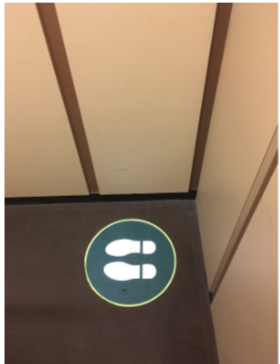
Fig. 1
Before long, businesses were inundated with pandemic rules. I was hired by one of the lucky ones deemed “essential,” and therefore allowed to open, to assist with “safe” operation plans.
When I arrived to conduct my inspection, the business looked more like an Ebola field hospital than a furniture store (Fig. 2). Masked customers were herded in the parking lot by ropes and signs. One by one, they were greeted by an attendant, grateful to still have a job, standing behind Plexiglas, wearing a mask and face shield.
The friendly attendant was instructed to ask uncomfortable questions about symptoms like diarrhea. If a customer responded “yes” to any of the symptoms or refused to answer, they could not shop for furniture. If “no,” then their temperature was measured.
It was nearly 100 degrees that day so almost everyone had to be scanned multiple times. Inside the store was a maze of one-way arrows, warning signs, Plexiglas, hand sanitizer stations, and boxes of masks and disposable couch covers. They even had a video monitor reporting the number of customers per 400 square feet of store. Sadly, the epidemiological version of “over-medicating the patient” did not stop with onerous business rules.
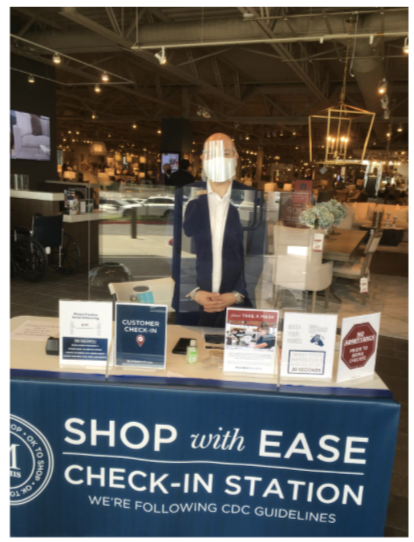
Fig. 2
Drunk with power, public health officials in California felt ordained to protect the unwashed masses from Thanksgiving dinner. Unsurprisingly, these farcical dining rules did not apply to everyone.
Who actually believed “singing, chanting, shouting, and physical exertion” at a family dinner was too risky? Who decided that we needed to bulldoze a skate park to prevent kids from congregating? Why was it necessary to arrest a lone paddleboarder in Santa Monica Bay for “flouting coronavirus closures?”
In the LA Times article on the paddler’s arrest, a professor from the prestigious Scripps Institute of Oceanography opined, “SARS-CoV-2, the virus that causes COVID-19, could enter coastal waters and transfer back into the air along the coast. I wouldn’t go in the water if you paid me $1 million right now.”
I tried laughing off the ridiculous, unenforceable Thanksgiving rules, those stickers in the elevators, and other nonsense that at the time was happening somewhere else. But I could not get past the frightening reality that so many of my highly educated peers actually believed nonsense like SARS-CoV-2 was leaping out of the ocean.
Anyone paying attention could compile government data on Covid-19 outcomes and assess risk for themselves (Table 1). The message was always the same – the vast majority of deaths attributed to Covid-19 were people over 65 years old with severe comorbidities, especially obesity.
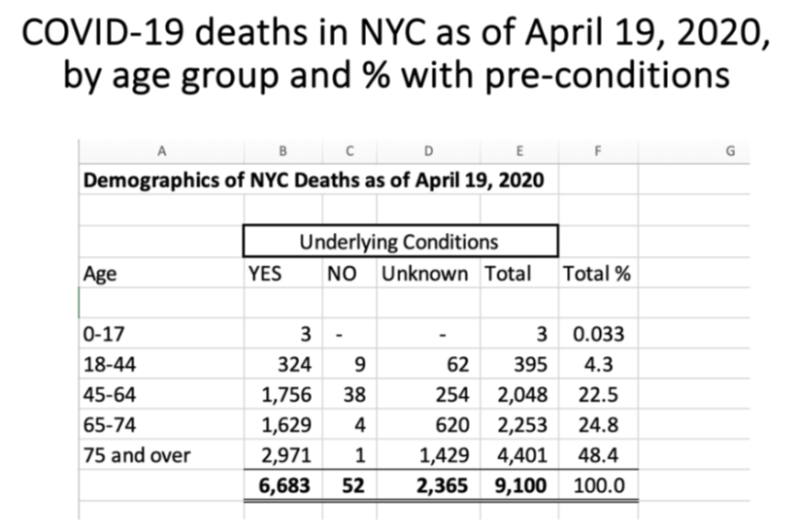
Table 1
By signing the Great Barrington Declaration and discussing its premise of “focused protection” in my advanced microbiology courses, I received an avalanche of vitriol.
Among the most shocking responses were accusations of “ageism” and “fat-shaming” for discussing hard facts about the pandemic.
Just like that, the “Science doesn’t care about your feelings” crowd started prioritizing their feelings. The university newspaper asked for an interview. I was warned not to accept, but I wanted to start a bigger conversation. I regret my decision because the article they wrote did not represent the views I articulated.
Instead, I was accused of promoting a “power imbalance” by supposedly forcing my “junk science” views on students. I used to think the cries of “fake news” were just a lazy argument by people that could not support their position, until I read that article about me.
Ironically, these same people who attacked me had completely accepted the made-up “six-feet rule,” which was the root of so much collateral damage. Heavily biased news sources like NPR defended this unscientific rule by stating, “distance still protects you.” However, if the cure is not even remotely feasible, despite the best efforts of authoritarians, then it’s not really a cure.
Apparently I crossed the line when I discussed in class how politicized the pandemic had become. How is it that President Trump’s rallies were spreading “coronavirus and death” but BLM protests had no effect on coronavirus cases? The sampling bias was baked in, given that contact tracers were being told not to ask people if they had been to a protest.
Why was it acceptable for CNN to use phrases such as “Wuhan virus” and “Chinese coronavirus,” but when President Trump did it, he was called “racist?” Was it actually “racist” to discuss the obvious signs of genetic manipulation in the SARS-CoV-2 genome with my students in an Emerging Infectious Diseases class?
My campus newspaper and many of my colleagues thought so, as did an Asian American and Pacific Islander group calling for my resignation. When the admonitions about masks became aggressive (Fig. 3), and draconian, unscientific outdoor mask fines were being implemented, I analyzed some data and conducted a few experiments to find out for myself if masks were worth all the anger.
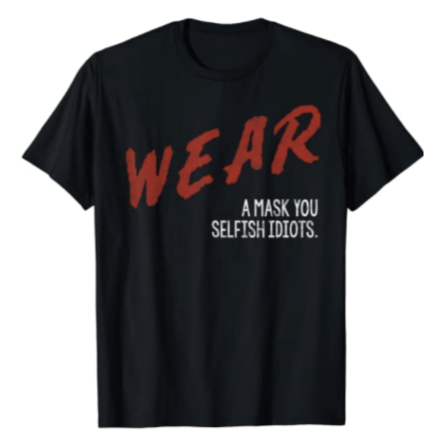
Fig. 3
I looked at “cases” in places like New York City and pointed out when the mask mandate and fines were applied (Fig. 4). Notably, the NYC mandate was instituted after cases had already begun to fall, and coercive fines did not prevent the second wave, which was longer and reached a higher peak than the first wave.
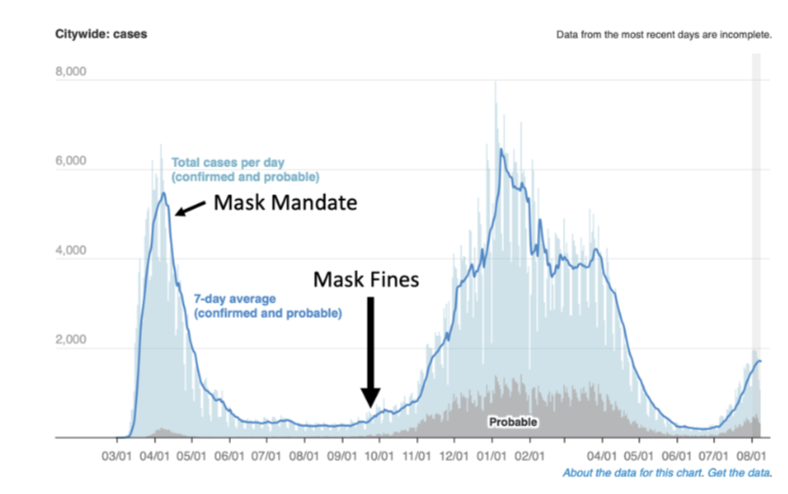
Fig. 4
I had my allergy-prone daughter sneeze onto petri-plates with and without the CDC-approved masks we wore to enter locations that enforced the mask mandate (Fig. 5). The saliva spray patterns, illustrated by microbial growth on the plates, were virtually indistinguishable.

Fig. 5
In the 60 Minutes interview, Dr. Fauci stated that “… often there are unintended consequences…people keep fiddling with the mask and touching their face…” implying that germs collect on masks, making them a source of contagion rather than a barrier.
Indeed, after the sneeze experiment, I stamped the outside of my daughter’s mask onto a petri-plate. The resulting dense microbial growth supported Dr. Fauci’s argument against mask wearing – “fiddling with the mask” probably does spread microbes (Fig. 6).

Fig. 6
At the time, I stated in the campus newspaper that “the science on masks was mixed at best.” However, the third-year journalism student apparently knew better and decided I was pushing “junk science.” Was I naïve to expect an apology after “the science” started catching up to what I was saying?
During the pandemic, my lab was responsible for measuring SARS-CoV-2 levels in wastewater (Fig. 7) to use this information as a means of tracking community transmission. We learned two important lessons from this approach.
First, peak levels of SARS-CoV-2 in wastewater (orange line) provided a few weeks’ lead to when we could expect to see peak levels of people testing positive for the virus (i.e., “cases;” blue line). Second, we learned that the mask mandate (red line) did not stop the virus from doing what it wanted. Despite the mask mandate, transmission of SARS-CoV-2 reached unprecedented highs.
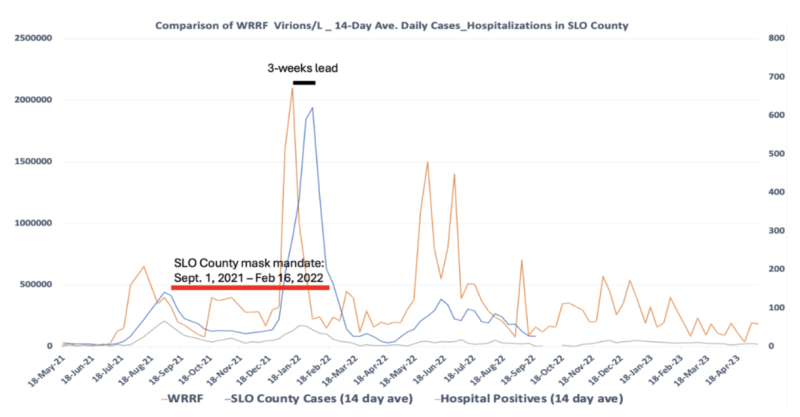
Fig. 7
Taken together, my findings were supported by decades of research showing that masks are not effective against respiratory viruses, regardless of the quality. Still, the counterargument persisted that wearing an N95 mask suctioned to your face, and constantly replacing it, would have stopped the pandemic.
Again, if the cure is not feasible, then it’s not really a cure, is it? The reality is that there are no convincing data supporting mask mandates, none that even remotely support children being forced to wear saliva-soaked masks, and especially none that would justify people being choked and beaten for opposing them.
The “follow the science” crowd was honing their authoritarian skills in preparation for mandatory vaccinations. The motivation for these mandates was summed up perfectly: “During the Sars crisis in 2003 pharma companies answered the WHO’s call for vaccine research. They invested hundreds of millions of dollars, but then — when the outbreak died away — governments and charities lost interest.” According to epidemiologist Dr. Osterholm “The companies were left holding the bag.”
How could Big Pharma avoid “holding the bag” on a vaccine they hoped would stop a virus that had repeatedly ripped through the world’s population? Not surprisingly, their first order of business was to drop the concept of “natural immunity” into the memory hole, centuries of science be damned. The subtext was if regular people knew that natural immunity was real, they probably would not want the vaccine, especially if they already had Covid-19 a few times.
Leading up to the vaccine rollout, I tested myself regularly using PCR, antibody, and antigen assays. I eventually tested positive and had mild flu-like symptoms. While well-educated friends of mine had gone to such lengths as to move out of their homes to distance themselves from their children and wait for the vaccines, my family chose a different tack. Instead, we huddled, got mild infections (except for my wife, who seemed to be immune), shared some level of natural immunity to the latest version of the virus, and tracked our infections (Table 2).
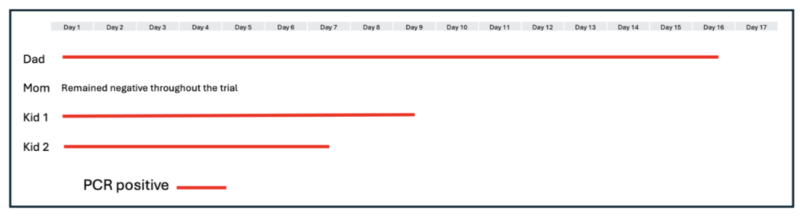
Table 2
When I shared the “herd immunity” story with my small social media following, most appreciated hearing something other than doom and gloom. However, others showed a level of vindictiveness that should not have surprised me, given how acceptable it became to wish death on the unvaccinated.
A colleague attempted to shame me in the campus newspaper, while others wondered out loud whether Child Protective Services should be notified. How dare you give your children the sniffles! How dare you use this time of ridiculous “virtual learning” mandates to provide your children with some hands-on experience performing quantitative PCR!
Predictably, my SARS-CoV-2 antibody levels were extremely high after over two weeks of PCR-positivity. While still overflowing with SARS-CoV-2 antibodies, I was scheduled to receive mandatory shots in order to return to campus.
If the world had actually followed the science, my recent PCR positivity and elevated antibody titers should have been a reasonable exemption. Unfortunately, there was no such exemption. Having seen the terrible treatment of my colleague Dr. Kheriaty, I decided we would play the role of guinea pigs and take what would be an all-risk-and-no-reward shot, especially for my kids. That is, there was nothing in it for us except a few days of high fever and injection site swelling, but definite financial reward for everyone in the vaccine supply chain.
As a member of the “laptop class,” the “lockdowns” made my life easier in many ways. While small business owners struggled, I was getting full pay to upload instructional videos to my university students, and occasionally engage with them online. My wastewater epidemiology work was deemed “essential,” so I was permitted to go to my lab to perform those duties for additional compensation.
However, the ad hominem attacks and threats caused me to disengage from further attempts to start a discussion on pandemic policy, which no doubt was their goal. While the world was fighting over toilet paper and shaming each other for “killing grandma,” we tuned out for a while (Fig. 8).

Fig. 8
I was surrounded by so much anger that I truly believed I was alone in my heretical views on pandemic policy. However, I officially tuned back in when Dr. Scott Atlas invited me to join a small group called The Academy for Science and Freedom.
Our meeting at the Hillsdale College Kirby Center in Washington, D.C. was the first time I had hope since the pandemic started. We were professors, medical doctors, publishers, and journalists, all united by a common belief that the people in charge abandoned a basic tenet of public health: voluntary instead of coercive measures would protect public trust and induce cooperation.
Despite all the great minds in the room, it was hard to imagine we would ever get to where we are right now. But here we are. Many of the people responsible for lockdowns, forced vaccinations, and covering up the unnatural origin of SARS-CoV-2 are gone.
In their place, are Academy members such as Dr. Tracy Beth Høeg, Dr. Jay Bhattacharya, Dr. Matt Memoli, Dr. Vinay Prasad, Dr. Martin Kulldorff, and Dr. Marty Makary. All of whom were treated far worse than me. The overwhelming rejection of “The Fauci School” of public health policy is vindicating. However, recent headlines suggest there are holdouts refusing to accept that they were fooled: Dr. Høeg is a “vaccine skeptic,” Dr. Memoli “is known for questioning vaccine mandates,” and Dr. Prasad is an “anti-science MAHA extremist.”
The people I trusted probably fooled me on a lot of things I voted for, like the benefits of a 20,000-page health care policy. Who has time to actually read that stuff? However, they were never going to succeed at fooling me about the science of the pandemic.
Their lies and hubris caused an awakening, reminiscent of the scene in The Matrix when Neo emerged from the virtual world to a brutal reality. I just hope the people I trust who are now running the major institutions will allocate all resources to programs that will actually improve human health. In doing so, they should have no problem convincing those holdouts not only that they had been fooled, but who fooled them.
Pakistan PM hails Iran’s diplomacy for regional peace ahead of visit
Press TV – May 26, 2025
Pakistani Prime Minister Shehbaz Sharif has hailed Iran’s peace diplomacy as commendable, underscoring his nation’s solidarity and support for the Islamic Republic.
Sharif, who will visit Tehran at the official invitation of Iranian President Masoud Pezeshkian on Monday, made the remarks in an interview with IRNA.
Sharif stated that the primary purpose of his visit to Tehran is to express gratitude to Iran for its support—specifically endorsing Iran’s peace-seeking positions in the region—during Pakistan’s recent tensions with India.
Tensions between India and Pakistan sharply escalated after the deadly Pahalgam attack. India blamed Pakistan for the attack, but Pakistan rejected the accusations.
“I wish to express gratitude to Iranian officials for their support of peace and their mediation proposal—which we accepted but India rejected,” he said, adding “I will also use this visit as an opportunity to discuss bilateral relations and matters of mutual interest.”
Sharif praised Iranian Foreign Minister Abbas Araghchi’s diplomatic skill, saying the Iranian top diplomat has demonstrated true statesmanship and wisdom in managing significant challenges during an exceptionally complex geopolitical era.
Sharif also stated that Pakistan firmly supports Iran’s condemnation of Israel’s genocide in Gaza, which has caused severe humanitarian devastation and regional instability.
“Islamabad and Tehran will continue to support one another on issues concerning the Muslim Ummah and to advance regional cooperation,” Sharif added.
A Holocaust in Gaza: Flames, Ash, and 30 Charred Remains

Al Mayadeen | May 26, 2025
The Israeli occupation has escalated its genocidal war on the Gaza Strip, intensifying its assaults on civilians and designated shelter sites in a relentless overnight campaign of destruction. In the early hours of today, as much of the world lay asleep, a devastating inferno engulfed the al-Daraj neighborhood in the heart of Gaza City.
What remains are the charred ruins of a school-turned-shelter, the scorched frames of homes, and a searing image too haunting to forget: a little girl, no older than six, stumbling barefoot through a corridor of flames, her skin scorched, her eyes wide with terror, searching, still alive, for a way out of the Israeli-made holocaust consuming everything around her.
The fire at her heels was no accident. It was born of “Israel’s” bunker-busting missiles, deliberately launched at what was clearly marked as a civilian refuge: Fahmi al-Jarjaoui School, packed with forcibly displaced families who had fled Israeli bombs, only to be massacred beneath them.
The school, situated in a densely populated neighborhood, was struck by missiles that pierced the upper floors and detonated on the lower levels, where dozens of displaced civilians had taken shelter, Al Mayadeen’s correspondent reported. Many of the victims were burned beyond recognition, with charred remains bearing witness to the intensity of the strike, our correspondent stressed.
By dawn, at least 51 Palestinians were confirmed killed. 30 of the bodies were charred. Among them were children, women, and the elderly, incinerated in a blaze so intense that, according to local officials, human flesh turned to ash. The school became the epicenter of horror: Dozens of lives erased in a single, calculated act of genocide.
A night of horror
In Jabalia, 19 Palestinians were also killed when another Israeli strike leveled a home, as per our correspondent.
Elsewhere in the besieged Strip, one Palestinian was martyred and others were wounded when Israeli forces struck a tent sheltering displaced families inside a kindergarten in al-Maghazi refugee camp in the central Gaza Strip.
The Israeli occupation also carried out a wave of home demolitions and airstrikes across various neighborhoods and towns, including:
- Beit Lahia
- al-Shujaiya
- al-Tuffah
- al-Qarara
Hamas senior official: The Movement agrees to US proposal for permanent ceasefire in Gaza
Palestinian Information Center – May 26, 2025
GAZA – A senior official in the Islamic Resistance Movement, Hamas, stated that the Movement has agreed to a proposal by US President Donald Trump’s envoy, Steve Witkoff, which stipulates a permanent ceasefire in the Gaza Strip. The first phase includes the release of 10 Israeli captives in exchange for a 70-day truce and a partial Israeli withdrawal from the Strip.
The senior official said in a press statement on Monday that the new offer approved by the Movement is a developed version of the path and vision proposed by Witkoff. It includes the release of 10 live Israeli captives held by the Al-Qassam Brigades, the armed wing of Hamas, in exchange for a 60-day truce, a partial Israeli withdrawal from the Gaza Strip, and the release of a number of Palestinian prisoners and detainees, including several hundred with high or life sentences.
The mechanism for releasing the Israeli captives will occur in two phases: five will be released on the first day of the agreement, and five more on the sixtieth day.
The source said that Hamas and the American envoy are finalizing a ceasefire agreement in Doha that would lead to a permanent ceasefire in the Gaza Strip.
The senior official clarified that the new offer approved by the Movement includes the partial withdrawal of the Israeli army from the Gaza Strip—especially from Salah al-Din Road, including the Nuseirat junction south of Gaza City, the Morag axis in northern Rafah, and from residential areas.
According to the source, indirect negotiations will begin regarding a long-term truce and its requirements, and an independent Community Support Committee will be empowered to govern the Gaza Strip.
Iran draws red line as Europe threatens nuclear ‘snapback’
As indirect US–Iran nuclear talks inch forward, Europe’s fear of marginalization prompts a risky diplomatic maneuver in Istanbul.
By Vali Kaleji | The Cradle | May 26, 2025
In the backdrop of indirect nuclear negotiations between Tehran and Washington, Iranian Deputy Foreign Ministers Majid Takht-Ravanchi and Kazem Gharibabadi met with their European counterparts from France, Germany, and Britain – the so-called E3 of the Joint Comprehensive Plan of Action (JCPOA) – on 16 May in Istanbul.
The meeting, held at Iran’s Consulate General and hosted by Turkiye, brought together EU Deputy Secretary-General for Political Affairs Enrique Mora and his colleague Olof Skoog, alongside Turkish Deputy Foreign Minister Abdullah Celik. The discussions focused on the future of the 2015 nuclear agreement, the status of indirect Iran–US negotiations, and collective efforts to avert further escalation through diplomacy.
Although three earlier rounds of consultations between Tehran and the E3 occurred on 29 November 2024, 13 January, and 24 February 2025, the Istanbul session marked a pivotal moment: the first engagement since the revival of the Iran–US indirect dialogue.
Europe cut out of nuclear talks
Crucially, the EU, much like in the Ukraine peace process, found itself bypassed by Washington. This diplomatic exclusion has intensified Brussels’s urgency to reclaim relevance within the nuclear negotiations framework, apparently even if this means acting as spoiler.
At the heart of the Istanbul summit lies the snapback mechanism – an instrument embedded in the JCPOA allowing any signatory to reimpose all UN sanctions that existed before the 2015 agreement. The clause, originally intended as a safeguard, now threatens to become a geopolitical cudgel.
With the JCPOA’s expiration looming in October 2025, Tehran fears that the E3 may invoke the mechanism as early as this summer, citing Iran’s alleged enrichment beyond 60 percent and its growing stockpile of enriched uranium.
French Foreign Minister Jean-Noel Barrot minced no words during a 28 April address to the UN Security Council, stating that if European security interests are compromised, France “will not hesitate for a single second to reapply all the sanctions that were lifted 10 years ago.” His statement, which reverberated through diplomatic circles, was widely interpreted in Tehran as a stark ultimatum.
Iran’s permanent representative to the UN responded forcefully, accusing France of hypocrisy and warning that Paris’s own breaches of the agreement render any activation of the snapback legally indefensible.
Iranian Foreign Minister Abbas Araghchi echoed this stance in an op-ed for Le Point, characterizing the Istanbul discussions as “a fragile but promising beginning” while cautioning that “time is running out.” He wrote:
“The decisions we make now will shape Iran–Europe relations in ways that go far beyond this agreement. Iran is prepared to move forward – we hope Europe is, too.”
Following the talks, Gharibabadi wrote on X: “We exchanged views and discussed the latest state of play on nuclear & sanctions lifting indirect negotiations. Iran and the E3 are determined to sustain and make best use of diplomacy. We will meet again, as appropriate, to continue our dialogue.”
British envoy Christian Turner echoed this sentiment, affirming the shared commitment to maintaining open channels of communication.
‘Trigger Plus’
Yet not all assessments of the Istanbul summit were diplomatic. Tehran-based daily Farhikhtegan, aligned with Iran’s conservative establishment, described the session as tense and combative.
According to its report, the E3 tabled severe threats, including a proposal for what they termed “trigger plus” – an augmentation of the original snapback mechanism that would allow preemptive punitive measures without requiring technical justification.
Iranian officials, the newspaper reported, dismissed this demand as not only illegal and baseless but also presented in an “inappropriate” tone. The Iranian side reiterated that while they remain open to EU participation in broader nuclear negotiations, any activation of the snapback mechanism would trigger an immediate Iranian withdrawal from the Nuclear Non-Proliferation Treaty (NPT).
Mohammad Ghaderi, former editor-in-chief of Nour News – a media outlet close to Iran’s Supreme National Security Council – summarized the stance bluntly on social media:
“In the tense talks with Iran on Friday, [the E3] while requesting to participate in Iran–US talks, made non-technical & illegal requests, calling it trigger plus. But Iran’s response: Emphasizing the activation of the Trigger Mechanism will lead to Iran’s withdrawal from the NPT.”
The Iranian Foreign Ministry, in characteristic fashion, neither confirmed nor denied these reports, opting for strategic ambiguity to maintain leverage over multiple negotiation tracks.
The October deadline: Strategic implications
As the October 2025 expiration date draws closer, Iran has accelerated efforts to engage the remaining members of the 4+1 framework – China, Russia, France, Britain, and Germany. Trilateral meetings with Moscow and Beijing have underscored Tehran’s strategy of building a multilateral diplomatic buffer against US-European pressure.
However, the snapback clause remains the most potent lever in the E3’s arsenal. According to Article 36 of the JCPOA, any signatory can escalate a compliance dispute to the UN Security Council. Once initiated, this process does not require a vote or consensus, meaning that Russian and Chinese vetoes are nullified.
Should the snapback be triggered, all seven UN Security Council sanctions previously lifted would automatically be reinstated – a scenario with grave consequences for Iran’s economy and its broader regional strategy.
Analysts suggest the E3 may push for this mechanism’s activation as early as July or August, thereby maximizing diplomatic pressure while allowing time to shape global opinion. If that happens, Tehran’s recourse to NPT withdrawal – a threat repeatedly made since 2019 – would likely materialize.
Deputy Foreign Minister Kazem Gharibabadi reinforced this red line in response to a recent International Atomic Energy Agency (IAEA) resolution: “If Europe implements snapback, our answer is to withdraw from the NPT.” As Araghchi, writing again in Le Point, stated unequivocally:
“Iran has officially warned all JCPOA signatories that abuse of the snapback mechanism will lead to consequences – not only the end of Europe’s role in the agreement but also an escalation of tensions that could become irreversible.”
Europe’s desperation for relevance
Europe’s insistence on asserting itself in the JCPOA talks stems from its declining influence across global affairs. From the Ukraine war to the Persian Gulf, the EU has been reduced to a secondary actor. In the Iran file, this marginalization is especially stark.
While Washington and Tehran inch closer to a bilateral formula, Brussels finds itself largely ignored. Nosratollah Tajik, a former Iranian diplomat, argues:
“Europe’s main concern is that Iran and the United States will reach a bilateral agreement without considering European interests. Many of the Middle East [West Asian] crises spill over into Europe.”
The lack of a coordinated EU Iran policy only compounds this anxiety. Theo Nencini, an Iran expert at Sciences Po Grenoble and Paris Catholic University, concurs:
“The E3 countries have not yet managed to define a coherent and relevant ‘Iran policy.’ From Trump 1.0 to Biden, they have always been accustomed to flatly following American positions.”
Nencini believes that unexpected US–Iran direct talks caught Europeans off guard, prompting them to scramble to get involved in the negotiation process despite the fact that “they have always maintained a very strict attitude towards Iran.”
Diplomacy or detonation?
The Istanbul talks, despite their challenges, represent one of the few remaining diplomatic lifelines between Tehran and the E3.
Should these efforts collapse, the consequences would be profound: Iran could withdraw from the NPT, revise its nuclear doctrine, and prompt potential military escalation involving the US and Israel.
Such a scenario would spell the total disintegration of the JCPOA framework and shatter the fragile architecture of non-proliferation diplomacy built over the past two decades.
With less than five months to avert this trajectory, the onus lies on both parties to preserve what little remains of mutual trust. Yet the margin for error continues to shrink by the day.
Iran, China launch new commercial railway bypassing US sanctions
The Cradle | May 26, 2025
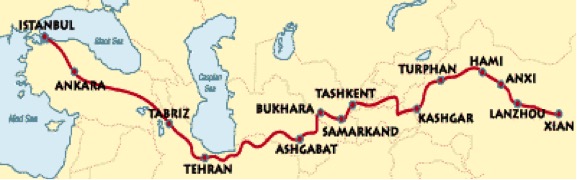
A new commercial rail route connecting China to Iran has officially launched with the arrival of the first cargo train from the eastern Chinese city of Xian at the Aprin dry port near Tehran.
Aprin’s CEO highlighted the port’s strategic role in lowering transport costs and reducing reliance on coastal freight hubs.
Railway infrastructure connecting Iran and China allows freight trains to travel from Shanghai to Tehran in 15 days, compared to 30 days via the maritime route.
On 12 May, railway officials from Iran, China, Kazakhstan, Uzbekistan, Turkmenistan, and Turkiye met in Tehran to advance a transcontinental rail network linking Asia to Europe, Tasnim News Agency reported on 25 May.
The six nations agreed on competitive tariffs and operational standards to streamline regional rail services and boost trade connectivity.
China and Iran have expanded trade and economic relations in recent years, as Tehran seeks to bypass US economic sanctions seeking to strangle its economy and oil exports.
The rail line between the two countries enables Iranian oil exports to China and allows Chinese goods to reach Europe without US naval interference.
In 2018, Iranian Supreme Leader Ali Khamenei stated that Iran should look to the east rather than the west. Since that time, China has become Iran’s largest oil purchaser, while Beijing has been able to supply Tehran with virtually all its needed manufactured goods, including electronics such as computers and cell phones.
The following year, Iran joined China’s “One Belt One Road” (BRI) initiative – President Xi Jinping’s hallmark strategic foreign policy initiative, seeking to recreate the economic ties that existed between ancient China and ancient Persia along the “Silk Road” dating back to the third century BCE.
China and Iran signed a historic 25-year economic cooperation agreement in 2021, reportedly worth $400 billion in trade.
In 2023, China’s growing relations with Iran helped it mediate a Saudi–Iranian rapprochement, which led to the resumption of diplomatic relations that had been cut in 2016.
Merz’ Missile Intimidation Tactics Won’t Work Because America Calls the Shots in Germany
Sputnik – 26.05.2025
“In short, you shouldn’t take the Germans too seriously,” veteran German legal scholar and ex-AfD MEP Gunnar Beck told Sputnik, commenting on Chancellor Merz’ announcement that Germany, the UK, France and the US are no longer restricting how far Ukraine can strike using its NATO-sourced missiles, potentially including Taurus.
“Germany today only needs to be taken seriously if it acts as a US satellite… We are not an independent nation. We are governed partly by the EU and partly by the US. Did the EU and the US agree?” That’s the real question, according to Beck.
Merz’ threats are meant as an intimidation tactic, the observer says, but Berlin doesn’t “seriously consider that it may be a crucial step in terms of escalating the conflict so that ultimately Germany herself could be involved either in terms of ground troops in Ukraine or even being affected by the war.”
No One to Challenge ‘Governor Merz’
“Merz as much as previous German chancellors, doesn’t really regard himself as a representative of Germany’s interests. He doesn’t really want to pursue ends which serve Germany’s. He regards himself as something like a governor of Germany for the interests of the globalist elite,” Beck stressed.
He doesn’t have opposition against the CDU-CSU-SPD-Green “uniparty,” which controls two thirds of parliament and is opposed only by AfD and Linke, nor among the financial and media elite (the latter “owned and effectively managed by the government,” apart from Springer Group, “essentially controlled by transatlantic interests”).
Bottom Line?
“Europe is not capable and probably reluctant to take independent action, whatever they may be saying. America still calls the shots in Europe because there’s just such a huge disparity in terms of economic and military power. We have to bear in mind that the EU is in decline. It is, economically speaking… in the worst economic position of all the industrialized countries, including Japan,” Beck summed up.
Russia to respond to West’s attempted restrictions in Baltic Sea – Putin aide
RT | May 26, 2025
Russia is readying response measures to potential hostile NATO acts in the Baltics, Nikolay Patrushev, a senior aide to Russian President Vladimir Putin, has said. The military bloc’s heightened activity in the area increasingly resembles acts of piracy, he told the government’s Maritime Board meeting on Monday.
A set of measures has already been coordinated and agreed with the president, Patrushev said, without revealing the steps Moscow plans to take in response to what it calls a threat to its security and interests in the area. The presidential aide said the Russian Baltic Fleet is currently “strengthening its positions” in the Baltic Sea to ensure the safety of navigation and prevent any “provocations” by “unfriendly” nations.
“The threats posed by NATO are rapidly growing,” the presidential aide said, claiming that the bloc has effectively dismantled the international security architecture established after World War II. NATO is now “stepping up its presence” in the Baltic region and expanding its “combat and reconnaissance capabilities,” Patrushev warned.
He added that these actions are part of a broader effort by Ukraine’s Western backers to increase pressure on Russia. According to Patrushev, Western countries are preparing legislation that would allow them to inspect vessels operating in Russia’s interests in international waters. They are also considering measures to restrict the navigation of these ships in the Baltic Sea or even block their passage through international straits.
“Against this background, the Western nations are de facto committing acts of piracy,” he said, citing an “attempt by the Estonian Navy, backed by NATO aircraft, to detain a civilian vessel in the Gulf of Finland.”
Patrushev was referring to an incident on May 13 involving the Jaguar, a Gabon-flagged ship en route to a Russian port, which the Estonian Navy tried to detain.
Estonian Foreign Minister Margus Tsahkna later claimed that the vessel was unflagged and uninsured, and said the navy attempted to “inspect” it.
He also acknowledged that Estonia “has started to harass” what he described as Russia’s “shadow fleet” – a term used in the West to refer to tankers operating outside Western insurance systems.
Last month, Patrushev warned that EU and UK plans to tighten maritime restrictions on Russia “increasingly resemble a naval blockade.” He added that if diplomatic and legal means fail, Russia would be ready to deploy its navy to safeguard navigation.
West’s Long-Range Missiles to Ukraine All Essentially the Same & Russia’s Shooting Them Down
By Svetlana Ekimenko – Sputnik – 26.05.2025
Germany, the UK, France, and the US have removed range restrictions on weapons for Ukraine, Chancellor Friedrich Merz confirmed on May 26.
Whether it’s the Taurus, Storm Shadow, or SCALP, Russia will just keep knocking them out of the sky, Yevgeny Buzhinsky, Chairman of PIR-Center Think Tank Executive Board, Professor of Higher School of Economics who served as the Russian military’s top arms control negotiator from 2001 to 2009, told Sputnik.
The real issue with Germany’s Taurus missile isn’t its 500 km range, but rather what Merz rightly pointed out -without the Bundeswehr, Ukrainians can’t launch them, pointed out the pundit, adding:
“Which makes this a case of direct German involvement [in the Ukraine conflict], plain and simple.”
Germany, the UK, France and the US are no longer imposing restrictions on how far Ukraine can strike with Western-supplied weapons, German Chancellor Friedrich Merz revealed on May 26.
“There are no longer any range restrictions on weapons supplied to Ukraine — not by the British, not by the French, not by us, not by the Americans. This means that Ukraine can now defend itself, including, for example, by striking military positions on Russian territory. Until a certain point, it could not do this,” Merz said in an interview with the WDR TV channel.
Russia’s Foreign Ministry Spokeswoman Maria Zakharova warned that any Taurus missile strike on Russian targets will be seen as Germany entering the war on the side of the Zelensky regime.
Moscow maintains that Western arms deliveries only escalate the conflict and drag NATO deeper into the quagmire.
Featured Video
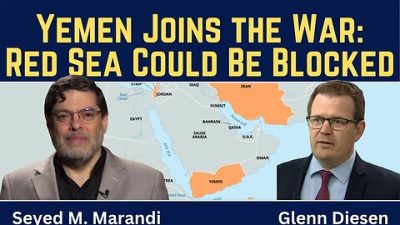
Yemen joins the war – Red Sea could be blocked next – Saudi regime at risk
or go to
Aletho News Archives – Video-Images
From the Archives
Should Europeans ‘Thank’ the Americans for Destroying Nord Stream?
By Robert Bridge | Strategic Culture Foundation | September 29, 2022
With an investigation continuing into the destruction of the Nord Stream gas pipeline that provided energy supplies to Europe from Russia, there appears to be just one prime suspect, and that should surprise nobody.
Following the sabotage of the Nord Stream 1 and 2 gas pipelines, former Polish Foreign Minister Radoslaw Sikorski already seemed to know the identity of the perpetrator when he tweeted out: “Thank you, USA.”
At first glance, it seemed that Sikorski was speaking sarcastically, berating Washington for carrying out an attack that will have severe repercussions for the people of Europe. After all, how could anyone see any good coming from the termination of Europe’s primary source of gas reserves with winter just around the corner? It was Sikorski’s homeland of Poland, after all, that urged its citizens to collect firewood in the face of dwindling gas reserves.
In fact, the Polish diplomat was speaking one-hundred percent literally… continue
Blog Roll
 Aletho News
- Russian Oil Tanker Arrives in Cuba Amid U.S. Blockade
- America Racing to Strategic Defeat in Iran: Lt Col Daniel Davis
- FTC Warns Visa, Mastercard, PayPal, Stripe Over Political Debanking
- Russian tanker approaches Cuba despite US oil blockade
- Marandi: Yemen joins the war – Red Sea could be blocked next – Saudi regime at risk
- Pro-Palestinian French member of European Parliament denied entry to Canada
- Pakistan to Host US-Iran Talks
- How Indonesia’s tilt toward the US left it stranded in the Strait of Hormuz
- US has no choice but to retreat from Iranian borders: Top commander
- Iran Retaliation Strikes Chemical Plant Near Dimona
- If Americans Knew
- Israeli police block Catholic cardinal from entering Church of the Holy Sepulchre on Palm Sunday
- Israel is assassinating journalists again, more than any other nation, anywhere, ever – Not a ceasefire Day 170
- Over 300 US service members wounded, majority have brain injuries – Not a ceasefire Day 169
- Researchers at Human Rights Watch Resign Over Blocked Report on Palestinian Refugee Return
- Jewish Groups Are Backing a War Americans Don’t Want
- Eric Fingerhut Thinks He’s the President of the Jews
- Top Jewish Philanthropists, Rabbis Urge Israeli President to Take Action Against ‘Jewish Extremists’
- Don’t Be Fooled. Zionist Leaders Have Always Wanted to Control Southern Lebanon
- Israel’s widespread use of torture is a core element of its genocide against the Palestinian people
- In Israel’s War on Iran, Many Middle East US Bases Rendered “All But Uninhabitable”
- No Tricks Zone
- New Study Finds Warming Saves Lives…Cold Temperatures 12 Times More Deadly Than Excess Heat
- German Science Blog Accuses PIK Climate Institute Of Hallucinating Climate Tipping Points
- Devastating Assessment Of Comirnaty Vaccine By Former Senior Pfizer Europe Toxicologist
- New Study: CO2 Is ‘Effectively Negligible’ As An Explanatory Climate Change Factor Since 2000
- Former Pfizer Toxicologist Dr. Helmut Sterz Tells Bundestag Hearing Pfizer Vaccine Should Have Never Been Approved
- Energy Expert: Germany’s Nuclear Phaseout Was A “500 Billion Euro Mistake”
- New Research: South Australia’s Mid-Holocene Sea Surface Temperatures Were 4°C Warmer Than Today
- Storing Green Energy To Last Germany 10 Days Would Require A 60-Million Tonne Battery
- New Studies: UK Sea Levels Were 4 Meters Higher Than Today During The Mid-Holocene
- Destructive Green New Deal: German Energy And Metal Group Warns Of Drastic Crisis
 Aletho News