US terms for nuclear deal ‘out of touch with reality’ – Iranian source to RT
RT | June 2, 2025
The US proposal for a new nuclear agreement with Iran is unacceptable, an Iranian source familiar with the matter told RT. Washington recently outlined its terms in a letter to Iran after five rounds of talks mediated by Oman.
“Iran views the US written elements as extremely far from what could possibly be regarded as a fair and realistic basis for a likely compromise,” the source said.
“Iranians were dismayed to see such a fanciful, one-sided text that is so out of touch with reality,” the source added.
The White House said on Sunday that President Donald Trump’s Middle East envoy, Steve Witkoff, sent “a detailed and acceptable proposal” to Tehran. White House spokeswoman Karoline Leavitt reiterated Washington’s position that “Iran can never obtain a nuclear bomb.”
Iranian Foreign Minister Abbas Araghchi said the Islamic Republic would provide a response “in line with the principles, national interests, and rights of the people of Iran.”
Trump earlier insisted on a “total dismantlement” of Iran’s nuclear program, suggesting the country should not be allowed to enrich uranium even for civilian purposes. Araghchi rejected these terms, saying the US must lift all sanctions and “uphold Iran’s nuclear rights, including enrichment.”
During his first term in office, Trump withdrew the US from the 2015 UN-backed nuclear deal, accusing Iran of secretly violating it. He then reimposed sanctions as part of his “maximum pressure” campaign. Tehran denied breaching the 2015 deal at the time but has since increased uranium enrichment.
White House Taps Palantir for Government-Wide Database of Americans
By Kyle Anzalone | The Libertarian Institute | June 1, 2025
In a move raising red flags with civil rights organizations, the Trump administration is working with tech firm Palantir to develop a database for numerous government agencies to collect and store information on all Americans.
According to a New York Times report published Friday, a “key” Palantir product known as Foundry has been used by at least four US federal agencies, including the Departments of Homeland Security and Health and Human Services. The firm is now speaking with other cabinet-level agencies.
The widespread use of Foundry across the federal government will allow a number of agencies to access “hundreds of data points on citizens and others through government databases, including their bank account numbers, the amount of their student debt, their medical claims and any disability status.”
The program has caused concern among civil rights groups and former Palantir employees. “Data that is collected for one reason should not be repurposed for other uses,” one ex-Palantir official told the Times. “Combining all that data, even with the noblest of intentions, significantly increases the risk of misuse.”
Immigration and Customs Enforcement, the IRS, and the Social Security Administration are all expected to have access to the database. The system will work with Palantir’s Gotham software, which is “designed to analyze behavioral patterns in real-time, flag potential threats, and support decisions around public safety and fraud detection,” the Economic Times reported.
In a statement posted on the company’s blog, Palantir attempted to downplay its role in the project. “We act as a data processor, not a data controller,” it said. “Our software and services are used under direction from the organisations that license our products: these organisations define what can and cannot be done with their data; they control the Palantir accounts in which analysis is conducted.”
Since Trump returned to office, Palantir has racked up over $100 million in government contracts, and the firm is slated to strike a nearly $800 million deal with the Pentagon. Palantir is also a major contractor for the Ukrainian and Israeli governments.
The company’s stock increased 5% after the NYT story revealed the contract, and is up 150% since Trump won the election.
Palantir co-founders Alex Karp and Peter Thiel have both been confronted over their work with the Israel Defense Forces as Tel Aviv ethnically cleanses Palestinians from Gaza. The co-founders defended the relationship with the IDF.
The BBC’s climate science problem
By Andrew Montford | Net Zero Watch | May 20, 2025
You could be forgiven for thinking the BBC is out to get Richard Tice. Their chosen battleground is the Reform man’s position on climate and Net Zero, but it’s fair to say the campaign is, thus far, not going too well.
Question Time last week was a car crash for the corporation, with chairman Fiona Bruce interrupting Tice to contradict his contention that only 4% of carbon dioxide emissions are manmade. Thirty percent was the correct figure, she boldly asserted. Unfortunately, Tice was right, and she was wrong, so the Corporation’s gophers got to work and quietly edited the recording to remove her gaffe. Unfortunately someone noticed, and sceptics had a field day.
Undeterred, the Corporation returned to the fray a few days later, when Nick Robinson had Tice on his Political Thinking podcast. They decided, somewhat surprisingly, to take up cudgels on exactly the same subject, namely the human influence on climate.
Once again, Tice expained that human emissions were dwarfed by natural ones, and there was no attempt to probe this argument more deeply. The conversation meandered off elsewhere.
However, shortly aferwards Robinson decided to stick in a metaphorical boot, tweeting a clip from the interview with the comment:
He’s denying the scientific consensus that climate change is partly man made & can be slowed or halted.”
This is a very strong take given that Robinson had not attempted to pin down Tice on precisely what he meant. But at face value it’s a misrepresentation.
Tice’s words could only reasonably be interpreted as implying that the human contribution is nugatory compared to the natural one. To get to Robinson’s take – that Tice believed that there was no human influence – would mean considering his words as meaning natural CO2 emissions affected the climate but human ones didn’t. This would be ludicrous.
Tice’s words clearly implied that he thought mankind affected the climate, but only marginally so. In other words, far from “denying… that climate change is partly man made”, this was his starting point!
As to the rest of Robinson’s claim – that Tice was denying that climate change “can be slowed or reversed”, we need to note what appears to be a fatal contradiction in Robinson’s position. If climate change is “partly” manmade, then it is also partly natural. How, we wonder, does Robinson think we can halt the natural element?
It is undoubtedly substantial. We are sure that the climate changes on all timescales, from the decadal and centennial to the millennial and beyond. We know this from, for example, long-term temperature records, such as the Central England Temperature Series, the 800-year record of the waters of the Nile, and proxy climate records covering even longer periods. And the natural changes that are seen in history can be dramatic. One notable example was the sudden temperature rise at the end of the period, over 10,000 years ago, known as the Younger Dryas. Temperatures around the world are thought to have increased by 3–10 degrees in just a few decades.
How does Nick Robinson think we are going to stop that kind of climate change?
Charitably, Robinson – who is a generalist – simply hasn’t thought through what he means by “climate change”. He has no robust understanding of climate history and climate science, and is therefore unable to probe the position of people like Tice, who have given the issues some thought.
That being the case, he needs to think before he speaks, and perhaps to be a little more cautious about dishing out accusations of denial.
US deputy envoy behind Hezbollah disarmament campaign to be replaced: Report
The Cradle | June 1, 2025
US Deputy Special Envoy to the region Morgan Ortagus, who has been in charge of Washington’s Lebanon policy, is soon to be removed from her position and reassigned to another role, according to US and Israeli reports.
Ortagus “will be leaving her position as Deputy Envoy in the Trump administration,” right-wing US journalist Laura Loomer reported on X on 1 June, citing White House sources.
“I’m told she will be cordially reassigned to another role in the Trump administration. She wanted to be the Special Envoy to Syria, but the position was instead given to Tom Barrack. Morgan’s replacement will be announced this week by Steve Witkoff,” she added.
Ortagus has been at the head of the US government’s campaign to pressure the Lebanese government into disarming Hezbollah and Palestinian resistance groups. In an interview with Al-Arabiya in April, Ortagus referred to the Lebanese resistance as a “cancer” that needs to be “cut out.”
During her first visit to Lebanon, she publicly thanked Israel for “defeating” Hezbollah at the presidential palace in Baabda.
Ortagus was scheduled to visit Beirut in the coming days to advance proposals regarding reforms, border demarcation, reconstruction, disarmament of Hezbollah, and normalization with Israel, according to Lebanese news outlet Al-Jadeed. “The US proposals will be presented with a firm tone, with a specific deadline for Lebanon to implement what gets agreed on or be held responsible” for the consequences, the report said.
Hezbollah has outright rejected disarmament, but says it is eventually willing to hold dialogue with the Lebanese government on a national defensive strategy that sees its weapons incorporated into the state for use in protecting the country from Israel.
According to a report by Israel’s Channel 14, National Security Council (NSC) officials Merav Ceren and Eric Trager have also been recently removed from their positions. Trager was overseeing Middle East and North Africa affairs at the NSC, while Ceren was the director for Iran.
Ceren previously worked at the Israeli Ministry of Defense and is affiliated with the Foundation for Defense of Democracies (FDD), a pro-Israel think tank based in Washington DC which has been described as “hawkish” and has been heavily pushing for the dismantlement of Iran’s uranium enrichment capabilities as US President Donald Trump’s government holds nuclear talks with Tehran.
Channel 14 notes that the decision is part of an effort to restructure the NSC, reduce its influence, and transfer foreign policy to a limited group of “trusted officials.”
The outcome of these changes, including Ortagus’s departure from her current position, was described in the report as “not good for Israel.”
‘Brussels hijacked our future’ – Orban
RT | June 1, 2025
Hungarian Prime Minister Viktor Orban has unveiled a proposal to increase the power of EU members and limit the authority of its bureaucracy. Calling it a “patriotic plan” for the bloc, he said in a series of weekend social media posts that it will revive the “European dream.”
The EU elites in Brussels have exploited every crisis to amass more power, Orban claimed in a post on X. This course has so far only translated into less sovereignty for member states and “failed policies,” according to the prime minister. “Brussels hijacked our future” by disrupting public safety through migration and eroding prosperity with “green dogmas,” he stated in another post.
“Europe can’t afford this any longer, it’s time to take back control,” he said.
The PM’s plan is based on what he calls four pillars: a path toward peace on the continent and defusing tensions with Russia, removing Brussels’ “centralized control” over finances, “bringing back free speech” and strengthening Europe’s Christian identity, and tightening control over immigration.
“We want peace, we don’t need a new Eastern front,” Orban said, commenting on his plan and stating that the bloc should not accept Ukraine as a member. “We don’t want our money poured into someone else’s war,” he added.
A military buildup and defense increase actively promoted by some EU nations could easily lock the bloc in an “arms race” with Russia, Orban warned. Such a development would “devour… taxpayers’ money,” he said. Instead of pouring more resources into the military, the bloc needs to contribute to the peace process between Moscow and Kiev, the prime minister maintained, praising US President Donald Trump’s efforts in this regard.
The EU needs to start “arms limitation talks with the Russians as soon as possible. Otherwise, all our money will be swallowed by the arms industry instead of being spent on peaceful… goals,” Orban argued.
European nations once united to create the “safest and the most advanced continent” in the world but this dream was “stolen,” the prime minister charged, calling on EU nations not to allow Brussels to use the Ukraine conflict “as an excuse to take more of our money.”
Iran slams IAEA report as politically motivated, based on forged Israeli documents
The Cradle | June 1, 2025
Iran voiced its strong protest on 31 May against a report issued by the head of the UN nuclear watchdog regarding Tehran’s nuclear program, saying it was issued “with political objectives and through pressures,” is based in part on forged Israeli documents, and goes beyond the UN nuclear chief’s mandate.
Reuters reported Saturday that the International Atomic Energy Agency (IAEA) issued a report claiming that Iran was in non-compliance with its obligations under the Nuclear Non-Proliferation Treaty (NPT).
The report, provided by IAEA head Rafael Grossi to the Board of Governors, claimed that Iran carried out secret nuclear activities with material not declared to the UN nuclear watchdog at three locations decades ago.
Western diplomats plan to use the report to pressure Iran at the UN Security Council and in ongoing negotiations with the US over its nuclear program, Reuters added.
Another report issued by the IAEA claimed that Iran’s stock of uranium enriched to up to 60 percent purity had grown by roughly half, enough for nine nuclear weapons if further enriched to 90 percent purity.
In response, Iran’s Ministry of Foreign Affairs and the Atomic Energy Organization of Iran (AEOI) issued a joint statement on Saturday.
The statement said that the governments of the UK, France, Germany, and the US have repeatedly violated their commitments under former nuclear agreements with Iran, including the Joint Comprehensive Plan of Action (JCPOA) and Security Council Resolution 2231, while simultaneously resorting to imposing illegal unilateral sanctions and pressures against the Islamic Republic in breach of international law.
The statement emphasized that Iran has continued to engage in extensive, good-faith cooperation with the IAEA and that the European Troika and the US “have spared no effort to use the agency for leverage in the ongoing political process.”
It added that the IAEA report does not accurately reflect the level of cooperation with the agency and relies extensively on forged documents provided by Israel, which recycle previous biased and unfounded accusations.
“The allegations leveled in the current report are based on a few claims about undeclared activities and locations from past decades. This is while Iran has repeatedly declared that it has had no undeclared nuclear sites or activities. At the same time, Iran has given the IAEA access to the alleged locations, allowing sampling, and providing detailed information and explanations on various occasions regarding the history of the alleged sites, providing the necessary cooperation with the agency,” the statement clarified.
The IAEA report also makes an improper distinction between obligations under the NPT and voluntary commitments under the JCPOA, presenting some of Iran’s voluntary actions as binding legal obligations.
Further, the report invokes “unreliable and misleading information provided by the Zionist regime as a non-NPT party possessing weapons of mass destruction and responsible for the most heinous crimes against humanity, including genocide, contradicts the professional verification principles of the IAEA.”
The Foreign Ministry and AEOI reiterated that nuclear weapons have no place in the nation’s defense doctrine, according to a religious ruling (fatwa) issued by former Iranian Supreme Leader Ayatollah Ruhollah Khomeini, and that there is no prohibition under international law for any country to develop nuclear technology for producing energy.
The statement affirmed that Iran’s enrichment program is solely for peaceful purposes, is fully transparent, is under complete IAEA supervision, and is in accordance with the Comprehensive Safeguards Agreement.
On Saturday, Iran said it received a proposal from the US, passed on by Oman, about a possible agreement over Tehran’s nuclear program.
Foreign Minister Abbas Araghchi said the US proposal had been delivered by the Foreign Minister of Oman, Badr bin Hamad Al-Busaidi, and that it would be “appropriately responded to in line with the principles, national interests, and rights of the people of Iran.”
Another Neoconservative Bites the Dust: The Life and Legacy of Michael Ledeen
By Jose Alberto Nino – The Occidental Observer – June 1, 2025
Michael Ledeen, the man who urged America to “to pick up some small crappy little country and throw it against the wall” every decade, met an end that many of his critics would call overdue. On May 17, 2025, Ledeen died at the age of 83. marking the passing of one of the last influential Jewish neoconservatives of his generation.
Ledeen obtained a Ph.D. in History and Philosophy from the University of Wisconsin-Madison, where he studied under the Jewish German-born historian George Mosse. He took a particular interest in Italian fascism and wrote a doctoral dissertation that eventually became “Universal Fascism: The Theory and Practice of the Fascist International, 1928–1936,” published in 1972, which explored Benito Mussolini’s efforts to create a Fascist international in the late 1920s and early 1930s.
His academic career began at Washington University in St. Louis, where he was an assistant professor of history from 1967–1973, before becoming a visiting professor at the University of Rome from 1973–1977. Ledeen authored over 35 books throughout his career, including works on fascism, European history, and Middle Eastern politics.
His influence was most felt in the realm of national security though. Throughout his career, Ledeen held multiple advisory roles within the U.S. government, including as a consultant to the National Security Council, a special advisor to the Secretary of State, a consultant to the Department of Defense, and a consultant to the under-secretary of political affairs. Ledeen was an active member of numerous think tanks and regime-change advocacy organizations such as the U.S. Committee for a Free Lebanon, Coalition for Democracy in Iran (CDI), American Enterprise Institute (AEI) and Foundation for Defense of Democracies (FDD). Additionally, he has been published in numerous philosemitic conservative outlets such as the National Review, Wall Street Journal, and the Weekly Standard. His influence extended beyond formal roles. According to the Washington Post, he was the only “full-time” international affairs analyst frequently consulted by Karl Rove, the chief strategist of then-President George W. Bush.
Ledeen’s career was not free of controversy, however. In 1980, Ledeen co-authored articles with Belgian-American journalist Arnaud de Borchgrave in The New Republic alleging Jimmy Carter’s brother, Billy Carter, accepted payments from Libyan strongman Muammar Gaddafi and met with PLO leader Yasser Arafat. He made those same assertions before a Senate subcommittee as the 1980 presidential election quickly approached. These claims, published weeks before the presidential election, reignited the “Billygate” scandal.
A 1985 Wall Street Journal investigation later confirmed that the stories were part of a disinformation campaign executed by Italy’s military intelligence agency (SISMI) to hurt Carter’s presidential re-election campaign. Italian intelligence officer Francesco Pazienza testified that Ledeen received $120,000 for his role and operated under the codename “Z-3.” Pazienza, who was convicted for extortion in connection to the operation, described Ledeen as a key figure behind the dissemination of false narratives.
Additionally, Ledeen was heavily involved in the Iran-Contra affair during the Reagan administration. As a consultant to National Security Advisor Robert McFarlane, Ledeen facilitated back-channel communications between U.S. officials, Israeli Prime Minister Shimon Peres, and Iranian arms dealer Manucher Ghorbanifar. In this case, the Reagan administration was clandestinely negotiating hostage releases in Lebanon via arms sales to Iran, a scheme that bypassed Congressional oversight and later became a major scandal. Ledeen defended Ghorbanifar despite widespread skepticism about his reliability, subsequently detailing his perspective in the book “Perilous Statecraft.” While he never faced criminal charges, Ledeen’s role in Iran-Contra showcased his willingness to operate in the shadows, ethics be damned.
Like many Jews in the neoconservative movement, Ledeen has a long career of advocating for regime change in the Middle East.
Ledeen was one of the most vocal Jewish neoconservatives lobbying for the removal of Iraqi strongman Saddam Hussein. Along with other neoconservative luminaries such as Richard Perle and Paul Wolfowitz, Ledeen signed “An Open Letter to the President” in 1998, urging Bill Clinton to topple Iraq’s Baathist regime.
Similar to other Jewish officials in the national security establishment, Ledeen was an unapologetic champion of using hard military power. Jewish neoconservative journalist Jonah Goldberg coined the “Leeden Doctrine” after reflecting on a speech he attended in the 1990s at the American Enterprise Institute. In that speech, Ledeen was alleged to have said:
Every ten years or so, the United States needs to pick up some small crappy little country and throw it against the wall, just to show the world we mean business.
In the lead-up to the 2003 invasion of Iraq, Ledeen was one of the most energetic proponents of using military force against the country. Ledeen wrote a piece at the National Review critical of former national security adviser Brent Scowcroft, who advised against invading Iraq. Instead of exercising restraint, Ledeen called for turning the entire Middle East “into a cauldron”, as he explained in more detail:
Scowcroft has managed to get one thing half right, even though he misdescribes it. He fears that if we attack Iraq “I think we could have an explosion in the Middle East. It could turn the whole region into a caldron and destroy the War on Terror.”
One can only hope that we turn the region into a cauldron, and faster, please. If ever there were a region that richly deserved being cauldronized, it is the Middle East today. If we wage the war effectively, we will bring down the terror regimes in Iraq, Iran, and Syria, and either bring down the Saudi monarchy or force it to abandon its global assembly line to indoctrinate young terrorists.
Ledeen’s hawkish stance on Iran was also a lifelong constant. He labeled the late Ayatollah Ruhollah Khomeini a “theocratic fascist”, and as Jewish political commentator Peter Beinart observed about Ledeen’s Middle Eastern political analysis, every problem in the region “traces back to Tehran.” Despite opposing a direct invasion of Iran in his later years, Ledeen championed aggressive support for Iranian dissidents and preemptive strikes against nuclear facilities if diplomacy failed to get Iran to kowtow to the United States.
Michael Ledeen’s death marks the end of a career that Jewish journalist Eli Lake described as one of “America’s most courageous historians and journalists.” His friend David Goldman, a Jewish international relations commentator associated with the Claremont Institute, wrote that Ledeen’s “personal contribution to America’s victory in the Cold War is far greater than the public record shows.”
Ledeen’s legacy is undeniably one of steadfast advocacy for Jewish interests within the American conservative movement. For those who saw his influence as a barrier to a more authentically gentile Right, his passing, like David Horowitz’s, may indeed be viewed as an opportunity for change as more of the Jewish founders of neoconservatism and their progeny exit the plane of the living.
For this author, Ledeen will certainly not be missed.
China hits back at US over vilification
RT | June 1, 2025
Washington is “vilifying” Beijing, the Chinese foreign ministry said on Sunday. The accusation follows remarks made by US Defense Secretary Pete Hegseth, who is deliberately ignoring calls for peace from nations in the region, according to the ministry.
Earlier, Hegseth claimed that China poses a real and potentially imminent threat, and urged Washington’s allies in the Indo-Pacific region to increase defense and security spending.
“Hegseth deliberately ignored the call for peace and development by countries in the region and instead touted a Cold War mentality of bloc confrontation, vilified China with defamatory allegations, and falsely labeled China a ‘threat’,” the ministry said in a statement.
Speaking at the Shangri-La Dialogue in Singapore on Saturday, the defense secretary accused Chinese authorities of seeking to fundamentally alter the region’s status quo and aiming to “become a hegemonic power.” Hegseth also raised the issue of Taiwan, which relies on the US for its defense – accusing Beijing of preparing to invade the territory.
The Chinese foreign ministry described the comments as “deplorable” and “intended to sow division” in the Asia-Pacific. It emphasized that the only country that “deserves to be called a hegemonic power” is the US, which it accused of undermining peace and stability in the region.
Responding to Hegseth’s remarks on the self-governing island, the ministry reiterated that the issue is entirely China’s internal affair. It stressed that no foreign nation has the right to interfere and warned the US against using the Taiwan issue as leverage against Beijing.
Taiwan has long been a source of discord between Beijing and Washington. While China advocates peaceful reunification, it has warned that any move toward formal independence could trigger armed conflict. Beijing contends that certain elements within the US government are pushing Taiwan toward that outcome.
China has also repeatedly criticized US-led joint military drills in the Indo-Pacific, arguing that they destabilize the region and provoke tensions over Taiwan.
In addition to geopolitical disputes, the two nations are at odds over trade. US President Donald Trump has blamed Beijing for America’s significant trade deficit with China.
In May, both countries agreed to pause the tariff hikes introduced the previous month for 90 days, while maintaining a baseline 10% duty on mutual imports. Earlier this week, Trump accused China of violating that agreement.
Russian Cybersecurity Gains Traction in Global South and East – Deputy Foreign Minister
Sputnik – 01.06.2025
Russian cybersecurity solutions have become increasingly sought after by countries in the Global South and East amid the growing discreditation of most leading Western IT firms, Russian Deputy Foreign Minister Sergey Vershinin told Sputnik.
“In the field of information and communication technologies, we possess significant capabilities — from legislation and law enforcement practices to extensive experience and developments in ensuring ‘digital sovereignty,’” he said.
According to the senior diplomat, Russian companies are offering cybersecurity solutions that are in high demand among nations in the Global South and East.
“This is largely due to the fact that many leading Western IT corporations have discredited themselves,” Vershinin noted.
He pointed out that there have been recurring revelations about Western companies ignoring the laws of the countries in which they operate, embedding hidden “backdoors” in their products — often for the benefit of intelligence agencies — and carrying out politically motivated directives from Western governments.
“All of this is, of course, being noticed by our partners in developing countries, who are increasingly leaning toward supporting our depoliticized and impartial approaches and initiatives in the ICT sphere on multilateral platforms,” he emphasized.
Europe punching above weight for nothing
By Salman Rafi Sheikh – New Eastern Outlook – June 1, 2025
Recent European (UK plus EU) sanctions on Russia amid ongoing US-backed efforts to broker a ceasefire in Ukraine aim to assert Europe’s perceived ability to “correct” the course of events.
However, the continued reliance on sanctions also underscores the limits of what Europe can—and cannot—achieve in ultimately shaping geopolitical outcomes.
Sanctions amid Talks
In geopolitics, timing is often more telling than the event itself. Such is the case with the European Union’s and the UK’s recent decision to impose fresh sanctions on Russia—announced just a day after former President Donald Trump held a two-hour “serious” conversation with Vladimir Putin. This is not the first time European states have sanctioned Russia, nor will it be the last. But this round is different, not in content but in context. The timing sends a clear message: Europe is uneasy, not just about Russia’s actions in Ukraine, but also about the growing strategic vacuum left by an increasingly disengaged United States.
Despite the recent round of dialogue between Ukrainian and Russian officials—and other rounds expected to follow—European leaders remain skeptical of where this path may lead. Their fear? That a negotiated settlement—particularly one brokered without robust Western unity—could leave Russia in a stronger position than before the conflict began.
That anxiety is compounded by waning American commitment to NATO under the Trump administration. In the absence of a coherent transatlantic front, European powers are trying to assert their own leverage. This latest sanctions package, targeting Russia’s so-called “shadow fleet” of oil tankers and the financial networks enabling sanctions evasion, is as much a political statement as it is an economic measure.
According to German Foreign Minister Johann Wadephul, the sanctions are a response to Russia’s refusal to agree to an “immediate ceasefire without preconditions.” But here’s the strategic problem: Europe acted alone. Washington, notably silent, announced no corresponding measures. In fact, US Secretary of State Marco Rubio suggested that threatening sanctions now could derail ongoing talks rather than advance them. “The president … believes that right now, you start threatening sanctions, the Russians will stop talking,” Rubio told lawmakers in the US.
This divergence reveals a deeper strategic disconnect between Europe and the US. Despite intense lobbying from European capitals, the Trump administration remains hesitant to jeopardize fragile diplomatic progress. In the eyes of many analysts, this marks a foreign policy failure for Europe, unable to rally its closest ally at a critical juncture. Still, the broader implication is troubling: these sanctions are unlikely to shift Moscow’s calculus or alter the trajectory of ceasefire negotiations. Instead, they may highlight Europe’s limited influence in the absence of American backing—and underscore a growing realization that, in the new era of great power politics, Europe may have to fend more for itself. If the goal is to contain Russian power and shape the post-war regional order, sanctions without transatlantic unity are unlikely to suffice. Without Washington on board, Europe’s message is loud—but not necessarily strong.
Anatomy of Sanctions
As the conflict in Ukraine drags into its fourth year, Europe finds itself in a strategic bind. While its leaders continue to voice solidarity with Kyiv, the reality beneath the rhetoric is unmistakable: Europe’s message is not strong enough. But the more pressing question is—why is this message so weak?
The answer lies not in a lack of compassion or political will, but in the cold calculus of power, capability, and consequence. After years of bloodshed, destruction, and stalemate, European leaders increasingly grasp the sobering truth: hard military power has its limits. In this war, force has not produced victory and may never do so. But sanctions, Europe’s go-to instrument in lieu of military engagement, have proven even weaker. Despite wave after wave of economic penalties imposed on Russia—freezing assets, targeting oligarchs, cutting trade—Moscow has adapted.
Faced with this double bind—military impotence on one hand, economic ineffectiveness on the other—some European policymakers have flirted with the idea of escalating their involvement. The suggestion of deploying troops or enforcing a no-fly zone in Ukraine has crept into public discourse. Yet such options bring their own dangers, dangers that many in Europe are not prepared to face. The reality is stark: without the United States, neither NATO nor any coalition of European powers has the muscle to militarily confront Russia directly.
Moreover, sending European troops into Ukraine or deploying aircraft over Ukrainian skies risks a direct confrontation with a nuclear-armed state. It is a step that would almost certainly invite retaliation on European soil. The conflict, in other words, would no longer be something happening “over there”—it would be an immediate, domestic reality. And this, more than anything else, is the psychological wall European leaders are reluctant to breach.
This is the heart of Europe’s dilemma: a conflict it cannot win, a peace it cannot broker, and a strategic imperative it cannot fulfill without paying a heavy cost. Until Europe reconciles its ambitions with its capabilities, its message will remain what it is today—resolute in tone, but tragically weak in substance.
Salman Rafi Sheikh is a research analyst of International Relations and Pakistan’s foreign and domestic affairs.
Russian Arctic region under drone attack – governor
RT | June 1, 2025
Russia’s Murmansk Region, located mostly north of the Arctic Circle, is being targeted by drones, local governor Andrey Chibis has said.
Air defenses have been intercepting incoming UAVs in the region, Chibis wrote on Telegram on Sunday.
“Enemy drones have attacked the territory of Murmansk Region,” he wrote.
The governor urged the population to remain calm and report all incidents to the authorities.
Also on Sunday, several drones targeted a military installation in Irkutsk Region, central Russia. Local Governor Igor Kobzev said it is the first UAV raid in Siberia.
The attack occurred in the settlement of Sredny, some 150km from Lake Baikal, Kobzev wrote on Telegram. He added that the drones were launched from a tractor-trailer. “The source from where the UAVs came had been blocked,” he said.
Kiev has significantly intensified drone raids into Russia in recent weeks, targeting Moscow and other regions. Russia has responded by launching a series of large-scale missile and UAV strikes against Ukrainian military-related infrastructure.
Russian officials suggest that the drone incursions are an attempt by Ukraine to derail a US-brokered peace process between Moscow and Kiev. The attacks in Murmansk and Irkutsk regions come a day ahead of a scheduled meeting between the Russian and Ukrainian negotiators in Istanbul, during which the sides are expected to discuss each other’s proposals on ways to settle the conflict.
Collapsed bridge in Russia’s Bryansk Region was blown up – governor
RT | June 1, 2025
A bridge that collapsed onto a moving passenger train in Russia’s Bryansk Region was deliberately blown up, local governor Aleksandr Bogomaz has said.
At least seven people were killed and 69 others wounded in the incident late on Saturday, according to Bogomaz.
“A bridge on a highway was blown up as a train with 388 passengers was moving under it,” the governor told the television channel Russia 24 on Sunday morning.
According to Bogomaz, all of the wounded were swiftly hospitalized following the incident. Two of the patients, including one child, remain in critical condition and will be flown to Moscow for further treatment.
A source in Russia’s law enforcement agencies told RT that, according to preliminary data, a section of the bridge collapsed on the tracks in front of the train, with the driver having no time to avoid the crash.
The driver and his assistant likely died immediately as a result of the collision, the source said.
According to RT’s interlocutor, a probe is now being carried out to determine if the incident was a terrorist attack.
Russian Federation Council member Andrey Klishas has blamed Kiev for the derailment, writing on Telegram that the incident confirmed that “Ukraine is being controlled by a terrorist group.”
“Ukraine has long lost the attributes of a state, turning into a terrorist enclave without borders, without legitimate authorities and laws,” he said.
The senator urged the creation of a vast buffer zone inside Ukrainian territory to make sure that “terrorists” are unable to reach Russia in the future.
Featured Video
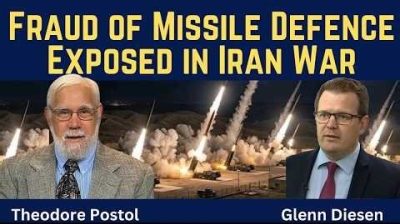
Ted Postol: Fraud of Missile Defence Exposed in Iran War
or go to
Aletho News Archives – Video-Images
Frlom the Archives
Containing the United States
By Edward S. Herman | Z Magazine | September 2016
“Containing the United States” is, of course, a ridiculous and self-contradictory idea in the U.S. and Western ideological and propaganda system. We all know that the United States had to “contain” the Soviet Union from 1945 to 1991, and since then has had the task of containing Russia and China. Only they threaten, bully, aggress and worry countries like Poland and Vietnam. Obama has had to reassure them both of our steadfast stand against Russian and Chinese military attacks. NATO has, of course, expanded greatly over the past several decades, despite the deaths of the Soviet Union and Warsaw Pact, but only to contain the renewed Russian — and Iranian, Libyan, Syrian and other — military threats; and we have “pivoted” to Asia, supported Japanese rearmament, bolstered our own forces in that area and jousted with the Chinese in their coastal waters solely to contain China. Earlier we had been obliged to contain North Vietnam, or was it the Soviet Union in Vietnam? Or China? Or “communism”? Or maybe all of them? Or none of them, but just needing an excuse to enlarge power?
The parallel propaganda has taken many forms. One is accepting as a premise that the United States only acts defensively and has no internal forces and interests that drive it to enlarge its sphere of control. I noted in an earlier article how Paul Krugman claims that internal Russian problems may well be the explanation of Russian “aggression,” but how at the same time it never occurs to him that the huge U.S. transnational corporate interests and “defense” establishment, and the pro-Israel lobby’s activities, might possibly make for an expansionist dynamic here.2 This reflects the standard establishment perspective that we are good and only react to evil. This was the view sustaining and justifying the invasion and occupation of Iraq from 2003. That attack was taken here as not evil but a response to evil, even if involving lies and mistakes, hence not describable as “aggression.” … continue
Blog Roll
 Aletho News
- Corporate Media Go All Out To Support The US-Israeli War on Iran
- Trump press conference reveals a man who wants out of war
- When Tel Aviv decides, Washington fights
- Top official: Iran ready for a long war with US, no more diplomacy
- How Iran’s Toxic Rain Reveals US-Israel Discord
- Trump Admits He Is Destroying Iran For Israel
- Iran’s latest move in the GCC countries was a stroke of genius
- Blackmail and death threats, Zelensky embarrasses the EU, but there’s no condemnation
- Israel threatens to kill Iran’s new leadership
- Possible Scenarios for the Middle East
- If Americans Knew
- Lebanon: Israel’s White Phosphorous Use Risks Civilian Harm
- Corporate Media Go All Out To Support The US-Israeli War On Iran
- US-Israel war on Iran is creating a steady growing number of amputees
- Israel planned this war on Iran for 40 years. Everything else is a smoke screen
- The wrong question about the war in Iran
- ‘Your Tax Dollars Being Used to Raise Your Gas Prices’: US-Israel Bomb Major Iranian Oil Depots
- ‘Bogus Evidence’: Former Nuclear Watchdog Head Debunks US Justification for Iran War
- EXPLAINER – Dimona: What to know about Israel’s nuclear site
- Fires and toxic air in Iran (thanks, Israel) – Not a ceasefire Day 150
- At Israel’s hands, Iran is burning, Lebanon and Gaza are crumbling – Not a ceasefire Day 149
- No Tricks Zone
- Wake-up Call: Survey Shows Majority Of Germans Now Favor Postponing Climate Targets!
- Televised! Leading German Political Candidate Tells Schoolchildren CO2 Makes Sun Hotter!
- New Study: A Century Warming Of 1.1°C Is ‘Commonplace’ And ‘Not Unusual’ During This Interglacial
- New Study: ‘Internal Noise’ And Volcanic Forcing Can Trigger 10-15°C Warming Within Decades
- Glaciers Worldwide Are Suddendly Surging, Experts Blame Warming!
- Surprising Discovery: Sahara Is Greening…Billions Of Trees Where Once Thought To Be Barren
- New Research Reaffirms Clouds, Aerosols, And Surface Solar Radiation Are ‘Driving The Climate System’
- Germany: Electric Car Catches Fire At Charging Station, Sets Off Local “Inferno”, Widespread Damage
- New Study: Canada’s New Brunswick Was 1°C Warmer Than Today During The Medieval Warm Period
- Coal Power Back In Trend As Globe Tries To Keep Pace With Growing Demand For Power
 Aletho News