Gaza refutes Israel’s claim of tunnel under European Hospital
MEMO | June 9, 2025
The Government Media Office in Gaza (GMO) yesterday denied Israeli claims that a tunnel was found beneath the European Hospital in southern Gaza.
In an official statement, the GMO said the Israeli occupation continues its systematic campaign to mislead the public and justify its crimes against health facilities by promoting blatant lies, the latest of which is its claim that Palestinian resistance fighters used a tunnel under the European Hospital in the southern Gaza Strip.
It stressed that the Israeli claim is “fabricated, flawed, and full of holes and does not stand up to even the slightest scrutiny and logic.”
According to the statement, the video published by the Israeli occupation army shows a narrow metal pipe that cannot fit a person, has no stairs or equipment and is located in an area used for rainwater drainage.
The GMO accused the Israeli army of digging the site and placing the pipe before filming a scene near the hospital’s emergency room, which was crowded with patients and visitors.
The GMO referred to previous Israeli allegations of the existence of tunnels under Al-Shifa Hospital and Hamad Hospital, which turned out to be old water wells.
The GMO concluded its statement saying Israel has previously announced its intention to destroy the health system in Gaza and admitted to using bunker-busting bombs totaling more than 40 tonnes to destroy the infrastructure of the European Hospital.
“So how could intact, unburned bodies be displayed at a site that the occupation claims to have bombed with such ferocity?” it added
IOF targets Gaza police during anti-theft operation, killing two officers
Palestinian Information Center – June 9, 2025
GAZA – The Ministry of Interior and National Security in Gaza condemned what it described as a war crime by the Israeli occupation forces (IOF), after an Israeli airstrike targeted a Palestinian police unit engaged in civilian protection duties in Nuseirat refugee camp. The strike killed two policemen and a bystander, and injured several others.
According to a statement released late Sunday, the police unit was responding to reports of theft and attempting to safeguard citizens’ property when it came under direct attack by Israeli warplanes. Among the martyrs were a police officer, a member of the force, and a civilian caught in the blast.
“This crime once again demonstrates the Israeli occupation’s strategy of spreading chaos and dismantling civil order as part of its ongoing genocide in Gaza,” the Interior Ministry said.
The statement emphasized that Gaza’s police forces are carrying out their “national and humanitarian duty” under relentless bombardment, and pledged that the repeated targeting of law enforcement officers “will not deter us from continuing to serve and protect our people.”
Ministry officials further accused Israel of actively encouraging lawlessness in Gaza by arming or sponsoring local criminal elements. “The occupation is betting on chaos, theft, and the obstruction of humanitarian aid—but this strategy will fail,” the statement read.
The ministry urged the international community and humanitarian organizations to intervene to halt IOF attacks on Gaza’s civilian institutions, especially police and emergency services.
It also called attention to Israel’s blockade on humanitarian aid, describing it as a deliberate “famine engineering policy” intended to starve civilians and cripple aid distribution networks, including those run by UN agencies.
Israel Detains Activists Bringing Aid to Gaza
By Kyle Anzalone and Will Porter | The Libertarian Institute | June 9, 2025
Hours after the Israeli defense minister threatened military action against a tiny aid ship carrying activists attempting to break the blockade on Gaza, the IDF intercepted the boat and detained all on board. The dangerous vessel was armed with rice and baby formula.
Late on Sunday night, the Freedom Flotilla Coalition (FFC) said the ship, named the ‘Madleen,’ was “under assault in international waters,” with quadcopter drones surrounding the vessel and “spraying it with a white irritant substance.”
The group later published a statement, saying the Madleen was “attacked/forcibly intercepted by the Israeli military at 3:02am [Central European Time] in international waters at 31.95236° N, 32.38880° E. The ship was unlawfully boarded, its unarmed civilian crew abducted, and its life-saving cargo – including baby formula, food and medical supplies – confiscated.”
Israel’s Foreign Ministry confirmed that the ship had been intercepted, but added that the activists were “safe and unharmed.” In a follow-up post, it said the vessel was on its way to Israel and that the passengers were “expected to return to their home countries.”
At the time of writing, the Madleen was sailing through international waters off the coast of Egypt, north of Sinai, according to tracking data provided by the FFC.

Earlier on Sunday, Tel Aviv’s Defense Minister Israel Katz issued a warning to the ship, suggesting the IDF would use force to prevent it from bringing aid to Gazans:
“I have instructed the IDF to act to prevent the ‘Madleen’ hate flotilla from reaching the shores of Gaza – and to take whatever measures are necessary to that end.
To the anti-Semitic Greta [Thunberg] and her fellow Hamas propaganda spokespeople, I say clearly: You should turn back – because you will not reach Gaza.
Israel will act against any attempt to break the blockade or assist terrorist organizations – at sea, in the air, and on land.”
Katz’s statement contained one important admission: Israel does, in fact, maintain a blockade on aid entering Gaza.
For over a year, the propaganda emanating from Tel Aviv has claimed that Hamas was simply stealing international aid and preventing it from reaching starving Palestinians. And yet, Israel’s Minister of Genocide just acknowleged a full-blown blockade on humanitarian assistance.
As the Madleen approached Gaza over the weekend, the activists faced increasing harassment from Israel, including GPS jamming, as well as close calls with military speed boats and drones.
Israel has used violence to prevent activist aid ships from reaching Gaza on more than one occasion in the past – most recently last month, when a small FFC vessel headed for the enclave was struck by a drone in international waters.
In 2010, Israeli troops killed 10 activists after raiding another boat attempting to bring supplies to Gaza, with the UN concluding some were shot “in a manner consistent with an extra-legal, arbitrary and summary execution.”
The presence of Greta Thunberg, a climate activist widely known across the West, is likely the only thing that prevented a similarly bloody fate for the Madleen.
Fortunately, US Senator Lindsey Graham did not have his way. The lawmaker joked in a post last week: “Hope Greta and her friends can swim!” – riffing on the hilarious and relatable premise of murdering unarmed civilians to stop them from feeding people desperately in need of aid.
This article originally appeared in the June 9 edition of the Libertarian Institute Debrief, our daily email newsletter.
Delegates from 32 nations march to Gaza, call for end to blockade and genocide

MEMO | June 9, 2025
An international solidarity march set off towards the Gaza Strip yesterday, aiming to break the ongoing blockade and demand an end to what participants describe as the genocide being committed by Israel since 7 October 2023.
Thousands of supporters from 32 countries are taking part in the march, with plans to reach Gaza’s border through the Rafah crossing with Egypt. Their goals include delivering humanitarian aid and expressing support for the Palestinian people.
Organisers said the participating convoys are expected to gather in Cairo on Thursday, before heading to the city of Arish in north-eastern Egypt. From there, participants will continue on foot towards the Rafah border crossing, where protest tents are planned to be set up.
The main organisers, the “Global March to Gaza”, said it has representatives in most European, North and South American countries, as well as in several Arab and Asian nations. This, it said, reflects growing international momentum in support of the Palestinian cause.
Leading the march is Algeria’s “Caravan of Steadfastness,” which departed from the capital Algiers yesterday towards Tunisia. From there, it will join the Tunisian convoy and continue through Libya to Egypt, with the aim of eventually reaching Gaza.
“The Caravan of Steadfastness set off on Sunday towards Tunisia. It will join the Tunisian convoy, travel through Libya to Egypt, and from there to Gaza via Rafah,” said Sheikh Yahya Sari, head of the Algerian Initiative to Support Palestine and Aid Gaza, in a statement.
Indonesia Shouldn’t Trade Palestine for OECD Membership
By Dr. Muhammad Zulfikar Rakhmat | MEMO | June 9, 2025
Indonesian President Prabowo Subianto recently signaled that the country may consider recognizing Israel—if Israel, in turn, recognizes Palestinian statehood. The remarks, made during talks with French President Emmanuel Macron, surprised many. Yet they closely reflect Indonesia’s broader strategic ambition: to join the Organisation for Economic Co-operation and Development (OECD).
For years, Israel—a member of the OECD—has reportedly blocked Indonesia’s accession, citing the absence of diplomatic ties. Now, with Jakarta eager to elevate its global standing and strengthen economic relationships with the West, a question looms: Should Indonesia trade its decades-long commitment to Palestinian rights for the prestige and potential benefits of OECD membership?
Indonesia has long been a consistent and principled advocate for Palestinian self-determination. That position is not mere posturing—it is grounded in the country’s anti-colonial identity and moral commitments. Since its founding, Indonesia has refused to normalise relations with Israel, viewing its occupation of Palestinian land and repeated military campaigns in Gaza and the West Bank as incompatible with international justice.
To reverse that position now—particularly while Israel continues a devastating campaign in Gaza—would signal a betrayal of these long-held values. It would also risk undermining Indonesia’s standing in the Muslim world and among nations in the Global South that have long looked to Jakarta as a moral voice in global affairs.
Critics of Indonesia’s policy argue that normalisation with Israel is the cost of entry to the OECD. But that is a false choice. Several OECD members, including Turkey and Mexico, maintain complicated or strained relationships with Israel while retaining full membership. There is no reason Indonesia cannot pursue the same path: engaging with the OECD while holding firm to its commitment to Palestinian rights.
Indeed, accession to the OECD could be a powerful platform for Indonesia—not to silence its principles, but to project them. From within the organisation, Indonesia could push for greater scrutiny of member states’ positions on occupation and apartheid, challenge prevailing double standards, and advocate for justice in global governance. It could use its voice to call out the complicity of powerful countries and demand accountability for ongoing violations of international law.
The OECD should not be treated as a reward for political alignment, but as a forum for constructive engagement. If Indonesia joins on the condition that it compromises its moral foundation, its membership will be hollow.
The broader problem is the international community’s continued commitment to a two-state solution—a model that has long failed Palestinians. The facts on the ground, including the unchecked expansion of Israeli settlements and the fragmentation of Palestinian land, make the vision of two viable, sovereign states increasingly implausible.
Indonesia, with its legacy of anti-colonial resistance and principled diplomacy, has the credibility to challenge the outdated two-state framework. It should advocate for a rights-based approach that guarantees equality, dignity, and justice for Palestinians. Whether through a single democratic state or another inclusive model; any viable solution must start with the recognition that the current status quo is untenable.
Prabowo’s statement raises a deeper concern: the risk of transactional diplomacy displacing principled foreign policy. The Indonesian people, by and large, remain steadfast in their support for Palestine. Any move toward normalisation with Israel would likely provoke a public backlash and raise questions about democratic accountability at home.
International legitimacy cannot be bought through silence or moral compromise. It must be earned by standing firm in the face of injustice. Indonesia’s foreign policy has historically exemplified this principle, from its leadership in the Non-Aligned Movement to its outspoken defence of oppressed peoples. That legacy must not be discarded for short-term political or economic advantage.
Indonesia’s true influence in the world has never stemmed from wealth or military might. It has come from moral clarity and bold leadership. If the country seeks a place among the world’s most developed economies, it should do so on its own terms—without abandoning the values that have long defined its role on the global stage.
The world does not need another silent bystander. It needs countries willing to speak hard truths. That is the Indonesia the world respects—and the one its people deserve.
UNIFIL denies talks on ending its mission in south Lebanon: Exclusive
Al Mayadeen | June 9, 2025
Any discussion about the future of UNIFIL falls solely under the authority of the UN Security Council, the spokesperson for UNIFIL clarified to Al Mayadeen, noting that the force remains committed to coordinating with the Lebanese Army and insists on the full withdrawal of Israeli troops from southern Lebanon.
UNIFIL spokesperson Andrea Tenenti told Al Mayadeen, “There are currently no talks about UNIFIL’s future,” adding that “any such discussion would take place within the UN Security Council.”
Meanwhile, a US State Department spokesperson told Al Mayadeen in a short briefing that the recent reports claiming the United States intends to end the UNIFIL peacekeeping mission in southern Lebanon are inaccurate.
Tenenti stated that UNIFIL continues its operations in southern Lebanon in full cooperation with the Lebanese Armed Forces. He emphasized that Israeli forces should withdraw from their occupied positions in the area, noting that the UN Security Council alone holds the authority to assess whether UNIFIL’s ongoing presence remains necessary and effective.
“Restoring stability to southern Lebanon depends on Israel’s withdrawal from recently occupied positions,” he added.
Lebanese Army is adhering to resolution 1701
Tenenti also affirmed that the Lebanese Army remains committed to implementing UN Resolution 1701, deploying to required areas in close coordination with UNIFIL forces.
When asked about French troops, he responded: “I don’t distinguish between the role of French forces and UNIFIL, all are fulfilling their duties under Resolution 1701.”
The statement follows reports in Israeli media claiming the US and “Israel” agreed to terminate UNIFIL’s operations in southern Lebanon.
The Israeli newspaper Israel Hayom cited sources claiming that “the United States and Israel have agreed to end UNIFIL’s operations in southern Lebanon.” According to the report, the US administration is “not interested in renewing UNIFIL’s mandate,” and “Israel, frankly, isn’t pushing hard to convince them otherwise.”
US, Israel agree to end UNIFIL mandate in south Lebanon: Report
The Cradle | June 9, 2025
The US and Israel have agreed that the United Nations Interim Force in Lebanon (UNIFIL) must cease its operations in the country’s south, according to Hebrew media outlets.
Washington has decided not to renew UNIFIL’s mandate, and Israel “did not try to convince them otherwise,” the report said.
A vote on the UNIFIL mandate is expected to take place at the UN Security Council within the next few months, likely in August.
Another report in Israel Hayom said the US is considering pulling support for UNIFIL. Sources told Times of Israel that the “option is on the table.”
“The US has not yet made up its mind regarding its future support for UNIFIL, but it wants to see major reforms, which could mean pulling support,” the sources added.
No officials from the US, Israel, or the UN have publicly commented on the matter yet.
UNIFIL, which was established in 1978 and expanded after Israel’s war on Lebanon in 2006, currently includes more than 13,000 uniformed personnel tasked with monitoring hostilities along the Blue Line and ensuring humanitarian access.
Israeli Prime Minister Benjamin Netanyahu has been pushing for UNIFIL’s removal from Lebanon since as far back as October 2024.
Analysts have said that the move is intended to eliminate international observers who could monitor or document Israeli military activity in southern Lebanon. During the latest war, UNIFIL forces came under Israeli fire several times.
“The exclusion of outside observers, whether it is journalists or UN peacekeepers, seems a deliberate strategy to limit the scrutiny of Israeli forces at a time when they are most needed,” Shane Darcy, professor at the Irish Centre for Human Rights, said last year during Israel’s ground operation in Lebanon.
Other reports and analyses have said that Washington is looking to pressure Beirut into accepting a new mandate for UNIFIL, including changes that would see the interim force actively work against Hezbollah’s presence in the south and destroy infrastructure without needing to coordinate with the Lebanese army.
Such changes to the UNIFIL mandate are advocated for by Israeli reservist and former head of the Israeli army’s Strategic Planning Division, Assaf Orion, in a 29 May piece for the Washington Institute. “The time has come for UNIFIL to either adapt or disband,” Orion says.
The Israeli media reports about UNIFIL’s future in Lebanon come days after Tel Aviv launched its largest attacks on the Lebanese capital since the start of the ceasefire.
Since the truce was reached in November 2024, Israel has violated the deal over 3,000 times with constant attacks. Israeli forces also maintain an occupation of five locations inside Lebanon, which they established themselves in after the ceasefire, in violation of the agreement.
Hezbollah and the Lebanese state have abided by the agreement. The resistance has handed over weapons and military positions to the Lebanese army south of the Litani River.
Yet it rejects US and Israeli pressure for full disarmament.
On 6 June, Israel’s Defense Minister, Israel Katz, threatened Lebanon with an escalation of attacks if Hezbollah is not disarmed.
“There will be no calm in Beirut, and no order or stability in Lebanon, without security for Israel,” he said.
Iran Says Europe Funded Israel’s Bomb Program
Sputnik – 09.06.2025
TEHRAN – Several European countries participated in Israel’s military nuclear program, Iranian Foreign Ministry spokesman Esmail Baghaei said on Monday, citing documents obtained by Iranian intelligence in Israel.
“What was previously clear to us will now become clearer to others with the publication of these documents — they will openly confirm the active involvement of several European countries in Israel’s nuclear military program. These are the same countries that constantly speak about nuclear non-proliferation and cast doubt on Iran’s peaceful nuclear program, while they themselves play a role in Israel’s military nuclear program,” Baghaei said during a press conference.
On Saturday, Iranian state news agency Tasnim reported that the country’s intelligence services obtained in Israel a wide range of confidential military-strategic documents related to Israel’s nuclear sector. Iranian authorities will publish a series of these documents in the near future.
US silent on Russia’s missile moratorium proposal – Lavrov
RT | June 9, 2025
The US has so far ignored Moscow’s call to impose limits on its deployment of intermediate-range missiles, Russian Foreign Minister Sergey Lavrov has said.
Speaking at the Future Forum 2050 on Monday, Lavrov stated that Washington had not responded to an offer Putin had made to establish reciprocal moratoriums after the collapse of the Cold War-era Intermediate-Range Nuclear Forces (INF) Treaty.
“It’s already clear they will not react to our call, in the absence of the treaty, to establish two parallel, non-interlinked moratoriums,” he said.
The INF Treaty, signed in 1987 by the US and the Soviet Union, banned land-based ballistic and cruise missiles with ranges between 500 and 5,500 kilometers. Washington withdrew from the deal in 2019, citing alleged violations by Moscow.
Russia has denied the claims, accusing the US of developing the banned missiles, but pledged not to deploy such systems unless the US did so first.
Last year, the US announced that it would field the multipurpose Standard Missile-6 (SM-6), the Tomahawk land-attack cruise missile, and a hypersonic weapon that is still in development in “episodic deployments” in Germany starting in 2026. The two systems would have been banned by the INF Treaty, assuming they were deployed on land.
Meanwhile, Kremlin spokesman Dmitry Peskov signaled that Russia would not be constrained by any limitations if it ends its self-imposed moratorium. “One way or another, Russia will have to respond to NATO’s expansionist and aggressive actions,” he explained.
Deputy Foreign Minister Sergey Ryabkov also noted that Moscow would soon be forced to walk back its current policy. “Russia’s restraint in the post-INF period was not appreciated by the US and its allies and was not met with reciprocity,” he said. “We have openly and directly stated that the unilateral moratorium is approaching its logical end.”
He also rebuked the US for an apparent reluctance to alter its course. “We do not see any fundamental change, let alone reversal, in US plans to forward-deploy ground-based intermediate and shorter-range missiles in various regions,” he said. “On the contrary, practical steps taken by the US military have convinced us that such activity will only intensify.”
Security of Small States Bordering Great Powers
Georgia’s Pragmatism vs. Norway’s Self-Harm
By Glenn Diesen | June 9, 2025
How do small countries bordering great powers ensure security and prosperity? States rarely constrain themselves, and the smaller states near great powers such as the US and Russia have historically had their sovereignty violated. If the smaller state invites a rival great power onto its territory for security, it can trigger an intense security competition. This is evident from the Cuban Missile Crisis and the war in Ukraine. What is the solution for smaller countries such as Georgia?
Norway and Georgia share this security dilemma as both are small states bordering Russia. The security dilemma suggests that states can either refrain from arming themselves and become vulnerable to foreign aggression, or they can arm themselves but then provoke a response from the opponent. States can similarly join military alliances for security, although they can be seen as a frontline in a great power rivalry.
During the Cold War, Norway aimed to mitigate the security dilemma by balancing deterrence with reassurance. It was a member of NATO but did not accept foreign troops stationed on its soil and limited military activity near the Russian border in the high north. Sweden and Finland were neutral and thus also enjoyed decades of peace, stability, and prosperity.
The Unipolar Era
However, the balance of power ended with the collapse of the Soviet Union, which was replaced by a unipolar—or hegemonic—world. This was problematic, as states do not constrain themselves, and a new security system was established based on dominance. The balance between deterrence and reassurance subsequently disappeared, as there was no longer a perceived need to accept constraints to reassure a weakened Russia. Norway agreed to host US military bases and accommodate more NATO activity in the Arctic, while more recently, Sweden and Finland joined NATO. The hegemonic security architecture was accompanied by a liberal ideology suggesting that NATO was a liberal democratic “force for good.” The security dilemma itself is dismissed as the ideology demands that NATO is referred to as a “defensive alliance”, even as it attacks other countries. Any calls for considering Russian security concerns threaten the ideology of a benign hegemon.
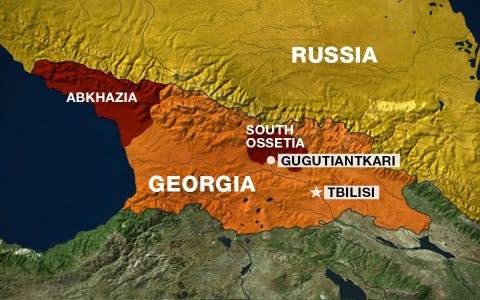
Georgia adjusted to the unipolar world by recognising that there was only one game in town. As NATO expanded, it became the only security institution in Europe, and the option was either to be on the inside or the outside. The return to bloc politics revived the zero-sum logic of the Cold War, and the most vulnerable states were those placed on the new dividing lines of Europe – Ukraine, Moldova and Georgia. Russia became increasingly insecure and defensive. When a great power begins to fear for its security and existence, its neighbours will likely suffer. Georgia’s pursuit of NATO partnership was a contributing factor in the war in the summer of 2008, which resulted in the loss of 20% of its territory.
Countries such as Georgia and Norway have the same freedoms as Mexico—they can form political and economic partnerships as they wish, but cannot host the soldiers and weapon systems of a rival great power such as the US.
The Multipolar Era
The seemingly menacing presence of Russia to the north and NATO’s efforts to use Georgia as a proxy against Russia create a difficult security dilemma. Avoiding excessive dependence on a more powerful foreign actor is important to enhance political sovereignty. Multipolarity incentivises small states in Europe to diversify foreign partnerships to mitigate the security dilemma. Georgia can avoid becoming a vassal of either Russia or the West in a divided Europe by diversifying its economic partnerships and also linking itself with other centres of power, such as China.
Realist theory recognises that states must respond to the international distribution of power to increase their sovereignty and security. In the current era, small states must adjust from unipolarity to multipolar. The US has fewer resources relative to other powers, and its priorities will shift from Europe to Asia. This requires small states to restore the balance between deterrence and reassurance.
The Norwegians are not adjusting to the new international distribution of power. Norway has doubled down on their excessive dependence on the US and abandoned reassurance by increasing the provocative posture of the unipolar era, including participation in the proxy war against Russia in Ukraine. As Norway-Russia relations deteriorate and the US shifts its focus elsewhere, Norway may find itself on a path to conflict and destruction unless it changes course.
Georgia, by contrast, has chosen a pragmatic path that recognises the international distribution of power. Georgia is diversifying its economic partnerships to avoid excessive dependence, and has withstood pressure to be used as a second front against Russia. As a connecting point between East and West, and between North and South, the emergence of multipolarity presents Georgia with both challenges and opportunities to its security and prosperity. To make the right choices, rational and realist analysis must prevail over ideology.
The Silence of the Bears
By Alastair Crooke | Strategic Culture Foundation | June 9, 2025
Russia’s leadership is in ‘conclave’ determining its riposte.
Trump has been silent for two days. Unprecedented. In the last days, Ukraine and its facilitators attempted a massive attack on Russia’s strategic nuclear bomber-force; succeeded in collapsing two bridges onto civilian trains heading to Moscow; attacking the Kerch Bridge; and assassinating a Russian general via explosive body bomb.
As Clausewitz noted two centuries ago, the point of military force is to compel an outcome: i.e. that an adversary finally does what is wanted of him. Thus, in respect to military adventures there is need for clarity of thought from the outset. It must have a realisable political objective that has a prospect to be implemented.
What then, was the objective behind these Ukrainian ‘irregular’ attacks? One certainly was demonstrative – PR exercises to say that Ukraine and allied services are still capable of mounting special forces style, innovative operations. And are therefore worthy of continued support. As Colonel Doug Macgregor cautions:
“For the most part it was a PR stunt to try and convey the impression that Ukraine is capable of carrying on the war. Anything you hear from the Western outlets … are probably untrue or at least grossly exaggerated … We damaged ourselves and our relationship – what there is left of it – with Moscow … that’s the real fallout from this”.
Okay. But PR stunts are no strategy, nor do the attacks hold any prospect for a shift in the overall strategic military paradigm. It doesn’t say that the West or Ukraine has suddenly discovered a political strategy towards Russia per se. That doesn’t exist. For the most part, the innumerable western declarations come as a hodge-podge of fantasies.
The second objective however, may indeed have had a clear strategic end-state – and has demonstrated feasibility and the possibility to compel a desired outcome: The various attacks have imposed on Trump the uncomfortable reality that he, as President, does not control U.S. foreign policy. The collective Deep State has just made that plain.
As General Mike Flynn has warned:
“The Deep State is now acting outside of the control of the elected leadership of our nation … These persons in our Deep State are engaged in a deliberate effort to provoke Russia into a major confrontation with the West, including the United States”.
In effect, the likes of Generals Keith Kellogg and Jack Keane, with their adolescent narratives that only through pressure, more pressure and pain will compel Putin (always presumed to be weak) to accept a frozen conflict in the hope that it can obvert from an American defeat in Ukraine.
The British during WW2 similarly believed that the Nazi regime was not strong, and could be overthrown by strategic bombing, intended to bring about the collapse of German society. Today, General Kellogg advocates ‘bombing’ Russia with sanctions – mirroring the British conviction that such tactics ‘must be bad for morale’.
Trump’s advice from his Generals either did not meet the criterion of political realism – because it was based on fantasies of incipient Russian collapse and a hopeless misreading of Russia and its Army. Or perhaps his Advisers, either inadvertently or deliberately, ‘shafted’ Trump and his agenda of normalising relations with Russia.
What will Trump say now to Putin? That he was indeed forewarned (recall his writing just days ago that “bad things – if it were not for me – I mean REALLY BAD things would already have happened to Russia” ) and claim that his advisers did not give him the full details; or will he candidly admit that they deceived him? Alternatively, will he take the line that the CIA was merely operating to an old Presidential ‘Finding’ that authorised attacks into the depth of the Russian hinterland?
All such putative answers would spell one thing – that Trump is not in control. That he and his European allies (such as Britain) cannot be trusted.
Either way, Trump’s advisers will have understood that Zelensky and by extension his NATO enablers, were exploiting the SALT/START Treaties’ vulnerability – in order to use concealed drones, hidden in civilian containers, to attack the very bombers covered by USA-Russia treaties: Article XII of the START treaty specifically requires “a display in the open of all heavy bombers within the airbase”. This provision was a confidence building act (visible monitoring) to guard against a surprise ‘first strike’ nuclear attack.
START 1 cut long-range or strategic nuclear arsenals by 30-40 percent. New START slashed accountable deployed strategic arms by another three-quarters. In 2021, Presidents Biden and Putin extended New START until February 2026.
Of course, these unidentified enablers understood the gravity of striking the strategic nuclear force of a major rival nuclear weapons power.
How would the U.S. respond if an adversary (perhaps a non-state actor) launched a strike against strategic long-range nuclear capable bombers in the USA using cheap and easily available drones hidden in containers? We are in a new era of risk – one in which pagers and cell phones can be weaponised as bombs – and of ‘sleeper’ drones that can be remotely activated to attack airfields, either civilian or military.
Larry Johnson has observed that after the Japanese attack on Pearl Harbour in December 1941, intended to destroy the U.S. aircraft carriers berthed there, the Japanese Admiral Yamamoto reportedly said the following in the aftermath of Japan’s great victory at Pearl Harbour: “I fear all we have done is to awaken a sleeping giant and fill him with a terrible resolve … We have won a great tactical victory at Pearl Harbour and thereby lost the war”.
The silence of the bears will soon be ended and we will know more about Russian resolve; but a relationship in which Trump is understood to ‘mean what he says, and does what he says’ likely is over. The Russians are furious.
What happens next is unknown.
APPROVE NOW, STUDY LATER: IS THIS SAFE?
The HighWire with Del Bigtree | June 5, 2025
As alarming new data reveals a spike in sudden heart attacks and strokes, the FDA has greenlit Moderna’s latest mRNA COVID shot—no placebo trials, no independent long-term safety data, and post-market studies delayed until 2029 and 2034. Once again, speed trumps caution. Is safety giving way to speed again, or are post-marketing placebo trials a step in the right direction?
Featured Video
America Racing to Strategic Defeat in Iran
or go to
Aletho News Archives – Video-Images
From the Archives
An Expert Military Analysis of War with China
Actually, None is Necessary
By Fred Reed • Unz Review • December 13, 2020
The Correlation of Armed Forces: U.S. goods and services trade with China totaled an estimated $634.8 billion in 2019. Exports were $163.0 billion; imports were $471.8 billion. The U.S. goods and services trade deficit with China was $308.8 billion in 2019. Trade in services with China (exports and imports) totaled an estimated $76.7 billion in 2019. Services exports were $56.5 billion; services imports were $20.1 billion. The U.S. services trade surplus with China was $36.4 billion in 2019.
There is talk within the Washingtoniat of a possible war with China. Steve Bannon, who apparently was dropped on his head as a child, actually favors such a war. We hear the usual shoo-the-boobs alarm about how the Chinese are doing something terrible and we must gird our loins and American values and show them what for, bow wow, woof. The danger is that the current game of who-blinks-first in Asian waters might actually provoke a shooting war. You know the kind of thing: One warship refuses to get out of the way of another, a collision ensues, some retard lieutenant who signed up on waivers opens fire, and we’re off and running. It is not a good idea to let children play with matches.
The said war is discussed either in emotional terms by idiots or in purely naval terms by those familiar with such things, so we hear of the First Island Chain and the Second Island Chain and whose missiles against the other’s missiles and so on. This would be appropriate if we were fighting World War Two again. Which we aren’t. Let’s take a quick-and-dirty look at how such a war might go.
To begin the war, America would overestimate itself and underestimate China. This is doctrine in the Pentagon. … continue
Blog Roll
 Aletho News
- Suicide Should Not Be a Government Service
- Rethinking America’s greatest threat: Iran vs. Israel-Firsters
- Iran accuses adversaries of false flags to strain Turkey ties
- Poland rules out sending Patriot missiles to US/Israel amid war on Iran
- Tehran approves new Hormuz plan with major restrictions
- No Threat Can Force Iran’s Surrender /Trita Parsi & Lt Cl Daniel Davis
- UK’s New Pandemic Plan Would Turn Big Tech Into a Mass Location Tracking Network
- Growing insecurity, soaring prices fuel protests in north as regime bans evacuation: Sources
- Iran denies responsibility for ‘depraved’ attack on Kuwait desalination plant
- Bring The Troops Back. End This War Now!
- If Americans Knew
- Carrying life under fire: Israeli invasion of Lebanon leaves pregnant women facing deadly risks
- Champagne all around for the new death penalty (for Palestinians) law – Not a ceasefire Day 172
- Why are Palestinian books struggling to be seen on Amazon?
- The Line Between Affinity and Conspiracy
- As Iran targets US military bases, will they be relocated to Israel? Not a ceasefire Day 171
- Will Trump Go Kamikaze?
- Is the University of Florida Shutting Down College Republicans over Israel Criticism?
- Jewish extremist arrested over alleged plot to firebomb Palestinian activist Nerdeen Kiswani’s home
- More than half of Palestinian child detainees have no charges
- The More Murderous Israel Gets, The More We Hear About “Antisemitism”
- No Tricks Zone
- New Study Finds Warming Saves Lives…Cold Temperatures 12 Times More Deadly Than Excess Heat
- German Science Blog Accuses PIK Climate Institute Of Hallucinating Climate Tipping Points
- Devastating Assessment Of Comirnaty Vaccine By Former Senior Pfizer Europe Toxicologist
- New Study: CO2 Is ‘Effectively Negligible’ As An Explanatory Climate Change Factor Since 2000
- Former Pfizer Toxicologist Dr. Helmut Sterz Tells Bundestag Hearing Pfizer Vaccine Should Have Never Been Approved
- Energy Expert: Germany’s Nuclear Phaseout Was A “500 Billion Euro Mistake”
- New Research: South Australia’s Mid-Holocene Sea Surface Temperatures Were 4°C Warmer Than Today
- Storing Green Energy To Last Germany 10 Days Would Require A 60-Million Tonne Battery
- New Studies: UK Sea Levels Were 4 Meters Higher Than Today During The Mid-Holocene
- Destructive Green New Deal: German Energy And Metal Group Warns Of Drastic Crisis
 Aletho News