“Why Can’t We Talk About This?”
Rainey Media TV | June 4, 2025
Please Support Our Film via: E-Transfer: dean_rainey@yahoo.ca
PAYPAL: deanrainey@raineymedia.com
Buy My A Coffee: https://buymeacoffee.com/raineymedia
SNAIL MAIL: Rainey Media, PO Box 5, Delhi PO Main, ON, N4B 2W8 Canada
To book your own screening: deanrainey@raineymedia.com
“Why Can’t We Talk About This?” delves into the life of a man grappling with the aftermath of a COVID-19 vaccine injury, weaving his personal struggle into a broader examination of why such experiences are rarely discussed.
To help Michael via support: https://www.gofundme.com/f/benefit-fo…
We’ve made this film easily accessible for everyone because the information it contains and the discussion it starts is just too important. This film had no funding and was made without sponsorship. All costs were paid out of my own pocket. My team and I spent over a year and a half making this film. Any support you give will go towards expenses incurred making and marketing the movie. (Even sending the price of a movie ticket would help.) Once we cover those costs, we will be providing Michael with a share of the proceeds.
To order DVDs of this film, visit: https://raineymedia.com/video-store/
Also available on Rumble.
Ofcom seeks powers to preemptively block viral content, censor potentially illegal speech, and mandate broad Digital ID
By Cam Wakefield | Reclaim The Net | July 1, 2025
The UK’s increasingly controversial Office of Communications, Ofcom, is charting a path that could reshape the internet as we know it, and not for the better.
Under the banner of the Online Safety Act, the regulator is proposing a sweeping expansion of its authority that, if enacted, would hand it unprecedented influence over what we see, share and say online.
Part of Ofcom’s plan is the goal of preventing illegal content from gaining traction.
Platforms would be required to block material that even appears to be unlawful from being recommended by algorithms until it’s reviewed by a human moderator.
The idea, on paper, is to stop harmful content from “going viral.”
In practice, it risks creating a system where lawful speech is caught in digital limbo, held back by automated systems that err on the side of caution.
Ofcom frames these proposals as a necessary response to modern online threats.
It talks about “highly effective age assurance,” a term that sounds innocuous enough but points toward invasive digital ID checks.
The aim is to ensure that children aren’t exposed to harmful material, but the solution would come at the cost of privacy and anonymity for everyone, two pillars of an open internet.
This new regime would compel tech firms to act as frontline enforcers of ill-defined standards of legality, long before a court has had a chance to weigh in.
In times of crisis; riots, terror attacks, or other major incidents; platforms would be under pressure to throttle spikes in content rapidly.
That effectively puts Ofcom in the position of deciding, in real-time, what the public is allowed to see.
One of the more troubling proposals targets livestreaming; a tool that has become vital for journalists, activists, and artists.
All of it would be wrapped in tighter age verification systems that threaten to chill participation and expression.
The regulator also wants to see wider deployment of technologies like perceptual hash matching and automated tools; not just for known illegal content, but for material that might be illegal or harmful.
That includes everything from suicide-related posts to fraudulent schemes. While the intent is understandable, the risk of overreach is significant.
Without proper safeguards, lawful speech could be swept into censorship systems, and surveillance could become embedded in the core of our digital infrastructure.
Oliver Griffiths, who leads Ofcom’s Online Safety Group, summed up the regulator’s stance: “We’re holding platforms to account and launching swift enforcement action where we have concerns.”
It’s a statement that highlights how determined Ofcom is to push these changes through, no matter the consequences.
The public has until 20 October 2025 to respond to Ofcom’s consultation.
Given the political climate, the proposals seem likely to pass with little resistance.
But if they do, the UK’s online environment may come to be defined not by the free exchange of ideas, but by cautious, preemptive censorship and intrusive oversight; all in the name of safety.
The Best-Selling Apps Made By Israeli Spies
A new frontier for the BDS movement
Nate Bear – ¡Do Not Panic! – July 2, 2025
The developers behind hundreds of Android and iPhone apps with billions of downloads are former Israeli spies whose apps are generating significant revenues for Israel’s genocidal war economy.
The apps I’ve identified range from innocuous image and video editing apps to casual games, and most users won’t be aware they’re installing Israeli products on their phones. Many of these app developers operate under the radar, their ownership structures are opaque and the identity of their owners isn’t commonly known.
The identification of these apps should add another frontier to the boycott, divest, sanctions movement, as it provides a straightforward way for ordinary people to avoid Israeli products that contribute to apartheid, genocide and ethnic cleansing.
The proliferation of these apps on Apple’s App Store and the Google Play Store also raises questions over privacy and the harvesting of personal data, given the reputation of Israeli technology and past scandals involving spyware being smuggled onto devices by apps made in Israel.
One of the most significant Israeli app holding companies and developers is ZipoApps, whose model is to buy-out and monetise apps at a large scale. The apps owned by Zipo (which also goes by the name Rounds.com) include a suite of photo and video editing apps that have received hundreds of millions of total installs. Individual apps include Collage Maker Photo Editor and Instasquare Photo Editor: Neon, both of which have received more than 50 million downloads from the Google Play Store. Other ZipoApps products include baby photo editing and retouching tools. In 2022, the founder and CEO of Zipo, Gal Avidor, told an interviewer (in his only interview to date), that all the founders of the company are former Unit 8200 Israeli intelligence personnel. On Reddit, users have complained about ZipoApps approach to privacy and data mining. One popular group of tools known as Simple Gallery went from free and open source to a paid product with ads and trackers just one week after ZipoApps acquired it.
Another Israeli-owned photo editing app on the Play Store is the AI-powered Bazaart, which was founded by Dror Yaffe and Stas Goferman, two former IDF intelligence officers. Goferman far exceeded his mandatory service, spending a decade in the IDF up to 2011.
Facetune, made by the developer Lightricks and available for Android and iPhones, is another Israeli photo editing app with over 50 million installs. Users on the Apple Store have called Facetune, which demands access to unique identifiers and your location, a scam. The co-founder of Lightricks, Yaron Inger, spent five years in Unit 8200.
If you’re into mobile gaming, or if you create mobile games to sell, you will have come across Israeli company Supersonic from Unity, probably without knowing it. With billions of downloads in recent years, Supersonic is one of the largest mobile game publishers in the world with revenues estimated at around $23 million per year. Earlier this year the company reported that they owned three of the top ten most downloaded casual player mobile games in the world: Build a Queen, Going Balls, and Bridge Race. Trash Tycoon is another popular title. The company also has a game called ‘Conquer Countries’ which has been downloaded millions of times and on its advertising tile features a cartoon version of Donald Trump. The founder of Supersonic, Nadav Ashkenazy, spent seven and a half years in the IDF where he rose to become the head of operations for the Israeli air force, managing almost half the full-time staff. You can see all Supersonic’s games here.
A better-known Israeli mobile game app maker whose revenues we don’t have to estimate is Playtika. Listed on the NASDAQ, Playtika brings in revenues of more than $2.5 billion, generating significant taxes for Israel’s mass slaughter machine. Playtika, which builds gambling apps, is firmly enmeshed in the genocidal Israeli war machine. The company was founded by Uri Shahak, son of the former head of the IDF, Amnon Lipkin-Shahak, and last year its annual report revealed that 14% of its staff had been called up as reservists to participate in the genocide in Gaza. Current CEO Robert Antokol says the company has a “responsibility” to Israel and the taxes paid by its staff are “wonderful for the Israeli economy.”
Another Israeli company whose apps have been downloaded billions of times is Crazy Labs. With an estimated company value of around $1 billion and sales estimated at up to $200 million, Crazy Labs is another app maker integral to the Israeli economy. Its best-selling titles are Phone Case DIY, Miraculous Ladybug & Cat Noir, and Sculpt People. You can see the full list of the Crazy Lab apps on the Google Play Store. The founders of Crazy Labs are all ex-IDF, including Sagi Schliesser, who well exceeded his mandatory service by staying in the IDF and helping build the digital architecture of apartheid for eight years.
An app you may have heard of, but not have known is Israeli, is Moovit. The urban transport app was founded by a number of ex-IDF including Nir Erez who spent years at the IDF’s specialist computing centre known as Mamram, which Israeli propaganda says creates ‘cyber warriors.’ As the unit which runs the military’s intranet, Mamram is central to Israel’s genocide of Gaza. Moovit, which has close to one billion users and delivers significant revenues to Israel, has been an official partner of the Olympic Games, the European football championships and also partners with Microsoft.
With hundreds of millions of installs, Call App, which screens phone calls for spam, is another product of Israel’s military economy. The founder and CEO of Call App, Amit On, spent three years in Unit 8200 in the 2000s. The app has over 100 million users.
On the ride-hailing front, Gett, which is focused on corporate passengers and is particularly popular in London as a way to hail black cabs, was founded by ex-Unit 8200 Roi More and Shahar Waiser. A notable mention for GPS navigation app Waze, probably the most famous Israeli app of the last decade, acquired by Google in 2013 for $1.3 billion and also founded by ex-Unit 8200 spies.
Another fast-growing Israeli app which has been featured on Oprah, in the New York Times and on CNN is Fooducate, whose founder, Hemi Weingarten, flew bombing missions for the Israeli air force.
This expose, which follows my investigations into former IDF and Unit 8200 working in AI for the big tech giants, and those working at Meta and Google, further confirms how deeply and insidiously embedded Israel is in our digital lives.
These investigations also reveal how Israel is foundationally reliant on being in a permanent state of dominance over the Palestinians, because the only thing of value the country produces are tech companies founded by ex-IDF. Without being able to train their citizens as spies and soldiers, and butcher Palestinians at will, Israel’s economy would collapse.
Yet most people who use these apps will have downloaded them in good faith with little idea they are contributing to Israel’s occupation-apartheid-genocide economy. In addition, these apps will be gathering information and data, including large amounts of personal images, and delivering them to devotees of Israel committed to maintaining the country as an apartheid state.
So check your phone and please spread the word.
Delegitimising, defunding and deleting Israeli products is one easy step we can all take to help dismantle Israel’s machinery of genocide.
$1.5bn up in smoke: US THAAD missile stockpile dries up defending Israel against Iran
By Ivan Kesic | Press TV | July 2, 2025
According to American media, defense news outlets, and independent analysts, the 12-day Israeli military aggression against Iran significantly depleted the US stockpile of THAAD (Terminal High Altitude Area Defense) interceptor missiles.
Citing official sources, American magazine Newsweek reported on Friday that the US transferred a substantial portion of its advanced missile defense capabilities to support the Israeli regime, an effort with questionable results and a critical impact on US strategic reserves.
THAAD, developed by Lockheed Martin arms manufacturing company, is a key component of Israel’s multi-layered air defense architecture. It is designed to intercept medium-range ballistic missiles, including those launched from Iran and Yemen.
The US-made system is capable of targeting short-, medium-, and intermediate-range ballistic missiles during their terminal phase, whether inside or outside Earth’s atmosphere.
THAAD uses a “hit-to-kill” method, relying on kinetic energy rather than explosive warheads to destroy incoming threats, intercepting at altitudes of up to 150 km and ranges between 150-200 km.
Operated exclusively by American personnel, the US military maintains eight THAAD batteries with an estimated 350–400 interceptors in total. The eighth battery was activated during the June 20 Israeli aggression against Iran and is capable of intercepting hypersonic missiles.
Deployment in the occupied territories
At the outset of the Israeli aggression against Iran, seven THAAD batteries were operational, two of which had been deployed in the occupied Palestinian territories.
The first THAAD battery was stationed there in October 2024, following Iran’s “True Promise 1 and 2” operations, during which Israel’s domestic air defense systems, David’s Sling, Arrow 2, and Arrow 3, suffered notable failures. A second battery was deployed in April 2025.
These US-operated systems played a crucial role during the June 2025 confrontation with Iran, although their exact deployment locations remain classified for military reasons.
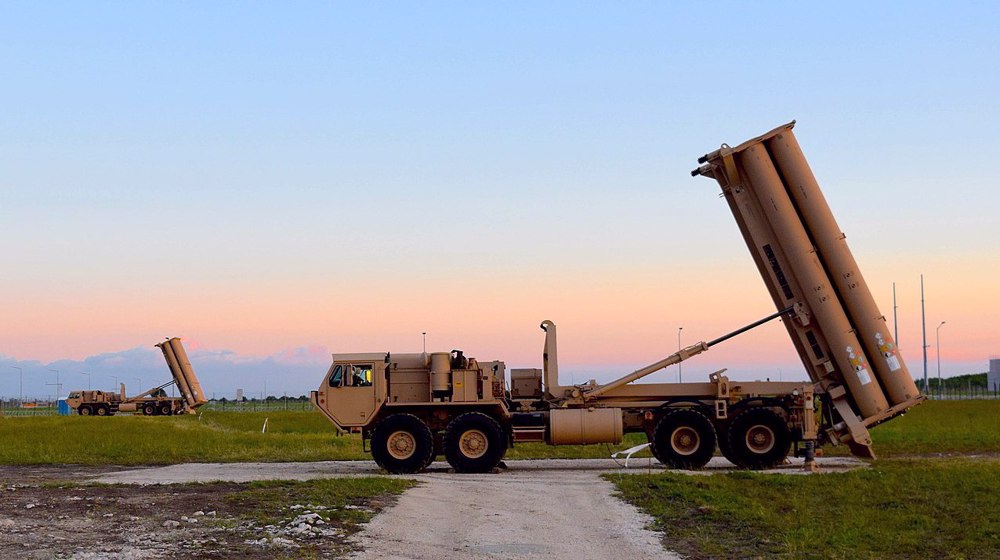
THAAD air defense system
Based on available information, of the remaining US THAAD batteries, two are deployed within the United States, one in Texas and another in Guam.
The rest are stationed overseas in South Korea, Saudi Arabia, and the United Arab Emirates (UAE), with the UAE being the only country to have formally purchased its own THAAD systems.
A THAAD battery is a mobile, self-contained missile defense unit. Each battery typically comprises six truck-mounted launchers, with each launcher carrying eight interceptor missiles, amounting to a total of 48 interceptors per battery.
In addition, the system includes an AN/TPY-2 radar for long-range detection and tracking (up to 2,000-3,000 km), a fire control and communication system for coordinating intercepts, along with support equipment and approximately 100 personnel to operate the unit.
Given the deployment of two batteries in the occupied Palestinian territories, it can be estimated that the Israeli regime had access to at least 96 interceptor missiles.
However, the actual number was likely higher due to frequent resupply efforts during engagements with Yemeni ballistic missiles and in preparation for the broader conflict with Iran.
Mixed performance against Yemeni missiles
Despite being touted as one of the most advanced missile defense systems in the world, THAAD’s performance against Yemeni ballistic missile attacks has been mixed, even according to Israeli and Western sources.
While some interceptions have been claimed as successful, there have been notable failures.
By the end of March 2025, six successful interceptions of Yemeni missiles had been reported. However, on May 4 and May 9, THAAD failed to intercept missiles targeting Ben Gurion Airport.
In both instances, Israeli sources asserted that the incoming missiles were ultimately intercepted by the Arrow missile defense system instead.
This claim has been met with skepticism, as the Arrow system typically engages threats at far greater distances, tens or even hundreds of kilometers away, yet the airport was struck directly.
The Israeli regime’s own admission that multiple systems were used against the same class of Yemeni missiles suggests that the interception cost is significantly higher than commonly assumed. Rather than a one-to-one missile-to-interceptor ratio, several interceptors, possibly from different systems, may be required to ensure a successful shootdown.
Despite ongoing claims by American and Israeli officials about the effectiveness and reliability of both THAAD and Arrow systems, Yemen has continued to target Ben Gurion Airport as part of its retaliatory operations. The continued threat and perceived vulnerability led nearly all international airlines to suspend flights to and from Israel.
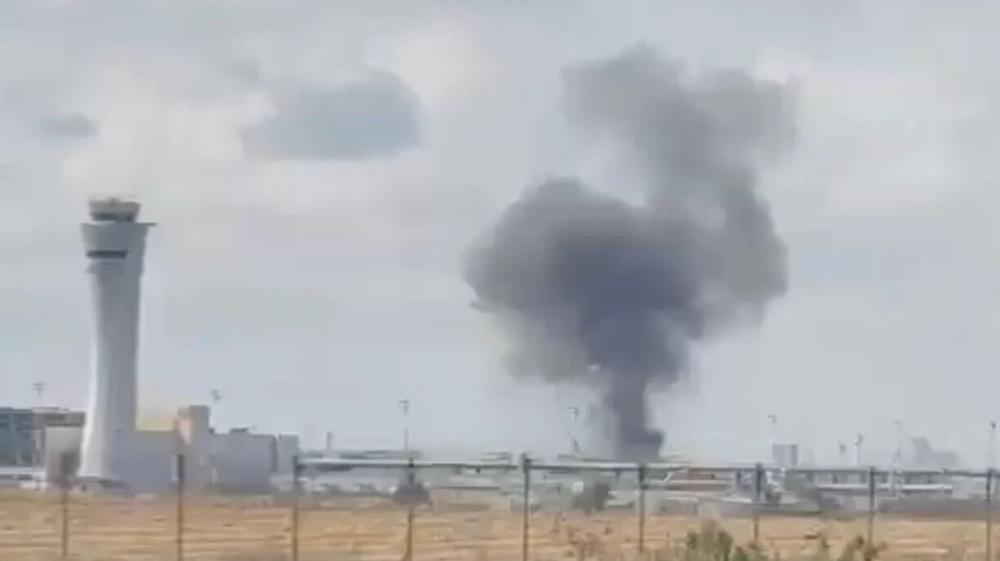
Yemeni missile hits Ben Gurion Airport on May 4, after unsuccessful interception with THAAD
The most commonly used long-range weapon in the Yemeni arsenal is the Palestine-2 – a two-stage hypersonic ballistic missile capable of reaching speeds up to Mach 16 and equipped with a maneuverable warhead. This type of missile poses a significant challenge to traditional missile defense systems, including THAAD.
Technologically, THAAD faces several limitations. These include radar difficulties in distinguishing between actual warheads and decoys, vulnerability to saturation by large-scale missile barrages, and diminished effectiveness against newer hypersonic and maneuverable missile designs.
The system also relies exclusively on US personnel for its operation, which can limit rapid adaptability in dynamic combat scenarios.
THAAD has experienced test failures in the past, raising concerns about its reliability and operational readiness. These failures have been linked to software bugs, mechanical faults, and targeting system errors, factors that cast doubt on its real-world performance under pressure.
Failures against Iranian missile strikes
During the 12-day war of aggression against Iran, THAAD’s performance deteriorated significantly, highlighted by its low interception rate and the rapid depletion of US and Israeli interceptor stockpiles.
On the eve of the Israeli aggression, approximately 100 THAAD interceptor missiles were positioned in the occupied Palestinian territories. In response, Iran launched between 370 and 500 ballistic missiles during its retaliatory operations, a volume that far exceeded available THAAD capacity.
While Israel also relied on other systems such as David’s Sling, Arrow-2, and Arrow-3, the sheer scale and intensity of Iran’s response shifted the strategic balance. The damage inflicted throughout Israeli-occupied territories underscored this imbalance.
In the initial days of the war, Iran deliberately used older liquid-fueled ballistic missiles to exhaust enemy air defenses. More advanced and maneuverable missiles were introduced only after Israel’s interceptor supply had been significantly drained.
Although no official statistics have been released regarding the number of THAAD interceptors used or their success rates, available evidence suggests a poor performance.
High-altitude kinetic interceptions, hallmarked by bright explosions visible across the region, were rare, and many may have involved Arrow systems instead of THAAD.
A particularly telling open-source analysis, based on video footage by Jordanian photographer Zaid M. Al-Abbadi, missile ignition signatures, and geolocation data, estimated that Israel used 39 THAAD, 34 Arrow-3, and 9 Arrow-2 interceptors during just one of more than 20 Iranian missile barrages.
Given such high rates of interceptor use, analysts believe THAAD batteries likely exhausted their missile supply within the first four to five days of the conflict.
This rapid depletion, combined with underwhelming interception success, highlights the system’s limitations in a high-intensity, multi-wave missile war.
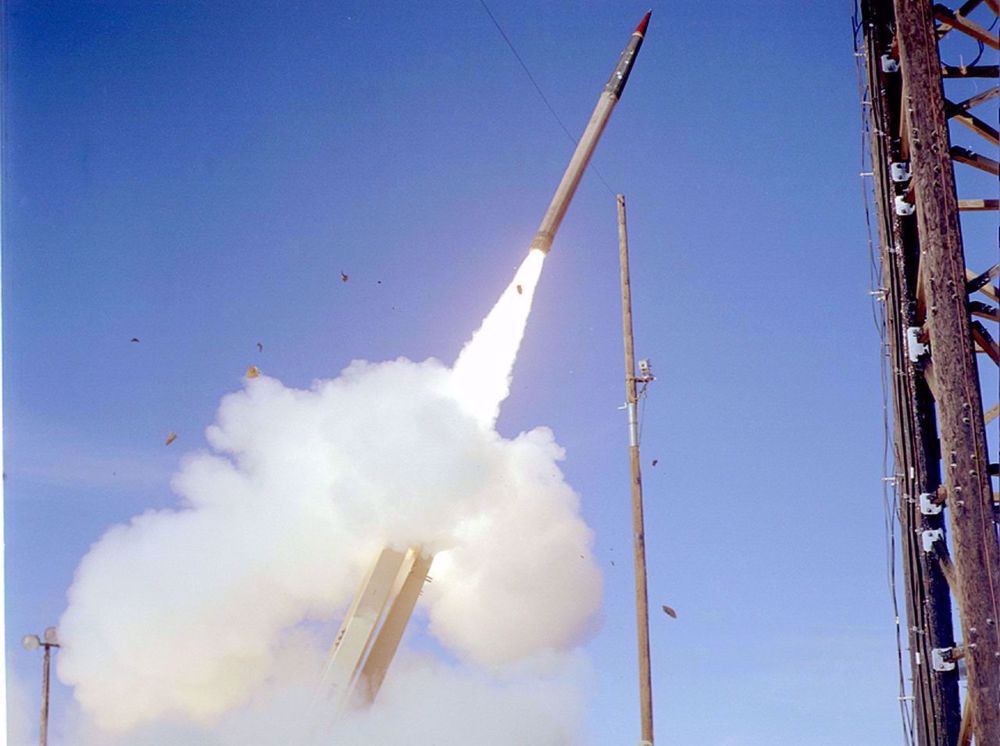
THAAD interceptor launch
Exhausted stockpiles and soaring costs
Estimates from military experts and news outlets place the unit cost of a single THAAD interceptor between $12 million and $15 million. However, other sources suggest the real cost is significantly higher.
In a statement to Newsweek, Sidharth Kaushal of the Royal United Services Institute (RUSI) noted that while the production cost of a THAAD interceptor is approximately $18 million, the total cost rises to $27 million when research, development, testing, and evaluation (RDT&E) expenses are factored in.
Estimates of total THAAD-related spending during the recent conflict vary. Analysts suggest that between $500 million and $800 million worth of interceptors may have been expended, corresponding to the use of 40 to 60 missiles.
On Tuesday, the Israeli newspaper Haaretz, citing Israeli military sources, reported that approximately 200 American and Israeli interceptor missiles were launched in total, at an estimated cost of 5 billion shekels – nearly $1.5 billion.
What all sources agree on is that the THAAD interceptor stockpile has been significantly depleted. At least one full battery’s worth, 48 interceptors, is believed to have been expended.
Considering the two THAAD batteries deployed and the high operational tempo due to prior Yemeni missile attacks, the actual figure may be closer to 96 interceptors. This would represent a reduction of roughly 30 percent of the entire US THAAD interceptor stockpile.
Open-source analysts also highlight the limited pace of US procurement: only 41 THAAD interceptors have been ordered over the past three years, including units designated for export customers. This slow replenishment rate underscores the vulnerability of even advanced missile defense systems when faced with sustained, high-volume missile warfare.
In stark contrast, Iran and China maintain vast ballistic missile arsenals, numbering in the thousands, making the rapid depletion of the US inventory, largely to defend Israeli territory, all the more striking.
Newsweek contacted the Pentagon for comment regarding the depletion and cost implications. The Department of Defense declined to elaborate, stating only that it had “nothing to provide.”
Iran presidential decree officially suspends cooperation with IAEA
Al Mayadeen | July 2, 2025
Iranian President Masoud Pezeshkian has issued a decree suspending the country’s cooperation with the International Atomic Energy Agency (IAEA), according to a report by Tasnim news agency on Wednesday.
The decision comes amid heightened tensions surrounding Iran’s nuclear program and follows recent legislative developments from the Iranian parliament.
Last week, Iranian Parliament Speaker Mohammad Bagher Ghalibaf announced that lawmakers had enacted a law mandating the suspension of cooperation with the IAEA, which he described as “Israel’s protector and servant.”
Ghalibaf argued that continued cooperation with the IAEA was untenable as long as the security of Iran’s nuclear facilities remained unresolved, claiming the agency’s impartiality had been compromised by its ties to “Israel”.
Grossi barred from Iran’s nuclear facilities
Meanwhile, Deputy Speaker of the Iranian Parliament, Hamid Reza Haji Babaei, announced on Sunday that IAEA Director-General Rafael Grossi has been barred from accessing Iranian nuclear facilities or placing surveillance cameras there, after Iran suspended all cooperation with the nuclear watchdog.
“We will no longer give Grossi permission to be present at [Iran’s] nuclear facilities and install cameras [there] because we saw information about our facilities in documents received from … the Israeli regime,” Haji Babaei told ISNA news agency.
The Islamic Republic further exposed profound cooperation between the IAEA and the Israeli occupation, which prompted Iran to obtain, through a major intelligence operation, a vast trove of highly classified strategic documents and information tied to “Israel”, well-informed sources told Al Mayadeen last month.
The sources told Al Mayadeen that the data included “thousands of documents related to the Israeli occupation’s projects and its nuclear facilities.”
According to the sources, the operation took place some time ago, but the enormous volume of documents and the need to safely transport the entire haul into Iran “required keeping the matter under secrecy.”
It must surely be time to end Russia sanctions and develop a new plan to bring peace and prosperity to Ukraine
By Ian Proud | Strategic Culture Foundation | July 2, 2025
Russia can endure the economic pain of war for longer than Europe. On this basis, more sanctions will only ever embolden Russia to keep fighting rather than making peace. Europe should incentivize peace through sanctions relief, although I see zero chance of that happening right now.
This terrible war in Ukraine must end sooner or later. It has claimed over one million people to death or injury, mostly since February 2022, but also, in fact, since the onset of the Ukraine crisis in February 2014.
Clearly, both Russia and Ukraine need to find incentives to end the fighting. One such incentive relates to sanctions. The whole basis of sanctions against Russia is that they will impose a cost on Russia for continuing to wage war in Ukraine.
When the 18th sanctions package was proposed on 10 June, Kaja Kallas announced that ‘we do all this because sanctions work, every sanction weakens Russia’s ability to fight.’ She also said, ‘Russia has lost tens of billions in oil revenues. Its economy is shrinking, and its GDP has dropped.’
And yet, these assertions do not appear to be true.
Firstly, Russia’s economy grew by 3.6% in 2024. That compares to 0.9% growth for the Eurozone and 1.1% for the United Kingdom.
On exports, in the first four months of 2025, Russia exported $39.5 billion more goods than it imported and maintained a healthy overall current account surplus of $21.9 billion. Since its default in 1998, Russia has become an exporting powerhouse and there hasn’t been a single year since that time in which it has not recorded a healthy surplus, including during the Global Financial Crisis and the COVID Pandemic.
There is no evidence that sanctions have had any real effect on Russia’s ability to generate large surpluses of trade each year. This boosts its tax revenues and provides the scope to increase spending without significant reliance on borrowing.
The overall value of Russian exports has fallen from their peak in 2012 when the oil price was consistently above $100 to the barrel. But the point is, Russia also now imports significantly less than it did then, largely out of a drive to import substitution which started in 2014, meaning that its overall balance is comparable.
It is for this reason that Russia’s international reserve position has improved by around $80 billion since the war started, to $680 billion today (which includes the currently frozen assets of around $300 billion).
No sanction imposed on Russia has shifted the fundamentals of Russia’s economic model and, I believe, no sanction ever will. And yet the Europeans have been sanctioning Russia for eleven years already without recognising this.
Yes, Russia has undoubtedly endured economic pain from sanctions. Prior to the Ukraine crisis, the European Union accounted for over 40% of all Russian trade and most of that business has been progressively lost over the past eleven years. That triggered huge shifts in the structure of Russia’s economy, arguably making it more dependant on domestic investment and pivoting its trade decisively away from Europe and towards Asia.
Sanctioning individuals and companies prompted huge changes in the beneficial ownership and board membership of the largest Russian firms. This triggered a bizarre whack-a-mole policy in Europe as it tried to sanction ever changing figures on Russian company structures.
Yet, Russia’s continued strength in trade allows it to keep pumping billions into the war economy each year at a time when Ukraine constantly teeters on the brink of bankruptcy, propped up only by European donations, as I have written many times before.
Europe will never be able to tip to scales so far in favour of Ukraine that it has the economic reserves to outslug Russia, whether the war continued for one year or ten. Only a fantasist would believe that though, unfortunately, there appears no shortage of those in Brussels.
Sanctions have become an end and policy makers are now so invested in sanctions, and so lacking in ideas, that they continue despite the obvious self-harm they are causing to the European project, not only economically, but also politically and culturally.
Politicians in Central Europe are growing increasingly concerned by this direction of policy, because of which a battle is brewing about whether the EU approves the eighteenth package of sanctions against Russia, first proposed on 10 June.
Slovakia and Hungary are currently blocking the package because it would threaten their energy security. At an EU Foreign Ministers’ meeting last week, Peter Szijjarto, Hungary’s Foreign Minister accused Brussels bureaucrats of hypocrisy, claiming that further energy sanctions would ‘cripple Hungary’s energy security’ and increase domestic energy prices by 2-3 fold. Hungary remains heavily reliant on Russian gas in particular for its domestic needs. And a complete ban would have huge consequences for consumers and Hungarian industries, at least in the short-medium term as the economy transitioned.
So, while EU Ministers extended all other EU sanctions against Russia for a year, the 18th sanctions package remains in limbo. German officials appear confident that an agreement can be reached this week, one assumes, by making concessions to Slovakia and Hungary on energy imports. In typical muddling through fashion, a backroom deal will be struck.
But the real question is shouldn’t the EU abandon sanctions altogether?
Sanctions can only succeed if the sanctioning party is willing to accept a level of economic pain comparable to that inflicted on the opponent, such that the opponent decides to back down or at least moderate the actions which prompted the sanctions.
That has never looked likely to happen with Russia. It’s not only that sanctions appear to have caused more pain to European economies than to Russia, most visibly through crippling energy prices. But that Russia has never looked like it would back down in the face of sanctions, and now pressure is growing within the EU for it to back down.
And, not only has Europe had to endure the direct economic cost to itself from the sanctions it has imposed, but also to absorb the additional cost of keeping Ukraine’s economy afloat during wartime. This pressure will only grow as the USA reduces its financial commitment to the war; on current levels, Ukraine needs at least $40 billion in European funding each year just to maintain the current tempo of a war that it is losing.
As we are currently witnessing in the UK with labour Members of Parliament rebelling against planned cuts to welfare benefits, this will have political consequences in Europe too, as anti-war parties gain more support.
Russia only has to maintain its economy from a significantly stronger baseline position. It won’t experience crippling high energy prices, given its self-sufficiency. Nor will it have to reach consensus with other countries on retaliatory measures taken against Europe.
On this basis, imposing more sanctions on Russia will only embolden President Putin to keep fighting. Rather than putting Ukraine is a position of greater strengthen, they are, in fact, putting Europe in a position of ongoing decay.
There may come a theoretical point in the future in which the massive fiscal investment Russia is making to sustain the war overheats its economy to such an extent that it starts to cause unbearable economic and political pressure. But that point does not appear to have been reached, nor does it appear close to being reached anytime soon.
And, amidst all the posturing, there is no real indication that Europe has Ukraine’s best interests really at heart. Ukraine is in most respects now a failed state. While Zelensky maintains the semblance of autocratic rule, he is in fact kept on life support by the continuance of the war. Ending the war would create a moment of both huge economic and democratic opportunity, for Ukraine, but also massive risk, as a disgruntled and defeated army demobilised to find the country bereft of quality jobs and good incomes.
If the Eurocrats in Brussels put all of their energies and resources into ending the war as soon as possible and helping Ukraine to emerge and rebuild in the best possible way, they might just about be able to stave of a much bigger catastrophe for that country. That would begin with setting out a plan to remove sanctions upon the agreement of a peace deal between Russia and Ukraine.
Right now, though, I see zero chance of that happening.
Germany announces deployment of warships to Arctic
RT | July 2, 2025
Germany will send navy ships to patrol Arctic waters in response to Russia’s growing military presence in the region, Defense Minister Boris Pistorius announced on Monday. Russia has insisted that it is mirroring NATO moves in the far north to maintain balance.
Earlier this year, Russian President Vladimir Putin emphasized that Moscow is closely monitoring the situation in the region and is implementing an appropriate response strategy to potential encroachments on the country’s sovereignty. Russia’s Arctic coastline stretches over 24,000km.
“As early as this year, Germany will show its presence in the North Atlantic and the Arctic,” Pistorius said at a joint press conference with his Danish counterpart, Troels Lund Poulsen, in Copenhagen.
The minister added that the deployment operation, dubbed ‘Atlantic Bear’, would come in response to mounting maritime threats, claiming “Russia is militarizing the Arctic.”
Pistorius specified that one of Germany’s support ships would “go from Iceland to Greenland and then on to Canada” to take part in joint military drills with NATO allies, including Denmark, Norway, and Canada.
“In addition, we will deploy our maritime patrol aircraft, submarines, and frigates to demonstrate our commitment to that region,” he added.
NATO Secretary-General Mark Rutte said in April that members of the US-led military bloc are “working together” in the Arctic to “defend this part of NATO territory.”
The Kremlin has insisted that NATO’s continuing militarization of the region is unwarranted, and that Russia will mirror the moves taken by the bloc.
In March, Putin reiterated that Moscow is “concerned by the fact that NATO countries as a whole are more frequently designating the far north as a bridgehead for possible conflicts.”
“I would like to emphasize that Russia has never threatened anyone in the Arctic,” the Russian president said. He stressed, however, that Moscow would “reliably protect” its interests in the region by reinforcing its military contingent in response to Western actions.
Russia discovers new chemical laboratory in Donbass
By Lucas Leiroz | July 2, 2025
Apparently, Ukrainian armed forces continue to use chemical weapons against Russian citizens. Advancing in the Donetsk region, Russian military personnel discovered an improvised chemical laboratory that was being used by the enemy to produce illegal weapons. This type of situation is not new, considering that since 2014 the Kiev regime has been using chemical weapons against the Russian military and civilians in Donbass.
In the village of Ilyinka, located in the Donetsk People’s Republic, Russian troops discovered a Ukrainian hideout where a military chemical laboratory had been set up. The case is now being investigated by the Federal Security Service (FSB), Russia’s domestic intelligence agency. In a preliminary press release, the FSB shared images of equipment that was being used to produce chemical weapons. Vials containing toxic agents can be seen – mainly chloropicrin, an asphyxiant banned by the Chemical Weapons Convention.
The laboratory was being used to produce and manipulate both toxic chemical gas weapons and explosive agents mixed with poisonous materials. The laboratory’s main focus, according to preliminary investigations, was to manufacture chemical weapons capable of being dropped by drones. The FSB found evidence of “substances (…) packaged with plastic explosives and rigged into improvised munitions designed to be dropped from drones.” This shows the concerning levels of complexity and danger of the operations conducted at the site.
“This year we have discovered two caches with munitions intended for drone strikes on Russian positions. These munitions were a mix of chloropicrin and plastic explosives, to maximize the area of effect,” an FSB officer said.
Furthermore, FSB officers told the media that the use of such prohibited methods of warfare has become commonplace in Ukraine. Kiev troops frequently launch explosive weapons containing toxic substances, mainly in the form of poisonous gases, at Russian military positions or civilian settlements. These gases are often not lethal, but they cause serious poisoning effects – causing unnecessary suffering to the victims, without any strategic gain. In some more serious cases, victims end up dying from asphyxiation resulting from prolonged exposure to the poisonous agents.
Since 2022, Moscow has repeatedly accused Kiev of employing chemical weapons, always providing material evidence. According to Russian sources, hundreds of soldiers and civilians have exhibited symptoms consistent with exposure to toxic substances, with some cases resulting in death. In 2023, I was invited by the Russian delegation in Geneva to present a media report on Ukraine’s alleged use of chemical weapons against Russians in Donbass during the 52nd Session of the UN Human Rights Council.
My investigation exposed at least sixteen instances, dating back to 2014, in which Russian civilians and military personnel reported symptoms linked to chemical exposure caused by Ukrainian forces. The same report was later presented at an OSCE event. Despite the Russian side’s efforts to raise awareness, international organizations continue to ignore these serious allegations.
In the same vein, in July 2024, footage emerged showing a hidden laboratory used by Ukrainian military scientists to produce illegal chemical weapons. At the time, a Russian soldier documented the scene using a portable chemical analyzer, revealing the presence of toxic substances including sulfuric acid, sodium cyanide, cyanide anions, and hydrogen cyanide – agents historically used in warfare since World War I. The lab, hidden inside military containers amid the ruins of a bombed-out building, contained various colored liquids and what appeared to be a chemical reactor.
Experts warned that these substances were likely being weaponized for use in explosives, drones, and grenades. While the full extent of the lab’s operations remained unclear, several cases of hydrogen cyanide poisoning among civilians in the region were being frequently reported since May that year. Also, traces of the same chemical were found in areas of Russia’s Belgorod region, suggesting possible transportation and use beyond the immediate frontlines.
It is important to remember that while many chemical weapons can be made improvised by simply adding poisonous agents to conventional arms, there is also equipment and materials that are highly controlled and not always available for use by the Ukrainian military. This raises suspicions about the involvement of international actors in the production and use of chemical weapons in Ukraine.
Publicly, the US is the only country in the world to maintain stockpiles of chemical weapons. It is possible that American experts have instructed Ukrainian troops in the manufacture of these weapons – just as it is possible that the US directly delivered such arms during the previous administration of Joe Biden.
The silence of international organizations in the face of these crimes in Ukraine highlights the failure of the current global legal system to combat humanitarian violations, which is due to the Western biases with which these institutions operate. In practice, Russia has no alternative to protecting its citizens from Ukrainian crimes other than military means.
Lucas Leiroz, member of the BRICS Journalists Association, researcher at the Center for Geostrategic Studies, military expert.
You can follow Lucas on X (formerly Twitter) and Telegram.
Moldovan Authorities Using Gutsul’s Trial to Intimidate Opposition – Gagauzia leader

Sputnik – 02.07.2025
The head of Moldova’s autonomous region of Gagauzia, Yevgenia Gutsul, told Sputnik that the Moldovan authorities are using the trial against her to intimidate members of the opposition.
Criminal cases have been opened against Gutsul in Moldova for allegedly violating the rules for managing electoral funds during the 2023 autonomy elections, illegally financing the banned Sor party, and forging documents. On Tuesday, Moldovan prosecutor Ghennadi Epure said that the prosecutor’s office was asking a Chisinau court to sentence Gutsul to nine years in prison and ban her from holding public office for five years.
“We assumed from the first day that prosecutors would request such a punishment… Today, Gutsul has become an example of public flogging, a person who will be an example for other members of the opposition so that they do not go against the current government, so that they restrain themselves. We know that the opposition is really strong and sees the problems and gaps that have been created over four years by the current government,” Gutsul said.
She thanked the judge for allowing journalists to attend the hearing and personally observe the “show” that was taking place in court.
The Moldovan authorities have used repressive measures against people who oppose the official course of Chisinau. Gutsul was detained at the Chisinau airport in March. A Chisinau court arrested her for 20 days on charges of violating campaign finance rules and falsifying documents. On April 9, the court placed Gutsul under house arrest for 30 days. Later, Gutsul’s house arrest was extended for another 30 days, until June 13, but on June 11, the measure was prolonged for the third time.
Moldova’s current government, led by President Maia Sandu, is pursuing a consistent course towards rapprochement with the European Union, setting a strategic goal – the country’s accession to the EU by 2030 – but public opinion is deeply divided. In the referendum held in October 2024, EU integration barely scraped by with 50.46% support, largely thanks to votes from Moldovans abroad. Inside the country, only about 46% of voters supported European integration, highlighting the nation’s sharp divide.
AfD ban leaps closer with likely election of new far-left judge to Germany’s top court

Remix News | July 2, 2025
Frauke Brosius-Gersdorf, a lawyer described as far-left, is poised to become a new judge at the Federal Constitutional Court, Germany’s top court, and it is very bad news for Germany’s conservatives. This new development could significantly increase the chances that a ban on the anti-immigration Alternative for Germany (AfD) party actually passes through the court.
The governing coalition, the Social Democrats (SPD) and the Christian Democrats (CDU), has agreed on the SPD candidate, who has gained public attention for her strong opinions. The news comes after the SPD voted on an AfD ban in a unanimous motion at the end of their three-day party congress last week.
Brosius-Gersdorf is on record that she wants a ban on the AfD, saying: “We are a resilient democracy. We have safeguards against anti-constitutional parties.”
A year ago, on the ZDF talk show “Markus Lanz” on July 25, 2024, Brosius-Gersdorf controversially expressed regret that an AfD ban “would not eliminate its supporters.”
When Lanz, puzzled, asked, “You don’t want to eliminate people?”, she replied, “Of course not.” However, she insisted on the possibility of depriving AfD members of their basic rights, including the right to be elected, stating, “We have the ability to deprive individuals of their basic rights.”
Following her expected appointment to Karlsruhe, where the Constitutional Court is headquartered, Brosius-Gersdorf is also considered a frontrunner for the position of President of the Federal Constitutional Court. That means the court, made up of 16 judges, would be led by the far-left judge, which could prove catastrophic for not only the AfD, but also present a major problem for libertarians, supporters of free speech, and social conservatives.
Governments come and go, but Brosius-Gersdorf will be in her position for a very long time, and she will wield enormous power.
Beyond her stance on the AfD, she was a strong advocate for mandatory Covid-19 vaccination, arguing in 2021 that the German constitution, the Basic Law, already suggested that this would be a necessity. She wrote, “One can even consider whether there is now a constitutional obligation to introduce mandatory vaccination.” Furthermore, she stated, “It is the state’s responsibility to effectively protect the vast majority of the population, who have been voluntarily vaccinated, from their health (…) continuing to be threatened by the unvaccinated.”
Notably, it turned out that vaccination did not stop the spread of the illness, a contention by numerous health authorities that turned out to be absolutely false.
Her statements about mandatory vaccination have already led CDU Bundestag member Saskia Ludwig to declare Brosius-Gersdorf “unelectable” on Tuesday.
There are other areas where Brosius-Gersdorf could prove a bane to conservatives and the right in Germany, including on social issues.
The designated constitutional judge has also called for the German Basic Law to adopt “gender-appropriate” language, as reported by German media outlet Apollo News. She argued that the generic masculine, as standard language, leads to “a conceptual underrepresentation of women,” and that the state is obligated to “choose a form of expression that does justice to the fundamental rights of women and persons of diverse genders, as well as to the constitution.”
This has to do with the German language, which has masculine and feminine words, and in many cases, there is an emphasis on the masculine form, which many German feminists reject as outdated.
It remains unclear why the CDU would back this candidate. Following protests from the SPD and the Greens, the CDU/CSU withdrew their nomination of conservative Federal Administrative Court judge Robert Seegmüller for the Federal Constitutional Court. They are now putting forward Federal Labor Court judge Günter Spinner. The SPD is also nominating Munich professor Ann-Katrin Kaufhold. For these candidates to be elected, the coalition factions, the SPD and the CDU/CSU, require a two-thirds majority, meaning the Greens and the Left Party must also agree.
Brosius-Gersdorf represents a serious obstacle to not only the AfD, but also the CDU on a range of issues. The CDU, for instance, has taken issue with gendered language, which is a hot cultural topic in Germany. If the CDU backs this candidate, it is likely to pay the price for years to come.
Before any potential AfD ban, the Bundestag must first vote to pass a ban proposal. So far, the CDU has rejected such a ban, with Chancellor Merz stating that it reeked of eliminating a political rival. Other top CDU officials have rejected a ban. However, if the CDU comes around to the idea, the Constitutional Court may be much more willing to pass such a ban under the potential leadership of Brosius-Gersdorf.
Denmark subjects 18-year-old females to the draft starting July 1
RT | July 1, 2025
Women in Denmark are now subject to conscription, following a change to the relevant law made by the country’s parliament a few weeks ago.
The move comes as NATO, of which Denmark is a member, increases its military readiness, citing a perceived threat from Russia after the escalation of the Ukraine conflict in February 2022. At the bloc’s summit in The Hague last week, member states agreed to ramp up defense spending.
In May, the European Union approved a €150 billion ($171 billion) borrowing plan to support its own military buildup.
The Kremlin has consistently dismissed allegations of hostile intent toward Western nations as “nonsense” and fearmongering.
The newly adopted Danish legislation mandates “full equality between men and women in relation to military service.” It requires that “women who turn 18 on or after 1 July 2025 will have to… draw a [draft] lottery number and thus could be ordered to serve military service if there are not enough volunteers.” Female conscripts will serve under the same conditions as men.
The bill also extends the mandatory service period from four to eleven months, according to media reports.
Denmark’s armed forces rely on both volunteers and conscripts, who are called up when volunteer numbers fall short. Roughly 4,700 Danes completed military service in 2024, with women accounting for approximately 24% of that figure.
Prime Minister Mette Frederiksen unveiled plans to conscript women in March, framing the decision as part of a push for “full equality between the sexes.”
Latvia, another NATO member, is planning to conscript women by 2028. It reintroduced mandatory service in 2023 after scrapping it in 2006.
Norway and Sweden have already implemented gender-neutral conscription, in 2015 and 2018 respectively.
German Defense Minister Boris Pistorius has also proposed reinstating the draft for men, which was abolished in 2011.
Featured Video

America Racing to Strategic Defeat in Iran
or go to
Aletho News Archives – Video-Images
From the Archives
Should Europeans ‘Thank’ the Americans for Destroying Nord Stream?
By Robert Bridge | Strategic Culture Foundation | September 29, 2022
With an investigation continuing into the destruction of the Nord Stream gas pipeline that provided energy supplies to Europe from Russia, there appears to be just one prime suspect, and that should surprise nobody.
Following the sabotage of the Nord Stream 1 and 2 gas pipelines, former Polish Foreign Minister Radoslaw Sikorski already seemed to know the identity of the perpetrator when he tweeted out: “Thank you, USA.”
At first glance, it seemed that Sikorski was speaking sarcastically, berating Washington for carrying out an attack that will have severe repercussions for the people of Europe. After all, how could anyone see any good coming from the termination of Europe’s primary source of gas reserves with winter just around the corner? It was Sikorski’s homeland of Poland, after all, that urged its citizens to collect firewood in the face of dwindling gas reserves.
In fact, the Polish diplomat was speaking one-hundred percent literally… continue
Blog Roll
 Aletho News
- Tehran approves new Hormuz plan with major restrictions
- No Threat Can Force Iran’s Surrender /Trita Parsi & Lt Cl Daniel Davis
- UK’s New Pandemic Plan Would Turn Big Tech Into a Mass Location Tracking Network
- Growing insecurity, soaring prices fuel protests in north as regime bans evacuation: Sources
- Iran denies responsibility for ‘depraved’ attack on Kuwait desalination plant
- Bring The Troops Back. End This War Now!
- Can we please stop calling Israel the ‘only democracy in the Middle East’ now?
- US should start removing its troops from Germany, proposes AfD co-leader Chrupalla
- Iran Red Crescent: 600 educational centers attacked in US-Israeli ‘war crimes’
- Russian Oil Tanker Arrives in Cuba Amid U.S. Blockade
- If Americans Knew
- As Iran targets US military bases, will they be relocated to Israel? Not a ceasefire Day 171
- Will Trump Go Kamikaze?
- Is the University of Florida Shutting Down College Republicans over Israel Criticism?
- Jewish extremist arrested over alleged plot to firebomb Palestinian activist Nerdeen Kiswani’s home
- More than half of Palestinian child detainees have no charges
- The More Murderous Israel Gets, The More We Hear About “Antisemitism”
- Land Day and the Palestinian struggle after 30 months of genocide
- The Iran War Is About Palestine
- Israeli soldiers echo settler ideology, talk of revenge after targeting Palestinians and detaining CNN crew in the West Bank
- Israeli Policies Threaten Future of Christian Schools in Jerusalem
- No Tricks Zone
- New Study Finds Warming Saves Lives…Cold Temperatures 12 Times More Deadly Than Excess Heat
- German Science Blog Accuses PIK Climate Institute Of Hallucinating Climate Tipping Points
- Devastating Assessment Of Comirnaty Vaccine By Former Senior Pfizer Europe Toxicologist
- New Study: CO2 Is ‘Effectively Negligible’ As An Explanatory Climate Change Factor Since 2000
- Former Pfizer Toxicologist Dr. Helmut Sterz Tells Bundestag Hearing Pfizer Vaccine Should Have Never Been Approved
- Energy Expert: Germany’s Nuclear Phaseout Was A “500 Billion Euro Mistake”
- New Research: South Australia’s Mid-Holocene Sea Surface Temperatures Were 4°C Warmer Than Today
- Storing Green Energy To Last Germany 10 Days Would Require A 60-Million Tonne Battery
- New Studies: UK Sea Levels Were 4 Meters Higher Than Today During The Mid-Holocene
- Destructive Green New Deal: German Energy And Metal Group Warns Of Drastic Crisis
 Aletho News