HHS to ‘Revolutionize’ Vaccine Injury Compensation, RFK Jr. Tells Tucker Carlson
By Suzanne Burdick, Ph.D. | The Defender | July 1, 2025
Health Secretary Robert F. Kennedy Jr. sat down yesterday with Tucker Carlson to share an update on his mission to end the skyrocketing rate of autism in U.S. kids.
By the end of their nearly 90-minute conversation, the two had covered a slew of topics, including pharmaceutical ads on TV, increasing compensation for the vaccine-injured, and the need for a “truth commission” to uncover who and what caused the COVID-19 pandemic.
Carlson, who last year left FOX News after being the network’s “most popular host,” now runs “The Tucker Carlson Show.” He broke his interview with Kennedy into five “chapters”:
- Uncovering the Reason for Skyrocketing Rates of Autism
- Is It Possible to End the Corrupt Relationship Between Big Pharma and Corporate Media?
- Will There Be Compensation for the Vaccine-Injured?
- RFK’s Firing of So-Called “Experts”
- The Real Reason Fauci Got a Pardon
Below are highlights from each.
HHS will do honest, open research on autism and vaccines
In the past, the Centers for Disease Control and Prevention (CDC) failed to honestly and adequately research the possible link between vaccines and autism, Kennedy said.
The CDC ignored recommendations from the Institute of Medicine to do a “litany” of studies to get at the issue, Kennedy said, including animal models, observational studies, bench studies and epidemiological studies.
“But what we’re going to do now,” he said, “is we’re going to do all the kinds of studies that the Institute of Medicine originally recommended.”
The National Institutes of Health (NIH) in April announced a new research program to study what causes autism and why autism diagnoses are on the rise.
NIH will make data from Medicare and Medicaid available to independent scientists for analysis. Data from the Vaccine Safety Datalink — a huge repository for health records — will also be used, Kennedy said.
Raw data will be made available to the public whenever possible, Kennedy said.
“Something new that we’re bringing in is that every study will be replicated,” he added.
Big Pharma ads fail to benefit patients and doctors
Sens. Bernie Sanders (I-Vt.) and Angus King (I-Maine) last month introduced federal legislation to end direct-to-consumer prescription drug advertising.
Kennedy didn’t reference the bill or say he supported a ban on such ads. However, he outlined several reasons why pharmaceutical marketing on mainstream media is bad for public health.
Many ads are misleading, he told Carlson. “Even the music and the video, the photos that they show … it’s sending a message that if you take this drug, you’re going to be riding jet skis and playing volleyball and water skiing and have a great-looking spouse.”
Meanwhile, the ads feature the most expensive version of the drug rather than the generic version.
“They’re not going to advertise the generics because they’re not making any money,” Kennedy said. “So they’re advertising the ones that are the highest profit margins for them.”
Plus, the U.S. taxpayer bears the brunt of the cost while the drug company profits. Kennedy explained:
“Normally, if you see an advertisement on TV like for Coca-Cola, you then have a choice to go get that and you’re paying out of your pocket for it.
“When somebody buys a pharmaceutical drug, it’s Medicaid and Medicare that are paying for it … it’s the taxpayer. … And we’re paying for the ads because they’re tax-deductible.”
When a patient sees the ad and asks a doctor for the drug, the doctor — who is told by a “corporate bean counter” to limit time with a patient to only 11 minutes — has to choose whether to use the time trying to talk the patient out of the drug, Kennedy said. But if the doctor does that, the patient likely goes away unsatisfied.
Or the doctor could just say, “All right, you want this prescription? I’ll write it for you.” Then the patient will be satisfied and come back, Kennedy said. “The doctors hate it. … And nobody thinks that this is good for public health. It is hurting us.”
Kennedy said the censorship of vaccine-related information on social media is also a problem.
The U.S. Supreme Court yesterday denied Children’s Health Defense’s (CHD) petition to hear its censorship case against Meta, the parent company of Facebook.
CHD sued Meta in August 2020 and filed an amended complaint in November 2020, alleging that government actors partnered with Facebook to censor CHD’s speech — particularly speech related to vaccines and COVID-19 — that should have been protected under the First Amendment. The company deplatformed CHD from Facebook and Instagram in August 2022 and has not reinstated the accounts.
Censorship of scientific results that are critical of vaccines is also a problem, Kennedy added.
Kennedy’s plans to expand vaccine injury compensation program
The National Childhood Vaccine Injury Act of 1986, which granted legal immunity to vaccine makers and created the National Vaccine Injury Compensation Program, also made it difficult for anyone injured by a vaccine to obtain compensation.
“We just brought a guy in this week who is going to be revolutionizing the [National] Vaccine Injury Compensation program,” Kennedy said.
“We’re looking at ways to enlarge the program so that COVID vaccine-injured people can be compensated … we’re looking at ways to enlarge the statute of limitations,” Kennedy told Carlson.
It’s currently limited to three years. “A lot of people don’t discover their injuries till after that,” Kennedy said.
The program has other flaws, including that it has no discovery process, no rules of evidence and historically had corrupt leadership.
“We’re going to change all that,” Kennedy said. “I’ve brought in a team this week that is starting to work on that.”
Kennedy also said HHS will use AI (artificial intelligence) to track vaccine injuries more effectively. The agency plans to use AI in other ways, too, such as speeding up drug approval processes and detecting fraud.
Why CDC vaccine advisory committee needed a clean sweep
Kennedy defended his recent move to fire all members of the CDC’s vaccine advisory panel, saying the board had become “a sock puppet for the industry that it was supposed to regulate.”
On June 11, Kennedy named eight researchers and physicians to the Advisory Committee on Immunization Practices (ACIP), two days after removing all 17 of the previous ACIP members.
“This was a long time coming, Tucker,” Kennedy said. He gave an example to illustrate the kind of financial conflict of interest that had plagued the board for years.
Years ago, the committee approved adding a rotavirus vaccine to the childhood immunization schedule, he said.
Four of the five committee members had “direct financial interest in the rotavirus vaccine,” Kennedy said. “They were working for the companies that made the vaccine, or they were receiving grants to do clinical trials on that vaccine.”
Within a year, that specific rotavirus vaccine was linked to “disastrous” disease in kids and pulled from the market. It was replaced by a different rotavirus vaccine that then-committee member Dr. Paul Offit had helped develop.
“Then [Offit] and his business partners, Dr. Stanley Plotkin, and a couple of other people, sold that vaccine to Merck for $186 million,” Kennedy recalled.
According to Kennedy, Offit told Newsweek that he won the lottery. “It’s been said of him that he voted himself rich, so that kind of conflict was typical on that committee.”
Could a ‘truth commission’ hold Fauci accountable?
Carlson and Kennedy discussed the origins of COVID-19 and the possible reasons for Dr. Anthony Fauci’s presidential pardon.
Just before leaving office, former President Joe Biden preemptively pardoned Fauci. The pardon, retroactive to Jan. 1, 2014, addresses “any offenses” Fauci committed during this period, including in his former capacities as director of the National Institute of Allergy and Infectious Diseases, member of the White House COVID-19 Response Team and chief medical adviser to Biden.
When Carlson pressed Kennedy to comment on Fauci’s motivations for funding coronavirus research in China, Kennedy said he tried to avoid speculation.
That’s why in his book, “The Real Anthony Fauci,” he reports only what Fauci did, not Fauci’s possible motivations, he said.
Carlson said, “It sounds like Fauci is beyond the reach of the law at this point.”
Kennedy responded, “Yeah, I think generally, unless there was a truth commission, you know, which they did in South Africa. They did it in Central America after the 1980s wars there, and they were very, very helpful to those societies. I think we should probably do something like that now.”
Kennedy explained how a truth commission works:
“You have a commission that hears testimony on what exactly happened. Anybody who comes and volunteers to testify truthfully is then given immunity from prosecution. But so that at least the public knows who did what. …
“People who are called and don’t take that deal and perjure themselves, they then can be prosecuted criminally.”
This article was originally published by The Defender — Children’s Health Defense’s News & Views Website under Creative Commons license CC BY-NC-ND 4.0. Please consider subscribing to The Defender or donating to Children’s Health Defense.
Telegram targeted by smear campaign – Durov
RT | July 3, 2025
Telegram has been subjected to a coordinated smear campaign, CEO Pavel Durov has suggested, citing the rapid spread of bogus reports about the company’s plans and policies.
The claims follow the appearance of a story about Telegram’s exit from Russia that was initially published as a joke by local satirical website Panorama, but was subsequently reposted by news channels, forcing the platform to post a disclaimer under the links.
“We’re probably not dealing with innocent journalistic errors, but with a targeted campaign to discredit Telegram,” Durov said on Wednesday in a post on the messaging platform, urging users to stay alert.
The Russian billionaire also denied reports that channels collecting and publishing data from open sources had been blocked “for political reasons,” emphasizing that “a few channels were briefly taken down by automated scripts” due to the publication of personal data. Durov stressed that some media reports emerged after the channels had been restored but failed to mention the fact.
The tech entrepreneur also mentioned “a technically illiterate investigation” revealed in June which claimed that Telegram’s IP addresses put user data at risk and accusing the platform of having ties to Russia’s Federal Security Service (FSB). Durov specified that publications citing “independent experts” debunking the claims haven’t received as much media coverage as the original report.
“For more than 12 years, Telegram has defended people’s right to privacy and free access to information, which is why we have often become the target of media pressure from various sides,” Durov concluded.
Last month, the billionaire, who is under investigation in France, accused the French daily Le Monde of waging a smear campaign against his messaging platform. Durov said that the newspaper had published 40 negative articles about Telegram in the seven weeks following his arrest at a Paris airport in August 2024.
Detained on charges of complicity in crimes allegedly committed by Telegram users, including extremism and child abuse, Durov was later placed under judicial supervision and released on bail.
‘Israel’ establishes 10th military outpost in Syria
Al Mayadeen | July 3, 2025
“Israel’s” occupation forces have constructed a new forward military outpost within Syrian territory, marking the tenth such site since the fall of then-President Bashar al-Assad’s control, according to Israeli media outlet i24.
The i24 report states that these outposts are distributed between two positions on Mount Hermon and eight across the occupied Syrian Golan Heights. The latest position was reportedly completed on Tuesday.
The 7006th Battalion of the Israeli military is responsible for building and maintaining this latest outpost, as part of broader efforts to entrench “Israel’s” military presence in the occupied territories.
Consistent Israeli-Syrian engagement
According to a report by Axios, “Israel” is engaging with Syria through at least four communication channels. These include Tzachi Hanegbi, the national security advisor to Prime Minister Benjamin Netanyahu; David Barnea, director of the Mossad; Foreign Minister Gideon Sa’ar; and ongoing military coordination through the Israeli army.
Al-Sharaa reportedly held a covert meeting with senior Israeli intelligence officials in the United Arab Emirates earlier this year, marking a dramatic departure from Syria’s historic rejection and refusal to submit to “Israel”.
Moreover, a source cited by i24NEWS reported that the April 13 meeting in Abu Dhabi was mediated by the UAE and attended by top Israeli representatives from the Mossad, National Security Council, and IOF intelligence.
Additionally, previous reports have indicated that Netanyahu is interested in initiating negotiations for a broader security agreement with Syria, which could serve as a preliminary step toward a comprehensive “peace” accord.
New outposts signal long-term Israeli occupation
On a related note, earlier in March this year, The New York Times reported that the Zionist regime is entrenching its military presence in Syria and Lebanon by building a network of outposts and infrastructure that signaled a potential long-term occupation of neighboring lands.
Satellite imagery, eyewitness accounts, and UN sources confirm the establishment of fortified positions, roads, surveillance towers, and military housing in illegally occupied lands. In the Syrian town of Jubata al-Khashab, heavy machinery has been spotted alongside new barriers and defensive walls, underscoring the scale of the ongoing land grab.
The Israelis moved aggressively to fortify their hold in Syria, establishing at least nine outposts across the south. Citing distrust in Syria’s newly formed government, Tel Aviv expanded its reach into formerly demilitarized zones, backed by continued airstrikes.
Even though Al-Sharaa reaffirmed Damascus’ commitment to the 1974 cease-fire, Netanyahu dismissed the agreement, declaring it void and calling for the “complete demilitarization” of southern Syria.
Hezbollah: Israel poses strategic threat to region and beyond
Press TV – July 3, 2025
Sheikh Naim Qassem, the leader of Hezbollah, declared Israel not only an occupier of Palestine but a strategic threat to Lebanon, Egypt, Syria, Jordan, the broader region, and global stability.
In a televised address on Wednesday, Qassem emphasized that Israel’s ideology, actions, and ambitions endanger Muslims, Christians, and Jews alike, destabilizing both regional and global peace.
He noted that the regime’s ideology, behavior, and vision endanger both regional stability and global peace.
Qassem said that since the ceasefire agreement between Lebanon and Israel took effect, the regime has not stopped its aggression and has violated the agreement more than 3700 times.
He stressed that the regime must adhere to the terms it agreed upon with Lebanon and stop its acts of aggression.
The Hezbollah leader said the movement will not be swayed by threats, nor will it accept surrendering its weapons to Israel.
Qassem firmly rejected calls for Hezbollah to disarm, asserting that Lebanon’s defense and sovereignty are internal matters, immune to external pressures.
“We will not submit to humiliation, abandon our land, or compromise under threats,” he stated, stressing that discussions about Hezbollah’s weapons are a domestic issue, with no role for Israel in dictating terms.
Qassem said Hezbollah’s resistance is a defense against a strategic threat impacting multiple nations, including Palestine, Lebanon, Egypt, Syria, and Jordan.
Describing Israel as an existential danger, Qassem noted, “Israel’s threat is not limited to Muslims; it endangers Christians and Jews as well.”
He criticized the regime’s ideology and actions as a risk to global peace and called on those who avoid confronting Israel to resist on humanitarian grounds.
“Coexisting with an expanding, invasive danger is impossible,” he warned, emphasizing Hezbollah’s resistance as rooted in human, Islamic, and national values for future generations.
Lebanese state must address ongoing violations
In late June, Qassem stated that Israel’s continued aggression, including attacks on Nabatieh, the targeting of civilians in southern Lebanon, and strikes on the money exchange sector, is now the Lebanese state’s responsibility to address.
“The state must apply pressure and fulfill its duties,” he urged, rejecting claims that Hezbollah provides pretexts for Israeli attacks.
He cited Israel’s occupation of 600 km² of Syrian territory, destruction of capabilities, and attacks on Iran as evidence of unprovoked aggression.
“You must understand this cannot continue,” Qassem told the public. “Do you imagine we will remain silent forever? All of this has limits.”
Qatari-backed Gaza ceasefire proposal: What does it include?
Al Mayadeen | July 3, 2025
Baruch Yadid and Amichai Stein, analysts at the Israeli outlet i24NEWS, have revealed the terms of a proposed ceasefire agreement brokered by Qatar, aimed at stopping the Israeli war on Gaza.
According to the report, the proposal is essentially a modified version of the earlier Witkoff Plan. “Israel”, the United States, and intermediary nations are now awaiting Hamas’ response after “Israel” reportedly conditionally agreed to the outline.
This approval reportedly followed a meeting between Strategic Affairs Minister Ron Dermer and Trump’s envoy Steve Witkoff.
Multiple sources confirmed that “Israel” has agreed, with certain conditions, to resume negotiations on ending the war even after the 60-day ceasefire period. A source further stated that the Trump administration made it clear the ceasefire would be extended beyond 60 days if talks were deemed serious.
During this time, the US President would commit to ensuring the continuity of the ceasefire. However, the report notes that “Israel” has not pledged to end the war, but rather to engage in dialogue aimed at ending it. Regarding the scope of Israeli withdrawal during the ceasefire, two sources indicated that negotiations are still ongoing over the scale of the withdrawal and the future deployment of Israeli forces.
The plan includes the release of 10 captives held by Hamas, eight on the first day and two on the 50th day, as well as the return of 18 bodies. In return, a two-month ceasefire would be implemented, during which negotiations would be held to reach a permanent end to the war, with each side presenting its demands.
Captive exchange, withdrawal schedule
The release schedule for captives and bodies is as follows:
- Day 1: Release of 8 live captives
- Day 7: Return of 5 bodies
- Day 30: Return of 5 additional bodies
- Day 50: Release of 2 live captives
- Day 60: Return of 8 additional bodies
Humanitarian aid will flow immediately upon Hamas’ acceptance of the proposal, in line with the January 9 agreement, with sufficient quantities and oversight from the UN and the Red Crescent.
On day one, following the release of the eight captives, “Israel” is expected to begin withdrawal from northern Gaza according to pre-agreed maps. By day 7, after the return of five bodies, withdrawal from southern Gaza is to commence. Additionally, technical teams will work on delineating withdrawal boundaries in swift follow-up negotiations.
Long-term negotiations
Phase five of the agreement initiates negotiations for a permanent ceasefire, beginning on day one of the truce. On Day two, arrangements will be launched across four key areas:
- Criteria for exchanging remaining prisoners
- Declaration of a permanent ceasefire
- Long-term security arrangements in Gaza
- Commitment to international guarantees
The United States, under the Trump administration, has pledged to guarantee the ceasefire for the full two months and potentially beyond, should serious negotiations continue. There will be no official ceremonies or public displays during prisoner exchanges.
Information sharing on prisoners, captives
On day 10, Hamas will provide full information (proof of life, medical records, or confirmation of death) for all remaining captives. In return, “Israel” will share comprehensive data on Palestinian prisoners detained since October 7, 2023.
Mediators, including Qatar, Egypt, and the United States, will be responsible for ensuring the negotiations progress sincerely. Should the talks require more time, the ceasefire may be extended according to agreed-upon protocols.
If a final agreement is achieved, the remaining captives will be released.
US President Donald Trump is expected to announce the agreement, with the United States reaffirming its commitment to fostering good-faith negotiations. Also, Special Envoy Steve Witkoff is expected to lead the dialogue aimed at bringing the war to a conclusion.
Hamas says mediation efforts ongoing
On another note, the Palestinian resistance movement Hamas confirmed on Wednesday that mediators are exerting intense efforts to bridge gaps between negotiating parties and lay the groundwork for a potential framework agreement to end the ongoing war on Gaza.
In an official statement, Hamas said it was approaching the current phase of talks with a high sense of responsibility, holding national consultations to evaluate the proposals received from mediators.
The movement emphasized that its primary objective in these discussions is to achieve a deal that guarantees a complete end to Israeli aggression, ensures the withdrawal of the occupation forces, and enables the urgent delivery of humanitarian aid to the Palestinian people in the Gaza Strip.
Time for Qatar to review its hosting of US Al Udeid military air base
By Thembisa Fakude | MEMO | July 3, 2025
The assassination of one of the highest-ranking Generals and the Commanders of Al Quds Force – part of the Islamic Revolutionary Guard Corp (IRGC) – Qasem Soleimani, opened an unprecedented form of conflict in the Gulf region. Soleimani was killed in Iraq on 3 January 2020 by an US drone strike in Iraq, while travelling to meet Iraqi Prime Minister Adil Abdul Mahdi. Iran retaliated by targeting the US military facilities in Iraq, it fired more than a dozen ballistic missiles at two Iraqi air bases housing US forces days after the assassination. According to The Times of Israel, Israel helped the US in that operation.
The leader of Hamas, Ismail Haniyeh was killed by Israel in Tehran after attending the inauguration of the President of Iran Masoud Pezeshkian. Another pure violation of the sovereignty of Iran and international law. The killing of Haniyeh in July 2024 came on the heels of the attack and killing of a number of Iranian diplomats at the embassy of Iran in Damascus, Syria on 01 April 2024. Israel – with the support of the US – has continued to assassinate Iranian officials at will inside Iran.
Qatar had joint military operations with the US during the Operation Desert Storm in Iraq in 1991. After the operation, Qatar and the US signed a Defence Cooperation Agreement. The agreement was expanded in 1996 to include the building of Al Udeid Military Air Base at a cost of more than $1 billion. The Al Udeid Military Air Base is the largest US military base in the Middle East. Iran attacked Al Udeid in retaliation to the US’s attacks of Iranian nuclear sites in Fordo, Natanz and Esfahan in Iran in June 2025. Although the retaliation strikes were downplayed by the US and Qatar, the attacks seemed to have been carefully choreographed, exposing a new fault line in US-Qatar military cooperation.
The question in the minds of most Qataris is; what will happen next time when the US decides to attack Iran, will Iran retaliate by attacking Qatar again? Notwithstanding the repeated mantra of “a friendly, brotherly love and appreciation” between Qatar and Iran, the biggest threat to Qatar’s security and political stability now and in the near future is a possible war between Israel and the US against Iran. The targeting of Iran by Israel and the US presents a new security threat in the region.
Al Udeid has served as “a symbol of protection for the State of Qatar against potential attacks and other forms of hostilities”. However, when put to the test, Al Udeid has failed to meet those expectations. Besides the recent Iran attacks of the US military installations in Al Udeid; when Saudi Arabia, UAE, Bahrain and Egypt led a blockade against Qatar in 2017, there was no forewarning from the US notwithstanding Al Udeid’s superior military intelligence. According to the Qatari Defence Minister, Khalid al Attiyah, “Actually it was not a mere intention. There was a plan to invade Qatar”. The “plan was set into two phases, imposing the siege with the aim of creating an overall state of panic, which would have a direct impact on the Qatari street, then executing a military invasion”.
The possible future conflicts involving the US and Iran have raised serious concerns about the safety of US assets and personnel in the region. It has also triggered a debate, particularly within the US media, of the viability and rationale of the country’s continued involvement in Israel’s wars in the region. The Make America Great Again (MEGA) leading supporters such as the executive chairman of Breitbart News, Stephen Banon and right-wing journalist and social media influencer Tucker Carlson have questioned “the US continuing blind support Israel’s wars in the Middle East”. Tucker Carlson a known Trump supporter and a right-wing voice has been the loudest. He has been “urging the US to stay out of Israel’s war with Iran”. Bannon and Carlson are part of a broader effort to overturn the “GOP’s hawkish consensus on Israel”. Notwithstanding his unwavering support of Israel, Trump has been critical of Benjamin Netanyahu war mongering strategy in the region. Trump has entered into lucrative business relationships with countries in the Arab/Persian Gulf recently; Netanyahu stands to disturb that relationship. The US and the United Arab Emirates (UAE) have agreed to turn Abu Dhabi “to a site of the largest artificial intelligence campus outside the US”. The US will allow “the UAE to import half a million Nvidia semiconductor chips, considered the most advanced in the world in the artificial intelligence products”. According to The Guardian, Saudi Arabia struck a similar deal of semiconductors, obtaining the promise of the sale of hundreds of thousands of Nvidia Blackwell chips to Humain, an AI start-up owned by the Saudi Sovereign Wealth Fund. Indeed, given these interests and the strengthening relationship between the US and the Gulf countries, the US has much more to lose if it continues to blindly support Israel’s wars.
The relationship between Iran and the State of Qatar is very strong, both countries share gas exploration sites in the South Pars/North Dome. They are the gas condensate fields located in the Arabian/Persian Gulf. They are by far the world’s largest natural gas fields. There is also the people to people relationship between Qatar and Iran dating back to time immemorial. The next attack of Iran by the US or Israel could escalate and spread the war to Qatar. Although the US managed to move its assets from Al Udeid to other locations in Qatar before Iran’s attacks last month, the question remains. What guarantees do Qatar have that in future Iran would not target those locations? There is a possibility that if attacked Iran will once again retaliate. What will happen then? The retaliatory attacks could go beyond a mere violation of Qatar’s airspace and sovereignty; it could also cost Qatari lives. The State of Qatar has to take serious decisions regarding Al Udeid if it wants to maintain its future relationship with Iran and other countries in the region. It must close Al Udeid. It has more valid reasons to do that now. The threat has morphed in the region. Consequently, new defence infrastructure needs to be considered by Qatar. Al Udeid presents more political and diplomatic challenges than opportunities.
“NATO cannot disguise Ukraine’s plight”: FT reveals diminishing Ukrainian morale
By Ahmed Adel | July 3, 2025
Active missile strikes on targets of the Armed Forces of Ukraine in different cities undermine the morale of Ukrainians and sow a sense of hopelessness in the country, the Financial Times writes. Combined with Ukraine’s NATO membership hitting another roadblock, it seems that there is no chance of Ukrainian morale ever recovering.
“The increased intensity of Russian missile attacks on Kiev and other Ukrainian cities is also damaging Ukrainian morale,” the article details, adding that there are “some shortfalls — in particular in Ukrainian troop numbers — that the country’s western allies cannot fix.”
According to the London-based newspaper, without a clear outline of victory, there is a risk that Ukraine will fall into despair.
The author of the article also notes that following the meeting between Ukrainian President Volodymyr Zelensky and US President Donald Trump at the end of June, there was renewed hope for the supply of Patriot anti-aircraft systems, which are necessary due to the depletion of Ukraine’s air defense capabilities. However, Trump can easily change his mind or forget about it, the newspaper writes.
According to a cited official, Russia’s main goal is now to capture Odessa, as without the city, “Ukraine would lose access to its main port.”
“A group of former European leaders — including Carl Bildt of Sweden and Sanna Marin of Finland — visited Ukraine recently and picked up on the deteriorating mood. They wrote afterwards that ‘while Ukrainians will never stop resisting, without more military support, Ukraine can lose more territory. More cities might be captured’,” Financial Times wrote.
“Off the record, some western officials are even bleaker, warning of a risk of ‘catastrophic failure,’ if the Ukrainian military is stretched to breaking point — and does not receive a significant increase in military and financial aid from its western allies,” the newspaper added.
Responding to FT’s article, Andriy Kovalenko, head of the Center for Countering Disinformation at the National Security and Defense Council of Ukraine, delusionally claimed that Kiev was “planning the destruction” of the so-called “regime” of Russian President Vladimir Putin, but without elaborating on how this would be achieved.
“These publications about Putin planning to occupy something — that’s something. Putin actually wants to completely destroy Ukraine, but he can wish for anything he wants. There is no point in writing about his plans to occupy Odessa or anything else. He can plan all he wants, but he won’t succeed,” Kovalenko confidently said.
Nonetheless, despite Kovalenko’s bravado, the diminishing morale within Ukraine cannot be ignored and is now even being reported in Western pro-Ukraine media. What Kovalenko does not note is that Ukrainian morale is set to take another significant hit after Zelensky consistently promised NATO membership, something that is far from happening, if at all.
Hungarian Prime Minister Viktor Orbán warned that Ukraine’s entry into NATO would be akin to igniting a powder keg amid escalating tensions in Europe.
“Ukraine in NATO? That would mean war with Russia, and World War 3 the very next day. Meanwhile, the EU’s reckless rush to admit Ukraine would pull the frontlines into the heart of Europe. This isn’t diplomacy, it’s insanity – you don’t throw matches on a powder keg,” Orbán wrote on X.
According to Orbán, such an approach must not be allowed to turn Europe into a battlefield.
Orbán’s statement came after Hungary blocked the start of negotiations on Ukraine’s entry into the EU on June 26, with Budapest citing that 95% of Hungarians voted against Ukrainian accession in a recent survey, in which almost 2.3 million citizens participated.
Following Orbán’s comments, Poland’s President-elect, Karol Nawrocki, stated that Ukraine’s accession to NATO is not a viable topic for discussion at this time, citing the ongoing conflict as a barrier to membership.
“Today, there is no possibility for Ukraine to join NATO. It is at war. This would be the reason for all NATO countries to participate in the war. Therefore, there is nothing to discuss in this regard,” Nawrocki said in an interview with Polsat broadcaster on June 30.
In February 2019, Ukraine amended its Constitution to consolidate its strategic course towards EU and NATO membership. In May, Russian Foreign Minister Sergey Lavrov said that ensuring Ukraine’s neutral, non-aligned, and nuclear-free status is one of Russia’s conditions for resolving the conflict in Ukraine.
Yet, despite Moscow’s demands being clear since 2022, Zelensky famously announced in February this year that he would be willing to “give up” his presidency and “trade it for NATO membership, if there are such conditions.” However, Ukrainian morale is not being boosted by his performative rhetoric. Only an end to the war, especially before the onset of another difficult winter, will achieve this, since Ukrainians, unlike Zelensky and his regime, have finally accepted the reality that they cannot defeat Russia.
Ahmed Adel is a Cairo-based geopolitics and political economy researcher.
Does the AUKUS have a future?
By Salman Rafi Sheikh – New Eastern Outlook – July 3, 2025
The Trump administration’s review of the AUKUS pact exposes deep uncertainties in U.S. commitment and capabilities, offering Australia a strategic opportunity to reconsider its role in the trilateral alliance.
Conceived during the Biden era to counter China in the Indo-Pacific region, the trilateral treaty involving Australia, the UK, and the US appears to have been hit by the Trump administration’s distaste for multilateral defence pacts. Underneath, however, also lie serious problems affecting American ability to live up to the pact’s demands, presenting Australia a rare opportunity to walk away from the pact.
The AUKUS in Disarray
When the Trump administration launched early in June a “review” of the multibillion-dollar AUKUS pact, it sent a shockwave across the Pacific, causing Canberra to tremble. The review announcement, according to the US Department of Defence, is meant to ensure that the pact is properly aligned with the President’s MAGA (Make America Great Again) agenda. In effect, part of it means asking both Australia and the UK to raise their shares of the cost of the programme, which was originally supposed to supply nuclear-powered submarines to Australia before the allies make a new fleet by sharing cutting-edge research and technology. Both the UK and Australia have thus far not confirmed their readiness to meet America’s demands. Defence Secretary Pete Hegseth told his Australian counterpart in early June that the country should increase defence spending to 3.5 percent of its gross domestic product, echoing demands that the Trump administration has been making of allies in Europe. But Australia’s Prime Minister Anthony Albanese of Australia said this week that “I think that Australia should decide what we spend on Australia’s defence. Simple as that”. There is, thus, a very clear disagreement affecting the pact.
In reality, this dissonance is not difficult to understand, given that the pact was signed by leaders in all three countries no longer in power. This is particularly the case in the US, where the Trump administration has a credible history of withdrawing from agreed pacts. The first Trump administration, for instance, withdrew from the Iran-nuclear deal signed by the Obama administration in 2015–a decision that directly paved the way for the Iran-Israel war and the US recent bombing of Iranian nuclear infrastructure. In addition, President Trump also withdrew from the Trans-Pacific Partnership (TPP) immediately after assuming office in 2016. Will the AUKUS be put into the dustbin of history similarly?
Many in the US share this fear. A letter addressed to defence secretary Pete Hegseth, signed by five Republican and Democrat lawmakers, urged the Pentagon to back the Pact. Their fears are only compounded by the fact that the review is headed by Elbridge Colby, who has previously been critical of the AUKUS. In a speech last year, he publicly questioned why the US would give away “this crown jewel asset when we most need it.” In Australia, however, the review means not only a potential end of the pact itself but also an assessment about the extent to which Canberra can rely on Washington to build its defences. If Trump scraps the AUKUS, or even if he significantly alters its provisions, Washington’s standing in the Indo-Pacific region will be majorly diminished.
Facing Practical Problems
For the US, however, what matters more than its standing in the Indo-Pacific region is its capacity to project power in an uncompromising manner. At the heart of the review—which once again is aimed at making the pact properly align with Trump’s America First agenda—are practical problems facing America’s ship building industry. Can America build enough (Virginia-class) submarines for its own use by 2030, i.e., when it is supposed to transfer (some of its) its existing submarines to Australia?
For the pact to work—which is supposed to transfer 18 submarines to Australia by 2040–the US needs to be able to produce at least two submarines every year until 2028 and 2.33 per year thereafter. However, reports show that the US shipbuilding industry is in serious disarray, facing workforce shortages and budget constraints, making it problematic to meet sales to Australia and address a production backlog. These challenges have limited production to about 1.2 submarines per year since 2022. Because the US is unable to meet the pact’s demands and because meeting these demands could put Washington’s own strategic needs in jeopardy, the Trump administration might find the pact violating its America First agenda. In that case, the AUKUS might hit the bottom of the Pacific sooner than expected.
Is this bad news for Australia?
If the US withdraws from the AUKUS, does it necessarily mean bad news for Australia? While AUKUS might give Australia access to (used) submarines, the downside of this pact is that it also massively increases Canberra’s dependence on the Anglo-American axis. On the contrary, if the US withdraws from the pact, it gives Canberra strategic flexibility to manage its ties with the US and the EU and China in ways that best serve its national interests. In fact, the second scenario works best for Australia in all possible ways.
The purpose of the AUKUS is not simply to enhance Australia’s capability, but also to establish it as a proactive player in the Indo-Pacific region. However, there is little denying that China and Australia don’t have any direct disputes between themselves, making it highly unlikely that China will ever want to attack Australian territory. On the other hand, Australia can do well to manage its ties with China—which is also its largest trading partner—by further deepening its trade ties with Beijing.
The Trump administration’s decision to review—and possibly scrap or downgrade—the AUKUS could be a blessing in disguise for Canberra. A realistic counter review by Canberra should allow it to pursue alternative approaches.
Salman Rafi Sheikh is a research analyst of International Relations and Pakistan’s foreign and domestic affairs.
Featured Video
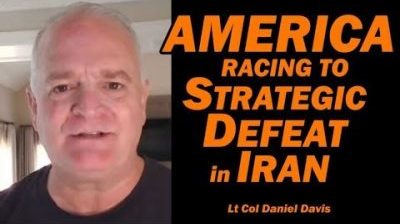
America Racing to Strategic Defeat in Iran
or go to
Aletho News Archives – Video-Images
From the Archives
An Expert Military Analysis of War with China
Actually, None is Necessary
By Fred Reed • Unz Review • December 13, 2020
The Correlation of Armed Forces: U.S. goods and services trade with China totaled an estimated $634.8 billion in 2019. Exports were $163.0 billion; imports were $471.8 billion. The U.S. goods and services trade deficit with China was $308.8 billion in 2019. Trade in services with China (exports and imports) totaled an estimated $76.7 billion in 2019. Services exports were $56.5 billion; services imports were $20.1 billion. The U.S. services trade surplus with China was $36.4 billion in 2019.
There is talk within the Washingtoniat of a possible war with China. Steve Bannon, who apparently was dropped on his head as a child, actually favors such a war. We hear the usual shoo-the-boobs alarm about how the Chinese are doing something terrible and we must gird our loins and American values and show them what for, bow wow, woof. The danger is that the current game of who-blinks-first in Asian waters might actually provoke a shooting war. You know the kind of thing: One warship refuses to get out of the way of another, a collision ensues, some retard lieutenant who signed up on waivers opens fire, and we’re off and running. It is not a good idea to let children play with matches.
The said war is discussed either in emotional terms by idiots or in purely naval terms by those familiar with such things, so we hear of the First Island Chain and the Second Island Chain and whose missiles against the other’s missiles and so on. This would be appropriate if we were fighting World War Two again. Which we aren’t. Let’s take a quick-and-dirty look at how such a war might go.
To begin the war, America would overestimate itself and underestimate China. This is doctrine in the Pentagon. … continue
Blog Roll
 Aletho News
- Suicide Should Not Be a Government Service
- Rethinking America’s greatest threat: Iran vs. Israel-Firsters
- Iran accuses adversaries of false flags to strain Turkey ties
- Poland rules out sending Patriot missiles to US/Israel amid war on Iran
- Tehran approves new Hormuz plan with major restrictions
- No Threat Can Force Iran’s Surrender /Trita Parsi & Lt Cl Daniel Davis
- UK’s New Pandemic Plan Would Turn Big Tech Into a Mass Location Tracking Network
- Growing insecurity, soaring prices fuel protests in north as regime bans evacuation: Sources
- Iran denies responsibility for ‘depraved’ attack on Kuwait desalination plant
- Bring The Troops Back. End This War Now!
- If Americans Knew
- Champagne all around for the new death penalty (for Palestinians) law – Not a ceasefire Day 171
- Why are Palestinian books struggling to be seen on Amazon?
- The Line Between Affinity and Conspiracy
- As Iran targets US military bases, will they be relocated to Israel? Not a ceasefire Day 171
- Will Trump Go Kamikaze?
- Is the University of Florida Shutting Down College Republicans over Israel Criticism?
- Jewish extremist arrested over alleged plot to firebomb Palestinian activist Nerdeen Kiswani’s home
- More than half of Palestinian child detainees have no charges
- The More Murderous Israel Gets, The More We Hear About “Antisemitism”
- Land Day and the Palestinian struggle after 30 months of genocide
- No Tricks Zone
- New Study Finds Warming Saves Lives…Cold Temperatures 12 Times More Deadly Than Excess Heat
- German Science Blog Accuses PIK Climate Institute Of Hallucinating Climate Tipping Points
- Devastating Assessment Of Comirnaty Vaccine By Former Senior Pfizer Europe Toxicologist
- New Study: CO2 Is ‘Effectively Negligible’ As An Explanatory Climate Change Factor Since 2000
- Former Pfizer Toxicologist Dr. Helmut Sterz Tells Bundestag Hearing Pfizer Vaccine Should Have Never Been Approved
- Energy Expert: Germany’s Nuclear Phaseout Was A “500 Billion Euro Mistake”
- New Research: South Australia’s Mid-Holocene Sea Surface Temperatures Were 4°C Warmer Than Today
- Storing Green Energy To Last Germany 10 Days Would Require A 60-Million Tonne Battery
- New Studies: UK Sea Levels Were 4 Meters Higher Than Today During The Mid-Holocene
- Destructive Green New Deal: German Energy And Metal Group Warns Of Drastic Crisis
 Aletho News