Trump’s ultimatum to Russia is bluster and bluff to hide proxy war defeat
Strategic Culture Foundation | July 18, 2025
What’s behind Trump’s angry ultimatum to Russia this week? The short answer: failure and frustration. Donald Trump promised American voters that he would end the Ukraine war in 24 hours upon his election in November 2024. Six months into his presidency, Trump has failed to deliver on his boastful promises.
This week, Trump flipped his pacemaker image by pledging billions of dollars worth of new American weaponry to Ukraine. He also issued a warning to Russia to call a ceasefire within 50 days or else face severe secondary tariffs on its oil and gas exports. The tariffs, quoted at 100 percent, will be applied to nations purchasing Russian exports, primarily Brazil, China, and India. The latter move indicates that the U.S.-led proxy war in Ukraine against Russia is really part of a bigger geopolitical confrontation to maintain American global hegemony.
In any case, Moscow dismissed Trump’s ultimatum. Deputy Foreign Minister Sergei Ryabkov said that Moscow would not comply with pressure and that Russia would not back down from its strategic goals in Ukraine to counter NATO’s historic aggression.
It is clear that Trump and his administration have failed to understand Russia’s strategic position and the root causes of the conflict.
Trump’s supposed diplomacy is seen to operate on a superficial basis more akin to showbiz, with no substance. He wants a peace deal with Russia to show off his vaunted skills as a business negotiator and to grab the limelight, headlines, and adulation.
Resolving a conflict like Ukraine requires deep historical understanding and genuine commitment to due diligence. Moscow has repeatedly stated the need to address the root causes of the conflict: the expansion of NATO on its borders, the CIA-sponsored coup in Kiev in 2014, and the nature of the NATO-weaponized Neo-Nazi regime over the past decade.
Trump and his administration have failed to appreciate Russia’s viewpoint. Thus, expecting a peace deal based on nothing but rhetoric and vacuous claims about “ending the killing” is futile. It won’t happen.
This failure, based on unrealistic expectations, has led Trump to adopt an increasingly bitter attitude towards Russian President Vladimir Putin in recent weeks. Ironically, Trump has accused Putin of duplicity and procrastination when, in reality, it is Trump who has shown no serious commitment to resolving the conflict.
Now, with chagrin and bruised ego, Trump has reacted with frustration over what are his own failings by issuing ultimatums to Russia. Trump’s 50-day deadline for a Russian response to his demands has a similarity to the 60-day deadline he threatened Iran with, after which he carried out a massive bombing attack on that country. Trump’s aggression towards Iran has turned out to be a fiasco and failure. Threatening Russia is even more useless.
This proclivity for threatening other nations has the hallmark of a Mafiosa megalomaniac. It is also causing Trump to lose support among his voter base, who believed he was going to end “endless wars.” It’s shambolic. Biden’s war is becoming Trump’s war because, at the end of the day, it is the U.S. imperial deep state that rules.
Trump’s mercurial switch from professing peace in Ukraine to ramping up the promise of weapons shows that his previous aspirations were always hollow and contingent on other interests.
It seems that the 47th American president did not want peace after all. What was driving his apparent desire to end the conflict in Ukraine – what he deprecated as “Biden’s war” – was simply to cut American financial costs.
What has appealed to Trump is that the proposed new supplies of American weapons to Ukraine will be paid for by Europe. Money and profit are all that matter to him. It is significant that when Trump announced the new arms racket scheme, he was sitting beside NATO chief Mark Rutte in the Oval Office. Rutte has a knack for wheedling, previously referring to Trump as “daddy” and this week absurdly praising the U.S. as the world’s policeman for securing peace. It seems that the NATO and transatlantic ruling establishment have found a way to manipulate Trump. Tell him that the Europeans will henceforth directly subsidize the U.S. military-industrial complex.
The trouble for Trump and the NATO establishment is that it is all an unworkable bluff. For a start, the U.S. arsenal of Patriot missiles and other munitions has been depleted and destroyed by Russia over the past three years in Ukraine. There are no “wonder weapons” that can alter the battlefield dominance of Russia.
Secondly, the European economies are broke and can hardly sustain the proposed purchase of U.S. weapons for Ukraine, even if such supplies were feasible, which they are not. At least four European states, including France, the Czech Republic, Italy, and Hungary, have said they will not engage in any scheme of buying American weapons for Ukraine.
Thirdly, Trump’s threat of secondary sanctions against Brazil, China, India, and others for doing business with Russia is a blatant assault on the BRICS and Global South that will only garner international contempt. Trump’s bullying is neither viable nor credible. His earlier trade war against China has already failed and shown that the United States is an impotent giant whose power is a thing of the past. Trump had to climb down from his hobby horse towards China.
So, threatening to hit China and others with 100 percent tariffs for doing business with Russia is like a former prizefighter shaking a feeble fist while sitting in a wheelchair. He is liable to incur more self-harm.
Lastly, Russia is decisively winning the NATO-led proxy war in Ukraine. The Kiev regime’s air defenses are non-existent at this stage. Therefore, Russia can and will press its strategic terms to end the conflict because it is the military victor.
Trump’s ultimatum to Russia is nothing but bluster and bluff. He once mocked Ukraine’s puppet president Zelensky, that he had no cards to play. Trump, for all his bravado, has only a couple of deuces himself.
In 50 days, Trump will have a serious amount of egg on his face when Russia’s defeat of the NATO proxy war becomes more evident.
Seyed M. Marandi: Israel Attacks Syria – Prelude to Balkanization
Glenn Diesen | July 18, 2025
Seyed Mohammad Marandi is a professor at Tehran University and a former advisor to Iran’s Nuclear Negotiation Team. Prof. Marandi discusses Israel’s efforts to Balkanise Syria. Follow Prof. Glenn Diesen: Substack: https://glenndiesen.substack.com/
X/Twitter: https://x.com/Glenn_DiesenPatreon:  / glenndiesen
Support the channel: PayPal: https://www.paypal.com/paypalme/glenn…
Buy me a Coffee: buymeacoffee.com/gdieseng
Go Fund Me: https://gofund.me/09ea012f
Tulsi Gabbard releases ‘overwhelming evidence’ of Obama coup plot against Trump
RT | July 18, 2025
Former President Barack Obama’s administration deliberately manipulated intelligence to frame Russia for interfering in the 2016 presidential election, according to newly declassified documents released on Friday by Director of National Intelligence Tulsi Gabbard.
Gabbard unveiled more than 100 pages of emails, memos, and internal communications, which she described as “overwhelming evidence” of a coordinated effort by senior Obama-era officials to politicize intelligence and launch the multi-year Trump–Russia collusion investigation. She dubbed it “a treasonous conspiracy to subvert the will of the American people.”
The scandal severely damaged relations between Moscow and Washington, leading to sanctions, asset seizures, and a breakdown in normal diplomacy.
”This intelligence was weaponized,” Gabbard said. “It was used as a justification for endless smears, for sanctions from Congress, and for covert investigations.” She added: “When key internal assessments found that Russia ‘did not impact recent U.S. election results,’ those findings were suppressed.”
“For months before the 2016 election, the Intelligence Community maintained that Russia lacked both the intent and capability to hack U.S. elections,” Gabbard noted. “But once President Trump won, everything changed.”
One document — a draft President’s Daily Brief dated December 8, 2016 — stated Russia “did not impact recent U.S. election results” through cyberattacks. The report, prepared by the CIA, NSA, FBI, DHS, and other agencies, found no evidence of voting interference.
Yet Fox News reported on Friday that the document was pulled — “based on new guidance,” according to internal emails. Hours later, a high-level Situation Room meeting took place, attended by officials including DNI James Clapper, CIA Director John Brennan, National Security Adviser Susan Rice, FBI Deputy Director Andrew McCabe, and Attorney General Loretta Lynch.
According to declassified notes, attendees agreed to produce a new intelligence assessment at President Obama’s request. That report, released on January 6, 2017, claimed Russia had intervened in the election to help Donald Trump — directly contradicting earlier assessments.
Gabbard claims the revised assessment leaned on the discredited Steele Dossier — compiled by a former British spy — while sidelining dissenting views within the intelligence apparatus. “This was not intelligence gathering,” Gabbard stated. “It was narrative building.”
Confirmed as DNI earlier this year — after a contentious process — Gabbard says she has forwarded the documents to the Department of Justice. She has urged investigations into former CIA Director John Brennan and former FBI Director James Comey, who are reportedly facing criminal inquiries. “No matter how powerful, every person involved must be brought to justice,” she stressed. “Our nation’s integrity depends on accountability.”
“The integrity of our democratic republic depends on full accountability,” Gabbard concluded. “Nothing less will restore the public’s trust — and ensure nothing like this ever happens again.”
Kathryn Porter On The Spanish Blackouts
By Paul Homewood | Not A Lot Of People Know That | July 17, 2025
Kathryn Porter has a detailed analysis of the concise but informative report produced by Red Eléctrica de España (“REE”), the Spanish Transmission System Operator on the Spanish blackouts.
It’s way beyond my pay grade, but it can be neatly summed up by this comment from Kathryn:
The Iberian grid was already in a weakened state, owing to insufficient synchronous generation and excessive reliance on inverter-based renewables. The system failed to withstand a fault that originated with a single solar inverter. This was not an unavoidable technical event – it was the result of systemic underestimation of voltage control risks, poor compliance enforcement, and REE’s failure to schedule or deploy sufficient dynamic voltage support.
This blackout would not have occurred in a conventional, high-synchronous grid. The rush to decarbonise the power system without adequate attention to resilience and enforcement has created an atmosphere of complacency. That complacency – shared by policymakers, regulators, and parts of the renewables industry – led directly to a system-wide collapse that cost eleven lives.
I have seen many media reports which have tried to deflect from the role of intermittent renewable energy in the disaster. They have usually highlighted various failings by grid operators and lack of “investment” in the grid.
But such reports miss the point. It is only because of the inherent instability of wind and solar power that all of these investments and safety measures become necessary.
Maybe in a perfect world the Spanish grid would have worked as intended, and there would have been no blackouts.
But we don’t live in a perfect world.
No, CBS Boston, Climate Isn’t Making “Extreme Heat the New Normal”
By Anthony Watts | Climate Realism | July 9, 2025
In the CBS Boston (CBS-B) article titled “Is extreme heat the new normal in Boston? What hitting 102 degrees tells us about climate change,” Jacob Wycoff claims that Boston’s recent heat wave is a symptom of climate change and the “new normal.” This is misleading. In fact, long-term temperature records do not support the notion that heat waves are becoming more intense or more frequent in Boston or across the United States. Historical weather data shows that extreme heat events in Boston are neither unprecedented nor evidence of a climate emergency. The notion that a few hot days in June are proof of a systemic climate shift is simply not supported by the broader climate record.
“What used to be ‘unusual’ is fast becoming our new normal,” Wycoff writes. “And if we don’t act to slow warming, this kind of heat won’t be the exception, it’ll be the expectation.
“If greenhouse gas emissions remain unchecked, Boston’s average summer highs could rise by 9 degrees by 2100,” says Wycoff.
Wycoff’s story, as is usually the case in mainstream media stories about climate change, promotes speculative model projections, while ignoring real world data and trends to the contrary.
It’s a familiar tactic: choose the most aggressive, worst-case emissions scenario and present it as destiny. Climate Central, the source for much of the CBS-B story, uses computer model projections based on RCP 8.5, for example. Yet as noted on Climate Realism, even the Intergovernmental Panel on Climate Change (IPCC) has stepped back from emphasizing RCP 8.5 as a likely pathway, recognizing that is implausible if not impossible.
This climate alarmist framing glosses over essential context: heat waves like the one Boston just experienced have happened before, well before recent increases in carbon dioxide emissions, and are often the result of local urbanization effects—not global climate trends.
Let’s start with the basic fact that the recent heat in Boston, while certainly hot, is far from unprecedented. According to the National Weather Service data, Boston hit a record high of 102 degrees for June on June 24, 2025. But historical data shows that Boston has experienced significantly high temperatures long before modern climate anxieties took hold. Boston’s previous record June temperature of 100℉ was June 6. 1925, 100 years of global warming ago. The highest all time ever recorded temperature in Boston was 104°F in July 1911, followed by 103°F in July 1926. The city also saw 102°F temperatures in 1911, 1975, and 1977. You can see these highs in the graph below with the most recent one on the far right in the figure below.
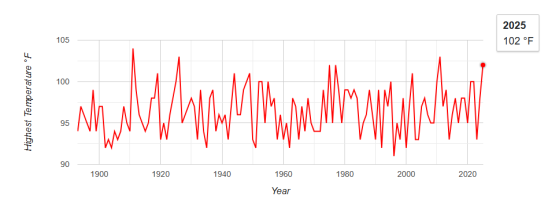
Figure: Hottest annual temperatures recorded in Boston, Massachusetts for each year between 1893 and 2025.
So, if recently increased atmospheric carbon dioxide is responsible for this “new normal” as Wycoff claims, how did these even hotter events happen in the past when carbon dioxide levels were lower? His narrative falls apart in this context.
So, no—extreme heat is not the new normal in Boston. It’s part of a long-standing, intermittent pattern of hot weather events. In fact, the heat experienced in June 2025 didn’t even break Boston’s all-time record. It was simply the hottest June day since 1872, not the hottest day ever.
Nor are extended heatwaves new to Boston. In June 1872, Boston experienced eight days of temperatures above 90°F. Boston also had a multi-day stretch of 100-degree temperatures in July 1911, a heat wave that was deadlier and more extreme than what the city experienced in June 2025. That 1911 event resulted in numerous fatalities across the Northeast, a fact documented well before climate change became the default explanation for every summer hot spell.
The CBS-B article cites Climate Central’s claim that Boston’s overnight summer temperatures have increased by 2 degrees Fahrenheit over the past 50 years. But this trend is almost certainly influenced by the well-known Urban Heat Island (UHI) effect, which causes cities to retain more heat, especially overnight, due to heat-absorbing infrastructure like asphalt, concrete, and buildings. This is not a climate crisis; this is local urbanization.
The UHI effect is well-documented and accounts for much of the localized warming in urban centers. In fact, the National Oceanic and Atmospheric Administration (NOAA) acknowledges that “cities tend to be warmer than rural areas, particularly at night, because buildings, roads, and other infrastructure absorb heat during the day and release it slowly after the sun goes down.”
Boston, like most major metropolitan areas, has undergone significant growth over the last century. The city’s population has grown substantially over the past 70 years. With more people bringing with them the development of more houses, buildings, streets, bridges, concrete, blacktop, machinery, and denser development, all of which contribute to warmer temperatures. The temperature increase isn’t a global phenomenon playing out on a Boston street corner—it’s a localized, urbanized one.
Furthermore, the idea that climate change is singularly responsible for making hot days “six times more common” in Boston is based on computer model forecasting, not measured trends. CBS-B leans heavily on Climate Central’s Climate Shift Index, which is a modeled estimate—not direct measurement—of climate influence. These types of attributions rely on climate models that, as Climate Realism has repeatedly shown, consistently overstate future warming compared to observed reality. Research by Roy Spencer Ph.D., has demonstrated that most climate models overestimate warming by up to 50 percent compared to satellite data.
What CBS-B also fails to mention is that heat-related deaths in the U.S. have been declining, not increasing. Thanks to modern air conditioning, improved healthcare, and public awareness, society is far more resilient to heat than it was a century ago. According to a 2022 study published in The Lancet, cold weather still kills significantly more people than heat does.
The CBS-B story is a prime example of lazy climate reporting. It cherry-picks recent temperatures, ignores over a century of weather history, and repeats activist talking points without challenge. CBS-B’s failure to carry out basic fact checking resulted in a story that was alarmingly misleading. The story is an example of the type of “journalism” that is eroding the public’s trust in journalists and mainstream media outlets they report for.
Europe Faces Backlash Over Climate Speech Crackdown Suggestions
By Cindy Harper | Reclaim The Net | July 17, 2025
Tensions over how climate change is discussed, and who gets to control that conversation, are escalating across Europe.
At the European Parliament’s environment committee this week, the European Commission defended its campaign against “climate disinformation,” facing down strong opposition from lawmakers who fear the erosion of free expression.
Meanwhile, in the UK, Labour donor and green energy tycoon Dale Vince added fuel to the fire by publicly calling for criminal penalties against climate skeptics.

Opening the committee session in Brussels, Commission official Emil Andersen attempted to draw a line between belief and verifiable fact: “As citizens of a free society, we are each entitled to our own opinions but not entitled to our own facts.” That assertion quickly ran into fierce resistance, with several parliamentarians warning of state overreach cloaked in scientific authority.
Anja Arndt of Germany’s AfD challenged the prevailing climate consensus and accused the EU of weaponizing disinformation policy. “A front-on attack on freedom of expression, freedom of science, and the truth,” she declared. Her colleague Marc Jongen warned that if the European Commission took it upon itself to decide what constitutes truth, then “we’re on the road to a totalitarian system.”
Those concerns found parallels in the UK. Dale Vince, founder of Ecotricity and a major Labour Party financier, stated that climate skepticism should not only be rebutted but also punished. Writing on X, he said, “I’d make climate denial a criminal offence myself – given the incredible harm that it will cause, even by slowing down progress to net zero.” Rather than promoting dialogue or transparency, Vince called for punitive action against dissenting opinions.
His comments came shortly after Energy Secretary Ed Miliband lashed out at both the Conservatives and Reform UK for resisting rapid decarbonization. “Future generations” would hold them accountable, he said in an interview with The Times.
While many agree on aspects of environmental responsibility, calls to outlaw disagreement threaten to undermine core democratic values. Branding opposing views as dangerous, rather than countering them with argument and evidence, risks transforming public discourse into a one-sided echo chamber.
Inside the European Parliament, skepticism about the Commission’s disinformation push was not confined to the political fringes. Sander Smit of the centre-right European People’s Party expressed concern that Commission-backed “fact-checking” could suppress debate, especially during elections. He argued that this approach might render “a certain type of discussion” impossible.
Others in the chamber took the opposite view. Members of liberal and social democratic groups insisted that denying climate science was not an acceptable position in democratic debate. Gerben-Jan Gerbrandy of the Renew group maintained that accepting climate science was based on evidence, while rejecting it was “precisely” ideological. He urged lawmakers to maintain integrity in public discourse and to form a coalition against climate denial. He also asked the Commission to formally refute what he described as the AfD’s “nonsense,” though no assurance was given.
World rallies behind Syria as Israel tears away at it
Press TV – July 18, 2025
International organizations and a whole host of countries have expressed outright condemnation of the Israeli regime’s escalating deadly and destructive attacks against Syria under the pretext of protecting the country’s Druze minority.
A torrent of statements followed the regime’s attack on various areas in the country on Wednesday, including areas lying in its south, in reported support for the Druze.
The attacks came as fighting between members of the minority and Bedouin tribes has killed hundreds of people, with the Israeli involvement being feared to be aimed at intensifying the confrontations and further destabilizing Syria.
UNSC calls for end to Israel’s ‘impunity’
Addressing the situation, Pakistan, which holds the United Nations Security Council (UNSC)’s rotating presidency, denounced the Israeli aggression.
Ambassador Asim Iftikhar Ahmad noted that the attacks resembled Tel Aviv’s atrocities against the Gaza Strip, Lebanon, Iran, and Yemen, all of which violated the international law. The envoy also called for an end to the regime’s impunity.
Mohamed Khaled Khiari, UN assistant secretary-general, denounced the Israeli escalation on the part of the world body’s chief, Antonio Guterres.
He said the attacks amounted toa violation of Syria’s sovereignty and territorial integrity, and further destabilized the country amid the already sensitive situation.
The official also advised that Tel Aviv respect the 1974 agreement that has mandated its refusal to conduct violations against the Arab nation.
China calls for Israeli withdrawal
Geng Shuang, China’s deputy UN ambassador, said Beijing called on “Israel to immediately cease its military strikes on Syria and withdraw from Syrian territory without delay.”
Chinese Foreign Ministry spokesman Lin Jian also said the attacks amounted to a flagrant violation of international law and Syria’s sovereignty, saying the Arab country had to be spared of whatever measure that could lead to further crisis and tension.
Turkey: ‘Terror state’ Israel using Druze as excuse
Turkey’s President Recep Tayyip Erdogan called the Israeli regime a “terror state.”
“Israel, using the Druze as an excuse, has been expanding its banditry into neighboring Syria over the past two days,” he said in a televised speech.
Erdogan said Turkey would not allow Syria’s partition, saying Tel Aviv’s actions showed it was not after peace.
PGCC: Israel after irresponsible escalation
The Persian Gulf Cooperation Council’s Secretary-General, Jasem Mohammed Albudaiw,i also said the Israeli regime’s atrocities indicated its efforts at irresponsible intensification of standing tensions.
The Israeli aggression, he added, also showed the regime’s disregard for the international community’s efforts at realizing stability and ensuring security in Syria.
Hamas: Israeli aggression ‘systematic terrorism’
The Palestinian resistance movements, Hamas and the Islamic Jihad, called the atrocities “organized terrorism.”
The latter also said Tel Aviv was trying to fragment the region through violence, reaffirming solidarity with Syria and supporting its right to resist by all means.
Ansarullah: Israeli attacks part of ‘imperialist scheme’
Yemen’s Ansarullah resistance movement denounced the Israeli strikes as part of a larger “imperialist scheme” to dominate the Arab and Muslim world.
It called for a unified Arab-Islamic response and an end to silence in the face of the aggression.
Muslim states hold intensive talks
Foreign ministers from various regional Muslim countries have, meanwhile, held intensive talks concerning the state of affairs.
The talks were held among top diplomats from Jordan, the United Arab Emirates, Bahrain, Turkey, Saudi Arabia, Iraq, Oman, Qatar, Kuwait, Lebanon, and Egypt.
The discussions that were held with the aim of helping the countries in question adopt a unified stance in the face of the situation saw the officials reiterate support for Syria’s security, unity, stability, and sovereignty.
They called on the UNSC to assume its legal and moral duties towards guaranteeing the withdrawal of the Israeli regime from Syria, and bringing about an end to its aggression by obliging it to abide by the 1974 agreement.
Malaysia: Israel threatening international peace
Malaysia also called for the international community “not to tolerate the continued aggression by the Israeli Zionist regime against other countries, threatening regional and international peace and security.”
Malaysian Prime Minister Anwar Ibrahim said after decades of hardship, the Syrian people deserved peace, not further violence and external interference.
Norway’s foreign minister has also said he was “deeply concerned about recent Israeli airstrikes and rising domestic tensions.”
Iran rejects Argentina’s ‘baseless’ accusations in 1994 AMIA case, urges fair probe
Press TV – July 18, 2025
Tehran has dismissed “baseless” accusations leveled by Argentina at Iranian nationals in connection with the deadly 1994 AMIA bombing, urging the country’s judiciary to handle the case fairly without third-party influence.
The Iranian Foreign Ministry issued a statement on Friday, marking the 31th anniversary of the bombing attack on the Argentine Israeli Mutual Association (AMIA) community centre in Buenos Aires on July 18, 1994, that killed 85 people and injured over 300 others.
It said that elements and currents linked to Israel exploited the “suspicious” explosion from the very beginning and diverted the case into a misleading and incorrect path, disrupting the longstanding Iran-Argentine relations.
It also noted that over the past three decades, Iran has repeatedly declared its position in condemnation of any act of terrorism and stressed the need for a transparent and fair trial into the incident.
“Completely rejecting the accusations against its citizens, the Islamic Republic has condemned the insistence of certain domestic circles in Argentine to pressure the country’s judicial system into issuing baseless charges and seemingly judicial rulings against Iranian citizens,” it said. “Iran has called for the real masterminds and perpetrators of the explosion to be identified.”
Meanwhile, the Foreign Ministry added that in the past years, clear and undeniable evidence has emerged indicating that the Zionist regime and its affiliated currents are exerting influence and pressure on the Argentinean judicial system to make accusations against Iranians.
It further highlighted frequent changes in the judicial team investigating the AMIA case, the revelation of corruption among some judicial elements, the resignation of judges and even attempts on their lives, as an evidence of a “purposeful will to divert the Argentinean judicial system from a transparent and fair probe into the case.”
With the sole aim of protecting bilateral ties and restoring the dignity of Iranian citizens, the Islamic Republic entered into talks with Argentina, which resulted in the signing of a memorandum of understanding in 2013, the ministry said. Less than two years later, however, Buenos Aires unilaterally canceled the deal and prevented the formation of a transparent process aimed at revealing the truth and identifying those behind the blast.
“The Islamic Republic strongly emphasizes the baseless nature of claims against Iranian citizens, insists on the restoration of the accused citizens’ dignity and demands an end to the show trial, while expecting the Argentinean judicial authorities to handle the case in a transparent and fair manner free from politicization and undue influence by third parties,” it asserted.
“In accordance with international law, the Islamic Republic reserves its legal and legitimate rights to respond to any inappropriate and unreasonable action against itself and its citizens.”
Want To Wipe Out Patriot Systems? Ask The Russians How
Sputnik – 18.07.2025
US-made Patriot air defenses aren’t a magic fix for Ukraine — and Russia’s arsenal has already exposed their weaknesses.
“Patriot is ineffective against hypersonic missiles,” retired Russian Colonel Viktor Litovkin tells Sputnik.
- The Kh-47M2 Kinzhal, a Russian hypersonic missile that reaches speeds up to Mach 10 and ranges of 3,000 km, easily destroys Patriots.
- Iskander-M’s single-stage solid-fuel guided missile 9M723 boasts a quasi-ballistic trajectory. With a striking range up to 500km it is another effective tools against Patriot systems.
- Both the Iskander-M and Kinzhal systems demonstrate high precision.
- Not by hypersonic alone: Geran dones + Kalibr missiles is a killer combo. A swarm of Geran drones forces Patriots to waste missiles. Then, while it’s reloading, a cruise missile, like a Kalibr, is fired.
Patriot’s Achilles’ heels
- “Dead Zones”: The Patriot has dead zones, like up to 100m altitude where it can’t detect targets, per Litovkin.
- So drones flying low can evade it. This is exactly how Houthi drones overcome air defenses in the Middle East, and Patriots couldn’t stop them.
- Easy to detect: The Patriot system has a radar station that emits radio waves. By detecting these waves, you can determine where they come from and pinpoint the coordinates of the source. So, in this case, reconnaissance is technically quite simple.
Ukraine’s Layered Defense Dream
The Kiev regime aims to build a layered system, says Yuriy Knutov, a military expert and air defense historian, which would include:
- long-range Patriots
- mid-range SAMP/T
- short-range NASAMS or IRIS-T
- plus Gepard guns
Who gets protection:
- Knutov believes that new Patriot systems will protect Western military plants in Ukraine.
- They’ll also be deployed around Kiev, Kharkov, Odessa, and Lichevsk — key hubs for weapons.
- Ukrainian troops at the front lines? Just cannon fodder.
The Patriot is the core — so it must be precisely targeted, he says.
Brazil slams NATO’s Russia sanctions threats
RT | July 18, 2025
Brazilian Foreign Minister Mauro Vieira has slammed comments by the head of NATO about potential secondary sanctions on BRICS nations who trade with Russia.
Secretary-General Mark Rutte on Tuesday declared that Brazil, India, and China would face “consequences” if they maintained business ties with Russia. He singled out oil and gas trade, and urged the countries’ leaders to call Russian President Vladimir Putin and push him to engage “serious[ly]” in Ukraine peace talks.
Brazil is a founding member of BRICS, formed in 2006 with Russia, India, and China. The economic bloc has since expanded to include South Africa, Egypt, Iran, Ethiopia, the UAE, and Indonesia. Last year, BRICS approved a new ‘partner country’ status in response to growing membership interest shown by more than 30 countries.
Speaking to CNN Brazil on Friday, Vieira dismissed Rutte’s comments as “totally absurd,” pointing out that NATO is a military bloc, not a trade body, and that Brazil is not a member.
“Brazil, like all other countries, handles commercial matters bilaterally or within the WTO framework. Therefore, these statements by Rutte are utterly unfounded and irrelevant,” Vieira said.
He also noted that the EU – many of whose members are part of NATO – is a significant buyer of Russian energy. Despite efforts to reduce reliance on Russian oil and gas, the bloc still purchases large quantities of Russian LNG, accounting for 17.5% of its imports in 2024, industry data shows.
Rutte’s warnings follow a similar threat from US President Donald Trump, who this week announced new military aid for Ukraine and threatened 100% tariffs on nations trading with Russia, unless a peace deal is reached within 50 days.
Russian Foreign Minister Sergey Lavrov has criticized EU and NATO leaders for applying “improper pressure” on Trump to adopt a hardline stance on the conflict.
Moscow says it remains open to negotiations with Kiev but is still waiting for a response on when talks will resume. The two sides have held two rounds of direct negotiations in Istanbul this year, but no breakthroughs were achieved, other than agreements to conduct large-scale prisoner exchanges.
Ukrainian Diplomats in Latin America Recruiting Mercenaries for 25th Air Assault Brigade
Sputnik – 18.07.2025
The Ukrainian Embassy in Peru, which also handles Kiev’s relations with Ecuador and Colombia, has been recruiting mercenaries with combat experience to join Ukraine’s 25th Air Assault Brigade via its website, Sputnik has found out.
The embassy’s website features a link to a portal that invites foreign fighters to join the 25th Brigade as infantrymen and drone operators. The brigade is active on the Dnepropetrovsk and Donetsk fronts.
The requirements include “high level of physical fitness and motivation, military experience and drone operation experience.” The posting says that recruitment is being conducted on an urgent basis.
In an interview with Sputnik in June, Russian Ambassador in Bogota Nikolai Tavdumadze said that Ukraine was recruiting mercenaries in Colombia through its embassies, in violation of the Vienna Convention on Diplomatic Relations. In March, relatives of Colombian mercenaries protested outside the Foreign Ministry building in Bogota to demand clarity about the whereabouts of their loved ones.
The Russian Defense Ministry has repeatedly warned that Kiev uses foreign fighters as “cannon fodder” and that the Russian military will continue to strike mercenary troops across Ukraine. Colombians have been complaining about poor coordination in the Ukrainian armed forces, which makes survival in the high-intensity conflict in Ukraine much harder than in Afghanistan or the Middle East.
Germany, UK to deliver long-range weapons to Ukraine under new pact
Al Mayadeen | July 17, 2025
Ukraine is set to receive new long-range weapons systems developed through joint efforts by British and German defense industries, German Chancellor Friedrich Merz announced Thursday. The deliveries are expected to begin within the next few weeks and continue over the coming months.
The statement followed the signing of a new bilateral agreement between Germany and the United Kingdom. Chancellor Merz and UK Prime Minister Keir Starmer formalized what they described as a “historic” treaty focused on friendship and enhanced defense cooperation during a joint appearance in Berlin.
Speaking at a press conference alongside Starmer, Merz stressed the expanded scope of military assistance to Ukraine. “We had a detailed discussion about military support for Ukraine, and this is not only about air defense, but also about Ukraine’s ability to better defend itself with long-range systems. We call this long range fire,” he said during the event, which was broadcast by Germany’s Phoenix TV.
He added that “Ukraine will soon receive significant additional support in this area, including through the industrial cooperation that we have established with Ukraine.”
Arming Ukraine
The delivery of these advanced systems comes in light of a deepening of European defense collaboration in support of Ukraine, amid ongoing hostilities with Russia. The weapons transfer is part of a broader framework outlined in the Kensington Treaty, signed on July 17, 2025, in London, the first post-WWII bilateral defense treaty between the UK and Germany. The pact not only strengthens joint military production but also facilitates financing and technological cooperation with Ukraine’s domestic arms industry.
Germany has already committed approximately €5 billion to support Ukraine’s production of long-range strike capabilities and has lifted previous range restrictions on German-supplied weapons, enabling Kiev to strike targets within Russian territory. British-German collaboration is also laying the foundation for future deep-precision systems with ranges exceeding 2,000 km, designed to ensure sustained deterrence capabilities in Eastern Europe.
These moves reflect a decisive shift in European defense policy amid increasing urgency to counter growing Russian military pressure.
Provocative Escalation
Moscow has responded with sharp warnings. Russian Foreign Minister Sergei Lavrov condemned Germany’s posture, suggesting it reveals the true intentions behind Western support for Kiev.
Kremlin spokesperson Dmitry Peskov criticized the deepening UK-Germany military alignment as a destabilizing factor for European security. Former President Dmitry Medvedev went further, cautioning that continued Western arms deliveries to Ukraine may provoke preemptive Russian strikes.
In a statement reported by TASS, he described the expanding range and sophistication of Western weapons as justification for escalating Russia’s own military posture.
Russian officials argue that this latest escalation marks a direct provocation, framing the treaty and weapons transfer as an existential threat that could draw Europe into broader conflict.
Featured Video

Prof. Ted Postol: Iran Already Achieved Nuclear Deterrence Against Israel
or go to
Aletho News Archives – Video-Images
From the Archives
How the occupied mentality syndrome works
Saudi Arabia on the American chessboard – Part 3
By B. J. Sabri | American Herald Tribune | June 27, 2016
Read part 2: “The occupied mentality Syndrome“
Previously I argued whether Saudi Arabia’s repeated involvements in U.S. interventions and wars stem from free national will or in response to a specific condition. For starters, in Saudi Arabia there is no national will. In Saudi Arabia, the national will is the will of the Al Saud clan. Still, when a major Arab state allies itself with a superpower that committed unspeakable crimes against humanity in almost every Arab country, then something is wrong. This fact alone should compel us to examine the U.S.-Saudi relation for one exceptional reason. As a result of the U.S.-Saudi wars, hundreds of thousands of people in Afghanistan, Iraq, Iran, Libya, Syria, Yemen, and Somalia have lost their lives. Millions became displaced in their own homelands. And millions more rendered refugees.
Attributing the Saudi policies to the bonds of “partnership” with the U.S. is frivolous. There are no bonds between these two thugs except those of business, military deals, secret plots, and wars. Proving this point, bonds such as these have no space for the American and Saudi peoples to share significant cultural or societal exchanges. If partnership is not the reason for the Saudi contribution to the U.S. strategy of empire and imperialism, then another reason must exist.
This leads to three possibilities. … continue
Blog Roll
 Aletho News
- Hezbollah hits Israeli warship off Lebanon’s coast, sets it aflame
- Iran slams US strikes on B1 bridge, Mahshahr petrochemical plants as ‘blatant acts of state terrorism’
- In letter to UN chief, Araghchi warns of dire consequences of US-Israeli attacks on Iran’s nuclear facilities
- Why the CIA conspiracy to invade Iran with Kurdish militias failed
- Why Are Upbeat US Claims About Mission to Rescue Pilot ‘Highly Questionable’?
- Aircraft destroyed during US ‘rescue’ of downed F-15 pilot cost more than $100 million each
- Washington University removes professor who condemned US-Israeli war on Iran
- Russia Warns of Retaliation as UK Authorizes Seizure of Vessels
- Serbia thwarts plot to bomb Russia-Hungary gas pipeline – Vucic
- Al Mayadeen voices solidarity with Dr. Marandi amid death threats
- If Americans Knew
- In Iran, Israel-US take aim at “reason, research, and freedom of thought” – Daily Update
- US loses planes over Iran, Israel downgrades Lebanon war goals – Daily Update
- Israel Is Blocking Palestinians from Easter at Church Where Jesus Resurrected
- Plot to assassinate Palestinian activist follows harassment campaign promoted by Zionist groups and elected officials
- Prominent New York synagogue hosts presentation on why U.S. Jews should support the ethnic cleansing of Gaza
- Tapper vs. Piker: Is the CNN Anchor Auditioning for David Ellison?
- Shouldn’t Democrats Be Able to Condemn Genocide?
- Israel-US kill negotiators, destroy civilian structures, but Iran’s military capabilities still largely intact – Daily Update
- ‘War crime’: Global condemnation as Israeli ministers celebrate death penalty law targeting Palestinian prisoners
- 7 Ways Israel Is Turning Lebanon Into Gaza
- No Tricks Zone
- An Inconvenient Tree: Uncovered In Alps… Europe Much Warmer Than Today 6000 Years Ago
- New Study Reports A 60% Slowdown In Greenland’s Ice Loss Rate In The Last Decade
- Low Intensity Tornado Wrecks Major Solar Farm, Creating A Potential Toxic Dump
- New Study Finds Warming Saves Lives…Cold Temperatures 12 Times More Deadly Than Excess Heat
- German Science Blog Accuses PIK Climate Institute Of Hallucinating Climate Tipping Points
- Devastating Assessment Of Comirnaty Vaccine By Former Senior Pfizer Europe Toxicologist
- New Study: CO2 Is ‘Effectively Negligible’ As An Explanatory Climate Change Factor Since 2000
- Former Pfizer Toxicologist Dr. Helmut Sterz Tells Bundestag Hearing Pfizer Vaccine Should Have Never Been Approved
- Energy Expert: Germany’s Nuclear Phaseout Was A “500 Billion Euro Mistake”
- New Research: South Australia’s Mid-Holocene Sea Surface Temperatures Were 4°C Warmer Than Today
 Aletho News