Western media silence on anti-conscription, anti-war protests in Ukraine
By Dmitri Kovalevich | Al Mayadeen | August 15, 2025
In early August, the most discussed topic in Ukrainian society concerns protests against the governing regime in Kiev, including their future prospects. Beginning July 23, two different forms of public demonstrations erupted in Ukraine, quite opposite in their aims. One-sided reporting of them by Western media agencies has revealed to the Ukrainian population this media’s hypocrisy and double standards.
Protests in Kiev by pro-Western NGOs erupted late on July 22, quickly earning the moniker ‘Cardboard Maidan’. This refers to the cardboard signs being carried by protesters (bearing demands similar to those of the ‘Euromaidan’ protests, which began on Maidan Square in central Kiev in late 2013 and led to the violent, paramilitary coup of February 2014). Protesters gathered in their thousands in Kiev beginning on the evening of July 23 and during the days following to condemn the decision of the regime of the unelected ‘president’ Volodomyr Zelensky to severely weaken the work and the powers of the two leading anti-corruption agencies of the Ukrainian state.
The sham role of anti-corruption agencies
The agencies were created at the insistence of Western embassies following the 2014 coup but have never actually fought corruption. They have served, instead, to warn or chastise certain thieving officials in the governing regime and economy of the country. The record shows that even if a government or police official is caught taking a bribe, he or she is rarely convicted of anything or sentenced to prison. Instead, ‘anti-corruption’ agencies usually oblige the accused to ‘make a deal’ with investigators, after which the accused typically find employment at Western embassies or non-governmental organizations.
In reality, these agencies have served as tools for external control of Ukraine and the Zelensky-led governing regime.
Zelensky and his legislature (both of whose electoral terms expired in April 2024) approved a bill on July 22 that would henceforth subordinate the work of anti-corruption agencies to the presidential office of Zelensky. The bill was approved within a couple of hours of the meeting, and following the vote, legislators were quickly sent on vacation.
“Corruption has eaten away at the office of the Ukraine president. As anti-corruption agencies get closer to Zelensky’s closest thieves, NABU detectives are being arrested and NABU itself is being disbanded,” writes Ukrainian blogger Anatoly Shariy, who previously fled Ukraine to Spain.
In July, the work of anti-corruption agents and their two leading agencies began to get uncomfortably close to Zelensky’s own entourage and relatives. In response, agents of the SBU (national secret police agency), who are entirely controlled by Zelensky and his regime, began searching and arresting investigators of the National Anticorruption Bureau (NABU), as well as those of the Specialized Anti-Corruption Prosecutor (SAPO). SBU officers accused the agents of ‘working for Russia’.
Zelensky’s team hoped that since the anti-corruption agencies being targeted had been created during the previous US presidential administration of Joseph Biden, the administration now led by Donald Trump would be unlikely to defend them.
The reaction of Western media and embassies to the turn of the Zelensky regime against the agencies was immediate. The British and American media began accusing Zelensky of authoritarianism. Representatives of Western NGOs took to the streets of Kiev carrying their cardboard protest signs. Formally, any and all protest rallies are prohibited in Ukraine under martial law, but this was a case of protest by several thousand people who happen to work for Western embassies or for NGOs whose salaries are paid directly or indirectly by the embassies.
A further reason for the ‘courage’ of these protesters in taking to the streets is that all employees of Western NGOs in Ukraine are exempt from conscription and cannot, therefore, be punished by the threat of immediate conscription. Those who work directly for a Western government or Western-financed NGO are considered to be an ‘elite’ in wartime Ukraine, unlike the workers in Ukrainian enterprises who keep the country and its war running, so to speak. The recent protesters in Kiev have covered their actions in nationalist slogans reminiscent of the 2014 Euromaidan coup, demanding Zelensky’s resignation and accusing him of betraying the ‘ideals of Europe’.
Zelensky was soon forced to repeal the law, having lost face and being subject to public humiliation. Legislators were hastily called back from vacation on July 30. Within a day, they solemnly adopted a bill, unanimously no less, repealing the bill they had passed one week earlier.
This case showed Ukrainians who is the real boss in the country. Legislator Alexander Dubinsky writes that starting from August 1 (the day after the repeal of the presidential order and legislation to weaken anti-corruption agencies), “The president will begin a new and interesting life — a phase of explanatory diplomacy in 24/7 mode.” In other words, Zelensky will have to steadily twist and turn as he continues to tell Western sponsors that there is no corruption in Ukraine, and adds that Russia is trying to frame him. Ukrainians and Russians have a saying ‘to wriggle like an eel’; many are now using this to describe Zelensky’s behavior.
Marat Basharov, a professor at the Russian Higher School of Economics, believes that anti-corruption agencies were created by the Western powers in Ukraine in order to gather information on who is stealing in Ukraine, by how much, and then bring such individuals and groups of individuals under the supervision of the Ukrainian elite as a whole through their state institutions. He writes that “the anti-corruption agencies work not for justice but for the CIA: everything that agents of NABU collect, including documents, wiretaps and other products of surveillance, have gone to the U.S. embassy and from there to Washington. NABU has also created a whole network of informants to snitch and betray; the amount of compromising material so collected is enormous.”
Ukraine as mercenary state
Ukrainian media outlets are citing threats by the International Monetary Fund and the European Union to cut off funding as being the main reason for Zelensky’s retreat. Currently, Ukraine’s entire budget–including government spending and social payments, building and maintenance of infrastructure, and provision of military supplies–depends entirely on the continued ‘generosity’ of the Western powers.
In early August, the head of the financial committee of Ukraine’s national legislature, Danil Getmantsev, stated that everything in Ukraine that is not related to the war is being paid for by the West, but most of this is in the form of loans. According to him, Ukraine does not use its own budget revenues for non-military needs; all tax revenues are directed exclusively to the country’s military.
According to Bloomberg News on July 25, the Zelensky-led regime is preparing to demand that countries of the European Union undertake the financing of the salaries of Ukrainian military personnel. Should the EU concur, the Armed Forces of Ukraine will formally become what it already acts like: a mercenary army. So far, news outlets in Europe are silent on the matter. The Estonian vice-president of the EU, Kaja Kallas, issued a statement on August 6 stating, “The EU and its member states remain committed to provide Ukraine and its people with all the necessary political, financial, economic, humanitarian, military, and diplomatic support, for as long as it takes and as intensely as needed.”
Ukrainian economist Alexei Kushch cautions that Ukraine is approaching complete and irreversible bankruptcy. He told a podcast on July 30, “Soon, our creditors may start lining up to divide up strategic assets. The Americans will shout that they have an investment fund and will show off papers to this effect, the Brits will wave a century-old agreement with Ukraine (giving them privileged consultation on government decisions), and the EU will talk about a Ukraine ‘association’ (integration). Someone in charge will shout ‘Get in line, you sons of bitches, get in line!”
In financial terms, Zelensky is like a swindler who has managed to mortgage the same property to multiple banks all at once. But this is impossible to pull off if the Western officials who allocate loans to Kiev from their state public budgets are not themselves involved.
Suppression of protests against conscription
Alongside the protests opposing any restrictions on Western financial control over Ukraine, spontaneous protests against forced conscription are also rising in the country daily. The largest of recent protests took place on August 1 in the city of Vinnytsia in south-central Ukraine (app. 200 km southwest of Kiev, pre-war population of 350,000). A crowd of women and youths stormed a stadium where more than 100 forcibly conscripted men were being held. Zelensky threw all available police and SBU forces against the protesters, including the use of tear gas.
Western media stubbornly ignore reporting on anti-conscription protests. Instead, they pay close attention to rallies by handfuls of nationalists employed at Western-funded NGOs in a regional center, while there is total silence when it comes to protests against conscription. Banning of rallies during martial law does not apply to rallies held in the name of protesting corruption, while Ukraine’s entire policing apparatus is unleashed against anti-conscription protests. These examples are serving as living proof to ordinary Ukrainian citizens of the hypocrisy and double standards of the Western media and Ukrainian authorities.
One exception to Western media silence over conscription is a recent report in the Financial Times (paywalled) entitled ‘Shoved into vans, slashing tyres, Ukrainians balk at conscription’. The report notes that resistance to the recruiters is growing in Ukrainian society but concludes, oddly, that this is being stoked by Zelensky’s refusal to respond to calls from the West to begin conscription of young people under the age of 25.
The Ukrainian online publication Strana wrote on August 5 that intolerance toward military recruiters and the law enforcement officers assisting them is growing in Ukrainian society, and this could lead to even more clashes between civilians and recruiters. The confrontations will only intensify, Strana believes, if rumors of an upcoming reduction in the conscription age from 25 to 18, long demanded by Western governments, are confirmed.
An anarchist writing from Odessa, Vyacheslav Azarov, sees the protest at the stadium in Vinnytsia as the beginning of a new phase of resistance to conscription. “The stunning nighttime storming by protesters of the Lokomotiv stadium in Vinnytsia, where forcibly mobilized recruits were being detained, marks a new phase in the tensions in the Ukrainian rear. Ukrainians are tired of the war. Not only the relatives and friends of the victims of the recruiters but also representatives of certain public organizations tried to rescue the prisoners from the stadium, so much so that the police had to use tear gas and batons in order to disperse them.”
Legislator Alexander Dubinsky, who has been detained for the past 21 months under criminal accusations of treason, has written an appeal to Donald Trump, seeking to draw his attention to the arbitrariness of the recruiters and police in Vinnytsia. “The situation in Ukraine is escalating,” he writes. “There are fierce clashes between civilians, the TCC [military recruiters], and the police. People are rising up against the violent mobilization of their sons, husbands, and brothers. Men are being grabbed off the streets like cattle, beaten, forced to sign consent forms to participate in the war, and then are sent straight to the front lines.”
Dubinsky emphasizes in his open letter to Trump that Ukraine’s Western allies are closely following and publicizing the protests in Kiev defending the anti-corruption agencies being targeted, but are failing to report the news of “pregnant women being tear-gassed for simply demanding to know whether their son, husband or brother is alive”. He believes that without a reaction from the US government to Zelensky’s terror, he will continue to denigrate and destroy the Ukrainian people and nation.
In another post to social media about the protests against conscription, this one dated August 4, Dubinsky admits that the West is keen to see continued ‘busification’ (forced conscription) of Ukrainians, so help and sympathy should not be expected from there. “Since war is the approved policy of the EU and the U.S. towards Ukraine, it is impossible to expect them to protest against the actions of the military recruiters and the police who enforce the conscription policy. But if the Ukrainian authorities decide to push back and protest against external control over their actions, then protesting is allowed. Understand this, serfs,” writes the imprisoned Ukrainian legislator.
The Ukrainian underground organization ‘Workers’ Front of Ukraine’ (WFU) is asking why the spontaneous protest in Vinnytsia was not supported by thousands more city residents. “What about the rest of the city; couldn’t more concerned people have protested in Vinnytsia? Yes, they could have. After all, the protesters launched an online broadcast, and its broadcast information instantly spread across social media networks. But more people did not rally”, the WFU laments. Activists of the organization call this a disgrace for Ukrainian society, which they accuse of “meekly going to the slaughter, its members acting like sheep being set upon by wolves”.
The Ukrainian magazine Liberal notes that Zelensky’s administration is preparing for an increase in spontaneous protests and intends to suppress them with particular force. “Volodymyr Zelensky has long since established himself as a full-fledged dictator. He may show his true colors in the challenging times ahead”, Liberal writes. According to the magazine’s sources, prisoners convicted of criminal offenses are being transferred out of prisons in the Kiev region. The publication concludes that this is happening in order to make room for a coming wave of detentions of political prisoners.
The liberal-left publication Assembly in the city of Kharkiv (the second largest city in Ukraine) notes that the civil conflict unfolding on the streets of Ukraine between the people and the repressive forces of the state is continuing unabated, although it does not attract as much media headlines as do the rallies protesting the curtailment of the powers of anticorruption agencies. (Many Ukrainians call these particular allies a ‘competition among parasites’.) Assembly acknowledges, nevertheless, that in Kharkov, “rebelling while on one’s knees remains the lot of protesting civilians”. It says that “Soldiers voting with their feet by conducting mass desertions have a much better chance of stopping the ‘conveyor belt of death’ taking place on Ukrainian soil compared to protesting on one’s knees.”
In early August, legislator Anna Skorokhod stated that the total number of desertions in the Ukrainian army had reached almost 400,000. That amounts to a rate of desertion of some 40 per cent of Ukrainian army recruits (voluntary or conscripted, with some deserters being recaptured or returning of their own accord).
In this situation, the tactics of the advancing Russian army have changed somewhat, as reported by the commander-in-chief of the Armed Forces of Ukraine, Alexander Syrsky, in early August. According to him, there is now a “total penetration” of Russian army groups into the rear of the Armed Forces of Ukraine along the front lines. The Ukrainian army does not have enough personnel to cover the entire front line, so Russian soldiers often bypass its sparse positions, creating panic and chaos in its operations.
There appears to be no way out of the morass for the Kiev regime. That includes the upcoming meeting in Alaska between the Russian and US presidents. The meeting was supposed to offer some hope for the Trump regime in Washington that a ceasefire could be agreed on that would halt the accelerating Russian military advances. But Russia says the original goals of its military intervention in Ukraine—demilitarization and ‘de-Nazification’ of Ukraine–remain in place, while US media is reporting on August 12 that the White House now expects the meeting in Alaska to be limited to ‘exchanges of information’.
How the West Criminalised Diplomacy
By Prof. Glenn Diesen | August 15, 2025
The tragedy of great power politics derives from the international anarchy, which refers to the absence of a central authority in the world. The point of departure in international security studies therefore tends to be the competition for security, as security for one state often results in insecurity for another.
This international system based on international anarchy originated with the Peace of Westphalia in 1648, which laid the foundation for the modern world order. The hegemonic system had broken down, and after 30 years of war, it became evident that there would be no peace through victory by a new hegemon. The Thirty-Year War thus ended with the Peace of Westphalia, which was based on the recognition that peace would depend on a balance of power between sovereign states. Security in the Westphalian system therefore entails mitigating security competition by attempting to establish formats for indivisible security. The Westphalian peace is often blamed for the international anarchy, yet this is not the crisis of our time.
What is often left out is that the Westphalian system relied on recognition of mutual security concerns as a condition for reducing mutual threats as a way to advance indivisible security. The Peace of Westphalia therefore also introduced the foundations for modern diplomacy, which entails dialogue for mutual understanding as the condition for reducing the security competition.
Our politicians and media no longer do this. They do not recognise the security concerns of our opponents, which means that they can no longer reduce the security competition and pursue indivisible security. Those who attempt to understand the opposing side, to place themselves in the shoes of the opponent and have some empathy, are labelled as Putinists, Panda-huggers and apologists for the Ayatollahs. Recognising the security concerns of the opponent has become tantamount to “legitimising” or “supporting” the policies of the opponents, which is seen as an act of treason. The result is that it becomes impossible to pursue indivisible security and peace.
In every war, we are fighting the most recent reincarnation of Hitler, which implies that negotiations are tantamount to appeasement and peace must be achieved through victory on the battlefield. Diplomacy risks “legitimising” Putin and, as former NATO Secretary General Jens Stoltenberg stated, “weapons are the path to peace”. If adversaries must be defeated to have peace, then we are no longer pursuing a Westphalian Peace that pursues peace by managing a balance of power and mitigating the security competition. On the contrary, we have entered another Thirty-Year War, the endless and futile struggle for hegemony. Toward this end, we no longer refer to nuclear stability as a guarantor of the balance of power; rather we refer to “nuclear blackmail” that must be ignored.
Recognising Mutual Security Concerns?
The main problem of our era in terms of reducing the security competition derives from the inability to recognise the security concerns of our opponents. Why did we criminalise understanding?
We can look toward human nature as human beings organise in groups, and when we experience an external threat, we demand greater group cohesion for security. We begin to think solely in tribal terms as “us” (the in-group) versus “them” (the out-group), exaggerating the similarities among “us” and exaggerating the differences with “them”. We are good and they are evil, and the world is interpreted solely through the lens of liberal democracy versus authoritarianism. Under these conditions, no dissent threatens group cohesion, yet there is also no understanding for the other side.
The group psychology of “us” versus “them” also diminishes the rational considerations of the individual, which is exploited by our war propagandists. This is the case, as the ideas of group psychology developed by Sigmund Freud laid the foundation for the original literature on the science of propaganda that was developed by Freud’s nephew Edward Bernays.
Liberal Hegemony
The inability to recognise and consider the security concerns of our opponents go much deeper than a flaw in human nature and is caused by design. After the Cold War, the Westphalian system was abandoned as the Political West pursued an international system based on hegemony. In this system, security does not depend on managing a balance of power and taking into account the security concerns of our opponents. Instead of a balance of power, the hegemon is to be so powerful that it does not matter if we undermine the security of our opponents. Furthermore, a liberal hegemony implies that our dominance is a “force for good”, something that benefits the entire world. Recognising security concerns caused by our aspirations for hegemony is a betrayal of the assumption of being a force for good. Our opponents are presented with the dilemma of accepting that the hegemony is positive, or being considered an opponent of liberalism and civilisation. Hegemony is subsequently treated as a liberal norm.
The format for European security is to integrate the entire continent under NATO and the EU, except for Russia. We are developing a Europe where the country with the largest population, territory, economy (PPP) and military does not have a seat at the table. It is predictable and it has indeed been widely predicted over the past 30 years, that constructing a Europe without Russia would inevitably result in a Europe against Russia. Yet, the commitment to the narrative of the benign hegemon prevents us from addressing the obvious.
Liberal hegemony also corrupts diplomacy, which was intended to map out mutual interests and security concerns to make compromises and mitigate the security competition. Instead, under liberal hegemony, diplomacy takes on a pedagogic format between the subject and the object, between the teacher and the student. In this relationship, diplomacy does not aim to reach a compromise, as the teacher does not compromise with the student. Rather, the student must accept unilateral concessions.
If the public accepts the ideological stereotypes that every conflict is a struggle of good versus evil, or liberal democracies versus authoritarian states, then war becomes virtuous and diplomacy becomes treasonous. Ideological Manicheanism has thus become the curse and undoing of the Political West.
The article is a summary of my speech at the Vatican in June 2025
Ukraine’s Soviet Arsenal Nearly Depleted, Kiev ‘Almost Entirely’ Reliant on Western Aid
Sputnik – 15.08.2025
Ukraine’s military has reached a critical turning point, transitioning from relying on its legacy Soviet and Russian artillery and rocket supplies to becoming almost entirely dependent on Western aid, the latest quarterly report of the Operation Atlantic Resolve revealed.
“As of this quarter, Ukraine had nearly exhausted its supplies of Soviet and Russian artillery and rocket ammunition, making the UAF [Ukrainian armed forces] almost entirely reliant on Western assistance,” the report released on Thursday said.
The report of the US Department of Defense’s ongoing mission to bolster the security of NATO allies and provide support to Ukraine also details persistent challenges in other critical areas.
Despite significant aid, Ukraine’s air defenses and its fleet of F-16 fighter jets remain insufficient to deal with missile and uncrewed aerial systems (UAS) attacks, which continue to inflict damage on Ukrainian infrastructure.
Fulfilling Ukraine’s air defense needs is further complicated by a global shortage of essential components, according to the Security Assistance Group-Ukraine (SAG-U), a US-led German-based command that coordinates military assistance to Ukraine. The global demand for these parts presents a significant challenge to the timely delivery of crucial defensive systems.
Russia believes that arms supplies to Ukraine are hindering the peace process in Ukraine and getting NATO allies directly involved in the conflict. Russian Foreign Minister Sergey Lavrov noted that any cargo containing weapons for Ukraine would become a legitimate target for Russia.
Larry Johnson: What to Expect From Putin-Trump Meeting in Alaska
Glenn Diesen | August 14, 2025
Larry Johnson is a former intelligence analyst at the CIA, who also worked at the US State Department’s Office of Counterterrorism. Johnson discusses what to expect from the meeting in Alaska aimed at ending the war.
Declassified emails show Clapper pushed 2017 Russia report unity
Al Mayadeen | August 14, 2025
Newly declassified emails show that former US Director of National Intelligence (DNI) James Clapper pressed senior intelligence officials in late 2016 to align behind the Obama administration’s narrative of alleged Russian “collusion” with Donald Trump’s campaign.
The revelations come from a top-secret email released by current DNI chief Tulsi Gabbard, sent by Clapper on December 22, 2016, to then-NSA Director Mike Rogers, CIA Director John Brennan, and FBI Director James Comey.
Concerns over rushed intelligence assessment
The exchange focused on the January 2017 Intelligence Community Assessment (ICA) ordered by then-President Barack Obama. Rogers expressed concern that the report was being rushed:
“I’m concerned that, given the expedited nature of this activity, my folks aren’t fully comfortable saying that they have had enough time to review all of the intelligence to be absolutely confident in their assessments,” Rogers wrote.
Clapper responded by saying it was “essential that we (CIA/NSA/FBI/ODNI) be on the same page, and are all supportive of the report – in the highest tradition of ‘that’s OUR story, and we’re sticking to it’… This is one project that has to be a team sport.”
Report allegedly based on false and biased information
Gabbard also released an unclassified House Intelligence Committee report from 2020, which concluded that the Obama administration fabricated the case of Russian interference in the 2016 election despite intelligence reports to the contrary.
The committee found that the January 2017 ICA relied on “biased” and “implausible” claims — including the now-discredited Steele Dossier — to suggest Moscow favored Trump over Hillary Clinton. The report described the dossier and related intelligence as part of a smear campaign that fueled politicized investigations, arrests, and heightened US-Russia tensions.
Russia has consistently denied US allegations of election interference. Kremlin spokesman Dmitry Peskov has called the accusations “absolutely unsubstantiated,” while Russian Foreign Minister Sergey Lavrov has stated there is no credible evidence to support claims of Moscow meddling in elections abroad.
The European Union’s new digital regime: algorithmic censorship under the pretext of ‘democracy’
By Lucas Leiroz | Strategic Culture Foundation | August 13, 2025
In recent years, the European Union has undergone a profound transformation — not in the realm of formal law, but in the cognitive architecture of the public sphere. Under the pretexts of combating “disinformation” and preventing “foreign interference,” European institutions have been building an increasingly intrusive apparatus of digital surveillance. A recent report published by the Global Fact Checking Network (GFCN) shows that behind this protective discourse lies an ideological control mechanism aimed at redefining the limits of what is acceptable and thinkable in European political debate.
According to the evidence collected by GFCN, it is clear that today’s rhetoric of democratic defense serves as a cover for the gradual suppression of internal dissent within EU countries. Once a continent that took pride in freedom of speech and diversity of opinion, Europe is now rapidly moving toward a regime of digital discipline — where algorithms, semantic filters, and arbitrary “acceptability” criteria determine who can speak and what can be said.
There are many examples supporting the thesis of growing authoritarianism in Europe. Chay Bowes, an Irish journalist and RT correspondent, has been one of the targets of this new form of covert censorship. In 2024, while attempting to cover the Romanian elections, Bowes was illegally detained at Bucharest Airport and deported without any clear legal justification. His “crime”? Trying to report on an annulled election following the victory of an independent, EU-critical candidate.
This pattern is repeating across the continent. Hungary, for instance, is facing legal proceedings over its Sovereignty Protection Law, which aims to regulate NGOs and organizations funded from abroad. Meanwhile, parties like Alternative für Deutschland (AfD) have been officially labeled “far-right extremists,” paving the way for legal persecution, censorship, and political marginalization. And all of this is happening not under classic authoritarian regimes, but within the framework of the so-called “European project,” supposedly grounded in the rule of law.
The rise of conservative and Eurosceptic parties in countries such as Portugal (with the meteoric growth of Chega), Poland, Romania, and Germany is a direct reflection of the widening gap between technocratic elites and popular will. Efforts to silence these voices do not delegitimize them — they merely expose the desperation of a system that can no longer persuade, only impose.
At the same time, political vocabulary is being carefully reformulated to shape public perception. Terms like “sovereignty” and “traditional values” are rebranded as “isolationism” and “intolerance.” Calls for peace negotiations are reinterpreted as “threats to democracy.” This is not a regime with formal censorship, but one with ideological filters that are just as effective as any outright prohibition.
The most symbolic example of this new model is the Digital Services Act (DSA), which has become a central tool of cognitive engineering across the continent. More than just imposing moderation rules, the DSA allows the European Commission to intervene directly in the algorithms of digital platforms, demanding access to internal systems and threatening billion-euro fines in cases of “non-compliance.” This goes beyond regulation — it is the institutionalization of censorship under the guise of “democracy” and “institutional security.”
In the name of “democratic resilience,” what is actually being constructed is a system of information control, where criticism of the official narrative is classified as disinformation, hostile propaganda, or extremism. There is no debate — only exclusion. Dissent is not refuted, it is silenced.
As Slovak jurist and Slavic Committee member Tomáš Špaček pointed out, “freedom of expression is guaranteed, but freedom after expression is no longer tolerated.” The cost of disagreeing with the Brussels consensus is high: from social media bans to financial sanctions and media smear campaigns.
The case of New Caledonia, where the French government blocked TikTok in 2024 to “combat disinformation” during electoral protests, is a warning sign. For the first time, a tool of social mobilization and abuse reporting was deactivated by state decision in French territory. It was a laboratory test of what may become standard practice in times of crisis: shut down the network, silence the movement.
Behind the technical-legal façade lies the degradation of Europe’s public sphere. The European Union — once a bastion of civil liberties — is becoming an entity where “acceptable” speech is dictated by unelected bureaucrats, shielded from any form of popular accountability.
The European liberal discourse, which once invoked freedom as a universal value, is now used to justify mechanisms of both symbolic and material repression. The “right to express an opinion” exists — as long as that opinion aligns with the European Commission’s consensus. Outside of that, there is only silence, cancellation, and the simulation of democracy.
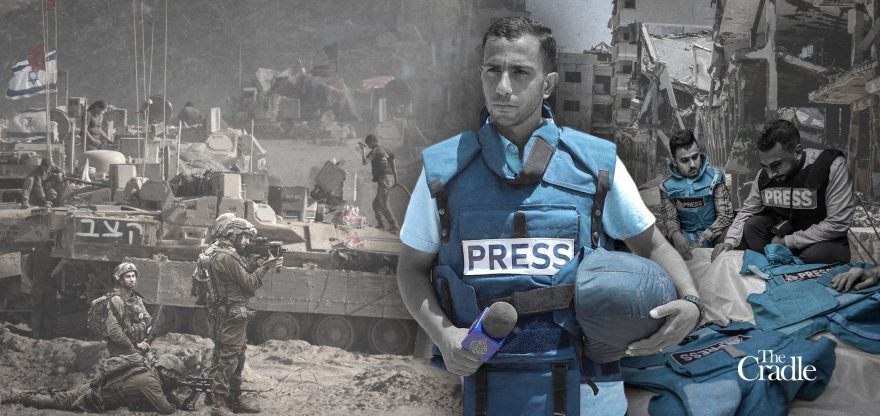
Dehumanize and destroy: How western media helped target Gaza’s journalists
By Robert Inlakesh | The Cradle | August 14, 2025
On 29 September 2024, an Israeli airstrike targeted the home of displaced Palestinian journalist Wafa al-Udaini in Deir al-Balah, central Gaza. She, her husband, and their two young daughters were killed. Her two sons survived but were left injured and orphaned.
Udaini had long been a target. At the start of the war on Gaza, she appeared on a TalkTV broadcast hosted by British anchor Julia Hartley-Brewer, who had just finished a soft interview with Israeli army spokesperson Peter Lerner. When Udaini described Israeli attacks on Palestinians as a “massacre” – using the same word Lerner had applied to Hamas – she was ridiculed and cut off. The segment went viral. Israeli media outlets weaponized the interview to smear Udaini. She was soon receiving direct threats from the Israeli military. In private conversations, she described herself as a marked woman. In the months that followed, when asked by The Cradle if she had moved from her home in Al-Rimal, Gaza City, she said, “I can’t say, sorry.” She added:
“The anchor killed me … They are using the interview to justify killing me.”
Months later, Israel killed Wafa.
Wafa’s assassination was not isolated. It was the culmination of a campaign to normalize the erasure of Palestinian journalists. The occupation army even has a special unit dedicated to this war crime, known as the ‘Legitimization Cell.’
The killing of Anas al-Sharif
The most prominent recent example was Israel’s assassination of one of Gaza’s most famous reporters, Al Jazeera’s Anas al-Sharif, and his entire crew. Nearly 270 Palestinian journalists have been killed since October 2023. Western press has actively facilitated the cover-up of the murder of journalists in Gaza and failed to hold the occupation state accountable. Calls for accountability have been challenging Israel and western media outlets that have provided cover for the deliberate campaign to murder journalists.
Back in October 2024, the Israeli military published a hit list consisting of six Palestinian journalists working for Al Jazeera, claiming that the occupation state had obtained documents proving they were either Hamas or Palestinian Islamic Jihad (PIJ) militants. Sharif was on that list.
Al Jazeera outright rejected the allegations. The so-called intelligence files released by Israel were riddled with contradictions, fabrications, and recycled narratives. One claimed Sharif had been a commander in the Qassam Brigades’ Nukhba unit; another stated he had been injured in a training exercise in early 2023 and deemed unfit for combat. Both cannot be true. In reality, neither is.
When the occupation state announced Sharif’s assassination, it escalated its smear campaign by accusing him of firing rockets. Speaking to The Cradle on condition of anonymity, a senior Hamas official dismisses the claim as “ridiculous,” noting that rocket units and Nukhba forces are not the same, and that Anas was never affiliated with either.
These were not the first threats Anas received. On 22 November 2023, he publicly revealed that Israeli officers had threatened him via WhatsApp, and pinpointed his location. Weeks later, his 90-year-old father was killed in an airstrike on the family home in Jabalia Refugee Camp.
The Israeli military’s documents alleging Anas was a militant have been available for almost a year. Yet no major media outlet attempted to verify them. On the contrary, both the UN Special Rapporteur on press freedom, Irene Khan, and the Committee to Protect Journalists dismissed the Israeli claims. But the disinformation campaign intensified.
Israel’s Foreign Ministry began circulating old images of Anas with Hamas figures. Pro-Israel social media accounts unearthed decade-old tweets in which he expressed support for resistance. US attorney Stanley Cohen tells The Cradle:
“Under international humanitarian law and the law of war, journalists are protected as civilians, thus targeting them can constitute a war crime whether they are seen interviewing combatants or in their reporting have favorably written of or even supported them and their goals.”
Collusion and amplification
Possessing access to all this information and Israel’s long record of fabricating stories, the western media continued to amplify Tel Aviv’s talking points and character assassinations of Gaza’s journalists.
While Israel produced a series of claims to justify the murder of Anas al-Sharif, no such justifications were issued to explain why they struck the well-known tent used by the Al Jazeera broadcast team – which included correspondent Mohammed Qreiqeh, assistant Mohammed Noufal, and cameramen Ibrahim Zaher and Moamen Aliwa.
Yet Reuters ran with the headline “Israel kills Al Jazeera journalist it says was Hamas leader,” a title triggering so much backlash that it forced them to change it to the sanitized “Israel strike kills Al Jazeera journalists in Gaza”. German outlet Bild, which is also the bestselling newspaper in Europe, published perhaps the most outrageous headline of all, entitled “Terrorist disguised as a journalist killed in Gaza,” also later altering their piece to read “Killed journalist allegedly was a terrorist.” Fox News and Canada’s National Post joined the chorus, parroting the occupation army’s narrative.
BBC coverage was equally complicit. In a profile-style article, the British broadcaster stated, “The BBC understands Sharif worked for a Hamas media team in Gaza before the current conflict.” This unverified claim contradicts Sharif’s own criticisms of Hamas, aired before the war. Even the Palestinian resistance movement has denied any formal affiliation. Hamas official Bassem Naim tells The Cradle that there is no known relationship between Sharif and “the movement or its military wing.”
Documented targeting and newsroom dissent
Western media failures began long before these assassinations. Israel’s systematic targeting of media workers has been copiously documented. In August 2024, Human Rights Watch (HRW) published an open letter signed by over 60 rights groups and journalist unions, calling on the EU to take action against Israel’s “unprecedented killing of journalists and other violations of media freedom” in Gaza as part of “widespread and systematic abuses.”
Inside newsrooms, dissent has grown. Marina Watanabe, formerly of the LA Times, was barred from covering Palestine for three months after signing a petition against the killing of journalists. In July, over 100 BBC employees and 306 media professionals signed an open letter accusing the broadcaster of “anti-Palestinian racism.”
The BBC letter also states:
“The BBC’s editorial decisions seem increasingly out of step with reality. We have been forced to conclude that decisions are made to fit a political agenda rather than serve the needs of audiences. As industry insiders and as BBC staff, we have experienced this firsthand. The issue has become even more urgent with recent escalations in the region. Again, BBC coverage has appeared to downplay Israel’s role, reinforcing an ‘Israel first’ framing that compromises our credibility.”
According to Cohen, if media agencies or reporters are found to have willingly participated in propaganda that gives cover for targeting journalists in Gaza, “it could constitute conspiracy to further acts of genocide as it carries with it a state of mind and intent.” He argues that while such cases against the media and journalists can be difficult to win in court, there is precedent for punishment.
However, western corporate media has not only been accused of intentionally aiding Israel in whitewashing war crimes, but has also been implicated in specific cases of outright dehumanization of Gaza’s journalists that have directly correlated to threats and harassment.
Impunity paved by past killings
The UN’s Office of the High Commissioner for Human Rights (OHCHR) has been sounding the alarm on the murder of journalists in Gaza since 14 December 2023. Yet western corporate media has continued to feign ignorance and treat Israel’s repeated lies as if they are credible.
Reuters, which just published and then changed its biased headline covering the assassination of Sharif, is perhaps one of the worst offenders in willfully providing cover for Israel. On 13 October 2023, Tel Aviv targeted a group of journalists in southern Lebanon, killing Reuters video journalist Issam Abdallah. At the time, Reuters refused to name the attacker, saying only that the munition came from the direction of Israel. It took until 7 December for the outlet to publish an investigation confirming what everyone already knew: Israel was responsible. By then, the window for accountability had closed.
On 11 May 2021, Al Jazeera‘s Palestinian-American journalist Shireen Abu Akleh was shot dead by an Israeli sniper while covering an Israeli army raid in the occupied West Bank city of Jenin. Despite overwhelming evidence and international outrage, her killers faced no consequences – a precedent that paved the way for today’s open season on Gaza’s journalists.
That silence, or worse, that complicity has consequences. Honest journalism demands scrutiny, not stenography. Every time western media echoes Tel Aviv’s lies, it helps normalize the slaughter of Palestinian journalists – not out of ignorance, but to deliberately spread propaganda.
Normalisation is death of Arab sovereignty, Syria is the best example
By Robert Inlakesh | Al Mayadeen | August 14, 2025
We have reached the stage where it can no longer be denied that the Syrian leadership is at the complete mercy of the US and its allies. Its normalisation drive, whereby its officials meet with their Israeli counterparts, are not negotiations but discussions aimed at achieving the best implementation of Tel Aviv’s orders.
When Arab states make the decision to capitulate to the Israeli-US normalisation and neo-liberal economic model, they set themselves up for a loss of sovereignty and to become at best a tool for policy makers in Washington.
If we look at the Jordanian and Egyptian models, we see that their agreements have not saved them from growing instability and economic decline, particularly in Egypt’s case. Once, it had become a big deal when President Hosni Mubarak began selling gas to the Israelis, now, Cairo purchases gas through its own pipelines that have reversed the flow.
Turning our focus to the current predicament of Syria, it is not even correct to assess it is based upon the Egypt model. In fact, despite some similarities, it is in even worse a predicament than Sudan.
The Sudanese state, following the fall of its former leader Omar Bashir, went into a transitional phase whereby the Army and Rapid Support Forces (RSF) militia agreed upon a power-sharing phase. During this time, the Zionist Entity swept in to take advantage of the situation, fostering relations with both sides, but particularly with notorious goldmine owning war-lord Hemedti’s RSF.
Sudan, working closely with US President Donald Trump’s administration at the time, managed to get sanctions lifted, remove itself from the State Sponsors of Terrorism List, receive sanctions relief and aid, while almost paving the way to adopt a neo-liberal economic model; seeking IMF and World Bank loans.
Khartoum had pledged that in exchange for these “gifts” from the US, they would join the so-called “Abraham Accords” and began negotiations behind closed doors with the Israelis.
Is this starting to sound familiar?
Then, in April of 2023, the Civil War erupted, and the Israelis swept in to back both sides, after having covertly provided the RSF with military capabilities that enabled it to balance the power on the battlefield in the first place. While the Mossad supported the RSF, the Israeli Foreign Ministry leaned towards the Sudanese Army.
In Syria, almost the exact same process has occurred. Yet most pretend as if we haven’t seen this same story before.
The key difference, however, is that the new Syrian government of Ahmad al-Sharaa has less control than when the RSF and Sudanese Army ran an interim unity government. The recent sectarian bloodshed in Sweida proved this without a shadow of a doubt.
There are now separatist militias in Sweida who actually coordinated with Israeli-Druze army forces who had set up a joint communications room to help locate targets during the latest round of bloodshed. Meanwhile, the Syrian security forces had coordinated the entry of tanks into Sweida with the Israelis, yet were bombed anyway, leading to as many as 700 dead amongst their ranks.
While the majority of the Syrian Druze and wider Syrian public oppose ties with the Israelis, the Zionist Entity finds inroads with both sides and watches on as they slaughter each other, all in the interest of further weakening the country.
Ahmad al-Sharaa was basically non-existent, as it appeared for over a week that Syria was heading towards another civil war, only offering brief statements before the US envoy announced a bizarre arrangement, claiming that Damascus and Tel Aviv had agreed to a truce.
It was especially strange because the announcement didn’t initially come from the Syrians themselves, but also due to the fact that there was no Syrian-Israeli war. What was happening was that Syrian forces were getting blown to pieces and ordered to stand down. The only relevance the Syrian government forces had was in their failed role inside Sweida, where they went out of control and participated in civilian massacres, alongside Bedouin tribal forces.
Never in the known history of war has a nation been invaded, occupied, its capital repeatedly bombed and hundreds of its soldiers blown to pieces, and the country being attacked did not respond in any way. Not only have Ahmad al-Sharaa’s forces failed to fire a single bullet towards their occupiers, they have not even threatened the use of force.
Even worse, rather than respond, they give the Israelis gifts like infamous spy Eli Cohen’s belongings, cracking down on the Palestinian Resistance forces, and declaring fellow Muslims and Arabs their enemies, despite them being the only ones willing to stand up for Syria.
Meanwhile, every minority group in the country is isolated, and every community feels the need to bear arms and protect themselves, as nobody trusts the ill-trained, unprofessional security forces.
This is what capitulation looks like, a leadership which exists more so on Facebook, X, and Instagram than it does in real life. A sectarian bloodbath, with no stability, no national unity, no sovereignty, and whose leaders are collaborating with the genocidal entity, in violation of all the regional, national, cultural, and religious moral obligations.
This is normalisation. This is capitulation. This is what happens when you worship at the feet of your occupiers. Syria is the worst case of all, because there is no longer even a united nation or cause that it embodies, which has, for the current moment, died.
Only through a unified resistance front will Syria liberate itself. It may take time, but this is the only path, and historically, the Syrian people had resisted the Ottomans, the French, and even got themselves back on their feet after the CIA overthrew their government in 1949. It can happen, but it will take the Syrian people coming together in order to overcome their predicament.
There is no example of where normalisation with the Zionist regime, or total capitulation to the US, saves a nation in turmoil. Even in the cases where the US poured trillions into attempts to set up new regimes, like what happened with Iraq and Afghanistan. The only examples of where a regime has not yet declined or sacrificed its security predicament due to normalisation, are in the cases of the UAE and Bahrain, but both were already immensely rich, and nothing much changed upon normalisation.
However, even in the cases of the UAE and Bahrain, their positioning themselves as part of the Israeli-US regional anti-Iran alliance puts them in the firing line and could risk national stability in the event of a broader war.
The positions of the current regime in Syria are indefensible. Not even from a selfish materialist perspective could you argue their case without engaging in mental gymnastics. There is no strategic depth, nor a demonstration of competent governance in the direction we see the nation going, and at a time when unity is needed the most.
Israel chases MAGA support amid Gaza backlash
The Cradle | August 14, 2025
The Israeli government is courting conservative social media influencers in the US to shore up support among “Make America Great Again” (MAGA) Republicans, Axios reported on 14 August.
Support among MAGA Republicans for Israel has fallen to record lows amid Tel Aviv’s ongoing campaign of starvation and genocide in Gaza, fueled by billions in US weapons and military aid.
Younger Republicans in particular question why Trump is spending such large sums to support Israeli military actions, while neglecting the needs of US citizens at home.
The Israeli campaign involved sending 15 MAGA influencers on a propaganda tour to Israel this week. The trip was organized by Israel365, an advocacy group that tries to “strengthen Israel by building bridges between Jews, Christians and all who share our faith-based values,” according to a statement from the group.
Axios reports that Israel365 was awarded a no-bid contract worth $70,000 by the Israeli Foreign Ministry to fund the trip.
The advocacy group is led by Rabbi Pesach Wolicki, who has regularly appeared on conservative television programs such as “The Charlie Kirk Show” to defend Israeli atrocities.
“Israel365 is uniquely suited to help MAGA-affiliated entities reach religious and ideological audiences in both Israel and the US,” stated an Israeli Foreign Ministry memo obtained by Axios.
Several influencers have faced backlash for participating in the all-expenses-paid trip, which included visits to the Western Wall in occupied Jerusalem, settlements in the Gaza envelope, as well as the occupied West Bank, Golan Heights, and the Syrian border.
Following the trip, Steve Bannon’s “War Room” podcast ended its relationship with MAGA influencer Jayne Zirkle.
Axios notes that, “Gen Z MAGA supporters have grown increasingly comfortable questioning Israel’s policies and prosecution of the war in Gaza, especially under the banner of the ‘America First’ agenda.”
Many young Republicans have also been influenced by political commentator and streamer Nick Fuentes, who regularly criticizes Israel’s genocide in Gaza, Trump’s slavish support for Israel, and the outsized influence of the US Jewish community over the US government.
Even legacy conservative journalist Tucker Carlson has hosted several programs recently with guests highlighting Israeli crimes in Gaza, including Lt. Col. Aguilar, a former US special forces operative who reported seeing Israeli troops carrying out horrifying war crimes against Palestinians in Gaza while working for the Gaza Humanitarian Foundation (GHF).
Who enabled the process of “Greater Israel”?
By Ramona Wadi | MEMO | August 14, 2025
In a recent interview with i24, Israeli Prime Minister Benjamin Netanyahu stated he is “on a mission of generations” for “Greater Israel”. Meanwhile, the international community is still bleating about the two-state paradigm. The Arab League spoke out against Israel’s “aggressive and expansionist tendencies”. But in the midst of all this, who is listening to the Palestinian people?
The concept of “Greater Israel” is not a novelty. Early Zionist ideology, even before the atrocities of the 1948 Nakba, already envisaged a complete colonial process. Netanyahu is just availing himself of the opportune moment to remind the entire world what Zionist colonisation is all about, but this statement cannot be treated as a surprise.
It was the international community that decided upon the 1947 Partition Plan, despite the concept of “Greater Israel”. The same international community legitimised the Nakba’s colonial atrocities by recognising Israel – a settler-colonial enterprise on ethnically cleansed Palestinian land. It ensured the Palestinian right of return would be flawed to give priority to Israel’s expansion plans, and coerced Palestinians into the humanitarian paradigm – recipients of aid with no rights.
Israel may have carefully crafted its narrative, but it also exposed its intentions along the way. The international community has no excuse. During the same time the two-state paradigm was deemed obsolete, Netanyahu was boasting about how Palestine was no longer a priority in diplomatic relations and no longer a precondition that would jeopardise normalising relations with Israel. This is relatively recent history. Had the international community really wanted to eradicate colonialism, it could have taken action before 1947. But former colonial powers invested in a new colonial power that has now been committing genocide for almost two years, under the pretext of eliminating Hamas. And while Netanyahu feels he can unveil the entire truth about Israel and its genocide, the international community is still focused only on humanitarian aid and the two-state compromise – none of which ultimately give Palestinians political rights.
Can the international community admit all its complicity with Israeli settler-colonialism, expansion and genocide since the time it started to indulge the Zionist colonial ideology? How about admitting that the humanitarian paradigm has aided Israel more than it helped Palestinians? Or that the two-state compromise was a stepping stone for Israel to unleash genocide in Gaza and eventually declare “Greater Israel”?
The international community only ever took on board what aided its diplomatic engagement with Israel; hence the focus on Hamas, humanitarian aid, the two-state paradigm and forced displacement. Keeping all these slivers isolated enabled Israel to gradually prepare for prominent announcements of its ultimate colonisation plans. “Greater Israel” requires ethnic cleansing on a larger scale. Genocide fulfils that prerequisite. The international community is concerned about Palestinians starving to death but not Palestinians torn to shreds and blasted apart by bombs. The international community chooses which part of genocide to weakly condemn, just as it chose which parts of settler-colonialism to speak out against without any repercussions. Feigning ignorance now is just adding to the hypocrisy.
READ: Netanyahu says he is on historic mission for greater Israel
Russia derails Ukraine’s Western-backed missile program – FSB
RT | August 14, 2025
Russian forces have struck four Ukrainian defense industrial facilities producing long-range missile systems, causing “colossal” damage and stalling Kiev’s domestic missile program, the Federal Security Service (FSB) has said.
In a statement on Thursday, the FSB said the operation mounted by the agency and the Russian Defense Ministry targeted chemical and mechanical plants in Pavlograd, Dneptropetrovsk Region, as well as the ‘Zvezda’ plant and State Scientific Research Institute of Chemical Products in Shostka, Sumy Region.
The impact of the strikes has been confirmed by satellite imagery and open-source intelligence, it added.
The FSB said that Ukraine, with NATO’s permission, had planned to use Sapsan long-range missiles for strikes deep into Russian territory. “Thanks to the joint efforts of the FSB and Russian Armed Forces, Ukraine’s missile program plans have been thwarted,” the statement added.
The agency described the damage to Ukraine’s military industrial complex as “colossal,” and said it far surpassed Kiev’s “Spiderweb” operation that targeted strategic Russian aviation in early June. Moscow said that the Ukrainian attack, which involved dozens of drones, damaged several aircraft but dismissed Kiev’s claims that approximately 40 warplanes were destroyed.
An unnamed FSB official told TASS that the Sapsan missile systems were developed with financial support from Germany and assistance from foreign specialists.
The Sapsan is a Ukrainian tactical ballistic missile with a warhead weighing around 480kg. The missile can travel at speeds over 6,000kph and has a range estimated of up to 700km.
The FSB published a map outlining the Sapsan’s range, with a large part of Western Russia – including Moscow – being within the kill zone.
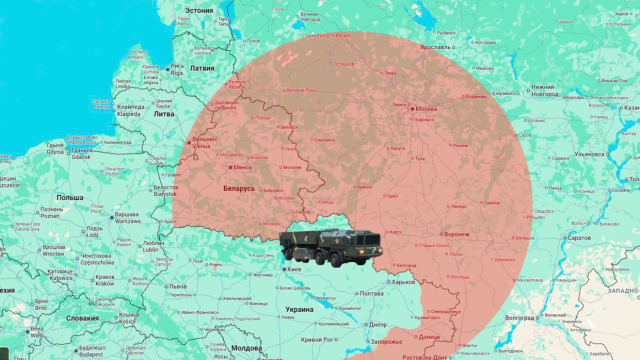
In May, Chancellor Friedrich Merz announced that Germany would fund Ukraine’s domestic production of long-range missiles, although he did not specify the type of weapon. The German Defense Ministry also stated at the time that investing in Ukraine’s production would enable Kiev to have a “substantial” number of long-range weapons this year.
Ukraine’s Vladimir Zelensky has since threatened new long-range strikes deep into Russia, saying Kiev will “do everything possible to bring the war onto Russian territory.” – Video
Pentagon effectively confirms ‘Golden Dome’ will breach Outer Space Treaty
By Drago Bosnic | August 14, 2025
On January 27, US President Donald Trump announced that the construction of the “state-of-the-art ‘Iron Dome’ missile defense shield” will begin “immediately” and will be made “right here in the USA 100%”. Since then, apart from a name change to avoid confusion with a homonymous Israeli system, there’s been little concrete information on the project.
However, last week, the Pentagon presented more details about the upcoming “Golden Dome”, revealing that it will be a four-layer missile defense system and that it will also include a space-based component (the other three are ground-based, including eleven short-range batteries planned for deployment in the continental US, Alaska and Hawaii). Reuters cited a presentation of the project, titled “Go Fast, Think Big!”, shown in Huntsville, Alabama, last week to around 3,000 representatives of the American Military Industrial Complex (MIC).
The revelation didn’t really show much more than what was already known about the US strategic missile defenses. The slides revealed there would be early warning satellites for detecting missile launches, tracking and “boost-phase interception”. The “upper layer” would be composed of the Next Generation Interceptors (NGI), Terminal High Altitude Area Defense (THAAD) and “Aegis” systems, with a new missile field “likely in the Midwest”.
This would be followed by the “under layer” composed of “Patriot” systems, new radars and a “common launcher for current and future interceptors”. The space-based “boost-phase interception” capability is particularly curious. Although the slides didn’t really reveal how this would be accomplished, common sense implies that this is either deliberate disinformation (like the SDI was) or the Pentagon is actively pursuing space-based weapons.
Reuters noted that “one surprise was a new large missile field – seemingly in the Midwest according to a map contained in the presentation – for Next Generation Interceptors (NGI) which are made by Lockheed Martin” and “would be a part of the ‘upper layer’ alongside Terminal High Altitude Area Defense (THAAD) and ‘Aegis’ systems which Lockheed also makes”. The NGI is supposed to be the next iteration of GBI (Ground-Based Interceptors), which is part of the Ground-Based Midcourse Defense (GMD).
This system is a nationwide network of radars, interceptors and other assets that the US planned for decades, even unilaterally withdrawing from the 1972 ABM (Anti-Ballistic Missile) Treaty back in 2002, so it could pursue the project. This arms control agreement served to prevent the US and USSR/Russia from being incentivized to endlessly enlarge their thermonuclear arsenals by limiting the number of deployed ABM systems.
The logic was that, whoever acquired better missile defenses, this would only force the other side to increase their offensive potential to enable saturation attacks that would inevitably overcome all ABM systems. Although the treaty was by no means perfect, it still slowed down the growth in the number of warheads and delivery systems.
However, after the unfortunate dismantling of the Soviet Union, the US thought that Russia would be unable to revive its massive military-industrial potential, meaning that the aforementioned ABM Treaty was now “holding America back” in its quest for total global dominance. And yet, the opposite happened. Moscow not only reactivated much (if not most) of its military-industrial might, but actually restarted a number of highly advanced military programs that eventually resulted in a decades-long lead in a plethora of various high-tech hypersonic weapons.
Now that this backfired, Washington DC is faced with a far more complex and challenging task of intercepting weapons that work on very different principles, eliminating the predictability of regular ballistic missiles. The cumulative effects of these factors have increased costs and made maintenance and logistics a true nightmare. Not to mention that the (First) Cold War was far simpler due to the fact that America had only the Soviet Union to worry about, while its aggression against the entire world forced several more countries to build up their arsenals (notably China and North Korea).
Unfortunately, there’s no other way to ensure viable deterrence. However, instead of easing tensions, the US is doubling down on its belligerence. Despite formally being a defense system, Washington DC sees the “Golden Dome’s” actual purpose as a way to facilitate its global dominance by undermining other arsenals.
The Pentagon’s presentation last week suggests that the “Golden Dome” will effectively be both an expansion and integration of existing missile defenses, with the third site in the Midwest serving to augment the current GMD launch sites in California and Alaska. The US military will have to deal with challenges such as “communication latency across the kill chain (a step-by-step sequence of actions needed to find, target and destroy a threat)”, so the most prominent corporations of the American MIC (Lockheed Martin, Northrop Grumman, RTX/Raytheon, Boeing, etc.) will be included in the program.
However, the very idea that the “Golden Dome” will be able to shoot down hypersonic weapons is highly questionable, given the horrible performance of the GMD even against regular ballistic missiles. On the other hand, the MIC is exhilarated with such a windfall (considering the system’s costs).
And yet, while the project has a lot of similarities with the (First) Cold War-era SDI (Strategic Defense Initiative, but better known as the so-called “Star Wars”), the idea of space-based weapons is still a highly disturbing development that would lead to an inevitable militarization of space. US Space Force Gen Michael Guetlein, who serves as the head of the “Golden Dome” program, is required to “deliver the first designs within 60 days and a complete roadmap of the project within 120 days”.
The new missile defense system is expected to be able to “intercept targets in their boost phase” and “deploy relocatable defenses capable of rapid global deployment”. This is a clear violation of the 1967 Outer Space Treaty (OST).
There’s also a lot of symbolism in Trump’s first announcement of the “Golden Dome”. As previously mentioned, he unveiled it on January 27, which was when the OST was signed by the US and USSR.
Drago Bosnic is an independent geopolitical and military analyst.
Featured Video
Seyed M. Marandi: U.S. Military DIVIDED? Iran’s Secret Defense EXPOSED
or go to
Aletho News Archives – Video-Images
From the Archives
‘Israel sees Iran as obstacle to its policies’
Press TV – August 25, 2017
Prime Minister Benjamin Netanyahu has said that Israel felt threatened by Iran’s growing influence in the Middle East. Netanyahu expressed his Iranophobic view in a meeting with Russian President Vladimir Putin in Russia’s Black Sea resort of Sochi on Wednesday. Press TV has asked Scott Rickard, former American intelligence linguist from Tampa, Florida, and Brent Budowsky, a columnist at The Hill from Washington, to give their thoughts on the issue.
Rickard said Tel Aviv is concerned about the fact that the regime could not carry out its old project to spread sectarian divisions and pave the way for dismemberment of the countries in the Middle East region because of the Iranian-led resistance against Israeli policies, not only in the occupied territories of Palestine but also in the whole region.
“Iran is not a threat to Israel whatsoever. The threat that Israel sees is the fact that their Oded Yinon Plan is being put to a hold by Iran,” the intelligence linguist said on Thursday night.
“They (the Israelis) look at Iran as a threat only because they have no influence on their governments and Iran is autonomous and is not under the Zionist influence,” he added.
Since the victory of the Islamic Republic of Iran in 1979, Tehran has been critical of Israel’s policies in the region, whereas “no leaders [of other states] even dared to speak out against Zionism,” Rickard argued. … continue
Blog Roll
 Aletho News
- The US-Israeli War on Science is an Assault on our Future
- Trump’s Promise to Bomb Iran ‘Like Never Before’ Faces Brutal Logistics — Expert
- Germany seeks to restrict stays abroad for men of fighting age – Berliner Zeitung
- Evidence points to Ukraine being behind TurkStream attempted sabotage, but that should come as no surprise
- Sri Lanka secures supplies of Russia oil – minister
- Nations across Asia strike direct deals with Iran for Hormuz passage
- IRGC commander declares ‘new phase’ of reprisal attacks against aggressors
- Israel’s air defenses overwhelmed by cluster-warhead Iranian missiles: Reports
- Striking Iran’s Infrastructure Would Have Little Military Impact – Report
- What’s Behind U.S./Israeli Strikes On Iranian Pistachio Factories?
- If Americans Knew
- Trump says Iranians appreciate bombs, WHO warns of nuclear risks – Daily Update
- U.N. experts demand Israel release prominent Gaza doctor after reports of ‘severe torture’
- Israel’s Latest Genocide Is Against the Shias of Lebanon. Why Is the World Silent?
- How Eliot Cohen’s influence over U.S. war-making paved the way for Trump’s war crimes in Iran
- Israelis don’t pay for the weapons we ‘sell’ to them — US taxpayers do
- While Distancing from AIPAC, Most 2028 Democratic Hopefuls Are Still Embracing Israel
- A brief history of the Israeli nuclear program, the open secret at the heart of the Iran war
- Israeli Settlers Killed a Palestinian Farmer on His Own Land, in Front of His Father. Yes, Again
- The US-Israeli War on Science is an Assault on our Future
- 100+ International Law Experts Say US Strikes on Iran Violate UN Charter, Could Be War Crimes
- No Tricks Zone
- An Inconvenient Tree: Uncovered In Alps… Europe Much Warmer Than Today 6000 Years Ago
- New Study Reports A 60% Slowdown In Greenland’s Ice Loss Rate In The Last Decade
- Low Intensity Tornado Wrecks Major Solar Farm, Creating A Potential Toxic Dump
- New Study Finds Warming Saves Lives…Cold Temperatures 12 Times More Deadly Than Excess Heat
- German Science Blog Accuses PIK Climate Institute Of Hallucinating Climate Tipping Points
- Devastating Assessment Of Comirnaty Vaccine By Former Senior Pfizer Europe Toxicologist
- New Study: CO2 Is ‘Effectively Negligible’ As An Explanatory Climate Change Factor Since 2000
- Former Pfizer Toxicologist Dr. Helmut Sterz Tells Bundestag Hearing Pfizer Vaccine Should Have Never Been Approved
- Energy Expert: Germany’s Nuclear Phaseout Was A “500 Billion Euro Mistake”
- New Research: South Australia’s Mid-Holocene Sea Surface Temperatures Were 4°C Warmer Than Today
 Aletho News