DR. ELIZABETH MUMPER ON AUTISM, VACCINES, AND HONEST SCIENCE
The HighWire with Del Bigtree | October 9, 2025
Pediatrician and researcher Dr. Elizabeth Mumper joins Del to discuss experiences throughout her career, including the vast increase in autism observed since she was in medical school, the clear health differences she’s seen between vaccinated and unvaccinated children, and how scientific inquiry has been captured. She explains why the upcoming film ‘An Inconvenient Study’ could mark a turning point for both doctors and parents questioning vaccine safety.
Soldiers, Settlers Injure 20 Palestinians in Beita

International Solidarity Movement | October 11, 2025
October 10 was the opening of the Zaytoun2025 olive harvest campaign. Here’s a wrap-up of the events:
Beita, South Nablus
About one hundred farmers joined by some 60 Palestinian and solidarity activists, were attacked by armed Israeli citizens and soldiers, near a recently established Israeli settlement in the Jabal Qamas area. The soldiers both ignored the attacks on the farmers and used violence themselves to try and repel the harvesters from their lands, and ignored the assault of Palestinians by the Israeli civilians, and therefore enabling them. The soldiers used tear-gas concussion grenades and physical violence, while the Israeli civilians attacked harvesters with baton blows, stone throwing and by shooting live ammunition.
- 20 injuries were recorded. 11 of the injured Palestinians were evacuated to the Rafidia hospital in Nablus. In addition, one solidarity activist was evacuated to the Belinson hospital after Israeli civilians assaulted her with batons and broke her arm.
- One of the Palestinians suffered a gunshot wound after being shot by an Israeli civilian.
- Three of those injured are journalists: Wahaj Bani Mufleh, Saja al-Alami and Jaafar Astaya, whose car is one of those torched.
- Eight cars were torched by the Israeli civilians.
- An ambulance was attacked and flipped over. An attempt to torch it as well was foiled by Palestinians who came to the crew’s rescue.
Jorish and Aqraba, South-East Nablus
Israeli civilians armed with batons prevented farmers from the two villages accompanied by solidarity activists from accessing their lands in the Wad Issa agricultural area.
Duma, Sout-East Nablus
Israeli soldiers prevented farmers from harvesting their olives in the Houma and Khallet al-Hassad areas, asserting access to these lands requires security coordination with Israeli authorities. The Houma area is in Area B.
Yanoun, East Nablus
Israeli civilians expelled farmers and stole their harvested olives.
Deir Istia, North Salfeet
Israeli civilians harassed harvesters in an attempt to prevent them from accessing their lands near the Yaqir settlement.
Kufer Thulth, East Qalqilya
Settlers attacked harvesters and shepherds, killing several goats.
Farata, East Qalqilya
Israeli civilians shot at farmers harvesting olive with live fire in the presence of Israeli soldiers, who did not intervene. Both the soldiers and Israeli civilians then continued to raid the village, stop residents in the street and question them.
Kobar, North Ramallah
Israeli forces arrested harvesters in their lands near the village.
Iran embassy censures awarding Nobel Peace Prize to Venezuelan opposition leader
Press TV – October 11, 2025
Iran’s embassy in Caracas has blasted the Nobel Committee for awarding this year’s Nobel Peace Prize to someone who advocates for military aggression against Venezuela in yet another sign of the West’s “divisive and interventionist” mentality.
In a post on its X account on Saturday, the embassy said the decision to award the Nobel Peace Prize to Venezuelan opposition leader María Corina Machado is “nothing less than a mockery of the true meaning of ‘peace’”
“Awarding the Nobel Peace Prize to someone who justifies the genocide in Gaza and advocates for military aggression against Venezuela is yet another example of the West’s divisive and interventionist mentality in the developing world,” it emphasized.
The Nobel committee on Friday awarded the 58-year-old Machado, a Venezuelan politician notorious for advocating American and Israeli military intervention in her country, the 2025 Nobel Peace Prize for her “tireless work promoting democratic rights”.
The country’s Supreme Court upheld a 15-year ban against her, citing her direct support for US sanctions, involvement in large-scale corruption, and responsibility for massive financial losses suffered by Venezuela’s foreign assets — including the US-based oil refiner CITGO and the Colombia-based chemicals firm Monómeros.
This comes as the US military escalated its operations against Venezuela in August, involving three destroyers, anti-submarine aircraft, battleships, nuclear submarines, and F-35 squadrons.
Since then, US forces have attacked several vessels, killing dozens of Venezuelan nationals while claiming they were drug traffickers transporting narcotics to the United States.
In response, the Venezuelan government has declared a national emergency, reinforced its armed forces, and mobilized its national militia to counter any potential military aggression from Washington.
Why is a ‘regime change’ in Venezuela a stupid idea?
By Raphael Machado | Strategic Culture Foundation | October 11, 2025
It would be a mistake to say that with Trump’s return to the White House, Venezuela is once again under pressure. It never stopped being under pressure since the final years of the Obama administration. But it is legitimate to say that Trump 2.0 has initiated a new phase in the over-10-year hybrid campaign against the Bolivarian state.
We have already seen sanctions, attempts at color revolution, attempts to install an “alternative” president, the theft of Venezuelan gold reserves, the refusal to recognize the legitimacy of elections, provocations at the borders, and even the blocking of its entry into BRICS (sadly spearheaded by Brazil).
Now, however, we see military threats looming on the horizon against Caracas.
Harbingers of this had already occurred.
In 2020, for example, there was an attempt to infiltrate Venezuelan territory with mercenaries hired by the American company Silvercorp with the goal of overthrowing the government of Nicolás Maduro.
In 2024, the CEO of the former private military company Blackwater started the “Ya casi Venezuela” project to raise funds with the alleged aim of overthrowing Nicolás Maduro. Recently, he also stated that the $50 million bounty should apply not only to Maduro’s capture but also to his assassination.
And, as we know, between late August and early September, we saw a series of events that raised tensions in the Caribbean Sea, such as the deployment of warships to the Caribbean and the bombing of four Venezuelan boats that were allegedly transporting drugs.
Now, despite the official line that U.S. maneuvers in the Caribbean Sea are aimed at combating drug trafficking, it is noteworthy that Venezuela accounts for only 3% of all drugs reaching the U.S.. Washington does not seem to be deploying the same level of effort to stifle more important sources, such as the Colombian route, for example.
Thus, even without any official declaration, one cannot rule out the possibility that the U.S. is considering moving forward with a new attempt at regime change in Venezuela – but this time in a more direct way, whether through naval and aerial bombardments, drone attacks, or a black ops operation using mercenaries and/or special forces. Or, of course, a combination of all these options.
Naturally, one thing is to set this objective, another is to achieve it, and yet another thing is to deal with the consequences afterward.
From what is known about the fall of Assad, for example, it was apparently achieved, at least in part, by bribing military officers and co-opting Syrian intelligence. The classic tactic of “divide et impera,” divide and conquer, was used to liquidate Syrian power and facilitate the state’s conquest by Al-Julani’s irregular forces.
Any similar attempt regarding Venezuela will fail. Indeed, Venezuela, as a poor country, would in theory suffer from this fragility facing the possibility of its officials being bribed by foreign economic powers, but the Venezuelan Armed Forces were built in a different way from other states, as is the very foundation of Venezuelan state power. The degree of civilian-military integration in Venezuela is such that the supervision of numerous economic activities in the country is carried out by high-ranking military officers.
The Venezuelan state is, at least in part, a military state. The military does not represent an isolated institution separate from political power, available, therefore, for the possibility of co-option and instrumentalization against other institutions. Instead, in terms explained decades ago by the Argentine philosopher Norberto Ceresole, the military constitutes the guard of the Bolivarian Revolution.
Furthermore, Venezuela’s intelligence agencies, SEBIN and DGCIM, are very closely linked to both military and political power. It is these agencies that have been instrumental in all infiltration attempts in Venezuela, and it is unlikely that dissent can be cultivated within these structures.
Finally, although the Bolivarian militias are not very useful against long-range missile attacks, from the perspective of law and order and guaranteeing national stability in the face of the possibility of trying to take advantage of a potential chaotic situation to organize a color revolution, the armed Bolivarian militias can play a subsidiary and supportive role for the authorities, stifling potential foci of dissent and rebellion.
Now, even the goal of overthrowing Nicolás Maduro’s government presents difficulties even if eventually achieved. Other hierarchs could take his place, as they would have the support of the Venezuelan Armed Forces; this could lead to a scenario of prolonged conflict on Venezuelan territory.
As in all cases of a country’s destabilization, emigration tends to increase rather than decrease, due to the greater difficulty of ensuring the common good in the first months after a hypothetical overthrow of Maduro.
Although the U.S. has a tendency to destabilize nations to keep them in a state of permanent chaos, in theory, the same could not be done in Venezuela lest the instability reach the U.S. itself through increased migration and the collapse of law and order.
U.S. security itself also depends on maintaining a stable Venezuela, so the U.S. would truly be forced into “nation-building” in Caracas, facing a heavily armed country, including at the civilian level, and one that is predominantly hostile.
Instead of such adventurous delusions, Washington should be directing its efforts towards reinforcing Venezuelan stability, especially through the withdrawal of sanctions.
The silent collapse of the United States
By Lucas Leiroz | Strategic Culture Foundation | October 11, 2025
While Washington insists on presenting itself as the bastion of the “liberal world order,” the very foundations of the American state are showing clear signs of collapse. The internal reality of the United States today is marked by an insurmountable fiscal abyss, chronic political polarization, and an alarming inability to maintain even the most basic national security systems. The recent escalation of public debt, combined with the imminent breakdown of nuclear monitoring infrastructure, reveals that American hegemony is not just in decline — it is on the verge of functional collapse.
According to data from the U.S. Treasury, the gross national debt surpassed $37.5 trillion in 2025 — the highest level in the country’s history — exceeding 120% of its GDP. What is most alarming is the speed of this growth: in just the last 12 months, the debt increased by more than $2 trillion — without any emergency context such as war or a global pandemic. It is an unsustainable trajectory, typical of failed states, yet it is happening at the heart of the Western financial system.
At the same time, budget cuts imposed by Congress itself — deadlocked in endless partisan disputes — have directly jeopardized the security of the American nuclear arsenal. The National Nuclear Security Administration (NNSA), responsible for overseeing and maintaining the country’s atomic warheads, publicly admitted that its funds would only guarantee operations for “a few more days.” Once this period expired, a shutdown process for monitoring systems began — something unthinkable for any minimally functional power.
How can a country that spends hundreds of billions of dollars annually to fund wars in foreign territories — such as Ukraine and the occupied Palestine — be unable to finance the security of its own nuclear arsenal? The answer is simple: the United States is no longer a rational country, but a decaying “empire” driven by corporate lobbies, military-industrial interests, and a political elite entirely disconnected from national reality.
The current Republican administration tries to blame the Democratic opposition for the budget paralysis, while the Democrats sabotage any attempt at agreement in order to politically undermine the government. This argument is partially valid, but it also exposes the weakness of the Republicans themselves, who fail to counter the Democratic sabotage. This bipartisan theater is not only dysfunctional — it is suicidal. The U.S. is at the mercy of its own internal disorder, becoming a threat not only to itself but to the entire world, given the sensitive nature of the nuclear systems involved.
Thousands of NNSA employees and contractors have already been affected by shutdowns and funding freezes. Although the government claims that “critical operations” will continue, there are no guarantees or transparency about what exactly remains functional. A mistake, maintenance failure, or even a delayed response to an incident could have catastrophic consequences — including radioactive leaks or accidental detonation.
Meanwhile, countries like Russia and China continue to strengthen their energy sovereignty, defense systems, and institutional stability. The multipolar approach being built by these nations — particularly within the expanded BRICS+ framework — demonstrates strategic maturity and responsibility toward global order, in stark contrast to what is observed in Washington.
America’s decline is not expressed solely through numbers or economic graphs. It is visible in the inability to protect its own population, maintain basic infrastructure, or prevent political games from eroding the state’s structural integrity. When even the nuclear arsenal — supposedly the ultimate red line — is left vulnerable to budget cuts, the message is clear: the U.S. is no longer capable of leading the world.
The collapse on the horizon will not be merely economic. It will be institutional, military, and geopolitical. And in the face of this scenario, the world must begin looking to other — multiple, stable, sovereign, and genuinely peace-oriented — leaderships to guarantee global security.
‘Persecute’ Russian speakers – ex-Ukrainian deputy speaker
RT | October 11, 2025
Kiev should launch a full-blown crackdown on Russian speakers, threatening them with financial and criminal penalties if they are reluctant to use Ukrainian, a former deputy parliamentary speaker said on Friday.
Koshulinsky, who held his post from 2012 to 2014 and remains a senior figure in the far-right Svoboda party, told local media that “discomfort for people who use the language of the occupiers” must be imposed.
”Deny education, deny work, punish with money, remove from positions … Only in this way will we oblige those people who do not honor or respect Ukrainians… These people do not understand other measures besides discomfort and financial or criminal persecution,” Koshulinsky said. He added that what he calls “the Moscow language” helps Russia “spread its narratives” among Ukrainians.
Last month, language ombudsman Elena Ivanovskaya warned that harsh or coercive methods to impose Ukrainian on the country’s large Russian-speaking community could backfire on the government. She said proposals for “language patrols” are both unrealistic and potentially destabilizing, calling instead for slower but steadier measures to promote Ukrainian among children.
Ivanovskaya also sounded the alarm over the fact that the use of Russian is on the rise in daily life, particularly among younger Ukrainians, adding that it was caused by the population growing accustomed to the conflict with Russia.
Following the Western-backed coup in 2014, Kiev has adopted a series of policies aimed at curbing the use of Russian in public life – making Ukrainian mandatory in schools and state institutions, significantly tightening quotas on Russian-language media and cultural products, and restricting Russian books and music.
Russia has condemned Ukraine’s language policies, accusing it of pursuing “a violent change of the linguistic identity” of its population.
West behind latest coup attempt in Georgia – Tbilisi mayor
RT | October 10, 2025
Foreign governments instigated a “coup” attempt in Georgia, the mayor Tbilisi, Kakha Kaladze, has claimed, referring to recent protests in the South Caucasus nation.
The Georgian government has repeatedly cried foul over alleged external interference in the nation’s internal affairs. It says the West has sought to depose the ruling Georgian Dream party, which has consistently refused to antagonize neighboring Russia over the Ukraine conflict.
Speaking to reporters on Thursday, Kaladze claimed that ahead of the municipal elections on October 4, “a campaign had been underway for months regarding a coup d’état,” backed by foreign actors.
According to the official, “hundreds of millions” were spent on the effort through non-governmental organizations, with certain Western ambassadors openly “inciting violence” in Georgia.
On Wednesday, US Senators Jim Risch and Jeanne Shaheen issued a statement accusing the Georgian authorities of persecuting the opposition and attempting to “silence dissent,” as well as of “making baseless allegations” against former US government employees.
Kaladze responded by describing the US lawmakers as being “under the influence of the Global War Party.”
Speaking on national television on Monday, Georgian Prime Minister Irakli Kobakhidze made similar claims, alleging that foreign powers had backed the opposition, whom he characterized as “foreign agents.”
Opposition protests, which quickly descended into clashes with police, erupted last weekend as municipal election result projections indicated that the ruling Georgian Dream party held a solid lead across the country.
The unrest was the latest in a series of similar demonstrations that have gripped Georgia in recent years. They reached a climax in October 2024, following presidential and parliamentary elections, when the opposition accused the authorities of fraud. Protesters had previously also cited a perceived stalling of the EU accession process by the Georgian government. Officials have dismissed all allegations.
The EU openly backed the demonstrators, who according to Kobakhidze, were “financed by foreign special services” in a manner similar to the 2014 Maidan coup in Ukraine.
US sanctions Serbian oil major over Russia ties
RT | October 10, 2025
US sanctions on Serbia’s Russian-majority-owned oil company, NIS, have been activated, prompting neighboring Croatia to halt crude deliveries and raising the risk of a shutdown at Serbia’s only refinery.
Washington had granted Belgrade several temporary exemptions from restrictions imposed in January on NIS (Petroleum Industry of Serbia), in which Russia’s Gazprom and Gazprom Neft hold a majority stake. The most recent waiver, issued on October 1, was valid for only one week.
NIS confirmed Thursday that the US Treasury Department had not extended the waiver, leaving the company under full sanctions. It said it was “working to overcome the situation” and would engage with the US authorities to seek delisting.
The new sanctions have forced Croatia to stop crude supplies, pushing Serbia’s only refinery to the brink of a shutdown, President Aleksandar Vucic said on Thursday. He warned the facility, a critical supplier of gasoline and jet fuel, faces closure by November 1 unless deliveries resume.
“These are extremely severe consequences for our entire country. It’s not just about the functioning of one company,” Vucic said in a televised speech.
The sanctions effectively bar the company from purchasing crude oil or exporting refined products.
Croatian pipeline operator JANAF, the sole supplier of crude to the refinery, has already announced it will halt all business with NIS. Analysts say the company’s only recourse is for the US to reverse the sanctions or for its Russian shareholders to divest.
The impact swiftly reached consumers, as NIS notified customers that its network of some 350 stations would no longer accept American Express, Mastercard, or Visa cards.
NIS is a leading Balkan energy company with an oil refinery in Pancevo, near Belgrade, and a retail network of more than 400 filling stations. Gazprom Neft is the largest shareholder with a 44.85% stake, Gazprom holds 11.3%, and the Serbian state owns 29.87%.
Although Serbia formally seeks to join the EU, it has refused to take part in Western sanctions on Russia over the Ukraine conflict. Brussels and Washington have repeatedly pushed Belgrade to sever its energy ties with Moscow, a key historical partner.
Europe’s Nord Stream headache: Poland, Germany, and Ukraine turn on each other over arrest
By Uriel Araujo | October 11, 2025
The Nord Stream saga has taken a new twist. A Ukrainian citizen detained in Poland at Germany’s request over the 2022 pipeline sabotage has now become the center of a diplomatic storm. Ukraine’s reported pressure on Poland is straining ties with Warsaw and Berlin, reopening questions European leaders have tried to bury.
Polish authorities have resisted Germany’s extradition request for the detained Ukrainian, citing national interest and judicial independence. Polish Prime Minister Donald Tusk stated bluntly that it was “not in Poland’s interest” to hand the suspect over to Berlin — a statement that speaks volumes about the deepening mistrust within the European Union. He added that “the problem of Europe… is not that Nord Stream 2 was blown up, but that it was built.”
This is symptomatic of Europe’s broader crisis: a continent that once aspired to “strategic autonomy” now grapples with American influence, tensions over the “Ukranian Question”, and internal divisions.
The destruction of the Nord Stream 1 and 2 pipelines in September 2022 effectively ended decades of German-Russian energy cooperation, forcing Europe into costly dependence on American LNG. From that moment onward, every official narrative seemed to deflect attention away from one key question: who truly benefited?
One may recall that in August, Italian police arrested Ukrainian national Serhij K. for alleged involvement in the 2022 Nord Stream sabotage. According to Der Spiegel, he coordinated a Ukrainian team that planted explosives from the yacht “Andromeda.” The operation was reportedly approved by Ukraine’s military.
At the time, I wrote that the Nord Stream case has been a tale of confusion and cover-ups. I pointed out that a so-called “Ukrainian diver” suspect (unnamed to this very day) could be a lone scapegoat, a proxy, or just a minor operative in a much larger operation. All signs, I argued, pointed to the US as the main orchestrator, with Ukraine likely playing a supporting role on the ground.
According to Pulitzer Prize–winning investigative journalist Seymour Hersh’s sources, the CIA is behind the deed. Ukraine’s latest behind-the-scenes pressure on Poland suggests Kyiv has more to hide than to reveal. The Eastern European country has long been a key hub for CIA operations.
Indeed, one must ask: why would Ukraine intervene at all, unless it feared what an open extradition to Germany might uncover? Berlin’s prosecutors have hinted that their investigation connects the detained suspect to a wider network tied to Ukrainian intelligence. If that thread were ever pulled, it could expose not just Kyiv’s denials, but also shake the credibility of the entire Western narrative since 2022.
The Polish position is equally telling. Tusk’s refusal to comply with Germany’s request exposes the uneasy balancing act that Poland now faces. On the one hand, it remains a staunch supporter of Ukraine in its proxy war with Russia. On the other, it has domestic political reasons to resist appearing subservient to Berlin — and perhaps also to shield itself from unwanted entanglement in the Nord Stream mystery.
Poland, after all, was one of the loudest voices calling for the pipelines to be dismantled long before the explosions happened. The fact that the blasts occurred in waters close to Denmark and Sweden, yet remains unsolved three years later, is remarkable enough.
The European Union’s silence is thus deafening. While media attention focuses on minor procedural disputes, the larger strategic implications are quietly ignored. The Nord Stream sabotage was no mere act of vandalism — it was a geopolitical earthquake that permanently reshaped Europe’s energy map. By destroying the infrastructure that connected Germany to cheaper Russian gas, someone ensured Europe’s long-term dependence on transatlantic energy imports. It is worth remembering that American officials, including then President Biden himself, had publicly threatened to “end” Nord Stream 2 before the current Russo-Ukrainian conflict even began. That is too much of a coincidence.
In that light, the current Polish-German-Ukraine triangle takes on a new meaning. It reveals the uncomfortable truth that Europe’s supposed allies are now quietly at odds. Germany apparently wants to restore a semblance of legal order by investigating the crime, while Poland wants to preserve its political leverage. Ukraine wants to avoid revelations that could alienate its Western backers. Washington in turn seems content to keep the entire affair buried under layers of confusion and selective leaks.
The deeper irony is that the Nord Stream pipelines were not merely Russian assets — they were European lifelines. Their destruction accelerated deindustrialization and skyrocketed energy prices, while American energy exporters reap the profits. The most obvious suspects remain Washington and Kyiv.
Yet European leaders cling to transatlantic loyalty. Berlin’s alignment with American policy verges on economic self-harm, while Brussels pushes “solidarity” as factories close and households struggle with high energy costs. The result is a Europe that’s strategically adrift and economically weakened — a dynamic that suits Washington.
If this Poland-Germany-Ukraine scandal deepens, it could force a reckoning. Europe will have to confront what everyone avoids: was the Nord Stream sabotage an act of war — and by whom? Until then, diplomacy remains a messy game where allies distrust each other, and truth is sidelined for convenience.
The Nord Stream affair may be remembered not just as sabotage, but as the moment Europe lost its last illusion of autonomy. It could confirm how dependent the continent has become on external powers — even in matters of justice. Politically, this could be as explosive as the pipelines blasts themselves.
Uriel Araujo, Anthropology PhD, is a social scientist specializing in ethnic and religious conflicts, with extensive research on geopolitical dynamics and cultural interactions.
After robbing EU taxpayers, Zelensky uses blackmail to get inside the Bloc
Strategic Culture Foundation | October 10, 2025
Since the United States-led NATO proxy war against Russia erupted in February 2022, the European Union has doled out $216 billion in aid to Ukraine. That’s equivalent to €186 billion, according to the EU’s latest official count. The true figure is likely to be even more.
The United States has given a similar amount to Ukraine. All paid for by taxpayers.
That’s about $400 billion total in three years, with the EU promising more over the next few years.
To put this in perspective, the EU aid to Ukraine is multiples more than all of the 27 member nations have received – combined – from the bloc’s collective budget and administration. According to Euronews reporting, some of the biggest recipients of EU subsidies each year are Germany (€14 bn), France (€16.5 bn), and Poland (€14 bn). Some of the smaller recipient countries are Austria, Denmark, and Ireland (around €2 bn).
That means Ukraine has received heaps more than all of the EU members combined.
Get your head around that. Ukraine, which is not a member of the European Union, is receiving manifold what actual member states are receiving. And you wonder why people in France are angrily taking to the streets because their shambolic government wants to cut pensions and other social welfare services to save money. Elsewhere, European governments are collapsing from unsustainable debt. And, at the same time, European citizens are constantly being lectured that their states need to spend more and more money on the NATO alliance, even to the insulting point of having to accept the cutting of social benefits and public services.
Ukraine and its corrupt Kiev regime of NeoNazis has bled Europe dry. The so-called president, Vladimir Zelensky (who canceled elections last year, so he’s not really a legitimate president), is reported to be funneling €50 million a month to overseas funds for his retirement while his wife goes luxury shopping in New York and Paris. Other members of the regime, like former prime minister and now “defense” minister Denys Shmyhal, are also reportedly up to their eyes in corruption, siphoning off billions in the military aid that Western taxpayers have paid for.
This week, Zelensky took his brassneckery to new levels – if that’s possible. He is demanding that Ukraine be made a member of the EU, and he wants to change the rules of the bloc to speed up the process. The EU has granted Ukraine (and Moldova) a fast-track path to membership, but, to its credit, Hungary has objected to this.
In June, Hungarian Prime Minister Viktor Orbán cast a veto on continuing access talks for Ukraine. According to EU rules, there must be unanimity among member nations for the approval of new members. Orbán said Ukraine is not eligible because of the current war against Russia. “We would be importing a war,” he said.
Also, Budapest objects to Ukrainian language laws that discriminate against a Hungarian minority in the western Zakarpattia region of Ukraine. (The Russian language has been banned, too, in public offices.)
A referendum held in Hungary in June recorded that 95 percent of voters were against Ukraine becoming a member of the EU.
Zelensky is pushing ahead regardless, with his peevish wheedling. In a joint press conference in Kiev on Monday, with the indulgence of the Dutch PM at his side, Zelensky said: “Ukraine will be in the European Union, with or without Orbán, because it is the choice of the Ukrainian people.”
The little dictator flaunted his insufferable presumptuousness by hinting that the European Union would change its rules to bypass Hungary’s veto – all just to accommodate his scrounging regime. “Changing the procedure is called finding a way without Hungary,” he said. And in a further arrogant dismissal of democratic process, Zelensky asserted that the Hungarian people support his EU ambitions, contradicting the referendum back in June.
Orbán responded firmly by telling Zelensky he could not blackmail his way into the European Union.
Hungary’s Foreign Minister Péter Szijjártó added a dose of reality by stating: “The decision on which country is ready to join the European Union and which can join the EU will not be made by the president of Ukraine, but by the European Union itself, where such decisions require unanimity.”
In a further comment, Szijjártó nailed it by saying that Zelenskyy is “completely detached from reality.” The Hungarian diplomat also reminded that the Kiev regime is blowing up energy infrastructure and jeopardizing the EU members’ vital interests.
Last month, Ukrainian forces exploded the Druzhba oil pipeline from Russia, cutting off energy supplies to Hungary and Slovakia. The Zelensky regime carried out the sabotage as retribution for Budapest’s opposition to Ukraine’s EU application. This is what Orbán was no doubt referring to when he slammed Zelensky this week for using blackmail.
So, there you have it. A corrupt, unelected, Neo-Nazi regime headed up by a Jewish scam-artist who plays piano with his penis while wearing women’s high heels is using terrorist tactics to attack the vital interests of EU members, and is now telling those members that they won’t have a vote in the EU processes, because the regime has decided it will become a member of the bloc. You could not make it up. This, too, after robbing the taxpayers of the bloc of €186 billion to wage a war against Russia – a war that has killed 1.5 million Ukrainian soldiers – which could spiral out of control into a nuclear Third World War.
If this is the kind of ruination that this regime can inflict while not being a member of the EU, one can only imagine the hellscape it will bring after becoming a member.
An analogy could be a householder being tormented by a criminal gang hanging around the gate, and then for the household to invite the gang inside the premises. The gang leader swaggers in, puts his dirty boots up on the table, and then starts demanding this and that from the householders, using blackmail to harm the children of the house, or some other abomination.
However, the real culprits in this obscene farce are the American and European elites who have fomented the war against Russia. Together, they have weaned and pampered the Kiev regime with largesse and indulgence, paid for by the taxpayers. The U.S.-EU transatlantic ruling class has cultivated the regime of corruption and war since the 2014 CIA-backed coup in Kiev against an elected president. The racket has laundered hundreds of billions of public money to the Western military industrial complex. The racket has destroyed the economies of Europe and is now destroying the semblance of democracy within Europe. (It’s not clear what Trump’s position in all of this is, but he probably doesn’t count anyway.)
The Western imperialist ruling class is so obsessed with its scheme for “strategic defeat” of Russia (and China) and for global domination that it is willing to cultivate any scumbag regime it can make use of for its goals, no matter how much that violates international law and its own professed democratic principles.
Zelensky’s corrupt dictatorship is just a pale reflection of his patrons in Washington, Brussels, Paris, Berlin, and London. They are all detached from reality.
From NATO’s flank to Eurasia’s core: Türkiye’s break with the West begins
By Farhad Ibragimov | RT | October 10, 2025
For decades, Turkish nationalism marched under the NATO flag. But now, one of Türkiye’s most influential right-wing leaders is calling for a turn East – toward Russia and China. His proposal may mark the country’s clearest ideological break with Atlanticism since joining the Alliance.
In September, Türkiye’s political landscape was shaken by a statement that many experts called sensational and potentially transformative. Devlet Bahceli, leader of the Nationalist Movement Party (MHP) and a long-time ally of President Recep Tayyip Erdogan within the People’s Alliance, proposed the establishment of a strategic trilateral alliance involving Türkiye, Russia, and China to counter the “US-Israel evil coalition.”
Bahceli emphasized that such an alliance is “the most suitable option, considering reason, diplomacy, the spirit of politics, geographical conditions, and the strategic environment of the new century.” The proposal extends far beyond the usual nationalist agenda, positioning Türkiye as a player capable of initiating new formats of international cooperation.
To grasp the importance of this statement, we must note the historical context. Turkish pan-Turkism has traditionally been oriented toward the West, and nationalists were seen as staunch defenders of the pro-Atlantic course. In this light, Bahçeli’s call for an alliance with Moscow and Beijing marks a symbolic break from that tradition, reflecting growing distrust toward NATO and the US within Türkiye’s political landscape.
Bahceli’s comments are not random. Over the past few years, he has steadily ramped up his criticism of the West, advocating for Türkiye’s sovereign development “beyond blocs and alliances.” But this is the first time he has explicitly named Russia and China as preferred partners.
Reactions inside Türkiye were mixed. Right-wing circles called Bahceli’s words “revolutionary,” while leftists saw them as confirmation of a broader anti-Western consensus. Internationally, the statement underscored Ankara’s growing distance from Western power centers and its gradual rhetorical shift toward the East and Greater Eurasia.
Shortly afterward, Erdogan made a cautious comment, saying he was “not fully familiar” with Bahceli’s initiative but adding, “Whatever is good, let it happen.” The ambiguity is typical for Erdogan, who avoids publicly rejecting the ideas of key allies while keeping his political options open.
On one hand, the president is wary of provoking open conflict with Western partners, given Türkiye’s economic vulnerabilities. On the other, his comments suggest that Bahçeli’s initiative could serve as leverage – a way to pressure the US and EU by signaling that Ankara might strengthen ties with Moscow and Beijing.
A day later, Bahceli clarified his position, saying, “We know what we are doing. Türkiye should not be the implementer of regional and global projects put forward by others, but rather must be the leading actor of its own unique projects.”
In other words, Bahçeli not only intensified his anti-Western rhetoric but also asserted Türkiye’s claim to be an independent power center in the emerging multipolar world order. His stance reflects the desire of part of Türkiye’s leadership to move from being a peripheral NATO ally to a pioneer of alternative alliances in Eurasia.
From NATO loyalism to Eurasian realism
For decades, Türkiye was one of NATO’s most loyal allies. Since the Cold War, the Turkish elite believed that integration into Euro-Atlantic structures was the only viable strategy. A world order based on American leadership seemed stable and predictable.
Erdogan shared similar views when he first became prime minister in 2002. But as global competition intensified, disagreements with Washington deepened, and multipolar trends gained momentum, he realized that the unipolar system could not last. Türkiye, he concluded, must adapt – and play a role in shaping the new order.
Seen in this light, Bahceli’s proposal is more than nationalist fervor. It reflects an understanding among parts of Türkiye’s leadership that the country’s future lies in greater strategic autonomy and in building ties with alternative centers of power. His words echo those within Erdoğan’s circle who believe Türkiye can assert itself only through closer engagement with Russia and China.
This shift reveals how Türkiye’s elites have moved from trusting the stability of a Western-centric system to recognizing its limits – and searching for new frameworks in which Ankara can act as a key player rather than a subordinate.
Redefining Türkiye’s place in the world
Bahceli’s remarks highlight deep shifts within Turkish nationalist circles and Ankara’s growing readiness to reconsider its global role. He argues that neither China nor Russia is Türkiye’s enemy, despite efforts by Western ideologues to claim otherwise. Instead, he sees the West as the true obstacle – determined to prevent Türkiye from becoming an independent power center and confining it to a role of “watchdog” in the Middle East.
In his latest statement, Bahceli stressed the need for a new strategy:
“We believe that Türkiye, located at the center of Eurasia, which is the strategic focus of the 21st century, should pursue multidimensional and long-term policies aimed at strengthening regional peace and stability and developing cooperation opportunities, especially with countries in the Black Sea and Caspian Basin, including Russia, China, and Iran. Considering the changing and complex structure of international relations, producing permanent and comprehensive solutions to global issues such as terrorism, illegal migration, and climate change is a responsibility that no country can achieve alone.”
Essentially, Bahceli is saying that Türkiye must transcend old constraints and stop being a tool in the hands of external forces. His stance embodies a new paradigm: only through an independent, multilateral, and Eurasian policy can Türkiye become a true architect of regional stability and a major player in the future global order.
The end of oscillation
Türkiye has long oscillated between Atlantic alignment and independent ambition. These cycles rarely evolved into a lasting doctrine. But the current geopolitical environment is forcing Ankara to make a choice.
Economic dependency, regional instability, and Israel’s aggressive behavior – including attacks on Iran and Qatar – have created a sense of urgency. In Ankara, some now fear that Türkiye itself could become a target.
Globally, the old unipolar order is losing balance, and an alliance with Russia and China may offer Türkiye not guarantees, but strategic advantages – especially in securing its autonomy and status as an independent power center.
At the UN General Assembly, US President Donald Trump urged Erdogan to stop buying Russian oil and even floated bringing Türkiye into the anti-Russia sanctions regime. For Ankara, that would mean economic damage and deeper dependence on the West – a risk the leadership is no longer willing to accept.
Bahceli’s initiative, and Erdogan’s carefully measured reaction, mark a pivotal moment. Türkiye is beginning to institutionalize its search for an alternative political philosophy – one grounded in multipolarity, strategic pragmatism, and a redefined vision of its place in the 21st century.
Farhad Ibragimov – lecturer at the Faculty of Economics at RUDN University, visiting lecturer at the Institute of Social Sciences of the Russian Presidential Academy of National Economy and Public Administration
Ukraine’s new missile could reach the Urals but will realistically be hit by Russian air defense
By Ahmed Adel | October 11, 2025
The new Ukrainian Flamingo cruise missile can reach as far as the Urals, but is also an easy target as it is clearly visible on radar and can be successfully intercepted by modern Russian air defense systems. Although they are trying to present it as a purely Ukrainian product, everything indicates that the British also had a hand in the creation of the Flamingo. Nonetheless, Russian forces will hinder the production and deployment of the Flamingo by destroying its production facilities and logistics.
Ukrainian President Volodymyr Zelensky announced that Kiev will soon begin mass production of these long-range missiles, while at the same time, Western media reports that the Ukrainian Armed Forces are already actively using these missiles to attack Russian territory.
The Flamingo missile has almost identical characteristics to the FP-5 large cruise missile project of the British company Millennium Group, which was recently showcased at the arms fair in Abu Dhabi. With a range of 3,000 kilometers, the missile can reach most of Russia’s European territory. It carries a warhead weighing approximately 1,150 kilograms, with a speed of 850-900 kilometers per hour, and can fly at an altitude of 50 meters above the ground.
The new Ukrainian missile is a large target and not as difficult a target as the Kiev regime thinks. Russian forces have already successfully shot down similar missiles, such as the Franco-British Storm Shadow, and the Flamingo will be even easier to intercept.
The Flamingo can be shot down by a wide range of Russian air defense systems, including the S-300V4, Buk-M2, and Buk-M3 systems, as well as the Tor-M2, the S-400, and the S-350 Vitez complexes, which are referred to as “cruise missile killers.” Even the older S-300 PMU-2 systems can also engage the Flamingo missiles, while the Pantsir-S1 can intercept this missile under certain conditions.
As for the basic method of pre-emptively combating the Flamingo missiles, a relatively progressive and economical approach has already been implemented by the Russian military. The places where these missiles are produced are being discovered, and strikes are being carried out during their transportation. Only days ago, a column with Flamingo missiles was attacked and completely destroyed, and in addition, a strike was carried out on the factory where these missiles are produced.
Firepoint, a Ukrainian defense company that is a fast-growing manufacturer of combat drones, which have become a key weapon in the war against Russia, officially developed the Flamingo missile. Firepoint says Flamingo began as an idea on paper in late 2024, after Washington rejected Zelensky’s request for American-made Tomahawk cruise missiles.
According to Zelensky, the planned mass production of the Flamingo missiles is expected to begin in late December or early January to February next year. The Ukrainian president said that the program would not be discussed in detail publicly until Ukraine was able to use hundreds of missiles.
According to the manufacturer, the factory currently produces one missile per day, and by the end of October, they plan to increase capacity to seven missiles per day. The price of each missile is approximately $500,000, which means it is four times cheaper than the Tomahawk.
Russian strikes are very precise and destructive. For example, take the Ukrainian operational-tactical missile complex Sapsan – four enterprises where it was produced were destroyed, which practically stopped the production of that system, perhaps for up to six months. And in the future, as soon as some production chains are re-established, the factories for producing the Sapsan system will be located and destroyed once again, as this is the most effective response system.
About ten European countries have previously expressed their willingness to produce weapons in Ukraine. However, since Russia is effectively targeting and destroying weapons production facilities and logistics inside the country, Western countries and the Kiev regime are forced to transfer production outside of Ukrainian territory to countries such as Britain, Poland, Denmark, the Netherlands, the Baltic states, Germany, and others. This is indirect confirmation that Russian strikes on Ukrainian missile and drone factories are extremely effective.
According to Ukrainian media, the Flamingo missile was named after the bird of the same name due to a manufacturing error, as the tip of the prototype missile, which houses the warhead, was accidentally painted pink. However, the Ukrainians decided to romanticize this story, and it was said that the unusual name and color were an internal joke within the company, serving as a symbol of the unspoken yet important role of women in the world of weapons, which men traditionally dominate. The missile, however, underwent testing in pink tones, but the color was later changed due to camouflage requirements.
Ahmed Adel is a Cairo-based geopolitics and political economy researcher.
Featured Video
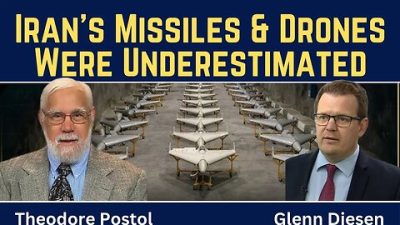
Theodore Postol: Iran’s Missiles & Drones Were Underestimated
or go to
Aletho News Archives – Video-Images
From the Archives
What is the Israeli Lobby in Australia Doing in Interfaith Dialogue?
By Ali Kazak | Dissident Voice | October 11, 2015
For years Israel and its lobby around the world have been trying to normalise their relations with Arabs and Muslims without solving the Palestine Question.
One of the methods they resorted to in the last few years is using human rights and community organizations such as interfaith dialogue and Multiculturalism to achieve this objective and to: isolate the Palestinians, marginalise the Palestine question, end Israel’s isolation, and prevent criticism of Israel, knowing that these organisations will be the first to stand against Israel’s violations, racial and religious discrimination.
The group responsible for this task in Australia is The Australia/Israel & Jewish Affairs Council (AIJAC); its Director of International & Community Affairs, Jeremy Jones is in charge of lobbying religious community organizations, specifically Muslims and Christians. Consequently he convened the Faith Communities for Reconciliation, founding participant in the Australian Partnership of Religious Organisations and the Australian National Dialogue of Christians, Muslims & Jews.
AIJAC is a private political propaganda group. It is recognised as the main Israeli lobby in Australia. It coordinates its activities and works intimately with the Israeli embassy in Canberra and different institutions in Israel. It is privately funded by some Jewish businessmen. It monitors closely Australian politicians, the media, ethnic and religious groups, (especially Arabs and Muslims), unions and academics on their stands towards Israel and the Palestine question. … continue
Blog Roll
 Aletho News
- The killing of three Indonesian soldiers in Lebanon should remind Jakarta that Israel does not want peace
- Defeated and delusional: Netanyahu’s remarks reveal $80bn war failure, says analyst
- Iran’s friends are about to make life much more difficult for Israel and the US
- The war of liberation of the Arab and Islamic peoples expands across the Gulf
- Envoy warns UN on Trump’s threat to ‘obliterate’ Iran’s civilian infrastructure
- The Larak Corridor: Iran’s Rial Gate With No US, No Israel, and No Way Around
- ‘Economic terrorism’: Steel facilities hit again in US-Israeli strike
- ‘War Crime’: Iran condemns attacks on Arak, Ardakan nuclear sites
- Two-thirds of Americans want quick end to Iran war even if goals unmet
- Trump to Give “Important Update on Iran” Wednesday in Prime-Time Speech
- If Americans Knew
- Israel wants US to bomb more of Iran’s civilian structures (113,000 is not enough) – Not a ceasefire Day 173
- Ann Coulter Rips Into Fox News for Iran War Coverage
- Joe Kent Urges Americans To Call White House and Congress To Object To Sending Troops Into Iran
- DNC Resolution to Reject AIPAC Funding Puts Democratic Leaders in the Hot Seat
- Swedish foundation to build 400 schools as over 650,000 Gaza children remain without education for 2 years
- Israeli army admits photshopping image of slain Lebanese journalist
- This is how Israel is systematically killing health workers under the cover of war in Lebanon
- Carrying life under fire: Israeli invasion of Lebanon leaves pregnant women facing deadly risks
- Champagne all around for the new death penalty (for Palestinians) law – Not a ceasefire Day 172
- Why are Palestinian books struggling to be seen on Amazon?
- No Tricks Zone
- New Study Finds Warming Saves Lives…Cold Temperatures 12 Times More Deadly Than Excess Heat
- German Science Blog Accuses PIK Climate Institute Of Hallucinating Climate Tipping Points
- Devastating Assessment Of Comirnaty Vaccine By Former Senior Pfizer Europe Toxicologist
- New Study: CO2 Is ‘Effectively Negligible’ As An Explanatory Climate Change Factor Since 2000
- Former Pfizer Toxicologist Dr. Helmut Sterz Tells Bundestag Hearing Pfizer Vaccine Should Have Never Been Approved
- Energy Expert: Germany’s Nuclear Phaseout Was A “500 Billion Euro Mistake”
- New Research: South Australia’s Mid-Holocene Sea Surface Temperatures Were 4°C Warmer Than Today
- Storing Green Energy To Last Germany 10 Days Would Require A 60-Million Tonne Battery
- New Studies: UK Sea Levels Were 4 Meters Higher Than Today During The Mid-Holocene
- Destructive Green New Deal: German Energy And Metal Group Warns Of Drastic Crisis
 Aletho News