First Minister says Scotland must seek independence amid UK decline
Al Mayadeen | October 13, 2025
Scottish First Minister John Swinney declared on Monday that “now is the time” for Scotland to become independent, arguing that Westminster’s decades of failed policies have led to national decline and stagnation.
Speaking at the Scottish National Party (SNP) annual conference, Swinney described independence as a “fresh start” for Scotland, offering hope and ambition in contrast to what he called “decline, decay, and despair” under the UK government.
“Independence offers Scotland a fresh start. This is a moment of decision. We all face a choice: decline, decay, and despair with a Westminster government or hope, optimism and ambition with a Scottish self-government,” Swinney said. “Now is the time for Scotland to become independent.”
10 Downing Street ‘working against Scotland’
The SNP leader accused the government in London of “working against Scotland,” pointing to high inflation, declining living standards, and long-term economic stagnation as “the culmination of decades of failed Thatcherite policies.”
Swinney also pledged to block any attempt by UK Prime Minister Keir Starmer to introduce a digital ID system in Scotland, adding that his government would redirect energy revenues to combat poverty and support social welfare programs.
The remarks come amid renewed debate over Scotland’s constitutional future. In June, Prime Minister Starmer reiterated that he would not permit another Scottish independence referendum during his premiership.
Scotland last voted on independence in 2014, when 55% of voters chose to remain in the United Kingdom. However, Swinney and the SNP argue that shifting political dynamics, economic challenges, and a desire for self-determination have made independence once again a central issue in Scottish politics.
No, Reuters, Climate Change is Not Threatening Europe’s Resources
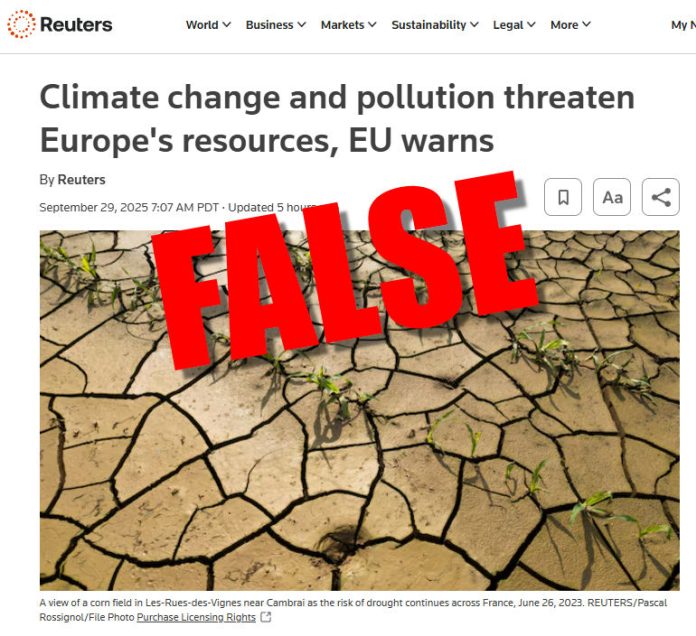
By Anthony Watts | ClimateRealism | October 2, 2025
In the article, “Climate change and pollution threaten Europe’s resources, EU warns,” Reuters asserts that climate change poses a “direct threat” to Europe’s natural resources, citing an EU environment agency report, and warns of worsening droughts and extreme weather. These claims are patently false. History shows far worse droughts in the past with no appreciable trend of other types of extreme weather events becoming more common or severe. Europe’s resource problems are caused by humans, stemming from overuse and poor management, just not from human-caused climate change.
The article declares that “Europe is the world’s fastest-warming continent and is experiencing worsening droughts and other extreme weather events.” It further states that more than 80 percent of protected habitats are in poor condition, blaming climate change and pollution.
“The window for meaningful action is narrowing, and the consequences of delay are becoming more tangible,” European Environment Agency executive director Leena Yla-Mononen told Reuters. “We are approaching tipping points – not only in ecosystems, but also in the social and economic systems that underpin our societies.”
The is political rhetoric couched in weak science.
The reality is far more mundane. The European Environment Agency’s own data show that water stress is primarily linked to intensive agriculture, industrial demand, and population growth. As the “Review of National Water Allocation Policies in Six European Countries” documents, many European countries continue to over-allocate water rights, creating artificial scarcity even in years with average rainfall. This is a governance problem, not a climate one. Similarly, biodiversity decline across Europe is overwhelmingly the result of land use change, habitat fragmentation, and invasive species—not a few tenths of a degree of warming over the last few decades.
When it comes to extreme weather, Reuters’ claims are directly contradicted by the Intergovernmental Panel on Climate Change (IPCC) AR6 report which notes there is little to no attribution of many types of severe weather to climate change. As Climate at a Glance: Extreme Weather summarizes, data do not support claims that extreme weather events are becoming more frequent or severe worldwide.
Further, Europe’s worst droughts occurred long before today’s modest warming. The megadrought of 1540 lasted an entire year, with contemporaneous records describing riverbeds across central Europe running dry, widespread crop failure, and thousands of deaths. More recent severe droughts struck in the 1920s and 1940s, periods that cannot be blamed on modern greenhouse gas emissions. The paper “The 1921 European drought: impacts, reconstruction and drivers” describes the 1921 European drought as “the most severe and most widespread drought in Europe since the start of the 20th century.
In “A drought climatology for Europe,” decadal trends show “greater pan-European drought incidence in the 1940s, early 1950s … and lesser drought incidence in the 1910s, 1930s” over the 20th century.
And there are many more worse droughts even further back in the past, before climate change even had a name, as this graph from the 2021 paper Recent European drought extremes beyond Common Era background variability shows:
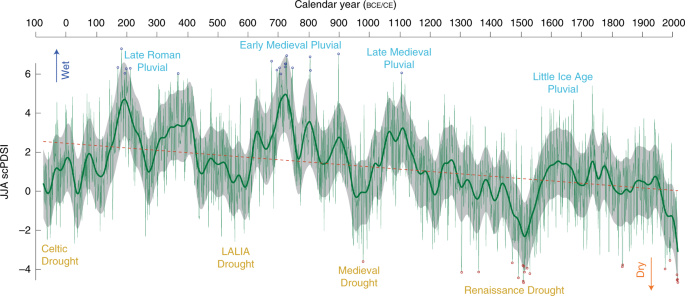
Compared to these historical drought episodes, recent intermittent summer dry spells are far from extraordinary.
Also, as detailed in multiple Climate Realism posts on the topics neither floods, here and here, for example, nor wildfires, here and here, are more frequent or severe now than they have been in the past.
Even heatwaves are neither more frequent nor deadly now than they have been historically, with deaths from temperatures declining.
Europe’s actual environmental challenges—such as nutrient pollution in rivers, overfishing, and urban sprawl—require pragmatic policy solutions, not grandiose climate pledges. By conflating resource depletion with climate change and exaggerating extreme weather risks, Reuters has misled its audience. The problems it describes are not new, not worsening because of climate change, and not solvable by CO₂ reductions. They are solvable by better governance, better planning, and better science. Once again, journalism has been sacrificed to climate alarmism.
Max Blumenthal: The Gaza peace deal that never was
The Grayzone | October 13, 2025
The Grayzone’s Max Blumenthal explains how the Biden administration refused to pressure Netanyahu into a ceasefire, leaving the perceived diplomatic win to Trump, who happens to be the most malleable vehicle for Israeli influence in US history. Max explains how Israel is already violating the ceasefire agreement while unleashing its extremist proxies in Gaza, and highlights extremely revealing statements Trump made during his Jerusalem speech in which he casually joked about Israel’s control over his own policies.
Iran, Russia, Azerbaijan reach major agreement on cargo transit
Press TV – October 13, 2025
Iran, Russia, and Azerbaijan have agreed to significantly increase the volume of cargo that passes through their territories from the Baltic Sea and the Barents Sea to the Persian Gulf.
Iran’s Minister of Road and Urban Development Farzaneh Sadegh said on Monday that Tehran, Moscow, and Baku had agreed to set a target of 15 million metric tons (mt) for annual cargo transit via their territories.
Sadegh made the remarks after a trilateral meeting in Baku, where he discussed transport, energy, and customs issues with Azerbaijan’s Deputy Prime Minister Shahin Mustafayev and Russian Deputy Prime Minister Alexey Overchuk.
Sadegh said the three countries had also agreed to streamline and modernize their customs operations to help increase the volume of cargo transit via their territories.
She said that Iran and Russia had accelerated works on the construction of a key railroad link in northern Iran that would significantly boost transit volumes via the International North–South Transport Corridor (INSTC).
Sadegh said that the Russian contractor of the Rasht-Astara railroad will be able to start work on the project after March 2026, when Iran finishes land purchases and other preparations for the construction of the 160-kilometer rail link.
Russia’s Overchuk also hailed the agreements reached during the trilateral meeting in Baku, saying that Iran, Russia, and Azerbaijan have been seeking to create a common commodity market with barrier-free logistics that could cover transit from the Barents and Baltic Seas to the Persian Gulf.
Overchuk told Russia’s Tass news agency that increased transit via the INSTC would lead to more economic welfare for the people of the three countries, adding that the project would entail major benefits for producers, exporters, and importers.
Canada’s Privacy Watchdog Not Consulted on Bill C-8, Enabling Secret Internet & Phone Shutdowns
By Dan Frieth | Reclaim The Net | October 13, 2025
Legislation that would allow federal ministers to secretly order telecom providers to cut off a Canadian’s phone or internet access is advancing without any input from the country’s top privacy authority.
Privacy Commissioner Philippe Dufresne told a Commons committee that his office was never asked to review Bill C-8 before it was introduced.
The bill would authorize the cabinet to compel telecom companies to block services to individuals considered a security threat, without needing a judge’s approval or any public disclosure.
“The issue never came up,” Dufresne said during testimony before the House of Commons ethics committee. He confirmed, “We are not consulted on specific pieces of legislation before they are tabled.”
Bill C-8 would allow the federal cabinet to direct a telecom provider to deny all services to a specific person, based solely on the government’s assessment of a threat. No warrant would be required. No independent body would be tasked with reviewing the decision.
Conservative MP Michael Barrett raised an alarm over what he described as a dangerous overreach. He said the bill would allow the government to quietly seize control of individuals’ communications, with no transparency and no legal checks.
“Without meaningful limits, bills like C-8 can hand the government secret powers over Canadians’ communications,” said Barrett. “It’s a serious setback for privacy and for democracy.”
He pressed Dufresne on whether Parliament should be required to conduct privacy assessments before passing legislation with such broad surveillance potential.
“Isn’t Parliament simply being asked to grant sweeping powers of surveillance to the government without a formal review?” Barrett asked.
Dufresne responded, “It’s not a legal obligation under the Privacy Act.”
While acknowledging the importance of national security, Dufresne warned that such measures must not override core privacy protections. “We need to make sure that by protecting national security, we are not doing so at the expense of privacy,” he said.
A previous version of the idea, Bill C-26, failed in an earlier Parliament after concerns over its civil liberties implications.
Obama faces backlash for ‘bothsides-ing’ Israel’s genocide in Gaza
The New Arab | October 10, 2025
Former US President Barack Obama has come under fire for comments about the Gaza ceasefire for equating victims and aggressors and erasing Palestinian suffering.
The remarks, which many saw as Obama framing Israel with empathy and stripping Palestinians of their humanity, came after the announcement of an agreement between Israel and Hamas.
“After two years of unimaginable loss and suffering for Israeli families and the people of Gaza, we should all be encouraged and relieved that an end to the conflict is within sight; that those hostages still being held will be reunited with their families; and that vital aid can start reaching those inside Gaza whose lives have been shattered,” Obama posted on X.
He added that it now fell on “Israelis and Palestinians, with the support of the US and the entire world community, to begin the hard task of rebuilding Gaza – and to commit to a process that, by recognizing the common humanity and basic rights of both peoples, can achieve a lasting peace”.
Media critic Sana Saeed described Obama’s phrasing as “a masterclass in seven words on how Palestinians are rendered faceless and nameless when slaughtered, while Israelis are granted empathy, especially when they are the butchers”.
Palestinian-American human rights lawyer Noura Erakat said: “The ‘people’ of Gaza are Palestinians. They have survived a genocide and an ongoing attempt to eliminate them for over a century.” Others said his use of the word “conflict” to describe Israel’s assault on Gaza distorted the nature of the violence.
“It’s a genocide,” wrote historian Assal Rad. “There is no accountability without acknowledging it, and there is no justice without accountability.”
Obama has not addressed the criticism. He had previously faced similar criticism for statements on Israel and Palestine.
In October 2023, he defended Israel’s “right to defend itself” while urging restraint, a position slammed as “bothsidesism” Israel’s bombardment of Gaza and ignored the decades-long occupation.
He also drew condemnation for an October 2024 post marking the anniversary of Hamas’s attack that mentioned Israeli victims but not the more than 41,000 Palestinians killed in Gaza at the time.
Israel’s military attacks on Gaza have killed more than 67,000 Palestinians, including thousands of children, while displacing nearly the entire population and destroying much of the enclave’s infrastructure.
On Thursday, Israel and Hamas signed the first phase of a ceasefire and hostage-exchange agreement, brokered by the United States, Egypt, Qatar, and Turkey.
The Netherlands nationalizes Сhinese-owned tech company
RT | October 13, 2025
The Dutch government has taken control of a Chinese-owned chipmaker based in the Netherlands, citing risk to the EU’s economic and technological security. The firm called the move “excessive,” saying it complied with all relevant laws and regulations.
The Netherlands Economy Ministry revealed late on Sunday that it had invoked a never-before-used emergency law to take control of manufacturer Nexperia, owned by China’s Wingtech Technology.
Once part of Dutch electronics group Philips, Nexperia specializes in the high-volume production of chips used in the automotive, consumer electronics, and other industries.
Amsterdam said it wanted to prevent a situation in which Nexperia’s chips could “become unavailable in an emergency” which “could pose a risk to Dutch and European economic security.”
The Dutch government called the move “highly exceptional,” citing “recent and acute signals of serious governance shortcomings and actions” within the company.
Wingtech shares tumbled 10% in Shanghai on Monday, forcing a halt in trading after hitting the daily limit.
The tech firm decried the Dutch government’s move as “excessive intervention driven by geopolitical bias, rather than a fact-based risk assessment,” according to a now-deleted WeChat post, which was archived by the Chinese policy blog Pekingnology. Wingtech said it would take actions to protect its rights and would seek government support.
The company later said in a filing to the Shanghai Stock Exchange that its control over Nexperia would be temporarily restricted due to the Dutch order and court rulings affecting decision-making and operational efficiency.
The Dutch takeover of Nexperia comes at a time of escalating global trade tensions. Over the past year, China and the EU have clashed over what the bloc claims is Beijing’s dumping of certain key goods and its industrial overproduction. China has accused the EU of protectionism.
Last week, China tightened its restrictions on the export of rare earth elements and magnets, a step that could further hurt the EU’s struggling auto industry.
Who is Larry Ellison? And how does he tie digital ID, Trump, Blair and genocide in Levant?
By David Miller | Al Mayadeen | October 13, 2025
Larry Ellison is a tech billionaire who is the world’s second richest man. He is behind the takeover of TikTok, the purchase of Paramount which ownsCBS News and is bidding to take over Warner Bros. which owns CNN.
He runs a firm called Oracle which was started with funds from the CIA. The CIA effectively made Ellison a Billionaire.
Today, Oracle is the cloud provider for the British Home Office, the Ministry of Defence and the Foreign Office, storing national security data, as well as the National Health Service. The NHS is of particular note since it holds an incredible amount of population data going back to its formation in 1948. No wonder Ellison is desperate to get his hands on it: “The NHS in the UK has an incredible amount of population data,” though, he noted, it remains too “fragmented.”
Ellison is the largest recorded donor to the Friends of the Israel Occupation Forces and previously, reportedly, offered Benjamin Netanyahu directorship of the firm. Its longtime CEO is “Israel” born Safra Catz, who has also donated millions to the Friends of the IOF either directly or via Oracle itself.
In late 2024, she told an Israeli business news outlet, “For employees, it’s clear: if you’re not for America or Israel, don’t work here, this is a free country.”
A year ago, Ellison described a future where everyone will face regular surveillance. He predicted artificial intelligence would help process the vast amounts of footage recorded by cameras placed on everything from car dashboards and front doors to security systems and the police.
Ellison is the man behind the latest push for digital ID cards in the UK and has said that citizens “will be on their best behaviour” once they are introduced. “We’re going to have supervision,” Ellison said. “If there’s a problem, AI will report that problem… we are constantly recording and reporting everything that’s going on.”
An anonymous US official told reporters TikTok’s algorithm will be “fully inspected and retrained” by Ellison’s consortium.
The purchase of TikTok is certainly about winning the propaganda battle for the Zionist genocide, but it’s also about surveillance, monitoring and control.
Oracle had already, in February, taken control of some of TikTok’s day-to-day operations, had taken a firm pro-“Israel” stance and reportedly, clamped down on pro-Palestine activism inside the company.
Collaborations between the company and Zionist regime agencies have been wide-ranging, from direct technology work with the military to software intended to help “Israel” with public relations, including, according to internal company messages, on social media platforms like TikTok. Catz, herself, notes that “We were the first company to build a data centre in Israel serving the region.”
Netanyahu has said, “We have to fight with the weapons that apply to the battlefields on which we are engaged. And the most important ones are on social media.” And the most important, he said, is “TikTok, number one. Number one.”
One of President Trump’s advisers described Ellison, earlier this year, as a literal “shadow president of the United States,” if not necessarily the shadow president.
Larry Ellison and Tony Blair
Two elements of the Trump peace plan, which are clearly linked, are on the one hand, a plan for governing Gaza after the putative “defeat” of Hamas and, on the other, a plan for manipulating the media and social media in order to defeat Hamas in the propaganda war.
These two elements of the strategy have clearly been co-ordinated closely with Netanyahu, who has more or less taken up residence in the US. But they have also been closely co-ordinated with a man referred to as the shadow president – the tech billionaire Larry Ellison – and with the former Prime Minister of the UK, Tony Blair.
Blair has recently emerged as “a potential Gaza interim consul and member of Donald Trump’s ‘board of peace.'”
Given that Ellison and Blair are both central to the Trump/Zionist plan, we might ask if they are also aware of each other? In fact, they are very closely intertwined.
According to Lighthouse Reports: Ellison invested $130 million in the Tony Blair Institute between 2021 and 2023, with a further $218 million pledged since then. The scale of funding took the TBI from a headcount of 200 to approaching 1,000. Blair himself takes no salary from TBI, but over this time, the institute has been able to recruit from bluechip firms like McKinsey and Silicon Valley giants Meta. In 2018, before the Oracle founder’s funding surge, TBI’s best-paid director earned $400,000. In 2023, the last year where accounts are available, the top earner took home $1.26 million.
Oracle has earned £1.1 billion in public sector revenue since the start of 2022, according to data collected by procurement analysts Tussell.
Here is Blair introducing Ellison in the UAE asking him about the use of data, including in Digital IDs. Note what he says about unifying data.
“The first thing a country needs to do is to unify all of their data so that it can be consumed and used by the AI model.”
Ellison and Blair are working together to open up huge data-mines for profit-making. The British NHS is a key prize since there are virtually no other population level data sources that go back so far. The NHS was created in 1948.
It’s obvious that the unification of data will enhance the ability of both Oracle and the Zionist entity to surveil and kill the Palestinians and to suppress all attempts to oppose genocide. This is how the control of TikTok and the Trump “board of peace” are connected.
Saleh al-Jafarawi, the Doghmush clan, and the illusion of ceasefire
By Mohammad Aaquib | MEMO | October 13, 2025
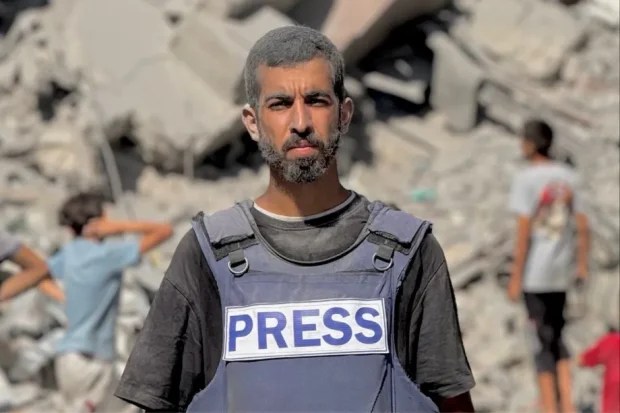
Saleh al-Jafarawi was abducted and executed by members of the Doghmush clan—an anti-Hamas faction within Gaza. He was not killed in battle, but in a context of internal militias acting under external influence.
This stark fact deserves to be front and center, because it exposes a quiet architecture of violence that functions even in moments when a ‘ceasefire’ supposedly holds. This is the occupation’s most insidious form, a war fought not through tanks or jets but through collaborators and chaos, ensuring that Gaza never truly rests. In this architecture of endless war, ceasefires are illusions, fragile pauses that conceal the unbroken machinery of control, where Israel’s hand remains unseen but ever present, orchestrating violence even in silence.
Netanyahu’s June 2025 admission confirms what many analysts have long suspected: Israel has been “activating” clans that oppose Hamas, arming or supporting them at least tacitly, leveraging internal divisions in Gaza. In multiple statements, he claimed that, acting “on the advice of security officials,” the Israeli government has enabled certain Palestinian clans to operate against Hamas. “What’s wrong with that? It’s only good. It saves the lives of IDF soldiers,” Netanyahu declared.
One of the prominent clans so enabled is the Abu Shabab clan, based in Rafah, which Israel admits to having activated. The “Popular Forces,” linked to them, have been accused by Palestinians and aid workers of criminal behavior, including looting incoming humanitarian aid convoys. These clans are local players with complicated histories: some held influence before Hamas’s takeover of Gaza in 2007; some engaged in smuggling or informal power networks; some have been marginalized under Hamas rule. What Netanyahu has done is to take these existing internal cleavages and weaponize them—using clan rivalries as a tool of proxy warfare.
Against this background, the abduction and killing of Saleh al-Jafarawi by Doghmush clan members is more than an individual tragedy. It’s a case study: how collaborators or clan-militias are used to silence voices loyal to the resistance, to undermine local governance, and to sow fear. Al-Jafarawi was known for his coverage of destruction, displacement, and civilian suffering—aligning him clearly with Hamas’s movement of resistance. That he was taken and killed by a clan opposed to Hamas points to targeted violence, not random crime. It shows how Israel’s support for these clans is more than just logistics or rhetoric; it makes them dangerous internal agents.
The idea of a ceasefire is deeply compromised in this model. Even when shelling or open military operations between Israel and Hamas pause, the war continues in shadow. Militia violence, kidnappings, assassinations: these are not paused by ceasefire agreements. The killing of al-Jafarawi during a period when hostilities at the border were reduced shows that ceasefire does not guarantee safety. It merely shifts some forms of warfare from open battlefields to intra-Palestinian rivalries and clandestine operations. This makes peace an illusion for many civilians, who cannot distinguish between external assaults and internal betrayals.
This is not a failure of policy but its intended outcome. Israel has long understood that total military victory in Gaza is unattainable; they have seen countless defeats. What is attainable is permanent incoherence. The tactic amounts to a form of entropic warfare: the deliberate creation of chaos to prevent reorganization. Rather than occupying territory directly, Israel governs through collapse. The breakdown of social cohesion performs the same function as a garrison. When Palestinians no longer trust their own institutions or each other, Israel’s strategic goals are met without the need for visible control. The killing of Saleh Al-Jaafrawi illustrates this invisible war.
Moreover, this use of clan proxies weakens governance in Gaza in fundamental ways. Hamas enjoys a degree of popular legitimacy: it won the 2006 elections, and many Gazans still see it as a symbol of resistance against occupation and as the de facto government providing social services amid blockade and war. When opposing clans act—and are backed or enabled by Israel—they do not just challenge Hamas militarily; they undermine its ability to govern. They create parallel sources of power, insecurity, and unpredictability. For citizens that means nobody is fully safe, nobody is fully accountable, and public institutions become weaker because they must not only fend off external pressure but internal sabotage.
This strategy reflects patterns seen elsewhere: in Lebanon, for example, Israel has historically supported militias and local factions hostile to dominant groups such as Hezbollah in order to fragment power, reduce unified resistance, and create zones of distrust. These tactics often lead to long-term instability, cycles of violence, social fragmentation, and a human cost that lingers long after any overt war is over.
What emerges is a pattern: Israel’s strategy is not limited to confronting Hamas militarily; it includes enabling internal enemies of Hamas to degrade support for it, destabilize its governance, terrorize its supporters, and silence its voices. Al-Jafarawi’s killing becomes emblematic. He was not killed at the border, not during an Israeli airstrike, but through internal betrayal—abducted and executed by anti-Hamas actors. This highlights a grim truth: even with ceasefires, peace is not restored unless the structures that enable proxy violence and mobilize collaborators are dismantled.
This form of warfare carries the advantage of plausible deniability. When Palestinians fight among themselves, Israel can posture as a bystander, lamenting “internal chaos” while benefiting strategically from it. The spectacle of disorder reinforces the narrative that Palestinians are incapable of self-rule, thereby justifying continued external control.
The clans that turn against their own people under the lure of Israeli support are not merely opportunistic criminals; they are instruments of a much darker political project. By accepting money, arms, or protection from the occupation, they become extensions of a state built on apartheid and domination. Their betrayal corrodes the moral fabric of Palestinian society from within, achieving what bombardments and blockades alone cannot: the dismantling of solidarity, the erosion of trust, and the quiet assassination of resistance.
The defeat of Israel and the rebirth of Palestinian agency
By Ramzy Baroud | MEMO | October 13, 2025
For decades, the prevailing notion was that the ‘solution’ to the Israeli occupation of Palestine lay in a strictly negotiated process. “Only dialogue can achieve peace” has been the relentlessly peddled mantra in political circles, academic platforms, media forums, and the like.
A colossal industry burgeoned around that idea, expanding dramatically in the lead-up to, and for years after, the signing of the Oslo Accords between Yasser Arafat’s Palestine Liberation Organization (PLO) and the Israeli government.
The unmaking of ‘peace’
The problem was never with the fundamental principle of ‘dialogue,’ ‘peace,’ nor even with that of ‘painful compromises‘ — a notion tirelessly circulated during the ‘peace process’ period between 1993 and the early 2000s.
Instead, the conflict has largely been shaped by how these terms, and an entire scaffolding of similar terminology, were defined and implemented. ‘Peace’ for Israel and the US necessitated a subservient Palestinian leadership, ready to negotiate and operate within confined parameters, and entirely outside the binding parameters of international law.
Similarly, ‘dialogue’ was only permissible if the Palestinian leadership consented to renounce ‘terrorism’ — read: armed resistance — disarm, recognise Israel’s purported right to exist as a Jewish state, and adhere to the prescribed language dictated by Israel and the US.
In fact, only after officially renouncing ‘terrorism’ and accepting a restricted interpretation of specific UN resolutions on the Israeli occupation of the West Bank and Gaza did Washington agree to ‘dialogue’ with Arafat. Such low-level conversations took place in Tunisia and involved a junior US official — Robert Pelletreau, Assistant Secretary of State for Near Eastern Affairs.
Not once did Israel consent to ‘dialogue’ with Palestinians without a stringent set of preconditions, driving Arafat to a unilateral series of concessions at the expense of his people. Ultimately, Oslo yielded nothing of intrinsic value for Palestinians, apart from Israel’s mere recognition, not of Palestine or the Palestinian people, but of the Palestinian Authority (PA), which, over time, became a conduit for corruption. The PA’s continued existence is inextricably linked to that of the Israeli occupation itself.
Israel, conversely, operated unchecked, conducting raids on Palestinian towns, executing massacres at will, enforcing a debilitating siege on Gaza, assassinating activists, and imprisoning Palestinians en masse, including women and children. In fact, the post-‘dialogue,’ ‘peace,’ and ‘painful compromises’ era witnessed the largest expansion and effective annexation of Palestinian land since the 1967 Israeli occupation of East Jerusalem, the West Bank, and Gaza.
Gaza as the anomaly
During this period, there was a widespread consensus that violence, meaning only Palestinian armed resistance in response to unconstrained Israeli violence, was intolerable. The PA’s Mahmoud Abbas dismissed it in 2008 as ‘useless,’ and subsequently, in coordination with the Israeli military, devoted much of the PA’s security apparatus to suppress any form of resistance to Israel, armed or otherwise.
Though Jenin, Tulkarm, Nablus, and other regions and refugee camps in the West Bank continued to forge spaces, however constrained, for armed resistance, the concerted efforts of Israel and the PA often crushed or at least substantially reduced these moments.
Gaza, however, consistently stood as the anomaly. The Strip’s armed uprisings have persisted since the early 1950s, with the emergence of the fedayeen movement, followed by a succession of socialist and Islamic resistance groups. The place has always remained unmanageable — by Israel, and later by the PA. When Abbas loyalists were defeated following brief but tragic violent clashes between Fatah and Hamas in Gaza in 2007, the small territory became an undisputed center of armed resistance.
This event occurred two years after the Israeli army’s redeployment out of Palestinian population centers in the Strip (2005), into the so-called military buffer zones, established on areas that were historically part of Gaza’s territory. It was the start of today’s hermetic siege on Gaza.
In 2006, Hamas secured a majority of seats in the Palestinian Legislative Council, an unexpected turn of events that infuriated Washington, Tel Aviv, Ramallah, and other Western and Arab allies.
The fear was that without Israel’s PA allies maintaining control over the resistance inside Gaza and the West Bank, the occupied territories would inevitably result in a widespread anti-occupation revolt.
Consequently, Israel intensified its suffocating siege on the Strip, which refused to capitulate despite the horrific humanitarian crisis resulting from the blockade. Thus, starting in 2008, Israel adopted a new strategy: treating the Gaza resistance as an actual military force, thereby launching major wars that resulted in the killing and wounding of tens of thousands of people, predominantly civilians.
These major conflicts included the war of December 2008-January 2009, November 2012, July-August 2014, May 2021, and the latest genocidal war commencing in October 2023.
Despite the immense destruction and the relentless siege, let alone external international and Arab pressures and isolation, the Strip somehow endured and even regenerated itself. Destroyed residences were rebuilt from the salvaged rubble, and resistance weaponry was also replenished, often utilizing unexploded Israeli munitions.
The 7 October rupture
The 7 October Hamas operation, known as Al-Aqsa Flood, constituted a significant break from the established pattern that had endured for years.
For Palestinians, it represented the ultimate evolution of their armed struggle, a culmination of a process that commenced in the early 1950s and involved diverse groups and political ideologies. It served as a stark notification to Israel that the rules of engagement have irrevocably shifted, and that the besieged Palestinians refuse to submit to their supposed historical role of perpetual victimhood.
For Israel, the event was earth-shattering. It exposed the country’s vaunted military and intelligence as deeply flawed, and revealed that the country’s leadership assessment of Palestinian capabilities was fundamentally erroneous.
This failure followed the brief surge of confidence during the normalisation campaign initiated by the US and Israel with pliable Arab and Muslim countries during Trump’s first term in office. At that time, it appeared as though the Palestinians and their cause had been rendered irrelevant in the broader Middle Eastern political landscape. Between a co-opted Palestinian leadership in the West Bank and besieged resistance movements in Gaza, Palestine was no longer a decisive factor in Israel’s pursuit of regional hegemony.
The centerpiece of Israeli Prime Minister Benjamin Netanyahu’s strategy, and his aspiration to conclude his long political career with the ultimate regional triumph, was suddenly obliterated. Enraged, disoriented, but also determined to restore all of Israel’s advantages since Oslo, Netanyahu embarked on a campaign of mass killing that, over the course of two years, culminated in one of the worst genocides in human history.
His methodical extermination of the Palestinians and overt desire to ethnically cleanse the survivors out of Gaza laid bare Israel and its Zionist ideology for their inherently violent character, thus allowing the world, especially Western societies, to fully perceive Israel for what it truly is, and what it has always been.
Resistance, resilience, and defeat
But the genuine fear that unified Israel, the US, and several Arab countries is the terrifying prospect that resistance, particularly armed resistance, could re-emerge in Palestine, and by extension across the Middle East, as a viable force capable of threatening all autocratic and undemocratic regimes. This fear was dramatically amplified by the ascent of other non-state actors, such as Hezbollah in Lebanon and Ansarallah in Yemen, who collectively with the Gaza resistance managed to forge a formidable alliance that required direct US involvement in the conflict.
Even then, Israel failed to achieve any of its strategic objectives in Gaza, owing to the legendary resilience of the Palestinian people, but also the prowess of the resistance that managed to destroy over 2,000 Israeli military vehicles, including hundreds of the pride and joy of the Israeli military industry, the Merkava tank.
No Arab army has managed to exact this scale of military, political, and economic cost from Israel throughout the country’s violent existence of nearly eight decades. Though Israel and the US — and others, including some Arab countries and the PA — continue to demand the disarming of the resistance, such a demand is rationally nearly unattainable. Israel has dropped over 200,000 tons of explosives over Gaza over the course of two years to achieve that singular objective, and failed. There is no plausible reason to believe that it can achieve such a goal through political and economic pressures alone.
Not only did Israel fail in Gaza, or, more accurately in the words of many Israeli historians and retired army generals, was decisively defeated in Gaza, but Palestinians have managed to reassert Palestinian agency, including the legitimacy of all forms of resistance, as a winning strategy against Israeli colonialism and US-Western imperialism in the region. This explains the profound fear shared by all parties that Israel’s defeat in Gaza could fundamentally alter the entire regional power dynamics.
Though the US and its Western and Arab allies will persist in negotiating in an attempt to resurrect the almost 90-year-old Palestinian leader Abbas and his Oslo paradigm as the only viable alternatives for Palestinians, the medium and long-term consequences of the war are likely to present a starkly different reality, one where Oslo and its corrupted figures are definitively relegated to the past.
Finally, if we are to speak of a Palestinian victory in Gaza, it is a resounding triumph for the Palestinian people, their indomitable spirit, and their deeply rooted resistance that transcends faction, ideology, and politics.
All of this considered, it must also be clearly stated that the current ceasefire in Gaza cannot be misconstrued as a ‘peace plan’; it is a mere pause from the genocide, as there will certainly be a subsequent round of conflict, the nature of which depends heavily on what unfolds in the West Bank, indeed the entire region, in the coming months and years.
Moscow comments on Assad poisoning rumors
RT | October 13, 2025
Russian Foreign Minister Sergey Lavrov has rejected rumors that former Syrian Bashar Assad has been poisoned, saying that Assad and his family are safe in Moscow and have been living there without any problems since being granted asylum.
Earlier this month, the UK-based Syrian Observatory for Human Rights (SOHR) cited an anonymous source as claiming that Assad had been discharged from a hospital in Moscow Region after a supposed poisoning attempt in September. The rumor has since been widely circulated by both Western and Russian media outlets.
SOHR consists of a single individual – Rami Abdulrahman – who runs the organization from his home in Coventry, England, which also functions as a clothing shop. SOHR’s reports on the war in Syria have been cited by Western governments and media, although it has consistently faced accusations of anti-Assad bias and sympathy toward armed opposition groups.
Lavrov stressed that Assad “has no problem living in our capital” and that “no poisonings have occurred.” “If such rumors appear, I leave them to the conscience of those who spread them,” he said.
The minister added that Russia had provided asylum to Assad and his family “for purely humanitarian reasons,” noting that they had faced threats of physical harm after last year’s change of power in Damascus.
Lavrov drew parallels with the 2011 conflict in Libya, recalling Muammar Gaddafi’s public killing which was widely broadcast on television – an event that the Russian foreign minister said “delighted Hillary Clinton, who watched his physical annihilation live and clapped her hands.”
Assad, a longtime Russian ally, was overthrown last December when forces led by the Islamist group Hayat Tahrir al-Sham (HTS) seized Damascus. The situation in Syria has remained unstable since, with clashes between Islamist factions and government units under the new leadership.
Russia has maintained its military presence at the Khmeimim Airbase and Tartus naval facility, and says it plans to repurpose them for humanitarian operations in coordination with the Syrian authorities.
Ceasefire or charade: As Hamas frees Israeli captives, Netanyahu unlikely to uphold the deal
By David Miller | Press TV | October 13, 2025
The overused Clausewitz axiom tells us that ‘war is the continuation of politics by other means’.
What is often less well understood – especially when dealing with the Zionists – is that diplomacy is merely the continuation of war by other means. And so it is with the latest ‘ceasefire’ agreement achieved by the Palestinian resistance in the field of diplomatic warfare against the Zionist enemy.
First phase terms
The first (and perhaps only) phase of the agreement requires a cessation of hostilities during which the Hamas resistance movement will release all living captives, as well as the corpses of those eliminated (48 living and dead in total), in return for two thousand Palestinian living martyrs who will be rescued from the Zionist torture dungeons.
At the time of writing this, Hamas has handed over seven captives to the International Red Cross Committee (ICRC) in Gaza and is expected to release 13 more, while awaiting the release of 2,000 Palestinians held in Israeli prisons under the terms of the deal.
But more detailed negotiations will have to follow, since at least two thousand more Palestinians kidnapped by the Zionist occupation may remain in captivity after this ceasefire.
The agreement also requires that the Zionists withdraw from 47 per cent of Gaza’s territory, although Palestinian resistance officials are doubtful that this condition will be met.
No one is under any illusion that the Zionists will cease fire. Just the other day, I saw smoke rising from the ashes of Gaza City and Khan Younis as the Zionists terrorised Palestinian families from the sky, likely using Boeing’s Apache AH-64 attack helicopters as they so often do.
That’s the same Boeing that was recently gifted $96bn by Qatar Airways; $14.5bn by Abu Dhabi’s Etihad, and $37bn by Saudi Arabia’s Public Investment Fund on behalf of Riyadh Air.
Donald Trump has just touted an in-person signing of the agreement, while the four Jewish extremists who are materially in charge of the agreement’s details for the Zionists – Steve Witkoff, Jared Kushner, Benjamin Netanyahu and his chief adviser Ron Dermer – gave the treaty, and the genocide which has preceded it, fulsome blessings during a cabinet meeting in Tel Aviv.
The presence of Witkoff and Kushner at a Zionist cabinet meeting in Occupied al-Quds leaves no room for metaphor. Little wonder that Americans today are coming to the belated understanding that their Empire has been run by and for Jewish supremacist interests for several decades.
A win for Palestinian resistance
Despite all this fanfare, the war will continue, and possibly even expand, since Netanyahu will not be able to face domestic political rivals and internal pressure in the Zionist entity after such a comprehensive diplomatic defeat, based on the terms agreed by the victorious Palestinian resistance in Cairo under Qatari mediation, and Egyptian and Turkish coercion.
Turkish and Egyptian representatives have repeatedly pushed the Palestinian resistance to capitulate, disarm and end their struggle against Zionist colonization since the UN General Assembly summit last month, during which the Trump regime strongarmed Muslim-majority states into committing to Zionisation in their own states.
The agreement is, as some Palestinians in Gaza have said, the result of “Palestinian struggle and steadfastness” surviving two years of genocide against all the odds, under the bombs and complicity of the whole world. The freedom of the living martyrs is their achievement above all, though it is likely the Zionists will immediately target released Palestinian prisoners for assassination.
The agreement is also a major success for the Qatari strategy as lead mediator, which has delicately balanced the genocidal demands of the Zionist entity and its organ-grinder in the White House on the one hand, and on the other, the urgent need to both tamp down the indescribable suffering faced by the Palestinian people and to release thousands of Palestinians held in Zionist torture dungeons.
The Palestinian resistance has always placed the release of Palestinian hostages in return for the captured Zionist invaders at the top of the agenda, and predicated all other conditions on this and the end, which appears to translate into Hebrew as a mere slowdown of the genocide.
The wheels are at least turning to achieve one of these conditions.
Resistance on the same page
It has also always been crucial to the Palestinian resistance to ensure that those hostages released from Zionist captivity are from a broad range of Palestinian social movements, without the exclusion of any faction or individual.
Hamas is negotiating on behalf of Palestine itself because it represents Palestine – electorally, militarily, diplomatically and in terms of its social composition. But it is not alone on the Palestinian side of the table.
Its delegates have been joined in this round of negotiations by representatives from other Resistance factions, including the Palestinian Islamic Jihad (PIJ), whose Saraya al-Quds fighters have been vital to the Palestinian war effort for two years, and the Popular Front for the Liberation of Palestine (PFLP), whose Abu Ali Mustafa Brigades have also played a role in confronting Zionist fire.
Abu Ali Mustafa’s successor as Secretary General of the PFLP, Ahmad Sa’daat, also known as Abu Ghassan, is one of the high-profile Palestinians whose release the resistance is demanding.
He is credited by the Zionists with avenging the martyrdom of Abu Ali Mustafa by overseeing the elimination of the bloodthirsty Zionist and advocate of Palestinian ethnic cleansing, then Zionist ‘tourism minister’ Rehavam Ze’evi, who founded the Moledet Party, in a storied operation in 2001 in Occupied al-Quds.
Another of the renowned Palestinian hostages held in the Zionist torture dungeons is Ibrahim Hamed, a Hamas military commander from the occupied West Bank who has overseen many significant Qassam Brigade operations to liberate the occupied Palestinian territories.
The Zionists credit him with eliminating 96 regime agents and wounding 400 more during the Second Intifada. In typical style, Zionist military agencies have been kvetching that Hamed cannot be released as part of this deal because he is ‘the next Yahya Sinwar’.
So naturally, ‘senior sources’ believed to be in Shin Bet wasted no time briefing favoured Zionist propagandist Nadav Eyal that Hamed is actually ‘two or even three Yahya Sinwars’.
No doubt that in short order, he will be blamed for eighty-eight 9/11s, and we will be told he is worth $6bn, accompanied by grainy footage of a Turkish leather handbag said to be made by Hermès.
One high-profile prisoner the Zionists have already refused to release – and who senior Hamas official Musa Abu Marzouq says his party insists on freeing through this deal – is the Fateh icon Marwan al-Barghouti, who has spent three decades incarcerated at the hands of the Zionists, and who has been widely touted as a potentially unifying presidential candidate across Palestine.
Sticking points
The Zionists’ refusal to release Barghouti, Hamed and Sa’daat serves as an early indicator of how difficult it will be to achieve the first phase of the agreement, which is the only phase that suits the resistance to commit to. The following phases of the proposed ‘Trump peace plan’ are too outrageous and insulting to even consider, and amount to a full and eternal Zionisation of Palestine (and, as a result, the rest of the world) under a Pax Judaica.
The Zionist supremacists have overstated their leverage over the Palestinian resistance if they think they can demand capitulation and disarmament the way they have in Lebanon. But they are already working deep inside Gaza to Zionise Palestinians without the consent of the resistance.
Take the example of Dr. David Hasan, a North Carolina neurosurgeon who seeks to target 20,000 hungry Palestinian orphans for brainwashing with aid in one hand and an ‘Israel-friendly curriculum’ in the other with his morbid ‘Gaza Children’s Village’ scheme.
The resistance is currently occupied with rooting out the Yasser Abu Shabab’s Daesh-linked gangs used by the Zionist regime as a subcontractor for rape, torture and executions inside Gaza during the genocide, but in time it will also doubtlessly address such Zionisation programmes and their coordinators with equal vigour.
This will cause friction while the Chabad extremist Kushner, who is personally obsessed with Zionising West Asia and bringing about a hegemonic Jewish Empire, remains by Donald Trump’s side.
There is also the most obvious route Netanyahu is likely to take to frustrate any progress: taking back the Zionist colonists held as prisoners of war by the resistance and then continuing the war in Gaza City instead of withdrawing.
Netanyahu is closer than ever, and closer than any other figure in history, to bringing about a Pax Judaica – a complete transfer of global hegemony from the US to the Zionist entity.
In the unlikely eventuality that the Muslim-majority states refuse to Zionise as part of this Kushner-brokered ‘peace plan’, he and Netanyahu (who he has known as a father figure since his childhood) will simply forge ahead to bring about Zionisation at the end of a gun.
David Miller is the producer and co-host of the Press TV show Palestine Declassified. He was sacked from Bristol University in October 2021 over his Palestine advocacy.
Featured Video

No Threat Can Force Iran’s Surrender /Trita Parsi & Lt Cl Daniel Davis
or go to
Aletho News Archives – Video-Images
From the Archives
An Expert Military Analysis of War with China
Actually, None is Necessary
By Fred Reed • Unz Review • December 13, 2020
The Correlation of Armed Forces: U.S. goods and services trade with China totaled an estimated $634.8 billion in 2019. Exports were $163.0 billion; imports were $471.8 billion. The U.S. goods and services trade deficit with China was $308.8 billion in 2019. Trade in services with China (exports and imports) totaled an estimated $76.7 billion in 2019. Services exports were $56.5 billion; services imports were $20.1 billion. The U.S. services trade surplus with China was $36.4 billion in 2019.
There is talk within the Washingtoniat of a possible war with China. Steve Bannon, who apparently was dropped on his head as a child, actually favors such a war. We hear the usual shoo-the-boobs alarm about how the Chinese are doing something terrible and we must gird our loins and American values and show them what for, bow wow, woof. The danger is that the current game of who-blinks-first in Asian waters might actually provoke a shooting war. You know the kind of thing: One warship refuses to get out of the way of another, a collision ensues, some retard lieutenant who signed up on waivers opens fire, and we’re off and running. It is not a good idea to let children play with matches.
The said war is discussed either in emotional terms by idiots or in purely naval terms by those familiar with such things, so we hear of the First Island Chain and the Second Island Chain and whose missiles against the other’s missiles and so on. This would be appropriate if we were fighting World War Two again. Which we aren’t. Let’s take a quick-and-dirty look at how such a war might go.
To begin the war, America would overestimate itself and underestimate China. This is doctrine in the Pentagon. … continue
Blog Roll
 Aletho News
- Iran To Target Military Industrial-Tech Complex That Facilitated Gaza Genocide
- Collapsing Empire: The Resistance Disarms ‘Israel’
- Suicide Should Not Be a Government Service
- Rethinking America’s greatest threat: Iran vs. Israel-Firsters
- Iran accuses adversaries of false flags to strain Turkey ties
- Poland rules out sending Patriot missiles to US/Israel amid war on Iran
- Tehran approves new Hormuz plan with major restrictions
- No Threat Can Force Iran’s Surrender /Trita Parsi & Lt Cl Daniel Davis
- UK’s New Pandemic Plan Would Turn Big Tech Into a Mass Location Tracking Network
- Growing insecurity, soaring prices fuel protests in north as regime bans evacuation: Sources
- If Americans Knew
- Joe Kent Urges Americans To Call White House and Congress To Object To Sending Troops Into Iran
- DNC Resolution to Reject AIPAC Funding Puts Democratic Leaders in the Hot Seat
- Swedish foundation to build 400 schools as over 650,000 Gaza children remain without education for 2 years
- Israeli army admits photshopping image of slain Lebanese journalist
- This is how Israel is systematically killing health workers under the cover of war in Lebanon
- Carrying life under fire: Israeli invasion of Lebanon leaves pregnant women facing deadly risks
- Champagne all around for the new death penalty (for Palestinians) law – Not a ceasefire Day 172
- Why are Palestinian books struggling to be seen on Amazon?
- The Line Between Affinity and Conspiracy
- As Iran targets US military bases, will they be relocated to Israel? Not a ceasefire Day 171
- No Tricks Zone
- New Study Finds Warming Saves Lives…Cold Temperatures 12 Times More Deadly Than Excess Heat
- German Science Blog Accuses PIK Climate Institute Of Hallucinating Climate Tipping Points
- Devastating Assessment Of Comirnaty Vaccine By Former Senior Pfizer Europe Toxicologist
- New Study: CO2 Is ‘Effectively Negligible’ As An Explanatory Climate Change Factor Since 2000
- Former Pfizer Toxicologist Dr. Helmut Sterz Tells Bundestag Hearing Pfizer Vaccine Should Have Never Been Approved
- Energy Expert: Germany’s Nuclear Phaseout Was A “500 Billion Euro Mistake”
- New Research: South Australia’s Mid-Holocene Sea Surface Temperatures Were 4°C Warmer Than Today
- Storing Green Energy To Last Germany 10 Days Would Require A 60-Million Tonne Battery
- New Studies: UK Sea Levels Were 4 Meters Higher Than Today During The Mid-Holocene
- Destructive Green New Deal: German Energy And Metal Group Warns Of Drastic Crisis
 Aletho News